EPISODES (continued 4)
Reading edition
In conclusion, let me inform you that the spring has been turned to good account by my generous host, Colonel Rees, who, aided by my amiable companion, the engineer, has directed its current so as to turn a mill, which suffices to grind the whole of his sugar-cane.
DEATH OF A PIRATE
In the calm of a fine moonlight night, as I was admiring the beauty of the clear heavens, and the broad glare of light that glanced from the trembling surface of the waters around, the officer on watch came up and entered into conversation with me. He had been a turtler in other years, and a great hunter to boot, and although of humble birth and pretensions, energy and talent, aided by education, had raised him to a higher station. Such a man could not fail to be an agreeable companion, and we talked on various subjects, principally, you may be sure, birds and other natural productions. He told me he once had a disagreeable adventure, when looking out for game, in a certain cove on the shores of the Gulf of Mexico; and, on my expressing a desire to hear it, he willingly related to me the following particulars, which I give you, not, perhaps, precisely in his own words, but as nearly so as I can remember.
"Towards evening, one quiet summer day, I chanced to be paddling along a sandy shore, which I thought well fitted for my repose, being covered with tall grass, and as the sun was not many degrees above the horizon, I felt anxious to pitch my mosquito bar or net, and spend the night in this wilderness. The bellowing notes of thousands of bull-frogs in a neighboring swamp might lull me to rest, and I looked upon the flocks of Blackbirds that were assembling as sure companions in this secluded retreat.
"I proceeded up a little stream, to insure the safety of my canoe from any sudden storm, when, as I gladly advanced, a beautiful yawl came unexpectedly in view. Surprised at such a sight in a part of the country then scarcely known, I felt a sudden check in the circulation of my blood. My paddle dropped from my hands, and fearfully indeed, as I picked it up, did I look towards the unknown boat. On reaching it, I saw its sides marked with stains of blood, and looking with anxiety over the gunwale, I perceived, to my horror, two human bodies covered with gore. Pirates or hostile Indians, I was persuaded, had perpetrated the foul deed, and my alarm naturally increased; my heart fluttered, stopped, and heaved with unusual tremors, and I looked towards the setting sun in consternation and despair. How long my reveries lasted I cannot tell; I can only recollect that I was roused from them by the distant groans of one apparently in mortal agony. I felt as if refreshed by the cold perspiration that oozed from every pore, and I reflected that though alone, I was well armed, and might hope for the protection of the Almighty.
"Humanity whispered to me that, if not surprised and disabled, I might render assistance to some sufferer, or even be the means of saving a useful life. Buoyed up by this thought, I urged my canoe on shore, and seizing it by the bow, pulled it at one spring high among the grass.
"The groans of the unfortunate person fell heavy on my ear as I cocked and reprimed my gun, and I felt determined to shoot the first that should rise from the grass. As I cautiously proceeded, a hand was raised over the weeds, and waved in the air in the most supplicating manner. I levelled my gun about a foot below it, when the next moment the head and breast of a man covered with blood were convulsively raised, and a faint hoarse voice asked me for mercy and help! A deathlike silence followed his fall to the ground. I surveyed every object around with eyes intent, and ears impressible by the slightest sound, for my situation that moment I thought as critical as any I had ever been in. The croaking of the frogs, and the last Blackbirds alighting on their roosts, were the only sounds or sights; and I now proceeded towards the object of my mingled alarm and commiseration.
"Alas! the poor being who lay prostrate at my feet was so weakened by loss of blood that I had nothing to fear from him. My first impulse was to run back to the water, and having done so, I returned with my cap filled to the brim. I felt at his heart, washed his face and breast, and rubbed his temples with the contents of a phial which I kept about me as an antidote for the bites of snakes. His features, seamed by the ravages of time, looked frightful and disgusting; but he had been a powerful man, as the breadth of his chest plainly showed. He groaned in the most appalling manner, as his breath struggled through the mass of blood that seemed to fill his throat. His dress plainly disclosed his occupation. A large pistol he had thrust into his bosom, a naked cutlass lay near him on the ground, a red silk handkerchief was bound over his projecting brows, and over a pair of loose trousers he wore fisherman's boots. He was, in short, a pirate.
"My exertions were not in vain, for as I continued to bathe his temples he revived, his pulse resumed some strength, and I began to hope that he might perhaps survive the deep wounds he had received. Darkness, deep darkness, now enveloped us. I spoke of making a fire. 'Oh! for mercy's sake,' he exclaimed, 'don't.' Knowing, however, that under existing circumstances it was expedient for me to do so, I left him, went to his boat, and brought the rudder, the benches, and the oars, which with my hatchet I soon splintered. I then struck a light, and presently stood in the glare of a blazing fire. The pirate seemed struggling between terror and gratitude for my assistance; he desired me several times in half English and Spanish to put out the flames; but after I had given him a draught of strong spirits, he at length became more composed. I tried to stanch the blood that flowed from the deep gashes in his shoulders and side. I expressed my regret that I had no food about me, but when I spoke of eating he sullenly waved his head.
"My situation was one of the most extraordinary that I have ever been placed in. I naturally turned my talk towards religious subjects, but, alas, the dying man hardly believed in the existence of a God. 'Friend,' said he, 'for friend you seem to be, I have never studied the ways of Him of whom you talk. I am an outlaw, perhaps you will say a wretch—I have been for many years a pirate. The instructions of my parents were of no avail to me, for I have always believed that I was born to be a most cruel man. I now lie here, about to die in the weeds, because I long ago refused to listen to their many admonitions. Do not shudder when I tell you—these now useless hands murdered the mother whom they had embraced. I feel that I have deserved the pangs of the wretched death that hovers over me; and I am thankful that one of my kind will alone witness my last gaspings.'
"A fond but feeble hope that I might save his life, and perhaps assist in procuring his pardon, induced me to speak to him on the subject. 'It is all in vain, friend—I have no objection to die—I am glad that the villains who wounded me were not my conquerors—I want no pardon from any one. Give me some water, and let me die alone.' With the hope that I might learn from his conversation something that might lead to the capture of his guilty associates, I returned from the creek with another capful of water, nearly the whole of which I managed to introduce into his parched mouth, and begged him, for the sake of his future peace, to disclose his history to me. 'It is impossible,' said he; 'there will not be time, the beatings of my heart tell me so. Long before day these sinewy limbs will be motionless. Nay, there will hardly be a drop of blood in my body; and that blood will only serve to make the grass grow. My wounds are mortal, and I must and will die without what you call confession.'
"The moon rose in the east. The majesty of her placid beauty impressed me with reverence. I pointed towards her, and asked the pirate if he could not recognize God's features there. 'Friend, I see what you are driving at,' was his answer; 'you, like the rest of our enemies, feel the desire of murdering us all. Well—be it so. To die is, after all, nothing more than a jest; and were it not for the pain, no one, in my opinion, need care a jot about it. But, as you really have befriended me, I will tell you all that is proper.'
"Hoping his mind might take a useful turn, I again bathed his temples, and washed his lips with spirits. His sunk eyes seemed to dart fire at mine; a heavy and deep sigh swelled his chest, and struggled through his blood-choked throat, and he asked me to raise him for a little. I did so, when he addressed me somewhat as follows; for, as I have told you, his speech was a mixture of Spanish, French, and English, forming a jargon the like of which I had never heard before, and which I am utterly unable to imitate. However, I shall give you the substance of his declaration.
"'First, tell me how many bodies you found in the boat, and what sort of dresses they had on.' I mentioned their number and described their apparel. 'That's right,' said he; 'they are the bodies of the scoundrels who followed me in that infernal Yankee barge. Bold rascals they were, for when they found the water too shallow for their craft, they took to it, and waded after me. All my companions had been shot, and to lighten my own boat I flung them overboard; but as I lost time in this, the two ruffians caught hold of my gunwale, and struck on my head and body in such a manner that after I had disabled and killed them both in the boat, I was scarce able to move. The other villains carried off our schooner and one of our boats, and perhaps ere now have hung all my companions whom they did not kill at the time. I have commanded my beautiful vessel many years, captured many ships, and sent many rascals to the devil. I always hated the Yankees, and only regret that I have not killed more of them.—I sailed from Matanzas.—I have often been in concert with others. I have money without counting, but it is buried where it will never be found, and it would be useless to tell you of it.' His throat filled with blood, his voice failed, the cold hand of death was laid on his brow; feebly and hurriedly he muttered, 'I am a dying man. Farewell!'
"Alas! it is painful to see death in any shape; in this it was horrible, for there was no hope. The rattling of his throat announced the moment of dissolution, and already did the body fall on my arms with a weight that was insupportable. I laid him on the ground. A mass of dark blood poured from his mouth; then came a frightful groan, the last breathing of that foul spirit; and what now lay at my feet in the wild desert?—a mangled mass of clay!
"The remainder of that night was passed in no enviable mood; but my feelings cannot be described. At dawn I dug a hole with the paddle of my canoe, rolled the body into it, and covered it. On reaching the boat I found several buzzards feeding on the bodies, which I in vain attempted to drag to the shore. I therefore covered them with mud and weeds, and launching my canoe, paddled from the cove with a secret joy for my escape, overshadowed with the gloom of mingled dread and abhorrence."
THE WRECKERS OF FLORIDA
Long before I reached the lovely islets that border the southeastern shores of the Floridas, the accounts I had heard of "The Wreckers" had deeply prejudiced me against them. Often had I been informed of the cruel and cowardly methods which it was alleged they employed to allure vessels of all nations to the dreaded reefs, that they might plunder their cargoes, and rob their crews and passengers of their effects. I therefore could have little desire to meet with such men under any circumstances, much less to become liable to receive their aid; and with the name of Wreckers there were associated in my mind ideas of piratical depredations, barbarous usage, and even murder.
One fair afternoon, while I was standing on the polished deck of the United States revenue cutter, the "Marion," a sail hove in sight, bearing in an opposite course, and close-hauled to the wind. The gentle rake of her masts, as she rocked to and fro in the breeze, brought to my mind the wavings of the reeds on the fertile banks of the Mississippi. By and by the vessel, altering her course, approached us. The "Marion," like a sea-bird with extended wings, swept through the waters, gently inclining to either side, while the unknown vessel leaped as it were, from wave to wave, like the dolphin in eager pursuit of his prey. In a short time we were gliding side by side, and the commander of the strange schooner saluted our captain, who promptly returned the compliment. What a beautiful vessel! we all thought; how trim, how clean rigged, and how well manned! She swims like a duck; and now with a broad sheer, off she makes for the reefs a few miles under our lee. There, in that narrow passage, well known to her commander, she rolls, tumbles, and dances, like a giddy thing, her copper sheathing now gleaming and again disappearing under the waves. But the passage is thridded, and now, hauling on the wind, she resumes her former course, and gradually recedes from the view. Reader, it was a Florida Wrecker.
When at the Tortugas, I paid a visit to several vessels of this kind, in company with my excellent friend Robert Day, Esq. We had observed the regularity and quickness of the men then employed at their arduous tasks, and as we approached the largest schooner, I admired her form, so well adapted to her occupation, her great breadth of beam, her light draught, the correctness of her water-line, the neatness of her painted sides, the smoothness of her well-greased masts, and the beauty of her rigging. We were welcomed on board with all the frankness of our native tars. Silence and order prevailed on her decks. The commander and the second officer led us into a spacious cabin, well-lighted, and furnished with every convenience for fifteen or more passengers. The former brought me his collection of marine shells, and whenever I pointed to one that I had not seen before, offered it with so much kindness that I found it necessary to be careful in expressing my admiration of any particular shell. He had also many eggs of rare birds, which were all handed over to me, with an assurance that before the month should expire, a new set could easily be procured; "for," said he, "we have much idle time on the reefs at this season." Dinner was served, and we partook of their fare, which consisted of fish, fowl, and other materials. These rovers, who were both from "down east," were stout, active men, cleanly and smart in their attire. In a short time we were all extremely social and merry. They thought my visit to the Tortugas, in quest of birds, was rather a "curious fancy;" but, notwithstanding, they expressed their pleasure while looking at some of my drawings, and offered their services in procuring specimens. Expeditions far and near were proposed, and on settling that one of them was to take place on the morrow, we parted friends.
Early next morning, several of these kind men accompanied me to a small Key called Booby Island, about ten miles distant from the lighthouse. Their boats were well-manned, and rowed with long and steady strokes, such as whalers and men-of-war's men are wont to draw. The captain sang, and at times, by way of frolic, ran a race with our own beautiful bark. The Booby Isle was soon reached, and our sport there was equal to any we had elsewhere. They were capital shots, had excellent guns, and knew more about Boobies and Noddies than nine-tenths of the best naturalists in the world. But what will you say when I tell you the Florida Wreckers are excellent at a Deer hunt, and that at certain seasons, "when business is slack," they are wont to land on some extensive Key, and in a few hours procure a supply of delicious venison.
Some days afterwards, the same party took me on an expedition in quest of sea shells. There we were all in water, at times to the waist, and now and then much deeper. Now they would dip, like ducks, and on emerging would hold up a beautiful shell. This occupation they seemed to enjoy above all others.
The duties of the "Marion," having been performed, intimation of our intended departure reached the Wreckers. An invitation was sent to me to go and see them on board their vessels, which I accepted. Their object on this occasion was to present me with some superb corals, shells, live Turtles of the Hawk-bill species, and a great quantity of eggs. Not a "picayune" would they receive in return, but putting some letters in my hands, requested me "to be so good as to put them in the mail at Charleston," adding that they were for their wives "down east." So anxious did they appear to be to do all they could for me, that they proposed to sail before the "Marion," and meet her under way, to give me some birds that were rare on the coast, and of which they knew the haunts. Circumstances connected with "the service" prevented this, however, and with sincere regret, and a good portion of friendship, I bade these excellent fellows adieu. How different, thought I, is often the knowledge of things acquired by personal observation from that obtained by report!
I had never before seen Florida Wreckers, nor has it since been my fortune to fall in with any; but my good friend Dr. Benjamin Strobel, having furnished me with a graphic account of a few days which he spent with them, I shall present you with it in his own words:—
"On the 12th day of September, while lying in harbor at Indian Key, we were joined by five wrecking vessels. Their licenses having expired, it was necessary to go to Key West to renew them. We determined to accompany them the next morning; and here it will not be amiss for me to say a few words respecting these far-famed Wreckers, their captains and crews. From all that I had heard, I expected to see a parcel of dirty, pirate-looking vessels, officered and manned by a set of black-whiskered fellows, who carried murder in their very looks. I was agreeably surprised on discovering the vessels were fine large sloops and schooners, regular clippers, kept in first-rate order. The captains generally were jovial, good-natured sons of Neptune who manifested a disposition to be polite and hospitable, and to afford every facility to persons passing up and down the Reef. The crews were hearty, well-dressed and honest-looking men.
"On the 13th, at the appointed hour, we all set sail together; that is, the five Wreckers and the schooner 'Jane.' As our vessel was not noted for fast sailing, we accepted an invitation to go on board of a Wrecker. The fleet got under way about eight o'clock in the morning, the wind light but fair, the water smooth, the day fine. I can scarcely find words to express the pleasure and gratification which I this day experienced. The sea was of a beautiful, soft, pea-green color, smooth as a sheet of glass, and as transparent, its surface agitated only by our vessels as they parted its bosom, or by the Pelican in pursuit of his prey, which rising for a considerable distance in the air, would suddenly plunge down with distended mandibles, and secure his food. The vessels of our little fleet with every sail set that could catch a breeze, and the white foam curling round the prows, glided silently along, like islands of flitting shadows, on an immovable sea of light. Several fathoms below the surface of the water, and under us, we saw great quantities of fish diving and sporting among the sea-grass, sponges, sea-feathers, and corals, with which the bottom was covered. On our right hand were the Florida Keys, which, as we made them in the distance, looked like specks upon the surface of the water, but as we neared them, rose to view as if by enchantment, clad in the richest livery of spring, each variety of color and hue rendered soft and delicate by a clear sky and a brilliant sun overhead. All was like a fairy scene; my heart leaped up in delighted admiration, and I could not but exclaim, in the language of Scott,—
'Those seas behold Round thrice an hundred islands rolled.
The trade wind played round us with balmy and refreshing sweetness; and, to give life and animation to the scene, we had a contest for the mastery between all the vessels of the fleet, while a deep interest was excited in favor of this or that vessel, as she shot ahead, or fell astern.
"About three o'clock in the afternoon, we arrived off the Bay of Honda. The wind being light and no prospect of reaching Key West that night, it was agreed that we should make a harbor here. We entered a beautiful basin, and came to anchor about four o'clock. Boats were got out, and several hunting parties formed. We landed, and were soon on the scent, some going in search of shells, others of birds. An Indian, who had been picked up somewhere along the coast by a Wrecker, and who was employed as a hunter, was sent ashore in search of venison. Previous to his leaving the vessel, a rifle was loaded with a single ball and put into his hands. After an absence of several hours, he returned with two Deer, which he had killed at a single shot. He watched until they were both in range of his gun, side by side, when he fired and brought them down.
"All hands having returned, and the fruits of our excursion being collected, we had wherewithal to make an abundant supper. Most of the game was sent on board the largest vessel, where we proposed supping. Our vessels were all lying within hail of each other, and as soon as the moon arose, boats were seen passing from vessel to vessel, and all were busily and happily engaged in exchanging civilities. One could never have supposed that these men were professional rivals, so apparent was the good feeling that prevailed among them. About nine o'clock we started for supper; a number of persons had already collected, and as soon as we arrived on board the vessel, a German sailor, who played remarkably well on the violin, was summoned on the quarter-deck, when all hands, with a good will, cheerily danced to lively airs until supper was ready. The table was laid in the cabin, and groaned under its load of venison, Wild Ducks, Pigeons, Curlews, and fish. Toasting and singing succeeded the supper, and among other curious matters introduced, the following song was sung by the German fiddler, who accompanied his voice with his instrument. He is said to be the author of the song. I say nothing of the poetry, but merely give it as it came on my ear. It is certainly very characteristic:—
THE WRECKERS' SONG.
Come, ye good people, one and all, Come listen to my song; A few remarks I have to make, Which won't be very long. 'Tis of our vessel, stout and good As ever yet was built of wood, Along the reef where the breakers roar, The Wreckers on the Florida shore! Key Tavernier's our rendezvous; At anchor there we lie, And see the vessels in the Gulf, Carelessly passing by. When night comes on we dance and sing, Whilst the current some vessel is floating in; When daylight comes, a ship's on shore, Among the rocks where the breakers roar. When daylight dawns we're under way, And every sail is set, And if the wind it should prove light, Why, then our sails we wet. To gain her first each eager strives, To save the cargo and the people's lives, Amongst the rocks where the breakers roar, The Wreckers on the Florida shore. When we get 'longside we find she's bilged; We know well what to do, Save the cargo that we can. The sails and rigging too; Then down to Key West we soon will go, When quickly our salvage we shall know; When everything it is fairly sold, Our money down to us it is told. Then one week's cruise we'll have on shore, Before we do sail again, And drink success to the sailor lads That are ploughing of the main. And when you are passing by this way, On the Florida reef should you chance to stray, Why we will come to you on the shore, Amongst the rocks where the breakers roar.
Great emphasis was laid upon particular words by the singer, who had a broad German accent. Between the verses he played an interlude, remarking, 'Gentlemen, I makes dat myself.' The chorus was trolled by twenty or thirty voices, which, in the stillness of the night, produced no unpleasant effect."
ST. JOHN'S RIVER IN FLORIDA
Soon after landing at St. Augustine, in East Florida, I formed acquaintance with Dr. Simmons, Dr. Porcher, Judge Smith, the Misses Johnson, and other individuals, my intercourse with whom was as agreeable as beneficial to me. Lieutenant Constantine Smith, of the United States army, I found of a congenial spirit, as was the case with my amiable but since deceased friend, Dr. Bell of Dublin. Among the planters who extended their hospitality to me, I must particularly mention General Hernandez, and my esteemed friend John Bulow, Esq. To all these estimable individuals I offer my sincere thanks.
While in this part of the peninsula I followed my usual avocation, although with little success, it then being winter. I had letters from the Secretaries of the Navy and Treasury of the United States, to the commanding officers of vessels of war of the revenue service, directing them to afford me any assistance in their power; and the schooner "Spark" having come to St. Augustine, on her way to the St. John's River, I presented my credentials to her commander Lieutenant Piercy, who readily and with politeness received me and my assistants on board. We soon after set sail with a fair breeze. The strict attention to duty on board even this small vessel of war, afforded matter of surprise to me. Everything went on with the regularity of a chronometer: orders were given, answered to, and accomplished, before they had ceased to vibrate on the ear. The neatness of the crew equalled the cleanliness of the white planks of the deck; the sails were in perfect condition; and, built as the "Spark" was, for swift sailing, on she went, gambolling from wave to wave.
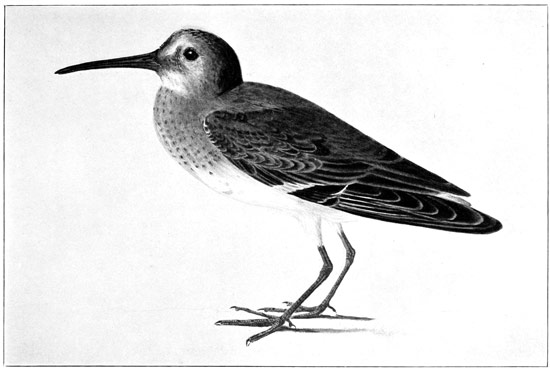
TRINGA ALPINA, RED-BACKED SANDPIPER. (Now Pelidna alpina pacifica.) FROM THE UNPUBLISHED DRAWING BY J. J. AUDUBON, NOVEMBER 24, 1831.
I thought that, while thus sailing, no feeling but that of pleasure could exist in our breasts; but, alas! how fleeting are our enjoyments. When we were almost at the entrance of the river, the wind changed, the sky became clouded, and, before many minutes had elapsed, the little bark was lying to "like a Duck," as her commander expressed himself. It blew a hurricane—let it blow, reader. At break of day we were again at anchor within the bar of St. Augustine.
Our next attempt was successful. Not many hours after we had crossed the bar, we perceived the star-like glimmer of the light in the great lantern at the entrance of the St. John's River. This was before daylight; and, as the crossing of the sand-banks or bars, which occur at the mouths of all the streams of this peninsula is difficult, and can be accomplished only when the tide is up, one of the guns was fired as a signal for the government pilot. The good man, it seemed, was unwilling to leave his couch, but a second gun brought him in his canoe alongside. The depth of the channel was barely sufficient. My eyes, however, were not directed towards the waters, but on high, where flew some thousands of snowy Pelicans, which had fled affrighted from their resting-grounds. How beautifully they performed their broad gyrations, and how matchless, after a while, was the marshalling of their files, as they flew past us.
On the tide we proceeded apace. Myriads of Cormorants covered the face of the waters, and over it Fish-Crows innumerable were already arriving from their distant roosts. We landed at one place to search for the birds whose charming melodies had engaged our attention, and here and there some young Eagles we shot, to add to our store of fresh provisions. The river did not seem to me equal in beauty to the fair Ohio; the shores were in many places low and swampy, to the great delight of the numberless Herons that moved along in gracefulness, and the grim Alligators that swam in sluggish sullenness. In going up a bayou, we caught a great number of the young of the latter for the purpose of making experiments upon them.
After sailing a considerable way, during which our commander and officers took the soundings, as well as the angles and bearings of every nook and crook of the sinuous stream, we anchored one evening at a distance of fully one hundred miles from the mouth of the river. The weather, although it was the 12th of February, was quite warm, the thermometer on board standing at 75°, and on shore at 90°. The fog was so thick that neither of the shores could be seen, and yet the river was not a mile in breadth. The "blind mosquitoes" covered every object, even in the cabin, and so wonderfully abundant were these tormentors that they more than once fairly extinguished the candles whilst I was writing my journal, which I closed in despair, crushing between the leaves more than a hundred of the little wretches. Bad as they are, however, these blind mosquitoes do not bite. As if purposely to render our situation doubly uncomfortable, there was an establishment for jerking beef on the nearer shores, to the windward of our vessel, from which the breeze came laden with no sweet odors.
In the morning when I arose, the country was still covered with thick fogs, so that although I could plainly hear the notes of the birds on shore, not an object could I see beyond the bowsprit, and the air was as close and sultry as on the previous evening. Guided by the scent of the jerkers' works we went on shore, where we found the vegetation already far advanced. The blossoms of the jessamine, ever pleasing, lay steeped in dew, the humming bee was collecting her winter's store from the snowy flowers of the native orange; and the little warblers frisked along the twigs of the smilax. Now, amid the tall pines of the forest, the sun's rays began to force their way, and as the dense mists dissolved in the atmosphere, the bright luminary at length shone forth. We explored the woods around, guided by some friendly live-oakers who had pitched their camp in the vicinity. After a while the "Spark" again displayed her sails, and as she silently glided along, we spied a Seminole Indian approaching us in his canoe. The poor, dejected son of the woods, endowed with talents of the highest order, although rarely acknowledged by the proud usurpers of his native soil, has spent the night in fishing, and the morning in procuring the superb feathered game of the swampy thickets; and with both he comes to offer them for our acceptance. Alas! thou fallen one, descendant of an ancient line of freeborn hunters, would that I could restore to thee thy birthright, thy natural independence, the generous feelings that were once fostered in thy brave bosom. But the irrevocable deed is done, and I can merely admire the perfect symmetry of his frame, as he dexterously throws on our deck the Trout and Turkeys which he has captured. He receives a recompense, and without smile or bow, or acknowledgment of any kind, off he starts with the speed of an arrow from his own bow.
Alligators were extremely abundant, and the heads of the fishes which they had snapped off, lay floating around on the dark waters. A rifle bullet was now and then sent through the eye of one of the largest, which, with a tremendous splash of its tail, expired. One morning we saw a monstrous fellow lying on the shore. I was desirous of obtaining him to make an accurate drawing of his head, and accompanied by my assistant and two of the sailors, proceeded cautiously towards him. When within a few yards, one of us fired, and sent through his side an ounce ball which tore open a hole large enough to receive a man's hand. He slowly raised his head, bent himself upwards, opened his huge jaws, swung his tail to and fro, rose on his legs, blew in a frightful manner, and fell to the earth. My assistant leaped on shore, and, contrary to my injunctions, caught hold of the animal's tail, when the alligator, awakening from its trance, with a last effort crawled slowly towards the water, and plunged heavily into it. Had he thought of once flourishing his tremendous weapon, there might have been an end of his assailant's life, but he fortunately went in peace to his grave, where we left him, as the water was too deep. The same morning, another of equal size was observed swimming directly for the bows of our vessel, attracted by the gentle rippling of the water there. One of the officers, who had watched him, fired, and scattered his brain through the air, when he tumbled and rolled at a fearful rate, blowing all the while most furiously. The river was bloody for yards around, but although the monster passed close by the vessel, we could not secure him, and after a while he sunk to the bottom.
Early one morning, I hired a boat and two men, with the view of returning to St. Augustine by a short-cut. Our baggage being placed on board, I bade adieu to the officers, and off we started. About four in the afternoon we arrived at the short-cut, forty miles distant from our point of departure, and where we had expected to procure a wagon, but were disappointed. So we laid our things on the bank, and leaving one of my assistants to look after them, I set out accompanied by the other and my Newfoundland dog. We had eighteen miles to go; and as the sun was only two hours high, we struck off at a good rate. Presently we entered a pine-barren. The country was as level as a floor; our path, although narrow, was well-beaten, having been used by the Seminole Indians for ages, and the weather was calm and beautiful. Now and then a rivulet occurred, from which we quenched our thirst, while the magnolias and other flowering plants on its banks relieved the dull uniformity of the woods. When the path separated into two branches, both seemingly leading the same way, I would follow one, while my companion took the other, and unless we met again in a short time, one of us would go across the intervening forest.
The sun went down behind a cloud, and the southeast breeze that sprung up at this moment, sounded dolefully among the tall pines. Along the eastern horizon lay a bed of black vapor, which gradually rose, and soon covered the heavens. The air felt hot and oppressive, and we knew that a tempest was approaching. Plato was now our guide, the white spots on his coat being the only objects that we could discern amid the darkness, and as if aware of his utility in this respect, he kept a short way before us on the trail. Had we imagined ourselves more than a few miles from the town, we should have made a camp, and remained under its shelter for the night; but conceiving that the distance could not be great, we resolved to trudge along.
Large drops began to fall from the murky mass overhead; thick impenetrable darkness surrounded us, and to my dismay, the dog refused to proceed. Groping with my hands on the ground, I discovered that several trails branched out at the spot where he lay down; and when I had selected one, he went on. Vivid flashes of lightning streamed across the heavens, the wind increased to a gale, and the rain poured down upon us like a torrent. The water soon rose on the level ground so as almost to cover our feet, and we slowly advanced, fronting the tempest. Here and there a tall pine on fire presented a magnificent spectacle, illumining the trees around it, and surrounding them with a halo of dim light, abruptly bordered with the deep black of the night. At one time we passed through a tangled thicket of low trees, at another crossed a stream flushed by the heavy rain, and again proceeded over the open barrens.
How long we thus, half lost, groped our way is more than I can tell you; but at length the tempest passed over, and suddenly the clear sky became spangled with stars. Soon after, we smelt the salt marshes, and walking directly towards them, like pointers advancing on a covey of partridges, we at last to our great joy descried the light of the beacon near St. Augustine. My dog began to run briskly around, having met with ground on which he had hunted before, and taking a direct course, led us to the great causeway that crosses the marshes at the back of the town. We refreshed ourselves with the produce of the first orange-tree that we met with, and in half an hour more arrived at our hotel. Drenched with rain, steaming with perspiration, and covered to the knees with mud, you may imagine what figures we cut in the eyes of the good people whom we found snugly enjoying themselves in the sitting-room. Next morning, Major Gates, who had received me with much kindness, sent a wagon with mules and two trusty soldiers for my companion and luggage.
THE FLORIDA KEYS I
As the "Marion" neared the Inlet called "Indian Key," which is situated on the eastern coast of the peninsula of Florida, my heart swelled with uncontrollable delight. Our vessel once over the coral reef that everywhere stretches along the shore like a great wall reared by an army of giants, we found ourselves in safe anchoring grounds, within a few furlongs of the land. The next moment saw the oars of a boat propelling us towards the shore, and in brief time we stood on the desired beach. With what delightful feelings did we gaze on the objects around us!—the gorgeous flowers, the singular and beautiful plants, the luxuriant trees. The balmy air which we breathed filled us with animation, so pure and salubrious did it seem to be. The birds which we saw were almost all new to us; their lovely forms appeared to be arrayed in more brilliant apparel than I had ever seen before, and as they fluttered in happy playfulness among the bushes, or glided over the light green waters, we longed to form a more intimate acquaintance with them.
Students of nature spend little time in introductions, especially when they present themselves to persons who feel an interest in their pursuits. This was the case with Mr. Thruston, the deputy collector of the island, who shook us all heartily by the hand, and in a trice had a boat manned, and at our service. Accompanied by him, his pilot and fishermen, off we went, and after a short pull landed on a large key. Few minutes had elapsed when shot after shot might be heard, and down came whirling through the air the objects of our desire. One thrust himself into the tangled groves that covered all but the beautiful coral beach that in a continued line bordered the island, while others gazed on the glowing and diversified hues of the curious inhabitants of the deep. I saw one of my party rush into the limpid element to seize on a crab, that, with claws extended upward, awaited his approach, as if determined not to give way. A loud voice called him back to the land, for sharks are as abundant along these shores as pebbles, and the hungry prowlers could not have found a more savory dinner.
The pilot, besides being a first-rate shot, possessed a most intimate acquaintance with the country. He had been a "conch diver," and no matter what number of fathoms measured the distance between the surface of the water and its craggy bottom, to seek for curious shells in their retreat seemed to him more pastime than toil. Not a Cormorant or Pelican, a Flamingo, an Ibis, or Heron had ever in his days formed its nest without his having marked the spot; and as to the Keys to which the Doves are wont to resort, he was better acquainted with them than many fops are with the contents of their pockets. In a word, he positively knew every channel that led to these islands, and every cranny along their shores. For years his employment had been to hunt those singular animals called Sea-cows or Manatees, and he had conquered hundreds of them, "merely," as he said, because the flesh and hide bring "a fair price" at Havana. He never went anywhere to land without "Long Tom," which proved indeed to be a wonderful gun, and which made smart havoc when charged with "groceries" a term by which he designated the large shot he used. In like manner, he never paddled his light canoe without having by his side the trusty javelin with which he unerringly transfixed such fishes as he thought fit either for market or for his own use. In attacking Turtles, netting, or overturning them, I doubt if his equal ever lived on the Florida coast. No sooner was he made acquainted with my errand, than he freely offered his best services, and from that moment until I left Key West he was seldom out of my hearing.
While the young gentlemen who accompanied us were engaged in procuring plants, shells, and small birds, he tapped me on the shoulder, and with a smile said to me, "Come along, I'll show you something better worth your while." To the boat we betook ourselves, with the captain and only a pair of tars, for more he said would not answer. The yawl for a while was urged at a great rate, but as we approached a point, the oars were taken in, and the pilot alone sculling desired us to make ready, for in a few minutes we should have "rare sport." As we advanced, the more slowly did we move, and the most profound silence was maintained, until suddenly coming almost in contact with a thick shrubbery of mangroves, we beheld, right before us, a multitude of Pelicans. A discharge of artillery seldom produced more effect; the dead, the dying, and the wounded, fell from the trees upon the water, while those unscathed flew screaming through the air in terror and dismay. "There," said he, "did not I tell you so; is it not rare sport?" The birds, one after another, were lodged under the gunwales, when the pilot desired the captain to order the lads to pull away. Within about half a mile we reached the extremity of the Key. "Pull away," cried the pilot, "never mind them on the wing, for those black rascals don't mind a little firing—now, boys, lay her close under the nests." And there we were with four hundred Cormorant's nests over our heads. The birds were sitting, and when we fired, the number that dropped as if dead, and plunged into the water was such, that I thought by some unaccountable means or other we had killed the whole colony. You would have smiled at the loud laugh and curious gestures of the pilot. "Gentlemen," said he, "almost a blank shot!" And so it was, for, on following the birds as one after another peeped up from the water, we found only a few unable to take to wing. "Now," said the pilot, "had you waited until I had spoken to the black villains, you might have killed a score or more of them." On inspection, we found that our shots had lodged in the tough dry twigs of which these birds form their nests, and that we had lost the more favorable opportunity of hitting them, by not waiting until they rose. "Never mind," said the pilot, "if you wish it, you may load The Lady of the Green Mantle[55] with them in less than a week. Stand still, my lads; and now, gentlemen, in ten minutes you and I will bring down a score of them." And so we did. As we rounded the island, a beautiful bird of the species called Peale's Egret came up, and was shot. We now landed, took in the rest of our party, and returned to Indian Key, where we arrived three hours before sunset.
The sailors and other individuals to whom my name and pursuits had become known, carried our birds to the pilot's house. His good wife had a room ready for me to draw in, and my assistant might have been seen busily engaged in skinning, while George Lehman was making a sketch of the lovely isle.
Time is ever precious to the student of nature. I placed several birds in their natural attitudes, and began to outline them. A dance had been prepared also, and no sooner was the sun lost to our eye, than males and females, including our captain and others from the vessel, were seen advancing gayly towards the house in full apparel. The birds were skinned, the sketch was on paper, and I told my young men to amuse themselves. As to myself, I could not join in the merriment, for, full of the remembrance of you, reader, and of the patrons of my work both in America and in Europe, I went on "grinding"—not on an organ, like the Lady of Bras d'Or, but on paper, to the finishing not merely of my outlines, but of my notes respecting the objects seen this day.
The room adjoining that in which I worked was soon filled. Two miserable fiddlers screwed their screeching, silken strings,—not an inch of catgut graced their instruments,—and the bouncing of brave lads and fair lasses shook the premises to the foundation. One with a slip came down heavily on the floor, and the burst of laughter that followed echoed over the isle. Diluted claret was handed round to cool the ladies, while a beverage of more potent energies warmed their partners. After supper our captain returned to the "Marion," and I, with my young men, slept in light swinging hammocks under the eaves of the piazza.
It was the end of April, when the nights were short, and the days therefore long. Anxious to turn every moment to account, we were on board Mr. Thruston's boat at three next morning. Pursuing our way through the deep and tortuous channels that everywhere traverse the immense muddy soap-like flats that stretch from the outward Keys to the Main, we proceeded on our voyage of discovery. Here and there we met with great beds of floating sea-weeds, which showed us that Turtles were abundant there, these masses being the refuse of their feeding. On talking to Mr. Thruston of the nature of these muddy flats, he mentioned that he had once been lost amongst their narrow channels for several days and nights, when in pursuit of some smugglers' boat, the owners of which were better acquainted with the place than the men who were along with him. Although in full sight of several of the Keys, as well as of the main land, he was unable to reach either until a heavy gale raised the water, when he sailed directly over the flats, and returned home almost exhausted with fatigue and hunger. His present pilot often alluded to the circumstance afterwards, ending with a great laugh, and asserting that had he "been there, the rascals would not have escaped."
Coming under a Key on which multitudes of Frigate Pelicans had begun to form their nests, we shot a good number of them, and observed their habits. The boastings of our pilot were here confirmed by the exploits which he performed with his long gun, and on several occasions he brought down a bird from a height of fully a hundred yards. The poor bird, unaware of the range of our artillery, sailed calmly along, so that it was not difficult for "Long Tom," or rather for his owner, to furnish us with as many as we required. The day was spent in this manner, and towards night we returned, laden with booty, to the hospitable home of the pilot.
The next morning was delightful. The gentle sea-breeze glided over the flowery isle, the horizon was clear, and all was silent, save the long breakers that rushed over the distant reefs. As we were proceeding towards some Keys seldom visited by men, the sun rose from the bosom of the waters with a burst of glory that flashed on my soul the idea of that power which called into existence so magnificent an object. The moon, thin and pale, as if ashamed to show her feeble light, concealed herself in the dim west. The surface of the waters shone in its tremulous smoothness, and the deep blue of the clear heavens was pure as the world that lies beyond them. The Heron heavily flew towards the land, like a glutton retiring at daybreak, with well lined paunch, from the house of some wealthy patron of good cheer. The Night Heron and the Owl, fearful of day, with hurried flight sought safety in the recesses of the deepest swamps; while the Gulls and Terns, ever cheerful, gambolled over the water, exulting in the prospect of abundance. I also exulted in hope, my whole frame seemed to expand; and our sturdy crew showed by their merry faces that nature had charms for them too. How much of beauty and joy is lost to them who never view the rising sun, and of whose waking existence, the best half is nocturnal.
Twenty miles our men had to row before we reached "Sandy Island," and as on its level shores we all leaped, we plainly saw the southernmost cape of the Floridas. The flocks of birds that covered the shelly beaches, and those hovering overhead, so astonished us that we could for a while scarcely believe our eyes. The first volley procured a supply of food sufficient for two days' consumption. Such tales, you have already been told, are well enough at a distance from the place to which they refer; but you will doubtless be still more surprised when I tell you that our first fire among a crowd of the Great Godwits laid prostrate sixty-five of these birds. Rose-colored Curlews stalked gracefully beneath the mangroves. Purple Herons rose at almost every step we took, and each cactus supported the nest of a White Ibis. The air was darkened by whistling wings, while, on the waters, floated Gallinules and other interesting birds. We formed a kind of shed with sticks and grass, the sailor cook commenced his labors, and ere long we supplied the deficiencies of our fatigued frames. The business of the day over, we secured ourselves from insects by means of mosquito-nets, and were lulled to rest by the cacklings of the beautiful Purple Gallinules!
In the morning we rose from our sandy beds, and—
THE FLORIDA KEYS II
I left you abruptly, perhaps uncivilly, reader, at the dawn of day, on Sandy Island, which lies just six miles from the extreme point of South Florida. I did so because I was amazed at the appearance of things around me, which in fact looked so different then from what they seemed at night, that it took some minutes' reflection to account for the change. When we laid ourselves down in the sand to sleep, the waters almost bathed our feet; when we opened our eyes in the morning, they were at an immense distance. Our boat lay on her side, looking not unlike a whale reposing on a mud bank. The birds in myriads were probing their exposed pasture-ground. There great flocks of Ibises fed apart from equally large collections of Godwits, and thousands of Herons gracefully paced along, ever and anon thrusting their javelin bills into the body of some unfortunate fish confined in a small pool of water. Of Fish-Crows, I could not estimate the number, but from the havoc they made among the crabs, I conjecture that these animals must have been scarce by the time of next ebb. Frigate Pelicans chased the Jager, which himself had just robbed a poor Gull of its prize, and all the Gallinules, ran with spread wings from the mud-banks to the thickets of the island, so timorous had they become when they perceived us.
Surrounded as we were by so many objects that allured us, not one could we yet attain, so dangerous would it have been to venture on the mud; and our pilot, having assured us that nothing could be lost by waiting, spoke of our eating, and on this hint told us that he would take us to a part of the island where "our breakfast would be abundant although uncooked." Off we went, some of the sailors carrying baskets, others large tin pans and wooden vessels, such as they use for eating their meals in. Entering a thicket of about an acre in extent, we found on every bush several nests of the Ibis, each containing three large and beautiful eggs, and all hands fell to gathering. The birds gave way to us, and ere long we had a heap of eggs that promised delicious food. Nor did we stand long in expectation, for, kindling a fire, we soon prepared in one way or other enough to satisfy the cravings of our hungry maws. Breakfast ended, the pilot, looking at the gorgeous sunrise, said: "Gentlemen, prepare yourselves for fun; the tide is coming."
Over these enormous mud-flats, a foot or two of water is quite sufficient to drive all the birds ashore, even the tallest Heron or Flamingo, and the tide seems to flow at once over the whole expanse. Each of us, provided with a gun, posted himself behind a bush, and no sooner had the water forced the winged creatures to approach the shore than the work of destruction commenced. When it at length ceased, the collected mass of birds of different kinds looked not unlike a small haycock. Who could not with a little industry have helped himself to a few of their skins? Why, reader, surely no one as fond of these things as I am. Every one assisted in this, and even the sailors themselves tried their hand at the work.
Our pilot, good man, told us he was no hand at such occupations and would go after something else. So taking "Long Tom" and his fishing-tackle, he marched off quietly along the shores. About an hour afterwards we saw him returning, when he looked quite exhausted, and on our inquiring the cause said, "There is a dewfish yonder, and a few balacoudas, but I am not able to bring them, or even to haul them here; please send the sailors after them." The fishes were accordingly brought, and as I had never seen a dewfish, I examined it closely, and took an outline of its form, which some days hence you may perhaps see. It exceeded a hundred pounds in weight, and afforded excellent eating. The balacouda is also a good fish, but at times a dangerous one, for, according to the pilot, on more than one occasion "some of these gentry" had followed him when waist-deep in the water, in pursuit of a more valuable prize, until in self-defence, he had to spear them, fearing that "the gentlemen" might at one dart cut off his legs, or some other nice bit, with which he was unwilling to part.
Having filled our cask from a fine well, long since dug in the sand of Cape Sable, either by Seminole Indians or pirates, no matter which, we left Sandy Isle about full tide, and proceeded homeward, giving a call here and there at different Keys, with the view of procuring rare birds, and also their nests and eggs. We had twenty miles to go, "as the birds fly," but the tortuosity of the channels rendered our course fully a third longer. The sun was descending fast, when a black cloud suddenly obscured the majestic orb. Our sails swelled by a breeze that was scarcely felt by us; and the pilot, requesting us to sit on the weather gunwale, told us that we were "going to get it." One sail was hauled in and secured, and the other was reefed, although the wind had not increased. A low murmuring noise was heard, and across the cloud that now rolled along in tumultuous masses shot vivid flashes of lightning. Our experienced guide steered directly across a flat towards the nearest land. The sailors passed their quids from one cheek to the other, and our pilot having covered himself with his oil jacket, we followed his example. "Blow, sweet breeze," cried he at the tiller, and "we'll reach the land before the blast overtakes us, for, gentlemen, it is a furious cloud yon."
A furious cloud indeed was the one which now, like an eagle on outstretched wings, approached so swiftly that one might have deemed it in haste to destroy us. We were not more than a cable's length from the shore, when, with an imperative voice, the pilot calmly said to us, "Sit quite still, gentlemen, for I should not like to lose you overboard just now; the boat can't upset, my word for that, if you will but sit still—Here we have it!"
Reader, persons who have never witnessed a hurricane, such as not unfrequently desolates the sultry climates of the South, can scarcely form an idea of their terrific grandeur. One would think that, not content with laying waste all on land, it must needs sweep the waters of the shallows quite dry, to quench its thirst. No respite for an instant does it afford to the objects within the reach of its furious current. Like the scythe of the destroying angel, it cuts everything by the roots, as it were, with the careless ease of the experienced mower. Each of its revolving sweeps collects a heap that might be likened to the full-sheaf which the husbandman flings by his side. On it goes with a wildness and fury that are indescribable, and when at last its frightful blasts have ceased, Nature, weeping and disconsolate, is left bereaved of her beauteous offspring. In some instances, even a full century is required before, with all her powerful energies, she can repair her loss. The planter has not only lost his mansion, his crops, and his flocks, but he has to clear his lands anew, covered and entangled as they are with the trunks and branches of trees that are everywhere strewn. The bark, overtaken by the storm, is cast on the lee-shore, and if any are left to witness the fatal results, they are the "wreckers" alone, who, with inward delight, gaze upon the melancholy spectacle.
Our light bark shivered like a leaf the instant the blast reached her sides. We thought she had gone over; but the next instant she was on the shore. And now in contemplation of the sublime and awful storm, I gazed around me. The waters drifted like snow; the tough mangroves hid their tops amid their roots, and the loud roaring of the waves driven among them blended with the howl of the tempest. It was not rain that fell; the masses of water flew in a horizontal direction, and where a part of my body was exposed I felt as if a smart blow had been given me on it. But enough—in half an hour it was over. The pure blue sky once more embellished the heavens, and although it was now quite night, we considered our situation a good one.
The crew and some of the party spent the night in the boat. The pilot, myself, and one of my assistants took to the heart of the mangroves, and having found high land, we made a fire as well as we could, spread a tarpauling, and fixing our insect bars over us, soon forgot in sleep the horrors that had surrounded us.
Next day the "Marion" proceeded on her cruise, and in a few more days, having anchored in another safe harbor, we visited other Keys, of which I will, with your leave, give you a short account.
The deputy-collector of Indian Isle gave me the use of his pilot for a few weeks, and I was the more gratified by this, that besides knowing him to be a good man, and a perfect sailor, I was now convinced that he possessed a great knowledge of the habits of birds, and could without loss of time lead me to their haunts. We were a hundred miles or so farther to the south. Gay May, like a playful babe, gambolled on the bosom of his mother Nature, and everything was replete with life and joy. The pilot had spoken to me of some birds which I was very desirous of obtaining. One morning, therefore, we went in two boats to some distant isle, where they were said to breed. Our difficulties in reaching that Key might to some seem more imaginary than real, were I faithfully to describe them. Suffice it for me to tell you that after hauling our boats and pushing them with our hands, for upwards of nine miles, over the flats, we at last reached the deep channel that usually surrounds each of the mangrove islands. We were much exhausted by the labor and excessive heat, but we were now floating on deep water, and by resting a short while under the shade of some mangroves, we were soon refreshed by the breeze that gently blew from the Gulf. We further repaired our strength by taking some food; and I may as well tell you here that, during all the time I spent in that part of the Floridas, my party restricted themselves to fish and soaked biscuit, while our only and constant beverage was molasses and water. I found that in these warm latitudes, exposed as we constantly were to alternate heat and moisture, ardent spirits and more substantial food would prove dangerous to us. The officers, and those persons who from time to time kindly accompanied us, adopted the same regimen, and not an individual of us had ever to complain of so much as a headache.
But we were under the mangroves; at a great distance on one of the flats, the Heron which I have named Ardea occidentalis[56] was seen moving majestically in great numbers. The tide rose and drove them away, and as they came towards us, to alight and rest for a time on the tallest trees, we shot as many as I wished. I also took under my charge several of their young alive.
At another time we visited the "Mule Keys." There the prospect was in many respects dismal in the extreme. As I followed their shores, I saw bales of cotton floating in all the coves, while spars of every description lay on the beach, and far off on the reefs I could see the last remains of a lost ship, her dismantled hulk. Several schooners were around her; they were wreckers. I turned me from the sight with a heavy heart. Indeed, as I slowly proceeded, I dreaded to meet the floating or cast-ashore bodies of some of the unfortunate crew. Our visit to the Mule Keys was in no way profitable, for besides meeting with but a few birds, in two or three instances I was, whilst swimming in the deep channel of a mangrove isle, much nearer a large shark than I wish ever to be again.
"The service" requiring all the attention, prudence, and activity of Captain Day and his gallant officers, another cruise took place, of which you will find some account in the sequel; and while I rest a little on the deck of the "Lady of the Green Mantle," let me offer my humble thanks to the Being who has allowed me the pleasure of thus relating to you, kind reader, a small part of my adventures.
THE TURTLERS
The Tortugas are a group of islands lying about eighty miles from Key West, and the last of those that seem to defend the peninsula of the Floridas. They consist of five or six extremely low, uninhabitable banks, formed of shelly sand, and are resorted to principally by that class of men called wreckers and turtlers. Between these islands are deep channels, which, although extremely intricate, are well known to those adventurers, as well as to the commanders of the revenue cutters, whose duties call them to that dangerous coast. The great coral reef, or wall, lies about eight miles from these inhospitable isles, in the direction of the Gulf, and on it many an ignorant or careless navigator has suffered shipwreck. The whole ground around them is densely covered with corals, sea-fans, and other productions of the deep, amid which crawl innumerable testaceous animals, while shoals of curious and beautiful fishes fill the limpid waters above them. Turtles of different species resort to these banks, to deposit their eggs in the burning sand, and clouds of sea-fowl arrive every spring for the same purpose. These are followed by persons called "eggers," who, when their cargoes are completed, sail to distant markets, to exchange their ill-gotten ware for a portion of that gold on the acquisition of which all men seem bent.
The "Marion" having occasion to visit the Tortugas, I gladly embraced the opportunity of seeing those celebrated islets. A few hours before sunset the joyful cry of "Land!" announced our approach to them; but as the breeze was fresh, and the pilot was well acquainted with all the windings of the channels, we held on, and dropped anchor before twilight. If you have never seen the sun setting in those latitudes, I would recommend to you to make a voyage for the purpose, for I much doubt if, in any other portion of the world, the departure of the orb of day is accompanied with such gorgeous appearances. Look at the great red disk, increased to triple its ordinary dimensions! Now it has partially sunk beneath the distant line of waters, and with its still remaining half irradiates the whole heavens with a flood of golden light, purpling the far-off clouds that hover over the western horizon. A blaze of refulgent glory streams through the portals of the west, and the masses of vapor assume the semblance of mountains of molten gold. But the sun has now disappeared, and from the east slowly advances the gray curtain which night draws over the world.
The Night-hawk is flapping its noiseless wings in the gentle sea-breeze; the Terns, safely landed, have settled on their nests; the Frigate Pelicans are seen wending their way to distant mangroves; and the Brown Gannet, in search of a resting-place, has perched on the yard of the vessel. Slowly advancing landward, their heads alone above the water, are observed the heavily laden Turtles, anxious to deposit their eggs in the well-known sands. On the surface of the gently rippling stream, I dimly see their broad forms, as they toil along, while at intervals may be heard their hurried breathings, indicative of suspicion and fear. The moon with her silvery light now illumines the scene, and the Turtle, having landed, slowly and laboriously drags her heavy body over the sand, her "flippers" being better adapted for motion in the water than on shore. Up the slope, however, she works her way; and see how industriously she removes the sand beneath her, casting it out on either side. Layer after layer she deposits her eggs, arranging them in the most careful manner, and with her hind paddles brings the sand over them. The business is accomplished, the spot is covered over, and with a joyful heart the Turtle swiftly retires towards the shore, and launches into the deep.
But the Tortugas are not the only breeding places of the Turtles; these animals, on the contrary, frequent many other Keys, as well as various parts of the coast of the mainland. There are four different species, which are known by the names of the Green Turtle, the Hawk-billed Turtle, the Logger-head Turtle, and the Trunk Turtle. The first is considered the best as an article of food, in which capacity it is well known to most epicures. It approaches the shores, and enters the bays, inlets, and rivers, early in the month of April, after having spent the winter in the deep waters. It deposits its eggs in convenient places, at two different times in May, and once again in June. The first deposit is the largest, and the last the least, the total quantity being, at an average, about two hundred and forty. The Hawk-billed Turtle, whose shell is so valuable as an article of commerce, being used for various purposes in the arts, is the next with respect to the quality of its flesh. It resorts to the outer Keys only, where it deposits its eggs in two sets, first in July, and again in August, although it "crawls" the beaches of these Keys much earlier in the season, as if to look for a safe place. The average number of its eggs is about three hundred. The Logger-head visits the Tortugas in April, and lays from that period until late in June three sets of eggs, each set averaging one hundred and seventy. The Trunk Turtle, which is sometimes of an enormous size, and which has a pouch like a Pelican, reaches the shores latest. The shell and flesh are so soft that one may push his finger into them, almost as into a lump of butter. This species is therefore considered as the least valuable, and, indeed, is seldom eaten, unless by the Indians, who, ever alert when the Turtle season commences, first carry off the eggs, and afterwards catch the Turtles themselves. The average number of eggs which it lays in the season, in two sets, may be three hundred and fifty.
The Logger-head and the Trunk Turtles are the least cautious in choosing the places in which to deposit their eggs, whereas the two other species select the wildest and most secluded spots. The Green Turtle resorts either to the shores of the Main, between Cape Sable and Cape Florida, or enters Indian, Halifax, and other large rivers or inlets, from which it makes its retreat as speedily as possible, and betakes itself to the open sea. Great numbers, however, are killed by the turtlers and Indians, as well as by various species of carnivorous animals, as Cougars, Lynxes, Bears, and Wolves. The Hawk-bill, which is still more wary, and is always the most difficult to surprise, keeps to the sea-islands. All the species employ nearly the same method in depositing their eggs in the sand, and as I have several times observed them in the act, I am enabled to present you with a circumstantial account of it.
On first nearing the shores, and mostly on fine, calm, moonlight nights, the Turtle raises her head above the water, being still distant thirty or forty yards from the beach, looks around her, and attentively examines the objects on the shore. Should she observe nothing likely to disturb her intended operations, she emits a loud hissing sound, by which such of her many enemies as are unaccustomed to it are startled, and so are apt to remove to another place, although unseen by her. Should she hear any noise, or perceive indications of danger, she instantly sinks, and goes off to a considerable distance; but should everything be quiet, she advances slowly towards the beach, crawls over it, her head raised to the full stretch of her neck, and when she has reached a place fitted for her purpose, she gazes all round in silence. Finding "all well" she proceeds to form a hole in the sand, which she effects by removing it from under her body with her hind flippers, scooping it out with so much dexterity that the sides seldom if ever fall in. The sand is raised alternately with each flipper, as with a large ladle, until it has accumulated behind her, when, supporting herself with her head and fore part on the ground fronting her body, she, with a spring from each flipper, sends the sand around her, scattering it to the distance of several feet. In this manner the hole is dug to the depth of eighteen inches, or sometimes more than two feet. This labor I have seen performed in the short period of nine minutes. The eggs are then dropped one by one, and disposed in regular layers, to the number of a hundred and fifty, or sometimes nearly two hundred. The whole time spent in this part of the operation may be about twenty minutes. She now scrapes the loose sand back over the eggs, and so levels and smooths the surface that few persons on seeing the spot could imagine anything had been done to it. This accomplished to her mind, she retreats to the water with all possible despatch, leaving the hatching of the eggs to the heat of the sand. When a Turtle, a Logger-head for example, is in the act of dropping her eggs, she will not move, although one should go up to her, or even seat himself on her back, for it seems that at this moment she finds it necessary to proceed at all events, and is unable to intermit her labor. The moment it is finished, however, off she starts; nor would it then be possible for one, unless he were as strong as a Hercules, to turn her over and secure her.
To upset a Turtle on the shore, one is obliged to fall on his knees, and placing his shoulder behind her fore-arm, gradually raise her up by pushing with great force, and then with a jerk throw her over. Sometimes it requires the united strength of several men to accomplish this; and, if the Turtle should be of very great size, as often happens on that coast, even handspikes are employed. Some turtlers are so daring as to swim up to them while lying asleep on the surface of the water, and turn them over in their own element, when, however, a boat must be at hand, to enable them to secure their prize. Few Turtles can bite beyond the reach of their fore-legs, and few, when once turned over, can, without assistance, regain their natural position; but, notwithstanding this, their flippers are generally secured by ropes so as to render their escape impossible.
Persons who search for Turtles' eggs, are provided with a light stiff cane or a gun-rod, with which they go along the shores probing the sand near the tracks of the animals, which, however, cannot always be seen, on account of the winds and heavy rains that often obliterate them. The nests are discovered not only by men, but also by beasts of prey, and the eggs are collected, or destroyed on the spot, in great numbers, as on certain parts of the shores hundreds of Turtles are known to deposit their eggs within the space of a mile. They form a new hole each time they lay, and the second is generally dug near the first, as if the animal were quite unconscious of what had befallen it. It will readily be understood that the numerous eggs seen in a Turtle on cutting it up, could not be all laid the same season. The whole number deposited by an individual in one summer may amount to four hundred, whereas, if the animal is caught on or near her nest, as I have witnessed, the remaining eggs, all small, without shells, and as it were threaded like so many large beads, exceed three thousand. In an instance where I found that number, the Turtle weighed nearly four hundred pounds. The young, soon after being hatched, and when yet scarcely larger than a dollar, scratch their way through their sandy covering, and immediately betake themselves to the water.
The food of the Green Turtle consists chiefly of marine plants, more especially the Grasswrack (Zostera marina) which they cut near the roots to procure the most tender and succulent parts. Their feeding-grounds, as I have elsewhere said, are easily discovered by floating masses of these plants on the flats, or along the shores to which they resort. The Hawk-billed species feeds on sea-weeds, crabs, various kinds of shell-fish and fishes; the Logger-head mostly on the fish of conch-shells of large size, which they are enabled, by means of their powerful beak, to crush to pieces with apparently as much ease as a man cracks a walnut. One which was brought on board the "Marion," and placed near the fluke of one of her anchors, made a deep indentation in that hammered piece of iron, which quite surprised me. The Trunk Turtle feeds on mollusca, fish, crustacea, sea urchins, and various marine plants.
All the species move through the water with surprising speed; but the Green and Hawk-billed, in particular, remind you, by their celerity and the ease of their motions, of the progress of a bird in the air. It is, therefore, no easy matter to strike one with a spear, and yet this is often done by an accomplished turtler.
While at Key West, and other islands on the coast, where I made the observations here presented to you, I chanced to have need to purchase some Turtles, to feed my friends on board "The Lady of the Green Mantle"—not my friends her gallant officers, or the brave tars who formed her crew, for all of them had already been satiated with Turtle soup, but my friends the Herons, of which I had a goodly number alive in coops, intending to carry them to John Bachman of Charleston, and other persons for whom I ever feel a sincere regard. So I went to a "crawl" accompanied by Dr. Benjamin Strobel, to inquire about prices, when, to my surprise, I found that the smaller the Turtles above ten-pounds weight, the dearer they were, and that I could have purchased one of the Logger-head kind that weighed more than seven hundred pounds, for little more money than another of only thirty pounds. While I gazed on the large one, I thought of the soups the contents of its shell would have furnished for a "Lord Mayor's dinner," of the numerous eggs which its swollen body contained, and of the curious carriage which might be made of its shell—a car in which Venus herself might sail over the Caribbean Sea, provided her tender Doves lent their aid in drawing the divinity, and provided no shark or hurricane came to upset it. The turtler assured me that although the "great monster" was, in fact, better meat than any other of a less size, there was no disposing of it, unless, indeed, it had been in his power to have sent it to some very distant market. I would willingly have purchased it, but I knew that if killed, its flesh could not keep much longer than a day, and on that account I bought eight or ten small ones, which "my friends" really relished exceedingly, and which served to support them for a long time.
Turtles, such as I have spoken of, are caught in various ways on the coasts of the Floridas, or in estuaries and rivers. Some turtlers are in the habit of setting great nets across the entrance of streams, so as to answer the purpose either at the flow or at the ebb of the waters. These nets are formed of very large meshes, into which the Turtles partially enter, when, the more they attempt to extricate themselves, the more they get entangled. Others harpoon them in the usual manner; but in my estimation no method is equal to that employed by Mr. Egan, the pilot of Indian Isle.
That extraordinary turtler had an iron instrument which he called a peg, and which at each end had a point not unlike what nail-makers call a brad, it being four-cornered but flattish, and of a shape somewhat resembling the beak of an Ivory-billed Woodpecker, together with a neck and shoulder. Between the two shoulders of this instrument a fine tough-line, fifty or more fathoms in length, was fastened by one end being passed through a hole in the centre of the peg and the line itself was carefully coiled up, and placed in a convenient part of the canoe. One extremity of this peg enters a sheath of iron that loosely attaches it to a long wooden spear, until a Turtle has been pierced through the shell by the other extremity. He of the canoe paddles away as silently as possible whenever he spies a Turtle basking on the water, until he gets within a distance of ten or twelve yards, when he throws the spear so as to hit the animal about the place which an entomologist would choose, were it a large insect, for pinning it to a piece of cork. As soon as the Turtle is struck, the wooden handle separates from the peg, in consequence of the looseness of its attachment. The smart of the wound urges on the animal as if distracted, and it appears that the longer the peg remains in its shell, the more firmly fastened it is, so great a pressure is exercised upon it by the shell of the Turtle, which, being suffered to run like a whale, soon becomes fatigued, and is secured by hauling in the line with great care. In this manner, as the pilot informed me, eight hundred Green Turtles were caught by one man in twelve months.
Each turtler has his crawl, which is a square wooden building or pen formed of logs, which are so far separated as to allow the tide to pass freely through, and stand erect in the mud. The Turtles are placed in this enclosure, fed and kept there until sold. If the animals thus confined have not laid their eggs previous to their seizure, they drop them in the water, so that they are lost. The price of Green Turtles, when I was at Key West, was from four to six cents per pound.
The loves of the Turtles are conducted in the most extraordinary manner; but as the recital of them must prove out of place here, I shall pass them over. There is, however, a circumstance relating to their habits which I cannot omit, although I have it not from my own ocular evidence, but from report. When I was in the Floridas several of the turtlers assured me that any Turtle taken from the depositing ground, and carried on the deck of a vessel several hundred miles, would, if then let loose, certainly be met with at the same spot, either immediately after, or in the following breeding season. Should this prove true, and it certainly may, how much will be enhanced the belief of the student in the uniformity and solidity of Nature's arrangements, when he finds that the Turtle, like a migratory bird, returns to the same locality, with perhaps a delight similar to that experienced by the traveller, who, after visiting distant countries, once more returns to the bosom of his cherished family.
THE FORCE OF THE WATERS
The men who are employed in cutting down the trees, and conveying the logs to the saw-mills or the places for shipping, are, in the State of Maine, called "lumberers." Their labors may be said to be continual. Before winter has commenced, and while the ground is yet uncovered with a great depth of snow, they leave their homes to proceed to the interior of the pine forests, which in that part of the country are truly magnificent, and betake themselves to certain places already well known to them. Their provisions, axes, saws, and other necessary articles, together with provender for their cattle, are conveyed by oxen in heavy sledges. Almost at the commencement of their march, they are obliged to enter the woods, and they have frequently to cut a way for themselves for considerable spaces, as the ground is often covered with the decaying trunks of immense trees, which have fallen either from age, or in consequence of accidental burnings. These trunks, and the undergrowth which lies entangled in their tops render many places almost impassable even to men on foot. Over miry ponds they are sometimes forced to form causeways, this being, under all circumstances, the easiest mode of reaching the opposite side. Then, reader, is the time for witnessing the exertions of their fine large cattle. No rods do their drivers use to pain their flanks; no oaths or imprecations are ever heard to fall from the lips of these most industrious and temperate men, for in them, as in most of the inhabitants of our Eastern States, education and habit have tempered the passions, and reduced the moral constitution to a state of harmony. Nay, the sobriety that exists in many of the villages of Maine, I acknowledge, I have often considered as carried to excess, for on asking for brandy, rum, or whiskey, not a drop could I obtain, and it is probable there was an equal lack of spirituous liquors of every other kind. Now and then I saw some good old wines, but they were always drunk in careful moderation. But to return to the management of the oxen. Why, reader, the lumbermen speak to them as if they were rational beings. Few words seem to suffice, and their whole strength is applied to the labor, as if in gratitude to those who treat them with so much gentleness and humanity.
While present on more than one occasion at what Americans call "ploughing matches," which they have annually in many of the States, I have been highly gratified, and in particular at one, of which I have still a strong recollection, and which took place a few miles from the fair and hospitable city of Boston. There I saw fifty or more ploughs drawn by as many pairs of oxen, which performed their work with so much accuracy and regularity—without the infliction of whip or rod, but merely guided by the verbal mandates of the ploughmen—that I was perfectly astonished.
After surmounting all obstacles, the lumberers with their stock arrive at the spot which they have had in view, and immediately commence building a camp. The trees around soon fall under the blows of their axes, and before many days have elapsed a low habitation is reared and fitted within for the accommodation of their cattle, while their provender is secured on a kind of loft covered with broad shingles or boards. Then their own cabin is put up; rough bedsteads, manufactured on the spot, are fixed in the corners; a chimney composed of a frame of sticks plastered with mud leads away the smoke; the skins of Bears or Deer, with some blankets, form their bedding, and around the walls are hung their changes of homespun clothing, guns, and various necessaries of life. Many prefer spending the night on the sweet-scented hay and corn blades of their cattle, which are laid on the ground. All arranged within, the lumberers set their "dead falls," large "steel traps," and "spring guns," in suitable places round their camps, to procure some of the Bears that ever prowl around such establishments.
Now the heavy clouds of November, driven by the northern blasts, pour down the snow in feathery flakes. The winter has fairly set in, and seldom do the sun's gladdening rays fall on the wood-cutter's hut. In warm flannels his body is enveloped, the skin of a Raccoon covers his head and brows, his Moose-skin leggings reach the girdle that secures them around his waist, while on broad moccasins, or snow-shoes, he stands from the earliest dawn until night, hacking away at majestic pines, that for a century past have embellished the forest. The fall of these valuable trees no longer resounds on the ground; and, as they tumble here and there nothing is heard but the rustling and cracking of their branches, their heavy trunks sinking into the deep snows. Thousands of large pines thus cut down every winter afford room for younger trees, which spring up profusely to supply the wants of man.
Weeks and weeks have elapsed; the earth's pure white covering has become thickly and firmly crusted by the increasing intensity of the cold, the fallen trees have all been sawn into measured logs, and the long repose of the oxen has fitted them for hauling them to the nearest frozen streams. The ice gradually becomes covered with the accumulating mass of timber, and, their task completed, the lumberers wait impatiently for the breaking up of the winter.
At this period they pass the time in hunting the Moose, the Deer, and the Bear, for the benefit of their wives and children; and as these men are most excellent woodsmen great havoc is made among the game. Many skins of Sables, Martens, and Musk-Rats they have procured during the intervals of their labor, or under night. The snows are now giving way, as the rains descend in torrents, and the lumberers collect their utensils, harness their cattle, and prepare for their return. This they accomplish in safety.
From being lumberers they now become millers, and with pleasure each applies the grating file to his saws. Many logs have already reached the dams on the swollen waters of the rushing streams, and the task commences, which is carried on through the summer, of cutting them up into boards.
The great heats of the dog-days have parched the ground; every creek has become a shallow, except here and there where in a deep hole the salmon and the trout have found a retreat; the sharp, slimy angles of multitudes of rocks project, as if to afford resting-places to the Wood-ducks and Herons that breed on the borders of these streams. Thousands of "saw-logs" remain in every pool, beneath and above each rapid or fall. The miller's dam has been emptied of its timber, and he must now resort to some expedient to procure a fresh supply.
It was my good fortune to witness the method employed for the purpose of collecting the logs that had not reached their destination, and I had the more pleasure that it was seen in company with my little family. I wish, for your sake, reader, that I could describe in an adequate manner the scene which I viewed; but, although not so well qualified as I could wish, rely upon it that the desire which I feel to gratify you will induce me to use all my endeavors to give you an idea of it.
It was the month of September. At the upper extremity of Dennysville, which is itself a pretty village, are the saw-mills and ponds of the hospitable Judge Lincoln and other persons. The creek that conveys the logs to these ponds, and which bears the name of the village, is interrupted in its course by many rapids and narrow embanked gorges. One of the latter is situated about half a mile above the mill-dams, and is so rocky and rugged in its bottom and sides as to preclude the possibility of the trees passing along it at low water, while, as I conceived, it would have given no slight labor to an army of woodsmen or millers to move the thousands of large logs that had accumulated in it. They lay piled in confused heaps to a great height along an extent of several hundred yards, and were in some places so close as to have formed a kind of dam. Above the gorge there is a large natural reservoir, in which the head-waters of the creek settle, while only a small portion of them ripples through the gorge below, during the later weeks of summer and in early autumn, when the streams are at their lowest.
At the neck of this basin the lumberers raised a temporary barrier with the refuse of their sawn logs. The boards were planted nearly upright, and supported at their tops by a strong tree extending from side to side of the creek, which might there be about forty feet in breadth. It was prevented from giving way under pressure of the rising waters by having strong abutments of wood laid against its centre, while the ends of these abutments were secured by wedges, which could be knocked off when necessary.
The temporary dam was now finished. Little or no water escaped through the barrier, and that in the creek above it rose in the course of three weeks to its top, which was about ten feet high, forming a sheet that extended upwards fully a mile from the dam. My family was invited early one morning to go and witness the extraordinary effect which would be produced by the breaking down of the barrier, and we all accompanied the lumberers to the place. Two of the men, on reaching it, threw off their jackets, tied handkerchiefs round their heads, and fastened to their bodies a long rope, the end of which was held by three or four others, who stood ready to drag their companions ashore, in case of danger or accident. The two operators, each bearing an axe, walked along the abutments, and at a given signal knocked out the wedges. A second blow from each sent off the abutments themselves, and the men, leaping with extreme dexterity from one cross log to another, sprung to the shore with almost the quickness of thought.