EPISODES (continued 2)
Reading edition
"Mr. —— returned, accompanied by three gentlemen. They looked upon me as if I had been Washington himself, and walked to the ash-tree, which I now called my own, as if in quest of a long-lost treasure. I took an axe from one of them, and cut a few chips off the bark. Still no signs were to be seen. So I cut again until I thought it was time to be cautious, and I scraped and worked away with my butcher knife until I did come to where my tomahawk had left an impression in the wood. We now went regularly to work, and scraped at the tree with care, until three hacks as plain as any three notches ever were, could be seen. Mr. —— and the other gentlemen were astonished, and, I must allow, I was as much surprised as pleased myself. I made affidavit of this remarkable occurrence in presence of these gentlemen. Mr. —— gained his cause. I left Green River forever, and came to where we now are; and, sir, I wish you a good night."
I trust, kind reader, that when I again make my appearance with another volume of Ornithological Biography, I shall not have to search in vain for the impression which I have made, but shall have the satisfaction of finding its traces still unobliterated. I now withdraw, and, in the words of the noted wanderer of the Western wilds, "wish you a good night."
NATCHEZ IN 1820
One clear, frosty morning in December I approached in my flatboat the city of Natchez. The shores were crowded with boats of various kinds, laden with the produce of the Western country; and there was a bustle about them such as you might see at a general fair, each person being intent on securing the advantage of a good market. Yet the scene was far from being altogether pleasing, for I was yet "under the hill;" but on removing from the Lower Town I beheld the cliffs on which the city, properly so called, has been built. Vultures unnumbered flew close along the ground on expanded pinions, searching for food; large pines and superb magnolias here and there raised their evergreen tops towards the skies; while on the opposite shores of the Mississippi vast alluvial beds stretched along, and the view terminated with the dense forest. Steamers moved rapidly on the broad waters of the great stream; the sunbeams fell with a peculiarly pleasant effect on the distant objects; and as I watched the motions of the White-headed Eagle while pursuing the Fishing Hawk, I thought of the wonderful ways of that Power to whom I too owe my existence.
Before reaching the land I had observed that several saw-mills were placed on ditches or narrow canals, along which the water rushed from the inner swamps towards the river, and by which the timber is conveyed to the shore; and, on inquiring afterwards, I found that one of those temporary establishments had produced a net profit of upwards of six thousand dollars in a single season.
There is much romantic scenery about Natchez. The Lower Town forms a most remarkable contrast with the Upper; for in the former the houses were not regularly built, being generally dwellings formed of the abandoned flatboats, placed in rows, as if with the view of forming a long street. The inhabitants formed a medley which it is beyond my power to describe; hundreds of laden carts and other vehicles jogged along the declivity between the two towns; but when, by a very rude causeway, I gained the summit, I was relieved by the sight of an avenue of those beautiful trees called here the Pride of China. In the Upper Town I found the streets all laid off at right angles to each other, and tolerably well lined with buildings constructed with painted bricks or boards.
The agricultural richness of the surrounding country was shown by the heaps of cotton bales and other produce that encumbered the streets. The churches, however, did not please me; but as if to make up for this, I found myself unexpectedly accosted by my relative, Mr. Berthoud, who presented me with letters from my wife and sons. These circumstances put me in high spirits, and we proceeded towards the best hotel in the place, that of Mr. Garnier. The house, which was built on the Spanish plan, and of great size, was surrounded by large verandas over-looking a fine garden, and stood at a considerable distance from any other. At this period the city of Natchez had a population not exceeding three thousand individuals. I have not visited it often since, but I have no doubt that, like all the other towns in the western district of our country, it has greatly increased. It possessed a bank, and the mail arrived there thrice in the week from all parts of the Union.
The first circumstance that strikes a stranger is the mildness of the temperature. Several vegetables as pleasing to the eye as agreeable to the palate, and which are seldom seen in our Eastern markets before May, were here already in perfection. The Pewee Fly-catcher had chosen the neighborhood of the city for its winter quarters, and our deservedly famed Mocking-bird sang and danced gratis to every passer by. I was surprised to see the immense number of Vultures that strode along the streets or slumbered on the roofs. The country for many miles inland is gently undulated. Cotton is produced abundantly, and wealth and happiness have taken up their abode under most of the planters' roofs, beneath which the wearied traveller or the poor wanderer in search of a resting-place is sure to meet with comfort and relief. Game is abundant, and the free Indians were wont in those days to furnish the markets with ample supplies of venison and Wild Turkey. The Mississippi, which bathes the foot of the hill some hundred feet below the town, supplies the inhabitants with fish of various kinds. The greatest deficiency is that of water, which for common purposes is dragged on sledges or wheels from the river, while that used for drinking is collected in tanks from the roofs, and becomes very scarce during protracted droughts. Until of late years the orange-tree bore fruit in the open air; but, owing to the great change that has taken place in the temperature, severe though transient frosts occasionally occur, which now prevent this plant from coming to perfection in the open air.
The remains of an old Spanish fort are still to be seen at a short distance from the city. If I am correctly informed, about two years previous to this visit of mine a large portion of the hill near it gave way, sank about a hundred feet, and carried many of the houses of the Lower Town into the river. This, it would appear, was occasioned by the quicksand running springs that flow beneath the strata of mixed pebbles and clay of which the hill is composed. The part that has subsided presents the appearance of a basin or bowl, and is used as a depot for the refuse of the town, on which the Vultures feed when they can get nothing better. There it was that I saw a White-headed Eagle chase one of those filthy birds, knock it down, and feast on the entrails of a horse which the Carrion Crow had partly swallowed.
I did not meet at Natchez many individuals fond of ornithological pursuits, but the hospitality with which I was received was such as I am not likely to forget. Mr. Gamier subsequently proved an excellent friend to me, as you may find elsewhere recorded. Of another individual, whose kindness to me is indelibly impressed on my heart, I would say a few words, although he was such a man as Fénelon alone could describe. Charles Carré was of French origin, the son of a nobleman of the old régime. His acquirements and the benevolence of his disposition were such that when I first met him I could not help looking upon him as another Mentor. Although his few remaining locks were gray, his countenance still expressed the gayety and buoyant feelings of youth. He had the best religious principles; for his heart and his purse were ever open to the poor. Under his guidance it was that I visited the whole neighborhood of Natchez; for he was acquainted with all its history, from the period at which it had first come under the power of the Spaniards to that of their expulsion from the country, its possession by the French, and subsequently by ourselves. He was also well versed in the Indian languages, spoke French with the greatest purity, and was a religious poet. Many a pleasant hour have I spent in his company; but alas! he has gone the way of all the earth!
THE LOST PORTFOLIO
While I was at Natchez, on the 31st of December, 1820, my kind friend, Nicholas Berthoud, Esq., proposed to me to accompany him in his keel-boat to New Orleans. At one o'clock the steam-boat "Columbus" hauled off from the landing and took our bark in tow. The steamer was soon ploughing along at full speed, and little else engaged our minds than the thought of our soon arriving at the emporium of the commerce of the Mississippi. Towards evening, however, several inquiries were made respecting particular portions of the luggage, among which ought to have been one of my portfolios, containing a number of drawings made by me while gliding down the Ohio and Mississippi from Cincinnati to Natchez, and of which some were to me peculiarly valuable, being of birds previously unfigured, and perhaps undescribed. The portfolio was nowhere to be found, and I recollected that I had brought it under my arm to the margin of the stream, and there left it to the care of one of my friend's servants, who, in the hurry of our departure, had neglected to take it on board. Besides the drawings of birds, there was in this collection a sketch in black chalk to which I always felt greatly attached while from home. It is true the features which it represented were indelibly engraved in my heart; but the portrait of her to whom I owe so much of the happiness that I have enjoyed was not the less dear to me. When I thought during the following night of the loss I had sustained in consequence of my own negligence, imagined the possible fate of the collection, and saw it in the hands of one of the numerous boatmen lounging along the shores, who might paste the drawings to the walls of his cabin, nail them to the steering-oars of his flatboat, or distribute them among his fellows, I felt little less vexed than I did some years before when the rats, as you know, devoured a much larger collection.
It was useless to fret myself, and so I began to devise a scheme for recovering the drawings. I wrote to Mr. Garnier and my venerable friend Charles Carré. Mr. Berthoud also wrote to a mercantile acquaintance. The letters were forwarded to Natchez from the first landing-place at which we stopped, and in the course of time we reached the great eddy running by the levee, or artificial embankment, at New Orleans. But before I present you with the answers to the letters sent to our acquaintances at Natchez, allow me to offer a statement of our adventures upon the Mississippi.
After leaving the eddy at Natchez, we passed a long file of exquisitely beautiful bluffs. At the end of twenty hours we reached Bayou Sara, where we found two brigs at anchor, several steamers, and a number of flatboats, the place being of considerable mercantile importance. Here the "Columbus" left us to shift for ourselves, her commander being anxious to get to Baton Rouge by a certain hour, in order to secure a good cargo of cotton. We now proceeded along the great stream, sometimes floating and sometimes rowing. The shores gradually became lower and flatter, orange-trees began to make their appearance around the dwellings of the wealthy planters, and the verdure along the banks assumed a brighter tint. The thermometer stood at 68° in the shade at noon; Butterflies fluttered among the flowers, of which many were in full blow; and we expected to have seen Alligators half awake floating on the numberless logs that accompanied us in our slow progress. The eddies were covered with Ducks of various kinds, more especially with the beautiful species that breeds by preference on the great sycamores that every now and then present themselves along our southern waters. Baton Rouge is a very handsome place, but at present I have no time to describe it. Levees now began to stretch along the river, and wherever there was a sharp point on the shore, negroes were there amusing themselves by raising shrimps, and now and then a catfish, with scooping-nets.
The river increased in breadth and depth, and the sawyers and planters, logs so called, diminished in number the nearer we drew towards the famed city. At every bend we found the plantations increased, and now the whole country on both sides became so level and destitute of trees along the water's edge that we could see over the points before us, and observe the great stream stretching along for miles. Within the levees the land is much lower than the surface of the river when the water is high; but at this time we could see over the levee from the deck of our boat only the upper windows of the planters' houses, or the tops of the trees about them, and the melancholy-looking cypresses covered with Spanish moss forming the background. Persons rode along the levees at full speed; Pelicans, Gulls, Vultures, and Carrion Crows sailed over the stream, and at times there came from the shore a breeze laden with the delicious perfume of the orange-trees, which were covered with blossoms and golden fruits.
Having passed Bayou Lafourche, our boat was brought to on account of the wind, which blew with violence. We landed, and presently made our way to the swamps, where we shot a number of those beautiful birds called Boat-tailed Grakles. The Mocking-birds on the fence stakes saluted us with so much courtesy and with such delightful strains that we could not think of injuring them; but we thought it no harm to shoot a whole covey of Partridges. In the swamps we met with warblers of various kinds, lively and beautiful, waiting in these their winter retreats for the moment when Boreas should retire to his icy home, and the gentle gales of the South should waft them toward their breeding-places in the North. Thousands of Swallows flew about us, the Cat-birds mewed in answer to their chatterings, the Cardinal Grosbeak elevated his glowing crest as he stood perched on the magnolia branch, the soft notes of the Doves echoed among the woods, nature smiled upon us, and we were happy.
On the fourth of January we stopped at Bonnet Carré, where I entered a house to ask some questions about birds. I was received by a venerable French gentleman, whom I found in charge of about a dozen children of both sexes, and who was delighted to hear that I was a student of nature. He was well acquainted with my old friend Charles Carré, and must, I thought, be a good man, for he said he never suffered any of his pupils to rob a bird of her eggs or young, although, said he with a smile, "they are welcome to peep at them and love them." The boys at once surrounded me, and from them I received satisfactory answers to most of my queries respecting birds.
The 6th of January was so cold that the thermometer fell to 30°, and we had seen ice on the running-boards of our keel-boat. This was quite unlooked for, and we felt uncomfortable; but before the middle of the day, all nature was again in full play. Several beautiful steamers passed us. The vegetation seemed not to have suffered from the frost; green peas, artichokes, and other vegetables were in prime condition. This reminds me that on one of my late journeys I ate green peas in December in the Floridas, and had them once a week at least in my course over the whole of the Union, until I found myself and my family feeding on the same vegetable more than a hundred miles to the north of the St. John's River in New Brunswick.
Early on the 7th, thousands of tall spars, called masts by the mariners, came in sight; and as we drew nearer, we saw the port filled with ships of many nations, each bearing the flag of its country. At length we reached the levee, and found ourselves once more at New Orleans. In a short time my companions dispersed, and I commenced a search for something that might tend to compensate me for the loss of my drawings.
On the 16th of March following, I had the gratification of receiving a letter from Mr. A. P. Bodley, of Natchez, informing me that my portfolio had been found and deposited at the office of the "Mississippi Republican," whence an order from me would liberate it. Through the kindness of Mr. Garnier, I received it on the 5th of April. So very generous had been the finder of it, that when I carefully examined the drawings in succession, I found them all present and uninjured, save one, which had probably been kept by way of commission.
THE ORIGINAL PAINTER
As I was lounging one fair and very warm morning on the levee at New Orleans, I chanced to observe a gentleman whose dress and other accompaniments greatly attracted my attention. I wheeled about, and followed him for a short space, when, judging by everything about him that he was a true original, I accosted him.
But here, kind reader, let me give you some idea of his exterior. His head was covered by a straw hat, the brim of which might cope with those worn by the fair sex in 1830; his neck was exposed to the weather; the broad frill of a shirt, then fashionable, flapped about his breast, whilst an extraordinary collar, carefully arranged, fell over the top of his coat. The latter was of a light green color, harmonizing well with a pair of flowing yellow nankeen trousers, and a pink waistcoat, from the bosom of which, amidst a large bunch of the splendid flowers of the magnolia, protruded part of a young Alligator, which seemed more anxious to glide through the muddy waters of some retired swamp than to spend its life swinging to and fro among folds of the finest lawn. The gentleman held in one hand a cage full of richly-plumed Nonpareils, whilst in the other he sported a silk umbrella, on which I could plainly read, "Stolen from I," these words being painted in large white characters. He walked as if conscious of his own importance—that is, with a good deal of pomposity, singing, "My love is but a lassie yet," and that with such thorough imitation of the Scotch emphasis that had not his physiognomy brought to my mind a denial of his being from "within a mile of Edinburgh," I should have put him down in my journal for a true Scot. But no: his tournure, nay, the very shape of his visage, pronounced him an American from the farthest parts of our eastern Atlantic shores.
All this raised my curiosity to such a height that I accosted him with, "Pray, sir, will you allow me to examine the birds you have in that cage?" The gentleman stopped, straightened his body, almost closed his left eye, then spread his legs apart, and, with a look altogether quizzical, answered, "Birds, sir; did you say birds?" I nodded, and he continued, "What the devil do you know about birds, sir?"
Reader, this answer brought a blush into my face. I felt as if caught in a trap; for I was struck by the force of the gentleman's question—which, by the way, was not much in discordance with a not unusual mode of granting an answer in the United States. Sure enough, thought I, little or perhaps nothing do I know of the nature of those beautiful denizens of the air; but the next moment vanity gave me a pinch, and urged me to conceive that I knew at least as much about birds as the august personage in my presence. "Sir," replied I, "I am a student of Nature, and admire her works, from the noblest figure of man to the crawling reptile which you have in your bosom."—"Ah!" replied he, "a—a—a naturalist, I presume!"—"Just so, my good sir," was my answer. The gentleman gave me the cage; and I observed, from the corner of one of my eyes, that his were cunningly inspecting my face. I examined the pretty Finches as long as I wished, returned the cage, made a low bow, and was about to proceed on my walk, when this odd sort of being asked me a question quite accordant with my desire of knowing more of him: "Will you come with me, sir? If you will, you shall see some more curious birds, some of which are from different parts of the world. I keep quite a collection." I assured him I should feel gratified, and accompanied him to his lodgings.
We entered a long room, where, to my surprise, the first objects that attracted my attention were a large easel with a full-length unfinished portrait upon it, a table with palettes and pencils, and a number of pictures of various sizes placed along the walls. Several cages containing birds were hung near the windows, and two young gentlemen were busily engaged in copying some finished portraits. I was delighted with all I saw. Each picture spoke for itself: the drawing, the coloring, the handling, the composition, and the keeping—all proved, that, whoever was the artist, he certainly was possessed of superior talents.
I did not know if my companion was the painter of the picture, but, as we say in America, I strongly guessed, and, without waiting any longer, paid him the compliments which I thought he fairly deserved. "Ay," said he, "the world is pleased with my work. I wish I were so too; but time and industry are required, as well as talents, to make a good artist. If you will examine the birds, I'll to my labor." So saying, the artist took up his palette, and was searching for a rest-stick; but not finding the one with which he usually supported his hand, he drew the rod of a gun, and was about to sit, when he suddenly threw down his implements on the table, and, taking the gun, walked to me and asked if "I had ever seen a percussion-lock." I had not, for that improvement was not yet in vogue. He not only explained the superiority of the lock in question, but undertook to prove that it was capable of acting effectually under water. The bell was rung, a flat basin of water was produced, the gun was charged with powder, and the lock fairly immersed. The report terrified the birds, causing them to beat against the gilded walls of their prisons. I remarked this to the artist. He replied, "The devil take the birds!—more of them in the market; why, sir, I wish to show you that I am a marksman as well as a painter." The easel was cleared of the large picture, rolled to the further end of the room, and placed against the wall. The gun was loaded in a trice, and the painter, counting ten steps from the easel, and taking aim at the supporting-pin on the left, fired. The bullet struck the head of the wooden pin fairly, and sent the splinters in all directions. "A bad shot, sir," said this extraordinary person. "The ball ought to have driven the pin farther into the hole, but it struck on one side; I'll try at the hole itself." After reloading his piece, the artist took aim again, and fired. The bullet this time had accomplished its object, for it had passed through the aperture and hit the wall behind. "Mr. ——, ring the bell and close the windows," said the painter, and, turning to me, continued, "Sir, I will show you the ne plus ultra of shooting." I was quite amazed, and yet so delighted that I bowed my assent. A servant having appeared, a lighted candle was ordered. When it arrived, the artist placed it in a proper position, and retiring some yards, put out the light with a bullet, in the manner which I have elsewhere in this volume described. When light was restored, I observed the uneasiness of the poor little Alligator, as it strove to effect its escape from the artist's waistcoat. I mentioned this to him. "True, true," he replied. "I had quite forgot the reptile; he shall have a dram;" and unbuttoning his vest, unclasped a small chain, and placed the Alligator in the basin of water on the table.
Perfectly satisfied with the acquaintance which I had formed with this renowned artist, I wished to withdraw, fearing I might inconvenience him by my presence. But my time was not yet come. He bade me sit down, and paying no more attention to the young pupils in the room than if they had been a couple of cabbages, said, "If you have leisure and will stay awhile, I will show you how I paint, and will relate to you an incident of my life which will prove to you how sadly situated an artist is at times." In full expectation that more eccentricities were to be witnessed, or that the story would prove a valuable one, even to a naturalist, who is seldom a painter, I seated myself at his side, and observed with interest how adroitly he transferred the colors from his glistening palette to the canvas before him. I was about to compliment him on his facility of touch, when he spoke as follows:—
"This is, sir, or, I ought to say rather, this will be the portrait of one of our best navy officers—a man as brave as Cæsar, and as good a sailor as ever walked the deck of a seventy-four. Do you paint, sir?" I replied, "Not yet."—"Not yet! what do you mean?"—"I mean what I say: I intend to paint as soon as I can draw better than I do at present."—"Good," said he; "you are quite right. To draw is the first object; but, sir, if you should ever paint, and paint portraits, you will often meet with difficulties. For instance, the brave Commodore of whom this is the portrait, although an excellent man at everything else, is the worst sitter I ever saw; and the incident I promised to relate to you, as one curious enough, is connected with his bad mode of sitting. Sir, I forgot to ask if you would take any refreshment—a glass of wine, or—" I assured him I needed nothing more than his agreeable company, and he proceeded. "Well, sir, the first morning that the Commodore came to sit, he was in full uniform, and with his sword at his side. After a few moments of conversation, and when all was ready on my part, I bade him ascend this throne, place himself in the attitude which I contemplated, and assume an air becoming an officer of the navy. He mounted, placed himself as I had desired, but merely looked at me as if I had been a block of stone. I waited a few minutes, when, observing no change on his placid countenance, I ran the chalk over the canvas to form a rough outline. This done, I looked up to his face again, and opened a conversation which I thought would warm his warlike nature; but in vain. I waited and waited, talked and talked, until, my patience—sir, you must know I am not overburdened with phlegm—being almost run out, I rose, threw my palette and brushes on the floor, stamped, walking to and fro about the room, and vociferated such calumnies against our navy that I startled the good Commodore. He still looked at me with a placid countenance, and, as he has told me since, thought I had lost my senses. But I observed him all the while, and, fully as determined to carry my point as he would be to carry off an enemy's ship, I gave my oaths additional emphasis, addressed him as a representative of the navy, and, steering somewhat clear of personal insult, played off my batteries against the craft. The Commodore walked up to me, placed his hand on the hilt of his sword, and told me, in a resolute manner, that if I intended to insult the navy, he would instantly cut off my ears. His features exhibited all the spirit and animation of his noble nature, and as I had now succeeded in rousing the lion, I judged it time to retreat. So, changing my tone, I begged his pardon, and told him he now looked precisely as I wished to represent him. He laughed, and, returning to his seat, assumed a bold countenance. And now, sir, see the picture!"
At some future period I may present you with other instances of the odd ways in which this admired artist gave animation to his sitters. For the present, kind reader, we shall leave him finishing the Commodore, while we return to our proper studies.
THE COUGAR
There is an extensive swamp in the section of the State of Mississippi which lies partly in the Choctaw territory. It commences at the borders of the Mississippi, at no great distance from a Chickasaw village situated near the mouth of a creek known by the name of Vanconnah, and partly inundated by the swellings of several large bayous, the principal of which, crossing the swamp in its whole extent, discharges its waters not far from the mouth of the Yazoo River. This famous bayou is called False River. The swamp of which I am speaking follows the windings of the Yazoo, until the latter branches off to the northeast, and at this point forms the stream named Cold Water River, below which the Yazoo receives the draining of another bayou inclining towards the northwest and intersecting that known by the name of False River at a short distance from the place where the latter receives the waters of the Mississippi. This tedious account of the situation of the swamp is given with the view of pointing it out to all students of nature who may happen to go that way, and whom I would earnestly urge to visit its interior, as it abounds in rare and interesting productions,—birds, quadrupeds, and reptiles, as well as molluscous animals, many of which, I am persuaded, have never been described.
In the course of one of my rambles, I chanced to meet with a squatter's cabin on the banks of the Cold Water River. In the owner of this hut, like most of those adventurous settlers in the uncultivated tracts of our frontier districts, I found a person well versed in the chase, and acquainted with the habits of some of the larger species of quadrupeds and birds. As he who is desirous of instruction ought not to disdain listening to any one who has knowledge to communicate, however humble may be his lot, or however limited his talents, I entered the squatter's cabin, and immediately opened a conversation with him respecting the situation of the swamp, and its natural productions. He told me he thought it the very place I ought to visit, spoke of the game which it contained, and pointed to some Bear and Deer skins, adding that the individuals to which they had belonged formed but a small portion of the number of those animals which he had shot within it. My heart swelled with delight, and on asking if he would accompany me through the great morass, and allow me to become an inmate of his humble but hospitable mansion, I was gratified to find that he cordially assented to all my proposals. So I immediately unstrapped my drawing materials, laid up my gun, and sat down to partake of the homely but wholesome fare intended for the supper of the squatter, his wife, and his two sons.
The quietness of the evening seemed in perfect accordance with the gentle demeanor of the family. The wife and children, I more than once thought, seemed to look upon me as a strange sort of person, going about, as I told them I was, in search of birds and plants; and were I here to relate the many questions which they put to me in return for those I addressed to them, the catalogue would occupy several pages. The husband, a native of Connecticut, had heard of the existence of such men as myself, both in our own country and abroad, and seemed greatly pleased to have me under his roof. Supper over, I asked my kind host what had induced him to remove to this wild and solitary spot. "The people are growing too numerous now to thrive in New England," was his answer. I thought of the state of some parts of Europe, and calculating the denseness of their population compared with that of New England, exclaimed to myself, "How much more difficult must it be for men to thrive in those populous countries!" The conversation then changed, and the squatter, his sons and myself, spoke of hunting and fishing until at length, tired, we laid ourselves down on pallets of Bear skins, and reposed in peace on the floor of the only apartment of which the hut consisted.
Day dawned, and the squatter's call to his hogs, which, being almost in a wild state, were suffered to seek the greater portion of their food in the woods, awakened me. Being ready dressed I was not long in joining him. The hogs and their young came grunting at the well known call of their owner, who threw them a few ears of corn, and counted them, but told me that for some weeks their number had been greatly diminished by the ravages committed upon them by a large Panther, by which name the Cougar is designated in America, and that the ravenous animal did not content himself with the flesh of his pigs, but now and then carried off one of his calves, notwithstanding the many attempts he had made to shoot it. The Painter, as he sometimes called it, had on several occasions robbed him of a dead Deer; and to these exploits the squatter added several remarkable feats of audacity which it had performed, to give me an idea of the formidable character of the beast. Delighted by his description, I offered to assist him in destroying the enemy, at which he was highly pleased, but assured me that unless some of his neighbors should join us with their dogs and his own, the attempt would prove fruitless. Soon after, mounting a horse, he went off to his neighbors several of whom lived at a distance of some miles, and appointed a day of meeting.
The hunters, accordingly, made their appearance, one fine morning, at the door of the cabin, just as the sun was emerging from beneath the horizon. They were five in number, and fully equipped for the chase, being mounted on horses which in some parts of Europe might appear sorry nags, but which in strength, speed, and bottom, are better fitted for pursuing a Cougar or a Bear through woods and morasses than any in that country. A pack of large, ugly curs were already engaged in making acquaintance with those of the squatter. He and myself mounted his two best horses, whilst his sons were bestriding others of inferior quality.
Few words were uttered by the party until we had reached the edge of the swamp, where it was agreed that all should disperse and seek for the fresh track of the Painter, it being previously settled that the discoverer should blow his horn, and remain on the spot, until the rest should join him. In less than an hour, the sound of the horn was clearly heard, and, sticking close to the squatter, off we went through the thick woods, guided only by the now and then repeated call of the distant huntsmen. We soon reached the spot, and in a short time the rest of the party came up. The best dog was sent forward to track the Cougar, and in a few moments the whole pack were observed diligently trailing, and bearing in their course for the interior of the Swamp. The rifles were immediately put in trim, and the party followed the dogs, at separate distances, but in sight of each other, determined to shoot at no other game than the Panther.
The dogs soon began to mouth, and suddenly quickened their pace. My companion concluded that the beast was on the ground, and putting our horses to a gentle gallop, we followed the curs, guided by their voices. The noise of the dogs increased, when, all of a sudden their mode of barking became altered, and the squatter, urging me to push on, told me that the beast was treed, by which he meant that it had got upon some low branch of a large tree to rest for a few moments, and that should we not succeed in shooting him when thus situated, we might expect a long chase of it. As we approached the spot, we all by degrees united into a body, but on seeing the dogs at the foot of a large tree, separated again, and galloped off to surround it.
Each hunter now moved with caution, holding his gun ready, and allowing the bridle to dangle on the neck of his horse, as it advanced slowly towards the dogs. A shot from one of the party was heard, on which the Cougar was seen to leap to the ground, and bound off with such velocity as to show that he was very unwilling to stand our fire longer. The dogs set off in pursuit with great eagerness and a deafening cry. The hunter who had fired came up and said that his ball had hit the monster, and had probably broken one of his fore-legs near the shoulder, the only place at which he could aim. A slight trail of blood was discovered on the ground, but the curs proceeded at such a rate that we merely noticed this, and put spurs to our horses, which galloped on towards the centre of the Swamp. One bayou was crossed, then another still larger and more muddy; but the dogs were brushing forward, and as the horses began to pant at a furious rate, we judged it expedient to leave them and advance on foot. These determined hunters knew that the Cougar being wounded, would shortly ascend another tree, where in all probability he would remain for a considerable time, and that it would be easy to follow the track of the dogs. We dismounted, took off the saddles and bridles, set the bells attached to the horses' necks at liberty to jingle, hoppled the animals, and left them to shift for themselves.
Now, kind reader, follow the group marching through the swamp, crossing muddy pools, and making the best of their way over fallen trees and amongst the tangled rushes that now and then covered acres of ground. If you are a hunter yourself, all this will appear nothing to you; but if crowded assemblies of "beauty and fashion," or the quiet enjoyment of your "pleasure grounds" alone delight you, I must mend my pen before I attempt to give you an idea of the pleasure felt on such an expedition.
After marching for a couple of hours, we again heard the dogs. Each of us pressed forward, elated at the thought of terminating the career of the Cougar. Some of the dogs were heard whining, although the greater number barked vehemently. We felt assured that the Cougar was treed, and that he would rest for some time to recover from his fatigue. As we came up to the dogs, we discovered the ferocious animal lying across a large branch, close to the trunk of a cotton-wood tree. His broad breast lay towards us; his eyes were at one time bent on us and again on the dogs beneath and around him; one of his fore-legs hung loosely by his side, and he lay crouched, with his ears lowered close to his head, as if he thought he might remain undiscovered. Three balls were fired at him, at a given signal, on which he sprang a few feet from the branch, and tumbled headlong to the ground. Attacked on all sides by the enraged curs, the infuriated Cougar fought with desperate valor; but the squatter, advancing in front of the party, and almost in the midst of the dogs, shot him immediately behind and beneath the left shoulder. The Cougar writhed for a moment in agony, and in another lay dead.
The sun was now sinking in the west. Two of the hunters separated from the rest to procure venison, whilst the squatter's sons were ordered to make the best of their way home, to be ready to feed the hogs in the morning. The rest of the party agreed to camp on the spot. The Cougar was despoiled of its skin, and its carcass left to the hungry dogs. Whilst engaged in preparing our camp, we heard the report of a gun, and soon after one of our hunters returned with a small Deer. A fire was lighted, and each hunter displayed his pone of bread, along with a flask of whiskey. The deer was skinned in a trice, and slices placed on sticks before the fire. These materials afforded us an excellent meal, and as the night grew darker, stories and songs went round, until my companions, fatigued, laid themselves down, close under the smoke of the fire, and soon fell asleep.
I walked for some minutes round the camp, to contemplate the beauties of that nature from which I have certainly derived my greatest pleasures. I thought of the occurrences of the day, and glancing my eye around, remarked the singular effects produced by the phosphorescent qualities of the large decayed trunks which lay in all directions around me. How easy, I thought, would it be for the confused and agitated mind of a person bewildered in a swamp like this, to imagine in each of these luminous masses some wondrous and fearful being, the very sight of which might make the hair stand erect on his head. The thought of being myself placed in such a predicament burst over my mind, and I hastened to join my companions, beside whom I laid me down and slept, assured that no enemy could approach us without first rousing the dogs, which were growling in fierce dispute over the remains of the Cougar.
At daybreak we left our camp, the squatter bearing on his shoulder the skin of the late destroyer of his stock, and retraced our steps until we found our horses, which had not strayed far from the place where we had left them. These we soon saddled, and jogging along, in a direct course, guided by the sun, congratulating each other on the destruction of so formidable a neighbor as the Panther had been, we soon arrived at my host's cabin. The five neighbors partook of such refreshment as the house could afford, and dispersing, returned to their homes, leaving me to follow my favorite pursuits.
THE RUNAWAY
Never shall I forget the impression made on my mind by the rencontre which forms the subject of this article, and I even doubt if the relation of it will not excite in that of my reader emotions of varied character.
Late in the afternoon of one of those sultry days which render the atmosphere of the Louisiana swamps pregnant with baneful effluvia, I directed my course towards my distant home, laden with a pack, consisting of five or six Wood Ibises, and a heavy gun, the weight of which, even in those days, when my natural powers were unimpaired, prevented me from moving with much speed. Reaching the banks of a miry bayou, only a few yards in breadth, but of which I could not ascertain the depth, on account of the muddiness of its waters, I thought it might be dangerous to wade through it with my burden, for which reason, throwing to the opposite side each of my heavy birds in succession, together with my gun, powder-flask, and shot-bag, and drawing my hunting-knife from its scabbard, to defend myself, if need should be, against Alligators, I entered the water, followed by my faithful dog. As I advanced carefully, and slowly, "Plato" swam around me, enjoying the refreshing influence of the liquid element that cooled his fatigued and heated frame. The water deepened, as did the mire of its bed; but with a stroke or two I gained the shore.
Scarcely had I stood erect on the opposite bank, when my dog ran to me, exhibiting marks of terror; his eyes seeming ready to burst from their sockets, and his mouth grinning with the expression of hatred, while his feelings found vent in a stifled growl. Thinking that all this was produced by the scent of a Wolf or Bear, I stooped to take up my gun, when a stentorian voice commanded me to "stand still, or die!" Such a qui vive in these woods was as unexpected as it was rare. I instantly raised and cocked my gun; and although I did not yet perceive the individual who had thus issued so peremptory a mandate, I felt determined to combat with him for the free passage of the grounds. Presently a tall, firmly built negro emerged from the bushy underwood, where until that moment he must have been crouched, and in a louder voice repeated his injunction. Had I pressed a trigger, his life would have instantly terminated; but observing that the gun which he aimed at my breast, was a wretched, rusty piece, from which fire could not readily be produced, I felt little fear, and therefore did not judge it necessary to proceed at once to extremities. I laid my gun at my side, tapped my dog quietly, and asked the man what he wanted.
My forbearance, and the stranger's long habit of submission, produced the most powerful effect on his mind. "Master," said he, "I am a runaway; I might perhaps shoot you down; but God forbids it, for I feel just now as if I saw him ready to pass his judgment against me for such a foul deed, and I ask mercy at your hands. For God's sake, do not kill me, master!" "And why," answered I, "have you left your quarters, where certainly you must have fared better than in these unwholesome swamps?" "Master, my story is a short, but a sorrowful one. My camp is close by, and, as I know you cannot reach home this night, if you will follow me there, depend upon my honor you shall be safe until the morning, when I will carry your birds, if you choose, to the great road."
The large, intelligent eyes of the negro, the complacency of his manners, and the tones of his voice, I thought invited me to venture; and as I felt that I was at least his equal, while moreover, I had my dog to second me, I answered that I would follow him. He observed the emphasis laid on the words, the meaning of which he seemed to understand so thoroughly that, turning to me, he said, "There, master, take my butcher's knife, while I throw away the flint and priming from my gun!" Reader, I felt confounded: this was too much for me: I refused the knife, and told him to keep his piece ready, in case we might accidentally meet a Cougar or a Bear.
Generosity exists everywhere. The greatest monarch acknowledges its impulse, and all around him, from the lowliest menial to the proud nobles that encircle his throne, at times experience that overpowering sentiment. I offered to shake hands with the runaway. "Master," said he, "I beg you thanks," and with this he gave me a squeeze that alike impressed me with the goodness of his heart and his great physical strength. From that moment we proceeded through the woods together. My dog smelt at him several times, but as he heard me speak in my usual tone of voice, he soon left us and rambled around as long as my whistle was unused. As we proceeded, I observed that he was guiding me towards the setting of the sun, and quite contrary to my homeward course. I remarked this to him, when he with the greatest simplicity replied, "Merely for our security."
After trudging along for some distance, and crossing several bayous, at all of which he threw his gun and knife to the opposite bank, and stood still until I had got over, we came to the borders of an immense cane-brake, from which I had, on former occasions, driven and killed several Deer. We entered, as I had frequently done before, now erect, then on "all fours." He regularly led the way, divided here and there the tangled stalks, and, whenever we reached a fallen tree, assisted me in getting over it, with all possible care. I saw that he was a perfect Indian in his knowledge of the woods, for he kept a direct course as precisely as any "Red-skin" I ever travelled with. All of a sudden he emitted a loud shriek, not unlike that of an Owl, which so surprised me, that I once more instantly levelled my gun. "No harm, master, I only give notice to my wife and children I am coming." A tremulous answer of the same nature gently echoed through the tree tops. The runaway's lips separated with an expression of gentleness and delight, when his beautiful set of ivory teeth seemed to smile through the dusk of evening that was thickening around us. "Master," said he, "my wife, though black, is as beautiful to me as the President's wife is to him; she is my queen, and I look on our young ones as so many princes; but you shall see them all, for here they are, thank God."
There, in the heart of the cane-brake, I found a regular camp. A small fire was lighted, and on its embers lay gridling some large slices of venison. A lad nine or ten years old was blowing the ashes from some fine sweet potatoes. Various articles of household furniture were carefully disposed around, and a large pallet of Bear and Deer skins, seemed to be the resting-place of the whole family. The wife raised not her eyes towards mine, and the little ones, three in number, retired into a corner, like so many discomfited Raccoons; but the Runaway, bold, and apparently happy, spoke to them in such cheering words, that at once one and all seemed to regard me as one sent by Providence to relieve them from all their troubles. My clothes were hung up by them to dry, and the negro asked if he might clean and grease my gun, which I permitted him to do, while the wife threw a large piece of Deer's flesh to my dog, which the children were already caressing.
Only think of my situation, reader! Here I was, ten miles at least from home, and four or five from the nearest plantation, in the camp of runaway slaves, and quite at their mercy. My eyes involuntarily followed their motions, but as I thought I perceived in them a strong desire to make me their confidant and friend, I gradually relinquished all suspicions. The venison and potatoes looked quite tempting, and by this time I was in a condition to relish much less savory fare; so, on being humbly asked to divide the viands before us, I partook of as hearty a meal as I had ever done in my life.
Supper over, the fire was completely extinguished, and a small lighted pine-knot placed in a hollowed calabash. Seeing that both the husband and the wife were desirous of communicating something to me, I at once and fearlessly desired them to unburden their minds, when the Runaway told me a tale of which the following is the substance.
About eighteen months before, a planter, residing not very far off, having met with some losses, was obliged to expose his slaves at a public sale. The value of his negroes was well known, and on the appointed day the auctioneer laid them out in small lots, or offered them singly, in the manner which he judged most advantageous to their owner. The Runaway, who was well known as being the most valuable next to his wife, was put up by himself for sale, and brought an immoderate price. For his wife, who came next, and alone, eight hundred dollars were bidden and paid down. Then the children were exposed, and, on account of their breed, brought high prices. The rest of the slaves went off at rates corresponding to their qualifications.
The Runaway chanced to be bought by the overseer of the plantation; the wife was bought by an individual residing about a hundred miles off, and the children went to different places along the river. The heart of the husband and father failed him under this dire calamity. For a while he pined in sorrow under his new master; but having marked down in his memory the names of the different persons who had purchased each dear portion of his family, he feigned illness, if indeed, he whose affections had been so grievously blasted could be said to feign it, refrained from food for several days, and was little regarded by the overseer, who felt himself disappointed in what he had considered a bargain.
On a stormy night, when the elements raged with all the fury of a hurricane, the poor negro made his escape, and being well acquainted with all the neighboring swamps, at once made directly for the cane-brake in the centre of which I found his camp. A few nights afterwards he gained the abode of his wife, and the very next after their meeting, he led her away. The children, one after another, he succeeded in stealing, until at last the whole of the objects of his love were under his care.
To provide for five individuals was no easy task in those wilds, which after the first notice was given of the wonderful disappearance of this extraordinary family, were daily ransacked by armed planters. Necessity, it is said, will bring the Wolf from the forest. The Runaway seems to have well understood the maxim, for under the cover of night he approached his first master's plantation, where he had ever been treated with the greatest kindness. The house-servants knew him too well not to aid him to the best of their power, and at the approach of each morning he returned to his camp with an ample supply of provisions. One day, while in search of wild fruits, he found a Bear dead before the muzzle of a gun that had been set for the purpose. Both articles he carried to his home. His friends at the plantation managed to supply him with some ammunition, and on damp and cloudy days he first ventured to hunt around his camp. Possessed of courage and activity, he gradually became more careless, and rambled farther in search of game. It was on one of his excursions that I met him, and he assured me the noise which I made in passing the bayou had caused him to lose the chance of killing a fine Deer, "although," said he, "my old musket misses fire sadly too often."
The Runaways, after disclosing their secret to me, both rose from their seat, with eyes full of tears. "Good master, for God's sake, do something for us and our children," they sobbed forth with one accord. Their little ones lay sound asleep in the fearlessness of their innocence. Who could have heard such a tale without emotion? I promised them my most cordial assistance. They both sat up that night to watch my repose, and I slept close to their urchins, as if on a bed of the softest down.
Day broke so fair, so pure, and so gladdening that I told them such heavenly appearances were ominous of good, and that I scarcely doubted of obtaining their full pardon. I desired them to take their children with them, and promised to accompany them to the plantation of their first master. They gladly obeyed. My Ibises were hung round their camp, and, as a memento of my having been there, I notched several trees; after which I bade adieu, perhaps for the last time, to that cane-brake. We soon reached the plantation, the owner of which, with whom I was well acquainted, received me with all the generous kindness of a Louisiana planter. Ere an hour had elapsed, the Runaway and his family were looked upon as his own. He afterwards repurchased them from their owners, and treated them with his former kindness; so that they were rendered as happy as slaves generally are in that country, and continued to cherish that attachment to each other which had led to their adventures. Since this event happened, it has, I have been informed, become illegal to separate slave families without their consent.
A TOUGH WALK FOR A YOUTH
About twelve years ago I was conveyed, along with my son Victor, from Bayou Sara to the mouth of the Ohio, on board the steamer "Magnet," commanded by Mr. McKnight, to whom I here again offer my best thanks for his attentions. The very sight of the waters of that beautiful river filled me with joy as we approached the little village of Trinity, where we were landed along with several other passengers, the water being too low to enable the vessel to proceed to Louisville. No horses could be procured, and as I was anxious to continue my journey without delay, I consigned my effects to the care of the tavern-keeper, who engaged to have them forwarded by the first opportunity. My son, who was not fourteen, with all the ardor of youth, considered himself able to accomplish, on foot, the long journey which we contemplated. Two of the passengers evinced a desire to accompany us, "provided," said the tallest and stoutest of them, "the lad can keep up. My business," he continued, "is urgent, and I shall push for Frankfort pretty fast." Dinner, to which we had contributed some fish from the river, being over, my boy and I took a ramble along the shores of Cash Creek, on which, some years before, I had been detained several weeks by ice. We slept at the tavern, and next morning prepared for our journey, and were joined by our companions, although it was past twelve before we crossed the creek.
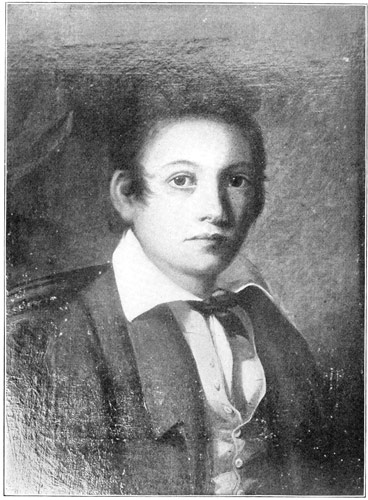
VICTOR GIFFORD AUDUBON. PAINTED BY AUDUBON ABOUT 1823.
One of our fellow-travellers, named Rose, who was a delicate and gentlemanly person, acknowledged that he was not a good walker, and said he was glad that my son was with us, as he might be able to keep up with the lively youth. The other, a burly personage, at once pushed forwards. We walked in Indian file along the narrow track cut through the canes, passed a wood-yard, and entered the burnt forest, in which we met with so many logs and briers that we judged it better to make for the river, the course of which we followed over a bed of pebbles, my son sometimes ahead, and again falling back, until we reached America, a village having a fine situation, but with a shallow approach to the shore. Here we halted at the best house, as every traveller ought to do, whether pedestrian or equestrian, for he is there sure of being well treated, and will not have to pay more than in an inferior place. Now we constituted Mr. Rose purser. We had walked twelve miles over rugged paths and pebbly shores, and soon proceeded along the edge of the river. Seven tough miles ended, we found a house near the bank, and in it we determined to pass the night. The first person we met with was a woman picking cotton in a small field. On asking her if we might stay in her cabin for the night, she answered we might, and hoped we could make shift with the fare on which she and her husband lived. While she went to the house to prepare supper, I took my son and Mr. Rose to the water, knowing how much we should be refreshed by a bath. Our fellow-traveller refused, and stretched himself on a bench by the door. The sun was setting; thousands of Robins were flying southward in the calm and clear air; the Ohio was spread before us smooth as a mirror, and into its waters we leaped with pleasure. In a short time the good man of the hut called us to supper, and in a trice we were at his heels. He was a tall, raw-boned fellow, with an honest, bronzed face. After our frugal meal we all four lay down on a large bed, spread on the floor, while the good people went up to a loft.
The woodsman, having, agreeably to our instructions, roused us at daybreak, told us that about seven miles farther we should meet with a breakfast much better than the last supper we had. He refused any pecuniary compensation, but accepted from me a knife. So we again started. My dear boy appeared very weak at first, but soon recovered, and our stout companion, whom I shall call S., evidently showed symptoms of lassitude. On arriving at the cabin of a lazy man, blessed with an industrious wife and six healthy children, all of whom labored for his support, we were welcomed by the woman, whose motions and language indicated her right to belong to a much higher class. Better breakfast I never ate: the bread was made of new corn, ground on a tin grater by the beautiful hands of our blue-eyed hostess; the chickens had been prepared by one of her lovely daughters; some good coffee was added, and my son had fresh milk. The good woman, who now held a babe to her bosom, seemed pleased to see how heartily we all ate; the children went to work, and the lazy husband went to the door to smoke a corn-cob pipe. A dollar was put into the ruddy hand of the chubby urchin, and we bade its mother farewell. Again we trudged along the beach, but after a while betook ourselves to the woods. My son became faint. Dear boy! never can I forget how he lay exhausted on a log, large tears rolling down his cheeks. I bathed his temples, spoke soothingly to him, and chancing to see a fine Turkey Cock run close by, directed his attention to it, when, as if suddenly refreshed, he got up and ran a few yards towards the bird. From that moment he seemed to acquire new vigor, and at length we reached Wilcox's, where we stopped for the night. We were reluctantly received at the house, and had little attention paid to us, but we had a meal and went to bed.
The sun rose in all its splendor, and the Ohio reflected its ruddy beams. A finer view of that river can scarcely be obtained than that from the house which we were leaving. Two miles through intricate woods brought us to Belgrade, and having passed Fort Massacre, we halted and took breakfast. S. gave us to understand that the want of roads made travelling very unpleasant; he was not, he added, in the habit of "skulking through the bushes, or tramping over stony bars in the full sunshine;" but how else he had travelled was not explained. Mr. Rose kept up about as well as Victor, and I now led the way. Towards sunset we reached the shores of the river, opposite the mouth of the Cumberland. On a hill, the property of a Major B., we found a house, and a solitary woman, wretchedly poor, but very kind. She assured us that if we could not cross the river, she would give us food and shelter for the night, but said that, as the moon was up, she could get us put over when her skiff came back. Hungry and fatigued, we laid us down on the brown grass, waiting either a scanty meal or the skiff that was to convey us across the river. I had already grated the corn for our supper, run down the chickens, and made a fire, when a cry of "Boat coming!" roused us all. We crossed half of the Ohio, walked over Cumberland Isle, and after a short ferry found ourselves in Kentucky, the native land of my beloved sons. I was now within a few miles of the spot where, some years before, I had a horse killed under me by lightning.
It is unnecessary to detain you with a long narrative, and state every occurrence till we reached the banks of Green River. We had left Trinity at twelve o'clock of the 15th of October, and on the morning of the 18th four travellers, descending a hill, were admiring the reflection of the sun's rays on the forest-margined horizon. The frost, which lay thick on the ground and the fences, glittered in the sheen, and dissolved away; all nature seemed beautiful in its calm repose; but the pleasure which I felt in gazing on the scene was damped by the fatigue of my son, who now limped like a lamed Turkey, although, as the rest of the party were not much better off, he smiled, straightened himself, and strove to keep up with us. Poor S. was panting many yards behind, and was talking of purchasing a horse. We had now, however, a tolerably good road, and in the evening got to a house, where I inquired if we could have a supper and beds. When I came out, Victor was asleep on the grass, Mr. Rose looking at his sore toes, and S. just finishing a jug of monongahela. Here we resolved that, instead of going by Henderson, we should take a cut across to the right, and make direct for Smith's Ferry, by way of Highland Lick Creek.
Next day we trudged along, but nothing very remarkable occurred excepting that we saw a fine black Wolf, quite tame and gentle, the owner of which refused a hundred dollars for it. Mr. Rose, who was an engineer, and a man of taste, amused us with his flageolet, and frequently spoke of his wife, his children, and his fireside, which increased my good opinion of him. At an orchard we filled our pockets with October peaches, and when we came to Trade Water River we found it quite low. The acorns were already drifted on its shallows, and the Wood Ducks were running about picking them up. Passing a flat bottom, we saw a large Buffalo Lick. Where now are the bulls which erst scraped its earth away, bellowing forth their love or their anger?
Good Mr. Rose's feet became sorer and sorer each succeeding day; Mr. S. at length nearly gave up; my son had grown brisker. The 20th was cloudy, and we dreaded rain, as we knew the country to be flat and clayey. In Union County, we came to a large opening, and found the house of a justice, who led us kindly to the main road, and accompanied us for a mile, giving us excellent descriptions of brooks, woods, and barrens; notwithstanding which we should have been much puzzled, had not a neighbor on horseback engaged to show us the way. The rain now fell in torrents and rendered us very uncomfortable, but at length we reached Highland Lick, where we stumbled on a cabin, the door of which we thrust open, overturning a chair that had been placed behind it. On a dirty bed lay a man, a table with a journal or perhaps a ledger before him, a small cask in a corner near him, a brass pistol on a nail over his head, and a long Spanish dagger by his side. He rose and asked what was wanted. "The way to a better place, the road to Suggs's." "Follow the road, and you'll get to his house in about five miles!" My party were waiting for me, warming themselves by the fires of the salt-kettles. The being I had seen was an overseer. By and by we crossed a creek; the country was hilly, clayey, and slippery; Mr. S. was cursing, Rose limped like a lame Duck, but Victor kept up like a veteran.
Another day, kind reader, and I shall for a while shut my journal. The morning of the 21st was beautiful; we had slept comfortably at Suggs's, and we soon found ourselves on pleasant barrens, with an agreeable road. Rose and S. were so nearly knocked up that they proposed to us to go on without them. We halted and talked a few minutes on the subject, when our companions stated their resolution to proceed at a slower pace. So we bade them adieu. I asked my son how he felt; he laughed and quickened his steps; and in a short time our former associates were left out of sight. In about two hours we were seated in the Green River Ferry-boat, with our legs hanging in the water. At Smith's Ferry this stream looks like a deep lake; and the thick cane on its banks, the large overhanging willows, and its dark, green waters, never fail to form a fine picture, more especially in the calm of an autumnal evening. Mr. Smith gave us a good supper, sparkling cider, and a comfortable bed. It was arranged that he should drive us to Louisville in his dearborn; and so ended our walk of two hundred and fifty miles. Should you wish to accompany us during the remainder of our journey I have only to refer you to the article "Hospitality in the Woods."
HOSPITALITY IN THE WOODS
Hospitality is a virtue the exercise of which, although always agreeable to the stranger, is not always duly appreciated. The traveller who has acquired celebrity is not unfrequently received with a species of hospitality which is much alloyed by the obvious attention of the host to his own interest; and the favor conferred upon the stranger must have less weight when it comes mingled with almost interminable questions as to his perilous adventures. Another receives hospitality at the hands of persons who, possessed of all the comforts of life, receive the way-worn wanderer with pomposity, lead him from one part of their spacious mansion to another, and bidding him good-night, leave him to amuse himself in his solitary apartment, because he is thought unfit to be presented to a party of friends. A third stumbles on a congenial spirit, who receives him with open arms, offers him servants, horses, perhaps even his purse, to enable him to pursue his journey, and parts from him with regret. In all these cases the traveller feels more or less under obligation, and is accordingly grateful. But, kind reader, the hospitality received from the inhabitant of the forest, who can offer only the shelter of his humble roof and the refreshment of his homely fare, remains more deeply impressed on the memory of the bewildered traveller than any other. This kind of hospitality I have myself frequently experienced in our woods, and now proceed to relate an instance of it.
I had walked several hundred miles, accompanied by my son, then a stripling, and, coming upon a clear stream, observed a house on the opposite shore. We crossed in a canoe, and finding that we had arrived at a tavern, determined upon spending the night there. As we were both greatly fatigued, I made an arrangement with our host to be conveyed in a light Jersey wagon a distance of a hundred miles, the period of our departure to be determined by the rising of the moon. Fair Cynthia, with her shorn beams, peeped over the forest about two hours before dawn, and our conductor, provided with a long twig of hickory, took his station in the fore-part of the wagon. Off we went at a round trot, dancing in the cart like peas in a sieve. The road, which was just wide enough to allow us to pass, was full of deep ruts, and covered here and there with trunks and stumps, over all which we were hurried. Our conductor, Mr. Flint, the landlord of the tavern, boasting of his perfect knowledge of the country, undertook to drive us by a short cut, and we willingly confided ourselves to his management. So we jogged along, now and then deviating to double the fallen timber. Day commenced with promise of fine weather, but several nights of white frost having occurred, a change was expected. To our sorrow, the change took place long before we got to the road again. The rain fell in torrents; the thunder bellowed; the lightning blazed. It was now evening, but the storm had brought perfect night, black and dismal. Our cart had no cover. Cold and wet, we sat silent and melancholy, with no better expectation than that of passing the night under the little shelter the cart could afford us.
To stop was considered worse than to proceed. So we gave the reins to the horses, with some faint hope that they would drag us out of our forlorn state. Of a sudden the steeds altered their course, and soon after we perceived the glimmer of a faint light in the distance, and almost at the same moment heard the barking of dogs. Our horses stopped by a high fence and fell a-neighing, while I hallooed at such a rate that an answer was speedily obtained. The next moment a flaming pine torch crossed the gloom, and advanced to the spot where we stood. The negro boy who bore it, without waiting to question us, enjoined us to follow the fence, and said that Master had sent him to show the strangers to the house. We proceeded, much relieved, and soon reached the gate of a little yard, in which a small cabin was perceived.
A tall, fine-looking young man stood in the open door, and desired us get out of the cart and walk in. We did so, when the following conversation took place. "A bad night this, strangers; how came you to be along the fence? You certainly must have lost your way, for there is no public road within twenty miles." "Ay," answered Mr. Flint, "sure enough we lost our way; but, thank God! we have got to a house; and thank you for your reception." "Reception!" replied the woodsman; "no very great thing after all; you are all here safe, and that's enough. Eliza," turning to his wife, "see about some victuals for the strangers, and you, Jupiter," addressing the negro lad, "bring some wood and mend the fire. Eliza, call the boys up, and treat the strangers the best way you can. Come, gentlemen, pull off your wet clothes, and draw to the fire. Eliza, bring some socks and a shirt or two."
For my part, kind reader, knowing my countrymen as I do, I was not much struck at all this; but my son, who had scarcely reached the age of thirteen, drew near to me, and observed how pleasant it was to have met with such good people. Mr. Flint bore a hand in getting his horses put under a shed. The young wife was already stirring with so much liveliness that to have doubted for a moment that all she did was a pleasure to her would have been impossible. Two negro lads made their appearance, looked at us for a moment, and going out, called the dogs. Soon after the cries of the poultry informed us that good cheer was at hand. Jupiter brought more wood, the blaze of which illumined the cottage. Mr. Flint and our host returned, and we already began to feel the comforts of hospitality. The woodsman remarked that it was a pity we had not chanced to come that day three weeks; "for," said he, "it was our wedding-day, and father gave us a good house-warming, and you might have fared better; but, however, if you can eat bacon and eggs, and a broiled chicken, you shall have that. I have no whiskey in the house, but father has some capital cider, and I'll go over and bring a keg of it." I asked how far off his father lived. "Only three miles, sir, and I'll be back before Eliza has cooked your supper." Off he went accordingly, and the next moment the galloping of his horse was heard. The rain fell in torrents, and now I also became struck with the kindness of our host.
To all appearance the united ages of the pair under whose roof we had found shelter did not exceed two score. Their means seemed barely sufficient to render them comfortable, but the generosity of their young hearts had no limits. The cabin was new. The logs of which it was formed were all of the tulip-tree, and were nicely pared. Every part was beautifully clean. Even the coarse slabs of wood that formed the floor looked as if newly washed and dried. Sundry gowns and petticoats of substantial homespun hung from the logs that formed one of the sides of the cabin, while the other was covered with articles of male attire. A large spinning-wheel, with rolls of wool and cotton, occupied one corner. In another was a small cupboard, containing the little stock of new dishes, cups, plates, and tin pans. The table was small also, but quite new, and as bright as polished walnut could be. The only bed that I saw was of domestic manufacture, and the counterpane proved how expert the young wife was at spinning and weaving. A fine rifle ornamented the chimney-piece. The fireplace was of such dimensions that it looked as if it had been purposely constructed for holding the numerous progeny expected to result from the happy union.
The black boy was engaged in grinding some coffee. Bread was prepared by the fair hands of the bride, and placed on a flat board in front of the fire. The bacon and eggs already murmured and spluttered in the frying-pan, and a pair of chickens puffed and swelled on a gridiron over the embers, in front of the hearth. The cloth was laid, and everything arranged, when the clattering of hoofs announced the return of the husband. In he came, bearing a two-gallon keg of cider. His eyes sparkled with pleasure as he said, "Only think, Eliza; father wanted to rob us of the strangers, and was for coming here to ask them to his own house, just as if we could not give them enough ourselves; but here's the drink. Come, gentlemen, sit down and help yourselves." We did so, and I, to enjoy the repast, took a chair of the husband's making, in preference to one of those called Windsor, of which there were six in the cabin. This chair was bottomed with a piece of Deer's skin tightly stretched, and afforded a very comfortable seat.
The wife now resumed her spinning, and the husband filled a jug with the sparkling cider, and, seated by the blazing fire, was drying his clothes. The happiness he enjoyed beamed from his eye, as at my request he proceeded to give us an account of his affairs and prospects, which he did in the following words: "I shall be twenty-two next Christmas-day," said our host. "My father came from Virginia when young, and settled on the large tract of land where he yet lives, and where with hard working he has done well. There were nine children of us. Most of them are married and settled in the neighborhood. The old man has divided his lands among some of us, and bought others for the rest. The land where I am he gave me two years ago, and a finer piece is not easily to be found. I have cleared a couple of fields, and planted an orchard. Father gave me a stock of cattle, some hogs, and four horses, with two negro boys. I camped here for most of the time when clearing and planting; and when about to marry the young woman you see at the wheel, father helped me in raising this hut. My wife, as luck would have it, had a negro also, and we have begun the world as well off as most folks, and, the Lord willing, may—But, gentlemen, you don't eat; do help yourselves. Eliza, maybe the strangers would like some milk." The wife stopped her work, and kindly asked if we preferred sweet or sour milk; for you must know, reader, that sour milk is by some of our farmers considered a treat. Both sorts were produced, but, for my part, I chose to stick to the cider.
Supper over, we all neared the fire, and engaged in conversation. At length our kind host addressed his wife as follows: "Eliza, the gentlemen would like to lie down, I guess. What sort of bed can you fix for them?" Eliza looked up with a smile, and said: "Why, Willy, we will divide the bedding, and arrange half on the floor, on which we can sleep very well, and the gentlemen will have the best we can spare them." To this arrangement I immediately objected, and proposed lying on a blanket by the fire; but neither Willy nor Eliza would listen. So they arranged a part of their bedding on the floor, on which, after some debate, we at length settled. The negroes were sent to their own cabin, the young couple went to bed, and Mr. Flint lulled us all asleep with a long story intended to show us how passing strange it was that he should have lost his way.
"Tired nature's sweet restorer, balmy sleep," and so forth. But Aurora soon turned her off. Mr. Speed, our host, rose, went to the door, and returning assured us that the weather was too bad for us to attempt proceeding. I really believe he was heartily glad of it; but anxious to continue our journey, I desired Mr. Flint to see about his horses. Eliza by this time was up too, and I observed her whispering to her husband, when he immediately said aloud, "To be sure, the gentlemen will eat breakfast before they go, and I will show them the way to the road." Excuses were of no avail. Breakfast was prepared and eaten. The weather brightened a little, and by nine we were under way. Willy, on horseback, headed us. In a few hours our cart arrived at a road, by following which we at length got to the main one, and parted from our woodsman with the greater regret that he would accept nothing from any of us. On the contrary, telling Mr. Flint, with a smile, that he hoped he might some time again follow the longest track for a short cut, he bade us adieu, and trotted back to his fair Eliza and his happy home.
NIAGARA
After wandering on some of our great lakes for many months, I bent my course towards the celebrated Falls of Niagara, being desirous of taking a sketch of them. This was not my first visit to them, and I hoped it should not be the last.
Artists (I know not if I can be called one) too often imagine that what they produce must be excellent, and with that foolish idea go on spoiling much paper and canvas, when their time might have been better employed in a different manner. But, digressions aside, I directed my steps towards the Falls of Niagara, with the view of representing them on paper, for the amusement of my family.
Returning as I then was from a tedious journey, and possessing little more than some drawings of rare birds and plants, I reached the tavern at Niagara Falls in such plight as might have deterred many an individual from obtruding himself upon a circle of well-clad and perhaps well-bred society. Months had passed since the last of my linen had been taken from my body, and used to clean that useful companion, my gun. I was in fact covered just like one of the poorer class of Indians, and was rendered even more disagreeable to the eye of civilized man by not having, like them, plucked my beard, or trimmed my hair in any way. Had Hogarth been living, and there when I arrived, he could not have found a fitter subject for a Robinson Crusoe. My beard covered my neck in front, my hair fell much lower at my back, the leather dress which I wore had for months stood in need of repair, a large knife hung at my side, a rusty tin-box containing my drawings and colors, and wrapped up in a worn-out blanket that had served me for a bed, was buckled to my shoulders. To every one I must have seemed immersed in the depths of poverty, perhaps of despair. Nevertheless, as I cared little about my appearance during those happy rambles, I pushed into the sitting-room, unstrapped my little burden, and asked how soon breakfast would be ready.
In America, no person is ever refused entrance to the inns, at least far from cities. We know too well how many poor creatures are forced to make their way from other countries in search of employment or to seek uncultivated land, and we are ever ready to let them have what they may call for. No one knew who I was, and the landlord, looking at me with an eye of close scrutiny, answered that breakfast would be on the table as soon as the company should come down from their rooms. I approached this important personage, told him of my avocations, and convinced him that he might feel safe as to remuneration. From this moment I was, with him at least, on equal footing with every other person in his house. He talked a good deal of the many artists who had visited the Falls that season, from different parts, and offered to assist me by giving such accommodations as I might require to finish the drawings I had in contemplation. He left me, and as I looked about the room I saw several views of the Falls, by which I was so disgusted that I suddenly came to my better senses. "What!" thought I, "have I come here to mimic nature in her grandest enterprise, and add my caricature of one of the wonders of the world to those which I here see? No; I give up the vain attempt. I shall look on these mighty cataracts and imprint them, where alone they can be represented—on my mind!"
Had I taken a view, I might as well have given you what might be termed a regular account of the form, the height, the tremendous roar of these Falls; might have spoken of people perilling their lives by going between the rock and the sheet of water, calculated the density of the atmosphere in that strange position, related wondrous tales of Indians and their canoes having been precipitated the whole depth—might have told of the narrow, rapid, and rockbound river that leads the waters of the Erie into those of Ontario, remarking en passant the Devil's Hole and sundry other places or objects. But, supposing you had been there, my description would prove useless, and quite as puny as my intended view would have been for my family; and should you not have seen them, and are fond of contemplating the more magnificent of the Creator's works, go to Niagara, reader; for all the pictures you may see, all the descriptions you may read, of these mighty Falls, can only produce in your mind the faint glimmer of a glow-worm compared with the overpowering glory of the meridian sun.
I breakfasted amid a crowd of strangers, who gazed and laughed at me, paid my bill, rambled about and admired the Falls for a while, saw several young gentlemen sketching on cards the mighty mass of foaming waters, and walked to Buffalo, where I purchased new apparel and sheared my beard. I then enjoyed civilized life as much as, a month before, I had enjoyed the wildest solitudes and the darkest recesses of mountain and forest.
MEADVILLE
The incidents that occur in the life of a student of nature are not all of the agreeable kind; in proof of which I shall present you, good reader, with an extract from one of my journals.
My money was one day stolen from me, by a person who perhaps imagined that to a naturalist it was of little importance. This happened on the shores of Upper Canada. The affair was as unexpected as it well could be, and as adroitly managed as if it had been planned and executed in Cheapside. To have repined when the thing could not be helped would certes not have been acting manfully. I therefore told my companion to keep a good heart, for I felt satisfied that Providence had some relief in store for us. The whole amount of cash left with two individuals fifteen hundred miles from home was just seven dollars and a half. Our passage across the lake had fortunately been paid for. We embarked and soon got to the entrance of Presque Isle Harbor, but could not pass the bar, on account of a violent gale which came on as we approached it. The anchor was dropped, and we remained on board during the night, feeling at times very disagreeable, under the idea of having taken so little care of our money. How long we might have remained at anchor I cannot tell, had not that Providence on whom I have never ceased to rely come to our aid. Through some means to me quite unknown, Captain Judd, of the U.S. Navy, then probably commandant at Presque Isle, sent a gig with six men to our relief. It was on the 29th of August, 1824, and never shall I forget that morning. My drawings were put into the boat with the greatest care. We shifted into it, and seated ourselves according to directions politely given us. Our brave fellows pulled hard, and every moment brought us nearer to the American shore. I leaped upon it with elated heart. My drawings were safely landed, and for anything else I cared little at the moment. I searched in vain for the officer of our navy, to whom I still feel grateful, and gave one of our dollars to the sailors to drink the "freedom of the waters;" after which we betook ourselves to a humble inn to procure bread and milk, and consider how we were to proceed.
Our plans were soon settled, for to proceed was decidedly the best. Our luggage was rather heavy, so we hired a cart to take it to Meadville, for which we offered five dollars. This sum was accepted, and we set off. The country through which we passed might have proved favorable to our pursuits, had it not rained nearly the whole day. At night we alighted and put up at a house belonging to our conductor's father. It was Sunday night. The good folks had not yet returned from a distant meeting-house, the grandmother of our driver being the only individual about the premises. We found her a cheerful dame, who bestirred herself as actively as age would permit, got up a blazing fire to dry our wet clothes, and put as much bread and milk on the table as might have sufficed for several besides ourselves.
Being fatigued by the jolting of the cart, we asked for a place in which to rest, and were shown into a room in which were several beds. We told the good woman that I should paint her portrait next morning for the sake of her children. My companion and myself were quickly in bed, and soon asleep, in which state we should probably have remained till morning, had we not been awakened by a light, which we found to be carried by three young damsels, who, having observed where we lay, blew it out, and got into a bed opposite to ours. As we had not spoken, it is probable the girls supposed us sound asleep, and we heard them say how delighted they would be to have their portraits taken, as well as that of their grandmother. My heart silently met their desire, and we fell asleep without further disturbance. In our backwoods it is frequently the case that one room suffices for all the members of a family.
Day dawned, and as we were dressing we discovered that we were alone in the apartment, the good country girls having dressed in silence, and left us before we had awakened. We joined the family and were kindly greeted. No sooner had I made known my intentions as to the portraits than the young folks disappeared, and soon after returned attired in their Sunday clothes. The black chalk was at work in a few minutes, to their great delight, and as the fumes of the breakfast that was meantime preparing reached my sensitive nose, I worked with redoubled ardor. The sketches were soon finished, and soon too was the breakfast over. I played a few airs on my flageolet, while our guide was putting the horses to the cart, and by ten o'clock we were once more under way towards Meadville. Never shall I forget Maxon Randell and his hospitable family. My companion was as pleased as myself, and as the weather was now beautiful we enjoyed our journey with all that happy thoughtlessness best suited to our character. The country now became covered with heavy timber, principally evergreens, the pines and the cucumber trees loaded with brilliant fruits, and the spruces throwing a shade over the land in good keeping for a mellow picture. The lateness of the crops was the only disagreeable circumstance that struck us; hay was yet standing, probably, however, a second crop; the peaches were quite small and green, and a few persons here and there, as we passed the different farms, were reaping oats. At length we came in sight of French Creek, and soon after reached Meadville. Here we paid the five dollars promised to our conductor, who instantly faced about, and applying the whip to his nags, bade us adieu, and set off.