AN UNIVERSAL DICTIONARY OF THE MARINE. (continued 9)
Reading edition
The ships of seventy-four cannon, and thereabouts, are generally esteemed the most useful in the line of battle, and indeed in almost every other purpose of war. It has therefore been judged conformable to our design, to represent different views and sections of a ship of this class. Thus plate IV. exhibits the head, together with the bow or fore part. Plate VII. shews a transverse section through the broadest part, with the profile of her upper and lower deck batteries. Plate III. contains an horizontal section at the lower deck, together with the plan of the battery planted on one side thereof, and all the pieces by which the deck is supported on the other. The quarter, and all the after part of the ship, is exhibited in plate VIII. and the elevation of the stern in plate X. all of which are on the same scale, viz. one fourth of an inch to a foot, except the deck, which is one eighth of an inch to a foot.
We have also, on a smaller scale, expressed an elevation or side-view of a sixty-gun ship, in plate I. with the head thereof in plate IV. fig. 11. and the stern in plate X. fig. 2. both of which are viewed upon a line on the continuation of the keel.
Armed Ship. See Armed Ship.
Hospital-Ship, a vessel fitted up to attend on a fleet of men of war, and receive their sick or wounded; for which purpose her decks should be high, and her ports sufficiently large. Her cables ought also to run upon the upper deck, to the end that the beds or cradles may be more commodiously placed between decks, and admit a free passage of the air, to disperse that which is offensive or corrupted.
Leeward Ship. See Leeward.
Merchant-Ship, a vessel employed in commerce, to carry commodities of various sorts from one port to another.
The largest merchant-ships are those employed by the different European companies of merchants who trade to the East Indies. They are in general somewhat larger than our forty-gun ships: they are mounted with twenty cannon on their upper deck, which are nine pounders, and six on their quarter-deck, which are six pounders. Plate IX. fig. 5. represents a view of one of these vessels on the larboard bow, where a is the ensign-staff, A the mizen-mast, B the main-mast, C the fore-mast, K the poop, L L an awning of wood extending across the after part of the quarter-deck, M poop-ladder, N O steps of the gangway, P head of the capstern on the quarter-deck, Q R the skeeds on the gangway, r the belfry on the forecastle, s the timber-heads, y the cut-water, with a lion-head fixed upon it. The other parts of this ship represented in the figure are referred to from the explanations of the head, plate IV. and the quarter in plate VIII.
Fig. 6. plate IX. exhibits a quarter view of a foreign-built East-Indiaman, with a square tuck, or perpendicular counter, and having three poop-lanthorns fixed on her taffarel.
Private Ship of war. See Privateer.
Store-Ship, a vessel employed to carry artillery or naval stores for the use of a fleet, fortress, or garrison.
Transport-Ship is generally used to conduct troops from one place to another.
Weatherly-Ship. See Weatherly Ship.
In the different kinds of ships, referred to above, and distinguished from each other by their size or figure, we have only considered those which are most common in European nations, where the marine art has received the greatest improvements. So far is apparently consistent with the views of utility. To give a circumstantial account of the various species of ships employed in different nations, besides being an almost endless task, would be of little service, except to gratify an useless curiosity. See Vessel.
To Ship, is either used actively, as, to embark any person, or put any thing aboard-ship; or passively, to receive any thing into a ship; as, we shipped a heavy sea at three o’clock in the morning.
To Ship, also implies to fix any thing in its place; as, to ship the oars, i. e. to fix them in their row-locks. To ship the swivel-guns, is to fix them in their sockets, &c.
Ship-Shape, according to the fashion of a ship, or in the manner of an expert sailor; as, the mast is not rigged ship-shape; trim your sails ship-shape.
SHIPPING, a multitude of vessels. The harbour is crouded with shipping.
SHOAL, a term synonimous with shallow. See that article.
SHOE of the anchor, soulier, a small block of wood, convex on the back, and having a small hole, sufficient to contain the point of the anchor-fluke, on the fore side. It is used to prevent the anchor from tearing or wounding the planks on the ship’s bow, when ascending or descending; for which purpose the shoe slides up and down along the bow, between the fluke of the anchor and the planks, as being press’d close to the latter by the weight of the former.
To Shoe an anchor, brider, is to cover the flukes with a broad triangular piece of plank, whose area or superficies is much larger than that of the flukes. It is intended to give the anchor a stronger and surer hold of the bottom in very soft and oozy ground.
SHORE, a general name for the sea-coast of any country.
Shore is also a prop or large stanchion fixed under a ship’s sides or bottom, to support her when laid aground or on the stocks, &c.
Bold Shore, a coast which is steep and abrupt, so as to admit the closest approach of shipping without exposing them to the danger of being stranded.
To SHORTEN, expressed of a ship’s sails, is used in opposition to make. See that article, as also Sail.
SHOT, a missive weapon, discharged by the force of inflamed powder from a fire-arm in battle.
The shot used in the sea-service is of various kinds, as bullets, bar-shot, chain-shot, case-shot, and grape-shot; all of which are used in the royal navy. There is besides other shot, of a more pernicious kind, used by privateers, and other piratical rovers: such are langrage star-shot, fire-arrows, &c.
The first and most simple is the round-shot, which is a ball or globe of iron, whose weight is in proportion to the size of the cannon, or to the diameter of its bore.
The double-headed, or bar-shot, fig. 11. plate VII. are balls cut into two equal parts, and joined together by a kind of iron bar. In the French service the middle is sometimes filled with a composition, and the whole covered with linen dipped in brimstone; the cannon in firing also inflames the combustibles or composition of this ball, which sets fire to the sails of the vessel. One of the heads of this ball has an hole to receive a fuse, which, communicating with the charge of the cannon, sets fire to the bullet[54].
The chain-shot, fig. 12. consists of two balls chained together, being principally designed to destroy the masts and rigging, which they are better fitted to perform than the single bullets.
Grape-shot is a combination of balls, fig. 13. put into a thick canvas bag, and corded strongly together, so as to form a sort of cylinder, whose diameter is equal to that of the ball which is adapted to the cannon. This shot is represented by fig. 13. on a larger scale, at the bottom of the plate.
Case-shot, fig. 14. is formed by putting a great quantity of musket-bullets into a cylindrical tin-box called a canister. They are principally used by the French to scour the decks of the enemy.
Diameter of Iron Shot used in the sea-service, according to their weight.
Wt. Diamet.
lb. Inch. Parts.
1½ 2 20
3 2 77
4 3 5
6 3 49
9 4 00
12 4 40
18 5 4
24 5 50
32 6 60
42 6 68
Construction of Grape-shot used in the Sea-service.
Pounders. Thickness of Bottoms. Spindles. Weight. Canvas for Bags. Cord. Weight finished.
Length. Diamet. Shot. Bottom. Length. Breadth Width made. Length. Circum.
Inch. Parts. Inch. Parts. Inch. Parts. lb. oz. lb. oz. Inches. Inches. Feet. Inch. Inches. lb. oz.
42 0 60 9 16 0 57 4 0 7 0 16 20 5 9 8 10 0 1 0 43 0
32 0 55 8 32 0 55 3 0 5 4 15 19 9 0 8 10 1 0 32 4
24 0 48 7 27 0 70 2 0 4 0 14 17 5 8 3 7 4 0 8 22 8
18 0 44 6 61 0 64 1 8 3 0 12 16 5 7 8 6 6 0 8 16 8
12 0 38 5 77 0 55 1 0 2 0 11 14 5 6 8 5 8 0 5 11 0
9 0 36 5 38 0 41 0 38 1 8 10½ 12 75 6 0 5 1 0 5 8 13
6 0 30 4 58 0 44 0 8 1 0 9 11 5 5 3 4 8 0 4 5 8
4 0 27 4 16 0 27 0 6 0 10½ 7 75 10 4 6 3 10 0 4 4 0
3 0 22 3 63 0 35 0 4 0 8 7 9 5 4 3 3 9 0 4 2 12
1½ 0 19 2 88 0 27 0 2 0 4 6 7 5 3 4 3 5 0 3 1 6
1 0 17 2 62 0 17 0 0½ 0 3 5 6 75 3 0 3 0 0 3 1 0
0½ 0 14 2 25 0 12 0 0¾ 0 2 4 5 5 25 2 3 2 3 Packthread 0 8¾
Lead.
Fire-arrows are described in the notes under the article Engagement, and Langrage under that word.
Star-shot consists of four pieces of iron, whose bases, when separate, form the quadrant of a circle; so that the whole being joined, forms a cylinder equal to the shot of the cannon. Each of those pieces is furnished with an iron bar, the extremity of which is attached to a sort of link, as keys are strung upon a ring. Being discharged from the gun, the four branches or arms extend every way from the link in the center. These also are chiefly intended to destroy the sails or rigging, but their flight and execution is very precarious at any tolerable distance.
SHROUDS, haubans, (scrud, Sax.) a range of large ropes extended from the mast-heads to the right and left side of the ship, to support the masts, and enable them to carry sail, &c.
The shrouds are always divided into pairs or couples: that is to say, one piece of rope is doubled, fig. 7. plate IX. and the two parts fastened together at a small distance from the middle a, so as to leave a sort of noose or collars a b to fix upon the mast-head. This collar being fixed in its place, viz. close down upon the tressel-trees k fig. 2. plate VI. a pair of shrouds depend from it, whose lower ends ought to reach down to the deck. The lower ends of these shrouds are set up or extended to the channel I. fig. 2. plate VI. on the outside of the ship, by the application of mechanical powers, as explained in the articles dead-eye and laniard.
The shrouds as well as the sails are denominated from the masts to which they belong. Thus they are the main, fore, and mizen shrouds, the main top-mast, fore top-mast, or mizen top-mast shrouds, and the main top-gallant, fore top-gallant, or mizen top-gallant shrouds.
The number of shrouds by which a mast is sustained, as well as the size of rope of which they are formed, is always in proportion to the size of the mast, and the weight of sail it is intended to carry.
The two foremost shrouds on the starboard and larboard side of the ship are always fitted first upon the mast-head; and then the second on the starboard and the second on the larboard, and so on till the whole number is fixed. The intention of this arrangement is to brace the yards with greater facility when the sails are close-hauled, which could not be performed without great difficulty if the foremost shrouds were last fitted on the mast-head, because the angle which they would make with the mast would then be greatly increased. See also Swifter.
The topmast-shrouds are extended from the topmast-heads to the edges of the tops, as expressed by fig. 3, pl. VI. and fig. 1. pl. IX. The lower dead-eye q, employed for this purpose, is fitted with an iron band, called the foot-hook plate, which passes thro’ a hole in the edge of the top, and communicates with a rope called the foot-hook shroud, whose lower end is attached to the shrouds of the lower mast, in the station l. The upper ends of the foot-hook shrouds are furnished with an iron hook n, which enters a hole in the lower end of the foot-hook plate, so that when the top-mast shrouds are extended to secure the mast, the foot-hook shrouds necessarily acquire an equal tension by means of the foot-hook plate, which, passing through the top, transmits the effort of the mechanical powers, to the foot-hook shrouds below.
The shrouds of the top-gallant masts are extended to the cross-trees, as represented by m, fig. 1. plate IX. See also fig. 5. plate VI.
SIDE, coté, a name given to the flanks of a ship, or in general to all that part which is presented to the view between the stem and stern, in a direction nearly perpendicular to the horizon.
The figure of the side is formed by that of the timbers upon which it is constructed. It is covered with planks, extending from one end of the ship to the other; it is also reinforced in different places by beams, clamps, knees, riders, and standards. See those articles.
The side is terminated above by the gunnel, and below by the lower edge of the main wale, which separates it from the bottom: it is inclosed by the stern abaft, and by the bow forward.
SIGNALS, (signal, Fr.) certain alarms or notices used to communicate intelligence to a distant object at sea.
Signals are made by firing artillery, and displaying colours, lanthorns, or fire-works: and these are combined by multiplication and repetition. Thus, like the words of a language, they become arbitrary expressions, to which we have previously annexed particular ideas: and hence they are the general sources of intelligence throughout a naval armament, &c. See Admiral and Engagement.
Signals ought to be distinct, with simplicity. They are simple, when every instruction is expressed by a particular token, in order to avoid any mistakes arising from the double purport of one signal. They are distinct, when issued without precipitation; when sufficient time is allowed to observe and obey them; and when they are exposed in a conspicuous place, so as to be readily perceived at a distance.
All signals may be reduced into three different kinds, viz. Those which are made by the sound of particular instruments, as the trumpet, horn, or fife; to which may be added, striking the bell, or beating the drum. Those which are made by displaying pendants, ensigns, and flags of different colours; or by lowering or altering the position of the sails: And, finally, those which are executed by rockets of different kinds; by firing cannon, or small arms; by artificial fire-works; and by lanthorns.
Firing of great guns will serve equally in the day or night, or in a fog; to make or confirm signals; or to raise the attention of the hearers to a future order. This method, however, is attended with some inconveniencies, and should not be used indiscriminately. Too great a repetition of the cannon is apt to introduce mistakes and confusion, as well as to discover the tract of the squadron. The report and flight of the rockets is liable to the same objection, when at a short distance from the enemy.
It is then, by the combination of signals, previously known, that the admiral conveys orders to his fleet; every squadron, every division, and every ship of which has its particular signal. The instruction may therefore occasionally be given to the whole fleet, or to any of its squadrons; to any division of those squadrons, or to any ship of those divisions.
Hence the signal of command may at the same time be displayed for three divisions, and for three ships of each division; or for three ships in each squadron, and for only nine ships in the whole fleet. For, the general signal of the fleet being shewn, if a particular pendant be also thrown out from some remarkable place on the same mast with the general signal, it will communicate intelligence to nine ships that wear the same pendant.
The preparatory signal given by the admiral to the whole, or any part of his fleet, is immediately answered by those to whom it is directed; by shewing the same signal, to testify that they are ready to put his orders in execution. Having observed their answer, he will shew the signal which is to direct their operations: as,
To chace, to form the line, to begin the engagement, to board, to double upon the enemy, to rally or return to action, to discontinue the fight, to retreat and save themselves. The dexterity of working the ships in a fleet depends on the precise moment of executing these orders; and on the general harmony of their movements: a circumstance which evinces the utility of a signal of preparation.
As the extent of the line of battle, and the fire and smoke of the action, or other circumstances in navigation, will frequently prevent the admiral’s signals from being seen throughout the fleet, they are always repeated by the officers next in command; by ships appointed to repeat signals; and, finally, by the ship or ships for which they are intended.
The ships that repeat the signals, besides the chiefs of squadrons or divisions, are usually frigates lying to windward or to leeward of the line. They should be extremely vigilant to observe and repeat the signals, whether they are to transmit the orders of the commander in chief, or his seconds, to any part of the fleet; or to report the fortunate or distressful situation of any part thereof. By this means all the ships from the van to the rear will, unless disabled, be ready at a moment’s warning to put the admiral’s designs in execution.
To preserve order in the repetition of signals, and to favour their communication, without embarassment, from the commander in chief, to the ship for which they are calculated, the commanders of the squadrons repeat after the admiral; the chiefs of the divisions, according to their order in the line, after the commanders of the squadrons; and the particular ships after the chiefs of the divisions; and those, in return, after the particular ships, vice versa, when the object is to convey any intelligence from the latter to the admiral.
Besides the signals above mentioned, there are others for different ranks of officers; as for captains, lieutenants, masters, &c. or for any of those officers of a peculiar ship. See Division and Squadron.
SKEET, a sort of long scoop commonly used to wet the decks and sides of a ship in hot weather, in order to keep them cool, and to prevent them from splitting by the heat of the sun. This practice is accordingly performed in general every morning and evening before sun-rise and after sun-set.
This instrument, fig. 8. plate IX. is also employed in small vessels to wet the sails, to render them more steady and efficacious in light breezes.
SKIDS, or SKEEDS, are long compassing pieces of timber, formed so as to answer the vertical curve of a ship’s side. See Q, R, fig. 5. plate IX. They are notched below so as to fit closely upon the wales; and as they are intended to preserve the planks of the side, when any weighty body is hoisted or lowered, they extend from the main wale to the top of the side; and they are retained in this position by bolts or spike-nails.
SKIFF, esquife (scaffa, Lat.) a small boat resembling a yawl. See the article Boat.
SLAB-LINE, cargue à vue, a small cord passing up behind a ship’s mainsail or fore-sail, and being reeved through a block, fig. 1. plate IX. attached to the lower part of the yard, is thence transmitted in two branches to the foot of the sail, to which it is fastened. It is used to truss up the sail as occasion requires; but more particularly for the conveniency of the pilot or steersman, that they may look forward beneath it, as the ship advances.
SLACK-WATER, the interval between the flux and reflux of the tide; or between the last of the ebb and the first of the flood, during which the current is interrupted; and the water apparently remains in a state of rest.
SLATCH, is generally applied to the period of a transitory breeze of wind, or the length of its duration.
SLEEPERS, a name formerly given by shipwrights to the thick-stuff placed longitudinally in a ship’s hold, opposite to the several scarfs of the timbers. It is now properly applied to the knees, which connect the transoms to the after-timbers on the ship’s quarter.
SLINGS, elingue (slingan, Sax.) a rope whose ends are fixed in such a manner to its other part, as to encircle a cask, bale, or case, and suspend it whilst hoisting or lowering. Of these there are various sorts, according to the weight or figure of the object to which they are applied. Those which are most frequently used in lading and delivering ships are represented in fig. 9. plate IX. being nearly in the form of a pair of spectacles, the tackle being hooked to the middle part a, whilst b and c are fixed on the opposite quarters of the cask, &c.
SLIP, a place lying with a gradual descent on the banks of a river convenient for ship-building.
SLOOP, a small vessel furnished with one mast, the main-sail of which is attached to a gaff above, to the mast on its foremost edge, and to a long boom below; by which it is occasionally shifted to either quarter. See Vessel.
Sloop of War, a name given to the smallest vessels of war, except cutters. They are either rigged as ships or as snows. See Command, Horse, and Rate.
To SLUE, is to turn any cylindrical or conical piece of timber about its axis, without removing it. This term is generally expressed of the movement by which a mast or boom is turned about, in its cap or boom-iron.
SMACK, a small vessel commonly rigged as a sloop or hoy, used in the coasting or fishing trade; or as a tender in the King’s service.
SNATCH-BLOCK, galoche, a block having an opening in one of its sides, wherein to fix the bight of rope occasionally. See Block.
SNOTTER. See the article Sprit.
SNOW, senau, is generally the largest of all two-masted vessels employed by Europeans, and the most convenient for navigation.
The sails and rigging on the main-mast and fore-mast of a snow, are exactly similar to those on the same masts in a ship; only that there is a small mast behind the main-mast of the former, which carries a sail nearly resembling the mizen of a ship. The foot of this mast is fixed in a block of wood on the quarter-deck abaft the main-mast; and the head of it is attached to the afterpart of the main-top. The sail, which is called the try-sail, is extended from its mast towards the stern of the vessel.
When the sloops of war are rigged as snows, they are furnished with a horse, which answers the purpose of the trysail-mast, the fore part of the sail being attached by rings to the said horse, in different parts of its height.
SOLE, a name sometimes given to the lower side of a gun-port, which however is more properly called the port-sell.
SOUNDING, (sonder, Fr.) the operation of trying the depth of the water, and the quality of the ground, by means of a plummet, plomb de sonde, sunk from a ship to the bottom.
There are two plummets used for this purpose in navigation; one of which is called the hand-lead, weighing about 8 or 9 pound; and the other the deep-sea-lead, which weighs from 25 to 30 pound, and both are shaped like the frustrum of a cone or pyramid. The former is used in shallow waters, and the latter at a great distance from the shore; particularly on approaching the land, after a sea-voyage. Accordingly the lines employed for this purpose are called the deep-sea lead-line, and the hand lead-line.
The hand lead-line, which is usually 20 fathoms in length, is marked at every 2 or 3 fathoms; so that the depth of the water may be ascertained either in the day or night. At the depth of 2 and 3 fathoms, there are marks of black leather; at 5 fathom, there is a white rag; at 7, a red rag; at 10, black leather; at 13, black leather; at 15, a white rag; and at 17, a red ditto.
Sounding with the hand-lead, which is called heaving the lead by seamen, is generally performed by a man who stands in the main-chains to windward. Having the line all ready to run out, without interrupton, he holds it nearly at the distance of a fathom from the plummet, and having swung the latter backwards and forwards three or four times, in order to acquire the greater velocity, he swings it round his head, and thence, as far forward as is necessary; so that, by the lead’s sinking whilst the ship advances, the line may be almost perpendicular when it reaches the bottom. The person sounding then proclaims the depth of the water in a kind of song resembling the cries of hawkers in a city. Thus, if the mark of 5 fathoms is close to the surface of the water, he calls ‘By the mark five!’ and as there is no mark at 4, 6, 8, &c. he estimates those numbers, and calls, ‘By the dip four,’ &c. If he judges it to be a quarter, or an half more than any particular number, he calls, ‘And a quarter five! and a half four,’ &c. If he conceives the depth to be 3 quarters more than a particular number, he calls it a quarter less than the next: thus, at 4 fathom and ¾, he calls ‘A quarter less five!’ and so on.
The deep-sea-lead is marked with two knots at 20 fathom, 3 at 30, 4 at 40, and so on to the end. It is also marked with a single knot in the middle of each interval, as at 25, 35, 45 fathoms, &c. To use this lead more effectually at sea, or in deep water on the sea-coast, it is usual previously to bring-to the ship, in order to retard her course: the lead is then thrown as far as possible from the ship on the line of her drift, so that, as it sinks, the ship drives more perpendicularly over it. The pilot feeling the lead strike the bottom, readily discovers the depth of the water by the mark on the line nearest its surface. The bottom of the lead being also well rubbed over with tallow, retains the distinguishing marks of the bottom, as shells, ooze, gravel, &c. which naturally adheres to it.
The depth of the water, and the nature of the ground, which is called the soundings, are carefully marked in the log-book, as well to determine the distance of the place from the shore, as to correct the observations of former pilots. See Coasting and Navigation.
SPAN, pendour (spanna, Ital.) a small line or cord, the middle of which is usually attached to a stay, from whence the two ends branch outwards to the right and left, and having either a block or thimble attached to their extremities. The intention of the span is accordingly to confine some rope which passes through the corresponding block or thimble, as well to increase the effort of the said rope, as to prevent it from swinging at too great a distance from the centre of its action in stormy weather. Such are the spans occasionally used for the top-gallant braces, or the fore-top-gallant bowlines, &c.
Span-shackle. See the article Davit.
SPARE, rechange, an epithet applied to any part of a ship’s equipage, or furniture, that lies in reserve, to supply the place of such as may be lost, or rendered incapable of service. Hence we say, spare top-masts, spare sails, spare rigging, &c.
PUMP-SPEAR. See the article Pump.
SPELL, the period wherein a sailor, or gang of sailors, is employed in a particular exercise, from which they are relieved as soon as the limited time expires. Such are the spells, to the hand-lead in sounding; to the pump; to look out on the mast-head, &c. and to steer the ship; which last, however, is generally called the trick. See Steering.
Spell also implies the relief, or the return of duty to those services: Thus we say, spell the pump, spell the lead, &c.
To SPILL, to discharge the wind out of the cavity or belly of a sail when it is drawn up in the brails in order to furl or reef it. This is either performed by collecting the sail together, or by bracing its edge to the wind, so as to shiver or be laid aback.
SPILLING-LINES, certain ropes fixed occasionally to the main-sail and fore-sail of a ship, in tempestuous weather, for reefing or furling them more conveniently. They are passed through blocks above the yard, and thence leading down before the sail, come under its bottom, and return upwards behind it to the yard, where they are fastened; so that the sail, by their effort, is closely and immoveably confined to the yard.
SPINDLE, a sort of iron-pin tapering at the upper end to a point. It is used to stick into the upper end of the top-gallant-mast, so as to carry a vane, which, turning thereon horizontally, will show the direction of the wind. It is usually crowned with a globular or conical piece of wood called the acorn, which prevents the vane from being blown off. See Acorn.
Spindle is also the lower end or foot of the capstern, which is shod with iron, and becomes the pivot or axis upon which it turns in the saucer. See the article Capstern.
SPIRKETTING, that range of planks which lies between the water-ways and the lower edge of the gun-ports within the side of a ship of war.
To SPLICE, episser (splitser Dutch, plico Lat.) to join the two ends of a rope together, or to unite the end of a rope to any other part thereof.
There are several different methods of performing this operation, according to the services on which it is to be employed. Thus, there is the short-splice, the long-splice, the eye-splice, and the cunt-splice; all of which are calculated for different purposes.
The short-splice is made by untwisting the ends of two ropes, or the two ends of one rope, and, having placed each of the strands of one opposite to and in the interval between two strands of the other, to draw them close together; and then interweave the strands of one into the alternate strands of the other, by penetrating the latter with a fid or marline-spike, parallel to the axis or length of the rope. This splice is used on the cables, slings, block-strops, and in general all ropes which are not intended to run through blocks, or where the splice is not in danger of being loosened or separated.
The long-splice being fixed in three places, occupies a greater extent of the rope; but by the division of the joinings, the bulk is also divided into different parts of its length. Hence it is much neater and smoother than the short-splice, and better adapted to run through the channel of a block, &c. for which use it is generally calculated.
The eye-splice being intended to make a sort of eye or circle at the end of a rope, the strands are untwisted, and their extremities thrust through the three strands in that part of the said rope, whereon the splice is to be formed, and thence passing over the surface of the second strand, they are again thrust through the third, which compleats the operation.
The cunt-splice is constructed in the same manner as the eye-splice, being no other than the ends of two lines fastened together at a short distance from each other, the extremities of either being interwoven into the bight of the other, so that the line becomes double in the extent of the splice. This is chiefly used in lead-lines, log-lines, and fishing-lines, where the short-splice would be liable to separation, as being frequently loosened by the water.
SPLIT, the state of a sail which is rent asunder by the violence of a tempest, or by sustaining a greater effort on one part of its surface than the rest.
Split, when applied to a ship, is also the state of being stranded and bilged on a rock or shore.
SPOON-DRIFT, a sort of showery sprinkling of the sea-water, swept from the surface of the waves in a tempest, and flying according to the direction of the wind like a vapour.
SPOONING. By the explanation of this term in our dictionaries, it seems formerly to have signified that movement, in navigation, which is now called scudding. Be that as it may, there is at present no such phrase in our sea-language.
SPRAY, the sprinkling of the sea, which is driven from the top of a wave in stormy weather. It differs from spoon-drift, as being only blown occasionally from the broken surface of a high wave, whereas the latter continues to fly horizontally along the sea, without intermission, during the excess of a tempest or hurricane.
SPRING, a crack or breach running transversely or obliquely through any part of a mast or yard, so as to render it unsafe to carry the usual quantity of sail thereon.
Spring is also a rope passed out of one extremity of a ship and attached to a cable proceeding from the other, when she lies at anchor. It is usually performed to bring the ship’s broad-side, or battery of cannon, to bear upon some distant object; as another ship, or a fortress on the coast, &c. When a ship rides by anchors which are only carried out of one end, she will swing upon the surface of the water like a weather-cock, according to the direction of the wind; unless when the wind is opposed by a current. Now, if instead of being fastened at one end, she is attached by ropes, which, proceeding from her head and stern towards the same source, sustain an equal effort of the wind, it is evident that her side will be presented to the wind; and that, by slackening one of those ropes, and keeping fast the other, her side will lie more or less obliquely to the wind, so as to be opposed to any distant object to the right or left.
Thus, if a ship rides with her head northerly, and it is required to cannonade a fortress lying on the south or south-east: a hauser is run out of the stern, and being carried forward, without her side, is attached to the cable, at a competent distance ahead of the ship: the hauser is then tightened by the capstern or tackles, and the cable being slackened, the ship immediately turns her side towards the object intended to be battered.
Spring is likewise a rope reaching diagonally from the stern of a ship to the head of another which lies along-side or a-breast of her, at a short distance. This is generally performed to make one of the ships sheer off, to a greater distance from the other; or to make merchant-ships lie uniformly in the same tier. Springs of this sort are therefore occasionally applied from a ship, to a wharf or key, for the same purposes.
To Spring a leak. See the article Leak.
Springing the Luff. See Luff.
Spring-tide, the periodical excess of the elevation and depression of the Tide. See that article.
SPRIT, (spryttan, Sax. to branch out) a small boom or pole which crosses the sail of a boat diagonally, from the mast, to the upper hindmost corner of the sail, which it is used to extend and elevate: the lower end of the sprit rests in a sort of wreath or collar called the snotter, which encircles the mast in that place. These sort of sails are accordingly called sprit-sails.
SPRITSAIL, civadiere, a sail attached to a yard which hangs under the bowsprit, as represented in fig. 2. y, plate IX. It is furnished with a large hole in each of its lower corners, to evacuate the water with which the cavity, or belly of it is frequently filled, by the surge of the sea when the ship pitches.
Spritsail-topsail, perroquet de beaupré, a sail extended above the former, by a yard which hangs across the gib-boom. The lower corners of this sail are hauled home to the spritsail-yard-arms; after which the sail is drawn out towards the extremity of the boom, in light winds, as any other topsail-yard is hoisted upon its mast.
Formerly the spritsail-topsails were set on a mast, which was erected perpendicularly on the end of the bowsprit: but this method has of late been justly rejected as inconvenient and dangerous to the bowsprit, although serviceable in light breezes,
SPUNGE. See the article Cannon.
SPUN-YARN, bittord, a small line or cord formed of two or three rope-yarns twisted together by a winch. The yarns of which it is usually made at sea, are drawn out of the strands of old cables or other ropes, and are knotted together and tarred. It is employed for several purposes; particularly to fasten one rope to another, to seize block-strops to the shrouds, and to serve ropes which are liable to be chafed by rubbing one against another, &c.
SPURS of the beams. See the article Deck, and the explanation of the figure annexed thereto.
SQUADRON, escadre, (squadrone, Ital.) either implies a detachment of ships employed on any particular expedition, or the third part of a naval armament. See the articles Flag, Centre, Fleet, and Division.
SQUALL, raffale, a sudden and violent blast of wind, usually occasioned by the interruption and reverberation of the wind from high mountains. These are very frequent in the Mediterranean; particularly that part of it which is known by the name of the Levant, as produced by the repulsion, and new direction which the wind meets with in its passage between the various islands of the Archipelago.
SQUARE, a term peculiarly appropriated to the yards and their sails, implying that they hang at right angles with the mast or keel; or that they are of greater extent than usual.
Thus, when the yards are so balanced by their lifts, as to hang at right angles with the mast, they are said to be square by the lifts: when they hang perpendicular to the ship’s length, they are called square by the braces: but when they lie in a direction perpendicular to the plane of the keel, they are square by the lifts and braces; or, in other words, they hang directly across the ship, and parallel to the horizon.
The yards are said to be very square, when they are of extraordinary length; and the same epithet is then applied to their sails, which by consequence acquire an additional breadth.
Square-rigged, an epithet applied to a ship whose yards are very long. It is also used in contradistinction to all vessels whose sails are extended by stays or lateen-yards; or by booms and gaffs; the usual situation of which is nearly in the plane of the keel; and hence
Square-sail, treou, is a sail extended to a yard, which hangs parallel to the horizon, as distinguished from the other sails which are extended by booms and stays, placed obliquely. This sail is only used in fair winds, or to scud under in a tempest. In the former case, it is furnished with a large additional part called the bonnet, which is then attached to its bottom, and removed when it is necessary to scud. See that article.
STAFF, baton, a light pole erected in different parts of a ship, whereon to hoist and display the colours.
The principal of these is reared immediately over the stern, to display the ensign; another is fixed on the bowsprit, to extend the jack; three more are erected at the three mast-heads, or formed by their upper ends, to show the flag or pendant of the respective squadron or division to which the ship is appropriated. See Ensign, Mast, Jack, and Pendant.
STANCHION, a sort of small pillar of wood or iron used for various purposes in a ship; as to support the decks, the quarter-rails, the nettings, the awnings, &c.
The first of these are two ranges of small columns, fixed under the beams, throughout the ship’s length between-decks; one range being on the starboard, and the other on the larboard side of the hatchways. They are chiefly intended to support the weight of the artillery.
Stanchions of the nettings, are either slender bars of iron, whose lower ends are fixed in iron sockets at proper distances; or square wooden pillars let into the upper part of the ship’s side. See Quarter-netting.
STANDARD, courbe, in ship-building, is no other than an inverted knee, which is placed above the deck instead of beneath it, and having its vertical branch pointed upwards from that which lies horizontally. The figure and position of one of these standards is expressed by the curve line f, which is dotted through the gun-carriage in the Midship-frame, plate VII. Such also are the standards of the bits and channels.
Royal Standard, etendard royale, a flag in which the imperial ensigns of Great Britain, and the arms of France and Ireland, together with the armorial bearings of Hanover, are united and quartered. It is never hoisted unless when the sovereign is personally aboard; at which time it is displayed at the main-top-mast-head.
STANDING, in navigation, the movement by which a ship advances towards a certain object, or departs from it: as the enemy stands in-shore: the English fleet are standing off: at day-break we discovered three sail standing to the northward, &c.
STARBOARD, tribord, the right side of the ship when the eye of the spectator is directed forward. See Larboard.
STAY, (etai, Fr.) a large strong rope employed to support the mast on the fore part, by extending from its upper end towards the fore part of the ship, as the shrouds are extended to the right and left, and behind it. See Mast, Rigging, and Shroud.
The stay of the fore-mast a, fig. 10. plate IX. which is called the fore-stay, reaches from the mast-head towards the bowsprit-end: the main-stay b, extends over the fore-castle to the ship’s stem; and the mizen-stay c, is stretched down to that part of the main-mast which lies immediately above the quarter-deck: the fore-top-mast-stay d, comes also to the end of the bowsprit, a little beyond the fore-stay: the main-top-mast-stay e, is attached to the head or hounds of the fore-mast; and the mizen-top-mast-stay comes also to the hounds of the main-mast: the fore-top-gallant-stay comes to the outer end of the jib-boom; and the main-top-gallant-stay is extended to the head of the fore-top-mast.
Stay-sail, a sort of triangular sail extended upon a stay. See Sail.
STEDDY, the command given by the pilot, &c. to the helmsman, in a fair wind, to steer the ship according to the line, on which she advances at that instant, without deviating to the right or left. The helmsman accordingly answers, steddy; to shew his attention and obedience to the pilot’s order.
STEERAGE, an apartment without the great cabin of a ship, from which it is separated by a thin partition. In large ships of war it is used as a hall through which it is necessary to pass to, arrive at, or depart from the great cabin. In merchant-ships it is generally the habitation of the inferior officers and ship’s crew. See also Birth.
Steerage is also used to express the effort of the helm; and hence
Steerage-way, is that degree of progressive motion communicated to a ship, by which she becomes susceptible of the effects of the helm to govern her course. See Helm and Sailing.
STEERING, gouverner (steoran, Sax.) may be defined the art of directing the ship’s way by the movements of the helm; or of applying its efforts to regulate her course when she advances.
The perfection of steering consists in a vigilant attention to the motion of the ship’s head, so as to check every deviation from the line of her course in the first instant of its motion; and in applying as little of the power of the helm as possible. By this she will run more uniformly in a streight path, as declining less to the right and left: whereas, if a greater effort of the helm is employed, it will produce a greater declination from the course, and not only increase the difficulty of steering, but also make a crooked and irregular tract through the water. See Helm.
The helmsman should diligently watch the movements of the head by the land, clouds, moon, or stars; because although the course is in general regulated by the compass, yet the vibrations of the needle are not so quickly perceived, as the sallies of the ship’s head to the right or left, which, if not immediately restrained, will acquire additional velocity in every instant of their motion, and demand a more powerful impulse of the helm to reduce them; the application of which, will operate to turn her head as far on the contrary side of her course.
The phrases used in steering a ship vary according to the relation of the wind to her course. Thus, if the wind is fair, or large, the phrases used by the pilot, or officer, who superintends the steerage, are port, starboard, and steddy. The first is intended to direct the ship’s course farther to the right; the second is to guide her farther to the left; and the last, as explained under that word, is designed to keep her exactly in the line, whereon she advances, according to the course prescribed. The excess of the first and second movement is called hard-a-port, and hard-a-starboard; the former of which gives her the greatest possible inclination to the right, and the latter an equal tendency to the left.
If, on the contrary, the wind is foul or scant, the phrases are luff, thus, and no nearer; the first of which is the order to keep her close to the wind; the second, to retain her in her present situation; and the third, to keep her sails full. The effects of these movements are farther explained under the several terms; but more particularly under the article Full and By.
In a ship of war, the exercise of steering the ship is usually divided amongst a number of the most expert sailors, who attend the helm in their turns; and are accordingly called timoneers, from the French term timonier, which signifies helmsman. The steerage is constantly supervised by the quarter-masters, who also attend the helm by rotation. In merchant-ships every seaman takes his turn in this service, being directed therein by the mate of the watch, or some other officer.
As the safety of a ship, and all contained therein, depend, in a great measure, on the steerage or effects of the helm, the apparatus by which it is managed should often be diligently examined by the proper officers. Indeed, a negligence in this important duty appears almost unpardonable, when the fatal effects which may result from it are duly considered.
STEEVING, the elevation of a ship’s bowsprit above the stem, or the angle which it makes with the horizon.
STEM, etrave, (stammen, Swed.) a circular piece of timber, into which the two sides of a ship are united at the fore end: the lower end of it is scarfed to the keel, and the bowsprit rests upon its upper end.
The stem is formed of one or two pieces, according to the size of the vessel; and as it terminates the ship forward, the ends of the wales and planks of the sides and bottom are let into a groove or channel, in the middle of its surface, from the top to the bottom: which operation is called rabetting. See that article.
The out side of the stem is usually marked with a scale, or division of feet, according to its perpendicular height from the keel. The intention of this, is to ascertain the draught of water at the fore part, when the ship is in preparation for a sea-voyage, &c.
The stem at its lower end is of equal breadth and thickness with the keel, but it grows proportionally broader and thicker towards its upper extremity. See Naval Architecture and Ship-Building.
STEMSON, marsouin, an arching piece of timber fixed within the apron to reinforce the scarf thereof, in the same manner as the apron supports the scarf of the stem. In large ships it is usually formed of two pieces, as represented by I. in plate I. Pieces of the Hull.
STEP, carlingue, a block of wood fixed on the decks or bottom of a ship, and having a hole in its upper side fitted to receive the heel of a mast or capstern.
The steps of the main and fore-masts of every ship rest upon the kelson, as appears in fig. 2. and 3. plate VI. to which they are firmly secured by knees, bolts, or spike-nails. The step of the mizen-mast usually rests upon the lower deck. See also the article Capstern.
STERN, arcasse, (steor, Sax.) the posterior face of a ship; or that part which is presented to the view of a spectator, placed on the continuation of the keel behind, as exhibited in plate X. fig. 1, 2, and 3; and in plate XI. fig. 1.
The stern, as represented in plate X. is terminated above by the taffarel, and below by the counters: It is limited on the sides by the quarter-pieces; and the intermediate space comprehends the galleries and windows of the different cabins.
EXPLANATION of fig. 1. plate X. which exhibits the Stern of
a seventy-four gun-ship.
A, the keel, with a the false keel beneath it.
A B, the stern-post.
C, the rail which determines the height of the counters.
D D, the upper and lower quarter-galleries, with their balustrades and windows.
E, the quarter-pieces: and P F P, the taffarel.
K G K, the lower counter, with H H, its gun-ports.
G, the rail which separates the lower counter from the second or upper counter; which last is included between G and C.
K K, the wing-transom.
L L, the deck-transom.
M, N, O, first, second, and third transoms; with l, m, n, o, four intermediate transoms.
O M L K P, the direction of the fashion-piece, whose upper part is expressed by the dotted lines K P.
Q, the cove, a sort of arched canopy, serving as a roof to the stern-gallery.
R Q R, the screen bulk-head, or partition, containing the cabin windows.
R S S R, the balustrade of the stern gallery, with S S, the foot-pace-rail, which determines the height of its floor, or platform.
S C S, the ward-room windows.
T, the lower finishing of the quarter gallery.
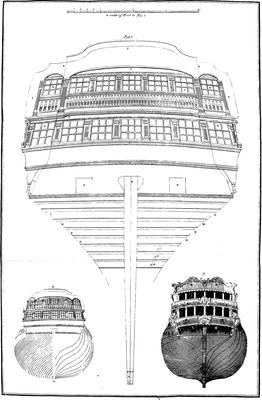
To Face STERN Plate x.
Fig. 2. exhibits a stern view of a 60 gun-ship, with the curve of the frame-timbers on one side, and the disposition of all the planks of the bottom on the other side.
Fig. 3. represents a stern view of a French man of war of 70 guns.
Plate XI. fig. 1. is a stern for a first or second rate: accordingly it is furnished with a middle apartment between the ward-room and the captain’s cabin. This apartment is also furnished with galleries on the stern and quarter. The other parts of it are described in the explanation of fig. 1. in plate X. See also the article Quarter.
Stern-fast, a rope used to confine the stern of a ship or boat to any wharf or jetty-head, &c.
Sternmost, usually implies that part of a fleet of ships which is in the rear, or farthest astern, as opposed to head-most.
Stern-post, etambot, a long straight piece of timber erected on the extremity of the keel, to sustain the rudder, and terminate the ship behind.
This piece, which is expressed by B in the Pieces of the Hull, plate I. ought to be well secured and supported; because the ends of all the lower planks of the ship’s bottom are fixed in a channel, cut on its surface; and the whole weight of the rudder is sustained by it.
The dimensions of the stern-post, or the proportional breadth and thickness, in the different parts of its height, are geometrically delineated in the quarter and stern of a 74 gun-ship, plate VIII. and X. being expressed in both by A B. It is usually marked like the stem, with a scale of feet from the keel upwards, in order to ascertain the draught of water, at that part of the vessel.
The difficulty of procuring a stern-post of sufficient breadth in one piece, has introduced the practice of fixing an additional piece behind it, which is strongly bolted to the former. The hinges, which support the rudder, are accordingly fixed to this latter, which is also tenanted into the keel, and denominated the back of the post, being expressed by E in the pieces of the hull, referred to above. It is half the breadth of the stern-post, at the heel, but diminishes gradually towards the upper end, where it is one third narrower.
The stern-post is strongly attached to the keel by a knee, G, Pieces of the Hull, of which one branch extends along the keel, being scarfed and bolted to the dead-wood, and fore-locked under the keel; whilst the other branch inclines upwards, and corresponds with the inside, or fore part of the stern-post; to which it is also bolted in the same manner.
Stern-sheets, that part of a boat which is contained between the stern and the aftmost, or hindmost, seat of the rowers. It is generally furnished with benches, to accommodate the passengers. See the article Boat.
Stern-way, the movement by which a ship retreats, or falls backward, with her stern foremost.
STEWARD, maitre-valet, an officer in a ship of war, appointed by the purser, to distribute the different species of provisions to the officers and crew; for which purpose he is furnished with a mate, and proper assistants.
STIFF, the quality by which a ship is enabled to carry a sufficient quantity of sail, without hazard of oversetting. See the articles Ballast and Trim.
STINK-POT, pot à feu, an earthen jar, or shell, charged with powder, grenadoes, and other materials of an offensive and suffocating smell. It is frequently used by privateers, in the western ocean, in the attack of an enemy, whom he designs to board; for which purpose it is furnished with a lighted fuse, at the opening or touch-hole. See Boarding.
STIRRUPS. See the article Horse.
STOCKS, a frame erected on the shore of a river, or harbour, whereon to build shipping. It generally consists of a number of wooden blocks, ranged parallel to each other, at convenient distances, and with a gradual declivity towards the water. See Lanching.
STOPPERS, bosses, certain short pieces of rope, which are usually knotted at one, or both ends, according to the purpose for which they are calculated. They are either used to suspend any weighty body, or to retain a cable, shroud, &c. in a fixed position.
Thus, the anchors, when first hoisted up from the ground, are hung to the cat-head, by a stopper attached to the latter, which passing through the anchor-ring, is afterwards fastened to the timber-head, n, fig. 10. plate IV. and the same rope serves to fasten it on the bow at sea; or to suspend it by the ring when it is to be sunk from the ship to the bottom.
The stoppers of the cables have a large knot, and a laniard, at one end, and are fastened to a ring-bolt in the deck, by the other. They are attached to the cable, by the laniard, which is fastened securely round both by several turns passed behind the knot, or about the neck of the stopper; by which means the cable is restrained from running out of the ship, when she rides at anchor. See also Bits and Ring-rope.
The stoppers of the shrouds have a knot and a laniard at each end. They are only used when the shrouds are cut asunder in battle, or disabled by tempestuous weather; at which time they are lashed, in the same manner as those of the cables, to the separated parts of the shroud, which are thereby reunited, so as to be fit for immediate service. This, however, is only a temporary expedient, applied when there is not time or opportunity to refit them, by a more complete operation.
STORE-KEEPER, garde-magasin, an officer in the royal dock-yards, invested with the charge of the principal naval stores; as the sails, anchors, cordage, &c.
Store-room, soute, an apartment, or place of reserve, of which there are several in a ship, to contain the provisions, or stores of a ship, together with those of her officers, during a sea-voyage.
STOWAGE, arrimage, the general disposition of the several materials contained in a ship’s hold, with regard to their figure, magnitude, or solidity.
In the stowage of different articles, as ballast, casks, cases, bales, and boxes, there are several general rules to be observed, according to the circumstances or qualities of those materials. The casks, which contain any liquid, are, according to the sea phrase, to be bung-up and bilge-free, i. e. closely wedged up, in an horizontal position, and resting on their quarters: so that the bilges, where they are thickest, being entirely free all round, cannot rub against each other, by the motion of the vessel. Dry goods, or such as may be damaged by the water, are to be carefully inclosed in casks, bales, cases, or wrappers; and wedged off from the bottom and sides of the ship, as well as from the bows, masts, and pump-well. Due attention must likewise be had to their disposition, with regard to each other, and to the trim and centre of gravity of the ship; so that the heaviest may always be nearest the keel, and the lightest gradually above them. See Ballast, Trim, and Rolling.
STRAIT, etroite, a narrow channel, or arm of the sea, contained between two opposite shores; as the straits of Gibraltar; the straits of Sunda; the straits of Dover, &c.
STRAKES, or STREAKS, the uniform ranges of planks on the bottom and sides of a ship; or the continuation of planks joined to the end of each other, and reaching from the stem, which limits the vessel forward, to the stern-post, and fashion-pieces, which terminate her length abaft. The lowest of these, which is called the garboard-streak, is let into the keel below, and into the stem and stern-post. See those articles.
STRAND, touron, one of the twists, or divisions, of which a rope is composed. See the articles Rope and Cable.
Strand also implies the sea-beach: hence a ship is said to be stranded when she has run a-ground on the sea-shore.
STRETCHER, banquet, a sort of staff fixed athwart the bottom of a boat, for the rower to place his feet against, in order to communicate a greater effort to his oar.
STRETCHING, in navigation, is generally understood to imply the progression of a ship under a great surface of sail, when close-hauled. The difference between this phrase and standing, is apparently in the quantity of sail, which, in the latter, may be very moderate; but in stretching, generally signifies excess: as, we saw the enemy at day-break stretching to the southward, under a crowd of sail, &c.
To STRIKE, in navigation, to run ashore, or to beat upon the ground in passing over a bank or shallow.
To Strike also implies to lower or let down any thing; as an ensign, or topsail, in saluting; or, as the yards and topmasts in tempestuous weather. It is, however, more particularly used to express the lowering of the colours, in token of surrender, to a victorious enemy.
STRING in ship-building, the highest range of planks in a ship’s ceiling; or that which lies between the gunnel, and the upper edge of the upper deck-ports, as expressed by T in the Midship-Frame, plate VII.
To STRIP the masts, defuner, is to unrig a ship, or deprive the masts of their machinery and furniture; an exercise which is otherwise called dismantling.
STROKE, a single sweep of the oars in rowing. Hence they say, Row a long stroke! longue rime! which is intended to push the vessel forward more steddily. See the article Oar; as also the French term Nager, and the phrases following it.
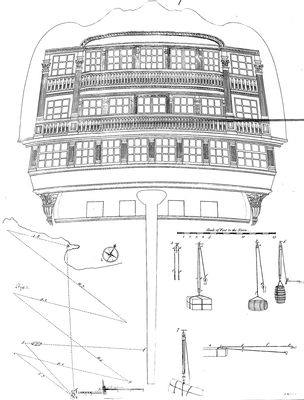
Plate xi. Geometrical Elevation of the Stern of a 1st 2d Rate.
Strokesman, the person who rows the hindmost oar in a boat, and gives the stroke, which the rest are to follow; so that all the oars may operate together.
STROP, etrope, a piece of rope spliced into a circular wreath, and used to surround the body of a block; so that the latter may be hung to any particular station about the masts, yards, or rigging. Thus, fig. 37. and 38. in plate II. represent two block-strops of different sorts. See Block and Eye.
Strops are also used occasionally to fasten upon any large rope, for the purpose of hooking a tackle to the eye, or double part of the strop; in order to extend, or pull with redoubled effort, upon the said rope; as in setting-up the rigging, where one hook of the tackle is fixed in a strop applied to the particular shroud, and the other to its laniard. See the article Laniard.
STUDDING-SAILS, bonettes en etui, certain light sails extended, in moderate and steddy breezes, beyond the skirts of the principal sails, where they appear as wings upon the yard-arms.
The word may be traced from several derivations; as from scud, stead, or steddy. The small sails used by sloops, schooners, and tartanes, when scudding, are nearly of the same size and figure with the lower studding-sails; and the accidental application of the former, to the usual design of the latter, throws a probability on the derivation from scud; especially as being used in the small vessels of our ancestors, who were unacquainted with topmasts; and, of course, had no conception of topmast-studding-sails. An ingenious friend of the author, seems, with greater propriety, to derive it from steddy; because, when the wind is extremely feeble, the fluctuation of the sea, although almost imperceptible, is communicated to the ship, and thence to the principal sails; which, being shaken and slapped against the masts, will, by their weight, prevent, or at least considerably diminish, the operation of the wind. The studding-sails, on the contrary, being of a much lighter and thinner texture, more readily feel the effort of the breeze, and continue inflated, so as to push the ship forward, and give her head-way. By this circumstance, she becomes susceptible of the power of the helm, and is accordingly retained in a steddy course; and hence those sails may originally have been called steddying-sails, afterwards corrupted into studding-sails. The last conjecture, which seems equally favourable, is drawn from the Saxon word sted, to help or assist; in which sense, those sails may be considered as auxiliar, being set occasionally to help the others, or assist the ship’s course; and thence called steading, or stedding-sails. But the expression of steering sails, however adopted by many officers, is a most contemptible conceit, without either authority or reason to support it. The others are implicitly submitted to the reader’s decision.
The topmast studding-sails, or those which are set on the out side of the topsails, are spread below by a boom, which, sliding out from the extremities of the main and fore-yards, as explained in the article Saddle, pushes out their lower corners: and their upper edges, which are attached to a light pole, are hoisted up to the topsail-yard-arms. See also Boom-iron, in the article Iron-work.
The lower studding-sails, which are spread beyond the skirts or leech of the main-sail and fore-sail, are fixed nearly in the same manner; only that the boom, which extends their bottoms, is generally hooked to the chains by means of a goose-neck; or else swings off along with the sail, to which it is suspended; being kept steddy behind by a rope called the guy.
STUFF, courrée, any composition, or melted mass, used to smear or daub the masts, sides, or bottom of a ship. That which is chiefly used for the lower masts is simply turpentine, rosin, or varnish of pine: for the topmasts, tallow or butter: for the sides, turpentine, varnish of pine, tar and oil, or tar mixed with oil and red oker: and for the bottom, a mixture of tallow, sulphur, and rosin, or tar: whale-oil and broken glass; or any part of these ingredients: and this application is called giving a new coat of stuff to the masts, sides, &c.
SUPERCARGO, an officer charged with the accounts of the cargo, and all other commercial affairs in a merchant-ship.
SUPPLY, a fresh recruit of provisions or stores sent to a ship or fleet.
SURF, the swell of the sea which breaks upon the shore, or any rock lying near the surface of the sea.
SURGE, the same with a wave; which see.
SURVEY, an examination made by several naval officers into the state or condition of the provisions, or stores, belonging to a ship, or fleet of men of war.
SURVEYORS of the navy, two officers, who sit at the navy-board, being invested with the charge of building and repairing his Majesty’s ships, at the different dock-yards of the kingdom: for which purpose they are trained to the theory and practice of ship-building. It is also their office to know the state of the navy; to audit the accounts of all boatswains and carpenters serving therein; and to enquire into the condition of all naval stores, at home or abroad, in order to supply whatsoever may be deficient.
SWAB, fauber, (swabb, Swed.) a sort of mop formed of a large bunch of old rope-yarns, and used to clean the decks and cabins of a ship: hence the person, who uses it, is called the swabber.
SWEEPING, draguer, the act of dragging the bight, or loose part of a small rope, along the surface of the ground, in a harbour, or road, in order to hook and recover some anchor, wreck, or other material, sunk at the bottom. It is performed by fastening the two ends of this rope to the sides of two boats which are abreast of each other, at some distance. To the middle of the rope are suspended two cannon-shot, or something which weighs heavy, in order to sink it to the ground; so that, as the boats advance, by rowing ahead, the rope drags along the bottom, to hook any anchor, &c. for which they are searching.
SWELL, enflement, generally denotes an heavy and continued agitation of the waves, according to a particular direction: as there is a great swell setting into the bay. It is, however, more particularly applied to the fluctuating motion of the sea, which remains after the expiration of a storm: as also, to that which breaks on the sea-shore; or upon rocks, or shallows.
SWIFTER, a rope used to confine the bars of the capstern in their sockets, whilst the men are heaving it about; for which purpose it is passed through holes in the extremities of the bars, so as to strain them firmly together like the spokes of a wheel; which is accordingly called swifting. See the article Capstern.
Swifter is also a strong rope, sometimes used to encircle a boat longitudinally, as well as to strengthen and defend her sides, as to enable her the better to resist the impression of other boats which may run against her occasionally. It is usually fixed about a foot under the boat´s upper edge, or gunnel.
Swifters are likewise two shrouds fixed on the starboard and larboard side of the lower masts, above all the other shrouds, as an additional security to the masts. The hoisters are never confined, like the other shrouds, by Cat-harpings. See that article.
To SWING, to turn round the anchors, or moorings, at the change of the wind, or tide: it is usually expressed of a ship, either when she is moored by the head, or riding at a single anchor.
T.
TABLING, bander, a sort of broad hem formed on the skirts and bottoms of a ship’s sails, to strengthen them in that part which is attached to the bolt-rope.
TACK, couet, a rope used to confine the foremost lower-corners of the courses and stay-sails in a fixed position, when the wind crosses the ship’s course obliquely. The same name is also given to the rope employed to pull out the lower corner of a studding-sail or driver to the extremity of its boom.
The main-sail and fore-sail of a ship are furnished with a tack on each side, which is formed of a thick rope tapering to the end, and having a knot wrought upon the largest end, by which it is firmly retained in the clue of the sail. By this means one tack is always fastened to windward, at the same time that the sheet extends the sail to leeward. See Chestree.
Tack is also applied, by analogy, to that part of any sail to which the tack is usually fastened.
A ship is said to be on the starboard or larboard tack, when she is close-hauled, with the wind upon the starboard or larboard side; and in this sense the distance which she sails in that position is considered as the length of the tack; although this is more frequently called a Board. See that article.
To Tack, virer vent devant, to change the course from one board to another, or turn the ship about from the starboard to the larboard tack, in a contrary wind. Thus the ship A, fig. 2. plate XI. being close-hauled on the larboard tack, and turning her prow suddenly to windward, receives the impression of the wind on her head-sails a, by which she falls off upon the line of the starboard tack a. Tacking is also used, in a more enlarged sense, to imply that manœuvre, in navigation, by which a ship makes an oblique progression to the windward, in a zigzag direction. This, however, is more usually called beating or turning to windward. See Beating and Turning.
Thus, suppose a ship A, fig. 2. plate XI. bound to a port B lying to windward, with the wind northerly, as expressed by the arrow. The sails a, b, c, being braced obliquely with the keel, the wind also falls upon their surfaces in an oblique direction, by which the ship is pushed to leeward, as explained in the article Lee-way. Hence, although she apparently sails W. N. W. upon the larboard tack, as expressed in the dotted line A d, and E. N. E. upon the other d f, yet if the lee-way is only one point, (and indeed it is seldom less in the smoothest water), the course will accordingly be W. by N. upon one tack, and E. by N. upon the other, as represented by the lines A e, and e g.
If the port A were directly to windward of the ship, it is evident that both tacks ought to be of equal length; or, in other words, that she ought to run the same distance upon each tack: but as the place of her destination lies obliquely to windward, she must run a greater distance upon one tack than the other; because the extremities of both boards should be equally distant from the line of her true course B A; so the larboard tack A e, crossing the course more obliquely than the other e g, will necessarily be much longer.
As the true course, or the direct distance from B to A, is only 12 leagues, it is evident, that with a favourable wind she could reach it in a few hours. On the contrary, her distance is considerably increased by the length of her boards, in a contrary wind; which, by its obliquity with her sails, operates also to retard her velocity. Thus her first board A e, on a W. by N. course, is equal to 5.7 leagues. The second tack e g is 9.2 leagues E. by N.: the third tack, parallel to A e, is 11.5: the fourth, parallel to e g, is 9.2: and the fifth, parallel to the first, 11.7 leagues. Finally, the sixth board is 4.8 leagues, parallel to the second, which brings her to the port B. By this scheme it appears that she has run more than four times the extent of the line A B, her primitive distance; and this in the most favourable circumstances of a contrary wind, viz. when the sea is smooth, and when she may carry her full topsails. For if the wind blows stronger, to render it necessary to reef the topsails, she will soon make two points of lee-way, and accordingly run east on one board, and west on the other. In this situation she will neither approach, nor recede from the place of her destination: but if the wind increases, the sea will also be enlarged; a circumstance that still farther augments the lee-way. Hence the vessel will gradually fall off from the port, in proportion to the augmentation of the wind and sea, which occasions a proportional increase of lee-way.
In order to explain the theory of tacking a ship, it may be necessary to premise a known axiom in natural philosophy, That every body will persevere in a state of rest, or of moving uniformly in a right line, unless it be compelled to change its state by forces impressed; and that the change of motion is proportional to the moving force impressed, and is made according to the right line in which that force is exerted.
By this principle it is easy to conceive how a ship is compelled to turn into any direction, by the force of the wind acting upon her sails, in horizontal lines. For the sails may be so arranged as to receive the current of air, either directly, or more or less obliquely: hence the motion communicated to the sails must of necessity conspire with that of the wind upon their surfaces. To make the ship tack, or turn round with her head to the windward, it is therefore necessary, after she has received the first impression from the helm, that the head-sails should be so disposed as to diminish the effort of the wind, in the first instant of her motion, and that the whole force of the wind should be exerted on the after-sails, which operating on the ship’s stern, carries it round like a weather-cock. But since the action of the after-sails, to turn the ship, will unavoidably cease when her head points to the windward, it then becomes necessary to use the head-sails, to prevent her from falling-off, and returning to her former situation. These are accordingly laid aback on the lee-side, to push the vessel’s fore-part towards the opposite side, till she has fallen into the line of her course thereon, and fixed her sails to conform with that situation.
It has been observed above, that the first effort to turn the ship in tacking is communicated by the helm, which is then put to the lee-side. This circumstance being announced by the pilot, or commanding-officer, who then calls out, Helm’s a-lee! the head-sails are immediately made to shiver in the wind, by casting loose their sheets, or bowlines. The pilot then calls, Up tacks and sheets! which is executed by loosening all the ropes which confine the corners of the lower sails, in order that they may be more readily shifted to the other side. When the ship has turned her head directly to windward, as in d, fig. 2. plate XI. the pilot gives the order to turn about the sails on the main and mizen masts, by the exclamation, Haul main-sail, haul! the bowlines and braces are then instantly cast off on one side, and as expeditiously drawn in on the other side, so as to wheel the yards about their masts: the lower corner of the main-sail is, by means of its tack, pulled down to its station at the chestree; and all the after-sails are, at the same time, adjusted to stand upon the other board. Finally, when the ship has fallen off five or six points, as h, fig. 2. plate XI. the pilot cries, Haul of all! or, Let go, and haul! the sails on the fore-mast are wheeled about by their braces: and as the ship has then a tendency to fall off, she is checked by the effort of the helm, which for that purpose is put hard a-lee. The fore-tack, or the lower corner of the fore-sail, being fixed in its place, the bowlines are hauled; and the other sails, which have been neglected in the hurry of tacking, are properly arranged to the wind, which exercise is called trimming the sails. See Lee-way and Sailing.
TACKLE, palan, pronounced taicle, a machine formed by the communication of a rope with an assemblage of blocks, and known in mechanics by the name of pulley.
Tackles are used in a ship to raise, remove, or secure weighty bodies; to support the masts; or to extend the sails and rigging. They are either moveable, as communicating with a runner; or fixed, as being hooked in an immoveable station; and they are more or less complicated, in proportion to the effects which they are intended to produce.
If a b d e, fig. 3. plate XI be a single block, upon which are suspended the weights f g, then since the nearest distance of the ropes f g, from the center of motion c, are a c equal to d c, the block will be reduced to the lever or balance a d with respect to its power: Since a c is then equal to d c, it is apparent that f g will always be in equilibrium. As no advantage therefore can be acquired, in raising a weight by an immoveable single block, it is only rendered useful by changing the direction of the moving power. This circumstance is extremely convenient to the labourers, and often absolutely necessary; particularly in raising bodies to a higher station; as from the hold to the upper decks, or from the deck to the masts or yards, &c. which would otherwise be difficult or impracticable to perform. See also the articles Block and Whip.
When a single block is moveable along with the body to which it is attached, fig. 4. plate XI. as the blocks of the brace-pendants, reef-tackle pendants, jiggers, &c. the momentum of the power is doubled; because it moves twice as fast as the weight, or body to which it is attached. For in the same time that any part of the rope f, moves upward from f to g, equal in length to the two equal ropes d and c, the block, and consequently the weight annexed, will be drawn through the space e h, whose length is equal to one of the ropes only.
When a tackle consists of two or more fixed and moveable blocks, wherein one rope communicates with the whole; if one end of the rope be fixed, as in fig. 5. 6. and 7. in order to proportion the weight to the resistance, the power applied must be to the weight, as one, to twice the number of sheaves in the moveable blocks: because, in the efforts of a tackle, the velocity of the moving power is, to the velocity of the rising or moving body, as twice the number of moveable sheaves to unity, as appears in fig. 5. which consists of one fixed block a, and another moveable as e. For since one rope operates on all the sheaves from g to f, the part at f, lying beyond the fixed block, and called the fall, cannot be drawn down and lengthened, unless the two parts d and c, on each side of the moveable block, be at the same time equally drawn up and shortened. Hence it is evident, that the part a f will be lengthened twice as much as either d or c is shortened, because whatever is taken from each of those parts is added to the length of a f; but the point f, to which the power is applied, descends as fast as a f is lengthened and the point e, to which the weight is fastened, ascends as fast as d or c is shortened. If therefore, a weight suspended at f, be to a weight suspended at e, as one to two, they will balance each other, as being in the reciprocal ratio of their velocities.
Whatever has been observed with regard to the tackles above mentioned, is equally applicable to all others, and is in the same manner demonstrable, viz. that the velocity with which the mechanical force moves, in raising a weight, is to the velocity wherewith the weight rises, as twice the number of moveable sheaves to unity.
A tackle wherein both the blocks are moveable, and communicate with a runner, is represented by fig. 10. plate VIII. That part of the tackle which is fixed to one of the blocks, &c. is called the standing part; all the rest are called running parts; and that whereon the men pull when employing the tackle, is called the fall. The application of the tackle to mechanical purposes is termed hoisting or bowssing. See those articles.
Ground Tackle. See Ground Tackle.
Tack-tackle, a small tackle used occasionally to pull down the tack of the principal sails of a ship to their respective stations. There is also a tackle of this kind constantly fixed to the tacks of the main-sail in brigs, sloops, and schooners, for the same purpose. See the French term Palan, and the phrases annexed thereto.
TAFFAREL, couronnement, the upper part of a ship’s stern, being a curved piece of wood, expressed by F F, in fig. 1. plate X. and usually ornamented with sculpture.
TAIL, a name given by sailors to the extremities of a hurricane, wherein the violence is considerably exhausted.
Tail-block, a small single block, having a short piece of rope attached to it, by which it may be fastened to any object at pleasure; either for convenience, or to increase the force applied to the said object, as explained in the first part of the article Tackle.
TAKING-IN, the act of brailing-up and furling the sails at sea, particularly when the wind increases. It is generally used in opposition to setting. See also Furl and Shorten.
TALLYING, border, a phrase used by the common sailors, implying the act of pulling aft the sheets, or lower corners of the main-sail and fore-sail.
TAR, a sort of liquid gum, of a blackish hue, which distils from pines or fir-trees, either naturally or by incision; and being prepared by boiling, is used to pay the sides of ships and boats, and their rigging, in order to preserve them from the effects of the weather, by which they would otherwise soon become cracked, split, or rotten.
Tar is also a figurative expression for a sailor of any kind.
Tar-pawling, prélart, a broad piece of canvas well daubed with tar, and used to cover the hatchways of a ship at sea, to prevent the penetration of the rain, or sea-water, which may occasionally rush over the decks. See Battens.
TARTAN, (tartana, Ital.) a small coasting vessel navigated in the Mediterranean sea, and having only one mast and a bowsprit, the principal sail, which is extremely large, being extended by a lateen-yard. See Vessel.
TAUGHT, roide, (dicht, Dutch) the state of being extended or stretched out. It is usually applied to a rope or sail, in opposition to slack.
TAUNT, foit, an epithet used, in the sea-language, to signify high or tall. It is peculiarly expressed of the masts when they are of an extraordinary length, as square is applied to the yards on the same occasion.
TENDER, patache, a small vessel employed in the King’s service, on various occasions; as, to receive volunteers and impressed men, and convey them to a distant place; to attend on ships of war or squadrons; and to carry intelligence or orders from one place to another, &c.
TENDING, the movement by which a ship turns or swings round her anchor in a tide-way, at the beginning of the flood or ebb. Thus, if the flood sets northerly, it is evident that the ship, unless when moored head and stern, will fall into the line of the current, turning her head to the southward. But as the reflux will for the same reason set to the southward, the ship will of necessity turn about at the change of the tide, and carry her head to the northward; and the transition from one situation to the other is called tending or swinging.
TENON, the end of a piece of timber cut smaller to enter into a mortise.
THIMBLE, cosse, a sort of iron ring, whose outer surface is hollowed throughout its whole circumference, in order to contain, in the channel or cavity, a rope which is spliced about it, and by which it may be hung in any particular station. See plate XII. fig. 1. It is used to guide the direction of some running rope, which passes through it, from one place to another. See Span.
THOLES, (tholet, Fr.) certain small pins driven perpendicularly into the upper edge of a boat, as expressed by e, fig. 1, plate III. In the exercise of rowing, the oar is contained between the two tholes, in the space which is called the row-lock. Sometimes there is only one pin to each oar, as in the boats navigated on the Mediterranean sea. In that case the oar is hung upon the pin by means of a strop; and indeed this method is much more ancient than the former. See the article Rowing.
THROAT, a name given to the inner end of a gaff, or to that part which is next to the mast. It is opposed to peek, which implies the outer extremity of the said gaff, or that part of it which extends the sail behind. Hence the ropes employed to hoist up, and lower a gaff, being applied to those parts of it, are called the throat and peek haliards. See Haliards.
THUS! the order by which the pilot directs the helmsman to keep the ship in her present situation when sailing with a scant wind; so that she may not approach too near the direction of the wind, and thereby shiver her sails, nor fall to leeward, and run farther out of her course. See Steering.
THWART, banc, the seat or bench of a boat whereon the rowers sit to manage the oars.
Thwart-ships, across the ship. See the article Athwart.
TIDE, marée, (tyd, Sax.) a regular periodical current of the water, setting alternately in a flux and reflux, produced by the influence of the moon.
If the ocean were equally deep in every place, the ebbing and flowing of the tide would be universally regular and equal; but the shallowness of the water in many places, and the streightness of the channels, by which the tides may be considerably interrupted in some parts, and propagated in others, occasion a great diversity in their force and quantity. Hence, without an exact knowledge of all the circumstances of the several places where they happen to run, as of the position of the land, the breadth and depth of channels; it is impossible to account for this diversity.
The theory of the tides is concisely described by a great author, in these words: “That motion of the water called tides is a rising and falling of the sea: the cause of this is the attraction of the moon, whereby the part of water in the great ocean which is nearest the moon, being most strongly attracted, is raised higher than the rest; and the part opposite to it being least attracted, is also higher than the rest; and these two opposite elevations of the surface of the water in the great ocean, following the motion of the moon from est to west, and striking against the large coasts of the continents, from thence rebounds back again, and so makes floods and ebbs in narrows, seas, and rivers.” Locke.
With regard to the relative force of the tide on a ship floating therein, it is already explained in the article Current.
TIER, batterie, a name given to the range of cannon mounted on one side of a ship’s deck. See the articles Deck and Cannon.
Tier of the cable, is a range of the fakes or windings of the cable, which are laid within one another in an horizontal position, so as that the last becomes the innermost. See Coiling.
Cable-Tier is the hollow space in the middle of a cable, when it is coiled.
TIGHT, (dicht, Dutch) the quality whereby a vessel resists the penetration of any fluid, whether compressing its surface, or contained within it. Hence a ship is said to be tight, when her planks are so compact and solid as to prevent the entrance of the water in which she is immersed: and a cask is called tight, when the staves are so close that none of the liquid contained therein can issue through or between them. In both senses it is opposed to leaky, which see.
TILLER, timon, or barre de gouvernail, the bar or lever employed to turn the rudder in steering. See the article Helm.
TILT, tendelet, (tyld, Sax.) a small canopy or awning of canvas, or other cloth, extended over the stern-sheets of a boat, and supported by small pillars, or broad laths of flexible wood incurvated into arches. It is used to cover the passengers from the rain or sunshine. See Boat.
TIMBERS, couples, the ribs of a ship, or the incurvated pieces of wood, branching outward from the keel in a vertical direction, so as to give strength, figure, and solidity to the whole fabric.
It has been observed in the article Naval Architecture, that one timber is composed of several pieces united into one frame, which is accordingly called a frame of timbers by the artificers. These different pieces are exhibited in plate I. Pieces of the Hull, by U, V, and W. The head of the lower piece, called the floor-timber, being cut square, to join the heel of the next above it. To support the connection of the timber in that place, another assemblage of pieces are formed, and joined in the same manner; so that when both the sets are fastened together, the joinings in one set will be nearly opposite to the middle of the pieces in the other. Hence it is evident, that the mould which serves for the lowest piece will conform to the under part of the corresponding piece above it: and thus the mould, appropriated to every division of a timber, will determine, or answer to the figure of the next adjoining thereto.
The timbers whose areas or planes are perpendicular to the keel, are called square timbers; and those which are placed obliquely on the keel, as at the extremities of a ship, are called cant-timbers. The foremost of those pieces on the ship’s bow, are called the knuckle-timbers; and the hindmost on the quarter are called the fashion-pieces.
The outlines, or bends of the principal timbers of the ship are geometrically delineated in the plane of projection, plate I. as also in plate IV. fig. 11. and plate X. fig. 2.: and their particular stations in the ship’s length are represented in the horizontal plane, and that of the elevation, plate I. In order to give a more comprehensive idea of their figures and dimensions, we have exhibited a perspective view of the carcase of a small vessel, in plate XII. fig. 2. consisting only of the keel A, the stern-post B, the stem C, the transoms K L M, and the ribbands F F.
Timber and room, or room and space, is the alliance betwixt the moulding edge of two adjoining timbers, which must always contain the breadth of two timbers; and sometimes two or three inches between them. It must be observed, that one mould serves for two timbers; the fore side of the one being supposed to unite with the after side of the other, and so make only one line; which is actually the case in all the frames, which in some ships are every third, and in others every fourth timber. The frames are first put up, and fastened to the ribbands, and afterwards the others are put up, which are called fitting-timbers. Murray’s ship-building.
TIMONEER, (timonier, Fr.) the helmsman, or person who manages the helm to direct the ship’s course. See the article Steering.
In a ship of war the quarter-masters and timoneers are usually chosen by the master, to cun and steer the ship; as also, to stow the provisions in the hold, coil the cables, regulate the watch, &c. See Quarter-master.
TOGETHER! accord, the order given to the men in the exercises of heaving, rowing, holding, &c. to act all in concert, or at the same instant.
TOGGEL, cabillot, a small wooden pin, about five or six inches in length, and usually tapering from the middle towards the extremities. It is used to fix transversely in the lower part of a tackle, in which it serves as an hook whereby to attach the tackle to a strop, slings, or any body whereon the effort of the tackle is to be employed.
There are also toggels of another kind, employed to fasten the top-gallant sheets to the span, which is knotted round the cap at the top-mast-head. For as the lifts of the topsail-yard are out of use when the topsail is hoisted, they are always converted into top-gallant sheets, to render the rigging at the mast-heads as light and simple as possible. Before the topsail-yards can be lowered so as to be sustained by their lifts, it therefore becomes necessary to transfer that part of the lift to the top-mast-head, that so the whole weight of the yard may be sustained by its mast-head, and no part thereof by the top-gallant-yard, which would otherwise be the case. This is performed by fixing the double part, or bight of the lift, within the eye of the span above mentioned, and inserting the toggel through the former, so as to confine it to the latter, which operation is amongst sailors called putting the sheets in the beckets.