AN UNIVERSAL DICTIONARY OF THE MARINE. (continued 8)
Reading edition
A Table of Velocities.
12 15 18 21 24 27 30 36
¼ 1043 1052 1058 1063 1066 1068 1071 1074
⅓ 1186 1200 1210 1217 1222 1224 1229 1234
½ 1406 1434 1452 1465 1475 1482 1488 1497
⅔ 1568 1613 1641 1662 1677 1688 1698 1711
“We made use of the diameter of a 9 pound shot, which being 4 inches, is more convenient in the calculation; and this diameter expresses the height of the charge when it is a quarter of the weight of the shot, and the rest in proportion.
“Several remarks may be made upon this table, which are of great importance in the construction of cannon. First, when the charge is but a quarter of the shot’s weight, the difference between the velocities, when the length is 12 and 15 diameters, is but 9 feet in a second; and the differences between the other velocities decrease as the length increases.
“Hence, as the difference between the velocities when the piece is 15 and 36 diameters long, is but 22 feet in a second, it is easily perceived, that when the pieces are charged with one quarter of the shot’s weight, the length from 12 to 15 diameters is the best.
“Secondly, When the charge is one third of the shot’s weight, the difference of the velocities, when the piece is 12, 15, and 18 diameters long, are 14, 10 seconds; and from thence decrease more and more, as the length of the piece increases: so the length, from 15 to 18 diameters seems to be the best, every thing being considered.
“Thirdly, and lastly, it appears, from the same manner of reasoning, that when the charge is one-half of the shot’s weight, the length ought to be from 18 to 21 diameters; and when the charge is two thirds of the shot’s weight, the length ought to be from 21 to 24 diameters.” Muller’s Artillery.
As one of the effects of the bomb results from its weight, the range of mortars is extremely different from that of cannon, because the former is not pointed at a certain object, like the latter, but inclined to the horizon at a certain angle; so that the bomb, being thrown up obliquely, much in the same direction as a tennis-ball struck by the racket, may fall upon the place intended. Hence it appears that the mortar has no point-blank range, or at least that no use is made of it.
The mortar, being fixed in a situation obliquely with the horizon, so as that the line a c, which passes through the middle of it longitudinally, being continued, would make an angle b a d with the horizon a b; a bomb, discharged in the direction of this continued line, would deviate from it every instant of its motion by its weight, which inclines it downwards, and by this means it would describe a curve-line, as a e b, called a parabola[49].
The line a b, fig. 19. plate VI. is called the extent of the range, or the amplitude of the parabola; and the line a d, the elevation of the mortar.
To make a bomb fall on a given place, two things are to be considered; viz. the elevation of the mortar; and the quantity of powder used to charge it; both of which may be ascertained as follows: A bomb discharged from a mortar, pointed vertically, will describe a line nearly perpendicular to the horizon: I say nearly, because the mortar will always have some little motion, which will destroy the exact perpendicularity of the bomb’s flight; but abstracted from this, a bomb, discharged vertically, would fall again into the mortar[50].
If the mortar be afterwards inclined more and more towards the horizon, the bomb will fall still farther and farther distant from the mortar, till the elevation rests at 45°; and the more the mortar is pointed under this angle, the more will the range of the bomb be diminished: all of which is strictly demonstrated by geometry. But the following is a very simple manner of conceiving it, without having recourse to that science.
A bomb, discharged in the direction of a line, nearly perpendicular to the horizon, will fall at a little distance from the bomb-vessel. This requires no proof. A bomb, thrown according to a line that makes a very acute angle with the horizon, will presently come to the ground by its weight, and by consequence will not, any more than the other, fall at a considerable distance from the mortar.
Hence it is easy to conceive, that in order to fall at the greatest distance from the mortar, the bomb must be fired according to an elevation at the greatest possible distance, as well from a vertical, as from an horizontal line. This elevation divides in two equal parts the angle formed by the vertical and horizontal lines, which being of 90 degrees, or what is called a right angle, a bomb will be thrown to the greatest distance, in the direction of a line making an angle of 45 degrees. For above this angle the range will diminish, because the bomb approaches the vertical line; and under the same elevation it will also decrease, because the flight of the bomb approaches the horizontal line.
Hence also it appears that there are two angles, according to which a mortar may be inclined to make the bomb fall on the same place; these are the angles, equally distant from the line, which cuts the quadrant into two equal parts: so that if, for example, a mortar is elevated at 30°, the bomb will fall at the same distance as if it had been elevated at 60°, each of these angles being 15° distant on this, and that side of the quadrant; that is, from the angle of 45 degrees.
The second thing to be considered, is, to know the exact charge of powder necessary to throw a bomb to a given distance.
If the bomb, being fired at an elevation of 45°, falls short of the place intended, the charge of powder must be increased. If it reaches the place, or goes beyond it, it is evident that the charge is sufficient. If the bomb, at an elevation under 45°, fall short of the place intended, with a given charge, the mortar must be more elevated: if, on the contrary, it falls too far off, it must be more inclined to the horizon: and by these essays the proper degree of inclination may be easily and speedily discovered.
If the mortar then is raised above 45°, it must be more inclined, so as to make a more acute angle with the horizon, to increase the range of the bomb; and, on the contrary, raised nearer a perpendicular, to diminish it: all of which are consequences drawn from what has been said on this subject.
It must be observed, first, that the greatest distance to which a bomb can be thrown, with the strongest charge, is little more than about 1800, or 2000 fathoms.
Secondly, that though a mortar may be elevated indifferently, either so much above or below 45° as to carry a bomb to a given distance, yet when any building is to be destroyed, it should be raised above 45°, because the shell, rising to a greater height when fired according to a greater angle, falls with greater force, and by consequence will do more damage to the place on which it is thrown. But when the business is to fire on a body of men, the mortar must be pointed below 45°, that the bomb may not have force enough to enter far into the ground, and that the splinters in the explosion may do more execution.
Practice for Sea-Mortars.
Nature of the Mortar.
13 Inch. Powder. 10 Inch. Powder. Flight in Seconds. Ranges in Yards. Length of Composition in Fuses.
lb. oz. lb. oz. Inches Parts
3 0 12 612 2 64
4 0 1 12 14 832 3 8
2 4 15 958 3 30
5 0 2 6 16 1088 3 52
5 8 2 8 17 1299 3 74
3 2 18 1377 2 96
7 0 3 8 19 1534 4 18
4 0 20 1700 4 40
8 12 4 8 21 1874 4 62
9 0 5 8 22 2057 4 84
12 0 23 2248
14 24 2448
16 25 2656
18 8 2 26 2873 5 72
20 0 8 10 27 3098 5 94
22 0 9 8 28 3332 6 16
24 8 11 4 29 3574 6 38
28 0 12 0 30 3821 6 60
31 8 31 4085 6 82
The ranges of mortars, at the several elevations below, are in proportion to one another, viz.
45 40 35 30 25 20 15 10 5
100 98 94 86 76 64 50 34 17
Example. Knowing the range of a shell at 45 to be 890 yards, required the range at 30 with the same powder; say, as 100 : 86 : : 890 : 765.4; and if you have a shell’s range at 30, and would know how far it will go at 45 with the same quantity of powder, rule as 86 : 100 : : 765.4 : 890.
N. B. These propositions only hold good when the powder is equal.
RATES, the orders or classes into which the ships of war are divided, according to their force and magnitude.
It has already been observed, in the article Navy, that this regulation, which limits the rates of men of war to the smallest number possible, seems to have been dictated by considerations of political œconomy, or of that of the simplicity of the service in the royal dock-yards. The British fleet is accordingly distributed into six rates, exclusive of the inferior vessels that usually attend on naval armaments; as sloops of war, armed ships, bomb-ketches, fire-ships and cutters, or schooners commanded by lieutenants.
Ships of the first rate mount 100 cannon, having 42 pounders on the lower deck, 24 pounders on the middle deck, 12 pounders on the upper deck, and 6 pounders on the quarter deck and forecastle. They are manned with 850 men, including their officers, seamen, marines, and servants.
In general, the ships of every rate, besides the captain, have the master, the boatswain, the gunner, the chaplain, the purser, the surgeon, and the carpenter; all of whom, except the chaplain, have their mates or assistants, in which are comprehended the sail-maker, the master at arms, the armorer, the captain’s clerk, the gunsmith, &c.
The number of other officers are always in proportion to the rate of the ship. Thus a first rate has six lieutenants, six master’s mates, twenty-four midshipmen, and five surgeon’s mates, who are considered as gentlemen; besides the following petty officers: quarter-masters, and their mates, fourteen; boatswains mates and yeomen, eight; gunners mates and assistants, six; quarter-gunners, twenty-five; carpenters mates, two, besides fourteen assistants; with one steward, and steward’s mate to the purser.
If the dimensions of all ships of the same rate were equal, it would be the simplest and most perspicuous method to collect them into one point of view in a table; but as there is no invariable rule for the general dimensions, it must suffice to remark those of some particular ships in each rate; for which purpose we have selected some of the latest construction.
The Victory, which is the last built of our first rates, is 222 feet 6 inches in length, from the head to the stern; the length of her keel, 151 feet 3 inches; that of her gun-deck, or lower deck, 186 feet; her extreme breadth is 51 feet 10 inches; her depth in the hold, 21 feet 6 inches; her burthen 2162 tons; and her poop reaches 6 feet before the mizen-mast.
Ships of the second rate carry 90 guns upon three decks, of which those on the lower battery are 32 pounders; those on the middle, 18 pounders; on the upper-deck, 12 pounders; and those on the quarter-deck, 6 pounders, which usually amount to four or six. Their complement of men is 750, in which there are six lieutenants, four master’s mates, twenty-four midshipmen, and four surgeon’s mates, fourteen quarter-masters and their mates, eight boatswain’s mates and yeomen, six gunner’s mates and yeomen, with twenty-two quarter-gunners, two carpenter’s mates, with ten assistants, and one steward and steward’s mate.
Ships of the third rate carry from 64 to 80 cannon, which are 32, 18, and 9 pounders. The 80–gun ships however begin to grow out of repute, and to give way to those of 74, 70, &c. which have only two whole batteries; whereas the former have three, with 28 guns planted on each, the cannon of their upper-deck being the same as those on the quarter-deck and fore-castle of the latter, which are 9 pounders. The complement in a 74 is 650, and in a 64, 500 men; having, in peace, 4 lieutenants, but in war, 5; and when an admiral is aboard, 6. They have 3 master’s mates, 16 midshipmen, 3 surgeon’s mates, 10 quarter-masters and their mates, 6 boatswain’s mates and yeomen, 4 gunner’s mates and yeomen, with 18 quarter-gunners, 1 carpenter’s mate, with 8 assistants, and 1 steward and steward’s mate under the purser.
Ships of the fourth rate mount from 60 to 50 guns, upon two decks, and the quarter-deck. The lower tier is composed of 24 pounders, the upper tier of 12 pounders, and the cannon on the quarter-deck and fore-castle are 6 pounders. The complement of a 50 gun ship is 350 men, in which there are three lieutenants, 2 master’s mates, 10 midshipmen, 2 surgeon’s mates, 8 quarter-masters and their mates, 4 boatswain’s mates and yeomen, 1 gunner’s mate and 1 yeoman, with 12 quarter-gunners, 1 carpenter’s mate and 6 assistants, and a steward and steward’s mate.
All vessels of war, under the fourth rate, are usually comprehended under the general name of frigates, and never appear in the line of battle. They are divided into the 5th and 6th rates, the former mounting from 40 to 32 guns, and the latter from 28 to 20. The largest of the fifth rate have two decks of cannon, the lower battery being of 18 pounders, and that of the upper-deck of 9 pounders; but those of 36 and 32 guns have only one complete deck of guns, mounting 12 pounders, besides the quarter-deck and fore-castle, which carry 6 pounders. The complement of a ship of 44 guns, is 280 men and that of a frigate of 36 guns, 240 men. The first has 3, and the second 2 lieutenants; and both have 2 master’s mates, 6 midshipmen, 2 surgeon’s mates, 6 quarter-masters and their mates, 2 boatswain’s mates and 1 yeoman, 1 gunner’s mate and 1 yeoman, with 10 or 11 quarter-gunners, and 1 purser’s steward.
Frigates of the 6th rate carry 9 pounders, those of 28 guns having 3 pounders on their quarter-deck, with 200 men for their complement; and those of 24, 160 men; the former has 2 lieutenants, the latter, 1; and both have 2 master’s mates, 4 midshipmen, 1 surgeon’s mate, 4 quarter-masters and their mates, 1 boatswain’s mate and 1 yeoman, 1 gunner’s mate and 1 yeoman, with 6 or 7 quarter-gunners, and 1 purser’s steward.
The sloops of war carry from 18 to 8 cannon, the largest of which have 6 pounders; and the smallest, viz. those of 8 and 10 guns, 4 pounders. Their officers are generally the same as in the 6th rates, with little variation; and their complements of men are from 120 to 60, in proportion to their force or magnitude.
N. B. Bomb-vessels are on the same establishment as sloops; but fire-ships and hospital-ships are on that of fifth rates.
Having already exhibited the dimensions of the largest first rate in our navy, we have, in the following table, collected those of the inferior rates:
Rates. Guns. Length of the keel. Length of the lower deck. Extreme breadth. Depth in the hold. Burthen in tons.
Feet. Inch. Feet. Inch. Feet. Inch. Feet. Inch.
2d rate, Barfleur, 90 144 ¾ 177 6 50 21 1934
3d rate, Arrogant, 74 138 168 3 47 4 19 9 1644
Europa, 64 139 159 44 4 19 4 1366
4th rate, Salisbury, 50 120 8 146 40 4 17 4 1044
5th rate, Phœnix, 44 116 11 140 9 37 1⅜ 16 856
Venus, 36 106 3 128 4½ 35 9 12 4 722
6th rate, Carysfort, 28 97 3½ 118 4 33 8 10 6 586
Dolphin, 24 93 4 113 32 1 11 511
Sloop, Nautilus, 16 80 7⅝ 98 27 2 12 8 316
Nothing more evidently manifests the great improvement of the marine art, and the degree of perfection to which it has arrived in England, than the facility of managing our first rates; which were formerly esteemed incapable of government, unless in the most favourable weather of the summer. In testimony of this observation we may, with great propriety, produce the example of the Royal George, which, during the whole course of the late war, was known to be as easily navigated, and as capable of service, as any of the inferior ships of the line, and that frequently in the most tempestuous seasons of the year. The ingenious M. Du Hamel, who is eminently distinguished for his knowledge of marine affairs, has indeed judiciously objected to the defects and bad qualities of such large ships[51]. It is nevertheless hardly possible for any Englishman, who was witness to the defeat of M. Conflans, by the victorious Sir Edward Hawke, on the ever-memorable 20th of November, without dissenting a while from that gentleman’s opinion. In reality, a fact, confirmed by repeated experience, must unavoidably triumph over all theoretical conclusions.
Ships of the second rate, and those of the third, which have three decks, carry their sails remarkably well, and labour very little at sea. They are excellent in a general action, or in cannonading a fortress. Those of the third rate, which have two tiers, are fit for the line of battle, to lead the convoys and squadrons of ships of war in action, and in general, to suit the different exigencies of the naval service.
The fourth rates may be employed on the same occasions as the third rates, and may be also destined amongst the foreign colonies, or on expeditions of great distance; since these vessels are usually excellent for keeping and sustaining the sea.
Vessels of the fifth rate are too weak to suffer the shock of a line of battle; but they may be destined to lead the convoys of merchant-ships, to protect the commerce in the colonies, to cruize in different stations, to accompany squadrons, or be sent express with necessary intelligence and orders. The same may be observed of the sixth rates.
The frigates, which mount from 28 to 38 guns upon one deck, with the quarter-deck, are extremely proper for cruizing against privateers, or for short expeditions, being light, long, and usually excellent sailers.
RATTLINGS, enflechures, certain small lines which traverse the shrouds of a ship horizontally, at regular distances from the deck, upwards, and forming a variety of ladders, whereby to climb to any of the mast-heads, or descend from them. Hence the term is apparently derived from rath, an obsolete word, signifying an hill.
In order to prevent the rattling from slipping down by the weight of the sailors, they are firmly attached by a knot, called a clove-hitch, to all the shrouds, except the foremost or aftmost; where one of the ends, being fitted with an eye-splice, is previously fastened with twine or packthread.
REACH, (ræcan, Sax.) the line, or distance, comprehended between any two points or stations on the banks of a river, wherein the current flows in a streight uninterrupted course.
REAR, (arriere, Fr.) a name given to the last division of a squadron, or the last squadron of a fleet, and which is accordingly commanded by the third officer of the said fleet or squadron. See the article Division.
REEF, ris, (reef, Dutch) a certain portion of a sail, comprehended between the top or bottom, and a row of eyelet-holes parallel thereto.
The intention of the reef is to reduce the surface of the sail in proportion to the increase of the wind; for which reason there are several reefs parallel to each other in the superior sails, whereby they may be still farther diminished, in order to correspond with the several degrees of the gale. Thus the top-sails of ships are usually furnished with three reefs, l m n, fig. 1. plate IX. parallel to the yard; and there are always three or four reefs, parallel to the bottom on those main-sails and fore-sails, which are extended upon booms: a circumstance common to many of the small vessels.
Reef also implies a chain of rocks, lying near the surface of the water.
REEF-BAND, a piece of canvas, sewed across the sail, to strengthen it in the place where the eyelet-holes of the reefs are formed.
REEFING, the operation of reducing a sail, by taking in one or more of the reefs, which is either performed by lines, points, or knittles.
Thus the top-sails are always, and the courses generally, reefed with points, which are flat braided pieces of cordage, whose lengths are nearly double the circumference of the yard. These being inserted in the eyelet-holes, are fixed in the sail by means of two knots in the middle, one of which is before, and the other behind the reef-band.
In order to reef the top-sails with more facility and expedition, they are lowered down and made to shiver in the wind, which considerably relaxes their tension. The extremities of the reef are then drawn up to the yard-arms by an assemblage of pullies communicating with the deck, termed the reef-tackle; and they are securely fastened to the yard-arms by small cords, called earings. The space of sail, comprehended in the reef, is then laid smoothly over the yard, in several folds, or doubles: and the whole is completed by tying the points about the yard, so as to bind the reef close up to it.
The courses of large ships are either reefed with points or small cords, which are thence called reef-lines. In the latter case the line is passed spirally through the eyelet-holes of the reef, and over the head of the sail alternately, and afterwards strained as tight as possible. It must be observed, however, that the reef-line is sometimes passed round the yard, and sometimes only round the head of the sail; and each of these methods have their advocates, with arguments more or less convincing. But if it should appear essential to prevent the friction by which a sail is galled between the line and the yard; and as the rope-bands are sufficient to sustain the effort of the sail, it is certainly much better to pass the line only round the sail, provided that the turns are inserted through the roband-legs; a circumstance which is carefully practised by every skilful sailor.
The same reason may be alledged, with equal propriety, in favour of tying the points of the courses in the same manner; that is to say, the after-end of the point should be thrust forward between the head of the sail and the yard; and the fore-leg of the said point should come aft over the head of the sail, and also under the yard: and thus crossed over the head of the sail, the point should be extended, and the two ends brought over the yard, and tied on the upper side of it as strait as possible.
When a sail is reefed at the bottom, it is done by knittles, which being thrust through the eyelet-holes thereof, are tied firmly about the space of canvas of which the reef is composed, and knotted on the lower side of the bolt-rope. These knittles are accordingly removed as soon as the reef is let out.
Besides the manner above described, there are other methods of reducing a sail to the storm, as explained in the articles Goose-Wing and Balance.
REEF-TACKLE, a rope which passes from the deck to a block at the topmast-head, and thence to another block at the topsail-yard-arm, where it communicates with another rope, called its pendant, that runs downwards through a hole in the yard, and is afterwards attached to a cringle, a little below the lowest reef, as exhibited by fig. 1. plate IX. where b is the reef-tackle, and i the pendant thereof. It is used, as we have already observed, to pull the skirts of the reefs close up to the extremities of the topsail-yards, in order to lighten the sail, the weight of which would otherwise render it very difficult to perform this operation.
REEL of the log. See the article Log.
To REEVE, is to pass the end of a rope through any hole, as the channel of a block, the cavity of a thimble, cleat, ring-bolt, &c.
RECKONING. See Dead-Reckoning.
REFITTING, is generally understood to imply the repairing any damages, which a ship may have sustained in her sails or rigging, by battle or tempestuous weather; but more particularly by the former. See Engagement and Repair.
REIGNING-WINDS, a name given to the winds which usually prevail on any particular coast or region, the knowledge of which is essentially necessary to every pilot who is charged with the navigation in those seas.
RELIEVING-TACKLES, two strong tackles, used to prevent a ship from overturning on the careen, and to assist in bringing her upright after that operation is compleated.
The relieving-tackles are furnished with two strong guys, (attrapes) or pendants, by which their efforts are communicated, under the ship’s bottom, to the opposite side, where the ends of the guys are attached to the lower gun-ports. The other ends of the tackles are hooked to the wharf, or pontoon, by which the vessel is careened. Thus if the ship is first to be laid down on the larboard-side, which is nearest the wharf, the relieving-tackles are passed under her bottom from the said wharf, and attached to the starboard-side, by which they will restrain her from falling lower than is necessary. See Righting.
Relieving-Tackle, is also a name sometimes given to the train-tackles of a gun-carriage. See Cannon and Exercise.
RENDERING, as a sea-term, is generally understood to be the effect of yielding, or giving way, without resistance, to the efforts of some mechanical power. It is usually expressed of a complicated tackle, laniard, or lashing, when the effect of the power applied is communicated with facility to all the parts, without being interrupted in its passage. It is therefore used in contra-distinction to sticking or jamming.
RENDEVOUS, the port, or place of destination, where the several ships of a fleet or squadron are appointed to rejoin the whole, in case of a separation, occasioned by tempestuous weather, or other unforeseen accident.
REPAIR, radoub, the operation of amending any injuries, or supplying any deficiencies, which a ship may have received by age, battle, tempestuous weather, &c.
The repair is necessarily greater or smaller, in proportion to the loss which the vessel has sustained. Accordingly a suitable number of the timbers, beams, or planks, or a sufficient part of either, are removed, and new pieces fixed in their places. The whole is completed by breaming, calking, and paying the body with a new composition of stuff. See Docking.
REPRISE, a ship which is retaken from the enemy, soon after the first capture; or at least before she has arrived in any neutral or hostile port.
If a vessel, thus retaken, has been twenty-four hours in the possession of the enemy, it is deemed a lawful prize; but if it be retaken within that time, it is to be restored to the proprietor, with every thing therein, upon his allowing one-third to the vessel who made the reprise. Also if the reprise has been abandoned by the enemy, either in a tempest, or from any other cause, before it has been led into any port, it is to be restored to the proprietor.
RETREAT, the order or disposition in which a fleet of French men of war decline engagement, or fly from a pursuing enemy[52].
RHOMB-LINE, a line prolonged from any point of the compass on a nautical chart, except the four cardinal points.
RIBBANDS, lisses, (from rib and bend) in naval architecture, long narrow flexible pieces of timber, nailed upon the outside of the ribs, from the stem the stern-post, so as to envelop the ship lengthways, and appear on her side and bottom like the meridians on the surface of the globe.
The ribbands, being judiciously arranged with regard to their height and distance from each other, and forming regular sweeps about the ship’s body, will compose a kind of frame, whose interior surface will determine the curve of all the intermediate, or filling-timbers, which are stationed between the principal ones. As the figure of the ship’s bottom approaches to that of a conoid, and the ribbands having a limited breadth, it is apparent, that they cannot be applied to this convex surface without forming a double curve, which will be partly vertical and partly horizontal; so that the vertical curve will increase by approaching the stem, and still more by drawing near the stern-post. It is also evident, that by deviating from the middle line of the ship’s length, as they approach the extreme breadth at the midship-frame, the ribbands will also form an horizontal curve. The lowest of these, which is terminated upon the stem and stern-post, at the height of the rising-line of the floor, and answers to the upper part of the floor-timber upon the midship-frame, is called the floor-ribband. That which coincides with the wing-transom, at the height of the lower-deck upon the midship-frame, is termed the breadth-ribband: all the rest, which are placed between these two, are called intermediate ribbands.
From this double curve it results, that the ribbands will appear in different points of view, when delineated upon different planes of the same ship. To conceive this, let us suppose the skeleton of a ship upon the stocks, as in plate IV. fig. 11. and plate X. fig. 2. with the ribbands represented by dotted lines upon her bottom, If a spectator is placed opposite to the stem or stern-post, on a line prolonged from the keel, he will only view the projection of the ribbands on the plane of the midship-frame, in which the horizontal curve is very little perceived; he will discover part of the vertical curve, which rises continually from the extreme breadth towards the stem and stern, so that they must be drawn upon the plane of projection as oblique lines, which terminate upon the midship-frame at the point where the ribband touches it, and upon the stem and stern-post at the point where their ends are lodged.
If the spectator were to change his position, and perceive the projection of the ribbands upon a plane, supposed to be elevated upon the length of the keel, he would also discover their vertical curve, as it is sometimes expressed in the sheer-draught, without distinguishing the horizontal one.
But if we imagine the eye of the spectator placed considerably above the ship, on a line perpendicular to the middle of the keel, he will then discover the projection of the ribbands upon the plane of the ground beneath the ship, and view the horizontal curve, (see the horizontal plane, plate I.) without perceiving the perpendicular one.
In order to give the reader as distinct an idea as possible of the ribbands, we have, besides the above representations, exhibited a perspective view of them in the frame or skeleton of a small vessel, referred to, from the article Timber.
RIBS of a ship, a figurative expression for the timbers. See that article.
Ribs of a parrel. See Parrel.
RIDERS, a sort of interior ribs, fixed occasionally in a ship’s hold opposite to some of the principal timbers, and reaching from the kelson to the beams of the lower-deck, and sometimes higher, in order to strengthen her frame. They are bolted to the other timbers, to support them when it is apprehended the ship is not sufficiently strong in the part where they are fixed; which is generally amidships.
The riders have also their floor-pieces and futtocks, and sometimes their top-pieces, all of which are scarfed to each other in the same manner as in the timbers.
The riders ought to be stationed so as to lie between two ports of the lower deck, and to correspond with the timbers to which they are attached, in such a manner, as that the scarfs of the riders may be clear of those of the timbers. They are scored upon the kelson, clamps, and thick-stuff of the bottom. They are secured by bolts, which are driven from without, so as to penetrate the outside planks, the timbers, the clamps, and the riders; on the inside of which last they are fore-locked. See those articles.
These pieces are rarely used in merchant-ships, because they would be extremely inconvenient in the hold, besides occupying too large a space thereof; neither are they always used in vessels of war, at least till after the ship is enfeebled by several cruizes at sea.
RIDGE, a long assemblage of rocks, lying near the surface of the sea, so as to intercept the passage of a ship under sail. See also Reef and Shallow.
RIDING, when expressed of a ship, is the state of being retained in a particular station, by means of one or more cables with their anchors, which are for this purpose sunk into the bottom of the sea, &c. in order to prevent the vessel from being driven at the mercy of the wind or current. See Mooring.
Riding athwart, the position of a ship which lies across the direction of the wind and tide, when the former is so strong as to prevent her from falling into the current of the latter.
Riding between the wind and tide, the situation of a vessel at anchor, when, the wind and tide act upon her in direct opposition; in such a manner as to destroy the effort of each other upon her hull; so that she is in a manner balanced between their reciprocal force, and rides without the least strain on her cables.
When a ship does not labour heavily, or feel a great strain when anchored in an open road or bay, she is said to ride easy. On the contrary, when she pitches violently into the sea, so as to strain her cables, masts, or hull, it is called riding hard, and the vessel is termed a bad roader.
A ship is rarely said to ride when she is fastened at both the ends, as in a harbour or river, that situation being comprehended in the article Mooring.
RIGGING, a general name given to all the ropes employed to support the masts; and to extend or reduce the sails, or arrange them to the disposition of the wind.
The former, which are used to sustain the masts, remain usually in a fixed position, and are called standing rigging; such are the shrouds, stays, and back-stays. The latter, whose office is to manage the sails, by communicating with various blocks, or pullies, situated in different places of the masts, yards, shrouds, &c. are comprehended in the general term of running-rigging. Such are the braces, sheets, haliards, clue-lines, brails, &c.
In rigging a mast, the first thing usually fixed upon its head, is a circular wreath of rope, called the grommet, or collar, which is firmly beat down upon the top of the hounds. The intent of this is to prevent the shrouds from being fretted or worn by the tressel-trees, or shoulders of the mast; after this are laid on the two pendants, from whose lower ends the main, or fore-tackles are suspended; and next, the shrouds of the starboard and larboard side, in pairs, alternately. The whole is covered by the stays, which are the largest ropes of the rigging.
When a yard is to be rigged, a grommet is also driven first on each of its extremities: next to this are fitted-on the horses, the braces; and, lastly, the lifts, or top-sail sheet-blocks: all of which are explained in their proper places.
The principal objects to be considered in rigging a ship appear to be strength, convenience, and simplicity; or the properties of affording sufficient security to the masts, yards, and sails; of arranging the whole machinery in the most advantageous manner, to sustain the masts, and facilitate the management of the sails; and of avoiding perplexity, and rejecting whatever is superfluous or unnecessary. The perfection of this art then consists in retaining all those qualities, and in preserving a judicious medium between them.
Rigging-out a boom, the operation of running out a pole upon the end of a yard, or bowsprit, to extend the foot of a sail. These booms are confined in those places by double rings, formed like a figure of 8, one part of which is fastened to the respective yard-arm, or bowsprit-end, and the other receives the boom, which is occasionally rigged out, or drawn in through it. The rings used in this service are termed boom-irons.
RIGHTING, relever, the act of restoring a ship to her upright position, after she has been laid on a careen, by the mechanical powers usually applied in that operation.
This is generally the natural effect of casting loose the careening pullies by which she had been drawn down. It is however necessary sometimes to apply mechanical powers to right the ship in such a situation. The principal of these are the relieving-tackles. See that article.
A ship is also said to right at sea when she rises, with her masts erected, after having been prest down on one side by the effort of her sails, or a heavy squall of wind.
Righting, when expressed of the helm, implies the replacing it in the middle of the ship, after having produced the required effect, of wheeling her to the right or left, as much as appeared necessary.
RIM, or BRIM, a name given to the circular edge of any of the tops. See that article.
RING-BOLT, cheville à boucle, an iron bolt, with an eye at one end, wherein is fitted a circular ring, as expressed in fig. 3. and 4. plate II. The ring bolts are for several uses, but particularly to hook the tackles, by which the cannon of a ship are managed and secured: accordingly there is one fixed in the deck opposite to every cannon, represented by Z, plate III. Deck: and they are, for the same purpose, fixed in the edges of the gun-ports, as expressed in the Midship-frame, plate VII. They are driven through the plank and the corresponding beam, or timber, and retained in this position by a small pin thrust through a hole in the small end, as appears in fig. 39, plate II.
RING-ROPES, short pieces of rope, tied occasionally to the ring-bolts of the deck, to fasten the cable more securely when the ship rides in a tempest, or turbulent sea, or rapid current. They are, however, more particularly necessary in veering away the cable gradually in those circumstances, in order to freshen the hause; as, without this precaution, it would be extremely difficult to check the cable, which, being then charged with a great effort, might be drawn violently out of the ship at random.
RING-TAIL, a small triangular sail, extended on a little mast, which is occasionally erected for that purpose on the top of a ship’s stern. The lower part of this sail is stretched out by a boom, which projects from the stern horizontally. This sail is only used in light and favourable winds, particularly in the Atlantic ocean.
Ring-tail is also a name given to a sort of studding-sail, hoisted beyond the after-edge, or skirt of those main-sails which are extended by a boom and gaff; as in all sloops, brigs, and schooners: this ring-tail is accordingly of the same depth with that part of the main-sail upon which it borders. See Sail.
RIPPLING, a broken and interrupted noise, produced by a current on or near the sea-coast.
RISING-LINE, a name given by shipwrights to an incurvated line, which is drawn on the plane of elevation, to determine the height of the ends of all the floor-timbers throughout the ship’s length, and which accordingly ascertains the figure of the bottom, with regard to sharpness and flatness.
ROAD, (rade, Fr.) a bay, or place of anchorage, at some distance from the shore, on the sea-coast, whither ships or vessels occasionally repair to receive intelligence, orders, or necessary supplies; or to wait for a fair wind, &c.
The excellence of a road consists chiefly in its being protected from the reigning winds, and the swell of the sea; in having a good anchoring-ground, and being at a competent distance from the shore. Those which are not sufficiently enclosed are termed open roads.
ROADER, a vessel riding at anchor in a road, bay, or river. If a vessel under sail strikes against any roader, and damages her in passing, the former is obliged by law to make good the damages sustained by the latter.
The roaders attentively observe to anchor, or moor, at a competent distance from each other; and that those which arrive last shall not moor in the tract of the shipping which anchored before, so as to intercept their passage when they are ready to depart.
ROBANDS, or ROPE-BANDS. See Rope-Band.
ROGUES-YARN, a name given to a rope-yarn, of a particular construction, which is placed, in the middle of every strand, in all cables and cordage in the king’s service. It differs from all the rest, as being untarred, and twisted in a contrary manner, by which it is easily discovered. The use of this contrivance is to examine whether any cordage, supposed to be stolen or embezzled, has been formed for the king’s service.
ROLLER, a cylindrical piece of timber, fixed either horizontally or perpendicularly above a ship’s deck, so as to revolve about an axis. It is used to prevent the cables, hausers, &c. from being chafed by the friction which their surfaces would otherwise encounter, from bearing against that part of the ship, where the roller is placed, whilst they are drawn into the ship, &c. by mechanical powers.
Rollers, are also moveable pieces of wood, of the same figure, which are occasionally placed under planks, or long pieces of timber, in order to move them with greater facility either in the dock-yards, or in lading and delivering merchant-ships.
ROLLING, the motion by which a ship rocks from side-to side like a cradle, occasioned by the agitation of the waves.
Rolling, therefore, is a sort of revolution about an imaginary axis, passing through the center of gravity of a ship: so that the nearer the center of gravity is to the keel, the more violent will be the rolling-motion; because the center about which the vibrations are made, is placed so low in the bottom, that the resistance made by the keel to the volume of water which it displaces in rolling, bears very little proportion to the force of the vibration above the center of gravity, the radius of which extends as high as the mast-heads.
But if the center of gravity is placed higher above the keel, the radius of vibration will not only be diminished; but an additional force to oppose the motion of rolling will be communicated to that part of the ship’s bottom which is below the center of gravity.
So far as relates to the effect of rolling, when produced by the quality or stowage of the ballast, and to the manner by which it may be prevented, viz. a change of the quantity or disposition of the ballast, we shall endeavour to explain under the article Trim. It may, however, be necessary to remark, that the construction of the ship’s bottom may also contribute to diminish this movement considerably.
To illustrate this by an example, let us suppose the section of a ship perpendicular to the keel to be exactly circular, plate VIII. fig. 8. it is evident, that if this be agitated in the water, it will have nothing to sustain it, because the rolling or rotation about its center displaces no more water than when it remains upright: consequently the rolling motion must be very great in a high sea. But if a plank is fixed below it edgeways, or perpendicular to the surface, as low as e, throughout the whole length of the ship, it is plain that the plank e will displace a volume of water to the right, when the ship is inclined to the left, which will retard her motion; and this obstruction will always act contrary to her heeling or inclination to one side, and greatly diminish the vibration or rolling; although it will add very little to her stiffness: For, admitting the ship to incline to one side, as in fig. 8. the plank d e would produce a very weak effort to bring her upright. But the depth of the keel, the rising of the floors, and the dead wood fore and aft, as in fig. 9. plate VIII. will answer the same purpose as the plank d e.
Many fatal disasters have happened to ships, arising from a violent rolling; as the loss of the masts, loosening of the cannon, and straining violently on the decks and sides, so as to weaken the ship to a great degree. See Ballast, Labouring, and Pitching.
Rolling-tackle, a pulley or purchase fastened to that part of a sail-yard which is to the windward of the mast, in order to confine the yard close down to the leeward, when the sail is furled.
It is used to prevent the yard from having a great friction against the mast in a high sea, which would be equally pernicious to both.
ROPES, cordes, (rap, Sax. reep, Dutch) a general name given to all sorts of cordage, above one inch in circumference, used in the rigging a ship. See Cable, Hauser, Towline, and Warp.
Ropes are either cable-laid or hauser-laid: the former are composed of nine strands, viz. three great strands, each of which is composed of three smaller strands; and the latter is made with three strands, each of which contains a certain number of rope-yarns, in proportion to the size of the rope required.
Rope-bands, rabans, pronounced roebins, certain pieces of small rope, or braided cordage, used to tie the upper edges of the great sails to their respective yards. They are inserted through the eyelet-holes in the head of the sail, being generally of a sufficient length to pass two or three times about the said yard.
Rope-yarn, fil de caret, the smallest and simplest part of any rope, being one of the threads of which a strand is composed; so that the size of the latter, and of the rope into which it is twisted, are determined by the number of rope-yarns.
ROVER, a pirate or free-booter. See Pirate.
ROUGH-TREE, a name given in merchant-ships to any mast, yard, or boom, placed as a rail or fence above the ship’s side, from the quarter-deck to the fore-castle. It is, however, with more propriety, applied to any mast, &c. which remains rough and unfinished.
ROUND-HOUSE, a name given, in East-Indiamen, and other large merchant-ships, to a cabin or apartment built in the after part of the quarterdeck, and having the poop for its roof. This apartment is usually called the coach in our ships of war.
ROUNDING, certain old ropes wound firmly and closely about that part of a cable which lies in the hause, or under the ship’s bow, or athwart the stem. It is used to prevent the surface of the cable from being chafed or fretted in those places. See the articles Kaicling and Service.
Rounding-in generally implies the act of pulling upon any rope which passes through one or more blocks, in a direction nearly horizontal; as, round-in the weather-braces! &c. It is apparently derived from the circular motion of the rope about the sheave or pulley through which it passes.
Rounding-up is used nearly in the same sense, only that it is expressed of a tackle which hangs in a perpendicular position, without sustaining or hoisting any weighty body: it is then the operation of pulling the blocks closer to each other, by means of the rope which passes through them, to compose the tackle; and is therefore opposed to over-hauling, by which the blocks are drawn farther asunder.
ROUSSING, the act of pulling together upon a cable, hauser, &c. without the assistance of tackles, capsterns, or other mechanical powers. It is particularly used in the exercise of removing a ship from one place to another, by means of ropes and anchors. See the article Warping.
To ROW, ramer, (rowan, Sax.) to impel a boat or vessel along the surface of the water by oars, which are managed in a direction nearly horizontal. See Oar.
Row-galley. See the article Galley.
Row-locks, those parts of the gunwale, or upper edge of a boat’s side, whereon the oar rests in the exercise of rowing. In the sides of the smallest vessels of war, a number of little square holes, called row-ports, are cut for this purpose, parallel to the surface of the water.
ROWERS, rameurs, a name given to the persons by whom the oars are managed.
ROWING-GUARD. See Guard-Boat.
ROYAL, boulingue, a name given to the highest sail which is extended in any ship. It is spread immediately above the top-gallant-sail, to whose yardarms the lower corners of it are attached. This sail is never used but in light and favourable breezes.
RUDDER. See the article Helm.
RUN, the aftmost or hindmost part of a ship’s bottom, where it grows extremely narrow, as the floor approaches the stern-post.
RUNG-HEADS, fleurs, a name sometimes given by shipwrights to the upper ends of the floor-timbers, which are otherwise more properly called floor-heads. See Naval Architecture.
RUNNER, itague, a thick rope used to increase the mechanical powers of a tackle. See that article.
The runner a, fig. 10. plate VIII. passes through a large hook-block, as c, and has usually a hook b attached to one of its ends, and one of the tackle-blocks to the other; and in applying it, the hook, as well as the lower block of the corresponding tackle, is fixed to the object intended to be removed.
RUNNING-out a warp, the act of carrying the end of a rope out from the ship, in a boat, and fastening it to some distant place, to remove the ship towards the said place, or keep her steddy whilst her anchors are lifted, &c.
Running-rigging, all that part of a ship’s rigging which passes through the blocks, to dilate, contract, or traverse the sails. See the article Rigging.
S.
SADDLE, a small cleat or wooden block, hollowed on the upper and lower side, and nailed on the lower yard-arms, to retain the studding-sail-booms in a firm and steddy position. For this purpose the cavity on the lower part of the saddle conforms to the cylindrical surface of the yard to which it is attached: and in like manner the hollow, on the upper side, answers to the figure of the boom, and serves as a channel whereby it may be run out or in, along the yard, as occasion requires.
SAGGING to leeward, the movement by which a ship makes a considerable lee-way, or is driven far to leeward of the course whereon she apparently sails. It is generally expressed of heavy-sailing vessels, as opposed to keeping well to windward, or, in the sea-phrase, holding a good wind.
SAIC, a sort of Grecian ketch, which has no top-gallant-sail or mizen-top-sail. See Ketch.
SAIL, voile, (segl, Sax. seyhel, seyl Dutch) an assemblage of several breadths of canvas, or other texture, sewed together, and extended on, or between the masts, to receive the wind, and carry the vessel along the water.
The edges of the cloths, or pieces, of which a sail is composed, are generally sewed together with a double seam: and the whole is skirted round at the edges with a cord, called the bolt-rope.
Although the form of sails is extremely different, they are all nevertheless triangular or quadrilateral figures or, in other words, their surfaces are contained either between three or four sides.
The former of these are sometimes spread by a yard, as lateen-sails; and otherwise by a stay, as stay-sails; or by a mast, as shoulder-of-mutton-sails: in all which cases the foremost leech or edge is attached to the said yard, mast, or stay, throughout its whole length. The latter, or those which are four-sided, are either extended by yards, as the principal sails of a ship; or by yards and booms, as the studding-sails, drivers, ring-tails, and all those sails which are set occasionally; or by gaffs and booms, as the main-sails of sloops and brigantines.
The principal sails of a ship (fig. 1. plate IX.) are the courses or lower sails a, the top-sails b, which are next in order above the courses; and the top-gallant-sails c, which are expanded above the top-sails.
The courses are the main-sail, fore-sail, and mizen, main-stay-sail, fore-stay-sail and mizen-stay-sail; but more particularly the three first. N. B. The main-stay-sail is rarely used except in small vessels.
In all quadrangular sails the upper edge is called the head; the sides or skirts are called leeches; and the bottom or lower edge is termed the foot. If the head is parallel to the foot, the two lower corners are denominated clues, and the upper corners earings.
In all triangular sails, and in those four-sided sails wherein the head is not parallel to the foot, the foremost corner at the foot is called the tack; and the after lower-corner the clue; the foremost perpendicular or sloping edge is called the fore leech, and the hindmost the after leech.
The heads of all four-sided sails, and the fore-leeches of lateen sails, are attached to their respective yard or gaff by a number of small cords called robands; and the extremities are tied to the yard-arms, or to the peek of the gaff, by earings.
The stay-sails are extended upon stays between the masts, whereon they are drawn up or down occasionally, as a curtain slides upon its rod, and their lower parts are stretched out by a tack and sheet. The clues of a top-sail are drawn out to the extremities of the lower yard, by two large ropes called the top-sail sheets; and the clues of the top-gallant-sails are in like manner extended upon the top-sail yard-arms, as exhibited by plate IX. fig. 1.
The studding-sails are set beyond the leeches or skirts of the main-sail and fore-sail, or of the top-sails or top-gallant-sails of a ship. Their upper and lower edges are accordingly extended by poles run out beyond the extremities of the yards for this purpose. Those sails however are only set in favourable winds and moderate weather.
All sails derive their name from the mast, yard, or stay upon which they are extended. Thus the principal sail extended upon the main-mast is called the main-sail, grande voile, d, fig. 2. plate IX.; the next above, which stands upon the main-top-mast, is termed the main top-sail, grand hunier, e; and the highest, which is spread across the main-top-gallant-mast, is named the main-top-gallant-sail, grand perroquet, f.
In the same manner there is the fore-sail, misaine, g; the fore-top-sail, petit hunier, h; and the fore-top-gallant-sail, petit perroquet, i; the mizen, artimon, k; the mizen top-sail, perroquet d’artimon, l; and mizen top-gallant-sail m. Thus also there is the main stay-sail o; main-top-mast stay-sail p; and main-top-gallant stay-sail q; with a middle stay-sail which stands between the two last. N. B. All these stay-sails are between the main and fore masts.
The stay-sails (voiles d’etai) between the main-mast and mizen-mast are the mizen stay-sail r; and the mizen top-mast stay-sail s; and sometimes a mizen top-gallant stay-sail above the latter.
The stay-sails between the fore-mast and the bowsprit are the fore stay-sail t; the fore top-mast stay-sail u; and the jib, foc, x. There is besides two square sails extended by yards under the bowsprit, one of which is called the sprit-sail, civadiere, y; and the other the sprit-sail top-sail z, perroquet de beaupré. For the French names of all the stay-sails, see the French term Etai, and the phrases following it.
The studding-sails (bonnettes en étui) being extended upon the different yards of the main-mast and fore-mast, are likewise named according to their stations, the lower, top-mast, or top-gallant studding sails.
The ropes by which the lower yards of a ship are hoisted up to their proper height on the masts, are called the jears. In all other sails the ropes employed for this purpose are called haliards.
The principal sails are then expanded by haliards, sheets, and bowlines, except the courses, which are always stretched out below by a tack and sheet. See Bowline, Close-hauled, &c. They are drawn up together, or trussed up, by bunt-lines, clue-lines, d d, fig. 1.; leech-lines, e e; reef-tackles, f f; slab-line, g; and spilling-lines. As the bunt-lines and leech-lines pass on the other side of the sail, they are expressed by dotted lines in the figure. See those articles.
The courses, top-sails, and top-gallant sails, are wheeled about the mast, so as to suit the various directions of the wind, by braces. The higher studding-sails, and in general all the stay-sails, are drawn down, so as to be furled, or taken in, by down-hauls. See Brace, Trim, and Down-haul.
Sail is also a name applied to any vessel beheld at a distance under sail.
To set Sail, faire voile, is to unfurl and expand the sails, upon their respective yards and stays, in order to begin the action of sailing.
To make Sail, is to spread an additional quantity of sail, so as to increase the ship’s velocity.
To shorten Sail, is to reduce or take in part of the sails, with an intention to diminish the ship’s velocity.
To strike Sail, is to lower it suddenly. This is particularly used in saluting or doing homage to a superior force, or to one whom the law of nations acknowledges as superior in certain regions. Thus all foreign vessels strike to an English man of war in the British seas. See Salute.
SAILING, the movement by which a vessel is wafted along the surface of the water, by the action of the wind upon her sails.
When a ship changes her state of rest into that of motion, as in advancing out of a harbour, or from her station at anchor, she acquires her motion very gradually, as a body which arrives not at a certain velocity till after an infinite repetition of the action of its weight.
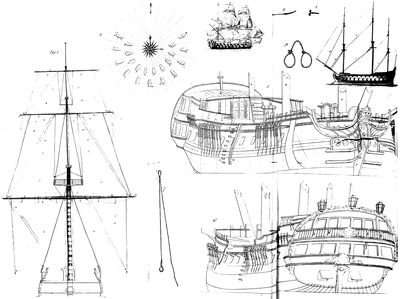
Plate. ix.
The first impression of the wind greatly affects the velocity, because the resistance of the water might destroy it, since the velocity being but small at first, the resistance of the water which depends on it will be very feeble: but as the ship increases her motion, the force of the wind on the sails will be diminished; whereas on the contrary the resistance of the water on the bow will accumulate, in proportion to the velocity with which the vessel advances. Thus the repetition of the degrees of force which the action of the sails adds to the motion of the ship, is perpetually decreasing; whilst on the contrary the new degrees added to the effort of resistance on the bow are always augmenting. The velocity is then accelerated in proportion as the quantity added is greater than that which is subtracted: but when the two powers become equal, when the impression of the wind on the sails has lost so much of its force, as only to act in proportion to the opposite impulse of resistance on the bow, the ship will then acquire no additional velocity, but continue to sail with a constant uniform motion. The great weight of the ship may indeed prevent her from acquiring her greatest velocity; but when she has attained it, she will advance by her own intrinsic motion, without gaining any new degree of velocity, or lessening what she has acquired. She moves then by her own proper force in vacuo, without being afterwards subject either to the effort of the wind on the sails, or to the resistance of the water on the bow. If at any time the impulsion of the water on the bow should destroy any part of the velocity, the effort of the wind on the sails will revive it, so that the motion will continue the same. It must however be observed, that this state will only subsist when these two powers act upon each other in direct opposition; otherwise they will mutually destroy one another. The whole theory of working ships depends on this counter-action, and the perfect equality which should subsist between the effort of the wind and the impulsion of the water. Bouguer, Traité du navire.
The effect of sailing is produced by a judicious arrangement of the sails to the direction of the wind. Accordingly the various modes of sailing are derived from the different degrees and situations of the wind with regard to the course of the vessel.
To illustrate this observation by examples, the plan of a number of ships proceeding on various courses are represented by fig. 3. plate IX. which exhibits the thirty-two points of the compass, of which C is the center: the direction of the wind, which is northerly, being expressed by the arrow.
It has been observed in the article Close-hauled, that a ship in that situation will sail nearly within six points of the wind. Thus the ships B and y are close-hauled, the former being on the larboard tack, steering E. N. E. and the latter on the starboard tack sailing W. N. W. with their yards a b braced obliquely, as suitable to that manner of sailing. The line of battle on the larboard tack would accordingly be expressed by C B, and on the starboard by C y.
When a ship is neither close-hauled, nor steering afore the wind, she is in general said to be sailing large. The relation of the wind to her course is precisely determined by the number of points between the latter and the course close-hauled. Thus the ships c and x have the wind one point large, the former steering E. b N. and the latter W. b N. The yards remain almost in the same position as in B and y: the bowlines and sheets of the sails being only a little slackened.
The ships d and u have the wind two points large, the one steering east and the other west. In this manner of sailing, however, the wind is more particularly said to be upon the beam, perpendiculaire du vent, as being at right angles with the keel, and coinciding with the position of the ship’s beams. The yards are now more across the ship, the bowlines are cast off, and the sheets more relaxed; so that the effort of the wind being applied nearer to the line of the ship’s course, her velocity is greatly augmented.
In e and t the ships have the wind three points large, or one point abaft the beam, the course of the former being E. b S. and that of the latter
W. b S. The sheets are still more flowing; the angle which the yards make with the keel farther diminished; and the course accelerated in proportion.
The ships f and s the first of which steers E. S. E. and the second W.S. W. have the wind four points large, or two points abaft the beam. In g and r the wind is five points large, or three points abaft the beam, the former sailing S. E. b E. and the latter S. W. b W. In both these situations the sheets are still farther slackened, and the yards laid yet more athwart the ship’s length, in proportion as the wind approaches the quarter.
The ships h and q, steering S. E. and S. W. have the wind six points large, or more properly on the quarter; which is considered as the most favourable manner of sailing, because all the sails co-operate to increase the ship’s velocity: whereas, when the wind is right aft, as in the ship m, it is evident, that the wind, in its passage to the foremost sails, will be intercepted by those which are farther aft. When the wind is on the quarter, the fore-tack is brought to the cat-head; and the main-tack being cast off, the weather-clue of the mainsail is hoisted up to the yard, in order to let the wind pass freely to the foresail; and the yards are disposed so as to make an angle of about two points, or nearly 22°, with the keel.
The ships i and p, of which the former sails S. E. b S. and the latter S. W, b S. are said to have the wind three points on the larboard or starboard quarter: and those expressed by k and o, two points; as steering S. S. E. and S. S. W. in both which positions the yards make nearly an angle of 16°, or about a point and an half, with the ship’s length.
When the wind is one point on the quarter, as in the ships l and n, whose courses are S. b E. and S. b W. the situation of the yards and sails is very little different from the last mentioned; the angle which they make with the keel being somewhat less than a point, and the stay-sails being rendered of very little service. The ship m sails right afore the wind, or with the wind right aft. In this position the yards are laid at right angles with the ship’s length: the stay-sails, being entirely useless, are hauled down: and the mainsail is drawn up in the brails, that the fore-sail may operate: a measure which considerably facilitates the steerage, or effort of the helm. As the wind is then intercepted, by the main top-sail and main top-gallant-sail, in its passage to the fore top-sail and fore top-gallant-sail, these latter are by consequence entirely becalmed, and might therefore be furled, to prevent their being fretted by flapping against the mast, but that their effort contributes greatly to prevent the ship from broaching-to, when she deviates from her course to the right or left thereof.
Thus all the different methods of sailing may be divided into four, viz. close hauled, large, quartering, and afore the wind; all which relate to the direction of the wind with regard to the ship’s course, and the arrangement of the sails. See also Drift and Leeway.
Order of Sailing, the general disposition of a fleet of ships when proceeding on a voyage or expedition.
It has already been observed in the article Fleet, that the most convenient order of sailing, for a squadron of ships, is in three parallel columns, so as to form the line of battle with greater facility and expedition. In this disposition, the station of each ship is previously appointed by the commander in chief; and the ranks or columns are as near to each other as regularity, and a regard for their common security, will admit. This distance, which ought to be carefully observed in tacking, may be regulated by the movements of some of the ships in the column farthest to windward, which should accordingly govern the operations of the whole squadron. See Tacking.
Sailing also implies a particular mode of navigation, formed on the principles, and regulated by the laws of trigonometry. Hence we say, plain sailing, mercator’s, middle-latitude, parallel and great circle sailing. See the article Navigation.
SAILOR, matelot, a seafaring man: a person trained in the exercise of fixing the machinery of a ship, and managing her, either at sea, or in a road, or harbour.
SAIL-YARD. See the article Yard.
SALVAGE, a third part of the value of anything recovered from the enemy, after having remained in his possession twenty-four hours; or of any thing dragged up from the bottom of the sea. It is paid by the first proprietors to the persons who have so recovered it, or else detained legally by the latter.
SALUTE, salut, (from saluto, Lat.) a testimony of deference or homage rendered by the ships of one nation to another; or by ships of the same nation to a superior or equal.
This ceremony is variously performed, according to the circumstances, rank, or situation of the parties. It consists in firing a certain number of cannon, or vollies of small arms; of striking the colours or top-sails; or of one or more general shouts of the whole ship’s crew, mounted on the masts or rigging for that purpose.
The principal regulations with regard to salutes in the royal navy are as follow.
‘When a flag-officer salutes the admiral and commander in chief of the fleet, he is to give him fifteen guns; but when captains salute him, they are to give him seventeen guns. The admiral or commander in chief of the fleet is to return two guns less to flag-officers, and four less to captains. Flag-officers saluting their superior or senior officer, are to give him thirteen guns. Flag-officers are to return an equal number of guns to flag-officers bearing their flags on the same mast, and two guns less to the rest, as also to captains.
‘When a captain salutes an admiral of the white or blue, he is to give him fifteen guns; but to vice and rear admirals, thirteen guns. When a flag-officer is saluted by two or more of his Majesty’s ships, he is not to return the salute till all have finished, and then to do it with such a reasonable number of guns as he shall judge proper.
‘In case of the meeting of two squadrons, the two chiefs only are to exchange salutes. And if single ships meet a squadron consisting of more than one flag, the principal flag only is to be saluted. No salutes shall be repeated by the same ships, unless there has been a separation of six months at least.
‘None of his Majesty’s ships of war, commanded only by captains, shall give or receive salutes from one another, in whatsoever part of the world they meet.
‘A flag-officer commanding in chief shall be saluted, upon his first hoisting of his flag, by all the ships present, with such a number of guns as is allowed by the first, third, or fifth articles.
‘When any of his Majesty’s ships shall meet with any ship or ships belonging to any foreign prince or state, within his Majesty’s seas, (which extend to Cape Finisterre) it is expected, that the said foreign ships do strike their top-sail, and take in their flag, in acknowledgment of his Majesty’s sovereignty in those seas: and if any shall refuse or offer to resist, it is enjoined to all flag-officers and commanders to use their utmost endeavours to compel them thereto, and not suffer any dishonour to be done to his Majesty. And if any of his Majesty’s subjects shall so much forget their duty, as to omit striking their top-sail in passing by his Majesty’s ships, the name of the ship and master, and from whence, and whither bound, together with affidavits of the fact, are to be sent up to the secretary of the admiralty, in order to their being proceeded against in the admiralty-court. And it is to be observed, that in his Majesty’s seas, his Majesty’s ships are in no wise to strike to any; and that in other parts, no ship of his Majesty’s is to strike her flag or topsail to any foreigner, unless such foreign ship shall have first struck, or at the same time strike her flag or top-sail to his Majesty’s ship.
‘The flag-officers and commanders of his Majesty’s ships are to be careful to maintain his Majesty’s honour upon all occasions, giving protection to his subjects, and endeavouring, what in them lies, to secure and encourage them in their lawful commerce; and they are not to injure, in any manner, the subjects of his Majesty’s friends and allies.
‘If a foreign admiral meets with any of his Majesty’s ships, and salutes them, he shall receive gun for gun. If he be a vice-admiral, the admiral shall answer with two guns less. If a rear-admiral, the admiral and vice-admiral shall return two less. But if the ship be commanded by a captain only, the flag-officers shall give two guns less, and captains an equal number.
‘When any of his Majesty’s ships come to an anchor in a foreign port or road, within cannon-shot of its forts, the captain may salute the place with such a number of guns as have been customary, upon good assurance of having the like number returned, but not otherwise. But if the ship bears a flag, the flag-officer shall first carefully inform himself how flags of like rank, belonging to other crowned heads, have given or returned salutes, and to insist upon the same terms of respect.
‘It is allowed to the commanders of his Majesty’s ships in foreign parts, to salute the persons of any admirals, commanders in chief, or captains of ships of war of foreign nations, and foreign noblemen or strangers of quality, as also the factories of the king’s subjects, coming on board to visit the ship; and the number of guns is left to the commander, as shall be suitable to the occasion, and the quality of the persons visiting; but he is nevertheless to remain accountable for any excesses in the abuse of this liberty. If the ship visited be in company with other ships of war, the captain is not to make use of the civilities allowed in the preceding article, but with leave and consent of the commander in chief, or the senior captain.
‘Merchant-ships, whether foreigners, or belonging to his Majesty’s subjects, saluting the admiral of the fleet, shall be answered by six guns less; when they salute any other flag-ships, they shall be answered by four guns less; and if they salute men of war commanded by captains, they shall be answered by two guns less. If several merchant-ships salute in company, no return is to be made, till all have finished, and then by such a number of guns as shall be thought proper; but though the merchant-ships should answer, there shall be no second return.——
‘None of his Majesty’s ships of war shall salute any of his Majesty’s forts or castles in Great Britain or Ireland, on any pretence whatsoever.’ Regulations and Instructions for the Sea-service.
SAMSONS-POST, piedroit, a sort of pillar erected in a ship’s hold, between the lower deck and the kelson, under the edge of a hatchway, and furnished with several notches that serve as steps to mount or descend, as occasion requires.
This post being firmly driven into its place, not only serves to support the beam, and fortify the vessel in that place, but also to prevent the cargo or materials contained in the hold from shifting to the opposite side, by the rolling of the ship in a turbulent and heavy sea.
SAUCER. See the article Capstern.
SCALING the guns, soufler, the act of cleaning the inside of a ship’s cannon, by the explosion of a small quantity of powder; which effectually blows out any dirt or scales of iron which may adhere to the interior surface.
SCANTING, addoner, the variation of the wind by which it becomes unfavourable to a ship’s course, after having been fair or large. It is distinguished from a foul wind, as in the former, a ship is still enabled to sail on her course, although her progress is considerably retarded; but in the latter she is obliged to deviate from the line of her course, as explained in the article Tacking.
SCANTLING, the dimensions of any piece of timber with regard to its breadth and thickness.
SCARF, empature, (scherven, Dutch) a particular method of uniting two pieces of timber together by the extremities.
When two pieces of timber are joined together, so that the end of one goes over the end of the other, being tapered so that the one may be let into the other, and become even, they are said to be scarfed: such are the keel-pieces. But when the ends of the two pieces are cut square, and put together, they are said to butt to one another; and when another piece is laid upon, and fastened to both, as is the case in all the frame-timbers, this is called scarfing the timbers; and half the piece which fastens the two timbers together is reckoned the length of the scarf. Murray’s Ship-building.
SCHOONER, a small vessel with two masts, whose main-sail and fore-sail are suspended from gaffs reaching from the mast towards the stern; and stretched out below by booms, whose foremost ends are hooked to an iron, which clasps the mast so as to turn therein as upon an axis, when the after ends are swung from one side of the vessel to the other.
SCOOP, écoupe, a little hollowed piece of wood, employed to throw water out of a boat into the sea, which is usually called bailing the boat.
SCRAPING, the act of shaving off the dirty surface of the plank, in a ship’s side or decks, particularly after a voyage, or when the seams have been covered with a new composition of melted pitch or rosin. The instrument with which this is performed is accordingly called a scraper, and is represented in fig. 4. plate IX.
After the sides of a ship are sufficiently scraped, they are varnished over with turpentine, or a mixture of tar and oil, or such materials; which preserves the planks from being rent or split by the sun and wind, and gives the ship a more gay and spendid appearance on the water.
SCUDDING, (Skutta, Swedish) the movement by which a ship is carried precipitately before a tempest.
As a ship flies with amazing rapidity through the water, whenever this expedient is put in practice, it is never attempted in a contrary wind, unless when her condition renders her incapable of sustaining the mutual effort of the wind and waves any longer on her side, without being exposed to the most imminent danger. See the article Trying.
A ship either scuds with a sail extended on her fore mast, or, if the storm is excessive, without any sail, which in the sea-phrase is called scudding under bare poles, aller à sec. In sloops and schooners, and other small vessels, the sail employed for this purpose is called the square-sail, voile de fortune. In large ships, it is either the foresail, at large, reefed, or with its goose-wings extended, according to the degree of the tempest; or it is the fore top-sail close-reefed, and lowered on the cap: which last is particularly used when the sea runs so high as to becalm the foresail occasionally; a circumstance which exposes the ship to the danger of broaching-to.
The principal hazards incident to scudding are generally, a pooping sea; the difficulty of steering, which exposes the vessel perpetually to the risk of broaching-to; and the want of sufficient sea-room. A sea striking the ship violently on the stern may dash it inwards, by which she must inevitably founder. In broaching-to suddenly, she is threatened with being immediately overturned; and, for want of sea-room, she is endangered by shipwreck on a lee-shore; a circumstance too dreadful to require explanation!
SCUPPERS, dalots, (schoepen, Dutch, to draw off) certain channels cut through the water-ways and sides of a ship, at proper distances, and lined with plated lead, in order to carry the water off from the deck into the sea.
The scuppers of the lower deck of a ship of war are usually furnished with a leathern pipe, called the scupper-hoase, which hangs downward from the mouth or opening of the scupper. The intent of this is to prevent the water from entering when the ship inclines under a weight of sail.
SCUTTLE, (écoutille, Fr.) a small hatchway cut for some particular purpose through a ship’s deck, or through the coverings of her hatchways, and being furnished with a lid which firmly encloses it whenever necessary. See Deck and Hatchway.
SCUTTLING, the act of cutting large holes through the bottom or sides of a ship, either when she is stranded or overset, and continues to float on the surface. The design of this expedient is usually to take out the whole or a part of the cargo, provisions, stores, &c. with all possible expedition.
SEA, mer, (sæ, Sax. zee, Dutch) is known to be a great congregation of waters, which is either universal or local; as surrounding the whole earth, or flowing on the coast of some particular country.
This term, however, is variously applied by sailors, to a single wave; to the agitation produced by a multitude of waves in a tempest; or to their particular progress or direction. Thus they say, a heavy sea broke over our quarter, or we shipped a heavy sea; there is a great sea in the offing; the sea sets to the southward. Hence a ship is said to head the sea, when her course is opposed to the setting or direction of the surges.
A long sea implies an uniform and steddy motion of long and extensive waves; on the contrary, a short sea is when they run irregularly, broken, and interrupted; so as frequently to burst over a vessel’s side or quarter.
Sea-Boat, vaisseau beau de mer, a vessel that bears the sea firmly, without labouring heavily, or straining her masts and rigging.
Sea-Coast, the shore of any country; or that part which is washed by the sea.
Sea-Faring, the occupation of a mariner or sailor.
Seaman, homme de mer, a mariner or person trained in the exercise of fixing the machinery of a ship, and applying it to the purposes of navigation.
The principal articles required in a common sailor to intitle him to the full wages, are, that he can steer, sound, and manage the sails, by extending, reefing, and furling them, as occasion requires. When he is expert at these exercises, his skill in all other matters relative to his employment is taken for granted.
Sea-Mark, a point or conspicuous place distinguished at sea.
Sea-marks are of various kinds, as steeples, promontories, piles of ruins, groupes of trees, &c. and are very necessary to direct vessels on the coast of their situation. See also Beacon and Buoy.
Sea-Room, belle derive, implies a sufficient distance from the coast, as well as from any rocks or shallows, whereby a ship may drive or scud without danger of shipwreck.
Sea-Weeds, sarts, a sort of herbs or tangles floating on the surface of the sea, or washed upon the sea-coast. See the French term Mer, and the phrases which follow in order.
SEAMS, coutures, the intervals between the edges of the planks in the decks and sides of a ship; or the places where the planks join together. These are always filled with a quantity of oakum, and covered with hot pitch, to prevent the entrance of the water. See the article Calking.
SEIZING, amarrer, the operation of fastening any two ropes, or different parts of one rope together, with a small line or cord: also the cord (ammarage) which fastens them.
SELVAGEE, a sort of hank or skein of rope-yarn tied together at several distances. It is used to fasten round any rope, as a shroud or stay, so that a tackle may be hooked in it, to extend the said shroud or stay, which is called setting it up.
SENDING, the act of pitching precipitately into the hollow or interval, between two waves.
SENNIT, garcettes, (from seven and knit) a sort of flat braided cordage, formed by platting five or seven rope-yarns together.
SERVING, fourrer, winding any thing round a rope, to prevent it from being rubbed. The materials used for this purpose, and which are accordingly called service, fourrure, are generally small lines, leather, plat canvas, &c.
SETTEE, scitie, a ship of two masts, equipped with triangular sails, commonly called lateen sails. These vessels are peculiar to the Mediterranean sea, and are generally navigated by Italians, Greeks, or Mahometans.
SETTING, the act of observing the situation of any distant object by the compass, in order to discover the angle which it makes with the nearest meridian; as, at seven in the evening, we set the Tower of Arabia near the port of Alexandria, and it bore S. S. E. distant four leagues by estimation. See Bearing.
Setting also denotes the direction of the wind, current, or sea, but particularly the two latter: as, the tide which sets to the south, is opposed to a swelling sea setting to the north-west.
Setting, when applied to the sails, is the loosening and expanding them, so as to move a ship along the water, after she had been for some time at rest; or to accelerate her velocity when she is already moving, and perhaps give a new direction to her motion. It is used in contradistinction to taking-in the sails, as loosing or heaving-out is opposed to furling or stowing them.
Setting-up, the act of extending the shrouds, stays, and back-stays, to secure the masts, by the application of mechanical powers, as tackles, &c. See Dead-eye, Laniard, &c.
SETTLED, lowered in the water; as, we have settled the land, or sunk it lower, by sailing farther out to seaward. This phrase is usually opposed to raising; the former being occasioned by departing from the object understood, and the latter by approaching it: however, the sense is more commonly expressed laying.
SEWED, the situation of a ship which rests upon the ground till the depth of water sufficient to float her is diminished by the reflux of the tide. Thus if a ship runs aground on the tide of ebb, and it be required to know if she has sewed, the water-line or mark on her side, stem, or stern-post, where the surface of the water reaches when she is afloat, is examined, and this mark being found above the water, she is said to be sewed by as much as is the difference.
SHAKES, ébaroui, a name given by shipwrights to the cracks or rents in a plank, occasioned by the sun or weather.
SHANK, the beam or shaft of an anchor. See that article.
Shank-Painter, a short rope and chain which hangs the shank and flukes of the anchor up to the ship’s side, as the stopper fastens the ring and stock to the cathead.
To SHAPE the course, commander à la route, to direct or appoint the track of a ship, in order to prosecute a voyage.
SHARP. See Bottom.
SHEATHING, doublage, a sort of casing or covering laid on the outside of a ship’s bottom, to protect the planks from the pernicious effects of the worms: particularly in hot climates, as between the tropics.
Sheathing either consists of a number of boards or deals of fir, or of sheets of lead or copper; which last is a very late invention, having been only experienced on a few of his Majesty’s frigates: it seems, however, to answer the purpose much better than the fir-planks. When the sheathing is performed with boards, there is a quantity of hair and tar inserted between the outside of the bottom and the inner surface of the boards.
SHEAVE, rouet, (schijf, Dutch) a solid cylindrical wheel, fixed in a channel, and moveable about an axis, as being used to raise or increase the mechanical powers applied to remove any body.
The sheaves are either fixed in blocks, or in channels cut through the masts, caps, cat-heads, or sides of a ship. See those articles.
SHEEP-SHANK: a sort of knot or hitch cast on a rope, to shorten it as occasion requires: particularly to increase the sweep or length of a tackle by contracting its runner. By this contrivance the body to which the tackle is applied may be hoisted much higher, or removed much farther, in a shorter time.
Thus if any weighty body is to be hoisted into a ship, and it be found that the blocks of the tackle meet before the object can reach the top of the side, it will be necessary to lower it again, or hang it by some other method, till the runner of the tackle is sheep-shanked, by which the blocks will again be separated to a competent distance.
SHEER, relevement, the longitudinal curve of a ship’s deck or sides.
SHEERING, in navigation, the act of deviating or straying from the line of the course, either to the right or left, so as to form a crooked and irregular path through the water. It is commonly occasioned by the ship’s being difficult to steer, but very often from the negligence or incapacity of the helmsman. Hence, to sheer off is to remove at a greater distance.
SHEERS, machine à mater, an engine used to hoist-in or displace the lower masts of a ship. See the article Mast.
The sheers employed for this purpose in the royal navy are described under the article hulk. In merchant-ships this machine is composed of two masts or props, erected in the same vessel wherein the mast is to be planted, or from whence it is to be removed. The lower ends of these props rest on the opposite sides of the deck, and their upper parts are fastened across, so as that a tackle, which depends from the intersection, may be almost perpendicularly above the station of the mast, to which the mechanical powers are applied. These sort of sheers are secured by stays, which extend forward and aft to the opposite extremities of the vessel.
SHEET, écoute, a rope fastened to one or both the lower corners of a sail, to extend and retain it in a particular station. See Clue and Sail.
When a ship sails with a lateral wind, the lower corner of the main and fore sail are fastened by a tack and a sheet; the former being to windward and the latter to leeward: the tack, however, is entirely disused with a stern-wind; whereas the sail is never spread without the assistance of one or both of the sheets.
The stay-sails and studding-sails have only one tack and one sheet each: the stay-sail-tacks are always fastened forward, and the sheet drawn aft; but the studding-sail-tack draws the outer clue of the sail to the extremity of the boom; whereas the sheet is employed, to extend the inmost.
To haul home the Sheet. See Home.
Sheet-anchor. See the article Anchor.
SHELL, in artillery. See Mortar and Range.
Shell of a block, the outer frame or case, wherein the sheave or wheel is contained, and traverses about its axis. See Block.
SHELVES, écueils, (schylf, Sax.) a general name given to any dangerous shallows, sand-banks, or rocks lying immediately under the surface of the water, so as to intercept any ship in her passage, and expose her to destruction.
SHIFTED, desarrimée, the state of a ship’s ballast or cargo when it is shaken from one side to the other, either by the violence of her rolling in a turbulent sea, or by an extraordinary inclination to one side when under a great pressure of sail. This circumstance, however, rarely happens, unless to those cargoes which are stowed in bulk, as corn, salt, or such materials. See Laden and Trim.
Shifted, sauté, when expressed of the wind, implies altered.
SHIFTER, detrempeur, a person appointed to assist the ship’s cook, particularly in washing, steeping, and shifting the salt provisions.
SHIFTING a tackle, the act of removing the blocks of a tackle to a greater distance from each other, on the object to which they are applied, in order to give a greater scope or extent to their purchase. This operation is otherwise called fleeting. See that article.
Shifting the helm, rencontrer, is the alteration of its position, by pushing it towards the opposite side of the ship. See Helm.
Shifting the voyal, depasser, changing its position on the capstern from the right to the left, and vice versa.
SHIP, vaisseau, (scip, Sax.) a general name given by seamen to the first rank of vessels which are navigated on the ocean.
Amongst people who are unacquainted with marine distinctions, this term is of very vague and indiscriminate acceptation: and indeed sailors themselves, submitting occasionally to the influence of custom, receive it according to this general idea. In the sea-language, however, it is more particularly applied to a vessel furnished with three masts, each of which is composed of a lower mast, top-mast, and top-gallant-mast, with the usual machinery thereto belonging.
The design of this work being professedly to treat of the construction, mechanism, furniture, movements, and military operations of a ship, we may properly consider the present article as a general recapitulation of the whole subject.
The plans, elevations, and sections used in the construction of a ship; the principal pieces of which she is composed, and the qualities requisite to answer the several purposes of navigation, are described, or referred to, in Naval Architecture: and the application of this theory to practice is treated in the article Ship-BUILDING.
The machinery and furniture with which she is equipped are variously diffused throughout this work, and naturally spring from one another, like a multitude of branches from one general trunk. See Mast, Sail, Yard, Rigging, Anchor, &c.
The qualities by which she is enabled to encounter a tempestuous sea are treated in the article Ballast and Trim; and her several movements therein are explained under Navigation, Drift, Sailing, Tacking, Leeway, Pitching, and Rolling.
Considered as a moveable fortress or citadel, her military operations are copiously described in Cannon, Cannonade, Engagement, Line, and Range; and as her efforts are occasionally like those of a mine, or bombardment, the reader is also referred to the articles Fire-ship and Mortar.
The vessels which are usually comprehended under the general name of ship, besides those of the line of battle, are galleons, frigates, hag-boats, cats, barks, pinks, and fly-boats; all of which are defined in their proper places, except the hag-boat, that only differs from a frigate-built ship in the figure of the stern, which has a great resemblance to that of the cat, as being in a middle degree between the former and the latter. See also the article Quarter.
Ships of war are properly equipped with artillery, ammunition, and all the necessary martial weapons and instruments for attack or defence. They are distinguished from each other by their several ranks or classes. See Rate.
Ship of the line is usually applied to all men of war mounting sixty guns and upwards. Of late, however, our fifty-gun ships have been formed sufficiently strong to carry the same metal as those of sixty, and accordingly may fall into the line in cases of necessity. See Line.