AN UNIVERSAL DICTIONARY OF THE MARINE. (continued 10)
Reading edition
TOMPION, (tampon, Fr.) a sort of bung or cork used to stop the mouth of a cannon. At sea this is carefully encircled with tallow or putty, to prevent the penetration of the water into the bore, whereby the powder contained in the chamber might be damaged or rendered incapable of service.
TONNAGE. See the article Burthen.
TOP, hune, a sort of platform, surrounding the lower mast-head, from which it projects on all sides like a scaffold.
The principal intention of the top is to extend the top-mast shrouds, so as to form a greater angle with the mast, and thereby give additional support to the latter. It is sustained by certain timbers fixed across the hounds or shoulders of the mast, and called the tressel-trees and cross-trees, the former of which are expressed by k, fig. 1. plate VI. and the latter by l, l, fig. 2. The plan of the top is represented in fig. 6. where g g represents the holes through which the top-mast shrouds communicate with those of the lower mast, as explained in the article Shroud.
Besides the use above mentioned, the top is otherwise extremely convenient to contain the materials necessary for extending the small sails, and for fixing or repairing the rigging and machinery, with more facility and expedition. In ships of war it is used as a kind of redoubt, and is accordingly fortified for attack or defence, being furnished with swivels, musketry, and other fire-arms; and guarded by a thick fence of corded hammocs. Finally, it is employed as a place for looking out, either in the day or night.
The frame of the top is either close-planked like a platform, or open like a grating. The former kind, which is exhibited in fig. 6. plate VI. is generally stronger and more convenient; but the latter is much better in tempestuous weather, as presenting a smaller surface to the wind when the ship leans over to one side, and by consequence being less exposed to its efforts.
In all ships of war, and in the largest merchantmen, the top is fenced on the aft-side by a rail of about three feet high, stretching across, and supported by stanchions, between which a netting is usually constructed, as appears by fig. 2. plate VI. The outside of this netting is generally covered with red bayze or red painted canvas, which is extended from the rail down to the edge of the top, and called the top-armour. By this name it seems to have been considered as a sort of blind, behind which the men may conceal themselves from the aims of the enemy’s fire-arms in time of action, whilst they are charging their own muskets, carabines, or swivels.
The dimensions of tops in the royal navy are as follow. The breadth of the top athwart-ships, q q, fig. 6. is one third of the length of its corresponding top-mast. The length of all tops, from the foremost to the after edge p p, is equal to three fourths of their breadth athwart; and the square hole in the middle is five inches to a foot of those dimensions. The tressel-trees and cross-trees extend nearly to the edge of the tops. See those articles.
Top-block. See Block and Mast.
Top-chain. See the article Chain.
Top-lanthorn, fanal de hune, a large lanthorn placed in the after part of the top, in any ship where an admiral or commodore is personally aboard. It is supported on each side by iron braces r, as expressed in fig. 3. plate VI.
Top-mast, mât de hune, the second division of a mast; or that part which stands between the upper and lower pieces. See the article Mast.
Top-rope, guinderesse, a rope employed to sway-up a top-mast or top-gallant mast, in order to fix it in its place; or to lower it in tempestuous weather, or when it is no longer necessary. The rope used on this occasion for the top-masts is, on account of their great weight, furnished with an assemblage of pullies, at its lower end, called the top-tackle, to hoist or lower the mast with greater facility. The whole of this is particularly explained in the article Mast, and the plate therein referred to.
Top-sails, certain large sails extended across the top-masts, by the top-sail-yard above, and by the yard attached to the lower mast beneath; being fastened to the former by robands, and to the latter by means of two great blocks fixed on its extremities, through which the topsail-sheets are inserted, passing from thence to two other blocks fixed on the inner part of the yard close by the mast: and from these latter the sheets lead downwards to the deck, where they may be slackened or extended at pleasure. See the article Sail. N. B. The top-gallant sails are expanded above the topsail-yard, in the same manner as the latter are extended above the lower yard.
The several parts of the machinery by which the top-sails are managed, as the bowlines, braces, haliards, lifts, and sheets, being copiously defined in their proper places, it would be superfluous to repeat their explanations.
TOPPING, apiquer, the act of pulling one of the extremities of a yard higher than the other, by slackening one of the lifts, and pulling upon the opposite one, so as to place the yard at a greater or lesser obliquity with the mast.
Topping-lift, balancine de gui, a large and strong tackle, employed to suspend or top the outer end of a gaff, or of the boom of a main-sail and fore-sail; such as are used in brigs, sloops, or schooners. See Square.
TORNADO, travade, a violent squall or gust of wind rising suddenly from the shore, and afterwards veering round the compass like a hurricane. These are very frequent on the coasts of Guinea and South Barbary. See Wind.
TOUCHING, the state of a ship’s sails when they first begin to shiver, with their edges in the direction of the wind. It is either occasioned by a sudden alteration of the ship’s course, or by a change of the wind, in which it blows more obliquely along the surface of the sails, instead of falling into their cavities from behind, according to its usual direction. See Full and by.
Touching-at, implies the circumstance of stopping, or anchoring occasionally, at some intermediate port, in the course of a voyage.
To TOW, remorquer, (teon, teohan, Sax.) to draw a ship forward in the water, by means of a rope attached to another vessel or boat, which advances by the effort of rowing or sailing.
Towing is either practised when a ship is disabled, and rendered incapable of carrying sail at sea; or when her sails are not fixed upon the masts, as in a harbour: or when they are deprived of their force of action by a cessation of the wind.
When a ship of war is dismasted, or otherwise disabled from carrying sail at sea, she is usually towed by a cable reaching from her bow to another ship a-head. In a harbour towing is practised by one or more boats, wherein all the force of the oars are exerted to make her advance.
Tow-line, a small hauser generally used to remove a ship from one part of an harbour or road to another, by means of anchors, capsterns, &c. as explained in the article Warping. It is also employed occasionally to moor a small vessel in a harbour, conveniently sheltered from the wind and sea.
Tow-rope, a name given to any cable or other rope used in the exercise of towing.
TRACING-LINE, martinet, a small cord generally passing through a block or thimble, and used to hoist up any object to a higher station, in order to render it less inconvenient. Such are the tracing-lines of the awnings, and those of the yard-tackles, which, by hanging down in a cavity or bight, would be aukward and incommodious.
TRACK of a ship. See the article Wake.
TRACKING, the act of pulling any vessel or floating body along the stream of a canal or river, by means of a rope extending from the vessel, &c. to the adjacent shore, and drawn along the banks of the river, by men or horses. Whence,
TRACK-SCOUT, a vessel employed to carry goods or passengers up and down the rivers or canals in Holland, and the countries bordering on the Baltic sea. It is usually tracked by a horse, who trots along the margin to a limited distance, after which he is relieved by another.
TRADE-WINDS, certain regular winds blowing within or near the tropics, and being either periodical or perpetual. Thus, in the Indian ocean, they blow alternately from different points of the compass, during a limited season; and, in the Atlantic ocean, continue almost without intermission in the same direction. They are accordingly called trade-winds, from their great utility in navigation and commerce. See Monsoon and Wind.
TRAIN. See the articles Cannon and Fire-ship.
TRANSOMS, barres d’arcasse, (transenna, Lat.) certain beams or timbers extended across the stern-post of a ship, to fortify her after-part, and give it the figure most suitable to the service for which she is calculated.
Transoms are here defined beams or timbers, because they partake equally of the form and purpose of those pieces. Thus the deck-transom is the aftmost or hindmost beam of the lower deck, whereon all the deck-planks are rabetted: and all the transoms are fixed athwart the stern-post, in the same manner as the floor-timbers are laid upon the keel. As the floor-timbers also, with regard to their general form and arrangement, have a rising, by which, the bottom becomes narrower as it ascends towards the extremities; so the arms of the transoms, being gradually closer in proportion to their distance from the wing-transom downwards, give a similar figure to that part of the ship, which accordingly becomes extremely narrow, from the counter towards the keel; and this general figure or curve is called the flight of the transoms.
Although these pieces are therefore extremely different in their figures, according to the extent of the angles formed by their branches or horns, each of them has nevertheless a double curve, which is partly vertical, and partly horizontal, with regard to its situation in the ship. The former of these is called, by the artificers, the round-up, and the latter the round-aft.
As the transoms fill up the whole space comprehended between the head of the stern-post above, and the aftmost floor-timbers below, it is necessary to distinguish them by particular names. Thus the highest is called the wing-transom: the next, the deck-transom; and afterwards follow the first, second, and third transoms; together with the intermediate ones, as represented in fig. 1. plate X. and described in the explanation thereof.
The vertical direction of the arms or angles of the transoms, with regard to the ship’s length, are expressed in the plane of Elevation; and their horizontal curves are also delineated on the plane of Projection; both of which are represented under those terms in plate I. and described in the general explanation of the planes in the article Naval Architecture.
The highest transoms are connected to the ship’s quarter by knees, which are bolted to those pieces, and to the after-timbers. See the article Sleepers.
TRANSPORT. See the article Ship.
TRANSPORTING, the act of removing a ship from one place to another, by the help of anchors and ropes. See Warping.
TRAVELLER, racambeau, a sort of thimble, whose diameter is much longer, in proportion to the breadth of its surface, than the common ones, fig. 3. plate XII. It is furnished with a tail formed of a piece of rope, about three feet in length, one end of which encircles the ring, to which it is spliced. These machines are principally intended to facilitate the hoisting or lowering of the top-gallant-yards at sea: for which purpose two of them are fixed on each back-stay, whereon they slide upwards and downwards, like the ring of a curtain upon its rod: being thus attached to the extremities of the top-gallant-yard, they prevent it from swinging backwards and forwards, by the agitation of the ship, whilst the yard is hoisting or lowering at sea.
TRAVERSE, in navigation, implies a compound course, or an assemblage of various courses, lying at different angles with the meridian. Thus fig. 2. plate XI. exhibits the traverses formed by a ship, when making an oblique progression against the direction of the wind, as explained in the article Tacking.
The true course and distance resulting from this diversity of courses is discovered by collecting the difference of latitude and departure of each course, and reducing the whole into one departure and one difference of latitude, according to the known rules of trigonometry. This reduction will immediately ascertain the base and perpendicular; or, in other words, will give the difference of latitude and departure to discover the course and distance. See Navigation.
Traverse-board, a thin circular piece of board, marked with all the points of the compass, and having eight holes bored in each, and eight small pegs hanging from the center of the board. It is used to determine the different courses run by a ship during the period of the watch; and to ascertain the distance of each course. This implement is particularly useful in light and variable winds, at which time the helmsman marks the course every half hour, by fixing a peg in that point of the compass whereon the ship had advanced. Thus, if the wind is northerly at the beginning of the watch, the ship, being close-hauled on the larboard tack, will steer W. N. W. If, after the first half hour, the wind changes to N. by W. the ship will fall off to W. by N. both of these courses are marked by the helmsman upon the traverse-board, by putting in one peg for every half hour on which she steers the same course; as, one peg into W. N. W. and two pegs into W. by N. if she sails an hour on the latter course; and so on. The lee-way and variation of the compass are afterwards allowed by the pilot, on summing up the whole.
TREE-NAILS, gournables, certain long cylindrical wooden pins, employed to connect the planks of a ship’s side and bottom to the corresponding timbers.
The tree-nails are justly esteemed superior to spike-nails or bolts, which are liable to rust, and loosen, as well as to rot the timber; but it is necessary that the oak of which they are formed should be solid, close, and replete with gum, to prevent them from breaking and rotting in the ship’s frame. They ought also to be well dried, so as to fill their holes when they are swelled with moisture. They have usually one inch in thickness to 100 feet in the vessel’s length; so that the tree-nails of a ship of 100 feet long, are one inch in diameter; and one inch and a half for a ship of 150 feet.
TRESTLE-TREES, tesseaux, two strong bars of timber fixed horizontally on the opposite sides of the lower mast-head, to support the frame of the top, and the weight of the top-mast. See Mast and Top.
TRIM, manege du navire, (trimman, Sax. to build) implies, in general, the state or disposition by which a ship is best calculated for the several purposes of navigation.
Thus the trim of the hold denotes the most convenient and proper arrangement of the various materials contained therein, relatively to the ships motion or stability at sea. The trim of the masts and sails is also their most apposite situation, with regard to the construction of the ship, and the effort of the wind upon her sails.
As the stowage of the hold, or the disposition of the several articles of the cargo, considerably affects the ship’s motion and stability, it will be necessary to give a general idea of the action of a heavy body upon the fluid that supports it, and the re-action of the fluid on the floating body.
The whole weight of any body, then, may be considered as united in its center of gravity; so that, if it were suspended by a line fastened to this center, the line would hang in a perpendicular position, as directed through the center of gravity to the center of the earth. A body which floats in a fluid is not, however, supported by its center of gravity, but by the compression of the surrounding filaments of water: and each of these, being considered as infinitely small, will act upon a very minute portion of the surface of the floating body, with regard to the specific gravity, and conform to a principle applicable to all fluids, in proportion to the height of these filaments, viz. That the weight of a column of any fluid will be in proportion to the specific gravity of the fluid and the height of the column multiplied by its base.
But as heavy bodies endeavour, by their gravity, to approach the center of the earth, in a vertical line passing through their centers; so the pressure of fluids endeavours to carry bodies in a vertical, tending from the center of the earth towards their surface, and passing through the center of gravity of the submerged part, which forces them towards the surface. So, in any submerged body at rest, these two opposite forces coincide in the same vertical, acting in a direction quite contrary to each other. Bouguer’s Traité du navire.
From this theory it results, that the stability or trim of a ship chiefly depends upon her construction, as considering the bottom to be homogeneous. This, however, can only happen when her cargo consists of the same materials throughout, as with corn, salt, or any species stowed in bulk, and when her hold is entirely filled. For if the ship has not sufficient breadth to resist the effort of the wind upon her sails; or if she is built too high, or too sharp in the floor, her center of gravity will be too high, and she will be very crank, i. e. apt to overturn.
But as the stiffness of a ship, or quality to carry sail without danger of overturning, depends very much on the stowage of the hold, the center of gravity may thereby be considerably lowered, by which her stability will be increased in proportion. It is a general maxim amongst mariners, that a ship will not carry sufficient sail till she is laden so deep that the surface of the water may glance on her extreme breadth amidships. She must therefore have a great deal of weight, as ballast, &c. to bring her to this situation, which is called a good sailing trim.
Several circumstances are also to be particularly considered with regard to the quality, weight, and stowage of the ballast. The center of gravity being placed too high, will render the ship incapable of carrying a sufficient quantity of sail; and by having it too low, she will be in danger of rolling away her masts. When it is placed too far forward, the ship will pitch, and labour heavily; and when too far aft, she will occasionally be exposed to the dangerous circumstance of a pooping sea. These extremes being carefully avoided, it remains to proportion the contents of every part of the hold to its capacity, and to place the lightest materials uppermost. See Stowage.
Trim, when applied to the sails, denotes the general arrangement which is best calculated to accelerate the ship’s course, according to the direction of the wind. See the article Sailing.
If the ship were always to sail before the wind, it would be a very simple operation to trim the sails; because nothing else could be required than to dispose them so as to receive the greatest possible effort of the wind, which is evidently performed by arranging them at right angles with its direction. But, when the current of wind acts more directly upon the ship’s side, it necessarily falls more obliquely on the surface of the sails, so as to diminish their effort to push the ship forward; and to augment their tendency to make her incline to one side. Hence we may conclude, that an increase of the wind, when accompanied with a variation unfavourable to the ship’s course, will by no means augment her velocity; because the force previously employed to push her forward, will afterwards operate to overturn her; and because this impression renders it necessary to reduce the quantity of sail; the effort of which is farther diminished by the obliquity of the action of the wind upon its surface.
By this theory it appears, that the effect of the wind to advance the ship decreases in proportion to its obliquity with any sail upon which it operates.
The mechanical disposition of the sails, according to every direction of the wind upon their surfaces, is copiously described in the articles Close-hauled, Large, Sailing, and Tacking.
Trim, when expressed of the masts, denotes their position with regard to the ship and to each other. Thus, in the latter sense, they should neither be too near nor too far apart; and, in the former, they should not be too far forward or aft; and, according to the situation or quality which communicates a greater velocity to the vessel, they should either be upright, or inclining aft, or forward.
Trim the boat. See Boat, and the phrases succeeding it.
Sharp-Trimmed, the situation of a ship’s sails in a scant wind.
TRIMONEER, a barbarous corruption of Timoneer. See that article.
TRIP, a cant phrase, implying an outward-bound voyage, particularly in the coasting navigation. It also denotes a single board in plying to windward.
TRIPPING, the movement by which an anchor is loosened from the bottom by its cable or buoy-ropes. See Atrip.
TROUGH, a name given to the hollow, or interval between two high waves, which resembles a broad and deep trench perpetually fluctuating. As the setting of the sea is always produced by the wind, it is evident that the waves, and consequently the trough or hollow space between them, will be at right angles with the direction of the wind. Hence a ship rolls heaviest when she lies in the trough of the sea.
TROWSERS, a sort of loose breeches of canvas worn by common sailors.
TRUCK, a piece of wood, which is either conical, cylindrical, spherical, or spheroidical.
Thus the trucks fixed on the spindle of a mast-head, and which are otherwise called acorns, are in the form of a cone: and those which are employed as wheels to the gun-carriages are cylinders. The trucks of the parrels assume the figure of a globe; and, lastly, those of the flag-staffs resemble an oblate spheroid. See the articles Acorn, Cannon, Parrel, and Flag-staff.
Trucks of the shrouds are nearly similar to those of the parrels: they are fastened to the shrouds about twelve or fourteen feet above the deck, the hole in the middle being placed perpendicularly to contain some rope which passes through it. The intention of these is to guide the sailors to the particular rope, which might otherwise be easily mistaken for some other of the same size, especially in the night.
Speaking-TRUMPET, trompette marine, a trumpet of brass or tin used at sea, to propagate the voice to a great distance, or to convey the orders from one part of the ship to another, in tempestuous weather, &c. when they cannot otherwise be distinctly heard by the persons to whom they are directed.
Fire-TRUNK. See the article Fire-ship.
TRUNNIONS, tourillons, the two knobs or arms which project from the opposite sides of a piece of artillery, and serve to support it in the carriage. See Cannon and Mortar.
TRUSS, (trousse, Fr.) a machine employed to pull a yard home to its respective mast, and retain it firmly in that position.
As the truss is generally used instead of a parrel, it is rarely employed, except in flying top-gallant-sails, which are never furnished with parrels. It is no other than a ring or traveller, which encircles the mast, and has a rope fastened to its after-part, leading downward to the top or decks; by means of which the truss may be straitened or slackened at pleasure. The haliards of the top-gallant-sail being passed through this ring; and the sail being hoisted up to its utmost extent; it is evident, that the yard will be drawn close to the mast, by pulling down the truss close to the upper part of the sail. For, without the truss, the sail and its yard would be blown from the mast, so as to swing about, by the action of the wind, and the rocking of the vessel; unless the yard were hoisted close up to the pulley wherein the haliards run; which seldom is the case in flying top-gallant-sails, because they are usually much shallower than those which are fixed or standing.
Truss-parrel. See Parrel.
TRYING, à la cape, the situation in which a ship lies nearly in the trough or hollow of the sea in a tempest, particularly when it blows contrary to her course.
In trying, as well as in scudding, the sails are always reduced in proportion to the increase of the storm. Thus, in the former state, a ship may lie by the wind under a whole main-sail, a whole fore-sail, or a whole mizen; or under any of those sails, when diminished by the reef or balance. As the least possible quantity of sail used in scudding are the goose-wings of the foresail; so in trying, the smallest portion is generally the mizen-staysail or main-staysail: and in either state, if the storm is excessive, she may lie with all the sails furled, or, according to the sea-phrase, under bare poles.
The intent of spreading a sail at this time is to keep the ship more steddy, and, by pressing her side down in the water, to prevent her from rolling violently; and also to turn her bow towards the direction of the wind, so that the shock of the waves may fall more obliquely on her flank, than when she lies along the trough of the sea. While she remains in this situation, the helm is fastened close to the lee-side, or, in the sea-language, hard a-lee, to prevent her as much as possible from falling-off. But as the ship is not then kept in equilibrio by the effort of her sails, which at other times counterbalance each other at the head and stern, she is moved by a slow but continual vibration, which turns her head alternately to windward and to leeward, forming an angle of three or four points in the interval. That part where she stops, in approaching the direction of the wind, is called her coming-to, and the contrary excess of the angle to leeward is termed her falling-off.
Thus, suppose the wind northerly, and a ship trying with her starboard side to windward: if, in turning her head towards the source of the wind, she arrives at N. W. ½ N. or N. 39° W. and then declines to the leeward as far W. ½ S. or S. 84° W, the former will be called her coming-to, and the latter her falling-off. In this position she advances very little according to the line of her length, but is driven considerably to leeward, as described in the articles Drift and Lee-way.
TUCK, a name given to that part of the ship where the ends of the bottom-planks are collected together immediately under the stern or counter.
When this part, instead of being incurvated, and forming a convex surface, assumes the shape of a vertical or oblique plane, it is said to be square, as represented in fig. 8. plate IX. A square tuck is accordingly terminated above by the wing-transom, and below and on each side by the fashion-pieces.
TUMBLING-HOME, encabanement, that part of a ship’s side which falls inward above the extreme breadth, so as to make the ship gradually narrower from the lower deck upwards. This angle is represented in general throughout all the timbers in the plane of projection, plate I. It is also more particularly expressed by Q T in the Midship-frame, plate VII. where it is evident, that the ship grows narrower from Q towards T. N. B. In all our old sea-books, this narrowing of a ship from the extreme breadth upwards is called housing-in. See Upper-work.
TURNING-to-windward, chicaner le vent, that operation in sailing wherein a ship endeavours to make a progress against the direction of the wind, by a compound course, inclined to the place of her destination. This method of navigation is otherwise called plying. See also Beating and Tacking.
TYE, itague, a sort of runner or thick rope, used to transmit the effort of a tackle to any yard or gaff, which extends the upper part of a sail.
The tye is either passed through a block fixed to the mast-head, and afterwards through another block moveable upon the yard or gaff intended to be hoisted; or the end of it is simply fastened to the said yard or gaff, after communicating with the block at the mast-head. See also the article Jears.
V.
VAN, avante-garde, the foremost division of any naval armament, or that part which usually leads the way to battle; or advances first in the order of sailing. See Center, Fleet, and Rear.
VANE, a thin slip of bunting hung to the mast-head, or some other conspicuous place in the ship, to show the direction of the wind. See b, fig. 1. plate I. It is commonly sewed upon a wooden frame called the stock, which contains two holes whereby to slip over the spindle, upon which it turns about as the wind changes.
Dog-Vane, panon, a small light vane, formed of a piece of packthread about two feet in length, upon which are fixed five or six thin slices of cork stuck full of light feathers. It is usually fastened to the top of a staff two yards high, which is placed on the top of the ship’s side on the quarter-deck, in order to shew the direction of the wind to the helmsman, particularly in a dark night, or when the wind is extremely feeble.
VANGS, a sort of braces to support the mizen gaff, and keep it steddy. They are fixed on the outer-end or peek, and reach downwards to the aftmost part of the ship’s side, where they are hooked and drawn tight, so as to be slackened when the wind is fair; and drawn in to windward when it becomes unfavourable to the ship’s course.
VARIATION, the angle contained between the true meridian and the magnetic meridian.
‘After the discovery of that most useful property of the magnet, or loadstone, namely, the giving hardened iron and steel a polarity, the compass was for many years used without knowing that its direction in any wise deviated from the poles of the world: and about the middle of the 16th century, so certain were some of its inflexibly pointing to the north, that they treated with contempt the notion of the variation, which about that time began to be suspected[55]. However, careful observations soon discovered, that in England, and its neighbourhood, the needle pointed to the eastward of the true north: but the quantity of this deviation being known, mariners became as well satisfied as if the compass had none; because they imagined that the true course could be obtained by making allowance for the true variation.
‘From successive observations made afterwards, it was found, that the deviation of the needle from the north was not a constant quantity; but that it gradually diminished, and at last, about the year 1660, it was found at London that the needle pointed due north, and has ever since been getting to the westward, and now the variation is more than 20 degrees to the westward of the north: so that in any one place it may be suspected the variation has a kind of libratory motion, traversing through the north to unknown limits eastward and westward. But the settling of this point must be left to time.
‘During the time of the said observations it was also discovered, that the variation of the needle was different in different parts of the world, it being west in some places when it was east in others; and in places where the variation was of the same name, yet the quantity of it greatly differed. It was therefore found necessary, that mariners should every day, or as often as they had opportunity, make, during their voyage, proper observations for an amplitude or azimuth; whereby they might be enabled to find the variation of the compass in their present place, and thence correct their courses.’ Robertson’s Elements of navigation.
Dr. Halley published, in the last century, a theory of the variations of the compass. In this work he supposes there are four magnetic poles in the earth, two of which are fixed and two moveable, by which he explains the different variation of the compass, at different times, in the same place. But it is impossible to apply exact calculations to so complicated an hypothesis. M. Euler, son of the celebrated geometrician of that name, has however shewn, that two magnetic poles placed on the surface of the earth will sufficiently account for the singular figure assumed by the lines which pass through all the points of equal variation in the chart of Dr. Halley.
M. Euler first examines the case, wherein the two magnetic poles are diametrically opposite; 2d. he places them in the two opposite meridians, but at unequal distances from the poles of the world; 3d. he places them in the same meridian. Finally, he considers them situated in two different meridians. These four cases may become equally important; because, if it is determined that there are only two magnetic poles, and that these poles change their situations, it may some time hereafter be discovered that they pass through all the different positions.
Since the needle of the compass ought always to be in the plane which passes through the place of observation and the two magnetic poles, the problem is reduced to the discovery of the angle contained between this plane and the plane of the meridian. M. Euler, after having examined the different cases, finds, that they also express the earth’s magnetism, represented in the chart published by Mess. Mountaine and Dodson in 1744, particularly throughout Europe and North America, if the following principles are established.
Between the Arctic pole and the magnetic pole 14° 53´.
Between the Antarctic pole and the other magnetic pole 29° 23´.
53° 18´ The angle at the north pole, formed by the meridians passing through the two magnetic poles.
250° The longitude of the meridian, which passes over the northern magnetic pole.
As the observations which have been collected with regard to the variation are, for the most part, loose and inaccurate, it is impossible to represent them all with precision; and the great variations observed in the Indian ocean, seem to require, says M. Euler, that the three first quantities should be 14, 35, and 63 degrees. In the mean time, the general agreement is sufficiently satisfactory.
The high reputation of Dr. Halley’s magnetical chart renders it more particularly necessary to point out the errors contained therein[56]. There is evidently too little distance between the lines of no variation, of which one crosses the equator 17° westward of London, and the other 119° to the eastward. This makes 136 degrees only; whereas it should necessarily exceed 180 and even 200, inasmuch as the pole of the world is supposed farther distant from the magnetic pole towards the south than in the north, as is required by the other phænomena. Again, upon the coasts discovered by Diemen, there was no variation in 1642; and Dr. Halley also supposes there was none in 1700. Meanwhile, by the alteration observed at Paris, the line of no variation should be advanced 60° towards the south, which will agree better with the calculations, and prove that the distance of the two intersections was really greater than Dr. Halley had established.
The table of variation of Mess. Mountaine and Dodson is accompanied with several interesting particulars, which equally deserve to be inserted here.
At Barbadoes, (says Capt. Snow) the variation seems very nearly at a stand; for in the road I observed 5° east; and by Dr. Halley’s draught, in the year 1701, 5½ degrees. In 1747, at Port Royal keys, Jamaica, I observed the variation 7° 20´ E.; and on the coast of Carthagena, the same week, off the high land of Santa Martha, 7° 45´ nearly south of Port Royal. Therefore these curves are not much altered: the curve at Jamaica is nearly at a stand, as though tied, and the south part of them with the rest dropping to the westward.
Under the equator, in longitude 40° E. from London, the highest variation during the whole fifty-six years appears to be 17°¼ W. and the least 16°½ W.: and in latitude 15° N. longitude 60° W. from London, the variation has been constantly 5° E.: but in other places the case has been widely different. For in the latitude of 10° S. longitude 60° E. from London, the variation has decreased from 17° W. to 7°¼ W.; and in latitude 10° S. longitude 5° W. from London, from 2°¼ W. to 12°¾ W.; and in latitude 15° N. longitude 20°, it has increased from 1° W. to 9° W.
But there is still a more extraordinary appearance in the Indian seas. For instance, under the equator:
LONGITUDE MAGNETICAL VARIATION
East from London. in 1700. in 1756.
Degrees. Degrees. Degrees.
40 16¾ West. 16¼ West.
45 17¾ W. 14½ W.
50 17½ W. 11¾ W.
55 16½ W. 8¾ W.
60 15¼ W. 6 W.
65 13½ W. 4½ W.
70 11½ W. 3¼ W.
75 9¾ W. 1 W.
80 7¾ W. 0¼ East.
85 5½ W. 1¼ E.
90 4¼ W. 1 E.
95 3¼ W. 0½ West.
100 2½ W. 1 W.
Where the west variation, in the longitude 40° E. is the same in both the above years; and in 1700 the west variation seemed to be regularly decreasing from longitude 50° E. to the longitude 100° E.; but in 1756, we find the west variation decreasing so fast, that we have east variation in the longitude 80°, 85°, and 90° E.; and yet in the longitude 95° and 100° E. we have west variation again. Philosophical Transactions for the year 1757.
To these remarks may be subjoined the following extracts from the Exposition du calcul astronomique, by M. de la Lande.
At the royal observatory in Paris, a magnetical needle of four inches deviated from the N. 18° 10´ towards the west, on the 15th of February 1759: and on the 22d of April 1760, the same needle varied 18° 20´. It is indeed natural to conceive, that nothing can be precisely ascertained by ten minutes upon a circle whose diameter is only four inches. It is nevertheless sufficiently evident, that this variation continues to increase at Paris. In 1610 the needle declined 8° towards the east, so that the variation has changed 26° 20´ in the space of 150 years; and this appears particularly since 1740: for the same needle, which has always been used by M. Maraldi, is more than 3° advanced towards the west, beyond what it was at that period; and this makes 9´ in one year.
To VEER and haul, to pull a rope tight, by drawing it in and slackening it alternately, till the body to which it is applied acquires an additional motion, like the increased vibrations of a pendulum, so that the rope is straitened to a greater tension with more facility and dispatch. This method is particularly used in hauling the bowlines.
The wind is said to veer and haul when it alters its direction, and becomes more or less fair. Thus it is said to veer aft and to haul forward.
To Veer away the cable. See Cable.
VEERING, virer vent arriere, the operation by which a ship, in changing her course from one board to the other, turns her stern to windward. Hence it is used in opposition to tacking, wherein the head is turned to the wind, and the stern to leeward.
Thus the ship A, fig. 8. plate XI. having made the necessary dispositions to veer, bears away gradually before the wind, till it blows obliquely upon the opposite side, which was formerly to leeward, as at a; and as the stern necessarily yields to this impression of the wind, assisted by the force of the helm, and the action of the waves upon the same quarter, the side which was formerly to leeward soon becomes to windward, as in the point a.
Since, by this movement, a ship loses ground considerably more than by tacking, it is rarely practised except in cases of necessity or delay: as, when the violence of the wind and sea renders tacking impracticable; or when her course is slackened to wait for a pilot, or some other ship in company, &c.
It has been observed in the article Tacking, that the change of motion in any body, will be in proportion to the moving force impressed, and made according to the right line in which that force operates. Hence it is evident, that veering as well as tacking is a necessary consequence of the same invariable principle; for as, in the latter, almost the whole force of the wind and of the helm are exerted on the hind part of the ship, to turn the prow to windward; so, in the former, the same impression, assisted by the efforts of the helm, falls upon the prow, to push it to leeward; and the motion communicated to the ship must in both cases necessarily conspire with the action of the wind.
Thus, when it becomes necessary to veer the ship, the sails towards the stern are either furled, or brailed up, and made to shiver in the wind; whilst those near the head are spread abroad, so as to collect the whole current of air which their surfaces can contain. Hence, while the whole force of the wind is exerted on the fore part of the ship to turn her about, its effect is considerably diminished, or altogether destroyed, on the surfaces of the after-sails. The fore part accordingly yields to the above impulse, and is put in motion; and this movement, conspiring with that of the wind, pushes the ship about as much as is necessary to produce the effect required. When she is turned so that the wind will act upon that quarter which was formerly to leeward, as at the point a, fig. 8. her circular motion will be accelerated by extending some of the sails near the stern, as the mizen, and by placing those at the prow more obliquely, which will wheel the vessel round with her bow to the windward; in the same situation, with regard to the wind, as when close-hauled, or tacking.
When the tempest is so violent as to prevent the use of sails, the effort of the wind operates almost equally on the opposite ends of the ship, so that the masts and yards situated at the head and stern counterbalance each other. The effect of the helm is also considerably diminished, because the head-way, which gives life and vigour to all its operations, is at this time feeble and ineffectual. Hence it is necessary to defray this equilibrium which subsists between the masts and yards afore and abaft, and to throw the balance forward, in order to prepare for veering. This is accordingly performed by bracing the foremost yards across the direction of the wind, and arranging those on the main-mast and mizen mast directly in the line of the wind. If this expedient proves unsuccessful, and it is absolutely necessary to veer, in order to save the ship from destruction, by oversetting or running ashore, the mizen-mast must instantly be cut away, and even the main-mast, if she yet remains incapable of answering the helm by bearing away before the wind.
VENT. See the articles Cannon and Windage.
VESSEL, batiment, a general name given to the different sorts of ships which are navigated on the ocean, or in canals and rivers. It is, however, more particularly applied to those of the smaller kind, furnished with one or two masts.
It has already been remarked in the article Ship, that the views of utility, which ought always to be considered in a work of this kind, seemed to limit our general account of shipping to those which are most frequently employed in European navigation. We have therefore collected into one point of view the principal of these in plate XII.; so that the reader who is unacquainted with marine affairs, may the more easily perceive their distinguishing characters, which are also more particularly described under the reflective articles.
Thus fig. 4. plate XII. exhibits a snow under sail; fig. 5. represents a ketch at anchor; fig. 6. a brig or brigantine; fig. 7. a bilander; fig. 8. a xebec; fig. 9. a schooner; fig. 10. a galliot; fig. 11. a dogger; all of which are under sail; fig. 12. & 13. two galleys, one of which is under sail, and the other rowing; and fig. 14. a sloop.
The ketch, whose sails are furled, is furnished with a try-sail, like the snow; and it has a fore-sail, fore-staysail, and jib, nearly similar to those of a sloop; but the sails on the main-mast and mizen-mast are like those of a ship. The main-sail and main-topsail of the brig are like those of the schooner; and the fore-mast is rigged and equipped with sails in the same manner as the ship and snow. The sails, masts, and yards of the xebec, being extremely different from these, are described at large under the article. In the schooner both the mainsail and foresail are extended by a boom and gaff, as likewise is the sloop’s mainsail; the sails of the dogger and galliot are sufficiently expressed in the plate; and, finally, the galleys are navigated with lateen-sails, which are extremely different from those of the vessels above described.
Agent VICTUALLER. See Agent Victualler.
To UNBALLAST, delester, to discharge the ballast of a ship.
UNBENDING, désamarrer, generally implies the act of taking off the sails from their yards and stays; of casting loose the anchors from their cables, or of untying one rope from another. See also Bend.
UNBITTING, débitter, the operation of removing the turns of a cable from off the bits. See Bits and Cable.
To UNDER-RUN, parcourir, to pass under or examine any part of a cable or other rope, in order to discover whether it is damaged or intangled.
It is usual to under-run the cables in particular harbours, as well to cleanse them with brooms and brushes from any filth, ooze, shells, &c. collected in the stream; as to examine whether they have sustained any injury under the surface of the water; as, from rocky ground, or by the friction against other cables or anchors.
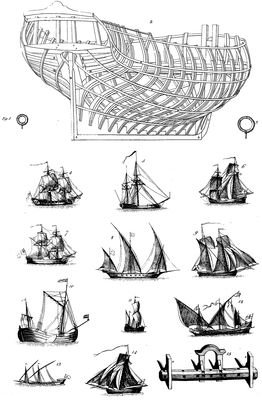
Plate. xii to face Vessel
To Under-run a tackle, is to separate the several parts of which it is composed, and range them in order, from one block to the other; so that the general effort may not be interrupted, when it is put in motion.
Under sail, the state of a ship when she is loosened from her moorings, and under the government of her sails and rudder. See Helm and Sail.
UNLACING, déboutonner, the act of loosening and taking off the bonnet of a sail from its principal part.
To UNMOOR, desafourcher, is to reduce a ship to the state of riding by a single anchor and cable, after she has been moored or fastened by two or more cables. See the articles Anchor and Mooring.
UNREEVING, the act of withdrawing or taking out a rope from any channel through which it had formerly passed; as in a block, thimble, dead-eye, &c. See Reeve.
To UNRIG a ship, défuner, is to deprive her of the standing and running rigging.
VOYAL, tournevire, a large rope used to unmoor, or heave up the anchors of a ship, by transmitting the effort of the capstern to the cables.
This is performed by fastening one part of the voyal to the cable in several places, and by winding another part thereof three or four times about the capstern, which answers the same purpose as if the cable itself were in that manner wound about the capstern; and the voyal being much lighter and more pliant, is infinitely more convenient in this exercise. See the articles Capstern and Nipper.
If the cable is drawn into the ship by the main capstern, the voyal is used without any block: but if the capstern in the fore-part of the ship be employed for this purpose, the voyal usually passes through a large block attached to the main-mast; and thence communicates with the jear-capstern.
UPPER-DECK, the highest of those decks which are continued throughout the whole of a ship of war, or merchantman, without any interruption, of steps or irregular ascents. See Deck and Waist.
UPPER-WORK, oeuvres mortes, a general name given to all that part of a ship which is above the surface of the water when she is properly balanced for a sea-voyage: hence it may be considered as separated from the bottom by the main wale, as explained particularly in the article Naval Architecture.
UPRIGHT, the situation wherein the opposite sides of a ship are equally elevated above the surface of the water, as in fig. 2. plate VI.; or when she neither inclines to the right nor left, with regard to the vertical position of her stem and stern-post.
USES AND CUSTOMS of the sea; certain general principles which compose the basis of marine jurisprudence, and regulate the affairs of commerce and navigation.
W.
WAD, bourrelet, a quantity of old rope-yarns rolled firmly together into the form of a ball, and used to confine the shot or shell, together with its charge of powder, in the breech of a piece of artillery.
M. Le Blond observes, in his Elements of war, that the wad is necessary to retain the charge closely in the chamber of the cannon, so that it may not, when fired, be dilated around the sides of the ball, by its windage as it passes through the chace; a circumstance which would considerably diminish the effort of the powder. But as the wad cannot be fastened to the sides of the bore, it is carried away in the same instant when the charge is inflamed, and that with so little resistance, that it cannot in any degree retard the explosion, or give time for the entire inflammation of the powder.
This reasoning may with equal propriety be applied to the wad that covers the bullet; which, nevertheless, is absolutely requisite, to prevent it from rolling out when the piece is fired horizontally or pointed downwards. Both are therefore peculiarly necessary in naval engagements, because, without being thus retained in its chamber, the shot would instantly roll out of the chace by the agitation of the vessel.
WAFT, berne, a signal displayed from the stern of a ship for some particular purpose, by hoisting the ensign, furled up together into a long roll, to the head of its staff. It is particularly used to summon the boats off from the shore to the ship whereto they belong; or as a signal for a pilot to repair aboard. See Signal.
WAIST, that part of a ship which is contained between the quarter-deck and fore-castle, being usually a hollow space, with an ascent of several steps to either of those places.
When the waist of a merchant-ship is only one or two steps of descent from the quarter-deck and fore-castle, she is said to be galley-built; but when it is considerably deeper, as with six or seven steps, she is called frigate-built. See the articles Deck, Deep-waisted, and Frigate.
WAKE, houaiche, the print or track impressed by the course of a ship on the surface of the water. It is formed by the re-union of the body of water, which was separated by the ship’s bottom whilst moving through it and may be seen to a considerable distance behind the stern, as smoother than the rest of the sea. Hence it is usually observed by the compass, to discover the angle of Lee-way.
A ship is said to be in the wake, dans l’eau, of another, when she follows her on the same track, or on a line supposed to be formed on the continuation of her keel. Thus the ships a b, fig. 11. and a b, fig. 7. plate V. are all in the wake of the foremost b. See the article Line.
Two distant objects observed at sea are called in the wake of each other, when the view of the farthest is intercepted by the nearest; so that the observer’s eye and the two objects are all placed upon the same right line.
WALE-KNOT, or WALL-KNOT, a particular sort of large knot raised upon the end of a rope, by untwisting the strands, and interweaving them amongst each other. See the article Knot.
WALE-REARED, an obsolete phrase, implying wall-sided, which see.
WALES, preceintes, an assemblage of strong planks extending along a ship’s side, throughout her whole length, at different heights, and serving to reinforce the decks, and form the curves by which the vessel appears light and graceful on the water.
As the wales are framed of planks broader and thicker than the rest, they resemble ranges of hoops encircling the sides and bows. They are usually distinguished into the main-wale and the channel-wale; the breadth and thickness of which are expressed by Q and R in the Midship-frame, plate VII. and their length is exhibited in the Elevation, plate I. where L Q Z is the main-wale, and D R X the channel-wale, parallel to the former.
The situation of the wales, being ascertained by no invariable rule, is generally submitted to the fancy and judgment of the builder. The position of the gun-ports and scuppers ought, however, to be particularly considered on this occasion, that the wales may not be wounded by too many breaches.
WALL-SIDED, the figure of a ship’s side, when, instead of being incurvated so as to become gradually narrower towards the upper part, it is nearly perpendicular to the surface of the water, like a wall; and hence the derivation of the phrase.
WALT, an obsolete or spurious term signifying crank. See that article.
WARP, a small rope employed occasionally to remove a ship from one place to another, in a port, road, or river. And hence,
To Warp, remorquer, is to change the situation of a ship, by pulling her from one part of a harbour, &c. to some other, by means of warps, which are attached to buoys; to anchors sunk in the bottom; or to certain stations upon the shore, as posts, rings, trees, &c. The ship is accordingly drawn forwards to those stations, either by pulling on the warps by hand, or by the application of some purchase, as a tackle, windlass, or capstern, upon her deck. See those articles.
When this operation is performed by the ship’s lesser anchors, these machines, together with their warps, are carried out in the boats alternately towards the place where the ship is endeavouring to arrive: so that when she is drawn up close to one anchor, the other is carried out to a competent distance before her, and being sunk, serves to fix the other warp by which she is farther advanced.
Warping is generally used when the sails are unbent, or when they cannot be successfully employed, which may either arise from the unfavourable state of the wind, the opposition of the tide, or the narrow limits of the channel.
WASH. See the article Oar.
Wash-board, a broad thin plank fixed occasionally on the top of a boat’s side, so as to continue the height thereof, and be removed at pleasure. It is used to prevent the sea from breaking into the vessel, particularly when the surface is rough, as in tempestuous weather.
WATCH, quart, the space of time wherein one division of a ship’s crew remains upon deck, to perform the necessary services, whilst the rest are relieved from duty, either when the vessel is under sail, or at anchor.
The length of the sea-watch is not equal in the shipping of different nations. It is always kept four hours by our British seamen, if we except the dog-watch between four and eight in the evening, that contains two reliefs, each of which are only two hours on deck. The intent of this is to change the period of the night-watch every twenty-four hours; so that the party watching from eight till twelve in one night, shall watch from midnight till four in the morning on the succeeding one. In France the duration of the watch is extremely different, being in some places six hours, and in others seven or eight; and in Turky and Barbary it is usually five or six hours.
A ship’s company is usually classed into two parties; one of which is called the starboard and the other the larboard watch. It is, however, occasionally separated into three divisions, as in a road or in particular voyages.
In a ship of war the watch is generally commanded by a lieutenant, and in merchant-ships by one of the mates; so that if there are four mates in the latter, there are two in each watch; the first and third being in the larboard, and the second and fourth in the starboard watch: but in the navy the officers who command the watch usually divide themselves into three parts, in order to lighten their duty.
Watch-glasses, horloge, a name given to the glasses employed to measure the period of the watch, or to divide it into any number of equal parts, as hours, half-hours, &c. so that the several stations therein may be regularly kept and relieved; as at the helm, pump, look-out. &c.
To set the Watch, is to appoint one division of the crew to enter upon the duty of the watch; as at eight o’clock in the evening. Hence it is equivalent to mounting the guard in the army. See the French term Bordée.
WATER-BORNE, the state of a ship, with regard to the water surrounding her bottom, when there is barely a sufficient depth of it to float her off from the ground; particularly when she had for some time rested thereon.
For Dead-Water, Foul Water, and High-Water, see Dead, Foul, and High.
Water-lines, lignes d’eau, certain horizontal lines supposed to be drawn about the outside of a ship’s bottom, close to the surface of the water in which she floats. They are accordingly higher or lower upon the bottom, in proportion to the depth of the column of water required to float her. See a particular account of these in the article Naval Architecture.
In order to conceive a clearer idea of the curves of those lines when represented on a plane, let us suppose a ship laid upright on a level ground; so that the keel shall lie in the same position, with respect to the horizon, as when she is laden. We may then describe several black horizontal lines about her bottom, which may be whitened for that purpose.
If a spectator is supposed to be placed, at a competent depth, under the middle of her bottom, in a line perpendicular to the plane of the ground; he will then, viewing the bottom upwards, discover the horizontal curves of all the water-lines.
These curves are all delineated on a plane, supposed to be formed by an horizontal section of the bottom, at the height of the load-water-line, ligne d’eau du vaisseau chargé.
Water-logged, the state of a ship when, by receiving a great quantity of water into her hold, by leaking, &c. she has become heavy and inactive upon the sea, so as to yield without resistance to the efforts of every wave rushing over her decks. As, in this dangerous situation, the center of gravity is no longer fixed, but fluctuating from place to place, the stability of the ship is utterly lost: she is therefore almost totally deprived of the use of her sails, which would operate to overset her, or press the head under water. Hence there is no resource for the crew, except to free her by the pumps, or to abandon her by the boats as soon as possible.
Water-sail, a small sail spread occasionally under the lower studding-sail, or driver-boom, in a fair wind, and smooth sea.
Water-shot. See the article Mooring.
Water-spout, an extraordinary and dangerous meteor, consisting of a large mass of water, collected into a sort of column by the force of a whirlwind, and moved with rapidity along the surface of the sea.
A variety of authors have written on the cause and effects of these meteors, with different degrees of accuracy and probability. As it would be superfluous to enter minutely into their various conjectures, which are frequently grounded on erroneous principles, we shall content ourselves with selecting a few of the latest remarks; and which are apparently supported by philosophical reasoning.
Dr. Franklin, in his physical and meteorological observations, supposes a water-spout and a whirlwind to proceed from the same cause, their only difference being, that the latter passes over the land, and the former over the water. This opinion is corroborated by M. de la Pryme, in the Philosophical Transactions; where he describes two spouts observed at different times in Yorkshire, whose appearances in the air were exactly like those of the spouts at sea; and their effects the same as those of real whirlwinds.
Whirlwinds have generally a progressive as well as a circular motion; so had what is called the spout at Topsham, described in the Transactions; and this also by its effects appears to have been a real whirlwind. Water-spouts have also a progressive motion, which is more or less rapid; being in some violent, and in others barely perceptible.
Whirlwinds generally rise after calms and great heats: the same is observed of water-spouts, which are therefore most frequent in the warm latitudes.
The wind blows every way from a large surrounding space to a whirlwind. Three vessels employed in the whale-fishery, happening to be becalmed, lay in sight of each other, at about a league distance, and in the form of a triangle. After some time a water-spout appeared near the middle of the triangle; when a brisk gale arose, and every vessel made sail. It then appeared to them all by the trimming of their sails, and the course of each vessel, that the spout was to leeward of every one of them; and this observation was farther confirmed by the comparing of accounts, when the different observers afterwards conferred about the subject. Hence whirlwinds and water-spouts agree in this particular likewise.
But if the same meteor which appears a water-spout at sea, should, in its progressive motion, encounter and pass over land, and there produce all the phenomena and effects of a whirlwind, it would afford a stronger conviction that a whirlwind and a water-spout are the same thing. An ingenious correspondent of Dr. Franklin gives one instance of this that fell within his own observation[57].
A fluid moving from all points horizontally towards a center, must, at that center, either mount or descend. If a hole be opened in the middle of the bottom of a tub filled with water, the water will flow from all sides to the center, and there descend in a whirl. But air flowing on or near the surface of land or water, from all sides towards a center, must at that center ascend; because the land or water will hinder its descent.
If these concentring currents of air be in the upper region, they may indeed descend in the spout or whirlwind; but then, when the united current reached the earth or water, it would spread, and probably blow every way from the center. There may be whirlwinds of both kinds; but from the effects commonly observed, Dr. Franklin suspects the rising one to be most frequent: when the upper air descends, it is perhaps in a greater body extending wider, as in thunder-gusts, and without much whirling; and when air descends in a spout or whirlwind, he conceives that it would rather press the roof of a house inwards, or force in the tiles, shingles, or thatch, and force a boat down into the water, or a piece of timber into the earth, than snatch them upwards, and carry them away.
The whirlwinds and spouts are not always, though most frequently, in the day-time. The terrible whirlwind which damaged a great part of Rome, June 11. 1749. happened in the night; and was supposed to have been previously a water-spout, it being asserted as an undoubted fact, that it gathered in the neighbouring sea, because it could be traced from Ostia to Rome.
The whirlwind is said to have appeared as a very black, long, and lofty cloud, discoverable, notwithstanding the darkness of the night, by its continually lightening, or emitting flashes on all sides, pushing along with a surprising swiftness, and within three or four feet of the ground. Its general effects on houses were, stripping off the roofs, blowing away chimnies, breaking doors and windows, forcing up the floors, and unpaving the rooms, (some of these effects seem to agree well with a supposed vacuum in the center of the whirlwind) and the very rafters of the houses were broke and dispersed, and even hurled against houses at a considerable distance, &c.
The Doctor, in proceeding to explain his conceptions, begs to be allowed two or three positions, as a foundation for his hypothesis. 1. That the lower region of air is often more heated, and so more rarified, than the upper; and by consequence specifically lighter. The coldness of the upper region is manifested by the hail, which sometimes falls from it in warm weather. 2. That heated air may be very moist, and yet the moisture so equally diffused and rarified as not to be visible till colder air mixes with it, at which time it condenses and becomes visible. Thus our breath, although invisible in summer, becomes visible in winter.
These circumstances being granted, he presupposes a tract of land or sea, of about sixty miles in extent, unsheltered by clouds and unrefreshed by the wind, during a summer’s day, or perhaps for several days without intermission, till it becomes violently heated, together with the lower region of the air in contact with it, so that the latter becomes specifically lighter than the superincumbent higher region of the atmosphere, wherein the clouds are usually floated: he supposes also that the air surrounding this tract has not been so much heated during those days, and therefore remains heavier. The consequence of this, he conceives, should be, that the heated lighter air should ascend, and the heavier descend; and as this rising cannot operate throughout the whole tract at once, because that would leave too extensive a vacuum, the rising will begin precisely in that column which happens to be lighted, or most rarified; and the warm air will flow horizontally from all parts to this column, where the several currents meeting, and joining to rise, a whirl is naturally formed, in the same manner as a whirl is formed in a tub of water, by the descending fluid receding from all sides of the tub towards the hole in the center.
And as the several currents arrive at this central rising column, with a considerable degree of horizontal motion, they cannot suddenly change it to a vertical motion; therefore, as they gradually, in approaching the whirl, decline from right to curve or circular lines, so, having joined the whirl, they ascend by a spiral motion; in the same manner as the water descends spirally through the hole in the tub before mentioned.
Lastly, as the lower air nearest the surface is more rarified by the heat of the sun, it is more impressed by the current of the surrounding cold and heavy air which is to assume its place, and consequently its motion towards the whirl is swiftest, and so the force of the lower part of the whirl strongest, and the centrifugal force of its particles greatest. Hence the vacuum which encloses the axis of the whirl should be greatest near the earth or sea, and diminish gradually as it approaches the region of the clouds, till it ends in a point.
This circle is of various diameters, sometimes very large.
If the vacuum passes over water, the water may rise in a body or column therein to the height of about thirty-two feet. This whirl of air may be as invisible as the air itself, though reaching in reality from the water to the region of cool air, in which our low summer thunder-clouds commonly float; but it will soon become visible at its extremities. The agitation of the water under the whirling of the circle, and the swelling and rising of the water in the commencement of the vacuum, renders it visible below. It is perceived above by the warm air being brought up to the cooler region, where its moisture begins to be condensed by the cold into thick vapour; and is then first discovered at the highest part; which being now cooled, condenses what rises behind it, and this latter acts in the same manner on the succeeding body; where, by the contact of the vapours, the cold operates faster in a right line downwards, than the vapours themselves can climb in a spiral line upwards; they climb, however, and as by continual addition they grow denser, and by consequence increase their centrifugal force, and being risen above the concentrating currents that compose the whirl, they fly off, and form a cloud.
It seems easy to conceive, how, by this successive condensation from above, the spout appears to drop or descend from the cloud, although the materials of which it is composed are all the while ascending. The condensation of the moisture contained in so great a quantity of warm air as may be supposed to rise in a short time in this prodigiously rapid whirl, is perhaps sufficient to form a great extent of cloud: and the friction of the whirling air on the sides of the column may detach great quantities of its water, disperse them into drops, and carry them up in the spiral whirl mixed with the air. The heavier drops may indeed fly off, and fall into a shower about the spout; but much of it will be broken into vapour, and yet remain visible.
As the whirl weakens, the tube may apparently separate in the middle; the column of water subsiding, the superior condensed part drawing up to the cloud. The tube or whirl of air may nevertheless remain entire, the middle only becoming invisible, as not containing any visible matter.
Dr. Stuart, in the Philosophical Transactions, says, “It was observable of all the spouts he saw, but more perceptible of a large one, that towards the end it began to appear like a hollow canal, only black in the borders, but white in the middle; and though it was at first altogether black and opaque, yet the sea-water could very soon after be perceived to fly up along the middle of this canal like smoke in a chimney.”
When Dr. Stuart’s spouts were full charged, that is, when the whirling pipe of air was filled with quantities of drops and vapour torn off from the column, the whole was rendered so dark that it could not be seen through, nor the spiral ascending motion discovered; but when the quantity ascending lessened, the pipe became more transparent, and the ascending motion visible. The spiral motion of the vapours, whose lines intersect each other on the nearest and farthest side of this transparent part, appeared therefore to Stuart like smoke ascending in a chimney; for the quantity being still too great in the line of sight through the sides of the tube, the motion could not be discovered there, and so they represented the solid sides of the chimney.
Dr. Franklin concludes by supposing a whirlwind or spout to be stationary, when the concurring winds are equal but if unequal, the whirl acquires a progressive motion in the direction of the strongest pressure. When the wind that communicates this progression becomes stronger above than below, or below than above, the spout will be bent or inclined. Hence the horizontal process and obliquity of water-spouts are derived.
Water-way, gouttiere, a long piece of timber serving to connect the sides of a ship to her decks, and form a sort of channel to carry off the water from the latter by means of scuppers. See that article.
The convexity of the decks, represented by N, M, N, in the Midship-frame, plate VII. necessarily carries the water towards the sides, where this piece is fixed, which is principally designed to prevent the water from lodging in the seams, so as to rot the wood and oakum contained therein. The water-ways N N are therefore hollowed in the middle lengthways, so as to form a kind of gutter or channel, one side of which lies almost horizontally, making part of the deck, whilst the other rises upwards, and corresponds with the side, of which it likewise makes a part. They are scored down about an inch and a half, or two inches, upon the beams, and rest upon lodging-knees or carlings. They are secured by bolts driven from without through the planks, timbers, and water-ways, and clinched upon rings on the inside of the latter.
The scuppers, which are holes by which the water escapes from off the deck, are accordingly cut through the water-ways.
WAVE, a volume of water elevated by the action of the wind upon its surface, into a state of fluctuation.
Mr. Boyle has proved, by a variety of experiments, that the utmost force of the wind never penetrates deeper than six feet into the water; and it should seem a natural consequence of this, that the water put in motion by it can only be elevated to the same height of six feet from the level of the surface in a calm. This six feet of elevation being then added to the six of excavation, in the part whence that water was raised, should give twelve feet for the greatest elevation of a wave, when the height of it is not increased by whirlwinds, or the interruption of rocks or shoals, which always gives an additional elevation to the natural swell of the waves.
We are not to suppose, from this calculation, that no wave of the sea can rise more than six feet above its natural level in open and deep water; for some immensely higher than these are formed in violent tempests, in the great seas. These, however, are not to be accounted waves in their natural state; but they are single waves composed of many others: for in these wide plains of water, when one wave is raised by the wind, and would elevate itself up to the exact height of six feet, and no more, the motion of the water is so great, and the succession of the waves so quick, that during the time wherein this rises, it receives into it several other waves, each of which would have been of the same height with itself. These accordingly run into the first wave, one after another as it rises: by this means its rise is continued much longer than it would naturally have been, and it becomes accumulated to an enormous size. A number of these complicated waves arising together, and being continued in a long succession by the duration of the storm, make the waves so dangerous to shipping, which the sailors, in their phrase, call mountains high.
WAY of a ship, the course or progress which she makes on the water under sail. Thus, when she begins her motion, she is said to be under way; and when that motion increases, she is said to have fresh way through the water. Hence also she is said to have head-way or stern-way. See those articles.
WEARING. See the article Veering.
WEATHER is known to be the particular state of the air with regard to the degree of the wind, to heat or cold, or to driness and moisture.
Weather is also used as an adjective, applied by mariners to every thing lying to-windward of a particular situation. Thus a ship is said to have the weather-gage of another, when she is farther to-windward. Thus also, when, a ship under sail presents either of her sides to the wind, it is then called the weather-side; and all the rigging and furniture situated thereon are distinguished by the same epithet; as, the weather-shrouds, the weather-lifts, the weather-braces, &c. See the article Lee.
To Weather, is to sail to-windward of some ship, bank, or head-land.
Weather-bit, a turn of the cable of a ship about the end of the windlass, without the knight-heads. It is used to check the cable, in order to slacken it gradually out of the ship, in tempestuous weather, or when the ship rides in a strong current. See also Ring-rope.
Weather-shore, a name given by seamen to the shore lying to the windward.
To WEIGH, denotes in general to heave up the anchor of a ship from the ground, in order to prepare her for sailing. See also Aweigh.
WELL, an apartment formed in the middle of a ship’s hold to inclose the pumps, from the bottom to the lower deck. It is used as a barrier to preserve those machines from being damaged by the friction or compression of the materials contained in the hold, and particularly to prevent the entrance of ballast, &c. by which the tubes would presently be choaked, and the pumps rendered incapable of service. By means of this inclosure, the artificers may likewise more readily descend into the hold, in order to examine the state of the pumps, and repair them, as occasion requires.
Well of a fishing-vessel, an apartment in the middle of the hold, which is entirely detached from the rest, being lined with lead on every side, and having the bottom thereof penetrated with a competent number of small holes, passing also through the ship’s floor, so that the salt-water running into the well is always kept as fresh as that in the sea, and yet prevented from communicating itself to the other parts of the hold.
Well-room of a boat, the place in the bottom where the water lies, between the ceiling and the platform of the stern-sheets, from whence it is thrown out into the sea with a scoop.
WHARF, a perpendicular building of wood or stone raised on the shore of a road or harbour, for the convenience of lading or discharging a vessel by means of cranes, tackles, capsterns, &c.
A wharf is built stronger or slighter, in proportion to the effort of the tide or sea which it is to resist, and to the weight which it is intended to support.
WHARFINGER, the person who has the charge of a wharf, and takes account of all the articles landed thereon, or removed from it, into any vessel lying alongside thereof; for which he receives a certain fee called wharfage, which becomes due to the proprietor for the use of his machines and furniture.
WHEEL of the helm. See Helm.
WHELPS. See the article Capstern.
WHIP, a sort of small tackle, either formed by the communication of a rope with a single immoveable block, as fig. 3. plate XI. or with two blocks, one of which is fixed, and the other moveable, as fig. 5. It is generally used to hoist up light bodies, as empty casks, &c. out of a ship’s hold, which is accordingly called whipping them up. See Tackle.
To Whip, is also to tie a piece of packthread, spun-yarn, &c. about the end of a rope, to prevent it from being untwisted and loosened.
Boatswain’s WHISTLE. See Call.
WHOODING. See the article Rabbit.
WINCH, a cylindrical piece of timber, furnished with an axis, whose extremities rest in two channels placed horizontally or perpendicularly. It is turned about by means of an handle resembling that of a draw-well, grind-stone, &c. and is generally employed as a purchase, by which a rope may be more conveniently or more powerfully applied to any object, than when used singly, or without the assistance of mechanical powers.
WIND, vent, a stream or current of air which may be felt; and usually blows from one part of the horizon to its opposite part.
The horizon, besides being divided into 360 degrees, like all other circles, is by mariners supposed to be divided into four quadrants, called the north-east, north-west, south-east, and south-west quarters. Each of these quarters they divided into eight equal parts, called points, and each point into four equal parts, called quarter-points. So that the horizon is divided into 32 points, which are called rhumbs or winds; to each wind is assigned a name, which shews from what point of the horizon the wind blows. The points of north, south, east, and west, are called cardinal points and are at the distance of 90 degrees, or eight points from one another.
Winds are either constant or variable, general or particular. Constant winds are such as blow the same way, at least for one or more days; and variable winds are such as frequently shift within a day. A general or reigning wind is that which blows the same way, over a large tract of the earth, almost the whole year. A particular wind is what blows, in any place, sometimes one way, and sometimes another, indifferently. If the wind blows gently, it is called a breeze; if it blows harder, it is called a gale, or a stiff gale; and if it blows with violence, it is called a storm or hard gale[58].
The following observations on the wind have been made by skilful seamen: and particularly the great Dr. Halley.
1st. Between the limits of 60 degrees, namely, from 30° of north latitude to 30° of south latitude, there is a constant east wind throughout the year, blowing on the Atlantic and Pacific oceans; and this is called the trade-wind.
For as the sun, in moving from east to west, heats the air more immediately under him, and thereby expands it; the air to the eastward is constantly rushing towards the west to restore the equilibrium, or natural state of the atmosphere; and this occasions a perpetual east wind in those limits.
2d. The trade-winds near their northern limits blow between the north and east, and near the southern limits they blow between the south and east.
For as the air is expanded by the heat of the sun near the equator; therefore the air from the northward and southward will both tend towards the equator to restore the equilibrium. Now these motions from the north and south, joined with the foregoing easterly motion, will produce the motions observed near the said limits between the north and east, and between the south and west.
3d. These general motions of the wind are disturbed on the continents, and near their coasts.
For the nature of the soil may either cause the air to be heated or cooled; and hence will arise motions that may be contrary to the foregoing general one.
4th. In some parts of the Indian ocean there are periodical winds, which are called Monsoons; that is, such as blow half the year one way, and the other half-year the contrary way.
For air that is cool and dense, will force the warm and rarefied air in a continual stream upwards, where it must spread itself to preserve the equilibrium: so that the upper course or current of the air shall be contrary to the under current; for the upper air must move from those parts where the greatest heat is; and so, by a kind of circulation, the N. E. trade-wind below will be attended with a S. W. above; and a S. E. below with a N. W. above: And this is confirmed by the experience of seamen, who, as soon as they get out of the trade-winds, generally find a wind blowing from the opposite quarter.
5th. In the Atlantic ocean, near the coasts of Africa, at about 100 leagues from shore between the latitudes of 28° and 10° north, seamen constantly meet with a fresh gale of wind blowing from the N. E.
6th. Those bound to the Caribbee islands, across the Atlantic ocean, find, as they approach the American side, that the said N. E. wind becomes easterly; or seldom blows more than a point from the east, either to the northward or southward.
These trade-winds, on the American side, are extended to 30, 31, or even to 32° of N. latitude; which is about 4° farther than what they extend to on the African side: Also, to the southward of the equator, the trade-winds extend three or four degrees farther towards the coast of Brasil on the American side, than they do near the Cape of Good Hope on the African side.
7th. Between the latitudes of 4° and 4° south, the wind always blows between south and east. On the African side the winds are nearest the south; and on the American side nearest the east. In these seas Dr. Halley observed, that when the wind was eastward, the weather was gloomy, dark, and rainy, with hard gales of wind; but when the wind veered to the southward, the weather generally became serene, with gentle breezes next to a calm.
These winds are somewhat changed by the seasons of the year; for when the sun is far northward, the Brasil S. E. wind gets to the south, and the N. E. wind to the east; and when the sun is far south, the S. E. wind gets to the east, and the N. E. winds on this side of the equator veer more to the north.
8th. Along the coast of Guinea, from Sierra Leone to the island of St. Thomas, (under the equator) which is above 500 leagues, the southerly and south-west winds blow perpetually: for the S. E. trade-wind having passed the equator, and approaching the Guinea coast within 80 or 100 leagues, inclines towards the shore, and becomes south, then S. E. and by degrees, as it approaches the land, it veers about to south, S. S. W. and when very near the land it is S. W. and sometimes W. S. W. This tract is troubled with frequent calms, violent sudden gusts of wind, called tornadoes, blowing from all points of the horizon.
The reason of the wind setting in west on the coast of Guinea, is in all probability owing to the nature of the coast, which being greatly heated by the sun, rarefies the air exceedingly, and consequently the cool air from off the sea will keep rushing in to restore the equilibrium.
9th. Between the 4th and 10th degrees of north latitude, and between the longitude of Cape Verd, and the eastermost of the Cape Verd isles, there is a track of sea which seems to be condemned to perpetual calms, attended with terrible thunder and lightnings, and such frequent rains, that this part of the sea is called the rains. In sailing through these six degrees, ships are said to have been sometimes detained whole months.
The cause of this is apparently, that the westerly winds setting in on this coast, and meeting the general easterly wind in this track, balance each other, and so produce the calms; and the vapours carried thither by each wind meeting and condensing, occasion the almost constant rains.
The last three observations shew the reason of two things which mariners experience in sailing from Europe to India, and in the Guinea trade.
And first. The difficulty which ships in going to the southward, especially in the months of July and August, find in passing between the coast of Guinea and Brasil, notwithstanding the width of this sea is more than 500 leagues. This happens, because the S. E. winds at that time of the year commonly extend some degrees beyond the ordinary limits of 4° N. latitude; and besides coming so much southerly, as to be sometimes south, sometimes a point or two to the west; it then only remains to ply to windward: And if, on the one side, they steer W. S. W. they get a wind more and more easterly; but then there is danger of falling in with the Brasilian coast, or shoals: and if they steer E. S. E. they fall into the neighbourhood of the coast of Guinea, from whence they cannot depart without running easterly as far as the island of St. Thomas; and this is the constant practice of all the Guinea ships.
Secondly. All ships departing from Guinea for Europe, their direct course is northward; but on this course they cannot proceed, because the coast bending nearly east and west, the land is to the northward. Therefore, as the winds on this coast are generally between the S. and W. S. W. they are obliged to steer S. S. E. or south, and with these courses they run off the shore; but in so doing they always find the winds more and more contrary; so that when near the shore, they can lie south; but at a greater distance they can make no better than S. E. and afterwards E. S. E.; with which courses they commonly fetch the island of St. Thomas and Cape Lopez, where finding the winds to the eastward of the south, they sail westerly with it, till coming to the latitude of four degrees south, where they find the S. E. wind blowing perpetually.
On account of these general winds, all those that use the West India trade, and even those bound to Virginia, reckon it their best course to get as soon as they can to the southward, that so they may be certain of a fair and fresh gale to run before it to the westward: And for the same reason those homeward-bound from America endeavour to gain the latitude of 30 degrees, where they first find the winds begin to be variable; though the most ordinary winds in the north Atlantic ocean come from between the south and west.
10th. Between the southern latitudes of 10 and 30 degrees in the Indian ocean, the general trade-wind about the S. E. by S. is found to blow all the year long in the same manner as in the like latitudes in the Ethiopic ocean: and during the six months from May to December, these winds reach to within two degrees of the equator; but during the other six months, from November to June, a N. W. wind blows in the tract lying between the 3d and 10th degrees of southern latitude, in the meridian of the north-end of Madagascar; and between the 2d and 12th degree of south latitude, near the longitude of Sumatra and Java.
11th. In the tract between Sumatra and the African coast, and from three degrees of south latitude quite northward to the Asiatic coasts, including the Arabian sea and the Gulf of Bengal, the Monsoons blow from September to April on the N. E.; and from March to October on the S. W. In the former half-year the wind is more steddy and gentle, and the weather clearer, than in the latter six months: and the wind is more strong and steddy in the Arabian sea than in the Gulf of Bengal.
12th. Between the island of Madagascar and the coast of Africa, and thence northward as far as the equator, there is a tract, wherein from April to October there is a constant fresh S. S. W. wind; which to the northward changes into the W. S. W. wind, blowing at times in the Arabian sea.
13th. To the eastward of Sumatra and Malacca on the north of the equator, and along the coasts of Cambodia and China, quite through the Philippines as far as Japan, the Monsoons blow northerly and southerly; the northern one setting in about October or November, and the southern about May. The winds are not quite so certain as those in the Arabian seas.
14th. Between Sumatra and Java to the west, and New Guinea to the east, the same northerly and southerly winds are observed; but the first half year Monsoon inclines to the N. W. and the latter to the S. E. These winds begin a month or six weeks after those in the Chinese seas set in, and are quite as variable.
15th. These contrary winds do not shift from one point to its opposite all at once; and in some places the time of the change is attended with calms, in others by variable winds: and it often happens on the shores of Coromandel and China, towards the end of the Monsoons, that there are most violent storms, greatly resembling the hurricanes in the West Indies; wherein the wind is so excessively strong, that hardly any thing can resist its force.
All navigation in the Indian ocean must necessarily be regulated by these winds; for if mariners should delay their voyages till the contrary Monsoon begins, they must either sail back, or go into harbour, and wait for the return of the trade-wind.
The relative force of the wind upon a ship’s sails, and the epithets by which it is distinguished, as fair, large, &c. according to the angle which it makes with her course, are explained in the article Sailing.
Reigning Wind. See Reigning Wind.
To Wind a ship or boat, is to change her position, by bringing the stern to lie in the situation of the head; or directly opposite to its former situation.
To Windward, towards that part of the horizon from whence the wind bloweth.
WINDAGE, the difference between the diameter of a piece of artillery, and the diameter of the shot or shell corresponding thereto. See Cannon and Mortar.
WINDING a Call, the act of blowing or piping upon a boatswain’s whistle, so as to communicate the necessary orders of hoisting, heaving, belaying, slackening, &c. See the article Call.
Winding-Tackle, a name usually given to a tackle formed of three fixed and two or three moveable sheaves. It is principally employed to hoist up any weighty materials into or out of a ship, in the exercises of lading and delivering. See Tackle.
WINDLASS, vindas, a machine used in merchant-ships to heave up the anchors from the bottom, &c.
The windlass is a large cylindrical piece of timber, fig. 15. plate XII. formed on the principles of the axis in peritrochio. It is supported at the two ends by two frames of wood, a, b, placed on the opposite sides of the deck near the fore-mast, called knight-heads, and is turned about in this position as upon an axis, by levers called handspecs, which are for this purpose thrust into holes bored through the body of the machine. See the article Heaving.