AN UNIVERSAL DICTIONARY OF THE MARINE. (continued 6)
Reading edition
To KEEP, a term used on several occasions in navigation: as,
To Keep the land aboard, is to keep within sight of land as much as possible. See also Hold.
To Keep the luff, to continue close to the wind, i. e. sailing with a course inclined to the direction of the wind, as much as possible, without deviating to leeward. This is also called, keeping the wind. See Close-hauled.
To Keep off, alargeer, tenir le largue, to sail off, or keep at a distance from the shore. See also Offing.
Boat-Keeper, one of the rowers, who remains as a centinel in his turn, to take care of any boat and her contents, either when she lies by the shore, or along-side of the ship; or when she is towed astern of her.
KELSON, contre quille, a piece of timber, which may be properly defined the interior, or counter-part of the keel, as it is laid upon the middle of the floor-timbers, immediately over the keel, and, like it, composed of several pieces, scarfed together, represented by X, plate I. Pieces of the Hull. In order to fit with more security upon the floor-timbers and crotches, it is notched about an inch and a half deep, opposite to each of those pieces, and thereby firmly scored down upon them to that depth, where it is secured by spike-nails. The pieces of which it is formed are only half the breadth and thickness of those of the keel.
The kelson serves to bind and unite the floor-timbers to the keel. It is confined to the keel by long bolts, which, being driven from without through several of the timbers, are fore-locked or clinched upon rings on the upper side of the kelson.
KETCH, a vessel equipped with two masts, viz. the main-mast and mizen-mast, and usually from 100 to 250 tons burthen.
Ketches are principally used as yachts, or as bomb-vessels, the former of which are employed to convey princes of the blood, ambassadors, or other great personages from one part to another; and the latter are used to bombard citadels, or towns, or other fortresses.
The bomb-ketches are therefore furnished with all the apparatus necessary for a vigorous bombardment. They are built remarkably strong, as being-fitted with a greater number of riders than any other vessel of war; and indeed this reinforcement is absolutely necessary to sustain the violent shock produced by the discharge of their mortars, which would otherwise, in a very short time, shatter them to pieces. See Mortar and Shell.
KEVELS, taquets, a frame composed of two pieces of timber, whose lower ends rest in a sort of step or foot, nailed to the ship’s side, from whence the upper ends branch outward into arms or horns, serving to belay the great ropes by which the bottoms of the main-sail and fore-sail are extended. These are represented by fig. 3. plate V.
KEY, quai, a long wharf, usually built of stone, by the side of a harbour or river, and having several store-houses for the convenience of lading and discharging merchant-ships. It is accordingly furnished with posts and rings, whereby they are secured; together with cranes, capsterns, and other engines, to lift the goods into, or out of, the vessels which lie along-side.
Keys, attalons, are also certain sunken rocks, lying near the surface of the water, particularly in the West-Indies.
KINK, a sort of twist or turn in any cable or other rope, occasioned by its being very stiff or close-laid; or by being drawn too hastily out of the roll or tier, when it lies coiled. See the article Coiling.
KNEE, courbe, a crooked piece of timber, having two branches, or arms, and generally used to connect the beams of a ship with her sides or timbers.
The branches of the knees form an angle of greater or smaller extent, according to the mutual situation of the pieces which they are designed to unite. One branch is securely bolted to one of the deck-beams, whilst the other is in the same manner attached to a corresponding timber in the ship’s side, as represented by E in the Midship-Frame, plate VII.
Besides the great utility of knees in connecting the beams and timbers into one compact frame, they contribute greatly to the strength and solidity of the ship, in the different parts of her frame to which they are bolted, and thereby enable, her, with greater firmness, to resist the effects of a turbulent sea.
In fixing of these pieces, it is occasionally necessary to give an oblique direction to the vertical, or side-branch, in order to avoid the range of an adjacent gun-port, or, because the knee may be so shaped as to require this disposition; it being sometimes difficult to procure so great a variety of knees as may be necessary in the construction of a number of ships of war.
In France, the scarcity of these pieces has obliged their shipwrights frequently to form their knees of iron.
Knees are either said to be lodging or hanging. The former are fixed horizontally in the ship’s frame, having one arm bolted to the beam, and the other across two or three timbers, as represented by F in the Deck, plate III. The latter are fixed vertically, as we have described above. See also Building, Deck, and Midship-Frame.
Knee of the head, poulaine, a large flat piece of timber, fixed edgways upon the fore-part of a ship’s stem, and supporting the ornamental figure or image, placed under the bowsprit. See the article Head.
The knee of the head, which may properly be defined a continuation of the stem, as being prolonged from the stem forwards, is extremely broad at the upper-part, and accordingly composed of several pieces united into one, Y Y, plate I. Pieces of the Hull. It is let into the head, and secured to the ship’s bows by strong knees fixed horizontally upon both, and called the cheeks of the head, Z Z, plate IV. fig. 10. The heel of it is scarfed to the upper end of the fore-foot, and it is fastened to the stem above by a knee, called a standard, expressed by &, in plate I. Pieces of the Hull.
Besides supporting the figure of the head, this piece is otherwise useful, as serving to secure the boom, or bumkin, by which the fore-tack is extended to windward; and, by its great breadth, preventing the ship from falling to leeward, when close-hauled, so much as she would otherwise do. It also affords a greater security to the bowsprit, by increasing the angle of the bob-stay, so as to make it act more perpendicularly on the bowsprit.
The knee of the head is a phrase peculiar to shipwrights; as this piece is always called the cut-water by seamen, if we except a few, who affecting to be wiser than their brethren, have adopted this expression probably on the presumption that the other is a cant phrase, or vulgarism. It appears a material part of the province of this work to call the several articles contained therein by their proper names, and to reject those which are spurious, however sanctified by the authority of official dulness, or seconded by the adoption of dignified ignorance. Accordingly we cannot help observing, that when a term of art has been established from time immemorial, and besides being highly expressive, produces the testimony of foreign nations[36] to its propriety, nothing more certainly betrays a superficial understanding, than the attempt to change it, without being able to assign the shadow of a reason for this alteration. For although knee of the head, being invariably used by the artificers, is of course explained in this work as a term of naval architecture, wherein practice has indeed rendered it natural and intelligible; it is nevertheless very rarely used by seamen, especially in common discourse, unless when it is intended to impress the hearer with an idea of the speaker’s superior judgment.
KNIGHT-HEAD, or Bollard-Timber. See the article Head.
Knight-Heads, two strong pieces of timber, fixed on the opposite sides of the main-deck, a little behind the fore-mast, in a merchant-ship.
They are used to support and inclose the ends of the windlass, which accordingly is turned therein as upon an axis. As each of the knight-heads is formed of two pieces, they may be occasionally separated in order to take off the turns of the cable from the windlass, or replace them upon it. They are sometimes called the bits, and in this sense their upper-parts only are denominated knight-heads, which being formerly embellished with a figure designed to resemble a human head, gave rise to the name they have ever since retained. See the article Windlass.
Knight-heads, sep de drisse, was also a name formerly given to the lower jear-blocks, which were then no other than bits, containing several sheaves, and nearly resembling our present top-sail-sheet bits.
KNITTLE, eguillette, (from knit) a small line, which is either plaited or twisted, and used for various purposes at sea; as to fasten the service on the cable, to reef the sails by the bottom, and to hang the hammocs between decks, &c.
KNOT, a large knob formed on the extremity of a rope, by untwisting the ends thereof, and interweaving them regularly amongst each other. There are several sorts of knots, which differ in their form and size, according to the uses for which they are designed: the principal of these are the diamond-knot, the rose-knot, the wall-knot or walnut, some of which are single, and others double.
The knots are generally used to fasten one rope to another, by means of a small cord attached to the neck of the knot, called the laniard, which is firmly tied about both ropes. They are also designed to prevent the end of a rope from sliding through an eye, which the knot is intended to confine in a particular situation. See Beckets.
L.
TO LABOUR, travailler, as a sea-term, implies to roll or pitch heavily in a turbulent sea; an effect, by which the masts and hull of the ship are greatly endangered, because by the rolling motion the masts strain upon their shrouds with an effort, which increases as the sine of their obliquity: and the continual agitation of the vessel gradually loosens her joints, and often makes her extremely leaky.
LADDER, echelle, a well-known convenience, of which there are a great number in a ship, formed of two pieces of plank joined together by crosspieces, which serve as steps, whereby to mount or descend from one deck to another.
The ladders derive their names from the several hatchways, or other parts of a ship, wherein they are situated. Besides these, there are, of a particular construction, the accommodation-ladder and the quarter-ladders.
Accommodation-Ladder, is a sort of light stair-case, occasionally fixed on the gangway of the admiral, or commander in chief, of a fleet. It is furnished with rails and entering-ropes, covered with red bays, and the lower-end of it is retained at a competent distance from the ship’s side by iron bars, or braces, to render the passage more convenient to those who enter or depart from the ship. See the article Gangway.
Quarter-Ladders, two ladders of rope, depending from the right and left side of a ship’s stern, whereby to descend into the boats which are moored astern, in order to bring them up along-side of the ship; or to use them for any other occasion.
LADEN, chargée, the state of a ship when she is charged with a weight or quantity of any sort of merchandizes, or other materials, equal to her tonnage or burthen. If the cargo with which she is laden is extremely heavy, her burthen is determined by the weight of the goods; and if it is light, she carries as much as she can stow, to be fit for the purposes of navigation. As a ton in measure is generally estimated at 2000 lb. in weight, a vessel of 200 tons ought accordingly to carry a weight equal to 400,000 lb. when the matter of which the cargo is composed is specifically heavier than the water in which she floats; or, in other words, when the cargo is so heavy that she cannot float high enough, with so great a quantity of it, as her hold will contain.
Laden in bulk, the state of being freighted with a cargo which is neither in casks, boxes, bales, or cases, but lies loose in the hold; being defended from the moisture, or wet of the hold, by a number of mats and a quantity of dunnage. Such are usually the cargoes of corn, salt, or such materials.
LAID-UP, the situation of a ship when she is either moored in a harbour during the winter season, or laid by, for want of employment: or when by age and craziness she is rendered incapable of further service.
LANCH, a peculiar sort of long-boat, used by the French, Spanish, and Italian shipping; and in general by those of other European nations, when employed in voyaging in the Mediterranean sea.
A lanch is proportionably longer, lower, and more flat-bottomed than the long-boat; it is by consequence less fit for sailing, but better calculated for rowing and approaching a flat shore. Its principal superiority to the long-boat, however, consists in being, by its construction, much fitter to under-run the cable, which is a very necessary employment in the harbours of the Levant sea, where the cables of different ships are fastened across each other, and frequently render this exercise extremely necessary.
Lanch is also the movement by which a ship or boat descends from the shore, either when she is at first built, or at any time afterwards.
To facilitate the operation of lanching, and prevent any interruption therein, the ship is supported by two strong platforms, laid with a gradual inclination to the water, on the opposite sides of her keel, to which they are parallel. Upon the surface of this declivity are placed two corresponding ranges of planks, which compose the base of a frame called the cradle, whose upper-part envelops the ship’s bottom, whereto it is securely attached. Thus the lower surface of the cradle, conforming exactly to that of the frame below, lies flat upon it, lengthways, under the opposite sides of the ship’s bottom; and as the former is intended to slide downwards upon the latter, carrying the ship along with it, the planes or faces of both are well daubed with soap and tallow.
The necessary preparations for the lanch being made, all the blocks and wedges, by which the ship was formerly supported, are driven out from under her keel, till her whole weight gradually subsides upon the platforms above described, which are accordingly called the ways. The shores and stanchions by which she is retained upon the stocks till the period approaches for lanching, are at length cut away, and the screws applied to move her, if necessary. The motion usually begins on the instant when the shores are cut, and the ship slides downward along the ways, which are generally prolonged under the surface of the water, to a sufficient depth, to float her as soon as she arrives at the farthest end thereof.
When a ship is to be lanched, the ensign, jack, and pendant, are always hoisted, the last being displayed from a staff erected in the middle of the ship. Plate V. fig. 4. represents a ship of war ready to be lanched from the stocks.
The largest ship that ever was lanched in England, is the Britannia, of 100 guns, built at Portsmouth. Ships of the first rate are commonly constructed in dry docks, and afterwards floated out, by throwing open the flood-gates, and suffering the tide to enter, as soon as they are finished.
LAND-FALL, atterrage, the first land discovered after a sea-voyage: hence it is common for ships, who accost each other at sea, to wish a good land-fall at parting, by which they imply a discovery of land, at or near the place whither their course is directed, and which they expect to make by their journals.
Land-locked, bouclé, the situation of a ship which is environed by the land on all sides in a road, bay, or haven; so as to exclude the prospect of the sea, unless over some intervening land. See the French word terre, and the phrases following it.
LANGREL, or LANGRAGE, mitrailles, a particular kind of shot, formed of bolts, nails, bars, or other pieces of iron tied together, and forming a sort of cylinder, which corresponds with the bore of the cannon, from which it is intended to be discharged. This contrivance is particularly designed to wound or carry away the masts, or tear the sails and rigging of the adversary, so as to disable him from flight or pursuit. It is never used in royal ships, but very often by privateers and merchantmen.
LANIARD, (lanier, Fr.) a short piece of cord or line, fastened to several machines in a ship, and serving to secure them in a particular place, or to manage them more conveniently. Such are the laniards of the gun-ports, the laniard of the buoy, the laniard of the cat-hook, &c.
The principal laniards used in a ship, however, are those employed to extend the shrouds and stays of the masts, by their communication with the dead-eyes, so as to form a sort of mechanical power, resembling that of a tackle. See Dead-Eyes.
These laniards, rides, are fixed in the dead-eyes as follows: One end of the laniard is thrust through one of the holes in the upper dead-eye, and then knotted, to prevent it from drawing out; the other end is then passed through one of the holes in the lower dead-eye, whence, returning upward, it is inserted through the second hole in the upper dead-eye, and next through the second in the lower dead-eye, and finally through the third holes in both dead-eyes. The end of the laniard being then directed upwards from the lowest dead-eye, is stretched as stiff as possible by the application of tackles; and that the several parts of it may slide with more facility through the holes in the dead-eyes, it is well smeared with hog’s lard or tallow, so that the strain is immediately communicated to all the turns at once.
LANTHORN, a well-known machine, of which there are many used in a ship, particularly for the purpose of directing the course of other ships in a fleet or convoy: such are the poop and top-lanthorns, &c.
LAP-SIDED, bordier, the state of a ship, which is built in such a manner as to have one side heavier than the other; and, by consequence, to retain a constant heel, or inclination towards the heaviest side; unless when she is brought upright, by placing a greater quantity of the cargo, or ballast, on the other side. See Ballast.
LARBOARD, babord, a name given by seamen to the left side of a ship, wherein the right and left are apparently determined by the analogy of a ship’s position, on the water, to that of a fish.
LARGE, a phrase applied to the wind, when it crosses the line of a ship’s course in a favourable direction, particularly on the beam or quarter. To understand this more clearly, let us suppose a ship steering west; then the wind, in any point of the compass to the eastward of the south or north, may be called large, unless indeed when it is directly east, and then it is said to be right aft.
Sailing Large, aller vent largue, is therefore advancing with a large wind, so as that the sheets are slackened and flowing, and the bowlines entirely disused. This phrase is generally opposed to sailing close-hauled, or with a scant wind, in which situation the sheets and bowlines are extended as much as possible.
LASHING, amarrage, a piece of rope employed to fasten or secure any moveable body in a ship, or about her masts, sails, and rigging: also the act of fastening or securing any thing by means of the rope used for this purpose.
LATEEN-SAIL, a long triangular sail extended by a lateen-yard, and frequently used by xebecs, polacres, settees, and other vessels navigated in the Mediterranean sea.
LAYING the Land, in navigation, the state of motion which increases the distance from the coast, so as to make it appear lower and smaller; a circumstance which evidently arises from the intervening convexity of the surface of the sea. It is used in contradistinction to raising the land, which is produced by the opposite motion of approach towards it.
LEAK, a chink or breach in the decks, sides, or bottom of a ship, through which the water passes into her hull. When a leak first commences, the vessel is said to have sprung a leak.
LEAKY, the state of a ship when abounding with leaks.
LEE, an epithet used by seamen to distinguish that part of the hemisphere to which the wind is directed, from the other part whence it arises; which latter is accordingly called to windward. This expression is chiefly used when the wind crosses the line of a ship’s course, so that all on one side of her is called to-windward, and all on the opposite side, to leeward: and hence,
Under the Lee, implies farther to the leeward, or farther from that part of the horizon from whence the wind blows; as,
Under the Lee of the shore; i. e. at a short distance from the shore which lies to windward. This phrase is commonly understood to express the situation of a vessel, anchored, or sailing under the weather-shore, where there is always smoother water, and less danger of heavy seas, than at a great distance from it[37].
Lee-larches, the sudden and violent rolls which a ship often takes to the leeward in a high sea, particularly when a large wave strikes her on the weather-side.
Lee-side, all that part of a ship or boat which lies between the mast, and the side farthest from the direction of the wind; or otherwise, the half of a ship, which is pressed down towards the water by the effort of the sails, as separated from the other half, by a line drawn through the middle of her length. That part of the ship, which lies to windward of this line, is accordingly called the weather-side.
Thus admit a ship to be sailing southward, with the wind at east, then is her starboard, or right-side, the lee-side; and the larboard, or left, the weather-side.
Leeward-ship, a vessel that falls much to-leeward of her course, when sailing close-hauled, and consequently loses much ground.
To Leeward, towards that part of the horizon which lies under the lee, or whither the wind bloweth. Thus, “We saw a fleet under the lee,” and, “We saw a fleet to-leeward,” are synonimous expressions.
Lee-way, is the lateral movement of a ship to-leeward of her course, or the angle which the line of her way makes with the keel when she is close-hauled. See that article.
This movement is produced by the mutual effort of the wind and sea upon her side, forcing her to-leeward of the line upon which she appears to sail; and in this situation her course is necessarily a compound of the two motions by which she is impelled, of which the one presses forward, according to the line of her keel, from H to K, fig. 5. plate V. whilst the other, acting in the line B A, pushes her to leeward of the course from B towards A, with a motion which is usually in proportion to the force of the wind, and the rate of her velocity, as appears by the following theory.
When a ship is close-hauled, and the head-sails are in perfect equilibrio with those abaft, the resistance of the water from A to B. fig. 5. plate V. is equal to the impulse of the sails, whether it is impressed upon the centre of gravity H of the ship, or any other point of her length before or abaft it. In this situation, the ship will as readily bear away as come nearer to the wind, with regard to the resistance of the water upon her bottom on one side, and the impulsion of the wind upon the sails on the other. But it must be observed, that the united effort of the sails acts upon the ship according to a direction B A, perpendicular to their surfaces, and commencing its action in some point H, being the mean d between the different effects C G, of the sails afore and abaft, which should exactly correspond with the resistance of the water from A towards B; so that the vessel is pushed to leeward of the course I K, which she steers in the direction B A of the effort of the sails. But the resistance of the water, acting upon the lee-side of her bottom, counterbalances this effort, and becomes stronger, in proportion to the greater facility with which she divides the fluid with her stem; so that she will really advance in the course N R, which lies nearer the line of her keel than B A. Thus the angle K H R of the lee-way is proportional to the greater or less resistance the ship meets with from the fluid upon her lee side, respectively with her greater or less facility of dividing it with her fore-part; so that the lee-way is very inconsiderable, except, when the ship is close-hauled, and is accordingly disregarded whenever the wind, is large.
This demonstration might be pushed farther by a fact founded on daily experience, which proves that not only the lee-way depends on the form of the vessel, but also the degree of velocity with which she advances; and perhaps never, intirely, upon the greater or less obliquity of the sails with the keel, as some authors have pretended. For when a swift-sailing ship is close-hauled, with all her sails out, in a very light wind, and scarcely having steerage-way, the lee-way is considerable even in smooth water. This is occasioned by the tardy motion of the vessel, which being feebly pushed forward, cannot impress the water with a forcible effect, and by consequence feels no resistance from it, but is accordingly carried with facility by her sails, in the direction of their effort B A: and if we consider the situation of the ship’s side, which presents a great surface of sail above the water, it appears that the lee-way will become yet more perpendicular to the keel. But when the wind makes a forcible impression, the velocity of moving forward is considerably augmented; the ship strikes the fluid with a force, expressed by the square of two or three leagues of swiftness, from B towards A, in the space of an hour, whilst the water repels her effort in a contrary direction. The resistance of the water is then, in the ratio of this square, to the square of her first velocity, or head-way; and in this state will not readily yield to its effort. The lee-way immediately decreases, and will be still farther diminished, if the ship’s course is accelerated. If then at the moment when the ship advances with great rapidity, she bears away 12 or 15 degrees, or even two points, without altering the general arrangement of her sails, their obliquity remains the same, the ship therefore ought to have the same lee-way, according to the opinion of those who have written on the theory of sailing. The velocity is augmented, because the sails then receive the wind by a greater sine of incidence, and thereby acquire a more powerful effort, whilst the ship’s head is always struck by the water in the same parts, and by the same sine of incidence; so that the lee-way is also diminished, because the water resists more, in consequence of the accelerated swiftness; and because the resistance is more exerted on the ship’s side than on her head, which is less opposed to its impulsion. Hence we may conclude, that the lee-way of a ship does not entirely depend on the disposition of her sails; that it is different in different vessels, because they are neither formed alike, nor are their sails equally trimmed in the same oblique courses: and finally, because they have always a different velocity, at the same time, and under the same sail. Thus it is evident, that the lee-way is always composed of the ship’s comparative velocity; of her form, which gives more or less proportional resistance upon the side than on the fore-part; and of the disposition of her sails, as forming a greater or smaller obliquity with the keel. See also Close-hauled, Drift, and Sailing.
LEECHES, bords, the borders or edges of a sail, which are either sloping or perpendicular. See Goring.
The leeches of all sails, whose tops and bottoms are parallel to the deck, or at right angles with the mast, are denominated from the ship’s side, and the sail to which they belong; as the starboard leech of the main-sail, the lee leech of the fore-top-sail, &c. but the sails which are fixed obliquely upon the masts, have their leeches named from their situation with respect to the ship’s length; as the fore-leech of the mizen, the after-leech of the jib, or fore-stay-sail, &c.
Leech-Lines, cargues-bouline, certain ropes fastened to the middle of the leeches of the main-sail and fore-sail, and communicating with blocks under the opposite sides of the top, whence they pass downwards to the deck, serving to truss up those sails to the yard, as occasion requires. See Brails.
Leech-rope, ralingue, a name given to that part of the bolt-rope, to which the border, or skirt of a sail is sewed. In all sails, whose opposite leeches are of the same length, it is terminated above by the earing, and below by the clue. See Bolt-rope, Clue, and Earing.
LENGTHENING, the operation of cutting a ship down across the middle, and adding a certain portion to her length. It is performed by sawing her planks asunder, in different places of her length, on each side of the midship frame, to prevent her from being weakened too much in one place. The two ends are then drawn apart, to a limited distance, which must be equal to the proposed addition of length. An intermediate piece of timber is next added to the keel, upon which a sufficient number of timbers are erected, to fill up the vacancy produced by the separation. The two parts of the kelson are afterwards united, by an additional piece which is scored down upon the floor-timbers; and as many beams as may be necessary, are fixed across the ship in the new interval. Finally, the planks of the side are prolonged, so as to unite with each other, and those of the ceiling refitted in the same manner; by which the whole process is completed.
To Let in, enclaver, amongst shipwrights, is to fix a diminished part of one plank or piece of timber into a vacancy, formed in another for this purpose. See Rabbit.
LETTER OF MART, a commission granted by the lords of the admiralty, or by the vice-admiral of any distant province, to the commander of a merchant-ship, or privateer, to cruize against, and make prizes of, the enemy’s ships and vessels, either at sea, or in their harbours.
To LIE along, or LIE over. See the article Along.
To Lie-to. See Lying-to, &c.
LIEUTENANT of a ship of war, the officer next in rank and power to the captain, in whose absence he is accordingly charged with the command of the ship; as also the execution of whatever orders he may have received from the commander relating to the king’s service.
The lieutenant, who commands the watch at sea, keeps a list of all the officers and men thereto belonging, in order to muster them, when he judges it expedient, and report to the captain the names of those who are absent from their duty. During the night-watch, he occasionally visits the lower decks, or sends thither a careful officer, to see that the proper centinels are at their duty, and that there is no disorder amongst the men; no tobacco smoaked between decks, nor any fire or candles burning there, except the lights which are in lanthorns, under the care of a proper watch, on particular occasions. He is expected to be always upon deck in his watch, as well to give the necessary orders, with regard to trimming the sails and superintending the navigation, as to prevent any noise or confusion; but he is never to change the ship’s course without the captain’s directions, unless to avoid an immediate danger.
The lieutenant, in time of battle, is particularly to see that all the men are present at their quarters, where they have been previously stationed according to the regulations made by the captain. He orders and exhorts them every where to perform their duty, and acquaints the captain at all other times of the misbehaviour of any persons in the ship, and of whatever else concerns the service or discipline.
The youngest lieutenant of the ship, who is also stiled lieutenant at arms, besides his common duty, is particularly ordered, by his instructions, to train the seamen to the use of small arms, and frequently to exercise and discipline them therein. Accordingly his office, in time of battle, is chiefly to direct and attend them, and at all other times to have a due regard to the preservation of the small arms, that they be not lost or embezzled, and that they are kept clean and in good condition for service.
LIFTS, balanciers, certain ropes, descending from the cap and mast-head, to the opposite extremities of the yard immediately under; where, passing through a block or pulley, they become double. They are used to keep the yard in equilibrio; or to pull one of its extremities higher than the other, as occasion requires; but particularly to support the weight of it, when a number of seamen are employed thereon, to furl or reef the sail.
The lifts of the top-sail-yards, called the top-sail-lifts, are also used as sheets to extend the bottom of the top-gallant-sail above.
The yards are said to be squared by the lifts, when they hang at right angles with the mast; that is to say, parallel to the horizon, when the vessel is upright upon the water.
Topping-Lift. See Topping-Lift.
LIGHT, lege, in the sea-language is used in contradistinction to laden. A ship is accordingly called light, either when she has no cargo, or when she is not sufficiently ballasted.
LIGHTER, allege, a large, open, flat-bottomed vessel, generally managed with oars, and employed to carry goods to or from a ship when she is to be laden or delivered. See the article Vessel.
There are also some lighters furnished with a deck throughout their whole length, in order to contain those merchandizes, which would be damaged by rainy weather: these are usually called close-lighters.
LIGHT-HOUSE, phare, tour à feu, a sort of tower erected upon a cape or promontory on the sea-coast, or upon some rock in the sea, and having a great fire, or light formed by candles, upon its top, in the night time, which is constantly attended by some careful person, so as to be seen at a great distance from the land. It is used to direct the shipping on the coast, that might otherwise run ashore, or steer an improper course, when the darkness of the night, and the uncertainty of currents, &c. might render their situation, with regard to the shore, extremely doubtful.
LIGHT-ROOM, fanal de soute, a small apartment, inclosed with glass windows, near the magazine of a ship of war. It is used to contain the lights by which the gunner, and his assistants, are enabled to fill the cartridges with powder, to be ready for action.
LIMBERS, or LIMBER-HOLES, parclosses, certain square holes cut through the lower parts of a ship’s floor-timbers, very near the keel. Being disposed in a line, parallel to the keel, they form a channel, which communicates with the pumps throughout the whole length of the floor, so that the water which enters by a leak, and would otherwise be intercepted by the timbers, is easily conveyed to the well-room, where the pumps are fixed. Every floor-timber has two limber-holes cut through it, viz. one on each side of the kelson.
Limber-Boards, short pieces of plank, which form a part of the ceiling, or lining of a ship’s floor, close to the kelson, and immediately above the limbers. They are occasionally removed, when it becomes necessary, to examine, or clear the limber-holes of any filth, sand, chips, or gravel, by which they may be clogged, so as to interrupt the passage of the water, in the ship’s floor, to the pump-well.
Limber-Rope, a long rope, frequently retained in the limber-holes of a ship, and communicating from one to another, in order to clear them by pulling the rope backwards and forwards, so as to loosen the sand or dirt by which they may occasionally be choaked.
LINE, ligne, a general name given to the arrangement or order in which a fleet of ships of war are disposed to engage an enemy.
This disposition, which is the best calculated for the operations of naval war, is formed by drawing up the ships in a long file, or right line, prolonged from the keel of the hindmost to that of the foremost, and passing longitudinally through the keels of all the others, from the van to the rear; so that they are, according to the sea-phrase, in the wake of each other.
In the line, or order of battle, all the ships of which it is composed are close-hauled, upon the starboard or larboard-tack, about 50 fathoms distant from each other. See plate V. fig. 5. where a b represents the elevation, and A B the plan of this order, upon the starboard-tack; the direction of the wind in both being expressed by the arrow in the latter.
A fleet is more particularly drawn up in the line when in presence of an enemy. It ought to be formed in such a manner as that the ships should mutually sustain and reinforce each other, and yet preserve a sufficient space in their stations, to work or direct their movements with facility during the action. Thus they will be enabled effectually to cannonade the enemy, without incommoding the ships of their own squadron.
The line close-hauled is peculiarly chosen as the order of battle, because if the fleet, which is to windward, were arranged in any other line, the enemy might soon gain the weather-gage of it; and even if he thinks it expedient to decline that advantage, it will yet be in his power to determine the distance between the adverse fleets, in an engagement, and to compel the other to action. The fleet to leeward, being in a line close-hauled, parallel to the enemy, can more readily avail itself of a change of the wind, or of the neglect of its adversary, by which it may, by a dextrous management, get to windward of him: or, should it fail in this attempt, it will nevertheless be enabled, by the favourable state of the wind, to avoid coming to action, if the enemy is greatly superior; or to prevent him from escaping, if he should attempt it.
Besides these advantages, this order of battle is singularly convenient and proper in other respects. The sails of each ship are disposed in such a manner as to counter-act each other, so that the ships in general neither advance or retreat during the action. By this circumstance they are enabled to retain their stations with greater stability, and to prosecute the battle with vigour and resolution, yet without perplexity and disorder. The uniformity of the line will be preserved, so that the admiral’s orders may be readily communicated by signals from the van to the rear. The distress of any particular ship, that is disabled and rendered incapable to continue the action, will be presently discovered, and her place accordingly supplied by one of the ships in reserve. The circumstances and situation of the enemy’s line will be ever open to the view of the commander in chief, so that he may be enabled to convert any disaster that may happen therein to his own advantage.
It may be alledged indeed, that the same reasons hold good with regard to the enemy, to whom this arrangement will be equally beneficial. It may also be observed, that particular occasions have rendered it necessary to break the order of the line; and that sometimes this expedient has been practised with equal judgment and success. To the first of these allegations it may be answered, that in war as well as politics, there are certain general rules absolutely necessary to be observed by the hostile powers: rules which are founded on mutual convenience, and authorised by the invariable example of all ages! Whatever tends to facilitate the designs of the adverse parties on each other, or whatever operates to shorten the period of war, and render it less destructive and fatal, are objects which ought never to be disregarded. Disorder has not only a tendency to protract the war, but to make it more bloody and ruinous, and to aggravate all the calamities with which it is inseparably attended. Perhaps this observation is particularly applicable to our present purpose, unless the consequences of disorder in a sea-fight, as related below, should rather be considered as the creation of fancy, than a recital of facts, naturally resulting from known causes. Although peculiar circumstances have sometimes, by their success, justified the measure of engaging an enemy’s fleet, without forming the line; or after the line has been separated; there is nevertheless very few operations in war that require greater delicacy and vigilance, if the hostile fleets are very near to each other. Perhaps no military enterprize can be attended with greater hazard, or with fewer hopes of success. The incessant fire of so large an assembly of ships in a very short time covers the scene of action with a cloud of smoke, which is constantly accumulating. The winds that enabled the two fleets to approach each other are soon become extremely feeble, or perhaps perfectly lulled, by the explosions of a vigorous cannonade: they are of course incapable any longer to dissipate the smoke, which then darkens the air, and is almost impenetrable to the eye. If in this situation the hostile ships are promiscuously scattered amongst each other, it is easy to foretel the mischief, perplexity, and distraction, to which the whole will be inevitably exposed. Not only is the most comprehensive skill of the commander in chief rendered useless; the smaller ships, abandoned to their ill fortune, may be torn to pieces by superior force, without relief or succour: and, what is infinitely worse than all, the ships of the same fleet may cannonade each other, with all the resolution and spirit which they exert against their enemies! If the design of war is conquest, and not massacre, it is thus totally perverted! The battle, instead of being brought to a speedy issue, and decided by a victory and defeat, is unhappily protracted into a scene of slaughter and ruin, equally fatal and undecisive to both parties.
If then disorder and confusion are fraught with such dangerous consequences in a naval armament, it is no less certain that the principal sinews of its strength are discipline, regularity, vigilance, and activity. It has been already remarked, that the ships of the line should be sufficiently close, to sustain each other; for if they are farther apart than those of the enemy’s line, many single ships will suffer the fire of two at once. Hence the fleet is rendered inferior to that of the enemy, at the onset of battle; a circumstance which evinces the superiority of larger ships, accompanied with weightier metal! the enemy is defeated by the efforts of a more numerous and more powerful artillery.
Besides these advantages, the larger ships are in other respects highly preferable in a line of battle. They overlook those of an inferior rate, which are accordingly laid open to the fire of their musquetry. In a high sea they can more safely employ the artillery of their lower deck than a smaller ship; and if both are obliged to shut their lower deck ports, the advantage of the three-decked ships, with regard to their cannon, will yet be considerable: they have three tier against two, and two against one. The same superiority subsists, in case they are dismasted, when the upper-deck is encumbered with the ruins.
The large ships, being higher between-decks, are less incommoded with the smoke; and their cannon is managed with greater facility.
The large ships, having greater solidity of frame, are better calculated to resist the effects of battle and tempest. In general also, they sail better than the small ones, except in fine weather; for in a fresh wind, when the sea becomes agitated, they have always the superiority.
The fire-ships do not succeed so well against large ships as the smaller ones: the artillery will sink them, or oblige them sooner to relinquish their design; and they are easily towed away by the great long boats.
The line of a fleet, which has abundance of capital ships, need not be so much enclosed as that of an enemy who has fewer. The former may be also less numerous, without being weaker.
An open line will, on many occasions, work more easily than one which is more enclosed; and if it is less numerous, the movements thereof are more expeditious; the signals better attended; the general order more exactly preserved; and the ships less liable to be separated. Hence it will be less embarrassed by a change of wind, and the order will be sooner re-established.
A less numerous line will more readily approach or escape from an enemy, or a hostile shore; and, finally, when cruizing in a smaller space, it will not be so much contracted.
From the preceding reflections it results, that the line, which contains more capital ships, will be stronger than one more numerous, if composed of smaller ships. This reflection however does not exclude a certain number of the third and fourth rates, which are necessary in all naval armaments[38].
As the hostile fleets are drawn up in two opposite lines, with their sides to the wind, it is evident that one must be to the leeward of the other, as appears in fig. 8. plate V. Both situations however have their defects as well as advantages.
The advantages of a weather-line are generally, that it may approach the enemy so as to determine the time and distance of action. If it is more numerous than the lee-line, it may easily appoint a detachment to fall upon the van and rear of the latter, and enclose it between two fires. It is little incommoded by the fire or smoke of the cannon, and may dispatch the fire-ships, under cover of the smoke, upon the disabled ships of the lee-line; or wheresoever they may occasion perplexity and disorder, by obliging the enemy to break the line and bear away.
The weather-line has nevertheless its defects, which sometimes counterbalance the advantages above recited. If the sea is rough, and the wind boisterous, it cannot readily fight with the lower-deck battery. It cannot decline the action without the dangerous expedient of forcing through the enemy’s line: and if it keeps the wind, the lee-line may enclose, and totally destroy it, especially if it is inferior in number to the latter; or if the ships thereof are in bad condition; for it then can find no other resource but in the dexterity of its manœuvres, unless it is favoured by the wind, or any oversight of the enemy. The disabled ships of the weather-line must tack, to avoid falling into the enemy’s fleet; and if they are much shattered, they may be altogether separated from their own fleet, particularly if they are in the rear of the line.
The line to leeward has also its advantages, which have occasionally been preferred to those of the weather-line. The ships of the former may use the guns of their lower decks, without the hazard of taking in much water at the ports in stormy weather; whereas the line to windward dare not open them, without the greatest danger. If the lee-line, although more numerous, cannot so easily double upon the van and rear of the enemy, and inclose them between two fires, it may nevertheless have opportunities of tacking, and cutting off a part of the enemy’s rear, by obliging them to bear away, or separate from the rest. The disabled ships to leeward are much more readily removed from the line than those to windward, without being obliged to tack and continue exposed to the enemy’s fire: they bear away, and remain at a competent distance from the fleet in a state of safety. Finally, the lee-line can with more facility avoid the action than its adversary; a circumstance which is extremely favourable to an inferior squadron.
The defects of the lee-line, on the contrary, are, that it cannot decide the time and distance of the battle, which may commence before it is sufficiently formed; and it will perhaps be attacked by an enemy, who bears away upon it in regular order. The fire and smoke of the weather-line are a great inconvenience to it; and it cannot easily break the enemy’s line with its fire-ships, which are very slowly and with great difficulty conveyed to windward.
It must be remarked, that the admiral’s ship attentively preserves her station in the centre of the line; for if the commander in chief should give way to the caprice or inattention of any of those under his direction, it would introduce an endless disorder into the squadron.
To illustrate this article, and enable the reader to form a clearer idea of the line, we have, in plate V. represented several distinct views, according to the different situations which it occasionally assumes.
Fig. 7. exhibits a perspective view of the line of battle on the starboard-tack, A B being the plan thereof.
Fig. 8. a, represents the profile of the same line on the starboard-tack, as brought to action by the opposite line b. The plan of these squadrons, A B, appears immediately below.
It is necessary to remark here, that a fleet frequently retains the order of the same tack, occasionally, when the whole fleet goes about at once, as expressed by a, fig. 9. of which A is the plan. Or it goes about gradually, the headmost ship having tacked first, and the next tacked as soon as she arrived in her wake; the rest following the same example. See c, fig. 7. and C in the plan of the same figure.
It also frequently preserves the order of the line close-hauled, although steering with a large wind, either in pursuit of a flying enemy, or proceeding in a particular course. Thus the fleet b, fig. 10. although ranged so as to be in a line upon the larboard-tack, if close to the wind, is chacing the fleet a to leeward, which is either parallel to the former and preserving the same order, or sails on a line abreast, as expressed by the plan C. See also the article Abreast.
Fig. 11 exhibits a fleet formed into a line, on the starboard-tack, bearing away upon the continuation of the same line astern. Thus supposing them to be formed on the starboard-tack, and sailing due north, in a line ahead; it is evident that if every ship, at one and the same time, bears away and steers south, the whole fleet will again be upon a line ahead, with the wind upon the larboard-quarter, as expressed in this figure, and in the plan under it.
Fig. 12 represents a fleet bearing away, and having half of its ships ranged on the starboard-tack, and the other half on the larboard-tack, so as to form the two sides of the angle b c a, of which the commander in chief a makes the central point. This disposition is sometimes used to force through a passage which is guarded by an enemy. See also the plan thereof, A B C below, where it is evident that the admiral is the foremost ship, whilst bearing away, although she would be the last in both lines, if they were close-hauled.
Fig. 13 expresses the order of retreat, which is frequently practised by the French, and is directly the reverse of this; because the angular point is farthest to leeward in the former, whereas it is to windward of both lines in the latter; being also the headmost of both, when close-hauled, although the sternmost ship while they are bearing away.
In an engagement, the ships are generally brought-to, with the main-top-sails laid aback, and their fore-top-sails full, for the purpose of bearing away more readily, when occasion requires. This disposition of the sails is represented in fig. 13. plate III. See also Lying-to.
The line is said to be formed abreast, when the ships sides are all parallel to each other, on a line which crosses their keels at right angles. This is more frequently used in pursuing or retreating, with the wind right aft, so that the line forms a perpendicular with the direction of the wind, as exhibited by the ships C, in the plan annexed to fig. 10.
Line is also a name given to several small cords, of different sizes, and used for various purposes at sea; as house-line, marline, rattling-line, &c. See those articles.
LINTSTOCK, baton à feu, a staff about three feet long, having a sharp point at one end, and a sort of fork or crotch in the other; the latter of which serves to contain a lighted match, and by the former the lintstock is occasionally stuck in the deck, in an upright position. It is frequently used in small vessels, in an engagement, where there is commonly one fixed between every two guns, by which the match is always kept dry and ready for firing.
LOADING. See the articles Cargo and Lading.
Shot-LOCKER. See Garland.
LOG, a machine used to measure the ship’s head-way, or the rate of her velocity as she advances through the sea. It is composed of a reel and line, to which is fixed a small piece of wood, forming the quadrant of a circle. The term log however is more particularly applied to the latter.
The log, fig. 14, plate V. is generally about a quarter of an inch thick, and five or six inches from the angular point a to the circumference b. It is balanced by a thin plate of lead, nailed upon the arch, so as to swim perpendicularly in the water, with about ⅔ immersed under the surface. The line is fastened to the log by means of two legs a and b, fig. 15, one of which passes through a hole a at the corner, and is knotted on the opposite side; whilst the other leg is attached to the arch by a pin b, fixed in another hole, so as to draw out occasionally. By these legs the log is hung in equilibrio, and the line, which, is united to it, is divided into certain spaces, which are in proportion to an equal number of geographical miles, as a half minute or quarter minute is to an hour of time.
This instrument is employed to measure the ship’s course in the following manner: The reel, fig. 16, about which the log-line is wound, being held by one man, and the half-minute glass by another, the mate of the watch at the same time fixes the pin, and throws the log over the stern, which, swimming perpendicularly in the sea, feels an immediate resistance as the ship advances. To prevent the pin from being drawn by the effort of this resistance, the person who heaves the log continually slackens the line over the stern, or quarter, so that it becomes almost straight on the water, and the log continues nearly in the same place where it first alighted, and is considered as fixed therein. The knots are measured from a mark fastened at the distance of 12 or 15 fathoms from the log; the glass is therefore turned at the instant when this mark passes over the stern, and as soon as the glass runs out, the line is accordingly stopped; when the water, acting forcibly on the surface of the log, immediately dislodges the pin, so that the log, no longer resisting the effort of the water, is easily drawn aboard. The degree of the ship’s velocity is then readily determined, by examining the number of knots nearest to that part of the line, where it was stopped at the expiration of the glass, as the knots increase in their natural order from the mark above mentioned. The space comprehended between that mark and the log is used to let the latter be far enough astern, to be out of the eddy of the ship’s wake when the glass is turned.
If the glass runs thirty seconds, the distance between the knots should be fifty feet. When it runs more or less, it should therefore be corrected by the following analogy: As 30 is to 50, so is the number of seconds of the glass to the distance between the knots upon the line. As the heat or moisture of the weather has often a considerable effect on the glass, so as to make it run slower or faster, it should be frequently tried by the vibrations of a pendulum. The line, being also liable to relax or shrink from the same cause, ought likewise to be measured, as occasion requires.
It is usual to heave the log once every hour in ships of war and East-India men; and in all other vessels, once in two hours; and if at any time of the watch, the wind has increased or abated in the intervals, so as to affect the ship’s velocity, the officer generally makes a suitable allowance for it, at the close of the watch.
LOG-BOARD, a sort of table, divided into several columns, containing the hours of the day and night, the direction of the winds, the course of the ship, and all the material occurrences that happen during the twenty-four hours, or from noon to noon; together with the latitude by observation. From this table the different officers of the ship are furnished with materials to compile their journals, wherein they likewise insert whatever may have been omitted; or reject what may appear superfluous in the log-board. See the article Journal.
Log-Book, a book into which the contents of the log-board is daily copied at noon, together with every circumstance deserving notice, that may happen to the ship, or within her cognizance, either at sea or in a harbour, &c. The intermediate divisions or watches of the log-book, containing four hours each, are usually signed by the commanding officer thereof, in ships of war or East-Indiamen.
LONG-BOAT, chaloupe, the largest and strongest boat belonging to any ship. It is principally employed to carry great burthens, as anchors, cables, ballast, &c. See the article Boat.
LOOF, the after-part of a ship’s bow; or that part of her side forward where the planks begin to be incurvated into an arch, as they approach the stem.
LOOK-OUT, découverte, a watchful attention to some important object, or event, which is expected to arise from the present situation of a ship, &c. It is principally used in navigation, when there is a probability of danger from the real or supposed proximity of land, rocks, enemies, and, in short, whatever peril she may encounter, through inattention, which might otherwise have been avoided by a prudent and necessary vigilance.
There is always a look-out kept on a ship’s forecastle at sea, to watch for any dangerous objects lying near her track, and to which she makes a gradual approach as she advances: the mate of the watch accordingly calls often from the quarter-deck, “Look out afore there!” to the persons appointed to this service.
LOOMING, an indistinct appearance of any distant object, as the sea-coast, ships, mountains, &c. as, “she looms large afore the wind; the looming of the land is high above the water,” &c.
LOOP-HOLES, meurtrieres, certain small apertures, formed in the bulk-heads and other parts of a merchant-ship, through which the small arms are fired on an enemy who boards her.
To LOOSE, deferler, to unfurl or call loose any sail, in order to be set, or dried, after rainy weather.
LOST, passé, the state of being foundered or cast away; expressed of a ship when she has either sunk at sea, or struck upon a rock, shelf, or lee-shore, where she has beat to pieces by the violence of the sea.
LOW-WATER, that state of the tide, in which the reflux has fallen to its greatest depression from the sea-coasts, or rivers of any country. See the article Tide.
To LOWER, amener, to ease down gradually, expressed of some weighty body, which is suspended by tackles, or other ropes, which, being slackened, suffer the said body to descend as slowly or expeditiously as the occasion requires. Hence
Lower handsomely! and lower cheerly! are opposed to each other, the former being the order to lower gradually, and the latter to lower expeditiously.
LUFF, lof, the order from the pilot to the steersman to put the helm towards the lee-side of the ship, in order to make the ship sail nearer the direction of the wind. Hence, luff round, or luff alee, envoie, lof tout, is the excess of this movement, by which it is intended to throw the ship’s head up in the wind, in order to tack her, &c.
A ship is accordingly said to spring her luff, faire une olofée, when she yields to the effort of the helm, by sailing nearer to the line of the wind than she had done before. See also Hauling the wind, and Steering.
Luff-Tackle, a name given by sailors to any large tackle that is not destined for a particular place, but may be variously employed as occasion requires. It is generally somewhat larger than the jigger-tackle, although smaller than those which serve to hoist the heavier materials into and out of the vessel; which latter are the main and fore-tackles, the stay and quarter-tackles, &c.
LUG-SAIL, treou, a square sail, hoisted occasionally on the mast of a boat, or small vessel, upon a yard which hangs nearly at right angles with the mast. These are more particularly in the barca longas, navigated by the Spaniards in the Mediterranean.
LYING-TO, or Lying-by, en panne, the situation of a ship when she is retarded in her course, by arranging the sails in such a manner as to counteract each other with nearly an equal effort, and render the ship almost immoveable, with respect to her progressive motion, or head-way. A ship is usually brought-to by the main and fore-top-sails, one of which is laid aback, whilst the other is full; so that the latter pushes the ship forward, whilst the former resists this impulse, by forcing her astern. This is particularly practised in a general engagement, when the hostile fleets are drawn up in two lines of battle opposite each other. It is also used to wait for some other ship, either approaching or expected; or to avoid pursuing a dangerous course, especially in dark or foggy weather, &c.
Lying-to in a storm. See the article Trying.
M.
MAGAZINE, soute au poudres, a close room or store-house, built in the fore, or after-part of a ship’s hold, to contain the gun-powder used in battle, &c. This apartment is strongly secured against fire, and no person is suffered to enter it with a lamp or candle: it is therefore lighted, as occasion requires, by means of the candles or lamps which are fixed in the light-room contiguous to it. See that article.
MAGNET. See the article Compass.
MAIN, an epithet usually applied by sailors to whatever is principal, as opposed to what is inferior or secondary. Thus the main land is used in contradistinction to an island or peninsula; and the main-mast, the main-wale, the main-keel, and the main-hatchway, are in like manner distinguished from the fore and mizen-masts, the channel-wales, the false-keel, and the fore and after-hatchways, &c.
As the sails, yards, and rigging of the main-mast, are all described in their proper places, namely, under those particular articles, to which the reader is referred, it will be unnecessary to say any thing farther of them here.
To MAKE, is variously applied, in the sea-language, to the land, to the sails, to the ship’s course, &c.
To Make a good board. See the article Board.
To Make the land, decouvrir, is to discover it from a distant situation, in consequence of approaching it after a sea-voyage: as, “In your passage to cape Tiburon, it will be necessary to make Turk’s Island.”
To Make sail, faire plus de voiles, is to increase the quantity of sail already extended, either by letting out the reefs, and by hoisting an additional number of small sails, or by performing either of those exercises separately.
To Make sternway, aller en arriere, is to retreat or move with the stern foremost.
To Make water, faire eau, usually signifies to leak, unless when the epithet foul is added thereto. A ship is said to make foul water, when running in shallow water, her keel disturbs and loosens the mud or ooze, lying at the bottom thereof.
MALLET, a sort of wooden hammer, of which there are several sorts used for different purposes on ship-board, as the
Calking-Mallet, an implement chiefly employed to drive the oakum into the seams of a ship, where the edges of the planks are joined to each other in the sides, decks, or bottom.
The head of this mallet is long and cylindrical, being hooped with iron to prevent it from splitting in the exercise of calking.
Serving-Mallet, a mallet used in serving the rigging, by binding the spun-yarn more firmly about it, than could possibly be done by hand; which is performed in the following manner: the spun-yarn being previously rolled up in a large ball, or clue, two or three turns of it are passed about the rope and about the body of the mallet, which for this purpose is furnished with a round channel in its surface, that conforms to the convexity of the rope intended to be served. The turns of the spun-yarn being strained round the mallet, so as to confine it firmly to the rope, which is extended above the deck, one man passes the ball continually about the rope, whilst the other, at the same time, winds on the spun-yarn by means of the mallet, whose handle acting as a lever, strains every turn about the rope as firm as possible.
MANGER, gatte, a small apartment, extending athwart the lower-deck of a ship of war, immediately within the hause-holes, and fenced on the afterpart by a partition, which separates it from the other part of the deck behind it.
This partition serves as a fence to interrupt the passage of the water, which occasionally gushes in at the hause-holes, or falls from the wet cable whilst it is heaved in by the capstern. The water, thus prevented from running aft, is immediately returned into the sea, by several small channels, called scuppers, cut through the ship’s side within the manger.
The manger is therefore particularly useful in giving a contrary direction to the water that enters at the hause-holes, which would otherwise run aft in great streams upon the lower deck, and render it extremely wet and uncomfortable, particularly in tempestuous weather, to the men who mess and sleep in different parts thereof.
MARINE, a general name for the navy of a kingdom or state; as also the whole œconomy of naval affairs; or whatever respects the building, rigging, arming, equipping, navigating, and fighting ships. It comprehends also the government of naval armaments, and the state of all the persons employed therein, whether civil or military.
Marines, or Marine-Forces, a body of troops employed in the sea-service, under the direction of the lords of the admiralty.
MARLINE, (merlin, Fr.) a small line, somewhat less than house-line, and used for the same purposes. See House-Line.
MARLING, the act of winding any small line, as marline, spun-yarn, packthread, &c. about a rope, so that every turn is secured by a sort of knot, so as to remain fixed in case all the rest should be cut through by friction, &c. This expedient is much preferable to the winding a line spirally about a rope for the same purpose, because as the turns are at some distance from each other, the same quantity of line will serve for the one method as the other; with this difference, that if one of the spiral turns are cut through, the whole will be rendered useless, whereas by marling, this is entirely prevented.
Marling is commonly used to fasten slips of canvas, called parsling, upon the surface of a rope, to prevent it from being galled by another rope that rubs against it, to attach the foot of a sail to its bolt-rope, &c.
Marling-Spike, epissoir, an iron pin, tapering to a point, and furnished with a large round head. It is principally used to penetrate the twists, or strands of a rope, in order to introduce the ends of some other through the intervals, in the act of knotting or splicing.
It is also used as a lever, on many other occasions, about the rigging, particularly in fixing the seizings upon the shrouds, block-strops, clues of the sails, &c.
To MAROON, deserter, to put one or more sailors ashore upon a desolate island, under pretence of their having committed some great crime. This detestable expedient has been repeatedly practised by some inhuman commanders of merchant-ships, particularly in the West-Indies.
MAST, mât, a long round piece of timber, elevated perpendicularly upon the keel of a ship, to which are attached the yards, the sails, and the rigging.
A mast, with regard to its length, is either formed of one single piece, which is called a pole-mast, or composed of several pieces joined together, each of which retains the name of mast separately. The lowest of these is accordingly named the lower-mast, a, fig. 1. plate VI. the next in height is the top-mast, b, which is erected at the head of the former; and the highest is the top-gallant-mast, c, which is prolonged from the upper end of the top-mast. Thus the two last are no other than a continuation of the first upwards.
The lower-mast is fixed in the ship by an apparatus, described in the articles hulk and sheers: the foot, or heel of it, rests in a block of timber called the step, which is fixed upon the kelson; and the top-mast is attached to the head of it by the cap and the tressel-trees. The latter of these are two strong bars of timber, supported by two prominencies, which are as shoulders on the opposite sides of the mast, a little under its upper end: athwart these bars are fixed the cross-trees, upon which the frame of the top is supported. Between the lower mast-head, and the foremost of the cross-trees, a square space remains vacant, the sides of which are bounded by the two tressel-trees. Perpendicularly above this is the foremost hole in the cap, whose after-hole is solidly fixed on the head of the lower-mast. The top-mast is erected by a tackle, whose effort is communicated from the head of the lower mast to the foot of the top-mast; and the upper end of the latter is accordingly guided into, and conveyed up through, the holes between the tressel-trees and the cap, as above mentioned. The machinery by which it is elevated, or, according to the sea-phrase, swayed-up, is fixed in the following manner: the top rope d, fig. 2. passing through a block e, which is hooked on one side of the cap, and afterwards through a hole, furnished with a sheave or pulley f, in the lower end of the top-mast, is again brought upwards on the other side of the mast, where it is at length fastened to an eye-bolt in the cap g, which is always on the side opposite to the top-block e. To the lower end of the top-rope is fixed the top-tackle h, the effort of which being transmitted to the top-rope d, and thence to the heel of the top-mast f, necessarily lifts the latter upwards, parallel to the lower-mast. When the top-mast is raised to its proper height, fig. 3. the lower end of it becomes firmly wedged in the square hole, above described, between the tressel-trees. A bar of wood, or iron, called the fid, is then thrust through a hole i in the heel of it, across the tressel-trees, by which the whole weight of the top-mast is supported.
In the same manner as the top-mast is retained at the head of the lower-mast, the top-gallant-mast is erected, and fixed at the head of the top-mast.
Besides the parts already mentioned in the construction of masts, with respect to their length, the lower-masts of the largest ships are composed of several pieces united into one body. As these are generally the most substantial parts of various trees, a mast, formed by this assemblage, is justly esteemed much stronger than one consisting of any single trunk, whose internal solidity may be very uncertain. The several pieces are formed and joined together, as represented in the section of a lower-mast of this sort, fig. 4. plate VI. where a is the shaft, or principal piece into which the rest are fixed, with their sides or faces close to each other. The whole is secured by several strong hoops of iron, driven on the outside of the mast, a, fig. 1. where they remain at proper distances.
The principal articles to be considered in equipping a ship with masts are, 1st, the number; 2d, their situation in the vessel; and 3d, their height above the water.
The masts being used to extend the sails by means of their yards, it is evident that if their number were multiplied beyond what is necessary, the yards must be extremely short, that they may not entangle each other in working the ship, and by consequence their sails will be very narrow, and receive a small portion of wind. If, on the contrary, there is not a sufficient number of masts in the vessel, the yards will be too large and heavy, so as not to be managed without difficulty. There is a mean between these extremes, which experience and the general practice of the sea have determined; by which it appears, that in large ships, every advantage of sailing is retained by three masts and a bowsprit.
The most advantageous position of the masts is undoubtedly that from whence there results an equilibrio between the resistance of the water, on the body of the ship, on one part, and of the direction of their effort on the other. By every other position this equilibrio is destroyed, and the greatest effort of the masts will operate to turn the ship horizontally about its direction; a circumstance which retards her velocity. It is counterbalanced indeed by the helm; but the same inconvenience still continues; for the force of the wind, having the resistance of the helm to overcome, is not intirely employed to push the vessel forward. The axis of the resistance of the water should then be previously determined, to discover the place of the main-mast, in order to suspend the efforts of the water equally, and place the other masts so as that their particular direction will coincide with that of the main-mast. The whole of this would be capable of a solution, if the figure of the vessel were regular, because the point, about which the resistance of the water would be in equilibrio, might be discovered by calculation.
But when the real figure of the ship is considered, these flattering ideas will instantly vanish. This observation induced M. Saverien to employ a mechanical method to discover the axis of resistance of the water, which he apprehended might be used with success in the manner following:
When the vessel is lanched, before the places of the masts are determined, extend a rope A B, fig. 6. plate VI. from the head to the stern. To the extremities A and B attach two other ropes A D, B C, and apply to the other ends of these ropes two mechanical powers, to draw the ship according to the direction B C, parallel to itself. The whole being thus disposed, let a moveable tube Z, fixed upon the rope A B, have another rope Z R attached to it, whose other end communicates with a mechanical power R, equal to the two powers D and C. This last being applied to the same vessel, in such manner as to take off the effects of the two others by sliding upon the rope A B, so as to discover some point Z, by the parallelism of the ropes A D B C feebly extended with the rope Z R; the line Z R will be the axis of the equilibrium of the water´s resistance, and by consequence the main-mast should be planted in the point Z.
The figures E, E, E, are three windlasses on the shore, by which this experiment is applied.
With regard to the situation of the other masts, it is necessary, in the same manner, to discover two points; so that the direction of the two mechanical powers operating, will be parallel to the axis of resistance R Z already found.
The exact height of the masts, in proportion to the form and size of the ship, remains yet a problem to be determined. The more the masts are elevated above the centre of gravity, the greater will be the surface of sail, which they are enabled to present to the wind; so far an additional height seems to be advantageous. But this advantage is diminished by the circular movement of the mast, which operates to make the vessel stoop to its effort; and this inclination is increased, in proportion to the additional height of the mast; an inconvenience which it is necessary to guard against. Thus what is gained upon one hand is lost upon the other. To reconcile these differences, it is certain, that the height of the mast ought to be determined by the inclination of the vessel, and that the point of her greatest inclination should be the term of this height, above the centre of gravity. See the article Trim.
With regard to the general practice of determining the height of the masts, according to the different rates of the ships in the royal navy, the reader is referred to the article Sail.
In order to secure the masts, and counterbalance the strain they receive from the effort of the sails impressed by the wind, and the agitation of the ship at sea, they are sustained by several strong ropes, extended from their upper-ends to the outside of the vessel, called shrouds, see fig. 5. plate VI.
They are further supported by other ropes, stretched from their heads towards the fore-part of the vessel. See Rigging.
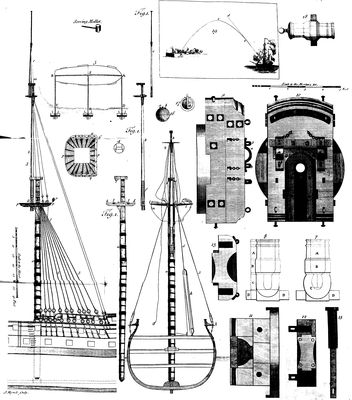
Plate vi.
The mast, which is placed at the middle of the ship’s length, is called the main-mast, grand-mât; that which is placed in the fore-part, the foremast, mât de misaine; and that which is towards the stern is termed the mizen-mast, mât d’artimon.
N. B. Mizen is applied to this mast by all the nations of Europe, except the French, who alone call the fore-mast misaine.
MASTER of a ship of war, maitre, an officer appointed by the commissioners of the navy to take charge of the navigating and conducting a ship from port to port, under the direction of the captain. The management and disposition of the sails, the working of the ship into her station in the order of battle, and the direction of her movements in the time of action, and in the other circumstances of danger, are also more particularly under his inspection. It is likewise his duty to examine the provisions, and accordingly to admit none into the ship but such as are sound, sweet, and wholsome. He is moreover charged with the stowage, or disposition of these materials in the ship’s hold; and to enable him the better to perform these services, he is allowed several assistants, who are properly termed mates and quarter-masters. See those articles.
Master of a merchant-ship, the commanding officer, who is appointed by the merchants to manage the navigation and every thing relating to her cargo, voyage, sailors, &c.
Master at arms, an officer appointed to teach the officers and crew of a ship of war the exercise of small arms; to confine and plant centinels over the prisoners, and superintend whatever relates to them during their confinement. He is also to observe that the fire and lights are all extinguished as soon as the evening gun is fired, except those which are permitted by proper authority, or under the inspection of centinels. It is likewise his duty to attend the gangway, when any boats arrive aboard, and search them carefully, together with their rowers, that no spirituous liquors may be conveyed into the ship, unless by permission of the commanding officer. In these several duties he is assisted with proper attendants, called his corporals, who also relieve the centinels, and one another, at certain periods.
Master-attendant, an officer in the royal dock-yards, appointed to hasten, and assist at, the fitting-out or dismantling, removing or securing vessels of war, &c. at the port where he resides. He is particularly to observe, that his majesty’s ships are securely moored; and for this purpose he is expected frequently to review the moorings which are sunk in the harbour, and observe that they are kept in proper repair to be always ready when occasion requires. It is also his duty to visit all the ships in ordinary, and see that they are frequently cleaned and kept in order; and to attend at the general musters in the dock-yards, taking care that all the officers, artificers, and labourers, registered in the navy-books, are present at their duty.
MAT, coussin, a sort of thick web or texture, formed of spun-yarn, or of a variety of strands, or separate parts of a small rope; or of a number of rope-yarns twisted into foxes. The foxes are therefore larger or smaller, as containing a greater or lesser number of rope-yarns, in proportion to the thickness of the mat intended to be woven.
Mats are commonly used to fasten upon the outside of such parts of the standing rigging as are exposed to the friction of other ropes, in extending, shifting, or trussing up the sails, particularly the lower ones. The largest and strongest sort of these mats are called panches.
MATE of a ship of war, an officer under the direction of the master, by whose choice he is generally appointed, to assist him in the several branches of his duty. Accordingly he is to be particularly attentive to the navigation in his watch, &c. to keep the log regularly, and examine the line, and glasses by which the ship’s course is measured, and to adjust the sails to the wind in the fore-part of the ship. He is also to have a diligent attention to the cables, seeing that they are well coiled and kept clean when laid in the tier, and sufficiently served when employed to ride the ship. Finally, he is to superintend, and assist at the stowage of the hold, taking especial care that all the ballast and provisions are properly stowed therein.
Mate of a merchant-ship, the officer who commands in the absence of the master thereof, and shares the duty with him at sea; being charged with every thing that regards the internal management of the ship, the directing her course, and the government of her crew.
The number of mates allowed to ships of war and merchantmen is always in proportion to the size of the vessel. Thus a first-rate man of war has six mates, and an East-Indiaman the same number; a frigate of 20 guns, and a small merchant-ship, have only one mate in each: and the intermediate ships have a greater or smaller number, according to their several sizes, or to the services on which they are employed.
MESS, a particular company of the officers or crew of a ship, who eat, drink, and associate together.
MESS-MATE, a companion or associate of the above division. See the article Birth.
MIDSHIP, maitre, a term of distinction, applied by shipwrights to several pieces of timber which lie in the broadest part of the vessel; as,
Midship-beam, maitre-bau, the beam upon which the extreme breadth of a ship is formed, and which is situated in the midship-frame, nearly in the middle of her length, serving as a standard from whence the dimensions and proportions of the masts and yards are to be taken.
Midship-frame, maitre-couple, a name given to that timber, or combination of pieces, formed into one timber, which determines the extreme breadth of the ship, as well as the figure and dimension of all the inferior timbers.
In the 8th page, from the beginning of the article Naval Architecture, the reader will find a full explanation of what is meant by a frame of timbers. He will also perceive the out-lines of all the principal frames, with their gradual dimensions, from the midship-frame delineated in the plane of projection annexed to that article. As the parts, of which the several frames are composed, have the same relation to each other throughout the vessel; and as all the corresponding pieces, without and within those frames, are also nearly alike, and fixed in the same manner, it will be sufficient for our purpose to represent the principal, or midship-frame, together with its corresponding parts, which are as follow:
Explanation of the Midship-frame, plate VII. which exhibits a transverse section of a 74 gun ship, at the broadest part, answering to the same scale by which are delineated the head, quarter, and stern of a ship, of the same size, in plates IV. VIII. and X. to which the reader is referred.
A the keel, with a the false keel beneath it.
B the chocks fixed upon the kelson, to retain the opposite pieces of the riders firmly together.
C one of the beams of the orlop.
D one of the lower-deck beams; with d the beams of the upper-deck.
E the hanging-knees, by which the beams are attached to the timbers.
F the standards, which are fixed above the decks to which they belong.
G the clamps, which sustain the extremities of the beams.
H the gun-ports of the lower-deck; with h the ports of the upper-deck.
I, K, L different pieces of thick-stuff, placed opposite to the several scarfs, or joinings, in the frame of timbers.
M the planks of the deck.
N the water-ways.
O the planks of the ceiling, between the several ranges of thick-stuff.
P the spirketting.
Q the mainwale, to fortify the ship’s side opposite to the lower-deck.
R the channel-wale, opposite to the upper-deck.
S the waist-rail.
T the string, with the moulding under the gunwale.
U the floor-timbers, which are laid across the keel, and bolted to it.
V the several futtocks; and W the top-timbers, which are all united into one frame.
X the kelson.
MIDSHIPMAN, a sort of naval cadet, appointed by the captain of a ship of war, to second the orders of the superior officers, and assist in the necessary business of the vessel, either aboard or ashore.
The number of midshipmen, like that of all other officers, is always in proportion to the size of the ship to which they belong. Thus a first-rate man of war has twenty-four, and the inferior rates a suitable number in proportion. No person can be appointed lieutenant, without having previously served two years in the royal navy in this capacity, or in that of mate, besides having been at least four years in actual service at sea, either in merchant-ships, or in the royal navy.
Midshipman is accordingly the station in which a young volunteer is trained in the several exercises, necessary to attain a sufficient knowledge of the machinery, discipline, movements, and military operations of a ship, to qualify him for a sea-officer.
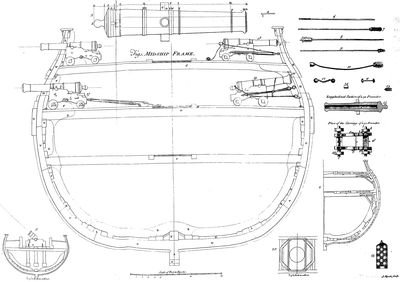
Plate vii.
As the chief object of our attention has been to facilitate the acquisition of this intelligence, we have endeavoured to treat those subjects at large, in the different parts of this work, according to their importance. We have also sketched the general outlines of the respective charges of all the superior officers, which, in conformity to the plan of this work, become previous to this article. Thus the duties of the admiral, the captain, the lieutenant, and the master, are already explained in their proper places; and whatever intelligence appears necessary to discharge those offices, is also, in a high degree, essential to the midshipman. Those officers indeed, as well as many others, are furnished with suitable instructions to regulate their conduct; but the midshipman, being invested with no particular charge from the government, is by consequence omitted in those official regulations. In a work of this kind, however, the importance of the subject is not always determined by the superiority of rank or station. If our province is to communicate instruction, those who are the least informed are certainly the principal objects thereof, and to them our attention is more peculiarly directed. Hence the extent of our design comprehends many circumstances which would be immaterial in general orders and regulations; and hence abundance of particular directions to respective officers, inserted in those general regulations, are rejected here as foreign to our purpose. Averse as we are, on other occasions, to offend the rigid nicety of a critic, by introducing moral reflections, in a performance dedicated to scientifical description, we must for once be indulged with a short deviation from the plan hitherto invariably followed. Happy! if our efforts may in any degree operate to produce the effects for which they were calculated.
On his first entrance in a ship of war, every midshipman has several disadvantageous circumstances to encounter. These are partly occasioned by the nature of the sea-service, and partly by the mistaken prejudices of people in general, respecting naval discipline, and the genius of sailors and their officers. No character, in their opinion, is more excellent than that of the common sailor, whom they generally suppose to be treated with great severity by his officers, drawing a comparison between them not very advantageous to the latter. The midshipman usually comes aboard tinctured with these prejudices, especially if his education has been amongst the higher rank of people; and if the officers happen to answer his opinion, he conceives an early disgust to the service, from a very partial and incompetent view of its operations. Blinded by these prepossessions, he is thrown off his guard, and very soon surprized to find, amongst those honest sailors, a crew of abandoned miscreants, ripe for any mischief or villainy. Perhaps, after a little observation, many of them will appear to him equally destitute of gratitude, shame, or justice, and only deterred from the commission of any crimes by the terror of severe punishment. He will discover, that the pernicious example of a few of the vilest in a ship of war are too often apt to poison the principles of the greatest number, especially if the reins of discipline are too much relaxed, so as to foster that idleness and dissipation, which engender sloth, diseases, and an utter profligacy of manners. If the midshipman, on many occasions, is obliged to mix with these, particularly in the exercises of extending or reducing the sails in the tops, he ought resolutely to guard against this contagion, with which the morals of his inferiors may be infected. He should however avail himself of their knowledge, and acquire their expertness in managing and fixing the sails and rigging, and never suffer himself to be excelled by an inferior. He will probably find a virtue in almost every private sailor, which is entirely unknown to many of his officers: that virtue is emulation, which is not indeed mentioned amongst their qualities by the gentleman of terra firma, by whom their characters are often copiously described with very little judgment. There is hardly a common tar who is not envious of superior skill in his fellows, and jealous on all occasions to be out-done in what he considers as a branch of his duty! Nor is he more afraid of the dreadful consequences of whistling in a storm, than of being stigmatized with the opprobious epithet of lubber. Fortified against this scandal, by a thorough knowledge of his business, the sailor will sometimes sneer in private, at the execution of orders, which to him appear aukward, improper, or unlike a seaman. Nay, he will perhaps be malicious enough to suppress his own judgment, and by a punctual obedience to command, execute whatever is to be performed, in a manner which he knows to be improper, in order to expose the person commanding to disgrace and ridicule. Little skilled in the method of the schools, he considers the officer who cons his lesson by rote as very ill qualified for his station, because particular situations might render it necessary for the said officer to assist at putting his own orders in practice. An ignorance in this practical knowledge will therefore necessarily be thought an unpardonable deficiency by those who are to follow his directions. Hence the midshipman, who associates with these sailors in the tops, till he has acquired a competent skill in the service of extending or reducing the sails, &c. will be often entertained with a number of scurrilous jests, at the expence of his superiors. Hence also he will learn, that a timely application to those exercises can only prevent him from appearing in the same despicable point of view, which must certainly be a cruel mortification to a man of the smallest sensibility.
If the midshipman is not employed in these services, which are undoubtedly necessary to give him a clearer idea of the different parts of his occupation, a variety of other objects present themselves to his attention. Without presuming to dictate the studies which are most essential to his improvement, we could wish to recommend such as are most suitable to the bent of his inclination. Astronomy, geometry, and mechanics, which are in the first rank of science, are the materials which form the skilful pilot and the superior mariner. The theory of navigation is entirely derived from the two former, and all the machinery and movements of a ship are founded upon the latter. The action of the wind upon the sails, and the resistance of the water at the stem, naturally dictate an enquiry into the property of solids and fluids: and the state of the ship, floating on the water, seems to direct his application to the study of hydrostatics and the effects of gravity. A proficiency in these branches of science will equally enlarge his views, with regard to the operations of naval war, as directed by the efforts of powder, and the knowledge of projectiles. The most effectual method to excite his application to those studies is, perhaps, by looking round the navy, to observe the characters of individuals. By this enquiry he will probably discover, that the officer, who is eminently skilled in the sciences, will command universal respect and approbation; and that whoever is satisfied with the despicable ambition of shining the hero of an assembly, will be the object of universal contempt. The attention of the former will be engaged in those studies, which are highly useful to himself in particular, and to the service in general. The employment of the latter is to acquire those superficial accomplishments, that unbend the mind from every useful science, emasculate the judgment, and render the hero infinitely more dextrous at falling into his station in the dance, than in the line of battle.