AN UNIVERSAL DICTIONARY OF THE MARINE. (continued 7)
Reading edition
Unless the midshipman has an unconquerable aversion to the acquisition of those qualifications, which are so essential to his improvement, he will very rarely want opportunities of making a progress therein. Every step he advances in those meritorious employments, will facilitate his accession to the next in order. If the dunces, who are his officers or mess-mates, are rattling the dice, roaring bad verses, hissing on the flute, or scraping discord from the fiddle, his attention to more noble studies will sweeten the hours of relaxation. He should recollect that no example from fools ought to influence his conduct, or seduce him from that laudable ambition which his honour and advantage are equally concerned to pursue.
MIZEN, artimon, (misana, Ital.) the aftermost or hindmost of the fixed sails of a ship, extended sometimes by a gaff, and sometimes by a yard which crosses the mast obliquely; the fore-end reaching almost down to the deck, and the after-end being peeked up as high above the middle of the yard, where it is attached to the mast. The figure of the mizen is accordingly a trapezia, or a parallelogram, one of whose corners is cut off by a diagonal, extended from one of its sides to the opposite corner, which becomes the peek of the mizen. See the article Sail.
MIZEN-MAST, the mast upon which the mizen and its top-sail and stay-sails are supported, besides other sails, which are set occasionally, as the driver, ring-tail, &c. See the article Mast.
The shrouds, stays, and back-stays of this mast, as well as all the running-rigging, together with its several yards and sails, being described under the articles Shrowd, Stay, Yard, &c. the reader is referred thither for the explanations thereof, which are in general applicable also to the same furniture of both the other masts.
MOLE, a name given in the Mediterranean to a long pier, or artificial bulwark of masonry, extending obliquely across the entrance of a harbour, in order to break the force of the sea from the vessels which are anchored within.
Mole is also, although improperly, applied to the harbour or haven, which is formed by the bulwark above described, which is then denominated the mole-head.
MONSOON, a name given to the periodical or trade-winds, which blow regularly in certain latitudes of the Indian ocean. They continue five or six months invariably in one direction, and then alter their course, and blow, during an equal space of time, from a different point of the compass with the same uniformity.
MOORING, the act of confining and securing a ship in a particular station, by chains or cables, which are either fastened to the adjacent shore, or to anchors in the bottom.
A ship may be either moored by the head, or by the head and stern; that is to say, she may be secured by anchors before her, without any behind: or she may have anchors out, both before and behind her; or her cables may be attached to posts, rings, or moorings, which answer the same purpose.
When a ship is moored by the head with her own anchors, they are disposed according to the circumstances of the place where she lies, and the time she is to continue therein. Thus wherever a tide ebbs and flows, it is usual to carry one anchor out towards the flood, and another towards the ebb, particularly where there is little room to range about; and the anchors are laid in the same manner, if the vessel is moored head-and-stern in the same place. The situation of the anchors, in a road or bay, is usually opposed to the reigning winds, or those which are most dangerous; so that the ship rides therein with the effort of both her cables. Thus if she rides in a bay, or road, which is exposed to a northerly wind and heavy sea from the same quarter, the anchors passing from the opposite bows ought to lie east and west from each other: hence both the cables will retain the ship in her station with equal effort against the action of the wind and sea.
Moorings are usually an assemblage of anchors, chains, and bridles, laid athwart the bottom of a river, or haven, to ride the shipping contained therein.
The anchors, employed on this occasion, have rarely more than one fluke, which is sunk in the river near low-water mark. Two anchors, being fixed in this manner, on the opposite sides of the river, are furnished with a chain, extending across from one to the other. In the middle of the chain is a large square link, whose lower end terminates in a swivel, which turns round in the chain as about an axis, whenever the ship veers about with the change of the tide. To this swivel-link are attached the bridles, which are short pieces of cable, well served, whose upper ends are drawn into the ship, at the mooring-ports, and afterwards fastened to the masts, or cable-bits.
A great number of moorings, of this sort, are fixed in the royal ports, or the harbours adjacent to the king’s dock-yards, as Deptford, Chatham, Portsmouth, Plymouth, &c.
MORTAR, a piece of artillery, shorter and wider than the cannon, and having a chamber different from the size of its bore.
Mortars are used in the attack of a fortified place, by sea, to discharge bombs or carcases amongst the buildings. The bomb is a great hollow ball, filled with powder, which, falling into the works of a fortification, &c. destroys the most substantial buildings by its weight; and, bursting asunder, creates the greatest disorder and mischief by its splinters.
The chambers of mortars are extremely different in their figures, and each of those figures is defended by better or worse arguments. Thus they are spherical, cylindrical, conical, bottled, or concave. In reality, nothing appears to be less determined upon true principles or experiments than the proportions of the several parts of a mortar[39].
As the sea-mortars, or those which are fixed in the bomb-vessels, are generally fixed at a much greater distance than is ever required ashore, they are made somewhat longer, and much heavier, than the land-mortars.
Plate VI. fig. 7. represents a sea-mortar, the principal parts of which are, A, the chace; B, the reinforce; C, the breech; and D, the trunnions. The interior part, comprehended between the dotted lines, is called the bore, wherein the bomb is lodged; and the inner part of the bore, which is diminished towards the breech, and contains the powder, is termed the chamber.
Mr. Muller, in his Treatise of Artillery, very justly observes, that the breech of our 13 inch sea-mortars is loaded with an unnecessary weight of metal. The chamber thereof contains 32 pounds of powder, and at the same time they are never charged with more than 12 or 15 pounds, by the most expert officers, because the bomb-vessel is unable to bear the violent shock of their full charge. Thus the action of the powder is diminished by the vacancy left in the chamber, which is never above half filled. As a charge of 12 or 15 pounds of powder at most is therefore sufficient, it is evidently proved, by the theory of powder, that this will produce the greatest effect when discharged from a mortar with a cylindrical chamber, represented by fig. 8. He also proves, by a variety of experiments made by Captain Desaguliers and himself, that the conical chamber, now used, is considerably inferior to the cylindrical one with the last charge of powder.
To facilitate the use of the mortar, it is placed in a solid carriage of timber, called the bed, whose different parts are strongly bolted together. By means of this it is firmly secured in its situation, so that the explosion of the powder may not alter its direction. In the middle of the upper-side of this carriage, plate VI. fig. 9. are two semi-circular notches, to receive the trunnions; over these are fixed two very strong bands of iron, called the cap-squares, a, the middle of which is bent into a semi-circle, to embrace the trunnions, and keep them fast in the mortar-bed. The cap-squares are confined to the timber-work by strong pins of iron, called the eye-bolts, b, into whose upper ends are driven the keys, chained beneath them. On the fore-part of the bed a piece of timber is placed transversely, upon which rests the belly of the mortar, or that part which contains the chamber. The elevation of this piece, which is called the bed-bolster, is represented by fig. 13. and the plan by fig. 12. it is used to elevate and support the mortar whilst firing.
These beds are placed upon very strong frames of timber, which are fixed in the bomb-ketch, and represented in fig. 14. plate VI. They are securely attached to the frames, by means of a strong bolt of iron, fig. 15. called the pintle, passing perpendicularly through both, and afterwards through one of the beams of the vessel. Thus the pintle, which passes through the hole in the centre of the plan, fig. 10. serves as an axis to the bed; so that the mortar may be turned about horizontally as occasion requires.
Plate VI. fig. 9. represents the elevation of the bed of a 10 inch sea-mortar; fig. 10 is the plan, and 11 the front view thereof; fig. 12 exhibits the plan, and fig. 13 the elevation of the bed-bolster.
We have already observed, that the bomb, which is usually called the shell by artillery-people, is a great hollow ball, charged with powder. Fig. 16 is a perspective view of the bomb, and fig. 17 a section of it, whereby the thickness is exhibited. The parts a and b of the shell are its handles, by which it is lifted up or removed; and c is the fuse-hole, or aperture, through which the powder is poured in to charge it.
It appears, by fig. 17, that the lower part of the shell is thickest, by which it becomes heavier on that side, and accordingly falls thereon, and never on the fuse. It is also the better enabled thereby to resist the impression of the powder, by which it is discharged from the mortar. Both of these reasons, however, Mr. Muller conceives to be immaterial, because nothing but an absolute stoppage of the air can exhaust the fuses, as their composition enables them to burn in water, as well as air or earth; and the explosion of the mortar would not, in his opinion, be able to break them, if they are equally thick every where. The most proper quantity of powder to charge a bomb is probably two thirds of the weight which would fill the cavity.
The fuse of the bomb is represented by c d, fig. 17. It is generally a conical tube, formed of beech, willow, or some dry wood, and filled with a composition of sulphur, salt-petre, and mealed-powder. The bomb being charged, this fuse is inserted in the cavity through the fuse-hole; and when fired, communicates the fire to the powder in the shell.
The fuses for bombs are charged with great care, that nothing may prevent them from communicating the fire to the powder in the centre of the bomb. They are driven into the shell so as that only about an inch and a half comes out beyond the fuse-hole; and then the shell is said to be fixed.
These fuses are also charged long before there is occasion to use them; and that the composition with which they are filled may not fall out, or be damaged, by growing damp, the two ends are covered with a composition of tallow, mixed either with pitch or bees wax. When the fuse is to be put into the shell, the little end is opened or cut off; but the great end is never opened till the mortar is to be fired[40].
When the proper quantity of powder, necessary to charge the mortar, is put into the chamber, it is covered with a wad, well beat down with the rammer. After this the fixed shell is placed upon the wad, as near the middle of the mortar as possible, with the fuse-hole uppermost, and another wad pressed down close upon it, so as to keep the shell firm in its position. The officer then points the mortar, or gives it the inclination necessary to carry the bomb to the place designed. When the mortar is thus fixed, the fuse is opened; the priming-iron is also thrust into the touch-hole of the mortar to clear it, after which it is primed with the finest powder. This done, two of the matrosses, or sailors, taking each one of the matches, the first lights the fuse, and the other fires the mortar. The bomb, thrown out by the explosion of the powder, is carried to the place intended; and the fuse, which ought to be exhausted at the instant of the shell’s falling, inflames the powder contained therein, and bursts the shell into splinters; which, flying off circularly, occasion incredible mischief wheresoever they reach.
Necessary orders before a bombardment by sea.
When any fixed shells are issued from the tenders, the artillery people on board are immediately to fix others in their room, and are always to keep in their tenders the same number they had at first.
The shells are to be fixed in the boat appointed to carry them, provided the weather permits; otherwise, in the safest place on deck, and to be kitted, or lowered down into a spare rack, which must be in each boat for that purpose. While the shells are fixing, the powder-room is to be shut, the hatches laid and well secured against fire, and the place where they are fixed is to be well watered.
The shells being carefully examined in order that no spike is left therein, by which the fuse may be split, the fuses are to be cut the full length, and to be set home into the shell very strongly.
No shells, fixed during the service, are to be kitted; but if any should be left, when the service is over, they are immediately to be kitted.
The powder in the bomb-vessels is to be used first; and none to be opened or measured out, except in the captain’s cabin, the door of which is to be kept shut during the whole time, and covered with tanned hides, to make it as secure as possible.
The fixed shells in the boats are to be likewise covered from fire or wet with hair-cloth and tanned hides, with the utmost care.
If the service is carried on at night, all the powder is to be ready measured out in cartridges, which may be kept in the powder-magazine and captain’s cabin, in the empty powder-barrels and powder-bags; and all the shells requisite are to be ready. The tin tubes, one powder-horn, and the port-fires; also the punches and bits for the vents, are to be kept in the captain’s cabin.
No fire or light, except match and port-fires, to be on board either bomb-vessel or tender during the service.
The captain’s cabin and the passage to it; also the way to the magazine and decks, are to be constantly watered.
The spunges for the mortars are to be all examined and tried, and if too large, they are to be cut so as to enter easily.
The vents of the mortars are to be examined, and the punches and tubes tried in them.
A laboratory-chest is to be on board each bomb-vessel, in the captain’s cabin, in which all the small stores are to be kept.
Two tubs of water are to be on deck, for the lightest port-fires and match, which must be constantly held in them till ordered to fire.
Two careful men are also to be appointed for this service, who are to do nothing else on any account.
Two careful men of the artillery are to be left on board each tender, for the filling and fixing of the shells.
Application must be made to the admiral for two men of war’s boats to attend on each bomb-ketch and tender, for carrying shells and stores. One of these is to be loaded with fixed shells, which, when sent to the bomb-vessel, must remain with her until they are all taken out, which should be only as they are wanted for loading the mortars; it is then to return to the tender. The other boat, mean while, will be receiving more fixed shells, and on the signal given from the bomb-ketch for more shells, must immediately repair to her with them.
A gang of warrant-officers, and eight seamen, are to be at each mortar, to give whatever assistance may be required.
A gang from the navy, with a careful warrant-officer, and a non-commissioned officer of the artillery, are to have the charge between decks on board each bomb and tender, to get up the fixed shells that are in the rack; and a careful person is to remain constantly at the powder-room door, which must be kept shut as much as possible.
When any powder is wanted from the tender for loading the mortar, it should be measured out in the tender, and the proper charge put into paper-cartridges, upon which should be written the quantity, and the mortar for which it is allotted.
If the service of mortars should render it necessary to use pound-shots, 200 of them, with a wooden bottom, are to be put into the 13 inch mortar, and a quantity of powder, not exceeding five pounds; and 100 of the above shot, with 2½ lb. of powder for the 10 inch mortar, or 3 lb. at most.
One inch of fuse burns 4 seconds and 48 parts.
Weight of the sea-mortars and shells, as also of their full charges.
Nature of the mortar. Powder contained in the chamber when full. Weight of the mortar. Weight of the shell when fixed. Weight of powder contained in the shell.
lb. oz. pl. Cwt. qu. lb. lb. lb. oz.
10 inch howitzer 12 0 0 31 2 26
13 inch mortar 30 0 0 81 2 1 198 7 0
10 inch mortar 12 0 0 34 2 11 93
The howitzer, fig. 18. is a sort of mortar, which is to be fixed horizontally like a cannon; and has, like the cannon, a wheel-carriage. These pieces, however, are very rarely used in the sea-service.
For an account of the elevation of the mortar, and flight of bombs according to the different charges of powder, the reader is referred to the article Range.
MOULD, devers, a thin flexible piece of timber, used by shipwrights, as a pattern whereby to form the different curves of the timbers, and other compassing pieces, in a ship’s frame. There are two sorts of these, namely, the bend-mould and hollow-mould: the former of these determines the convexity of the timbers, and the latter, their concavity on the outside, where they approach the keel, particularly towards the extremities of the vessel. The figure, given to the timbers by this pattern, is called their bevelling. See that article.
MOUNTED, monté, the state of being armed or equipped with a certain number of cannon; expressed of a vessel of war.
MOUSE, fusée, a sort of knob, usually in the shape of a pear, wrought on the outside of a rope, by means of spun-yarn, parsling, &c. as described in the article puddening. It is used to confine some other securely to the former, and prevent it from sliding along its surface.
These mouses are particularly used on the stays of the lower-mast, to prevent the eye from slipping up to the mast; a circumstance which would render it extremely difficult to remove the stay from the mast-head, when necessary.
MOUSING a hook, the operation of fastening a small cord, or line, across the upper-part, from the point to the back thereof, in order to prevent it from unhooking by the motion of the vessel, or otherwise.
MUSTERING, (mousteren, Dutch) the act of calling over a list of the whole ship’s company, or any particular detachment thereof, who are accordingly summoned to answer by their names on the occasion.
N.
NAVAL, of or belonging to a ship, or to the royal navy. Hence we say, naval-stores, naval officers, &c.
NAVE-LINE, a sort of small tackle, depending from the head of the main-mast and foremast, and fastened to the middle of the parrel immediately behind the mast, and communicating with the gears. It is used to keep the parrel directly opposite to the yard, and particularly whilst hoisting or lowering, as it would otherwise hang under the yard, and prevent it from being sufficiently braced.
NAVIGATION, (navigation, Fr.) the art of directing the movements of a ship by the action of the wind upon the sails. See the article Sailing.
Navigation is then applied, with equal propriety, to the arrangement of the sails, according to the state of the wind; and to the directing and measuring a ship’s course by the laws of geometry; or it may comprehend both, being then considered as the theory and practice thereof.
Since every sea-officer is presumed to be furnished with books of navigation, in which that science is copiously described, it would be superfluous to enter into a particular detail of it in this place. As it would also be a fruitless task to those who are entirely ignorant of the rules of trigonometry, it appears not to come within the limits of our design: and those who are versed in that science generally understand the principles of navigation already. It suffices to say, that the course of a ship, and the distance she has run thereon, are measured by the angles and sides of a right-angled plain triangle, in which the hypothenuse is converted into the distance; the perpendicular, into the difference of latitude; the base, into the departure from the meridian; the angle, formed by the perpendicular and hypothenuse, into the course; and the opposite angle, contained between the hypothenuse and base, into its complement of the course.
The course of the ship is determined by the compass; and the log-line, or a solar observation, ascertains the distance. Hence the hypothenuse and angles are given, to find the base and perpendicular; a problem well known in trigonometry.
That part of navigation, which regards the piloting or conducting a ship along the sea-coast, can only be acquired by a thorough knowledge of that particular coast, after repeated voyages. The most necessary articles thereof are already described in the article Coasting: it is sufficient to observe, that the bearings and distances from various parts of the shore are generally ascertained in the night, either by light-houses, or by the different depths of the water, and the various sorts of ground at the bottom; as shells of different sizes and colours, sand, gravel, clay, stones, ooze, or shingle. In the day, the ship’s place is known by the appearance of the land, which is set by the compass, whilst the distance is estimated by the master or pilot.
NAVY (from navis, Lat.) implies, in general, any fleet or assembly of ships. It is, however, more particularly understood of the fleet of vessels of war, that belong to a kingdom or state, to be employed either in assaulting and destroying its enemies, or protecting its commerce, and defending its coasts against hostilities or invasion.
The navy of Great-Britain, together with its civil and military departments, is governed by the lord high-admiral, or the lords commissioners for executing this office. It is divided into several classes, or orders, in proportion to the size of the ships, &c. See the article Rate.
If the only objects to be considered in the distribution of the navy, into different rates, were to improve ship-building, and facilitate the operations of the marine, it might appear expedient to multiply the rates, much beyond their present number, which would oblige the shipwrights to study the principles of their art with more diligence and application. But the simplicity of the service in our dock-yards, and the views of œconomy, which ought never to be neglected when they regard important objects, has rendered it convenient to arrange the masts, the yards, the sails, the rigging, and artillery, into six rates; which, besides that of sloops of war, answers all the purposes of the navy. See Dock-Yards.
Navy is also the collective body of officers employed in his majesty’s sea-service.
NEAPED, (from nepflod, Sax.) the situation of a ship which is left aground on the height of a spring-tide, so that she cannot be floated off till the return of the next spring. See Tide.
NEEDLE, See the article Compass.
NETTING, a sort of fence, formed of an assemblage of ropes, fastened across each other, so as to leave uniform intervals between. These are usually stretched along the upper-part of a ship’s quarter, and secured in this position by rails and stanchions. See Quarter.
NIPPERS, garcettes de tournevire, certain pieces of flat, braided cordage, used to fasten the cable to the voyal in a ship of war, when the former is drawn into the ship by mechanical powers applied to the latter.
These nippers are usually six or eight feet in length, according to the size of the cable; and five or six of them are commonly fastened about the cable and voyal at once, in order to be heaved in by the capstern. Those which are farthest aft are always taken off, as the cable approaches the main hatchway; and others are at the same time fastened on, in the fore-part of the ship, to supply their places. The persons employed to bind the nippers about the cable and voyal, are called nipper-men: they are assisted in this office by the boys of the ship, who always supply them with nippers, and receive the ends of those which are fastened, to walk aft with them, and take them off at the proper place, in order to return them to the nipper-men.
NITTLES. See Knittles.
NO NEARER! (arrive!) the command given by the pilot, or quarter-master, to the helmsman, to steer the ship no higher to the direction of the wind than the sails will operate to advance the ship in her course. It is often abbreviated into no near, and sometimes into near; and is generally applied when the sails shake in the wind. See Shivering.
NO MAN’S LAND, St. Aubinet, a space between the after-part of the belfrey and the fore-part of a ship’s boat, when the said boat is stowed upon the booms, as in a deep-waisted vessel. These booms are laid from the forecastle nearly to the quarter-deck, where their after-ends are usually sustained by a frame called the gallows, which consists of two strong posts, about six feet high, with a cross piece, reaching from one to the other, athwart-ships, and serving to support the ends of those booms, masts, and yards, which lie in reserve to supply the place of others carried away, &c. The space called No man’s land is used to contain any blocks, ropes, tackles, &c. which may be necessary on the forecastle. It probably derives this name from its situation, as being neither on the starboard nor larboard side of the ship, nor on the waiste or forecastle; but being situated in the middle, partakes equally of all those places.
NORMAN, a name given to a short wooden bar, thrust into one of the holes of the windlass in a merchant-ship, whereon to fasten the cable. It is only used when there is very little strain on the cable, as in a commodious harbour, when the ship is well sheltered from the wind and tide.
NUTS of the anchor, two little prominencies, appearing like short square bars of iron, fixed across the upper-part of the anchor-shank, to secure the stock thereof in its place; for which purpose there is a corresponding notch, or channel, cut in the opposite parts of the stock, of the same dimensions with the nuts. See the article Anchor.
O.
OAKHAM, or OAKUM, the substance into which old ropes are reduced, when they are untwisted, loosened, and drawn asunder. It is principally used to drive into the seams, or intervals, between the planks of a ship, to prevent the water from entering. See the article Caulking.
White Oakum, is that which is formed of untarred ropes.
OAR, rame, (are, Sax.) a long piece of timber, flat at one end, and round or square at the other, and which being applied to the side of a floating-vessel, serves to make it advance upon the water.
That part of the oar which is out of the vessel, and which enters into the water, is called the blade, or wash, plat; and that which is within-board, is termed the loom, whose extremity, manche, being small enough to be grasped by the rowers, or persons managing the oars, is called the handle.
To push the boat or vessel forwards, by means of this instrument, the rowers turn their backs forward, and, dipping the blade of the oar in the water, pull the handle forward so that the blade at the same time may move aft in the water: But since the blade cannot be so moved, without striking the water, this impulsion is the same, as if the water were to strike the blade from the stern towards the head: the vessel is therefore necessarily moved according to this direction. Hence it follows, that she will advance with the greater rapidity, by as much as the oar strikes the water more forcibly. Thus it is evident, that an oar acts upon the side of a boat or vessel like a lever of the second class, whose fulcrum is the station, upon which the oar rests on the boat’s gunnel. In large vessels, this station is usually called the row-port; but in lighters and boats it is always termed the row-lock.
To ship the Oars, armer, is to fix them in the row-locks ready for rowing.
OBSERVATION, the art of measuring the altitude of the sun or a star, in order to determine the latitude, or the sun’s azimuth, &c.
OFF, an expression applied to the movement of a ship, when she sails out from the shore towards the distant sea. When a ship is beating to windward, so that by one board she approaches towards the shore, and by the other sails out to sea-ward, she is said to stand off and on shore, alternately. Hence,
Offing, largue, dehors, implies out at sea; or at a competent distance from the shore, and generally out of anchor-ground.
Offward, the situation of a ship which lies aground, and leans off from the shore.
OLERON, a name given to a code of general rules relating to naval affairs, and formed by Richard I. when he was at the island of Oleron. These have been frequently esteemed the most excellent sea-laws in the world; and are still preserved in the black book of the admiralty.
OPEN, debouclé, the situation of a place which is exposed to the wind and sea, with little or no shelter for shipping to anchor therein.
Open, ouvert, is also expressed of any distant object, to which the sight or passage is not intercepted by something lying, or coming between. Thus, to be open with any place, is to be opposite to it; as the entry of a port, road, or haven.
OPENING, a passage, or streight, between two adjacent coasts or islands.
ORDINARY, gardiens, the establishment of the persons employed by the government to take charge of the ships of war, which are laid-up in the several harbours adjacent to the royal dock-yards. These are principally composed of the warrant-officers of the said ships, as the gunner, boatswain, carpenter, deputy-purser and cook, and their servants. There is besides a crew of labourers enrolled in the list of the ordinary, who pass from ship to ship occasionally to pump, moor, remove, or clean them, whenever it is necessary.
The term ordinary is also applied, sometimes, to the ships themselves; it is likewise used to distinguish the inferior sailors from the most expert and diligent. Thus the latter are rated able on the navy-books, and have 1l. 4s. per month whereas those who are rated ordinary, have only 19s. per month.
ORLOP, (over-loop, Dutch) faux-pont, a plat-form of planks laid over the beams, in the hold of a ship of war, whereon the cables are usually coiled, and the several officers store-rooms contained.
OVER-BOARD, the state of being thrown out of a ship, or boat, into the water whereon she swims: also the act of falling from such a vessel into the sea, &c. as, the ship sprung a leak, and obliged us to throw the guns over-board; a heavy sea broke over the deck, and carried two of our men over-board.
OVER-CAST-STAFF, trebuchet, a scale, or measure, employed by shipwrights to determine the difference between the curves of those timbers which are placed near the greatest breadth, and those which are situated near the extremities of the keel, where the floor rises and grows narrower.
OVER-HAULING, parcourir, the act of opening and extending the several parts of a tackle, or other assemblage of ropes, communicating with blocks or dead-eyes. It is used to remove those blocks to a sufficient distance from each other, that they may be again placed in a state of action, so as to produce the effect required. See the article Tackle.
Over-hauling, is also vulgarly expressed of an examination or inspection into the condition of a person or thing.
OVER-MASTED, the state of a ship, whose masts are too high, or too heavy, for the weight of her hull to counter-balance.
OVER-SETTING, chavirer, the act of turning any thing upside-down; also the movement of a ship when she over-turns, faire capot, so that the keel becomes above the water, and the masts under the surface.
OUT, dehors, an expression frequently used at sea, implying the situation of the sails when they are set, or extended, to assist the ship’s course; as opposed to in; which is also applied, in the contrary sense, to signify that such sails are furled.
OUT-FIT, is generally used to signify the expences of equipping a ship for a sea-voyage; or of arming her for war, or both together. See Fitting-out.
OUT OF TRIM, endormi, the state of a ship when she is not properly balanced for the purposes of navigation; which is either occasioned by the size, or position of her masts and sails; or by the comparative quantity, or arrangement of her cargo and ballast in the hold.
OUT-RIGGER, a strong beam of timber, of which there are several fixed on the side of a ship, and projecting from it, in order to secure the masts in the act of careening. See that article.
The outer ends of these beams are firmly lashed to a bolt in the ship’s side beneath, by which they are enabled to support the mast, by counteracting the strain it suffers from the effort of the careening tackles; which being applied in the mast-head, draws it downwards, so as to act upon the vessel with the power of a lever, whose fulcrum is in her centre of gravity.
Out-rigger is also a small boom, occasionally used in the tops to thrust out the breast-back-stays to windward, in order to increase their tension, and thereby give additional security to the top-mast.
This boom is usually furnished with a tackle at its inner-end, communicating with one of the topmast-shrouds; and has a notch on the outer end to contain the back-stay, and keep it steddy therein. As soon as the back-stay is drawn tight, by means of its tackle in the chains, the out-rigger is applied aloft, which forces it out to windward, beyond the circle of the top, so as to increase the angle which the mast makes with the back-stay, and accordingly enable the latter the better to support the former.
This machine is sometimes applied without any tackle; it is then thrust out to its usual distance beyond the top-rim, where it is securely fastened; after which the back-stay is placed in the notch, and extended below.
OWNER, the proprietor of a ship, by whom she is freighted to the merchant for a sea-voyage.
P.
PACKET, or PACKET-BOAT, (paquet, Fr.) a vessel appointed by the government to carry the mail of letters, packets, and expresses from one kingdom to another by sea, in the most expeditious manner. Thus the packet-boats, under the direction of the post-master-general of Great-Britain, carry the mails from Dover to Calais, from Falmouth to Lisbon, from Harwich to Helvoetsluys, and from Parkgate to Dublin.
PADDLE, pagaie, (pattal, Welsh) a sort of oar used by the savages of Africa and America to navigate their canoes. It is much shorter and broader in the blade than the oars of a boat, and is equally employed in rowing and steering. See the article Canoe.
PAINTER, cableau, (probably from bindar, Sax. to bind) a rope employed to fasten a boat either along-side of the ship to which she belongs, or to some wharf, key, &c. as occasion requires.
PALM, paumet, an implement used instead of a thimble in the exercise of making and mending sails. It is formed of a piece of leather or canvas, on the middle of which is fixed a round plate of iron, of an inch in diameter, whose surface is pierced with a number of small holes, to catch the head of the sail-needle. The leather is formed so as to encircle the hand, and button on the back thereof, while the iron remains in the palm; so that the whole strength of the hand may be exerted to thrust the needle through the canvas, when it is stiff and difficult to be penetrated in sewing.
PANCH, a sort of thick and strong mat, or texture, formed by interweaving twists of rope-yarn as close as possible. It is chiefly used to fasten on the outside of the yards, or rigging, to prevent their surfaces from being rubbed by the friction of some other contiguous object, particularly when the vessel is rocked by a tempestuous sea. See also Mat.
PARBUCKLE, a contrivance used by sailors to lower a cask or bale from any height, as the top of a wharf or key, into a boat or lighter, which lies along-side, being chiefly employed where there is no crane or tackle.
It is formed by fastening the bight of a rope to a post, or ring, upon the wharf, and thence passing the two parts of the rope under the two quarters of the cask, and bringing them back again over it; so that when the two lower parts remain firmly attached to the post, the two upper parts are gradually slackened together, and the barrel, or bale, suffered to roll easily downward to that place where it is received below. This method is also frequently used by masons, in lifting up or letting down large stones, when they are employed in building; and from them it has probably been adopted by seamen.
PARCELLING, certain long narrow slips of canvas, daubed with tar, and frequently bound about a rope, in the same manner as bandages are applied to a broken limb in surgery.
This is chiefly practised when the said rope is intended to be served, at which time the parcelling is laid in spiral turns, as smoothly upon the surface as possible, that the rope may not become uneven and full of ridges. It is also employed to raise the mouses, which are formed on the stays and on the voyal being firmly fastened by marling it from one end to the other.
Parcelling a seam, is laying a shred of canvas upon it, and daubing it over with melted pitch, both above and below the canvas.
PARLIAMENT-HEEL, the situation of a ship, when she is made to stoop a little to one side, so as to clean the upper part of her bottom on the other side, and cover it with a new composition; and afterwards to perform the same office on that part of the bottom which was first immersed. The application of a new composition, or coat of stuff, on this occasion, is called boot-topping. See that article.
PARREL, racage, (probably from parallel) a machine used to fasten the sail-yards of a ship to the masts, in such a manner as that they may be easily hoisted and lowered thereon, as occasion requires.
There are four different sorts of parrels, one of which is formed of a single rope; another, of a rope communicating with an assemblage of ribs and trucks; a third, of a rope passing through several trucks, without any ribs; and the fourth, of a truss, by which the yard may be at any time slackened from the mast, or confined thereto as close as possible.
The first of these, which is also the simplest, is formed of a piece of rope, well covered with leather, or spun-yarn, and furnished with an eye at each end. The middle of it being passed round the middle of the yard, both parts of it are fastened together on the after-side of the yard, and the two ends, which are equally long, are passed round the after-part of the mast; and one of them being brought under, and the other over the yard, the two eyes are lashed together with a piece of spun-yarn on the fore-side thereof, whilst another lashing is employed to bind them together, behind the mast, according to the manner described in the article Marling.
The second and most complicated are composed of ribs and trucks, the former of which are long flat pieces of wood, having two holes near their ends, bigots, as represented by fig. a. plate VIII. the latter, pommes, are small globular pieces, b, with a hole through the middle, of the same size with those of the ribs. Between every two ribs are placed two trucks, of which one is opposite to the upper hole, and the other to the lower holes of both ribs; so that the parrel-rope, bâtard, which passes through the whole, unites them together like a string of beads.
In order to fasten this machine c more conveniently about the mast and yard, so as to attach the latter to the former, the parrel-rope is formed of two pieces, each of which are furnished with an eye at one end, and both eyes lie on one side of the mast; that is to say, one piece of the rope passes through the lower part of the parrel, and thence under the yard, whilst the other comes through the upper part of the parrel and over the yard, till both eyes meet on the fore-side of the yard, where they are joined together. The other two ends of the parrel-rope are passed about the yard, and the hind part of the parrel alternately, till the latter is sufficiently secured to the former. The whole process is compleated by marling the turns of the parrel-rope together, so as to confine them close in the cavity, formed on the back of the ribs, as expressed in the figure.
The third is nothing more than a single rope, with any number of trucks thereon, sufficient to embrace the mast. These are calculated for the cheeks of a gaff. See that article.
The last, which are known by the name of truss-parrels, are somewhat resembling the first, only that instead of being fastened by lashings, the ropes, of which they are composed, communicate with tackles reaching to the deck, so that the parrel may be occasionally slackened or straitened, in order to let the yard move off from the mast, or confine it thereto as strictly as possible. The last of these are peculiar to the lower-yards, whereon they are extremely convenient. The second are always used for the top-sail yards, and frequently for the lower-yards, in merchant-ships; and the first are seldom employed but for the top-gallant-yards.
PARSLING. See Parcelling.
PARTING, démarrer, the state of being driven from the anchors, expressed of a ship, when she has broke her cable by the violence of the wind, waves, or current, or all of them together.
PARTNERS, etambraies, certain pieces of plank nailed round the several scuttles, or holes, in a ship’s deck, wherein are contained the masts and capsterns. They are used to strengthen the deck where it is weakened by those breaches, but particularly to support it when the mast leans against it; as impressed by a weight of sail, or when the capstern bears forcibly upon it whilst charged with a great effort.
Partners is also a name given occasionally to the scuttles themselves, wherein the masts and capsterns are fixed.
PASS, or PASSPORT, a permission granted by any state to navigate in some particular sea, without hindrance or molestation from it. It contains the name of the vessel, and that of the master, together with her tonnage, and the number of her crew, certifying that she belongs to the subjects of a particular state, and requiring all persons, at peace with that state, to suffer her to proceed on her voyage without interruption.
PASSAGE, traversée, a voyage from one place to another by sea; an outward or homeward-bound voyage.
PASSAREE, a rope used to fasten the main-tack down to the ship’s side, a little behind the chesstree. This contrivance however is very rarely used, and never but in light breezes of wind.
PAUL, elinguet, (epaule, Fr.) a certain short bar of wood, or iron, fixed close to the capstern, or windlass of a ship, to prevent those engines from rolling back, or giving way, when they are employed to heave-in the cable, or otherwise charged with any great effort. See Capstern and Windlass.
PAUNCH. See Panch.
To PAY, espalmer, as a naval term, implies to daub or anoint the surface of any body, in order to preserve it from the injuries of the water, weather, &c.
Thus the bottom of a ship is paid with a composition of tallow, sulphur, resin, &c. as described in the article Breaming.
The sides of a ship are usually paid with tar, turpentine, or resin; or by a composition of tar and oil, to which is sometimes added red oker, &c. to protect the planks thereof from being split by the sun or wind. The lower-masts are, for the same reasons, paid with materials of the same sort, if we except those, along which their respective sails are frequently hoisted and lowered; such are the masts of sloops and schooners, which are always paid with tallow for this purpose: for the same reason all top-masts and top-gallant-masts are also paid with hog’s lard, butter, or tallow. See Coat and Stuff.
PAYING-OFF, abattée, the movement by which a ship’s head falls to leeward of the point whither it was previously directed: particularly when, by neglect of the helmsman, she had inclined to windward of her course, so as to make the head-sails shiver in the wind, and retard her velocity. See also Falling-off.
Paying-off is likewise used to signify the payment of the ship’s officers and crew, and the discharge of the ship from service, in order to be laid-up at the moorings.
Paying-out, or Paying-away, the act of slackening a cable, or other rope, so as to let it run out of the vessel for some particular purpose.
PEAK, or PEEK, a name given to the upper-corner of all those sails which are extended by a gaff; or by a yard which crosses the mast obliquely, as the mizen-yard of a ship, the main-yard of a bilander, &c. The upper extremity of those yards and gaffs are also denominated the peak. Hence
Peek-haliards, are the ropes, or tackles, by which the outer end of a gaff is hoisted, as opposed to the throat-haliards, which are applied to the inner end. See Haliards.
PENDANT, flamme, a sort of long narrow banner, displayed from the mast-head of a ship of war, and usually terminating in two ends or points, as expressed by a, fig. 4. plate V. There are, besides others, pendants, cornets, of a larger kind, used to distinguish the chief of a squadron of ships. See the article Commodore.
Pendant, pantoire, is also a short piece of rope, fixed under the shrouds, upon the head of the main-mast and fore-mast, from which it depends as low as the cat-harpings, having an eye in the lower-end, which is armed with an iron thimble, to prevent the eye from being fretted by the hooks of the main and fore-tackles, &c.
There are, besides, many other pendants of the latter kind, which are generally single or double ropes, to whose lower extremities is attached a block, or tackle: such are the fish-pendant, the yard-tackle-pendants, the reef-tackle-pendants, &c. all of which are employed to transmit the effort of their respective tackles to some distant object.
PERIAGUA, a sort of large canoe, used in the Leeward islands, South America, and the gulf of Mexico. It differs from the common vessels of that name, as being composed of the trunks of two trees, hollowed and united into one fabric; whereas those which are properly called canoes, are formed of the body of one tree. See Canoe.
PIER, a strong mound, or fence, projecting into the sea, to break off the violence of the waves from the entrance of a harbour.
PILLOW, coussin, a block of timber, whereon the inner-end of the bowsprit is supported. See Bowsprit.
PILOT, the officer who superintends the navigation, either upon the sea-coast or on the main ocean. It is, however, more particularly applied by our mariners to the person charged with the direction of a ship’s course, on, or near the sea-coast, and into the roads, bays, rivers, havens, &c. within his respective district[41].
PIN of a block. See Block.
PINK, (pinque, Fr.) a name given to a ship with a very narrow stern; whence all vessels, however small, whose sterns are fashioned in this manner, are called pink-sterned.
PINNACE, a small vessel, navigated with oars and sails, and having generally two masts, which are rigged like those of a schooner.
Pinnace is also a boat, usually rowed with eight oars. See the article Boat.
PINTLES, certain pins or hooks, fastened upon the back part of the rudder, with their points downwards, in order to enter into, and rest upon the googings, fixed on the stern-post to hang the rudder. See Helm.
PIRATE, pirate (πειρατης, Gr.) a sea-robber, or an armed ship that roams the seas without any legal commission, and seizes or plunders every vessel she meets indiscriminately, whether friends or enemies.
The colours usually displayed by pirates are said to be a black field, with a death’s head, a battle-axe and hour-glass. The last instrument is generally supposed to determine the time allowed to the prisoners, whom they take, to consider whether they will join the pirates in their felonious combination, or be put to death, which is often perpetrated in the most cruel manner.
Amongst the most celebrated pirates of the north is recorded Alvilda, daughter of a king of the Goths, named Sypardus. She embraced this occupation to deliver herself from the violence imposed on her inclination, by a marriage with Alf, son of Sigarus, king of Denmark. She drest herself as a man, and composed her band of rowers, and the rest of her crew, of a number of young women, attired in the same manner. Amongst the first of her cruizes she touched at a place where a company of pirates bewailed the death of their captain. The strangers were captivated with the agreeable manners of Alvilda, and chose her for their chief. By this reinforcement she became so formidable upon the sea, that prince Alf came to engage her. She sustained his attacks for a considerable time; but, in a vigorous action, Alf boarded her vessel, and having killed the greatest part of her crew, seized the captain, namely, herself; whom nevertheless he knew not, because the princess had a casque which covered her visage. Being master of her person, he removed the casque, and, in spite of her disguise, instantly recognized her, and offered her his hand in wedlock[42].
PITCH, brai, (pix, Lat.) a composition, black, dry, brittle, and shining, which remains at the bottom of an alembic after the oil of turpentine is drawn off by distillation. It is used in calking a ship, to fill the chinks, or intervals between the planks of her sides, or decks, or bottom. It is sometimes mixed with resin, or other glutinous material. See Tar.
To Pitch the seams. See the article Pay.
PITCHING, tangage, (appicciare, Ital.) may be defined, the vertical vibration which the length of a ship makes about her centre of gravity; or the movement, by which she plunges her head and after-part alternately into the hollow of the sea.
This motion may proceed from two causes: the waves, which agitate the vessel; and the wind upon the sails, which makes her stoop to every blast thereof. The first absolutely depends upon the agitation of the sea, and is not susceptible of inquiry; and the second is occasioned by the inclination of the masts, and may be submitted to certain established maxims[43].
When the wind acts upon the sails, the mast yields to its effort, with an inclination, which increases in proportion to the length of the mast, to the augmentation of the wind, and to the comparative weight and distribution of the ship’s lading.
The repulsion of the water, to the effort of gravity, opposes itself to this inclination, or at least sustains it, by as much as the repulsion exceeds the momentum, or absolute effort of the mast, upon which the wind operates. At the end of each blast, when the wind suspends its action, this repulsion lifts the vessel; and these successive inclinations and repulsions produce the movement of pitching, which is very inconvenient; and when it is considerable, will greatly retard the course, as well as endanger the mast, and strain the vessel.
PLANE, a term used by shipwrights, implying the area, or imaginary surface, contained within any particular outlines. Thus the plane of elevation, plate I. exhibits a surface limited by the head before, by the stern abaft, by the keel below, and by the upper part of the vessel’s side above. Thus the horizontal plane, in the same plate, is comprehended within the lines which describe the ship’s greatest breadth and length; and thus also the plane of projection, represented likewise in plate I. circumscribes the greatest height and breadth of the same vessel.
PLANKING, border, the act of covering and lining the sides of a ship with an assemblage of oak planks, which completes the process of ship-building, and is sometimes called laying on the skin, by the artificers. See the article Building.
The breadth and thickness of all the planks of a 74 gun ship, as also of her wales and thick-stuff, are exhibited in the midship section, plate VII.
PLAT, garcette de cable, a sort of braided cordage, formed of several strands of old rope-yarn, twilled into foxes. It is used to wind about that part of the cable which lies in the hause-hole, or against the fore-part of the ship, where it would otherwise be greatly injured by the continual friction, produced by the agitation of the ship in stormy weather. See the articles Freshen and Service.
PLUG, pelardeaux, (plugg, Swed.) certain pieces of timber, formed like the frustrum of a cone, and used to stop the hause-holes, and the breaches made in the body of a ship by cannon-balls; the former of which are called hause-plugs, and the latter, shot-plugs, which are formed of various sizes in proportion to the holes made by the different sizes of shot, which may penetrate the ship´s sides or bottom in battle; accordingly they are always ready for this purpose. See Engagement.
PLUNDER, butin, a name given to the effects of the officers or crew of a prize, which are pillaged by the captors.
PLYING, the act of making, or endeavouring to make, a progress against the direction of the wind. Hence a ship, that advances well in her course in this manner of sailing, is said to be a good plyer, boulinier. See the articles Beating and Tacking.
POINT, a low angle, or arm of the shore, which projects into the sea, or into a river, beyond the rest of the beach.
POINTING, the operation of tapering the end of a rope, and weaving a sort of mat, or close texture, about the diminished part of it, so as to thrust it more easily through any hole, and prevent it from being readily untwisted. Thus the end of a reef-line is pointed, so that, being stiffer, it may more readily penetrate the eye-let holes of the reef; and the ends of the strands of a cable are occasionally pointed, for the greater conveniency of splicing it to another cable, especially when this task is frequently performed. The extremities of the splice of a cable are also pointed, that it may pass with more facility through the hause-holes.
POINTS, garcettes de ris, short flat pieces of braided cordage, tapering from the middle towards each end, and used to reef the courses and top-sails of a ship. See the article Reef.
POLACRE, a ship with three masts, usually navigated in the Levant, and other parts of the Mediterranean. These vessels are generally furnished with square sails upon the main-mast, and lateen sails upon the fore-mast and mizen-mast. Some of them however carry square sails upon all the three masts, particularly those of Provence in France. Each of their masts is commonly formed of one piece, so that they have neither top-mast nor top-gallant-mast; neither have they any horses to their yards, because the men stand upon the top-sail-yard to loose or furl the top-gallant-sail, and on the lower-yard to reef, loose, or furl the top-sail, whose yard is lowered sufficiently down for that purpose. See also Xebec.
POLE-AXE, a sort of hatchet nearly resembling a battle-axe, having an handle about 15 inches in length, and being furnished with a sharp point, or claw, bending downwards from the back of its head; the blade whereof is formed like that of any other hatchet. It is principally employed to cut away and destroy the rigging of any adversary who endeavours to board.
Pole-axes are also said to have been successfully used on some occasions in boarding an enemy, whose sides were above those of the boarder. This is executed by detaching several gangs to enter at different parts of the ship’s length, at which time the pole-axes are forcibly driven into her side, one above another, so as to form a sort of scaling-ladders.
POLE-MAST. See the article Mast.
Under bare Poles, etre à sec, the situation of a ship at sea when all her sails are furled, particularly in a tempest. See the articles Scudding and Trying.
POMIGLION, a name given by seamen to the cascabel, or hindmost knob of a cannon. See that article.
PONTOON, (ponton, Fr.) a low flat vessel, nearly resembling a lighter, or barge of burthen, and furnished with cranes, capsterns, tackles, and other machinery necessary for careening ships of all sizes. These are very common in the principal parts of the Mediterranean, but are rarely used in the northern parts of Europe.
POOP, dunette, (puppis, Lat.) the highest and aftmost deck of a ship. See the article Deck.
Poop-royal, dunette sur dunette, a short deck, or platform, placed over the aftmost part of the poop in the largest of the French and Spanish men of war, and serving as a cabin for their masters and pilots. This is usually called the top-gallant-poop by our shipwrights.
POOPING, the shock of a high and heavy sea, upon the stern or quarter of a ship, when she scuds before the wind in a tempest. This circumstance is extremely dangerous to the vessel, which is thereby exposed to the risk of having her whole stern beat inwards, by which she would be immediately laid open to the entrance of the sea, and of course, foundered or torn to pieces.
PORT, a harbour or haven on the sea-coast. See the article Harbour.
Port is also a name given, on some occasions, to the larboard, or left-side of the ship, as in the following instances:
The ship heels to Port, i. e. stoops or inclines to the larboard side.
Top the yard to Port, the order to make the larboard extremity of a yard higher than the other. See Topping.
Port the helm! the order to put the helm over to the larboard-side of the vessel.
In all these senses this phrase appears intended to prevent any mistakes happening from the similarity of sounds in the words starboard and larboard, particularly when they relate to the helm, where a misapprehension might be attended with very dangerous consequences.
PORTS, sabords, the embrasures or openings in the side of a ship of war, wherein the artillery is ranged in battery upon the decks above and below.
The ports are formed of a sufficient extent to point and fire the cannon, without injuring the ship’s side by the recoil; and as it serves no end to enlarge them beyond what is necessary for that purpose, the shipwrights have established certain dimensions, by which they are cut in proportion to the size of the cannon.
The ports are shut in at sea by a sort of hanging-doors, called the port-lids, mantelets; which are fastened by hinges to their upper-edges, so as to let down when the cannon are drawn into the ship. By this means the water is prevented from entering the lower-decks in a turbulent sea. The lower and upper edges of the ports are always parallel to the deck, so that the guns, when levelled in their carriages, are all equally high above the lower extremity of the ports which is called the port-cells. The ports are exhibited, throughout the ship’s whole length, by H. in the Elevation, plate I. They are also represented upon a larger scale in plate IV. fig. 10. and plate VIII. fig. 3. The gun-room-ports, in the ship’s counter, are expressed by H. fig. 1. plate X. See also the articles Deck and Cannon.
POWDER-CHESTS, certain small boxes, charged with powder and a quantity of old nails, or splinters of iron, and fastened occasionally on the decks and sides of a ship, in order to be discharged on an enemy who attempts to seize her by boarding. See that article.
These cases are usually from 12 to 18 inches in length, and about 8 or 10 in breadth, having their outer or upper-part terminating in an edge. They are nailed to several places of the quarter, the quarter-deck and bulk-head of the waist, having a train of powder which communicates with the inner apartments of the ship, so as to be fired at pleasure to annoy the enemy. They are particularly used in merchant-ships, which are furnished with close quarters to oppose the boarders. See Close-Quarters.
PRAM, or PRAME, a sort of lighter, used in Holland and the ports of the Baltic sea, to carry the cargo of a merchant-ship along-side, in order to lade her: or to bring it ashore to be lodged in the store-houses after being discharged out of the vessel.
PRATIC, pratique, a term used in the European ports of the Mediterranean sea, implying free intercourse or communication with the natives of the country, after a limited quarantine has been performed, in consequence of a voyage to Barbary or Turkey.
PREVENTER, an additional rope, employed at times to support any other, when the latter suffers an unusual strain, particularly in a strong gale of wind; as the
Preventer-brace, a temporary brace, fixed occasionally to succour the main or fore-yard of a ship, but particularly the latter, when it is charged with a greater effort than usual, and which, it is apprehended, the common standing braces would not be able to support. See Brace.
Preventer-shrouds, and Preventer-stays, are applied, in the same manner, to serve the same purposes; and may be easily understood by referring to the articles Shroud and Stay.
PRICKING the chart, pointer, the act of tracing a ship’s course upon a a marine chart, by the help of a scale and compasses, so as to discover her present situation.
Pricking the sails, the act of stitching two cloths of a sail together along the space, comprehended between the two edges, or selvages, that overlay each other. Or, it is the sowing a middle-seam between the two seams which are employed to unite every cloth of a sail to the next adjoining. This operation is rarely performed till the sails have been worn for a considerable time, so that the twine, with which they were originally sewed, is become very feeble and incapable of resisting the efforts of a strong gale of wind.
PRIMING, the train of powder which is laid from the opening of the touch-hole, along the cavity of the pan, in order to fire the piece: also the operation of laying this train. See the articles Cannon and Exercise.
PRIMING-WIRE, or PRIMING-IRON, a sort of iron-needle, employed to penetrate the touch-hole of a cannon, when it is loaded, in order to discover whether the powder contained therein is thoroughly dry, and fit for immediate service.
PRIVATEER, a vessel of war, armed and equipped by particular merchants, and furnished with a military commission by the admiralty, or the officers who superintend the marine department of a country, to cruize against the enemy, and take, sink, or burn their shipping, or otherwise annoy them as opportunity offers. These vessels are generally governed on the same plan with his majesty’s ships, although they are guilty of many scandalous depredations, which are very rarely practised by the latter.
PRIZE, a vessel taken from the enemy by a ship of war, privateer, or armed merchantman[44].
PRIZING, the application of a lever to move any weighty body, as a cask, anchor, cannon, &c.
PROTEST, an instrument, drawn up in writing, and attested before a justice of peace, by the master and a part of the ship’s crew after the expiration of a voyage, describing the severity of the said voyage, occasioned by tempestuous weather, heavy seas, an insufficient crew, or any other circumstances by which the ship has suffered, or may suffer, either in her hull, masts, rigging, or cargo. It is chiefly intended to shew, that such damages or misfortunes did not happen through any neglect or ill conduct of the master or his officers.
PROW, proue (pros, Lat.) a name given by seamen to the beak, or pointed cut-water of a polacre, xebeck, or galley. The upper-part of the prow, in those vessels, is usually furnished with a grating-platform for the convenience of the seamen who walk out to perform whatever is necessary about the sails or rigging on the bowsprit.
PUDDENING, bourrelet, a thick wreath, or circle of cordage, tapering from the middle towards the ends, and fastened about the main-mast and fore-mast of a ship, to prevent their yards from falling down, when the ropes by which they are usually suspended are shot away in battle.
The puddening, which is represented by fig. 1. plate VIII. is generally formed in the following manner: A small piece of rope, whose length is twice the diameter of the mast, is spliced together at the two ends, and being thus doubled and extended, a thimble is seized into each of the extremities. After this a large quantity of parcelling is firmly wound about its surface in such a manner as to make it gradually larger from the two ends towards the middle. It is afterwards, once or twice, served with spun-yarn throughout its whole length, to bind the parcelling more closely, and render it firmer and more compact; and the whole is completed by pointing it on the surface. Being then fitted with a laniard at one of the eyes, it is fixed about the mast by passing the laniard alternately through both eyes or thimbles on the fore side of the mast. See also Dolphin.
PULLING, a name given by sailors to the act of rowing with the oars.
PUMP, a well-known machine, used to discharge the water from the ship’s bottom into the sea.
The common pump is so generally understood, that it hardly requires any description. It is a long wooden tube, whose lower end rests upon the ship’s bottom, between the timbers, in an apartment called the well, inclosed for this purpose near the middle of the ship’s length.
This pump is managed by means of the brake, and the two boxes, or pistons. Near the middle of the tube, in the chamber of the pump, is fixed the lower-box, which is furnished with a staple, by which it may at any time be hooked and drawn up, in order to examine it. To the upper-box is fixed a long bar of iron, called the spear, whose upper-end is fastened to the end of the brake, by means of an iron bolt passing through both. At a small distance from this bolt the brake is confined by another bolt between two cheeks, or ears, fixed perpendicularly on the top of the pump. Thus the brake acts upon the spear as a lever, whose fulcrum is the bolt between the two cheeks, and discharges the water by means of the valves, or clappers, fixed on the upper and lower boxes.
These sort of pumps, however, are very rarely used in ships of war, unless of the smallest size. The most useful machine of this kind, in large ships, is the chain-pump, which is universally used in the navy. This is no other than a long chain, equipped with a sufficient number of valves, at proper distances, which passes downward through a wooden tube, and returns upward in the same manner on the other side. It is managed by a roller or winch, whereon several men may be employed at once; and thus it discharges, in a limited time, a much greater quantity of water than the common pump, and that with less fatigue and inconvenience to the labourers.
This machine is nevertheless exposed to several disagreable accidents by the nature of its construction. The chain is of too complicated a fabric, and the sprocket-wheels employed to wind it up from the ship’s bottom, are deficient in a very material circumstance, viz. some contrivance to prevent the chain from sliding or jerking back upon the surface of the wheel, which frequently happens when the valves are charged with a considerable weight of water, or when the pump is violently worked. The links are evidently too short, and the immechanical manner in which they are connected, exposes them to a great friction in passing round the wheels. Hence they are sometimes apt to break or burst asunder in very dangerous situations, when it is extremely difficult or impracticable to repair the chain.
The consideration of the known inconveniences of the above machine has given rise to the invention of several others which should better answer the purpose. They have been offered to the public one after another with pompous recommendations by their respective projectors, who have never failed to report their effects as considerably superior to that of the chain-pump with which they have been tried. It is however much to be lamented, that in these sort of trials there is not always a scrupulous attention to what may be called mechanical justice. The artist who wishes to introduce a new piece of mechanism, has generally sufficient address to compare its effects with one of the former machines which is crazy or out of repair. A report of this kind indeed favours strongly of the evidence of a false witness, but this finesse is not always discovered. The persons appointed to superintend the comparative effects of the different pumps, have not always a competent knowledge of hydraulics to detect these artifices, or to remark with precision the defects and advantages of those machines as opposed to each other. Thus the several inventions proposed to supplant the chain-pump have hitherto proved ineffectual, and are now no longer remembered.
Of late, however, some considerable improvements have been made on the naval chain-pump, by Mr. Cole, under the direction of Capt. Bentinck. The chain of this machine is more simple and mechanical, and much less exposed to damage. It is exactly similar to that of the fire engine, and appears to have been first applied to the pump by Mr. Mylne, to exhaust the water from the caissons at Black-fryars bridge. It has thence been transferred to the marine by Capt. Bentinck, after having received some material additions to answer that service. The principal superiority of this pump to the former is, 1. That the chain is more simple and more easily worked, and of course less exposed to injuries by friction. 2. That the chain is secured upon the wheel, and thereby prevented from jerking back when charged with a column of water. 3. That it may be easily taken up and repaired when broken, or choaked with ballast, &c. 4. That it discharges a much greater quantity of water with an inferior number of men.
The latter part of this account is inserted after the last article in W.
PUNT, a sort of flat-bottomed boat, whose floor resembles the platform of a floating-stage. It is used by the naval artificers, either in calking, breaming, or repairing the bottom of a ship.
PURCHASE, a name given by sailors to any sort of mechanical power employed in raising or removing heavy bodies, or in fixing or extending the ship’s rigging. Such are the tackles, windlasses, capsterns, screws, and handspikes.
PURSER, an officer, appointed by the lords of the admiralty, to take charge of the provisions of a ship of war, and to see that they are carefully distributed to the officers and crew, according to the instructions which he has received from the commissioners of the navy for that purpose.
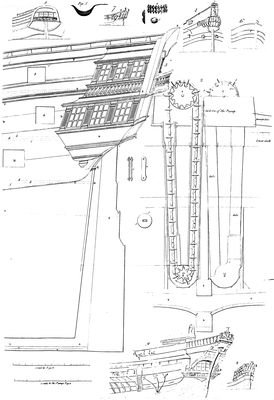
Plate viii to face QUARTER
Q.
QUADRANT, an instrument used to take the altitude of the sun or stars at sea, in order to determine the latitude of the place; or the sun’s azimuth, so as to ascertain the magnetical variation.
These instruments are variously constructed, and by consequence the apparatus of each kind is somewhat different from those of the others, according to the improvements they have at different times received from several ingenious artists.
As all the different kinds of quadrants are circumstantially described, either in printed directions to use them, or in other books, a particular account of them here might reasonably be esteemed superfluous. It suffices to say that the most useful, as well as the most general, for taking observations at sea is the octant, originally invented by Sir Isaac Newton, and since that time improved and brought into practice by Mess. Godfrey and Hadley. It may not however be unnecessary to remark, that the back-observation, which, in many situations, is certainly more accurate and useful than that which is taken in front, is almost totally neglected by our observers, under pretence of its being more uncertain, or more liable to error: but really because it is somewhat more difficult to learn. We may venture to affirm however, that no artist, who thoroughly understands the operation, will ever advance so absurd an objection, unless we should doubt the testimony of a multitude of experiments.
QUARANTINE, the state of the persons who are restrained within the limits of a ship, or lazaretto; or otherwise prevented from having a free communication with the inhabitants of any country, till the expiration of an appointed time, during which they are repeatedly examined with regard to their health. It is chiefly intended to prevent the importation of the plague, from the countries under the dominion of the Turks.
QUARTER of a ship, hanche, that part of a ship’s side which lies towards the stern, or which is comprehended between the aftmost end of the main chains and the sides of the stern, where it is terminated by the quarter-pieces.
Although the lines by which the quarter and bow of a ship, with respect to her length, are only imaginary, yet experience appears sufficiently to have ascertained their limits: so that if we were to divide the ship’s sides into five equal portions, the names of each space would be readily enough expressed. Thus the first, from the stern, would be the quarter; the second, abaft the midships; the third, the midships; the fourth, before the midships; and the fifth, the bow. Whether these divisions, which in reality are somewhat arbitrary, are altogether improper, may be readily discovered by referring to the mutual situation or approach of two adjacent vessels. The enemy boarded us on the larboard-side! Whereabouts? Abaft the midships, before the midships, &c.
Plate VIII. fig. 3. represents a geometrical elevation of the quarter of a 74 gun ship, as corresponding with the other figures of a ship of the same rate, delineated upon the same plate. See the articles Head, Midship-Frame, and Stern.
In this figure, all the parts are distinguished by the same letters as those in the plane of elevation, plate I. wherein the quarter is continued into the side, upon a smaller scale.
Explanation of fig. 3. plate VIII.
A the keel, with a the false keel beneath it.
B the stern-post.
D D the quarter-gallery, with its ballustrades and windows.
E F the quarter-pieces, which limit and form the outlines of the stern.
F the taffarel, or upper pieces of the stern.
F G the profile of the stern, with its galleries.
H the gun-ports of the lower-deck.
h the gun-ports of the upper and quarter-decks.
I the after-part of the mizen-channel.
K the wing-transom.
K G the lower counter.
L B the station of the deck-transom.
L Q the after-part of the main-wale.
D R the after-part of the channel-wale, parallel to the main-wale,
S U the sheer-rail, parallel to both wales.
T t the rudder.
A t F the rake of the stern.
P i i the drift-rails.
T U the after-part of the load water-line.
k k l the curve of the several decks corresponding to those represented in the head.
As the marks, by which vessels of different constructions are distinguished from each other, are generally more conspicuous on the stern, or quarter, than any other part, we have represented, in plate VIII. some of the quarters, which assume the most different shapes, and form the greatest contrast with each other.
Fig. 4. shews the stern and quarter of a Dutch flight.
Fig. 5. the stern and quarter of a cat.
Fig. 8. is the stern and quarter of a common galley.
Fig. 9. exhibits the quarter of a first-rate galley, otherwise called a galleasse.
Fig. 6. the quarter of a Dutch dogger, or galliot.
Fig. 7. represents the stern and quarter of a sloop of war.
The quarters of all other ships have a near affinity to those above exhibited. Thus all ships of the line, and East-Indiamen, are formed with a quarter little differing from the principal figure in this plate. Xebecs have quarters nearly resembling those of galeasses, only somewhat higher. Hag-boats and pinks approach the figure of cats, the former being a little broader in the stern, and the latter a little narrower; and the sterns and quarters of cats seem to be derived from those of fly-boats. The sterns of Dutch doggers and galliots are indeed singular, and like those of no other modern vessel: they have nevertheless a great resemblance to the ships of the antient Grecians, as represented in medals and other monuments of antiquity.
On the Quarter, may be defined an arch of the horizon, contained between the line prolonged from the ship’s stern and any distant object, as land, ships, &c. Thus if the ship’s keel lies on an east and west line, the stern being westward, any distant object perceived in the north-west or south-west, is said to be on the larboard or starboard quarter. See the article Bearing.
Quarter-bill, a roll, or list, containing the different stations, to which all the officers and crew of the ship are quartered, in the time of battle, and the names of all the persons appointed to those stations.
Quarter-cloths, bastingage, long pieces of painted canvas, extended on the outside of the quarter-netting from the upper-part of the gallery to the gangway. They are generally decorated with martial instruments, or allegorical figures.
Quarter-gallery, a sort of small balcony, with or without ballustrades, on the quarter of a ship, as represented by fig. 1. plate VIII. The gallery on the quarter generally communicates with that on the stern, by means of a door passing from one to the other.
Quarter-gunner, an inferior officer under the direction of the gunner of a ship of war, whom he is to assist in every branch of his duty; as keeping the guns and their carriages in proper order, and duly furnished with whatever is necessary; filling the powder into cartridges; scaling the guns, and keeping them always in a condition to be ready for service. The number of quarter-gunners in any ship is always in proportion to the number of her artillery, one quarter-gunner being allowed to every four cannon.
Quarter-master, an inferior officer, appointed by the master of a ship of war to assist the mates in their several duties; as stowing the ballast and provisions in the hold, coiling the cables on their platforms, overlooking the steerage of the ship, and keeping the time by the watch-glasses.
Quarter-netting, a sort of net-work, extended along the rails on the upper-part of a ship’s quarter. In a ship of war these are always double, being supported by iron cranes, placed at proper distances. The interval is sometimes filled with cork, or old sails, but chiefly with the hammocs of the sailors, so as to form a parapet to prevent the execution of the enemy’s small arms in battle. See the article Engagement.
Quarter-rails, are narrow-moulded planks, generally of fir, reaching from the top of the stern to the gangway. They are supported by stanchions, and serve as a fence to the quarter-deck, to prevent the men from tumbling into the sea by the rolling of the ship, particularly in small vessels.
QUARTERS, a name given, at sea, to the several stations where the officers and crew of a ship of war are posted in action. See the article Engagement.
The number of men appointed to manage the artillery is always in proportion to the nature of the guns, and the number and condition of the ship’s crew. They are, in general, as follow, when the ship is well manned, so as to fight both sides at once occasionally:
Nature of the gun.
Pounder. No. of men.
To a 42 15
32 13
24 11
18 9
12 7
9 6
6 5
4 4
3 3
This number, to which is often added a boy to bring powder to every gun, may be occasionally reduced, and the guns nevertheless well managed. The number of men appointed to the small arms, on board his majesty’s ships and sloops of war, by order of the admiralty, are,
Rate of the ship. No. of men to the small arms.
1st 150
2d 120
3d of 80 guns 100
— of 70 guns 80
4th of 60 guns 70
4th of 50 guns 60
5th 50
6th 40
Sloops of war 30
The lieutenants are usually stationed to command the different batteries, and direct their efforts against the enemy. The master superintends the movements of the ship, and whatever relates to the sails. The boatswain, and a sufficient number of men, are stationed to repair the damaged rigging; and the gunner and carpenter, wherever necessary, according to their respective offices. See also the articles Cannon and Exercise.
The marines are generally quartered on the poop and forecastle, or gangway, under the direction of their officers; although, on some occasions, they assist at the great guns, particularly in distant cannonading.
Quarters! is also an exclamation to implore mercy from a victorious enemy.
QUICK-SAND, a loose quaking sand, into which a ship sinks by her own weight, as soon as the water retreats from her bottom.
Quick-work, œuvres-vives, a general name given to all that part of a ship, which is under the surface of the water when she is laden fit for a sea-voyage. It is also applied, occasionally, to that part of the side which is above the sheer-rail, and which is usually painted with trophies, &c. on the outside.
QUILTING, (kulcht, Dutch) the operation of weaving a sort of coat, or texture, formed of the strands of rope, about the outside of any vessel, to contain water, &c. as a jar, cask, bottle, &c.
QUOIN, a sort of wedge, employed to raise the cannon to a proper level, that it may be more truly directed to the object.
Quoins are also employed to wedge off the casks of wine, oil, spirituous liquors, &c. from each other, that their bilges may not rub against each other so as to occasion a leak, by the agitation of the ship, at sea.
R.
RABBIT, rablure, (rabatre, Fr.) a deep groove, or channel, cut in a piece of timber longitudinally, to receive the edge of a plank, or the ends of a number of planks, which are to be securely fastened therein. The depth of this channel is equal to the thickness of the plank, so that when the end of the latter is let into the rabbit, it will be level with the outside of the piece. Thus the ends of the lower planks of a ship’s bottom terminate upon the stem afore, and the stern-post abaft, with whose sides their surfaces are even. The surface of the garboard streak, whose edge is let into the keel, is, in the same manner, level with the side of the keel at the extremities of the vessel.
RACKING, the fastening two opposite parts of a tackle together, so as that any weighty body suspended thereby, shall not fall down, although the rope, which forms the tackle, should be loosened by accident or neglect.
This expedient is chiefly practised when the boats are hung up to the ship’s side, during the night time, in an open road or bay, lest the rope of the tackle should be untied by the inattention of some of the crew; by which accident the boat might be considerably damaged, and probably lost, or dashed in pieces.
RAFT, radeau, a sort of float, formed by an assemblage of various planks, or pieces of timber, fastened together side by side, so as to be conveyed more commodiously, to any short distance in a harbour or road, than if they were separate. The timber and plank, with which merchant-ships are laden, in the different parts of the Baltic sea, are attached together in this manner, in order to float them off to the shipping.
Raft-port, a square hole, cut through the buttocks of some ships, immediately under the counter, to receive the planks or pieces of timber which are brought to lade her for transportation; and which, on account of their great length, could not be received aboard otherwise.
RAG-BOLT, an iron pin, having several barbs, as explained in the article Iron-work, and represented in fig. 2, plate II.
RAILS, are narrow planks, generally of fir, upon which there is a moulding stuck. They are for ornament, and are nailed across the stern, above the wing-transom and counters, &c. They are likewise nailed upon several planks along the side; one in particular is called the sheer-rail, which limits the height of the side from the forecastle to the quarter-deck, and runs aft to the stern, and forward to the cat-head; the wales are nearly parallel to this. Murray’s Ship-Building.
The reader will understand this article better by referring to the figures of the rails, as represented in plates I, IV, VII, and VIII. and their explanations, in Naval Architecture, &c.
Rails of the head, certain curved pieces of timber, extending from the bows on each side to the continuation of the ship’s stem, to support the knee of the head, and the ornamental figure fixed thereon. The form of these rails is represented at large in the figure referred to from the article Head, plate IV.
To RAISE, to elevate any distant object at sea, by a gradual approach towards it from the place whence it was formerly observed. This effect is known to be occasioned by the convexity of the surface of the sea, which previously intercepted the view, when directed towards the lower parts of the said object. This term is opposed to Laying, which see.
RAISING a purchase, the act of disposing certain instruments, or machines, in such a manner, as that, by their mutual effects, they may produce a mechanical force sufficient to overcome the weight, or resistance of the object to which this machinery is applied.
RAKE, the projection of the upper parts of a ship at the height of the stem, and stern, beyond the extremities of the keel. Thus if a plummet be hung from the top of a ship’s stern, so as to be level with the continuation of the keel, the distance between the after end of the keel and the plummet will be the length of the rake abaft, or the rake of the stern.
RAKING a ship, the act of cannonading a ship on the stern, or head, so as that the balls shall scour the whole length of her decks; which is one of the most dangerous incidents that can happen in a naval action. This is frequently called raking fore and aft, being the same with what is called enfilading by engineers.
RANGE, a sufficient length of the cable, drawn up on the deck, before the anchor is cast loose from the bow, to let it sink to the bottom, without being interrupted, that the flukes may be forced the deeper into the ground, by the additional weight which the anchor acquires in sinking. For this reason the range, which is drawn up out of the tier, ought to be equal in length, to the depth of the water where the ship anchors. See Anchor and Cable-Tier.
Range, is also the distance to which a bomb or cannon-ball is thrown from a piece of artillery, by the explosion of gun-powder. See the articles Cannon and Mortar.
The flight of a shot is distinguished, by artillery people, into two different ranges, of which the first is called the point-blank; and the second, the random-shot. To these also may be added the ricochet, or rolling and bounding-shot.
Whatever has been observed, in other parts of this work, with regard to the flight of a shot from a piece of artillery, is on the presumption that it describes a right line in its passage to the object. This, however, is not strictly true; because by its weight it inclines to the earth every instant of its motion: but as its velocity is very great when first discharged from the cannon, the weight does not sensibly affect the direction in the first instant of its motion. Thus the line it describes, as represented in plate III. extending from fig. 16. to the ship under sail, is apparently straight, and the extent of this line is called the point-blank range of the piece; which accordingly may be defined the extent of the apparent right line, described by a ball discharged from a cannon.
This range is much less than the greatest range, or random-shot; but the piece cannot be levelled, or, as it is generally expressed, pointed at an object intended to be battered, if that object is not within the distance of the point-blank range; for beyond that, the stroke is very uncertain.
A piece is said to fire at random-shot, when the breech rests upon the bed of the carriage, so that the ball is carried to the greatest possible distance. But as, in this method of firing, the ball cannot be directed to any determinate object, it is rarely used in the sea-service, and only when the shot cannot fail of doing great execution in the place whereon it falls.
Besides the two ranges above described, there is the ricochet[45], invented by the Marshal de Vauban.
To fire a piece by way of the ricochet, the cannon is only charged with a quantity of powder sufficient to carry the shot along the face of the works attacked. The shot, thus discharged, goes rolling and bounding, killing, maiming, or destroying all it meets in its course, and creates much more disorder by going thus slowly, than if thrown from the piece with greater violence.
When ricochet firing is used, the pieces are elevated from 3 to 6 degrees, and no more; because if the elevation is greater, the shot will only drop into the work, without bounding from one place to another. They are to be loaded with a small charge, and directed in such a manner as just to go over the parapet[46].
It was the opinion of engineers formerly, that by charging the pieces high, the ball was thrown to a greater distance. Hence the pieces were charged with two thirds, or even the whole weight of the shot, in order to impel it with greater velocity; but it has been discovered since, that the half, or one third of the weight of the ball, is the fittest charge for the piece[47].
If the whole quantity of powder, employed to charge the cannon, could take fire at the same instant, it is apparent that the velocity, communicated to the shot, would increase in proportion to the additional quantity of powder. But though the time of its inflammation is very short, it may yet be conceived as divided into many instants. In the first instant, the powder begins to dilate and impel the shot forward; and if it has force enough to expel it from the piece before the whole charge is inflamed, that part which is left to take fire afterwards will produce no effect at all on the shot. A charge of extraordinary force does not therefore accelerate the velocity of the bullet: and hence it follows that the piece ought to be charged with no more powder, than will take fire whilst the ball is passing through the chace of the cannon.
It may not be amiss to observe here, that the range of cannon is greater in the morning and at night, than at noon; and in cold, than in hot weather. The reason is, that at these times the air being less heated, gives less way to the dilatation of the powder, which being by this means confined, as it were, to a smaller sphere of action, must have a stronger effect in proportion[48].
“When the lengths of cannon are proportional to the height of the charge, the shot will be discharged with the same velocity, whatever the calibre may be; and since the ratios of the velocities of shots, issuing from pieces of different lengths, loaded with different charges of powder, will be of great use in the construction of cannon, we have collected them in the following table, where the numbers at the top express the length of the pieces by the diameter of their shots. That is, the first is 12 diameters; the second 15, and so on. The first perpendicular column expresses the charges, in respect to the weight of the shots: thus, ¼, ⅓, ½, ⅔ imply that the weight of the charge is ¼, ⅓, ½, ⅔ of the weight of the shot. The other numbers, in the same horizontal lines, express the distance in feet moved over by the velocities of the shot, uniformly continued in a second of time.