AN UNIVERSAL DICTIONARY OF THE MARINE. (continued 4)
Reading edition
G, the carlings, ranging fore and aft, from one beam to another.
H, the gun-ports.
I, the pump-dales, being large wooden tubes which return the water from the pumps into the sea.
K, the spurs of the beams; being curved pieces of timber serving as half-beams to support the decks, where a whole beam cannot be placed on account of the hatch-ways.
L, the deck-transom, which is bolted by the middle to the stern-post, and whose ends rest upon the fashion-pieces.
M, the bulk-head or partition, which encloses the manger, and prevents the water which enters at the hause-holes from running aft between decks.
N N, the fore hatch-way.
O O, the after hatch-way.
P, the drum-head of the gear cap-stern.
P p, the drum-head of the main capstern.
Q, one of the lower transom-knees.
R, one of the breast-hooks under the gun-deck.
S, the breast-hook of the gun-deck.
T T, the station of the chain-pumps.
V, the breadth and thickness of the timbers at the height of the gun-deck.
U U, scuttles leading to the gunner’s store-room, and bread-room.
W, the station of the fore-mast.
X, the station of the main-mast.
Y, the station of the mizen-mast.
Z, the ring-bolts of the decks, used to retain the cannon whilst charging.
a, a, the ring-bolts of the sides, whereon the tackles are hooked that secure the cannon at sea.
c a a d, the water-ways, through which the scupper-holes are pierced, to carry the water off from the deck into the sea.
b, b, plan of the foremost and aftmost cable-bits, with their crosspieces g, g, and their standards e, e.
Thus we have represented on one side, all the pieces which sustain the deck with its cannon; and on the other side, the deck itself, with a tier of 32 pounders planted in battery thereon. In order also to shew the use of the breeching and train-tackle, one of the guns is drawn in as ready for charging. See the articles Breeching and Cannon.
The number of beams, by which the decks of ships are supported, is often very different, according to the practice of different countries; the strength of the timber of which the beams are framed; and the services for which the ship is calculated.
As the deck which contains the train of a fire-ship is furnished with an equipage peculiar to itself, the whole apparatus is particularly described in the article Fire-ship.
Flush-Deck, or Deck-Flush fore and aft, implies a continued floor laid from stem to stern, upon one line, without any steps or intervals.
Half-Deck, corps de garde, a space under the quarter-deck of a ship of war, contained between the foremost bulk-head of the steerage, and the fore-part of the quarter-deck.
In the colliers of Northumberland the steerage itself is called the half-deck, and is usually the habitation of the ship’s crew.
DECOY, a stratagem employed by a small ship of war to betray a vessel of inferior force into an incautious pursuit, till she has drawn her within the range of her cannon, or what is called within gun-shot.
It is usually performed by painting the stern and sides in such a manner as to disguise the ship, and represent her either much smaller, and of inferior force, or as a friend to the hostile vessel, which she endeavours to ensnare, by assuming the emblems and ornaments of the nation to which the stranger is supposed to belong. When she has thus provoked the adversary to chase, in hope of acquiring a prize, she continues the decoy by spreading a great sail, as endeavouring to escape, at the same time that her course is considerably retarded by an artful alteration, of her trim till the enemy approaches.
Decoying is also performed to elude the chace of a ship of superior force in a dark night, by throwing out a lighted cask of pitch into the sea, which will burn for a considerable time, and misguide the enemy. Immediately after the cask is thrown out, the ship changes her course, and may easily escape if at any tolerable distance from the foe.
DEEP-WAISTED, encastillé, the distinguishing fabric of a ship’s decks, when the quarter-deck and fore-castle are elevated from four to six feet above the level of the upper-deck, so as to leave a vacant space, called the waiste, on the middle of the upper-deck. See the article Waiste.
DEMURRAGE, an allowance given to the commander of a trading ship by the merchants, for having detained him longer in port than the time previously appointed for his departure.
DEPARTURE, in navigation, the distance between any two places lying on the same parallel, counted in miles of the equator; or the distance of one place from the meridian of another, counted on the parallel passing over that place. See Navigation.
DEPTH of a sail, chute, the extent of any square or oblong sail from the head-rope to the foot-rope; or the length of the after-leech of any boom-sail or stay-sail. See the article Sail.
DETACHMENT of a fleet or squadron, a certain number of ships chosen by an admiral or commodore from the rest of the fleet, charged to execute some particular service.
DIFFERENCE of latitude, in navigation, the difference between any two places lying on the same meridian; or the distance between the parallels of latitude of any two places, expressed in miles of the equator.
DINNAGE, see the article Dunnage.
DISABLED, desemparé, the state of a ship when, by the loss of her masts, sails, yards, or rigging; by springing a leak, or receiving some fracture in her hull, or other disaster; she is rendered incapable of prosecuting her voyage without great difficulty and danger.
To DISCHARGE, (decharger, Fr.) when applied to a ship, signifies to unlade her, or take out her stores, ammunition, artillery, &c. When expressed of the officers or crew, it implies to disband them from immediate service.
DISMASTED, dematé, the state of a ship which has lost her masts by boisterous weather, engagement, or other misfortune.
DIVISION, a select number of ships in a fleet or squadron of men of war, distinguished by a particular flag or pendant, and usually commanded by a general officer. A squadron is commonly ranged into three divisions, the commanding officer of which is always stationed in the center.
When a fleet consists of sixty sail of the line, that is, of ships having at least sixty cannon, the admiral divides it into three squadrons, each of which has its divisions and commanding officers. Each squadron has its proper colours, according to the rank of the admiral who commands it, and every division its proper mast. Thus, the white flag denotes the first squadron of France; the white and blue the second, and the third is characterised by the blue. In England, the first admiral, or the admiral of the fleet, displays the union flag at the main-top-mast-head; next follows the white flag with St. George’s cross; and afterwards the blue. The private ships carry pendants of the same colour with their respective squadron, at the masts of their particular divisions; so that the last ship in the division of the blue squadron carries a blue pendant at her mizen-top-mast-head.
DOCK, forme, (imagined of δοχεῖον) a sort of broad and deep trench, formed on the side of a harbour, or on the banks of a river; and commodiously fitted either to build ships, or receive them to be repaired and breamed therein. These sorts of docks have generally strong flood-gates, to prevent the flux of the tide from entering the dock while the ship is under repair.
There are likewise docks of another kind, called wet-docks, where a ship can only be cleaned during the recess of the tide, or in the interval between the time when the tide left her dry a-ground, and the period when it again reaches her by the return of the flood. Docks of the latter kind are not furnished with the usual flood-gates.
DOCKING a ship, the act of drawing her into the dock, in order to give her a proper repair, and cleanse the bottom, and cover it anew with a preparation of stuff, as explained in the article Breaming.
DOCK-YARDS, arcenaux, certain magazines containing all sorts of naval stores, and timber for ship-building. In England, the royal dock-yards are at Chatham, Portsmouth, Plymouth, Deptford, Woolwich, and Sheerness. His majesty’s ships and vessels of war are generally moored at these ports, during the time of peace; and such as want repairing are taken into the docks, examined, and refitted for service. See the article Repair.
The principal dock-yards are governed by a commissioner, resident at the port, who superintends all the musters of the officers, artificers, and labourers, employed in the dock-yard, and ordinary. He also controls their payment therein; examines the accounts; contracts, and draws bills on the Navy-office to supply the deficiency of stores; and, finally, regulates whatever belongs to the dock-yard, maintaining due order in the respective offices.
These yards are generally supplied from the northern crowns with hemp, pitch, tar, rosin, canvas, oak plank, and several other species. With regard to the masts, particularly those of the largest size, they are usually imported from New-England.
DOG, a sort of iron hook, or bar, with a sharp fang at one end, so formed as to be easily driven into a plank: it is used to drag along the planks of oak when they are let into a hole under the stern of a ship, to be stowed in the hold. For this purpose there is a rope fastened to the end of the dog, upon which several men pull, to draw the plank towards the place where it is to be stowed. It is also used for the same purpose in unlading the ship.
DOGGER, dogre-bot, a Dutch fishing-vessel navigated in the German ocean. It is generally employed in the herring fishery, being equipped with two masts, viz. a main-mast and a mizen-mast, and somewhat resembling a ketch.
DOLPHIN of the mast a peculiar kind of wreath, formed of platted cordage, to be fastened occasionally round the masts, as a support to the puddening, whose use is to sustain the weight of the fore and main-yards, in case the rigging, or chains, by which those yards are suspended, should be shot away in the time of battle; a circumstance which might render their sails useless at a season when their assistance is extremely necessary. See the article Puddening.
DOUBLING, in navigation, (doubler, Fr.) the act of sailing round, or passing beyond a cape or promontory, so as that the cape or point of land separates the ship from her former situation, or lies between her and any distant observer.
DOUBLING-NAILS, amongst shipwrights, the nails commonly used to fasten the lining of the gun-ports, &c.
DOUBLING-UPON, in a naval engagement, the act of enclosing any part of a hostile fleet between two fires, or of cannonading it on both sides.
It is usually performed by the van or rear of that fleet which is superior in number, taking the advantage of the wind, or of its situation and circumstances, and tacking or veering round the van or rear of the enemy, who will thereby be exposed to great danger, and can scarcely avoid being thrown into a general confusion.
To DOUSE, molir, to lower suddenly or slacken: expressed of a sail in a squall of wind, an extended hawser, &c.
DOWN-HAWL, calebas, a rope passing up along a stay through the rings of the stay-sail, and tied to the upper-corner of the sail, to pull it down, when they are shortening sail.
Down-haul-Tackle, a complication of pullies, employed to pull down the main or fore-yard in a tempest, in order to reef the sail. It is used at this time, because the violence of the wind prevents the weight of the yard from having its natural effect, of descending, when the ropes by which it is suspended are slackened.
DRABLER, an additional part of a sail, sometimes laced to the bottom of the bonnet of a square-sail, in sloops and schooners.
DRAG, a machine consisting of a sharp square iron ring encircled with a net, and commonly used to rake the mud off from the platform or bottom of the docks. See plate II. fig. 35.
DRAGGING the anchor, the act of trailing it along the bottom, after it is loosened from the ground, by the effort of the wind or current upon the ship, communicated to the cable. See the article Anchor.
DRAUGHT, the depth of a body of water necessary to float a ship; hence a ship is said to draw so many feet of water, when she is borne up by a column of water of that particular depth. Thus, if it requires a body of water whose depth is equal to twelve feet, to float or buoy up a ship on its surface, she is said to draw twelve feet water; and that this draught may be more readily known, the feet are marked on the stem and stern-post, regularly from the keel upwards.
DRESSING, (faire la parade), the act of ornamenting a ship with a variety of colours; as ensigns, flags, pendants, &c. displayed from different parts of her masts and rigging on a day of festivity.
DRIFT, in navigation, derive (from drive), the angle which the line of a ship’s motion makes with the nearest meridian, when she drives with her side to the wind and waves, and is not governed by the power of the helm: it also implies the distance which the ship drives on that line.
A ship’s way is only called drift in a storm; and then, when it blows so vehemently, as to prevent her from carrying any sail, or at least restrains her to such a portion of sail as may be necessary to keep her sufficiently inclined to one side, that she may not be dismasted by her violent labouring produced by the turbulence of the sea.
DRIVER, an oblong sail, occasionally hoisted to the mizen-peak, when the wind is very fair. The lower corners of it are extended by a boom or pole, which is thrust out across the ship, and projects over the lee-quarter.
DRIVING, abattre (drifan, Sax.) the state of being carried at random along the surface of the water, as impelled by a storm, or impetuous current: it is generally expressed of a ship when, accidentally, broke loose from her anchors or moorings.
DROP, etarcure, a name sometimes given to the depth of the principal sails; as, her main-top-sail drops seventeen yards.
DUCKING, a sort of marine punishment inflicted by the French on those who have been convicted of desertion, blasphemy, or exciting sedition. It is performed as follows: the criminal is placed astride of a short thick batten, fastened to the end of a rope, which passes thro’ a block hanging at one of the yard-arms. Thus fixed, he is hoisted suddenly up to the yard, and the rope being slackened at once, he is plunged into the sea. This chastisement is repeated several times, conformable to the purport of the sentence pronounced against the culprit, who has at that time several cannon-shot fastened to his feet during the punishment, which is rendered public by the firing of a gun, to advertise the other ships of the fleet thereof, that their crews may become spectators. Aubin.
Ducking, is also a penalty which veteran sailors pretend to inflict on those, who, for the first time, pass the tropic of Cancer, the Equator, or the streights of Gibraltar, in consequence of their refusal or incapacity to pay the usual fine levied on this occasion, which would redeem them from the said penalty.
DUNNAGE, fardage, a quantity of faggots, boughs of trees, or other loose wood, laid in the bottom of a ship, either to raise the heavy goods which might make her too stiff, or to keep the cargo sufficiently above the bottom, that it may sustain no damage from the water, if the ship should prove leaky.
E.
EARINGS, rabans, certain small cords employed to fasten the upper corners of a sail to its respective yard; for which purpose one end of the earing is spliced to the cringle, fixed in that part of the sail; and the other end of it is passed six or seven times round the yard-arm and through the cringle, thereby fastening the latter to the former. Two of the turns are intended to stretch the upper-edge of the sail tight along the yard; and the rest to draw it close up to it. The former are therefore called outer, and the latter inner turns, as being passed without, or within the rigging, on the yard-arms.
EASE the ship! the command given by the pilot to the steersman, to put the helm close to the lee-side, or, in the sea-phrase, hard-a-lee, when the ship is expected to pitch or plunge her fore-part deep in the water, while close-hauled. The reason usually given for this practice is, that the sudden movement of the helm prevents the ship’s head from falling with so much weight and rapidity into the hollow of the sea, as it would do otherwise: which is presuming that the flow, and uncertain effect of the helm is sufficient to retard the certain and violent action of gravity: a position that necessarily infers a very singular theory of mechanics. We shall not endeavour to advance any argument in favour of this practice; only to remark, that it is most religiously observed, both in merchant-ships and his majesty’s navy.
To Ease off, or Ease away, molir, filer, to slacken gradually any single rope, or complication of ropes, formed into a tackle.
EBB, jussant, the reflux of the tide, or the return of it into the sea after the highest of the flood, usually termed full-sea, or high-water.
EDDY, remoux, (ed, backward, again, and ea, water, Sax.) the water that, by some interruption in its course, runs contrary to the direction of any river, or current, and appears like the motion of a whirlpool.
To EDGE away, in navigation, abattre, to decline gradually from the shore, or from the line of the course which the ship formerly steered: it is particularly applied when a ship changes her course, by sailing nearer the direction of the wind; or, in the lea-language, by sailing larger, or more afore the wind, than she had done before that operation.
ELBOW in the hause, a particular twist in the cables by which a ship rides at anchor. In this situation each of the cables, after crossing the other before the stem, is directed outwards on the same bow from which it issued: that is to say, the starboard cable grows out on the starboard bow, and the larboard cable on the larboard bow, as exhibited in fig. 36, plate II. where a expresses the fore-castle, b the stem, c c the larboard cable, and d d the starboard one. See the article Hawse.
EMBARGO, in commerce, arret (embargar, Span.), an arrest laid on ships or merchandise by public authority, or a prohibition of state, commonly issued on foreign ships, to prevent their putting to sea in time of war; and sometimes to prevent their coming in, and otherwise both to prevent their entrance and departure.
EMBAYED, encapé, (from bay,) the situation of a ship when she is inclosed between two capes or promontories. It is particularly applied when the wind, by blowing strongly into any bay or gulf, makes it extremely difficult, and perhaps impracticable, for the vessel thus enclosed, to claw off from the shore, so as to weather the capes and arrive into the offing.
ENGAGEMENT, in a naval sense, implies a particular or general battle at sea; or an action of hostility between single ships, or detachments, or squadrons of men of war.
In order to have a clearer idea of this article, it will, therefore, be necessary that the reader who is little acquainted with the subject, should previously refer to the explanation of those terms, as also to the articles Cannon, Division, Exercise, Fleet, and Line of Battle.
The sea-fights of the ancients were usually carried on in two different manners. Advanced by the force of their oars, the gallies ran violently aboard of each other, and by the mutual encounter of their beaks and prows, and sometimes of their sterns, endeavoured to dash in pieces, or sink their enemies.
The prow, for this purpose, was commonly armed with a brazen point or trident, nearly as low as the surface of the sea, in order to pierce the enemy’s ships under the water. Some of the gallies were furnished with large turrets, and other accessions of building, either for attack or defence. The soldiers also annoyed their enemies with darts and slings, and, on their nearer approach, with swords and javelins; and, in order that their missive weapons might be directed with greater force and certainty, the ships were equipped with several platforms, or elevations above the level of the deck[9]. The sides of the ship were fortified with a thick fence of hides, which served to repel the darts of their adversaries, and to cover their own soldiers, who thereby annoyed the enemy with greater security.
As the invention of gun-powder has rendered useless many of the machines employed in the naval wars of the ancients, the great distance of time has also consigned many of them to oblivion: some few are, nevertheless, recorded in ancient authors, of which we shall endeavour to present a short description. And first,
The Δελφιν was a large and massy piece of lead or iron, cast in the form of a dolphin. This machine being suspended by blocks at their mast-heads or yard-arms, ready for a proper occasion, was let down violently from thence into the adverse ships, and either penetrated through their bottom, and opened a passage for the entering waters, or by its weight immediately sunk the vessel.
The Δρήπαναν an engine of iron crooked like a sickle, and fixed on the top of a long pole. It was employed to cut asunder the slings of the sail-yards, and, thereby letting the sails fall down, to disable the vessel from escaping, and incommode her greatly during the action. Similar to this was another instrument, armed at the head with a broad two-edged blade of iron, wherewith they usually cut away the ropes that fastened the rudder to the vessel[10].
Δόρατα ναύμαχα, a sort of spears or maces of an extraordinary length, sometimes exceeding twenty cubits, as appears by the 15th Iliad of Homer[11], by whom they are also called μακρὰ.
Κιραῖαι were certain machines used to throw large stones into the enemies ships.
Vegetius mentions another engine, which was suspended to the main-mast, and resembled a battering-ram: for it consisted of a long beam, and an head of iron, and was, with great violence, pushed against the sides of the enemies gallies.
They had also a grappling-iron, which was usually thrown into the adverse ship by means of an engine: this instrument facilitated the entrance of the soldiers appointed to board, which was done by means of wooden bridges, that were generally kept ready for this purpose in the fore-part of the vessel[12].
The arms used by the ancients rendered the disposition of their fleets very different, according to the time, place and circumstances. They generally considered it an advantage to be to windward, and to have the sun shining directly on the front of their enemy. The order of battle chiefly depended on their power of managing the ships, or of drawing them readily into form; and on the schemes which their officers had concerted. The fleet being composed of rowing-vessels, they lowered their sails previous to the action: they presented their prows to the enemy, and advanced against each other by the force of their oars[13]. Before they joined battle, the admirals went from ship to ship, and exhorted their soldiers to behave gallantly. All things being in readiness, the signal was displayed by hanging out of the admiral’s galley a gilded shield, or a red garment or banner. During the elevation of this the action continued, and by its depression, or inclination towards the right or left, the rest of the ships were directed how to attack, or retreat from their enemies. To this was added the sound of trumpets, which began in the admiral’s galley, and continued round the whole navy. The light was also begun by the admiral’s galley, by grappling, boarding, and endeavouring to overset, sink, or destroy, the adversary, as we have above described[14]. Sometimes, for want of grappling irons, they fixed their oars in such a manner as to hinder the enemy from retreating.[15] If they could not manage their oars as dexterously as their antagonists, or fall along-side so as to board him, they penetrated his vessel with the brazen prow. The vessels approached each other as well as their circumstances would permit, and the soldiers were obliged to fight hand to hand, till the battle was decided: nor indeed could they fight otherwise with any certainty, since the shortest distance rendered their slings and arrows, and almost all their offensive weapons, ineffectual, if not useless. The squadrons were sometimes ranged in two or three right lines, parallel to each other; being seldom drawn up in one line, unless when formed into an half moon. This order indeed appears to be the most convenient for rowing vessels that engage by advancing with their prows towards the enemy. At the battle of Ecnomus, between the Romans and the Carthaginians, the fleet of the former was ranged into a triangle, or a sort of wedge in front, and towards the middle of its depth, of two right parallel lines. That of the latter was formed into a rectangle, or two sides of a square, of which one branch extended behind, and, as the opening of the other prosecuted the attack, was ready to fall upon the flank of such of the Roman gallies as should attempt to break their line. Ancient history has preserved many of these orders, of which some have been followed in later times. Thus, in a battle in A. D. 1340, the English fleet was formed in two lines, the first of which contained the larger ships, the second consisted of all the smaller vessels, used as a reserve to support the former whenever necessary. In 1545 the French fleet under the command of the Mareschal d’Annebault, in an engagement with the English in the Channel, was arranged in the form of a crescent. The whole of it was divided into three bodies, the center being composed of thirty-six ships, and each of the wings of thirty. He had also many gallies; but these fell not into the line, being designed to attack the enemy occasionally. This last disposition was continued down to the reigns of James I. and Louis XIII[16].
Meanwhile the invention of gun-powder, in 1330, gradually introduced the use of fire-arms into naval war, without finally superseding the ancient method of engagement. The Spaniards were armed with cannon in a sea-fight against the English and the people of Poitou abreast of Rochelle in 1372; and this battle is the first wherein mention is made of artillery in our navies. Many years elapsed before the marine armaments were sufficiently provided with fire-arms[17]. So great a revolution in the manner of fighting, and which necessarily introduced a total change in the construction of ships, could not be suddenly effected. In short, the squadrons of men of war are no longer formed of rowing-vessels, or composed of gallies and ships of the line, but entirely of the latter, which engage under sail, and discharge the whole force of their artillery from their sides. Accordingly they are now disposed in no other form than that of a right line parallel to the enemy; every ship keeping close-hauled upon a wind on the same tack. Indeed the difference between the force and manner of fighting of ships and gallies rendered their service in the same line incompatible. When we consider therefore the change introduced, both in the construction and working of ships, occasioned by the use of cannon, it necessarily follows, that squadrons of men of war must appear in the order that is now generally adopted. Finally, the ships ought to present their broad-sides to the enemy; and to sail close upon a wind in the wake of each other; as well to retain their own uniformity, as to preserve or acquire the advantage which the weather-gage gives them over their adversary[18].
The machines which owe their rise to the invention of gun powder have now totally supplanted the others; so that there is scarce any but the sword remaining, of all the weapons used by the ancients. Our naval battles are therefore almost always decided by fire-arms, of which there are several kinds, known by the general name of artillery.
In a ship of war fire-arms are distinguished into cannon mounted on carriages, swivel-cannon, grenadoes, and musquetry. The first has been already described at large in its proper place. The second is a small piece of artillery, carrying a shot of half a pound, and fixed in a socket on the top of the ships side, stern or bow, and also in her tops. The trunnions of this piece are contained in a sort of iron crotch, whose lower-end terminates in a cylindrical pivot resting in the socket, so as to support the weight of the cannon. The socket is bored in a strong piece of oak, reinforced with iron hoops, in order to enable it to sustain the recoil. By means of this frame, which is called the swivel, and an iron handle on its cascabel, the gun may be directed by hand to any object. It is therefore very necessary in the tops, particularly when loaded with musket-balls, to fire down on the upper-decks of the adversary in action.——The grenado is a kind of little bomb of the same diameter as a four pound bullet; it weighs about two pounds, being charged with four or five ounces of powder.——Grenadoes are thrown from the tops by the hands of the seamen. They have a touch-hole in the same manner as a bomb, and a fuse of the same composition. See Mortar. The sailor fires the fuse with a match, and throws the grenado as he is directed: the powder being inflamed, the shell instantly bursts into splinters, that kill or maim whomsoever they reach on the decks of the enemy. As this machine cannot be thrown by hand above fifteen or sixteen fathoms, the ship must be pretty near, to render it useful in battle.——The musket or firelock is so well known, that it appears unnecessary to describe it in this place.—Besides these machines, there are several others used in merchant-ships and privateers, as coehorns, carabines, fire-arrows, organs, powder-flasks, stink-pots, &c[19].
Since a general engagement of fleets or squadrons of men of war is nothing else than a variety of particular actions of single ships with each other, in a line of battle; it appears necessary, according to the plan of this work, to begin by describing the latter, and then proceed to represent the usual manner of conducting the former.
The whole oeconomy of a naval engagement may be arranged under the following heads, viz. the preparation; the action; and the repair, or refitting, for the purposes of navigation.
The preparation is began by issuing the order to clear the ship for action, which is repeated by the boatswain and his mates at all the
hatchways or stair-cases, leading to the different batteries. As the management of the artillery in a vessel of war requires a considerable number of men, it is evident that the officers and sailors must be restrained to a narrow space in their usual habitations, in order to preserve the internal regularity of the ship. Hence the hammocs, or hanging-beds, of the latter are crowded together as close as possible between the decks, each of them being limited to the breadth of fourteen inches. They are hung parallel to each other, in rows stretching from one side of the ship to the other, nearly throughout her whole length, so as to admit of no passage but by stooping under them. As the cannon therefore cannot be worked while the hammocs are suspended in this situation, it becomes necessary to remove them as quick as possible. By this circumstance a double advantage is obtained: the batteries of cannon are immediately cleared of an incumbrance, and the hammocs are converted into a sort of parapet, to prevent the execution of small-shot on the quarter-deck, tops, and fore-castle. At the summons of the boatswain, Up all hammocs! every sailor repairs to his own, and, having stowed his bedding properly, he cords it up firmly with a lashing, or line provided for that purpose. He then carries it to the quarter-deck, poop, or forecastle, or wherever it may be necessary. As each side of the quarter-deck and poop is furnished with a double net-work, supported by iron cranes fixed immediately above the gunnel or top of the ship’s-side; the hammocs thus corded are firmly stowed by the quarter-master between the two parts of the netting, so as to form an excellent barrier. The tops, waiste, and fore-castle, are then fenced in the same manner.
Whilst these offices are performed below, the boatswain and his mates are employed in securing the sail-yards, to prevent them from tumbling down when the ship is cannonaded, as she might thereby be disabled, and rendered incapable of attack, retreat, or pursuit. The yards are now likewise secured by strong chains, or ropes, additional to those by which they are usually suspended. The boatswain also provides the necessary materials to repair the rigging, wherever it may be damaged by the shot of the enemy; and to supply whatever parts of it may be entirely destroyed. The carpenter and his crew in the meanwhile prepare his shot-plugs and mauls, to close up any dangerous breaches that may be made near the surface of the water; and provide the iron-work necessary to refit the chain-pumps, in case their machinery should be wounded in the engagement. The gunner with his mates and quarter-gunners is busied in examining the cannon of the different batteries, to see that their charges are thoroughly dry and fit for execution: to have every thing ready for furnishing the great guns and small arms with powder, as soon as the action begins: and to keep a sufficient number of cartridges continually filled, to supply the place of those expended in battle. The master and his mates are attentive to have the sails properly trimmed, according to the situation of the ship; and to reduce or multiply them, as occasion requires, with all possible expedition. The lieutenants visit the different decks, to see that they are effectually cleared of all incumbrance, so that nothing may retard the execution of the artillery: and to enjoin the other officers to diligence and alertness, in making the necessary dispositions for the expected engagement, so that every thing may be in readiness at a moment’s warning.
When the hostile ships have approached each other to a competent distance, the drums beat to arms. The boatswain and his mates pipe, all hands to quarters! at every hatchway. All the persons appointed to manage the great guns, immediately repair to their respective stations. The crows, handspikes, rammers, spunges, powder-horns, matches, and train tackles, are placed in order by the side of every cannon. The hatches are immediately laid, to prevent any one from deserting his post by escaping into the lower apartments. The marines are drawn up in rank and file, on the quarter-deck, poop, and fore-castle. The lashings of the great guns are cast loose, and the tompions withdrawn. The whole artillery, above and below, is run out at the ports, and levelled to the point-blank range ready for firing.
The necessary preparations being completed, and the officers and crew ready at their respective stations, to obey the order, the commencement of the action is determined by the mutual distance and situation of the adverse ships, or by the signal from the commander in chief of the fleet or squadron. The cannon being levelled in parallel rows, projecting from the ship’s side, the most natural order of battle is evidently to range the ships abreast of each other, especially if the engagement is general. The most convenient distance is probably within the point-blank range of a musket, so that all the artillery may do effectual execution.
The combat usually begins by a vigorous cannonade, accompanied with the whole efforts of the swivel-guns and the small arms. The method of firing in platoons, or vollies of cannon at once, appears inconvenient in the sea-service, and perhaps should never be attempted, unless in the battering of a fortification. The sides and decks of the ship, although sufficiently strong for all the purposes of war, would be too much shaken by so violent an explosion and recoil. The general rule observed on this occasion throughout the ship, is to load, fire, and spunge, the guns with all possible expedition, yet without confusion or precipitation. The captain of each gun is particularly enjoined to fire only when the piece is properly directed to its object, that the shot may not be fruitlessly expended. The lieutenants who command the different batteries, traverse the deck to see that the battle is prosecuted with vivacity; and to exhort and animate the men to their duty. The midshipmen second these injunctions, and give the necessary assistance wherever it may be required, at the guns committed to their charge.
The gunner should be particularly attentive that all the artillery is sufficiently supplied with powder, and that the cartridges are carefully conveyed along the decks in covered boxes. The havoc produced by a continuation of this mutual assault may be readily conjectured by the reader’s imagination: battering, penetrating, and splintering the sides and decks; shattering or dismounting the cannon; mangling and destroying the rigging; cutting asunder, or carrying away the masts and yards; piercing and tearing the sails so as to render them useless; and wounding, disabling, or killing the ship’s company! The comparative vigour and resolution of the assailants to effect these pernicious consequences in each other, generally determine their success or defeat: I say generally, because the fate of the combat may sometimes be decided by an unforeseen incident, equally fortunate for the one and fatal to the other. The defeated ship having acknowledged the victory, by striking her colours, is immediately taken possession of by the conqueror, who secures her officers and crew as prisoners in his own ship; and invests his principal officer with the command of the prize until a captain is appointed by the commander in chief.
The engagement being concluded, they begin the repair: the cannon are secured by their breechings and tackles, with all convenient expedition. Whatever sails have been rendered unserviceable are unbent; and the wounded masts and yards struck upon the deck, and fished, or replaced by others. The standing rigging is knotted, and the running rigging spliced wherever necessary. Proper sails are bent in the room of those which have been displaced as useless. The carpenter and his crew are employed in repairing the breaches made in the ship’s hull, by shot-plugs, pieces of plank, and sheet-lead. The gunner and his assistants are busied in replenishing the allotted number of charged cartridges, to supply the place of those which have been expended, and in refitting whatever furniture of the cannon may have been damaged by the late action.
Such is the usual process and consequences of an engagement between two ships of war, which may be considered as an epitome of a general battle between fleets or squadrons, The latter, however, involves a greater variety of incidents, and necessarily requires more comprehensive skill and judgment in the commanding officer.
When the admiral, or commander in chief, of a naval armament has discovered an enemy’s fleet, his principal concern is usually to approach it, and endeavour to come to action as soon as possible. Every inferior consideration must be sacrificed to this important object; and every rule of action should tend to hasten and prepare for so material an event. The state of the wind, and the situation of his adversary, will, in some measure, dictate the conduct necessary to be pursued with regard to the disposition of his ships on this occasion. To facilitate the execution of the admiral’s orders, the whole fleet is ranged into three squadrons, each of which is classed into three divisions, under the command of different officers. Before the action begins, the adverse fleets are commonly drawn up in two lines parallel to each other, and close-hauled. We have endeavoured to explain the propriety and necessity of this disposition in the article Line. As soon as the admiral displays the signal for the line of battle, the several divisions separate from the columns, in which they were disposed in the usual order of sailing, and every ship crouds into its station in the wake, of the next a-head: and a proper distance from each other, which is generally about fifty fathom, is regularly observed from the van to the rear. The admiral, however, will, occasionally, contract or extend his line, so as to conform to the length of that of his adversary, whose neglect, or inferior skill, on this occasion, he will naturally convert to his own advantage; as well as to prevent his own line from being doubled, a circumstance which might throw his van and rear into confusion.
When the adverse fleets approach each other, the courses are commonly hauled up in the brails, and the top-gallant sails and stay sails furled. The movement of each ship is chiefly regulated by the main and fore-top sails, and the jib; the mizen-top sail being reserved to hasten or retard the course of the ship, and, in fine, by filling or backing, hoisting or lowering it, to determine her velocity.
The frigates, tenders, and fire-ships, being also hauled upon a wind, lie at some distance, ready to execute the admiral’s orders, or those of his seconds, leaving the line of battle between them and the enemy. If there are any transports and store-ships attendant on the fleet, these are disposed still further distant from the action. If the fleet is superior in number to that of the enemy, the admiral usually selects a body of reserve from the different squadrons, which will always be of use to cover the fire-ships, bomb-vessels, &c. and may fall into the line in any case of necessity: these also are stationed at a convenient distance from the line, and should evidently be opposite to the weakest parts thereof.
And here it may not be improper to observe, with an ingenious French author[20], that order and discipline give additional strength and activity to a fleet. If thus a double advantage is acquired by every fleet, it is certainly more favourable to the inferior, which may thereby change its disposition with greater facility and dispatch than one more numerous, yet without being separated. When courage is equal to both, good order is then the only resource of the smaller number. Hence we may infer that a smaller squadron of men of war, whose officers are perfectly disciplined in working their ships, may, by its superior dexterity, vanquish a more powerful one, even at the commencement of the fight; because the latter being less expert in the order of battle, will, by its separation, suffer many of the ships to remain useless, or not sufficiently near, to protect each other[21].
The signal for a general engagement is usually displayed when the opposite fleets are sufficiently within the range of point-blank shot, so that they may level the artillery with certainty of execution, which is near enough for a line of battle. The action is begun and carried on throughout the fleet, in the manner we have already described between single ships, at which time the admiral carries little sail, observing, however, to regulate his own motions by those of the enemy. The ships of the line mean while keep close in their stations, none of which should hesitate to advance in their order, although interrupted by the situation of some ship a-head, which has negligently fallen astern of her station.
Such is now the practice of naval war, that the necessary order of battle, and the fabric of our ships, very seldom permit the assault of boarding, unless in single actions. No captain ought therefore to abandon his station in the line, under any pretence whatsoever, unless his ship is too much disabled to continue the combat. The small quantity of sail carried on this occasion will permit the bulk of the fleet, altho’ somewhat impaired, to continue their cannonade a long time without quitting the line.
An ambition to distinguish himself should never seduce any captain to break the line, in order to atchieve any distant enterprize, however the prospect may flatter him with success. He ought to wait the signal of the admiral or his commanding officer; because it is more essential to preserve the regularity of a close line, which constitutes the principal force of the fleet, than to prosecute a particular action, which, although brilliant in itself, has seldom any material consequences, unless its object is to seize a flag-ship, and even this can only be justified by success[22].
The various exigencies of the combat call forth the skill and resources of the admiral, to keep his line as complete as possible, when it has been unequally attacked; by ordering ships from those in reserve, to supply the place of others which have suffered greatly by the action; by directing his fire-ships at a convenient time to fall aboard the enemy; by detaching ships from one part of the line or wing which is stronger, to another which is greatly pressed by superior force, and requires assistance. His vigilance is ever necessary to review the situation of the enemy from van to rear, every motion of whom he should, if possible, anticipate and frustrate. He should seize the favourable moments of occasion, which are rapid in their progress, and never return. Far from being disconcerted by any unforeseen incident, he should endeavour, if possible, to make it subservient to his design. His experience and reflection will naturally furnish him with every method of intelligence to discover the state of his different squadrons and divisions. Signals of enquiry and answers; of request and assent; of command and obedience; will be displayed and repeated on this occasion. Tenders and boats will also continually be detached between the admiral and the commanders of the several squadrons or divisions.
As the danger presses on him, he ought to be fortified by resolution and presence of mind, because the whole fleet is committed to his charge, and the conduct of his officers may, in a great degree, be influenced by his intrepidity and perseverance. In short, his renown or infamy may depend on the fate of the day.
If he conquers in battle, he ought to prosecute his victory as much as possible, by seizing, burning, or destroying the enemies ships. If he is defeated, he should endeavour by every resource his experience can suggest, to have as many of his fleet as possible; by employing his tenders, &c. to take out the wounded and put fresh men in their places; by towing the disabled ships to a competent distance, and by preventing the execution of the enemies fire-ships. In order to retreat with more security, he may judge it expedient to range his fleet into the form of an half-moon, placing himself in the center. By this disposition the enemy’s ships which attempt to fall upon his rear, will at once expose themselves to the fire of the admiral, and his seconds, in a disadvantageous situation; a circumstance which will serve to facilitate the escape of his own ships, and retard the pursuit of those of his adversary.
If his fleet is too much extended by this arrangement, the wings or quarters are easily closed, and the half-moon rendered more complete; in the midst of which may be placed his store-ships, tenders, &c. In flying, or retreating, the uncertainty of the weather is to be considered: it may become calm, or the wind may shift in his favour. His schemes may be assisted by the approach of night, or the proximity of the land; since he ought rather to run the ships ashore, if practicable, than suffer them to be taken afloat, and thereby transfer additional strength to the enemy. In short, nothing should be neglected that may contribute to the preservation of his fleet, or prevent any part of it from falling into the hands of the conqueror.
By what we have observed, the real force, or superiority, of a fleet consists less in the number of vessels, and the vivacity of the action, than in good order, dexterity in working the ships, presence of mind, and skilful conduct in the captains.
ENSIGN, pavillon de pouppe, (enseigne, Fr.) a large standard, or banner, hoisted on a long pole erected over the poop, and called the ensign-staff.
The ensign is used to distinguish the ships of different nations from each other, as also to characterise the different squadrons of the navy.
The British ensign in ships of war is known by a double cross, viz. that of St. George and St. Andrew, formed into an union, upon a field which is either red, white, or blue.
ENTERING Ropes, tire-veilles, two ropes hanging from the upper-part of a ship’s-side, on the right and left of the accommodation-ladder, or steps of the gangway. See Gangway.
ENTRANCE, a name frequently given to the foremost part of a ship under the surface of the sea.
To EQUIP, a term borrowed from the French marine, and frequently applied to the business of fitting a ship for sea, or arming her for war. See the article Fitting.
ESCUTCHEON, (ecusson, Fr.) a name sometimes given to the compartment for the name, or arms, of the owner, or of the person whose title the vessel assumes: it is usually fixed on the middle of the ship’s stern, and is more peculiar to the French and other foreigners, than to English built vessels. See fig. 3, plate 10.
EXERCISE is the preparatory practice of managing the artillery and small-arms, in order to make the ship’s crew perfectly skilled therein, so as to direct its execution successfully in the time of battle.
The exercise of the great guns has, till the late war, been very complicated, and abounding with superfluities, in our navy, as well as all others. The following method was then successfully introduced by an officer of distinguished abilities.
Exercise of the great guns.
1st. Silence.
2d. Cast loose your guns.
3d. Level your guns.
4th. Take out your tompions.
5th. Run out your guns.
6th. Prime.
7th. Point your guns.
8th. Fire.
9th. Spunge your guns.
10th. Load with cartridge.
11th. Shot your guns.
12th. Put in your tompions.
13th. House your guns.
14th. Secure your guns.
“Upon beat to arms[23] (every body having immediately repaired to their quarters) the midshipman commanding a number of guns, is to see that they are not without every necessary article, as (at every gun) a spunge, powder-horn, with its priming wires, and a sufficient quantity of powder, crow, hand-spike, bed, quoin, train-tackle, &c. sending, without delay, for a supply of any thing that may be missing; and, for the greater certainty of not overlooking any deficiency, he is to give strict orders to each captain under him, to make the like examination at his respective gun, and to take care that every requisite is in a serviceable condition, which he is to report accordingly. And (besides the other advantages of this regulation) for the still more certain and speedy account being taken upon these occasions, the midshipman is to give each man his charge at quarters (as expressed in the form of the monthly report) who is to search for his particular implements, and, not finding it, is immediately to acquaint his captain, that, upon his report to the midshipman, it may be replaced.
“The man who takes care of the powder is to place himself on the opposite side of the deck from that where we engage, except when fighting both sides at once, when he is to be amidships. He is not to suffer any other man to take a cartridge from him, but he who is appointed to serve the gun with that article, either in time of a real engagement, or at exercise.
“Lanthorns are not to be brought to quarters in the night, until the midshipman gives his orders for so doing to the person he charges with that article. Every thing being in its place, and not the least lumber in the way of the guns, the exercise begins with,
1st, Silence.
“At this word every one is to observe a silent attention to the officers.
2d. Cast loose your guns.
“The muzzle lashing is to be taken off from the guns, and (being coiled up in a small compass) is to be made fast to the eye-bolt above the port. The lashing-tackles at the same time to be cast loose, and the middle of the breeching seized to the thimble of the pomillion. The spunge to be taken down, and, with the crow, hand-spike, &c. laid upon the deck by the gun.
“N. B. When prepared for engaging an enemy, the seizing within the clinch of the breeching is to be cut, that the gun may come sufficiently within-board for loading, and that the force of the recoil may be more spent before it acts upon the breeching.
3d. Level your guns.
“The breech of your metal is to be raised so as to admit the foot of the bed’s being placed upon the axle-tree of the carriage, with the quoin upon the bed, both their ends being even one with the other.
“N. B. When levelled for firing, the bed is to be lashed to the bolt which supports the inner end of it, that it may not be thrown out of its place by the violence of the gun’s motion, when hot with frequent discharges. See fig. 17, plate VII.
4th. Take out your tompions.
“The tompion is to be taken out of the gun’s mouth, and left hanging by its laniard.
5th. Run out your guns.
“With the tackles hooked to the upper-bolts of the carriage, the gun is to be bowsed out as close as possible, without the assistance of crows or hand-spikes; taking care at the same time to keep the breeching clear of the trucks, by hauling it through the rings; it is then to be bent so as to run clear when the gun is fired. When the gun is out, the tackle-falls are to be laid along-side the carriages in neat fakes, that when the gun by recoiling overhauls them, they may not be subject to get foul, as they would if in a common coil.
6th. Prime.
“If the cartridge is to be pierced with the priming wire, and the vent filled with powder, the pan also is to be filled; and the flat space having a score through it at the end of the pan, is to be covered, and this part of the priming is to be bruised with the round part of the horn.”
The apron is to be laid over, and the horn hung up out of danger from the flash of the priming.
7th. Point your guns.
“At this command the gun is, in the first place, to be elevated to the height of the object, by means of the side-sights; and then the person pointing is to direct his fire by the upper-sight, having a crow on one side and a hand-spike on the other, to heave the gun by his direction till he catches the object.
“N. B. The men who heave the gun for pointing, are to stand between the ship’s side and their crows or hand-spikes, to escape the injury they might otherwise receive from their being struck against them, or splintered by a shot; and the man who attends the captain with a match is to bring it at the word, “Point your guns,” and kneeling upon one knee opposite the train-truck of the carriage, and at such a distance as to be able to touch the priming, is to turn his head from the gun, and keep blowing gently upon the lighted match to keep it clear from ashes. And as the missing of an enemy in action, by neglect or want of coolness, is most inexcusable, it is particularly recommended to have the people thoroughly instructed in pointing well, and taught to know the ill consequences of not taking proper means to hit their mark; wherefore they should be made to elevate their guns to the utmost nicety, and then to point with the same exactness, having caught the object through the upper-sight at the word,
8th. fire.
“The match is instantly to be put to the bruised part of the priming; and when the gun is discharged the vent is to be closed, in order to smother any spark of fire that may remain in the chamber of the gun; and the man who spunges is immediately to place himself by the muzzle of the gun in readiness, when, at the next word,
9th. Spunge your gun.
“The spunge is to be rammed down to the bottom of the chamber, and then twisted round, to extinguish effectually any remains of fire; and when drawn out, to be struck against the out-side of the muzzle, to shake off any sparks or scraps of the cartridge that may have come out with it; and next its end is to be shifted ready for loading; and while this is doing, the man appointed to provide a cartridge is to go to the box, and by the time the spunge is out of the gun, he is to have it ready; and, at the word,
10th. Load with cartridge.
“The cartridge (with the bottom-end first, seam-downwards, and a wad after it) is to be put into the gun, and thrust a little way within the mouth, when the rammer is to be entered; the cartridge is then to be forcibly rammed down, and the captain at the same time is to keep his priming-wire in the vent, and, feeling the cartridge, is to give the word home, when the rammer is to be drawn, and not before. While this is doing, the man appointed to provide a shot is to provide one (or two, according to the order at that time) ready at the muzzle, with a wad likewise, and when the rammer is drawn, at the word,
11th. Shot your guns.
“The shot and wad upon it are to be put into the gun, and thrust a little way down, when the rammer is to be entered as before. The shot and wad are to be rammed down to the cartridge, and there have a couple of forcible strokes, when the rammer is to be drawn, and laid out of the way of the guns and tackles, if the exercise or action is continued; but if it is over, the spunge is to be secured in the place it is at all times kept in.
12th. Put in your tompions.
“The tompions to be put into the muzzle of the cannon.
13th. House your guns.
“The seizing is to be put on again upon the clinched end of the breeching, leaving it no slacker than to admit of the guns being housed with ease. The quoin is to be taken from under the breech of the gun, and the bed, still resting upon the bolt, within the carriage, thrust under, till the foot of it falls off the axle-tree, leaving it to rest upon the end which projects out from the foot. The metal is to be let down upon this. The gun is to be placed exactly square, and the muzzle is to be close to the wood, in its proper place for passing the muzzle lashings. See Cannon, and fig. 19, plate VII.
14th. Secure your guns.
“The muzzle lashings must first be made secure, and then with one tackle (having all its parts equally taught with the breeching) the gun is to be lashed. The other tackle is to be bowsed taught, and by itself made fast, that it may be ready to cast off for lashing a second breeching.
“N. B. Care must be taken to hook the first tackle to the upper bolt of the carriage, that it may not otherwise obstruct the reeving of the second breeching, and to give the greater length to the end part of the fall.
“No pains must be spared in bowsing the lashing very taught, that the gun may have the least play that is possible, as their being loose may be productive of very dangerous consequences.
“The quoin, crow, and handspike, are to be put under the gun, the powder-horn hung up in its place, &c.
“Being engaged at any time when there is a large swell, a rough sea, or in squally weather, &c. as the ship may be liable to be suddenly much heeled, the port-tackle falls is to be kept clear, and (whenever the working of the gun will admit of it) the man charged with that office is to keep it in his hand; at the same time the muzzle lashing is to be kept fast to the ring of the port, and being hauled taught, is to be fastened to the eye-bolt over the port-hole, so as to be out of the gun’s way in firing, in order to haul it in at any time of danger.
“This precaution is not to be omitted, when engaging to the windward, any more than when to the leeward, those situations being very subject to alter at too short a warning.
“A train tackle is always to be made use of with the lee-guns, and the man stationed to attend it is to be very careful in preventing the gun’s running out at an improper time.”
Exercise may also be applied with propriety to the forming our fleets into orders of sailing, lines of battle, &c. an art which the French have termed evolutions, or tactiques. In this sense exercise may be defined, the execution of the movements which the different orders and disposition of fleets occasionally require, and which the several ships are directed to perform by means of signals.
EYE of a block-strop. In the article Block it has been mentioned, that a block is commonly bound with a ring, or wreath, formed of a piece of rope, called the strop; the eye of the strop, therefore, is that part by which it is fastened, or suspended, to any particular place upon the sails, yards, or rigging, the eye whereof is represented by fig. 37, plate II. The eye is sometimes formed by fastening the two ends of the strop together with a short line, so as to bind round a mast, yard, or boom, as occasion requires. See fig. 38, of the same plate.
Eye of a stay, oeillet, that part of a stay which is formed into a sort of collar to go round a mast-head.
EYE-BOLT, a long bar of iron with an eye in one end of it, represented by fig. 39, plate II. It is formed to be driven into the decks or sides of a ship for divers purposes, as to hook tackles, or fasten ropes to, as occasion requires.
EYE-LET-HOLE. See the article Sails.
EYES of a ship, oeils, a name frequently given to those parts which lie near the hause-holes, particularly in the lower apartments within the vessel.
F.
FACTOR, in commerce, an agent, or correspondent, residing beyond the seas, or in some remote part, and commissioned by merchants to buy or sell goods on their account, or assist them to carry on their trade. Hence any place where a considerable number of factors reside, to negociate for their masters, or employers, is called a factory; as the factories of Lisbon, of Leghorn, of Calcutta, &c.
FAG-END, the end of any rope, or cord, which is become untwisted and loosened by frequent use. To prevent this effect, the ends of ropes are generally well fastened by winding a piece of small line, or pack-thread, around them, which operation is called whipping.
FAIR, a general term for the disposition of the wind, when it is favourable to a ship’s course, in opposition to that which is contrary or foul.
This term, when applied to the wind, is much more comprehensive than large, since the former seems to include about eighteen points of the compass, or at least sixteen; whereas large is confined to the beam or quarter, that is, to a wind which crosses the keel at right angles, or obliquely from the stern, but never to one right a-stern. See the articles Large and Scant.
FAIR-CURVE, a winding line, used in delineating ships, whose shape is varied according to the part of the ship it is intended to describe: this curve is not answerable to any of the figures of conic sections, although it occasionally partakes of them all.
FAIR WAY, the path or channel of a narrow bay, river, or haven, in which ships usually advance in their passage up and down; so that if any vessels are anchored therein, they are said to lye in the fair-way.
FAKE, one of the circles, or windings, of a cable, or hauser, as it lies disposed in the coil. See the article Coiling. The fakes are greater or smaller in proportion to the extent of space which a cable is allowed to occupy where it lies.
FALL, garant, the loose end of a tackle; or that part upon which the people pull, or hoist, to produce the required effect. See the article Tackle.
To Fall aboard. See the article Aboard.
To Fall a-stern, (tomber en arriere,) to be driven backwards; to retreat with the stern foremost: expressed of the motion of a ship either under sail or at anchor.
To Fall calm, pacifier, a phrase expressed of the weather, implying to fall into a state of rest by a total cessation of the wind.
To Fall down, in navigation, to sail, or be conducted from any part of a river, towards some other nearer to its mouth or opening.
FALLING-OFF, abatíe, the movement or direction of the ship’s head to leeward of the point whither it was lately directed, particularly when she sails near the wind, or lies by.
Cat Fall. See the article Cat.
Falling-off, is also the angle contained between her nearest approach towards the source of the wind, and her farthest declination from it, when Trying. See that article.
FASHION-PIECES, estains, the aft-most or hind-most timbers of a ship, which terminate the breadth, and form the shape of the stern. They are united to the stern-post, and to the extremity of the wing-transom by a rabbit, and a number of strong nails, or spikes, driven from without. See their connection with the stern post and transom, in plate X. fig. I. as explained in the article Stern.
FATHOM, bras, a measure of six feet, used for a variety of purposes at sea; as to regulate the length of the rigging, cables, &c. and to divide the log lines, and sounding-lines.
To FAY, to fit any two pieces of wood so as to join close together. The plank is said to fay to the timbers, when it bears, or lies, close to all the timbers. Murray’s Ship-building.
FENDERS, (from fend,) certain pieces of old cable, timber, faggots, or other materials, hung over the side of a ship or vessel, to prevent it from striking or rubbing against a wharf, or key: as also to preserve the smaller vessel from being damaged by the larger ones.
To FETCH Way, to be shaken or agitated from one side to another. It is usually applied to a mast, bowsprit, &c. when it is not sufficiently wedged, being loose in the partners: it is also said of a cask, box, or such body which moves by the rocking of the ship at sea, as not being well secured and enclosed.
FETCHING the pump, the act of pouring a can of water into the upper-part of it, to expel the air which is contained between the lower box, or piston, and the lower-end of the pump that rests upon the ship’s floor; and accordingly to make the water, poured into the chamber, communicate with that in the bottom of the pump-well, so as to be thrown out above by striking with the brake, or handle. See Pump.
FID, clef de ton, a square bar of wood, or iron, with a shoulder at one end, as represented in plate IV. fig. I. It is used to support the weight of the top-mast, when erected at the head of the lower-mast, by passing through a mortise in the lower end of the former, and resting its ends on the tressel-trees, which are sustained by the head of the latter. The fid, therefore, must be withdrawn every time the top-mast is lowered. The top-gallant-mast is retained at the head of the top-mast in the same manner. See the article Mast.
Fid, (fitta, Ital.) is also a large pin of hard wood, tapering to a point, and used for splicing of cables or large cordage.
Sea-FIGHT. See the article Engagement.
To FILL, in navigation, faire servir, to brace the sails in such a manner, as that the wind, entering their cavities from behind, dilates them so as to advance the ship in her course, after the sails had for some time been shivering, or braced aback. See those articles.
FIRE-ARROW, a steel dart used by privateers and pirates to fire the sails of the enemy in battle: these machines are particularly described in the article Engagement.
FIRE-SHIP, brulot, an old vessel filled with combustible materials, and fitted with grappling-irons to hook, and set fire to, the enemies ships in battle, &c.
As there is nothing particular in the construction of this ship, except the apparatus by which the fire is instantly conveyed from one part to another, and from thence to the enemy, it will be sufficient to describe the fire-room, where these combustibles are enclosed, together with the instruments necessary to grapple the ship intended to be destroyed.
The fire-room is built between-decks, and limited on the after-part by a bulk-head, I, behind the main-mast, from which it extends quite forwards, as represented in fig. 2, plate IV. The train enclosed in this apartment is contained in a variety of wooden troughs, D, G, which intersect each other in different parts of the ship’s length; being supported at proper distances by cross-pieces and stanchions. On each side of the ship are six or seven ports, H, about eighteen inches broad, and fifteen inches high, and having their lids to open downward, contrary to the usual method.
Plate. iv.
Against every port is placed an iron chamber[24], which, at the time of firing the ship, blows out the port-lid, and opens a passage for the flame. Immediately under the main and fore shrouds is fixed a wooden funnel, M; whose lower-end communicates with a fire-barrel[25], by which the flame passing through the funnel is conducted to the shrouds. Between the funnels, which are likewise called fire-trunks, are two scuttles, or small-holes in the upper-deck, serving also to let out the flames. Both funnels must be stopped with plugs, and have sail-cloth, or canvas, nailed close over them, to prevent any accident happening from above to the combustibles laid below.
The ports, funnels, and scuttles, not only communicate the flames to the out-side and upper-works of the ship, and her rigging, but likewise open a passage for the inward air, confined in the fire-room, which is thereby expanded so as to force impetuously through those out-lets, and prevent the blowing up of the decks, which must of necessity happen, from such a sudden and violent rarefaction of the air as will then be produced.
On each side of the bulk-head behind is cut a hole L, of sufficient size to admit a trough of the same dimensions as the others. A leading trough, L I, whose foremost-end communicates with another trough within the fire-room, is laid close to this opening, from whence it extends obliquely to a sally-port, I, cut through the ship’s side. The decks and troughs are well covered with melted rosin. At the time of firing either of the leading troughs, the flame is immediately conveyed to the opposite side of the ship, whereby both sides burn together.
The spaces N, O, behind the fire-room, represent the cabins of the lieutenant and master, one of which is on the starboard, and the other on the larboard side. The captain’s cabin, which is separated from these by a bulk-head, is exhibited also by P.
Proportion of Stores for one Fire-ship,
Number of stores of each nature. Interior diameter of each end. Interior diameter at the bulge. Height of the composition. Greatest height. Weight empty. Length of one. Diameter of the breadth of one. Composition.
Swedish pitch. Tallow. Corn powder. Salt petre. Rosin. Sulphur. Mealed powder.
Feet. Inches. Feet. Inches. Feet. Inches. Feet. Inches. ℔ ℥ ʒ Feet. Inches. Feet. Inches. C. Qr. ℔ C. Qr. ℔ C. Qr. ℔ C. Qr. ℔ C. Qr. ℔ C. Qr. ℔ C. Qr. ℔
Fire barrels, 8 1 8½ 2 9½ 2 1 2 4 3 3 6
Curtains, 30 3 9 3 9
Bavins, 200 4 6
Port fires, 24
Reeds long, 150 3 5 5 2 4 6 1 8 3 6 12
short, 75 2 6 4½
short double dipped 75 2 6 4½
Composition in barrels, for firing, 3½ 1 22 6 1 12 3 16
Quick match in barrels, 1
Hand grenadoes, 60
Chambers for ports, 12
Four of the eight fire-barrels are placed under the four fire-trunks; and the other four between them, two on each side the fire-skuttles, where they are securely cleated to the deck. The longest reeds[26] are put into the fore and aft troughs, and tied down: the shortest reeds are laid in the troughs athwart, and tied down also. The bavins[27], dipped at one end, are tied fast to the troughs over the reeds and the curtains are nailed up to the beams, in equal quantities, on each side of the fire-room.
The remainder of the reeds are placed in a position nearly upright, at all the angles of every square in the fire-room, and there tied down. If any reeds are left, they are to be put round the fire-barrels, and other vacant places, and there tied fast.
Instructions to prime.
Take up all your reeds, one after another, and strow a little composition at the bottom of all the troughs under the reeds, and then tye them gently down again: next strow composition upon the upper part of the reeds throughout the fire-room, and upon the said composition lay double quick-match[28] upon all the reeds, in all the troughs: the remainder of the composition strow over all the fire-room, and then lay your bavins loose.
Cast off all the covers of the fire-barrels, and hang the quick-match loose over their sides, and place leaders of quick-match from the reeds into the barrels, and from thence into the vent of the chambers, in such a manner as to be certain of their blowing open the ports, and setting fire to the barrels. Two troughs of communication from each door of the fire-room to the sally-ports, must be laid with a strong leader of quick-match, four or five times double: also a cross-piece to go from the sally-port, when the ship is fired, to the communication trough, laid with leaders of quick-match, that the fire may be communicated to both sides at once.
What quick-match is left, place so that the fire may be communicated to all parts of the room at once, especially about the ports and fire-barrels, and see that the chambers are well and fresh primed.
N. B. The port-fires[29] used for firing the ship, burns about twelve minutes. Great care must be taken to have no powder on board when the ship is fired.
The sheer-hooks represented by fig. 3, plate IV. are fitted so as to fasten on the yard-arms of the fire-ship, where they hook the enemies rigging. The fire-grapplings, fig. 4, are either fixed on the yard-arms, or thrown by hand, having a chain to confine the ships together, or fasten those instruments wherever necessary.
When the commanding officer of a fleet displays the signal to prepare for action, the fire-ships fix their sheer-hooks, and dispose their grapplings in readiness. The battle being begun, they proceed immediately to prime, and prepare their fire-works. When they are ready for grappling, they inform the admiral thereof by a particular signal.
To avoid being disabled by the enemy’s cannon during a general engagement, the fire-ships continue sufficiently distant from their line of battle, either to windward or to leeward.
They cautiously shun the openings, or intervals, of the line, where they would be directly exposed to the enemy’s fire, from which they are covered by lying on the opposite side of their own ships. They are attentively to observe the signals of the admiral, or his seconds, in order to put their designs immediately in execution.
Although no ship of the line should be previously appointed to protect any fire-ship, except a few of the smallest particularly destined to this service, yet the ship before whom she passes in order to approach the enemy, should escort her thither, and assist her with an armed boat, or whatever succour may be necessary in her situation[30].
The captain of the fire-ship should himself be particularly attentive that the above instructions are punctually executed, and that the yards may be so braced, when he falls along-side of the ship intended to be destroyed, that the sheer-hooks and grapplings fastened to the yardarms, &c. may effectually hook the enemy. He is expected to be the last person who quits the vessel, and being furnished with every necessary assistance and support, his reputation will greatly depend on the success of his enterprise.
FISH, a machine employed to hoist or draw up the flukes of the ship’s anchor towards the top of the bow in order to stow it, after having been heaved up by the cable. It is composed of four parts, viz. the pendant, the block, the hook, and the tackle; which, together with their several uses, are described in the article Davit.
Fish, jumelle, is also a long piece of oak, convex on one side, and concave on the other. It is used to fasten upon the outside of the lower masts, either as an additional security, to strengthen them when it becomes necessary to carry an extraordinary pressure of sail, in pursuit of, or flight from, an enemy, or to reinforce them after they have received some damage in battle, tempestuous weather, &c.
The fishes are also employed for the same purpose on any yard, which happens to be sprung or fractured. Thus their form, application, and utility are exactly like those of the splinters applied to a broken limb in surgery.
FISH-GIG, foesne, an instrument used to strike fish at sea, particularly dolphins. It consists of a staff, three or four barbed prongs, and a line fastened to the end, on which the prongs are fixed: to the other end is fitted a piece of lead, which serves to give additional force to the stroke when the weapon flies, and to turn the points upward after the fish is penetrated.
FITTING-OUT, equiper, the act of providing a ship with a sufficient number of men, to navigate and arm her for attack or defence: also to furnish her with proper masts, sails, yards, ammunition, artillery, cordage, anchors, and other naval furniture; together with sufficient provisions for the ship’s company.
FLAG, pavillon, (flag, Dutch) a certain banner or standard, by which an admiral is distinguished at sea from the inferior ships of his squadron; also the colours by which one nation is distinguished from another.
In the British navy flags are either red, white, or blue, and are displayed from the top of the main-mast, fore-mast, or mizen-mast, according to the rank of the admiral.
The first flag in Great Britain is the royal standard, which is only to be hoisted when the king or queen are aboard the vessel: the second is that of the anchor of hope, which characterizes the lord high admiral, or lords commissioners of the admiralty: and the third is the union flag, in which the crosses of St. George and St. Andrew are blended. This last is appropriated to the admiral of the fleet, who is the first military officer under the lord high admiral.
When a flag is displayed from the flag-staff on the main-mast, the officer distinguished thereby, is known to be an admiral; when from the fore-mast, a vice-admiral; and when from the mizen-mast, a rear-admiral.
The next flag after the union is that of the white squadron, at the main-mast, and the last, which characterizes an admiral, is the blue, at the same mast-head.
For a vice-admiral, the first flag is the red; the second, the white; the third, the blue, at the flag-staff on the fore-mast.
The same order proceeds with regard to the rear-admirals, whose flags are hoisted on the top of the mizen-mast: the lowest flag in our navy is accordingly the blue on the mizen-mast.
FLAG-OFFICER, a term synonimous to admiral.
FLAG-SHIP, the ship on which any flag is displayed.
FLAG-STAFF, baton, a pole erected at the head of a top-gallant-mast, or top-mast, whereon to hoist and display the flag or pendant.
FLAKE, echafaud, a sort of scaffold or platform, formed of hurdles and supported by stanchions, and used for drying cod-fish in Newfoundland. These flakes are usually placed near the shores of fishing-harbours.
FLAT, plain, a level ground lying at a small depth under the surface of the sea, and otherwise called a shoal or shallow.
To Flat-in, the action of drawing in the aftmost lower-corner, or clue of a sail towards the middle of the ship, to give the sail the greater power of turning the vessel. Thus if the mizen, or after-sails are flatted-in, it is evident that the intention is to carry the stern to leeward, and turn the head nearer to the direction of the wind: and if the head-sails are slatted-in, the intention is accordingly to make the ship fall off, when by design or accident she has come so near the wind as to make the sails shiver. Hence
Flat-in forward, traverse misaine, is the order to draw in the fore-sheet, jib-sheet, and fore-stay-sail-sheet, towards the middle of the ship. This operation is seldom performed, except in light breezes of wind, when the helm has not sufficient government of the ship.
FLEET, vaisseaux du roi, (flota, Sax.) a general name given to his majesty’s navy, or to any part thereof destined on a particular enterprise or expedition: also a convoy or company of merchant ships, flotte, conserve, with or without ships of war to defend them.
The admirals of his majesty’s fleet are classed into three squadrons, viz. the red, the white, and the blue. When any of these officers are invested with the command of a squadron or detachment of men of war, the particular ships are distinguished by the colours of their respective squadron: that is to say, the ships of the red squadron wear an ensign, whose union is displayed on a red field; the ensigns of the white squadron have a white field; and those of the blue squadron, a blue field; the union being common to all three. The ships of war therefore are occasionally annexed to any of the three squadrons, or shifted from one to another.
Of whatsoever number a fleet of ships of war is composed, it is usually divided into three squadrons; and these, if numerous, are again separated into divisions. The admiral, or principal officer, commands the centre; the vice-admiral, or second in command, superintends the van-guard; and the operations of the rear are directed by the rear-admiral, or the officer next in rank. See the article Division.
The disposition of a fleet, while proceeding on a voyage, will in some measure depend on particular circumstances; as the difficulty of the navigation; the necessity of dispatch, according to the urgency or importance of the expedition; or the expectation of an enemy in the passage. The most convenient order is probably to range it into three lines or columns, each of which is parallel to a line close-hauled according to the tack, on which the line of battle is designed to be formed. This arrangement is more used than any, because it contains the advantages of every other form, without their inconveniences. The fleet being thus more inclosed, will more readily observe the signals, and with greater facility form itself into the line of battle; a circumstance which should be kept in view in every order of sailing.
FLEETING, the act of changing the situation of a tackle, when the blocks are drawn together; or what is called block and block by sailors. The use of fleeting is accordingly to replace the mechanical powers into a state of action; the force by which they operated before being destroyed by the meeting of the blocks or pullies.
Fleeting therefore is nearly similar to the winding up of a watch or clock. See the article Tackle.
FLOAT, a raft, or quantity of timber fastened together across, to be wafted along a river with the tide or current.
FLOATING, (flotter, Fr.) the state of being borne up, or wafted along with the tide on the surface of the water, the theory of which is explained in the article Trim.
FLOOR, the bottom of a ship; or all that part on each side of the keel, which approaches nearer to an horizontal, than a perpendicular situation, and whereon she rests when aground. Thus it is common to say, a sharp floor, a flat floor, a long floor, &c. Whence
Floor-timbers, varangues, are those parts of the ship’s timbers which are placed immediately across the keel, and upon which the bottom of the ship is framed: to these the upper parts of the timbers are united, being only a continuation of floor-timbers upwards. See Naval Architecture.
FLOWING, the position of the sheets, or lower corners of the principal sails, when they are loosened to the wind, so as to receive it into their cavities in a direction more nearly perpendicular than when they are close-hauled, although more obliquely than when the vessel is sailing before the wind.
A ship is therefore said to have a flowing sheet when the wind crosses the line of her course nearly at right angles: that is to say, a ship steering due north, with the wind at east, or directly on her side, will have a flowing sheet; whereas if the sheets were extended close aft, she would sail two points nearer the wind, viz. N. N. E. See the articles Close-hauled, Large, and Trim.
FLY of an ensign, battant, the breadth or extent from the staff to the extremity or edge that flutters loose in the wind.
FLY-BOAT, or FLIGHT, a large flat-bottomed Dutch vessel, whose burthen is generally from four to six hundred tons. It is distinguished by a stern remarkably high, resembling a Gothic turret, and by very broad buttocks below.
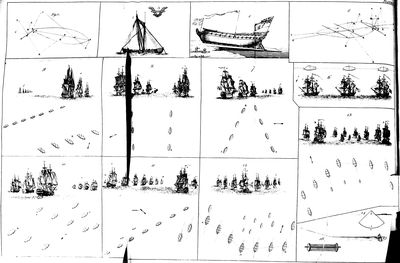
Plate. v.
FOOT of a sail, fond de voile, lower edge or bottom.
Foot-rope, the rope to which the foot of a sail is sewed. See Bolt-Rope.
Foot-ropes are also the same with horses of the yards. See that article.
FOOT-WALEING, the whole inside planks or lining of a ship, used to prevent any part of the ballast or cargo from falling between the floor-timbers. See Midship-Frame.
FORE, the distinguishing character of all that part of a ship’s frame and machinery which lies near the stem.
Fore and Aft, throughout the ship’s whole length, or from end to end.
Fore Bowline, the bowline of the fore-sail. See Bowline.
Fore-castle, gaillard d’avant, a short deck placed in the fore part of the ship, above the upper deck. It is usually terminated, both before and behind, by a breast-work in vessels of war; the foremost end forming the top of the beak-head, and the hind part reaching to the after part of the fore-chains.
Fore-cat-harpings, a complication of ropes used to brace in the upper part of the fore-shrouds. See Cat-harpings.
Fore-foot, brion, a piece of timber which terminates the keel at the fore end. It is connected by a scarf to the extremity of the keel, of which it makes a part: and the other end of it, which is incurvated upwards into a sort of knee or crotch, is attached to the lower end of the stem, of which it also makes a part, being also called the gripe.
As the lower arm of the fore-foot lies on the same level with the keel, so the upper one coincides with the middle line of the stem: its breadth and thickness therefore correspond to the dimensions of those pieces, and the heel of the cut-water is scarfed to its upper end.
The form of this piece, and its disposition and connexion with the adjacent pieces, appears by the letter i, in plate I. Pieces of the Hull.
Fore-Hooks, the same with breast-hooks, which see.
Foreland, a cape or promontory projecting into the sea; as the North or South Forelands.
Fore-Lock, clavette, a little flat-pointed wedge of iron, used to drive through a hole in the end of a bolt, to retain it firmly in its place.
Fore-Jears. See Jears.
Fore-Mast. Mast.
Fore-Sail. Sail.
Fore-Shrouds. Shrouds.
Fore-Stay. Stay.
Fore-Top. Top.
Fore-Top-mast. Top-mast.
Fore-Top-gallant-mast. Top-gallant-mast.
Fore-Tye. Tye.
Fore-Yard, &c. Yard, &c.
N B. By referring to the articles Top-mast and Top-gallant-mast, we mean to comprehend all the apparatus thereto belonging, as their yards, sails, &c.
Fore-reaching upon, the act of advancing before, or gaining ground of, some other ship or ships in company.
FORGING OVER, the act of forcing a ship violently over a shoal, by the effort of a great quantity of sail.
FORMING the Line. See the article Line.
FORWARD, avant, towards the fore part of the ship. See Afore.
FOTHERING, a peculiar method of endeavouring to stop a leak in the bottom of a ship while she is afloat, either under sail or at anchor. It is usually performed in the following manner: a basket is filled with ashes, cinders, and chopped rope-yarns, bonette lardeé, and loosely covered with a piece of canvas; to this is fastened a long pole, by which it is plunged repeatedly in the water, as close as possible to the place where the leak is conjectured to lie. The oakum, or chopped rope-yarns, being thus gradually shaken through the twigs, or over the top of the basket, are frequently sucked into the hole along with the water, so that the leak becomes immediately choaked, and the future entrance of the water is thereby prevented.
FOUL, empecheé, as a sea-term, is generally used in opposition to clear, and implies intangled, embarrassed, or contrary, in the following senses:
A ship ran foul of us in the river, i. e. entangled herself amongst our rigging.
Foul, when expressed of a ship’s bottom, denotes that it is very dirty; as being covered with grass, sea-weeds, shells, or other filth which gathers to it during the course of a long voyage. When understood of the ground or bottom of a road, bay, sea-coast, or harbour, mal sain, it signifies rocky, or abounding with shallows, or otherwise dangerous.
When spoken of the hawse, it means that the cables are turned round each other, by the winding or turning about of the ship while she rides at anchor. See Elbow and Hawse.
Foul, when applied to the wind, is used to express that it is unfavourable, or contrary to the ship’s course, as opposed to large or fair.
To FOUNDER, sancir, to sink at sea, as being rendered, by the violence and continuation of a storm, and the excess of the leaks, unable to keep the ship afloat above the water.
FOX, a sort of strand, formed by twisting several rope-yarns together, and used as a seizing, or to weave a mat or paunch, &c.
FRAME. See Timber.
FRAPPING, the act of crossing and drawing together the several parts of a tackle, or other complication of ropes, which had already been straitened to their utmost extent: in this sense it exactly resembles the operation of bracing up a drum, &c. The frapping always increases the tension, and of course adds to the security acquired by the purchase. Hence the cat-harpings are no other than frappings to the shrouds.
Frapping a ship, ceintrer, the act of passing three, four, or five turns of a cable round the hull, or frame of a ship, in the middle, to support her in a great storm, when it is apprehended that she is not strong enough to resist the violent efforts of the sea. This expedient however is rarely put in practice, unless in very old ships, which their owners are willing to venture to sea as long as possible, by ensuring them deeply.
FREEING, affranchir, the act of pumping, or otherwise throwing out the water which has leaked into a ship’s bottom at sea, &c.
FREEZING, a sort of ornamental painting on the upper part of a ship’s quarter, stern, or bow. It consists generally of armour, instruments of war, marine emblems, &c.
FREIGHT, or fraight of a ship (affretement) the hire, or a part thereof, usually paid for the carriage and conveyance of goods; or the sum agreed, upon between the owner and the merchant for the hire and use of a vessel.
Freight also implies the lading or cargo which she has aboard.
FRESH, when applied to the wind, generally signifies strong, but not violent or dangerous: hence when the gale increases, it is said to freshen.
To FRESHEN the hawse, refraichir, to relieve that part of the cable which for some time has been exposed to the friction in one of the hawse-holes, produced by the rocking and pitching of a ship as she rides at anchor in a high sea.
When a ship remains in such a situation, it is always necessary to wrap some old canvas, mat, leather, or such like material, round that part of the cable which rubs against the stem, &c. The matter used for this purpose is called service: but as the violent agitation of the ship, produced by the tempest, or sea, as she rides in an open road, must communicate a great friction to the cable, the service will consequently be soon worn through: it is necessary therefore to have it frequently renewed by a fresh application of the like materials, behind the former, for the preservation of the cable, on which every thing depends; and this renewal of service is called freshening the hawse, a circumstance which cannot be too vigilantly observed.