THE VOYAGES OF Capt. WILLIAM DAMPIER.
Reading edition
Among the Navigators who first surrounded the globe, Captain William Dampier, considered as a Mariner and Naturalist, will ever be held in the foremost rank. From his Voyages the world received the earliest and best information of remote countries, and their genuine productions; and it is on his plan that future navigators have thought fit to proceed in giving an account of new discoveries. His history will afford a notable instance of the power of genius and application unassisted by learning, when the mind is wholly bent upon the pursuit and improvement of one art.
He was the son of parents who lived in the parish of East Coker, in Somersetshire, reputable, but not rich. While they lived they gave him an education very ill suited to a sea-faring life; but they both dying when he was yet young, those to whose care he was entrusted removed him from the grammar-school, and put him to an English school to learn writing and accompts. Here he did not remain long before an opportunity offered of placing him with the master of a ship at Weymouth, agreeable to the inclinations which he had very early discovered of going to sea; a lesson to parents and guardians to consult the genius of children, if they would wish them to rise to eminence in the profession to which they are bred.
With this master he made a short voyage to France, and was highly gratified: but, his next voyage being to Newfoundland, where he was employed a whole summer in the fishery, the rigour of the climate and the nature of the service so cooled his ardour for sea-adventures, that he determined to relinquish the employment, and return to his friends.
He was now eighteen years of age; and, after leading for some time an idle life, finding his friends begin to look cool upon him, he formed a resolution to leave the country, and to try his fortune in town. His course of life, and the natural bent of his inclination, led him to seek the company of sea-faring companions, who, being pleased with his jovial humour, encouraged him to resume his old employment, to which, having an opportunity to enter on board an Indiaman, he was easily persuaded.
In this ship, the John and Martha, Captain Earning, he sailed to Bantam, in quality of a foremastman; and in little more than a year returned to England, perfectly reconciled to the business of a mariner, which, by the severity of the service he was first employed in, he had determined never to follow.
In this voyage, by favour of the master of the ship, he learned the rudiments of the art of navigation, in which he afterwards became a great proficient; but he had not yet learned to keep a journal. It should seem that he employed the following year, after his Indian voyage, in improving those hints which he received from the master, and in qualifying himself for an easier and more advantageous birth, than that of going before the mast for the future. With this view he retired again into the country, and spent the summer with his brother. But, tired of a studious life, he embraced the occasion of the Dutch war, to enter on board the Royal Prince, commanded by Sir Edward Sprague, but in what station does not appear. He tells us, indeed, that he was in two engagements; but that, falling sick, he was put on board the hospital ship, and saw the third only at a distance, in which his Commander was unfortunately killed: so that he does not seem to have risen higher at this period than the ordinary rank of an able seaman.
Being soon after removed to Harwich among the rest of the sick and wounded, he there languished till the conclusion of the Dutch war, when he received his discharge; and then returned again to Somersetshire for the recovery of his health; which was no sooner restored than he prepared again to go to sea.
But Colonel Hellier, a neighbouring Gentleman, having a large plantation in Jamaica, being acquainted with his resolution, made him an offer of going there as a superintendant, with a handsome appointment; which he very readily accepted; and, about the beginning of the year 1674, embarked for Jamaica. But he soon grew tired of land service; his roving disposition still inclining him to seek the sea. The road, he says, to take possession of his new office, when he arrived at Jamaica, was formerly a great way round: but Mr. Hellier, the Colonel’s brother, being desirous of shortening the way, coasted along the river with some companions, till they found it run between rocks that rose perpendicular on both sides: they endeavoured to climb that which intercepted the way to the plantation: but, while they with the utmost danger and difficulty were surmounting the rock, a dog they had with them found a more convenient passage through a hole. This suggested to Mr. Hellier a new track: so by blowing up some fragments of the rock in one part, and levelling some hollows in others, a passage was obtained wide enough for a loaded horse. By this accidental discovery the road was shortened near one half.
He was now in his 22d year. In six months after his arrival at Jamaica he was tired of his superintendency, and quitted it; and soon after engaged in a trade with the logwood-cutters in Campeachy bay; which trade he followed near three years, and then commenced logwood-cutter himself. Unsettled in his mind, and still eager in pursuit of new adventures, in less than a year he quitted the logwood-cutters; and about the beginning of 1678, returned to England.
In 1679, we find him again returned to Jamaica, with a cargo of merchandize, which being sold at Port Royal, he furnished himself with other goods, such as he knew he could carry to a good market at Campeachy; and by this advantageous traffic, he so enriched himself, as to be able to purchase an estate in his own country, of one whom he knew had a good title to it. And now, sufficiently happy, he was preparing to return home; when one Mr. Hobby invited him to make a short trading voyage to the Moskito-shore, a part of the world he had not yet seen. This invitation to embark in a new adventure he could not resist and, therefore, sent home the writings of his late purchase to his brother, with the same friends whom he purposed to have accompanied to England himself, and then went on board with Mr. Hobby.
The Moskitos, he says, are Indians that inhabit the main, between the Honduras and Nicaragua. They are tall, well-made, raw-boned, lusty, strong, and nimble of foot, long visaged, have lank black hair, look stern, are hard favoured, and of a dark copper-coloured complexion. They are but a small nation; the same, perhaps, that Drake calls Symerons. They are very dexterous at throwing the lance, fisgig, harpoon, or any manner of dart, being bred to it from their infancy; for, the children, imitating their parents, never go abroad without a lance, which they throw indifferently at almost every object that falls in their way, till by constant practice they become masters of the art. They next learn to parry a lance, arrow, or dart; and the training of them to this exercise is in this manner: Two boys place themselves at a small distance, and throw light blunt lances at each other; one throws the lance, and the other parries, alternately. He that parries holds a small stick in his right hand, with which he turns aside the lance that is darted at him: and, by constantly practising in this manner, they at last become so dexterous, that they will shoot arrows at each other, and parry them as fast as they are shot. This they will do with a small stick no bigger than the rammer of an ordinary fowling-piece.
Before they arrive at manhood, they become so dexterous, that they disregard the arrows of their enemies; and, unless they are poured thick upon them, and come more than one at a time, they will suffer not one in a thousand to hit them.
They are no less expert at striking of fish; and two or three of them will in those seas maintain a ship’s company of 100 men. Turtle and manatee are their principal pursuit: the former will commonly weigh 600 weight; and two Moskito-men will strike two of them a-day, while the season lasts, for many days together. The manatee is known also by the name of the sea-cow, and is struck with a harpoon, so contrived by the Moskito-men as to be thrown with a long stick; but they are very cautious of discovering their art even to the English—the Spaniards they hate mortally. The turtle they strike with a different instrument, of which our author has given a cut.
About this time the æra of buccaneering commences. The buccaneers were a set of low men, who, in humble imitation of their betters, first began with fitting out small vessels in some of the islands in the West Indies, and then cruising in them till they were able to make themselves masters of better ships. This being accomplished, they went in formidable companies as occasion offered, and declared open war against all the Spanish settlements. These freebooters had generally two or three Moskito-men on board each of their vessels, whom they found serviceable in many other respects besides supplying them with fish. By their situation they had opportunities of being well acquainted with the strength and riches of the Spanish settlements, and by their inclination they were their avowed enemies. They therefore served the buccaneers for guides, and at the same time assisted in their most hazardous attacks.
This being premised, let us now return to Dampier, who, as has just been said, had agreed to make a voyage with Captain Hobby; and having set sail from Port Royal, either by accident or design, they fell in with Coxen, Sawkings, Sharp, and other buccaneers, who were riding at anchor on the west side of the island of Jamaica, and were then meditating an enterprize over the isthmus of Darien, in order to fall suddenly upon the Spaniards in the South Seas. This expedition, it was given out, would enrich the undertakers; and as all who engaged in it, according to the law of buccaneers, were to be proportionable sharers, all Captain Hobby’s men deserted him to join the buccaneers, Dampier only excepted, who, after three or four days consideration, was easily persuaded to make one among the rest.
Shortly after Christmas, 1680, they all set sail, and steering to Porto Bello, on the 5th of April, they landed near Golden Island, to the number of between three and four hundred men, and began their march guided by chiefs of the Muskito Indians, and headed by Captain Sawkings, who, by general consent, was chosen their leader.
After a fatiguing journey of nine days, in which many of them suffered great hardships, they arrived at Santa Martha, a Spanish settlement on a river of that name that empties itself into the Southern ocean; which after some opposition they took. They were made to believe, before they approached it, that it was a place of considerable strength, abounding in riches, and inhabited by merchants of considerable property; but upon entering it, they were greatly disappointed, and therefore, as might be expected from such a lawless crew, they were as ready to fall upon those who had projected the enterprise, as upon those whom they accounted the enemy.
They now, much discontented with one another, parted company. One party, continuing their march to the Southern ocean, and there embarking, some in canoes, some in periagos, and some in small barks which they found in the river, continued their course to the bay of Panama, and in their way attempted the little town of Puebla Novo, before which their commander in chief Captain Sawkins was killed, and his followers defeated. In what manner this undisciplined crew procured ships, guns, and ammunition, we are not told; yet ships, guns, and ammunition to pursue their ravages they did procure as appears by the sequel.
Captain Coxen, with his company, foreseeing many difficulties in this Southern project, after the taking of Santa Martha returned to the North Seas, where he continued his piracies with various success.
Dampier, however, followed the views of those who persevered in their first resolution of prosecuting their fortune in the South Seas; and he continued to accompany them during the year 1680; but, after the death of Sawkings, Captain Sharpe being chosen commander in chief in his room, Dampier with many of his companions, suspecting both the courage honesty of their new leader, entered into a confederacy to displace him, and to choose Captain Watling in his room, which they soon found means to accomplish by general consent. Under Captain Sharpe the only enterprize of consequence was the taking of Ylo, a small island on the Peruvian coast, from whence they sailed to Juan Fernandez, where, as has been said, Captain Sharpe was displaced.
It happened, however, that Captain Watling, soon after his advancement, having planned an attack upon Arica, fell a victim to his own project; for he was killed in the first onset, and his party defeated. The confederates, after this misfortune, remaining some time without a leader, fell again into party divisions; one party declaring themselves in favour of their former Commander, the other opposing his re-election. To put an end to these dissentions, it was at last agreed to part companies, and to cast lots which company should keep possession of the ship. It happened that the party in opposition to Dampier proved the fortunate party; so that Dampier and his companions were reduced to the necessity of returning either to the N. Sea over the same isthmus by which they came into the South, or submitting themselves to the mercy of the Spaniards. Nor does it appear that any of them carried more riches back than they brought with them, notwithstanding the vast promises with which they had been flattered at their first setting out: for it has been generally observed, that the confederacies of the wicked are defeated by their own deceit; and that they themselves are, for the most part, the instruments of their own misfortunes.
The company with which Dampier chose to associate, consisted of 44 men who bore arms, a Spanish Indian who bore arms also, two Moskito Indians, already described, with five slaves taken in the South Seas, whom they kept to carry their luggage. The vessels they had to carry this company were, the long-boat belonging to the ship, and two canoes, one of which had been sawn asunder, and joined again; and these were furnished for their defence with two patararoes, the companies small arms, and very scanty proportion of provisions and ammunition: and, thus equipped, they had to sail more than 200 leagues before they reached the river of Santa Martha, from whence they were to set out on their march by land for the North Sea. Such an enterprize, one would imagine, could hardly have been undertaken with any hope of succeeding by reasonable men.
On April the 17th, 1681, they parted with Captain Sharpe, 12 leagues to the north-west of the island of Plate; and, on May the 1st, they landed, after many strange adventures, in the bay of Panama, in order to pursue their journey. Here they found the river Santa Martha, of which they meant to avail themselves, blocked up by a ship of considerable force, that had been stationed there for more than six months to intercept their passage. This obliged them to seek a new tract, through which, however, the greatest part of the company, with incredible difficulty, passed safe to the opposite shore, among whom was Dampier, whose hardiness enabled him to undergo the severest trials, and whose well-judged precautions exempted him from many unnecessary sufferings to which others by their imprudence frequently exposed themselves.
On the 1st of May, about three in the afternoon, they began their march; and, on the 23d, they completed their journey; in which time they travelled 110 miles, crossing some lofty mountains, but chiefly keeping along the vallies among deep and dangerous rivers, some of which they forded, some they passed by felling large trees upon the banks, and some they were obliged to swim over in their cloaths and accoutrements. Those who could not swim were dragged through by means of ropes. Their first landing-place upon the south coast was very disadvantageous to them, and forced them to a circuit of 50 miles more than was necessary, could they have landed in the bay of Santa Martha, or navigated the river Chepoa, by either of which the Indians pass from one shore to the other in three days, and sometimes in less.
Those who arrived on the north coast first, among whom was Dampier, embarked immediately on board a French buccaneer, Captain Tristrian, Commander, who, in two days after they arrived, joined eight sail of buccaneers more, who were planning another expedition over-land to Panama: but, when they were told of the ill success of the first, the fatigues they must undergo, the risques they must run, and at length the uncertainty of the event, they unanimously concurred in relinquishing that design, and held a consultation what other enterprize was fit for such a formidable body of them to undertake. At length, they concluded to attack a Spanish town up Carpenter’s river, and for that purpose set sail one after another, in order to preserve secresy, having previously appointed a place of rendezvous. When the ship in which our navigator sailed arrived at the place appointed, they found Captain Wright there before them, who had taken a Spanish Tartan with 30 men, well furnished with small arms, and four patararoes, who with 12 armadillos had been fitted out to seek the buccaneers, and to sink them. This, they that came over-land, who were heartily tired with living among the French, thought a good opportunity to set up for themselves; they, therefore applied to Captain Wright, requesting him to fit up the Tartan for them; to which, after some hesitation, he consented, on condition that they should be under his command as one and the same ship; to which they made no objection.
The rest of the fleet not arriving at the general rendezvous, according to agreement, it was soon discovered, that the Spanish armadillos [or small men of war] had fallen in with and dispersed them. Every one, therefore, was at liberty to pursue his own enterprise; and Captain Wright with his new associates chose the coast of Carthagena to try their fortune. Here they were joined by Captain Yankey; and, falling in with a stout ship, they fought and took her. She proved to be a prize of 14 guns and 40 men, laden with sugar and tobacco, and had eight or ten tons of marmalet on board. The Captains differed about the right to the ship. Yankey, however, took possession by vote of the crews; and Captain Wright took Yankey’s ship, which was better than his own. The cargo, after a great deal of difficulty, they disposed of at a Dutch settlement for less than one-fourth of its value.
However, the goods being now converted into ready money, the produce was shared, and the Captains parted. Captain Wright stood for the Caracca coast, with his men drunk, and quarrelling every day; and Captain Yankey pursued a quite different course. On the coast of the Caraccas, Captain Wright took three barks, one laden with hides, one with European commodities, and a third with earthen-wares and brandy. With these barks he went to the island Rocu; and, having divided the cargoes into three equal parts, he gave to every 20 men (for they were 60 in all) one part and a bark, and so dismissed them. That in which our navigator had an interest was brought to Virginia on July 16, 1682, where we shall leave both him and the ship, to give some account of Captain Yankey.
On board of Yankey sailed one Mr. Cook, as quarter-master, the second in command, according to buccaneer law; and, they having taken a prize from the Spaniards, the command of the prize was claimed by Mr. Cook, on board of which all who chose to sail under the new Captain had liberty so to do: among others there were several who came over land with him from the South Seas (for he too had left Captain Sharpe, and had followed the example of Dampier). All these chose to follow the fortune of their old acquaintance: but the Frenchmen grudging the English the possession of so fine a vessel, together with their share of the goods on board her, combined together; and, after plundering them of ship, goods, arms, and money, turned them all a-drift on the island of Vacca. In this destitute condition, Captain Tristrian, of whom mention has already been made, shewed some compassion, by taking on board about eight or nine of them, among whom were Captain Cook and Captain Davis, formerly masters of buccaneers, who, being carried into Petit Guavres, found means, when the French crews were carousing on shore, to make themselves masters of their benefactor’s ship, to slip her cable, and to steer with all the sail they could spread to Vacca to the relief of their starving countrymen, who, overjoyed to be released, instantly came on board; and, soon after they set sail, had the good fortune to make prize of a ship laden with wine, which was newly come from France. They afterwards fell in with a ship of good force, of which they likewise made prize; and in her they came to the resolution of sailing into the South Seas, and ranging the coasts of Chili and Peru. But, first, it was necessary for them to sail to Virginia to dispose of their spare ships and cargoes, and to fit their capital prize for war. This they did by mounting her with 28 guns, and furnishing her with stores, provisions, and other necessaries for the prosecution of so long a voyage. When these ships arrived at Virginia, Dampier, and all those who came over-land with him, happened to be there; and, being made acquainted, with Captain Cook’s intention, they very readily agreed to join in his adventure.
And now, having followed Dampier through all the busy scenes of action in which he was engaged, till his 30th year, we come at length to that period, at which the more notable adventures of his life commence.
On the 18th of August, 1683, he set sail from Achamack river, in Virginia, in the prize under the command of Captain Cook; and, on the 23d, they met with a violent tempest, which lasted without intermission till the 28th, during which time they shipt some of the heaviest seas that ever ship endured. But as soon as the storm abated, they had fine weather, and a brisk gale, till they arrived at the islands of Cape Verd, where they staid to careen their ship, to refresh themselves, and to take in fresh water. This they did at the little island of Sal: but, being told that the island of Mayo abounded most with cattle, they left Sal, and went to Mayo to purchase provisions. Here they met with a cold reception; the inhabitants absolutely refusing to have any traffic with them, or to suffer them to land: the reason was, that about a week before, an English ship pretending friendship had cast anchor, and by a shew of kindness had invited the Governor with his train on board; but, as soon as they had them in their power, they caused them to write for cattle and other provisions, by way of ransom, to regain their liberty; and, what was still more base, after they were furnished with what they required, they carried off their prisoners, who had not then been heard of. Dampier afterwards learnt, that the Englishman who was guilty of this treachery was Captain Bond, who afterwards surrendering himself to the Spaniards, entered into their service, and taught them to fit out fire-ships, of which they were before totally ignorant in the South Seas.
From Mayo they sailed to Sherboro, on the coast of Africa, where they staid a few days, and purchased rice, palm-wines, sugar, honey, and fowls, and then made sail for the straits of Magellan. On the 6th of February, 1684, they came in sight of the straits mouth; but the wind being contrary, they continued their course to the south, and doubled Cape Horn. In latitude 57, when they thought themselves clear of the cape, they encountered a storm on the 14th of February, which lasted without abatement till the 3d of March, during which time the rain poured down immoderately for many days; by which, however, they were plentifully supplied with fresh water.
When the storm abated, the wind changed to the south, and proved very favourable; for at this time they found themselves in lat. 60 deg. S. But, the gale continuing brisk, by the 17th of March they had run to the height of Baldivia, in 48 deg. S. On the 19th, in the morning, they saw a ship to the southward coming after them with all the sail she could croud. Supposing her to be a Spanish ship from Baldivia and Lima, they lay by for her; but, on her nearer approach, they saw she was an English ship; and, upon hailing her, was told that her Captain’s name was Eaton, that she came from London, and was bound for a cruise in the South Seas.
Rogues are always good friends till they come to share their booty; so these free-booters agreed to sail together; and accordingly kept company to the island of Juan Fernandez, where they both prepared to refresh and refit.
March 22, 1684, they anchored in the south bay, in 25 fathoms water, not a cable’s length from the shore; and as soon as Captain Cook’s ship was moored, Dampier was eager to go ashore to look for a Moskito-man, whom they had left in this island, when they were driven from it in the year 1681, by three Spanish men of war, Dampier being at that time in the ship commanded by Captain Watling, just after Captain Sharpe was displaced. This man, when Captain Watling drew off his crew, happened to be in the woods hunting for goats; and the ship was under sail before he came back. Dampier was curious to know whether this Moskito-man was yet alive; and, if he was, how it had fared with him and it seemed that the Indian was no less anxious to enquire after his friends, when he saw that the ships that were approaching were English ships. The poor fellow had observed them the day before, when first they came in sight, and, judging about what time they would come to an anchor, he had killed three goats, and gathered greens, ready to dress as soon as the company should be at liberty to come on shore. He was already upon the beach before the ships could be well secured, and was first seen by one of his countrymen who happened to be on board; and it was no small pleasure to mark the excessive joy of these two Indians at their meeting. The Moskito-man belonging to the ship was named Robin: he on the island Will. Robin was the first who leapt on shore; and, running to Will, threw himself flat on his face at his feet, who, helping him up, and embracing him, fell flat in like manner with his face at Robin’s feet, and was by him taken up and embraced as before. The surprize, the tenderness, the solemnity of the interview, which was exceedingly affectionate on both sides, was admired even by the crews of buccaneers, who were spectators from the ships of what passed on shore. When Dampier, who was his old friend, came up, Will was no less transported with joy to see him than to meet his countryman, but he expressed it in quite another manner: other friends too he met with among the crew who knew him, and they were all over-joyed at meeting so unexpectedly; for these men are very much beloved on board the ships wherever they sail, for their readiness to assist in whatever service they are put upon. When the ceremonies of congratulation were over, and they had time to make enquiries, he told them, that he was several times sought after by the Spaniards, who knew that he was left upon the island; because when the ship set sail he was in sight of the shore, and was seen by them before he could secret himself: but as he was continually upon the watch, and had discovered a secret retreat, they never had been able to find him. He had with him, he said, his gun and his knife, a small horn of powder, and a few shot. These being soon spent, he contrived a way, by notching his knife, to saw the barrel of his gun in small pieces, with which he made harpoons, lance-heads, hooks, and a long knife; heating the pieces first in the fire, which he lighted after the English manner, by striking his gun-flint against the back of his knife. The iron when it was hot he hammered with stones, and formed it into the various shapes he had occasion to apply it. By continued labour and perseverance, he had worked himself such a complete set of instruments, for killing and catching his provisions by land and water, as surprized the people when they were brought out for their inspection. But, says Dampier, it is no more than these Moskito-men are accustomed to do in their own country, where they make their own fishing and striking instruments, without either forge or anvil: and other Indians are still more ingenious; for they make hatchets of a very hard stone, with which they cut down trees, make canoes, and frame their houses.
Poor Will had built himself a little house about half a mile from the shore, which he had made warm and convenient, by lining it with goat-skins. He had likewise raised himself a couch about two feet above the ground, which he had also made soft with the fur of the animals he caught, and with the down of the young birds (for he could catch no other) which he occasionally met with and pluckt. Cloaths he had none; for he had worn them to rags among the bushes and brambles through which he was often obliged to pursue his prey. He had been on the island about three years; and in all that time had never conversed with any human being. He had seen Spaniards; but he always took care, after the first, that none of them should ever see him.
At this island these free-booters staid sixteen days; and, on the 8th of April, the two ships set sail together, and pursued their course northwards towards the Line, at the distance of 12 or 14 leagues from the shore, for fear of being seen. The land from 24 deg. to 10 deg. S. is of a most prodigious height, with ridges of such lofty mountains from one end of Peru and Chili to the other, that their summits seem to rise above the clouds; and from the sea they appear for ever blue. Dampier attributes to the excessive height of these mountains, the want of great rivers in all this tract; and says, there seldom falls any rain from 30 deg. to 4 deg. S. He adds, that the limits of the Pacific Ocean ought to be confined within that space extended westward indefinitely; for, in all this tract of water, says he, there are no dark rainy clouds, nor any winds, but trade winds, no tempests, no tornadoes, or hurricanes, though north of the Line, they are met with in this Ocean as well as the Atlantic. There is, however, often a thick horizon, so as to hinder an observation of the sun with the quadrant; and, sometimes, hazy mornings, and thick mists, but not such as will wet one. The rivers in all this tract, he says, run small; sometimes they run at one season of the year, and at others are quite dry. These observations, if just, are truly wonderful.
They coasted along the Pacific Ocean from Juan Fernandez to lat. 90 deg. 40 min. S. without meeting with any thing worthy of note; but, on the 3d of May, they fell in with a ship laden with timber, which they instantly took without resistance. From this ship they learnt, that the Spaniards were apprized of their being upon their coasts, and that the Viceroy had sent expresses to all the sea-ports to put the inhabitants upon their guard against any sudden attack.
On this intelligence they immediately altered their course, and steered for Lobos de la Mer, in lat. 6 deg. 24 min. S. Here they cleared their ships bottoms; and strictly questioned their prisoners concerning the state of the country, and which were the towns of greatest note. Several towns were mentioned; but Truxillo appeared to be that which, if conquered, would yield the most profit: Truxillo was therefore the place agreed upon to make a descent. In their passage they descried three sail: Eaton pursued two of those to seaward; and Cook presently made prize of that which was nearest the land. They were ships laden with flour for Panama; in one of which was found a letter from the Viceroy of Lima to the President of Panama, acquainting him with enemies being upon the coast, and with the supposed strength of their forces. They also found an image of the Blessed Virgin in wood, and a stately mule, being a present to the President, with seven or eight tons of marmalate of quinces, which is eaten as a great delicacy in that country. From the prisoners taken in these prizes they learned, that the Spaniards were fortifying Truxillo, and that a garrison was already established. The attack of that town was therefore judged impracticable; and it was resolved to retire to the Gallapagos with the prizes, and there to consult what next was best to be undertaken. The Gallapagos are a cluster of islands lying on the Equator, very little known or frequented, till the buccaneers found their way into the South Seas; the nearest of them lies 110 leagues to the westward of the main, in long. 70 deg. W. from England. For these islands they set sail on the 29th of May, and reached them on the 31st. Here they found plenty of turtle, which they feasted upon fresh every day. They staid about ten or twelve days; and laid up about 5000 packs of meal from their prizes to serve as a future supply in case of necessity.
Being told by an Indian prisoner that was born at Rio Lexa, that there were great riches in his city, and that he would shew them the way to the place, they concluded to set sail, and to trust to the fidelity of their Indian guide; intending, however, to anchor by the way at the island of Cocos, in lat. 5 deg. 40 min. S. to lodge some of their meal, as more convenient to have recourse to on ordinary occasions than the islands of Gallapagos. With this intent their stoutest meal-ship was taken with them; but, not being able to make the island, they steered to the continent.
It happened, however, in the course of this short run, that Captain Cook, who had been taken ill at Juan Fernandez, as soon as he came within a few leagues of Cape Blanco, in latitude 9 deg. 56 min. S. suddenly died, “though in the morning, says Dampier, he was as likely to live as he had been for a long time before;” but, he adds, “it is usual for sick men coming from the sea, to die off as soon as they come within sight of land.” The death of Captain Cook occasioned a general consultation, when it was agreed to come to an anchor in Caldera-bay, within a league of Cape Blanco, and there to give him christian burial. While the men were employed in digging the grave, three Indians came up to see what they were about, and entered into conversation with the diggers, at the same time appearing very shy; but, notwithstanding their caution, as soon as the corps was decently interred, they were all three seized at once by the company, and very strictly examined. They at first pretended to know nothing of the Spaniards; but at length they acknowledged that they were sent from Nicoya, a town about 12 leagues off, to learn what they could concerning any strangers that should touch upon the coast, the people of that town having advice that enemies were in the adjoining seas, and that therefore it behoved them to be upon their guard. They learnt likewise from these Indians, that the inhabitants in that neighbourhood were chiefly husbandmen, and bred cattle; that they traded in hides, corn, and other provisions, for which they received in return, shoes, hats, linnen, and other cloth; and that, at no great distance, there were some very large cattle-pens, where they might furnish themselves with as many buffaloes as would fill their ships. This was welcome news to sailors, none of whom had tasted any fresh meat for many weeks; and a company of 24 of them set out immediately with an Indian for their guide, to look for the cattle-pens.
After a short march of between three and four miles, they came in sight of a savannah where a great number of cattle were grazing; of which, some were for instantly killing as many as they could carry away, while others were for staying all night, and driving them into the pens to supply the ships at once, before the owners were apprized of their design. This resolution prevailed; but Dampier, who was of the party, and who never chose to run unnecessary hazards, returned to the ships with about half the company, together with the Indian guide, while the rest chose to stay where they were. In the morning, when these voluntary drovers were expected to return with their cattle, none came: it was therefore feared that some disaster had befallen them; and boats were manned, and sent out to look for them.
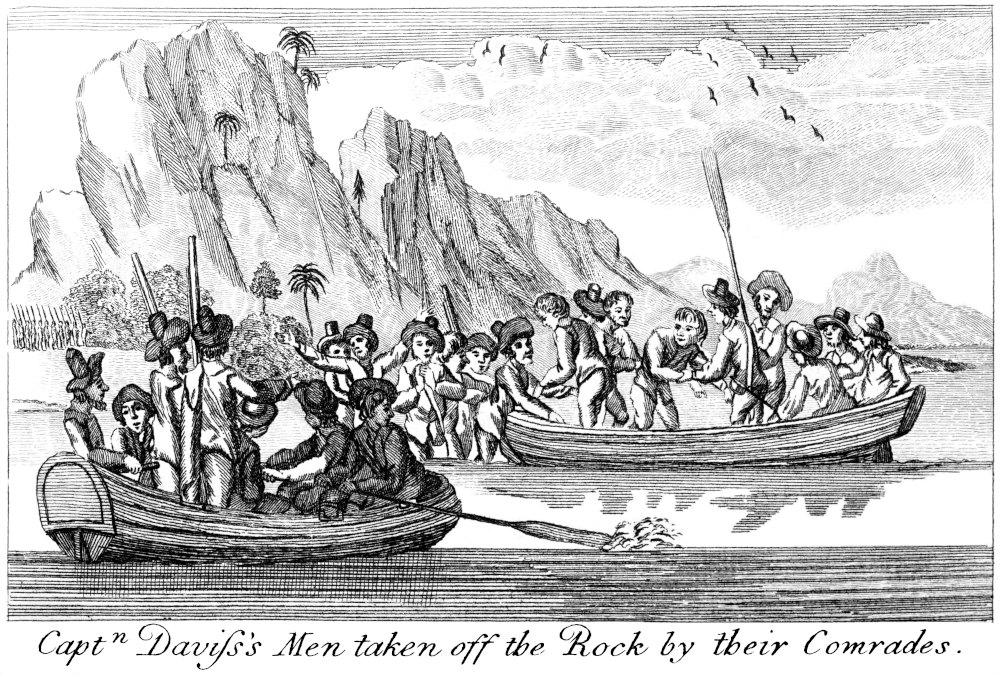
Capt
n
Davis’s Men taken off the Rock by their Comrades.
As the boats were rowing along, some of the company happened to spy a number of people upon a rock up to their middles in water; and, upon nearing them, they soon saw that they were the very people they were in search of; and, therefore, hastened to take them on board. Lucky it was, that the boatmen happened to spy them just as they did, for in an hour more they had been all swallowed up by the tide. They had been suffered to sleep all night unmolested; and in the morning when they were scattered about among the cattle, and driving them into the pens, they were surprized by the sudden appearance of about 60 Spanish soldiers well armed, who placed themselves in a convenient situation to cut off their retreat. Alarmed at this unexpected discovery, they hastened to join in a body, resolving to sell their lives dear, if they found it impossible to make their escape. Accordingly, they looked well round them in order to discover an opening to some other part of the shore, than that against which their ships rode, marching at the same time in as good order as their situation would admit, and giving the Spaniards now-and-then a volley of shot, to keep them at a proper distance. The Spaniards, who are not over eager to come to a close engagement, kept themselves sheltered behind the bushes, whistling some random shot at the fugitives, by way of return; which, however, did them no harm. In this cautious manner they advanced slowly towards the beach where Captain Cook was buried; and, looking for their boat, saw her in flames by the water-side, near the spot where they had grounded her the night before. All hope of retreat being now cut off; and the Spaniards, to make sure of their surrender, having posted themselves in such a manner as to prevent all communication with the ships, they were at length reduced to the last extremity; when, fortunately, spying a rock just above water, about 100 yards from the shore, they all determined to commit themselves to the mercy of the ocean, rather than fall into the hands of the Spaniards. With this resolution they rushed together into the tide, holding fast by one another, and determining that if one perished all should perish. In this manner they made good their landing upon the rock, where they had continued seven hours when they happened to be discovered by their comrades, who were suffered by the Spaniards to release them without firing a gun.
After this disappointment it was thought adviseable not to hazard a second attempt; they therefore weighed anchor, and continued their course to Ria Lexa, having first chosen Mr. Edward Davis, the next in command to Captain Cook, Commander in his room. On the 20th of July they set sail, and in three days they were a-breast of their intended port.
Ria Lexa is known by a high-peaked volcano, which smokes all the day, and in the night sometimes sends forth flames of fire. It lies a considerable distance from the main, and before you approach the town there is a small island on which the Spaniards had placed a guard. This guard the buccaneers surprized; but from them they learnt, that the town was strongly fortified; that the Governor was informed of their being upon the coast, and that the garrison was well provided for defence. This news discouraged the adventurers, who did not come to fight but to plunder: they therefore instantly withdrew from Ria Lexa, and steering for the gulph of Amapalla, they there careened their ships, and parted company. This gulph is a large arm of the sea running ten leagues up into the country. On the south point lies Cape Cawina, and on the N. W. St. Michael’s Mount, in lat. 12 deg. 40 min. N. But before they came to the gulph, it was agreed that Captain Davis should go before with two canoes well-manned, in order, by surprising some of the natives, to gain intelligence. Accordingly, as soon as they approached the gulph, the canoes departed, and Captain Davis, the first night, arrived at a small island on which there was a town called Mangera, which, for want of a guide, he could not find. In the morning he found it; but the Indian inhabitants had all fled, and left the place deserted; only the padre, with two boys to attend him, were left to take their fate. As all that Captain Davis wanted was a prisoner for the sake of information, one more intelligent than the friar could not have fallen into his hands. From him they learnt, that there were several Indian villages in the gulph; but that there were only three towns that had churches; that he served all the three; that there was only another white man, besides himself, in the whole gulph, who was a kind of secretary to the Spanish government, and who collected the revenues and kept the accompts.
Captain Davis, upon receiving this intelligence, taking with him the friar and his two boys, ventured to approach Amapalla, which stands upon an eminence. As Davis with his men gained the ascent, the Secretary, attended by the Casique or Indian Chief, demanding, in Spanish, who they were, and from whence they came, was answered by Davis, that they were Biscayers, and that they were sent thither by the King of Spain to clear the seas from enemies; that their ships were foul, and were coming there to clean; and that he was come before to prepare a convenient station, and to demand assistance from his Majesty’s Indian subjects. The Secretary bid him welcome; said he loved an Old Spain man; and gave him and his followers a kind invitation to come and take their residence in the town. Captain Davis ascended the hill, placing the friar in the front. They were received with every possible mark of respect both by the Secretary and the Indian inhabitants, and after the first salutations were past, they were conducted to the church, where all business of a public nature is transacted. Accordingly, the friar entered first and was followed by Captain Davis and most of the by-standers; but one or two of the Indians loitering behind were pushed in by Davis’s men, who then, suspecting some mischief, sprung back again, and all the rest of the Indians taking the alarm, followed their example, leaving Davis and the friar, looking at one another in high confirmation, ignorant as posts of the cause that had occasioned the desertion, while, at the same time, the brutes who had caused the rout were firing upon the poor Indians for flying, and in the skirmish the Secretary was killed upon the spot, the only person in all the gulph that could speak Spanish, the friar and his two boys excepted.
Davis’s design was, when they were all in the church, to have shut them in, and made his own terms with them: but, poor wretches! there was no need to practice farther treachery with them; for, notwithstanding the brutality of these pretended Biscayers, the Indians shewed them every kind of civility, helped them to repair their ships, hewed down timber for them, and brought it to the docks; furnished them with cattle and fresh provisions from the main; and assisted them in filling water, and carrying wood aboard. All this while the friar with his two lads were kept prisoners, and it was feared, when they were ready to sail, that they would have carried them off; for the Indians had a great veneration for their priest. He had learned their language, and was very useful to them both by his kind offices and admonitions.
They remained here from the latter end of July till the 3d of September, when they set the friar and his youths on shore; and, the two Captains, or more properly the two crews, having quarrelled, each of them pursued a different course. Davis steered along the main of Peru, till having ranged the whole coast of South America, they came to the island of Plata, in lat. 1 deg. 10 min. S. so called by the Spaniards, after Drake had shared the plunder of the Cacafuego upon it. Here the two ships met again, when Captain Eaton’s men reported that they had met in their course with dreadful tornadoes, with thunder and lightning frightful to the last degree; that the air smelt of sulphur, and they every moment expected to be involved in smoke and flame. Captain Eaton proposed a reconciliation but, his terms being rejected, he staid but one night, and the day following Davis left the island, and attempted the little town of Manta, about seven or eight leagues from Plata. They found the place deserted, and brought away one old woman, the only living creature they found in the place. She informed them, that a great many enemies were come over-land from the north seas; that they were yet in canoes and periagoes; and that the Viceroy had commanded all the Spanish trading ships on the coast to be burnt, to prevent their falling into the enemies hands. On this news, Davis retired again to the island of Plata, to wait the event, where soon after an English ship arrived, called the Cygnet, commanded by Captain Swan. This ship had been fitted out by some merchants of London, with a view to trade; but all trade being effectually at a stop, Swan was easily persuaded to put his goods up to auction among the adventurers with whom he accidentally fell in, to man his ship with them, and to turn buccaneer himself. The new comers were headed by a Captain Harris, who contented himself for the present to command a small bark under Captain Swan. There was great joy at this meeting; and Captain Davis and Captain Swan were, like other rogues, very fond of each other for their own villainous purposes. They now wished for Captain Eaton again, that having men enough they might all unite, and undertake some place of consequence. With this view they fitted up a small bark, and dispatched her in pursuit of him, appointing a place of rendezvous, if the bark should be fortunate enough to meet with him. In the mean time they set sail, directing their course to Payta, a small town in lat. 5 deg. 15 min. S. built under a rock near the sea-side. In their way they fell in with a large ship of 400 tons, laden with timber, by whom they received intelligence that the Viceroy had ordered 10 frigates to be fitted up with all expedition, in order to drive them out of those seas. “Captain Davis’s unsettled crew, says Dampier, began now heartily to repent their not accepting of Captain Eaton’s terms.” However, they pursued their course, and on the 3d of November landed in the road of Payta, and next morning attempted the town, which they found deserted, and not so much as one day’s provisions left in the whole place. Here they got intelligence, that Captain Eaton had burnt a ship in that road the week before, and was sailed to the westward; by which they judged that he had taken his departure for the East Indies, by which course it was always his intention to return home. They, therefore, began to prepare for their defence, in case of being attacked by the Spanish frigates. They burnt Captain Harris’s bark, because she was a heavy sailor, and fitted up another small bark for a fire-ship; and, having examined their powder and ammunition, and overhauled their rigging, and put every thing in the best order they could, they made sail for the isles of Lobos. At Lobos they found a letter left by the bark that was sent in quest of Captain Eaton, acquainting them that he had been there, but had sailed some days before the arrival of the bark; and that the bark was gone to Plata, the place of rendezvous. Here it was concerted to attempt the town of Guaiaquil, before they returned to Plata. Accordingly, on the 29th in the morning, they set sail from Labos, steering directly for the bay of Guaiaquil. This bay runs in between Cape Blanco on the south side, and Point Shanday on the north, 25 leagues from Cape Blanco. In the bottom of this bay lies the island of Santa Clara, in the form of a corpse laid out in a shroud, of which the east end represents the head, and the west end the feet. Ships that are bound to the port of Guaiaquil keep to the southward of this isle, to avoid the shoals on the north side, where, it is reported, a very rich wreck lies sunk, and that a person, who came from the King of Spain with a patent to fish for wrecks, had taken up some of the plate, but he dying, the patent expired without much effect. The Indians, however, have taken some by stealth, and would probably have got much more but for the swarms of cat-fish that hover round this island, the prick of whose fins is so poisonous that whenever they draw blood the wound proves mortal. From Santa Clara to Puna Arona is about seven leagues, on which island the inhabitants, who are all seamen or fishermen, are obliged to keep constant watch, and to give notice to the Governor of Guiaquil of the approach of all shipping, whether friends or foes. The houses in the town of Puna stand upon posts 10 or 12 feet high, with ladders on the outsides to ascend the rooms. Dampier says, he never saw any such in any other part of the world, except among the Malayans in the East Indies. They are thatched with palmeto-leaves, and their chambers well boarded, in which they exceed the Malayans. From Puna to Guiaquil is seven leagues, and at the distance of one league from the entrance of the river, which rises about two miles on the other side Guiaquil, it is divided into two streams, one stream leading to Leon, the other to Guiaquil. Guiaquil, according to Dampier, is one of the principal sea-ports in the South Seas. The commodities exported from that city are cocoa, hides, tallow, sarsaparilla and other drugs, and woolen-cloth, commonly called Quito cloth. This cloth, which is made at the rich inland town of Quito, is worn by all the common people throughout the kingdom of Peru. But, besides cloth, Quito abounds with gold, washed down from the mountains that surround it, which the Indians make a trade of gathering in the adjacent brooks, where it is sometimes found in solid lumps, but generally in small dust mixed with sand.
As soon as the ships entered the bay they cast anchor off Cape Blanco; and the crews manned their boats and small barks to advance with the more secrecy towards the town. In their way they made prize of a small vessel, laden with Quito-cloth, the master of which told them of the watch at Puna; and at the same time acquainted them that three ships were expected to sail from Guiaquil next tide with 1000 negro slaves. They had not rowed far before they fell in with one of the ships laden with negroes, and took her. They cut her main-mast down, and left her at anchor. The next day they made prize of the other two; but in taking them they alarmed the town: and, there being no discipline observed, no Commander in Chief to lead them on in a body, one party counteracted the other party; so that none of their attacks took place. Captain Davis advanced with a party of his men till they were quite exhausted in marching through swamps and mangroves. Captain Swan and most of his men were for retreating, seeing the town alarmed; but, being upbraided with cowardice, agreed to proceed. They had two Indian guides; and one of them undertook to lead the way into the town, and was followed by a Davis’s man, who was fastened to him by a rope, to prevent his making his escape. But, a little before they came within musket-shot, Davis’s man, who had boasted of his courage, and sought the post of honour, to be next man to the guide, cut the string, and let the guide loose; who, finding himself at liberty, took to his heels, and made his escape. The other, when he saw him out of reach, cried out, that somebody had cut the string, and that the guide was gone. This spread a general panic; so the design was all at once defeated; for, after that, not a man would advance a step farther, but all retired to their boats and embarked without either firing a gun, or having a gun fired at them. After looking at the town for half an hour, they departed: and, having drest a cow, and filled their bellies, they fell down the bay with the tide, rifled the negro-ships, and took about 40 of the stoutest men along with them, and turned the rest adrift. Dampier remarks upon this miscarriage, that there never was a fairer opportunity for men to enrich themselves than they had: but all their golden dreams vanished at once; and they returned as they went, directing their course to Plata, to meet the bark sent in search of Captain Eaton.
When they arrived, they found her with her crew almost famished; for having sought the ships at Lobos, and from Lobos to Plata, and from Plata to Lobos again, without finding them, and having scarce 14 days provisions on board when they set out, they were constrained to make a descent upon the village of Santa Helena, where they succeeded, and got a small quantity of maize, with which and the turtle they happened to strike, and some boobies and penguins they killed, they had made shift to subsist, though with the utmost difficulty. Such was the regard these plunderers bore for each other, when projects of robbery were in view. Here the cargo of the cloth-bark, the only booty they had made, was shared by lots, and Captain Swan had the bark to serve him as a tender. Here also, according to custom, they quarrelled; Captain Davis’s men placing the miscarriage to the cowardice of Captain Swan’s; and Captain Swan’s to the over-forwardness of Captain Davis’s. At length the matter was compromised by the mediation of the two Commanders; and they agreed in the next place to attack Lavelia, a pretty large town in the bay of Panama, about seven leagues from the sea-side, on the banks of a river on the north-side of the bay.
On this expedition they set sail the 23d of December, 1684. On the 28th, they arrived at a small village called Tomaco, which they surprized and took, and in it a Spanish Knight, Don Diego de Pinas, who came in a ship from Lima to load timber, in which ship there were only eight Spaniards, and twelve or thirteen jars of good old wine. The wine they seized, but let the ship go.
On the 1st of January, 1685, in passing from Tomaco to Gallo they took a packet-boat from Panama to Lima with letters. The Spaniards threw the letters over-board; but there being a string and a small buoy to the box in which they were inclosed, the box was seen and taken up. The contents of the public dispatches were, that the armada from Old Spain were arrived at Porto Bello, and that the President of Panama had received orders to hasten the Plate fleet from Lima.
This was joyful news for the buccaneers, who now thought of nothing but sharing the treasures of Peru. They laid aside their pitiful project upon Lavelia, and concluded to careen their ships at the King’s Isles, near the entrance of the gulph of Panama, to which gulph no ships could sail without being seen from these isles. There were now two ships and three barks in company, a fire-ship, and two small tenders. They all changed their course, and steered for the isles, in their way to which they took a ship of 90 tons, laden with flour. On the 23d of January they arrived at the place appointed; and on the 25th, they cast anchor in the harbour of Galleria, setting all hands to work to clean the barks, in order to cruise in the channel till the next spring-tide, when the large ships might be laid up to be cleaned also.
On the 27th, the barks, being finished, were sent to cruise in the entrance of the gulph; and on the 4th day after, they brought in a prize laden with corn, salt-beef, and fowls. The beef and fowls came in good time. The 14th of February, they made an end of careening their large ships, took in wood and water, and, on the 15th, sailed into the channel, to cruise for the plate-fleet. When they came a-breast of Old Panama, they sent their Knight upon his parole with a letter to the President, to treat for the exchange of prisoners; but by some accident, says Dampier, he was killed. The next day they sent another letter to the President by a Mestiso (a mixed breed, half Indian half Spaniard). This letter produced the desired effect. The English prisoners were released, and about 40 Spaniards were returned in their room.
Leaving Panama, they cast anchor before Tobago; and, while they lay in that road, a stratagem was played upon them that was near proving fatal to men and ships. A pretended merchant from Panama came by stealth to trade with them for such merchandize as they might have on board (a thing not uncommon on those coasts), and was well received. It was agreed, that in the night he should send his bark out with such commodities as they wanted, and take back such as they had to return. Accordingly the bargain was made, and the bark came out as was expected, hailing the ships with the watchword that was to be her security. Being cautious, however, lest some mischief should be intended, they called to the people on board the bark to cast anchor; which they not regarding, were instantly fired at; upon which the crew took to their canoes, and set fire to the pretended smuggling ship, which had been prepared as a fireship by that Capt. Bond who carried off the officers from Mayo, as has been already related in the beginning of the voyage. This was aimed chiefly at Captain Davis’s ship; but at the same time, Captain Swan’s people observed a small float on the water with something like a man in it, making towards their ship; the man, seeing he was discovered, dived, and the float disappeared: this, they apprehended, when they saw the fireship blow up, was some combustible matter intended to be stuck to the rudder of Swan’s ship, as was formerly attempted upon that of Captain Sharpe’s in the harbour of Coquimbo. Both ships, however, were glad to cut their cables, and it was with difficulty that Davis’s escaped. The fireship drove burning, towards Tobago, but after the first explosion she did not burn clear, only made a smother, not being properly contrived.
This Bond, who instructed the Spaniards in making her, after he left the Cape de Verd isles, as has already been related, steered for the South Seas, and in his passage meeting with Captain Eaton, Bond’s pilot, Richard Morton by name, persuaded him to join with Eaton and to make the voyage conjointly; but after they had sailed in company two days, Morton took an opportunity to slip on board Eaton, and persuaded him to drop Bond, which he did in the night, Morton still continuing on board with Eaton. Bond being thus deserted, and having no navigator with him who had ever been in the South Seas, and having been scouted for mal-practices in the North Seas, had no other resource but that of betraying his countrymen’s designs to ingratiate himself with the Spaniards. With this view he steered directly for Porto Bello, surrendered himself and crew to the Governor, informing him of the buccaneer’s designs in the South Seas, and offering to remain himself as surety for the truth of what he said. The Governor, not doubting the fact, entertained him, and sent him over to the Viceroy of Lima to be employed by him as he should think fit; and he proved a very useful instrument in defeating the enterprizes of his old companions.
But to proceed. In the morning when it was light, the ships returned to their buoys to fish up their anchors; and while they were thus employed, they were alarmed by a multitude of canoes and periagoes that were in motion all round the island. They seemed to make directly towards the ships, and when they came within call, the people on board learnt that they were a new company of English and French invaders just arrived from the North Seas to try their fortune along with the old, and were headed by two captains, one Grenet, the other Lequie; that they consisted of 200 French and the rest English; and that 180 English more were still on the isthmus, under the command of Captain Townley, and were daily expected to arrive in order to join the rest. All the Englishmen were immediately taken on board Captain Davis and Captain Swan; and the French were accommodated with the flour prizes, of which mention has already been made, and Captain Grenet, as the eldest officer, was made choice of to command his countrymen. In a few days, Captain Townley arrived, having already made himself master of two ships, one laden with flour, the other with wine, brandy, and oil: the prisoners they took in these ships declared, that the fleet from Lima was ready to sail. Soon after the arrival of Capt. Townley, there came a canoe out of the river of Santa Martha, who said there were 300 men more on the isthmus of Darien in their way to these seas. On the 15th, they fell in with a bark with five or six Englishmen in her that belonged to Captain Knight, who had been six months in the South Seas, and was now upon the coast of Mexico, where he came in sight of this bark, but not being able to come up with her in his ship, had sent the men that were found in her in a canoe to make prize of her; who, having succeeded, had lost company in the night, and could not recover their ship again. This bark Captain Swan took under his care, on pretence that the men had run away and left their commander, and gave her to Captain Harris, who presently manned her.
The time approached when the Lima fleet was expected, and some letters were intercepted that contained the instructions to the commanders which course to steer. In consequence whereof the captains of the buccaneers held a consultation in what manner to steer in order to intercept them; but, while they were yet undetermined, word was brought that the Spanish fleet was advancing, and, as it should seem, to give them battle. This news was by no means agreeable. Such a motley crew of common plunderers were but ill suited to stand a regular engagement. However, there was now no alternative, either they must fight or run away; in which case, being taken singly, they probably would all be destroyed; but by fighting some might chance to escape. The Spaniards were 14 in number; of which the Admiral carried 40 guns and 540 men; the Vice-admiral 40 guns, 400 men; the Rear-admiral 36 guns, 360 men; one ship of 24 guns, 300 men; one of 18 guns, 250 men; and one of eight guns, 200 men; two fireships; six ships with only small arms, some periagoes and tenders, having eight hundred men among them all.
The English, who were to engage this formidable squadron, consisted of ten sail; Captain Davis’s ship of 36 guns, 156 men, mostly English; Captain Swan, 16 guns, 140 men, all English; these were the only ships of force; the others being furnished with none but small arms; Captain Townley had 110 men, all English; Captain Grenet 308 men, all French; Captain Harris 100 men, most English; Captain Branley 36 men, some English, some French; Davis’s tender, eight men; Swan’s tender, eight men; Townley’s bark, eighty men; and a small bark of thirty tons made into a fireship, with a canoe’s crew in her; in all 960 men. The English, notwithstanding the superiority of the enemy, resolved to begin the attack, having the advantage of the weather gage, which gave them the choice either to fight or run. Accordingly, about three in the afternoon, they bore down right before the wind on the enemy, who kept close upon a wind to meet them; but night came on without any thing material being done on either side.
When it grew dark, the Spanish Admiral put forth a light as a signal for the fleet to cast anchor, and presently hoisted a light on his top, which after continuing there an hour was taken down, and in a little time hoisted again. The English, being still to windward, were not aware of this stratagem; for the Spaniard, knowing of what consequence it was to gain the weather gage, hoisted the second light upon the topmast of one of his barks, and edged away silently himself, followed by his capital ships, and, as soon as it was day-light, appeared to windward of the English. This was an unexpected stroke, and left them no other course to take but to fly.
Captain Townley being hard pressed by the enemy, made a bold push through a narrow gut that parted the isles, and was followed by several of the smaller ships, by which they escaped. Captain Harris was chaced to the westward, and returned no more. And Captain Davis maintained a running fight all day round the bay of Panama, with the loss only of a single man. At night the Spaniards gave over the pursuit, and suffered the English to rendezvous at the same islands from whence they sailed the day before to begin the attack.
The 30th, the Spaniards, without pursuing their victory, continued their course to Panama; and the English having lost Captain Harris in the engagement, as has just now been mentioned, set sail to the keys of Quibo in search of him, that being the place appointed to rendezvous in case of being dispersed. Here they cashiered their cowardly French Captain, who never came into the engagement at all; and, having found Captain Harris, they held a consultation about their future operations.
All their hopes being now frustrated of effecting any thing considerable by sea, they turned their thoughts on making their fortunes by land; and for that purpose their prisoners were all strictly examined, with regard to the strength and riches of the principal cities along the sea-coast, and within 20 or 30 miles within land.
On the 5th of July they were joined by Captain Knight, of whom mention has already been made. He had been cruising more than six months, and had got nothing except a good ship. He expected to have found the fleet at King’s Islands enriched with the treasures of the Spanish fleet: but when he came there, he was informed by the master of a bark-log which he took, that they were worsted, and had fled to the westward, where he had now come to join them.
In order more effectually to pursue their inland enterprizes, they set about providing canoes for navigating the rivers that led to the chief cities, against which they had formed designs, and on the 20th of July they sailed from Quibo, bending their course for Ria Lexa, the nearest port to Leon, the city they determined first to attack. Their whole force consisted of 640 men in eight ships, commanded by the Captains Davis, Swan, Townley, and Knight, with a fireship and three tenders.
Being arrived within eight leagues of the shore, they quitted their ships and embarked to the number of 520 men in 31 canoes; and after a dangerous passage, in which they met with two dreadful tornados, and in which the large canoes were very near sinking; they arrived at length at the creek that leads to Leon, and advancing within five miles of the city without the loss of a man, they landed to the number of 470, leaving the remainder under the command of Dampier to guard the canoes.
They marched from the boats in three divisions. Captain Townley with 80 of the briskest men led the van; Captain Swan with 100 men followed next, to support him; Captain Davis headed the main body, consisting of 170 men, and Captain Knight with the remainder, composed the rear. Captain Townley, who had advanced more than two miles a head of the rest, met a party of Spanish horsemen, and defeated them. Encouraged by this success, his men pushed briskly on, and entered the town, driving all before them. When they had gained the high-street they were opposed by the main body of the Spaniards, drawn up on the parade in order of battle; but, on two or three of their principal Officers being killed, they were soon dispersed; and Captain Townley had made himself master of the city before the foremost division that was to support him had entered the suburbs. About six in the evening the rearguard came straggling in; many of the men who composed it, being tired and unable to keep pace with the rest, came dropping in all night; and one old man was killed next morning by the Spaniards, from whom he refused to accept of quarter. He fired his piece among them, reserving his pistols to defend himself when he should come to close engagement; but they returned his fire, and shot him dead at a distance. He was a stout grey-headed old man, aged about 84, and had served under Oliver in the time of the Irish Rebellion; after which, he entered on board a ship, and sailed to Jamaica, where he had followed buccaneering for many years. He could not be prevailed on to tarry with the canoes, but said he would venture as far as the boldest man among them. He was much regretted, being a cheerful old man, and never dispirited.
The Spaniards likewise picked up another straggler, one Mr. Smith, a merchant, who had accompanied Capt. Swan with an intent to trade, when that gentleman took in his cargo at London for the South Seas. This gentleman was carried before the Governor of Leon, who was encamped at some distance from the town, and was examined by him concerning the number of the invaders. Being known to a Mulatto servant that attended the Governor, he was the more easily credited; when he told him, that they were 1000 strong in the town, and that 500 were left to guard the canoes. This information had its effect; for the Governor, who was assembling the force of the country to fall upon the assailants, sent next day a flag of truce, with an offer to ransom the city. They demanded 300,000 pieces of eight, and provisions for 1000 men for four months. The demand, it is probable, exceeded the Governor’s abilities; so that he was obliged to suffer the city to be set on fire, because he could not comply with their exorbitant demands. In the mean time, Mr. Smith being exchanged for a lady that had fallen into the hands of the invaders, and a Spanish gentleman released, upon promise of sending them 150 oxen to Ria Lexa, the next town they intended to assault, they left Leon in flames, and returned to their canoes. It does not appear that the plunder of Leon answered the expectations of the assailants. Be that as it may, they prowled down the river, stealing cattle, or any thing that fell in their way; and, on the 16th of June, reached Ria Lexa, in the harbour of which the ships were already arrived. The Spaniards, for their better defence, had thrown up an intrenchment at the mouth of a narrow creek leading to the town, and had placed 110 soldiers to defend it; they had besides thrown a boom across the river, to prevent either ships or boats from advancing up the channel: so that these men might have maintained their posts against an army of 500 regulars. But when the English came in sight of the breast-work, they fired but two guns before the Spaniards run away. They were about half an hour in cutting the boom; and, the channel being now clear, they entered the town without farther opposition. Here they found nothing but empty houses, except such things as the inhabitants could not, or would not carry away; these were about 500 sacks of flour, some pitch, tar, and cordage, all which, though things of little value to the Spaniards, were notwithstanding of great use to them. They therefore conveyed them aboard the ships; and having here received the 150 beeves (the ransom of the gentleman released on his parole at Leon), some were employed in killing and salting, while others made excursions to the neighbouring farms and sugar-works, from whence they rarely returned empty handed.
They staid here from the 17th to the 24th, “when some of our destructive crew (to use Dampier’s own words) set fire to the houses, I know not by whose order, but we marched away, and left them burning.”
The 25th, the Captains Davis and Swan agreed to part company. They had hitherto been unsuccessful in concert; they therefore determined to try their fortunes separately. Knight and Harris accompanied Davis; and Townley with his two barks followed Captain Swan.
In a few days Davis set sail for the coasts of Peru; but Capt. Swan, after staying to take in wood and water, and to recover his men, pursued his course to the westward, intending first to examine the country of Mexico towards the north, and then to steer for the East-Indies, and by that course to return home. This was a very flattering voyage for Dampier, who was no less earnest to store his mind with the knowledge of new countries, than to enlarge his fortune by the riches they contained: he therefore quitted Davis, and entered on board with Captain Swan.
On the 3d of September they set their prisoners and pilots on shore; the latter being of no farther use, and the former only an incumbrance. A malignant fever continued to rage on board, which carried off many of their men. As the same distemper broke out in the fleet of Captain Davis, it was concluded that they had taken the infection at Ria Lexa, where, a few months before their arrival, the inhabitants had been visited by a kind of plague, which had almost depopulated the town. They had still, however, about 340 men in tolerable health in four ships.
In their course to the north-westward, they met with most tempestuous weather, violent tornadoes from the north-east almost every day, with such flashes of lightning and claps of thunder, as no man on board had ever heard.
On the 14th they came in sight of the well-known volcano of Guatimala, which appears at first with a double peak. Between these peaks fire and smoke with dreadful roarings frequently break forth, and spread the alarm far and wide; yet the inhabitants of Guatimala continue to reside near the foot of the mountain, and are not so much intimidated upon those occasions as those who live at a greater distance. This city is famous for many rich commodities, the produce of the neighbouring hills and savannas among which it is situated. It lies about eight leagues from the South Sea, and by report not above 40 or 50 leagues from the North, to which it sends annually great quantities of indico, anatta, silvester, and cochineal. The indico plant grows wild about Guatimala, and has lately been introduced and cultivated in Georgia and Carolina. The anatta is a red dye, and is made from the flowers of a shrub which grows in many of the southern provinces of America. Silvester is the seeds of a fruit not unlike the prickly pear of England; and cochineal is a collection of insects bred in fruit of the same shape and size. Both the trees grow wild about Guatimala; and both the silvester and cochineal yield the same kind of dye, and are sometimes substituted one for the other, though the cochineal is generally accounted the most valuable.
The volcano of Guatimala is seen at 75 miles distance; and the sea, as they approached it, was full of floating pumice-stones, washed by the rains from the adjacent hills, and precipitated by the floods into the main ocean, where, by a constant accumulation, they cover an immense space. Driftwood they likewise observed in great abundance; and the trees were large and not much rotted.
When they had reached the latitude of Toguantapeque, in 14 deg. 30 min. N. Captain Townley, with 106 men in nine canoes, attempted to land; but found the country defended by huge sandy hills, against which the waves beat high with incredible fury. The wind being fair, he coasted along the shore for several days, and the ships continued to follow him with an easy sail: at length, grown desperate, he rushed upon a sandy beach, but the canoes overset before they could reach the land. In this attempt one or two men perished; some had a leg or an arm broke, and others were very much hurt. However, the majority having made good their landing, dragged afterwards their boats on shore; but what gave them the greatest concern was, that all but those who had been provident enough to seal up their cartouch-boxes, had wetted their powder, and rendered their fire-arms useless. This gave a damp to their enterprize; yet they prepared to penetrate the country, and to get sight of the town of which they were in search: but either there was no such place, or their fears prevented their discovering it; for all that were alive returned on board the ships without procuring a meal’s provisions to refresh the sick.
After this fruitless expedition, they still continued coasting to the westward, with the wind at east-north-east, till they came to Tangola, a small island where there was good anchorage; from thence they sailed to Guatulco, a sea-port in lat. 15 deg. 30 min. N. the best in Mexico. On one side of the entrance into this harbour there is a small island, and on the other a hollow rock, through which the billows as they pass produce a horrible roaring, and, being compressed against the sides, are forced through a hole at the top, and rise like the waters of an artificial fountain to an incredible height. In this harbour there is good anchorage. It is about three miles in depth and one in breadth, runs in north-west, and on the west side small ships may ride land-locked secure from wind, or weather. At the bottom of this harbour, Drake found a fine rivulet of water, near a village, of which hardly any traces remained, except the ruins of a small chapel enclosed in a fine grove of trees that gave it a very venerable appearance. Here the sick on board the ships were brought ashore; and here a project was formed to traverse the country, and plunder the inland towns; but, after travelling 14 miles, and seizing two or three Indian guides, they could only find a little village, where some vanellos were drying, the cods of which are held in great esteem by the Spaniards. They grow upon vines that creep like ivy about trees of greater magnitude, and flourish in the bay of Campeachy, as well as in the country of Guatulco; but the Indians keep the method of curing them a secret to themselves. The Indians of this village could speak but little Spanish, appeared to be a poor harmless people, had neither gold nor silver among them, nor could they tell where those precious metals were to be obtained. It was therefore to no purpose to pursue their march through a country, rich, indeed, in natural productions, but destitute of cultivation, and almost without inhabitants; they therefore returned to their ships; and, while the sick were endeavouring to regain their strength, the healthy employed themselves in providing necessaries to continue the voyage.
On the 8th, four canoes well manned set forwards to the port of Angels, with orders to wait there till the arrival of the ships. In the mean time their instructions were to take some prisoners.
On the 12th, the malignity of the distemper with which they had been long afflicted being abated, and the sick in a fair way of recovery, the ships set sail in order to follow the boats. The boats, however, had mistaken the harbour, and two of them, in attempting to land at a place near which they had observed some cattle feeding, were overset in the beach, and with difficulty got out again to sea, with the loss of one man drowned, and some others hurt. They lost likewise four of their guns, and spoiled their ammunition; and, in a very distressed condition, the next day met the ships. The other two canoes parted from them in the night of the 9th, and had not rejoined them since. The harbour of Port Angels lies in latitude 15 deg. N. and is open to all winds, except those from the land. The Spaniards had compared it to that of Guatulco; but there being no similitude, the boats had passed it without knowing it; and the two that were missing had rowed as far as Acapulco before they discovered their mistake. When the ships arrived before the harbour, the missing boats were ready to join them; and there appearing to be plenty of cattle at no great distance from the shore, 100 men were landed to supply the ships with beef.
The country round this harbour exhibited a most delightful prospect; the hills were covered with large and lofty trees, the plains with a most beautiful verdure, and the savannas interspersed with rills and rivers, on the banks of which were innumerable little shrubs, the beauty and variety of whose flowers surpass description. Here they made no doubt of being furnished with whatever their wants required. In less than four miles march, the party that were landed met with a grazing seat belonging to Don Diego de la Rosa, in which they found store of salt, and a considerable quantity of maize, but no inhabitants, the family having fled on the first appearance of a descent. They found also poultry in abundance, and hogs or cabritos without number. Here they feasted for two or three days, and every man brought away as much as he could carry; but the ruggedness of the road, and the weakness of the company, debilitated by sickness, prevented their improving so favourable an opportunity to the best advantage. They relinquished with reluctance many good things which they had in possession, more than sufficient for present enjoyment, but too cumbersome to be conveyed to the ships for future use.
In the harbour of Port Angels there is good riding in 13, 20, and 30 fathom water. The flood rises about five feet, sets to the north-east; and the ebb at south-west.
The 27th in the morning they set sail from Port Angels, and in the evening came to an anchor in 16 fathom water, under a small rocky island six leagues to the westward of their former station, of which island the Spanish books give no account. The next day they weighed and continued their course; and, being a-breast of a small lagune whence the missing boats had a few days before taken a quantity of fish, they lay to, and sent in a boat with 12 men to bring off a more ample supply. The Spaniards, on marking the trim of the ships, suspected their intent; and, concealing themselves behind a rock at the narrow entrance of the lagune, discharged a volley of small arms at the boat just as it passed the place of their ambuscade, by which five of the crew were dangerously wounded. Alarmed at this sudden attack, and finding it impossible to retreat, because of the narrowness of the channel, they pushed forwards into the lagune, where they could lie out of gunshot till the enemy dispersed, or till they should be relieved by the vigilance and valour of their own people. In this situation, however, they continued two days and three nights; till at length Captain Townley, fearing some disaster had befallen them, manned his canoes, and, beating the Spaniards from the rocks, opened the sufferers a free passage to the sea. Their joy was the greater, as the pains of the wounded men began to grow intolerable; and, had they not then been relieved, they must in another day, nay, some of them, perhaps, in a few hours, have died in the greatest agonies. This lagune lies in latitude 16 deg. 40 min. N.
On the 2d of November they passed by a remarkable rock, called by the Spaniards the Algatross; five or six miles to the westward of which are seven or eight white cliffs that serve to direct mariners to avoid a dangerous shoal stretching about a league and a half south-by-west. A little farther to the westward the Spaniards have erected a breast-work upon a small island at the mouth of a fair river, which at that time was defended by 200 men. They manned their boats, and being determined to land, the Spaniards, after firing 20 or 30 shot, deserted the island, and left the channel open. They entered on the west side, and found plenty of salt laid up in cabbins for curing the fish which they catch in the lagunes, but in what manner Dampier could not conceive, for he neither saw hook, line, net, boat, or canoe. At the distance of three leagues from the entrance of the river they came to a house in which was a Mulatto servant, who informed them, that at Acapulco there was a stout ship from Lima; and that a little higher up the river, there was maize and cattle in abundance, to which place he offered to be their guide.
On this intelligence a contention arose between the commanders. Captain Townley, who was in want of a better ship, proposed to sail immediately to Acapulco to make himself master of that from Lima; but Captain Swan was first for procuring provisions to enable them to subsist while they were pursuing the grand object they had in view, that of intercepting the Manilla ship which every year comes constantly from the East Indies richly laden, and arrives nearly at a certain season off the southermost point of California in her course to Acapulco. As questions of this kind are always decided by numbers among voluntary adventurers, Captain Townley’s proposal was not only seconded by his own crew, but also by the greatest part of Captain Swan’s. They accordingly returned to the ships with all expedition, and set sail on the 5th, and on the 7th came in sight of the high land of Acapulco, a port easy to be distinguished from all others, by means of three hills, the middlemost of which rises like a sugar loaf, and the westermost of the other two has on its summit two hillocks which shew in appearance like two paps. When the ships came to the distance of about 12 leagues they brought to, and Captain Townley with 140 men embarked on board canoes with a view to seize the Lima ship by surprize, before his own ships should come in sight.
They had hardly sailed four leagues before there arose so dreadful a tornado that those on board the ships thought themselves in the utmost peril of their lives, and everyone concluded that the boats must perish. Happily, however, they weathered the storm; but were driven in great distress into Port Marquis, a tolerable harbour about a league to the eastward of Acapulco. Here they staid to dry their cloaths, and refit their furniture, and in the night of the following day they rowed softly into Acapulco harbour; “and, because they would not be heard,” says Dampier, “they hauled in their oars, and paddled as softly as if they had been seeking manatee. They paddled close to the castle; then struck over to the town, and found the ship riding between the breastwork and the fort, about 100 yards from each. When they had well viewed her, and considered the danger of the design, they thought it impossible to accomplish it; therefore they paddled softly back again till they were out of command of the forts, and then they attempted to land, but were opposed by a company of Spanish soldiers, who fired at them and kept them at a distance from the shore till day-light; when, taking a view of the town and castle, and not liking their appearance, they returned on board, tired, hungry, and heartily mortified at their disappointment.”
Acapulco lies in 17 deg. N. on the west-side of the continent of America, famous for its trade to the East Indies, and to Lima; in which trade three ships are annually employed; two of them are so regulated, that each has the advantage of the trade-winds that blow between the Tropics, both in going and returning to their respective ports. The third is employed in supplying the other two with Spanish goods from Lima, and in bringing to Lima the Indian merchandize and money brought from Manilla.
On the 11th, the ships sailed from Acapulco, and continued coasting along the shore to the westward. Near the sea-side the land is low, but rises gradually till within land it appears to touch the clouds. Though the ground is clean and the anchorage good at a mile from land, yet it is defended by breakers that render the shore inaccessible, except at the utmost hazard of men’s lives. In their passage, observing a cluster of little round hills a little to the westward of the promontory of Petaplan in 17 deg. 20 min N. they examined the coast narrowly, and discovered a small river, at the entrance of which they landed 170 men, who, after marching about 14 miles up the country, came to a wretched Indian village, in which a Mulatto woman and four children were the only living creatures left. These they brought to the ships; and, by the intelligence they received from the old woman, they proceeded to the harbour of Chequetan, from whence she conducted them, through a pathless wood, to a farm-house, where they found a caravan of sixty mules laden with flour, chocolate, and cheese; all which, together with some oxen, they brought down to their canoes. The cargo of the caravan they instantly conveyed on board the ships; but the oxen, with eighteen cows which they afterwards seized without opposition, they first killed and cured, and, having divided the whole into lots, every ship’s crew took their own share on board.
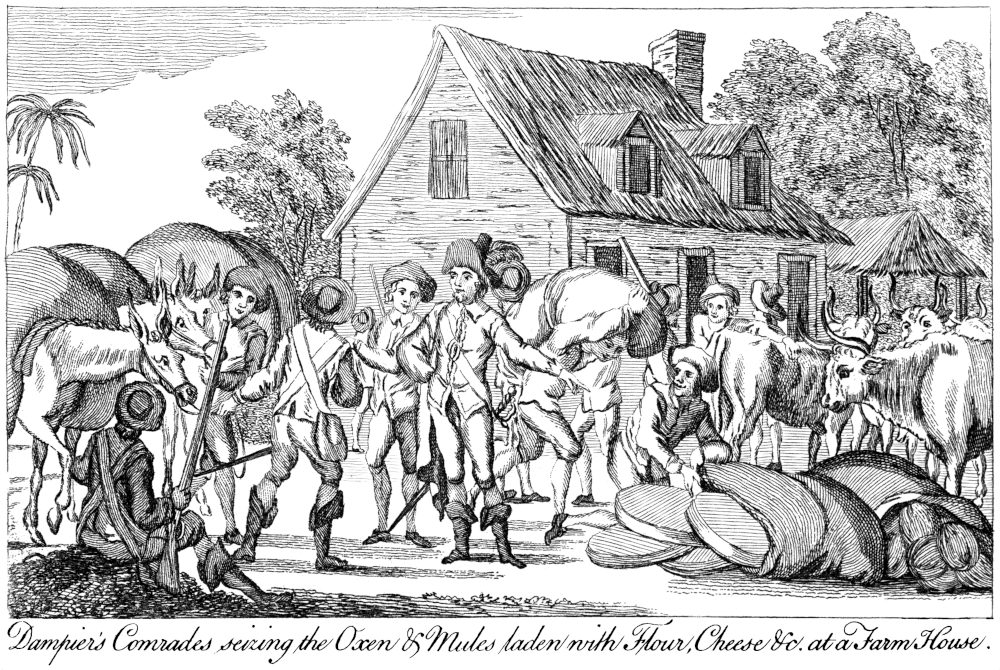
Dampier’s Comrades seizing the Oxen & Mules laden with Flour, Cheese &c. at a Farm House.
On the 21st they quitted this fortunate harbour, leaving the Mulatto and her four children to their fate. On the 25th they passed a lofty hill divided into peaks, in lat. 18 deg. 8 min. N. near which the Spanish maps place a town called Cupan, which however they could not find; after a short stay in search of it, they proceeded along the coast, till on the 28th they came in sight of the volcano of Colima, in lat. 18 deg. 36 min. N. at the foot of which is situated the rich town of Colima, from whence it takes its name. Of the valley by which this burning mountain is surrounded, the Spaniards give a most luxuriant description; but our navigators found it absolutely inaccessible from the sea; for the surf ran so high, and the breakers appeared so formidable, that the boldest of them durst not attempt it: they therefore very reluctantly quitted the neighbourhood, and proceeded in quest of Sallagua, the bay of which they discovered in lat. 18 deg. 52 min. N. Here they landed 200 of their best men, who were opposed by a body of Spanish foot, supported by a party of horse; but, on the first charge, the foot gave way, and the horse soon followed. In the pursuit the English were led into a broad road, and followed it, through a woody and rocky country, to the distance of four or five leagues, without seeing house or inhabitant. In their way back they met with two straggling Mulattoes, who told them the road led to the city of Oarrah four days journey off, and the soldiers whom they had defeated were sent from thence to escort the passengers from India that were expected to land in Sallagua bay, from on board the Manilla ship that every year touched upon that coast.