THE VOYAGES OF Capt. THOMAS CAVENDISH, THE SECOND ENGLISH NAVIGATOR WHO SAILED ROUND THE WORLD. (continued 2)
Reading edition
This band of men shot at us from the shore with their musquets, but hit none of us, and we shot at them again. They also manned a frigate, and sent it out after our boat to have taken us, but we with our oars went from them; and whether they perceived they could not overtake us, but that they must come within danger of the ordnance of our ship, they stood in with the shore again, and landed their men; and presently sent their frigate about the point, but whither we knew not: so we came on board with this one Spaniard, who was neither soldier nor sailor, but one who was come among the rest from Manilla, and had been in the hospital there a long time before, and was a very simple fellow, and such a one as could answer to very little that was enquired of him concerning the state of the country. Here we rode at anchor all that night, and perceived that the Spaniards had dispersed their band into two or three parties, and kept great watch in several places with fires and shooting-off of their pieces.
This island hath much plain ground in it in many places, and many fair and straight trees grow upon it, fit to make excellent masts for all sorts of ships. There are also mines of very fine gold in it, which are in the custody of the Indians. And, to the southward of this place, there is another very great island, which is not subdued by the Spaniards, nor any other nation. The people who inhabit it are all negroes; and the island is called the Island of Negroes. It is almost as big as England, standing in nine degrees. The most part of it seemeth to be very low land, and, by all likelihood, is very fruitful.
The 29th day of January, about six o’clock in the morning, we set sail, sending our boat before, until it was two o’clock in the afternoon, passing all this time as it were through a strait, betwixt the said two islands of Panama and the island of Negroes; and, about 16 leagues off, we espied a fair opening, trending south-west and by-south; at which time our boat came on board, and our General sent commendations to the Spanish Captain, whom we came from the evening before, by the Spaniard we had taken, and desired him to provide good store of gold, for he intended to see him with his company at Manilla within a few years, and that he did but want a bigger boat to have landed his men, or else he would have seen him then; and so caused him to be set on shore.
The 8th day of February, by eight o’clock in the morning, we espied an island near Gilolo, called Batochina, which standeth in one degree from the Equinoctial Line, northward.
The 14th day of February, we fell in with eleven or twelve very small islands, lying very low and flat, full of trees; and passed by some islands which are sunk, and have the dry sands lying in the main sea. These islands, near the Moluccas, stand in three degrees ten minutes to the southward of the Line.
On the 17th day, one John Gameford, a cooper, died, who had been sick of an old disease a long time.
The 20th day, we fell in with certain other islands, which had many small islands among them, standing four degrees to the southward of the Line.
On the 21st day of February, being Ash-Wednesday, Captain Havers died, of a most violent and pestilent ague, which held him furiously for seven or eight days, to the no small grief of our General, and of all the rest of the company, who caused two falcons and one sacre to be shot off, with all the small shot in the ship; who, after he was shrouded in a sheet, was thrown over-board, with great lamentation of us all. Moreover, presently after his death, myself, with divers others in the ship, fell very sick, and so continued in very great pain for the space of three weeks, or a month, by reason of the extreme heat and intemperateness of the climate.
The 1st day of March, having passed through the straits of Java Minor and Java Major, we came to an anchor, under the south-west parts of Java Major; where we espied certain of the inhabitants, who were fishing by the sea side in a bay which was under the island. Then our General taking into the ship-boat certain of his company, and a negroe who could speak the Morisco tongue, whom he had taken out of the Santa Anna, made towards those fishers; who, having espied our boat, ran on shore into the woods, for fear of our men. But our General caused his negroe to call unto them; who had no sooner heard him call, than presently one of them came to the shore side, and made answer. Our General, by the negroe, enquired of him for fresh water; which they found; and caused the fisher to go to the King, and to acquaint him of a ship that was come to have traffic for victuals, and for diamonds, pearls, or any other rich jewels that he had for which, he should have either gold, or other merchandize in exchange. The fisher answered, that we should have all manner of victuals that we would request. Thus our boat came on board again. Within a while after, we went about to furnish our ship thoroughly with wood and water.
About the 8th of March, two or three canoes came from the town unto us, with eggs, hens, fresh fish, oranges, and limes, and brought word we should have had victuals more plentifully, but that they were so far to be brought to us where we rode. Which when our General heard, he weighed anchor, and stood in nearer for the town; and, as we were under sail, we met with one of the King’s canoes coming towards us: whereupon we dropt some of our sails, and staid for the canoe until it came aboard us, then stood into the bay, which was hard by, and came to an anchor. In this canoe was the King’s Secretary, who had on his head a piece of died linnen, folded up like unto a Turkish turban. He was all naked, except about his waist; his breast was carved with the broad arrow upon it; he went bare-footed. He had an interpreter with him, who was a Mestizo, that is, half an Indian and half a Portuguese, who could speak very good Portuguese. This Secretary signified unto our General, that he had brought him an hog, hens, eggs, fresh fish, sugar canes, and wine, which wine was as strong as aqua-vitæ, and as clear as any rock-water. He told him farther, that he would bring victuals so sufficiently for him as he and his company would request, and that within the space of four days. Our General used him singularly well, banquetted him most royally with the choice of many and sundry conserves, wines both sweet and otherwise; and caused his musicians to make him music. This done, our General told him, that he and his company were Englishmen; that we had been at China, and had trafficked in that country; that we were come thither to make enquiries, and purposed to go to Molucca. The people told our General, that there were certain Portuguese in the island, who staid there as factors continually, to traffic with them, to buy negroes, cloves, pepper, sugar, and many other commodities. This Secretary of the King, with his interpreter, lay one night on board our ship. The same night, because they lay on board, in the evening at the setting of the watch, our General commanded every man in the ship to provide his harquebuss, and his shot; and so with shooting off forty or fifty small shot, and a sacre, himself set the watch. This was no small wonder to these heathen people, who had not commonly seen any ship so furnished with men and ordnance. The next morning we dismissed the Secretary and his interpreter, with all humanity.
The fourth day after, which was the 12th of March, according to their appointment, came the King’s canoes: but the wind being somewhat scant, they could not get on board that night, but put into a bay under the island until the next day; and, presently after the break of day, there came to the number of nine or ten of the King’s canoes, so deeply laden with provisions as they could swim, with two live oxen, half a score of large fat hogs, a number of live hens, ducks, and geese, with eggs, plantains, sugar-canes, sugar in plates, cocoas, sweet oranges, and bitter limes, great store of wine and aqua-vitæ, salt to season meat with, and almost all manner of provisions besides, accompanied with divers of the King’s Officers who were there. Among all the rest of the people, in one of these canoes, came two Portuguese, who were men of middle stature, and very proper personage: they were each of them in a loose jerkin and hose, which came down from the waist to the ancle, according to the fashion of the country, and partly because it was Lent, and a time for doing of their penance. They account it as a thing of great dishonour among these heathens, to wear either hose or shoes on their feet. The Portuguese had on each of them a very fair and a white lawn shirt, with falling bands on the same, very decent, their bare legs excepted. These Portuguese were no small joy unto our General, and all the rest of our company; for we had not seen any christian that was our friend for a year and an half before. Our General used and treated them singularly well with banquets and music. They told us, that they were no less glad to see us than we were to see them, and enquired into the estate of their country, and what was become of Don Antonio, their King, and whether he were living or not; for that they had not been in Portugal for a long time, and that the Spaniards had always brought them word that he was dead? Then our General satisfied them in every demand, assuring them that their King was alive and in England, and had honourable allowance from our Queen; and that there was war betwixt Spain and England, and that we were come under the King of Portugal into the South Sea, and had warred upon the Spaniards there, and had fired, spoiled, and sunk all the ships along the coast that we could meet with, to the number of eighteen or twenty sail. With this report they were abundantly satisfied.
On the other side, they declared unto us the state of the island of Java: First, the plentifulness, great choice, and store of provisions of all sorts, and of all manner of fruits, as before set down; then the great and rich merchandizes which are there to be had. Then they described the nature and properties of the people, as followeth: The name of the King of that part of the island was Raya Bolamboam, who was a man had in great majesty and fear among them. The common people may not bargain, sell, or exchange any thing with any other nation, without special licence from their King; and, if any so do, it is present death for him. The King himself is a man of great years, and hath an hundred wives; his son hath fifty. The custom of the country is, that, whensoever the King doth die, they take the dead body and burn it, and preserve the ashes of him; and, within five days next after, the wives of the said King so dead, according to the custom and use of their country, every one of them go together to a place appointed; and, the chief of the women, who was nearest to him in account, hath a ball in her hand, and throweth it from her; and to the place where the ball resteth, thither they go all, and turn their faces to the eastward, and every one, with a dagger in her hand (which dagger they call a crise, and is as sharp as a razor), stab themselves to the heart, and, with their own hands, bathe themselves in their blood, and falling flat on their faces, so end their days. This thing is as true as it may seem to any hearer to be strange.
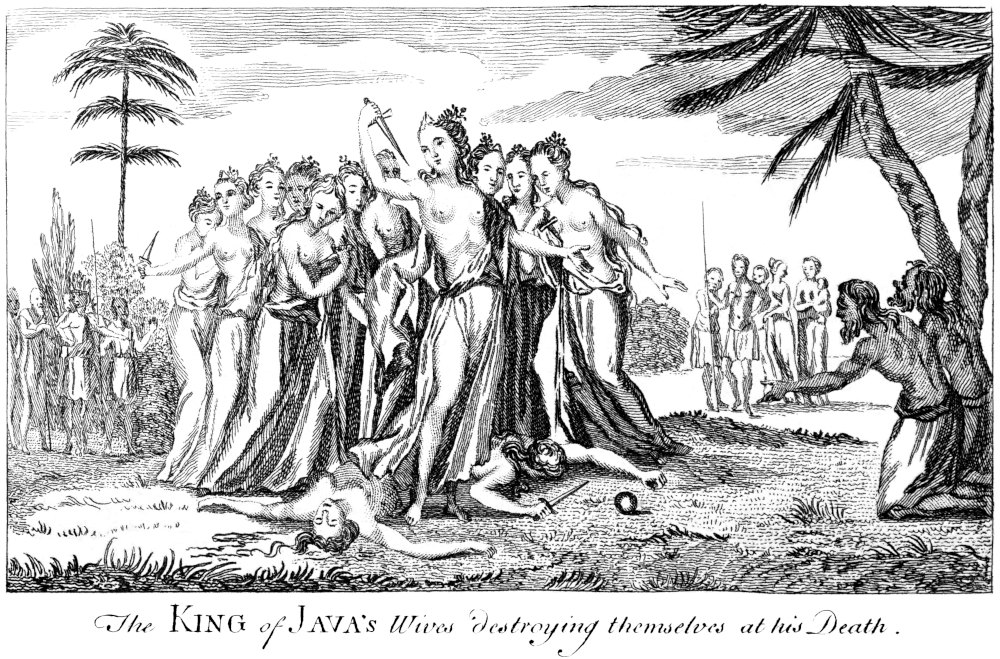
The
King
of
Java’
s Wives destroying themselves at his Death
.
The men of themselves are very politic and subtle, and singularly valiant (being naked men) in any action they undertake, and very submissive and obedient to their king: for example, if their king command them to undertake any exploit, be it ever so dangerous or desperate, they dare not nor will not refuse, though they should die every man of them in executing the same; for he will cut off the heads of every one of them who return alive, without bringing their purpose to pass; which is such a thing amongst them as maketh them the most valiant people in all the south-east parts of the world; for they never fear any death; for being in fight with any nation, if any of them feeleth himself hurt with lance or sword, he will willingly run himself upon the weapon quite through the body to procure his death the more speedily, and in this desperate manner end his days, or overcome his enemy. Moreover, although the men be tawny of colour, and go continually naked, yet their women are fair of complexion, and go more apparelled.
After they had thus described the state of the island and the order and fashion of the people, they told us further, that, if their king, Don Antonio, would come unto them, they would warrant him to have all the Moluccas at command, besides China-Sanglos and the isles of the Philippines; and that he might be assured to have all the Indians on his side that were in the country. After we had fully contented these Portuguese, and the people of Java who had brought us provisions in their canoes, they took their leave of us with promise of all good entertainment at our return; and our General gave them three great pieces of ordnance at their departing.
Thus, the next day, being the 16th of March, we set sail towards the Cape of Good Hope, called by the Portuguese Cabo de Buena Esperanca, on the most southern coast of Africa.
The rest of March, and all the month of April, we spent in traversing that mighty and vast sea, between the island of Java and the main of Africa, observing the heavens, the Crosiers, or the South-pole, the other stars, the fowls which are marks unto seamen of fair weather and foul weather, approaching of lands or islands, the winds, the tempests, the rains and thunder, with the alterations of tides and currents.
The 10th day of May, we had a storm from the west, and it blew so hard that it was as much as the ship could steer close by under the wind; and the storm continued all that day and all that night.
The next day, being the 11th of May, in the morning, one of the company went up to the top, and espied land bearing north and north-by-west of us; and about noon we espied land to bear west of us, which we imagined to be the Cape of Buena Esperanca, whereof indeed we were short about forty or fifty leagues; and, by reason of the scantness of the wind, we stood along to the south-east until midnight, at which time the wind came fair, and we hauled along westward.
The 12th and 13th days we were becalmed, and the sky was very hazy and thick until the 14th day at three o’clock in the afternoon, at which time the sky cleared, and we spied land again, which was that called Cabo Falso, which is short of Cabo de Buena Esperanca forty or fifty leagues.
This cape is very easy to be known, for there are right over it three very high hills, standing but a small way one off another, and the highest standeth in the midst, and the ground is much lower by the sea-side. The Cape of Good Hope beareth west and by-south from the said Cabo Falso.
The 16th day of May, about four o’clock in the afternoon, the wind came up at east a very brisk gale, which continued till Saturday with as much wind as ever the ship could go before. At which time, by six o’clock in the morning, we espied the promontory or head-land called the Cabo de Buena Esperanca, which is a pretty high-land; and at the westernmost point, a little off the main, appear two hummocks, the one upon the other, and three other hummocks lying further off into the sea, yet low land between and adjoining unto the sea.
This Cape of Buena Esperanca is set down and accounted 2000 leagues from the island of Java in the Portuguese sea charts, but it is not so much by almost 150 leagues, as we found by the running of our ship. We were in running of these 1850 leagues just nine weeks.
The 8th day of June, by break of day, we fell in sight of the island of St. Helena, seven or eight leagues short of it, having but a small gale of wind, or almost none at all, insomuch as we could not get into it that day, but stood off and on all that night.
The next day, being the ninth of June, having a pretty easy gale of wind, we stood in with the shore, our boat being sent away before to make the harbour; and, about one o’clock in the afternoon, we came to an anchor in twelve fathoms water, two or three cables length from the shore, in a very fair and smooth bay under the north-west side of the island.
This island is very high land, and lieth in the main sea; standing, as it were, in the midst of the sea, between the main land of Africa, the main of Brazilia, and the coast of Guinea; and is in fifteen degrees forty-eight minutes to the southward of the Equinoctial Line, and is distant from the Cape of Buena Esperanca between five and six hundred leagues.
The same day, about two or three o’clock in the afternoon, we went on shore, where we found an exceeding fair and pleasant valley, wherein divers handsome buildings and houses were set up; and one particularly, which was a church, was tiled and whitened on the outside very fair, and made with a porch; and within the church, at the upper end, was set an altar, whereon stood a very large table, set in a frame, having in it the picture of our Saviour Christ upon the cross, and the image of our Lady praying, with divers other histories curiously painted in the same. The sides of the church were hung round with stained cloths, having many devices drawn on them.
There are two houses adjoining to the church, on each side one, which serve for kitchens to dress meat in, with necessary rooms and houses of office. The coverings of the said houses are made flat, where is planted a very fair vine, and through both the said houses runneth a very good and wholesome stream of fresh water.
There is also over against the church a very fair causeway, made up with stones reaching unto a valley by the sea side, in which valley is planted a garden, wherein grow great store of pompions and melons; and upon the said causeway is a frame erected, whereon hang two bells, wherewith they ring to mass; and near to it a cross is set up, which is squared, framed, and made very artificially of free-stone, whereon is carved in cyphers what time it was built, which was in the year of our Lord 1571.
This valley is the fairest and largest low plot in all the island, and is exceeding sweet and pleasant, and planted in every place, either with fruit or with herbs.
There are fig-trees which bear fruit continually and very plentifully; for on every tree you may see blossoms, green figs, and ripe figs all at once, and it is so all the year long. The reason is, that the island standeth so near the sun. There is also great store of lemon-trees, orange-trees, pomegranate-trees, pomecitron-trees, and date-trees, which bear fruit as the fig-trees do, and are planted carefully and very artificially, with pleasant walks under and between them; and the said walks are overshadowed with the leaves of the trees; and in every void place is planted parsley, sorrel, basil, fennel, anniseed, mustard-seed, radishes, and many very good herbs. The fresh-water brook runneth through divers places in this orchard, and may, with very small pains, be made to water any one tree in the valley.
This fresh-water stream cometh from the tops of the mountains, and falleth from the cliff into the valley the height of a cable; and hath many arms issuing out of it, that refresh the whole island, and almost every tree in it. The island is altogether high mountains and steep vallies, except it be on the tops of some hills, and down below in some of the vallies, where great plenty of all those fruits before spoken of do grow. There are much more growing on the tops of the mountains than below in the vallies; but it is very toilsome and dangerous travelling up unto them and down again, by reason of the height and steepness of the hills.
There are also upon this island great store of partridges, which are very tame, not making any great haste to fly away, though one come very near them, but only to run away and get up into the steep cliffs; we killed some of them with a fowling-piece; they differ very much from our partridges which are in England both in bigness and also in colour, for they are almost as big as hens, and are of an ash colour, and live in covies, twelve, sixteen, and twenty together; you cannot go ten or twelve score paces but you shall see or spring one or two covies at the least.
There are likewise no less plenty of pheasants in the island, which are also very big and fat, surpassing those which are in our country in bigness and in numbers in a company; they differ not very much in colour from the partridges before spoken of. We found, moreover, on this island, plenty of Guinea-cocks, which we call turkies, of colour black and white, with red heads; they are much the same in bigness with ours in England; their eggs are white, and as big as a turkey’s egg.
There are in this island thousands of goats, which the Spaniards call cabritos, which are very wild; you shall see one or two hundred of them together, and sometimes you may see them go in a flock almost a mile long; some of them (whether it be the nature of the breed of them or of the country I know not) are as big as an ass, with a mane like a horse, and a beard hanging down to the very ground; they will climb up the cliffs, which are so steep that a man would think it a thing impossible that any living creature could go there. We took and killed many of them for all their swiftness, for there are thousands of them upon the mountains.
Here are in like manner great store of swine, which are very wild and fat, and of great bigness; they keep altogether upon the mountains, and will very seldom abide any man to come near them, except it be by mere chance, when they are found asleep, or otherwise, according to their kind, are taken lying in the mire.
We found in the houses, at our coming, three slaves who were negroes, and one who was born in the island of Java, who told us, that the East-Indian fleet, which were in number five sail, the least whereof was in burden eight or nine hundred tons, all laden with spices and Calicut cloth, with store of treasure, and very rich stones and pearls, were gone from the said island, St. Helena, but twenty days before we came thither.
This island hath been found long ago by the Portuguese, and hath been altogether planted by them for their refreshment, as they come from the East-Indies; and, when they come, they have all things in plenty for their relief, by reason that they suffer none to inhabit there, that might eat up the produce of the island, except some very few sick persons of their company, whom they suspect will not live until they come home; these they leave there to refresh themselves, and take them away the year following, with the other fleet, if they live so long. They touch here rather in their coming home from the East Indies, than at their going thither, because they are thoroughly furnished with corn when they set out of Portugal; but are meanly victualled at their coming from the Indies, where there groweth but little corn.
The 20th day of June, having taken in wood and water, and refreshed ourselves with such things as we found there, and made clean our ship, we set sail about eight o’clock at night towards England. At our setting sail we had the wind at south-east, and we hauled north-west and by-west. The wind is commonly off the shore at this island of St. Helena.
On Wednesday the 3d day of July, we went away north-west, the wind being still at south-east; at which time we were in one degree and forty-eight minutes to the southward of the Equinoctial Line.
The 12th day of the said month of July there was very little wind; and, towards night, it was calm, and blew no wind at all, and so continued till Monday, being the 15th day of July.
On Wednesday the 17th day of the said month, we had a small gale at west-north-west. We found the wind continually to blow at east and north-east, and east-north-east, after we were in three or four degrees to the northward; and it altered not until we came between thirty and forty degrees to the northward of the Equinoctial Line.
On Wednesday the 21st day of August, the wind came up at south-west a fair gale; by which day at noon we were in thirty-eight degrees of north latitude.
On Friday in the morning, being the 23d of August, at four o’clock we hauled east and east-by-south, for the most northern islands of the Azores.
On Saturday the 24th day of the said month, by five o’clock in the morning, we fell in sight of the two islands of Flores and Corvo, standing thirty-nine degrees thirty minutes; and sailed away north-east.
The 3d of September, we met with a Flemish hulk that came from Lisbon, and declared unto us the overthrowing of the Spanish fleet, to the singular rejoicing and comfort of us all.
The 9th of September, after a terrible tempest, which carried away most part of our sails, by the merciful favour of the Almighty, we recovered our long-wished-for port of Plymouth, in England, from whence we set forth at the beginning of our voyage.”
[The wealth acquired in this voyage, though very considerable, was soon dissipated; and, in less than three years, Cavendish again found himself under the necessity of preparing for a second, in which, however, he was very unfortunate. He had, indeed, increased his preparations; and, it is not to be doubted, but that the certainty he had conceived of acquiring a more ample fortune by a second enterprize, made him the more careless in the management of the treasure he had acquired by the first.
The ships fitted out on this occasion were the Leicester, commanded by himself as Admiral; the Roebuck, Captain Cocke, Vice-Admiral; the Desire, Captain Davis, Rear-Admiral; the Dainty, Captain Coffen; and the Black Pinnace, whose Commander’s name is not mentioned. The Commanders in this expedition were some of the ablest navigators the nation produced, and the highest expectations were formed from their fortitude and approved experience.
Of the accounts that have been given of this expedition, that published by John Jane, a gentleman who accompanied Captain Davis in the Desire, is the most complete; for which reason, we shall give it in the writer’s own words, as it is but in few hands, and full of interesting events:
“The 26th of Aug. 1591, we departed from Plymouth, says Mr. Jane, with three large ships and two barks.
The 29th of November, we fell in with the bay of Salvador, upon the coast of Brasil, twelve leagues on this side Cape Frio, where we were becalmed until the 2d of December: at which time we took a small bark bound for the river of Plate, with sugar, haberdash-wares, and negroes. The master of this bark brought us to an isle called Placentia, thirty leagues west from Cape Frio, where we arrived the 5th of December, and rifled six or seven houses inhabited by the Portuguese. The 11th, we departed from this place, and, the 14th, arrived at the island of St. Sebastian; from whence Mr. Cocke and Captain Davis presently departed with the Desire and Black Pinnace, for taking the town of Santos. The 15th, at evening, we anchored at the bar of Santos, from whence we departed, with our boats, to the town; by which expedition, we took all the people at mass, both men and women, whom we kept all that day in the church as prisoners. The cause why Mr. Cavendish desired to take this town, was to supply his great wants; and, having it now in quiet possession, we stood in assurance of having provisions in great abundance. But such was the negligence of Captain Cocke, that the Indians were suffered to carry out whatsoever they would in open view, and no man did controul them: and the next day, after we had won the town, our prisoners were all set at liberty; only four poor old men were kept as pledges to supply our wants. Thus, in three days, the town, which was able to furnish such another fleet with all kinds of necessaries, was left unto us nakedly bare, without people and provisions.
Eight or ten days after, Mr. Cavendish himself came hither, where he remained until the 22d of January, seeking by entreaty to have that whereof we were once possessed. But, in conclusion, we departed worse furnished from the town, than when we came unto it. The 22d, we burnt St. Vincent’s to the ground. The 24th, we set sail, shaping our course for the straits of Magellan.
The 7th of February, we had a very great storm; and, the 8th, our fleet was separated by the fury of the tempest. Then our Captain called unto him the master of our ship, a very honest and sufficient man; and, conferring with him, he concluded to go for Port Desire, hoping that the General would come thither, because that in his first voyage he had found great relief there; for our Captain could never get any direction what course to take in any such extremities, though many times he had entreated for it, as often I have heard him with grief report. In sailing to this port, by good chance, we met with the Roebuck, wherein Mr. Cocke had endured great extremities, and lost his boat, and therefore desired our Captain to keep him company, for he was in a very desperate situation. Our Captain hoisted out his boat, and went on board him to know his estate, and, returning, told us the hardness thereof, and desired the Master and all the company to be careful in all their watches not to lose the Roebuck, and so we both arrived at Port Desire the sixth of March.
The 16th of March, the Black Pinnace came to us; but the Dainty came not, but returned back to England, leaving their captain on board the Roebuck, without any provision more than the apparel that he wore. The 18th the Leicester came into the road, and Mr. Cavendish came into the harbour in a boat which he had made at sea; for his long boat and pinnace were lost at sea: and being on board the Desire, he told our captain of all his extremities, and spoke most hardly of his company, and of divers gentlemen that were with him, purposing no more to go on board his own ship, but to stay in the Desire. We all sorrowed to hear such hard speeches of our good friends; but having spoken with the gentlemen of the Leicester, we found them faithful, honest, and resolute in proceeding, although it pleased our General otherwise to conceive of them.
The 20th of March, we departed from Port Desire, Mr. Cavendish being in the Desire with us. The 8th of April, we fell in with the straits of Magellan, enduring many furious storms between Port Desire and the strait. The 14th, we passed through the first strait. The 16th, we passed the second strait, being ten leagues distant from the first. The 18th, we doubled Cape Froward, which cape lieth in 53 degrees 30 minutes. The 21st we were forced, through the fury of the weather, to put into a small cove with our ships, four leagues from the said cape, upon the south shore, where we remained until the 15th of May. In the which time we endured extreme storms, with perpetual snow, where many of our men died with cursed famine, and miserable cold, not having wherewith to cover their bodies, nor to fill their bellies, but living by muscles, water, and weeds of the sea, with a small relief, from the ship’s store, in meal, sometimes. And all the sick men in the Leicester were most uncharitably put on shore into the woods, in the snow, rain, and cold, when men of good health could scarcely endure it, where they ended their lives in the highest degree of misery, Mr. Cavendish all the while being on board the Desire. In these great extremities of snow and cold, doubting what the end would be, he asked our captain’s opinion, because he was a man that had good experience of the north-west parts, in his three several discoveries that way, employed by the merchants of London. Our captain told him, that this snow was a matter of no long continuance, and gave him sufficient reason for it, and that thereby he could not much be prejudiced or hindered in his proceeding. Notwithstanding, he called together all the company, and told them, that he purposed not to stay in the straits, but to depart upon some other voyage, or else to return again for Brazil: but his resolution was to go for the Cape of Good Hope. The company answered, that, if it pleased him, they did desire to stay God’s favour for a wind, and to endure all hardness whatsoever, rather than to give over the voyage, considering they had been here but a small time, and because they were within forty leagues of the South Sea, it grieved them now to return: notwithstanding, whatever he ordered, that they would perform. So he concluded to go for the Cape of Good Hope, and to give over this voyage. Then our captain, after Mr. Cavendish was come on board the Desire from talking with the company, told him, that, if it pleased him to consider the great extremity of his situation, the slenderness of his provisions, with the weakness of his men, it was no course for him to proceed in that new enterprize: for if the rest of your ships (said he) be furnished answerable to this, it is impossible to perform your determination; for we have no more sails than masts, no victuals, no ground-tackling, no cordage more than is over-head, and, among seventy-five persons, there is but the master alone that can order the ship, and but fourteen sailors: the rest are gentlemen, serving-men, and artificers. Therefore it will be a desperate case to take so hard an enterprize in hand. These persuasions did our captain not only use to Mr. Cavendish, but also to Mr. Cocke. In fine, upon a petition delivered in writing by the chief of the whole company, the General determined to depart out of the straits of Magellan, and to return again for Santos in Brazil.
So the 15th of May, we set sail, our General being then in the Leicester. The 18th, we were free of the straits, but at Cape Froward it was our hard hap to have our boat sunk at our stern in the night, and to lose all our oars.
On the 20th, being thwart of Port Desire, in the night the General altered his course, as we suppose, by which occasion we lost him: for, in the evening, he stood close by a wind to seaward, having the wind at north-north-east, and we standing the same way, the wind not altering, could not the next day see him: so that we then persuaded ourselves, that he was gone for Port Desire to relieve himself, or that he had sustained some mischance at sea, and was gone thither to remedy it. Whereupon our captain called the General’s men unto him, with the rest, and asked their opinion what was to be done. Every one conjectured that the General was gone for Port Desire. Then the Master, being the General’s man, and careful of his master’s service, as also of good judgment in sea-matters, told the company how dangerous it was to go for Port Desire, if we should there miss the General: for (said he) we have no boat to land ourselves, nor any anchors or cables that I dare trust in so quick streams as are there: yet, in all likelihood concluding that the General was gone thither, we steered our course for Port Desire, and by chance met with the Black Pinnace, which had likewise lost the fleet, being in a very miserable case: so we both concluded to seek the General at Port Desire.
The 26th day of May, we came to Port Desire, where not finding our General as we hoped, being most slenderly victualled, without sails, boat, oars, nails, cordage, and all other necessaries for our relief, we were struck into a deadly sorrow. But, referring all to Providence, we entered the harbour, and found a place of quiet road, which before we knew not. Having moored our ship with the pinnace’s boat, we landed upon the south shore, where we found a standing pool of fresh-water, which by estimation might hold about ten tons, whereby we were greatly comforted. From this pool we fetched more than forty tons of water, and yet we left the pool as full as we found it. And, because at our first being at this harbour we were at this place and found no water, we persuaded ourselves that God had sent it for our relief. Also there were such extraordinary low ebbs as we had never seen, whereby we got muscles in plenty and great abundance of smelts, so that, with hooks made of pins, every man caught as many as he could eat: by which means we preserved our ship’s victuals, and spent not any during the time of our abode here.
Our Captain and Master, considering our ability to go to the General, found our wants so great, as that in a month we could not fit our ship to set sail; for we must needs set up a smith’s forge to make bolts, spikes, and nails, besides the repairing of our other wants. Whereupon they concluded it to be their best course, to take the pinnace, and to furnish her, and to go to the General with all expedition, leaving the ship and the rest of the company until the General’s return; for he had vowed to our Captain, that he would return again to the straits, as he had told us. The Captain and Master of the pinnace, being the General’s men, were well contented with the motion.
But the General having in our ship two most pestilent fellows, when they heard of this determination, they utterly misliked it, and, in secret, dealt with the company of both ships, vehemently persuading them that our Captain and Master would leave them in the country to be devoured by the cannibals, and that they were merciless and without charity: whereupon the whole company joined in secret with them, in a night, to murder our Captain and Master, with myself and all those they thought were their friends. There were marks taken in his cabbin, how to kill him with musquets through the ship’s side, and bullets made of silver for the execution, if their other purposes should fail. All agreed hereunto except the boatswain of our ship, who, when he knew the matter, revealed it to the Master, and so to the Captain. Then the matter being called in question, those two murderous fellows were found out, whose names were Charles Parker and Edward Smith.
The Captain, being thus hardly beset, in peril of famine, and in danger of being murdered, was constrained to use lenity, and by courteous means to pacify this fury: shewing, that, to do the General service, unto whom he had vowed faith in this action, was the cause why he purposed to go unto him in the pinnace, considering that the pinnace was so necessary a thing for him, as that he could not be without her, because he was fearful of the shore in so great ships. Whereupon all cried, with cursing and swearing, that the pinnace should not go unless the ship went. Then the Captain desired them to shew themselves christians, and not so blasphemously to behave themselves, without regard and thanksgiving to God for their great deliverance. By which gentle speeches, the matter was pacified, and the Captain and Master, at the request of the company, were content to forgive this great treachery of Parker and Smith, who, after many admonitions, concluded in these words: “The Lord judge between you and me:” which after came to a most sharp revenge, even by the punishment of the Almighty. Thus, by a general consent, it was concluded not to depart, but to stay there for the General’s return. Then our captain and Master, seeing that they could not do the General that service which they desired, made a motion to the company, that they would lay down under their hands the losing of the General, with the extremities wherein we then stood: whereunto they consented, and wrote under their hands what followeth:
The Testimonial of the Company of the Desire, touching the losing of their General, which appeareth to have been utterly against their meanings.
“The 26th of August 1591, we whose names are here underwritten, with divers others, departed from Plymouth, under Mr. Thomas Cavendish our General, with four ships of his, viz. the Leicester, the Roebuck, the Desire, and the Black Pinnace, for the performance of a voyage into the South Sea. The 19th of November, we fell in with the bay of Salvador, in Brazil. The 16th of December we took the town of Santos, hoping there to revictual ourselves, but it fell not out to our contentment. The 24th of January we set sail from Santos, shaping our course for the straits of Magellan. The 8th of February, by violent storms, the said fleet being parted, the Roebuck and the Desire arrived at Port Desire the sixth of March. The sixteenth of March, the Black Pinnace arrived there also: and the 18th of the same, our Admiral came into the road, with whom we departed the 20th of March in poor and weak estate. The 8th of April 1592, we entered the straits of Magellan. The 21st of April we anchored beyond Cape Froward, within 40 leagues of the South Sea, where we rode until the 15th of May. In which time we had great store of snow, with some gusty weather, the wind continuing still west-north-west against us. In this time we were inforced, for the preserving of our victuals, to live the most part upon muscles, our provision was so slender; so that many of our men died in this hard extremity. Then our General returned for Brazil, there to winter, and to procure victuals for this voyage against the next year. So we departed the straits, the 15th of May. The 21st, being thwart of Port Desire, 36 leagues off the shore, the wind then at north-east and by-north; at five of the clock at night, lying north-east, we suddenly cast about, lying south-east and by-south, and sometimes south-east: the whole fleet following the Admiral, our ship coming under his lee, shot a-head of him, and so framed sail fit to keep company. This night we were severed, by what occasion we protest we know not, whether we lost them or they us. In the morning we only saw the Black Pinnace, then supposing the Admiral had overshot us. All this day we stood to the eastwards, hoping to find him; because it was not likely that he would stand to the shore again so suddenly. But missing him towards night, we stood to the shoreward, hoping by that course to find him. The 22d of May, at night, we had a violent storm, with the wind at north-west, and we were inforced to hull, not being able to bear sail; and this night we perished our main tressle-trees, so that we could no more use our main-top-sail, lying most dangerously in the sea. The pinnace likewise received a great leak, so that we were inforced to seek the next shore for our relief. And, because famine was like to be the best end, we desired to go for Port Desire, hoping, with seals and penguins, to relieve ourselves, and so to make shift to follow the General, or there to stay his coming from Brasil. The 24th of May we had much wind at north. The 25th was calm, and the sea very lofty, so that our ship had dangerous foul weather. The 26th, our fore-shrouds broke, so that, if we had not been near the shore, it had been impossible for us to get out of the sea. And now, being here moored in Port Desire, our shrouds are all rotten, not having a running rope whereto we may trust, and being provided only of one shift of sails, all worn, our top-sails not able to abide any stress of weather; neither have we any pitch, tar, or nails, nor any store for the supplying of these wants; and we live only upon seals and muscles, having but five hogsheads of pork within board, and meal three ounces for a man a day, with water for to drink. And for as much as it hath pleased God to separate our fleet, and to bring us into such hard extremities, that only now by his mere mercy we expect relief, though otherwise we are hopeless of comfort; yet, because the wonderful works of God, in his exceeding great favour towards us his creatures, are far beyond the scope of man’s capacity, therefore by him we hope to have deliverance in this our deep distress. Also, for as much as those upon whom God will bestow the favour of life, with return home to their country, may not only remain blameless, but also manifest the truth of our actions, we have thought good, in christian charity, to lay down under our hands the truth of all our proceedings, even till the time of this our distress.
Given in Port Desire, the 2d of June, 1592,” &c.
After they had delivered this under their hands, then we began to labour to preserve our lives; and we built up a smith’s forge, and made nails, bolts, and spikes; others made ropes of a piece of our cable; and the rest gathered muscles, and took smelts, for the whole company. Three leagues from this harbour there is an isle with four small isles about it, where there are abundance of seals; and, at that time of the year, the penguins came thither, in great plenty, to breed. We concluded with the pinnace, that she should sometimes go thither to catch seals for us; upon which condition we would share victuals with her man for man; whereunto the whole company agreed. So we parted our poor store, and she laboured to fetch us seals to eat, wherewith we lived when smelts and muscles failed; for in the nep-tides we could get no muscles. Thus, in the most miserable calamity, we remained until the 6th of August, still keeping watch upon the hills to look for our General and so great was our vexation and anguish of soul, as I think never flesh and blood endured more. Our misery daily increasing, time passing, and our hope of the General being very cold, our Captain and Master were fully persuaded that the General might, perhaps, go directly for the straits, and not come to this harbour: whereupon, they thought no course more convenient, than to go presently for the straits, and there to stay his coming; for, in that place he could not pass, but of force we must see him: Whereunto the company most willingly consented, as also the Captain and Master of the pinnace; so that upon this determination we made all possible speed to depart.
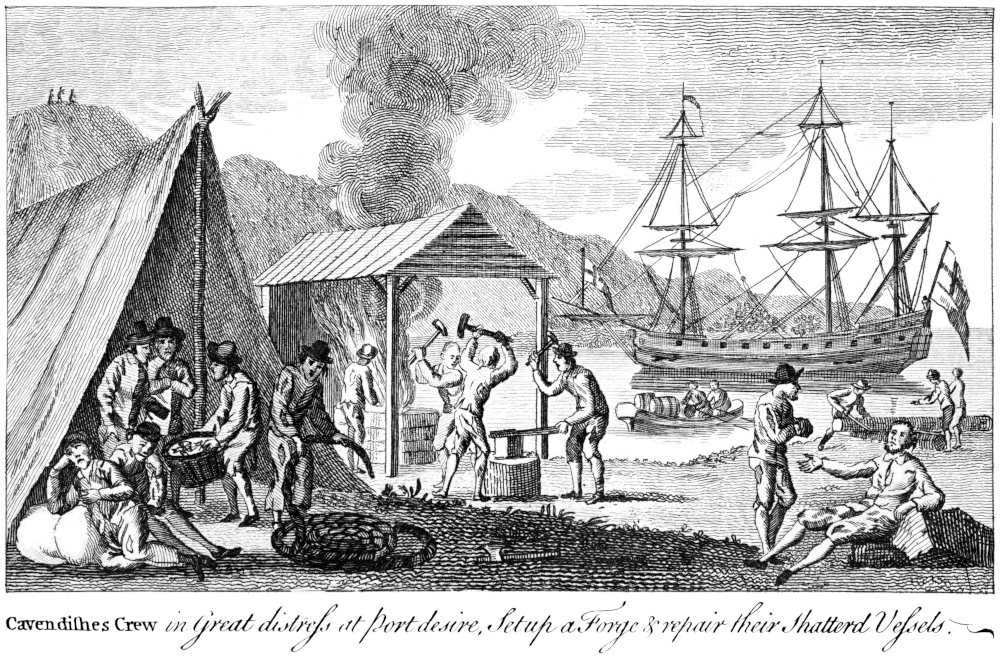
Cavendishes Crew
in Great distress at Port desire, Setup a Forge & repair their shatterd Vessels
.
The 6th of August we set sail, and went to Penguin Isle; and, the next day, we salted 20 hogsheads of seals, which was as much as our salt could do. The 7th, towards night, we departed from Penguin Isle. The 9th, we had a sore storm, so that we were constrained to hull, for our sails were not fit to endure any force. The 14th, we were driven in among certain isles never before discovered by any known relation, lying fifty leagues, or better, off the shore, east and northerly from the straits; in which place, had not the wind ceased, we must of necessity have perished. But, the wind shifting, we directed our course for the straits; and, the 18th of August, we fell in with the Cape in a very thick fog; and, the same night, we anchored ten leagues within the Cape. The 19th, we passed the first and second straits. The 21st, we doubled Cape Froward. The 22d, we anchored in Salvage Cove, so called because we saw many savages there. Notwithstanding the extreme cold of this place, yet do all these people go naked, and live in the woods like satyrs, painted and disguised, and flee from you like wild deer. They are very strong, and threw stones at us of three or four pounds weight, an incredible distance. The 24th, in the morning, we departed from this cove, and the same day we came into the north-west reach, which is the last reach of the straits. The 25th, we anchored in a good cove, within 14 leagues of the South Sea: in this place we purposed to stay for the General; for the strait at this place, is scarce three miles broad, so that he could not pass but we must see him. After we had staid here a fortnight in the depth of winter, our victuals consuming (for our seals stunk most vilely, and our men died pitifully through cold and famine, for the greatest part of them had not cloaths to defend them from the extremity of the winter’s cold) being in this heavy distress, our Captain and Master thought it the best course to depart from the straits into the South Sea, and to go for the isle of Santa Maria, which is to the northward of Baldivia, in 37 deg. 15 min. where we might have relief, and be in a temperate clime, and there stay for the General, for of necessity he must come by that isle. So we departed the 13th of September, and came in sight of the South Sea. On the 14th, we were forced back again, and recovered a cove, three leagues within the straits from the South Sea. Again we put forth, and being eight or ten leagues free of the land, the wind rising furiously at west-north-west, we were forced back again into the straits for want of sails; for we never durst bear sail in any stress of weather, they were so weak: so again we recovered the cove three leagues within the straits, where we endured most furious weather; so that one of our two cables brake, whereby we were hopeless of life: yet it pleased God to calm the storm, and we unreeved our sheets, tacks, halliards, and other ropes, and moored our ship to the trees, close by the rocks. We laboured to recover our anchor again, but could not, it lay so deep in the water, and, as we think, covered with oaze. Now had we but one anchor, which had but one whole fluke, a cable spliced in two places, and a piece of an old one. In the midst of these our troubles, the wind came fair the first of October; whereupon, with all expedition, we loosed our moorings, and weighed our anchor, and so towed off into the channel; for we had mended our boat in Port Desire, and had five oars of the pinnace. When we had weighed our anchor, we found our cable broken; only one strand held. Being in the channel, we reeved our ropes, and again rigged our ship; no man’s hand was idle, but all laboured even for the last gasp of life. Here our company was divided; some desired to go again for Port Desire, and there to be set on shore, where they might travel for their lives; and some stood with the Captain and Master to proceed. Whereupon the Captain said to the Master, “Master, you see the wonderful extremity of our estate, and the great doubts among our company of the truth of your reports, as touching relief to be had in the South Sea. Now, good Master, for as much as you have been in this voyage once before with your Master the General, satisfy the company of such truths as are to you best known; and, you the rest of the General’s men, who likewise have been with him in his first voyage, if you hear any thing contrary to the truth, spare not to reprove it, I pray you.” Then the Master said, “If you think good to return, I will not gainsay it: but this I think, if life may be preserved by any means, it is in proceeding; for at the isle of Santa Maria I do assure you of wheat, pork, and roots enough. Also, I will bring you to an isle where pelicans be in great abundance, and we shall have meal in great plenty, besides a possibility of intercepting some ships upon the coast of Chili and Peru. But, if we return, there is nothing but death to be hoped for: therefore, do as you like, I am ready; but my desire is to proceed.” These his speeches, being confirmed by others that were in the former voyage, there was a general consent for proceeding; and so, the 2d of October, we put into the South Sea, and were free of all land. This night the wind began to blow very much at west-north-west, and still increased in fury, so that we were in great doubt what course to take. To put into the straits we durst not, for lack of ground-tackle: to bear sail we doubted, the tempest was so furious, and our sails so bad. The pinnace came round with us, and told us that she had received many grievous seas, and that her ropes did every hour fail her, so as they could not tell what shift to make. We, being unable in any sort to help her, stood under our courses in view of the lee-shore, still expediting our ruinous end.
The 4th of October, the storm growing beyond measure furious, the pinnace, being in the wind of us, struck suddenly a hull, so that we thought she had received some grievous sea, or sprung a leak, or that her sails failed her, because she came not with us; but we durst not hull in that unmerciful storm, but sometimes tried under our main course, sometimes with a haddock of our sail, for our ship was very leeward, and most laboursome in the sea. This night we lost the pinnace, and never saw her again.
The 5th, our fore-sail was split and all torn: then our Master took the mizzen, and brought it to the fore-mast, to make our ship work, and with our sprit-sail we mended our fore-sail, the storm continuing beyond all description in fury, with hail, snow, rain, and wind, such and so mighty, as that in nature it could not possibly be more, the sea such and so lofty, with continual breach, that many times we were doubtful whether our ship did sink or swim.
The 10th of October, being, by the account of our Captain and Master, very near the shore, the weather dark, the storm furious, and most of our men having given over to labour, we yielded ourselves to death without further hope of succour. Our Captain sitting in the gallery very pensive, I came and brought him some rosa solis, to comfort him; for he was so cold, that he was scarce able to move a joint. After he had drank, and was comforted in heart, he began, for the ease of his conscience, to make a large repetition of his forepassed time, and, with many grievous sighs, he concluded with a short prayer for our preservation. Having ended, he desired me not to make known to any of the company his intolerable grief and anguish of mind, because they should not thereby be dismaid. And so suddenly, before I went from him, the sun shined clear; so that he and the Master both observed the true elevation of the Pole, whereby they knew by what course to recover the straits. Wherewithal our Captain and Master were so revived, and gave such comfortable speeches to the company, that every man rejoiced, as though we had received a present deliverance. The next day, being the 11th of October, we saw Cape Deseado, being the cape on the south shore (the north shore being nothing but a company of dangerous rocks, isles, and shoals). This cape being within two leagues to the leeward of us, our Master greatly doubted that we could not double the same: nevertheless, being a man of good spirit, he resolutely made quick dispatch, and set sail. Our sails had not been half an hour on board, but the foot-rope of our fore-sail brake, so that nothing held but the oylet-holes. The seas continually brake over the ship’s poop, and flew into the sails with such violence, that we still expected the tearing of our sails, or over-setting of the ship; and, besides, to our utter discomfort, we perceived that we fell still more and more to lee-ward, so that we could not double the cape. We were now come within half a mile of the cape, and so near the shore, that the counter-surf of the sea would rebound against the ship’s side, so that we were much dismaid with the horror of our present end. Being thus at the very point of our death, the wind and the seas raging beyond measure, our Master veered some of the main sheet; and whether it was by that occasion, or by some current, or by the wonderful power of God, as we verily think it was, the ship quickened her way, and shot past that rock, where we thought she would have shored. Then between the cape and the point there was a little bay; so that we were somewhat farther from the shore: and, when we came so far as the cape, we yielded to death; yet the Father of all mercies delivered us, and we doubled the cape about the length of our ship, or very little more. Being shot past the cape, we presently took in our sails, which only God had preserved unto us; and when we were shot in between the high lands, the wind blowing trade, without an inch of sail, we spooned before the sea, three men being not able to guide the helm, and in six hours we were put twenty-five leagues within the straits, where we found a sea answerable to the ocean.
In this time we freed our ship from water, and after we had rested a little, our men were not able to move; their sinews were stiff, and their flesh dead, and many of them (which is most lamentable to be reported) were so eaten with lice, as that in their flesh did lie clusters of them, as big as pease, yea and some as big as beans. Being in this misery, we were constrained to put into a cove, for the refreshing of our men. Our Master knowing the shore, and every cove very perfectly, put in with the shore, and moored to the trees, as before time we had done, laying our anchor to the sea-ward. Here we continued until the 20th of October; but not being able any longer to stay, through extremity of famine, the 21st we put off into the channel, the weather being reasonably calm: but before night it blew most extremely at west-north-west. The storm growing outrageous, our men could scarcely stand by their labour; and, the straits being full of turning reaches, we were constrained by the discretion of the Captain and Master in their accounts, to guide the ship in the hell-dark night, when we could not see any shore, the channel being in some places scarce three miles broad. But our Captain, as we first passed through the straits, drew such an exquisite plan of the same, as I am assured it cannot in any sort be bettered: which plan he and the Master so often perused, and so carefully regarded, as that in memory they had every turn and creek, and in the deep-dark night, without any doubting, they conveyed the ship through that crooked channel: so that I conclude, the world hath not any so skilful pilots for that place, as they are; for otherwise we could never have passed in such sort as we did.
The 25th, we came to an island in the straits, named Penguin Isle, whither we sent our boat to seek relief, for there were great abundance of birds, and the weather was very calm; so we came to an anchor by the island in seven fathoms. While our boat was on shore, and we had great store of penguins, there arose a sudden storm, so that our ship did drive over a breach, and our boat sunk at the shore. Captain Cotton and the Lieutenant, being on shore, leapt into the boat and freed the same, and threw away all the birds, and with great difficulty recovered the ship: myself also was in the boat at the same time, where for my life I laboured to the best of my power. The ship, all this while, driving upon the lee-shore, when we came on board we helped to set sail, and weighed the anchor; for before our coming they could scarce hoist up their yards, yet with much ado they set their fore-course. Thus in a mighty fret of weather, the 27th day of October we were free of the straits, and the 30th of October we came to Penguin Isle, being three leagues from Port Desire, the place where we purposed to seek for our relief.
When we were come to this isle we sent our boat on shore, which returned laden with birds and eggs; and our men said the penguins were so thick upon the isle, that ships might be laden with them; for they could not go without trampling upon the birds, whereat we greatly rejoiced. Then the captain appointed Charles Parker and Edward Smith, with twenty others, to go on shore, and to stay upon the isle, for the killing and drying of these penguins, and promised, after the ship was in harbour, to send the rest, not only for expedition, but also to save the small store of victuals in the ship. But Parker, Smith, and the rest of their faction, suspected that this was a device of the captain’s to leave his men on shore, that, by these means, there might be victuals for the rest to recover their country: and when they remembered that this was the place where they would have slain their captain and master, surely (thought they) for revenge hereof will they leave us on shore. Which, when our captain understood, he called God to witness, that revenge was no part of his thoughts; they gave him thanks, desiring to go into the harbour with the ship, which he granted. So there were only ten left upon the isle, and the last of October we entered the harbour. Our master, at our last being here, having taken careful notice of every creek in the river, in a very convenient place, upon sandy oaze, ran the ship a-ground, laying our anchor to sea-ward, and with our running ropes moored her to stakes upon the shore, which he had fastened for that purpose; where the ship remained till our departure.
The 3d of November, our boat with water, wood, and as many as she could carry, went for the isle of Penguins; but being deep she durst not proceed, but returned again the same night. Then Parker, Smith, Townshend, Purpet, with five others, desired that they might go by land, and that the boat might fetch them when they were against the isle, it being scarce a mile from the shore. The captain bade them do what they thought best, advising them to take weapons with them: “For, (saith he) although we have not at any time seen people in this place, yet in the country there may be savages.” They answered: “That here were great store of deer, and ostriches: but if there were savages, they would devour them.” Notwithstanding, the captain caused them to take weapons with them, carlivers, swords, and targets: so the 6th of November, they departed by land, and the boat by sea; but from that day to this day we never heard of our men. The 11th, while most of our men were at the isle, only the captain and master, with six others, being left in the ship, there came a great multitude of savages to the ship, throwing dust in the air, leaping and running like brute beasts, having vizards on their faces like dogs faces, or else their faces are dogs faces indeed. We greatly feared lest they would set our ship on fire, for they would suddenly make fire, whereat we much marvelled: they came to windward of our ship, and set the bushes on fire, so that we were in a very stinking smoak; but as soon as they came within our shot, we shot at them, and striking one of them in the thigh, they all presently fled; so that we never saw more of them. Hereby we judged, that these cannibals had slain our nine men. When we considered who they were that were thus murdered, and found that they were the principal men who would have murdered the captain and master, with their friends, we saw the just judgment of God, and made supplication to his Divine Majesty to be merciful unto us. While we were in this harbour, our captain and master went with the boat to discover how far this river did run, that, if need should enforce us to leave our ship, we might know how far we might go by water: so they found, that, farther than twenty miles, they could not go with the boat. At their return they sent the boat to the isle of penguins: whereby we understood that the penguins dried to our hearts content, and that the multitude of them was infinite. All the time that we were in this place, we fared passing well with eggs, penguins, young seals, young gulls, and other birds, such as I know not, of all which we had abundance. In this place we found an herb called Scurvy-grass, which we fried with eggs, using train-oil instead of butter. This herb did so purge the blood, that it took away all kinds of swellings, of which many had died, and restored us to perfect health of body; so that we were in as good case as when we came first out of England. We staid in this harbour until the 22d of December, in which time we had dried 20,000 penguins; and the captain, the master, and myself, had made some salt, by laying salt-water upon the rocks in holes, which, in six days would be kerned. Thus God did feed us, even as it were with manna from heaven.
The 22d of December, we departed with our ship for the isle, where, with great difficulty, by the skilful industry of our master, we got 14,000 of our birds, and had almost lost our captain in labouring to bring the birds on board: and, had not our master been very expert in the set of those tides, which run after many fashions, we had also lost our ship in the same place. The 22d at night we departed with 14,000 dried penguins, not being able to fetch the rest, and shaped our course for Brazil. Now, our captain rated our victuals, and brought us to such allowance, as that our victuals might last six months for our hope was, that within six months we might recover our country, though our sails were very bad. So our allowance was two ounces and an half of meal for a man a-day, and to have so twice a-week; so that five ounces did serve for a week. Three days a week, we had oil, three spoonfuls for a man a-day; and two days in a week pease, a pint among four men a-day, and every day five penguins for four men, and six quarts of water for four men a-day. This was our allowance; wherewith we lived, though weakly, and very feeble. The 30th of January, we arrived at the isle of Placentia in Brazil, the first place that, outward-bound, we were at: and having made the shoal, our ship lying off at sea, the captain, with twenty-four of the company, went with the boat on shore, being a whole night before they could recover it. The last of January, at sun-rising, they suddenly landed, hoping to take the Portuguese in their houses, and by that means to recover some Casavi meal, or other victuals for our relief; but when they looked for the houses, they were all razed and burnt to the ground, so that we thought no man had remained on the island. Then the captain went to the gardens, and brought from thence fruits and roots for the company, and came on board the ship, and brought her into a fine creek which we had found out, where we might moor her by the trees, and where there was water, and hoops to trim our casks. Our case being very desperate, we presently laboured for dispatch away; some cut hoops, which the coopers made, others laboured upon the sails and ship, every man travailing for his life; and still a guard was kept on shore to defend those that laboured, every man having likewise his weapon by him. The 3d of February, our men, with twenty-three shot, went again to the gardens, being three miles from us upon the north shore, and fetched Casavi-roots out of the ground, to relieve our company, instead of bread; for we spent not of our meal while we staid here. The 5th of February, being Monday, our captain and master hastened the company to their labour; so some went with the coopers to gather hoops, and the rest laboured on board. This night many of our men in the ship dreamed of murder and slaughter: in the morning they reported their dreams: one saying to another, “This night I dreamed that thou wert slain.” Another answered, “And I dreamed that thou wert slain.” And this was general through the ship. The captain hearing this, who likewise had dreamed very strangely himself, gave very strict charge, that those who went on shore should take weapons with them, and saw them himself delivered into the boat, and sent some of purpose to guard the labourers. All the forenoon they laboured in quietness, and when it was ten o’clock, the heat being extreme, they came to a rock near the wood’s side (for all this country is nothing but thick woods), and there they boiled Casavi-roots, and dined. After dinner some slept, others washed themselves in the sea, all being stripped to their shirts, and no man keeping watch, no match lighted, and not a piece charged. Suddenly, as they were thus sleeping and sporting, having got themselves into a corner, out of sight of the ship, there came a multitude of Indians and Portuguese upon them, and slew them sleeping: only two escaped, one very sore hurt, the other not touched, by whom we understood of this miserable massacre. With all speed we manned our boat, and landed to succour our men; but we found them slain, and laid naked in rank one by another, with their faces upward, and a cross set by them: and withal we saw two very great pinnaces come from the river of Janeiro very full of men; who we suspected came from thence to take us; because there came from Janeiro soldiers to Santos, when the General had taken the town, and was strong in it. Of seventy-six persons who departed in our ship out of England, we were now left but twenty-seven, having lost thirteen in this place, with their chief furniture, as muskets, calivers, powder, and shot. Our casks were all in decay, so that we could not take in more water than was in our ship, for want of casks, and that which we had was marvellous ill-conditioned. And being there moored by trees, for want of cables and anchors, we still expected the cutting of our moorings, to be beaten from our decks with our own furniture, and to be assailed by them of Janeiro. What distress we were now driven into, I am not able to express. To depart with eight tons of water in such bad casks, was to starve at sea, and in staying our case was ruinous. These were hard choices; but, being thus perplexed, we made choice rather to fall into the hands of the Lord than into the hands of men. So, concluding to depart, the 6th of February we were off in the channel, with our ordnance, and small shot, in readiness for any assault that should come; and, having a small gale of wind, we recovered the sea in most deep distress. Then bemoaning our estate one to another, and recounting over all our extremities, nothing grieved us more than the loss of our men twice, first being slaughtered by the cannibals at Port Desire, and at this isle of Placentia by the Indians and Portuguese. And considering what they were who were lost, we found that all those who conspired the murdering of our Captain and Master were now slain by savages, the gunner only excepted. Being thus at sea, when we came to Cape Frio the wind was contrary; so that three weeks we were grievously vexed with cross winds; and, our water consuming, our hope of life was very small. Some desired to go to Baya, and to submit themselves to the Portuguese, rather than to die for thirst: but the Captain, with fair persuasions altered their purpose of yielding to the Portuguese. In this distress it pleased God to send us rain in such plenty, as that we were well watered, and in good comfort to return. But after we came near unto the sun, our dried penguins began to corrupt, and there bred in them a most loathsome and ugly worm, of an inch long. This worm did so mightily increase, and devour our victuals, that there was in reason no hope how we should avoid famine, but be devoured of these wicked creatures; there was nothing that they did not devour, iron only excepted; our cloaths, hats, boots, shoes, shirts, and stockings: and for the ship, they did so eat the timbers, as that we greatly feared they would undo us, by gnawing through the ship’s side. Great was the care of our Captain, Master, and company, to consume these vermin, but the more we laboured to kill them, the more they increased; so that at the last we could not sleep for them, but they would eat our flesh, and bite like musquetos. In this woeful case, after we had passed the Equinoctial Line towards the north, our men began to fall sick of such a monstrous disease, as I think the like was never heard of: for in their ancles it began to swell; from thence in two days it would be in their breasts, so that they could not draw their breath; and then fell into their lower parts, and there did swell most grievously, and most dreadful to behold, so that they could neither stand, lie, nor go: whereupon our men grew big with grief. Our Captain, with extreme anguish of his soul, was in such woeful distress, that he desired only a speedy end; for divers grew raging mad, and some died in most loathsome and furious pain. It were incredible to write our misery as it was. There was no man in perfect health, but the Captain and one boy; the Master being a man of good spirit, with extreme labour, bore out his grief, so that it grew not upon him. To be short, all our men died, except sixteen, of which there were but five able to move. The Captain was in good health, the Master indifferent, Captain Cotton and myself swolen and short-winded, yet better than the rest who were sick, and one boy in health: upon us five only the labour of the ship did stand: The Captain and Master as occasion served, would take in and heave out the top-sails; the Master only attended on the sprit-sail; and all of us at the capstan without sheets and tacks. In fine, our misery and weakness was so great, that we could not take in or heave out a sail: so our top-sail and sprit-sail were torn all in pieces by the weather. The Master and Captain taking their turns at the helm, were mightily distressed, and monstrously grieved with the woeful lamentation of our sick men. Thus, as lost wanderers upon the sea, the 11th of June 1593, it pleased God that we arrived at Bear Haven in Ireland, and there ran the ship on shore; where the Irishmen helped us to take in our sails, and to moor our ship for floating; which slender pains of theirs cost our Captain ten pounds, before he could have the ship in safety. Thus, without victuals, sails, men, or any furniture, God only guided us into Ireland, where the Captain left the Master and three or four of the company to keep the ship; and, within five days after, he and certain others had passage in an English fisher-boat to Padstow, in Cornwall. In this manner our small remnant, by God’s mercy only, were preserved and restored to our country, to whom be all honour and glory world without end.”
We have already observed, that the above relation is the only complete account of this voyage which has hitherto appeared; by which we would be understood to mean, that it is the only complete account of the proceedings of any one of the ships engaged in this second expedition of Cavendish, from her first setting out till her return home. There are other accounts of the distresses attending this voyage, but they refer to parts only, and do not contain a regular series of events from beginning to end, as we shall endeavour to shew, in pursuance of our plan of tracing the great out-lines of the lives of our celebrated circum-navigators, from their first entering upon action till the period of their retreat.
When the impartial reader revolves in his mind the effects of distresses like those already described in the foregoing account, upon a company of ungovernable sailors, not under that subordination which regular discipline always establishes to Officers properly commissioned, he will then be prepared to determine, whether Cavendish complains with reason against Davis, as being the death of him, and to use his own words, “the decay of the whole action;” or, whether the miscarriage did not arise partly from unavoidable accidents, and partly from the impetuosity of his own temper, and his own misconduct.
The misfortunes that attended the progress of this most distressful voyage, appear to us to have taken their rise from the accident of being becalmed for seven-and-twenty days under the Line; during which time they not only consumed a considerable proportion of their provisions, but the men became sick; and the scurvy, which seldom makes its approaches on this side the Equator, had already infected near half the crews.
This reduced them to the necessity, not only of seeking land where fresh provisions might be procured, but of wasting more time with a view to the recovery of the sick, than was consistent with the navigation of those boisterous seas through which they were to pass.
We have already seen that when they were masters of Santos, they were in the utmost distress for want of provisions, and yet the opportunity was suffered to pass without obtaining any effectual relief; and that this distress is not aggravated by the writer of the above voyage, appears from the testimony of Knivet, in Purchas’s Pilgrams, who says, “that here they had such disorders among themselves, that if the Portuguese had been of any courage, they might have destroyed the whole fleet; for our men, says he, would fight for their victuals, as if they had been no Christians but Jews”, (which by the way shews the strange notions which the multitude in those days entertained of the uncharitable disposition of the Jews to one another; a characteristic not at all applicable to that people); “and they that got the best would get them into some hole, or into the wilderness under some tree, and there they would remain as long as they had meat.”
From this early beginning of distress, very little hope could be reasonably entertained of the issue. The season was advancing fast, when the severity of the weather would render their proceeding into the South Seas by the straits of Magellan very dangerous; and, being already in want of provisions, they could have no means of an effectual supply till they could reach the fertile countries on the opposite side of those straits; the General’s prolonging his stay therefore on the eastermost coasts of Brazil till the 22d of January, was not only an imprudent but a fatal delay; and, as it was foreseen, proved the actual ruin of the voyage.
At the time when they should have passed the straits of Magellan, they were in consultation, if not worse employed, at Santos; and after they set sail they were attacked by a storm, of which Cavendish himself says, “a worser might not be endured. Such was the fury of the west-south-west winds, as we were driven from the shore four hundred leagues, and constrained to beat from 50 deg. to the southward into 40 degrees to the northward again, before we could come near the shore; in which time we had a new shift of sails clean blown away, and our ship in danger to sink in the sea three times; which with extremity of men’s labour we recovered.” Here the reason that prevented Cavendish’s arrival at Port Desire till the 18th of March, 12 days after the Desire and Roebuck, is fully explained. And after he had refitted his ship and refreshed his men, and was ready to sail, he goes on in the same letter, which is directed to Sir Tristriam Gorges, “And now,” says he, “we were almost four months beating between the coast of Brazil and the straits, being in distance not above 600 leagues, which is commonly run in twenty or thirty days; but such was the adverseness of our fortune, that in coming thither we spent the summer, and found in the straits the beginning of a most extreme winter, not durable for Christians.”
After this concession, compared with what the writer of Davis’s voyage has related of the sufferings of his people, let the reader determine with what justice Cavendish arraigns Davis, when he attributes to the villainy of that officer his own death, and the ruin of the voyage.
But to pursue the narrative of the General’s proceedings from the time of his parting with the Desire and Black Pinnace in the night of the 20th of May, as already related in the preceding voyage. It appears indeed, that he continued his course to the coast of Brazil accompanied by the Roebuck, which, however, was parted from him in lat. 36° S. in one of the most grievous storms, as he himself confesses, that any Christians ever endured upon the seas to live, in which the Roebuck sprung her masts, and was otherwise so much damaged as to arrive in the bay of St. Vincent in the greatest distress, being little better than a mere wreck.
The General himself suffered considerably, and was forced to take shelter likewise in the same bay, though the little town of St. Vincent they had burnt on their leaving Santos the summer before. Here twenty-five of his men, getting drunk on shore, were suddenly set upon by the Portuguese, in revenge for their former treatment, and every man of them slaughtered. To revenge this treachery, as it is called, Cavendish determined to attack Santos, and to level it with the ground; and now, being joined by the crew of the Roebuck, he landed above the town, but was most shamefully repulsed, after having plundered a few farm-houses, and, as it should seem the custom was, set them on fire.
Here being disappointed of his revenge, he departed with a view to attack a small inhabited island about twenty leagues to the westward; from whence, when he had provided himself with such necessaries as the island could afford, he intended, according to his promise, and agreeable to the expectations of Davis, to have returned to the straits of Magellan, and to have proceeded to the South Seas in prosecution of his first design. But there seemed a fatality attending every measure he devised.
He was diverted from the prosecution of this enterprize by the persuasions of a Portuguese pilot on board, who advised the attack of Spirito Santo, as the only place that could supply his wants, and enable him to refit his ships. In this undertaking he lost fourscore of his men killed, and forty wounded. And now, having no alternative, but either to return home, or to burn one of his ships for want of hands, and proceed with the other to the straits; the crew of the Roebuck, fearing, as they well might, that theirs was the ship destined for the flames, watched their opportunity when their Captain was sick on board the General, to make their escape in the night, taking with them both the surgeons, and, as Cavendish says, double the proportion of provisions for their number of men, “having with them at their departure but six and forty men, and carrying away with them the proportion for six months victual of 120 men at large.” Yet it is not easy to reconcile the truth of this assertion with the distresses for want of provisions which are all along complained of from their first arrival on the coast of Brazil in the summer to the present time. In the straits of Magellan, it is asserted, that, to save their victuals, they were forced in a great measure to live upon sea-weeds, muscles, periwincles, and the fruits of the country; for, says Knivet, the allowance from the ship was but little.—But to proceed:
Cavendish, finding himself thus forsaken, every-where disappointed, betrayed, as he complains, and distressed to the last extremity, his ship full of sick and wounded, and himself with a wounded spirit, directed his course to the island of St. Sebastian, 200 leagues to the westward of Spirito Santo, where he arrived when he had but just one cask of water left. Here he set 20 of his sick men ashore; and, having refitted his ship, and refreshed his people, he wanted very much to have sailed back to the straits: “But, says his biographer, his mutinous crew obliged him to sail for England;” and he died before his return.
In his letter to Sir Tristriam Gorges, which appears to have been written a little before his death, he discovers the utmost perturbation of mind. “And now, says he, what with grief for the loss of my most dear cousin [John Lock], and the continual trouble I endured among such hell-hounds [his ship’s crew], wishing myself upon any desart place in the world, there to die, rather than thus basely to return home again; which course I had put in execution, had I found an island which the charts make to be in eight degrees to the southward of the Line. I swear to you I sought it with all diligence, meaning (if I had found it) there to have ended my unfortunate life. But God suffered not such happiness to light upon me; for I could by no means find it; so was forced to come towards England.”
The bitterness which he expresses against his crew might, and did, probably, arise from their determined resolution not to expose themselves to the like hardships they had already undergone, and in which the major part of their companions were suffered to perish without pity, and to languish without relief: for, if we may believe Jane, the sick men on board the General were most uncharitably put on shore into the woods in the straits of Magellan; where, according to Cavendish’s own account, “there was nothing but such flights of snow, and extremities of frosts, as in his life he had never beheld or felt the like. The men, adds he, were well in the morning, and by night frozen to death.” In this miserable manner, in seven or eight days, 40 of his crew actually perished, and 70 more sickened.
Of the ships that sailed in this expedition, consisting of five sail, we can trace only three that returned to England, namely, the Galleon, otherwise named the Leicester, of which the General was Commander; the Dainty, commanded by Captain Cotton, who went a volunteer, and whose ship, having parted company on her first arrival on the coast of Brazil, instead of pursuing her voyage to the South Seas, returned back to England with very little damage.
The Roebuck, in which sailed from Plymouth 170 brave seamen, after stealing away from the General in the night, as already related, was never more heard of; the Black Pinnace foundered in a violent storm in the South Sea, and in her about 70 men. Of the crews of the Desire, only 26 out of 150 lived to see their native country; and, of the General’s ship, though the number that perished cannot be exactly ascertained, yet there could not more than 50 at most survive their General.
Now, if the gallant actions and glorious exploits that entitle men to fame and immortality, involve in their atchievement so many of their fellow-creatures in misery, let the benevolent and humane unite with us in depreciating such murderous practices; and, instead of holding forth a Drake, or a Cavendish, as examples worthy of imitation, let us hold in detestation all those false worthies, whose actions have their rise in “a ravenous appetite for robbery, and in an insatiable desire of acquiring wealth without industry, and greatness without virtue.”