Sir FRANCIS DRAKE’s VOYAGES, PARTICULARLY THAT ROUND THE WORLD, In 1577, 1578, 1579, and 1580. (continued 2)
Reading edition
It was not many days after this quarrel before the Swan fell in again with the fleet; when Drake, as has been said, caused her to be hauled on shore, set on fire, and burnt; or, as others say, broke up and converted into fire-wood for the use of the fleet.
Mr. Doughty, being here delivered from the fly-boat, was again restored to the Pelican, where the master with whom he had the dispute appears to have preferred a complaint against him, and with such aggravations as he thought proper to add; all which were favourably heard, and credit given to the whole relation by the General, who wanted only a pretence to persevere in his severity to the man who, being once his favourite, was now become the object of his most inveterate hatred. Doughty, provoked, no doubt, by the misrepresentations of the master, and the partiality with which they were heard, gave the General some opprobrious, language, adding, “that the lightest word that came out of his (Doughty’s) mouth was to be believed as soon as the General’s oath. Whereupon the General did not only strike him, but commanded him to be bound to the mast; for the accomplishment of which, the master of the fly-boat took no little pains. This happened as the two ships (the Pelican and the Canter) lay together; and as soon as Doughty was released, he was put into the Canter, although greatly against his will, for that he said he knew them to be there that sought his life, as namely the master of the fly-boat, and some other desperate and unhonest people; but would he or no, thither he must, or else the General swore he would lift him out with the tackle, and for that purpose commanded the tackle to be loosed. Thus aboard the Canter he went, and his brother John Doughty with him.” The Canter was a vessel taken from the Spaniards on the coast of Africa.
While they lay in this harbour, there is one remarkable incident related by this author that deserves particular notice, as it tends to illustrate the previous steps that were pursued to accomplish the ruin of this unfortunate gentleman.
“On board the fly-boat, says he, was one, Thomas Cuttle, who some time had been Captain of the Pelican under Drake, with whom the General had been tampering. This man came out from him in great wrath, and offering to go over to the main, between the which, and the island where they then lay, was (as has been said) but a shallow water. He, standing well nigh up to the middle in the water with his piece, uttered these words, Well, my Masters, quoth he, I find I am heavily borne with here, because I will not accuse this gentleman (meaning Doughty) of that, as I take God to witness, I know not by him; and, therefore, I declare before you all, that, whatsoever becomes of me, I never knew any thing by him but to be the General’s friend; and, rather than I will bide this hard countenance at the General’s hands, I will yield myself into cannibal’s hands; and so I pray you all to pray for me.”
After this public declaration the man departed; and, having reached the opposite shore, he went up into the country, where firing his piece to bring the natives to him, Drake taking it for a signal that he wanted to return, sent a boat over to the main, and brought him back.
Just before their departure from this harbour, which lay in a bay a little to the southward of Cape Hope, “Captain Drake himself came on board the Elizabeth, and calling all the company together, told them, that he was to send thither a couple of men, the which he did not know how to carry along with him this voyage, and go through therewithal, as namely, quoth he, Thomas Doughty, who is a commotioner and a seditious fellow, and a very bad and lewd fellow, and one that I have made that reckoning of as of my left hand; and his brother the young Doughty, a witch, a poisoner, and such a one as the world cannot judge of, having his knowledge from the devil; and so warning the company that none should speak to them, nor use any conference with them; if they did, he would hold them as his enemies, and enemies to the voyage. And he willed that great care should be taken that they should neither write nor read; and then he declared what wealth the worst boy in the fleet should get by this voyage, and how the worst boy should never need to go again to sea, but should be able to live in England with a right good gentleman; for, quoth he, you shall see that we will have gold come as plentiful as wood into the ships. Having finished his speech, he departed, and shortly after sent the said Thomas Doughty and his brother aboard the Elizabeth, commanding them, as they would answer it with their lives, not to set pen to paper, nor yet to read but what every man might understand and see. And sure, adds our author, their entertainment there was accordingly; for men durst not speak to them, although willingly perhaps they would; and as their fare was with the simplest in the ship, so was their lodging. But he, Thomas Doughty, having agreed with the boatswain of the ship for a cabin which stood, God knows, in an uncomfortable room, yet must he pay 3 l. for the same in England. But what came of this to the poor fellow! he was fain for his friendly using him to lose his office, and continue in heavy displeasure.”
Having staid fifteen days in the harbour, during which time they continued their friendly intercourse with the savages, on June the 3d they set sail towards the South Sea, and six days afterwards stopt at a little bay to break up the Christopher, which from the smallness of its size was found incapable of living in those boisterous seas, of which, before they entered them, they had conceived no adequate idea. Then passing on, they found it necessary to call anchor in another bay, with a view to recover the Portuguese prize, which was separated from them in the storm of the 27th of April, and had not yet rejoined them. To return in search of it was sufficiently mortifying; to proceed without it, was not only to deprive themselves of a considerable part of their force, but to expose their friends and companions, who had voluntarily embarked on board her, to certain death or certain captivity. This consideration prevailed; and, therefore, on the 18th, after prayers to God, with which Drake (for example’s sake) never forgot to begin an enterprize, he put to sea, and the next day near Port Julian discovered their associates, whose ship was now grown leaky, having suffered much in the first storm by which they were separated, and afterwards in the fruitless attempts to regain the fleet. Drake, therefore, being desirous to relieve their fatigues, entered Port Julian. They no sooner landed than they were accosted by two of the natives, of whom Magellan left a very terrible account, having described them as a nation of giants and monsters: nor did they find his narrative entirely without foundation; for the least of those they saw was larger and taller than the largest of their company. The two who accosted the English appeared much pleased with their new guests, received willingly whatever was given them, and very exactly observed every thing that passed, seeming more particularly delighted with seeing Oliver, the master-gunner, shoot an English arrow. They shot themselves likewise in emulation, but their arrows always fell to the ground far short of his.
Soon after this friendly contest came another, who, observing the familiarity of his countrymen with the strangers, appeared much displeased; and, as the Englishmen perceived, endeavoured to persuade them from such an intercourse. What effect his arguments had was soon after apparent; for another of Drake’s companions, being desirous to shew the third Indian a specimen of the English valour and dexterity, attempted likewise to shoot an arrow; but, drawing it with his full force, burst the bow-string: upon which, the Indians, who were unacquainted with their other weapons, imagining them disarmed, followed the company as they were walking negligently down towards their boat, and let fly their arrows, aiming particularly at Winter, who had the bow in his hand. He, finding himself wounded in the shoulder, endeavoured to refit his bow; and, turning about, was pierced with a second arrow in the breast. Oliver, the gunner, immediately presented his piece at the insidious assailants, which failing to take fire, gave them time to level another flight of arrows, by which he was killed; nor, perhaps, had any of them escaped, surprized and perplexed as they were, had not Drake animated their courage, and directed their motions, ordering them, by perpetually changing their places, to elude as much as might be the aim of their enemies, and to defend their bodies with their targets; and instructing them by his own example to pick up and break the arrows as they fell, which they did with so much diligence that the Indians were soon in danger of being disarmed. Then Drake himself taking the gun, which Oliver had so unsuccessfully attempted to make use of, discharged it at the Indian that first began the fray and had killed the gunner, aiming it so happily that the hail-shot, with which it was loaded, tore open his belly, and forced him to such terrible outcries, that the Indians, though their numbers increased, and many of them shewed themselves from different parts of an adjoining wood, were too much terrified to renew the assault; and suffered Drake without molestation to withdraw his wounded friend, who, being hurt in his lungs, languished two days, and then dying, was interred with his companion with the usual ceremony of a military funeral.
They staid here two months after this quarrel, without receiving any other injuries from the natives, in which time they discovered the gibbet on which Magellan had formerly executed some of his mutinous company, and where “Drake, according to the writers of the Biographia Britannica, did the least commendable action of his life, in executing Mr. John Doughty, a man next in authority to himself; in which, however, he preserved a great appearance of justice.”
To clear this matter fully, it will be necessary to bring together the substance of what these authors have said on the subject, and then to add the plain relation from the manuscript already quoted.
‘Here it was (at Port St. Julian), say these writers, that on a sudden, having carried the principal persons engaged in the service to a desart island lying in the bay, he called a kind of council of war, or rather court martial, where he exposed his commission, by which the Queen granted him the power of life and death, which was delivered him with this remarkable expression from her own mouth; We do account, that he, Drake, who strikes at thee, does strike at us. He then laid open, with great eloquence, (for, though his education was but indifferent, he had a wonderful power of speech) the cause of this assembly. He proceeded next to charge Mr. John Doughty, who had been second in command, during the whole voyage, when Drake was present, and first in his absence, with plotting the destruction of the undertaking, and the murder of his person. He said he had the first notice of this gentleman’s bad intentions before he left England; but that he was in hopes his behaviour towards him would have extinguished such disposition, if there had been any truth in the information. He then appealed for his behaviour to the whole assembly, and to the gentleman accused. He next exposed his practices from the time that he left England, while he lived towards him with all the kindness and cordiality of a brother; which charge he supported by producing papers under his own hand, to which Mr. Doughty added a full and free confession. After this, the Captain, or, as in the language of those times he is called, the General, quitted the place, telling the assembly he expected that they should pass a verdict upon him, for he would be no judge in his own cause. Camden, as the reader will see, says, that he tried him by a jury; but, other accounts affirm, that the whole forty persons of which the court was composed, had judged him to death, and gave this in writing under their hands and seals, leaving the time and manner of it to the General. Mr. Doughty himself said, that he desired rather to die by the hands of justice than to be his own executioner. Upon this, Captain Drake having maturely weighed the whole matter, presented three points to Mr. Doughty’s choice: first, to be executed upon the island where they were; next, to be set on shore on the main land; or, lastly, to be sent home to abide the justice of his country. He desired he might have till the next day to consider of these, which was allowed him, and then, giving his reasons for rejecting the two last, he declared that he made the first his choice; and, having received the sacrament with the General, from the hands of Mr. Francis Fletcher, Chaplain to the fleet, and made a full confession, his head was cut off with an axe by the Provost-Marshal, July the 2d, 1578.
‘As to the imputation which this matter brought upon Drake, we will first cite what Camden says of this transaction: “On the 26th of April, entering into the mouth of the river of Plate, he saw an infinite number of sea-calves; from thence sailing into the haven of St. Julian he found a gibbet, set up, as it was thought, by Magellan for the punishment of certain mutineers. In this very place John Doughty, an industrious and stout man, and the next unto Drake, was called to his trial for raising a mutiny in the fleet, found guilty by twelve men after the English manner, and condemned to death, which he suffered undauntedly, being beheaded, having first received the holy communion with Drake. And, indeed, the most impartial persons in the fleet were of opinion, that he had acted seditiously, and that Drake cut him off as an emulator of his glory, and one that regarded not so much who he himself excelled in commendation for sea matters, as who he thought might equal him; yet wanted there not some who, pretending to understand things better than others, gave out that Drake had in charge from Leicester to take off Doughty upon any pretence whatever, because he had reported that the Earl of Essex was made away by the cunning practices of that Earl.”
‘We find this matter, add the writers just cited, touched in several other books, and particularly in two, which were written on purpose to expose the Earl of Leicester, and, perhaps, deserving the less credit for that reason.
‘It may be offered in defence of Sir Francis Drake, that this man was openly put to death, after as fair a trial as the circumstances of time and place would permit; that he submitted patiently to his sentence, and received the sacrament with Drake, whom he embraced immediately before his execution. Besides these, there are two points that deserve particular consideration: first, that, in such expeditions, strict discipline, and legal severity, are often absolutely necessary; secondly, that, as to the Earl of Essex, for whose death Doughty had expressed concern, he was Drake’s first patron, and it is, therefore, very improbable he should destroy a man for endeavouring to detect his murderer. We may add to all this, if liberty may be indulged to conjectures, that this man, presuming upon the Earl of Leicester’s favour (who very probably imposed him upon Drake to be rid of him), was from thence encouraged to form designs against Drake; and this might also be the reason which hindered him from inclining to an absolute pardon, as doubting whether it was possible to trust one who had so far abused his confidence already, and whose known interest with so great a man might always enable him to find instruments, in case he was wicked enough to enter upon fresh intrigues.’
We shall just remark upon, what is above quoted, that the authors do not seem to have been well informed for they have all along imputed to John Doughty what related to his brother Thomas; and, if credit may be given to the author of the manuscript (John Cook by name), this unfortunate Thomas fell a sacrifice to Drake’s resentment. “On this island in Port St. Julian, says he, passed many matters, which, I think, God would not have to be concealed, especially for that they tended to murder; for he (Drake) spewed out against Thomas Doughty his venom. Here he ended all his conceived hatred, not by courtesy and friendly reconcilement, but by most tyrannical blood-spilling; for he was never quiet while he lived, who in wisdom and honest government as far surpassed him, as he in tyranny surpassed all men. The world never committed a fact like unto this; for here he murdered him that, if he had well looked unto himself, had been a more sure and stedfast friend unto him than ever was Pythias to his friend Damon, as I think the sequel of this case will shew.
“The last day of June, the General himself, being set in place of judgment, and having the whole company brought on shore, and having Captain John Thomas set close by him, who opened a bundle of papers that were rolled up together, wherein was written divers and sundry articles, the which, before they were read, the General spoke unto the purport of them, and turning himself to Thomas Doughty, who was there present, being before brought thither more like a thief than a gentleman of honest conversation, he began his charge thus: Thomas Doughty, you have here sought by divers means, in as much as you may, to discredit me, to the great hinderance and overthrow of this voyage; besides other great matters with which I have to charge you, the which, if you can clear yourself of, you and I shall be very good friends; whereof if you cannot, you have deserved death. Master Doughty answered, It should never be approved that he had merited ill by undertaking any villainy towards him. By whom, quoth the General, will you be tried? Why, good General, said he, let me live to come unto my country, and I will there be tried by her Majesty’s laws. Nay, Thomas Doughty, said he, I will here impannel a jury on you to enquire into those matters that I have to charge you withal. Why, General, replied Doughty, I hope you will see your Commission be good. I’ll warrant you, answered the General, my Commission is good enough. I pray you then let us see it, said Master Doughty; it is necessary that it should be here shewn. Well, quoth he, you shall not see it. Then, addressing himself to the company, You see, my Masters, how this fellow is full of prating, bind me his arms, for I will be safe of my life. My Masters, you that be my good friends, Thomas Good, Gregory ⸺, you there, my friends, bind him; so they took and bound his arms behind him. Then he uttered divers furious words unto Thomas Doughty, as charging him to be the man that poisoned my Lord of Essex; whereas Master Doughty avouched it to his face, that he was the man that brought the General first to the presence of my Lord in England. Thou bring ME, quoth the General, to my Lord! See, my Masters, see here how he goeth about to discredit me. This fellow with my Lord was never of any estimation. I think he never came about him as a gentleman; for I that was daily with my Lord never saw him there above once, and that was long after my entertainment with my Lord.
“Then, in fine, was there a jury called, whereof Master John Winter was foreman. Then by John Thomas were the articles read unto them, even once over for a last farewel, for fear that men should have carried them away by memory; all which appeared to consist of words of unkindness, and to proceed of some choler when the prisoner was provoked, all which Doughty did not greatly deny; until at length came in one Edward Bright, whose honesty of life I have nothing to do with, who said, Nay, Thomas Doughty, we have other matter for you yet, that will a little nearer touch you. It will i’ faith bite you to the girskin. I pray thee, Ned Bright, said the prisoner, charge me with nothing but truth, and spare me not. Then John Thomas read further for his last article to conclude the whole withal, That Thomas Doughty should say to Edward Bright, in Master Drake’s garden, that the Queen’s Majesty and Council would be corrupted. So Bright holding up his finger, said, How like ye this gare, sirrah? Why, Ned Bright, said Master Doughty, what should induce thee thus to belye me? thou knowest that such familiarity was never between thee and me: but it may be, that I have said, if we brought home gold, we should be the better welcome; but yet this is more than I do remember. Then it came out, on farther evidence, that Master Doughty should say, that my Lord Treasurer had a plot of the present voyage. No, that he hath not, quoth General Drake. The other replied, that he had, and had it of him. See, my Masters, said Drake, what this fellow hath done. God will have his treachery all known; for her Majesty gave me special commandment, that of all men my Lord Treasurer should not know it; but you see his own mouth hath bewrayed him: so this was a special article against him to hurt his throat, and greatly he seemed to rejoice at this advantage.
“Then Master Doughty offered him, if he would permit him to live, and to answer these objections in England, he would set his hand to whatso was there written, or to any thing else that he would set down. Well, once let these men, quoth the General, first find whether you are guilty in this or no, and then we will talk further of the matter. And then he delivered (after they had all taken their oaths given by John Thomas) the bills of indictment, as I may term them, unto Mr. John Winter, who was foreman of this inquest. Then Master Leonard Vicary, a very assured friend of Master Thomas Doughty’s, said unto him, General, this is not law, nor agreeable to justice, that you offer. I have not to do with you crafty lawyers, neither do I care for the law; but I know what I will do. Why, quoth Master Vicary, who was one of his jury, I know not how we may answer his life. Well, Master Vicary, quoth he, you shall not have to do with his life; let me alone with that; you are but to find whether he be guilty in these articles that here are objected against him, or no. Why, very well, said Master Vicary, then there is, I trust, no matter of death. No, no, Master Vicary, quoth he; so with this the jury went together, finding all to be true, without any doubt or stop made, but only to that article that Edward Bright had objected against him; for it was doubted of some whether Bright were sufficient with his only word to cast away the life of a man. And truly it did argue small honesty in a man to conceal such a matter if it had been spoken in England, and to utter it in this place where will was law, and reason put in exile; for, an honest subject would not have concealed such matter, which made some doubt of an honest dealing. But, to be brief, answer was made, that Bright was a very honest man; and so the verdict being given in, it was told to the General, that there was doubt made of Bright’s honesty. Why, quoth Master Drake, I dare to swear that what Ned Bright has said is very true (yet within a fortnight after, the same Bright was in such disliking with him, as he seemed to doubt his life; and having displaced him of the Pelican, and put him into the Marygold, he gave for reason, that himself would be safe, and he would put him far enough from him). Thus having received in the verdict, he rose off the place, and departed towards the water-side, where, calling all the company with him, except Master Thomas Doughty and his brother, he there opened a certain bundle of letters and bills, and, looking on them, said, God’s will! I have left in my cabin that I should especially have had (as if he had there forgotten his Commission): but, whether he forgot his Commission or no, he much forgot himself, to sit as Judge without shewing that he had any; but, truly, I think he shewed to the uttermost what he had: for here he shewed forth, first, letters that were written, as he said, by Master Hankins to my Lord of Essex for his entertainment; secondly, he shewed letters of thanks from my Lord of Essex unto Master Hankins, for preferring so good a servitor unto him, and how much he had pleasured him; then read he letters that past from my Lord of Essex unto Secretary Walsingham in his great commendation then shewed he letters of Master Hatton’s unto himself, tending for the acceptance of his men John Thomas and John Brewer, for their well usage in this voyage; and, lastly, he read a bill of her Majesty’s adventure of a thousand crowns (but I most marvelled that so many noblemen and gentlemen did leave their letters in his hands, except it were to shew in this place for his credit). So when he had all done, he said, Now, my Masters, you may see whether this fellow hath sought my discredit or no, and what should hereby be meant but the very overthrow of the voyage; as, first, by taking away of my good name, and altogether discrediting me, and then my life, which I being bereaved of, what then will you do? You will fain one to drink another’s blood, and so to return again unto your own country; you will never be able to find the way thither. And now, my Masters, consider what a great voyage we are like to make, the like was never made out of England; for by the same the worst in this fleet shall become a gentleman; and, if this voyage go not forward, which I cannot see how possibly it should, if this man live, what a reproach it will be, not only unto our country, but especially unto us, the very simplest here may consider of. Therefore, my Masters, they that think this man worthy to die, let them with me hold up their hands; and, they that think him not worthy to die, hold down their hands; at the which, divers that envied his former felicity, held up their hands; some others, again, for fear of his favouritry, sticked not to lift their hands, although against their hearts; but some, again, lifted up their hands and very hearts unto the Lord, to deliver us of this tyrannous and cruel tyrant; who upon the same, coming to his former judgment-seat, pronounced him the child of death, and persuaded him withal, that he would by this means make him the servant of God: and said farther, if any man could, between this and next meeting, devise any way that might save his life, he would hear it; and wished himself to devise some way for his own safeguard. Well, General, quoth he, seeing it is come to this pass, that I see you would have me made away, I pray you carry me with you to Peru, and there set me ashore. No, truly, Master Doughty, I cannot answer it to her Majesty, if I should so do; but, how say you, Thomas Doughty, if any man will warrant me to be safe from your hands, and will undertake to keep you sure, you shall see what I will say unto you. Master Doughty then calling on Master Winter, said unto him, Master Winter, will you be so good as to undertake this for me? Then Master Winter said unto Master Drake, that he should be safe of his person, and he would warrant him, if he did commit him to his custody. Then Drake, a little pausing, said, See then, my Masters, we must thus do; we must nail him close under the hatches, and return home again without making any voyage, and if you will do so, then speak your minds. Then a company of desperate bankrupts that could not live in their own country without the spoil of that as others had got by the sweat of their brows, cried, God forbid, good General! which voice was no less attentively heard, for there needed no spur to a willing horse. Thus, telling Master Doughty to prepare for his death, and having given him one whole day’s respite to set all things in order, he rose and departed, promising that his continual prayers to God should not cease, that it would please God to put it into his head how he might do him good: but he had so often before sworn that he would hang him, that I think at this present he meant to do him little good. Thus Master Doughty continuing all this night, the next day, and the second night in his prayers, except some small time that he used in setting his worldly business in some way, and distributing to such as he thought good, such things as he then had with him, was the 2d day of July commanded to prepare himself, and to make ready to die. Then Master Doughty, with a more chearful countenance than ever he had in all his life, to the show, as one that did altogether contemn life, prayed him, that, ere he died, he might receive the sacrament; which was not only granted, but Drake himself offered to accompany him to the Lord’s Table, for the which Master Doughty gave him hearty thanks, never worse terming him than my good Captain. Master Drake offered him withal to make choice of his own death, and for that he said he was a gentleman he should but lose his head, the which kind of death was most agreeable to his mind, in as much as he must needs die. And, truly, I heard say, that Master Drake offered him, if he would, that he should be shotten to death with a piece, and that he himself would do that exploit, and so he should die by the hands of a gentleman. But, in fine, they together received the Lord’s Supper; the which, I do ever assure myself, that he did take with as uncorrupted a mind as ever did any innocent of the world; for he, sure, shewed himself to have all his affiance and only trust in God; he shewed himself so valiant in this extremity as the world might wonder it; he seemed to have conquered death itself, and it was not seen, that of all this day before his death, that ever he altered one jot of his countenance, but kept it as staid and firm as if he had some message to deliver to some nobleman. They having thus received the sacrament, there was a banquet made, such as the place might yield, and there they dined together, in which time, the place of execution being made ready, after dinner, as one not willing any longer to delay the time, he told the General, that he was ready as soon as pleased him; but prayed him, that he might speak alone with him a few words, with the which they talked a-part the space of half a quarter of an hour, and then with bills and staves he was brought to the place of execution, where he shewed himself no less valiant than all the time before; for, first, here kneeling on his knees, he first prayed for the Queen’s Majesty of England his Sovereign lady and mistress; he then prayed to God for the happy success of this voyage, and prayed to God to turn it to the profit of his country: he remembered also therein divers his good friends, and especially Sir William Winter, praying Master John Winter to commend him to that good Knight; all which he did with so chearful a countenance, as if he had gone to some great prepared banquet, the which, I sure think, that he was fully resolved that God had provided for him; so, at the last, turning to the General, he prayed him that he might make water ere he died, for, quoth he, the flesh is frail, and withal turned him about and did so; and coming again, said, Now, truly, I may say as said Sir Thomas More, that he that cuts off my head shall have little honesty, my neck is so short: So turning him, and looking about on the whole company, he desired them all to forgive him, and especially some that he did perceive to have displeasure borne them for his sake, whereof Thomas Cuttle was one, Hugh Smith was another, and divers others: whereupon, Smith prayed him to say before the General then, whether ever they had any conference together that might redound to his (the General’s) prejudice or detriment. He declared it at his death, that neither he, nor any man else, ever practised any treachery towards the General with him; neither did he himself ever think any villainous thought against him. Then he prayed the General to be good unto the same Hugh Smith, and to forgive him for his sake. So the General said, Well, Smith, for Master Doughty’s sake, and at his request, I forgive thee; but become an honest man hereafter. So then, Master Doughty embracing the General, naming him his good Captain, bid him farewel; and so bidding the whole company farewel, he laid his head to the block, the which being stricken off, Drake most despitefully made the head to be taken up and shewed to the whole company, himself saying, See, this is the end of traitors! So he being buried, and those things finished, the whole company being together, Master Drake protested before God, that whosoever he was who should offend but the eighth part that Thomas Doughty had done, should die for it. He also protested, and swore by the life of God, and the blessed sacrament which he that day had received, that whosoever he were within the fleet that did give another a blow, should lose his hand, without exception of any; and yet, the next day, it fortuned that Master Doughty’s younger brother, walking both silently and mournfully, as well for remembrance of his brother’s late death, as also weighing the imminent peril over his own head, (as what has been already said and the present consequence may purport), there comes unto him this Edward Bright, the chief instrument of his brother’s death, saying unto him, God’s wounds! thou villain, what knowest thou by my wife? and withal struck at him with his ruler, as of purpose to pick a quarrel, to hasten his end also. Why, Ned Bright, quoth he, thou seest in what case I am, I pray thee let me alone; and withal bore off the blow with his arm, wherewith the ruler broke: but Bright, seeming very furious, thrust him in the face with the piece that remained in his hand, the splinters whereof entered an inch into his face; presently upon the which, he went unto the General to complain of Bright. Why, John Doughty, quoth he, without having any regard of his oath the day before made, Ned Bright will be open to your revenge in England; for, I dare say, thy brother did belye her, when he said that she had an ill name in Cambridge. Then might every man perceive the little-meant honesty.”
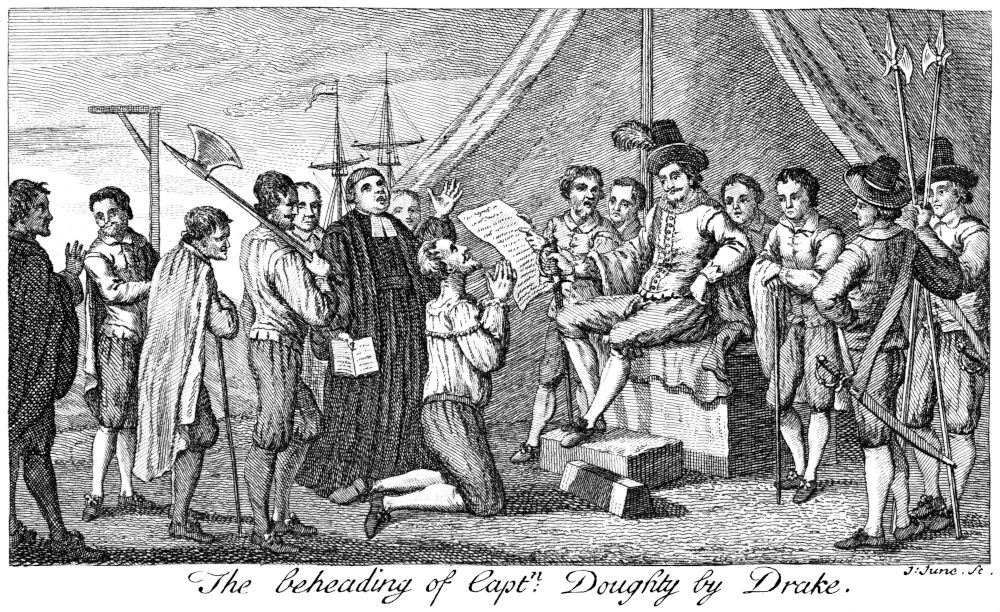
The beheading of Capt
n
. Doughty by Drake.
J. June Sc.
From this plain narrative of the trial and execution of Doughty, of the genuineness of which there cannot be the least doubt, as the concomitant little circumstances all concur to confirm the author both an eye and ear witness of what he has related, there is reason to believe, that the success of the voyage covered the iniquity of the undertaker; and that the immense booty which Drake brought to England, enabled him to stifle the complaints of individuals; and, by a proper address, to convert the acts of oppression, murder, and pyracy, of which he was guilty, into so many deeds of necessary duty, in order to the accomplishment of the main object, the acquisition of wealth at the expence of honesty.
That Drake never had a Commission from the Queen, as his friends would suggest, appears not only from his not producing it at the trial of Doughty (which can hardly be justified, in contempt to the prisoner), but from his not producing it upon another occasion, when, as shall be shewn immediately, he vauntingly produced other credentials of far less moment, in order to justify his conduct, and give him credit with his company. The story, then, of the remarkable words foisted into the mouth of his Sovereign, and recited by his biographer, is as false as inconsistent with the character of that wise Princess, who, though there is reason from her after-conduct to conclude that she was privy to the voyage, yet never openly countenanced it, till after it was completed, and the issue of it determined; as appears from the account of the conversation which Drake himself gave to his followers, a few days before he left Port St. Julian to seek a passage into the South Seas.
“On the 6th of August, says our author, he commanded his whole company to be ashore, and, placing himself in a tent, one side of which was open, and calling Master Winter on one side of him, and John Thomas on the other side, his man laid before him a great paper book, and withal Master Fletcher offered himself to make a sermon. Nay soft, Master Fletcher, said he, I must preach this day myself, although I have small skill in preaching. Well, all ye the company, here are ye, or not? Answer was made, that they were all here. Then commanded he every ship’s company severally to stand together; which was also done. Then, said he, My Masters, I am a very bad orator, for my bringing up hath not been in learning; but whatso I shall here speak, let every man take good notice of, and let him write it down, for I will speak nothing but what I will answer it in England, yea, and before her Majesty, as I have it here already set down [but whether it were in his book or not, that I know not, but this was the effect of it, and very near the words]: Thus it is, my Masters, that we’re very far from our country and friends; we are compassed in on every side with our enemies; wherefore we are not to make small reckoning of a man, for we cannot have a man if we would give for him ten thousand pounds; wherefore we must have these mutinies and discontents that are grown amongst us redressed; for, by the life of God, it doth even take my wits from me to think on it. Here is such controversy between the sailors and the gentlemen, and such stomaching between the gentlemen and sailors, that it doth even make me mad to hear it. But, my Masters, I must have it cease; for I must have the gentlemen to haul and draw with the mariners, and the mariners with the gentlemen: and let us shew ourselves to be all of a company; and let us not give occasion to the enemy to rejoice at our decay and overthrow. I would know him that would refuse to set his hand to a rope; but I trust there is not any such here; and, as gentlemen are very necessary for government sake on the voyage, so have I shipt them for that purpose, and to some further intent; and yet, though I know sailors to be the most envious people of the world, and so unruly without government, yet may not I be without them. Also, if there be any here willing to return home, let me understand of them; and here is the Marygold, a ship that I can very well spare, I will furnish her to such as will return with the most credit that I can give them, either by my letters or any way else; but let them take care that they go homeward; for, if I find them in my way, I will surely sink them; therefore, you shall have time to consider hereof until to-morrow, for, by my troth, I must needs be plain with you; I have taken that in hand that I know not in the world how to go through withal; it passeth my capacity; it hath even bereaved me of my wits to think on it. [Well, yet the voice was, that none would return; they would all take such part as he did.] Well then, my Masters, quoth he, came ye all forth with your own good wills, or no? They answered, All, willingly. At whose hands, my Masters, take ye to receive your wages? At yours, answered the company. Then, said he, how say you, will you take wages, or stand to my courtesy? To your courtesy, good Captain, was the reply. Then he commanded the steward to the Elizabeth to bring him the key of the stores, the which he did; then, turning him unto Master Winter, he said, Master Winter, I do here discharge you of your Captainship; and so in brief he said to all the Officers. Then Master Winter and John Thomas asked him what should move him to displace them? He asked in return, whether they could make any reason why he should not do so? So willing them to content themselves, he willed silence in those matters, saying, Ye see here the great disorders we are entangled into; and, although some have already received condign punishment, as by death, who, I take God to witness, as you all know, was to me as my other hand, yet you see, over and besides the rest, his own mouth did bewray his treacherous dealings: and see, how, trusting to the singularity of his own wit, he over-reacht himself at unawares. But see what God would have to be done; for her Majesty commanded, that of all men my Lord Treasurer should have no knowledge of this voyage, and to see that his own mouth hath declared that he had given him a plot thereof. But, truly, my Masters, and as I am a gentleman, there shall no more die; I will lay my hand on no more, although there be here who have deserved as much as he; and so charging one Worrall that was present, that his case was worse than Doughty’s, who, in Master Doughty’s extremities, was one of Drake’s chief confellows, who, humbling himself to Drake, even upon his knees, prayed him to be good unto him, Well, well, Worrall, said he, you and I shall talk well enough of this matter hereafter. Then he charged one John Audley with some ill dealings towards him, but opened no matter, but said, he would talk with him alone after dinner. Here is some again, my Masters, not knowing how else to discredit me, say and affirm, that I was set forth on this voyage by Master Hatton; some by Sir William Winter; and some by Master Hankins; but these are a company of idle heads that have nothing else to talk of. And, my Masters, I must tell you, I do know them as my very good friends; but, to say that they were the fitters forth of this voyage, or that it was by their means, I tell you it was nothing so. But, indeed, thus it was, My Lord of Essex wrote in my commendation unto Secretary Walsingham more than I was worthy; but by like I had deserved somewhat at his hands, and he thought me in his letters a fit man to serve against the Spaniards for my practice and experience that I had in that trade; whereupon, indeed, Secretary Walsingham did come to consult with his Lordship, and declared unto him, that for that her Majesty had received divers injuries of the King of Spain, for the which, she desired to have some revenge; and withal, he shewed me a plot, willing me to set my hand, and to write down where I thought he might most be annoyed; but I told him some part of my mind, but refused to set my hand to any thing, affirming, that her Majesty was mortal, and that, if it should please God to take her Majesty away, it might so be that some person might reign that might be in league with the King of Spain, and then will mine own hand be a witness against myself. Then was I very shortly after, and on an evening, sent for unto her Majesty by Secretary Walsingham; and, the next day, coming to her Majesty, these, or the like words, she said, Drake, so it is that I would gladly be revenged on the King of Spain for divers injuries that I have received: and said further, that he was the only man that might do this exploit, and withal craved his advice therein, who told her Majesty of the small good that was to be done in Spain, but the only way was to annoy him by his Indies. Then, with many more words, he shewed forth a bill of her Majesty’s adventure of 1000 crowns, which, however, he said at some time before, that her Majesty did give him towards his charges. He shewed also a bill of Master Hatton’s adventure, and divers letters of credit that had passed in his behalf; but he never let them come out of his own hands. He said also, that her Majesty did swear by her crown, That, if any within her realm did give the King of Spain hereof to understand (as she suspected but two), they should lose their heads therefore. And now, Masters, said he, let us consider what we have done: We have now set together by the ears three mighty Princes, namely, her Majesty, the Kings of Spain and Portugal; and, if this voyage should not have good success, we should not only be a scorning, or a reproachful scoffing-stock unto our enemies, but also a great blot to our whole country for ever; and, what triumph would it be to Spain and Portugal; and, again, the like would never be attempted. And now, restoring every man again to his former office, he ended: thus shewing the company that he would satisfy every man, or else he would sell all that he ever had even unto his plate; for, quoth he, I have good reason to promise, and am best able to perform it; for, I have somewhat of mine own in England; and, besides that, I have as much adventure in this voyage as three of the best whatsoever; and, if it so be, that I never come home, yet will her Majesty pay every man his wages, whom indeed you and I all came to serve; and, for to say you came to serve me, I will not give you thanks; for it is only her Majesty that you serve; and this voyage is only her fitting forth: so willing all men to be friends, he willed them to depart about their business. The 8th of August, they weighed anchor and departed; but, the day before, he came on board the Elizabeth, and swore very vehemently, I know not upon what occasion, that he would hang to the number of 30 in the fleet that had deserved it: and then again charged Worrall that his case was worse than Doughty’s, and that by God’s wounds he had deserved to be hanged. And, Master Winter, said he, where is your man Ulysses? By God’s life, if he were my man, I would cut off his ears: nay, by God’s wounds, I would hang him; but wherefore truly I do not know.”
Nothing can be a clearer proof that Drake had no Government Commission than the above account. In his speech, which the writer says is nearly in his own words, he does not so much as pretend to have received any Commission, only a private intimation from the Queen and Walsingham, that her Majesty wanted to be revenged of divers injuries received from the King of Spain. But was countenancing four or five piratical plunderers to rob innocent people, a princely way for one Sovereign to take revenge of another, in times of profound peace? It was, indeed, a pitiful connivance in Queen Elizabeth to engage 1000 crowns in a piratical adventure of this kind, and what could never have been credited of that magnanimous Princess, had she not afterwards approved of his piracy, by going aboard his ship, and openly approving what, it was even then said, least became a trading nation to encourage, the breach of treaties, and piratical practices. But, it is remarkable, that five months elapsed after his return to England before her Majesty’s pleasure was publicly known; during which time men talked variously of the expedition, and the fate of Drake seemed to hang in suspence; so true proved Doughty’s prediction, that “the Queen’s Majesty and Council might be corrupted.”
That Drake bore no naval Commission appears still more clearly, from his displacing the Captains and Officers of all his ships without demanding from them their Commissions; from his lifting his men, not for any hostile expedition, but for a trading voyage to Alexandria; and from his asking them, before his setting sail from the Port of St. Julian to enter the South Seas, from whom they expected their wages. From these circumstances it follows incontestibly, that, if he had a naval Commission, he was the only Officer in the fleet possessed of one;—Doughty, whom he beheaded, and who, before their falling out, was second in command, bore no naval Commission; and, it is more than probable, that this gentleman’s questioning the Commission of Drake was the real cause of his death, as Drake more than once charges him with the overthrow of the voyage, which he could no otherwise effect than by discrediting a Commission, on the authority of which both Officers and men were to be persuaded to plunder a people at peace with their nation, and without which every man was liable to be executed for piracy, whenever he should be overpowered.
It were needless for us to enlarge our remarks; every reader has now the subject before him, and every reader will form a judgment for himself.
What we have said, in consequence of having traced this transaction from beginning to end, may seem to clash with the opinion we previously entertained of Drake’s humanity, courage, and kindness to his followers, but will not seem strange to those who are acquainted with the nature of periodical writings, where one part of the work is necessarily printed off before the other is written. In pursuing the course of this voyage, new authors have been consulted, and new lights collected, which have enabled us to detect not only the errors of other writers, but also to correct our own; and, from the sequel of this voyage, we may venture to foretel, that the reader will concur in sentiment with us, that, though Drake was bold, he was not honest; that, though he did not kill those he plundered and had no motive to destroy, he spared none who opposed his designs, or who did not pay implicit obedience to his arbitrary will; that, though he was an able seaman, he was a jealous rival; and that, though he was a gallant leader, he was a most tyrannical Commander. We shall now accompany him to the South Seas, where the Spaniards, not suspecting an enemy, were in no condition to defend themselves against his attacks.
Drake having reduced the number of his ships to three, they left the port, and on August the 20th entered the Straits of Magellan, in which they struggled with contrary winds, and the various dangers which the intricacy of that winding passage exposed them to, till night, when they had passed the first narrow, and had entered a wider sea, where they discovered an island, to which they gave the name of Elizabeth, in honour of their Sovereign. On the 24th they came to an island, in which they found such an infinite number of birds, since called penguins, that they killed 3000 of them in one day. This bird, of which they then knew not the name, they describe as somewhat less than a wild goose, without feathers, and covered with a kind of down, unable to fly or rise from the ground, but capable of running and swimming with amazing celerity. They feed on fishes in the sea, and come to land only to rest in the day, and lay their eggs, which, according to later voyagers, they deposit in holes, as regularly dispersed and as numerous as the cells in a beehive.
From these islands to the South Sea the strait becomes very crooked and narrow; so that sometimes by the interposition of head-lands the passage seems entirely shut up. To double these capes they found it very difficult, on account of the frequent variations to be made in the course. Here are, indeed, as Magellan observes, many harbours; but in most of them no bottom is to be found, which, however, does not seem verified by experience; the harbours being in general good, though the tides and blasts continually rushing in from various directions create the danger. The land on both sides rises into innumerable mountains; the tops of them were encircled with clouds and vapours, which, being congealed, fall down in snow, and increase their height by hardening into ice; an observation which might naturally occur to Drake, who passed the strait in their winter before the snows were dissolved. However, even at that season, which answers to our February, they found the vallies, in some places, green, fruitful, and pleasant. Anchoring in a bay near Cape Forward, Drake, imagining the strait quite shut up, went in his boat to endeavour to find some other passage out; and, having found an inlet towards the North, was returning to his ships; but curiosity soon prevailed upon him to stop for the sake of observing a canoe or boat with several natives of the country in it. He could not at a distance help admiring the form of this little vessel, which seemed inclining to a semi-circle, the stern and prow standing up, and the body sinking inward; but much greater was his wonder, when, upon a nearer inspection, he found it made only with the barks of trees, sewed together with thongs of seal-skin, so artificially, that scarcely any water entered the seams.
The people were well shaped, and painted like those who have been already described. On the land they had a hut built with poles, and covered with skins, in which they had water-vessels and other utensils, made likewise with the barks of trees. Among these people they had an opportunity of remarking, what is frequently observable in savage countries, how natural sagacity and unwearied industry may supply the want of such manufactures or natural productions as appear to us absolutely necessary for the support of life. Though the inhabitants were wholly strangers to iron and to the use we make of it, yet, instead of it, they substituted the shell of a muscle, of prodigious size, found upon their coasts. This they ground upon a stone to an edge, which was so firm and solid, that neither wood nor stone were able to resist it. With instruments made of shells, these simple people were able to perform all their mechanic operations; nor do they seem so deformed and ugly as our late voyagers represent them, who being, perhaps, more refined than those who sailed with Captain Drake, might fancy a greater difference between themselves and these savages than in nature there really is.
On this occasion we cannot forbear remarking, that, though Drake entered the strait in what is accounted the most unfavourable season, yet he passed it in sixteen days, though, at that time, wholly unknown; a passage the more extraordinary, as none of our later voyagers made it in less than thirty six days in the middle of summer, and Captain Wallis was at least four months in making it.
Drake, as has been said, having taken a survey of the country from Cape Forward, continued his course to the North-west-ward, and, on the sixth of September, entered the great South Sea, on which no English vessel had ever been navigated before; and proposed to have directed his course towards the Line, that his men, who had suffered by the severity of the climate, might recover their strength in a warmer latitude. But his design was scarce formed, before it was frustrated; for on September the seventh, after an eclipse of the moon, a storm arose so violent that it left them little hopes of surviving it: nor was its fury so dreadful as its continuance; for it lasted, with little intermission, thirty-two days, in which time they were driven more than 200 leagues out of their course, without being able either to avail themselves of their sails, or make use of their anchors.
In this storm, on the 30th of September, the Marigold, Captain Thomas, was separated from them; and on the 7th of October, having entered a harbour, where they hoped for some intermission of their fatigues, they were in a few hours forced out to sea again by a violent gust, at which time they lost sight of the Elizabeth, Captain Winter, whose crew, as was afterwards discovered, wearied with labour, and discouraged with the prospect of future dangers, recovered the straits the day following, and, returning by the same passage through which they came, sailed along the coast of Brazil, and, in the year following, arrived in England.
They were now driven Southward 55 degrees, where they discovered a cluster of islands, in one of which they anchored and staid two days, to the great refreshment of the crew, having met with excellent water, and plenty of greens. Not far distant from this bay they entered another, where they beheld some naked inhabitants ranging along the coast in their canoes in search of provisions. With these they exchanged some toys for such refreshments as they had to supply.
And now, being furnished with wood and water, they again set sail, and were, by a new storm, driven to the latitude of 57 degrees, when they beheld the extremities of the American coast, and the confluence of the Atlantic and Southern oceans. Here they arrived on the 28th of October, and at last were blest with the sight of a calm sea, having, for almost two months, endured such a storm, as no voyager has given an account of, and such as in that part of the world, though accustomed to hurricanes, the inhabitants were unacquainted with.
On the 30th of October, they steered towards the place appointed for the rendezvous of the fleet, in case of separation, which was in 30 degrees South; and, on the next day, discovered two islands, so well stocked with fowls, that they victualled their ships with them. After this supply, they sailed northward, along the coast of Peru, till they came to 30 degrees, where, finding neither ships, nor any convenient port, they came to anchor Nov. the 29th, at Mucho, an island inhabited by such Indians as the cruelty of their Spanish conquerors had driven from the continent, to whom they applied for water and provisions, offering them in return such things as they imagined most likely to please them. The Indians seemed willing to traffic; and, having presented them with fruits and two fat sheep, shewed them a place where they might come for water.
Next morning, according to agreement, the English landed with their water-vessels, and sent two men forward towards the place appointed, who, about the middle of the way, were suddenly attacked by the Indians and immediately slain. Nor were the rest of the company out of danger; for behind the rocks was lodged an ambush of 500 men, who, starting up from their retreat, discharged their arrows into the boat with such dexterity, that every one of the crew was wounded by them. The sea being then high, and hindering them from either retiring or making use of their weapons, Drake himself received an arrow under his eye, which pierced him almost to the brain; and another in his breast. The danger of these wounds was much increased by the absence of their surgeon, who was in the Elizabeth, so that they had none to assist them but a boy, whose age did not admit of much experience or skill; yet so much were they favoured by Providence, that they all recovered. No reason could be assigned for which the Indians should attack them with so furious a spirit of malignity, but that they mistook them for Spaniards, whose cruelties might very reasonably incite those to revenge, whom they had driven, by incessant persecution, from their country, wasting immense tracts of land by massacre and devastation. Nuno da Sylva adds, that none of the Indians were hurt by the English, though they came so near the boat, as to seize and carry off four of the oars.
On the afternoon of the same day they set sail, and on the 30th of November dropt anchor in Phillip’s bay, where their boat, having been sent out to discover the country, returned with an Indian in his canoe whom they had intercepted. He was of a graceful stature, drest in a white coat or gown, reaching almost to his knees; very mild, humble, and docile; such as perhaps were all the Indians, till the Spaniards taught them revenge, treachery, and cruelty. This Indian, having been kindly treated, was dismissed with presents; and informed, as far as the English could make him understand, what they chiefly wanted, and what they were willing to give in return; Drake ordered his boat to attend him, and set him safe on shore.
When he was landed, he made signs for the boat to wait till his return, and meeting some of his countrymen, gave them such an account of his reception, that, within a few hours, several of them repaired with him to the boat, with fowls, eggs, and a hog; and with them one of their captains, who willingly came into the boat, and desired to be conveyed by the English to their ship.
By this man Drake was informed that no supplies were to be expected here; but that Southward, in a place to which he offered to be his pilate, there was great plenty. This proposal was accepted, and on the 5th of December, under the direction of the good-natured Indian, they came to anchor in the harbour called by the Spaniards Val Parizo, in 33 deg. 40 min. S. latitude, near the little town of St. Jago, where they met not only with sufficient stores of provisions, and with storehouses full of the wines of Chili, but with a ship called the Captain of Morial, richly laden, having, together with large quantities of the same wine, some of the fine gold of Baldivia to the amount of threescore thousand pezoes, each pezo of the value of eight shillings, and a great cross of gold set with emeralds. The Spaniards at first, mistaking the English for friends, invited them to feast with them; but soon being undeceived, one of the crew jumped overboard, and alarmed the town; but the inhabitants, instead of making opposition, fled hastily, and left whatever was in the town a prize to the enemy. In the chapel Drake and his men found the most valuable booty.
Having spent three days here in storing their ships, and loading the money and effects, they departed, and landed their Indian pilot where they first received him, after having rewarded him much above his expectations or desires. They had now little other anxiety than for their friends, who had been separated from them, and whom they now determined to seek. But considering that, by entering every creek and harbour with their ships, they exposed themselves to unnecessary dangers, and that their boat could not contain such a number as might defend themselves against the Spaniards, they determined to station their ship at some place where they might commodiously build a pinnace, which, being of light burden, might safely sail where the ship would be in danger of being stranded; and, at the same time, carry a sufficient force to resist the enemy, and afford better accommodation than it was possible to obtain in the boat. To this end, on the 19th of December, they entered a bay near Coquimbo, a town inhabited by the Spaniards, who, discovering them immediately, issued out to the number of 100 horsemen, with about 200 naked Indians running by their sides. The English, observing their approach, retired to their boat without any loss, except of one man, whom no persuasions or intreaties could move to retire with the rest, and who was therefore overtaken by the Spaniards, who thought to have taken him prisoner, but, having an halbert in his hand, he manfully defended himself, till, being overpowered by numbers, he was run through the body with a lance. The Spaniards, exulting at the victory, ordered the Indians to draw the dead carcase from the rock on which he fell, and in the sight of the English beheaded it, and then cut off the right hand, and tore out the heart, which they carried away in triumph.
Leaving this place, they soon found a harbour more secure and convenient, where they built their pinnace, in which Drake went to seek his companions; but, finding the wind contrary, he was obliged to return in two days.
From hence they came to a port called Sarcipaxa, where, being landed, they found a Spaniard asleep with silver bars lying by him to the value of 4000 Spanish ducats: notwithstanding the insults which they had received from his countrymen, they did not think fit to disturb this harmless man’s repose, but, taking the silver, left him quietly to sleep out his nap.
Coasting along the shore, they observed a Spaniard driving eight Peruvian sheep, which on landing they found to be laden with silver, each sheep having 100lb. weight in two leather bags across his back. They delivered the poor animals of their heavy burdens, and lodged the bags in their own ships.
Farther on lay some Indian towns, from which the inhabitants repaired to the ship on floats made of seal-skin blown full of wind, two of which they fasten together, and, sitting between them, row with great swiftness, and carry considerable burdens. They very readily traded for glass and such trifles, with which the old and the young seemed equally delighted.
Arriving at Marmarena on the 26th of January, Drake invited the Spaniards to traffic with him, which they accepted; and supplied him with necessaries, selling to him, among other provisions, some of those sheep which have been mentioned, whose bulk is equal to that of a cow, and whose strength is such, that one of them can carry three tall men upon his back; their necks are like a camel’s, and their heads like those of our sheep. They are the most useful animals of this country, not only affording excellent fleeces and wholesome flesh, but serving as carriers over rocks and mountains, where no other beast can travel for their foot is of a particular form, which enables them to tread firm on the steepest and most slippery places.
On all this coast, it is said, the mountains are so impregnated with silver, that from one hundred weight of common earth five ounces of fine silver may be separated.
They continued their course towards the North, and on the 7th of February arrived at Arica, in 8 deg. 30 min. S. latitude, and in this port found three small barks, in which they found 57 slabs of silver, each of the size and shape of an ordinary brick, and weighing about 20lb. They took no prisoners; for the crews, fearing no interlopers, were all on shore carousing with one another. At this port the Spaniards were wont to land their merchandize, and to embark the silver, which was transported from thence to Panama; but, since Drake’s incursion, they carry their silver over land to Lima, and load no more treasure here, except what they pay for the purchase of such merchandize as is brought from Europe to supply their market. Wanting numbers to assault the town, they proceeded in their course, and falling in with a small coasting-vessel, laden with linen and other cloaths, Drake supplied his crew with what quantity of those articles they stood in need of, and dismissed the Spaniards with the remainder.
From hence they sailed to Chuli; in which port there was a ship that had 300,000 pezoes of silver in bars; but the Spaniards had sent an express from Arica, to acquaint the Governor that Drake was upon the coast. This express arrived at Chuli, just two hours before Drake entered the port; in which time the master of the ship had thrown his treasure overboard, and had secured himself and crew on shore, leaving only one Indian on board to make the report. Drake, fearing the alarm would spread faster than he could sail, lost no time in hazardous searches, but instantly departed, and steered for Lima, where they arrived on the 15th of February, and entered the harbour without resistance, in which, according to some writers, there were thirty sail of ships; others say, twelve; but all agree, that several of them were of considerable force: so that Drake’s security consisted not in his strength, but in his reputation, which had so intimidated the Spaniards, that the sight of their own superiority could not rouse them to opposition. Instances of such panic terrors are to be met with in other relations; but as they are, for the most part, quickly dissipated by reason and resolution, a wise Commander will rarely ground his hopes of success on them; and, perhaps, on this occasion, the Spaniards scarcely deserve a severer censure for their cowardice, than Drake for his temerity. A writer of good authority, to reconcile the matter, tells us, that Drake took them at unawares, and that the crews, as is usual in times of perfect security, were with their families on shore; and many of those who were ready to sail, were taking leave of their friends. Be this as it may, all seem to agree, that Drake made here a considerable booty, having taken from one ship a chest full of rials of plate, which he found concealed under the steerage, and, from other ships, silks and linen cloth to a considerable value. He did not, however, remain long in this harbour, but hastened in pursuit of the Cacafuego, which ship had sailed but three days before, and which, they were here informed, was bound to Paita. In the pursuit, they fell in with another ship, out of which they took a large quantity of gold, together with a crucifix of the same metal, richly adorned with emeralds. They continued the pursuit; but, having gained intelligence, that, instead of Paita, she was gone to Panama, Drake crouded all the sail he could, and, to encourage the pursuers, promised, that whoever first descried the prize should have his gold chain as a reward; which fell to the lot of his brother John. On the 1st of March they came up with her, and, after exchanging a few shot, they boarded her, and found not only a quantity of jewels, and thirteen chests of money, but eighty pounds weight of gold, and twenty-six tons of uncoined silver, with services of wrought plate to a great value. In unlading this prize they spent six days; and then dismissing the Spaniards, stood off again to sea.
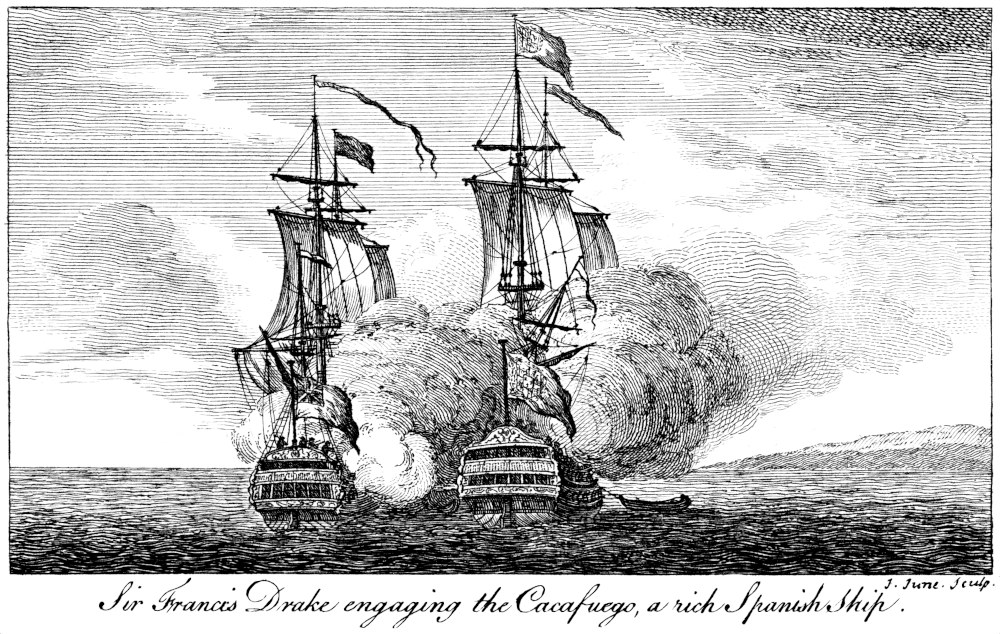
Sir Francis Drake engaging the Cacafuego, a rich Spanish ship.
J. June Sculp.
Lopez Vaz, a Spanish writer, tells us, that, in less than 24 hours after their departure from Lima in pursuit of the Cacafuego, news was brought that Drake was upon the coast, but that the Governor had already assembled the force of the country to oppose his landing; and that, finding he had left the harbour, he ordered three ships with six pieces of cannon (being all he could collect), and 250 men, to pursue him: but, the equipment of these vessels necessarily requiring time, Drake had gained the advantage of them: and, coming within sight of the prize off Cape Francisco, the Captain of which, Juan de Anton, a Biscayan, seeing at a distance a ship crouded with sails, and imagining the Viceroy of Peru had dispatched her on some message to him, struck his sails, and lay to till Drake approaching nearer, he discovered his mistake. He would then have made his escape, but Drake nearing him fast with his great ordnance, against which the Captain could make no defence, he was constrained to yield. “There was in this ship, adds the Spaniard, eight hundred and fifty thousand pezoes of silver, and forty thousand pezoes of gold, all which silver and gold was customed: but what treasure they had uncustomed, I know not; for many times they carry almost as much more as they pay custom for; otherwise the King would take it from them, if they should be known to have any great sum; wherefore every ship carries a bill of custom, that the King may see it. All the treasure which Drake took was merchants and other mens goods, saving 180,000 pezoes of the King’s. He had also out of this ship good store of victuals, with other necessaries, which were to be carried from Panama, and was five days in taking out such things as he needed.
“This done, he sailed to the coast of New Spain, without going to Panama. The ships that were sent by the Viceroy of Peru from Lima, arrived off Cape St. Francisco 20 days after Drake had taken the Cacafuego, and had intelligence by a ship coming from Panama, which they met at the said Cape, that Francis Drake had taken the ship with silver, and was not gone for Panama; whereupon the Commander of the three ships, thinking that Captain Drake had been gone for the Straits of Magellan, directed his course that way to seek him.”
Thus Drake, changing his course to the west, escaped his enemies, and fell in with a ship from the East Indies laden with silks, China ware, and cotton. The owner, a Spaniard, was on board, who presented Drake with a falcon wrought in massy gold, with an emerald set in the breast of it, the largest he had ever beheld. With this present, and a golden cup from the pilot, Drake was contented, and dismissed the ship, taking only four chests of China ware, which at that time was of great value in Europe.
On the 13th of March they came in sight of land, which happened to be a small island about two leagues from the main continent. There they found a harbour, and anchored in five fathom water, where they staid till the 20th, on which day, a little coasting frigate passing by, was pursued by the pinnace, boarded, and taken. Being laden with sasaparilla, honey, butter, and other country goods, Drake unloaded the sasaparilla, and in the room of it put the gold and silver from his own ship, in order to heave her up, to new caulk her sides, and stop her leaks; in which service the crew were employed till the 26th of the same month, when having reloaded the cargo, and taken in a sufficient quantity of wood and water, they continued their course westward along the coast, taking the Spanish frigate with them to bear them company.
On April 6, a little before sun-set, they discovered a ship, that held on her course about two leagues to seaward from the main land. To this ship they gave chace, and before morning they neared her, and suddenly boarded her while the men slept. Being masters of this prize without resistance, they ordered the prisoners on board their own ship, among whom was one Don Francisco Xarate, who meant to sail to Panama, and from thence to China, with the letters and patents that were found in his possession (among which were the letters of the King of Spain to the Governor of the Philippines); as also the sea charts wherewith they were to be directed in their voyage, which were of admirable use to Drake in his return home. From this ship they took great quantities of bale-goods, and other valuable merchandize, and then dismissed her. They also took a young negroe girl, whom Drake or some of his companions having got with child, they afterwards inhumanly set her on shore on an island in their way home, just as she was ready to lie in; of which notice will be taken in its proper place. Having retained a Spanish pilot from this ship, they obliged him to direct them to a safe harbour, where they might supply themselves with provisions for their intended voyage. This man brought them to the harbour of Anguatulco, or, as others write, Guatalco, where arriving on the 13th of April, they staid till the 26th of the same month, and then set sail, having first dismissed all their Spanish prisoners, together with Nuno da Sylva, the Portugueze pilot, whom they brought from the Canaries, and who had served them faithfully in all their trials and dangers; in reward for which he was now abandoned by Drake to the mercy of the enemy. This man, when he landed on the continent, was first carried to Mexico, and there put to the torture to make discoveries. He was afterwards sent prisoner into Old Spain, and there examined; and, having given a faithful relation of all he knew, was released, and returned home to his own country, where he published, as has already been said, an account of the voyage as far as he went, which was afterwards translated into all the European languages, and universally read.
On their arrival at Anguatulco, they had no sooner landed than Drake with part of his men marched up to the town, where they found the chief magistrate sitting in judgment upon a parcel of poor savages, and ready to pass sentence of death upon almost all of them, they being charged with a conspiracy to kill their masters, and set fire to the town. Drake changed the scene, and made judges and criminals without distinction, his prisoners, conducting them all in procession to his ship. Here he made the Judge write an order to the Commanding Officer to deliver up the town, in which they found a great pot, says my author, as big as a bushel, full of rials of plate, a gold chain, and a few jewels. The gold chain was taken from a gentleman who was making his escape from the town, but was intercepted by an English sailor, who rifled him of all the valuables he had about him, of which the gold chain was thought to be of the least value.
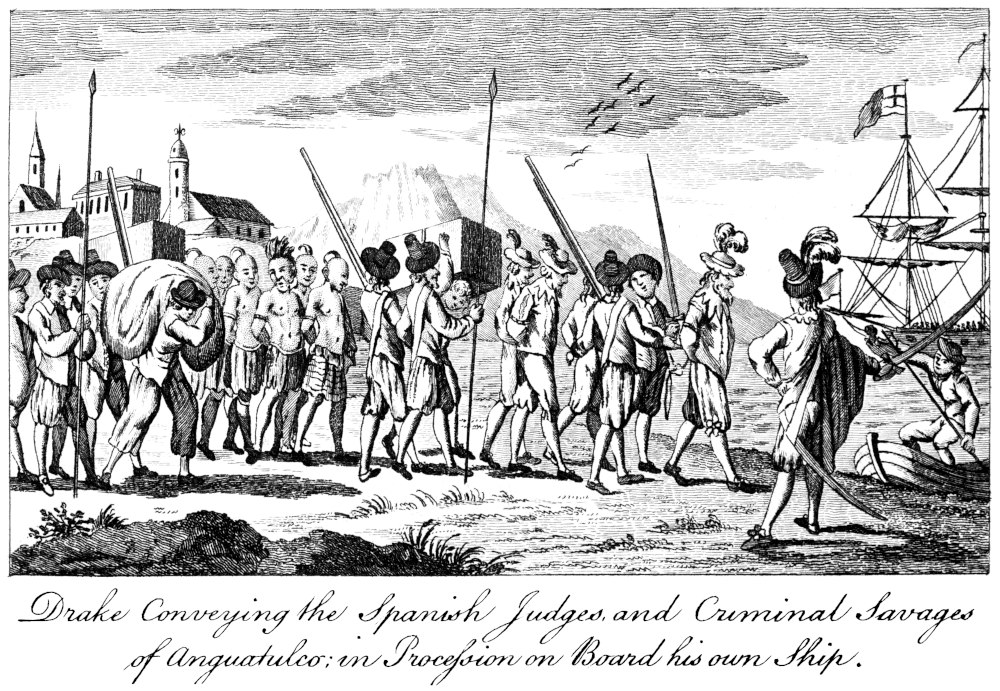
Drake Conveying the Spanish Judges and Criminal Savages of Anguatulco; in Procession on Board his own Ship.
Being now sufficiently enriched, and having given over all hopes of finding their associates, and, perhaps, beginning to be infected with that desire of ease and pleasure which is the natural consequence of wealth obtained by successful villainy, or, what is still more probable, being in fear of a surprize before they had secured their booty, they began to consult about their return home; and, in pursuance of Drake’s advice, resolved first to find out some convenient harbour where they might more safely lie and equip themselves for the voyage, and then endeavour to discover a nearer passage from the South Seas into the Atlantic Ocean; a passage that would not only enable them to return home with full security, and in a shorter time, but would much facilitate the navigation into those parts, and of course immortalize their names.
For this purpose they had recourse to a port in the island of Canes, where they met with fish, wood, and fresh water; and, being sufficiently stored with other provisions, with which they had supplied themselves from their prizes and at Anguatulco, they set sail first with a resolution of seeking a passage by the north-west, and, if that failed, by the Moluccas, and thence, following the course of the Portugueze, to return by the Cape of Good Hope.
In pursuance of the first resolution, they sailed about 600 leagues, till coming into the latitude of 43 deg. north, they found the air so excessive cold, that the men could no longer bear to handle the ropes to navigate the ship: they, therefore, changed their course till they came into the latitude of 38 deg. and 30 min. under which height they discovered a very good harbour, and, fortunately, had a favourable wind to enable them to enter it.
Here, on the 17th of June, they cast anchor, and, in a short time, had opportunities of observing that the natives of that country were not less sensible than themselves; for, the next day, there came a man rowing in his canoe towards the ship, and, at a distance from it, made a long oration with very extraordinary gesticulations, and great appearance of vehemence; and, a little time afterwards, made a second visit in the same manner; and then returning a third time, he presented them, after his harangue was finished, with a kind of crown of black feathers, such as their kings wear upon their heads, and a basket of rushes filled with a particular herb, both which he fastened to a short stick, and threw into the boat: nor could he be prevailed upon to receive any thing in return, though pushed towards him upon a board, only he took up a hat that was flung in the water.
Three days afterwards, the ship, having received some damage at sea, was brought nearer to land, that her lading might be taken out; in order to which, the English, who had now learned not to commit their lives too negligently to the mercy of savage nations, raised a kind of fortification with earth and palissades, and erected their tents within it. All this was not beheld by the inhabitants without the utmost astonishment, which incited them to come down in crouds to the coast, with no other view, as it afterwards appeared, but to compliment the beautiful strangers that had condescended to touch upon their country.
Drake, neither confiding too much in appearances, nor wholly distrusting the friendly disposition of the inhabitants, directed them to lay aside their bows and arrows, and, on their approach, presented them with linen and other necessaries, of which he shewed them the use. They then returned to their habitations, about three quarters of a mile from the English camp, where they made such loud and violent noises, that they were heard by the English, who had vanity enough to believe that they were paying them a kind of melancholy adoration.
Two days afterwards, they perceived the approach of a far more numerous company, who stopt at the top of a hill which over-looked the English settlement, while one of them made a long oration, at the end of which all the assembly bowed their bodies, and pronounced the syllable Ob with a solemn tone, as by way of confirmation of what had been said by the orator. Then the men laying down their bows, and leaving their women and children on the top of the hill, came down towards the tents, and seemed transported in the highest degree at the kindness of Drake, who received their gifts, and admitted them to his presence. The women at a distance appeared seized with a kind of phrenzy, such as that of old among the Pagans in some of their religious ceremonies, and, in honour as it seemed of their guests, tore their cheeks and bosoms with their nails, and threw themselves upon the stones with their naked bodies.
Three days after this, on June 25, 1579, Drake received two Ambassadors from the Hioh, or King, of the country, who, intending to visit the camp, required that some token might be sent him of friendship and peace. This request was readily complied with; and soon after came the King, attended by a guard of about an hundred tall men, and preceded by an Officer of State, who carried a sceptre made of black wood, adorned with chains made of a kind of bone or horn, which are marks of the highest honour among them. Behind him was the King himself, dressed in a coat of beasts skins, with a crown woven with feathers upon his head. His attendants followed, dressed nearly in the same manner all but the crown; and after them came the common-people, with baskets platted so artificially that they held water, in which, by way of present, they brought roots and fish.
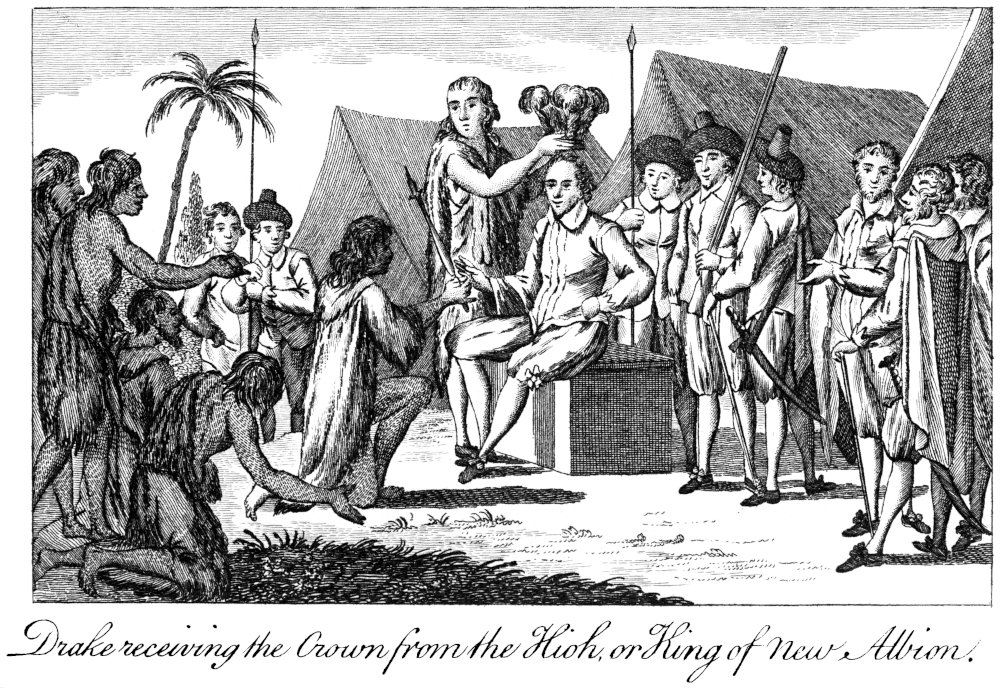
Drake receiving the Crown from the Hioh, or King of New Albion.
Drake, not lulled into security, ranged his men in order of battle, and waited their approach, who coming nearer, stood still, while the scepter-bearer made an oration; at the conclusion of which, they came again forward at the foot of the hill, and then the scepter-bearer began a song, which he accompanied with a dance, in both which the men joined, but the women danced without singing. Drake now distrusting them no longer, admitted them into his fortification, where they continued their song and dance a short time; and then both the King and some others of the company made a long harangue, in which it appeared, by the rest of their behaviour, that they entreated them to accept of the government of their country; and the King, with the concurrence of the rest, placed the crown upon Drake’s head, graced him with the chains and other signs of authority, and saluted him with the title of Hioh. The kingdom thus offered, though of no farther value to him than that it furnished him with present necessaries, Drake thought it not prudent for him to refuse; and, therefore, took possession of it in the name of Queen Elizabeth, not without ardent wishes that this acquisition might be of use to his native country. The kingdom being thus consigned, and the grand affair at an end, the common people left their King and his Nobles with Drake, and dispersed themselves over the camp; and when they saw any one that pleased them more than the rest, they tore their flesh and vented their outcries, as before, in token of reverence and respect. They then proceeded to shew them their wounds and diseases, in hopes, perhaps, of a miraculous cure; to which the English, to benefit and undeceive them at the same time, applied such remedies as they used on like occasions.
They were now grown confident and familiar, and came down to the camp every day, repeating their ceremonies, till they were more fully informed how disagreeable they were to those whose favour they were so studious of obtaining. They then visited them without ceremony, indeed, but with a curiosity so ardent, that it left them no leisure to provide the necessaries of life, with which the English were, therefore, obliged to supply them. They had, then, sufficient opportunity to remark the custom and disposition of these new allies, whom they found tractable and benevolent, strong of body far beyond the English, yet unfurnished with weapons either for assault or defence, their bows being too weak for any thing but sport. Their dexterity in taking fish was such, that, if they saw them so near the shore that they could come to them without swimming, they never missed them.
The same curiosity that had brought them in such crouds to the shore, now induced Drake and some of his companions to travel up into their country, which they found at some distance from the coast very fruitful, filled with large deer, and abounding with a peculiar kind of cunnies smaller than ours, with tails like rats, paws such as those of a mole, and bags under their chins, in which they carry provisions to their young.
The houses of the inhabitants were round holes dug in the ground, from the brink of which they raise rafters, or poles, shelving towards the middle, where they all meet in a ridge, and are crampt together; the people lie upon rushes, and make the fire in the middle of the house, letting the smoke fly out at the door. The men are generally naked; but the women make a kind of petticoat of bulrushes, which they comb like hemp, and throw the skin of a deer over their shoulders. They are very modest, tractable, and obedient to their husbands. The soil is but badly cultivated; but contentment seems to prevail in a very eminent degree among all ranks of this happy people.
The land was named by Drake New Albion, from its white cliffs, in which it bore some resemblance to his native country, and the whole history of the resignation of it to the English was engraven on a piece of brass, then nailed on a post, and fixed up before their departure, which being now discovered by the people to be near at hand, they could not forbear perpetual lamentations.
When the English on the 23d of July weighed anchor, they saw them climbing to the tops of hills, that they might keep them in sight, and observed fires lighted up in many parts of the country, on which, as they supposed, sacrifices were offered.
Near to this harbour, they touched at some islands where they found abundance of seals; and, despairing now to find any passage through the northern regions, they, after a general consultation, determined to steer away to the Moluccas; and, setting sail July 25, they held a western course for 68 days without sight of land; and, on September 30, arrived within view of some islands, about 20 deg. northward from the Line, from whence the inhabitants resorted to them in canoes hollowed in the middle, and raised at both ends so high above the water, that they seemed almost a semi-circle; they were burnished in such a manner that they shone like ebony, and were kept steady by a piece of timber fixed on each side of them. The first company that came brought fruits, bananas, and other things of no great value, with an appearance of traffic, and exchanged their lading for other commodities with great show of honesty and friendship. But having, as they imagined, laid all suspicion asleep, they sent another fleet of canoes, of which the crews behaved with all the insolence of savages, and all the rapacity of thieves; for, whatever was suffered to come into their hands, they seemed to consider as their own, and would neither pay for it nor restore it: and, at length, finding the English resolved to admit them no longer, they discharged a shower of stones from their boats, which insult Drake prudently and generously returned, by firing his great guns without hurting them; at which they were so terrified, that they leaped into the water, and hid themselves under their canoes.
Here we cannot help remarking how nearly this description agrees with the accounts given by the late navigators, of the temper and disposition of the inhabitants of the islands lately discovered between the Tropics. Drake, indeed, found the firing of his guns without hurting them, sufficient to intimidate these ignorant people; but our later voyagers have thought their vengeance not complete for any slight insult, without murdering them by wholesale to strike them with terror. The writer of the late voyages says, “Our men shewed as much impatience to destroy them as a sportsman to kill his game.”
Having for some time but little wind, they did not arrive at the Moluccas till the 3d of November; and then, designing to touch at Tidore, as they coasted along the island Mutua, belonging to the King of Ternate, they were visited by his Viceroy, who informed them that it would be more advantageous for them to have recourse to his master for supplies, than to the Portuguese, with whom he was at enmity. Drake was, by the arguments of the Viceroy, prevailed upon to alter his resolution; and, on November the 5th, cast anchor before Ternate. Scarce was he arrived, before the Viceroy, with others of the chief nobility, came out in three large barges rowed by forty men on each side, to conduct the ship into a safe harbour; and, soon after, the King himself, having received a velvet cloak by a messenger from Drake, as a token of peace, came with such a retinue and dignity of appearance, as was not expected in those remote parts of the world. He was received with discharges of cannon, and every kind of music, with which he was so much delighted, that he invited the performers on board his barge.
The King was of a graceful stature and royal carriage, of a mild aspect and low voice. His attendants were dressed in white cotton or callico, of whom some, whose age gave them a venerable appearance, seemed as councilors, and the rest officers or nobles. His guards were not ignorant of fire-arms, but had not many among them, being equipped for the most part with bows and darts. The King, having spent some time in admiring the new objects that presented themselves, retired as soon as the ship was brought to anchor, and promised to return on the day following and in the mean time the inhabitants, having leave to traffic, brought down provisions in great abundance. The King came not aboard, according to his promise, but sent his brother to excuse him, and withal to invite Drake ashore, proposing to stay himself as an hostage for his return. Drake declined going himself, but sent some gentlemen of his retinue in company with the King’s brother, and kept the Viceroy till their return.