Sir FRANCIS DRAKE’s VOYAGES, PARTICULARLY THAT ROUND THE WORLD, In 1577, 1578, 1579, and 1580.
Reading edition
Before we proceed to the relation of the particular Voyages that characterize the navigators who first surrounded the globe, and who immortalized their names by their skill and their courage, it may be expected that we should give some account of their families and first setting out, the distinguishing marks of genius that led them to prefer the fatigues and dangers of a sea-faring life to learned ease, or the calm pursuit of less hazardous employments; and that we should trace the steps by which they rose to eminence by their bravery and their conduct.
The bare narration of the incidents recorded in a single voyage, however memorable, would convey but a very imperfect knowledge of the general character of those renowned heroes, who carried the glory of their country to the remotest regions of the earth. We shall, therefore, endeavour to follow them as they advance to fame, and accompany them from their highest elevation to that period when all distinctions are levelled.
The celebrated mariner, of whom we are now to give an account, was son to Edmund Drake, a gentleman of Tavistoke, in Devonshire, who, being inclined to the doctrine of the Protestants, at that time much opposed by Q. Mary, was obliged to quit his place of residence, and retire to Medway, in Kent; where, after that Queen’s death, he was first appointed Chaplain in the royal navy, and afterwards Vicar of Upnor. In these employments, his appointments being small, and his family large, he owed the education of several of his children to the kindness of his relations, and that, in particular, of Francis, the eldest of twelve, to Sir John Hawkins; under whom, as it appears, he very early distinguished himself, and laid the foundation both of his fame and his fortune.
The learned Camden, indeed, informs us, that he was put apprentice to the master of a small trading vessel, in whose service he behaved so well, that his master, dying a batchelor, left him his vessel as a reward for his diligence: but Stowe, who seems better informed, represents him in a superior light; tells us, that Francis Russel, afterwards Duke of Bedford, was his godfather; and that Sir John Hawkins was his near relation. What Camden relates of Francis may, however, be true of his brother; for there were no less than four who were bred to the sea.
Be this as it may, the first enterprize of consequence, in which we find him engaged, was in a voyage to the West-Indies, as Captain of the Judith, under his relation already mentioned. Those islands, having but lately been discovered, and very little frequented by the English, were thought so much to abound in wealth, that no voyager thither could fail of being recompensed with great advantages. Nothing was talked of among the mercantile or adventurous part of mankind but the beauty and riches of the new world. Fresh discoveries were frequently made; new countries and nations, never heard of before, were daily described; and it may easily be concluded, that the relators did not lessen the merit of their discoveries, by suppressing or diminishing any circumstance that might produce wonder, or excite curiosity.
This was the age of enterprize and discovery; and her Majesty encouraged the ardour of her subjects by furnishing ships and commissions to such officers of distinction in her royal navy as were willing to engage in hazardous pursuits.
The projects, however, that were formed, were not always successfully carried into execution; they were frequently defeated by the ignorance of the adventurers, but more often by the malice of the Spaniards, who, from the first discovery of America, considered every other nation that attempted to follow them, as invaders of their rights, and incroachers on their territories. At that time, however, as now, it was no uncommon thing for those who went in search of new discoveries, to carry on a kind of contraband trade with the new settlers; which, though prohibited by the Crown of Spain, was yet countenanced by the Viceroys and Governors: but even these would sometimes take advantage of the power lodged in their hands, and make prize of the profits of the voyage, under pretence of an illicit trade.
Among those who suffered most by the injustice of the Viceroys, was Sir John Hawkins; who, having struck out a new trade, highly advantageous to the parties concerned, though disgraceful to humanity, supplied the Mexican Spaniards with slaves from Africa, and received from them, in return, large remittances in gold and silver. This was connived at, though we do not find that it was absolutely tolerated, by the Spanish court.
It was, however, after one of those successful voyages, in which we find two of the Queen’s ships engaged (namely, the Jesus, commanded by Hawkins, as Admiral; and the Minion, of which Captain John Hampton was Commander; with four other armed trading ships, among which was the Judith, Captain Drake), that, being driven by stress of weather into the port of St. John d’Ulloa, in the bay of Mexico, they were there waiting for a supply of provisions, when the Spanish fleet from Europe arrived, consisting of 12 sail, richly laden with European merchandize, and on board of which was a new Viceroy.
As the port was then absolutely in the power of the English, it was debated, among the principal officers, whether the Spanish fleet should be suffered to enter; as their Admiral suspected, that, if they were admitted, they would contrive some means of distressing him; and if they were not, they must perish at sea; an event that would certainly bring on a war,—a consequence he could by no means justify.
Upon mature deliberation, it was, therefore, judged safest to propose an agreement with the Viceroy, to which he consented, and by which it was stipulated, that the English should hold one side of the harbour, and the Spaniards the other; and that hostages should be given on both sides, that no injury should be done to either. But it was soon discovered, that, though on the part of the English, six gentlemen were sent, yet, on that of the Spaniards, the hostages were only common men, finely dressed. This gave cause of distrust; yet the English, naturally honest, were not sufficiently on their guard.
The Spaniards for some weeks behaved with seeming cordiality; mutual civilities passed between the officers of both nations; and the English, having supplied their wants, were preparing to depart, when, all of a sudden, at a signal given, the Spaniards assaulted their ships as the officers were at dinner, boarded the Minion by a concealed ambuscade, which, however, was repulsed with loss, and then a general massacre ensued. The English who were on shore were all put to death; three of the four trading ships were presently sunk; and the Minion and Jesus were so embarrassed by their moorings, that it was almost a whole hour before they could be placed in a posture of defence; which, however, was at last effected. They then returned the attack with so much fury, that the Spanish Vice-Admiral was soon blown up, and in her perished 300 men; and not long after the Spanish Admiral himself was sunk. The Spaniards, in revenge, set two of their ships on fire to burn the Minion and Jesus, the first of which set sail and escaped; but the Jesus, after shifting her crew on board the Judith, fell a victim with the rest to Spanish treachery.
In the night, the Judith having made her escape, endeavoured, but in vain, to join the Minion; and being only a bark of 50 tons, alone, on a hostile coast, crouded with men, and having only provisions on board for her own slender crew, a mutiny arose among the mariners, and by far the greatest number insisted on being put on shore, chusing rather to take their chance among the savages, than to remain on board to starve at sea, or again to fall into the power of the merciless Spaniards.
Accordingly, Captain Hawkins, gave every man his choice, either to land on the continent, or sail with him, and share his fate. About 100 of the stoutest seamen chose the former; of whom five only lived to return to England. These gave an account, that, on their landing, the natives, mistaking them for Spaniards, fell upon them suddenly, and killed eight of their number; that, after they were known to be enemies to the Spaniards, they were used with kindness; that, however, being tired of living among savages, they agreed to part, and seek the means of returning home; some directed their course to the northward, and watched the opportunity of seizing a small vessel, and, crossing the Gulph, traversed an immense tract of land, till they arrived at a French settlement in the North; of those who travelled westward, which was by far the greatest part, sixty-five fell into the hands of the Spaniards, and suffered various torments from the Inquisition, three were burnt alive, and two only survived to reach their own country. Of those who followed the other course, five found means, after enduring incredible hardships, to get to Nova Scotia, of whom three were brought safe to England in French merchants ships.
It was in the above engagement that Capt. Drake first distinguished himself; and to his judicious conduct, that those who escaped from the Jesus owed their preservation. The Judith had the good fortune to arrive safe in England, having purchased some provisions on the Island of Cuba; but what became of the Minion we have not been able to learn.
In this expedition Sir John Hawkins lost an immense sum. It was in vain to make complaint to his sovereign of the infraction of the peace. The Spanish minister vindicated the injustice of the Viceroy and the Queen, tho’ she secretly resented the loss of her ships, could not openly abett the illicit trade carried on by her servants.
Drake, who shared in the misfortune of his relation, possessed both his spirit and his industry. He did not sit down to lament the loss he had sustained; but, having acquired some degree of credit by his gallant behaviour, and some knowledge of the weakness and wealth of his enemies, he determined to profit by his losses, and to make reprisals whenever a fair opportunity should offer.
It was no difficult matter to engage new adventurers in new projects in those early days of Mexican commerce, and Drake was not long before he raised a fund to begin trade on a new footing. In 1570 he made his first expedition, chiefly on his own account, with two ships, the Dragon and the Swan; and the next year in the Swan alone; in both which voyages he enlarged his experience, but it does not appear that he repaired his loss.
In 1572 he found means, however, to fit out a much greater force, in order to carry into execution an enterprise which he had meditated, not only to reinstate his fortune, but to revenge the treachery of his enemies.
About this time war was agitating between England and Spain, to which it must be confessed the illicit trade carried on to the Spanish settlements not a little contributed. He, therefore, set sail from Plymouth in the Pascha, a letter of marque ship, of 70 tons, accompanied by the Swan, of 50 tons, the command of which he entrusted to his brother John; in both which ships he had embarked 73 choice men, with a year’s provisions and such warlike stores and ammunition as he judged necessary for the enterprize he had in view. He had, likewise, the precaution to take with him the frames of two or three small pinnaces, that, if any accident should befal either of his larger ships, he might have it in his power to preserve the crew without being driven to the necessity of leaving any of them behind; a precaution which experience had taught him in the unfortunate voyage of his kinsman Sir John. But this was not the only use for which he foresaw these small vessels would be wanted, as will appear in the sequel.
With this warlike force, inconsiderable as it may now appear, he cleared the land of England on the 12th of May, 1572; and, the weather continuing fair, and the wind favourable, on the 29th of June he passed between Dominica and Guadaloupe, and on the 6th of July came in sight of the high land of Santa Martha; then continuing his course to the southward, on the 15th of the same month both ships arrived at Port Pheasant, which lay at a convenient distance from Nombre de Dios, the place of their destination.
Here he proposed to build his pinnaces, and was going a-shore with a few men unarmed; when, discovering a smoke at a distance, he made the signal for another boat to follow him with an armed force. Being joined by this reinforcement, he marched towards the fire, where he found a plate of lead nailed to a tree, with an inscription engraven upon it by one Garret, an Englishman, who had left that place a day or two before, and had taken that method of informing him that the Spaniards had been advertised of his intended visit, and of his rendezvous at that port; and that, therefore, it would be prudent for him to make but a very short stay.
Drake, surprized, no doubt, at the news, but at the same time knowing how convenient this place was for his designs, and considering that the hazard, and waste of time, which could not be avoided in seeking another station, was equivalent to any other danger which was to be apprehended from the Spaniards, determined to follow his first resolution; only, for his greater security, he ordered a kind of palissade or fortification to be made, by felling a number of large trees, and laying the trunks and branches one across another, on an elevated spot that commanded the river. This done, he set the carpenters to work; and while they were employed in putting the frames of the pinnaces together, one Captain Rause happened to touch at the same port, with a bark of 50 men. To Rause Drake imparted his design; and, when the pinnaces were ready, both set sail together, shaping their course to Nombre de Dios. They touched at the Island of Pines, where they were informed, by the negroes they found there, that the inhabitants of that place were in daily expectation of some soldiers, which the Governor of Panama had promised to send, to defend them from the Symerons, or fugitive negroes, who, having escaped from the tyranny of their masters, had settled themselves under two kings, or leaders, on each side of the passage between Nombre de Dios and Panama; and not only asserted their natural right to liberty and independance, but endeavoured to revenge the cruelties they had suffered, and had lately put the inhabitants of Nombre de Dios into the utmost consternation. These negroes the Captain set on shore on the main land, so that they might, by joining the Symerons, recover their liberty, or at least might not have it in their power to give the people of Nombre de Dios any speedy information of his intention to invade them. Then, selecting 53 men from his own company, and 20 from the crew of his new associate Captain Rause, he embarked with them in his new pinnaces, and set sail for Nombre de Dios.
On July the 28th, at night, he approached the town undiscovered, and dropt his anchors under the shore, intending, after his men were refreshed, to begin the attack; but, finding that they were terrifying each other with formidable accounts of the strength of the place, and the multitude of the inhabitants, he determined to hinder the panic from spreading farther, by leading them immediately to action; and, therefore, ordering them to their oars, he landed without any opposition, there being only one gunner upon the key, though it was fortified by six brass cannon of the largest size. But the gunner, while they were employed in throwing the cannon from their carriages, alarmed the town, as they soon discovered by the bells, the drums, and the noise of the people.
Drake, leaving twelve men to guard the pinnaces, marched into the town with little or no opposition. After a short skirmish, the forces that the alarm had hastily drawn together were soon dispersed, except a few whom he detained as prisoners, in order to shew him the Governor’s house, and also the store-house, where the mules that bring the silver from Panama were unloaded.
Being now in full possession of the town, he posted the main of his small body, under the command of his brother, in the market-place; and then followed the guides, with the rest, to the store-house; where, forcing the door, and entering the room where the silver was deposited, they found it heaped up in bars, in such quantities as almost exceed belief, the pile being, as they conjectured, seventy feet in length, ten in breadth, and twelve in height, each bar weighing between thirty and forty-five pounds. It is easy to imagine, that, at the sight of this treasure, nothing was thought of, by the English sailors, but by what means it might best be conveyed to their boats, and, doubtless, it was not easy for Drake (who, considering their distance from the shore, and the number of their enemies, was afraid of being intercepted in their retreat) to hinder his men from encumbering themselves with so much silver as might have retarded their march, and obstructed the use of their weapons: however, by promising to lead them to the King’s treasury, where there were gold and jewels to a far greater value, and where the plunder was not only more portable, but nearer the shore, he persuaded them to follow him (not, however, without every man his bar), and rejoin the main body in the market-place. Here he found his little troop much discouraged by the apprehension that, if they stayed any longer, the enemy might gain possession of their pinnaces, and that they should then, without any means of safety, be left to stand alone against the whole force of that country. Drake, not indeed easily terrified, but sufficiently cautious, sent to the harbour to examine the ground of their fears, and to learn if the same panic had taken possession of the men whom he had left to guard his boats; but, finding no foundation for these dreadful apprehensions, he persisted in his first design, and led the troop forward to the royal treasury. In their way there fell a violent shower of rain, which wet some of their bow-strings, and extinguished many of their matches (spring-locks for muskets not being then invented); a misfortune which might soon have been repaired, and which, perhaps, the enemy might suffer in common with them; but which, however, on this occasion, very much embarrassed them, as the delay produced by it repressed that ardour which, sometimes, is only to be kept up by continued action.
It was in vain for Drake to expostulate, or to represent the disgrace of returning in rags, after having the chief treasure of the world within their power; he therefore reproached their cowardice, set before their eyes the imminent danger to which they would inevitably be exposed, if they failed to behave like men anxious for glory, and zealous for the honour of their country. Animated by these incentives, they resumed their former spirit, and, pushing briskly forward, the whole company followed till they arrived at the treasury, which they instantly forced. Having thus far succeeded, Drake committed the care of the riches to his brother, and Oxenham, of Plymouth[1], (a man known afterwards for his bold adventures in the same parts) while he, with the main body, should again return and reconnoitre the market-place, and disperse any parties of the Spaniards that might be forming into a body to oppose their progress. With this view, as he was advancing, his strength suddenly failed him, and he fell down speechless.
Then it was that his companions perceived a wound in his leg, that he received in the first encounter, but hitherto concealed, lest his men, easily discouraged, should make their concern for his life a pretence for returning to their boats. Such, however, had been his loss of blood, as was discovered upon nearer observation, that it had filled the prints of his foot-steps; and it appeared scarce credible, that, after such an effusion, life should remain. The bravest were now willing to retire; neither desire of honour, or of riches, was thought to prevail in any man over his regard for his leader.
Drake, whom cordials soon restored to his senses, was the only man who could not be prevailed on to leave the enterprize unfinished. It was to no purpose that they advised him to submit to go on board to have his wound dressed, and promised to return with him to compleat their design. He well knew how impracticable it was to regain the opportunity when it was once lost, and could easily foresee that a respite of but a few hours would enable the Spaniards to recover from their consternation, to assemble their forces, refit their batteries, and remove their treasure. What he had undergone so much danger to obtain, was now in his hands, and the thoughts of leaving it untouched was too mortifying to be patiently borne; however, as there was little time for consultation, and the same danger attended their stay in that perplexity and confusion, as their return, they bound up his wound with his scarf, and, partly by force, partly by intreaty, they carried him back to the boats, in which, with what treasure they were able to bring off, they all embarked by break of day. Then taking with them, out of the harbour, a sloop laden with wines, they went to the Bastimento’s, an island about a league from the town, where they staid two days, to recover the wounded men who had been hurt in the first rencounter, and to regale themselves with the wines they had taken, and with the fruits that grew in great plenty in the gardens of that island.
During their stay here, there came over to that island a Spanish gentleman, sent by the Governor with instructions to inquire whether the Captain was that Drake who had before been on their coast; whether the arrows with which many of their men were wounded were not poisoned; and whether they wanted provisions or other necessaries? The messenger, likewise, extolled their courage with the highest encomiums, and expressed his admiration of their daring undertaking. Drake, though he knew the civilities of an enemy are always to be suspected, and that the messenger, amidst all his professions of regard, was no other than a spy, yet knowing that he had nothing to apprehend, treated him with the highest honours that his condition admitted of. In answer to his inquiries, he assured him, that he was the same Drake with whose character they were before acquainted; that he was a rigid observer of the laws of war, and that he never permitted the arrows discharged by his followers to be poisoned. He dismissed him with considerable presents and told him, that, though he had in part failed in this attempt, he would never desist from his design of revenging the treachery of the Viceroy of Mexico, till he had shared with Spain the treasures of America.
He then resolved to return to the Isle of Pines, where they had left their ships, and to consult about the measures they were now to take; and, having arrived on the 1st of August at their former station, they dismissed Captain Rause, who, judging it unsafe to stay any longer on the coast, desired to be no farther engaged in their designs. But Drake, not to be diverted from his purpose, after being cured of his wound, inquired of a negroe, whom he took on board at Nombre de Dios, the most wealthy settlements, and weakest parts of the coast, who advised the attack of Carthagena. This the Admiral seemed to approve; and, setting sail without loss of time, came to anchor, Aug. 13, between Charecha and St. Barnard’s, two islands at a little distance from the harbour of Carthagena. Then passing with his boats round the island, he entered the harbour, and in the mouth of it found a frigate with only an old man in it, who voluntarily informed him, that, about an hour before a pinnace had passed by, with sails and oars, and all the appearance of expedition and importance; that, as she passed, the crew on board her bid him take care of himself; and that, as soon as she touched the shore, he heard the noise of cannon, fired as a warning, and saw the shipping of the port drawn up under the guns of the castle. The Captain, who had himself heard the discharge of the artillery, was soon convinced that he was discovered; and that, therefore, nothing could be attempted there with any probability of success. He therefore contented himself with taking a ship of Seville, of 240 tons (which the relator of this voyage mentions as a very large ship), and two small frigates, in which he found letters of advice from Nombre de Dios, intended to alarm that part of the coast.
Drake, now finding his pinnaces of great use, and not having a sufficient number of sailors for all his vessels, was desirous of destroying the Swan, the ship commanded by his brother, that the others might be better manned. This, necessary as it was, could not easily be done without disgusting his company; who, having made several prosperous voyages in that vessel, would naturally be averse to her destruction.
Drake knew that nothing but the love of their leaders could animate his followers to encounter such hardships as he was about to expose them to; and, therefore, rather chose to bring his designs to pass by artifice than by authority. He sent for the carpenter of the Swan, took him into his cabin, and, having first engaged him to secrecy, ordered him in the middle of the night, to go down into the well, and bore three holes through the bottom, laying something against them that might hinder the bubbling of the water from being heard. To this the carpenter, after some expostulation, consented, and the next night performed his promise. In the morning, August the 15th, Drake, going out with his pinnace a-fishing, rowed up to the Swan; and, having invited his brother to partake of his diversion, inquired, with a negligent air, why the Swan was so deep in the water? Upon which, his brother, being alarmed, sent down his steward to learn the cause, who returned immediately, with an account that the ship was leaky, and in danger of sinking in a very little time. They had instantly recourse to the pump; but, having laboured for five hours, and gained very little upon the water, they willingly, according to Drake’s advice, set the vessel on fire, and went on board the Pascha.
Finding it now necessary to lie concealed for some time, till the Spaniards should forget their danger, and remit their vigilance, they set sail for the Sound of Darien, and, without approaching the coast, that their course might not be observed, they arrived there in six days.
This being a convenient place for their reception, both on account of privacy, it being out of the road of all trade, and as it was well supplied with wood, water, wild-fowl, hogs, deer, and all kind of provisions, he stayed here fifteen days, to careen his vessels, and refresh his men, who worked interchangeably, on one day the one half, and on the next day the other half.
On the 5th of September, Drake left his brother with the ship at Darien, and set out with two small vessels towards the Rio Grand, which they reached in three days, and on the 9th of the same month were discovered by a Spaniard from the land, who, believing them to be his countrymen, made a signal for them to come on shore, with which they very readily complied; but he, soon finding his mistake abandoned his plantation, where they found great plenty of provisions, with which having laden their vessels, they departed.
In the mean time, his brother, Captain John Drake, went, according to the directions that had been left him, in search of the Symerons, or fugitive negroes, from whose assistance they now entertained hopes of completing the success of their voyage: and, touching upon the main land, by means of the negroes whom they had taken from Nombre de Dios, engaged two of the Symerons to come on board his ship, leaving two of his own men as hostages for their safe return. Those men, having assured him of the affection of their nation, appointed an interview between Drake and their leaders. With this appointment Drake being made acquainted, he immediately quitted Port Plenty, so named by the English from the great store of provisions they had amassed at that place, and came, by the direction of the Symerons, into a secret bay, among beautiful islands covered with trees, which concealed their ships from observation, and where the channel was so narrow and rocky that it was impossible to enter it by night; so that there was no danger of a sudden surprize. Here they met, and entered into engagements, which common enemies and common dangers preserved from violation. But the first conversation informed the English that their expectations were not immediately to be gratified: for, upon their enquiries after the most probable means of acquiring gold and silver, the Symerons told them, that, had they known sooner the chief end of their expedition, they could easily have gratified them; but that during the rainy season, which was now begun, they could not recover the treasure, which they had taken from the Spaniards, out of the rivers in which they had concealed it. Drake, therefore, proposing to wait in this place till the rains were passed, built with the assistance of the Symerons, a fort of earth and timber; and, leaving his brother and part of his company with the Symerons, set out with three pinnaces towards Rio de la Hacha, being of a spirit too active to lie still patiently, even in a state of plenty and security, and with the most probable expectations of immense riches.
In their way thither, they anchored within sight of Carthagena without landing, and on the 17th of October took a Spanish bark, with which they entered the harbour in disguise; but were soon accosted by a Spanish gentleman whom they had sometime before taken and set at liberty; who coming to them in a boat, as he pretended, without the knowledge of the Governor, made them great promises of friendship, and professions of esteem. But Drake, having waited till next morning without receiving the information he had been encouraged to expect, found that all this pretended kindness was no more than a stratagem to amuse him, while the Governor was raising forces for his destruction.
This appeared more clearly on the 20th, when two frigates, well armed and manned, came out in the night with a view to surprize the pinnaces, and make prisoner of Drake: but these being discovered, and their design frustrated, Drake, when day-light approached, leapt intrepidly ashore single, in defiance of their troops, which hovered at a distance in the woods and on the hills, without ever venturing to advance within reach of the shot from the pinnaces. To leap, however, upon an enemy’s coast, in sight of a superior force, only to shew how little they were feared, was an act that in these times would meet with little applause: but motives of policy might influence the conduct of Drake, and make that necessary then which now appears a ridiculous bravado. Finding the whole country advertised of his attempts, and in arms to oppose him, he might make a feint only of landing to increase their fears, and encourage their alarms, that they might keep together till he should assault them in their deserted posts; a stratagem which there is reason to think he put in practice, as he continued upon the coast till one of his vessels had only a gammon of bacon and a small quantity of bread on board for seventeen men, and till there was on board his own vessel even a greater scarcity. But resolution and success reciprocally produce each other. They had not sailed more than three leagues on their return to their ships before they fell in with and attacked a coasting vessel, which after some resistance they took, and happily found it laden with excellent provisions. He now determined to return to the Symerons, with whom, as has been said, he left his brother, and part of his force; and to attempt, by their assistance and direction, to make his way over, and invade the Spaniards in the inland parts, where they would probably never dream of an enemy.
When they arrived at Port Diego, so named from the negroe who had procured them their intercourse with the Symerons, they found Captain John Drake and one of his company dead, being killed in attempting, almost unarmed, to board a frigate well provided with all things necessary for its defence. The Captain was unwilling to make the attack, and represented to his company the madness of their proposal; but, being over-borne by their clamours and importunities, to avoid the imputation of cowardice, complied to his destruction.
But this was not the only misfortune that befel this little company; for soon after many of them fell ill of the calenture, a malignant fever, very frequent in the hot climates, which carried off, among several others, Joseph Drake, another brother of the Commander.
While Drake was employed in the recovery of the sick, the Symerons, who ranged the country for intelligence, brought him an account that the Spanish fleet was arrived at Nombre de Dios, the truth of which was confirmed by a pinnace which he sent out to make observations. This, therefore, was the time for their journey, when the treasures of the American mines were to be transported from Panama, over land, to Nombre de Dios. He, therefore, by the direction of the Symerons, furnished himself with all things necessary; and, on the third of February in the following year, set out from Port Diego. Having lost already twenty eight of his company, and being under the necessity of leaving some to guard his ship, he took with him only 18 English and 30 Symerons, who not only served as guards to shew the way, but as purveyors to procure provisions.
They carried with them arrows for war, and arrows for hunting and fowling, the heads of which are proportioned in size to the game they are pursuing. For oxen, stags, or wild boars, they have arrows or javelins with heads weighing a pound and half, which they discharge near hand, and which scarcely ever fail of being mortal. Their second sort are about half as heavy as the other, and are generally shot from their bows; these are intended for smaller beasts. With the third sort, of which the heads are an ounce in weight, they kill birds. As this nation is in a state which does not set them above continual cares for the immediate necessaries of life, he that can temper iron best is among them most esteemed; and, perhaps, it would be happy for every nation, if honours and applauses were as justly distributed, and he were most distinguished whose talents were most useful to society.
Every day by sun-rising they began to march, and having travelled till ten, rested near some river till twelve; then travelling again till four, they reposed all night in huts, or wigwams, which the Symerons had either left standing in their former marches, or very readily erected for them, by setting up three or four posts in the ground, and laying poles from one to another, in the form of a roof, which they covered with palmetto boughs and plantain leaves. In the vallies, where they were sheltered from the winds, they left three or four feet next the ground open; but, on the hills, where they were more exposed to the chill blasts of the night, they thatched them close to the ground, leaving only a door for entrance, and a vent a-top in the middle for the smoke of the fire to escape.
In their march, they met not only with plenty of fruits upon the banks of the rivers, but with wild swine in abundance, of which the Symerons without difficulty killed, for the most part, as many as were wanted. One day, however, they found only an otter, and were about to dress it; at which Drake expressing his wonder, was asked by Pedro, the chief Symeron, “Are you a man of war, and in want, and yet doubt whether this be meat that hath blood in it?” For which Drake in private rebuked him, says the relator; whether justly or not, it is not very important to determine; only it shews the genius of the times when superstition prevailed, and when the greatest men were not wholly exempt from its influences.
On the third day of their march, and the 6th of February, they came to a town of the Symerons, situated on the side of a hill, and encompassed with a ditch and a mud wall, to secure it from any sudden surprize. Here they lived with great neatness, and in plenty; and with some observation of religion, paying great reverence to the cross; a practice which, the relator says, Drake prevailed upon them to change for the use of the Lord’s Prayer; which, however, in so short a stay, is very unlikely. Indeed, it is added, that here they strongly importuned Drake to prolong his abode, promising to double his force; but he, either thinking greater numbers unnecessary, or fearing, that, if any difference should arise between them and his own men, he should be overborne by numbers, he prudently declined their invitation, and their offer of additional assistance, and that in such terms as expressed his eagerness to engage, and his confidence of success from the bravery of his followers.
The Symerons continued to conduct him on his journey, and led him through rural shades and lofty woods, which sheltered his people so effectually from the sun, that their march was less toilsome than if they had travelled in England during the heat of summer. Four of the Symerons that were acquainted with the way, went about a mile before the main body, and cut off branches as marks to direct them, for there was no beaten track; then followed twelve Symerons, after whom came the English, with the two leaders; and the other Symerons closed the rear. In this order, on the 11th of February, they arrived at the top of a very high hill, on the summit of which grew a tree of a wonderful height and magnitude, in which they had cut steps for the more easy ascent to the top, where there was a kind of alcove, to which they invited Drake, and from thence shewed him not only the North Sea, from whence they came, but the great Pacific Ocean, on which no English vessel had ever yet sailed. This prospect exciting his natural curiosity and ardour for adventures and discoveries, he lifted up his hands to God, and implored his blessing upon the resolution which he that instant formed of sailing in an English ship on that immense sea.
From this stupendous mountain they descended, after having feasted their eyes with the grandest prospect the earth can furnish; and in two days came into an open level country, where their march was incommoded with the grass, which is of a peculiar kind, consisting of a stalk like that of a bull-rush, and a blade on which the oxen and other cattle feed till it grows too high for them to reach: then it is that the natives set the whole on fire; and it is no uncommon thing to behold vallies of immense extent in a blaze at once; from whence the cattle fly in the utmost terror, and many perish by the sudden conflagration. It might be supposed, that this burning of the soil, would, in a hot climate, check the powers of vegetation, and that it would be years before the earth could recover its fertility; but it is just the contrary; the ashes of the reeds are hardly extinguished before a new verdure begins to appear; and before a month is elapsed, the whole valley, beheld at a distance, looks as green as ever; so astonishingly wonderful are the powers of Nature on this happy soil!
When they had arrived within a convenient distance of the road from Panama, they posted themselves in a grove or wood, near which the treasure was to be conveyed from thence to Nombre de Dios. They then dispatched a trusty Symeron, in the habit of a slave, properly instructed, to learn on what day the mules, on whose backs the treasure is carried, were to set out. The man was so well qualified for the service, and so industrious in the prosecution of it, that he soon returned with an account, that the treasurer of Lima, intending to embark for Europe, would pass the night following with eight mules laden with gold, and one with jewels; that it was their custom to travel by night, and to rest in the day, to avoid the heat; and that Venta Cruz was to be their first stage.
On this intelligence, they changed their situation, and immediately directed their march towards Venta Cruz, sending, for security, two Symerons, habited as before, to examine the way, who, as they passed along, perceived, by the scent of a match, that some Spaniard was before them and creeping silently forward, surprized a soldier asleep upon the ground. They bound him, without offering any other violence, and brought him to Drake, who, upon enquiry, found that their spy had not deceived them in his intelligence. The soldier, having informed himself of the Captain’s name, conceived such a confidence in his well-known clemency, that, after having made an ample discovery of the treasure that was now at hand, cautioned them likewise against being deceived by the recoes, or carriers, from Nombre de Dios, who met the others by the way, and who were hourly expected, with merchandize and provisions, but without any gold. He closed his examination with an humble petition to Drake, that, when the expected treasure should fall into his hands, he would be graciously pleased to allow him as much of it as would maintain himself and his children during the remainder of their lives, since there would abundantly more arrive than he and his company could carry away. Drake agreed to his request, upon condition that he led him to a place of secrecy, where he could conceal his men till the time of action, and where there was no danger of the mules passing by without being perceived. This the man did; and Drake placed his ambush accordingly.
Before the time expected, the men were properly refreshed and instructed. Oxenham was appointed to head the Symerons, assisted by Pedro their leader; and Drake was to command the English. The parties were then divided; the English took the right of the way in front, and the Symerons the left at a small distance in the rear. In this manner they were posted, that one company might be in readiness to seize the hindmost mule at the same time that the other had seized the foremost; for the mules, it seems, being tied together, travel in a line, and are all guided by leading the first.
Every thing being now as well concerted as human prudence could direct, and the critical moment of action soon expected, they lay down and covered themselves in the grass, at about eighty or ninety paces distance from the road, that the noise of their breathing might not be heard by the guard that conveyed the treasure.
They had not been more than an hour in this situation, when the bells of the mules on the left, coming from Venta Cruz, began to be heard: but previous orders having been given to meddle only with those from Panama, those from Venta Cruz were suffered to pass unmolested. Unfortunately, however, it happened, that one Robert Pike, being heated with liquor, prevailed upon the man that was next him to creep forward with him, in order to be in readiness to signalize themselves, by being the first to seize the mules from Panama. At that instant, an officer, who accompanied the recoes from Venta Cruz, perceiving something white moving in the grass (for Drake had ordered all his company to put their shirts over their clothes, to distinguish them in the night), took the alarm, and, from a walk, was observed to push his horse forward on a smart trot; and, before he had passed the hindmost ambuscade, he was heard to ride along in a full gallop; but neither Drake, who commanded the English, nor Oxenham, who headed the Symerons, being apprized of the reason, had any thought of taking measures to intercept his journey.
It was not, however, long before the recoes from Panama came up, and were eagerly seized by the English in front, and secured by the Symerons, as had been agreed upon, in the rear but, to their great mortification, they found two of them only loaded with silver, and the rest with provisions, six of those from Panama, which carried the valuable burdens of gold and jewels, being ordered back, and the like number that came from Venta Cruz sent forward in their room. The drivers were brought immediately to the Captain, and examined, who informed him, that a horseman who met them riding in haste had talked with the treasurer, and advised him to send back his gold and jewels, and suffer those only to proceed that were now in his [Drake’s] power, that he might, by that cheap experiment, discover whether there was any ambush in the way.
That Drake was not less enraged than his followers at this disappointment cannot be doubted; but there was now no time to be spent in complaints. The whole country, he knew, would soon be alarmed, and all the force of the Spaniards assembled to overwhelm him; he had no fortress to retire to; every man was his enemy; and every road better known to the Spaniards than to himself. This was an occasion that demanded all the qualities of an hero, an intrepidity never to be shaken, and a judgment never to be perplexed. He immediately considered all the circumstances of his present situation, and found that it afforded him only the choice of marching back by the same way through which he came, or forcing his passage through Venta Cruz. He foresaw many difficulties in marching back, besides the hazard of having his ships seized before his return; he, therefore, determined to pass forwards to Venta Cruz, before the enemy could be prepared to oppose him. He asked Pedro, the leader of the Symerons, whether he was resolved to follow him? and, having received from him the strongest assurance that nothing should separate them, commanded his men to refresh themselves, and prepare to set forwards. When they came to the gates of the town, they dismissed the mules they had made use of to carry their prize, and continued their march with as little noise as possible; yet they discovered that the alarm had been spread, and the forces of the town hastily drawn together, to oppose their entrance. Drake, who was not unacquainted with the behaviour of that kind of military, received their first onset, and then breaking in upon them, drove them before him without farther opposition, and was seconded by the Symerons, who could not be restrained from making plunder of the town: but Drake hastened in person to the Spanish ladies, and assured them that no injuries should be offered to them; so inseparable is humanity from true courage.
Having thus broken the spirits, and scattered the forces of the Spaniards, he continued his march to the ships without any apprehension of danger, yet with great speed, being very solicitous about the state of the crew; so that he allowed his men, harrassed as they were, but little time for sleep or refreshment; but by kind exhortations, gentle authority, and a chearful participation of all their hardships, prevailed upon them to bear without murmur, not only the toil of travelling, but, on some days, the pain of hunger. In this march, he owed much of his expedition to the assistance of the Symerons, who, being accustomed to the climate, and naturally robust, when any of the English fainted by the way, two of them would carry him between them for miles together. Nor was their valour less than their humanity, after they had learned from their English companions to dispise the fire-arms of the Spaniards.
When they were within five leagues of the ships, they found a town built in their absence by the Symerons, at which Drake consented to halt, sending a Symeron to the ships with his gold toothpick as a token, which, though the master knew it, was not sufficient to gain the messenger credit, till, upon examination, he found that the Captain, having ordered him to regard no message without his hand-writing, had engraven his name upon it with the point of his knife; he then sent the pinnace up the river, which they met, and afterwards sent to the town for those whose weariness had made them unable to march farther.
On February the 23d, the whole company was re-united and Drake, whose good or ill success never prevailed over his piety, celebrated their meeting with thanks to God.
Drake, not yet discouraged, soon turned his thoughts to new projects; and, without languishing in melancholy reflections upon past miscarriages, employed himself in forming schemes for repairing them. Eager of action, and acquainted with man’s nature, he never suffered idleness to infect his followers with cowardice; but kept them from sinking under any disappointment, by directing their attention to some new enterprize.
Upon consultation with his own men, and the Symerons, he found them divided in their opinions; some declaring, that, before they engaged in any new attempt, it was necessary to increase their stores of provisions; and others urging that the ships, in which the Spanish treasure was embarked, should be immediately attempted. The Symerons proposed a third plan, and advised them to undertake another journey over-land, to the house of one Pezoro, near Veragua, whose slaves brought him every day more than 200 pounds sterling from the mines, which he heaped together in a strong stone house, that might, by the help of the English, be easily forced. But Drake, being unwilling to fatigue his followers with another journey over land, determined to steer a middle course between these variable opinions; and, manning his two pinnaces, the Bear and the Minion, he sent John Oxenham in the Bear towards Tolu, to seek provisions; and went himself in the Minion to the Cabezes, to endeavour to intercept the treasure that was to be transported from Veragua and that coast, to the fleet at Nombre de Dios; first dismissing with presents those Symerons who desired to return to their wives, and ordering those that chose to remain with him to be kindly entertained. Drake took at the Cabezes a frigate of Veragua, the pilot of which informed him, that there was in the harbour of Veragua a ship freighted with more than a million of gold; to which he offered to conduct him, being well acquainted with the soundings, if he might be allowed his share of the prize; so much was his avarice superior to his honesty.
Drake, after some deliberation, complying with the pilot’s conditions, sailed towards the harbour; but had no sooner entered the mouth of it than he heard the report of artillery, which was answered by others at a greater distance; upon which the pilot told them that they were discovered, this being the signal appointed by the Governor to alarm the coast.
Drake now thought it convenient to return to the ships, that he might enquire the success of the other pinnace, which he found with a frigate that she had taken with twenty-eight fat hogs, 200 hens, and a great store of maize or Indian corn. The vessel itself was so strong and well-built, that he fitted it for war, determining to make a second attempt on Nombre de Dios.
On March the 21st, he set sail with the new frigate and the Bear towards the Cabezes, at which he arrived in little more than two days, and found there one Totu, a Frenchman, with a ship of war. Having supplied his ship with water, and other articles of which he was in want, the Captain desired to join the Admiral in his new attempt, to which Drake consented, and admitted him to accompany him with 20 of his men, stipulating to allow them a proportionable share of whatever booty they should acquire: yet they were not without some suspicions of danger from this new ally, he having eighty men, and they being now reduced to thirty-one. Manning, however, the pinnaces, they set sail for Rio Francisco, at which place they arrived on the 29th of March. Here they landed; and, having dismissed their pinnaces for fear of discovery, and ordered them to repair to the same place on the 4th day following, they began their march through the woods towards Nombre de Dios, and continued it with such silence and regularity as surprized the French, who did not imagine the Symerons so discreet and obedient to command as they appeared to be, and were therefore in perpetual anxiety about the fidelity of their guides: nor did the Symerons treat the Frenchmen with that submission and regard which they paid to the English, whose bravery and conduct they had already tried. At length, after a laborious march of more than seven leagues, they began to hear the hammers of the carpenters in the bay, it being the custom in that hot season to work in the night, and to rest in the day; and, in a short time, they perceived the approach of the recoes, or droves of mules, from Panama. They now no longer doubted that their labour would be rewarded, and every man imagined himself secure from poverty for the remaining part of his life; they, therefore, when the mules came up, rushed out, and seized them with an alacrity proportioned to their expectations. The three droves consisted of one hundred and nine mules, each of which carried 300 pounds weight of silver. It was to little purpose that the soldiers, ordered to convoy the treasure, attempted resistance. After a short combat, in which the French Captain and one of the Symerons were wounded, it appeared with how much greater ardour men are animated by interest than fidelity.
As it was possible for them to carry away but a small part of this treasure, after having wearied themselves with hiding it in the thickets, they determined to return by the same way they came; and, without being pursued, they traversed the woods, where the French Captain, being disabled by his wound, was obliged to stay, two of his company continuing with him. When they had gone forward about two leagues, the Frenchmen missed another of their company, who, upon enquiry, was known to be intoxicated with wine, and supposed to have lost himself in the woods by neglecting to observe the guides; but common prudence not allowing them to hazard the whole company by too much solicitude for a single life, they travelled on towards Rio Francisco, at which they arrived on the 3d of April; and, looking out for their pinnaces, were surprized with the sight of seven Spanish sloops, and immediately concluded that some intelligence of their motions had been carried to Nombre de Dios, and that these vessels had been fitted out to pursue them, which might undoubtedly have overpowered the pinnaces and their feeble crews. Nor did their suspicions stop here; but immediately it occurred to them, that their men might be compelled by torture to discover where their frigate and ship were stationed, which being weakly manned, and without the presence of the chief Commander, would fall into their hands almost without resistance, and all possibility of escaping be entirely cut off. These reflections sunk the whole company into despair; and every one, instead of endeavouring to break through the difficulties that surrounded him, resigned himself up to his ill fortune; when Drake, whose intrepidity was never to be shaken, and whole reason was never to be surprized or embarrassed, represented to them, that, though the Spaniards should have made themselves masters of the pinnaces, they might yet be hindered from discovering the ships. He put them in mind, that the pinnaces could not be taken, the men examined, their examinations compared, their resolutions formed, their vessels sent out, and the ships taken, in an instant. Some time must necessarily be spent before the last blow could be struck; and, if that time were not neglectfully lost, it might be possible for some of them to reach the ships before the enemy, and direct them to change their station.
They were animated with this discourse, by which they observed that their leader was not without hope; but, when they came to look more narrowly into their situation, they were unable to conceive upon what it was founded. To pass by land was impossible, as the way lay over high mountains, thick woods, and deep rivers; they had not a single boat in their power, so that passage by water seemed equally impracticable. But Drake determined upon the only means of success which their condition afforded them; and, ordering his men to make a raft out of the trees that were then floating in the river, offered himself to put out to sea upon it, and chearfully asked who would accompany him. John Owen, John Smith, and two Frenchmen, who were willing to share his fortune, embarked with him on the raft, which was fitted out with a sail made of the biscuit sacks in which they had carried their provisions, and formed a kind of oar to direct its course instead of a rudder. Then, having comforted the rest with assurances of his regard for them, and resolution to leave nothing unattempted for their deliverance, he put off; and, after having with much difficulty sailed three leagues, descried two pinnaces hasting towards him, which, upon a nearer approach, he discovered to be his own; and, hailing them, proposed that they should anchor behind a point that jutted out into the sea, while he put to shore; and, crossing the land on foot, was received by his company with that satisfaction which is only known to those who have been acquainted with dangers and distresses.
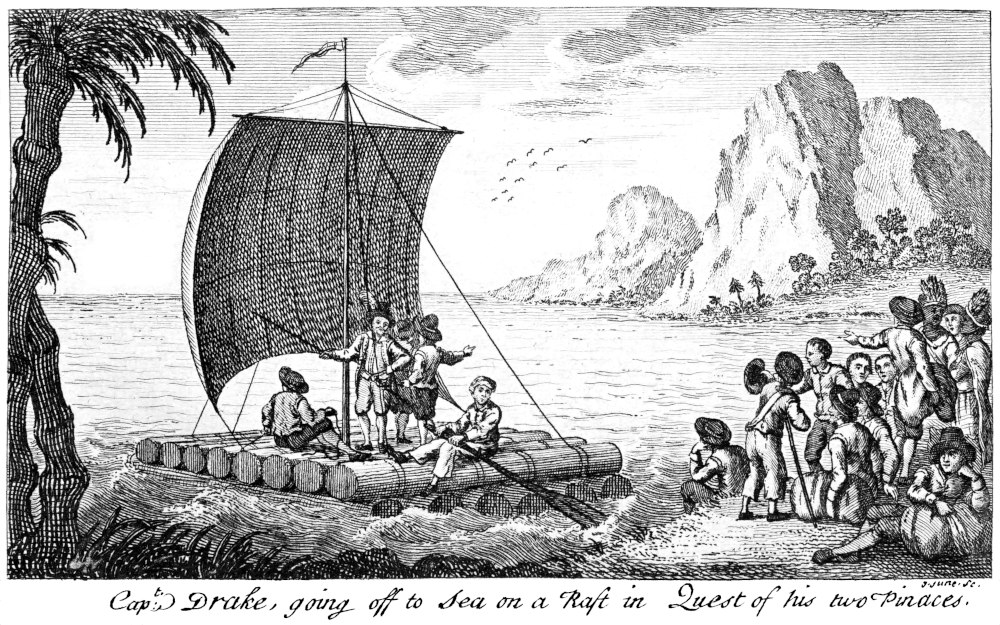
Cap
t
. Drake, going off to Sea on a Raft in Quest of his two Pinnaces.
J. June. Sc.
The same night they rowed silently to Rio Francisco, where they embarked the whole company, with what treasure they had been able to bring with them through the woods; then sailing back with the utmost expedition, they returned to their frigate, and soon after to their ship, where Drake divided the gold and silver equitably between the French and English.
Here they spent fourteen days in fitting out their frigate more completely; during which time, the Frenchmen, with their ship, lay among the Cabezes, while twelve English and sixteen Symerons travelled once more into the country, as well to recover the French Captain, whom they had left wounded, as to bring away the treasure which they had hid in the woods. Drake, whom his company would not suffer to hazard his person in another land expedition, went with them to Rio Francisco, where he found one of the Frenchmen who had staid to attend their Captain, and was informed by him, upon his enquiries after his fortune, that, half an hour after their separation, the Spaniards came upon them, and easily seized upon the wounded Captain; but that his companion might have escaped with him, had he not preferred money to life; for seeing him throw down a box of jewels that retarded him, he could not forbear taking it up, and, with that and the gold which he had already, was so loaded that he could not escape. With regard to the bars of gold and silver which they had concealed in the ground, he informed them that 200 men had been employed in searching for them. The people, however, either mistrusting the informer’s veracity, or confident that what they had hidden could not be found, pursued their journey; but, upon their arrival at the place, found the ground turned up for two miles round, and were able to recover no more than 13 bars of silver, and a small quantity of gold. They discovered afterwards, that the Frenchman who was left drunk in the woods, falling into the hands of the Spaniards, was tortured by them till he confessed where Drake and his company had concealed their plunder; so fatal to Drake’s expedition was the drunkenness of his followers.
Then, dismissing the French, they passed by Carthagena with their colours flying, and soon after took a frigate laden with provisions and honey, which they valued as a great restorative, and then sailed away to the Cabezes. Here they staid about a week to careen their vessels, and fit them for a long voyage, determining to set sail for England; and that the faithful Symerons might not go away unrewarded, broke up their pinnaces, and gave them the iron, the most valuable present in the world to a nation whose only employments were war and hunting, and amongst whom show and luxury had no place. Pedro, their Captain, being desired by Drake to go through the ships, and to chuse what he most desired, fixed his eye upon a scymetar set with jewels, which the French Captain had presented to Drake for the provisions with which he had supplied him, and, being unwilling to ask for so valuable a present, offered for it four large quoits, or thick plates of gold, which he had formerly concealed in the waters; but Drake, desirous to shew him, that fidelity seldom is without a recompence, gave it him with the highest professions of satisfaction and esteem. Pedro, receiving it with the utmost gratitude, informed him, that by bestowing it he had conferred greatness and honour upon him; for, by presenting it to his King, he doubted not of obtaining the highest rank among the Symerons. He then persisted in his resolution of giving him the gold, which was generously thrown by Drake into the common stock; for he said, that those at whose expences he had been sent out, ought to share in all the gain of the expedition, whatever pretence cavil and chicanery might supply for the appropriation of any part of it. Thus was Drake’s character consistent with itself; he was equally superior to avarice and fear; and, through whatever danger he might go in quest of gold, he thought it not valuable enough to be obtained by artifice or dishonesty.
They now forsook the coast of America, which for many months they had kept in perpetual alarms, having taken more than 100 vessels of all sizes between Carthagena and Nombre de Dios, of which they never destroyed any, unless they were fitted out against them, nor ever detained the prisoners longer than was necessary for their own security or concealment, providing for them in the same manner as for themselves, and protecting them from the malice of the Symerons; a behaviour which humanity dictates, and which, perhaps, even policy cannot disapprove. He must, certainly, meet with obstinate opposition who makes it equally dangerous to yield as to resist, and who leaves his enemies no hopes but from victory.
What riches they acquired is not particularly related; but, it is not to be doubted, that the plunder of so many vessels, together with the silver seized at Nombre de Dios, must amount to a very great sum, though the share that was allotted to Drake was not sufficient to lull him into effeminacy, or to repress his natural inclination to adventures. They arrived at Plymouth on the 9th of August, 1573, on Sunday in the afternoon; and so much were the people delighted with the news of their arrival, that they left the preacher, and ran in crouds to the key with shouts and congratulations.
Drake having, in the voyage just mentioned, had a view of the South Sea, as has already been related, and formed a resolution to sail upon it, did not suffer himself to be diverted from his design by the prospect of any difficulties that might obstruct the attempt, nor any danger that might attend the execution. His reputation was sufficiently established to remove all obstacles (for obstacles he met with), and to obviate the motives that produced them; but it was not till the year 1577, that he was able to assemble a force proportioned to his design, and to obtain a commission from the Queen, by which he was constituted Captain-General of a squadron, consisting of five vessels, of which the Pelican, of 100 tons, was commanded by himself as Admiral; the Elizabeth, of 80 tons, Vice-Admiral, commanded by John Winter; the Marygold, of 30 tons, by John Thomas; the Swan, of 50 tons, by John Chester and the Christopher, of 15 tons, by Thomas Moon, the honest carpenter, who, on the former voyage, destroyed the Swan by Drake’s direction.
These ships, equipped partly by himself, and partly by other private adventurers, he manned with 164 stout sailors, and furnished with such provisions as he thought necessary for so long and hazardous a voyage: nor did he confine his concern to the ordinary equipment of his ships with naval stores and military preparations, but carried with him whatever he thought might contribute to raise, in those nations with which he should have intercourse, the highest ideas of the arts and grandeur of his native country. He, therefore, not only procured a complete service of silver-plate for his own table, and furnished the cook-room with many vessels of the same metal, but engaged several musicians to accompany him; rightly judging, that nothing would more excite the admiration of savages, or uncivilized people, than the powers of music. On this occasion, however, it must not be concealed, that he engaged his men on the false pretence of sailing to Alexandria; and that it was not till after he arrived on the coast of Brazil, that he acquainted them with his design of passing the Straits, and entering the South Seas.
On the 15th of Nov. 1577, about three in the afternoon, he sailed from Plymouth; but a heavy storm (such as no man on board had ever seen the like), taking him almost as soon as out of port, forced him into Falmouth, where he staid till the 13th of December to refit. He then took his departure, and on the 25th of the same month fell in with the coast of Barbary, and on the 27th cast anchor at the island of Mogadore, about one mile distant from the main, between which and the isle they found a very convenient harbour. Here he began to build the pinnaces, the frames of which he brought ready from Plymouth to be put together, as in his former voyage. While the carpenters were employed in this service, they were discovered by the Moors that inhabit those coasts, who sent two of their Chiefs on board Drake’s ship, receiving at the same time two of his company as hostages. These men he not only treated in the most hospitable manner, but presented them with such things as they appeared most to admire; it being with him an established maxim to endeavour to secure in every country a kind reception to such Englishmen as should come after him, by treating the inhabitants with kindness and generosity.
But this friendly intercourse was in appearance soon broken; for, on the next day, observing the Moors making signals from the land, they sent out their boat, as before, to fetch them to the ship; and one John Frye leapt ashore, intending to become an hostage, as on the former day, when immediately he was seized by the Moors; and the crew, observing great numbers start from behind a rock with weapons in their hands, thought it next to madness to attempt his rescue, and, therefore, provided for their own security by returning to the ship. Frye was mounted on horseback, and immediately carried up into the country to their King, who being then in continual expectation of an invasion from Portugal, suspected that these ships were sent only to reconnoitre the coast, and discover a proper harbour for a more formidable fleet; but, being informed who they were, and whither they were bound, not only dismissed his captive, but made large offers of friendship and assistance; which Drake, however, did not stay to receive; but being disgusted at this breach of the laws of commerce, and apprehending further treachery, he quitted the coast on December 31, and on the 17th of January arrived at Cape Blanco, having in their passage taken several Spanish vessels, and found one in the harbour with no men.
Here, while Drake was employing his men in catching fish, and training them for land as well as sea service, the natives came down to the sea-side with ambergrease and other gums, to traffic for such commodities as they then stood most in need of, and with which Drake very generously supplied them.
Having rifled and discharged the Spanish ships which they had taken, they sailed on the 22d of January towards the isles of Cape Verd, and on the 27th came to anchor before Mayo, hoping to furnish themselves with fresh water; but, having landed, they found the chief town deserted; and, marching farther up the country, saw the vallies extremely fruitful, and abounding with ripe figs, cocoes, and plantains, but could by no means prevail upon the inhabitants to converse or traffic with them. However, they were suffered by them to range the country without molestation, but found no water, except at such a distance from the sea, that the labour of carrying it to their ships was greater than it was at that time necessary for them to undergo. Salt, had they wanted it, might have been obtained with less trouble, being left by the sea upon the sands, and hardened by the sun, during the ebb, in such quantities, that the chief traffic of this island is carried on by means of it. Thus, though the island abounded with goats, poultry, and delicious fruits of various kinds, they could procure none of any consequence, because the Portuguese, who were then in possession of it, were prohibited all commerce with strangers on very severe penalties.
On the 31st of January they made St. Iago, an island at that time divided between the natives and the Portuguese, who, first entering these islands under the shew of traffic, by degrees established themselves, claimed a superiority over the natives, and harrassed them with such cruelty, that they obliged them either to fly to the woods and mountains, where many of them perished with hunger, or to take arms against their oppressors, and, under the insuperable disadvantages with which they contended, to die almost without a battle. Such treatment had the natives of St. Iago received, which had driven them into the rocky parts of the island, from whence they made incursions into the plantations of the Portuguese, sometimes with loss, but generally with that success which desperation produces; so that the Portuguese were in continual alarms, and lived with the natural consequences of guilt, terror, and anxiety. They were wealthy but not happy, and possessed the island, but did not enjoy it.
In passing this island, the garrison of the fort discharged three pieces of cannon at them, but without effect. For this insult they took a Portuguese ship laden with wines, the pilot of which they retained, but set the rest of the crew on shore. This man, Nuno da Silva by name, was very useful to them in traversing the coast of Brazil, being acquainted with the bays and harbours where fresh water and provisions were to be obtained. Him they continued to detain captive, though they broke up his ship before they entered the Straits, till they were about to leave the coasts of Peru, when finding him no longer serviceable, they set him on shore in the Spanish settlements, from whence he afterwards returned home, and wrote an account of the voyage as far as he went, which is thought by many to be very authentic.
It was soon after the capture of this ship that a difference arose between Drake and his friend, Mr. Thomas Doughty, which, gradually increasing, grew into inveteracy, and terminated at last in the death of the latter. Doughty was a gentleman and a scholar, whom Drake had persuaded to embark in this expedition to better his fortune and to whom, till the incident happened which we are about to relate, he had shewn particular marks of favour and friendship; but trivial beginnings are often productive of the most important events.
The ground of the malevolence with which Drake pursued Doughty, under the colour of justice, has hitherto lain concealed from the public eye; but we shall now trace it, step by step, till the fatal period when the unhappy victim was brought to the block, and when Drake, by suffering revenge to triumph over virtue, left an indelible blot upon his character, which no panegyric can wipe away.
Among the Harleian manuscripts there is a written account of this voyage, in which the author has particularly had his eye on this transaction. As he was an eye-witness of all that passed, his relation will best appear in his own words: “Captain Drake, says he, having boarded the ship of Nuno da Sylva, and feasted his eyes with the view of the commodities, he committed the custody and well-ordering of this prize unto Master Thomas Doughty, as his good and esteemed friend, praying him in any case to see good order kept, and whoso should be the breaker thereof, to give him to understand of any such without exception of any.
“It thus chanced that General Drake had a brother (not the wisest man in christendom), whom he put into this said prize, as also divers others. This Thomas Drake, as one more greedy of prey than covetous of honesty or credit, offered himself the first and only man to break the General his brother’s commandment; for he, contrary to his strict prohibition, did not only break open a chest, but did dive suddenly into the same, that Master Doughty knew not how to discharge himself against the General but by revealing it unto him; yet first Master Doughty called Thomas Drake unto him, and shewed him his great folly in this behalf, who, yielding unto his fault, prayed Master Doughty to be good unto him, and keep it from the General; but he briefly told him he could not keep it, but he would deliver it with what favour he might. So at the General’s next coming on board the prize, Master Doughty opened the same unto him, who presently falling into a rage, not without some great oaths, seemed to wonder what Thomas Doughty should mean to touch his brother; and did, as it were, assure himself that he had some farther meaning in this, and that he meant to strike at his credit, and he would not, or could not, by God’s life (as he phrased it), suffer it. From this time forth grudges did seem to grow between them from day to day, to the no small admiration of the rest of the company, although some envying his former favour and friendship with the General, and some, I think, doubting that his capacity would reach too far to the aggrandizing his credit in the country, talked variously of the matter; however, Master Doughty was put again into the Pelican. Thus grudges, although they had not long rested, yet were they grown to great extremities, such and so great as a man of any judgment would verily think that his love towards him in England was more in brave words than hearty good will or friendly love.” So writes our author.
In proceeding on their voyage, they came within sight of Fogo, an island so called from a mountain about the middle of it continually burning, and like the rest inhabited by the Portuguese. Two leagues to the south of Fogo lies Brava, which has received its name from its fertility, abounding with all kinds of fruits, and watered with great numbers of springs and brooks, but, having neither harbour nor anchorage, was at that time uninhabited.
Drake, having sent out his boats with plummets to sound, was not able to find any ground about it; and it is reported, that many experiments of the like kind have been made without success. However, he took in water sufficient; and on the 2d of Feb. set sail for the coast of Brazil.
On February the 17th, he passed the equator, after being becalmed near three weeks, during which time they had dreadful storms of thunder with lightning, but without any memorable accident, till, continuing their voyage, on March 28, one of their vessels with 28 men, and the greatest part of the fresh water on board, was, to their great discouragement, separated from them; but their perplexity lasted not long, for on the next day they discovered her, and she again joined her associates. In their long course, which gave them opportunities of observing several animals, both in the air and water, at that time very little known, nothing entertained or surprized them more than the flying-fish, which is nearly of the same size with a herring, and has fins of the length of his whole body, by the help of which, when he is pursued by the benito (a large kind of mackarel), as soon as he finds himself upon the point of being taken, he springs up into the air, and flies forward as long as his wings continue wet, moisture being, as it seems, necessary to make them pliant and moveable; and, when they become dry and stiff, he falls down into the water, unless some vessel intercepts him, and dips them again for a second flight. This unhappy animal is not only pursued by fishes in his natural element, but attacked in the air, where he hopes for security, by the don or spar kite, a great bird that preys upon fish; and their species must certainly be destroyed, were not their increase so great, that the young fry, in one part of the year, covers that part of the sea.
There is another fish, named the cuttle, of which whole shoals will sometimes rise at once out of the water, and of which a great multitude fell into their ship.
At length, having sailed without sight of land for 54 days, they arrived April the 5th on the coast of Brazil. “In the mean while, you shall hear, says our author, what befel: Master Drake, never leaving to seek and force upon Master Doughty, found, in the end, this opportunity to degrade him. Whether of purpose, or his own voluntary, it chanced John Brown the trumpet to go aboard the Pelican, where, for that he had been long absent, the company offered him a hobbey, among the which, Master Doughty putting in his hand, said, Fellow John, you shall have in my hand, although it be but light amongst the rest; and so laying his hand on his buttock, which perceived of John Trumpet, he began to swear wounds and blood to the company to let him loose, for they are not all (said he) the General’s friends that be here; and with that turned him to Master Doughty, and said unto him, (as himself presently after told me in the prize) God’s wounds, Doughty, what dost thou mean to use this familiarity with me, considering thou art not the General’s friend; who answered him, What, fellow John! what moves you to this, and to use these words to me, that am as good and as sure a friend to my good General as any in this place, and I defy him that shall say the contrary. But is the matter thus? why yet, fellow John, I pray thee let me live until I come into England. Thus, John Brown coming again presently aboard the prize, had not talked any long time with the General, but the boat went aboard and rested not, but presently brought Master Doughty to the prize’s side, General Drake sitting in the midst of his men, who hearing the boat at the ship’s side stood up, and Master Doughty offering to take hold of the ship to have entered, said the General, Stay there, Thomas Doughty, for I must send you to another place, and with that commanded the mariners to row him on board the fly-boat, saying unto him, it was a place more fit for him than that from whence he came: but Master Doughty, although he craved to speak with the General, could not be permitted, neither would he hear him.” Soon after this, the fly-boat here mentioned, (called the Swan,) was separated from them by a violent storm, “in all whose absence, says our author, the General never ceased to inveigh against Master Doughty, terming him a conjurer and a witch; and, at any time when we had foul weather, he would say that Tom. Doughty was the occasion thereof, and that it came out of Tom. Doughty’s capcase, and would avouch the same with oaths.”
After the storm above-mentioned, they steered near the land to the southward; and on the 14th anchored under a cape, which they afterwards called Cape Joy, because in two days the vessel that was missing returned to them. Here they refreshed their weary crews, and took in fresh water; but, finding the country, though pleasant, without inhabitants, they weighed anchor, and, by running a little farther to the southward, found a small harbour between a rock and the main, where the rock breaking the force of the sea, the ships rode at anchor with the greatest security. On this rock they killed several seals, keeping them for food, and found them wholesome, though not palatable.
Their next course was directed to the great river of Plate, in 36 deg. of south latitude; but, not finding anchorage in that river, they sailed in quest of a more convenient harbour, when they were surprized by a sudden storm, in which they again lost sight of the fly-boat. This accident determined Drake to contract the number of his ships, that he might not only avoid the inconvenience of such frequent separations, but ease the labour of his men, by having more hands in each vessel. For this purpose he sailed along the coast and on May the 13th discovered a bay, which, though it promised fair, he durst not enter before it was examined: he, therefore, ordered his boat to be hoisted out, and, taking the line into his own hand, went on sounding the passage till he was three leagues from his ship, when on a sudden the weather changed, the skies blackened, the wind rose, and all the usual forerunners of a storm began to threaten them. Nothing was now thought of but the means of returning to the ship; but the thickness of the fog intercepting it from their sight, made the attempt almost impracticable. In this perplexity, which Drake was not more sensible of than those whom he had left in the ships, nothing was to be omitted, however dangerous, that might tend to extricate them from it. Captain Thomas, therefore, having the lightest vessel, steered boldly into the bay, and, taking the Admiral on board, dropt anchor, and lay out of danger; while the rest that were in the open sea suffered much from the tempest, and the Mary (the Portugueze prize) was driven before the wind. The others, as soon as the tempest was over, discovering by the fires that were made on shore where Drake was, repaired to him.
Here they met with no inhabitants, though there were several wigwams or huts standing, in which they found some dried fowls, and among them ostriches, of which the thighs were as large as those of a sheep. These birds are too unwieldy to rise from the ground; but with the help of their wings, or rather stumps, they run so swiftly, that the English could never come near enough to shoot any of them.
Not finding this harbour convenient, or well stored with wood and water, they left it on the 15th of May, and on the 18th entered another much safer and more commodious, which they no sooner arrived at, than Drake sent Winter to the southward in search of those ships that were absent, and immediately after sailed himself to the northward, and happily meeting with the Swan, conducted her to the rest of the fleet; after which, in pursuance of his former resolution, he ordered her to be broken up, preserving the iron work for a future supply. The other vessel which was separated in the late storm, could not be discovered. While they were thus employed upon an island about a mile from the main land, to which, at low water, there was a passage on foot, they were discovered by the natives, who appeared upon a hill at a distance, dancing, and holding up their hands, as beckoning to the English to come to them, which Drake observing, sent out a boat with knives, bells, and bugles, and such things as by their usefulness or novelty he imagined would be agreeable. As soon as the English landed, they observed two men running towards them as deputed by the company, who came within a little distance, and then standing still, could not be prevailed upon to come nearer. The English, therefore, tied their presents to a pole, which they fixed in the ground, and then retiring, saw the Indians advance, who taking what they found upon the pole, left in return such feathers as they wore upon their heads, with a small bone about six inches in length, carved round the top and burnished. Drake observing their inclination to friendship and traffic, advanced with some of his company towards the hill, upon sight of whom the Indians ranged themselves in a line from east to west, and one of them running from one end of the rank to the other, backwards and forwards, bowed himself towards the rising and setting of the sun, holding his hands over his head, and, frequently stopping in the middle of the rank, leaped up towards the moon, which then shone directly over their heads thus calling the sun and moon, the deities they worship, to witness to the sincerity of their professions of peace and friendship. While this ceremony was performing, Drake and his company ascended the hill, to the apparent terror of the Indians, whose apprehensions when the English perceived, they peaceably retired, which gave the natives so much encouragement, that they came forward immediately, and exchanged their arrows, feathers, and bones, for such trifles as were offered them. Thus they traded for some time but by frequent intercourse, finding that no violence was intended, they became familiar, and mingled with the English without the least distrust. They go quite naked, except the skin of some animals, which they throw over their shoulders when they walk or lie in the open air. They roll up their hair, which is very long, with a plume of ostrich’s feathers, and usually stick their arrows in it, that they may not encumber them, they being made with reeds headed with flint, and therefore not heavy. Their bows are about an ell long. Their chief ornament is paint, which they use of several kinds, delineating generally upon their bodies the figures of the sun and moon in honour of their deities.
It is observable, that the inhabitants of most nations amongst whom the use of cloaths is unknown, paint their bodies. Such was the practice of the inhabitants of our own country. To this custom did our earliest enemies, the Picts, owe their denomination. As it is not probable that caprice or fancy should be uniform, there must be doubtless some reason for a practice so general, and prevailing in distant parts of the world which have no communication with each other. The original end of painting their bodies was probably to exclude the cold; an end, which, if we believe some relations, is so effectually produced by it, that the men thus painted never shiver at the most piercing blasts: but, doubtless, any people so hardened by continual severities, would, even without paint, be less sensible of the cold than the civilized inhabitants of the same climate. However, this practice may contribute in some degree to defend them from the injuries of winter, and, in those climates where little evaporates by the pores, may be used with no great inconvenience: but in hot countries, where perspiration in a greater degree is necessary, the natives only use unction to preserve them from the other extreme of weather, or, more probably, from the inconvenience of the flies, which, were it not for that or some such defence, would be intolerable.
These savages had no canoes, like the other Indians, nor any method of crossing the water; which was probably the reason why the birds in the adjacent islands were so tame that they might be taken with the hand, having never been before frighted or molested. The birds here spoken of are, without doubt, the penguins of which so ample a description is given in the Voyages of Byron and Wallis. The great plenty of these fowls, and of the seals that were found every-where on the shores of this coast, contributed much to the refreshment of the English, who named the bay where they then lay, Seal-bay, from the number they there killed of those animals.
These seals seem to be the chief food of the natives; for the English often found raw pieces of their flesh half eaten, and left, as they supposed, after a full meal, by the savages, whom they never knew to make use of fire, or any art in dressing or preparing their victuals. Nor were their other customs less wild or uncouth than their way of feeding. One of them, having received a cap off the General’s head, and being extremely pleased as well with the honour as the gift, to express his gratitude, retired to a little distance, and thrusting an arrow into his leg, let the blood run upon the ground, testifying, as it is probable, that he was ready to shed his blood in his defence.
When the Swan fly-boat was separated from the fleet in the storm off the coast of Brazil, the crew, despairing of ever being able to rejoin it, began to be in fear for provisions. They were on a desart coast, had no place of rendezvous, and were ignorant even of their place of destination. In this untoward situation a dispute arose among the officers, of which the author of the manuscript before cited, gives the following relation:—He had already taken notice that Master Thomas Doughty had been sent on board this vessel as a kind of punishment, and in truth so it proved; for the master of the vessel, who seems also to have been the purser, knowing upon what terms he stood with Drake, took every occasion to insult, or, as our author’s phrase is, to discredit him; for those were always ranked among Drake’s friends who were enemies to Master Doughty. “This man, foreseeing that provisions might run short, put himself from the mess of Master Doughty, Captain Chester, and the rest of the gentlemen, and did set himself amongst the sailors, nothing at all sparing, but rather augmenting his own diet; but how scantily those gentlemen did fare, there be some come home, that, except they will deny their own words, can make relation thereof.
“Master Doughty, with Master Chester, whom the General had made Captain of the fly-boat, found themselves so ill used, that Master Doughty accosted his friend one day in these words: I marvel, Master Chester, that you will take it at his hands to be thus used, considering that you were here authorized by the General to be our Commander. And, at the same time, he spoke to the Master, and told him, that he used so much partiality in the distribution of his provisions, that the same could not be borne, considering the extremity they were like to fall into for want of victuals; and that it was against reason that he and his messmates should be so plentifully fed, while others were at the point to starve. The Master hereat putting himself in a rage, swore that such rascals as he was should be glad to eat the shoals (husks) when he would have them. Master Doughty answered him again, that reason would will that he should be used as well as other men, considering his advantages. Thou any advantage here! replied the Master, I would not give a point for thee nor thy advantages; and if ever thou comest home to enjoy any advantages, I will be trussed up. Then in multiplying words, and as I heard a blow or two passing between them, the Master, in the spleen of his heart, looking at him with an evil eye, Thou! will thou have victuals! thou shalt be glad, if we do not meet with the General, the rather to eat that falls from my tail on the anchor-fluke ere thou gettest home again. Then Master Doughty, turning to Master Chester, said unto him, Master Chester, let us not be thus used at this knave’s hands. Lose nothing of that authority that the General committed unto you. If you will, we will put the sword into your hands again, and you shall have the government. This case I will aver to be true, for there were two or three witnesses sworn to these articles, as some of the special matter that he had to lose his head for.”