THE VOYAGES OF Capt. WILLIAM DAMPIER. (continued 2)
Reading edition
Encouraged by this intelligence, they hastened to embark; and, setting sail on the 6th of December, steered directly for Cape Corientes, at the height of which they expected to meet their prize. In this passage, Dampier, who had hitherto by temperance preserved his health, was seized with a fever and ague, which at length terminated in a dropsical disorder that was very near carrying him off, and which carried off many of the men. The dropsy, Dampier says, is a general disorder on this coast, and the natives pretend that the stone of the alligator dried and powdered, and drank in water, is an infallible remedy. The same receipt he found mentioned in a Mexican almanac; but could find no alligator to give it a trial.
On the 11th of December they came in sight of Cape Corientes. It is of a moderate height, flat and even a-top, cloathed with woods, and projecting into the sea in steep cliffs. It is laid down in the Spanish maps in latitude 20 deg. 28 min. N. and longitude 230 deg. 56 min. W. from Teneriff, or in 121 deg. 41 min. W. from the Lizard-point in England.
They were now four ships in company; Captain Swan and his tender, and Captain Townley and his tender. These were all properly stationed to gain intelligence; but, provisions growing short, Captain Townley’s bark was dispatched with 60 men to traverse the coast to the westward of the Cape, in search of some town or village where their wants might be supplied. On the 17th the bark returned, being unable to weather the cape, or make any useful discovery. She had left, however, four canoes with 46 men, who determined to double the cape, or perish in the attempt.
On the 18th, all the ships quitted their stations, and sailed for the island of Chametley, about 16 or 18 leagues to the eastward of the cape, to take in wood and water. On these islands live the fishermen, who, as the Spaniards say, fish for the inhabitants of the city of Purification. On the 20th, they anchored between the islands and the main in five fathom water, clear sand. Here they caught plenty of rock-fish, but saw no inhabitants. On the 21st Captain Townley with about 60 men went to an Indian village about seven or eight leagues to the westward, to endeavour to procure provisions; and next day Captain Swan returned to his station off the cape. On the 24th, the four canoes who had doubled the cape, returned to the cruisers, and reported, that they had rowed to the bay of the valley of Valderas, or Val d’ Iris, and had landed in the garden of the world, where they found fruits of the most delicious flavour growing wild in the plains, and where the cattle were feeding at large among the streams of water that flowed meandering in the savannas, and lost their waters among the finest groves of trees they ever beheld; but when they marched in pursuit of the beeves that were every where straying in the vallies, they were suddenly surrounded by a body of Spaniards, who briskly attacked them, some on foot, and some on horseback. They made a gallant defence, and suddenly retreated into an adjoining wood, where they were followed by the Spanish horse. These were armed each with a case of pistols, and some of them, besides their pistols, had short guns. The English, being covered by the trees, made use of their fire-arms with advantage; and, after killing about 17 of the assailants, and wounding several others, the rest being unsupported by the foot, fled with precipitation. In this skirmish four English were shot dead, besides two desperately wounded; and, not daring again to attempt the valley, they killed a horse, and, having satisfied their hunger, they returned to their canoes.
On the 25th, being Christmas-day, they cruised close to the cape, and sent in three of their strikers to kill fish. In the afternoon they returned with three great jew-fish, which afforded them all a Christmas-dinner. Captain Townley on the 28th came to his station, and brought with him 40 bushels of maize, which he had seized at an Indian village four or five leagues up the country, and which his men were obliged to carry all that way on their backs.
They cruised till the 1st of January, 1686, off Corientes, and then steered towards the valley of Valderas, in order to furnish themselves with beef; and before night they anchored in 60 fathom water a mile from the shore. The next day they landed, dividing themselves into two parties; one party posted themselves on the hills to watch the motions of the Spaniards, while the other party traversed the vallies to kill the cattle. The Spaniards frequently presented themselves in companies, but did not dare to come near enough to engage. They continued here till the 7th, in which time they had killed and salted beef enough for two months allowance for their whole company, and, had not their salt failed them they might have stored themselves with much more.
They now gave over all farther expectation of the Manilla ship, it being the general opinion that she had escaped (as they were afterwards assured she had) while the ships were employed in seeking provisions. “So this design failed,” says Dampier, “through Captain Townley’s eagerness after the Lima ship, which he attempted in Acapulco harbour. For though,” adds he, “we took a little flour hard by, yet the same guide who told us of the Lima ship, would have conducted us where we might have had store of beef and maize; but instead thereof we lost both our time and the opportunity of providing ourselves, and so were forced to be victualling when we should have been cruizing, to the total ruin of the enterprize.”
Being now provided with beef in abundance, and having taken in wood and water in proportionable quantities, the two commanders, Swan and Townley, having separate views, though united in this one grand object of intercepting the Manilla ship, thought proper to part company, Captain Swan intending to steer westward, and Captain Townley to return eastward. Hitherto a Moskito chief with three of his men had sailed with Captain Swan, but being now about to depart never more to return to their country, he was desirous of recommending them to the care of Captain Townley, who being bound to the coast of Peru, might there put them on shore at some convenient place, from whence they might travel over land to the North Sea. This Captain Townley undertook to perform; and the ships being now under sail, they saluted each other, and parted.
Our navigator continued to sail with Captain Swan. Before night they passed Point Pontique, which forms the westernmost point of the bay, distant from Cape Corientes about twenty leagues. This point is in lat. 20 deg. 50 min. N. a league to the westward of which are two barren islands, called the islands of Pontique. Beyond these islands the land trends to the northward, presenting a very rugged unpleasant appearance as far as the eye can extend the prospect. On the 14th, they came in sight of a small white rock in lat. 21 deg. 15 min. N. which at a distance seemed like a ship under sail. From this island the land runs full more northerly, and the sea tumbles in with such violence upon the shore, that for many leagues together there is no landing; there is, however, every where good anchoring as far as the islands of Chametley. These islands are six in number, and different from those of the same name on the east of Cape Corientes, being a little within the Tropic of Cancer, and not above three leagues from the main. On these islands grows a fruit called the penguin, of which there are two sorts, the yellow and the red. The yellow grows on a thick stem about a foot high, the leaves narrow and about half the length of the stem edged with prickles. The fruit grows out from the top of the stem in two or three large clusters, 16 or 20 in a cluster. It is round and in size like a small pullet’s egg; the outer coat is thick and tough, and the pulp in the inside is full of little black seeds. The red penguin is in shape like a little nine-pin; grows up on stools from the ground in clusters of 60 or 70 on a stool, standing upright like the leaves of houseleek, and are smaller than the yellow: they are surrounded by leaves a foot and a half long, edged with prickles like the former. They have a sharp pungent taste, are very wholesome; but those who eat of them immoderately find them heating. They grow wild, and in the bay of Campeachy Dampier says they are so plentiful, that one can hardly range the plains for their prickly leaves.
From these islands Captain Swan embarked 100 men in canoes, and went himself in search of Coolican, a river in the province of Cullacan, with a town of considerable trade (probably that marked Pastla in the Spanish maps) upon its banks, the inhabitants whereof pass in boats to the island of California and fish for pearls. They coasted along the shore as far as lat. 24 deg. N. but found no river; and after three or four days absence returned without making any discovery.
A few leagues to the N.N.W. of Chametley is a narrow entrance into a lake, called by the Spaniards Rio de Sal, which runs about 12 leagues easterly, parallel with the shore, forming many low mangrove islands, and having depth of water every where for boats to row along its banks. In this lake Captain Swan entered, accompanied by 150 of his men in 12 canoes. In his progress he observed a grazing farm, and landing some of his men, they found the house deserted, and the cattle driven away. On proceeding further along the lake, two Indians were seen running at some distance, whom they took for spies, and having discharged a volley of small arms, one of them was wounded in the thigh, and not being able to continue his race, was seized by a party landed for that purpose who brought him on board. He informed them, that, about four leagues from the place where they there were, an Indian town was situated in a savanna, abounding with cattle. The company were scarcely landed to go in search of this town before they were attacked by a body of Spanish horse, who not being properly armed, made but a faint opposition, and suddenly retired. While the English were in pursuit, the enemy played off a stratagem that greatly annoyed them. We have already mentioned, in the voyages of Captain Sir Francis Drake, the nature of the grass that covers the savannas on the isthmus of Darien between the North and the South Seas. Such was the grass with which the pursuers were surrounded, when the Spaniards set it on fire, and, being dry as stubble, it burnt with astonishing fury, and spread with such rapidity, that it was with the utmost difficulty the whole party escaped being involved in the flames. This disaster not only made them more cautious, but occasioned a delay, which gave the Spaniards time to collect their force and to make a more formidable opposition. When the English arrived the next day at the village of which they had intelligence, they found it occupied by an armed garrison, whom it was necessary to overcome before they could enter; but as the Spaniards were, for the most part, destitute of fire-arms, and the Indians wholly unexperienced in their use, the advantage the English derived from that circumstance soon decided the contest in their favour. The enemy fled after the loss of some of their leaders, and left the conquerors master of the place, having only one man killed with an arrow, and their surgeon sorely wounded.
They were told by their prisoners, that, about five leagues from the town of which they were now in possession, two rich gold mines were wrought by Indian slaves belonging to the Spaniards of Compostella, the most considerable Spanish city in that district. It was not now a time to search for gold, when they were in want of every kind of food, except the beef they had cured at Valderas. Their chief search was now for maize, and having plundered the village of all they could find, they conveyed it to their boats with great labour; and next day quitted the lake, and returned on board the ships. This lake is laid down in latitude 23 deg. 30 min. N.
On the 2d of February, Captain Swan made another excursion with 80 men in search of the river Rosario, at the entrance of which they landed, and marched to an Indian town of the same name. Here they were told, that the gold mines were not above two leagues from the town; but, like the cock in the fable, they rejected the pearl and chose the barley-corn; about 90 bushels of maize, and the other provisions they found in the place, though insufficient for the purpose of their intended voyage, were yet of more value in their present necessity than all the gold of Compostella.
On the 3d the ships came to an anchor off the river’s mouth of Rosario, in seven fathom water, oozy ground, in lat. 22 deg. 51 min. N.
On the 7th, the Captain with his company came on board. The quantity of provisions which he had procured was but trifling for so many men; he therefore sent the next day a party in search of the river Oleta, but they returned without having found it. The river St. Jago was next attempted, and on the 11th they anchored in seven fathom water near the mouth of it, three leagues E. S. E. of the white rock of Maxentelbo, the high hill of Zelisco bearing S. E. This is one of the principal rivers upon the coast, and lies in latitude 22 deg. 15 min. N.
On the 11th, 70 men were sent up the river to make discoveries; they spent two days in examining the creeks and inlets, and at length came to a large field of maize which they had begun to gather, when they spied an Indian who had been sent to watch the corn, whom they seized and carried on board, in hopes of gaining from him some intelligence, by which they might obtain a more effectual and speedy supply. He told them, there was a town called Santa Pecaque, about four leagues from the place where he was taken, in which there was great store of provisions, and to which he undertook to be their guide. Captain Swan, overjoyed at the news, ordered 140 men to be instantly embarked on board the canoes, and to proceed with the Indian as he should direct. After rowing five leagues up the river, they came in sight of the town, when they landed in the night, and next morning set out on their march by land. About 10, they had advanced within musket-shot; and, having dispatched a party to reconnoitre, they found the town deserted, and entered it without opposition.
The town of Santa Pecaque is seated near the side of a wood in a spacious plain, neatly built, with a square in the middle, on each side of which the houses are furnished with balconies, from whence the inhabitants, in general, are spectators of the frequent processions exhibited by the Spanish priests, in order to convert the Indians, who are now almost all become christians in the Spanish settlements. The town, though small, has two churches; and they were told, that about 70 white families constantly resided in it, besides those who occasionally came there as carriers from the mines, and as merchants from Compostella. These carriers furnish the adjacent miners with maize, sugar, salt, and salt-fish, of all which there was great plenty in Santa Pecaque.
Captain Swan being acquainted by an express with the success of this expedition, and with the opportunity that now offered to supply his wants, hastened to the town to give the necessary orders. When he arrived, he divided his men into two parties; one party he employed in conveying the provisions to the boats; the other in plundering and packing up. These he relieved alternately; and when both parties were wearied out with this laborious service, they caught horses, and, having laden them with maize, dispatched them under a strong escort down to the canoes.
On the 17th, when they arrived, they found the men who guarded the canoes in high spirits, though they had been attacked by the Spaniards, and had one man desperately wounded. The party that escorted the horses thought it adviseable, however, to reinforce the canoe-guard, lest the Spaniards should renew the attack. Next day they returned to the town, and the party left therein were preparing to convoy more maize to the canoes; but, before they set out, Captain Swan understood by an Indian whom they had made prisoner, that 1000 men were in arms in order to attack them, and that they were already advanced within three leagues of the place. Upon this intelligence, the Captain advised all his men to load as much maize as they could altogether bear away, and instantly to depart in a body. With this advice they absolutely refused to comply, being determined not to leave Santa Pecaque while a load of provisions remained within it. It was in vain to endeavour to persuade those whom he could not punish for disobeying orders; and, therefore, on the 19th, he suffered 50 of them to depart with as many loaded horses; exhorting them, however, to march in a body, that they might be the better able to defend themselves against any sudden surprize. They were equally deaf to advice and instruction; they pursued their old course, marching in a line, and every one leading a single horse. The Spaniards had remarked their manner of marching, and had placed themselves in ambush the preceding night. They had scarce travelled half a league before they were suddenly set upon, and every man cut to pieces before they could assemble to prepare for their defence. Captain Swan, who had heard the firing, hastened with his party to the place of action; but on his approach he was struck with horror at the sight of such a number of his followers weltering in their blood, stript of their arms, and divested of their charge. The Spaniards, after the slaughter, having possest themselves of their musquets, &c. seized also the loaded horses, and instantly fled. Though the party commanded by Captain Swan did not exceed the number of those already slain, yet they were suffered to pass unmolested to the canoes, on board of which they embarked, and, with the provisions they had already secured, returned to the ships. Among the slain on this occasion was Mr. Ringrose, who wrote that part of the history of the buccaneers that relates to Captain Sharpe.
The slaughter of this unfortunate party dampt the spirits of the survivors, and discouraged them from attempting any farther descents upon this coast. It was therefore determined to steer directly for Cape St. Lucas on the island of California, where they might lie secure from the attacks of the Spaniards, till the men were refreshed, and the ships put in a condition to undertake a new voyage.
The lake of California (for so it is called in the Spanish charts) is either very little known to the Spaniards, or very carefully concealed. Though they have mines open already more than they can work, in Mexico, Chili, and Peru, yet they are very unwilling to allow other European powers to share the treasures of those countries, though they themselves cannot exhaust them; nor is it at all likely that any considerable advantages will ever be made by others, till by some lucky chance a nearer passage into those seas is discovered. “Were I,” says Dampier, “to attempt a North-west passage, I would go first to the South Seas, bend my course from thence along by California, and that way seek a passage into the Western Seas. If I succeeded in my attempt, I should then be without that dread which others must have had of passing from a known to an unknown region; and which, it is not improbable, obliged them to relinquish the pursuit just as they were on the point of accomplishing their designs. In like manner,” he adds, “were I to be employed in search of a North-east passage, I would winter about Japan, Conca, or the North-east part of China; and taking the spring and summer before me, I would make my first trial on the coast of Tartary, wherein if I succeeded I should come into some known part, and have a great deal of time before me to reach Archangel or some other European harbour.”
On the 21st they set sail, directing their course for California; but, being opposed by contrary winds, were unable to reach their destined port, and obliged to put in at the Maria islands, in latitude 21 deg. 40 min. N. distant about 40 leagues from Cape St. Lucas, and 20 from Cape Corientes. These islands are three in number, and they came to an anchor at the east end of the middlemost in five fathom water, clear sand; where, as soon as they moored their ships, they instantly began to unrig them, in order to careen.
Here Captain Swan proposed to his company to return home by way of the East Indies, which was highly approved by some, and as violently opposed by others, who, being ignorant, imagined, as Dampier says, that he would carry them out of the world. At first coming they lived upon nothing but seal; but in two or three days their strikers furnished them plentifully with turtle; and they likewise killed guanicoes, conies, and large pigeons; so that they consumed none of their ship provisions during their stay. While the sailors were working upon the ships, the officers employed themselves in surveying the stores and measuring the maize; which they divided into three parts, and allotted two parts to the ship, and one part to the bark, the ship carrying one hundred men, the bark only fifty.
Here Dampier, who had been long ill of the dropsy, tried a very uncommon remedy. He stripped himself stark naked, laid himself down upon the hot sand, and caused the surgeon to cover him all but his head; in this manner he lay near half an hour; but being unable to endure it any longer, he was carried to his tent and put to bed. While he was in the sand he sweat immoderately, and to that operation he ascribes the recovery of his health.
They staid till the 26th, when their ships being clean, they sailed to the valley of Valderas, in order to take in fresh water. Here they came to an anchor at the mouth of the river where they had anchored before; but, now that the dry season prevailed, they found the water brackish, and unfit for use. They then weighed, and, coming to a fine fresh-water brook at the foot of a little round hill about four leagues from Cape Corientes, they filled on the 29th 32 tons of excellent water, a quantity sufficient to serve their voyage.
Being provided with every thing they had reason to expect in this country, they now began seriously to consider of the possibility of performing their intended voyage. Upon a nice calculation, they found they had only 60 days provisions on board, at a little more than half a pint of maize a-day for each man; they had a great many rats on board, which they could not prevent from consuming a part of the maize; they had, according to the Spanish account, more than 7000 miles to run from Cape Corientes to Guam, the nearest land; and, that island being subject to the Spaniards, they had no certainty of a supply when they came there. All these discouragements staggered the most forward of them; and nothing could prevail with the majority but a promise from Captain Swan to cruise off Manilla, to intercept the register ship, as soon as they should arrive in the proper station. To this condition Captain Swan was forced to submit, though much against his inclination; for he had no mind to commence plunderer at first; and now he was heartily tired of the trade.
On the 31st of March, 1686, they took their departure from Cape Corientes, the Cygnet, Captain Swan, with 100 men; and the bark, Captain Teat, with 50. At first they steered with a small land breeze at E. N. E. which carried them three or four leagues; then the sea-wind came on at W. N. W. and changed their course S. W. By six o’clock in the evening they were nine leagues S. W. from the cape. About 10 the next morning they had the sea-breeze at N. N. E. so that at noon they were 30 leagues from the cape. It then blew a fresh gale, which carried them into the true trade-wind. At first they had it at N. N. E. and then northerly. At 250 leagues from the shore it settled at E. N. E., and there stood till they came within 40 leagues of Guam.
After the second day of their departure, having fine clear weather, and a fresh trade-wind, they crouded all the sail they could spread, and had frequently observations of the sun, moon, and stars; so that they could calculate their longitudinal distance by way of amusement almost every day. At their first setting out they steered into the latitude of 13 deg. N. and it is remarkable, that in a run of more than 6700 miles in this latitude they saw none of those small islands that are so plentifully interspersed in the same latitude on the opposite side of the Line; nor did Commodore Anson, who afterwards pursued the same track from Acapulco, see land till he arrived at the island of Tinian. As they run at a great rate, and the wind had every appearance of continuing, after being at sea about 20 days, the men began to grow clamorous to have their allowance enlarged; with which the Captain was forced to comply, though he endeavoured to persuade them to patience, and represented to them the danger of being becalmed, of missing their intended port, or of being refused a supply when they arrived. But none of these could prevail. The cry was for an augmentation, and an augmentation they had. Till the 20th of April their allowance was eight spoonfuls of boiled maize a man; but after that it was enlarged to ten. Dampier, who, as has been before noticed, had long been troubled with a dropsical disorder, gathered strength by this spare regimen; but those who were in full health it very much weakened. He says, he constantly drank three times a-day; but there were many on board who did not drink once in nine or ten days, and some not in twelve; one in particular did not drink in 17 days, and then said he was not a-dry, though he made water every day. Amidst these hardships one poor fellow was found guilty of theft, and sentenced to receive three stripes with a two-inch rope on his bare back from every man in the ship. Captain Swan, Dampier says, began first, and struck with a hearty good will, and his example was followed by all the rest; a punishment that must make every feeling mind shudder.
Though by the Spanish account the distance from Cape Corientes to Guam is said to be 2400 leagues, or 7200 English miles, yet Captain Swan had persuaded his men, that, by the English account the distance was only 1900 leagues; and that, as Drake and Cavendish had run it in less than 50 days each, they with better built ships might run it even in less than either of them: when, therefore, they had run the 1900 leagues, and the 50 days were nearly expired, they began to grow very mutinous and those who had declared against the voyage from the beginning, exclaimed bitterly against the Captain, and against all those who had persuaded them to undertake it. They had, during this long run of 6000 miles, seen neither fish, fowl, bird, or insect, except once when, at the distance of 4975 miles from Cape Corientes, they spied some ruabies, which they apprehended had come from islands or cliffs at no great distance, though they never came in sight of any. The Captain in the midst of these tumults gave them fair words; told them, that it was probable, the Spanish accounts might be the best, and encouraged them by giving them hopes, that, as the breeze continued, a few days patience would put an end to their troubles. On the 18th of May they met with some rain, and the clouds settling in the west foretold their near approach to land. On the 20th, the bark being near three leagues a-head, ran over a rocky shoal, on which there was only four fathom water. On the shoal they observed abundance of fish swimming every where about; and Captain Teat imagining that land was near, clapt upon a wind with the bark’s head to the north, and lay by to speak with the ship. When the ship came up, Captain Teat went on board, and related what he had seen; on which, being then in lat. 12 deg. 55 min. N. and Guam being laid down in 13 deg. N. they clapt on a wind, and steered to the northward, very doubtful, however, of being right, as no shoals near Guam are noticed in the Spanish charts. They pursued this course, however, till four in the afternoon; when, to their unspeakable joy, they saw the island of Guam at eight leagues distance. “And happy it was, says Dampier, that we got sight of it before our provisions were gone, of which we had but enough for three days more; for, as I was afterwards informed, the crew had combined first to kill Captain Swan, and eat him, when the victuals were gone; and, after him, all of us who were accessary in promoting the voyage.”
Nothing can exhibit a more striking indication of the ferocity of man’s nature, than the resolution formed by this abandoned crew. After a long series of enormities, robberies, murders, burning of houses and towns, exposing their fellow-creatures to want of food and shelter, and spreading terror and devastation wherever they set their feet, they at length, distressed and half-famished themselves, begin to murmur against their leaders, and the greater number combine to murder the lesser number, and to make food of their flesh. Need we, after reading this, have recourse to those we call barbarous nations for instances of the savage nature of man! The most uncultivated of those eat only the flesh of enemies killed in war; but these wretches, who called themselves christians, exceeded in their intention every horrid example we read of; they conspired to kill and eat their own Chiefs!
On the 21st of May they came to an anchor about the middle of the island of Guam on the west side. This is one of the Ladrone islands. Dampier places it in 13 deg. 21 min. N. and computes the meridian distance of Guam from Cape Corientes to be about 7302 miles; and supposes the South Sea to be of greater breadth by 25 degrees than is commonly allowed by hydrographers. It is about twelve leagues in length and four in breadth; on it the Spaniards have a small fort of six guns, garrisoned by 20 or 30 soldiers, and commanded by a Governor, and one or two subordinate Officers. The climate is healthy, and the natives active, docile, and ingenious, and are the best boat-builders throughout the Indian seas. Dampier believes their boats sail the best of any in the world. He tried one of them by the log; and, by the rate she ran in half a minute, computes her course at 24 miles within the hour. These Indians are no less dexterous in navigating than in building their boats. By report they will pass to other islands at 30 leagues distance, do business, and return again in 12 hours.
They had no sooner cast anchor than a Spanish friar came on board, with three Indians: Captain Swan received the priest with great civility told him they came with no hostile intention, but as friends to purchase with their money provisions to continue their voyage. The priest replied, that provisions were now scarce upon the island, but would engage the Governor to do his utmost to supply their wants. They thought proper, however, to detain the padre till his promise was fulfilled.
Next day a messenger was sent with letters and a present to the Governor, and in the mean time two boats were manned, one to fish, and another to purchase cocoa-nuts; the former returned empty, but the latter came back laden. The Governor, on the receipt of the letters and present, in token of friendship complimented the Captain with six hogs, 12 musk-melons, and as many water melons; and at the same time sent an order to the Indians in the nearest town to bake every day as much bread-fruit as the ships should require, and to assist the mariners in gathering cocoa-nuts and other fruits; with which order the Indians very readily complied. During this friendly intercourse the Manilla ship came in sight; but, being first seen from the fort, the Governor found means to apprize her of her danger, and she stood off, and escaped without being discerned by the ships. But in steering to the southward to avoid them, she was very near sharing a worse fate; for she struck upon the shoal already mentioned, and, after three days incessant labour, floated off with the loss of her rudder. During her distress the men got intelligence of her situation; but Captain Swan, who had determined no longer to follow the infamous employment of plundering, found means to divert them from their purpose of attacking her.
On the 30th of May the Governor sent his last present to Captain Swan, consisting of some hogs, a jar of pickled mangoes, a jar of excellent pickled fish, a jar of rusk or bread made of fine flour, and six or seven packs of rice. In return, at his own request, he was furnished with powder and shot of which he was in want; but what he coveted most was a fine English dog which they had on board, with which he was likewise gratified. The friar’s civility was rewarded with a brass clock, an astrolabe, and a large telescope; in return for which he sent the Captain six hogs, some bushels of potatoes, a roasting pig, and half a hundred weight of fine Manilla tobacco. The ships were plentifully supplied, besides, with every thing the island afforded; cocoa-nuts and bread-fruit as many as the ships could stow, and upwards of 50 hogs in pickle. Captain Swan was desirous of the Governor’s letter to the merchants of Manilla, having a private view to trade, which he concealed from his villainous crew.
On the 2d of June, they departed from Guam, directing their course to Mindanao, one of the Philippines; a range of islands extending in length from the 5th to the 19th degree of North latitude, and occupying in breadth about six degrees of longitude. The principal island in this range is Luconia on the north, where Magellan, in his voyage round the world, was slain with a poisoned arrow, and where the Spaniards made their first settlement, and established at Manilla a mart of traffic with the richest kingdoms of the east.
On the south, Mindanao is the principal island. It is in length about 60 leagues, and in breadth fifty. It is diversified with hills and vallies. The hills abound with gold, and the vallies are covered with perpetual verdure. It is finely watered with rivers and springs; and the plains and lawns are interspersed with groves of lofty trees, some of which are formed for shade, and some afford food for the inhabitants.
Of the pith of one they make their bread, and of the sap of others they make a pleasant drink. The marshy grounds abound with rice, and on the dry hilly land they cultivate yams, potatoes, melons, and a variety of vegetables unknown to Europeans. Their chief fruits are plantains, bonanoes, nutmegs, cloves, beetel-nuts, durians, jaccas, cocoa-nuts, bread-fruit, and oranges.
The plantain Dampier calls the king of fruit, and prefers it to every other. The tree that bears it is between three and four feet in circumference, and rises about ten or twelve feet high. When at its height, there springs from the top a stem about the size of a man’s arm, round which the fruit grows in clusters, in shape not unlike the Turkey cucumber, the coat of which is of a yellow colour when ripe. The inclosed fruit is of a delicate flavour, and melts in the mouth like mamalet. It is highly esteemed by all Europeans, and all their settlements are furnished with plantain walks, some families subsisting wholly upon that fruit.
The bonanoe differs but little from the plantain, except in size, being small and less luscious.
The nutmeg and clove trees are rare in this island, but those that grow are large and fine. The natives discourage their growth for fear of exciting the jealousy of the Dutch, who have monopolized the whole trade for spices, and who keep in pay a company of armed soldiers to cut down the spice-trees in the uninhabited islands, lest other European nations should avail themselves of their plenty. Dampier says, that he has been assured that, in some of the eastern islands, it is usual to see, at the shedding time, cloves three or four inches deep under the trees.
Of the beetel-nut all the Eastern people are immoderately fond. It is the fruit of a tree that grows like the cabbage-tree to the height of ten or twelve feet, without either leaf or branch, and then sends forth shoots on every side, among which the fruit is found in clusters, on tough stalks about the bigness of a man’s finger. It is larger than a nutmeg, and rounder; they cut it, when green, in quarters, wrapping each quarter up in an arek-leaf, and chewing both together. It tastes rough, dyes the lips red, and makes the teeth black.
The durian grows on trees like apple-trees, and are in size as large as pumpkins, covered with a thick rind, which, when ripe, opens and sends forth a strong scent, not unlike that of roasted onions. It divides into chives, each about the size of a pullet’s egg, the inside of which is of the consistence of cream, and must be eaten in its prime, or there is no enduring its rankness.
The jacca differs very little from the durian; only the inside of the former is yellow, and that of the latter white.
The island of Mindanao abounds likewise with animals of various kinds; and, according to Dampier, is one of the most plentiful islands in the world; and, though so near the Equator, being in 7 deg. N. the air is temperate, enjoying gentle sea breezes in the day, and cooling land-winds in the night.
Though they arrived on this coast about the middle of June, yet it was the middle of July before they could come to an anchor. They were ignorant of the situation of the chief town; and, arriving first on the opposite side, had been all that time plying about the island in search of it. At length they cast anchor near the river that bears the name of the island, and leads to the chief city. They fired seven guns, and were answered from the shore by three. They were presently after invited by a Raja and one of the Emperor’s sons, who demanded in Spanish, who they were, and from whence they came? They were answered by Mr. Smith (the gentleman made prisoner at Leon), that they were English, and had been long from their country. They were told, they were welcome; and asked if they were come to settle a factory, and to open trade? They said, they came only to purchase provisions. At which the Mindaneians appeared disconcerted. Captain Swan was some time at a loss to account for this circumstance; but he afterwards understood, that a Captain Goodluck had been there some time before, with some proposals from the East-India Company; and that, when he went away, he had given them some reason shortly to expect an Ambassador from England, to complete the treaty.
The Raja and Prince sat in their canoes; and, after half an hour’s conversation, took their leave, having invited Captain Swan ashore, and promised to assist him in procuring provisions.
There are three small islands called Meangis, within 20 leagues of Mindanao, that abound with gold and cloves; and, while Captain Swan was beating along the coast, in his passage from Guam to the river where the ships now were at anchor, they were observed by the Princes of that country, and known to be English. The Prince of those islands, having heard a good report of the English, and fearing a visit from the Dutch, sent secretly his nephew to Captain Swan, to invite him and his company to come and settle in his territories, offering every advantage in point of trade and security that he should require. Nothing could have been more advantageous, both to the nation and the settlers than this offer; but Captain Swan paid no regard to it.
As the season was now approaching when the westerly monsoon was about to set in, which would necessarily oblige the ships to stay a considerable time in the port of Mindanao, Captain Swan judged it his interest to cultivate a good understanding with the reigning Sultan. With this view he caused a magnificent present to be prepared for the Sovereign, consisting of scarlet-cloth, gold lace, a Turkish scymetar enriched with jewels, and a case of pistols, together with presents of less value to his chief Ministers; and, being in readiness, he sent them on shore by Mr. More, who sailed with him from London as chief supercargo, when his design was to trade in the South Seas. These presents were graciously received. The Sultan made Mr. More sit down by him, and asked him many questions concerning England, by means of a Spanish interpreter; and, after an hour’s conversation, dismissed him with marks of the highest esteem. Next day Captain Swan was invited on shore, and admitted to an audience in form; when the Sultan shewed him letters from the East-India Company, and desired to know if he came to settle in consequence of those letters? He talked with him much concerning the produce of his country, and the nature of carrying on commerce; and seemed highly entertained with the accounts he gave of it, and of the countries through which he had passed, and the novelties he had seen. He was three hours in close conversation; and, when he was dismissed, was entertained by Raja Laut, the King’s uncle, with a sumptuous banquet, after their manner, consisting of boiled rice, fish, and fowls.
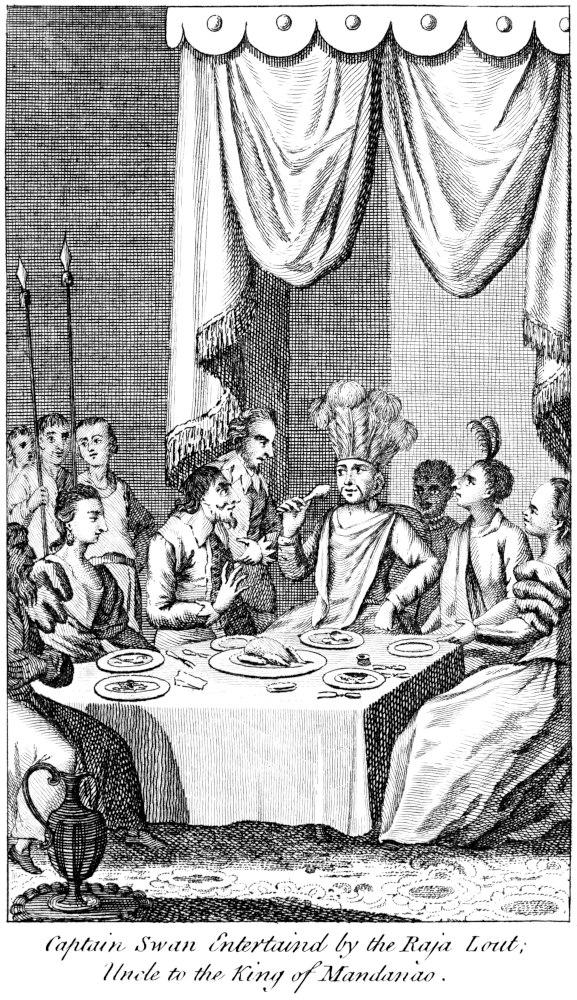
Captain Swan Entertaind by the Raja Lout; Uncle to the King of Mandanao.
On this occasion, Captain Swan was given to understand, that, while Mr. Goodluck resided in that city, he had been robbed by a servant belonging to Raja Laut, and that the fellow absconded till Mr. Goodluck took his leave; but that he was now returned, and was ready to be delivered up to be punished, in such manner and with such severity as crimes of the like nature are punished by the laws of England. But Captain Swan told him, that in his country none but the injured party could prosecute the criminal; and, as the man had committed no offence against him, he could take no cognisance of his crime. The Raja heard him with astonishment; and, to shew that the Princes of Mindanao were far from countenancing such practices, he caused the fellow to be stript naked, tied to a post, and exposed a whole day with his face to the burning sun; while at the same time the Moskitos continually tormented him without a possibility of being able to brush them off; a kind of torture that few have hardiness enough to survive. This condescension, in offering to deliver up the criminal to be punished by the Captain, was followed by a like offer from the Captain, with respect to any of his men who should offend against the laws of the Mindaneians; but the Minister returned the compliment, and left the punishment to the Captain himself, who, upon the least complaint, punished his men with a severity that shewed more of revenge than of justice, and which they afterwards look occasion to resent. Among those who felt the effects of his indignation was Captain Teat, his chief mate, who commanded the bark that accompanied him in his run across the Southern Ocean; and others, who had offended him on board, he remembered, now he had the countenance of the court on shore.
Captain Swan was highly caressed by the Chiefs of Mindanao, and pressed to stay and secure his ships from the approaching tempests, which always attend the change of the monsoons; and, as the river before the rainy season generally runs low, finding it difficult to float his ship over the bar, fifty or sixty Mindaneian fishermen were immediately sent with their canoes, to assist him in lightening his ship, and floating her up the river. She was no sooner moored than a free intercourse with the natives commenced. They expressed their regard for the English by signs that were easily understood. When the Dutch were mentioned to them, they would spread their fore-fingers half a foot apart, saying Bujeto, they are so far distant in friendship: when speaking of the Spaniards, they would spread their fingers still wider; but when the English were spoken of, they would bring their fingers quite close, saying Samo, we are all one. They were very fond of getting the men to their houses, where they kindly entertained them, after their manner, with tobacco, and beetel-nut; and where those who had money, and were decently dressed, were pressed to connections with the best families, and courted by the young females to the most familiar intimacy. To men who have long been at sea, such inducements are irresistible; and many of them made themselves poor by being too easily drawn in by these allurements to spend their money lavishly. Some who accompanied Harris from the North Seas had gold in abundance; and the Mindaneian misses, when they knew their power, very soon found the way to ease them of it. In Mindanao they had goldsmiths and other artificers, who charged double their value for such baubles as these prodigals were for ever bespeaking to present to their favourites; besides, some of them bought houses, and hired servants, and lived as profusely as the Raja himself, imitating the custom of the country, and having a pagelly or principal companion, and half a dozen mistresses. It was not long before the town’s-people discovered the true humour of English sailors, and they likewise took care to make their advantage of it. As they had no other but gold in lumps, when they wanted change, they gave them at the rate of 11 or 12 dollars an ounce. To others the same gold was exchanged for 18 dollars. The price of provisions and common necessaries was in like manner enhanced by those spendthrifts; and thus, says Dampier, the poor were made to suffer by the folly of the rich, and a foundation was laid for imposing upon all Englishmen who should hereafter have occasion to take up their residence in that port.
Captain Swan himself was seldom seen at any other house but Raja Laut’s or the royal palace. At the latter he made frequent visits, and at the former dined every day, attended by such of his men as had no money to spend, who had rice in plenty provided for them, and sometimes the remains of fowls or pieces of buffalo, drest in a course, and served in a hoggish manner. The Mindaneians use neither knives nor forks in eating, and they cram their mouths with lumps as large as they can take in, those being accounted the genteelest who can open their mouths the widest.
The religion of Mindanao is the Mahometan, and when the ships first cast anchor, it was their Ramadam, which answers to our Lent, when all sports and pastimes are suspended; on this account the Raja made an apology for not entertaining the Captain with the usual diversions of the country. The wet season too came on, which caused a general suspension of all out-door business.
During the month of August the weather became tempestuous, and the rains excessive. The river swelled and overflowed its banks; and it was with the utmost difficulty the ships were prevented from driving on the main land, or into the open sea; for trees of vast magnitude came floating down with the torrent, and frequently pressed against their bows with such weight, that they were in continual fear lest their cables should give way. During the time of these inundations the city stands, as it were, in a pond, and there is no communication between house and house till the floods abate. It was probably this circumstance that suggested to them the manner of constructing their houses. They are all built upon posts from 12 to 20 feet high. These posts are larger or smaller according to the height or magnitude of the superstructure. The Sultan’s palace has but one floor, on which, however, there are many rooms, to which they ascend by stairs from the street. It stands upon 180 posts, and is twenty feet above the level of the ground. The ordinary houses are also of one floor, and ascended by ladders. The roofs are all covered with palmeto leaves. The area beneath their houses is usually fenced in, and there the poorer sort keep their poultry; and there also is received the common draught of their sculleries; and, were it not for the frequent inundations that carry off the soil, the nastiness of the meaner people would render living in Mindanao impossible: but every crevice is scoured clean by the violence of the currents, which frequently overset the houses; though the posts on which they stand are sunk deep in the ground.
The inhabitants of Mindanao are, like all the Eastern people, very clean in their persons; they constantly bathe every day once, and sometimes oftener; they wash after every meal: and, if they happen to touch by accident any unclean thing, they have their times of purification allotted, before the expiration of which they are not permitted to leave their chambers. Swine are held with them in abomination, and though they run wild in the woods, yet they are never eaten. The chief food of the people is rice, sago, plantains, bread-fruit, cocoa-nuts, and other nutritious fruits; among the better sort, fowls and beef are used rather by way of relish, than as solid subsistance; for they are boiled to rags in their strange messes.
The Mindaneians are of low stature, small limbs, straight bodies, little heads, and are of a brown copper-colour. The women are fairer than the men, and their hair is black and long, and generally well dressed. Their visage too is rounder, and better featured than that of the men; only their noses are small, and so flat between their eyes that the rising is scarce discernible. At a distance they look tolerable, but on a nearer approach these imperfections are rather disgusting. Their dress consists of a petticoat and a loose jacket. The sleeves of the jacket are long and wide at the shoulders, but sloping down to their wrists, where they are so tight that it is with difficulty they get their hands through in putting them on. They then rise in folds about the arm, and in that lies their pride. The better sort of people wear fine callico or silks; the meaner sort, an ordinary cloth made of the plantain-tree, which they call saggen. The women, in general, (as has been noted) love the company of strangers, especially of white men; and Dampier adds, that the men belonging to the ships could scarce walk the streets without being pulled into their houses.
The chief artists among them are goldsmiths, ship-builders, carpenters, and smiths; all of whom are excellent in their way, allowing for the badness of their tools. Dampier gives a description of their smith’s bellows, which is simple and ingenious. It is composed of two hollow cylinders, like the large wooden pipes used by us for the conveyance of water; they are cut flat at both ends, in length about four feet, and placed upright at the distance of two feet from each other upon a stone hearth before the fire. Within two inches of the bottom of each a pipe is placed, projecting like a cock towards the fire, but bending so as that the pipes from both cylinders meet and terminate in one before they reach it. Thus constructed, and fixed firm, a man with two light brushes made of feathers, which he works alternately like two pistons, keeps up a continual blast; and with this simple contrivance, without either vice or anvil, other than a large stone or the butt-end of an old cannon, they fabricate their work to admiration. Their carpenters have neither saws nor planes, and yet they split and smooth their boards with great neatness. This requires time, but their work is the more durable for it, because the grain being unbroken the timber remains the tougher.
In Mindanao there is only one mosque, or place of worship, and that but little frequented by the meaner people. In this mosque they have a contrivance for striking the time. A drum of vast dimensions, shaped in form of a bell, is placed over a large hollow cavity, the head of which drum is covered with brass, and called a gong. A certain number of men are appointed to attend this gong, who relieve each other alternately night and day, and with a stick as large as a man’s arm, with a ball at the end of it, at certain intervals, they strike the gong, the sound of which is heard from one extremity of the town to the other, and supplies the place of a clock.
The Mindaneians use circumcision, and that operation is performed with great ceremony. The usual time among the common people is about the age of twelve; but the Princes of the blood are circumcised, like the Jews, at the end of eight days. On this occasion, the warriors all appear in arms, and, like Europeans at a review, make a sham-fight, for the diversion of the spectators, in which both the Sultan and his General are principal performers.
When the waters were subsided, and the Ramadam over, Raja Laut, the Sultan’s brother, and General of his forces, to entertain Captain Swan, assembled the dancers, who are women bred from their infancy, like those in Europe, to that art. On this occasion, more than 50 of them were assembled, who, being ranged in a ring, danced to their own music. In these dances their feet and legs are but little employed. Having no other than vocal music, they sing at first solo parts in slow time; but their chorusses are brisk; and then their hands, arms, heads, and bodies, are all employed in such contortions, that one would think they were made without bones.
Dancing and processions were the favourite diversions among the Chiefs of this island; and, Captain Swan, in conformity to the prevailing taste, resolving to give an English entertainment, ordered his music ashore, and such of his men as could dance were likewise ordered to attend. Accordingly, having hired a convenient house, he invited the Sultan, and Chiefs of the place, with their women, to be spectators of the splendor of the European dances. He had caused the house to be hung round with the richest silks, of which he had store on board and decorated it with gold and silver-lace, which, when illuminated with a profusion of wax-candles, made a most brilliant appearance. When the company assembled, they were struck with amazement, and thought all they beheld was the effect of enchantment. Among the dancers, there was one Jack Thacker, a common sailor, who at the music-houses at Wapping had learned to dance a horn-pipe. This man attracted the notice of the Mindaneians more than all the rest, because more in the antic manner to which they were accustomed. Him, therefore, they fixed their eyes upon, and considered as a man of consequence. When they had spent the best part of the night in feasting their eyes and their appetites (for Captain Swan had ordered his cook to prepare a cold collation of sweet-meats, and other savoury dishes), they were still unwilling to retire; and it was almost day-break before the Sultan retired, and, very unwillingly, was accompanied by his female train. Raja Laut and his women staid longer; and, it is said, notwithstanding his devotion to his prophet, drank plentifully of wine.
Nothing was talked of so much among the Mindaneians, during the stay of the ships, as the comic English dancer, of whom Raja Laut was willing to know the history; and, having enquired, was told by one of his companions, that he was an English nobleman who travelled for his diversion, and that all those who wore fine cloaths were gentlemen of inferior quality, who left their own country out of curiosity to see the countries abroad.
This harmless imposition, being told by the General to Captain Swan, who was of a morose unsociable disposition, cost the poor fellow a hearty drubbing, though he was wholly ignorant of what had been told. He was first stript of his fine cloaths, in the presence of the Raja, by his Captain’s orders, and then stript of his nobility by flogging his back. It was not long, however, before the man was revenged.
About the middle of November they began to prepare for their departure, and for that purpose their first business was to examine the ships bottoms, the sheathing of which they found eaten by the worm like a honey-comb; and the bottom of the bark not being sheathed, was eaten to the timbers, and the vessel thereby rendered unserviceable: application was therefore made to the Raja for planks to new sheathe the ship. The Raja’s sincerity was never suspected, till this incident gave reason for jealousy. When he came down to the river, and saw the carpenters ripping off the sheathing, he shook his head, and seemed much disconcerted, declaring he had never before seen a ship with two bottoms. His hope was, that the ship, like the bark, would have been eaten through, and that he should have had all her guns. A like accident had formerly entitled him to a like advantage, when a Dutch ship, by anchoring in the same river during the westerly monsoon, was entirely disabled, and never again put to sea. He was sensible enough of the mischief that would infallibly ensue to the ships by lying so long among those destructive vermin; for, whenever the natives disuse their vessels, they haul them up on the dry beach, burn their bottoms, and there let them lie, till they want again to use them.
While some were employed in ripping off the old worm-eaten planks, others were busy in preparing new and, by the beginning of December, the sheathing was repaired and tallowed. The latter part of the month was taken up in putting the ballast, stores, and guns aboard: this was a work of the greater labour, as it was first necessary to carry the ship out to sea before it was undertaken. About the beginning of January they began to fill water, and to take in rice; and application was made to Raja Laut to furnish buffaloes, as he had all along promised to do. He now began to form excuses, and pretended to take men out every day a-hunting (for those creatures always run wild); but always came home empty, and pleaded ill success. The Captain too began to act very mysteriously. By the help of the government on shore, he had got the absolute ascendancy over his men, and was as implicitly obeyed as if he had been Captain of a king’s ship. When he was importuned to declare when he intended to sail, he chose to be silent; and when the men wanted to know upon what enterprize they were next to be employed, he reproached them with their eagerness for piracy. He had sold Raja Laut some tons of iron and lead, and was to have had in return rice and beef; as to the first, the Raja had failed in furnishing the stipulated quantity, and the latter he had hitherto in no shape fulfilled. The Raja had besides borrowed of him 20 ounces of gold; and, when he required payment, the Raja demanded a much larger sum for his own board, and the board of his men. This treatment, and these disappointments, served to discompose a mind naturally sour, and to put him out of humour with every body about him.
All this while the westerly monsoon was wasting that was to carry them on to India. The men began again to murmur, and grow unruly: some, weary of rambling about, and who had formed connections with the natives, were for staying at Mindanao: some, who had husbanded their money, of whom indeed there were but few, were eager to get home; and others, who were poor (by far the majority), were for continuing their ravages, and were impatient to be in action.
While matters were in this situation, strong representations were made to the Captain to come on board, and to declare himself; and, after many delays, a day was at length fixed for a determination.
In the mean time, those who were bent on returning home, foreseeing that continued extravagancies would necessarily create new wants, and that new wants would require new means of supply, took occasion secretly to purchase a canoe, and formed a design to depart in the night for Borneo, where, by a letter just received from thence by a Mindaneian vessel, they hoped to meet with an English factory, and from thence find a passage home; but Captain Swan getting intelligence of their design, seized their canoe, and threatened to punish for deserters all those concerned in the plot.
Another party about the same time, hearing that the ship was about to sail, retired into the country, to conceal themselves till after her departure.
The party on board, who had nothing but the ship’s allowance to subsist on, became unruly, and sent ashore to the merchants iron to sell for arrack and honey, with which they made themselves drunk, and grew quarrelsome. All these disorders, Dampier says, might easily have been redressed, had Captain Swan exerted his authority in time, and established proper discipline on board the ship; but he living with his merchants constantly on shore, and leaving every one to do as he pleased on board, they encouraged one another in their villainies, and at length grew mutinous.
When these things were come to extremity, he gave orders that the whole crew should attend him on board the ship, on the 13th of January [1687]; but, unluckily for him, two days before this meeting was to take place, Captain Swan sent his gunner to fetch something he had occasion for out of the locker of his cabin. This man, in rummaging for what he wanted, among other things happened to take out the Captain’s journal, which, being laid carelesly by, was taken up by one John Read, (an ingenious young man, who likewise kept a journal) out of mere curiosity to peep in it, to see how nearly his and the other agreed.
At the first opening of the book he cast his eye on a part in which the Captain had made a memorandum of the mutinous behaviour of his men in their passage from Cape Corientes to Guam, and had particularly noted that of one John Read, a Jamaica-man, a namesake of the Read who took the journal, but no relation. This naturally excited his curiosity to look farther, and he found means, while the gunner was busy, to convey the journal away to examine it at his leisure. As soon as the gunner was gone ashore, John Read, the artist, shewed the book to John Read, the Jamaica-man, and both of them held a consultation with their comrades on the contents. These men, who were before ripe for mischief, now grew outrageous, and it was unanimously agreed to consult Captain Teat, who, as has been before noted, had received unworthy treatment from Captain Swan on shore, which, they knew, he only wanted an opportunity to resent. Teat left nothing unsaid to aggravate the failings of his superior, and to incense the company against him. He represented him as proud, ignorant, avaricious, cruel, and vindictive, and withal cowardly and unfit to command upon any bold and manly enterprize; called to their minds the opposition he made to the attacking the Manilla ship off Guam, by the conquest of which they would all have been enriched; and which, he said, Swan did not oppose out of a principle of honesty or gratitude, but from the fear of engaging a ship so much superior to his own in weight of metal and in numbers, though he, Teat, would have pawned his head to have been master of her in a few hours close attack. Men whose expectations have been raised to an unreasonable pitch, give easy credit to unfavourable suggestions against the authors of their disappointment. The crew took fire, and instantly bound themselves by an oath to deprive Captain Swan of the command, without naming any officer to substitute in his room; nay, so precipitate was their resolution, that the majority were for setting sail immediately, and leaving all that were on shore behind: and this hasty resolve would certainly have taken place, had either of the surgeons been on board; but, as their cry was for war, it was judged too desperate to go to sea without one skilful person on board to assist the wounded.
As all this passed in the night, it was agreed to stay till morning, and then to send a trusty messenger on shore, speedily to request the surgeons to come to the assistance of a man who had broken his leg. The chief surgeon said he should see the man the next day, and in the mean time sent his mate, Mr. Herman Coppinger, to his immediate relief. This man, a few days before, was sleeping at his mistress’s, when a snake twisted itself round his neck, but quietly went away upon his waking without hurting him. Coppinger, supposing the accident real, made haste to pack up his moveables to go on board; and, as the Captain was to have his general rendezvous the next day, Dampier took the opportunity of going with him. They scarce had mounted the ship’s side before they discovered the trick. But when the mutineers were thus in possession of the surgeon, they presently dispatched the canoe to shore again to invite all the men who chose it to come on board, but with a strict caution not to tell the reason, lest their design should reach the ears of their captain.
The 13th in the morning they weighed, and fired a gun. The Captain, much alarmed, immediately dispatched Mr. Nelly, his mate, to know the cause. To him they told their grievances, and shewed the journal; he persuaded them to stay till next day to hear what the Captain and merchants had to say. They did so, and Mr. Harthop came on board in the morning. He advised them to a reconciliation, and to take more rice on board. They were deaf to his persuasion; yet at his entreaty they staid till two in the afternoon to wait for the Captain and such gentlemen or seamen as chose to accompany them, but suffered none to go ashore, except Mr. Harthop and a man with a wooden leg. Dampier remarks, that, if Captain Swan had then come on board, as a man of sense and spirit ought to have done, he might at the very last have crusht their designs, and reduced the mutineers to order and discipline; but being of a sullen, suspicious, vindictive temper himself, he dreaded the resentment of those he had marked for vengeance; and therefore suffered the time to elapse, and was with 36 others left behind in the town. Besides these, six or eight had deserted and were up the country; and sixteen had died of poison, given them, as was supposed, by the husbands of those women whom they had seduced; and there were others on board, who had received the poison, and died of it some months after. In this manner their numbers were considerably diminished, and of 150 who sailed from Cape Corientes, not above 80 were now on board.
It has been more than once hinted, that Captain Swan sailed from London with no design of privateering, but of carrying on trade with the Spaniards on the western coasts of America. He had therefore a great quantity of heavy goods, such as iron and lead, not yet disposed of, some of which he had sold to Raja Laut, and no doubt was willing to have received the payment before he departed. This may, in some measure, account for his delay. His crew was composed of men, who, most of them, had forced themselves upon him for purposes which he abhorred; and, perhaps, he wanted to have rid himself of the greatest part of them, if he could have found a proper opportunity. Those marked in his journal were, no doubt, the men most obnoxious to him, and the most averse to trade, which he was determined to follow in his way home, having already 5000l. of his owners money, which he had received for the goods put up by auction at his first commencing buccaneer; with this he purposed to have purchased a cargo to take with him from the East-Indies. Hence arose his mysterious conduct, and his want of resolution. The loss of his bark was his embarrassment. Could that have been rendered serviceable, his design could more easily have been carried into execution. The suspicious part of the crew might have been shipped on board the bark; and by giving them a wrong track, they might have been deserted in the night, and left to their own course. But a discovery being made before the Captain’s designs were ripe for execution, he was entangled in his own net.
But to return: On the 14th of January, 1687, at three o’clock in the afternoon, they set sail from the river Mindanao, and next day came a-breast of Chambango, where formerly the Spaniards had a settlement, and where, it is said, there were plenty of swine and buffaloes. On the 17th, they anchored in a good bay on the west side of a small island, where they chose their Officers, constituting John Read the Jamaica-man Captain, Thomas Teat Master, and Henry More Quarter-master; and, having cut some curious short-jointed canes, and plentifully supplied the ship with water from a clear spring, they pursued their course; but on their passage they struck on a rock, where after lying two hours, they were heaved off by the rising of the tide, and escaped with the loss only of a large piece of their rudder, though in more danger than ever they had experienced in the whole voyage.
On the 18th, they anchored at the north-west end of the island of Mindera, in 10 fathom water. While they lay there a canoe with four Indians from Manilla came along side, who informed them, that at Manilla there was seldom less than 20 or 30 sail of ships of different nations, who came to traffic with the Spanish merchants; and that, if they meant to trade, they might for a trifle have a letter of recommendation from a friar to whom they were carrying dispatches, and would in a few days return with his answer. Trade, however, was no part of their employment; and the Indians were suffered to pass without molestation.
On the 23d, they reached Luconia, the island so ardently wished for by this piratical crew, and presently descried a sail, which they instantly pursued and took. She proved a Spanish bark from Pangassanam, laden with rice and cotton-cloth, and bound for Manilla. The master of this prize was boatswain to the Acapulco ship that passed by Guam; this man gave Dampier an account of all that happened on that occasion. The time of the year being too far spent to effect any thing of consequence on this coast, they concluded to sail for Pulo Condore, and there wait till the latter end of May, about which time the Acapulco ship generally arrives at Manilla. With this resolution they quitted Luconia on the 26th of February; and, on the 14th of March, cast anchor at the island of Condore, on the coast of Cambodia. Among the productions of these islands (for there is a cluster of them), there is a lofty tree, the body of which is in diameter three or four feet, from which the inhabitants extract a clammy juice, which being boiled becomes a perfect tar, and answers all the purposes of that balsam. On the 16th, they entered a convenient harbour, and employed themselves in careening their ships, in which they were assisted by the natives of the island, who brought them hogs and turtle in exchange for rice, of which they had now great plenty.
While they lay in this harbour, two of the men died who had been poisoned in Mindanao; they were opened by the surgeon, and their livers were found black, light, and dry, like pieces of cork.
Before they departed, they engaged an old native who could speak the Malayan language, to pilot them to Siam, where they expected to purchase dried fish, having nothing now but rice to eat at sea.
On the 21st of April they sailed from Condore, and, on the 24th, anchored in the bay of Siam, where, however, they could get no fish. On the 21st of May they left Siam and, in their return to Pulo Condore, overtook a Chinese junk, laden with pepper, who told them that the English were settled on the island of Sumatra, at a place called Sillebar, which was the first intelligence they received of that factory. This junk accompanied them to Pulo Condore, where Captain Read, observing a Malayan vessel at anchor within shore, sent a canoe to learn from whence they came; but, knowing the Malayans to be desperate fellows, cautioned his men not to trust themselves on board, but to hail them from the boat: but the men, not regarding the Captain’s instructions, went on board armed; which the Malayans observing, fell upon them unawares with their short daggers, and stabbed five or six of them dead upon the spot; the rest jumped into the sea, and saved themselves by swimming, among whom was one Daniel Wallis, who never could swim before or since, but in his fright made shift to reach the boat, and made his escape with the rest. Here Herman Coppinger, the surgeon, went on shore, on purpose to leave this diabolical company; but Read sent an armed force, and pressed him on board again. Dampier intended following his example, but waited a more convenient place.
They were now confined at this island by stormy weather till the 4th of June; and in the mean time a Malayan Portuguese from the junk entered on board, whom they entertained as an interpreter, to facilitate an intercourse with the natives. When they weighed anchor, the wind was contrary; yet they kept plying to the westward in hopes of its shifting to carry them to Manilla, before their much longed-for prize should arrive. In this hope they continued labouring incessantly for 10 days; when, being almost worn out with fatigue, and finding no probability of accomplishing their desires, they relinquished that project in despair, and, instead of it, stood away for Prata, in lat. 20 deg. 40 min. N. where they flattered themselves with fishing up much treasure from the China ships that had been cast away on that island, some of which were said to contain immense riches. But in this too they were disappointed by adverse winds; and, notwithstanding the utmost exertion of their skill in seamanship, they were driven by the violence of the gale to the island of St. John, on the coast of China. While they lay at this island they visited the shore every day, and purchased hogs, fowls, and buffaloes. Some of the men visited the continent, but found nothing there that answered their purpose.
On the 3d of July they weighed anchor with a gentle breeze, but on the 4th there came on a violent gale from the north-east, which increased till the dead of the night, when the rain began to pour down in such torrents that the fountains of heaven seemed to be opened, and a second deluge threatened; at the same time the thunder began to crack, and the flashes of lightning that pierced through the torrents of rain, appeared upon the face of the deep as if the sea was overspread with a blue flame. The darkness that succeeded between the flashes presented the most horrid gloom that ever covered the deep. The sea was raised to an astonishing height, and the waves broke short upon the ship with such violence, that it was thought every succeeding billow must have dashed her to the bottom. One sea struck away the rails of the head, and at the same time dislodged the sheet-anchor that was lashed with its fluke over the bend of the ship in the strongest manner, and it was every moment expected to beat a hole through the ship, by striking against her bows. It then became necessary to steer right before the wind, to endeavour to secure the anchor; and it was impossible afterwards to change the course till the storm abated. The fury of the storm abated about four in the morning, about which time they observed what the sailors call a Corpus Sant at the mast-head. This meteor is seen at sea, sometimes at the mast-head, sometimes at the yard-arm, and sometimes upon the deck. When it appears aloft it is like a star, and is taken for a good omen; but when below, it resembles a glow-worm, and always dreaded as a bad sign. The crew was overjoyed on seeing it at the very pinnacle of the ship’s fane.
From two in the morning till seven they kept scudding before the wind; but the wind gradually dying away, and the sea subsiding, they set their mizzen, brought the ship up upon a wind, and lay to under their mizzen till eleven, when for two hours there ensued a perfect calm, yet the sky looked black and lowring. About one the wind shifted to the south-west, and began again to blow hard, with violent rain. They furled up their mizzen, wore ship, and suffered her to scud before the wind, as before, till ten at night, when the wind ceased, and before morning the sea was calm, and the sky perfectly serene. This storm, however, dispirited the crew, who were now driven out of their knowledge, and were anxious for nothing but a place of shelter to preserve them from the fury of a second hurricane, which they had reason to expect towards the full of the moon.
They consulted their sea-charts, and concluded to steer for the Piscadores, islands situated in lat. 23 deg. N. of which, however, they knew nothing but the name. On the 20th of July they came in sight of them; and when they arrived were astonished to see so many junks passing and re-passing as were continually in sight. They followed some of the largest into a spacious harbour, which brought them to a considerable town, such as they did not expect to have found among islands so little known. On their attempting to land, they were met by a Tartarian Officer, who demanded, whence they came, of what nation they were, and whither they were bound? And being told they were English, and driven there in distress, they were kindly entertained; but were told, they must not come on shore; but whatever necessaries they wanted should be sent them on board without delay. Mutual civilities were exchanged. The ship was supplied with the best provisions they had ever tasted and the Captain in return sent a curious Spanish silver-hilted rapier, an English carbine, and a gold chain, as a present to the Governor. They staid till the 29th, and then directed their course to a cluster of islands that lie between Formosa and Luconia, the place they still set their hearts upon. On the 6th of August they came in sight of the islands they were in pursuit of, and, contrary to expectation, found them well inhabited.
On these islands were plenty of goats and swine, but very few birds or poultry. It is an observation of Dampier, founded on reason and confirmed by experience, that, in countries abounding in corn and maize, birds and all manner of fowls are bred in abundance; but in those islands where the inhabitants subsist chiefly on fruits, roots, and fish, birds wild and tame are more rare.
As these islands were without names in the sea-charts, Captain Read called them all by one general name of Bashee Islands. The situation of their towns was remarkable. They were built on precipices inaccessible on every side, except by ladders placed at the ends of the streets, which all ran in lines parallel to each other, and on which the houses rise in ranges one above another, till they terminate in a single row. The inhabitants of these islands were acquainted with the use of iron, and they had amongst them a yellow metal that very much resembled gold, for some of which Captain Read exchanged iron; and Dampier laments that he could purchase none of it, because he had nothing to bestow in return. They were very ingenious, had large fishing-boats, and lived in a peculiar manner different from any people they had yet visited. They were not very delicate in their food; for they would gather up the goats-skins and goats-paunches which the men threw away; and would singe, broil, and eat the former; the latter they would stew (not over nicely cleansed), and, mincing raw fish very small, would mix the mess together, and with a little salt over it, make a very savoury meal. The paunches of the swine they never touched. They appeared to be very cleanly in their persons, and withal so honest and good natured, that they would take nothing but what was given them; nor were they ever out of humour with the strangers, though they had often cause enough, nor with one another. No provocation could incense them to anger; nor any opportunity induce them to theft. They brought constantly every morning goats, hogs, potatoes, and fruits, to the ship, which they exchanged for iron, nails, old hoops, or bullets. Thus the crew of the ship fared sumptuously every day, and salted 70 or 80 hogs for future use. These islands lie in lat. 20 deg. 21 min. N.
Being now sufficiently stored with provisions, and having filled their casks with water, after staying from the 13th of August till the 24th of September, and after having mended their sails, and scrubbed the ships bottom, they were preparing to sail, when a violent storm came on, which forced them to cut their cables and put to sea, leaving six of their best men on shore.
They put before the wind with their bare poles; but it was the 1st of October before they could recover to their former station. On the following day their six men were brought on board by the natives, whom they rewarded with three bars of iron, a present to them more valuable than so many bars of solid gold. The men reported, that, as soon as the ship was out of sight, the natives were more kind to them than ever; that they endeavoured to prevail upon them to cut their hair short, like theirs; and that they offered to each the choice of a wife, with a small hatchet, a set of planter’s tools, and a portion of land for each of them to cultivate by way of dowry; and, when the ship came in sight again, they then importuned them for iron, which was the only recompense they required.
This second storm quite disconcerted all their measures. They began to think that the winds and the waves were employed against them, and were terrified with the thoughts of their unhappy situation. Most of them were heartily weary of being tost to and fro to no manner of purpose, and were very desirous of getting home: only Read and Teat were determined to make their fortunes at whatever risque; they therefore, finding the crew resolute to leave this dangerous coast, persuaded them to accompany them to Cape Comorin, where, if they disapproved of their proceedings, every one should be at liberty to follow his own course. To this they all agreed; but these freebooters, fearing to meet English or Dutch ships in the direct road, proposed to coast along the east side of the Philippines, and so, keeping south towards the spice islands, to pass into the Indian ocean near the island of Timor. With this view they let sail on the 3d of October, 1687; and leaving the island of Luconia on the west, “with all our golden projects,” says Dampier, “along with it, we stood to the southward till we came in sight of the island St. John on the coast of Mindanao, and on the 16th came to an anchor on the south-east side of that island.” While they lay in this bay, the young prince of Meangis, formerly mentioned, came on board, and importuned Captain Read to transport him and his men back to his own island, promising to reward him handsomely for his trouble. He said, that a few days before he had seen Captain Swan and some of his people all well at the city of Mindanao; that they had accompanied Raja Laut in a military expedition against his enemies, and had acquired great honour and were in high favour with the Sultan; that Captain Swan was preparing to leave the island; and that he had offered 40 ounces of gold for a ship to carry him off, but did not think the Raja would suffer him to depart. Captain Read promised to stay for the prince three days, and in that time he engaged to return with his men. In the mean time Dampier took occasion to sound how the crew stood affected towards their old Captain, and found one party, who happened to be filling water ashore, very well inclined; and he desired them to be silent till he had consulted the other party whose turn it was next day to fill water at the same place; but one of the company, who appeared to be the most zealous in Swan’s favour, as soon as he got aboard discovered the secret; on which Read and Teat ordered all hands on board and weighed directly.
Dampier says he was afterwards informed, that Captain Swan and his men continued long at Mindanao; that Messieurs Harthop and Smith, merchants, both died there; that Rofy and Nelly, his mates, got passage in a Dutch ship to Batavia, and from thence, after various adventures, to Europe; and that Swan himself, with his surgeon, endeavouring to get on board another Dutch ship, were run down and drowned by the natives by order of Raja Laut, who seized their gold. Among other reasons assigned for this treachery, Dampier mentions Swan’s threatening, on some provocation, to raise a band of men to destroy the town, and seize upon the country. Be this as it may, the poor Captain lost his life, and the Raja kept his money. Part of his journal, as far as Cape Corientes, was recovered and preserved by a Mr. Moody, of whom mention will be made hereafter.
On November the 2d, the day the prince was to have come on board, Captain Read set sail, and stood to the west, till on the 9th, the wind changing, they came up with the north-east end of the island of Celebes, in lat. 3 deg. N. 30 leagues to the southward of Gilolo, on the western side of which lie the clove islands of Tidore and Ternate, the finest in the world. At the southermost end of Celebes the town of Macasser is seated, the chief place of trade in those parts belonging to the Dutch.
They anchored in a sandy bay on the south-east side of Celebes, where they found a creeping kind of vine, the leaves of which pounded and boiled with hog’s-lard is an infallible cure for old ulcers. The men, knowing its virtues, crammed their chests with it; and one man, whose legs were ulcerated, was perfectly cured by the use of it.
Here they cut down a tree 18 feet in circumference, and 44 feet in clean body. It proved unsound, and therefore unfit for the purpose they intended it, which was that of a canoe; they therefore left it, and set sail.
On the 30th, they sailed south; and in the afternoon they had a violent tornado, and saw a spout. This phenomenon appears at first like a small ragged cloud, hanging sloping from a black heavy cloud above, small at the bottom, seemingly no bigger than a man’s arm. Underneath this the sea begins to be in gentle agitation, and gradually proceeds to foam and froth till a violent whirling ensues, and then it flies upwards in a pillar, the base of which may be about one hundred paces in compass, but lessening gradually till it decreases to the size of the spout, with which it meets, and through which the rising sea-water seems to be conveyed to increase the cloud. As soon as the water reaches the spout, you then see the cloud, that was at rest before, drive along with incredible swiftness, sucking up the water in its course, and causing a furious wind to fly before it. Thus it will continue sometimes half an hour, sometimes longer, till breaking off, all the water that remains below the spout falls down again into the sea, with a dreadful noise and violent agitation of the waves. Dampier relates, that one Captain Records, of London, being on the coast of Guinea, in the year 1674, in a ship of 300 tons, was overtaken by one of these spouts, which broke before he could well furl his sails to receive it. On its breaking, it made the same kind of noise as if a castle or some immense building had been plunged from a great height into the sea, and raised the billows in proportion to its height. The fury of the wind, at the same time, took the ship on the starboard bow, and snapt off the boltsprit and foremast both at once like rotten sticks, and drove the ship along ready to overset her; but the ship presently righting, and the wind whirling round, took her again on the opposite quarter, and snapt the mizzen-mast as the fore-mast and boltsprit had been snapt before. Three men were in the fore-top when the fore-mast broke, and one on the boltsprit, when they fell into the sea; but all were saved, and the ship with difficulty carried into port.
December 1st, they continued to move slowly along, and on the 4th they came up with the north-west end of the island of Bouton, where their strikers killed some turtle, and brought with them an Indian who conducted them to a harbour, where they had an interview with the Sultan, and where they were permitted to purchase whatever they wanted, and where Captain Read was presented by the Sovereign with a little boy who had a double set of teeth, one set within another, on each jaw.
On the 12th, they took leave of the Sultan, and were about weighing anchor; but when they expected it to rise, being hooked to a rock, the cable came home without it. As soon as they were loose, finding the anchor irrecoverable, they steered to the south-east, and fell in with some islands five or six leagues from Callasusung harbour. They appeared very green; and as they passed them in the night they heard drums beating, but whether for mirth, or spreading an alarm, they knew not.
On the 20th, they passed the island of Omba, and saw in it many smoaks by day, and fires by night, but observed no inhabitants. From Omba they passed by Timor, where, meeting with tornados and strong gales of wind, they endeavoured to get clear of the shoals, and stood off south, intending to touch at New Holland to try what that country would afford.
On the 4th of January, 1688, they fell in with the coast of New Holland in lat. 16 deg. 50 min. S. and, steering close in, came to a point from whence the land trends east and southerly for 10 or 12 leagues, but how far southerly Dampier says he does not know. That able navigator, however, pronounced, that, if it was not a continent, it neither joined to Asia, Africa, nor America. They fell in upon the west side, and examined but a small part of this vast tract of land, of which Captain Cook, in his late voyage round the world in the Endeavour, traversed the eastern coast for near 2000 miles, and has left it still doubtful whether it is island or continent. There is a remarkable difference between Dampier’s description of the part he visited on the west, and that described by Captain Cook in the same latitude on the east side. “The land,” says Dampier, “is of a dry sandy soil, destitute of water, except you make wells. There are divers sorts of trees; but the woods are not thick, nor the trees large. Most of them were dragon-trees, of the size of apple-trees—we compared the gum with the gum-dragon we had aboard, and found it the same—we saw no trees that bore fruit. We saw no animal, nor any track of animal but one, and that was of a beast of the size of a mastiff-dog—few land-birds, and none bigger than a blackbird—few sea-fowls—few fish, turtle and manatee excepted. The inhabitants are the most miserable people in the world—without houses—without cloathing—without conveniences of any kind—and, setting aside their human shape, very little different from brutes. They are tall, straight bodied, thin, and small limbs; they have great heads, round fore-heads, and large brows. Their eyelids are always half-closed; they have great bottle-noses, full lips, wide mouths, and the two fore-teeth in the upper jaw wanting in all of them; but whether they draw them out or not, I know not. [Captain Cook says, those on the opposite side have their teeth entire.] They are long-visaged—without beards—of an unpleasing aspect, with no one graceful feature in their faces—their hair black, short, and curled like negroes—and their colour coal-black. They live in companies, 20 or 30 men, women, and children, together—their food is fish, and their manner of catching them is in weirs across little inlets of the sea, in which every tide leaves some—they have no instruments to take great fish—in other places they fish for cockles, muscles, periwinkles, but of these there are but few—of what they catch all partake alike—all watch the tides—for all depend upon the sea for their support; the earth producing neither herb, root, pulse, or any sort of grain. These poor creatures, adds Dampier, have a sort of weapons, consisting of a piece of wood shaped somewhat like a cutlass, and a long straight pole with a sharp end hardened in the fire: with these they made a shew of frightening us; but on firing one gun, they all ran away frighted.”