THE VOYAGE OF Master COWLEY ROUND THE WORLD.
Reading edition
Of Master Cowley we can find no other account than what is contained in the voyage written by himself; therefore, we shall, in his own words, preserve such parts of that voyage as have not already been related in the voyage of Dampier; premising only, that his first setting out among the buccaneers was in the same prize, in which Dampier set sail from Virginia, under the command of Captain Cook; that he continued to serve that Commander, as Master, during his life; and that, after sailing sometime in consort with Captain Eaton in the South Seas, he chose rather to serve that gentleman than to continue with his own Captain’s successor. One remark more, and then to proceed. We find him, in every collection of voyages in which he is introduced, distinguished by the appellation of Captain Cowley, though the highest employment to which he ever seems to have arrived, was Master on board the buccaneers before-mentioned; who, during the time they were suffered to commit their ravages, traversed the globe as wolves the forest, merely for the sake of whom they might devour. We find, however, but few of them successful; by far the greatest part, like other robbers, died miserably; and such of them as escaped with life, were, at certain times, exposed to sufferings not less shocking to human nature, than the distresses to which they reduced innocent people by their cruelty and lust for gold. But now to proceed:
In August, 1683, I departed, says Cowley, from Cape Charles in Virginia, lying in latitude 36 deg. N. and in longitude 305 deg. in the good ship called the Revenge, Captain John Cook Commander, pretending to me, that I should navigate the ship to Petitguavaz, where a Frenchman was the Governor, and to which port I began to shape my course; but was told, as soon as we had left the shore, that they were now bound for the coast of Guinea, to provide a better ship; and that then their design was to sail to the Great South Sea. I was thereupon obliged to alter my course, and to steer E. S. E. for the Cape de Verd islands in lat. 16 deg. N.
In the month of September, we made the island of Salt, where we came to an anchor, careened our ship, and afterwards sailed to St. Nicholas, where was held a consultation of officers, whether to sail directly for the South Seas in their present ship, or pursue their former resolution and proceed to the coast of Guinea to seek a better. After much debate, it was at length concluded to try St. Jago, another of the Cape de Verd islands, and, if any ship was found in that road fit for their purpose, to lay her on board, and make her their prize.
On our approach to this island on the eastern side, we descried a large ship from the mast-head, which proved to be a Dutch East Indiaman of 50 guns, and, as we afterwards learnt, of 400 men, most of whom were on shore; but on seeing us stand towards the road, they instantly repaired to their posts, clapt a spring upon their cable, heaved their broad side to us, struck out their ports below, and running out their lower tier of guns, made themselves ready to receive us. We had now advanced too near; but marking their force, and that it was in vain to attempt a conquest, we put before the wind, and steered directly to the coast of Guinea, where we had no sooner arrived, than we fell in with a new ship of 40 guns, which we boarded, and carried away. Upon examination, we found her well stored with brandy, water, and provisions; and in order to furnish her with other necessaries from our old ship, we put into Sherborough, resolving to touch at no other port till we should come to Juan Fernandez, in lat. 33 deg. 40. min. S.
About the beginning of December, we sailed from latitude 8 deg. N. steering S. W. till we arrived in 12 deg. S. when we steered away S. W. by W. till we came into soundings on the coast of Brazil; and finding 80 fathom water in a sandy bank, we altered our course to the S. W. and about the latitude of 40 deg. S. found the sea as red as blood, occasioned by great shoals of shrimps, which coloured the ocean, for many leagues together. We found also a multitude of seals, and such abundance of small whales as to exceed the number found in the North Seas in the proportion of one hundred to ten. We held, on our course till we came into lat. 47 deg. where we saw land, never before discovered. It proved an uninhabited island, to which I gave the name of Pepy’s island, and at which ships may conveniently wood and water, having a harbour where 1000 sail may ride in safety. In this island we saw plenty of fowls, and round it there is no doubt abundance of fish; but, it blowing a storm, we could neither dare to approach it, nor to examine its coasts. We therefore stood to the southward, shaping our course S. S. W. till we came into the latitude of 50 deg. S. and then steering S. W. by W. resolving not to attempt the straits of Magellan, but to make the land of Ter del Fuego; and there, finding great riplings, and apprehending danger, we resolved to attempt the passage discovered by Bartholomew Sharpe, in 1681, and to sail round all, leaving Staten land to the N. With this view, hauling away S. W. we came a-breast of Cape Horn on the 14th of February, where, chusing valentines, and discoursing of the witchcraft of women, there arose a prodigious storm, which continued till the last day of the month, driving us into latitude 60 deg. 30 min. which is farther than any ship ever yet sailed to the south; so that we concluded that talking of the wiles of women at sea was very unlucky discourse.
About the beginning of March, the wind coming to the south, we were soon wafted into a warmer climate; for in the 60th deg. the weather was so extremely cold, that we could bear drinking three quarts of burnt brandy a man in four-and-twenty hours, without being the least intoxicated. We steered north-by-east till we came into lat. 40 deg. S. where we fell in with the Nicholas of London, Captain John Eaton Commander; and, being glad of each others company, we sailed in consortship to the island of Juan Fernandez, where we found plenty of good fat goats, good fish, wood, and water. [Here Cowley relates the story of the Moskito-man, the account of which has already been given by Dampier.] This island is naturally fortified; so that with 100 men, and at 100 l. expence, it may be defended from the attacks of 2000 men, in case of an invasion. [Accordingly the Spaniards have taken the hint; for when the last ships sailed upon discoveries, they found it fortified.] It lies 110 leagues due west from the port of Valparayso.
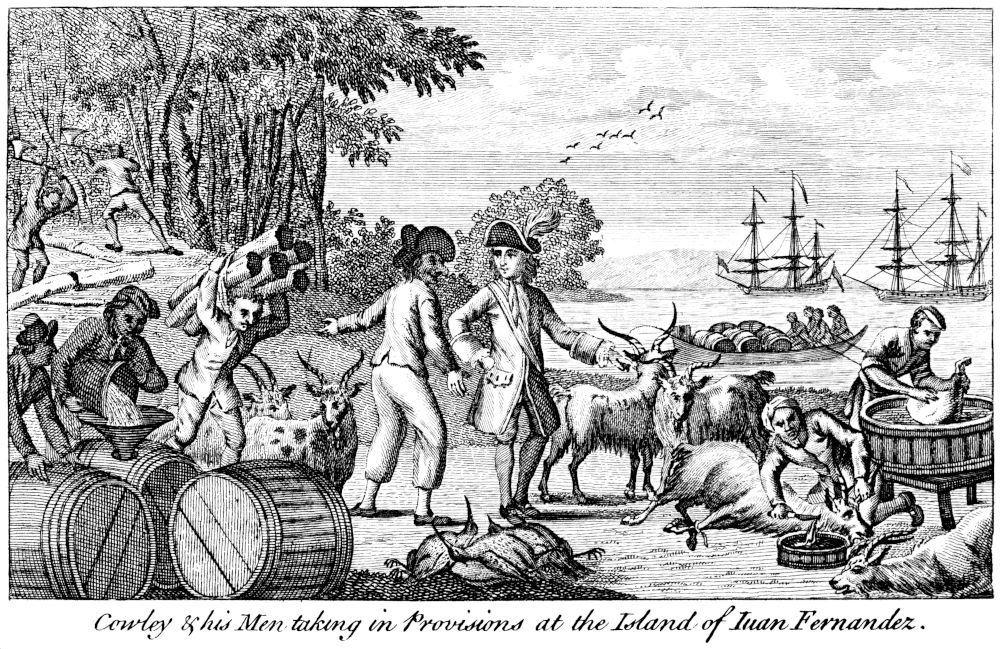
Cowley & his Men taking in Provisions at the Island of Iuan Fernandez.
We steered from this island north-north-east, till we made the high land of Arica, in latitude 18 deg. S. Being before the bay, the officers of both ships held a consultation whether best to go into Arica-bay, or proceed farther on the coast; when it was resolved to sail as low down at Cape Blanco, and there wait for the Spanish plate-fleet coming to the bay of Panama. This was an unfortunate resolution; for in Arica-bay rode at that time a ship with 300 tons of silver on board, which we missed, and in the room of her took a timber-ship bound to Lima, with 30 hands on board, which at that time stockt us with more mouths than we could well spare meat to fill. With this ship we sailed away north to the island of Lobos, in lat. 7 deg. S. where we set our sick men on shore, though we could neither find wood or water upon it. Here having heeled our ships, at a general council it was resolved, to attack the town of Truxillo, in lat. 8 deg. N. ten miles within land; and with this view just as we were weighing anchor to proceed, some of our people from the mast-head espied three sail of ships passing by, which we instantly ran out and took. These ships were all laden with flour, fruit, and sweet-meats; but having had intelligence that we were upon the coast, they had left all their silver (their silver-service plate not excepted) on shore. Their provisions, however, were very acceptable; and we now thought only of seeking a proper place to lay up our stores in security, and where we might conceal ourselves for five or six months, to make the enemy believe that we had forsaken their seas, and that they had nothing to fear from fresh attacks. On this occasion, the islands called by the Spaniards Gallapagoes, or Enchanted Islands, were proposed, and the only objection made was, the uncertainty of finding them; but that being overcome, we weighed anchor, and after three weeks sail came in sight of them, being seventeen in number, to all which I gave distinct names. We came to an anchor in a very good harbour, lying towards the northernmost end of a fine island under the Equinoctial Line, in which we found plenty of fish, sea and land-tortoises, fowls of various sorts, among which were turtle-doves, so tame at first that they would often light upon the hats and shoulders of our men as they walked abroad; but not being able to satisfy their hungry appetite by catching them alive, the sailors so scared them at last, by frequently firing upon them, that they became, like other birds, very shy.
This island I called the Duke of York’s Island, near to which lies a small island, which being viewed in several directions, always assumed a different shape. This I called Cowley’s Enchanted Island. I examined several others; but upon none of them found fresh-water, save only upon the Duke of York’s Island. The bay in which we anchored I called Albany-bay, and the harbour York-road; and, after having laid up 1500 bags of flour, with a quantity of sweet-meats, and other provisions, in a convenient store-room, we sailed to the northward, to try for fresh water a second time; lest, being distressed, we should be forced, upon some future occasion, to seek relief in other harbours, when it might not be possible for us to reach the present; but we found good water in none of them; and, to our great surprize, we met with such a violent current, that when we would have returned to the Duke of York’s Island, we could not stem it; and we were obliged to bear away N. N. E. when the first land we made upon the main was Cape Trespontas, upon the easternmost shore of which we watered our ship. The first day after our arrival, we buried our Captain; the second day, three Spanish Indians came down, whom our men brought on board. Being strictly examined concerning the strength and opulence of the town of Ria Lexa, they gave very satisfactory answers: but, while they were under examination, our long-boat being sent on shore to get beef, a party of Spanish Indians came down, and set their boat on fire, and drove the crew for shelter upon a rock, where they were forced to remain till we sent another boat with 20 men to rescue them.
We retained the three Indians, and led them with ropes about their necks as guides to conduct us afterwards to Rio Lexa; but one of them having got his neck out of the collar, made his escape, and alarmed the town; so that our men returned very much discouraged at this second disappointment. We now found it necessary to turn all our prisoners away to shift for themselves; and then directed our course to the gulph of St. Miguel, where we took two islands, one inhabited by Indians, the other plentifully stocked with cattle; but for gold and silver, we got but little. Here we staid and careened our ships; and here Captain Cook’s ship and Captain Eaton’s broke consortship; and, both ships being refitted, I got on board Captain Eaton, where I was entertained as his master, to navigate his ship to any place or port where he should direct.
[It is now that the voyage of Master Cowley may be said to commence. Hitherto he has gone hand-in-hand with Dampier; but now Cowley pursues one course with Captain Eaton, and Dampier another with Captain Davis, the successor of Captain Cook.]
We in our ship, continues Cowley, towards the middle of August, set sail from the gulph of Miguel [in the bay of Amapalla], steering for Cape St. Francisco, where we chaced a ship that escaped from us; and then we bore up to latitude 7 deg. S. where finding the country alarmed, we stood for Payta, in lat. 5 deg. S. where we took two ships lying at anchor; which the Spaniards refusing to ransom, we, by way of farewel, set them on fire. From hence we sailed to Gorgona, at which island we watered our ship for the East-Indies.
This island lies in lat. 3 deg. 15 min. N. and in long. 305 deg. E. and as soon as we had supplied ourselves with wood and water, we took our departure, steering W. N. W. till we came as low almost as the rocks of St. Bartholomew, in long. 240 deg. then we sailed into lat. 15 deg. N. till we judged we were past those rocks; and then returned into 13 deg. N. which latitude we held till we made the island of Guam, in lat. 13 deg. N. and in long. 150 deg. E. according to our reckoning; at which island, when we arrived, we had a very sickly ship, no man being free from the scurvy, and most of us in a consuming condition. It was on the 14th of March about seven in the morning that we saw land. At 12 o’clock we were in lat. 13 deg. 2 min. N. by observation, having made out on our sailing, by judgment, 7646 miles, that is to say, departed so many miles from Gorgona by loss made out in longitude, which is about 2549 leagues. The next day we sailed about the south-west part of the island, and came to an anchor in a fair bay, from whence we sent a boat on shore, with a flag of truce; but, on landing, our people found that the natives had burnt their houses, and had fled; however, our men felled some cocoa-nut trees, and brought a hundred or two of them on board to refresh the crew. In the mean time a party of Indians rushed from behind the bushes, and in a hostile manner threatened to attack us; but we made signs of friendship, and one of the Indians returned to the wood, and having peeled a stick so as to make it appear white, he came forward, when one of his companions perceiving that he had no cap to compliment our people, called him back, and presented him with one for that purpose.
From Sunday the 15th till Tuesday the 17th, we continued a free trade with the Indians; but on that day our men going over to a small island on the west side of Guam, the Indians fell upon them with stones and lances, which occasioned a fray, in which some of the Indians were killed upon the spot.
Two days after, the Governor, who happened to be a Spaniard, came to a point of land near the ship, and sent a letter written in Spanish, French, and Dutch, demanding in the name of the King his Master, who we were, whither we were bound, and from whence we came? Our answer was written in French, that we were employed by some gentlemen in France upon the discovery of the unknown parts of the world. On the return of the messenger, the Governor sent a letter of invitation to the Captain to come on shore, with which he instantly complied, and was received under a triple discharge of cannon from the fort, which was answered by the same number of guns from the ship. They soon came to a good understanding. Our Captain made an apology for killing some of the Indians in his own defence; and the Governor gave for answer, that, if he had killed them all, he should have esteemed the favour the greater. We were afterwards told, that the Indians on the small island were in rebellion.
On Wednesday, about 12 o’clock, a Spanish Captain came on board, and continued with us till 12 the next day. He brought as a present from the Governor 10 hogs, a large quantity of potatoes, plantains, oranges, papas, and red pepper; in return for which our Commander sent the Governor a diamond-ring, and presented the Officer with a rich sword.
The next day the Governor sent on board a captain, a jesuit, and a friar, with a request to our Commander to spare him some powder, of which he was in want. This request was readily complied with; we sent him four barrels, and offered him four great guns. The first he thankfully received, and sent a box in which were 1600 pieces of eight in gold and silver for the Captain to pay himself for the powder; but the guns he politely declined accepting. Our Captain returned the box with the money untouched, and afterwards received from the Governor a valuable present.
While mutual civilities were passing between the Governor and our Captain, our people went out every day chasing the Indians, whom they had full license to kill and destroy wherever they met with them; but they, finding us not to be Spaniards, became very tractable, and offered to assist in supplying us with fish and fruit, which they exchanged with us for old nails and old iron. After having tarried here sometime, and a free intercourse had been established between the Indians on shore and our people on board the ship, the Indians made signs for as many of our men as chose it, to come and see them haul the seine. Our men, not suspecting any design, manned the boat, and went to look at them; but, while the men were amusing themselves with the sport, the Indians had very artfully brought their seine round the boat, with a design to draw it on shore, and thereby entangle both boat and crew; but the sailors, discovering the plot, gave the Indians no time to carry it into execution; for, being provided with fire-arms, which they never went ashore without, they fired amongst the thickest of them, killed a great many, and drove the rest away.
These Indians are large in stature, some of them being seven feet and a half high; they go stark-naked; never bury their dead, but let them lie in the sun to rot. They have no arms but slings and lances; the sharp ends of the latter are pointed with dead mens bones, which, being cut like scoops, and jagged at the edges like unto saws, if a man happens to be wounded by them, and is not cured in nine days, he certainly dies. Our people took four of these treacherous savages prisoners, bound them, and brought them on board; but they had not been long among us, before three of them leapt into the sea, and with their hands tied behind them swam away like fishes. However, we sent the boat after them, and found that a strong man at the first blow could not penetrate their skins with a cutlass. One of them, in my judgment, had received 40 bullets in his body before he died; and the last of the three that was killed, swam a good English mile, not only with his hands tied behind him, but with his arms pinioned, before he expired.
The Spanish Governor’s kindness increased in proportion to the mischief done to the Indians. He sent us, the succeeding day, by one of his captains, thirty hogs, some melons, pumpkins, potatoes, fruits, and rice; and received in return six small patararoes.
Having now new rigged our ship, and supplied ourselves with wood and water, we began to prepare for our departure. On the first of April, we weighed anchor, and next day came a-breast of the fort, which we saluted with three guns, and were complimented with the same number; and on the 3d the Governor sent his last present to our Captain. On the 4th we set sail, and steered W. by S. till we arrived at the height of St. Bartholomew, when we shaped our course W. N. W. till we came into the latitude of 20 deg. 30 min. N. where we fell in with a cluster of islands lying to the north of Luconia, distant from Guam 560 leagues. They seemed to be uninhabited; but the men who went ashore in the boat, found abundance of nutmegs on one of them, and saw some goats.
From these islands we steered S. W. for the island of Luconia, and on the 26th of April Cape Bajadore bore from us east; after which we came up with Cape Mindato, where the S. W. monsoon overtaking us, we were obliged to bear away for Canton, in China, where we lay and refitted our ship, and where we might have laden ourselves with plunder from thirteen Tartar ships, who came thither full of the richest goods of China: but our men, being under no government, refused to attack them; saying, They came for gold and silver, not to be made pedlars to carry packs. But, alas! had reason prevailed, we might have all made our fortunes, without injuring any prince or subject in christendom; for these goods the Tartars had taken from the Chinese about two years before, and had stored them at Macao, an island near Canton, to be taken away when they judged it convenient.
From Canton we sailed for Manilla, to wait for the Tartar ship that annually goes thither, and which, we were informed, was laden one half with silver; but, though we were fortunate enough to come in sight of her, yet she out-sailed us, and escaped. We then bore away for an island that lies to the north of Luconia, intending there to stay till the wind came fair to carry us to Bantam, not then knowing that Bantam had been taken from the English by the Dutch.
At this island we stored ourselves with fruit, goats, and guanos; which last are here good meat: and here we found an Indian who directed us to an island, where there was plenty of great cattle; but the wind soon coming fair, we made sail to the southward, steering our course S. S. W. till we came into lat. 10 deg. N. where we were so entangled among the islands of Paragoa, that none of us ever expected to escape with life. After three days, however, we very providentially got clear; and stood in for an island at the north end of Borneo, where we hauled our ship ashore, and erected a tent, planting a battery of ten guns for our defence, in case of an attack from the natives. Here we unloaded our ship, and, having provided sufficiently for our security, we ranged the country for natives to trade with us; but they, having never seen any white men before, were very shy; and when, by chance, our men fell in with one of their canoes that was full of women, (among whom was the queen of the country and her retinue) on the approach of our ship’s boat, they all leapt over-board; but, after taking them up, and treating them kindly, they laid aside their fears, and grew familiar; and, upon our offering them civility, instead of avoiding, they soon became fond of us. They brought us fish in great plenty, with oranges, lemons, mangoes, plantains, and pine-apples; and, besides these, we exchanged some trifles for bezoar, musk, and civet, with which the island is well stored.
The year was now drawing to a close, when we set sail from this little island, directing our course for Timor, where, finding the ship’s company begin to grow mutinous, and not under command of their Captain, myself, Mr. Hill, and eighteen more, joined our forces together, and purchased a large boat, in which we sailed to the island of Java, distant from Timor 300 leagues. The wind being contrary to carry us to Batavia, we bore away for Cheribon, a factory belonging to the Dutch, lying eastward of Batavia, where we were kindly received by the Governor. There we heard that King Charles was dead, and that his brother James was proclaimed king; we heard also that Bantam had been taken from the English; and that the Dutch had erected a new factory in that island.
After refreshing at Cheribon, we agreed to divide our twenty men into three parties; two of which chose to sail for the bay of Bengal, and the third to stay with me; but knowing that Batavia was the Hollander’s magazine for India, we proposed first to sail thither, and there to provide for ourselves as well as we could. Being all arrived, we were courteously received by the General; and I, with Mr. Hill and another friend, who were all my party, were promised our passage to Europe in their East-India fleet. About this time the General was sending four or five ships of war, with soldiers, to procure satisfaction from the King of the island for an outrage that had been committed on a party of Hollanders, who, to the number of 80, had been slaughtered by the Javanese. These ships, it seems, were originally designed against Sillebar, an English settlement on the west coast of Sumatra; but this act of hostility happening to intervene, it had diverted their purpose, and saved the factory for this time. There were now in Batavia twenty of us, who, on hearing this news, would willingly have repaired to Sillebar; but the Dutch would by no means permit us, though we had bought a sloop for that purpose. When we were just ready to sail, the General ordered our sloop to be seized; and when we remonstrated against this incivility, they produced an old law, by which the subjects of the republic in India are forbidden to sell any vessel to any foreigner; and they even went so far as to imprison those who had transgressed it. To us, indeed, they gave the prime cost of the sloop, but paid us nothing for fitting her up.
This project failing, Mr. Hill, another friend, and I, embarked on board the Solida Indiaman, bound to Holland; and, as we were putting out of the road, we saw our ship Captain John Eaton coming in; however, we held our course; but, finding the wind unfavourable, we turned down to Bantam to take in provisions, and from thence steered to Prince’s Island, where we lay for a fair wind three weeks. About the end of March, we set sail from thence, with the wind at N. W. and shaped our course to the Cape of Good Hope. On the 11th of May, after a pleasant passage, we made the land called Point Primicra, bearing from us N. W. distant 12 leagues. We had the wind at N. E. being distant from the cape 560 miles, the land trending away S. W. by W. The fish which came about the ship near the island of Mona, the 30th of March, left us now, when we judged ourselves in latitude 32 deg. 47 min. S. From the 15th of May to the 29th we had sailed only 96 miles; but observing next day, we found by our latitude that we had a very strong current, that had driven our ship to the southward 34 miles farther than we judged ourselves to be; for we thought we had been in the latitude of 33 deg. 41 min. S. whereas we found ourselves in lat. 34 deg. 15 min. S. our course having been S. W. 40 miles. I argued the reason with the chief mate of the ship, and he told me it once happened in this place, that they lay a-trie with three main-sails, and the wind at W. S. W. three days; and when they took their observation, they found the ship driven to windward 200 English miles; and likewise in lat. 36 deg. 37 min. they say, they often find the like.
From hence to the 27th nothing remarkable happened; but on that day we had the wind very furious, blowing a storm from W. S. W. We lay a-trie with our main-sails, and found we were in lat. 30 deg. 2 min. S. coming in with the land; and now the current went to the eastward, and we began to fear lest we should lose our passage by the cape. Our Captain, who had long been sick, was now judged to be past recovery, and in the middle of the night died: this occasioned a great deal of confusion; and, to add to our difficulties, our water began to fail, and we were reduced to a pint a day per man. Next day we heaved our Dutch Captain’s corpse overboard, when a council-of-war was called, wherein it was resolved, that Captain Tominall, Commander of the Critsman, should command the Solida, and that Captain Tominall’s chief-mate should command the Critsman. The pilot also of the Solida, whose name was Houdin, was ordered on board the Critsman; but he refused to go, and the men assembled tumultuously, and declared, they would not part with him. The Lord Van Heldine was in a great rage with the steersman; but the crew were resolute, and he was obliged to yield.
On the 1st of June we again came in sight of land. It appeared like a round hill flat at top, and bore from us N. N. E. with a smaller hill to the eastward of it. Next day we were before the harbour of the cape, with the wind at north, and fine fair weather. On the 3d, at night, we came to an anchor in the bay before the castle, in nine fathom water. Three days before we lost sight of the Critsman in the hard gale; but this day we saw a sail at sea, and concluded that it must be the Critsman. Here we heard, that the Francis Maria was lost, with 400 men on board; and here likewise we were told, that the King of England had taken the Duke of Monmouth, and that he was beheaded. Another piece of news we learned was, that a Portuguese carrack was cast away upon the reef, having on board four millions of guelders in gold, sent as a present from the King of Siam to the King of Portugal; and that four Dutch ships had likewise struck upon the same reef, but that they had fortunately escaped with very little damage.
This day four of the natives came down to the city, dancing naked, and offering their wives to the Hollanders for little bits of tobacco. They were the filthiest men I ever saw. Next day my two friends and I walked about the town, in which are about 100 houses, built very low to save them from the boisterous gales of wind that blow here in the months of December, January, and February: but the Dutch have here a strong castle, with 80 guns well mounted, and a spacious garden with pleasant walks, and planted with almost every kind of fruit, flowers, and herbs. This is the greatest rarity that we saw at the cape. We walked, moreover, without the town to the village inhabited by the Hodmandods (so called by the Hollanders), who are the natives of the country. These people are said to be born white, but make themselves black by anointing their bodies, and exposing their infants to the sun and smoke. Their houses, or huts, are built round, like the cabbins in Ireland of the wild Irish, with the fire-place in the middle, round which they all lie in common, covered only with the skins of some beast, and without any other bed than the ashes of the wood on which they dress their meat. They eat any thing that is foul, and will gather from the dunghills the offal that is thrown out by the Dutch to feed their dogs. Their men are not at all jealous of foreigners; but will beat their wives unmercifully for lying with their neighbours. When the women marry, they cut off a joint of the middle-finger; and if the husband dies, and the widow marries again, she cuts off another joint; and so many men as they marry, so many joints of their fingers they lose. They are supposed to worship the moon, because at the full and change they assemble in great numbers, dancing and rejoicing when she shines, but howling and lamenting when they are deprived of her light.
It happened while we were at the cape, that one of the Hodmandods drank himself dead at the fort; of which his countrymen getting intelligence, they assembled about him, and with oil and milk endeavoured to recover him; but, finding all their efforts vain, and that they could perceive no spark of life remaining, they began to make preparations for his funeral, which they performed in the following manner. They first brought knives, and shaved him from head to foot; then, digging a hole in the ground, they carefully placed him in a sitting posture, with his body and head erect, and his legs and thighs stretched out horizontally, and pressed down streight; this being performed, they propt him up in this attitude with stones and then came a company of their women to howl over him, who accompanied their lamentations with a hideous shrieking, as if death appeared before them in the shape of a monster, and was ready to devour them. After their time of mourning was over, they filled up the hole with earth, and covered it over with the green turf.
During the time of our stay at the cape, our people were chiefly employed in cleansing and scouring the ship, in fishing her masts, and in fitting and trimming her rigging. We also took in wood and water, supplied ourselves with fresh provisions; and, on the 15th of June, when the wind came fair, we were ready to sail.
We were now three ships in company, the Solida and Critsman, who came together from Batavia, and the Emeland who came from Bengal. On Tuesday the 16th, we pursued our course to the N. W. and N. W. by W. till Tuesday the 29th, without any material incident intervening. We had no observation; but I judged we were in lat. 19 deg. 54 min. S. This day it was that I spoke with an Englishman on board the Emeland, that had been some time in the Dutch service, who told me, that they came out in company with two English ships, one named the Resolution, the other the Defence, with both of whom they had parted in a storm on the coast of Coromandel; that the Resolution was leaky, and that there were little hopes of her crew’s being able to keep her above water. He told me likewise, that there were several Englishmen in the King of Siam’s service; that the English East-India Company was but little regarded by the Moors; but that the interlopers were very much encouraged; and that one Mr. Deane, being their Chief, lived in great splendor, never going out without 70 or 80 Moors to attend him.
We had, moreover, this day great feasting on board us, the Commanders of the other ships being invited to an entertainment. But while the men were loading the guns to pay the usual salute, they were alarmed by a strange voice from the sea, crying out, Come help, come help, a man over-board! on which they forthwith brought the ship to, thinking to take him up; but they neither saw, nor heard any more of him. Enquiry was then made through all the ships, if any of them had lost a man; but upon the strictest examination, it appeared that every ship had her proper complement; so that they concluded it was the spirit of some man that had been drowned in that latitude by accident.
On the 11th of July another very wonderful incident very much astonished our company. When we left Batavia we took a she-goat on board, which had then two young kids about three weeks old. This creature was observed to grow bigger every day; and all that our people could conjecture was, that it proceeded from the unwholesomness of the water that made her swell; but, to the astonishment of all of us, she now brought forth four young ones, although no male had been on board.
On the 4th of July we threw one man overboard who died the night before, though no one knew of his being ill. He was an old Dane, who, having no body on board to take care of his effects, those who first perceived he was dead fell to rummaging his chest, to secure to themselves what he had saved; but, as in like cases, they could not agree about dividing the plunder, the matter came to the knowledge of the Captain, who made the thieves give up all they had stolen, which he took under his own care for the benefit of his family.
On the 12th of July we came up with the Island of Ascension, and next day took a new departure from thence. On the 20th we found we were in lat. 15 deg. N. And now a council-of-war was called upon our Captain. His accusation was, that he had formed a conspiracy with five men more, to murder a person of quality and his lady, with some other passengers on board, and that, when the murders were accomplished, they were to seize upon their riches, and run away with the ship. The purser was the chief accuser; but, upon examination, the whole charge seemed so improbable, and the man who broached the story denying upon the trial what he had confidently affirmed before to the purser, the Captain was honourably acquitted, and the villain punished.
Wednesday the 22d, we made out in longitude from the cape 11 deg. 56 min. judging ourselves to be in long. 355 deg. 56 min. And no wit was that I cut the same Line which I did when I departed from Virginia in the year 1683, having encompassed the globe; and cannot but note, that I have been farther southward than any man that I ever heard or read of before me in this voyage, having, as I have already said, reached as far as lat. 60 deg. 30 min. S. and so it happened, that, being bound to go north about Scotland to make Holland, I passed about 60 deg. north, though I mention this as no extraordinary thing.
We met with no extraordinary occurrence till the 2d of August, when our Captain, after three days illness, died of a pain in his bowels. His chief steersman was made Commander in his room; but, though his cause was warmly espoused by the men on a former occasion, yet it was not till after much opposition that they acquiesced in his present advancement.
On the 5th of September, about 10 at night, we had a violent storm, and we had like to have been on board the Critsman; and, by endeavouring to avoid it, had well-nigh overset our own ship.
On Sunday the 19th, when the weather began to clear up, I saw land, as did also two men more. I supposed it to be the island of Shetland; but our Captain would not believe it; however, about six in the evening, the Critsman’s people saw land also, and let go the flag, which nettled our Captain, who blamed his own incredulity.
We came up with the Isle of Farley by the 22d, steered on, and on the 25th had the wind all round the compass. About this time we came up with a Scotch ship, who steered so that we ran her on board on her quarter; and, had we not slackened sail, should certainly have sunk her. Two passengers leapt into our ship to save their lives; but they happened to be more afraid than hurt. The ship was called the Lion of Leith; and the crew told us, that the Turks lay at Plymouth and Dartmouth, where they had victualled and careened, and from whence they had occasionally slipt out, and had taken 100 sail of Hollanders, and among them a Dutch frigate of 36 guns, which gave occasion to many hard speeches against the English nation; though we found afterwards that the whole was an idle story, framed only to amuse the Dutchmen, and to flatter their humour by belying the English.
On sailing next day with the wind at E. S. E. we found ourselves in latitude 53 deg. 35 min. N. and I judged us to be on the West-bank. At the same time we came up with two ships, one a Dane, the other an Englishman from London, with whom I sent my quadrant, and with whom myself and my two friends would willingly have gone, if our Dutch lord would have given us leave; but he told us, he could not answer the letting us go, to his Masters the States-General.
On Tuesday the 28th, we came before the Maes, with the wind at E. N. E. When it was day we saw the Brill Church, and came to an anchor in 10 fathom water. On the 30th we got bread and beer on board. Next day we entered the harbour at Helvoetsluys, after we had been seven months in our passage from Batavia. Three days after our arrival, one of my two mates died, and I made no great stay here but went to Rotterdam, where I found the Anne yacht. In her I came passenger for England, and, through the infinite mercy of God, arrived at London, October 12 following.
Of Cowley’s history, as we can know nothing but from this relation of his voyage, so it is not easy either to form a judgment of his capacity or of his acquirements. He seems to have been an excellent navigator, as we do not find, in the whole course of his pursuits, either that he was ever at a loss in finding the ports he sought, or that the ships of which he had the direction were ever in danger of being cast away. The nature of his employment in a subordinate station, led him rather to a habit of obedience than of opposition; and therefore his quitting the ship in which it was his choice to sail, is more to be wondered at, than that he should steal away from his company at Batavia with only two friends. Perhaps his conduct on this occasion might be owing to principle; for of the enormities committed by the buccaneers, with whom he was engaged, Cowley must be acquitted, because he was drawn into their service by stratagem; and a strong proof of his honesty is, his embracing the first fair opportunity of deserting them.
We know there are writers, and those of no mean credit, who have taken pains to justify the practices of the buccaneers, and who have attributed to their discoveries and to their exploits the advancement of the art of navigation, and the emolument of their country: but it neither appears to us, that their discoveries were of any consequence in a national sense, or that the riches they brought home were a counter-balance for the lives that were sacrificed in the acquisition.
Their discoveries were chiefly of lurking-places to which they were forced to retire to escape the pursuit of the enemy; and, as to the treasures they acquired, they were generally purchased with the lives of many brave men, who, had they been employed in honest commerce, would have gained profit to themselves and honour to their country.
It is not from the temporary excursions of a banditti that a nation can hope to become rich; nor is it by a hasty race round the world that the art of navigation is to be improved. The improvements of art are slow in their progress; and the acquisition of national wealth can only be obtained by a steady perseverance in industry and commerce. It is, therefore, the true interest of every commercial nation to discountenance plunderers, and to applaud those only who are employed in cultivating the arts of peace.
*** Though the following relations may seem foreign to our design of giving an account only of the discoveries of our English navigators, yet we have judged them too curious to be here omitted.