THE VOYAGES OF Capt. WILLIAM DAMPIER. (continued 3)
Reading edition
Such is the description given by Dampier of the people of the north part of New Holland; and it is not a little astonishing, that a man, by once touching upon their coast, could so minutely describe a people with whom he could no otherwise converse but by signs and gestures. The crew made an acquaintance with some of them, and gave them meat, which they readily devoured, but paid no regard to the ship, nor did they seem to admire any thing that was shewn or offered to them. While the ship remained here, where nothing was to be gotten, Dampier endeavoured to persuade the men to carry her to some English factory; but that too being told the Commanders, he was threatened to be set ashore, and left among these miserable beings.
On the 12th of March they quitted New Holland, with a view to sail to the isle of Cocos, in lat. 12 deg. 12 min. S. but the wind being contrary, they chose to bear away to the islands on the west of Sumatra, with which Dampier says he was well pleased, as he then might have an opportunity of making his escape from them. They met with nothing worth notice till the 28th, when they fell in with a woody island, where they killed boobies and men-of-war birds as many as the ship’s company could eat, and where they found a land animal resembling a large crab without its great claws, such as Sir Francis Drake met with in the island of Ternate, and which being dressed was excellent meat. These creatures burrow in the ground like rabbits, and two of them were as much as a man could eat.
They made but a short stay at this island; and, proceeding on their course, on the 7th of April they came in sight of the high land of Sumatra; and on the 13th they came to a small island called Triste, 14 or 15 leagues to the west of Sumatra, where they loaded their boats with cocoa-nuts, and struck some turtle to supply their table, having now nothing but rice to live upon.
They continued cruising among the islands to the west of Sumatra; and, on the 29th, they came in sight of a sail, to which they gave chace, and on the 30th they took her. She proved a proa, with four men belonging to Achin, laden with cocoa-nuts and cocoa-nut oil. They took out of her as much as they thought fit, bored a hole in her bottom, and sunk her, keeping the four men prisoners. All this coast is known to the English by the name of the West-coast, without adding the name of Sumatra; and the prisoners shewed the channels and openings to the island of Achin, where the English had a factory, to which many on board wished to find a passage.
The 4th of May they came in sight of one of the Nicobar islands, the southernmost of which lies about 40 leagues to the N. N. W. of Sumatra. The inhabitants of these islands are independent of every other people, and trade with the ships of every nation indifferently that happen to touch upon their coast. Their chief commodities are ambergrease and fruits, the former of which they adulterate abominably; and Captain Welden, who touched at these islands a few weeks before their arrival, purchased some at a low price that was worth nothing.
On the 5th of May they anchored at the N. W. end of the island of Nicobar, properly so called, in lat. 7 deg. 30 min. N. Here Dampier quitted the free-booters, but not without some difficulty. He knew it was impossible to do it by stealth; and therefore asked Captain Read, as soon as he learned that the ship was about to sail, to set him on shore on this island. He says, he had another motive for staying at this particular place, besides that of leaving Captain Read, which he always intended, and that was, that he had here a prospect of commencing a profitable trade for ambergrease with these people, and of gaining a considerable fortune to himself; for, by rowing with the natives, and conforming to their customs and manner of living, he imagined he should be able to learn how they got their ambergrease, and likewise the whole secret of preparing it. Captain Read, thinking this as obscure a place as any, and being willing, no doubt, to be rid of a man who was for ever exciting the company to oppose him, very readily consented; and Dampier as readily took him at his word. In an instant he got all his moveables together, and stowing them in the ship’s canoe, he prevailed upon some of the people to row him ashore, and to land him on a sandy bay, near to which were two houses, but without inhabitants. He had not been landed an hour before Captain Teat and three or four armed men came to fetch him on board again. He tells us, that if a cabbin-boy had been sent for him he should have returned; but he no sooner entered the ship than he found the whole crew in an uproar, several others, encouraged by his example, insisting to be set ashore likewise, among whom was Herman Coppinger, the surgeon, who having jumped into the boat with a gun in his hand, swore he would shoot dead the first man that opposed him; yet John Oliver, the quarter-master, leapt into the canoe to him, and wrenched the gun from him: he was presently followed by others, who forced Coppinger again on board. When this tumult was appeased, and the surgeon again in their possession, they suffered Dampier, with two other malcontents (a Mr. Hall, and a sailor named Ambrose), to depart quietly; and the man who rowed them on shore, having concealed an ax, gave it them at parting, well knowing what a valuable present it would be to conciliate them to the Indians. These three Englishmen were soon joined by the four prisoners taken from the Achinese proa, and the mongrel Portuguese, formerly taken from the Chinese junk, all of whom Captain Read set on shore before he departed. They were now eight in number; and, having concluded to leave the island, and row to Sumatra, at 40 leagues distance, they purchased a canoe of the natives for an ax; and, having provided a sufficient quantity of provisions for their subsistence, they all embarked on the 20th of May, in order to proceed; but they had no sooner put to sea than the canoe overset, and turned bottom upwards. Being near the shore they preserved their lives by swimming; but, though the English recovered their chests and fire-arms, yet their books and papers were miserably defaced by the sea-water; their powder escaped without injury, being sealed up. Though this accident seemed an unfortunate outset, yet it proved the means of their future safety; for while the English were drying their books, and cleaning their arms, the Achinese employed themselves in fitting up their boat with out-leaguers, which are beams placed across the body of the boat, projecting a yard or two over the sides, and united at the extremities by transverse boards jointed to the ends; while these remain entire, the vessel can never over-set. Besides the out-leaguers the Achinesemen had provided a good stout mast, and had contrived a sail. And thus fitted out, on the 15th of May they again embarked; but their provisions being exhausted, it was necessary for them to repair to a distant part of the island, to procure a supply. Here a misunderstanding arose between them and the natives, which by the prudent management of Dampier was soon accommodated. He observes, that there is not a people upon earth that he should be afraid to approach unarmed and alone, provided no previous injury had been done them by any of his company unprovoked. An European has it always in his power to insinuate himself into the favour of the most savage people by some slight, by shewing them some toy, by smiles and submission, and even by shewing them the simple knack of lighting a match with a flint and steel. The only danger, he adds, is from their first onset, because their way is to abscond, and kill by surprize; if therefore their first fury can be avoided, the fiercest of them becomes gentle as a lamb.
The natives being again brought to good humour, they were presently furnished with such provisions as they wanted; and they again embarked on their former project. At their first setting out, the wind was fair, and the weather hot; and they proceeded rowing and sailing as occasion required, Mr. Hall and Dampier taking it by turns to manage the helm. However, after two days labour, they found that they had steered a wrong course; and, instead of approaching Sumatra, they were but eight leagues from Nicobar. They then changed their course, but were still so violently opposed by a contrary current, that on the third day they had made but little way.
On the 18th the wind freshened, and the sky began to be clouded. About nine in the morning they had an alarming presage by a circle round the sun, which in that climate is an infallible sign of an approaching storm. They therefore, after some consultation, concluded to stand before the wind to whatever land was right a-head; and for that purpose they furled their sail, settled the yard about three feet above the boat’s sides, and in this manner prepared to receive the storm. About 12 at noon the gale came on, and the wind continued increasing all the afternoon. The sea swelled to an incredible height, and often broke over the little skiff (hardly so big as a below-bridge wherry, only a small matter deeper, but not so wide), which, had it not been for her out-leaguers, could not have survived a single moment; but the thinness of her body, and the firmness of her out-leaguers, were her security; for the stern being high and narrow, cut the rolling waves like the edge of a knife, and divided their force; so that what fell in the skiff came down like a shower, and was easily baled out by the Achinese. The evening of this day shewed very dreadful. Dampier’s own words will best describe his feelings: “The sky looked very black, says he, being covered with dark clouds; the wind blew hard, and the sea was already roaring in a white foam about us; a dark night coming on, and no land in sight to shelter us; and our little ark in danger to be swallowed by every wave; and, what was worst of all, none of us thought ourselves prepared for another world. I had been in many imminent dangers before now, but the worst of them all was but a play-game in comparison with this. I must confess that I was in great conflicts of mind at this time. Other dangers came not upon me with such a leisurely and dreadful solemnity; a sudden skirmish or engagement was nothing when the blood was warm, and pushed forwards with eager expectations; but here I had a lingering view of approaching death, and little or no hopes of escaping it; and, I must confess, that my courage, that had hitherto kept up, failed me here; and I made very sad reflections on my former life, and looked backward with horror and detestation upon actions which before I disliked, but now I trembled at the remembrance of them. I had long before this repented me of that roving course of life, but never with such concern as now. In this temper of mind, submitting ourselves to God’s good providence, and taking all the care we could to preserve our lives, Mr. Hall and I took turns to steer, and the rest took turns to heave out the water; and thus we provided to spend the most doleful night I ever was in. About 10 o’clock it began to thunder, lighten, and rain; but the rain was welcome to us, having drank up all the water we brought from the island. The wind at first blew harder than before; but within half an hour it became more moderate, and the sea assuaged of its fury. And then by a lighted match, of which we kept a piece burning on purpose, we looked on our compass, to see how we steered, and found, we varied but little from our intended course: and, finding our vessel lively enough with that small sail which was abroad, we began to bear up to the true point to which our views were directed. But about two in the morning we had another gust of wind, with thunder, lightning, and rain, which obliged us again to put before the wind. The hard rain soaked us so thoroughly that we had not one dry thread about us, and the cold rain chilled us extremely; for any fresh-water is much colder than the sea-water, and much more unwholesome for man’s body. In this wet, starving condition, we spent the tedious night. Never did poor mariners on a lee-shore more earnestly long for the dawning light than we did. At length the day appeared; but with such dark black clouds near the horizon, that the first glimpse of the dawn appeared dreadful. We continued our course before the wind till eight in the morning of the 19th, and then one of our Achinesian friends cried out, Pulo Way. We, thinking the fellow had said Pull away, were at a loss to conceive his reason; but presently observing his motions, we found he pointed to his companions to shew them land. We, dropping with wet, cold, and hungry, were overjoyed at this sight. It bore south, and the wind was still at west, a strong gale; yet with our small sail, no bigger than an apron, we changed our course, and bore up to it. Here our out-leaguers did us great service; and, though our boat’s side was pressed down very much, we could brook it well enough, and next day we ran to the mouth of a river in the island of Sumatra, called Passange Jonca, where all fell ill of fevers, of which some died; and I that survived was a whole year before I recovered my strength.”
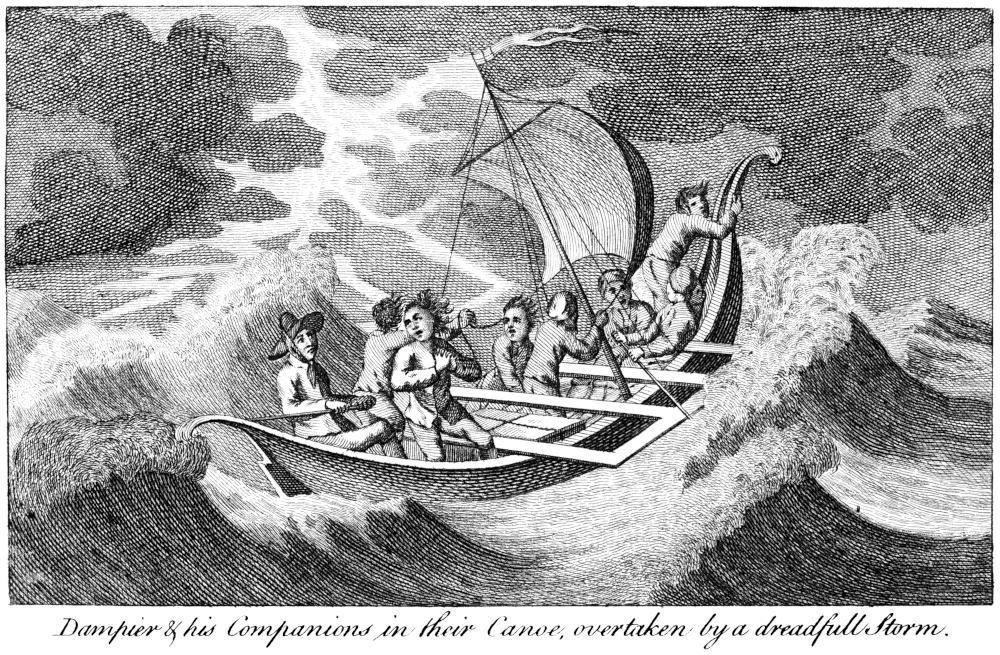
Dampier & his Companions in their Canoe, overtaken by a dreadfull Storm.
Here they staid ten or twelve days, and were kindly entertained, because the Achinese told the natives, that they were prisoners on board the pirate as well as themselves, and that they were all set ashore together. Hall and Dampier were strongly importuned to stay, to assist in improving their navigation; but, longing to get home, they chose to be conveyed to the English factory at Achin: a vessel was therefore provided for them, and in three days they arrived safe. Three days after their arrival, the Portuguese died, and Ambrose lived but a short time after him. Dampier and Mr. Hall, after passing examination, were kindly entertained by Mr. Driscal, an Irish gentleman, interpreter to the factory; and the four Achinese were restored to their families and friends.
Dampier was so drenched by a Malayan doctor, that he never expected to survive the effects of the potions he prescribed; yet after more than sixty evacuations from one dose, he gathered strength daily; and, after his health was a little restored, both Hall and he undertook to sail with Captain Bowry to Nicobar. This Captain Bowry was the gentleman who sent the letter from Sumatra to Mindanao, already spoken of, which involved a double mistake. Bowry imagined an English factory to subsist at Mindanao, and the English at Mindanao, from Bowry’s letter, imagined there had been an English factory at Sumatra. They sailed from Achin-road the beginning of June; but, a storm coming on, they presently returned. About this time Captain Welden arrived from Fort St. George; and Dampier engaged to sail with him to Tonqueen, in China, and afterwards made a voyage to Malacca. His next ramble was to Fort St. George, and, after his return from thence, he came to Bencouli, an English factory on the west coast of Sumatra; from whence, about the beginning of 1691, he set out on his return to England.
After his return to Achin from his voyage to Malacca, he found there one Mr. Morgan, formerly belonging to the Cygnet, who was then mate of a Danish ship belonging to Tranquebar: and being curious to know the sequel of the adventures of his old companions, was told by Morgan, that, when they left Nicobar, they directed their course to Ceylon; but, not being able to weather that island, they were forced to seek refreshment on the coast of Coromandel, where they began to form new projects; but their schemes not succeeding, about half their number left them, among whom were Morgan and Coppinger, who both were entertained in the Danish service, and two or three others repaired to Fort St. George but the main body went up the country, and listed in the army of the Great Mogul, where a few of them continued orderly for some time; but Oliver, the quarter-master, and a party with him, soon left the camp, and rambled about, plundering and robbing the villages, and flying whenever they were pursued.
Captain Read, having thus lost the better half of his men, after having filled his water and got rice, sailed again, still intending for the Red Sea. He had taken off Ceylon a rich Portuguese ship, and had plundered her of what he liked; but not being able to bear up against the westerly winds, he stood for the island of Madagascar. There, after various adventures, Captain Read, with half a dozen of his followers, slipt away from the rest of the company, and embarked in a ship for New York. Captain Teat succeeded Captain Read in the command; and, having joined Captain Knight, of whom mention has been made before, they sailed some time in company; but the Cygnet proving leaky, Knight gave her the slip, on which she returned again to Madagascar, and finally sunk in St. Augustin bay.
While Dampier was at Fort St. George, there arrived a ship from Mindanao, laden with clove-bark, on board of which came Mr. Moody, as supercargo. This gentleman, while at Mindanao, purchased the Prince of Meangis, of whose country mention has already been made in the former part of this relation. This unfortunate Prince, with his mother, and some attendants, had been driven off their own coast by a storm, and had been seized at sea by some Mindaneian fishermen, who brought them to Mindanao, and sold them for slaves; a common practice among savage islanders. The Prince attracted the notice of Mr. Moody by the curious manner in which he was painted, and which, by Dampier’s description, exactly corresponds with that of tataowing among the New Zealanders. His design was to have brought him over with him to England; but Mr. Moody speaking the Malayan language, and being otherwise well qualified to manage the company’s affairs at a new factory, he was persuaded by the Governor of Fort St. George to accept of the Chiefship of Indrapore, in the room of Mr. Gibbons, who had just resigned in order to return home. Upon this unexpected promotion, Mr. Moody importuned Dampier to go with him to be his gunner, and, in order to encourage him thereto, promised to purchase a small vessel to carry the Prince and his mother to their own country, and to send him as Commander, with full power to establish a commerce with Meangis, which could not fail of turning greatly to the advantage of all concerned. This was a generous and friendly offer which Dampier could not refuse; and accordingly he embarked in a company’s coasting ship, in which there were seven or eight officers passengers, and about 60 soldiers for the new factories. They had a pleasant passage till they came upon the west coast of Sumatra, when a storm arose, by which they were driven from their intended port, and forced to make the harbour of Bencouli. At Bencouli they were all very kindly received, and the gunner of that fort being just dead, Dampier was offered the post, with a more ample salary than Mr. Moody, in a newly-established factory, could venture to allow. Dampier consented to accept of this appointment, provided Mr. Moody approved of it; and Mr. Moody, not being certain of being able to fulfil his engagement, so far as the same related to the Prince of Meangis, very readily gave Dampier leave to contract with the Governor of Bencouli; and, at the same time, assigned to him a half-share in the two slaves, the Prince and his mother, that he might not be a sufferer by leaving Fort St. George to follow him.
Matters being thus accommodated, Mr. Moody repaired to his station at Indrapore, and Dampier with the two slaves continued at Bencouli. They lived at a house in the town, and Dampier was accommodated in the fort. All this passed in 1690; but, before the year was expired, Dampier grew tired of his office, and, wanting to get home, applied to the Governor and Council for his discharge. The Council thought it highly reasonable that his request should be granted; and the Governor made no opposition, there being at that time no ship in readiness to carry him off: but, as he had foreseen, when the Defence, Captain Heath, bound for England, came into harbour, he then made many excuses, and at length absolutely refused to permit him to go. In vain did Captain Heath remonstrate; and in vain also did Mr. Goddard, the chief mate, interest himself in Dampier’s release,—the Governor was inflexible. The Defence had touched at Indrapore before she put into Bencouli; and Mr. Moody had consigned the other half-share of the slaves to Mr. Goddard, on having been previously acquainted by letter from Dampier of his intention to sail for England. In consequence of this assignment, the Prince who some time before had been attacked with an infectious distemper, of which his mother died, and of which he was but just recovered, was put on board the Defence; and it was privately agreed between Captain Heath and Dampier, that, if the latter could make his escape, the former would undertake to carry him safe off. Accordingly, when all the company’s business was completed, and the letters put on board, notice was given to Dampier of the precise time when the ship was to sail; “and, says he, after several assays, I slipt away at midnight; and, creeping through one of the port-holes of the fort, I got to the shore, where the ship’s boat waited for me, and carried me on board.”
On the 25th of January, 1691, they set sail for the Cape of Good Hope; and, the wind being fair, they proceeded at first very successfully: but they had not been long at sea before the men began to droop, being attacked with a distemper that stole insensibly upon them, and before they thought themselves ill were ready to die. Dampier attributes this fatal disorder to the badness of their water, which was filled from a river fed by many noxious streams from the low swampy lands that in the dry season, as it were, drained their dregs into it, which at times were as black as ink. Besides, it was stowed among the pepper in the hold, which heated it to that degree, that every morning when the men went to take their allowance, it was so hot, they could hardly bear to hold a bottleful of it in their hands; “a thing scarce to be credited, says Dampier, that water should be ready to boil in a ship’s hold.” This distemper was so universal, that not a man in the ship was wholly unaffected by it; so that when the wind blew a hard gale, there wanted hands to work the ship.
Captain Heath, pitying the condition of his men, distributed every day among them a quantity of tamerinds, some jars of which he had brought with him from India; and this was a very seasonable relief: but the wind coming south, and the passage being already protracted to an unusual length, the Captain called the whole ship’s crew together, to consult what was best to be done in the present extremity, and desired every man, from the highest to the lowest, to deliver his opinion freely. Thus all circumstances being duly considered, it was unanimously agreed at last, notwithstanding the wind was then contrary, to prosecute their voyage to the cape. But as that determination would infallibly require a more than ordinary exertion of labour from those that were well, to supply the place of those that were sick, the Captain promised a month’s extra pay to every man who should assist on all occasions that should require help, whether it was his watch or not and this premium he engaged to pay at the cape. This offer was first accepted by the Officers, and then as many men as were capable of duty entered themselves upon the roll. In a short time, it pleased God, says Dampier, to favour us with a fair wind, which being improved to the best advantage by the incessant labour of those new-listed men, wafted us in a short time to the cape; and, being brought safe to an anchor by the assistance of 100 Dutch sailors, who unbent the sails, and did every thing for us they were required to do, the sick were presently sent on shore, where they remained about six weeks, and all but three or four recovered.
On the 23d of May they sailed from the cape in company with the James and Mary, and the Josiah Indiamen. They directed their course towards the island of St. Helena, and met with nothing remarkable, except a swelling sea, which taking them on the broad side, rolled every thing about that was loose between the decks and in the hold. This great tumbling sea took them soon after doubling the cape; “an eminent token, says Dampier, that the south-west winds were now violent in the higher latitudes towards the South Pole, we having fine clear weather all the while.”
On the 20th of June they arrived at Santa Helena, where they staid four or five days, and afterwards continued their voyage to England without any remarkable incident; and arrived safe in the Downs, Sept. 16, 1691.
What advantage Dampier and his partner Mr. Goddard made of their painted prince is not related; but they certainly sold him to be carried about the country to be shewn for money. He was painted all down his breast, between his shoulders, on his thighs, and round his legs and arms like bracelets. “I cannot, says Dampier, liken the drawings to any figure of animals, or the like; but they were very curious, full of great variety of lines, flourishes, chequered work, and innumerable convolutions, keeping a very graceful proportion, and appearing very artificial, even to the wonder of all that beheld him.” It has already been remembered, that the mother of the Prince died in India of the infectious disorder of which he was but just recovered when he embarked for Europe. On that occasion Dampier did what he could to comfort Jeoly, for that was the name they gave him; but he took on extremely, insomuch that it was feared he could not have long survived; on which account a grave was immediately dug to hide the dead body out of his sight; and being shrouded decently with a piece of fine new calico, the corpse was about to be interred; but Jeoly was not satisfied till he wrapped all his mother’s cloaths about her, and two new pieces of chintz that Mr. Moody gave her, saying they were her’s, and she must have them. After this he suffered her to be interred, which was done with great solemnity; but he continued to pine after her during the whole time he continued in India.
In the printed relation that was given of him when he was shewn for a sight, the showmen heightened their account with a romantic story of a beautiful sister of his being a slave with him at Mindanao, and of the Sultan’s falling in love with her, and taking her to his bed; but these were stories indeed! They reported also, that the paint with which he was ornamented was of such virtue, that serpents and all venomous creatures would fly from him: but poor Jeoly was as much afraid of serpents, scorpions, and centipedes, as a little child, for he was exceedingly timorous. He died at Oxford, but Dampier does not tell the year.
The publication of the above voyage round the world having recommended Dampier to the notice of persons of the first eminence, he was afterwards employed by government in discoveries, both in the Eastern and Southern Seas. His first expedition was to the coast of New Holland, which could have no other object but discovery in view. He sailed from the Downs, on Jan. 14, 1698, in his Majesty’s ship the Roebuck, carrying only 12 guns, and 50 men, and having 20 months provisions on board. On the 1st of August they fell in with the western coast of New Holland, in lat. 26 deg. S. where, however, they found nothing very different from what Dampier had before described. The only land animals they saw, were a small sort of racoons, different from those of the West-Indies chiefly in their legs, which are short before, and on which they run jumping; and a sort of guano’s, or lizards, peculiar to the country, which appear to have two heads, but in reality have but one, and no tail; and, what is no less remarkable, their four legs seem to be all forelegs, so formed as that the creature may walk either way. To these may now be added the kanguroo, a quadrupede of a particular shape, as large as a sheep, and a creature of the oppossum kind, discovered by Mr. Banks; with dogs and wolves seen by the Endeavour’s crew; of the latter sort some were seen by Dampier’s men, but so lean that they were nothing but skin and bone. In latitude 23 deg. S. they saw dolphins, and small whales, and abundance of scuttle-shells, swimming in the sea.
Captain Cook found plenty of water on the east side of this island; but Dampier was much distressed for want of it on the west side. Being ashore employed in digging a well, he was assaulted by ten or twelve of the natives, with whom he had a skirmish, and was forced to shoot one of them dead, to disengage a young man who was surrounded by three of them, and wounded in the check with a lance. On a gun’s being fired over the heads of the assailants, though it startled them at first, they soon recovered their surprize, and continued their hostilities; but as soon as they saw a man fall, they were terribly frightened, and fled with precipitation. Dampier very humanely adds, that he attempted the natives no farther, being very sorry for what had happened.
Among the natives engaged on this occasion, there was one who by his appearance and carriage seemed to be the chief of them. He was a young brisk man, not very tall, nor so personable as some of the rest, though more active and courageous. He was painted with a circle of white pigment about his eyes, and a white streak down his nose from his forehead to the tip of it; his breast and some part of his arms were also made white with the same paint; not for beauty or ornament as it should seem, but, as some wild Indian warriors are said to do, to make themselves look more terrible in war. He was indeed a very frightful being; for the manner in which he was painted, adding to his natural deformity, gave him more the appearance of a monster of the woods, than of a man born of a woman. Dampier in this second voyage to New Holland, confirms what he said of the natives in his first, that they are the worst-featured savages he ever beheld. Captain Cook, on the contrary, or his editor, assures us, that their features are not disagreeable, their noses are not flat, nor are their lips thick; their teeth are white and even, and their hair naturally long and black, but universally cropt short: in general it is straight, but sometimes has a small curl; their beards are of the same colour with their hair, bushy and thick, which they shorten by singeing: they are of the middle stature, in general well made, clean limbed, remarkably vigorous, active, and nimble; their countenances not altogether void of expression, and their voices remarkably soft and effeminate. Such are the different descriptions given by voyagers of the same people; or, to speak more precisely of people on the east and west side of the same continent; for which it is not easy to account.
Our voyager, however, not being able either to find fresh water, or a harbour to careen his ship, set sail from this miserable country about the beginning of September, 1699; and, directing his course to the island of Timor, arrived there September 15, and received a supply of water and provisions from the Chief of the Dutch factory there. He was likewise hospitably entertained by the gentlemen of the Portuguese factory on the same island. From thence he sailed to the coast of New Guinea, traded with the inhabitants, and ranging along the coast, found the main land divided into two parts. To the easternmost division he gave the name of New Britain.
In his return back he touched again at Timor, and from thence sailed to Batavia; where having careened his ship, and supplied himself with necessaries of every kind, on the 17th of October, 1700, he set sail for the Cape of Good Hope; from thence continuing his voyage to St. Helena, he arrived at that island January 31, 1701; but in his course home his ship sprung a leak at sea, and, after endeavouring in vain to stop it, he was obliged to run her a-ground on the island of Ascension; where having landed his men, and taken from on board all necessary provisions, they in a short time discovered a fine spring of water, and lived tolerably, till they were at last relieved by some English men-of-war, who were convoying home the Canterbury Indiaman, and brought them all safe to England.
In 1703, notwithstanding the bad success of the voyage just mentioned, Dampier was again employed in an expedition to the South Sea, in conjunction with Captain Pulling, who had each a ship of 26 guns, and 120 men under his command. That commanded by Captain Dampier was called the St. George; and that by Captain Pulling, the Fame. They were victualled for nine months, and had commissions from his Royal Highness Prince George of Denmark, then Lord High Admiral, to proceed in a warlike manner against the French and Spaniards; and both were upon the same terms of No purchase no pay. But while they were in the Downs, some difference having arisen between the two Captains, Captain Pulling set sail alone, and left Dampier to take his own course; who, stopping some time in Ireland, was joined by the Cinque Ports galley of 90 tons, 16 guns, and 63 men, Captain Charles Pickering Commander. In this expedition, Dampier had three grand objects in view: the first was, to sail to Buenos Ayres, in order to surprize the Spanish galleons that usually take in their lading at that port; the second depended on missing the first, in which case they were to pass through the straits of Magellan to cruise upon the coasts of Peru, for the Baldivia ships that carry gold to Lima; and the third was only to take place, if both the former miscarried; and was, to proceed to the coast of Mexico, to intercept the Manilla ship that annually arrives at Acapulco, and is said to be worth eight or nine millions of pieces of eight, equal to a million and a half of our money.
Full of these projects, they set sail from Kinsale, in Ireland, on the 11th of September, 1703, and on the 25th arrived off Madeira, where they learned that the galleons were sailed from Buenos Ayres, and then lay at Teneriff. The first project being thus defeated, they proceeded to put the second in execution with all possible dispatch. On the 24th of November they anchored on the island Le Grand, on the coast of Brazil, where they buried Captain Pickering, and chose Lieutenant Stradling in his room.
From this island they sailed the 8th of December; and, doubling Cape Horn on the 20th of January, they changed their direction, sailed to the northward, and on the 10th of February came to an anchor in the great bay of Juan Fernandez, where they met their consort Captain Stradling, with whom they had parted in passing Cape Horn in a violent storm, which happened on the 26th of January.
At Juan Fernandez they continued refitting their ships till the 29th, when seeing a sail, they slipt their cables, and put to sea. She proved to be a French ship of 400 tons, 30 guns, and full of men. The St. George fought her about seven hours, when a gale springing up, she sheered off. On this occasion, the Cinque Ports behaved but indifferently, firing only a few guns, and lying by.
Next day, in returning to Juan Fernandez, they fell in with two French men-of-war of 36 guns each; from whom they narrowly escaped, leaving their cables, anchors, and five or six of their men belonging to the Cinque Ports on that island, with a new suit of sails, and several other necessaries which they could ill spare.
They now proceeded upon their second enterprize; but they were equally unfortunate in that as in the former. The Baldivian ships were sailed, and the gold secured. They then meditated a surprize against the town of Santa Maria, in the gulph of Panama, where the Spaniards getting intelligence of their designs, laid ambuscades, and after killing and wounding several of them, put the rest to flight.
In this manner, disappointments succeeding disappointments, differences began to arise between the Commanders and they concluded to part company. But about this time, a large ship, fortunately for them, coming to an anchor in the night close by them, they instantly boarded and made prize of her. She was deeply laden with flour, sugar, brandy, wine, about thirty tons of malmalade of quinces, a considerable quantity of salt, with some tons of linnen and woolen-cloth. This proved a seasonable supply; and provisions that were before so scarce, that only five green plantains were the daily allowance for six men, were now so abundant on board the prize, that they might have laid in a stock for several years; yet in less than six months we find them starving.
After rummaging the prize and dividing the spoil, the Captains parted; and in two or three days, Dampier fell in with a Spanish man-of-war, fitted out on purpose to take him. The two ships had a smart engagement, and parted in the night by consent.
Soon after this engagement, Dampier and Clippinton, his first Lieutenant, having some difference, Clippinton seized upon the ship’s tender, in which were the stores and ammunition, and with 21 of the best men weighed anchor, and set sail. When he had cleared the islands, he sent to invite all those who were willing to sail with him to come on board; but Dampier’s last project being now on the point of being carried into execution, the men who remained with him resolved to abide the issue. Clippinton, though he had quarrelled with the Captain, had no mind to distress the men; he therefore thought fit to restore the powder and ammunition, reserving only enough for his own use. In the bay of Tacames, Dampier had taken a small bark of 60 tons, laden with plantains. This bark they intended to keep as a tender. She had two masts, with two square sails; and they named her the Dragon.
The Master of this bark, Christian Martin by name, was a Spaniard by birth, but taken prisoner while he was a boy, and bred up in England. This man they kept prisoner on board and now proceeded to intercept the Manilla ship.
On the 6th of December in the morning, they saw a sail, and soon came up with her. She proved their last hope, the great Manilla ship, from the East-Indies. They instantly bore down upon her, and before she could bring her guns to bear gave her several broadsides; and, taking her unprepared, put the company on board in the utmost disorder. Captain Martin, though a Spaniard, advised to lay her aboard immediately, before the Spaniards had recovered their surprize; but that advice was disregarded till it was too late; for while two parties were quarrelling on board the St. George, the one for laying the enemy aboard, the other not, the Spaniards got out a tier of 24-pounders, every one of which that took place was ready to send the St. George to the bottom. The assailants were therefore soon beaten off with disgrace, after having received a shot between wind and water in the powder-room, by which two feet of planking was driven in on each side the stern. And now, being disappointed of this their last expectation, all the men grew discontented, and impatient to return home. However, they were prevailed upon to cruise a few weeks longer on the coast of Mexico; and with that view passed the ports of Acapulco, Port Angels, Port Guatulco, and several others; but without meeting with any prize worth waiting for.
Ill success is generally succeeded by discontent; the men who were before impatient of fatigue without reward, grew now ungovernable. A party, therefore, formed the design of returning home by way of the East-Indies; and these were encouraged by Mr. Funnel, the chief mate, who, having the command of the small Spanish prize already mentioned, determined to hazard every thing to regain his native country, rather than continue under the direction of a man with whom there was no keeping terms. He therefore embraced the first opportunity to reach the gulph of Amapalla, to new-water his bark, and prepare for his voyage home.
It should seem, that this voyage of Dampier, though countenanced with a government commission, was notwithstanding fitted out by private adventurers; for, on this occasion, the owners agent is said to have divided the provisions and stores between those who chose to remain with Dampier, and those who determined to follow the fortune of Mr. Funnel. Their whole number was already reduced to 60 effective men, 33 of whom chose to accompany Funnel, and 27 only remained with Dampier, but upon what terms they engaged, or what course they pursued afterwards, we are not told; for Dampier, though he returned home, never published any account of this voyage. What we have related concerning it, in order to complete his adventures, as far as our materials extend, we have extracted from the account published by Funnel; who, having left Dampier in the gulph of Amapalla, on the 1st of February, 1705, takes no farther notice of his Captain; but goes on with the story of his own voyage, which was indeed unfortunate enough; for his ship was seized by the Dutch at Amboyna, the goods on board confiscated, and most of the men cruelly used, being confined and half-starved by our good friends the Dutch, who were jealous lest they should make discoveries prejudicial to their commerce. Funnel himself, however, soon got released; and, having made strong representations against the authors of his sufferings at Amboyna, he at length obtained some shew of redress; with which, though not a compensation for his losses, he was forced to be contented. On the 2d of Nov. he, with two of his company, got passage to Europe in the Dutch East-India fleet; and, on the 15th of July following, arrived safe in the Texel, from whence, after visiting the principal towns in Holland, he came to England, and published the account just mentioned, in which he followed the example of Dampier, by giving a description of the natural productions of the islands at which he touched, their inhabitants, arts, and commerce.
We can find no traces of the latter part of the life of Dampier, who seems to have been an able navigator, but of a restless turbulent spirit, like the ocean on which he was bred. He certainly possessed the art of sailing in a very eminent degree; but he wanted that happier art of conciliating the wavering discordant passions of his followers and associates. He seems, too, to have been more cautious than brave, more subtle than wise, and more enterprizing than fortunate. In all his engagements, both as an inferior officer and as a commander, he seems neither to have braved danger nor to have feared it. It is not easy to determine, whether his thirst for gold, or desire of knowledge, was the governing principle that led him to range the world for new discoveries. If the former, he seems totally to have failed in the pursuit; if the latter, he was more successful. At Mindanao, we find him poor; at the Bashee islands he laments the want of every article that could purchase from the natives a small specimen of the yellow metal that bore the resemblance of gold; but withal so honest, that he would neither take the iron belonging to the owners of the ship to give in exchange, nor would he take the metal from the inhabitants without an equivalent. In short, I think, we may conclude, from what he himself has written, that Dampier was a man of strong natural parts, of blunt manners, of quick discernment, inflexible in his resolutions, but deficient in natural qualities to command respect, and in acquired abilities to maintain it.