THE VOYAGES OF Capt. THOMAS CAVENDISH, THE SECOND ENGLISH NAVIGATOR WHO SAILED ROUND THE WORLD.
Reading edition
This Gentleman was descended from an antient family in Suffolk, whose ancestors came into England with William the Conqueror. His father, William Cavendish, of Trimley St. Martin, near Ipswich, dying young, left his son Thomas a minor, and heir to the manors of Trimley, Stratton, and Grimston, with other lands of inheritance to a very considerable amount: but this youth, whose atchievements we are about to relate, being of a high-spirited disposition, and, as soon as he came of age, subject to no controul, fell early into the fashionable gallantries and vices of the times, and dissipated the best part of his ample fortune before he entertained any thoughts of applying to business, or, perhaps, was sensible how deeply his affairs were embarrassed.
But he no sooner began to reflect, and to perceive, that, without application to some kind of employment, he must be undone, than he made choice of a sea-faring life, not only as most suitable to his unsettled turn of mind, but also as the most likely means of restoring his fortune, and establishing his credit.
The kingdom was now involved in war with the Spaniards, the then most powerful, and consequently the haughtiest and most formidable people in Europe, who, drawing immense riches from their new acquisitions in America, not only raised the envy but the enmity of other powers, by their pride and their perfidy.
Gentlemen of fortune, and gentlemen of no fortune, were about this time equally encouraged to distress the enemy. The war laid open an immense field for enterprize; and every one was at liberty to share the harvest, who was willing to bestow the pains of gathering the produce and bringing it home.
Among the most active and the most indefatigable was Sir Walter Raleigh, who not only was the most experienced, but the most successful leader of his time. With him our adventurer first determined to embark; and, as Sir Walter had just projected a new voyage to America at his own charge, he was ready enough to admit associates, who were able and willing to bear a part of the expence. Unfortunately for our new adventurer, all the advantage he derived from this project was only in the knowledge he obtained of sea affairs, and of the temper and genius of the people with whom he had to deal; for the profits that accrued from the voyage by no means answered the sums employed in pursuing it. He observed, that, by means of their great riches, the Spaniards could command intelligence of all that was in agitation against them on this side the globe; but that, if they were to be taken off their guard, the southern hemisphere must be the place of action. He had already an example, in Sir Francis Drake, of the immense wealth that was to be acquired on the coast of Peru, if secrecy could be preserved, and he determined to be upon his guard, and to keep his design solely within his own breast.
With this view he sold a part of the remains of his estate, and set about building two ships proper for his enterprize at Harwich, at that time an obscure port, namely, one called the Desire, of 120 tons; and another of 60, called the Content; to these he added the Hugh Gallant, a bark of 40 tons. In the equipment of this little squadron, he purchased many articles of commerce to cover his design, and then privately laid in guns, ammunition and stores, with a moderate quantity of provisions, intending to purchase the rest at some other convenient port, when he was just ready to depart.
He likewise enlisted but half his complement of men; and when he arrived at Plymouth he supplied the rest. In the whole conduct of what has been already related, he was his own sole director, and none of those who sailed with him knew whither he was bound, till after their embarkation at Plymouth. It is even uncertain whether Lord Hounsdon, who procured his commission, knew the place of his destination.
An enterprize so well concerted cannot fail to excite curiosity; and as it was excellently written by Mr. Pretty, brother to Sir William, who accompanied Cavendish throughout the voyage, it will best appear in its ancient dress.
“We departed, says Mr. Pretty, out of Plymouth on Thursday the 21st of July, 1586, with three sails (to wit, the Desire a ship of 120 tons, the Content of 60 tons, and the Hugh Gallant a bark of 40 tons); in which small fleet were 123 persons of all sorts, with all kind of furniture, and victuals sufficient for the space of two years. On Tuesday the 26th of the same month, we were forty-five leagues from Cape Finis Terræ, where we met with five sails of Biscayers, coming from the Grand Bay in Newfoundland, as we supposed, which our Admiral shot at, and fought with them three hours; but we took none of them, by reason the night grew on.
The 1st of August we came in sight of Fort Ventura, one of the isles of the Canaries, about ten o’clock in the morning.
On Sunday, being the 7th of August, we were gotten as high as Rio del Oro, on the coast of Barbary.
On Monday the 19th, we fell in with Cape Blanco, but the wind blew so much at the North, that we could not get up where the Canters do use to ride and fish: therefore we lay off six hours west-south-west, because of the sand which lieth off the Cape south-west and by south.
The 15th day of the same month we were in the height of Cape Verd, by estimation fifty leagues off the same. The 18th, Sierra Leona did bear east of us, being forty leagues from us; and the same day the wind shifted to the north-west; so that, by the 20th day of the said month, we were in six degrees thirty minutes to the northward of the Equinoctial Line.
The 23d, we set sail for Sierra Leona, and on the 25th day we fell in with the point on the south-side of Sierra Leona, which Mr. Brewer knew very well, and went in before with the Content, which was Vice-admiral: and we had no less than five fathoms water when we had least, and had, for fourteen leagues in south-west, all the way running into the harbour of Sierra Leona, sixteen, fourteen, twelve, ten, and eight fathoms of water.
The 26th of the said month, we put into the harbour; and, in going in, we had by the southmost point at least five fathoms water by the rock, which lieth at the said point: and after we came within two or three cables length of the said rock, we never had less than ten fathoms water until we came up to the road, which is about a league from the point, bordering always on the south-side until you come up to the watering-place, in which bay is the best road: but you must ride far into the bay, because there runs prodigious great tides in the offing, and it commonly floweth into the road at a south-east and by east moon.
It is from England to this place 930 leagues; which we ran from the 21st of July to the 26th of this month of August. On Saturday, being the 27th day, there came two negroes from the shore aboard our Admiral, and made signs unto our General that there was a Portuguese ship within the harbour; so the Hugh Gallant, being the Rear-admiral, went up three or four leagues, but, for want of a pilot, they went no farther; for the harbour runneth up three or four leagues more, and is of a prodigious breadth, and very dangerous, as we were afterwards informed by a Portuguese.
On Sunday the 28th, the General sent some of his company on shore, and there, as they played and danced all the forenoon among the negroes, to the end that they might hear some good news of the Portuguese ship, and as they were returning to go on board, they spied a Portuguese, which lay hid among the bushes, whom we took and brought away with us the same night: and he told us it was very dangerous going up with our boats in search of the ship that was at the town. Whereupon we went not to seek her, because we knew he told us the truth for we bound him and made him fast, and so examined him. He told us also, that his ship was there cast away, and that there were two more of his company among the negroes. The Portuguese’s name was Emmanuel, and was by his occupation a chalker, belonging to the port of Portugal.
On Monday morning, being the 29th day, our General landed with 70 men, or thereabouts, and went up to their town, where we burnt two or three houses, and took what spoil we could, which was but little; but all the people fled: and, in our retiring on board, in a very little plain, at their town’s end, they shot their arrows at us out of the woods, and hurt three or four of our men. Their arrows were poisoned; but yet none of our men miscarried at that time. Their town is very artificially built with mud walls; their houses built round, with their yards paled in, and kept very clean, as are their streets. These negroes used great obedience to their King, as one of our men said, which was an hostage for the negroes which came first. There were in their town, by estimation, about one hundred houses.
The first of September, there went many of our men on shore at the watering-place, and did wash shirts very quietly all the day. And the second day they went again, and the negroes were in ambush round about the place; and the carpenter of the Admiral going into the wood, to do some special business, espied them by good fortune. But the negroes rushed out upon our men so suddenly, that, in retiring to our boats, many of them were hurt; among whom Wm. Pickman, a soldier, was shot in the thigh; who, plucking the arrow out, broke it, and left the head behind; and he told the chirurgeons that he plucked out all the arrow, because he would not have them lance his thigh: whereupon the poison wrought so that night, that he was prodigiously swolen, and the next morning he died; the piece of the arrow with the poison being afterwards plucked out of his thigh.
The 3d day of the said month, divers of our fleet went up four miles within the harbour with our boat, and caught great store of fish, and went on shore, and took lemons from the trees; and, coming on board again, saw two buffaloes.
The 6th day we departed from Sierra Leona, and went out of the harbour, and staid one tide three leagues from the point of the mouth of the harbour, in six fathoms, and it flowed south-south-west.
On Wednesday, being the 7th of the same month, we departed for one of the isles of Cape Verd, which is ten leagues distant from the point of Sierra Leona and about five o’clock the same night we anchored about two miles off the island, in six fathoms water, and landed the same night, and found plantains only upon the island.
The 8th day, one of our boats went out, and sounded about the island, and they passed through a Sound at the west end of the island, where they found five fathoms water round about the island, until they came to the very gut of the Sound, and then for a cast or two they had but two fathoms water, and presently after six fathoms, and so deeper and deeper. And, at the east end of the island, there was a town where negroes resorted at some times, as we perceived by their provision.
There is no fresh water on all the south-side that we could perceive; but, on the north-side, three or four very good places of fresh water: and all the whole island is a wood, save certain little places where the houses stand, which are environed round about with plantain trees, whereof the fruit is excellent meat. This place is subject very much to thunder, rain, and lightning, in this month: I think the reason is, because the sun is near the Line Equinoctial. On Saturday the 10th, we departed from the said island about three o’clock in the afternoon, the wind being at the south-west.
The last of October, running west-south-west, about twenty-four leagues from Cape Frio in Brazil, we fell in with a great mountain, which had an high round knob on the top of it, standing like a tower.
The first of November, we went in between the island of St. Sebastian and the main land, carried several things on shore, set up a forge, and had our casks on shore; our cooper made hoops: and so we remained there until the 23d day of the same month in which time we fitted our things, built our pinnace, and filled our fresh water. And while our pinnace was building, there came a canoe from the river of Janeiro, meaning to go to St. Vincent, wherein were six naked slaves of the country, which did row the canoe, and one Portuguese; and the Portuguese knew Christopher Hare, Master of the Admiral; for that Mr. Hare had been at St. Vincent, in the Minion of London, in the year 1581: and, thinking to have John Whithal, the Englishman, which dwelleth at St. Vincent, come unto us, which is twenty leagues from this harbour, with some others, thereby to have had some fresh victuals, we suffered the Portuguese to go with a letter unto him, who promised to return or send some answer within ten days, for that we told him we were merchants, and would traffic with them; but we never received any answer from him and seeing that he came not according to appointment, our business being dispatched, we weighed anchor, and set sail from St. Sebastian on the 23d of November.
The 16th day of December we fell in with the coast of America, in 47 deg. and 20 min. the land bearing west from us about six leagues off; from which place we ran along the shore until we came into 48 deg. It is a steep beach all along.
The 17th of December, in the afternoon, we entered into an harbour, where our Admiral went in first; wherefore our General named the said harbour Port Desire; in which harbour is an island or two, where there is a wonderful great store of seals, and another island of birds, called grey gulls. These seals are of a wonderful bigness, huge and monstrous of shape; and, for the fore-part of their bodies, cannot be compared to any thing better than to a lion: their head, neck, and fore-part of their bodies, are full of rough hair; their feet are in the manner of a fin, and in form like unto a man’s hand; they breed and cast every month, giving their young milk, yet continually get they their living in the sea, and live altogether upon fish: their young are extraordinary good meat; and being boiled or roasted, are hardly to be known from lamb or mutton. The old ones are of such bigness and force, that it is as much as four men are able to do to kill one of them with great staves; and he must be beaten down with striking on the head of him; for his body is of that bigness, that four men could never kill him, but only on the head; for being shot through the body with an harquebuss, or a musket, yet he will go his way into the sea, and never care for it at the present. Also the fowls that were there were very good meat, and great plenty of them: they have burrows in the ground like conies, for they cannot fly; they have nothing but down upon their pinions; they also fish and feed in the sea for their living, and breed on shore.
This harbour is a very good place to trim ships in, and to bring them on ground and grave them in, for there ebbeth and floweth much water; therefore we graved and trimmed all our ships there.
The 24th of December, being Christmas-eve, a man and a boy of the Rear-admiral went some forty scores from our ships, unto a very fair green valley at the foot of a mountain, where was a little pit or well which our men had digged and made some two or three days before, to get fresh water; for there was none in all the harbour; and this was but brackish; therefore this man and boy went thither to wash their linen: and being in washing at the said well, there were great numbers of Indians which were come down, and found the said man and boy in washing. These Indians being divided on each side of the rocks, shot at them with their arrows, and hurt them both; but they fled presently, being about fifty or threescore, though our General followed them but with sixteen or twenty men. The man was shot quite through the knee, the boy into the shoulder; either of them having very sore wounds. Their arrows are made of little canes, and their heads are of a flint stone, set into the cane very artificially. They are as wild as ever was a buck, or any other wild beast; for we followed them, and they ran from us as we had been the wildest things in the world. We took the measure of one of their feet, and it was eighteen inches long. Their custom is, when any of them die, to bring him or them to the cliffs by the sea-side, and upon the top of them they bury them; and in their graves are buried with them their bows and arrows, and all their jewels which they had in their life-time, which are fine shells that they find by the sea-side, which they cut and square after an artificial manner; and all are laid under their heads. The grave is made with large stones of great length and bigness, being set all along full of the dead man’s darts, which he used when he was living. And they colour both their darts and their graves of a red colour, which they use in colouring themselves.
The 28th of December, we departed out of the port of Desire, and went to an island which lieth three leagues to the southward of it; where we trimmed our saved penguins with salt, for victuals, all that and the next day, and departed along the coast south-west and by-south.
The 31st we fell in with a rock, which lieth about five leagues from the land, much like unto Edistone, which lieth off the sound of Plymouth; and we sounded, and had eight fathoms rocky ground, within a mile thereof; the rock bearing west-south-west. We went coasting along south-south-west, and found great store of seals. This rock standeth in 48 deg. 30 min. to the southward of the Line.
The 2d day of January, we fell in with a very fair white cape, which standeth in 51 degrees, and had seven fathoms water a league off the land.
The 3d, we fell in with another great white cape, which standeth in 52 deg. 45 min. from which cape there runneth a low beach about a league to the southward; and this beach reacheth to the opening of the dangerous strait of Magellan, which is in divers places five or six leagues wide, and in two several places more narrow. Under this cape we anchored, and lost an anchor; for it was a great storm, and lasted three days very dangerous.
The 6th day we put in for the straits.
The 7th day, between the mouth of the straits and the narrowest place thereof, we took a Spaniard, whose name was Hernando, who was there with 23 Spaniards more, which were all that remained of four hundred left there three years before, all the rest being dead with famine. And the same day we passed through the narrowest of the straits, where the aforesaid Spaniard shewed us the hull of a small bark, which we judged to be a bark called the John Thomas, one of Drake’s fleet. It is from the mouth of the straits unto the narrowest of the straits fourteen leagues, and the course lieth west and by-north. The mouth of the straits lieth in 52 degrees.
From the narrowest of the straits unto Penguin island is ten leagues, and lieth west-south-west, somewhat to the southward, where we anchored the 8th day, and killed and salted plenty of penguins for victuals.
The 9th day we departed from Penguin island, and ran south-south-west to King Philip’s city, which the Spaniards had built; which town or city had four forts, and every fort had in it one cast piece, which pieces were buried in the ground; the carriages were standing in their places unburied: we digged for them and had them all. They had contrived their city very well, and seated it in the best place of the straits for wood and water: they had built up their churches by themselves: they had laws very severe among them, for they had erected a gibbet, whereon they had done execution on some of their company. It seemed unto us, that their whole living for a great space was altogether upon muscles and limpets; for there was not any thing else to be had, except some deer which came out of the mountains down to the fresh rivers to drink. These Spaniards came to fortify the straits, to the end that no nation should have passage through into the South Sea, saving their own only: but, as it appeared, it was not God’s will so to have it; for during the time that they were there, which was two years at the least, they could never have any thing to grow, or in any ways prosper; and, on the other side, the Indians often preyed upon them, until their victuals grew so short, (their store being spent which they had brought with them out of Spain, and having no means to renew the same) that they died like dogs in their houses, and in their clothes, wherein we found some of them still at our coming, until that in the end the town being wonderfully tainted with the smell and savour of the dead people, the rest which remained alive were driven to bury such things as they had there in their town, and so to forsake the town, and to go along the sea-side to seek their victuals to preserve them from starving, taking nothing with them, but every man his harquebuss, and his furniture, that was able to do it (for some of them were not able to carry them for weakness), and so lived, for the space of a year and more, on roots, leaves, and sometimes a fowl which they might kill with their piece. To conclude, they set forward, determined to travel towards the river of Plate, there being only twenty-three persons left alive, whereof two were women, which were the remainder of four hundred. In this place we watered and wooded well and quietly. Our General named this town Port Famine: it standeth in 53 degrees by observation to the southward.
The 14th day we departed from this place, and ran south-south-west, and from thence south-west unto Cape Froward, five leagues west-south-west, which cape is the southermost part of all the straits, and standeth in the latitude of 54 degrees. From which cape we ran west and by-north five leagues, and put into a bay or cove on the south side, which we called Muscle-cove, because there was great plenty of them: we rode therein six days, the wind being still westerly.
The 21st day of January we departed from Muscle-cove, and went north-west and by-west ten leagues, to a very fair sandy bay on the north-side, which our General called Elizabeth-bay: and, as we rode there that night, one of our men died which went in the Hugh Gallant, whose name was Grey, a carpenter by his occupation, and was buried there in that bay.
The 22d we departed from Elizabeth-bay in the afternoon, and went about two leagues from that place, where there was a fresh water river, up which our General went with the ship’s boat about three miles; which river hath very good and pleasant ground about it. It is low and champaign soil, and we saw no other ground in all the straits, but what was craggy rocks, and monstrous high hills and mountains. In this river are a great many savages, which we saw, and had conference with them. They were men-eaters, and fed altogether upon raw flesh, and other filthy food: which people had lately preyed upon some of the Spaniards before spoken of; for they had gotten knives, and some pieces of rapiers to make darts of. They used all the means they could possibly to have enticed us farther up the river, on purpose to have betrayed us; which being perceived by our General, he caused us to shoot at them with our harquebusses, whereby we killed many of them. So we sailed from this river, to the channel of St. Jerome, which is two leagues off.
From the river of St. Jerome, about three or four leagues, we ran west into a cape which is on the north-side; and from that cape unto the mouth of the straits the course lieth north-west and by-west, and north-west; between which place and the mouth of the straits, to the southward, we lay in harbour until the 23d of February, by reason of contrary winds, and most vile and foul weather, with such rain and violent stormy winds which came down from the mountains and high hills, that they hazarded the best cables and anchors that we had for to hold; which, if they had failed, we had been in great danger to have been cast away, or at least to have been famished: for, during this time, which was a full month, we fed almost altogether on muscles, limpets, and birds, or such as we could get on shore, seeking every day for them, as the fowls of the air do where they can find food in continual rainy weather.
There is, at every one or two miles end, an harbour on both sides of the land. And there are, between the river of St. Jerome and the mouth of the straits, going into the South Sea, about 34 leagues, by estimation; so that the whole length of the straits is about 90 leagues: and the mouth of the said straits standeth nearly in the same height that the entrance standeth in when we pass out of the North Sea, which is about 52 deg. and 40 min. to the southward of the Line.
The 24th day of February, we entered into the South Sea; and on the south side in going out of the straits is a fair high cape, with a low point adjoining to it; and on the north-side are four or five islands which lie six leagues off the main, and much broken and sunken ground about them. By noon, the same day, we had brought these islands east of us five leagues off; the wind being southerly.
The first of March, a storm took us at north, which night the ships lost the company of the Hugh Gallant, being in 49 degrees 30 min. and 45 leagues from land. This storm continued three or four days and for that time we in the Hugh Gallant, being separated from the other two ships, looked every hour to sink, our bark was so leaky, and ourselves so fatigued and weakened with freeing it of water, that we slept not during three days and three nights.
The 15th of March, in the morning, the Hugh Gallant came in between the island of St. Mary and the main, where she met with the Admiral and the Content, who had rid at the island of La Mocha two days, which island standeth in south latitude 38 deg. at which place some of our men went on shore with the Vice-Admiral’s boat, where the Indians fought with them with their bows and arrows, and were very wary of their calivers. These Indians were enemies to the Spaniards, and belonged to a great place called Arauco, and took us for Spaniards, as we afterwards learned.
The above-mentioned place, Arauco, is very rich, and full of gold mines; and yet could it not be subdued at any time by the Spaniards; but they always returned with the greatest loss of men: for these Indians are quite desperate, and careless of their lives, living at their own liberty and freedom.
The 15th day aforesaid, in the afternoon, we weighed anchor, and ran under the west side of St. Mary’s island, where we rid very well in six fathoms water, and very fair ground, all that night.
The 16th day, our General went on shore himself, with 70 or 80 men, every one with his furniture. There came down to us certain Indians, with two which were the Chiefs of the island, to welcome us on shore, thinking we had been Spaniards, for it is subdued by them; who brought us up to a place where the Spaniards had erected a church, with crosses and altars in it; and there were about this church two or three store-houses, which were full of wheat and barley ready threshed, and made up in cades of straw, to the quantity of a bushel of corn in every cade. The wheat and barley was as fair, as clear, and every way as good as any we have in England. There were also the like cades full of potatoe-roots, which were very good to eat, ready made up in the store-houses, for the Spaniards when they should come for their tribute. This island also yielded many sorts of fruits, hogs, and hens. These Indians are held in such slavery by their masters, that they dare not eat a hen or hog themselves: but the Spaniards have made them all in that island christians. Thus we filled ourselves here with corn as much as we would have, and as many hogs as we had salt to salt them with, and great plenty of hens, with a number of bags of potatoe-roots, and about 500 dried dog-fishes, and Guinea wheat, which is called maiz. And having taken as much as we would, yet we left a prodigious great store behind us. Our General had the two Chiefs of the island on board our ship, and provided great cheer for them, and made them merry with wine: and they, in the end, perceiving that we were not Spaniards, made signs, as near as our General could perceive, that, if we would go over unto the main land to Arauco, there was much gold; making us signs, that we should have great store of riches. But, because we could not understand them, our General made haste, and within two or three days we furnished ourselves, and departed.
The 18th day, in the morning, we departed from this place; and ran all that day north-north-east about ten leagues, and at night lay with a short sail off and on the coast.
The 19th, we ran in east-north-east with the land, and bore in with a place called the Conception, where we anchored under an island, and departed the next morning without going on land.
The 20th, we departed from the Conception, and went into a little bay, which was sandy, where we saw fresh water and cattle; but we staid not there.
The 30th day, we came into the bay of Quintero, which standeth in 33 deg. and 50 min.
The said day, presently after we were come to an anchor in the bay, there was a herdsman, that kept cattle, lying upon the point of the hill asleep; who, when he awaked, and had espied three ships which were come into the bay, before we could get on shore, he had mounted a horse which was feeding by, and rode his way as fast as ever he was able; and our General, with thirty shot with him, went on shore. He had not been on land an hour when there came three horsemen with bright swords towards us, so hard as they could ride, till within a quarter of a mile of us, and then stopt, and would come no nearer unto us: so our General sent unto them a couple of our men with their shot, and Hernando, who was the Spaniard that we had taken up at the mouth of the straits. But the Spaniards would not suffer our men to come near with their shot, but made signs that one of our men should come alone unto them: so the said Hernando, the Spaniard, went unto them, and our two men stood not far from them. They had some conference; and, in the end, Hernando came back from them, and told our General that he had parlied with them for some victuals, and they had promised as much as we would have. Our General sent him back again with another message, and another shot with him; and being come near unto them, they would not suffer any more than one to approach them: whereupon our men let the Spaniard go unto them alone; who being at some good distance from them, they staid but a small time together, before the said Hernando leaped up behind one of them, and rode away with them, notwithstanding the damnable oaths which he had made continually to our General, never to forsake him, but to die on his side before he would be false. Our General, seeing how he was dealt with, filled water all that day with good watch, and carried it on board: and night being come, he determined next day to send into the country to find their town, and to have taken the spoil of it, and to have fired it, if they could have found it.
The last of March, Captain Havers went up into the country, with 50 or 60 men, with their shot and furniture with them, and we travelled seven or eight miles into the land: and, as we were marching along, we espied a number of herds of cattle, of kine and bullocks, which were wonderfully wild: we saw also great plenty of horses, mares, and colts, which were very wild and unhandled: there is also great store of hares and conies, and plenty of partridges, and other wild fowls. The country is very fruitful, with fair fresh rivers all along, full of wild-fowl of all sorts. Having travelled so far, that we could go no farther for the monstrous high mountains, we rested ourselves at a very fair fresh river, running in and along fair low meadows, at the foot of the mountains, where every man drank of the river, and refreshed himself. Having so done, we returned to our ships, the likeliest way we thought their town would be; so we travelled all the day long, not seeing any man, but we met with many wild dogs; yet there were two hundred horsemen abroad that same day, by means of the Spaniard which they had taken from us the day before, who had told them that our force was but small, and that we were wonderfully weak; and, though they did espy us that day, yet durst they not give the onset upon us; for we marched along in array, and observed good order, whereby we seemed a greater number than we were, until we came unto our ships that night again.
The next day, being the first of April, 1587, our men went on shore to fill water at a pit which was a quarter of a mile from the water-side; and, being early hard at their business, were in no readiness: mean while, there came pouring down from the hills almost two hundred horsemen, and before our people could return to the rocks from the watering-place, twelve of them were cut off, part killed, and part taken prisoners; the rest were rescued by our soldiers who came from the rocks to meet with them; for though only fifteen of us had any weapons on shore, yet we made the enemy retire in the end, with the loss of twenty-four of their men, after we had skirmished with them an hour.
After the loss of these men, we rode at anchor, and watered in despite of them, with good watch and ward, until the 5th of the said month.
The 5th day, we departed out of this bay of Quintero; and off from the bay there lieth a little island, about a league distant, whereon there are great store of penguins, and other fowls, whereof we took to serve our turns, and sailed away north, and north-by-west; for so lieth the coast along this place.
The 15th, we came thwart of a place, which is called Morro-Moreno, which standeth in twenty-three degrees thirty minutes, and is an excellent good harbour: and there is an island which maketh it an harbour; for a ship may go in at either end of the island. Here we went with our General on shore, to the number of thirty men; and as soon as we had effected our landing, the Indians of the place came down from the rocks to meet us, with fresh-water and wood on their backs. They are in great awe of the Spaniards, and very simple people, living most savagely: for they brought us to their dwellings, about two miles from the harbour, where we saw their women and bedding, which is nothing but the skin of some beast laid upon the ground; and over them, instead of houses, is nothing but five or six sticks laid across, which stand upon forked sticks stuck in the ground, and a few boughs laid over them. Their diet is raw fish, which stinketh most vilely: and when any of them die, they bury their bows and arrows with them, and all that they have; for we opened one of their graves, and saw the order of them. Their canoes or boats are very artificially made of two skins resembling bladders, and are blown full at one end with quills: they have two of these bladders blown full, which are sewed together, and made fast with a sinew of some wild beast; which, when they are in the water, swell, so that they are as tight as may be. They go to sea in these boats, and catch plenty of fish, but they use it in a beastly manner.
On the 23d, in the morning, we took a small bark, which came out of Arica road, which we kept and called the George. The men forsook it, and went hastily away with their boat. Our Admiral’s pinnace followed the boat, and the Hugh Gallant’s boat took the bark: our Admiral’s pinnace could not recover the boat before it got on shore, but went along into the road of Arica, and laid aboard a great ship of one hundred tons, riding in the road right before the town, but all the men and goods were gone out of her, only the bare ship was left alone. They made three or four very fair shots at the pinnace as she was coming in, but missed her very narrowly with a minion-shot which they had in the fort. Whereupon we came into the road with the Admiral and the Hugh Gallant: but the Content, which was the Vice-admiral, was behind out of sight; by means whereof, and for want of her boat to land men withal, we landed not: otherwise, if we had been together, our General with the company would resolutely have landed to take the town, whatsoever should have come of it. The cause why the Content staid behind, was, that she had found, about fourteen leagues to the southward of Arica, in a place where the Spaniards had landed a whole ship’s lading of botigas of wine of Castile, whereof the said Content took into her as many as she could conveniently carry, and came after us into the road of Arica the same day. By this time we perceived that the town had gathered all their power together, and also conveyed all their treasure away, and buried it, for they had heard of us. Now, because it was very populous with the aid of one or two neighbouring places, our General saw there was no landing without loss of many men; wherefore he gave over that enterprise. While we rode at anchor they shot at us, and our ships shot at them again for every shot two. Moreover, our pinnace went in close almost to the shore, and fetched out another bark which rode there, in despite of all their forts, though they shot still at the pinnace, which they could never hit. After these things our General sent a boat on shore with a flag of truce, to know if they would redeem their great ship or no: but they would not; for they had received special commandment from the Viceroy at Lima, not to buy any ship, or ransom any man, upon pain of death. Our General did this, in hopes to have redeemed some of our men, which were taken prisoners on shore by the horsemen at Quintero, otherwise he would have made them no offer of parley.
The 25th, riding still in the road, we spied a sail coming from the southward, and our General sent out his pinnace to meet her, with all our boats; but the town made such signs from the hill with fires and tokens out of the watch-house, that before our pinnace could get to them, they ran the bark on shore two miles to the southward of the town; but they had little leisure to carry any thing with them, but all the men escaped, among whom there were certain friars, for we saw them in their friar’s weeds as they ran on shore. Many horsemen came from the town to rescue them and to carry them away, otherwise we had landed and taken or killed them: so we went on board the bark as she lay sunk, and fetched out the pillage; but there was nothing in it of any value: and we came on board our ships again the same night, and the next morning we set the great ship on fire in the road, and sunk one of the barks, carrying the other along with us, and so departed from thence and went away north-west.
The 27th, we took a small bark which came from St. Jago, near unto Quintero, where we lost our men first. In this bark was one George, a Greek, an intelligent pilot for all the coast of Chili. They were sent to the city of Lima with letters of advice of us, and of the loss of our men: there were also in the said bark one Fleming and three Spaniards, and they were all sworn, and received the sacrament, before they came to sea, by three or four friars, that, if we should chance to meet them they should throw those letters overboard; which as we were giving them chace with our pinnace, before we could reach them, they had accordingly thrown away. Yet our General wrought so with them, that they did confess their errand; but he was fain to cause them to be tormented with their thumbs in a winch, and to repeat it several times with extreme pain: also he made the old Fleming believe that he would hang him, and the rope being about his neck, he was pulled up a little from the hatches; and yet he would not confess, chusing rather to die than he would be perjured.
The 3d of May, we came into a bay where are three little towns, which are called Paracca, Chincha, and Pisca; where some of us landed, and took certain houses wherein was bread, wine, figs, and hens: but the sea went so high that we could not land at the best of the towns, without sinking of our boats, and great hazard of us all. This place standeth in thirteen degrees and forty minutes to the southward of the Line.
The 5th of May, we departed from this harbour, leaving the Content, our Vice-admiral, at the island of Seals, by which means at that time we lost her company.
The 9th, we gave chace to a sail, but we could not reach it.
The 10th day, the Hugh Gallant, in which bark I Francis Pretie was, lost company of our Admiral.
The 11th, we who were in the Hugh Gallant put into a bay which standeth in twelve degrees forty minutes, in which bay we found a river of fresh water about eight o’clock at night; and though we were but of small force, no more than one bark and eighteen men in it, yet we went on shore to fill water; where, having filled one boat’s lading, while our crew were going on board, two or three of our company which were on shore, as they were going a little from the watering-place with their furniture about them, spied where there were four or five hundred bags of meal on an heap covered with a few reeds; so that night we filled water, and took as much meal as we thought good, which fell out well for us who were then lost, and stood in need of victuals: and, by break of day in the morning, we came on board, and there staid and rode until the afternoon; in which time the town, seeing us ride there still, brought down much cattle to the sea-side to have enticed us to come on shore; but we saw their intent, and weighed anchor, and departed the 12th day.
The 13th day at night, we put into a bay which standeth in nine degrees twenty minutes, where we saw horsemen. And that night we landed, namely, Mr. Bruer, captain; myself; Arthur Warford; John Way, preacher; John Newman; Andrew Wight; William Gargefield; and Henry Hilliard; and we eight only, having every man his harquebuss and his furniture about him, marched three quarters of a mile along the sea side, where we found a boat of five or six tons hauled up dry on the shore about a cable’s length from the water; and with extreme labour we launched the bark. When it was on float, Captain Bruer and I went in, while the rest were fetching their things; but suddenly it was ready to sink, and the Captain and I stood up to the knees, laving out the water with our targets; but it sunk down faster than we were able to free it, insomuch that in the end we had much ado to save ourselves from drowning. When we were out, we stood in great fear that our own boat, wherein we came on shore, was sunk; for we could no where see it. Howbeit, the Captain commanded them to keep it off for fear of the great surge that went by the shore, yet in the end we spied it, and went on board by two and two, and were forced to wade up to the arm-pits sixty paces into the sea, before we could get into the boat, by reason of the shoalness; and then departed the fourteenth day in the morning.
The 16th, we took with the Hugh Gallant, being but sixteen men of us in it, a large ship which came from Guaianil, which was called the Lewis, and was of the burthen of three hundred tons, having twenty-four men in it, wherein was a pilot, one Gonsalvo de Ribas, whom we carried along with us, and a negroe called Emmanuel. The ship was laden with nothing but timber and victuals, wherefore we left her seven or eight leagues from the land very leaky and ready to sink: we sunk her boat, and took away her foresail and some provisions.
The 17th of May, we met with our Admiral again, and all the rest of our fleet: they had taken two ships, the one laden with sugar, melasses, maize, skins, many packs of pintadoes, some marmalade, and a thousand hens. The other ship was laden with wheat-meal, and boxes of marmalade. One of these ships, which had the chief merchandize in it, was worth twenty thousand pounds, if it had been in England, or in any other part of Christendom, where we might have sold it. We filled all our ships with as much as we could of these goods; the rest we burnt and the ships also, and set the men and women that were not killed on shore.
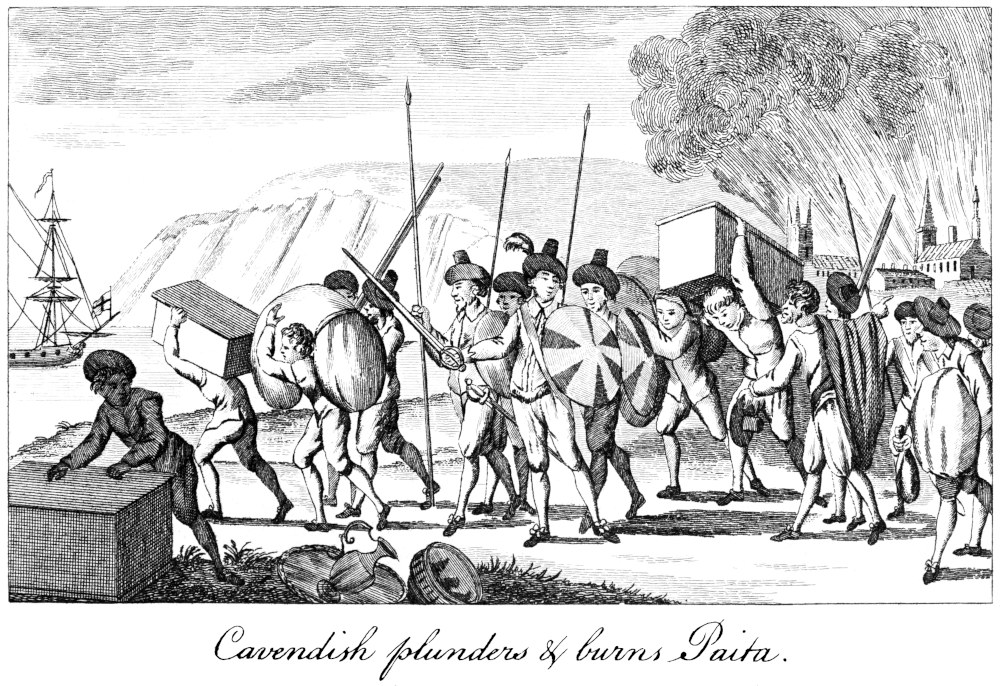
Cavendish plunders & burns Paita.
The 20th day in the morning, we came into the road of Paita; and, being at an anchor, our General landed with sixty or seventy men, skirmished with some of the town, and drove them all to flight to the top of the hill which is over the town; except a few slaves and some others who were of the meaner sort, who were commanded by the Governor to stay below in the town at a place which was building for a fort, having with them a bloody ensign, being in number about an hundred men. Now, as we were rowing between the ships and the shore, our gunner shot off a great piece out of one of the barks, and the shot fell among them, and made them to fly from the fort, as fast as they could run; but, having got up upon the hill, they in their turn, shot among us with their small-shot. After we were landed, and had taken the town, we ran upon them and chaced them so fiercely for the space of an hour, that we drove them in the end away by force; and, being got up the hills, we found where they had hid what they had brought out of the town. We also found the quantity of twenty-five pounds weight of silver in pieces of eight, and abundance of houshold stuff, and storehouses full of all kinds of wares. But our General would not suffer the men to carry much cloth or apparel away, because they should not cloy themselves with burdens; for he knew not whether our enemies were provided with fire-arms according to the number of their men, for they were five men to one of us, and we had an English mile and an half to our ships. Being come down in safety to the town, which was very well built, and kept very clean in every street, with a town-house or guildhall in the midst of it, and had to the number of two or three hundred houses at least in it; we set it on fire, and burnt it to the ground, and goods to the value of five or six thousand pounds. There was also a bark riding at anchor in the road, which we set on fire and departed, directing our course to the island of Puna.
The 25th of May, we arrived at the island of Puna, where is a very good harbour. There we found a great ship of 250 tons riding at anchor with all her furniture, which was ready to be hauled on ground, for there is a special good place for that purpose. We sunk it and went on shore, where the Lord of the island dwelt, who had a sumptuous dwelling, which was by the water-side, exceedingly well contrived, with many very singular good rooms and chambers in it, and out of every chamber was framed a gallery, with a stately prospect towards the sea on one side, and into the island on the other side, with a magnificent hall below, and a very great storehouse at one end of the hall, which was filled with botigas of pitch and bast to make cables with; for the most part of the cables in the South Sea are made upon that island. This great Casique obliged all the Indians on the island to work and trudge for him: he is an Indian born, but is married to a beautiful woman who is a Spaniard, by reason of his pleasant habitation and his great wealth.
This Spanish woman, his wife, is honoured as a Queen in the island, and never walketh upon the ground on foot, but accounteth it too base a thing for her; but when her pleasure is to take the air, or to go abroad, she is always carried in a sedan upon four mens shoulders, with a veil or canopy over her, to shade her from the sun or the wind, having her gentlewoman still attending about her, with a great troop of the best men in the island with her. But both she and the lord of the island, with all the Indians in the town, were nearly fled out of the island before we get could get to an anchor, by reason we were becalmed before we could get in, and were gone over unto the main land, having carried with them 100,000 crowns, which we knew by a Captain of the island, an Indian, whom we had taken at sea as we were coming into the road, being in a balsa or a canoe for a spy to see what we were.
The 27th, our General himself, with certain shot and some targetliers, went over to the main unto the place where this Indian Captain told us the Casique, who was Lord of all the island, was gone unto, and had carried all his treasure with him: but, at our coming to the place where we went to land, we found newly arrived there four or five great balsas laden with plantains, bags of meal, and many other kinds of victuals. Our General marvelled what they were, and what they meant, asking the Indian guide, and commanding him to speak the truth upon his life. Being then bound fast, he answered, being very much abashed, as well as our company were, that he neither knew from whence they should come, nor who they should be, for never a man was in either of the balsas; yet he had told our General before, that it was an easy matter to take the said Casique and all his treasure; and that, there were but three or four houses standing in a desart place, and no resistance; and that if he found it not so, he might hang him. Again being demanded to speak upon his life what he thought these balsas should be? he answered, that he could not say what they were, nor from whence they should come, except it was to carry sixty soldiers, who he did hear were to go to a place called Guaiaquil, which was about six leagues from the said island, where two or three of the King’s ships were on the stocks in building, and where there were continually an hundred soldiers in garrison, who had heard of us, and had sent for sixty more, for fear of burning of the ships and town. Our General, not any whit discouraged, either at the sight of the balsas unlooked for, or at hearing of the sixty soldiers not until then spoken of, bravely animating his company to the exploit, went presently forward, being in the night in a most desart path through the woods, until he came to the place; where, as it seemed, they had kept watch either at the water-side, or at the houses, or at both, and were newly gone out of the houses, having so short warning that they left the meat both boiling and roasting at the fire, and were fled with their treasure with them, or else buried it where it could not be found. Our company took hens, and such things as we thought good, and came away.
The 29th, our General went in the ship’s boat unto a little island adjoining, whither the Casique, who was Lord of Rena, had caused all the hangings of his chambers, which were Cordovan leather, all gilded over, and painted very fair and rich, with all his houshold stuff, and all the ships tackling which were riding in the road at our coming in, with great store of nails, spikes of iron, and very many other things, to be conveyed; all which we found, and brought away what our General thought requisite for the ships.
This island is very pleasant for all the delights of life, and fruitful; but there are no mines of gold or silver in it. There are, at least, 200 houses in the town about the Casique’s palace, and as many in one or two towns more upon the island, which is almost as big as the Isle of Wight, in England. There is planted, on the one side of the Casique’s house, a fair garden with all herbs growing in it, and at the lower end a well of fresh water, and round about it are trees set, whereon bombazine cotton groweth after this manner: The tops of the trees grow full of cods, out of which the cotton groweth, and in the cotton is a seed of the bigness of a pea, and in every cod there are seven or eight of these seeds; and if the cotton be not gathered when it is ripe, then these seeds fall from it and spring again.
There are also in this garden fig-trees, which bear continually; also pompions, melons, cucumbers, raddishes, rosemary, and thyme, with many other herbs and roots. At the other end of the house there is also another orchard, where grow oranges, sweet and sour lemons, pomegranates, and limes, with divers other fruits. There is very good pasture-ground in this island and there are many horses, oxen, bullocks, sheep very fat and fair, a great many goats, which are very tame, and are used continually to be milked. They have also abundance of pigeons, turkies, and ducks of prodigious bigness.
There was also a very large and great church near to the Casique’s house, whither he caused all the Indians in the island to come and hear mass, for he himself was made a christian when married to the Spanish woman before spoken of; and upon his conversion he caused the rest of his subjects to be christened. In this church was an high altar, with a crucifix, and five bells hanging in one end thereof. We burnt the church, and brought the bells away.
By this time we had hauled on ground our Admiral, and made her clean, burnt her keel, pitched and tarred her, and had hauled her on float again; and, in the mean time, kept watch in the great house both night and day.
The 2d of June, in the morning, by day-break, every one of the watch having gone abroad to seek provisions, some one way and some another, some for hens, some for sheep, some for goats; upon a sudden there came down upon us an hundred soldiers, with musquets, and an ensign, which were landed on the other side of the island that night, and all the Indians of the island along with them, everyone with weapons, and their baggage after them; which happened by means of a negroe, whose name was Emmanuel, who fled from us at our first landing there. Thus, being taken at a disadvantage, we had the worst, for our company did not exceed sixteen or twenty, whereof they had slain one or two before they were come to the houses; yet we skirmished with them an hour and a half. At last, being greatly over-charged with multitudes, we were driven down from the hill to the water side, and there we kept them in play a while, until in the end our halberdier, who had kept the way of the hill, and had slain a couple of them as he breathed himself, had an honourable death, for a shot struck him to the heart; who, feeling himself mortally wounded, cried to God for mercy, and fell down dead. But, soon after, the enemy was driven back from the bank side to the green; and, in the end, our boat came, and carried as many of our men as could go in her without hazard of sinking; but one of our men was shot through the head with his own piece, being a snap-hand, as he was getting into the boat. Four of us were left behind, which the boat could not carry, of whom myself was one, who had our shot ready, and retired into a cliff until the boat came again, which was presently after they had carried the rest on board. There were forty-six of the enemy slain by us, whereof they dragged some into bushes, and some into old houses, which we found afterwards. We lost only 12 of our men.
The same day we went on shore again with 70 men, and had a fresh skirmish with the enemy, and made them retire. This done, we set fire to the town, and burnt it to the ground; and, shortly after, made havock of their fields, orchards, and gardens, and burnt four great ships more, which were building on the stocks.
The 3d of June, the Content, which was our Vice-Admiral, was hauled on ground to grave at the same place, in spite of the Spaniards; and also our pinnace was new trimmed.
The 5th, we departed out of the road of Puna, where we remained eleven days, and turned up to a place which is called Rio Dolce, where we watered; at which place also we sunk our Rear-Admiral, called the Hugh Gallant, for want of men, being a bark of 40 tons.
The 10th, we set the Indians on shore, which we had taken before as we were coming into the road of Puna.
The 11th, we departed from Rio Dolce.
The 12th, we doubled the Equinoctial Line, and continued our course northwards all that month.
The 1st of July, we had sight of the coast of Nueva Espanna, being four leagues distant from land, in the latitude of 10 degrees to the northward of the Line.
The 9th, we took a new ship of 120 tons burthen, wherein was one Michael Sancius, whom our General took to serve his turn to water along the coast; for he was one of the best coasters in the South Sea. This Michael Sancius was a provincial born in Marseilles, and was the first man that told us news of the great ship called the Santa Anna, which we afterwards took coming from the Philippines.
There were six men more in this new ship. We took her sails, ropes, and fire-wood, to serve our turns, set her on fire, and kept the men.
The 10th, we took another bark, which was going with advice of us and our ships all along the coast, as Michael Sancius told us; but all company that were in the bark were fled on shore. Neither of these ships had any goods in them; for they came both from Sonsonate, in the province of Guatimala; the new ship, for fear we should have taken her in the road; and the bark, to carry news along the coast, which bark we also set on fire.
The 26th, we came to anchor in ten fathoms, in the river of Copalita, where we intended to water; and that same night we departed with thirty-two men in the pinnace, and rowed to Aguatulco, which is but two leagues from the aforesaid river, and standeth in 15 deg. 40 min. to the northward of the Equinoctial Line.
The 27th day, in the morning, by break of day, we came into the road of Aguatulco, where we found a bark of 50 tons, which was come from Sonsonate, laden with cocoas and anil, which they had there landed; and the men were all fled on shore. We landed there, and burnt the town, with the church and custom-house, which was very fair and large, in which house were 600 bags of anil to dye cloth, every bag whereof was worth 40 crowns; and 400 bags of cocoas, every bag whereof is worth 10 crowns. These cocoas go among them for meat and money; for 150 of them are in value one rial of plate in ready payment. They are very like an almond, but are not so pleasant in taste. They eat them, and make drink of them: this the owner of the ship told us. I found in this town, before we burnt it, a flasket full of boxes of balm. After we had spoiled and burned the town, wherein there were some hundred houses, the owner of the ship came down out of the hills with a flag of truce unto us, who before with all the rest of the townsmen run away, and at length came on board our pinnace upon Captain Havers’ word of safe return. We carried him to the river of Copalita, where our ships rode. When we came to our General, he caused him to be set on shore in safety the same night, because he came upon the Captain’s word.
The 28th, we set sail from Copalita, because the sea was so great that we could not fill water, and ran the same night into the road of Aguatulco.
The 29th, our General landed, and took with him thirty men two miles into the woods, were we took a Mestizo, whose name was Michael de Truxillo, who was customer of that town, and we found with him two chambers full of his stuff; we brought him and his stuff on board: and whereas I say he was a Mestizo, it is to be understood, that a Mestizo is one who hath a Spaniard to his father, and an Indian to his mother.
The 2d day of August, having watered, and examined the said Mestizo and set him on shore again, we departed from the port of Aguatulco the same night; which standeth, as I said before, in 15 deg. and 40 min. to the northward of the Line. Here we overslipped the haven of Acapulco, from whence the ships are fitted out for the Philippines.
The 24th, our General with thirty of us went with the pinnace to an haven called Puerto de Natividad, where we had intelligence by Michael Sancius that there should be a pinnace; but, before we could get thither, the said pinnace was gone to fish for pearls twelve leagues farther, as we were informed by certain Indians whom we found there. We took a mullatto in this place in his bed, who was sent with letters of advice concerning us along the coast of Nueva Galicia, whose horse we killed. We took his letters, left him behind, set fire to the houses, and burnt two new ships of 200 tons each which were building there on the stocks, and came on board of our ships again.
The 26th, we came into the bay of St. Jago, where we watered at a fresh river, along which river many plantains were growing. Here is abundance of fresh fish; here also some of our company dragged for pearls, and caught some quantity.
The 2d of September, we departed from St. Jago, at four o’clock in the evening. The bay of St. Jago standeth in nineteen degrees and eighteen minutes to the northward of the Line.
The 3d, we arrived in a little bay a league to the westward of Port de Natividad, called Malacca, which is a very good place to ride in; and this day, about twelve o’clock, our General landed with thirty men, and went up to a town of Indians which was two leagues from the road, which town is called Acatlan: there were in it about 20 or 30 houses, and a church which we defaced, and came on board the same night. All the people fled out of the town at the sight of us.
The 4th, we departed from the road of Malacca, and sailed along the coast. The 8th we came to the road of Chacalla, in which bay there are two little houses by the water-side. This bay is 18 leagues from the Cape de los Corientes.
The 9th, in the morning, our General sent up Captain Havers with forty men of us before day, and, Michael Sancius being our guide, we went unto a place about two leagues up into the country, in a most obscure desart path, through the woods and wilderness, and in the end we came to a place where we took three housholders with their wives and children, and some Indians, one carpenter (who was a Spaniard), and a Portuguese. We bound them all, and made them come to the sea-side with us: our General made their wives fetch us plantains, lemons, oranges, pine-apples, and other fruits, whereof they had abundance, and so let their husbands depart, except Sembrano, the Spanish carpenter, and Diego, the Portuguese, and the tenth day we departed from the road.
The 12th, we arrived at a little island called the isle of St. Andrew, on which there is great store of fowl and wood; where we dried and salted as many of the fowls as we thought good. We also killed there abundance of seals and oguanos, which are a kind of serpents with four feet, and a long sharp tail, strange to them who have not seen them, but they are very good meat. We rode here until the 17th, at which time we departed.
The 24th, we arrived in the road of Massatlan, in twenty-three degrees thirty minutes, just under the Tropic of Cancer. It is a very great river within, but is barred at the mouth; and upon the north side of the bar without is good fresh water, but there is much difficulty in filling it, because at low water it is shoal half a mile off the shore. There is great store of fresh fish in this bay, and good fruits up in the country, whereof we had some, though not without danger.
The 27th, we departed from the road of Massatlan, and ran to an island which is a league to the northward of the said Massatlan, where we trimmed our ships, and new built our pinnace. There is a little island a quarter of a league from it, on which are seals; where a Spanish prisoner, whose name was Domingo, being sent to wash shirts, with one of our men to keep him, made his escape and swam to the main, which was an English mile distant; at which place we had seen thirty or forty Spaniards and Indians, who were horsemen and kept watch there, and came from a town called Chiametla, which was eleven leagues up into the country, as Michael Sancius told us. We found upon the island where we trimmed our pinnace, fresh water, by digging two or three feet deep into the sand, where no water nor sign of water was before to be perceived; otherwise we must have gone back 20 or 30 leagues to water, which might have occasioned our missing the prey we had long waited for: but one Flores, a Spaniard, who was also a prisoner with us, made a motion to dig in the sands. Now, our General, having had experience before of the like, commanded to put his motion in practice, and, digging three feet deep, we found very good and fresh water: so we watered our ships, and might have filled a thousand tons more if we had pleased.
We staid in this island until the ninth day of October, and then departed at night for the Cape of St. Lucar, which is on the west side of the point of California.
The 14th, we fell in with the Cape of St. Lucar, which cape is very like the Needles at the isle of Wight, and within the said cape is a great bay, called by the Spaniards Aguada Segura, into which bay falleth a fair fresh river, about which many Indians use to keep. We watered in the river, and lay off and on with the said cape of St. Lucar, until the 4th of November, and had the winds hanging still westerly.
The 4th of November, beating up and down upon the head-land of California, in 23 degrees 40 minutes to the northward, between seven and eight o’clock in the morning, one of the company of our Admiral, who was the trumpeter of the ship, going up unto the top, espied a sail bearing in from the sea with the cape; whereupon he cried, with no small joy to himself and all the company, A sail! a sail! With which chearful word, the Master of the ship, and divers others of the company, went also up to the main-top, who, perceiving his speech to be very true, gave information unto our General of this happy news, who was no less glad than the cause required: whereupon he gave in charge presently unto the whole company, to put all things in readiness; which being performed, he gave them chace for three or four hours, standing with our best advantage, and working for the wind. In the afternoon we got up to them, giving them a broadside with our great ordnance, and a volley of small shot, and presently laid the ship aboard, whereof the King of Spain was owner, which was Admiral of the South Sea, called St. Anna, and thought to be seven hundred tons in burthen. Now, as we were ready on the ship’s side to enter her, there not being above fifty or sixty men at most in our ship, we perceived that the Captain of the Santa Anna had made sights fore and aft, and hid their sails close on their poop, their midship, with their forecastle, and not one man to be seen, they standing so close under their sights, with lances, javelins, rapiers, targets, and an innumerable quantity of large stones, which they threw overboard upon our heads, and into our ships so fast, and being so many of them, that they put us off the ship again, with the loss of two of our men, who were slain, and four or five wounded. But for all this, we new trimmed our sails, and fitted every man his furniture, and gave them a fresh encounter with our great ordnance, and also with our small shot, raking them through and through, to the killing and wounding of many of their men. Their Captain, still like a valiant man, with his company, stood very stoutly unto his close sights, not yielding as yet. Our General encouraging his men afresh, with the whole noise of trumpets, gave them the other encounter with our great ordnance, and all our small shot, to the great discouragement of our enemies, raking them through in divers places, killing and wounding many of their men. They being thus discouraged and spoiled, and their ship being in hazard of sinking, by reason of the great shot which were made, whereof some were under water, after five or six hours fight, set out a flag of truce, and parlied for mercy, desiring our General to save their lives, and to take their goods, and that they would presently yield. Our General promised them mercy, and willed them to strike their sails, and to hoist out their boat, and to come on board: which news they were full glad to hear, and presently struck their sails, hoisted out their boat, and one of their chief merchants came on board unto our General, and, falling down upon his knees, offered to have kissed our General’s feet, and craved mercy. Our General pardoned both him and the rest, upon promise of their true dealing with him and his company, concerning such riches as were in the ship; and sent for their Captain and pilot, who, at their coming, used the like duty and reverence as the former did. Our General promised their lives, and good usage. The said Captain and pilot presently certified the General what goods they had on board, viz. 122,000 pezoes of gold; and the rest of the riches that the ship was laden with, were silks, sattins, damasks, with musk, and divers other merchandize, and great plenty of all manner of provisions, with the choice of many conserves, and several sorts of very good wines. These things being made known to the General by the aforesaid Captain and pilot, they were commanded to stay on board the Desire; and on the 6th day of November following we went into an harbour, which is called by the Spaniards Aguada Segura, or Puerto Seguro.
Here the whole company of Spaniards, both men and women, to the number of 190 persons, were set on shore; where they had a fair river of fresh water, with great plenty of fresh fish, fowl, and wood, and also many hares and conies upon the main land. Our General also gave them plenty of provisions, garvances, peason, and some wine. Also they had all the sails of their ship to make them tents on shore, with licence to take such store of planks as should be sufficient to make them a bark. Then we fell to heaving in of our goods, sharing of the treasure, and allotting to every man his portion; in division whereof, the 8th of this month, many of the company fell into a mutiny against our General, especially those who were in the Content, which were nevertheless pacified for the time.
On the 17th day of November, which is the day of the happy coronation of her Majesty, our General commanded all his ordnance to be shot off, with the small shot, both in his own ship, and in the Content, which was our Vice-Admiral. This being done, the same night we had many fire-works, and more ordnance discharged, to the great admiration of all the Spaniards who were there, for the most of them had never seen the like before.
This ended, our General discharged the Captain, and gave him a royal reward, with provision for his own and company’s defence against the Indians, both of swords, targets, pieces, shot, and powder, to his great contentment. But before his departure, he took out of this great ship two young lads born in Japan, who could both read and write their own language; the eldest, being about twenty years old, was named Christopher; the other was called Cosmus, about seventeen years of age; both of very good capacity. He took also with him, out of their ship, three boys born in the isles of Manilla; the one about fifteen, the other about thirteen, the youngest about nine years of age: the name of the eldest was Alphonso, the second Anthony de Dasi, the third remaineth with the Right Honourable the Countess of Essex. He also took from them one Nicholas Roderigo, a Portuguese, who had not only been in Canton, and other parts of China, but had also been in the islands of Japan, being a country most rich in silver mines, and had also been in the Philippines. He took also from them a Spaniard, whose name was Thomas de Ersola, who was a very good pilot from Acapulco, and the coast of Nueva Espanna, unto the islands of Ladrones, where the Spaniards put in to water, sailing between Acapulco and the Philippines; in which isles of Ladrones they found fresh-water plantains, and potatoe-roots: howbeit, the people are very rude, and heathens.
The 19th day of November aforesaid, about three o’clock in the afternoon, our General caused the King’s ship to be set on fire, which, having to the quantity of 500 tons of goods in her, we saw burnt unto the water, and then gave them a piece of ordnance, and set sail joyfully homewards towards England, with a fair wind, which by this time was come about to east-north-east; and, night growing near, we left the Content a-stern of us, which was not as yet come out of the road: and here, thinking she would have overtaken us, we lost her company, and never saw her after.
We were sailing from this haven of Aguada Segura, in California, unto the isles of Ladrones, the rest of November, and all December, and so forth until the 3d of January, 1588, with a fair wind, for the space of forty-five days; and we esteemed it to be between seventeen and eighteen hundred leagues.
The 3d of January, by six o’clock in the morning, we had sight of one of the islands of Ladrones, called the island of Guarsa, standing in 13 deg. 40 min. towards the north; and, sailing with a gentle gale before the wind, by one or two o’clock in the afternoon we were come within two leagues of the island, where we met with sixty or seventy sail of canoes, full of savages, who came off to sea unto us, and brought with them in their canoes, plantains, cocoas, potatoe-roots, and fresh fish, which they had caught at sea, and held them up unto us for to truck, or exchange with us; which, when we perceived, we made fast little pieces of old iron upon small cords and fishing lines, and so veered the iron into their canoes; and they caught hold of them, and took off the iron, and in exchange of it they would make fast unto the line, either a potatoe-root, or a bundle of plantains, which we hauled in: and thus our company exchanged with them, until they had satisfied themselves with as much as did content them; yet we could not be rid of them; for, afterwards, they were so thick about the ship, that it stemmed and broke one or two of their canoes; but the men saved themselves, being in every canoe four, six, or eight persons, all naked, and excellent swimmers and divers. They are of a tawny colour, marvellously fat, and ordinarily bigger of stature than the most of our men in England, wearing their hair very long, yet some of them have it made up and tied with a knot on the crown, and some with two knots, much like unto their images, which we saw them have carved in wood, and standing in the head of their boats, like unto the images of the devil. Their canoes were as artificially made as any that ever we had seen, considering they were made and contrived without any edged tool: they are not above half a fathom in breadth, and in length some seven or eight fathoms, and their heads and sterns are both alike: they are made out with rafts of canes and reeds on the starboard-side, with mast and sail: their sail is made of mats of sedges square or triangle ways; and they sail as well right against the wind as before it. These savages followed us so long that we could not be rid of them until in the end our General commanded our harquebusses to be made ready, and he himself fired one of them, and the rest shot at them; but they were so nimble, that we could not discern whether they were killed or not, because they could fall backward into the sea and prevent us by diving.
The 14th, by break of day, we fell in with an head-land of the Philippines, which is called Cabo del Spirito Santo, which is of very great bigness and length; high land in the midst of it, and very low land, as the cape lieth east and west, trending far into the sea to the westward. This cape or island is distant from the isle of Guana 310 leagues. We were in sailing of this course eleven days, with scant winds and foul weather, bearing no sail two or three nights. This island standeth in thirteen degrees, and is inhabited for the most part by heathens, and very woody through the whole island. It is short of the chiefest island of the Philippines, called Manilla, about sixty leagues. Manilla is well planted, and inhabited by Spaniards to the number of six or seven hundred persons, who dwell in a town unwalled, which hath three or four small block-houses, part made of wood and part of stone, being indeed of no great strength. They have one or two small gallies belonging to the town. It is a very rich place in gold and many other commodities; and they have yearly traffic from Acapulco, in Nueva Espanna, and also twenty or thirty ships from China, and from the Sanguelos, which bringeth them many sorts of merchandize. The merchants of China and the Sanguelos are part Moors and part heathens; they bring great quantities of gold with them, which they traffic and exchange for silver, and give weight for weight. These Sanguelos are men of great genius for inventing and making all manner of things, especially in all handicrafts and sciences; and every one is so expert, perfect, and skilful in his faculty, that few or no Christians are able to go beyond them in that which they take in hand. For drawing and embroidering upon sattin, silk, or lawn, either beast, fowl, fish, or worm, for liveliness and perfectness both in silk, silver, gold, and pearl, they excel.
The 14th, at night, we entered the straits between the island of Lucon and the island of Camlaia.
The 15th day, we fell in with an island called Capul, and had, betwixt that and another island, a very narrow passage, occasioned by a ledge of rocks, lying off the point of the island of Capul, and no danger, but water enough a good way off. Within the point there is a fine bay, and a very good harbour in four fathoms water, within a cable’s length of the shore. Our ship was no sooner come to an anchor, than presently there came a canoe rowing on board us, in which was one of the chief Casiques of the island, whereof there are seven, who, supposing that we were Spaniards, brought us potatoe roots, which they call camotas, and green cocoas, in exchange for which we gave his company linnen to the quantity of a yard for four cocoas, and as much linnen for a basket of potatoe roots, of a quart in quantity, which roots are very good eating, and very sweet either roasted or boiled.
This Casique’s skin was carved and cut with various coloured strakes and devices all over his body; we kept him still on board, and caused him to send those men who brought him on board back to the island, to invite the rest of the principal men to come on board: who were no sooner gone on shore, than presently the people of the island came down with their cocoas and potatoe roots, and the rest of the Casiques likewise came on board, and brought with them hens and hogs. They used the same order with us which they do with the Spaniards; for they took for every hog, which they call balboye, eight rials of plate, and for every hen or cock one rial of plate. Thus we rode at anchor all that day, doing nothing but buying roots, cocoas, hens, hogs, and such things as they brought, refreshing ourselves very much.
The same day, at night, Nicholas Roderigo, the Portuguese whom we had taken out of the great Santa Anna, at the Cape of California, desired to speak with our General in secret; which, when our General understood, he sent for him, and asked him what he had to say to him. The Portuguese made him answer, That, although he had offended his worship heretofore, yet now he had vowed his faith and true service to him; and, in respect whereof, he neither could nor would conceal such treason as was plotting against him and his company; which was this, that the Spaniard who was taken out of the great Santa Anna for a pilot, whose name was Thomas de Ersola, had written a letter secretly, sealed it, and locked it up in his chest, meaning to convey it, by the inhabitants of this island, to Manilla; the contents whereof were, that there had been two English ships along the coast of Chili, Peru, Nueva Espanna, and Nueva Galicia, and that they had taken many ships and merchandize in them, and burnt divers towns, and spoiled all that ever they could come unto; and that they had taken the king’s ship which came from Manilla, and all his treasure, and all the merchandize that was therein, and had set all the people on shore, taking himself away by force; therefore he willed them that they should make strong their bulwarks, with their two galleys, and all such provision as they could possibly make. He further signified, that we were riding at an island called Capul, which was at the end of the island of Manilla; being but one ship with small force in it; and that the other ship, as he supposed, was gone for the north-west passage, standing in fifty-five degrees; and that, if they could use any means to surprize us, being there at anchor, they should dispatch it, for our force was but small, and our men but weak; and that the place where we rode was but fifty leagues from them: otherwise, if they let us escape, within a few years they must make account to have their town besieged and sacked by an army of English. This information being given, our General called for him, and charged him with these things, which, at the first, he utterly denied; but, in the end, the matter being made manifest and known of certainty by special trial and proofs, the next morning, our General gave orders that he should be hanged, which was accordingly performed the 16th of January.
We rode for the space of nine days about this island of Capul, where we had divers kinds of fresh victuals, with excellent fresh water in every bay, and great plenty of wood. The people of this island go almost naked, and are of a tawny colour. The men wear only a girdle about their waists, of a kind of linnen of their own weaving, which is made of plantain leaves, and an apron, which, coming from their back and covering their nakedness, is made fast to their girdles at their navels.
These people use a strange kind of order among them, which is this: every man and man-child among them hath a little peg-nail thrust through the head of his privy parts, being split in the lower end, and rivetted, and on the head of the nail is as it were a crown; which they take out and in as they have occasion: and for the truth thereof we ourselves have taken one of these nails from a son of one of their kings, who was of the age of ten years.
On the 23d of January, our General, Mr. Thomas Cavendish, caused all the chiefs of this island and of an hundred islands more, whom he had made to pay tribute to him, which tribute was in hogs, hens, potatoes and cocoas, to appear before him, and made himself and his company known unto them, that they were Englishmen, and enemies to the Spaniards; and thereupon spread his ensign, sounded his trumpets, and beat his drums; which they much wondered at. To conclude, they promised both themselves and all the islands thereabout, to aid him whensoever he should come again to overcome the Spaniards. Also our General gave them, in token that we were enemies to the Spaniards, money back again for all their tribute which they had paid, which they took very friendly, and rowed about our ship to give us pleasure. At last our General ordered a sacre to be shot off, whereat they wondered, and, with great contentment, took their leave of us.
The next day, being the 26th of January, we set sail, about six o’clock in the morning, and ran along the coast of the island of Manilla, shaping our course north-west, between Manilla and the isle of Masbat.
The 28th in the morning, about seven o’clock, riding at an anchor between two islands, we spied a frigate under her courses, coming out between two other islands, which, as we imagined, came from Manilla, sailing close by the shore along the main island of Panama. We chaced this frigate along the shore, and gained fast upon her, until in the end we came so near that she stood in for the shore, close by a wind, and being becalmed, banked up with her oars; whereupon we came to an anchor with our ship a league and a half from the place where the frigate rowed in, and manned our boat with half a dozen shot, and as many men with swords, who did row the boat. Thus we made after the frigate, which had run into a river where we could not reach her; but as we rowed along the shore, our boat came into very shallow water, where many marks were set up in divers places in the sea, from whence two or three canoes came forth, whereof one made somewhat near unto us with three or four Indians in it. We called unto them, but they would not come nearer unto us, but rowed from us, whom we durst not follow too far, for fear of bringing ourselves too much to the leeward of our ship. Here, as we looked about us, we spied another balsa or canoe of a great bigness, which they who were in her did set along, as we usually set a barge, with long staves or poles, which was builded up with great canes, and below near the water made to row with oars, wherein were about five or six Indians and one Spaniard. Now, as we were come almost at the balsa, we ran aground with our boat, but one or two of our men leapt overboard and freed it again presently, and keeping thwart her head, we laid her aboard, and took into us the Spaniard, but the Indians leaped into the sea, and dived and rose again far off from us. Presently, upon the taking of this canoe, there appeared upon the sands a band of soldiers, marching with an ensign having a red cross like the flag of England, who were about fifty or sixty Spaniards, lately come from Manilla to that town, which is called Reguan, in a bark to fetch a new ship of the king’s, which was building in a river within the bay, and staid there only for certain irons to serve for the rudder of the said ship, which they looked for every day.