SOURCES OF WATER SUPPLY
Reading edition
Rain Water
The sources of our water supply may be classified as: Rain and snow water, surface water and ground or subsoil water.
The rain and snow water provide a supply for domestic purposes. This source cannot be relied upon in some sections of the country because of the variable amount of rain fall. Rain water is pure from the fact that it has been vaporized and then condensed the same as in distillation; but it does not remain long in this pure state since it is exposed to so many sources of pollution. This water is collected in receptacles called cisterns and tanks and used mostly for household purposes. It can readily be seen that water thus stored might become polluted from the surfaces with which it comes in contact. To prevent this special care would be necessary, and in the majority of cases the need for this precaution is not recognized.
This source of water supply is not very desirable since its quantity is variable and also because of the difficulty in storing large quantities and in providing protection so that it will not become contaminated and thereby rendered unfit for household use.
While rain water in its unpolluted state is a pure water, it is not suitable for drinking purposes until it is properly aerated. The air contains dust and other suspended impurities which will be precipitated with the rain and thus pollute the water. However, the amount of pollution is so small that it is of little sanitary importance. After the air has been cleared of these suspended impurities the rain water will be relatively pure. It will be noticed that after a rain the air seems clear and clean; this is due to the rain actually washing the air.
It is necessary to filter rain water collected from the surface of roofs because roofs collect impurities from smoke and dust. The average filter used for this purpose is usually inadequate and receives such little care that it is of slight value.
In the large cities or even in the larger towns the cisterns have been replaced with more modern and more satisfactory means of water supply. Rain water is soft and therefore is most desirable for laundry purposes and is also very desirable for cooking. It is not considered as satisfactory for drinking, however, as ground water or properly filtered surface water. It always contains gases such as nitrogen, oxygen, and carbon dioxide. The amount of solids varies. The storage of water in cisterns forms a good breeding place for a certain kind of mosquito, stegomyia calopus, which is supposed to cause yellow fever; but regardless of the supposed pathogenicity of this mosquito it is quite objectionable.
Surface Water
Surface water is derived from ponds, lakes, rivers and creeks; in fact, any water which is in contact with the atmosphere is known as surface water. Surface water forms really the most desirable and satisfactory source of public water supply.
Streams form natural sewers for the regions which they drain and ponds and lakes form convenient dumping places for the sewage carried by the streams, therefore it will readily be seen that the surface water is liable to great pollution from these sources. It therefore becomes necessary to purify it by some means before it can be used for domestic purposes.
At one time it was thought that streams purified themselves in their flow, but this is now disputed and has been proven to be erroneous and should be strenuously denied. There are many factors at work in Nature which purify water in its natural state. Before civilization brought about so many artificial and unnatural conditions it was true that, with the small amount of waste material emptied into the streams, Nature would, through her natural processes, keep the waters of the streams in a state of natural purity. But in the present day with not only the sewage of our large cities pouring into the rivers and lake, but also the waste material from factories and different industries, it becomes necessary to use some artificial methods for water purification.
Lakes, from a sanitary standpoint, form a more desirable source of public water supply than rivers. There are several reasons for this. First: there is possible a greater dilution of the impurities that reach the lake. Second: there is greater opportunity for sedimentation which is a very important process in water purification. Third: the water is softer than river water and freer from organic impurities.
The greatest problem that a city getting its water supply from a lake has to solve is how to keep its sewage from polluting its own water supply. To prevent this, it is necessary to place the intake for the water supply far out in the lake. The danger from pollution has become so great in some places, as in Chicago, that special canals have been constructed to carry the sewage into other channels rather than empty it into the lake.
The impurities from the sewage may travel a great distance into the lakes. Serious sewage pollution was found ten miles out in the lake from the mouth of the Detroit River. Pollution has been found as far as eighteen miles from the shore in some places.
So it is readily observed that, notwithstanding the fact that the lakes and ponds furnish a more desirable public water supply, yet this source is not, by any means, free from objections.
The impounding reservoir, which is an artificial reservoir for the purpose of storing up water, is another very reliable source of public water supply. These reservoirs are often built in the mountains by placing a dam across a ravine or canyon. The largest dam in the world is the New Croton across the Esopus Creek in the Catskill mountains in New York. It is 248 feet high, 185 feet thick at the bottom and eleven feet thick at the top. This impounding reservoir furnishes an addition to the water supply of New York City.
There are many advantages to the impounding reservoirs, but there are also many disadvantages. One advantage is that the area drained is comparatively small and therefore the pollution from that source is lessened; also the storage factor which is experienced in this reservoir is an advantage. In this way many of the so-called pathogenic microörganisms die before they are carried to the consumer. A disadvantage is that they are open to the atmosphere and light and this is conducive to stagnation because the water is still. This results in an increase in the growth of algæ and other microscopic organisms. The stagnation of the water results in an increase of the products of decomposition. This, together with the microörganisms and algæ, produce the foul smell and bad taste of the water.
The stagnation of impounding reservoirs and small lakes may become a vital factor from a hygienic standpoint. If the water is less than twenty feet deep it will be kept in motion by the wind and in this way will not become stagnant, but if it is more than twenty feet deep the lower portion will remain still. This prevents the water from mixing and therefore the under portion will become stagnant while the surface will not. If the water supply is taken near the surface there will not be so much danger from the stagnant water, but even then there are times of the year when there is a complete stirring up of the water. This mixing of the surface water and the bottom water takes place twice a year, in the spring and in the fall. This mixing is the result of the changing of the temperature of the surface water. During the summer the surface water becomes warm and the temperature may reach 80° F. In this way the warm water remains on top but is kept stirred up by the wind. The wind will not usually create a disturbance for more than twenty feet except in very large lakes where it may be as great as forty feet.
As winter approaches the water cools until finally the temperature of the surface water becomes the same or more nearly the same as the bottom water. Then the wind exerts a deeper influence and the surface and deep water will mix. During this process vertical currents may be produced. This mixing continues until all the water has been thoroughly mixed and until the temperature of the surface water goes below the point of maximum density which occurs at 4° C. The cold water accumulates on the surface where ice is often formed. In the spring the process is just reversed. The fall mixing of the water is much more thorough and intense than the spring mixing.
The changes brought by this mixing are obvious. The surface water contains a large amount of oxygen. The bottom water contains much less oxygen but a great quantity of decomposed products. The oxygen is carried to the bottom and there oxidizes and neutralizes some of the products of decomposition.
The sources of impurities in surface water are various. One of the most menacing sources is from the sewage which is carried from the centers of population. In the rivers it is the sewage of the towns and cities situated above. In the lakes it is usually the sewage of the city itself that is likely to pollute its own water supply. Under the present conditions it seems that it is easier to purify the water supply than to purify the sewage or provide some other method for its disposal.
Naturally the water of rivers is purest near the source. The reason for this is that the rivers form a natural drainage for the land through which they flow. The waste products from every process carried on in that territory find their way into the streams as a natural result of the law of gravity. The water will be found to contain large amounts of mineral and organic matter after passing through populated and cultivated areas. Purification of rivers is considered under Water Purification.
Ground or Subsoil Water
In the consideration of the three sources of water supply it is difficult to draw definite lines of demarcation since the rain and snow water soon becomes surface water and the surface water may percolate through the ground and become subsoil water.
Well water and spring water are classed as ground or subsoil water. From a hygienic standpoint water obtained from wells or springs forms a very reliable and satisfactory source of supply.
Especially is well or spring water desirable for private domestic use, since it is usually in a reasonable degree of purity and does not, therefore, require any artificial process for purification. The sources of water supply used for public purposes, made necessary because of the volume of water required, are not so satisfactory for a private or domestic supply because its purification would entail too great an expense to warrant the practicability on such a small scale. Therefore, the most desirable source when only a limited amount of water is required is the wells.
Wells may be used for public water supply and are in some of the smaller towns, but they are not so practicable as their supply is likely to be inconstant. In other words, there is danger of the wells going dry, and since they are put down at a great expense, this would be too great a risk to take even though the water thus obtained is satisfactory from a hygienic standpoint.
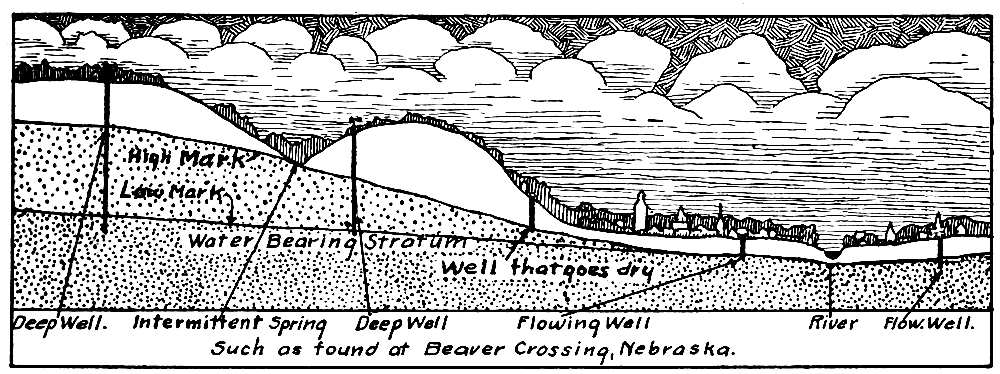
The above illustration shows the fluctuation of ground water. When the ground water is at the low mark the shallow well becomes dry; as the water rises it flows into the well. When the water has reached the high mark the intermittent spring becomes a flowing spring. The pressure of the ground water is great enough to produce flowing wells down on the level.
Not all wells, by any means, will furnish a pure water supply. There are many factors to consider from the viewpoint of the pollution of well water and these will be considered in due time. When water reaches an impervious strata it remains at that level and moves in a horizontal plane. Water may form in beds or be found in underground streams. It is only in the limestone regions that water forms in streams under the ground.
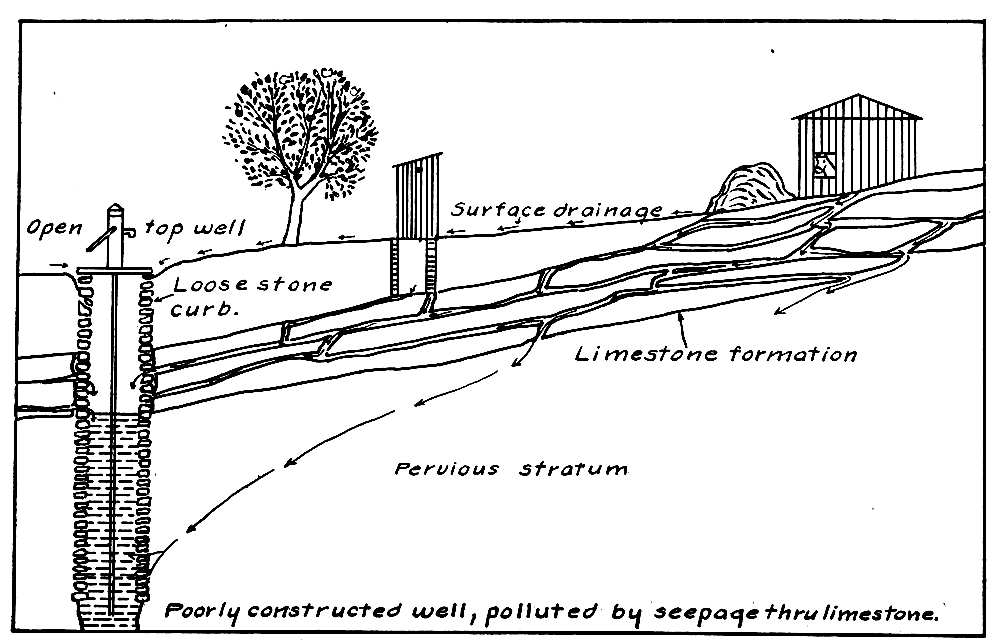
Poorly constructed well, polluted by seepage thru limestone.
The depth at which water is found beneath the surface varies. The water directly beneath the surface, or that which is derived from surface drainage and the rainfall, is, by some, styled the ground water. This is the shallow water. That which is found at a lower level is called the lower subsoil water or underground water.
The ground water does not provide a very desirable source of well water because there is danger of pollution from the surface. The degree of this impurity will depend largely upon the character of the soil. If it is sandy and thus provides a good filter medium there is little danger from pollution; but if the soil is of a limestone formation it makes a very poor filter and the shallow water is likely to be polluted from the surface drainage.
The subsoil water moves in the direction of the nearest body of water. That is, if it is near a river or lake its movement will be in the direction of this river or lake. For this reason a well near the seashore will contain fresh water.
In wells less than fifty feet deep the temperature of the water will be influenced by that of the atmosphere. It will be warmer in summer and cooler in winter. Some authors put this depth at much less than fifty feet, maintaining that the atmospheric temperature will have no influence whatsoever at such a depth. It is true, however, and the fact is undisputed, that in wells 50 feet deep or more the water is cool and the temperature remains constant. It is not influenced by the change in atmospheric temperature.
Sand and gravel deposits form the best source through which to obtain subsoil water. To supply any very great amount there must be a number of wells and these must be far enough apart so as not to draw from the same territory. Seventy-eight million gallons of subsoil water per day is provided at Brooklyn from twenty-four separate pumping stations. Memphis, Tennessee, is the largest city in the United States which gets its entire water supply from sand and gravel deposits.
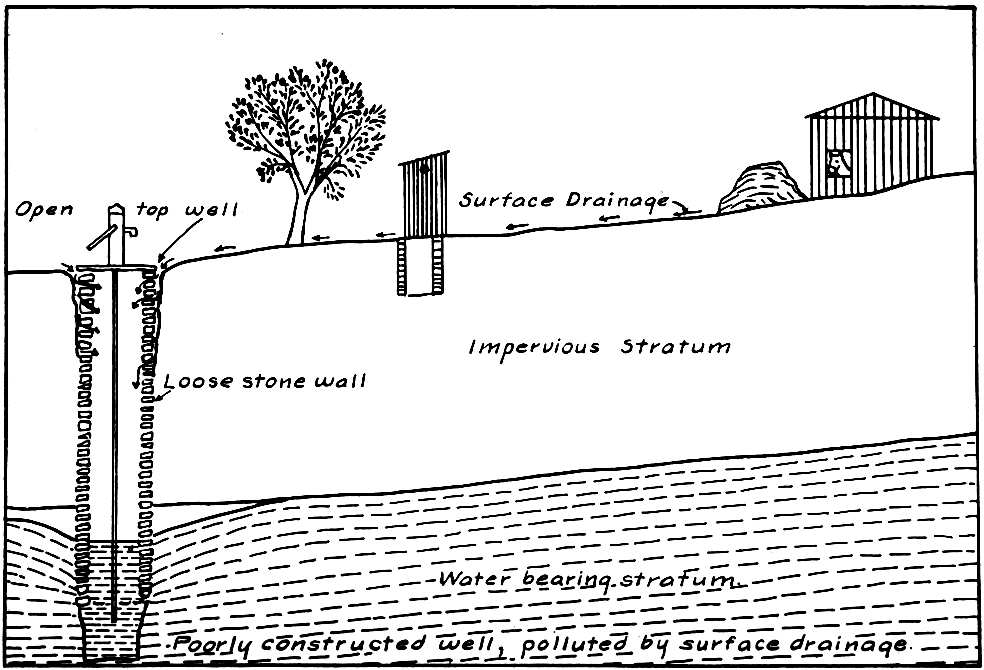
Poorly constructed well, polluted by surface drainage.
Sandstone rock furnishes an excellent source for subsoil water since it makes an excellent filter. Because of the limited amount of water obtained in a sandstone formation this source is practicable only for a very limited supply.
Limestone formation is the most undesirable source of subsoil water supply from a hygienic standpoint. Limestone is not porous and therefore has no filtering qualities. If water does pass through this sort of a formation it must travel through its crevices and fissures.
It is very difficult to know where the pollution of water passing through limestone originates. As these fissures are usually very long, and as the water is in no way filtered as it passes through them, the contamination might enter the water at a point far distant from where the well is sunk. The water supply from limestone is likely to be inconstant because the water is not contained in the limestone, but flows through the cracks and crevices. In this way it may soon flow away unless the source is replenished by rain or snow.
Water from the subsoil is obtained, as has been stated, from wells. Wells are classified as shallow and deep. By a shallow well is commonly meant one that is dug and not more than thirty feet deep. This type is usually walled up with brick or stone and is from five to six feet in diameter. Shallow wells may also be driven. That is, a gaspipe with a sand point is driven into the ground until the water-table is reached, the water being pumped out with an ordinary suction pump.
Shallow wells must never be considered a satisfactory source of water supply where there are conditions existing which would result in such pollution of the ground that the water percolating through can not be more or less filtered. Sewage polluted soil never is satisfactory for shallow wells.
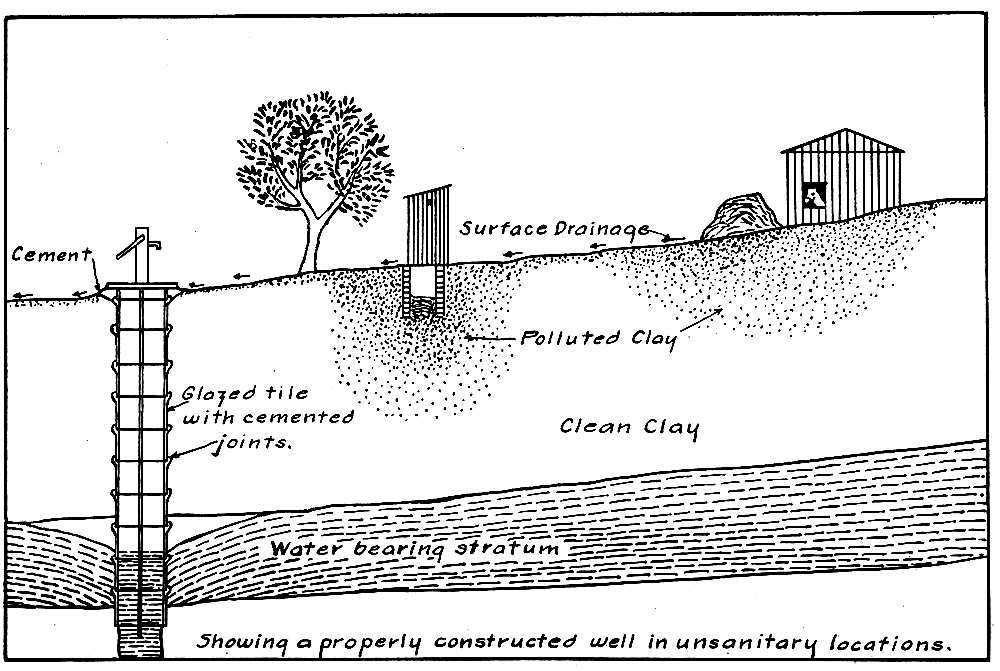
Showing a properly constructed well in unsanitary locations.
Deep wells are drilled and are from six to eight inches in diameter. The water from deep wells may be free from contamination but may contain a great deal of mineral in solution and different salts which render it permanently or temporarily hard. This decreases its value from a sanitary viewpoint and more particularly from an economic standpoint.
Special attention should be given the construction of the well. The casing or walls should be as tight as possible. Special care should be exercised against the possibility of surface water percolating through the casing as this drainage will bring impurities.
The casing should project far enough above the surface of the ground to insure against water running from the surface. It should extend at least eighteen inches above the ground. The well should have a tight covering.
The ground possesses great filtering qualities and therefore great quantities of impurities will be taken from the water as it filters through. The danger is when the ground becomes so filled with impurities that its filtering qualities have been destroyed or when there is not sufficient distance between the source of pollution and the water level; also when the soil is of a limestone formation and the water, instead of percolating through it, passes through cracks and crevices, in which event it will in no sense be filtered.
It was at one time considered that wells should be ventilated and a great deal of stress was laid upon it. When it is taken into consideration that the water under ground is in no way ventilated except through the natural means, it will readily be understood that it is not necessary to provide ventilation merely because the water has been tapped by a well.
If the origin of pollution, such as cesspools, is too near the well or the well is too shallow, not allowing enough distance for purification, there will be great danger from such sources. The greatest danger is in the shallow wells. However, these are entirely satisfactory as a source of domestic supply, providing the soil is of a sandy or gravel formation and there are no barnyard or cesspools, for example, too near the wells. A shallow well in a limestone region is not satisfactory and should be discarded when at all possible. If it is necessary to use such, every precaution possible should be taken to eliminate the possibility of contamination.