METHODS OF PURIFICATION
Reading edition
Natural Methods of Water Purification
In considering the subject of water purification it is not our thought to go into detail and explain the processes that are necessary to accomplish a pure water supply, but to deal with the subject in a general way that we may appreciate what is necessary in this line.
We will first take note of the methods used by Nature in purifying water. Nature’s method of obtaining chemically pure water is by evaporation and condensation. The result of this method is the snow and rain water. About three-fourths of the earth’s surface is covered with water. The sun acts as a great furnace and the atmosphere as a vast still. In this way we see that a great quantity of water is distilled and returned to the earth in a state of purity. It is estimated by Summerville that “186,240 cubic miles of water are annually raised from the surface of the globe in the form of vapor chiefly in the intertropical seas.”
It is entirely erroneous to assume that the impurities in water are eliminated by freezing. Ice may contain great quantities of impurities, even so-called pathogenic germs. It has been shown that many germs are not destroyed by freezing. It is true, however, that ice will be purer than the water from which it is taken.
There are certain processes which result in a purifying influence as water is crystallized. As ice forms it excludes suspended matter and even under certain conditions will exclude dissolved substances. It will thus be seen that even though ice may not be pure, the danger from its use is greatly reduced. It is not advisable to use water from melted ice for drinking purposes.
Manufactured ice is supposed to be free from impurities, but this is not necessarily true. If ice is produced artificially from distilled or properly filtered water it will naturally be pure, provided it does not become polluted in the process of manufacture.
At one time it was believed that river water would become pure in a flow of seven miles. This, however, could not be true since the distance of the flow is of less importance than the time required for the flow.
The greatest aid in this method of water purification comes from the impurities mixing with the volume of water as it flows. The impurities become diluted and if sufficient time elapses the bacteria and microörganisms will die a natural death.
The principal process involved in self-purification of water is the oxidation of nitrogenous organic matter which is a chemical process. In the course of time the microörganisms die as a result of the biological action. Then there is the effect of dilution, sedimentation, especially in lakes and still water, and the effect of sunlight.
Food for the bacteria is lessened as a result of the destruction of the organic matter through oxidation. The minute infusoria, amœbæ and water worms feed upon organic matter and bacteria and thus aid in the process of purification. The plants known as algæ play a very important part also in water purification. They take up the organic substances and perform other functions similar to the vegetation on the land. The purifying effects of water vegetation is very important.
One of the chief sanitary safeguards in Nature is dilution. A small amount of pollution may be quickly diluted by a volume of water until it is practically harmless. In its concentrated state, however, there might be enough poison, the strength of which would be greater than the internal resistance of the individual. This would produce toxic conditions, or it might even be great enough to produce subluxations.
Sedimentation is another of Nature’s methods that is of great value. This process has been aped by man in the coagulation produced by the use of chemicals. This action is largely mechanical. During the process of sedimentation it is only the suspended matter that settles; but it is maintained that the bacteria and microörganisms become entangled and are carried to the bottom and in this way the water is freed from more than simply the mechanical impurities. If allowed to remain in storage a sufficient time, the harmful bacteria will die a natural death. There are processes, however, that take place during the time of storage which are objectionable, but these relate more to the taste or smell of the water than to the production of harmful ingredients.
During sedimentation there is a natural settling of the suspended particles. Not only is the desired result obtained in freezing the water of solids, but as the suspended matter sinks to the bottom many of the bacteria will also be carried down. Sedimentation, however, is not a method that can be used promiscuously. It is usually employed in connection with some other method; with a slow sand filter, for example, or when mechanical filtration is used.
Sunlight is Nature’s greatest germicide. Direct sunlight destroys germ life and renders much aid in maintaining sanitary environmental conditions. It has a purifying effect upon water in this way. When the water is in motion or during times of turbidity great good is accomplished from a sanitary standpoint by the direct rays of the sun.
Artificial Methods of Water Purification
The only way to obtain chemically pure water is by distillation. However, since this method is very slow and expensive, it is not at all practicable for the purification of even a private water supply, and since a chemically pure water is not required for drinking or other domestic purposes it would be entirely unnecessary to provide it. Again, distilled water is not desirable for drinking purposes since its taste is insipid until it is aerated.
When only a small amount of water is required it may be freed of organic poisonous substances by boiling. This will not, however, render water that contains lead and other stable chemical substances injurious to health safe for domestic use.
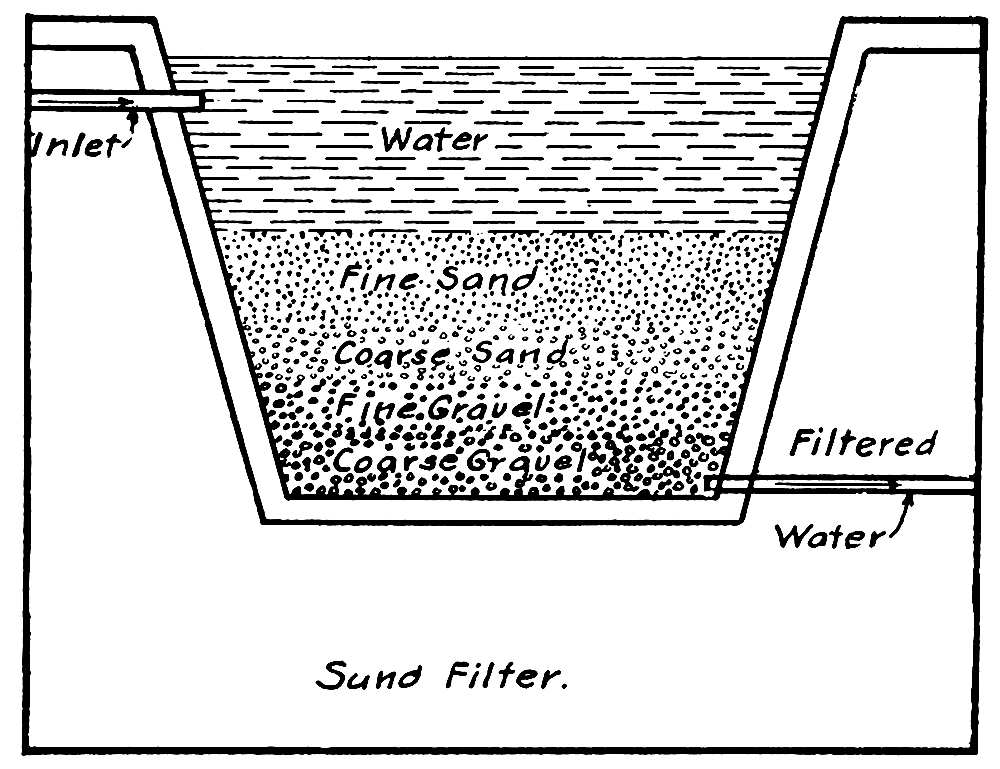
Sand Filter.
The dissolved gases are given off by boiling and this leaves the water with a flat taste which may be improved by aerating; this may be done by stirring or by placing the water in a jar and shaking it.
Filtration is by far the most practicable method of water purification. There are many different methods used. The two most used are known as the natural and mechanical.
Under what is known as the natural methods, the sand filter seems to have precedent. The efficiency of this filter depends upon the material used, the velocity of the water through the filter and the care, such as proper cleaning which the filter receives.
As a matter of information the student should become somewhat familiar with the general construction of a sand filter. The size of the filter, that is, the area it covers, will be governed by the amount of water to be filtered per day, which in turn will depend upon the demands. The greatest objection to a slow sand filter is that a very large tract of land is required to provide sufficient surface for the percolation of the water.
The bottom and sides of the filter-beds are water-tight and are constructed of cement with proper drains to carry off the filtered water. A layer of very coarse gravel is placed on the bottom of the filter, then on top of this is a layer of fine gravel. This is then covered with fine sharp sand about three feet deep. Ordinarily the entire filter medium is from four to six feet deep.
On top of this layer of fine sand a thin scum is formed which increases the efficiency of the filter, its action being biological. As this scum accumulates it becomes necessary to remove it. This is done by special devices. It is necessary to remove only a small portion of the sand, for it will be clean immediately below the surface. This process is continued until the layer of sand has decreased in depth to about twelve inches when it is replenished with new, or with polluted sand which has been removed and thoroughly washed with filtered water.
The filter is first filled by admitting water from beneath for the purpose of forcing the air out. The depth of water is kept about three feet above the sand.
The rate of filtration is controlled and kept at a velocity of about two inches per hour. At this rate a filter of one acre area will provide about 3,000,000 gallons per day.
A first class slow sand filter should free the water of 99% of the bacteria. Hygienists claim that filtered water should not contain more than 100 bacteria to a cubic centimeter. Water from a new filter or one that has just been cleaned should be tested before it is used. By this method one can determine whether the desired results are being obtained.
It may be necessary to store the water in reservoirs before it is passed through the sand filter for the purpose of sedimentation. This will rid the water of the small particles of sediment which is contained in the turbid water. If turbid water is passed through a sand filter the smallest particles will pass on through with it. This causes a tendency to fill the filter with clay and other substances.
Instead of the water passing slowly through the sand, it is forced through in mechanical filtration. The sand is contained in cylinders or tanks and the water is forced through either as the result of gravity and weight of the water above or by mechanical means. Before it is passed through the sand in the mechanical filter, it is treated chemically to coagulate and precipitate the suspended impurities. This process is not only mechanical in the sense that it is accomplished by means of certain machinery, but the action on the water is mechanical. There is no bacteriological action which is so essential as this mechanical action in the process of water purification.
The mechanical method of water filtration has not been found to be as satisfactory as the slow sand filter process, although very large amounts of water may be filtered in much less time. One great disadvantage of this method is that the filters require such frequent cleaning and in this respect are very expensive to maintain.
Chemical purification is not considered by some hygienists as a satisfactory method for purifying large water supplies. There are many objections to this method. Even though the water is freed from the impurities it has received in its natural course, it is laden with chemicals that may be as injurious to health as the impurities themselves.
The chemicals used are: Chlorine, bromine, copper sulphate, metallic iron, ozone and sodium bisulphate.
Swimming Pools
In connection with the subject of water a word relative to the sanitation of swimming pools will not be out of place. There are many municipal swimming pools in operation and while they are intended to improve the sanitary conditions, they may at the same time become a great menace to hygiene if they are not properly conducted.
No individual should be allowed to enter a swimming pool without first having taken a shower bath with a liberal use of soap. No one should be allowed in the pool who is infected with skin dis-eases of any kind, ulcers, running sores, conjunctivitis, or venereal dis-eases.
The water should be properly filtered when it enters the pool and there should be a constant process of disinfection. There should be not only right construction, but also fit maintenance of the pool. The swimmer should be properly instructed relative to swimming pool sanitation.