SANITARY MEASURES IN PRODUCTION
Reading edition
Milk, a Germ Medium
Milk, because of its characteristic qualities, forms a medium in which all kinds of bacteria and germs, or low forms of life, thrive. When we consider the processes necessary to obtain the milk and deliver it to the consumer, even though the most rigid sanitary methods are observed, it can readily be seen that milk is exposed to almost all kinds of dirt and to the different forms of organisms.
It is very difficult to obtain milk in a state of purity and if germs played as important a part in the production of dis-ease as is thought by some, one of the most important articles of diet would be lost to mankind. Great quantities of these germs are ingested into the stomach of individuals who drink milk.
These bacteria are carried into the milk during milking and in the handling of the milk and the retainers. Bacteriological standards have been established, but vary a little with different authors. Usually it is agreed that certified milk should not contain more than 10,000 bacteria per cubic centimeter. Market milk should not have more than 1,000,000 bacteria per cubic centimeter in the raw state and not more than 50,000 per cubic centimeter after pasteurization.
It can be seen by this standard that even the relatively pure milk contains great numbers of bacteria and yet these bacteria are ingested into the digestive tract and no harm done. As a matter of fact, this helps to substantiate the contention of Chiropractic that these germs and the different bacteria are essential to life. There is no question, however, that poisons may be contained in milk, and when these are taken into the stomach Innate may not be able to properly adapt the tissues and thus a toxic condition will be produced.
Because of the characteristic qualities of milk, the strictest sanitary measures should be observed in all the processes involved, from the time the milk is taken from the cow until it is delivered to the customer.
Milk undergoes certain physical, chemical and biological changes as soon as it is taken from the cow: the cream rises and thus it is separated from the milk; there is also a separation of the solids from the fluids.
Care in the Milking
A sanitary environment should be provided for the cows and special care should be taken in the process of milking to prevent the milk from becoming contaminated with dirt and filth. Those who handle this milk should take proper precautions to prevent dirt from getting into it. All utensils should be kept clean, sweet and free from sour milk.
Sanitary measures should include: Proper care and feeding, or the health of the milch cows; (2) proper regulation of the bottling and transportation of the milk. The cows should by all means be healthy, inasmuch as milk is an animal secretion. It is certain that if the animal is suffering from dis-ease, this secretion will not be normal. Over-exertion and fright will also affect the milk. Care must be exercised to detect dis-ease and such dis-eased animals should be separated from the herd and their milk not used.
Care of the Cows
The cows should have plenty of exercise, but care should be taken that they are not frightened or over-exerted. They should be provided with proper protection from the weather and should have plenty of fresh hay, ground whole grain, and, when possible, be allowed to graze. Spoiled vegetables or fruits, foul or fermented foods are detrimental to dairy cows. A proper supply of salt is necessary and plenty of pure, fresh water is absolutely essential for the health of cows.
Barns and Barnyards
The barns and barnyards where milch cows are kept should be free from manure, pools of stagnant water, dirt and refuse. The ground should be well drained so that it will not become water-logged. Such ground should be located on elevations to assure proper drainage. The habit of allowing the refuse to accumulate in large quantities before hauling it away is not only repulsive but very unsanitary and may become a source of pollution of the milk supply.
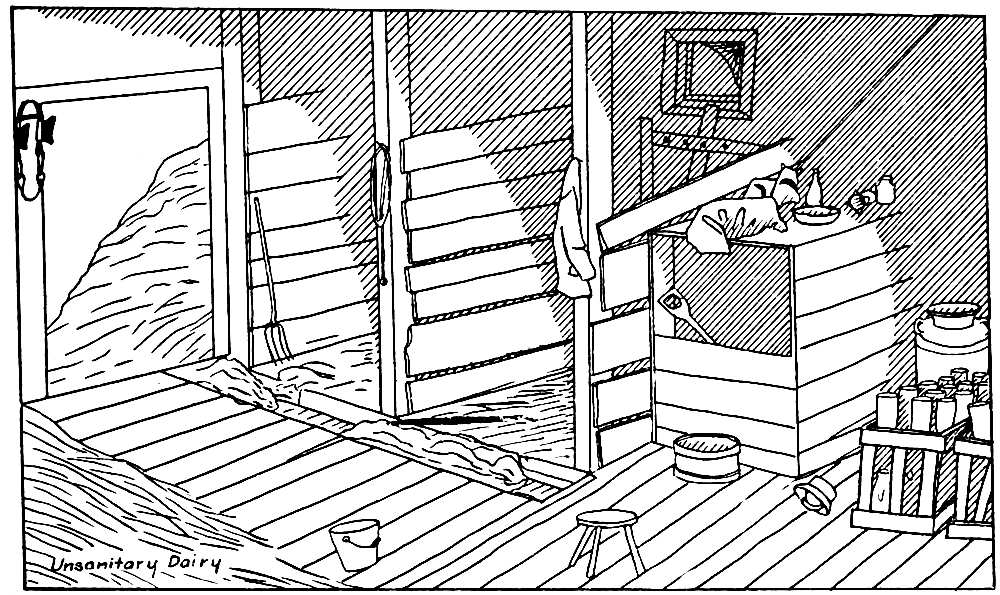
Stable should be constructed to assure proper ventilation and to provide proper shelter for the animals. The floors should be of material that is non-absorbent, well drained, and easily cleaned. Concrete is best. Each cow should have a separate stall furnished with a stanchion. The walls should be of material that can be cleaned. There should be 600 cubic feet space for each cow in the barn.
Bottling
Milk should be strained through gauze placed over the wire strainer. All the utensils should be thoroughly cleaned after each milking and, if possible, sterilized in a steam sterilizer. The straining should not be done in the barns where the cows are, but in special separate milk houses. The bottling should be done only in establishments specially fitted for such purpose.
Proper Temperature
Milk should be kept at a temperature not above 50° F. during transportation. The cans or bottles should be properly covered, sealed, and the milk protected from too much agitation.
Because milk undergoes a very rapid change, beginning almost as soon as it is drawn from the cow, it is necessary to either consume it in a short time or provide some means of preserving it. Milk soon deteriorates, becomes sour and unfit for use as food.
The best means of preserving milk is to keep it at a low temperature. Bacteria are not destroyed in low temperature, but the activity is inhibited and their development retarded. In this way milk is kept from souring and from undergoing fermentative changes. The digestibility and character of milk are not changed by cold, and it will be sweet for a day or even longer if kept at a temperature under 50° F.
An entirely sterile milk may be furnished only by raising the temperature to 248° F. for at least two hours, but this destroys the milk ferments. There are certain changes produced by boiling milk which renders it less desirable for food, making it less digestible. It is, therefore, especially undesirable for infants.