LOCAL HEATING
Reading edition
Radiation
The vibrating molecules of a heated substance will set into motion the ether of space and in this way the heat may be transmitted as wave motion. We have an illustration of this in the transmission of heat to the earth from the sun. Ether waves are generated by the violent vibration of the molecules of the sun and the vibrations are transmitted to the earth and they in turn generate molecular vibrations of the bodies of the earth. This is spoken of as radiant heat and is illustrated by the heat from the open fireplace.
Open fireplaces give off heat by direct radiation. This is the oldest method of heating and has been in use for many generations. It is not a satisfactory method, however. The radiation of heat takes place through air very readily, but air is not a good conductor of heat. Heat may be radiated from the body very rapidly through the air to cold objects. As for instance, sitting near a cold wall one will feel chilly due to the radiation of the heat from the body to the cold wall, although the air in the room may be sufficiently warm to be otherwise comfortable.
Heat may be readily radiated from an open fire, but it must be remembered that the intensity of the radiated heat is inversely proportional to the distance of the heated object from the place where the heat is produced. To illustrate: If one object is one foot from the source of heat, the open fireplace, and another object is three feet from the fireplace, the object that is farther away will receive only one-ninth as much heat as the one nearer. This is one of the disadvantages of the open fireplace as a means of heating a room. A fireplace is very cheery and gives a room a comfortable appearance and is very popular in the modern home. It is adequate to take the chill away when the weather is not very cold, but it is certainly a very undesirable means of heating a house in cold weather.
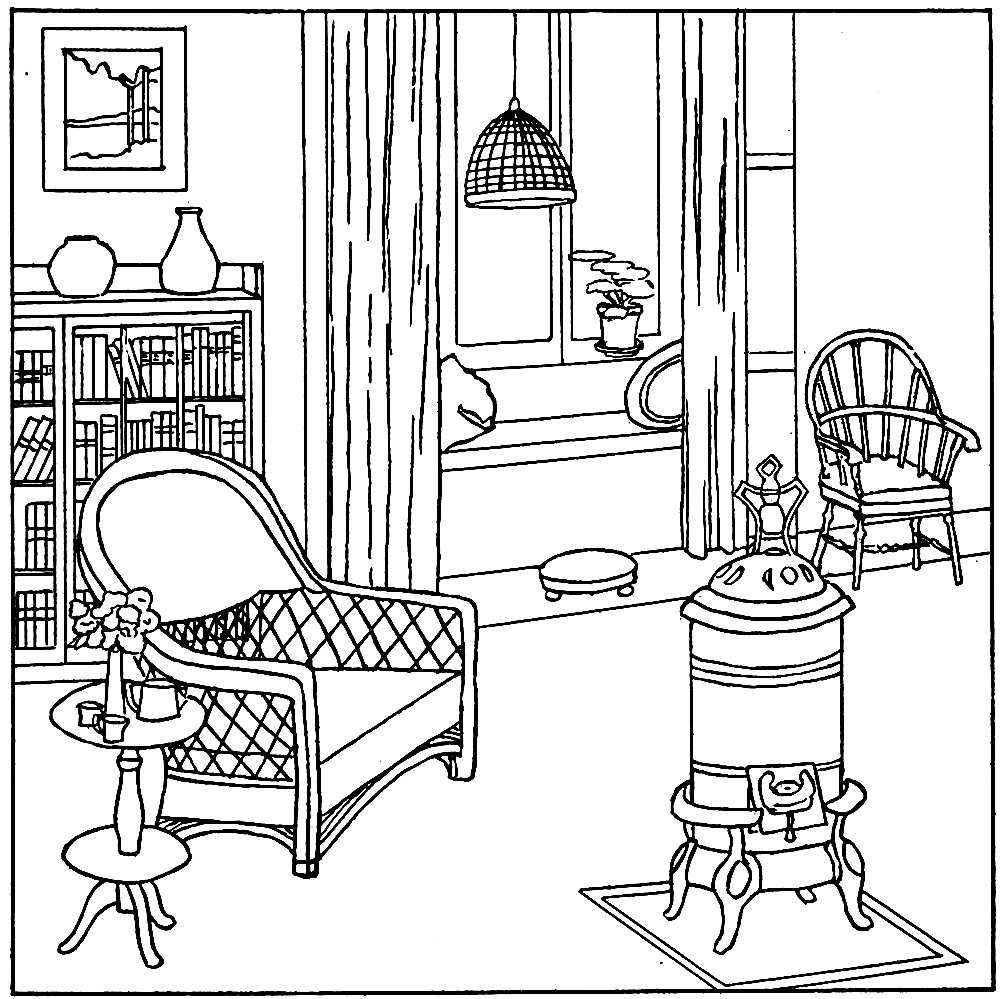
Local Heating
Another objection to the open fireplace is that it requires a great deal of fuel. About 75% of the heat is lost through the chimney. There is, however, an advantage in the open fireplace since it affords an excellent means for ventilation; there is always a draft up the chimney.
Conduction
Heat is carried through such metals as iron by molecular action and such heat transference is known as conduction. The fact that heat is transferred through metals by conduction is of vital significance in the question of heat losses and dissipation, as through walls of buildings for example.
If heat be applied to any part of an iron bar or piece of metal it will be transferred to all parts of that iron by the molecular action until it is all heated. This can be illustrated nicely by placing the end of the poker in the furnace fire and in a short time the heat will be felt in the other end of the poker.
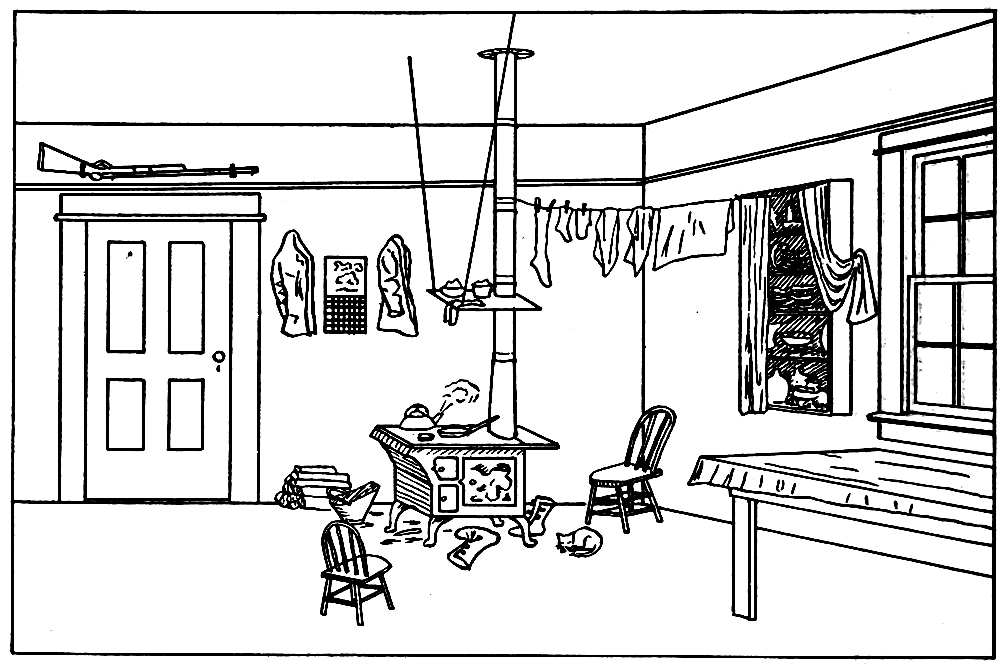
Undesirable Local Heating
The stove is a good example of the conduction of heating. The heat is conducted through the iron of the stove to the air in the room, and then by convection through the air to all parts of the room. The molecules that are in contact with the fire first have their motion accelerated by the heat and this motion is passed from molecule to molecule until all the molecules in the entire iron are accelerated in their motion and thus the temperature of the metal is increased. Some metals are better conductors of heat than others, owing to the difference in the character of the connection between the molecules. Silver forms the best conductor of heat among the metals and is used as a standard of conductivity.
In conduction heat is produced inside a fire pot, as in a stove, and conducted through the iron then radiated from its outer surface. This is also called indirect radiation and is a more satisfactory method than the direct radiation since the material of the stove will retain the heat for a longer period of time and allow for its more equitable distribution. In this way it is possible to heat the room more evenly than with an open fire.
One of the objections to this method is that it is local and has all the disadvantages of a local heating system. The combustion takes place in the room and as a result there are certain amounts of impurities that are admitted into the breathing zone. There is the added disadvantage of having dirt and dust from the fuel and from the ashes and refuse from the process of combustion. These disadvantages are not encountered in a central system.
In extremely cold weather the stoves are likely to become overheated in an effort to keep the rooms warm, and overheated stoves not only increase the hazard from fires, but tend to scorch the air. Red hot iron consumes oxygen and gives off carbon dioxide which produces an unfit atmosphere for breathing. It is difficult to maintain an even heat in a room that is heated by a stove for the stove requires a great amount of attention.