Chapter II · HOUSING HYGIENE
Reading edition
HOUSING HYGIENE
GENERAL CONSIDERATIONS Site RELATION TO HEALTH EFFECT OF DAMP SITE Aspect MOST SUITABLE ARRANGEMENT OF ROOMS DIRECT RAYS OF THE SUN Soil RELATION TO HEALTH MOST SUITABLE SOIL Ground Water and Ground Air FLUCTUATION OF DISTANCE OF GROUND WATER FROM SURFACE GROUND AIR FORCED INTO BREATHING ZONE DRAINAGE OF GROUND WATER ASSISTANCE IN PROCESS OF PURIFICATION ILL EFFECTS OF WATER-LOGGED SITES Stagnant Water ILL EFFECTS OF METHODS OF DISPOSAL BUILDING CONSTRUCTION Foundation RELATION TO THE BUILDING CHARACTER AND PREPARATION OF PREVENTION OF DAMPNESS Walls MATERIALS USED CONSTRUCTION Floors SANITARY REQUIREMENTS MATERIALS USED CONSTRUCTION Roof MATERIALS TO MEET SANITARY REQUIREMENTS FIREPROOF HEAT CONDUCTION THROUGH House Dampness OBJECTIONS TO SOURCE OF DAMPNESS METHOD OF PREVENTION ILL EFFECTS OF HOUSE DAMPNESS Fireproofing ADVANTAGES OF FIREPROOFING METHODS USED IN FIREPROOFING CONSTRUCTION House Plumbing SYSTEM OF PIPES FIXTURES TRAPS SEAL WATER TO CARRY AWAY SEWAGE
CHAPTER II
HOUSING HYGIENE
GENERAL CONSIDERATIONS
Site
From a hygienic standpoint the building site bears a certain relation to health and this should not be overlooked. This is in perfect accord with the chiropractic philosophy as to the expression of life in the body. The building site may be so unnatural as to create an environment which would draw too heavily upon the adaptative forces of the body. In this case Innate would find difficulty in maintaining a state of coördination.
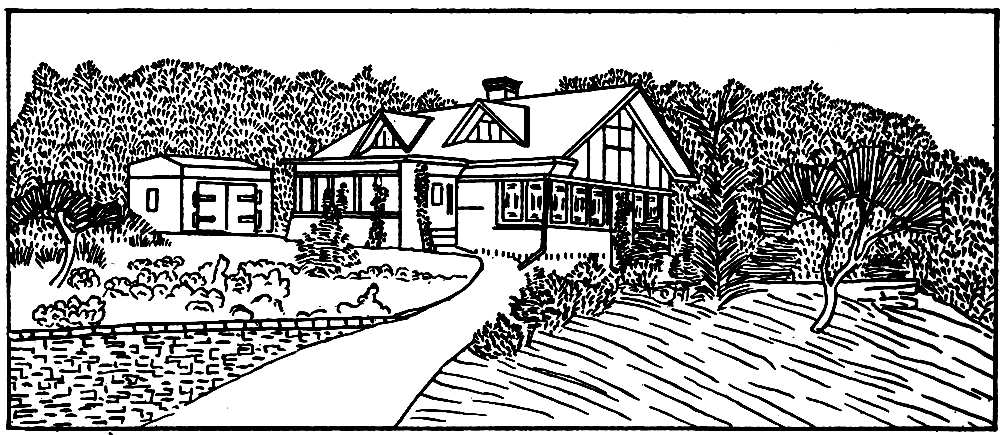
Model Site
The artificial methods of living must be made to conform as nearly as possible to the needs of the body. Damp surroundings might have no ill effects upon the individual who was living a very active life outdoors “roughing it,” but place that individual in a damp, poorly lighted and poorly heated house where he is less active and his expression of life will be materially affected. Innate requires a proper environment, although not necessarily a perfect one, but it must be such that an adaptation can be maintained.
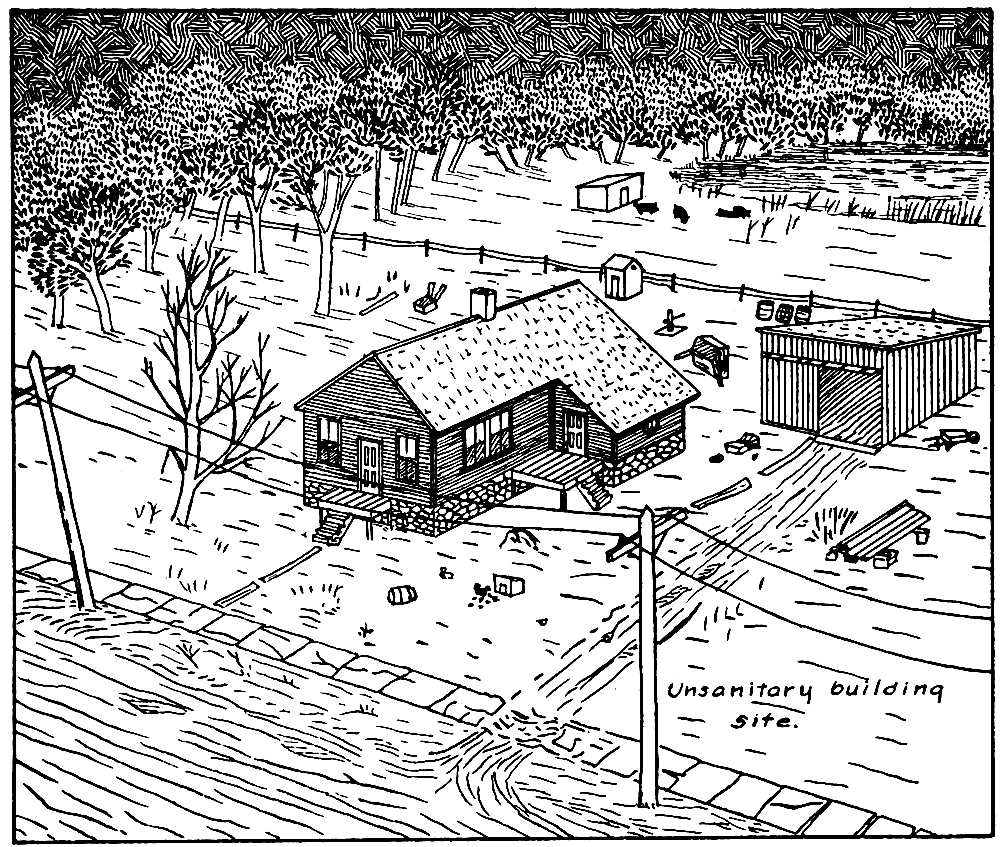
If the building site is damp it will require special methods to prevent the dampness from entering the house. This is expensive and if the site is too humid such a method will prove highly unsatisfactory. If the location is cold the house is very likely to be cold. The site should be well adapted to the needs of the building.
Aspect
The importance of the aspect should not be overlooked. A southeasterly facing is generally considered best, because it is dry and mild and has the morning sun and yet is not exposed to the hot afternoon sun.
The main living rooms should be so arranged as to admit the direct rays of the sun some time during the day. This can best be accomplished when these rooms are on the southeast. Each room should be so arranged with respect to window space that there will be ample lighting and proper ventilation of the whole house. Care must be exercised, however, that there is not too much window space which will give excessive heat in summer or too much cold in winter.
In large dwellings there is a tendency for the halls and stairways to be poorly lighted and poorly ventilated. This should not be. Ample provision supplying light through windows, and ventilation from the outside should be made to insure plenty of light and air.
Bedrooms should be well lighted and if possible direct sunshine should be admitted some time during the day, preferably in the morning.
Soil
The soil bears a close relation to health. The porous soils such as sand and gravel are considered the most healthful because they are driest. But there are objections to these, since they are easily polluted by leaky drains and cesspools, and are capable of holding a notable volume of ground water and ground air. Such air is almost invariably impure. The rain percolates through the soil until it reaches an impervious stratum which prevents it from penetrating any further, and it is held in the interstices or interspaces of the soil and forms the ground water.
Ground Water and Ground Air
There is a certain fluctuation of ground water and ground air. As the water rises the air is forced out of the ground, and as it recedes air is drawn in to occupy its place. There are other factors which influence the ground air, such as the perflating action of the wind and certain climatic changes. Thus the ground may be spoken of as breathing.
If the ground water is near the surface the ground air will be noticeably moist and will produce a dampness of the atmosphere which will result in a decided cooling of the air by evaporation. If the ground water is deep the ground air will be comparatively dry, although the ground near the surface is generally moist owing to the capillary attraction and evaporation from the surface of the ground water. For this reason it is important that damp soils be properly drained to permanently lower the level of the ground water. This may be accomplished by properly laid tile. This will reduce the fluctuation of the ground water since it will be carried off when it rises to the level of the drains. In this way the ground air will not be forced out into the breathing zone to pollute the atmosphere.
The ground air is impure due to the organic matter in the soil. This organic matter is decomposed by microörganisms that feed upon such material and break it up into simpler combinations, carbonic acid, ammonia and water. These processes of fermentation and decay result in a purifying action converting the complex organic matter into products which growing vegetation is capable of assimilating. The presence of oxygen, moisture and warmth is essential to the proper execution of these processes. We can thus see that ample provision has been made for the natural purification and utilization of animal and vegetable matter. Nature provides the oxygen in the ground air, the necessary moisture is derived from the ground water and the temperature of the earth is generally sufficient to supply the needed warmth for this natural process of purification.
If the ground water rises too near the surface or if the building site is water-logged, the water may be drawn off by means of a subsoil drainage. This will also prevent fluctuation of ground water, for as this water rises the ground air is forced out and causes the atmospheric air to become damp. This brings about a cooling of the air. The moisture will ascend by capillary attraction into the walls of the houses; in the evaporation from the inner surfaces, heat will be absorbed from the surrounding objects and this will cause the houses to become damp and cold.
This drainage may be accomplished by placing unglazed porous tiles with the ends in apposition, but not jointed in the subsoil. The fluctuation of ground water is of little consequence in itself; but we can see that in this way the water in wells may become polluted, impure ground air may be forced into houses, and dampness may thus be produced.
Stagnant Water
Stagnant water favors the breeding of mosquitoes and the development of certain dis-eases, malaria and cholera for example; hence the necessity for proper drainage. Trees are sometimes planted in such districts and they, together with the subsoil drainage, render the conditions more healthful. The trees and other vegetation in hot climates absorb the water from the ground and then it is evaporated from the leaves and in this way soil is made drier.