QUESTIONS WITH ANSWERS,
Reading edition
Concerning the Operation and Care of Steam Engines and Boilers.
Q. What should be done first, after receiving a new engine, to prepare it for running properly?
A. If a traction or farm engine, remove the box containing the fittings and tools, from the fire box, and see that the grates are in their proper places. Also take out the tools which are packed in the smoke box at front end of boiler. Then, with waste or rags well saturated with kerosene, turpentine or benzine, wipe off all the grease that the manufacturer has put on to protect the bright work from rusting. After this has been thoroughly done, clean every oil hole and bearing found upon the engine, of all dirt and cinders. Special attention should be given to this, as if dirt and cinders are allowed to remain, the bearings will cut and heat.
Q. After this is done thoroughly, what next?
A. Take all the fittings from the box and clean them carefully, fit each oil cup to its proper place and screw them in tightly with a wrench, to prevent them from working loose and falling off while engine is running on the road.
Fill all cups with good oil, lard oil for bearings, good cylinder oil for the automatic oiler, which oils the cylinder and valve, and solid oil for both grease cups at crank and cross-head. Then put the steam gauge, the glass water gauge, gauge cocks, safety valve, whistle, surface blow-off and blow-off valves, cylinder cocks, governor belt, etc., in their proper places; all fittings should be screwed up tight with a wrench. Examine the stuffing boxes and see that they are all well packed and cleaned.
Q. The fittings all being attached, what next?
A. Proceed to fill the boiler with water by unscrewing the cap from filling plug located on top of boiler near the steam dome, screw funnel on plug, and fill boiler with as clean soft water as is obtainable.
Q. How much water is required in the boiler before starting fire?
A. Fill the boiler until the water shows about one and one-half inches in the glass water gauge, or have a free flow of water from the lowest gauge cock.
Q. After the boiler is filled with water to the proper level, what next?
A. Start a moderate fire with dry wood in the furnace or fire box, and open the draught damper wide. Add fuel slowly, and while steam is being raised take your oil can and wrench and examine the engine thoroughly at all its parts. See that every screw and bolt is tight and that none of the oil holes have been overlooked.
If a traction engine, examine all the gearing and see that all gears, axles and bearings are thoroughly greased and oiled—grease for gears and axles, oil for bearings.
If firing with coal, keep the grates well covered with a thin layer. Do not throw in large lumps or too much fresh coal at one time. A thin fire lightly and frequently renewed, is the most economical.
Q. Is the natural draught of the boiler enough to enable steam to be raised quickly?
A. No. The boiler and water being cold the fire will not burn briskly, but as soon as steam pressure shows upon the steam gauge, turn on the blower, which will force and increase the draught; then with good fuel, any desired steam pressure can be raised quickly.
Q. Must the blower be used when the engine is running to keep up sufficient steam pressure?
A. No. When the engine is started, the exhaust steam is discharged from the cylinder first through the heater, then into smoke stack, producing the same effect as the blower.
Q. If the boiler steams too fast, what should be done?
A. Simply close the damper. Do not open the fire door, as the fire door should never be opened unless absolutely necessary, nor should it be kept open longer than is needed, as the cold air admitted through it injures the boiler and is wasteful of fuel.
Q. After sufficient steam is raised, how do you proceed to start the engine?
A. Before turning steam on the engine, go to the fly-wheel and turn it a few times to see that everything is all right and no obstacle in the way to prevent the engine from running when steam is applied, being sure to leave the crank-pin off the center to enable the steam to start the engine when throttle valve is opened. Next, open both the cylinder cocks, then the throttle valve just a trifle to allow a little steam to enter the cylinder, to warm it and expel the water of condensation. Then open the throttle gradually, and if everything is right, the engine will move off faster and faster until the proper speed is attained. After engine is thoroughly heated and is working dry steam, close the cylinder cocks and set the automatic oiler to work.
Q. How do you obtain the proper speed, and how is the engine made to run steadily with the steam pressure so varied?
A. The proper speed and steadiness in running is maintained by the use of the governor, which receives its motion from the engine shaft by means of a belt.
Q. Are the bearings of a new engine liable to heat when first started up?
A. Not if proper attention is given to them. When starting a new engine the first time, it should be stopped frequently and the moving parts and bearings carefully examined. Feel of all the bearings, the link block, the eccentrics, crank-pin, cross-head, etc., to ascertain if they are heating. If they are, slacken up the boxes a little, but not enough to make them knock or pound. Always be careful not to loosen or tighten bearings or keys too much; just a trifle at a time, but do it often, until the bearings and boxes run cool, but tight. If this is done carefully, the engine will run smoothly and quietly.
Q. After the engine is started, what should be done next?
A. Fill the tank on the engine with water and start the injector to work, so that the proper level of water may be kept in the boiler. The independent pump, if used, should now be fitted, connected and tried, to see if it is in proper shape to feed the boiler. If a cross-head pump is used, it should be fitted and attached to water supply with the suction hose. In this case when the engine is running, the pump can be regulated to supply the required amount of feed water.
Q. How is the boiler supplied with water while the engine is stopped?
A. By the independent pump or injector.
Q. Has the independent pump sufficient capacity to supply the boiler with water under all conditions?
A. Yes, always, when running at a reasonable speed.
Q. Why should an injector be furnished if the pump will supply the boiler?
A. Many times through carelessness or otherwise the pump is prevented from working by dirt, straw, chips and other obstructions which find their way into the pump and hold the valves from their seats. In this case it is necessary to take the pump apart and remove the obstructions wherever found, which would necessitate stopping the engine and allowing the steam to go down, involving a large loss of time. Whereas if the engine is also supplied with an injector, should the pump fail, the injector can immediately be started and the pump examined at leisure without loss of time and avoiding all danger of explosion.
Q. Should the supply of feed water be continuous while the engine is running?
A. Yes. Gauge the speed of the independent pump so that it will furnish the required amount of water to the boiler. Regulate the feed of a cross-head pump, by the suction valve. By so doing, the boiler steams easier, the flues are not so liable to leak, and a uniform steam pressure can be easily maintained more economically.
Q. How is a boiler supplied when engine is in motion?
A. By the independent or cross-head pump.
Q. When should the injector be used in preference to the independent pump?
A. There being no exhaust steam when engine is not running, no benefit is derived from the heater. Now, as cold water should never be forced into a hot boiler the injector becomes of great value, as it heats the feed water to a very high temperature before it enters the boiler.
Q. Is there any independent steam pump made that heats the feed water before it goes into the boiler?
A. See Marsh Pump description.
Q. When engine, pump, and injector are found to be working properly, what next?
A. If a traction engine, the engine should be reversed several times. This can be done by throwing the reverse lever forward and backward, to ascertain whether the valve is so set that engine will run equally well both ways; then the traction gear may be tried. If engine is supplied with a friction clutch, by simply pressing the clutch lever gradually until the friction shoes take hold, the engine will start slowly upon the road. This can be done while engine proper is running at full speed.
The clutch lever should be held in one hand when first starting, so that in case of anything being wrong with gearing, it can be stopped immediately by quickly loosening the lever. With the other hand, the steering wheel should be operated to guide the engine upon the road. When all is found to be working properly, and you wish to run the engine any distance, the clutch lever should be placed in notch provided for it; this will hold the friction shoes securely to the wheel, and the engine will move along the road at full speed.
Q. If the engine has no friction clutch, how do you proceed to start the gearing?
A. Stop the engine and place the reversing lever in center notch, slide the spur pinion on main shaft into gear and open the throttle valve wide; then with the reverse lever in one hand (the steering wheel in the other) you can start engine upon the road by throwing the lever backward or forward, which should be done gradually at first, so that engine will start slowly. If all is right, by throwing the reverse lever in the last notch in quadrant, the engine will travel its full speed upon the road.
Q. How should a traction engine be first started upon the road, forward or backward?
A. Always forward, as you can see where you are going and can guide the engine more easily.
ADVANCE TRACTION ENGINE.
In illustration is given the engine side of the Advance Engine, which is of the side crank, side gear type, with the engine placed at forward end of boiler.
The cylinder is overhanging, and is bolted to the cylindrical formed engine frame which forms the front head. The frame is attached to the boiler with two brackets, and it contains the bored cross-head guides and pillow block bearing.
The engine has the Marsh Reverse Gear, Marsh Pump, Friction Clutch attached to band wheel, Injector, Governor and all necessary fittings.
The boiler is the locomotive round bottom fire box style, with dome in center. It is mounted upon the traction wheels with axle arms attached to brackets bolted to the sides of fire box, in which are placed springs.
The spokes of the wheels are cast in both hub and rim, the latter having mud cleats cast on. The platform has both Water Tank and Tool Box attached, and the steering wheel and band wheel are on the same side of the engine.
The chains for the steering attachment are supplied with springs.
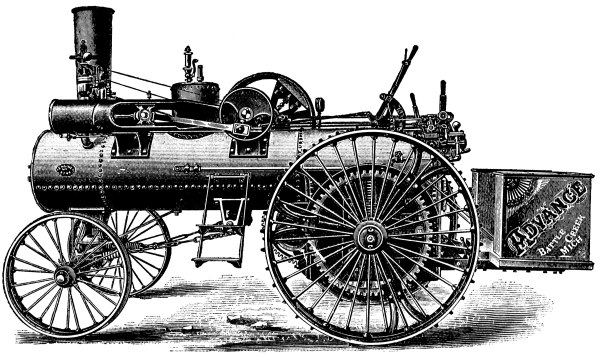
Advance Traction Engine.
Q. How should you guide a traction engine?
A. There is no fixed rule for guiding a traction engine upon the road. It must be learned by experience. Good judgment is required to make a success of it. One man should always handle both reverse lever and steering wheel when guiding an engine.
Q. How should the steering chains be put on a traction engine?
A. The chains should be so put on, that when the steering wheel is turned to the right, the engine turns to the right; when wheel is turned to the left, the engine turns to the left.
REVERSING AN ENGINE.
To reverse the motion of a plain Slide Valve engine, remove the cover of steam chest and place the engine on the dead center. Observe the amount of lead or opening that the valve has on the steam end, then loosen the eccentric and turn it around on the shaft, in the direction the engine is wanted to run, until the valve has exactly the same amount of lead at the other end; then turn the engine to the opposite center, to determine whether the lead at this end is the same as at the other; then place the crank at half stroke top and bottom, and see that the port openings are equal in both positions, and replace cover.
Q. What is dead center?
A. The dead center of an engine is the point where crank and piston rod are in an exact line.
Q. What is a half stroke?
A. It is the point reached by the piston after traveling exactly one-half its travel.
Q. What is the meaning of “lost motion”?
A. Lost motion is looseness of the connecting rod at crank or wrist-pin, or looseness of the link or link block, cross-head and guides, main crank shaft and pillow block, caused by friction and wearing away of the metals and the neglect to take up the wear.
The lost motion in all parts of an engine should be taken up frequently, to keep it running smoothly, but care must be taken not to tighten bearings or keys too tight.
Q. What is lap and lead?
A. Lap is the position of the valve which extends or laps over the edge of the ports when the valve is in its central position. That on the inside of the D is the inside or exhaust lap, while that at the ends of the valve is the outside lap and affects the admission and cut-off.
Lead is the amount of opening which is given to the port by the valve when the engine is on the center.
Lead on a valve is the admission of steam into the cylinder before the piston completes its stroke.
Q. How much “lead” should a valve have?
A. There is no general rule for the amount of lead that would be best suited for all makes of engines. It must be determined by the design or construction, speed and work required, to produce the best results for economy and quietness in running.
Q. What is a throttle engine?
A. A throttle engine is one in which the speed is controlled by throttling the steam with a governor, as opposed to an automatic engine in which the speed is regulated by varying the point of cut-off at the valve.
Q. What is the difference between a stroke and a revolution?
A. A stroke is the movement of the piston, from one end to the other of cylinder. A revolution takes two strokes of piston.
Q. How are steam packing rings put on the piston head?
A. Remove the back cylinder head and take the piston and rod out of the cylinder, and stand it “head up.” Then place the inside of the ring, opposite to the opening, against the side of the piston head next to you; gradually press the ring open with your hands, and it can be easily slipped over the head and put in place.
Q. How is a piston put into cylinder?
A. It is always entered from the back end in horizontal engines. The rings (if steam packing) should be carefully placed in position and compressed by the hand if piston is small, but if large, curved blocks of wood or a band of sheet iron can be used to support them until they enter cylinder. When the piston rod passes through the stuffing box, it should be supported at outer end to prevent cutting.
WATERTOWN HIGH SPEED ENGINE.
The frame of this engine is very heavy, with longitudinal and cross ribs securely bracing it. It forms the lower guide for cross-head, and contains the pillow block bearings at the front end. It also forms the front cylinder head, to which the cylinder is bolted. The working parts are placed as low in the frame as is possible, so that the strain is brought in line with the line of greatest resistance.
The double disc center crank shaft allows of two small heavy band wheels, one of which has the shaft governor attached to the inside, that operates the valve automatically to give the point of cut-off in accordance with the variation of load.
The valve is of a special design, and so constructed as to admit steam to the cylinder port through four different openings. It also exhausts steam through four different openings at once.
The engine frame rests its whole length and is securely bolted to the sub-base, which is bolted to the floor, and the smaller sizes need no elaborate foundations.
This style of engine ranges in size from 35 to 350 horse-power approximately, the speed of the smaller ones ranging from 275 to 325 revolutions, and of the larger from 160 to 185 revolutions, and are used extensively where high speed is required, and where the load is of an intermittent character.
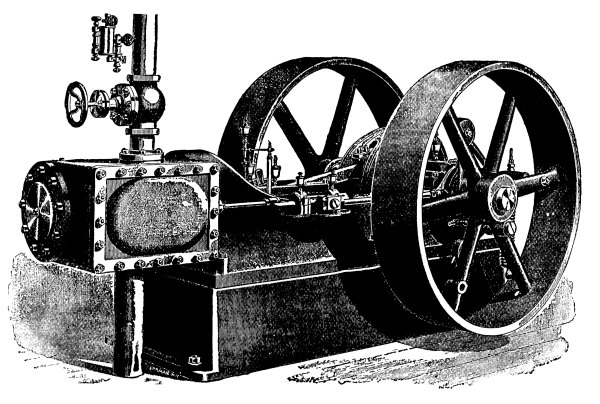
Watertown High Speed Engine.
TESTING PISTON RINGS AND VALVES.
To ascertain whether the piston rings and valves are leaking or not, first place a block of wood about four inches long upon the guide for cross-head and against the front cylinder head. Then turn the engine “over” until the cross-head comes back tight against the block. This will place the valve of a simple engine in such a position that steam would be admitted to cylinder through front steam port. If a reversing engine, throw the reverse lever in the last notch in end of quadrant that would allow the engine to run “over”. Then take off the back cylinder head, and open the throttle valve wide. If steam blows out past the piston, it would indicate that the rings were not tight. In case steam packing rings are used, they should be refitted or replaced by new ones. If adjustable rings are used, they should be adjusted to stop the leak, care being taken not to get them too tight. If the steam blows out through the back port, the slide valve is not tight and it will require refitting, as will also the valve seat.
If a very small amount of steam blows through, new rings or adjustment would not be necessary, as the waste of steam or back pressure resulting from it would amount to very little.
This test should be tried occasionally with a full head of steam on, to assure of the piston rings and valve being tight, as leaky pistons and valves are very wasteful of steam, sometimes causing priming, and greatly diminishing the power of the engine. Never run your engine with leaky piston or valve. Have them properly fitted at once.
After making the test, and repairing if necessary, replace the cylinder head, and be sure to remove the wood block from the guides.
KNOCKS OR POUNDS.
The Knocks or Pounds of steam engines are frequently caused by lost motion in the crank and wrist-pin boxes, valve rod and valve, cross-head and link; looseness of the piston rod, pillow block or main bearings, follower plate, or eccentrics; the slide valve having not enough or too much lead, the exhaust being cut off too soon or too late, shoulders being worn in each end of the cylinder by the packing rings not traveling over the counter-bore at the end of each stroke; or shoulders may be worn in the guides by the cross-head slides, or they may not be adjusted properly to fit the guides; boiler may foam, causing the water to be drawn over in cylinder; the piston rings may leak, thus causing cushioning; and as the crank approaches the centers, steam occupies the space between the cylinder head and piston, causing a tremendous strain upon the engine; the piston rod being packed too tight, the boxes and pins being worn flat or oval; the key in driving pulley may be loose.
TO REMEDY KNOCKS OR POUNDS OF A STEAM ENGINE.
While it is hardly possible to prescribe a remedy for all cases, if the following practical methods are closely followed they will be found to be very useful, although in many instances the remedy must be determined by the circumstances of the individual case.
The knock or pound of boxes in connecting rod at cross-head or crank pin or the valve rod, may be remedied by taking out the boxes, and filing off the top and bottom inside edges sufficiently to allow them to just come together and not fit the pin too tightly. In replacing them, be careful not to key them up too tight.
Where there is not sufficient draught in the key or gib, place a liner in front or behind the boxes.
Knocks or pounds in the link may be remedied (if the link block has too much play in the link) by reducing the liners in each end of the link enough to fit the block properly.
The knocks or pounds of piston are caused by the rod becoming loose in the head; and if allowed to continue, will destroy the fit of the rod in the hole. It may be remedied under such circumstances by removing the rod, re-boring the hole and bushing it perfectly true, and refitting the rod.
Knocks or pounds of follower plate are generally caused by dirt accumulating in the hole, which will not allow the bolts to enter far enough to take up the lost motion of the plate, or the bolts may be too long. To remedy this, remove the accumulation of dirt from the hole, or shorten the bolts.
The knocks or pounds in main crank shaft, if caused by the bearings being worn oval or out of round, may be remedied by removing the shaft; true it up in a lathe, and refit or re-babbitt the boxes.
The knock or pound in eccentrics is generally caused by the eccentric straps being too loose upon the eccentrics, which can be remedied by reducing the liners in the straps to allow them to fit perfectly.
The knock or pound in slide valve caused by being improperly set, may be remedied by taking off the steam chest bonnet and re-adjusting the valve so as to give the same amount of lead at each end of stroke. This being done, and the valve well proportioned and the connections properly fitted, there should be no knocks or pounds from this cause.
The knock or pound in cylinder caused by shoulders being worn in it, can be remedied by re-boring the cylinder, being sure to make the counter bore of sufficient depth to allow the piston rings to overlap them at the end of each stroke.
The knock or pound on guides caused by shoulders being worn on them, is remedied by planing the guides and making the shoe slides of sufficient length to overlap the guides at either end when crank is on the center.
The knock or pound caused by the cross-head slides not fitting the guides properly, may be remedied by adjusting them both top and bottom to fit the guides closely, being careful not to get them too tight, which causes undue wear and strain upon the frame.
The knock or pound caused by wrist-pin or crank-pin becoming worn flat or oval, may be remedied by filing them perfectly round.
The knock or pound caused by the piston leaking, which causes cushioning, can be remedied only by having a tight piston.
The knock or pound caused by the driving pulley key being loose, can be remedied by driving the key in its seat; or if a defective key, replace by a new one perfectly fitted.
If the knocks or pounds are caused by lost motion in any of the revolving, reciprocating or vibrating parts of an engine, they may be detected and located by placing the finger upon the different parts while the engine is running very slowly or worked back and forth by hand.
HEATING OF JOURNALS.
The heating of journals and reciprocating parts of an engine may be attributed to the following causes:
Improper proportions and fitting, unsuitable material, want of homogeneity between the metals of which the journals and bearings are composed, the revolving or reciprocating parts not being in line, the boxes being keyed up too tight, sand or grit getting into the journals, improper lubricating, etc. The last mentioned cause is very complicated, as the conditions of weight of load, area of surface subject to pressure, velocity of movement, etc., must be taken into consideration.
To remedy the heating of journals which is caused by the revolving or reciprocating parts not being in line, the engine or shaft must be put in line.
When caused by the boxes or bearings being too tight, they must be loosened a very little at a time until bearings run cool. Apply plenty of good oil.
Clean the boxes and journals thoroughly, and see that the oil holes are not stopped up; also see that the oil-cups are clean, to assure of the oil getting to the bearings freely.
Oiling frequently, using a little oil at a time, gives the best results and is the most economical.
PACKING PISTON AND VALVE RODS.
When the piston or valve rod of an engine or pump needs re-packing, take off the stuffing box gland, remove all the old packing carefully, and replace with new.
If a patent packing is used, it should be cut in suitable lengths diagonally across the packing, making the angle of one end opposite from that of the other, so that when ends are brought together they will make a splice joint. The joint of each ring of this packing should be placed at opposite sides of the rod, and the stuffing box filled, the gland replaced and screwed up just tight enough to stop leakage. If hemp packing is used, take about the amount required and pick it to pieces, removing all sticks, lumps or hard substances. Then twist it into three compact cords, saturate well with oil or tallow, and braid the cords together tightly. Then wind this braid around the rod until stuffing box is full, replace the stuffing box gland, and screw up as before described.
Care should be taken not to screw the packing in stuffing boxes too tight, as it not only increases the friction on the rod and diminishes the power of the engine, but will have a tendency to flute the rod. If the rod is once fluted, it will be very difficult to stop leakage at this joint.
When stuffing box of water piston of pumps needs re-packing, the same rule will apply, with the exception that little or no grease or tallow should be used upon the packing.
Always keep piston and valve rod packing in a clean place, as any dirt or gritty substance that may become attached to it will have a tendency to cut the rod.
SETTING A PLAIN SLIDE VALVE.
First, take up all “lost motion” and place the engine on the center. This is done by putting the wrist-pin, crank-pin and center of the main shaft in line. To do this accurately, turn the engine until the cross-head is about half an inch from the end of its stroke, and mark the position of the cross-head on the guide.
Place a marker against the edge of the fly-wheel, and make a mark on the fly-wheel opposite the marker, then turn the engine until the cross-head completes the stroke and comes back to the mark made on the guide.
The crank will now be as much below the center as it was above before. In this position make another mark upon the fly-wheel opposite the marker.
Now, midway between the two marks on the fly-wheel, when turned opposite the marker will put the engine on dead center. Next, remove steam chest cover and place the eccentrics about one-quarter turn ahead of the crank in the direction the engine is to run. If the engine is to run “over”, place the throw of eccentric up. If it is to run “under”, place throw of eccentric down.
Then set eccentric carefully at such a point that the valve will have just commenced to open say ¹/₃₂ of an inch on the end that should be taking steam. If there is a rocker arm used which reverses the direction of the motion, i. e., making the valve stem move in the opposite direction from the eccentric rod, the eccentric must be set behind the crank, when the engine is to run “over”, in order that the port may open as the engine turns forward; but if a rocker arm is used merely to multiply the motion without changing the direction, proceed as though there was no rocker arm at all. Next, measure the “lead” which you have given to the valve at end which you have set. This is easily done by pushing a wedge-shaped stick or piece of soft wood into the port opening. The edge of the valve and port will mark the distance it goes in. Turn the engine upon the other center, which will be found as before described, and see if the lead is the same at both ends of the valve. If it is, the engine is properly set. If it is not, move the valve on the stem towards the end having the greatest amount of lead, a distance equal to one-half the difference in the leads. If the equalized lead is more than is necessary, set the eccentric back a little.
There are numerous methods of attaching the stem to the valve. A common way is with jam-nuts. With this arrangement it is only necessary to turn back the nuts on end towards which the valve is to be moved, an amount which will allow the given movement; then, turn the other nuts until the valve is forced into place to travel equal distance both ways from its center position. When the stem screws directly into the valve, the connection to the rocker arm or guide must be taken apart, and the stem screwed into or out of the valve enough to give it the required position. After the valve is set, replace the steam chest cover, and secure the eccentric perfectly tight with the set-screws, to prevent it from slipping.
SETTING SLIDE VALVE OF REVERSING ENGINES.
The Link Reverse Being Used.
First, see that all the lost motion in the connecting rod, pillow block bearings and cross-head is taken up; then throw the reverse lever in last notch in quadrant, which would allow the engine to run “over”; then, remove the steam chest cover. Next, loosen eccentric (the eccentric rod of which is in direct line with the valve rod), turn the eccentric completely around, and watch the valve to see whether it laps the steam ports exactly the same amount at both ends, or travels an equal distance from its central position both ways. If it does, the valve is in proper position upon the rod. If it does not travel equally, the valve must be made to do so by adjusting it upon the valve rod, which is done by lengthening or shortening the rod, by use of jam-nuts, with which the rod is usually furnished. After this is done accurately, place the engine upon its forward center. This is done by turning the engine forward until the cross-head is about ½ inch from end of its stroke and mark the position of the cross-head upon the guide; then, with the use of long tram or dividers, mark from any convenient point on the frame to the band wheel or disc, and mark both points with prick-punch. Again turn the engine forward until the cross-head completes its stroke and comes back to the mark made on the guide; then, with the same long tram or dividers, mark the band wheel or disc as before from the prick mark already made on the frame.
Midway between punch marks on band wheel or disc, which can be found by use of dividers, will give the point which will place the engine on the “center” by turning engine back far enough to allow the long tram or divider to fit in punch mark on frame, and center punch mark on band wheel or disc. Now turn the eccentric over in the direction in which the engine is to run, until the valve gives the proper amount of lead on the front of steam port, which is about ¹/₃₂ of an inch, and fasten eccentric with set-screw. Then turn engine over the way it is to run, and place it upon its back center. This is done exactly as before described for forward center, and if the valve is properly proportioned, it will give the required ¹/₃₂ of an inch lead on the back steam port, and valve will be properly set for running in this direction.
Now throw the reverse lever in the last notch in opposite end of quadrant, which would allow the engine to run “under”, then loosen the other eccentric (the eccentric rod of which is in a direct line with the valve rod), and proceed same as described when engine is running “over”, to get valve to lap both steam ports equally. Then place engine upon either center and move the eccentric in opposite direction from the other eccentric until the valve gives the ¹/₃₂ of an inch lead to steam port, fasten the eccentric and place the engine upon opposite center, and the amount of lead should be the same on both steam ports, and the valve properly set.
The valve being set, replace the steam chest cover, and secure the eccentrics perfectly tight by screwing the set-screws up hard to prevent them from slipping.
Always set the valve so as to run the engine backwards or “under” first.
TO SET VALVES OF DUPLEX PUMP.
Set the pistons at mid-stroke, and set the valves which are worked from the opposite side at mid-stroke also, and it will be right at all other points. The mid position of the valve can be obtained by moving it back and forth the amount of its lost motion, and dividing it so that the lead or opening on both sides will be the same.
ASCENDING HILLS.
Q. How do you ascend a hill with a traction engine?
A. When approaching a hill which you have to climb with a traction engine, see that about two inches of water shows in the glass gauge when engine is on a level. Open draft door wide, stir the fire and get it to burn briskly, and get up a good head of steam. Put reverse lever in last notch, then open throttle gradually, allowing just the necessary amount of steam to pass into the cylinder to keep the engine pulling steadily up the hill. Always start up the hill slowly; do not attempt to go up a hill at full speed, but go slowly and steadily, keeping the speed as uniform as possible by opening or closing the throttle as the case may be. Never attempt to go up a hill on a decreasing steam pressure, as there is a great liability to become stalled, in which case great damage may be done to the front end of flues. Always start on a rising steam pressure; then you know the boiler is making steam, which assures a steady ascent, as at every exhaust of the engine on an increasing or steady pressure the power becomes stronger, while at every exhaust on a decreasing pressure the power becomes weaker. Keep a uniform supply of water in the boiler at all times by use of either the pump or injector. Always when going up hill keep the draft door wide open until the steam gauge indicates that the pressure has risen almost to the blow-off point, then close the damper. Never allow steam to blow off when going up hill, as it will cause the water to raise and be carried over into the cylinder, greatly diminishing the power of the engine. Do not under any circumstances allow your engine to be stopped when going either up or down hill, as great damage may be done to the boiler.
FRICK TRACTION ENGINE.
The illustration of the left side of the Frick Traction given on opposite page represents it as being a Center Crank, Rear Geared traction engine.
This engine is constructed with an overhanging cylinder, bolted to the cast iron engine frame, which contains the locomotive style guides and both pillow block bearings for the crank shaft. It has a Cross-head Pump connected with long heater, has a specially designed Reverse Gear, also a Friction Clutch attached to the band wheel.
The round bottom fire box boiler swings in a channel iron frame, which reaches from front axle to the rear of the boiler, around the fire box, to which it is attached, and has a spring in front end only.
The wheels are made entirely of iron, with forged spokes and wrought tire, with high mud grouters bolted on.
On the channel iron frame in front of fire box is placed a heavy plank, to which two large water tanks are attached on either side. The steering wheel and band wheel are on opposite sides of engine and it has all the necessary fittings, so that with proper handling it will be found perfectly safe and reliable. The platform in rear is also supported upon the channel iron frame.
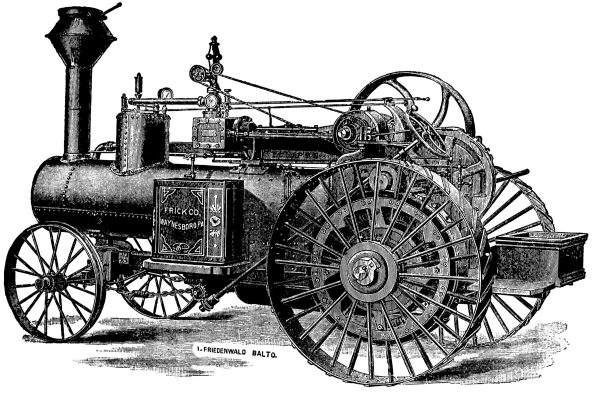
Frick Traction Engine.
DESCENDING HILLS.
Q. How do you descend a hill with a traction engine?
A. When approaching a hill which you wish to descend with a traction engine, see that the water in the boiler is at the regular height, or two inches in glass gauge when engine is on the level. Close the draught door to ash pan and open damper in smoke box when about to descend. Close the throttle almost tight, allowing just a little steam to enter cylinder, then take hold of the reversing lever, and the speed of the engine can be governed so as to descend at any speed desired, or be stopped, if absolutely necessary by throwing the lever into last notch.
Do not stop while going down hill unless absolutely necessary, as there is great danger of melting out the fusible plug and damaging the crown sheet, as the water is much lower over the crown sheet when going down hill with the required amount of water in the boiler than at any other time.
When it is absolutely necessary to stop the engine for a short time when descending a hill, do not turn on the pump or injector; but open the fire door, allowing the cold air to pass over the fire, which will protect the crown sheet. This should never be done, though, except in extreme cases.
ENGINE STALLED.
There is no standard rule by which a traction engine can be gotten out of bad places upon the road, as one rule would not apply to all situations, though a few suggestions on this subject may be beneficial.
When the engine is in a bad mud hole, or on a very sandy road, and the driving wheels will not take hold, but simply turn around, the best way to get out of the fix is to hitch a good team of horses to it and pull it out with what assistance the engine can give. Though in many cases, if a quantity of straw, stones or brush, as may be most handy, is placed under the driving wheels and the power applied, the wheels may get a footing and the engine will come out all right. Old boards or rails placed in the same manner will produce the same result.
It should be understood, however, that if the driving wheels do not take hold, but simply turn around in the sand or mud, the engine should be stopped at once and some of the aforesaid remedies tried. If you continue to work the engine under such circumstances, it will become more difficult to get out of the mire, as the wheels sink deeper in at every revolution.
CROSSING BRIDGES AND CULVERTS.
Before crossing a bridge or culvert with a traction engine, examine the stringers and floor carefully to ascertain whether it is in condition to hold the engine or not. If it appears a little weak, by laying heavy plank across for the traction wheels to run on, it may be crossed in safety, though the crossing of small bridges and culverts must be done with judgment, to prevent accident and delay.
FOAMING.
Foaming is the violent agitation of the volume of water in the boiler; it occurs only in dirty boilers and where dirty feed water is used, which causes the water to become saturated with foreign matter, such as lime, sediment, mud, oil or grease, etc.
The steam trying to escape through the scum formed by these impurities, raises the whole mass from the surface of the water in large bubbles, and causes a general frothing or foaming condition of the water level, which is indicated by the dirty appearance of the gauge cocks and joints and the cutting of piston rod and cylinder by the gritty matter carried over by the steam. Foaming does not result in carrying over so much water, but a foamy boiler does not produce as dry steam as one that is kept perfectly clean.
Q. How do you prevent a boiler from foaming?
A. To remedy foaming, or prevent it, requires frequent blowing off from the surface of the water the scum which causes it, and the use of pure feed water. It may be stopped for a while by closing the throttle valve for an instant, to give the water and scum a chance to settle.
PRIMING.
Priming in a steam boiler is the carrying over of large quantities of water by the steam to the engine, and may occur in a perfectly clean boiler. It is usually caused by too great a demand on the capacity of the boiler, too sudden and fierce firing, or after steam pressure is lowering, an increasing demand is made for it. It is usually a radical defect in the construction or capacity of the boiler, and is most frequently the result of insufficient steam space, small evaporating capacity, and lack of good circulation.
Priming is indicated by the water rising and lowering in the glass gauge more or less violently, by the clicking sound in the steam cylinder of engine as the piston forces the water from end to end, and by the regular shower of water falling from the exhaust.
Q. How do you remedy priming?
A. There are several remedies for priming, none of which will apply effectually in all cases. Where insufficient capacity is the cause, the only remedy is a larger boiler. In others, it may be prevented by carrying the water level lower, if same can be done with safety, or taking steam from side of dome instead of top, or increasing the size of steam pipe, or taking out the top row of flues, and in boilers that have no steam dome, a long dry pipe with perforated top may be of benefit.
Q. What are other causes and remedies for priming?
A. The piston rings may leak badly. If they do, they should be replaced, or made to fit cylinder perfectly. The cylinder may be badly cut by the rings. If it is, it should be re-bored and new piston rings put in.
The slide valve may be cut, and leak. In this case the valve will need re-planing and scraping, also the valve seat. If the valve is not properly set, it may also cause priming. The exhaust nozzle may be clogged with burnt oil and sediment; if it is, clean it out thoroughly.
FIRING WITH WOOD.
Always keep a level fire. Fill every open space as fast as the wood burns out. Allow as little cold air to pass through the fire as possible. Never stir a wood fire. Fire quickly, and keep the door shut as much as possible.
FIRING WITH STRAW.
To start the fire, push a small forkful of dry straw into funnel in fire door, leaving the small end of funnel pressed full; then touch the match to it. Begin at once to push in the straw regularly, a small quantity at a time, being very careful not to clog the main flue, and allowing ample time for straw to burn.
The fire should be raked down frequently, as the burned straw leaves a charred mass over the grates. This should be done when the funnel is full of straw, thus allowing no cold air to pass through the funnel into the main flue. Clean out the ash pan frequently, so that the natural draught may not be checked. Do not open blower until gauge shows ten or fifteen pounds steam pressure.
After steam is raised to the necessary pressure, the feeding should be regular, using small forkfuls of straw, keeping the funnel full all the time, and raking down at short intervals. Use as dry straw as it is possible to obtain.
The above will apply to any style or make of straw-burning engines.
FIRING WITH COAL.
After fire is well started with wood, throw coal into the center of grate, and do not disturb it until it is well ignited and burning briskly; then break the fire down and put in a shovel or two of coal, and so continue keeping the grates covered with a thin layer.
Always aim to put in fresh coal on a rising head of steam pressure. Never pile coal against the flue sheet or keep the fire box too full. Nothing is gained by the latter, but much is lost.
Q. Which is the more economical to burn, wet or dry coal?
A. Dry. If your coal is wet, you simply have to evaporate that much more water, which goes out of the stack instead of to the engine.
Q. How much water will one pound of coal evaporate?
A. One pound of coal will, under very favorable circumstances, evaporate twelve pounds of water, but the average evaporative power of anthracite coal is 9½ pounds of water, and semi-bituminous coal is 9⁹/₁₀ pounds.
Q. If cold air is allowed to strike the flue sheet and flues, what is the result?
A. It will eventually cause them to leak.
Q. How should a fire be regulated in case of temporary stoppage by accident or otherwise under full head of steam?
A. Close the damper and keep the fire door closed; then open small door in smoke box or the damper in chimney.
Q. Why not leave the fire door open?
A. Because it would allow the cold air to come in contact with flue sheet and flues, and consequent damage to boiler.
BANKING FIRES.
To bank a fire in a furnace, push the fire in a heap at the back of the furnace against the flue sheet; leaving a large portion of the grate open, to allow the air caused by the natural draught to pass up over the fire to the flues; then cover it over with fine coal or a layer of dry ashes, and see that the draught door is closed to prevent draught as much as possible.
This being done, the fire will last over night, and when ready to start again in the morning, all that is necessary to do is to rake the fire over the grates, open the damper and apply more fuel.
Q. What benefit is derived from banking the fire?
A. By banking the fire, the water in the boiler is kept warm over night and steam is raised quickly in the morning, saving time and fuel.
Q. When leaving a banked fire, is it practicable to shut the water out of the glass or water column?
A. Yes. In freezing weather, this may be done by closing the valve at the top and bottom of the glass; and open pet cock beneath. Care should be taken, however, to open them before the fire is started in the morning.
LAYING UP A TRACTION ENGINE.
Q. How should you prepare your engine and boiler for laying up through the winter, to protect them from frost and injury?
A. While steam is on, clean your boiler and engine thoroughly outside, scrape off all oil, grease and scale; after which apply a good coat of asphaltum paint to the boiler and smoke stack. If no paint can be had, lamp black and linseed oil will answer. If this cannot be had, take rags, saturate them with grease or oil, and go over them with that.
Now open the blow-off valve, and blow the water off with a low pressure of steam, after which take out all the hand-hole plates and wash the boiler out thoroughly, removing all the mud and scale; then replace the hand-hole plates, close the blow-off valve and fill the boiler nearly full of water, after which pour in a gallon of black oil upon the water.
After this is done, open the blow-off valve again and allow the water to run out. The oil will follow the water down and cover the whole inside of boiler with a coating of oil, making as good a protection against rust as can be found.
Next, remove all the brass fittings, such as lubricator, steam gauge, safety valve, injector, check valves, pump valves, gauge cocks, water gauge, etc., etc.
Disconnect all pipes where water may lodge, in order to prevent freezing. Every pipe and valve allowed to freeze will surely burst. Unscrew all stuffing boxes and remove the packing; for unless this is done, another season you will find parts badly rusted where the packing was allowed to remain.
Take off all cylinder cocks, pet cocks, etc., from the heater and pump. All fittings should be carefully packed and laid away. Clean the flues and fire box, also the ash pan, and do not neglect to paint the ash pan both inside and outside.
Remove the back cylinder head, roll the engine forward and smear the inside of cylinder with tallow, or oil if no tallow can be had. Place the head back again and smear all the bright work, such as piston rod, connecting rod, etc., with grease. Do not forget to cover top of smoke stack, to keep out water and snow.
If the foregoing directions are followed carefully you will find another season that your engine will be clean, free from rust and ready to serve you faithfully without any trouble or delay in starting, either in time or expense.
BELTING.
Do not tax belts by overloading. Keep them free from accumulation of dust, grease and all animal oils, as these are injurious to both rubber and leather belts.
Special care should be taken to protect the edges of rubber belts from all animal oils, as they are liable to rot the belt.
Always run the grain (or hair) side of leather belts on the pulley, as it gives greater driving power, hugs the pulley closer, is less liable to slip, and will drive 30 per cent. more than the flesh side.
Rubber belts will be greatly improved and their life prolonged, by putting on with a brush, and letting it dry, the following mixture:
Equal parts of black lead and litharge mixed with boiled oil; add enough Japan to dry it quickly. In case the rubber peels off, the same mixture can be used.
In comparison to leather belts, 4-ply rubber is equivalent to a single leather belt and 6-ply rubber to double leather belt.
To find the length of a belt, add the diameter of the two pulleys together, divide the result by 2 and multiply the quotient by 3¹/₇; then add to this product twice the distance between the centers of shafts.
When piecing a belt when pulleys are changed, multiply the difference of the diameters of the pulleys by 1½, the product will be the length of the piece required.
The seam side of rubber belt should always be placed outside and not next to pulley. In case the belt slips, coat the side next to pulley with boiled linseed oil or soap.
In lacing a belt, begin in the center and be careful to keep both ends exactly in line. Lace both ends equally tight and do not cross the lace on the pulley side of belt. Great care should be taken that the ends butting together be cut perfectly square; if not, the belt will stretch more on one side than the other, which greatly impairs its worth.
Q. What is the practical limit of belt speed?
A. Belts should not be run much over 5000 feet per minute.
Q. How then is the capacity of a belt affected by its speed?
A. It varies directly as the speed. A given belt will transmit twice the horse-power if its speed is doubled within limits.
Q. Is the capacity of a belt affected by its width?
A. Yes, the capacity varies directly as the width. If a two inch belt will transmit one horse-power, two such belts will transmit two horse power; and this is true whether they are run separately or joined into a four inch belt.
To preserve cotton or Gandy belting, apply with a brush a little common paint to pulley side of belt while running, to be followed shortly afterwards by a little soft oil or grease to preserve its flexibility.
If the edges of the belt become frayed from the use of belt guides or forks, the loose threads may be cut off without injury to the belt.
If the belt slips at first, consequent to the surface being ruffled by unrolling, apply a little grease, oil or soap to the pulley side to make it grip.
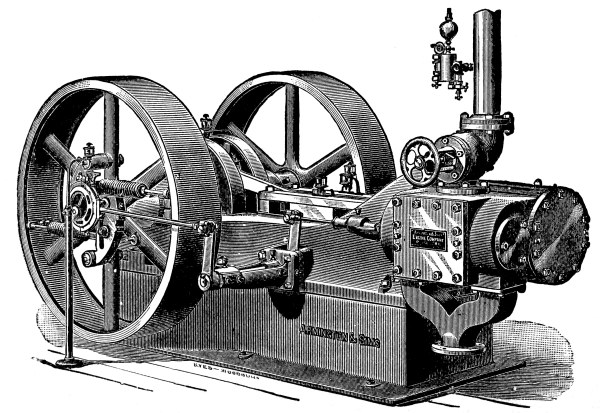
Armington & Sims High Speed Engine.
ARMINGTON & SIMS HIGH SPEED ENGINE.
The cylinder and steam chest of this engine are cast in one piece and bolted securely to the engine frame, which forms the front cylinder head. The cylinder is lagged with mineral wool and jacketed to prevent radiation, and it is overhanging and self-lining.
The valve is a hollow piston valve, the body of which is steel tubing with cast iron ends. It receives its motion from the shaft governor, attached to one of the band wheels, which regulates the cut-off automatically according to the variation of load. The steam is exhausted at each end of the valve by very direct passages which quickly free the cylinder, preventing back pressure.
The engine frame is cast heavy and rigid, and contains the locomotive guides for cross-head and the pillow block bearings for the crank shaft.
The double disc center crank shafts allow of two small heavy band wheels being used.
The base of this engine is cast in one piece, to which the engine frame is securely bolted, and with this arrangement, the engine needs no expensive foundation.
The engine is simple and self-contained, ranging in sizes from 11 to 450 horse-power, and is intended to run at the very high speed of from two hundred to three hundred and fifty revolutions per minute according to size, and is used extensively in driving electric lighting machinery, and where high speed and continuous work is desired.