COMPOUND ENGINES.
Reading edition
The Compound Engine dates from the year 1781, when Hornblower, a contemporary of Watt, conceived the idea of utilizing the force in the exhaust steam of the simple engine in a second cylinder.
From his crude design, the constant progress of experiment has developed the marvelous engines now used in ocean steamers, and in both large and small power plants, also on locomotives. Some of the compound engines built in the early part of the century show results, according to the records, not far behind the best attainable in modern times.
The era of the Compound locomotive engine began in Europe in 1876, but in this country half a dozen years would almost cover its history.
However, in this short time, its advantages in putting to profitable use the entire force of the steam supplied, has been so clearly shown, that it has evidently come to stay. Its availability as an efficient, economical, powerful high speed locomotive, demonstrates the value of the Compound as a farm traction engine, and makes it plain that it will be extremely serviceable on this class of engines.
The Compound Traction Engines belonging to the class known as the “Woolf,” or continuous expansion type, are so constructed that the steam passes directly from the high pressure to the low pressure cylinder without the intervention of any receiving chamber or steam chest. This arrangement is considered much better adapted to traction engine work, and to produce superior results under the varying conditions of this class of work than the “cross” compound, or what is generally styled the “receiver” type of compound engines, in which the high pressure cylinder exhausts into a receiver connected with the steam chest of the low pressure cylinder.
In the Woolf Compound as constructed, the cylinders are either cast in one piece, end to end, or cast separately and bolted together in substantially the same way, in order that perfect alignment can be secured by boring both cylinders at the same operation. This makes it not only easy to get them in line at the start, but it prevents any possibility of their getting out of line, which is a very important feature.
The pistons of both cylinders are upon the one rod, thus requiring only one cross-head, connecting rod and crank. There is but one steam chest, in which a valve is placed, with such relation to the valve seat which contain the ports leading to both cylinders, that it performs the double function of first admitting the steam to the high pressure cylinder, cutting off the admission at the proper time to allow expansion to take place there, and after high pressure piston has reached the end of its stroke, passing on the steam to the low pressure cylinder, where it is further expanded and exhausted in the usual manner after its work is done.
The valve is specially designed with cavities so arranged as to co-operate in increasing the area of opening to double the amount obtainable with an ordinary valve having the same travel.
Without some special provision, the full power of the compound engine cannot be exerted in starting, as the steam operates primarily on the high pressure piston only, which has led to the condemnation of the compound as a traction engine. This objection has been thoroughly overcome in the Woolf by means of a “converting valve,” rendering it possible to admit steam directly to the large or low pressure cylinder, thus largely increasing the power obtainable from the engine, even when exerting its maximum power as a compound. This arrangement can be used not only in starting, but also in cases of emergency, such as climbing steep hills, getting out of bad places on the road, or disposing of an especially tough cut in sawing, etc.
Without increasing the boiler pressure beyond that ordinarily used, the compound engine gets fully one-third more force out of the steam used than is at present obtainable with the simple engine as commonly worked.
In other words, the compound will show results compared favorably with a good condensing simple stationary engine doing the same work.
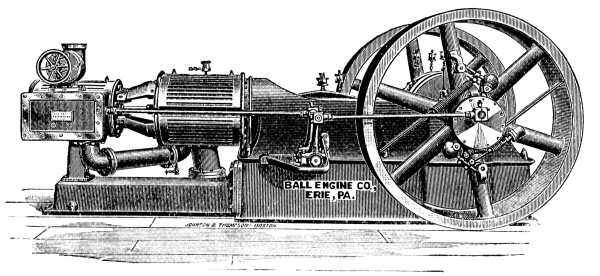
Ball Tandem Compound Engine.
BALL TANDEM COMPOUND ENGINE.
The heavy case iron base is cast in two sections, the rear part being securely bolted to the front section. To the front section is also bolted the main engine frame. This frame contains the bar guides for the cross-head, and pillow block bearing for the double disc crank shaft, and also forms the front head for the low pressure cylinder, which is securely bolted to it.
The high pressure cylinder is attached to the low pressure cylinder by two brackets securely bolted, and is supported by a pedestal, bolted to the rear part of base. By this arrangement, both the high and low pressure pistons are upon the same piston rod, which necessitates of but one cross-head, connecting rod and crank.
The valve of the high pressure cylinder is operated and completely under the control of the automatic shaft governor attached to one of the band wheels, while the valve of the low pressure cylinder receives its motion from a single eccentric on crank shaft at opposite side of engine.
When engine is running, the steam enters the high pressure cylinder first, and after performing its work there, exhausts through the receiver pipe into the low pressure cylinder, and there exerts its minimum force by expansion, and passes out to the condenser, if used, or exhausts into the open air.