Volume 5 — THE PLANNING OF MEALS
Reading edition
NECESSITY FOR CAREFUL MEAL PLANNING
1. As every housewife realizes, the feeding of the members of her family places upon her serious and important responsibilities. While she deserves and receives credit for their good health, the blame for much of their ill health falls upon her, too. The reason for this is that illness is due in a greater measure to wrong food than to any other single factor; and even if improper diet is not directly responsible for ill health, it certainly lowers the bodily resistance and thus makes a person susceptible to disease.
The health of her family is naturally the housewife's first and greatest consideration, and as this depends so much on correct diet, it should be the aim of every housewife to plan her meals in the careful, intelligent way required to supply her household with the food each member needs.
2. As has already been learned, a knowledge of the selection, care, and preparation of food is absolutely necessary in providing proper diet. But correct feeding requires more than this. In addition, the housewife must have a working knowledge of what foods contain and their effect in the body. She must also learn what her family needs and then make every effort to supply this need in the most economical way. The result will be a sufficient amount of food of the right kind at a minimum expenditure of funds.
She should keep in mind, however, that the cost of diet has no direct relation to its food value, but that economy and proper feeding are closely connected. For instance, an inexpensive diet may be just as satisfactory from a food-value standpoint as an expensive one. But in order to make the inexpensive one adequate and the expensive one balanced, the housewife must apply her knowledge of the general composition of food; that is, she must know whether a food predominates in carbohydrate, fat, or protein, and whether or not it furnishes minerals. Equipped with such knowledge, she will be able to purchase the largest amount of nutritive material for the smallest outlay of money. The cheapest food is not always the one that sells for the lowest price per pound, quart, or bushel, but the one that furnishes the most nutritive material at the lowest cost; also, food that is the wrong kind to serve is not an economical one to purchase.
3. Many housewives regard it as unnecessary to plan beforehand and persist in preparing meals without giving any previous thought to them. But to begin thinking about an hour before meal time what to have for a meal is neither wise nor economical, for then it is too late to determine what ought to be served from a diet standpoint and there can be prepared only those foods which the time will allow. As can well be understood, this is both a disastrous plan for correct diet and a very extravagant way in which to feed a family. Quickly broiled steaks and chops, commercially canned vegetables and fruits, and prepared desserts should be the occasional treat rather than the daily food. Instead of using these constantly, time should be allowed for the preparation of the less expensive meats and vegetables and the home-made desserts.
To prepare such foods successfully requires that meals should be planned at least 24 hours before they are to be served, and in reality the main dishes should be decided on 48 hours ahead of time. Then, sometime between breakfast and luncheon and before the day's marketing is done, detailed plans should be made for luncheon and dinner of that day and for breakfast of the next. Nor should the left-overs be disregarded if economy would be the watchword in the management of the household. Rather, they should be included in the plans for each day and used up as fast as possible.
PURCHASE OF FOODS
SUCCESSFUL MARKETING
4. The truly economical housewife will find it necessary each day to determine three things: (1) what is left from yesterday's meals and what use can be made of it; (2) what is in supply that can be used for that day; and (3) what must be added to these things to provide satisfactory meals for the family. Having determined these points, she should make a list of the articles that she must purchase when she does her marketing. A pad fastened to the kitchen wall and a pencil on a string attached to the pad are convenient for this purpose. At the same time, they serve as a reminder that when all of any article, such as coffee, sugar, baking powder, etc., has been used, a note should be made of this fact. To her list of supplies that have become exhausted since her preceding marketing day should be added the fresh fruits, vegetables, and other perishable foods needed for the next day or preferably for the next two days if they can be kept.
5. It is only with proper preparation that the housewife may expect her marketing trips to be successful. If she starts to market with merely two or three items in mind and then tries to think of what she needs as she orders, not only does she waste the grocer's time, but her marketing trip will be a failure. After she arrives home, she will find that there are other things she should have purchased, and the grocer will be forced to make an extra delivery to bring them to her. This is more than she has a right to expect, for the grocer should not be obliged to pay for her lack of planning.
6. To purchase economically, it is advisable, when possible, to buy at a cash grocery and to pay cash for what is bought. When this is done, one is not helping to pay the grocer for accounts he is unable to collect. It is a fortunate grocer who is able to collect 80 per cent. of his bills from his patrons when he conducts his business on the credit plan. However, if it is desired to deal with a credit grocer, all bills should be paid at least once a month. No customer has a right to expect the grocer to wait longer than 30 days for his money.
In many of the cities and large towns, some credit grocers have adopted what is called the "cash-and-carry plan." All customers, whether they buy for cash or on credit, must pay the same price for groceries, but those who wish their goods delivered must pay additional for delivery and those who buy on credit must pay a certain percentage additional on each purchase for bookkeeping. It will readily be seen that such a plan gives the cash customers, especially if they carry their purchases, a decided advantage over credit customers. Also, the grocer is better able to sell his wares at a lower price than the credit grocer who makes free deliveries and no charge for bookkeeping.
KEEPING HOUSEHOLD ACCOUNTS
7. NECESSITY FOR KEEPING ACCOUNTS.--Practically every family is limited to a definite sum of money that may be spent for food. The first consideration, then, while it may not be the most important one, is that of making each dollar buy all that it possibly can in order that the income may meet all the demands upon it. Various conditions arise that affect the proportion of the income to be used for this purpose. For instance, two women whose husbands have equal incomes would, under the same conditions, have an equal amount of money to spend for food, but as a rule there is something to cause this amount to become unequal. One woman may have two children in her family while the other has none, a condition that means, of course, that the woman with the children will have less money to spend for food and with that money she must feed more persons. Her family must be, if possible, as well nourished as the other one. In order to accomplish this task, it will be necessary to supply all the required food material in a form that will cost less than the food purchased by the woman who has a smaller family to feed and clothe.
An excellent way in which to keep expenses down and consequently to live within one's income is to keep a simple record of household expenses. Such a record will enable every housewife to determine just what each item of household necessities costs and whether or not the proportion of cost to income is correct. To keep a record of expenditures will not prove much of a task if it is done systematically, for a few minutes a day will be sufficient time in which to keep accounts up to date. However, if account keeping is attempted, it should not be neglected even for a day, for it will soon assume the proportions of a large task and will have a tendency to discourage the housewife with this part of her work.
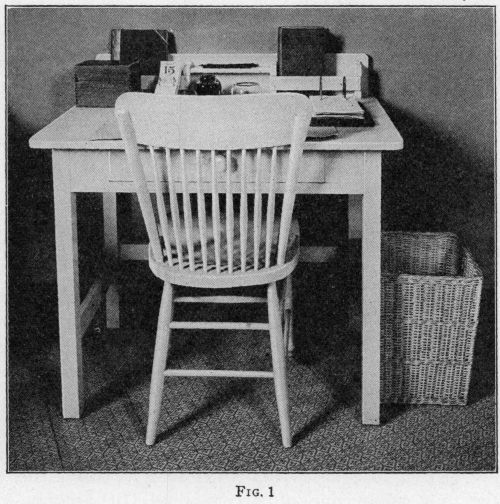
8. EQUIPMENT FOR HOUSEHOLD ACCOUNT KEEPING.--For convenience in keeping household accounts, a small desk like the one shown in Fig. 1 should, if possible, be secured and placed in an unoccupied or convenient corner of the kitchen. Here can be kept cook books, recipes, suitable books or cards for account keeping, the marketing pad, a file for bills from the grocer and the butcher, labels for cans and jars, etc. Here may also be placed an extension telephone, which, by being so convenient, will save the housewife many steps. A white desk with a chair to match is the most attractive kind to select for kitchen use, but a dark one may be used if preferred. The desk illustrated was a simple wooden one that was enameled white after it was bought, but it is possible to buy white desks for this purpose. A small, plain table will, of course, answer very well if no desk is available and it is desired not to buy one.
9. METHODS OF HOUSEHOLD ACCOUNT KEEPING.--If the housewife runs a credit account with the grocer, she will learn that different grocers have different ways of recording her purchases.
In some cases, she is provided with a "store book," which she takes to the grocer each time she makes a purchase and in which he records the date and the items bought by her. Then at the end of a stated time, usually the end of the month, when a settlement is to be made, the amounts for the month are totaled and a new account is started. With such a plan, the housewife does not have to keep any record for herself. To be certain that the grocer's account is accurate, she simply has to check the entries each time they are made in the book by the grocer.
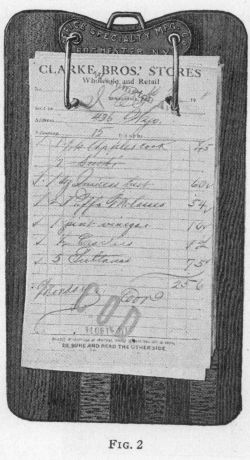
In other cases, the grocer merely makes out a slip, or bill, for each purchase and at the end of the month presents his statement for the amount due. In such an event, provided the housewife does not wish to make entries into a suitable book, she may file the slips as she receives them in order that she may check the grocer's monthly bill as to accuracy. A bill file like that shown in Fig. 2 is very convenient for the filing of bills. However, if she does not wish to save each slip she receives, she may adopt one of two methods of account keeping, depending on how much time she has to devote to this matter.
10. If she desires to be very systematic and has sufficient time, it will prove a good plan to record each purchase in a suitable book in the manner shown in Fig. 3. Books for this purpose can be purchased in any store where stationery is sold and are not expensive. In this method of recording, as a page becomes filled with items, the total is carried forward to each new page until the bill is paid at the end of the month. Then, for the next month, a new account may be started. This same method may also be followed in keeping accounts for meats, milk, and such household expenses as rent, light, heat, and laundry. All these accounts, together with an account for clothing and one for miscellaneous expense, make up a complete expense account.
GROCERY ACCOUNT
With ___John Smith, 420 Fourth Avenue__________
10/151 pk. Apples$ .45
1 doz. Eggs.55
1 lb. Butter.53
2 lb. Sweet Potatoes.15
2 cans Duff's Molasses.54
1 pt. Vinegar.10
10/171 cake Yeast.04
6 lb. Crisco1.98
1 box Coconut.35
1 can Pineapple.25
1 lb. coffee.40
2 qt. Carrots.10
10/191 box Matches.10
2 bars Laundry Soap.12
1 head Lettuce.08
1 can Corn.20
1 bu. Potatoes2.00
1 qt. Maple Sirup.65
Forwarded$8.59
FIG 3
11. A somewhat simpler plan and one that requires less time is shown in Fig. 4. When the slips are received, they should be checked to see whether they are correct and then added to get the total. Only this total, together with the date, is placed in the book kept for the purpose, the slips then being discarded. Such a plan will prove very satisfactory for the various household expenses if care is used in checking the items of the slips and in adding them.
Regarding the settlement of her accounts, the housewife who buys on credit will find it a good plan to pay her bills by check. Then receipts will not have to be saved, for the returned check is usually all that is required to prove that a bill has been paid.
12. The housewife who buys for cash does not necessarily have to keep a detailed record of her purchases, for by simply filing her purchase slips in the manner shown in Fig. 2 she can determine at any time what her money has been used for. Still, in every well-regulated household, it is advisable to keep a daily record of income and expenditure; that is, to put down every day how much is spent for food, laundry, cleaning, and, in fact, all expenditures, as well as how much cash is received. Indeed, if such an account is kept, the tendency of money to "slip away" will be checked and a saving of money is bound to result.
GROCERY ACCOUNT
With______John Smith, 420 Fourth Avenue_____
10/2Groceries$ 2.10
10/3Groceries2.76
10/6Groceries.42
10/8Groceries4.12
10/10Groceries1.09
10/13Groceries.32
10/15Groceries2.30
10/17Groceries2.13
10/20Groceries1.93
10/22Groceries3.97
10/24Groceries1.69
10/27Groceries4.10
10/29Groceries1.12
10/31Groceries3.35
Forwarded$31.40
FIG. 4
13. A simple plan for keeping such a record is illustrated in Fig. 5. For this record it is possible to buy sheets of paper or cards already ruled at any stationery store, but it is a simple matter to rule sheets of blank paper that will answer the purpose very well. As will be observed, there is a space provided for every day of the month and columns into which may be placed the expenditures for groceries, including fruits and vegetables, as well as for meats and fish, milk, laundry and cleaning, and miscellaneous items, such as ice and other necessities that are not ordinarily classed as groceries. Of course, the number of columns to be used can be regulated by the person keeping the account, the illustration simply showing the general procedure. However, one column should be devoted to the daily expenditure, the figures here being the amounts of the total money spent for the different items each day. In the last column should be recorded the various amounts of money received by the housewife during the month for the settlement of her bills. At the end of the month, all of the columns should be totaled. The total of the daily outlay should equal that of the preceding columns. The difference between this total and that of the money received will show the housewife just how she stands with regard to income and expenditure for foods and kitchen supplies. In this case, there is an excess of expenditure amounting to $10.68, and this sum should be forwarded to the June account. On the other hand, should the housewife find that her expenses exceed her allowance, she will know that it will be necessary for her to curtail her expenditures in some way.
Expenditures and Receipts for the Month of ___May___, 19___
DateGroceriesMeats and FishMilkLaundry and CleaningMiscell- aneous Expend- ituresDaily OutlayMoney Rec'vd
1$ 2.10$.60$.28$ 1.50 $ 4.48$ 5.70
2 .40.28 .58
32.761.90.28 $.355.2915.00
4 .28 .28
5 .28 .28
6.42 .28 .351.05
7 .36.28 .10.74
84.12 .282.00.406.80
9 .28 .28
101.091.83.28 .383.6015.00
11 .28 .28
12 .28 .35.63
13.32.76.28 1.36
14 .28 .19.47
152.30 .281.50.124.20
16 .53.28 .81
172.131.63.28 .604.6415.00
18 .28 .28
19 .28 .22.50
201.93 .28 .402.61
21 .90.28 1.18
223.97 .282.00.406.65
232.10 .28 .28
242.102.24.28 .805.0115.00
25 .28 .10.38
26 .281.50 1.78
274.10 .28 .354.73
28 .38.28 .66
291.12.46.281.50.403.76
30 .28 .28
313.351.87.28 .556.0515.00
Total$31.40$13.88$ 8.68$10.00$ 6.66$70.02$80.70
FIG. 5
Such a method of record keeping could also be followed with good results for showing the distribution of the entire income of a family. It would simply mean the planning of suitable columns for the different items of expenditure.
14. Too much cannot be said of the merit of following some such simple account-keeping method as the ones here outlined, for, as has been explained, it will enable the housewife to know with a fair degree of accuracy what she has spent her money for. In addition to the satisfaction this will give, it will supply a basis from which she can apportion, or budget, her yearly income if she so desires. By giving careful consideration to the various items of expense, she may find it possible to reduce some of them in order to increase her savings account or to have money for other items that require a larger expenditure.
COST OF FOODS
FACTORS INFLUENCING COST
15. Certain factors that enter into the production of food add so much to the cost that they must be taken into consideration when food is purchased. The housewife who disregards these factors fails in the purchase of food, for she does not know so well what foods to buy nor how to buy them in a way to keep down the cost as the woman who is familiar with these matters. It is possible that the cost of a food may be out of all proportion to its value because of the profits that must necessarily be paid to each person through whose hands the food passes. In the first place, the overhead expenses of the food dealer must be paid by the housewife, who is regarded as the consumer. These expenses include his rent, light, and heat, his hired help, such as clerks, bookkeepers, delivery men, and the cost of delivery. In addition, the cost of transportation figures in prominently if the foods have to be shipped any distance, the manufacturer's profit must often be counted in, and the cost of advertising must not be overlooked. With all such matters, the housewife must acquaint herself if she would buy in the most economical way.
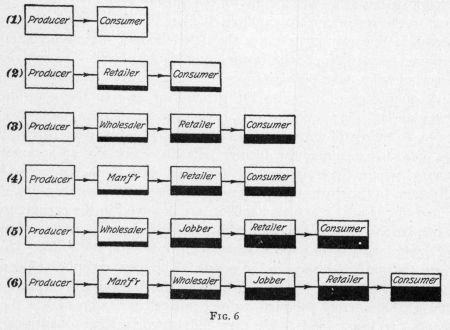
16. CHART OF FOOD PROBLEM.--To assist the housewife in her mastery of the purchasing side of the food problem, a chart, Fig. 6, is presented. This chart shows the various routes through which foods travel before they reach the housewife, or consumer. The lines used to connect all dealers from the producer to the consumer represent transportation or delivery, and the increase in cost due to overhead expense and profit is indicated by the black spaces, which increase in size as the number of dealers increase. The producer may be the manufacturer, but in most cases he is the farmer, the stockman, the dairyman, or the fruit grower. The dealers handling the food between the producer and the consumer are known as middlemen. They include the wholesaler, the jobber, and the retailer. The retailer is the grocer, the butcher, or the green grocer.
17. So that this chart may be clearly understood, several concrete examples are given. Thus, the farmer who delivers vegetables directly to the consumer is an example of plan No. 1. He has very little overhead expense and consequently can sell cheaper than dealers who have a large overhead expense. However, when the farmer delivers his vegetables to the grocer and the grocer sells them to the consumer, an example of plan No. 2 is afforded. Food bought in this way costs more than that bought directly from the farmer. In plan No. 3, the farmer, for instance, sells his vegetables to a wholesaler, who perhaps buys from other farmers and then sells small quantities of them to the grocer for sale to the consumer. This plan, as will readily be seen, is more involved than either No. 1 or No. 2, but a still more roundabout route is that of plan No. 4. In this case, for instance, the farmer sells his vegetables to a canning factory, where they are canned and then sold to the grocer, who sells them in this form to the consumer. Often two wholesalers, the second one being known as a jobber, are involved in the transaction, as in plan No. 5. In such an event, the farmer sells to the wholesaler, who sells to the jobber, who, in turn, sells to the grocer, from whom the consumer secures the goods. The most complicated route is that shown in plan No. 6. This illustrates the case of the farmer who sells his cereal products to a manufacturer, who makes them up into breakfast foods. He then sells them in large quantities to the wholesaler, who sells them in 50- or 100-case lots to the jobber. From the jobber they go to the grocer, who delivers them to the consumer.
From a study of this chart, it can be readily seen that the cost of food may be reduced if the middlemen can be eliminated. For instance, the housewife will be able to get fruits and vegetables cheaper if she buys them from a farmer instead of a grocer, for she will not be called on to pay any of the grocer's overhead expense or profit. Again, if she buys her staple groceries in a store that is able to eliminate the wholesaler or the jobber, she will get them at a lower price than if she deals where these agencies must receive their share of the profits.
18. NATIONALLY ADVERTISED GOODS.--Much is said about the fact that the consumer, in buying package foods that are nationally advertised, must pay for the package and the advertising. This statement is absolutely true; but it must be remembered that where large quantities of foods are handled, the materials can be bought by the manufacturer or the wholesaler at a lower price than by one who purchases only a small amount. Then, too, if great quantities are sold, and this condition is made possible only through advertising, the profit on each package sold can be much smaller than that which would have to be made when less is sold. Often, therefore, in spite of the advertising cost, a widely advertised food can be sold for less than one that is not advertised at all because a much greater quantity is sold.
19. CHAIN STORES.--The principle of selling great quantities of food at a comparatively small profit on each item is put into practice in chain stores, which are operated by different companies throughout the United States. Such stores are a boon to the housewife who must practice economy, for they eliminate a middleman by acting both as wholesaler and as retailer. Because of this fact, foods that are purchased in large quantities from the producer or manufacturer can be offered to the consumer at a lower price than in a retail store not a part of a chain. Therefore, if foods of the same quality are not lower in price in chain stores, it must be because the buying is not well done or a greater profit is made in selling them. In addition, chain stores generally require cash for all purchases made in them and they do not usually deliver goods. Consequently, their overhead expense is materially reduced and they do not need to make such a large profit.
ECONOMICAL BUYING
20. APPORTIONMENT OF INCOME.--When the housewife thoroughly understands the qualities of foods as well as their comparative food values and is familiar with the factors that govern food prices, she is well equipped to do economical buying for her family. Then it remains for her to purchase the right kind of food and at the same time keep within her means. A good plan is to apportion the household expenses according to a budget; that is, to prepare a statement of the financial plans for the year. Then the amount of money that can be used for this part of the household expenses will be known and the housewife will be able to plan definitely on what she can buy. If necessary, this amount may be reduced through the housewife's giving careful attention to the details of buying, or if she is not obliged to lower her expenses, she may occasionally purchase more expensive foods, which might be considered luxuries, to give variety to the diet. The amount of money that may be spent for food depends, of course, on the income, and the greater the income, the lower will be the proportion of money required for this item of the household expense.
21. To throw some light on the proper proportion of the family income to spend for food, Table I is given. As the basis of this table, a family of five is taken and the proportion that may be spent for food has been worked out for incomes ranging from $600 to $2,400 a year. As will be noted, an income of $600 permits an expenditure of only 19 cents a day for each person. When food prices are high, it will be a difficult matter to feed one person for that amount, and still if the income is only $600 it will be necessary to do this. To increase the food cost over 39 cents a day per person, which is the amount allotted for an income of $2,400, would denote extravagance or at least would provide more luxury than is warranted.
TABLE I PROPORTION OF FAMILY INCOME FOR FOOD
Income per Year Per Cent. of Income Spent for Food Amount Spent per year for Food Amount Spent per Day for Five Persons Amount Spent per Day per Person
$60060$360$ .98$.19
$80055$500$1.36$.27
$1,00050$576$1.57$.31
$1,20048$576$1.57$.31
$1,50044$660$1.80$.36
$1,80039$702$1.92$.38
$2,40030$720$1.97$.39
Various conditions greatly affect this proportion. One of these is the rise and fall of the food cost. Theoretically, the buyer should adjust this difference in the food cost rather than increase her expenditures. For instance, if in a certain year, the general cost of food is 20 per cent. greater than it was in the preceding year, the housewife should adjust her plan of buying so that for the same amount of money spent in the previous year she will be able to supply her family with what they need. Of course, if there is an increase in the income, it will not be so necessary to work out such an adjustment.
22. ECONOMIES IN PURCHASING FOOD.--Through her study of the preceding lessons, the student has had an opportunity to learn how to care for food in order to avoid loss and waste, how to prepare it so that it may be easily digested and assimilated, and how to make it appetizing and attractive so that as little as possible is left over and none is wasted. She should therefore be thoroughly acquainted with the methods of procedure in regard to all such matters and should have worked out to her satisfaction the best ways of accomplishing these things to suit her individual needs. But, in addition to these matters, she must give strict attention to her food purchases if she would secure for her family the most wholesome and nourishing foods for the least expenditure of money.
23. To purchase food that will provide the necessary food value for a small outlay is possible to a certain extent, but it cannot be done without the required knowledge. In the first place, it means that fewer luxuries can be indulged in and that the family dietary will have to be reduced to necessities. It may also mean that there will probably be a difference in the quality of the food purchased. For instance, it may be necessary to practice such economies as buying broken rice at a few cents a pound less than whole rice or purchasing smaller prunes with a greater number to the pound at a lower price than the larger, more desirable ones. The housewife need not hesitate in the least to adopt such economies as these, for they are undoubtedly the easiest ways in which to reduce the food expenses without causing detriment to any one.
24. Further economy can be practiced if a little extra attention is given in the purchase of certain foods. As is well known, the packages and cans containing food are labeled with the contents and the weight of the contents. These should be carefully observed, as should also the number of servings that may be obtained from the package or can. For instance, the housewife should know the weight per package of the various kinds of prepared cereals she uses and the number of servings she is able to procure from each package.
Let it be assumed that she buys two packages of different cereals at the same time, which, for convenience, may be called package No. 1 and package No. 2. She finds that No. 1 contains 16 ounces and No. 2, only 12 ounces; so she knows that No. 1 furnishes the greater amount of food by weight for the money spent. But, on the other hand, No. 2 may go farther; that is, it may serve a greater number of persons. This, in all probability, means that the cereals are similar in character, but that the food value of the servings from No. 2 is greater than that of the servings from No. 1. No. 2 is therefore the more economical of the two. Matters of this kind must not be overlooked, especially in the feeding of children.
Then, too, the housewife should work out carefully which she can use to greater advantage, prepared or unprepared cereals. If she finds that unprepared cereals are the more economical and if she can depend on their food value as being as high as that of the prepared ones, she should by all means give them the preference. Of course, she may use prepared cereals for convenience or for varying the diet, but the more economical ones should be used with greater regularity.
25. Canned goods should be carefully observed. A certain brand of tomatoes, for instance, may have 16 ounces to the can, whereas another brand that can be bought for the same price may have 24 ounces. There may be, however, and there probably is, a great difference in the quality of the tomatoes. The 24-ounce can may have a much greater proportion of water than the 16-ounce can, and for this reason will not serve to the same advantage. As it is with canned tomatoes, so is it with canned corn, peas, and other canned vegetables, for the price depends altogether on the quality. Therefore, several brands should be compared and the one should be purchased which seems to furnish the most food or the best quality of food for the least money, provided the quality continues.
26. In the preparation of meat, there is always some waste, and as waste is a factor that has much to do with the increasing of costs, it should be taken into consideration each time a piece of meat is purchased. If there is time for some experimenting, it makes an interesting study to weigh the meat before and after preparation, for then the amount of shrinkage in cookery, as well as the waste in bone, skin, and other inedible material, can be determined.
An actual experiment made with a 4-pound chicken showed that there was a loss of 2-3/4 pounds; that is, the weight of the edible meat after deducting the waste was only 1-1/4 pounds. The following shows how this weight was determined:
POUNDS
Weight of chicken, including head, feet, and entrails4
Weight of head, feet, and entrails1-1/4
Weight of bones after cooking7/8
Weight of skin after cooking1/4
Shrinkage in cooking3/8
-----
Total amount of waste2-3/4
-----
Actual weight of edible meat1-1/4
It will readily be seen that chicken at 40 cents a pound would make the cost per pound of edible meat amount to exactly $1.28, a rather startling result. It is true, of course, that the busy housewife with a family can hardly spare the time for the extra labor such experiments require; still the greater the number of persons to be fed, the more essential is the need for economy and the greater are the possibilities for waste and loss.
27. The home production of foods does not belong strictly to economical buying, still it is a matter that offers so many advantages to the economical housewife that she cannot afford to overlook it. A small garden carefully prepared and well cultivated will often produce the summer's supply of fresh vegetables, with sufficient overproduction to permit much to be canned for winter. Not only do foods produced in a home garden keep down the cost of both summer and winter foods, but they add considerably to the variety of menus.
CORRECT DIET
SUITABILITY OF FOOD
28. At the same time the housewife is making a study of economy and trying to procure as nearly as possible the best quality and the largest quantity of food for the amount of money she has to spend, she must consider the suitability of this food for the persons to whom it is to be served. This matter is undoubtedly of greater importance than economy, for, regardless of the amount of money that is to be spent, suitable foods for the nourishment of all the members of the family must be supplied to them. For instance, a family of two may have $10 a week to spend for food, whereas one of five may perhaps have no more; but the larger family must have nourishing food just as the one of two must have. Therefore, whether the housewife has much or little to spend, her money must purchase food suited to the needs of her family. Unless she is able to accomplish this, she fails in the most important part of her work as a housewife, and as a result, the members of her family are not properly nourished.
29. It has long been an established fact that correct diet is the greatest factor in maintaining bodily health. Food is responsible for the growth and maintenance of the body tissues, as well as for their repair. In addition, it supplies the body with heat and energy. Consequently, taking the right food into the body assists in keeping a person in a healthy condition and makes work and exercise possible.
Because so much depends on the diet, the housewife, while considering what can be bought with the money she has to spend, must also decide whether the foods she plans to buy are suitable for the needs of her family. In fact, she should be so certain of this matter that she will automatically plan her menus in such a way that they will contain all that is necessary for each person to be fed. But, as every housewife knows, the appetites of her family must also be taken into consideration. Theoretically, she should feed her family what the various members need, regardless of their likes and dislikes. However, very few persons are willing to be fed in this way; in truth, it would be quite useless to serve a dish for which no one in the family cared and in addition it would be one of the sources of waste.
30. To make the work of the housewife less difficult, children should be taught as far as possible to eat all kinds of food. Too often this matter is disregarded, and too often, also, are the kinds of food presented, to a family regulated by the likes and dislikes of the person preparing the food. Because she is not fond of certain foods, she never prepares them; consequently, the children do not learn to like them. On the other hand, many children develop a habit of complaining about foods that are served and often refuse to eat what is set before them. Such a state of affairs should not be permitted. Indeed, every effort should be made to prevent a spirit of complaint. If the housewife is certain that she is providing the members of her family with the best that she can purchase with the money she has to spend and that she is giving them what they need, complaining on their part should be discouraged.
31. With a little effort, children can be taught to like a large variety of foods, especially if these foods are given to them while they are still young. It is a decided advantage for every one to form a liking for a large number of foods. The person who can say that he cares for everything in the way of food is indeed fortunate, for he has a great variety from which to choose and is not so likely to have served to him a meal in which there are one or more dishes that he cannot eat because of a distaste for them.
Every mother should therefore train her children during their childhood to care for all the cereals, vegetables, and fruits. Besides affording the children a well-balanced diet, these foods, particularly vegetables and fruits, when served in their season, offer the housewife a means of planning economical menus, for, as every one knows, their price is then much lower than at any other time and is less than that of most other foods. During the winter, turnips, carrots, onions, and other winter vegetables are more economical foods than summer vegetables that must be canned or otherwise prepared to preserve them for winter use or the fresh summer vegetables purchased out of season. However, it is advisable to vary the diet occasionally with such foods.
COMPOSITION OF FOOD
32. To feed her family properly, the housewife should understand that the daily food must include the five food substances--protein, fat, carbohydrate, mineral matter, and water. As these are discussed in Essentials of Cookery, Part 1, they should be clear to the housewife, but if they are not fully understood, a careful review should be made of the discussions given there. The ways in which these food principles contribute to the growth and health of the body, as well as the ordinary foods that supply them in the greatest number, are tabulated in Table II for easy reference. This information will assist the housewife materially in the selection and preparation of food for her family; consequently, close attention should be given to it and constant application made of it.
33. As has already been learned and as will be noted here, a food substance often has more than one use in the body. For instance, protein builds tissue and also yields energy, but its chief work is that of building tissue, and so it is classed first as a tissue-building food substance. The fats and carbohydrates also have a double use in the body, that of producing heat and energy and of building fatty tissue. However, as their chief use is to produce heat and energy, they are known principally as heat-producing foods. Mineral matter not only is necessary for the building of bone and muscle, but also enters into the composition of the blood and all the fluids in the body. Growth and development are not ideal without an adequate supply of the many kinds of these salts, which go to make up the tissues, nerves, blood, and other fluids in the body.
34. The body regulators must be included in the food given, for they assist in all processes carried on in the body. Some are necessary to aid in the stimulation required to carry on the processes of digestion and in some cases make up a part of the digestive fluids. Consequently, vegetables and fruits that supply these body regulators and foods that supply vitamines should be provided.
Water, the chief body regulator, not only is essential to life itself, but forms by far a greater proportion of the body than any other single substance. The largest part of the water required in the body is supplied as a beverage and the remainder is taken in with the foods that are eaten.
TABLE II FOOD SUBSTANCES AND THEIR RELATION TO GROWTH AND HEALTH
I Body-building materials Proteins. Meat
Fish and shell fish
Poultry and game
Eggs
Milk and milk products
Legumes (dried beans, peas, lentils)
Wheat and wheat products, as corn starch
Nuts
Mineral matter, or ash Vegetables
Fruits
Eggs
Milk
Cereals
Meats
II Heat-producing materials Fats Animal Lard
Suet
Tallow
Butter and cream
Vegetable Olive oil
Corn oil
Cottonseed oil
Coconut oil
Nut oils
Mixed oils Oleomargarine
Butterine
Nut butter
Crisco, etc.
Carbohydrates Starch Cereals and cereal products
Irish and sweet potatoes
Sugar Cane sugar and molasses
Beet sugar
Maple sugar and sirup
Honey
Corn sirup and other manufactured sirups
Proteins Same as in I
III Body regulators Water
Mineral matter, or ash Same as in I
Cellulose Fruits
Vegetables
Covering of cereals and nuts
Food Acids Sour fruits--citric and malic
Tomatoes--malic
Spinach--oxalic
Rhubarb--oxalic
Vitamines Fat soluble A Milk
Butter
Egg yolk
Water soluble B Green vegetables, as spinach, chard, lettuce, beet greens
Asparagus and stem vegetables, as celery
Fruit vegetables, as tomatoes, peppers, okra
Fruits
The importance of bulk in foods cannot be emphasized too much. The indigestible cellulose of fruits, vegetables, and cereals is of such importance in the body that some of these foods should be supplied with every meal. Therefore, their incorporation into the diet should be considered as a definite part of the menu-making plan.
The acids of fruits are valuable as stimulants both to the appetite and to the digestion. Then, too, they give a touch of variety to a menu otherwise composed of rather bland foods. The stimulation they produce is much more healthful than that of condiments, drugs, or alcoholic beverages and should receive the preference.
Vitamines are substances necessary for both growth and health. A child deprived of the foods containing them is usually not well and does not grow nor develop normally. These substances are also required in the diet of adults in order to maintain the body in a healthy condition. The leafy vegetables and milk are the foods that yield the greatest supply of vitamines. In fact, it is claimed by those who have experimented most with this matter that these two sources will supply the required amount of vitamines under all conditions.
BALANCING THE DIET
QUANTITY AND PROPORTION OF FOODS
35. FACTORS INFLUENCING FOOD.--Numerous factors affect the kind and quantity of food necessary for an individual. Chief among these are age, size, sex, climate, and work or exercise. In addition to determining the amount of food that must be taken into the body, these factors regulate largely the suitability of the foods to be eaten. It is true, of course, that all the food substances mentioned in Table II must be included in every person's diet after the first few years of his life, but the quantity and the proportion of the various substances given vary with the age, sex, size, and work or exercise of the person and the climate in which he lives. Merely to provide dishes that supply sufficient food value is not enough. This food material must be given in forms that can be properly digested and assimilated and it must be in the right proportion for the person's needs. The aim should therefore be to provide a balanced diet, by which is meant one that includes the correct proportion of the various food substances to supply the needs of the individual.
36. QUANTITY OF FOOD IN CALORIES.--Without doubt, the most intelligent way in which to feed people is to compute the number of calories required daily. As will be remembered, the calorie is the unit employed to measure the amount of work that the food does in the body, either as a tissue builder or a producer of energy. The composition and food value of practically all foods are fairly well known, and with this information it is a simple matter to tell fairly accurately the amount of food that each person requires.
As has been stated, the number of calories per day required by a person varies with the age, size, sex, and occupation of the person, as well as with the climate in which he lives. For the adult, this will vary from 1,800 to 3,000, except in cases of extremely hard labor, when it may be necessary to have as high as 4,500 calories. The average number of calories for the adult, without taking into consideration the particular conditions under which he lives or works, is about 2,500. Still a small woman who is inactive might be sufficiently fed by taking 1,800 calories a day, whereas a large man doing heavy, muscular work might require 3,500 to 4,000 daily.
37. IMPORTANCE OF PROPER AMOUNT OF FOOD.--Most authorities agree that it is advisable for adults and children well past the age of infancy to take all the food required in three meals. The taking of two meals a day is sometimes advocated, but the possibility of securing in two meals the same quantity of food that would ordinarily be taken in three is rather doubtful, since it is assumed that large amounts of food are not so easily disposed of as are smaller ones.
On the other hand, to overeat is always a disadvantage in more respects than one. Taking food that is not required not only is an extravagance in the matter of food, but overtaxes the digestive organs. In addition, it supplies the body with material that must be disposed of, so that extra work on the part of certain organs is required for this activity. Finally, overeating results in the development of excessive fatty tissue, which not only makes the body ponderous and inactive, but also deadens the quickness of the mind and often predisposes a person to disease or, in extreme cases, is the actual cause of illness.
38. EFFECT OF WEIGHT ON DIET.--An idea of the way in which the weight of a person affects the amount of food required can be obtained by a study of Tables III and IV. As will be observed,
Table III gives the number of calories per pound of body weight required each day by adults engaged in the various normal activities that might be carried on within 24 hours. It deals only with activity, the various factors that might alter the amounts given being taken up later. The figures given are for adults and the factors mentioned are those which affect the intake of food to the greatest extent.
The lowest food requirement during the entire 24 hours is during the time of sleep, when there is no activity and food is required for only the bodily functions that go on during sleep. Sitting requires more food than sleeping, standing, a still greater amount, and walking, still more, because of the increase in energy needed for these activities.
In a rough way, the various occupations for both men and women are classified under three different heads: Light Work, Moderate Work, and Heavy Work. It is necessary that these be understood in examining this table.
TABLE III CALORIES PER POUND FOR 24 HOURS FOR ADULTS
OccupationCalories
Sleeping12
Sitting14
Standing17
Walking20
Light work22
Moderate work24
Heavy work27
Those considered as doing light work are persons who sit or stand at their employment without any great degree of activity. They include stenographers, dressmakers, milliners, teachers, clerks, shoemakers, tailors, machine operators, elevator operators, and conductors.
Moderate work involves a little more activity than light work, but not so much as heavy work. Professional cooks, professional housekeepers, housekeepers in their own homes, professional chambermaids, waitresses, masons, drivers, chauffeurs, plumbers, electricians, and machinists come under this class.
Persons doing heavy work are the most active of all. They include farmers, laundresses, excavators, lumbermen, miners, metal workers, and soldiers on forced march.
39. To show the variation in the amount of food required according to body weight, Table IV is given. The scale here presented has been worked out for two persons who are normal and whose weight is correct, but different, one weighing 130 pounds and the other 180 pounds. It is assumed, however, that they are occupied in 24 hours with activities that are identical, each one sleeping 8 hours, working at moderate labor for 8 hours, walking 2 hours, standing 2 hours, and sitting 4 hours.
TABLE IV DIFFERENCE IN FOOD REQUIREMENTS THROUGH VARIATION IN WEIGHT
Number of Calories for 130 Pounds
8hours, sleeping520
4hours, sitting303
2hours, standing184
2hours, walking216
8hours, moderate work1,040
-------
242,263
Number of Calories for 180 Pounds
8hours, sleeping720
4hours, sitting430
2hours, walking300
2hours, standing238
8hours, moderate work1,440
-------
243,128
To find the total number of calories required for these activities, the weight, in pounds, is multiplied by the calories per pound for 24 hours for a certain activity. Thus, as in Table IV, if a person weighing 130 pounds sleeps for 24 hours, the number of pounds of weight, or 130, would be multiplied by 12, which is the number of calories required per pound in 24 hours for sleeping. However, since only 8 hours is occupied by sleep and 8 is 1/3 of 24, the required number of calories would be only 1/3 of this number. In this way each item is worked out in the table, as is clearly shown by the following figures:
For sleeping130 X 12 X 1/3 =520
For sitting130 X 14 X 1/6 =303
For standing130 X 17 X 1/12 =184
For walking130 X 20 X 1/12 =216
For moderate work130 X 24 X 1/3 =1,040
Total, as in Table IV2,263
40. In this connection, it may be interesting to know the ideal weight for persons of a given height. Table V shows the various heights for both men and women, in inches, and then gives, in pounds, the correct weight for each height. When, from this table, a person determines how far he is above or below the ideal weight, he can tell whether he should increase or decrease the number of calories he takes a day. For persons who are under weight, the calories should be increased over the number given in Table III for the normal individual if the ideal weight would be attained. On the other hand, persons who are overweight should decrease the number of calories until there is sufficient loss of weight to reach the ideal. Of course, an adjustment of this kind should be gradual, unless the case is so extreme as to require stringent measures. In most cases, a slight decrease or increase in the quantity of food taken each day will bring about the desired increase or decrease in weight.
TABLE V CORRECT WEIGHT FOR CERTAIN HEIGHTS
MenWomen
Height InchesWeight Pounds Height InchesWeight Pounds
6113159119
6213360122
6313661124
6414062127
6514363131
6614764134
6715265139
6815766143
6916267147
7016768151
7117369155
7217970159
73185
74192
75200
41. EFFECT OF SEX ON DIET.--The difference in sex does not affect the diet to any great extent. Authorities claim that persons of opposite sex but of the same weight and engaged in the same work require equal quantities of food. But, in most cases, the work of women is lighter than that of men, and even when this is not the case women seem to require less food, probably because of a difference in temperament. That taken by women is usually computed to be about four-fifths of the amount necessary for a man. The proportion of food substances does not differ, however, and when individual peculiarities are taken into consideration, no definite rules can be made concerning it.
In the case of boys and girls up to the age of young manhood and womanhood, the same amount of food is required, except for the difference in activity, boys usually being more active than girls.
42. EFFECT OF CLIMATE ON DIET.--The climate in which a person lives has much to do with the kind of diet he requires. In the extreme North, the lack of vegetation makes it necessary for the inhabitants to live almost entirely upon animal food except during the very short warm season. Consequently, their diet consists largely of protein and fat. Under some circumstances, a diet of this kind would be very unfavorable, but it seems to be correct for the people who live in these regions, for generations of them have accustomed themselves to it and they have suffered no hardship by doing so. It is true, however, that races of people who do not live on a well-balanced diet are not physically such fine specimens as the majority of persons found in countries where it is possible to obtain a diet that includes a sufficient supply of all the food substances.
43. In hot countries, the diet consists much more largely of vegetables than any other class of foods. This means that it is very high in carbohydrate and comparatively low in protein and fat. As can well be understood, a diet of this kind is much more ideal for a warm climate than a diet composed to a great extent of animal foods.
44. In temperate zones, the diet for both summer and winter seasons varies according to the appetite of the inhabitants themselves. Usually a light diet consisting of fruits, vegetables, cereals, and a small amount of meat is found the most desirable for summer weather, while a similar one with a larger proportion of meat is the usual winter diet. On the whole, the desire for food, which, to a certain extent, is regulated by the climate, can be trusted to vary the diet fairly well for the existing conditions.
45. EFFECT OF AGE ON DIET.--The proper diet for infancy and childhood is a matter that must be discussed by itself, for it has practically no connection with other diet. It is also well understood that up to maturity there is a difference in the diet because of a difference in the needs of the body. However, from maturity up to 60 years of age, the diet is altered by the conditions already mentioned, namely weight, size, sex, climate, and work or exercise. At the age of 60, the amount of food required begins to decrease, for as a person grows older, the body and all of its organs become less active. Then, too, there is a reduced amount of physical exercise, which correspondingly reduces the necessity for food. At this time, an oversupply of food merely serves to overwork the organs, which being scarcely able to handle the normal quantity of food certainly keep in better condition if the amount of work they are called upon to do is decreased rather than increased.
It has been estimated that persons 60 years of age require 10 per cent. less food than they formerly did; those 70 years old, 20 per cent. less; and those 80 years old, 30 per cent. less. Usually the appetite regulates this decrease in food, for the less active a person is, the less likely is the appetite to be stimulated. However, the fact that there is also a great difference in persons must not be lost sight of. Some men and women at 70 years of age are as young and just as active as others at 50 years. For such persons, the decrease in quantity of food should not begin so soon, nor should it be so great as that given for the more usual cases.
46. As there is a decrease in quantity with advancing years, so should there be a difference in the quality of the food taken. That which is easily digested and assimilated is preferable to food that is rich or highly concentrated. Usually, it is necessary to increase the laxative food in the diet at this time of life, but this matter is one of the abnormalities of diet and therefore belongs properly to medical dietetics rather than to a lesson on normal diet.
DIET FOR INFANTS AND CHILDREN
47. From birth until a child has attained full growth, the food requirement is high in proportion to the size of the child. This is due to the fact that energy must be supplied for a great deal of activity, and at the same time new tissue must be manufactured from the food taken. It should be remembered, too, that all body processes during growth are extremely rapid. At birth, the average child weighs about 7 pounds, and for several days after birth there is a normal loss of weight. In a few days, however, if the diet is correct, the child begins to increase in weight and should gain about 1/2 pound a week until it is 3 months old. From this time on, its weekly gain should be slightly less, but it should be constant. If the weight remains the same or there is a decrease for a number of consecutive days or weeks, it is certain that the diet is incorrect, that the quantity of food is insufficient, or that the child is ill. The reason for the loss should be determined at once and the trouble then corrected.
Normal diet for the infant is the mother's milk, but if this cannot be supplied, the next best diet is modified cow's milk, which for the young child must be greatly diluted. If it is found necessary to give proprietary, or manufactured, foods, raw food of some kind should be used in addition, the best way to supply this being with a little orange juice or other fruit juice. At the age of 3 months, this may be given in small quantity if it is diluted, and then the amount may be gradually increased as the child grows older.
48. EFFECT OF WEIGHT ON CHILDREN'S DIET.--The food requirement in the case of children is determined by weight. To decide on the proper amount, it is necessary to know the normal weight at certain ages. At birth, as has been stated, the normal weight is 7 pounds; at 6 months, 15 pounds; at 1 year, 21 pounds; at 2 years, 30 pounds. The food requirement for 24 hours per pound of weight is as follows:
CALORIES PER LB. IN 24 HOURS
Children up to 1 year45
Children from 1 to 2 years40
Children from 2 to 5 years36
From a study of these figures, it will be noted that there is a gradual decrease in the required number of calories per pound as the child grows older. The decrease continues until maturity is reached, and then the scale for adults applies.
49. EFFECT OF AGE ON CHILDREN'S DIET.--A child should not be kept exclusively on milk for more than 6 or 8 months, and then only in case it is fed on the mother's milk. Fruit juice, which has already been mentioned as an additional food, is recommended if the diet requires raw food or if it is necessary to make the child's food more laxative. When the child reaches the age of 6 months, it should be taught to take foods from a spoon or a cup; then when it must be weaned, the task of weaning will be much easier. At the age of 8 or 9 months, depending on the condition of the child, small amounts of well-cooked, strained cereals may be added to the diet, and these may gradually be decreased as the food is increased in variety. Up to 1-1/2 years of age, a child should have 8 ounces of milk three times a day, which amounts to 1-1/2 pints. At this age, half of a soft-cooked egg or a spoonful or two of tender meat chopped very fine, may be given, and for each such addition 4 ounces of milk should be taken out of the day's feeding. But from 1-1/2 years up to 5 years, at least 1 pint of milk a day should be included in the diet.
At a little past 1 year of age, a normal child may begin taking a few well-cooked vegetables, such as a bit of baked potato, a spoonful of spinach, carrot, celery, green peas, or other vegetables that have been forced through a sieve or chopped very fine. At 1-1/2 years, the normal child should be taking each day one vegetable, a cereal, buttered bread or toast softened with milk, eggs, fruit juice, a little jelly, and plain custards. However, each of these foods should be added to the diet with caution and in small amounts, and if it appears to disagree with the child in any way, it should be discontinued until such time as it can be tolerated.
In case a child is being raised on a formula of cow's milk and it is a strong, normal child, it should be taking whole milk at the age of 8 or 10 months. If the child is not strong, the milk may still be diluted with a small amount of sterile water, but this should be gradually decreased until the child is able to tolerate whole milk.
50. FEEDING SCALE FOR INFANTS.--It is, of course, a difficult matter to make definite rules for the feeding of all children, for conditions arise with many children that call for special plans. However, for children that are normal, a feeding scale may be followed quite closely, and so the one given in Table VI is suggested.
TABLE VI
FEEDING SCALE FOR INFANTS
First Three MonthsMilk.
Fourth MonthSame as for preceding months and orange juice and cereal waters.
Sixth MonthSame as for preceding months and well-cooked and strained cereal.
Eighth MonthSame as for preceding months and beef juice, beef broth, and yolk of soft-cooked egg.
Tenth Month Same as for preceding months and unstrained cereal, half of soft-cooked egg, both white and yolk, chopped or strained cooked vegetables, such as spinach and other greens, asparagus, carrots, celery, and squash, stale bread, crackers, toast and butter.
Eleventh Month Same as for preceding months and well-cooked rice, baked potato, jelly, plain custard, corn-starch custard, and junket.
Twelfth Month Same as for preceding months and whole egg, a tablespoonful of tender meat, string beans, peas, turnips, onions, chopped or strained applesauce, stewed prunes, and other fruits.
Eighteenth Month Same as for preceding months and home-made ice cream, plain sponge cake, milk soups, and cereal puddings.
This scale is to be used by adding to the diet for one month the foods suggested for the next month, giving them at the time the child reaches the age for which they are mentioned. For instance, a child of 8 months may have everything included in the first three, four, and six months and, in addition, beef juice, beef broth, and the yolk of a soft-cooked egg, which is the diet suggested for the eighth month. Then at the tenth month it may have all of these things together with those given for this month.
51. When any of these foods is first added to the diet, much care is necessary. Each new food should be given cautiously, a teaspoonful or two at a time being sufficient at first, and its effect should be carefully observed before more is given. If it is found to disagree, it should not be repeated. If at any time a child is subject to an attack of indigestion, its diet should be reduced to simple foods and when it has recovered, new foods should be added slowly again. In the case of any of the ordinary illnesses to which children are subject, such as colds, etc., the diet should be restricted to very simple food, and preferably to liquids, until the illness has passed. The diet of a baby still being fed on milk should be reduced to barley water or a very little skim milk diluted with a large amount of sterile water. When the illness is over, the child may be gradually brought back to its normal diet.
DIET FOR THE FAMILY
52. One of the difficulties of every housewife having a family composed of persons of widely different tastes and ages is the preparation of meals that will contain sufficient food of the correct kind for all of them. Children up to 6 years of age usually require something especially prepared for their meals, except breakfast, but, as a rule, the selection of the diet for children from 6 years up to 15 or 16 years of age is merely a matter of taking from the meal prepared for the remainder of the family the right amount of the various foods. Tea and coffee should not be included in the diet of growing children, and should under no circumstances be given to small children. If the proper method is followed in this matter, no difficulty will result, but where children expect to eat the food served to the others at the table and are not content with what is given to them, it is better not to feed them at the same table with the adults.
53. The most satisfactory way in which to arrange meals that are to be served to persons of different ages is to include several foods that may be fed to all members of the family and then to select certain others proper only for adults and still others suitable for the children. A sample of such a menu for supper is the one here given. It is assumed that the children that are to eat this meal are not infants.
SUPPER MENU
ADULTS
Rice Croquettes with Cheese Sauce
Lettuce Salad
Bread, Butter, Jelly
Baked Apples
Plain Cookies
Tea
CHILDREN
Steamed Rice
Bread, Butter, Jelly
Baked Apples
Plain Cookies
Milk
A menu of this kind is not difficult to prepare, and still it meets the needs of both the children and the adults of the family. The main dish for each has the same foundation--rice. Enough to serve the entire family may be steamed. Then some may be retained for the children and the rest made up into croquettes and served with cheese sauce to the adults. The remainder of the menu, bread, butter, jelly, baked apples, and plain cookies, may be eaten by every one. Tea will probably be preferred by the adults, but milk should be served to the children. Other suitable menus may be planned without any extra trouble if just a little thought is given to the matter.
PROPORTION OF FOOD SUBSTANCES
54. The proportion of food substances necessary for building and repairing the body and for providing it with material necessary for its various functions is a matter to which much discussion has been given. Formerly, it was not understood that the protein should be limited to exactly what the body needed and that its requirements were comparatively low regardless of conditions or exercise. The standard for diet very often allowed as much as 25 per cent. in protein. This percentage has been gradually reduced by the discovery of the actual body needs, so that now it is believed by the most dependable authorities that only about 10 per cent. of the entire day's rations for the adult should be protein. The growing child needs a greater proportion than this because he is building up muscle tissue. The adult whose muscles have been entirely constructed requires protein only for repair, and 10 per cent. of the day's food in protein is sufficient for this. This means that if the total calories for the day are 2,500, only 250 of them need be protein.
55. The remainder of the calories are largely made up by fat and carbohydrate. These, however, need not be in such exact proportion as the protein, for no real danger lies in having either one in a greater amount than the ideal proportion. This is usually three-tenths fat and six-tenths carbohydrate or in a diet of 2,500 calories, 750 fat and 1,500 carbohydrate. The carbohydrate is very much in preponderance because of its easy digestion and assimilation. As may be imagined, it is not a simple matter to figure a diet as closely and carefully as this, and it is only in extreme cases where such planning is necessary.
56. The required amount of protein for the ordinary daily diet can be had with about 3 ounces of meat, together with that which is found in the bread, vegetables, and cereals taken each day. At any rate, the menu should be planned so as to supply a protein dish for at least one meal in the day. The fat is supplied largely by the butter taken and the fat used in the cooking of foods. The carbohydrate is provided by the starch found in cereals, bread, and vegetables and by the sugar contained in fruits, as well as that used in the preparation of various foods and in the sweetening of beverages, cereals, and fruits.
In addition to providing these food substances, each meal should include at least one food, and for dinner preferably two foods, that will supply a large amount of mineral salts, cellulose, and vitamines. As will be remembered, fruits and vegetables are the foods to be used for this purpose.
57. This method of menu planning may seem somewhat difficult at first thought, but in reality it is not different from that which the intelligent housewife follows who attempts to provide her family with a variety of foods and who appreciates the value of that variety. If she plans her menu in this manner, prepares the food so that it will be wholesome, easily digested, and given in the proper proportion, and at the same time watches the weights of the members of the family in the manner suggested, she need have no fear about the general health of her family, for it will be well maintained.
MENU MAKING AND TABLE SERVICE
GENERAL RULES FOR MENU MAKING
58. Perhaps the greatest problem in the planning of menus for a family is that of securing sufficient variety. A housewife who uses the same recipes and the same combinations of food repeatedly is apt to get into a rut and the members of her family will undoubtedly lose interest in their meals. This condition results even with the dishes of which those of the family are extremely fond. However, they will not tire so quickly of the foods they care for if such foods are served to them less often. Then, too, there is more chance to practice economy when a larger variety of food is used.
The importance of planning menus systematically should not be overlooked, either, no matter how simple they may be. Even if breakfast consists of only two or more dishes, luncheon of three or four, and dinner of no more than four or five, a certain amount of planning should be done in order that the meal may be properly balanced. If the suggestions for meal planning already given are applied to this work, very little difficulty will be experienced in providing meals that are both attractive and properly balanced. In addition to these suggestions, a few general rules for menu making ought to be observed. Most of these are simple and can be followed with very little effort.
59. Unless the menu is planned for a special occasion, the cost of the various dishes should be made to balance. For instance, if an expensive meat is to be served, the vegetables and the salad selected to accompany it should be of moderate cost. On the other hand, if an expensive salad is to be served, a dessert of moderate cost, such as a simple rice pudding, should be used to offset the price of the other dish. Planning meals in this way is urged for the sake of economy, and if it is carefully followed, all the meals may be made to average about the same cost.
60. Another important point in successful meal planning is the avoidance of two dishes in the same meal made from the same food. For instance, tomato soup and tomato salad should not be served in the same meal, for the combination is undesirable. Corn soup contrasts much better with tomato salad than does the tomato soup, for it has the bland flavor that is needed to offset the acid salad. Some housewives, it is true, object to such planning on the ground that it does not give them opportunity to utilize all the materials they may have on hand at the same time. But in nearly every instance the materials can be used to excellent advantage in meals that are to follow and, in addition, the gain in variety is sufficient to warrant the adoption of such a method.
61. As there should be variety in the materials used to make up the dishes of a meal, so should there be variety in the flavor of the foods selected. Rice, macaroni, and potato, for instance, make an undesirable combination. They are too similar because they are all high in starch; besides, they resemble one another too closely in consistency and they are all bland in flavor. If a meal contains one or two bland dishes, a special effort should be made to supply some highly flavored dish in order to relieve the monotony. The same thing may be said of acid foods; that is, an oversupply of these is just as distasteful as too many bland foods.
62. To have fresh fruit for the daily breakfast would be very delightful, but such fruit cannot always be secured. When fresh fruit cannot be had every day, it is better to alternate it with canned fruit or stewed dried fruit than to have it for several days in succession and then have to serve the alternative for a number of days. The same is true of cereals. If use is to be made of both cooked and uncooked cereals, it is much better to alternate them than to serve the cooked ones for breakfast for an entire week and then uncooked ones the next week.
63. When two vegetables are used in the same meal, they should be different. Sweet potatoes and white potatoes, although often served together, do not belong in the same meal. In fact, for most seasons of the year, two vegetables dissimilar in consistency should be supplied. For instance, if spinach is included in a meal, some contrasting vegetable, such as carrots, shell beans, etc., should be served with it. Beets and carrots would not make a good combination, nor should cabbage be combined with spinach, especially if both vegetables are prepared with a sour dressing.
64. A bland food or one high in fat, such as roast pork, certain kinds of fish, etc., is much more palatable if a highly seasoned sauce or another highly seasoned food or, in fact, a food of an entirely different flavor is served with it. Apple sauce or baked apples are usually served with roast pork for this purpose, while sour sauces or pickles of some description are served with fish to relieve its blandness.
65. To secure the most successful meals, the main course should be decided upon first and the additional dishes, such as soup, salad, and dessert, should be the second consideration. In this method of planning meals, they can be properly balanced, for if the main course is heavy, the others can be made light or some of them omitted altogether, while if the main course is a light one, heavier dishes may be selected to accompany it.
Whenever it is possible to do so, the heavy meal of the day should be served at noon and the lighter one in the evening. This plan should always be followed for children, and it is preferable for adults. However, having dinner at noon is often very inconvenient and sometimes impossible, because frequently one or more members of the family are at business some distance from home and their coming home at noon for dinner is impractical. In such an event, the evening meal should be the heavy one, but it should not be made too hearty and overeating should be avoided.
At all meals, tea and coffee should be used sparingly. Especially should this rule be followed by persons who are nervous, or high strung, or are troubled with indigestion and insomnia. At any rate, it is advisable not to drink either of these beverages at night.
METHODS OF SECURING VARIETY IN MEALS
CARD-FILE SYSTEM OF MENU MAKING
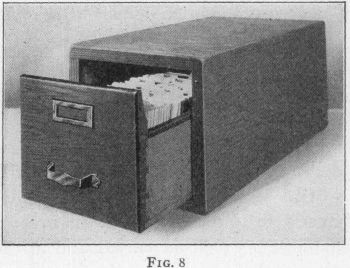
66. With the general rules for meal planning in mind, the housewife is well prepared to arrange menus that will be properly balanced, as well as varied and attractive. One means of securing variety in menus, and at the same time supplying oneself with a very convenient piece of kitchen equipment, consists in placing the recipes used on small cards and filing them in a card file under the headings to which they belong, as shown in Figs. 7 and 8. For instance, a heading should be made for soups, one for potatoes, and so on. These cards may then be rotated in order to make up menus. When the first card of each group has been used, it should be placed at the back of the others in that group; then each one will come in the order in which it was originally placed in the file. Of course, when the cards are not filed alphabetically, it is a little more difficult to find the recipes one needs at a particular time, and so if desired other means of using the cards for menu making may be easily devised without changing their position.
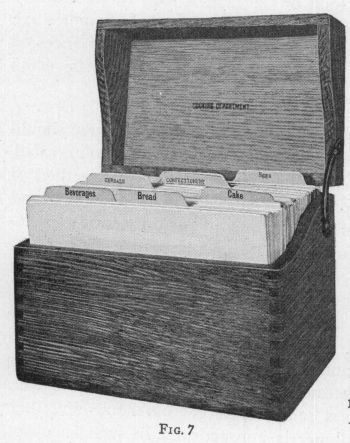
In addition to serving as a basis for menus, this arrangement takes the place of a cook book. In fact, it is much more convenient, for instead of a book containing recipes on the table where the work is being done, a small card, which takes up less space and is much less likely to be in the way, may be substituted.
DINNER MENUS
67. To assist the housewife materially in planning dinners in great variety, Table VII, which contains suggestions for dinner menus, is given. As will be noted, it is intended that each dinner shall consist of a soup, a meat, potatoes in some form, another vegetable, a salad, and a dessert. It is not necessary, of course, to include all these dishes when a simpler meal is desired, but a number of suggestions are given in each group so that there may be a good selection. In order to use this table to advantage and to secure a large variety of menus, different combinations of the various foods may be made. Then, too, the combinations given may be rotated so that frequent repetition of the same combination will be avoided. This table therefore has the advantage over meals planned for 14 or even 21 days, for these must be repeated once in 2 or 3 weeks.
TABLE VII SUGGESTIONS FOR DINNER MENUS
SOUP 1. Tomato Bouillon
2. Rice
3. Cream of Corn
4. Noodle
5. Cream of Pea
6. Julienne
7. Clear Bouillon
8. Oxtail
9. Split-Pea Purée
10. Cream of Tomato
11. Celery
12. Cream of Onion
13. Barley Broth
14. Cream of Asparagus
15. Vegetable
16. Corn Chowder
MEAT 1. Roast Beef
2. Pork Chops
3. Macaroni and Cheese
4. Broiled Hamburg
5. Baked Fish
6. Broiled Steak
7. Kidney-Bean Loaf
8. Roast Pork
9. Lamb Chops
10. Roast Chicken
11. Baked Beans
12. Meat Loaf
13. Liver and Bacon
14. Roast Mutton
15. Broiled Ham
16. Scalloped Salmon
17. Roast Lamb
18. Lima-Bean Loaf
19. Veal Tongue
20. Fried Oysters
POTATOES 1. Boiled Potatoes with Butter and Parsley
2. Scalloped Potatoes
3. Hashed-Brown Potatoes
4. Baked Potatoes
5. Potato Puff
6. French Fried Potatoes
7. Potato Patties
8. Roast Potatoes
9. Candied Sweet Potatoes
10. Mashed Potatoes
11. Creamed Potatoes
12. Stuffed Potatoes
13. Baked Sweet Potatoes
14. Potatoes au Gratin
15. Sautéd Potatoes
VEGETABLES 1. Spinach
2. Green Peas
3. Breaded Tomatoes
4. Squash
5. Red Beets
6. Sweet Corn
7. Buttered Carrots
8. Mashed Turnips
9. Scalloped Eggplant
10. Buttered Cauliflower
11. Hot Slaw
12. Scalloped Tomatoes
13. Carrots and Peas
14. Buttered Kohlrabi
15. Baked Onions
16. Sautéd Eggplant
17. Stuffed Peppers
18. Creamed Turnips
19. Browned Parsnips
20. Sautéd Tomatoes
21. Escalloped Cabbage
22. Creamed Onions
23. String Beans
24. Asparagus
25. Succotash
SALADS 1. Apple and Celery
2. Lettuce
3. Banana
4. Orange and Coconut
5. Cabbage
6. Tomato
7. Peas and Celery
8. Apple, Date, and Orange
9. Asparagus
10. Pineapple and Nut
11. Green Pepper and Cheese
12. String Bean
13. Fruit
14. Combination
15. Cucumber
16. Waldorf
17. Cabbage and Celery
18. Pineapple and Cream Cheese
19. Humpty Dumpty
DESSERTS 1. Chocolate Blanc Mange
2. Brown Betty
3. Raisin Pie
4. Crackers and Cheese
5. Fruit Gelatine
6. Cake and Fruit
7. Apricot Fluff
8. Tapioca Pudding
9. Steamed Pudding
10. Short Cake
11. Prunes in Jelly
12. Rice Pudding
13. Custard Pie
14. Baked Apples
15. Peach Cobbler
16. Chocolate Bread Pudding
17. Pineapple Tapioca
18. Ice Cream
19. Jelly Tarts
20. Gingerbread and Whipped Cream
21. Indian Pudding, with Custard Sauce
22. Floating Island
23. Prune Fluff
24. Nuts and Raisins
68. In the application of Table VII, use should be made of the dishes numbered 1 in the various groups for the first day's menu. This dinner, then, will consist of tomato bouillon, roast beef, boiled potatoes with butter and parsley, spinach, apple-and-celery salad, and chocolate blanc mange. In this way, the menus should be made by going through the entire list and combining the dishes whose numbers correspond. Upon coming to the last of the soups, which is No. 16, and attempting to make up a menu, it will be discovered that there are only fifteen varieties of potato dishes. In order to obtain a menu, the rotation must be begun again, and so No. 1 of the potato dishes is used. This menu would therefore consist of corn chowder, scalloped salmon, boiled potatoes with butter and parsley, sautéd eggplant, peach-and-cream-cheese salad, and chocolate bread pudding.
In planning menus with the aid of this table, the housewife may not be able to use a certain dish that is suggested because it is out of season, cannot be procured, or resembles too closely some of the other dishes in the menu. In such an event, she should select another dish to take the place of the one that spoils the combination. Likewise, she should not hesitate to make any change that will result in producing properly balanced meals.
LUNCHEON MENUS
69. To aid the housewife in the preparation of suitable luncheons, a large number of luncheon menus are here given. These menus will serve to give variety in the preparation of meals if they are rotated properly and changes are made every once in a while in making up combinations of food for this important and interesting meal.
THE PLANNING OF MEALS
No. 1
Rice Croquettes
Bread and Butter
Fruit Salad
Gingerbread and Cream Cheese
No. 2
Cream-of-Corn Soup
Egg Salad
Whole-Wheat Muffins
Baked Bananas
Tea
No. 3
Creamed Chicken on Toast
Sliced Tomatoes
Rolls
Fruit Cake
No. 4
Scalloped Oysters
Apple-and-Celery Salad
Wafers
Tea
No. 5
Cream-of-Tomato Soup
Hashed-Brown Potatoes
Graham Bread and Butter
Baked Apples
Tea
No. 6
Macaroni and Cheese
Cabbage Salad
Wafers
Sugar Cookies
Coffee
No. 7
Eggs à la Goldenrod
Rice with Raisins
Bread and Jam
Tea
No. 8
Omelet
Toast
Prune Whip
Vanilla Wafers
Tea
No. 9
Consommé
Chicken Salad
Rolls
Warm Gingerbread and Whipped Cream
No. 10
Creamed Dried Beef on Toast
Lettuce Salad
Stewed Fruit
Tea
No. 11
Scalloped Corn
Brown Bread and Butter
Fruit Salad
Cheese Straws
Coffee
No. 12
Cold Ham
Potato Salad
Graham Bread and Butter
Cookies
Tea
No. 13
Oyster Stew
Wafers
Celery
Pineapple
Sponge Cake
No. 14
Cheese Soufflé
Baked Tomato on Toast
Rice Pudding
Tea
No. 15
Meat Pie
Cranberry Jelly
Table Raisins
Coffee
BREAKFAST MENUS
70. WINTER BREAKFAST MENUS.--To assist the housewife in planning properly balanced breakfast menus for winter, a number of suggestions are here given. These necessarily differ from breakfast menus for other seasons because of the difference in the food that can be obtained. They are usually of a more hearty nature and contain more heat-producing foods.
No. 1
Oranges
Rolled Oats with Cream
Soft-Cooked Eggs
Toast and Butter
Coffee
No. 2
Stewed Prunes
Cream of Wheat with Cream
Broiled Bacon
Muffins and Butter
Coffee
No. 3
Baked Apples
Griddle Cakes with Maple Sirup
Sausage Patties
Coffee
No. 4
Rolls and Butter
Corn Flakes with Hot Milk
Grapefruit
Coffee
No. 5
Vitos with Dates
French Toast and Butter
Jelly
Hot Chocolate
No. 6
Apple Sauce
Fried Cornmeal Mush with Sirup
Broiled Bacon
Coffee
No. 7
Orange Juice
Steamed Rice
Omelet
Cornmeal Muffins and Butter
Coffee
No. 8
California Grapes
Hominy Grits
Waffles and Sirup
Coffee
No. 9
Sliced Bananas
Pearl Barley
Codfish Balls
Marmalade
Toast
Coffee
No. 10
Popovers Filled with Warm Apple Sauce
White Cornmeal Mush
Baked Eggs in Cream
Toast
Coffee
71. SUMMER BREAKFAST MENUS.--During the summer season, fresh fruits of various kinds can be obtained, and these are generally used as the first course for breakfast. As the menus here given show, it is well to vary the fruit course as much as possible, so that there will be no danger of tiring the persons to be served. An uncooked breakfast food is preferable to a cooked one for summer and so several varieties of these are here suggested.
No. 1
Strawberries and Cream
Scrambled Eggs
Toast
Coffee
No. 2
Raspberries
Puffed Rice
Baking-Powder Biscuits and Honey
Coffee
No. 3
Blackberries
Corn Flakes
Creamed Toast
Coffee
No. 4
Blueberries
Grape Nuts and Cream
Jelly
Omelet
Toast
Coffee
No. 5
Sliced Peaches
Puffed Wheat
Clipped Eggs
Toast
Coffee
No. 6
Cantaloupe
Krumbles with Cream
French Toast and Sirup
Coffee
MENUS FOR SPECIAL OCCASIONS
72. Special occasions, such as New Year's, Easter, Fourth of July, Thanksgiving, Christmas, etc., are usually celebrated with a dinner that is somewhat out of the ordinary. Then, too, on such days as St. Valentine's, St. Patrick's, Hallowe'en, etc., it is often desired to invite friends in for a social time of some kind, when dainty, appetizing refreshments make up a part of the entertainment. To assist the housewife in planning menus for occasions of this kind, a number of suggestions are here given. Suitable decorations are also mentioned in each instance, for much of the attraction of a special dinner or luncheon depends on the form of decoration used.
It should not be thought that elaborate, costly decorations are necessary, for often the most effective results can be achieved with some very simple decoration. Of course, the decorations should be suitable for the occasion to be celebrated. Favors of various kinds are generally on sale in confectioners' and stationers' shops, so that, if desired, favors may be purchased. However, the ingenious housewife can, with very little trouble, make favors that will be just as attractive as those she can buy and that will be much less expensive. She may copy some she sees in the shops or work out any original ideas she may have on the most suitable decorations for the occasion.
NEW YEAR'S DINNERS
No. 1
DECORATION--Ground Pine
Cream-of-Tomato Soup
Mustard Pickles
Croutons
Baked Ham
Hot Slaw
Candied Sweet Potatoes
String Beans
Orange-and-Pineapple Salad
Maple Parfait
Macaroons
Salted Nuts
Coffee
No. 2
DECORATION--Potted Jerusalem Cherries
Crab-Flake Cocktail
Asparagus Broth
Radishes
Wafers
Roast Goose
Hot Baked Apples
Creamed Turnips
Mashed Potatoes
Peas-and-Celery Salad
Vanilla Ice Cream, Apricot Sauce
Table Raisins
Coffee
EASTER DINNERS
No. 1
DECORATION--Daffodils
Clear Tomato Soup
Mixed Pickles
Croutons
Creamed Mushrooms in Timbale Cases
Roast Spring Chicken
Mint Sauce
Potato Puff
Creamed Peas and Carrots
Grapefruit-and-Celery Salad
Milk Sherbet
Sponge Cake
Coffee
No. 2
DECORATIONS--Chinese Lilies and Iris
Fruit Cocktail
Bouillon with Whipped Cream and Pimiento
Celery Wafers
Fricassee of Chicken
Riced Potatoes Scalloped Corn
Tomato Salad
Bavarian Cream Salted Nuts
Coffee
ST. VALENTINE PARTIES
DINNER MENU
DECORATIONS--Red Hearts and Ribbons, Red Candle Shades
Heart-Shaped Canapes Olives
Clam Bouillon
Creamed Chicken and Mushrooms in Pattie Shells
Potatoes au Gratin
Grapefruit-and-California-Grape Salad
Vanilla Ice Cream Heart-Shaped Cakes
Candies
LUNCHEON MENU
DECORATIONS--Red Roses, Heart-Shaped Favors, Cupids
Tuna-Fish Salad
Heart-Shaped Brown Bread and Marmalade Sandwiches
Nut Sandwiches
Ice Cream in Heart-Shaped Cases
Small Decorated Cakes
Candies Nuts
ST. PATRICK'S DAY PARTIES
DINNER MENU
DECORATIONS--Shamrocks and Green Ribbon
Cream-of-Pea Soup
Olives Wafers
Roast Pork Loin Potatoes with Parsley Sauce
Tomatoes au Gratin
Green-Peppers-and-Cheese Salad
Lemon Ice Cakes
Coffee Green Mints
LUNCHEON MENU
DECORATIONS--White Narcissus, Green Carnations, Shamrocks
Chicken Salad
Cheese-and-Green-Pepper Sandwiches
Pistachio Ice Cream Sponge Cake
Mint Punch
FOURTH-OF-JULY LUNCHEONS
No. 1
DECORATIONS--Sweet Peas, Small Flags
Iced Tomato Bouillon
Wafers
Cold Sliced Ham
Swiss Cheese
Creamed Potatoes and Peas
Strawberry-and-Pineapple Salad
Coconut Cream Pie
Iced Tea
No. 2
DECORATIONS--Cornflowers and Daisies
Iced Watermelon with Mint
Creamed Chicken and Mushrooms on Toast
Potato Croquettes
Corn on the Cob
Sliced Cucumbers
Vanilla Ice Cream
Chocolate Sauce
Punch
HALLOWE'EN LUNCHEONS
No. 1
DECORATIONS--Pumpkin Jack o' Lantern, Black-Paper Cats and Witches
Tongue Sandwiches
Swiss-Cheese Sandwiches
Cider
Doughnuts
Pumpkin Pie
Molasses Taffy
No. 2
DECORATIONS--Tiny Paper Jack o' Lanterns
Pink Bunny
Brown-Bread-and-Marmalade Sandwiches
Nut Cookies
Gingerbread
Candies
Cider
THANKSGIVING DINNERS
No. 1
DECORATIONS--Basket of Fruit
Oyster Cocktail
Consommé with Peas
Celery
Wafers
Roast Turkey
Candied Sweet Potatoes
Asparagus with Drawn-Butter Sauce
Cranberry Frappé
Head Lettuce
Thousand-Island Dressing
Pumpkin Pie
Fruit
Coffee
No. 2
DECORATIONS--Baby Chrysanthemums
Grapefruit Cocktail
Celery Soup
Olives
Bread Sticks
Roast Chicken
Cranberry Jelly
Mashed Potatoes
Cottage-Cheese Balls
Baked Onions
Stuffed Dates
Mince Pie
Coffee
CHRISTMAS DINNERS
No. 1
DECORATIONS--Small Christmas Tree
Oyster Broth
Oyster Crackers
Small Pickles
Olives
Chicken Pie
Pickled Peaches
Baked Sweet Potatoes
Creamed Cauliflower
Fruit Salad
Christmas Pudding
Sauce
Bonbons
Salted Nuts
Coffee
No. 2
DECORATIONS--Poinsettias and Holly
Grapefruit with Grape Juice
Cream Chicken Bouillon
Stuffed Celery
Wafers
Roast Duck
Currant Jelly
Mashed Potatoes
Baked Squash
Spiced Punch
Cabbage-and-Green-Pepper Salad
Plum Pudding
Sauce
Mints
Almonds
Coffee
WEDDING BREAKFASTS
No. 1
DECORATIONS--Seasonal Flowers
Iced Fruit
Creamed Chicken on Toast
Stuffed Potato
Asparagus with Butter Sauce
Rolls
Marmalade
Butter
Ice
Cake
Coffee
No. 2
DECORATIONS--Seasonal Flowers
Orange and Grapefruit Juice
Broiled Sweetbreads
Creamed Potatoes
Lima-Bean Soufflé
Hot Biscuits
Honey
Butter
Pineapple Fritters
Milk Sherbet
Cake
Coffee
WEDDING LUNCHEONS
No. 1
DECORATIONS--Seasonal Flowers
Oyster Cocktail
Chicken Soup
Radishes
Olives
Broiled Squab
Browned Potatoes
Fresh String Beans
Fruit Salad
French Ice Cream
Cake
Candies
Coffee
No. 2
DECORATIONS--Seasonal Flowers
Grapefruit Cocktail
Bouillon
Celery
Radishes
Chicken Croquettes
Potato Puff
Stuffed Tomatoes
Bread-and-Butter Sandwiches
Hearts of Lettuce
Mayonnaise
Chocolate Nut Ice Cream
Cake
Mints
Coffee
WEDDING DINNERS
No. 1
DECORATIONS--Seasonal Flowers
Fresh Pineapple
Cream-of-Celery Soup
Ripe Olives
Radishes
Broiled Chicken
Candied Sweet Potatoes
Green Peas in Cream
Corn Fritters
Whole-Wheat Rolls
Butter
Grapefruit Salad
Individual Molds of Ice Cream
Cake
Mints
Coffee
No. 2
DECORATIONS--Seasonal Flowers
Crabflake Cocktail
Consommé Julienne
Celery
Olives
Radishes
Roast Young Duck
Mashed Potatoes
Green Lima Beans
Creamed Cauliflower
Rolls
Butter
Waldorf Salad
Vanilla Ice Cream
Chocolate Sauce
Cake
Candies
Coffee
BIRTHDAY PARTIES FOR CHILDREN
BIRTHDAY DINNER
DECORATIONS--Kewpies with Large Bows of Ribbon To be Used as Favors
Fruit Cocktail in Orange Basket
Creamed Sweetbreads on Toast
Mashed Potatoes
Asparagus Soufflé
Peach-and-Cream-Cheese Salad
Vanilla Ice Cream with Maple Sirup
Birthday Cakes
Candies
Nuts
BIRTHDAY LUNCHEON
DECORATIONS--Pink Sweet Peas, Maiden-Hair Fern, Pink Favors Filled with Candy
Fruit Salad
Wafers
Punch
Chocolate Ice Cream with Marshmallow
Birthday Cake
Stuffed Dates
BIRTHDAY PARTIES FOR ADULTS
BIRTHDAY DINNER
DECORATIONS--Pink Roses, Pink Candle Shades
Fruit Cocktail
Cream-of-Pea Soup
Radishes
Olives
Wafers
Chicken Croquettes
Stuffed Potatoes
Asparagus Tips
Pineapple-and-Cream-Cheese Salad
Meringue Glacé
Birthday Cake
Coffee
BIRTHDAY LUNCHEON
DECORATIONS--Seasonal Flowers, Candle Shades, and Favors to Match
Lobster Cocktail
Clear Soup
Wafers
Stuffed Olives
Chicken à la King
Julienne Potatoes
Stuffed-Tomato Salad
Chocolate Parfait
Birthday Cake
Candies
Nuts
Coffee
AFTERNOON TEAS
No. 1
Ribbon Sandwiches
Date-and-Nut Sandwiches
Toasted Pound Cake
Salted Nuts
Tea
No. 2
Apricot Sandwiches
Cream-Cheese-and-Peanut Sandwiches
Marguerites
Candied Orange Peel
Tea
SUPPER PARTIES
No. 1
Welsh Rarebit
Tomato Sandwiches
Chocolate Éclairs
Coffee
No. 2
Club Sandwiches
Bisque Ice Cream
Cakes
Coffee
TABLE SERVICE
73. ESSENTIALS OF GOOD TABLE SERVICE.--Too much cannot be said of the importance of attractive table service. The simplest kind of meal served attractively never fails to please, while the most elaborate meal served in an uninviting way will not appeal to the appetite. Therefore, a housewife should try never to neglect the little points that count so much in making her meals pleasing and inviting. It is not at all necessary that she have expensive dishes and linen, nor, in fact, anything out of the ordinary, in order to serve meals in a dainty, attractive way. Some points, however, are really essential and should receive consideration.
74. In the first place, there should be absolute cleanliness in everything used. To make this possible, the dishes should be properly washed and dried. The glasses should be polished so that they are not cloudy nor covered with lint. The silver should be kept polished brightly. The linen, no matter what kind, should be nicely laundered. Attention given to these matters forms the basis of good table service.
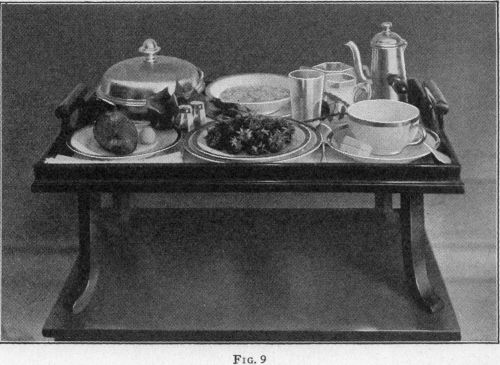
Close in hand with these points comes a well-arranged and neatly set table. To this may be added some attractive touches in the way of flowers or other simple decoration. These need cost little or nothing, especially in the spring and summer seasons, for then the fields and woods are filled with flowers and foliage that make most artistic table decorations. Often, too, one's own garden offers a nice selection of flowers that may be used for table decoration if a little time and thought are given to their arrangement. In the winter, a small fern or some other growing plant will answer.
75. BREAKFAST, LUNCHEON, AND DINNER SERVICE.--To give an idea of proper table service for the three meals, breakfast, luncheon, and dinner, Figs. 9, 10, and 11 are offered. Attention should be given to the details of each of these, for they show how to arrange meals that are intended to be served tastily and invitingly.
76. In Fig. 9 is shown a breakfast cover for one. By a cover is meant the silver and dishes placed on the table for one person. In a simple meal, this might consist of a knife, a fork, spoons, a plate, a glass, a cup and saucer, and a bread-and-butter plate. Here the cover has been arranged on a breakfast tray for service at a bedside. This meal is not in the least unusual, but it is very dainty and pleasing. It consists of strawberries with the stems left on so that they may be dipped into sugar and eaten, a cereal, a roll with butter, a hot dish of some kind, such as eggs, and a hot beverage.
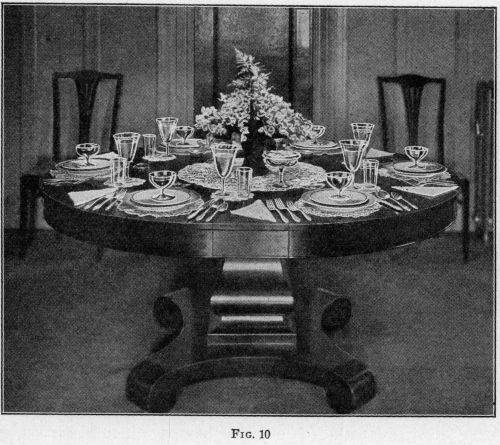
77. A luncheon table with covers for six is shown in Fig. 10. The first course consists of a fruit cocktail, which is placed on the table before the persons to be served are seated. The silver required up to the dessert course is also laid beforehand. Just before the dessert is served, the entire table should be cleared and the silver necessary for this course laid at each place.