Volume 5 — THE PLANNING OF MEALS (continued 2)
Reading edition
A point to be remembered in the placing of silver is that the various pieces should always be placed on the table in the order in which they are to be used. Here the first spoon is for the cocktail, which is already on the table, while the second spoon is for the soup, the next course. The knife, which is the third piece of silver, with the two forks on the opposite side will be required for the dinner course, while the third fork is a fork for the salad course.
As will be noted, doilies have been used in place of a table cloth for this luncheon. These, which may be as simple or as elaborate as desired, save laundering and, if they are inexpensive, they are an economy as well as a convenience. Since they also make a luncheon table very attractive, they are strongly recommended for meals of this kind. The luncheon napkin, which is smaller than that used for dinner service, should always be placed where it is shown here, that is, at the left of the forks. If only one beverage is to be served, as is usually the case, the glass is placed at the tip of the knife.
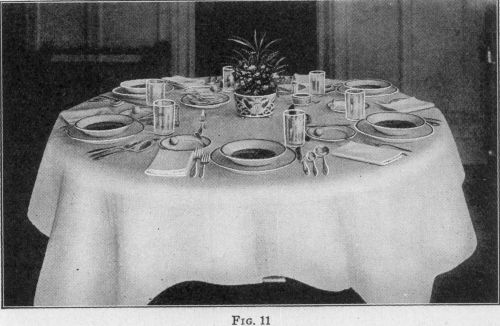
78. An example of a correctly set dinner table is shown in Fig. 11. A table cloth, as will be noted, is used, for a cloth is always preferable to doilies for dinner. At this meal, the first course is soup. This, with anything that is to be eaten with the soup, such as the wafers used here, or a relish, should be placed before the guests are seated. The bread-and-butter plate, which is placed just at the top of the fork, should also be on the table. Between each two persons, it is well to have a set of salt-and-pepper shakers.
THE PLANNING OF MEALS
EXAMINATION QUESTIONS
(1) What knowledge is necessary for the planning of economical and well-balanced meals?
(2) Discuss a systematic plan for the purchasing of foods.
(3) Compare the advantages of buying foods at a cash store and a credit store.
(4) Mention the advantages of keeping an account of household expenditures.
(5) Tell how economy in the purchase of foods may be practiced.
(6) Discuss the training of a child's appetite.
(7) Why is a variety of food necessary in the diet?
(8) Name the factors that influence the amount and proportion of food substances required for an adult.
(9) (a) Explain the meaning of calorie as applied to food. (b) What is the average number of calories required by the adult?
(10) With the aid of Table V, find out how many pounds you are under weight or over weight. Then tell how you would proceed to acquire your correct weight.
(11) Make out menus for breakfast, dinner, and supper for 1 day for a child 12 months old.
(12) Plan a dinner menu that contains foods suitable for both adults and a child 4 years old, and from it select the foods you would give the child.
(13) What does a balanced diet include?
(14) What can be done to balance the cost of foods used in a meal?
(15) Give several points of importance in selecting the dishes for a meal.
(16) Make out menus for the seventeenth and eighteenth days from Table VII.
(17) Plan an original menu and decorations for a dinner you can serve for a special occasion.
(18) What are the advantages of a nicely arranged table?
(19) Give a few general rules for the correct serving of food and setting of tables.
(20) Why is the following menu undesirable and what changes would you suggest to make it more nearly correct?
Cream Soup
Potatoes
Roast Pork
Greens
Bread and Butter
Pudding
Hard Sauce