Volume 5 — CONFECTION MAKING (continued 2)
Reading edition
112. ORIENTALS.--Delicious chocolate creams known as orientals can be made by the amateur if a little care is exercised. It should be remembered, however, that these cannot be made successfully on a damp day and that it is somewhat difficult to make them in warm weather. A clear, cold day is required for satisfactory results. Unlike fondant, these creams must be made up at once, so it will be necessary to allow sufficient time not only for the cooking and creaming processes, but also for the making and coating as well. After being made up, however, they should be allowed to stand for 3 or 4 days, as they, like many other cream candies, improve upon standing.
Since these centers are very sweet, a slightly bitter chocolate is the best kind with which to coat them. Confectioner's bitter-sweet chocolate will be found to be the most satisfactory, but if this cannot be procured, bitter chocolate may be mixed with sweet coating chocolate.
ORIENTALS
5 c. granulated sugar
2 c. water
1 tsp. glycerine
6 drops acetic acid
2 egg whites
Vanilla
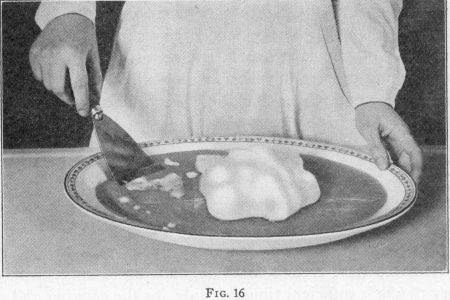
Put the sugar, water, and glycerine over the fire and stir until the sugar is dissolved. Wash down the sides of the kettle with a cloth, and just as the mixture begins to boil, add the acetic acid. Place a cover over the pan and allow the mixture to boil until a temperature of 238 degrees is reached on the thermometer or a firm ball that can be easily held in the fingers will form. Pour out on a slab or a platter to cool, and when perfectly cool begin to work it as for fondant, but first beat the egg whites until they are stiff. As soon as the candy is collected into a mass, pour the egg whites over it, as shown in Fig. 16. Continue to work the candy until all of the egg white is worked in. Add the vanilla during this process. If the mixture seems stiff and the eggs do not work in, continue with a little patience, for they will eventually combine with the candy. Because of the eggs, oriental cream is whiter than bonbon cream, and so it is a little difficult to tell just when it is beginning to get creamy. However, it softens a little as it begins to set, just as fondant does. At this point work slowly, and as it hardens get it into a mass in the center of the slab. When completely worked, it will not be so hard as fondant. Make it up at once into small, round centers, and as they are made place them on pieces of oiled paper to become dry. Chopped nuts may be added to the filling if desired before it is made up. As soon as it is possible to handle the centers, coat them with chocolate in the usual way. Be careful to cover the entire surface with chocolate, for otherwise the quality of the center will deteriorate. A good plan is to wrap candies of this kind in waxed paper, especially if they are to be packed in boxes, for then they will not be so likely to crush.
113. UNCOOKED FONDANT.--A fairly satisfactory substitute for fondant can be made by moistening confectioner's sugar with egg white or sweet cream. A very fine sugar must be secured for this purpose or the candy will be granular, and even then the result will not be so satisfactory as in the case of cooked fondant properly made. Uncooked fondant, too, is more limited in its uses than cooked fondant, for it cannot be melted and used for bonbons.
UNCOOKED FONDANT
XXXX sugar
Egg white or sweet cream
Roll and sift the sugar if it is lumpy, making it as fine as possible. Beat the egg white just enough to break it up or pour into a bowl the desired amount of sweet cream, remembering that very little liquid will moisten considerable sugar. Add the sugar a little at a time, beating all the while, until a sufficient amount has been used to make the mixture dry enough to handle with the fingers. Then flavor and color in any desired way and make up as if it were fondant.
MISCELLANEOUS CONFECTIONS
114. STUFFED DATES.--Dates from which the seeds have been removed and which have been filled with nuts or fondant or a combination of both are a confection that meets with much favor. The uncooked fondant is entirely satisfactory for this purpose, but if some of the other is on hand it will make an especially fine confection. Regardless of what is used for a filling, though, the preparation of such dates is the same.
First wash the dates in warm water and rinse them in cold water. Then, if there is time, spread them out in a single layer on a cloth and let them remain until they are entirely dry. Cut a slit in the side of each one with a knife and remove the seed. If nuts, such as English walnuts, are to be used for the filling, place half a nut meat in the cavity left by the seed and press the date together over it. In case fondant and nuts are to be used, chop the nuts and mix them with the fondant. Coconut may be used in place of the nuts if desired or the fondant may be used alone. Shape the fondant into tiny balls, press one tightly into the cavity left by the seed, and close the date partly over the filling. When all the dates have been stuffed, roll them in sugar, preferably granulated, and serve.
115. SALTED NUTS.--Nuts to which salt has been added are an excellent contrast to the sweet confections that have been described. At social gatherings, luncheons, dinners, etc., they are often served in connection with some variety of bonbon and many times they replace the sweet confection entirely. Peanuts and almonds are the nuts generally used for salting. If peanuts are to be salted, the unroasted ones should be purchased and then treated in exactly the same way as almonds. Before nuts are salted, they must first be browned, and this may be accomplished in three different ways: on the top of the stove, in the oven, and in deep fat. Preparing them in deep fat is the most satisfactory method, for by it all the nuts reach the same degree of brownness.
116. First blanch the nuts by pouring boiling water over them and allowing them to remain in the water until the skins can be removed; then slip off the skins without breaking the nuts apart if possible. Spread the nuts out on a towel to dry.
If the deep-fat method of browning them is to be followed, have in a small saucepan or kettle a sufficient quantity of cooking fat or oil.
Allow it to become as hot as for frying doughnuts or croquettes, place the nuts in a sieve, and fry them in the fat until they become a delicate brown. Pour them out into a pan, sprinkle them with salt, cool, and serve.
To brown nuts on top of the stove, heat a heavy frying pan over a slow fire and into it put a small amount of fat. Add the nuts and stir constantly until they are browned as evenly as possible. This part of the work requires considerable time, for the more slowly it is done the less likely are the nuts to have burned spots. Salt the nuts before removing them from the pan, turn them out into a dish, cool, and serve.
It is more difficult to brown nuts equally by the oven method, but sometimes it is desired to prepare them in this way. Put the nuts with a little fat into a pan and set the pan in a hot oven. Stir frequently until they are well browned, salt, cool, and serve.
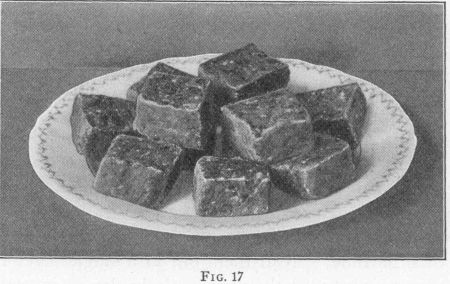
117. ORIENTAL DELIGHT.--An excellent confection that can be prepared without cooking is known as oriental delight. It is composed of fruit, nuts, and coconut, which are held together with egg white and powdered sugar. When thoroughly set and cut into squares, oriental delight appears as in Fig. 17.
ORIENTAL DELIGHT
1/2 lb. dates
1/2 lb. raisins
1/2 lb. pressed figs
1/2 c. shredded coconut
1/2 c. English walnuts
1 egg white
Powdered sugar
Wash all the fruits, put them together, and steam for about 15 minutes. Then put these with the coconut and nuts through a food chopper or chop them all in a bowl with a chopping knife. When the whole is reduced to a pulpy mass, beat the egg white slightly, add sufficient sugar to make a very soft paste, and mix with the fruit mixture. If it is very sticky, continue to add powdered sugar and mix well until it is stiff enough to pack in a layer in a pan. Press down tight and when it is set mark in squares, remove from the pan, and serve as a confection.
118. MARSHMALLOWS.--To be able to make marshmallows successfully is the desire of many persons. At first thought, this seems somewhat of a task, but in reality it is a simple matter if the directions are carefully followed. Upon being cut into squares, the marshmallows may be served plain or they may be coated with chocolate or, after standing several days, dipped into a warm caramel mixture.
MARSHMALLOWS
8 tsp. gelatine
1-1/4 c. water
2 c. sugar
Few grains salt
1 tsp. vanilla
1/2 Tb. corn starch
Soak the gelatine in one-half of the water for 5 minutes. Cook the sugar and the remaining water until it will spin a thread when dropped from a spoon. Remove from the fire and add the gelatine. When partly cold, add the salt and the flavoring. Beat with an egg whip, cooling the mixture as rapidly as possible, until it is light and fluffy. When the mixture is thick, add the corn starch slowly, working it in thoroughly. Then pour out on a flat surface that is well dusted with confectioner's sugar. Let stand in a cool place until thoroughly chilled. Cut in squares by pressing the blade of a knife down through the mass, but do not slide it along when cutting. Remove the pieces, dust on all sides with powdered sugar, and serve.
119. NOUGAT.--The confection known as nougat consists usually of a paste filled with chopped nuts. Both corn sirup and honey are used in the preparation of this candy. Generally it is merely flavored with vanilla, but if chocolate flavoring is preferred it may be added.
NOUGAT
3 c. sugar
1-1/2 c. corn sirup
1/4 c. strained honey
1 c. water
2 egg whites
1 tsp. vanilla
2 c. nut meats
Put the sugar, corn sirup, honey, and water together and cook until a temperature of 260 degrees is reached or a brittle ball will form in water. Beat the egg whites stiff and pour the mass slowly into them, beating constantly until the mixture grows stiff and waxy. Then add the vanilla and nut meats. Mix well and pour into a small box or pan lined with waxed paper. If chocolate is to be used for flavoring, add the desired amount just before pouring the mixture into the pan. When it has cooled sufficiently, cut in squares or slices.
120. CANDIED PEEL.--Another favorite confection and one that is much used in connection with candies for social functions is candied orange, lemon, and grapefruit peel. After being removed from the fruit, the peel should be well scraped and then cut into thin strips. In this form, it is ready to coat with sirup.
CANDIED PEEL
1/2 doz. lemons, oranges, or grapefruit
1/2 c. water
1 c. sugar
Remove the skin in quarters from the fruit, scrape off as much of the white as possible, and cut each piece of skin into narrow strips. Put these to cook in cold water, boil them until they may be easily pierced with a fork, and then drain off the water. Add the water to the sugar and cook until a thread will form when the sirup is dropped from a spoon. Add the cooked peel to the sirup and cook for 5 to 10 minutes. Drain and dredge in granulated sugar. Spread in a single layer to dry.
121. POP-CORN BALLS.--Pop corn in any form is always an attractive confection, especially to young persons. It is often stuck together with a sirup mixture and made into balls. In this form, it is an excellent confection for the holiday season.
To make pop-corn balls, first shell the corn and pop it. Then make a sirup with half as much water as sugar and cook it until it will spin a thread. Have the pop corn in a large bowl and pour the sirup over it, working quickly so that all the sirup can be used up while it is warm. To form the balls, take up a large double handful and press firmly together. If the sirup sticks to the hands, dip them into cold water so as to moisten them somewhat before the next handful is taken up. Work in this manner until all the corn is made into balls.
122. CRACKER JACK.--Another pop-corn confection that is liked by practically every one is cracker jack. In this variety, pop corn and peanuts are combined and a sirup made of molasses and sugar is used to hold them together.
CRACKER JACK
4 qt. popped corn
1 c. shelled, roasted peanuts
1 c. molasses
1/2 c. sugar
Put the popped corn and the peanuts together in a receptacle large enough to hold them easily. Cook the molasses and the sugar until the sirup spins a thread. Then pour this over the popped corn and peanuts and mix well until it becomes cold and hard.
SERVING CANDY
123. The best time to serve candy is when it will interfere least with the digestion, and this is immediately after meals. A dish of candy placed on the table with the dessert adds interest to any meal. It should be passed immediately after the dessert is eaten.
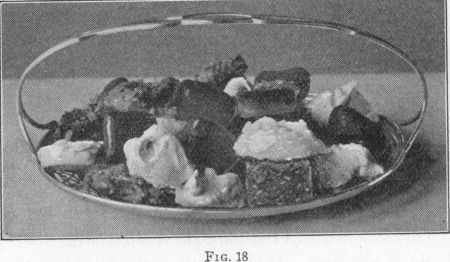
Various kinds of bonbon dishes in which to serve candies are to be had, some of them being very attractive. Those having a cover are intended for candy that is to be left standing for a time, while open dishes should be used for serving. Fig. 18 shows candy tastefully arranged on a silver dish having a handle. Dishes made of glass or china answer the purpose equally as well as silver ones, and if a bonbon dish is not in supply a small plate will do very well. A paper or a linen doily on the dish or plate adds to the attractiveness, as does also the manner in which the candy is arranged.
CONFECTIONS
EXAMINATION QUESTIONS
(1) What are confections?
(2) Discuss the use of confections in the diet of children and adults.
(3) (a) What food substance is found in the largest proportion in candy? (b) Are candies high or low in food value?
(4) Discuss briefly the kinds and qualities of sugar and their uses.
(5) What is the value of glucose in candy making?
(6) What kinds of flavorings are the most desirable?
(7) What care should be exercised in the use of colorings in candy?
(8) (a) What acids are used in candy making? (b) Why are these acids used?
(9) Of what value are milk, cream, and butter in the making of candy?
(10) What may be said of the selection of a pan for cooking candy?
(11) (a) What methods are used for testing candies? (b) Which of these methods is the most accurate?
(12) (a) How should the mixture be poured out to cool when a creamy candy is being made? (b) To what point should the sirup be cooled before the stirring is begun?
(13) (a) How should chocolate be melted? (b) How should coating with chocolate be done?
(14) How should waxed paper be cut for wrapping candies?
(15) Discuss the ingredients generally used for taffy.
(16) On what do good results in caramel making depend?
(17) What should be guarded against in the making of all cream candies?
(18) (a) What is fondant? (b) How may fondant be stored for future use?
(19) How should dates be prepared for stuffing?
(20) What is the best time for the serving of candy?