Volume 5 — FRUIT AND FRUIT DESSERTS (continued 2)
Reading edition
117. SUMMER COCKTAIL.--As strawberries and pineapples can be obtained fresh at the same time during the summer, they are often used together in a cocktail. When sweetened slightly with powdered sugar and allowed to become ice cold, these fruits make a delicious combination.
SUMMER COCKTAIL
(
Sufficient to Serve Six
)
2 c. diced fresh pineapple
2 c. sliced strawberries
Powdered sugar
Prepare a fresh pineapple in the manner previously explained, and cut each slice into small pieces or dice. Wash and hull the strawberries and slice them into small slices. Mix the two fruits and sprinkle them with powdered sugar. Place in cocktail glasses and allow to stand on ice a short time before serving.
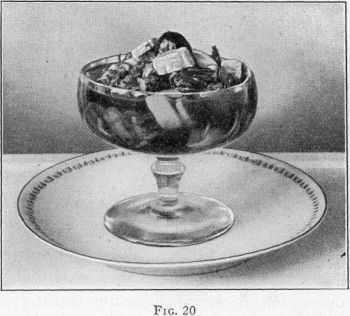
118. FRUIT COCKTAIL.--A fruit cocktail proper is made by combining a number of different kinds of fruit, such as bananas, pineapple, oranges, and maraschino cherries. As shown in Fig. 20, such a cocktail is served in a stemmed glass set on a small plate. Nothing more delicious than this can be prepared for the first course of a dinner or a luncheon that is to be served daintily. Its advantage is that it can be made at almost any season of the year with these particular fruits.
FRUIT COCKTAIL
(
Sufficient to Serve Six
)
2 bananas
1 c. canned pineapple
2 oranges
1 doz. maraschino cherries
Lemon juice
Powdered sugar
Peel the bananas and dice them. Dice the pineapple. Remove the pulp from the oranges in the manner previously explained, and cut each section into several pieces. Mix these three fruits. Cut the cherries in half and add to the mixture. Set on ice until thoroughly chilled. To serve, put into cocktail glasses as shown in the illustration, and add to each glass 1 tablespoonful of maraschino juice from the cherries and 1 teaspoonful of lemon juice. Sprinkle with powdered sugar and serve.
DRIED FRUITS
VARIETIES OF DRIED FRUITS
119. The fruits that have been discussed up to this point are fresh fruits; that is, they are placed on the markets, and consequently can be obtained, in their fresh state. However, there are a number of fruits that are dried before they are put on the market, and as they can be obtained during all seasons they may be used when fresh fruits are out of season or as a substitute for canned fruits when the household supply is low. The chief varieties of dried fruits are dates, figs, prunes, which are dried plums, and raisins, which are dried grapes. Apples, apricots, and peaches are also dried in large quantities and are much used in place of these fruits when they cannot be obtained in their fresh form. Discussions of the different varieties of dried fruits are here given, together with recipes showing how some of them may be used.
DATES
120. DATES, which are the fruit of the date palm, are not only very nutritious but well liked by most persons. They are oblong in shape and have a single hard seed that is grooved on one side. As dates contain very little water and a great deal of sugar, their food value is high, being more than five times that of apples and oranges. They are also valuable in the diet because of their slightly laxative effect. When added to other food, such as cakes, hot breads, etc., they provide a great deal of nutriment.
121. The finest dates on the market come from Turkey and the Eastern countries. They are prepared for sale at the places where they grow, being put up in packages that weigh from 1/2 to 1 pound, as well as in large boxes from which they can be sold in bulk. It is very important that all dates, whether bought in packages or in bulk, be thoroughly washed before they are eaten. While those contained in packages do not collect dirt after they are packed, they are contaminated to a certain extent by the hands of the persons who pack them. To be most satisfactory, dates should first be washed in hot water and then have cold water run over them. If they are to be stuffed, they should be thoroughly dried between towels or placed in a single layer on pans to allow the water to evaporate. While the washing of dates undoubtedly causes the loss of a small amount of food material, it is, nevertheless, a wise procedure.
122. Dates can be put to many valuable uses in the diet. They are much used in cakes, muffins, and hot breads and in fillings for cakes and cookies. Several kinds of delicious pastry, as well as salads and sandwiches, are also made with dates. Their use as a confection is probably the most important one, as they are very appetizing when stuffed with nuts, candy, and such foods.
FIGS
123. FIGS are a small pear-shaped fruit grown extensively in Eastern countries and to some extent in the western part of the United States. The varieties grown in this country are not especially valuable when they are dried, but they can be canned fresh in the localities where they are grown. Fresh figs cannot be shipped, as they are too perishable, but when dried they can be kept an indefinite length of time and they are highly nutritious, too. In fact, dried figs are nearly as high in food value as dates, and they are even more laxative.
124. Dried figs are found on the market both as pressed and pulled figs. Pressed figs are those which are pressed tightly together when they are packed and are so crushed down in at least one place that they are more or less sugary from the juice of the fig. Pulled figs are those which are dried without being pressed and are suitable for such purposes as stewing and steaming.
125. STEWED FIGS.--If pulled figs can be secured, they may be stewed to be served as a sauce. When prepared in this way, they will be found to make a highly nutritious and delightful breakfast fruit or winter dessert.
STEWED FIGS
(
Sufficient to Serve Six
)
2 c. pulled figs
3 c. water
Wash the figs and remove the stems. Put them into a preserving kettle with the water and allow them to come slowly to the boiling point. Simmer gently over the fire until the figs become soft. If they are desired very sweet, sugar may be added before they are removed from the heat and the juice then cooked until it is as thick as is desirable. Serve cold.
126. STEAMED FIGS.--When figs are steamed until they are soft and then served with plain or whipped cream, they make a delightful dessert. To prepare them in this way, wash the desired number and remove the stems. Place them in a steamer over boiling water and steam them until they are soft. Remove from the stove, allow them to cool, and serve with cream.
PRUNES
127. PRUNES are the dried fruit of any one of several varieties of plum trees and are raised mostly in Southern Europe and California. In their fresh state, they are purple in color, but they become darker during their drying. They are priced and purchased according to size, being graded with a certain number to the pound, just as lemons and oranges are graded with a certain number to the case. In food value they are about equal to dates and figs. They contain very little acid, but are characterized by a large quantity of easily digested sugar. They also have a laxative quality that makes them valuable in the diet.
128. STEWED PRUNES.--A simple way in which to prepare prunes is to stew them and then add sugar to sweeten them. Stewed prunes may be served as a sauce with cake of some kind or they may be used as a breakfast fruit.
STEWED PRUNES
(
Sufficient to Serve Six
)
1 lb. prunes
1 c. sugar
Look the prunes over carefully, wash them thoroughly in hot water, and soak them in warm water for about 6 hours. Place them on the stove in the same water in which they were soaked and which should well cover them. Cook slowly until they can be easily pierced with a fork or until the seeds separate from the pulp upon being crushed. Add the sugar, continue to cook until it is completely dissolved, and then remove from the stove and cool. If desired, more sweetening may be used or a few slices of lemon or a small amount of lemon peel may be added to give an agreeable flavor.
129. STUFFED PRUNES.--After prunes have been stewed, they may have the seeds removed and then be filled with peanut butter. Stuffed in this way and served with whipped cream, as shown in Fig. 21, or merely the prune juice, they make an excellent dessert.
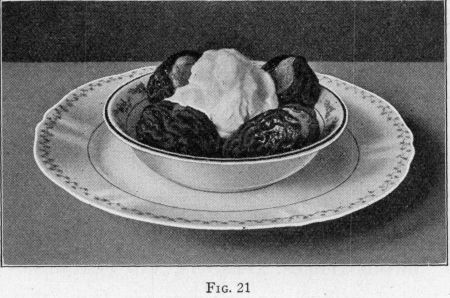
Select prunes of good size and stew them according to the directions just given, but remove them from the fire before they have become very soft. Cool and then cut a slit in each one and remove the seed. Fill the cavity with peanut butter and press together again. Serve with some of the prune juice or with whipped cream.
130. PRUNE WHIP.--A very dainty prune dessert can be made from stewed prunes by reducing the prunes to a pulp and then adding the whites of eggs. Directions for this dessert follow:
PRUNE WHIP
(
Sufficient to Serve Six
)
1 c. prune pulp
1/4 c. powdered sugar
2 egg whites
Whipped cream
Make the prune pulp by removing the seeds from stewed prunes and forcing the prunes through a sieve or a ricer. Mix the powdered sugar with the pulp. Beat the whites of the eggs until they are stiff and then carefully fold them into the prune pulp. Chill and serve with whipped cream.
RAISINS
131. RAISINS are the dried fruit of various kinds of grapes that contain considerable sugar and are cured in the sun or in an oven. They come principally from the Mediterranean region and from California. They have an extensive use in cookery, both as a confection and an ingredient in cakes, puddings, and pastry. In food value, raisins are very high and contain sugar in the form of glucose; however, their skins are coarse cellulose and for this reason are likely to be injurious to children if taken in too large quantities. They are also valuable as a laxative and in adding variety to the diet if they are well cooked before they are served.
Like other dried fruits, raisins should be washed thoroughly before they are used. They may then be soaked in warm water and stewed in exactly the same way as prunes. Sugar may or may not be added, as desired. Sultana raisins, which are the seedless variety, are especially desirable for stewing, although they may be used for any of the other purposes for which raisins are used.
DRIED APPLES, APRICOTS, AND PEACHES
132. Apples, apricots, and peaches are fruits that are used extensively in their dried form. They enable the housewife to supply her family with fruit during seasons when it is impossible to obtain fresh fruit. They may also be used to take the place of canned fruit, especially when the supply is low or has been exhausted. Besides their use as a sauce, they may be used for pies and various desserts.
133. These fruits, which may all be used in just the same way, should be soaked before stewing and should be stewed according to the directions for the preparation and cooking of prunes. Then sufficient sugar to make them sweet should be added. If they are desired for sauce, they may be used without any further preparation. However, they may be substituted for fresh fruit in recipes that call for any of them or for prunes. For instance, dried apricots, after being stewed, may be passed through a sieve to make a purée and may then be used to make apricot whip or soufflé according to the directions given for other similar desserts. The flavor of apricots is very strong and a small amount of the pulp will flavor a large quantity of ice cream, sherbet, or water ice.
FRUIT AND FRUIT DESSERTS
EXAMINATION QUESTIONS
(1) To what are the flavors and odors of fruits chiefly due?
(2) What food substances are found in only very small amounts in fruits?
(3) Mention the kinds of carbohydrate to which the food value of fruits is chiefly due.
(4) What parts of fruits make up the cellulose they contain?
(5) Discuss the value of minerals in fruits.
(6) Of what value in cookery are fruits containing large quantities of acid?
(7) What qualities of fruits are affected as they ripen?
(8) Discuss the digestibility of fruits.
(9) What are the effects of cooking on fruit?
(10) What sanitary precautions concerning fruits should be observed?
(11) (a) How do weather conditions affect the quality of berries? (b) What is the most important use of berries in cookery?
(12) Name some varieties of apples that can be purchased in your locality that are best for: (a) cookery; (b) eating.
(13) How can peach juice be utilized to advantage?
(14) Mention the citrus fruits.
(15) Describe a method of preparing grapefruit for the table.
(16) Describe the preparation of oranges for salads and desserts.
(17) Describe the appearance of bananas in the best condition for serving.
(18) (a) Give a test for the ripeness of pineapples. (b) Describe the most convenient method of preparing pineapples.
(19) Discuss the use of fruit cocktails.
(20) Describe the general preparation of dried fruits that are to be stewed.