SPECIES ACCOUNTS
Reading edition
Large Whales With a Dorsal Fin
BLUE WHALE (B)[9] Balaenoptera musculus (Linnaeus 1758)
Other Common Names
Sulphur-bottom.
Description
Blue whales are the largest living mammals. Though reports of maximum length and weight vary from one account to another, Antarctic blue whales are known to have reached lengths to 100 feet (30.5 m) and weights of over 150 tons (136,363 kg)[10] before stocks were severely depleted by whaling operations. North Atlantic blue whales may be expected to reach lengths of 80-85 feet (24.4-25.9 m). In all known populations of blue whales, females are slightly larger than males of the same age.
Viewed from above, the blue whale's rostrum is broad, flat, and nearly U-shaped (actually shaped like a Gothic arch, slightly flattened on the tip), with a single ridge extending from the raised area just in front of the blowholes towards but not quite reaching the tip of the snout.
The dorsal fin is extremely small [to only 13 inches (33 cm)] and variable in shape from nearly triangular to moderately falcate. In all cases, it is located so far back on the animal's tail stock that it is seldom visible until the animal is about to begin a dive.
Blue whales are light bluish gray overall, mottled with gray or grayish white. Some animals may have yellowish or mustard coloration, primarily on the belly, the result of the accumulation of diatoms during long stays in the cooler waters to the north. The undersides of the flippers are light grayish blue to white.
The baleen plates are all black.
Natural History Notes
The blow or "spout" is tall, to perhaps 30 feet (9.1 m), slender, vertical, and not bushy, as is the blow of humpback whales, for instance.
Although the blowing and diving patterns of blue whales may vary, depending on the speed of movement and the activity of the whale when it is encountered, they may be generally described as follows: If the animal is moving slowly, the blowhole and part of the head may still be visible when the dorsal fin breaks the surface, and the animal may settle quietly into the water without exposing the last portion of the tail stock or the tail flukes. If the animal is moving more quickly, however, or is about to begin a long dive, the blowhole disappears below the surface, a broad expanse of the back is exposed and disappears, and the dorsal fin emerges briefly just before the animal lifts its tail stock and flukes slightly above the surface before slipping out of sight.
In this species it can be generally stated that the maximum height of back in the area of the dorsal fin which is exposed above the surface as the animal sounds is approximately four times the height of the dorsal fin itself. The exposure of the tail flukes is unlike that of the humpback whale (Fig. 39), the right whale (Fig. 50), or the sperm whale (Fig. 57) in that when beginning a long dive all these other species raise the flukes high out of the water and usually descend at a steep angle. Blue whales lift the flukes only slightly, if at all.
Blue whales are relatively shallow feeders, feeding as they do almost exclusively on "krill" (small shrimplike crustaceans), most of which are distributed in the surface 330 feet (100 m). Blue whales usually occur singly or in pairs.
May Be Confused With
At sea, blue whales may be confused with fin whales (p. 26) and though the two are sometimes difficult to distinguish from a distance, the following key differences permit identification at close range:
Blue WhaleFin Whale
COLORATION
Mottled bluish gray above and below. Gray above, white below; frequently grayish-white chevron behind head, right lower lip white.
BALEEN
All black. Bluish gray with yellowish-white strips; front fifth to third of baleen on right side all white.
HEAD
Broad and nearly U-shaped; all dark. Narrower, more V-shaped; right lower lip white.
DORSAL FIN
To 13 inches (33 cm); triangular to moderately falcate; in last third of back; visible well after blow. To 24 inches (61 cm); falcate; located slightly more than a third forward from tail flukes; usually visible shortly after blow.
SURFACING AND PREPARING TO DIVE
Often shows head and blowholes; broad expanse of back and much later, dorsal fin. Usually rolls higher out of water, particularly on long dive; dorsal fin visible shortly after blow.
DIVING
Dives for 10-20 min; surfaces and blows 8-15 times, making a series of 12- to 15-s dives between blows, then disappears again; sometimes raises flukes slightly on last dive; on sounding, the maximum height of back in the area of dorsal fin which is exposed is approximately 4 times the height of the dorsal fin. Dives 5-15 min (most often 6-7); surfaces steeply for 3-7 blows then dives rather steeply again; does not show flukes on dive: on sounding, the maximum height of back in the area of dorsal fin which is exposed is approximately 2 times the height of the dorsal fin.
GROUPING
Usually found singly or in pairs. Occasionally found singly or in pairs, more often found in pods of six or seven individuals; many pods, consisting of as many as 50 animals, may be found in small area.
See also comparison of fin whale and sei whale (p. 26).
Distribution
Though blue whales have been reported from the pack ice to Cristobal Harbor, Panama Canal Zone, their normal range in the western North Atlantic is more limited. In spring and summer months (about April through at least August) they can be expected in the northern portion of their range, at least as far north as the Arctic Circle, feeding on the krill abundant in those waters. A small portion of the population may venture north, beyond the Circle. In fall and winter the population moves south, presumably into temperate and perhaps to tropical waters. Reliable records include animals from observations off Long Island and Ocean City, Md.
Though southern limits of the species are poorly known, there are no records from Florida or the West Indies and no verified records from the Gulf of Mexico.
Summaries of blue whale distribution based on records when the species was more numerous indicate that they were found during spring and summer months in some abundance on the Nova Scotian Banks, the St. Lawrence Gulf and estuary, the Strait of Belle Isle, Grand Bank, and in the waters off the coasts of Iceland, southern Greenland, and the Davis Straits and Baffin Bay. (Some individuals have entered the Hudson Strait but not apparently Hudson Bay itself.)
Historically, a few animals apparently appeared off the coast of southeastern Canada as early as February. It was speculated that from there a portion of the population underwent a migration from the Strait of Belle Isle north through the Davis Straits to the waters off western Greenland. Some individuals entered the Gulf of St. Lawrence after the ice was clear and remained behind until as late as November. In the fall months, certainly by November, the northern portion of the population had begun retreating to the south in front of the advancing ice. The remainder apparently also underwent this migration as well, since blue whales have historically been nearly absent from Canadian waters during midwinter.
Many of the migrating individuals were assumed to continue south to temperate and, less frequently, to tropical water where they calved. It should be emphasized that though all of the southward and the subsequent northward migrations were presumed to be along pelagic routes, details were poorly documented.
Blue whales have been reported in both shallow inshore and deep oceanic zones.
Despite considerable attention in the popular literature to the plight of the blue whale populations and frequent statements that they are near extinction, blue whale stocks in the western North Atlantic appear more abundant than has been usually reported. While present stocks are far short of previous population sizes, which may have exceeded 200,000 individuals worldwide, they should be sufficiently large for the species to continue their increase, barring renewed exploitation.
Stranded Specimens
Stranded blue whales can be readily identified by 1) the large body size (to 85 feet [25.9 m]); 2) the broad flat head; 3) the all-black baleen plates (270-395 in number), which are usually barely more than twice as long as they are wide; and 4) the 55-88 ventral grooves extending to the navel or beyond (Table 2).
Depending on the state of decay and the position of the stranded specimen, any of the body characteristics described for living animals may also be used to positively identify the specimen.
Figure 9.—Closeup views of swimming blue whales off British Columbia (top) and Baja California (bottom). In both photos note the broad rounded appearance of the head and the single, prominent central head ridge. In the animal on the top note also the black baleen plates, barely visible at the front of the slightly open mouth. In the animal on the bottom note the pattern of light grayish-white mottling along the back and the raised areas around the blowholes. These features clearly mark these animals as blue whales. (Photos by R. M. Gilmore [top] and K. C. Balcomb [bottom].)
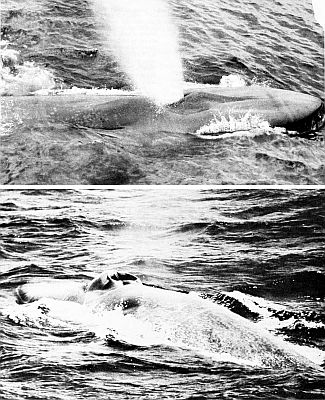
Figure 10.—The dorsal fins of blue whales may vary from distinctly triangular (top) to broadly rounded (middle and inset) to smoothly falcate in appearance (bottom). Regardless of its shape, however, the fin is always located well back on the tail and does not become visible until long after the animal's blow. (Photos by Japanese Whales Research Institute, courtesy of H. Omura, mid-Pacific [top]; S. Leatherwood, southern California (middle and inset); and F. W. True, northern North Atlantic, courtesy of U.S. National Museum [bottom].)
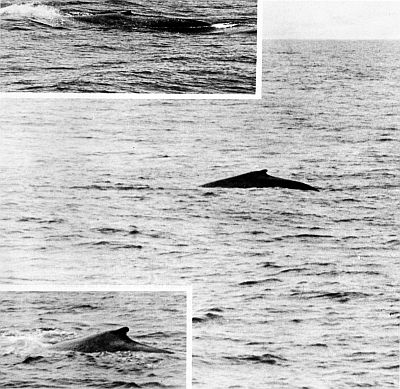
Figure 11.—A blue whale swimming leisurely at the surface off San Clemente Island, Calif. Note that the blowholes, marked by the raised areas on the top of the head, are still exposed after the dorsal fin has become visible. Note also the very small size and the shape of the dorsal fin and its position well back towards the tail. (Photo by S. Leatherwood.)
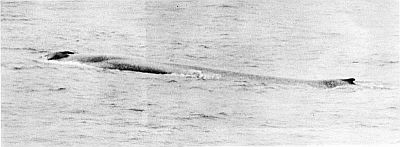
Figure 12.—A sequence showing fast-swimming blue whales off southern California. The animal rises rather steeply to the surface (a), emits a tall, vertical blow (b, c), shows its broad bluish back, mottled with grayish white, and its small dorsal fin (d, e), and then dives out of sight (f). When swimming in this manner, blue whales sometimes raise their tail flukes slightly above the surface before beginning their long dives (g). (Photos by J. F. Fish [a-f] and K. C. Balcomb [g].)
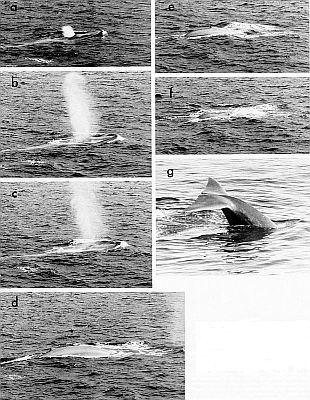
Figure 13.—Two views of blue whales on the ramps of whaling stations in Japan (top) and at Hermitage Bay, Newfoundland (bottom). Note the broad rounded appearance of the head, the single central head ridge, and the dark bluish-gray coloration, interrupted only by mottlings of grayish white. In the animal on the bottom note the all-black baleen plates, which are very broad relative to their length. (Photos by Japanese Whales Research Institute, courtesy of H. Omura [top]; and F. W. True, courtesy of U.S. National Museum [bottom].)
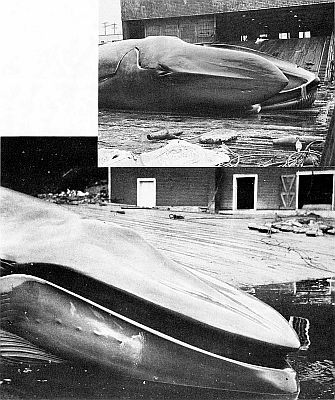
Figure 14.—Dead blue whales, harpooned and afloat off the stern of a factory ship in the Antarctic (top), and on the deck of a whaling station in western Canada (bottom). In both, note the numerous ventral grooves (from 55 to 85 or more) extending to the region of the navel and sometimes beyond, and the light coloration of the undersides of the flippers. Even though grooves are often present above the flippers, and occasionally even on the side of the head, counts of ventral grooves are usually made between the flippers. (Photos by Japanese Whales Research Institute, courtesy of H. Omura [top]; and G. C. Pike, courtesy of I. MacAskie [bottom].)
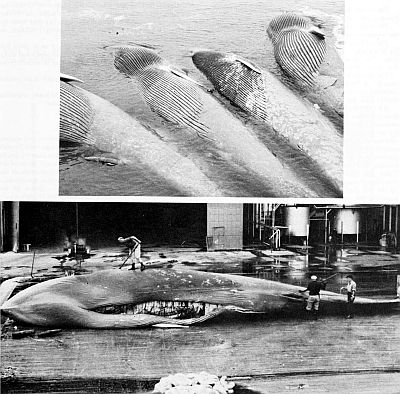
FIN WHALE (B) Balaenoptera physalus (Linnaeus 1758)
Other Common Names
Finback whale, finner, razorback, common rorqual.
Description
Fin whales have been reported to reach 79 feet (24 m). Females are slightly larger than males of the same age.
The back is distinctly ridged towards the tail, prompting the common name "razorback" whale.
The rostrum is narrower and more V-shaped than that of the blue whale and has the same sort of single distinctive head ridge. The top of the head is flat, though slightly less than that of the blue whale.
The dorsal fin is up to 24 inches (61 cm) tall; angled less than 40° on the forward margin, located slightly more than one-third forward from the tail, and appears on the surface shortly after the blow.
All individuals are dark gray to brownish black on the back and sides with none of the mottling present on blue whales and are rarely as heavily scarred as sei whales. Along the back, just behind the head, there is a grayish-white chevron, with the apex along the midline of the back and the arms of the chevron oriented posteriorly, which is sometimes distinctive and may be visible as the animals surface to breathe. The undersides, including the undersides of the flukes and flippers, are white. On the head, the dark coloration is markedly asymmetrical, reaching farther down on the left than on the right side. The right lower lip, including the mouth cavity, and the right front baleen (approximately one-fifth to one-third) are yellowish white. Occasionally the right upper lip is also white. The remainder of the plates on the right side and all those on the left side are striped with alternate bands of yellowish white and bluish gray. The fringes of the plates are brownish gray to grayish white.
Natural History Notes
Fin whales are one of the most common baleen whale species in the world and constitute a major portion of the whaling catch. They are reportedly one of the fastest of the big whales (sei whales may be slightly faster) possibly reaching burst speeds in excess of 20 knots, and were not an important commercial species until the comparatively recent development of fast catcher boats and the depletion of blue whale stocks.
A fin whale's blow can be from 15 to 20 feet (4.6 to 6.1 m) tall and has been described as an inverted cone or an elongated ellipse.
Fin whales dive to at least 755 feet (230.1 m). This depth is probably deeper than that of either blue or sei whales, a factor usually reflected in differences among the surfacing, blowing, and diving characteristics of these three species. When they are moving leisurely at the surface, fin whales expose the dorsal fin shortly after the appearance of the blowholes, slightly later than that of the sei whales. When they are surfacing from a deeper dive, however, they surface at a steeper angle, blow, submerge the blowholes, and then arch the back and dorsal fin high into the air before beginning another long dive. In this species it can be generally stated that the maximum amount of the back in the area of the dorsal fin which is exposed above the surface as the animal sounds is approximately 2 times the height of the dorsal fin. Fin whales do not show their tail flukes when beginning a dive.
Unlike blue or sei whales, fin whales do breach on occasion. When they do leap clear of the water, fin whales usually reenter with a resounding splash, like that made by humpback and right whales and not smoothly, head first, as minke whales often do.
Fin whales are sometimes found singly or in pairs but more often occur in pods of six or seven individuals and many pods consisting of as many as 50 animals may be concentrated in a small area.
Fin whales calve and breed in winter, mostly in temperate waters.
Atlantic fin whales eat a wide variety of foods, including krill, capelin, squid, herring, and lanternfish.
May Be Confused With
Fin whales may be confused with blue whales, sei whales, and, in the southernmost portion of their range, with Bryde's whales. They may be distinguished from the blue whales by differences in overall coloration, coloration and shape of the head, and the size, position, and time of appearance of the dorsal fin at the surface (see p. 19). After close examination they may be distinguished from Bryde's whales by the presence of three ridges along the head (of the Bryde's whale) and by the smaller, more sharply pointed falcate dorsal fin of the Bryde's whale (see Fig. 31). They may be distinguished from sei whales in the following similar ways:
Fin Whale Sei Whale
DORSAL FIN
Slightly falcate, forms angle of less than 40° with back slightly more than one-third forward from tail. Sharply pointed and falcate: forms angle of greater than 40° with back well more than one-third forward from tail.
SURFACING BEHAVIOR
Usually rise obliquely so top of head breaks surface first; after blowing, animal arches its back and rolls forward exposing the dorsal fin on the long dive; on sounding, the maximum amount of back in the area of the dorsal fin which is exposed is approximately 2 times the height of dorsal fin. Primarily skimmer feeders; usually rise to surface at shallow angle so that dorsal fin and head are visible almost simultaneously; when starting the long dive does not usually arch the back as much as the fin whale; on wsounding, the maximum amount of back in the area of the dorsal fin which is exposed is approximately 1 times the height of the dorsal fin.
BLOW
Tall (to 20 feet [6.1 m]); inverted cone (point down) or elongated ellipse. Similar shape but smaller—rarely taller than 10-15 feet (3.1-4.6 m).
DIVING
Dive for 5-15 (usually 6-7) min; blow 3-7 times or more at intervals of up to several minutes, then dive again. Dive for 3-10 min; usually blow at even intervals over long periods of time; often visible just below the surface, even on longer dives.
COLOR OF UNDERSIDES
White higher up on right than on left side. Mostly gray; irregular whitish area on belly.
COLOR OF LOWER LIP
White on right, gray on left. Gray.
BALEEN PLATES
Right one-fifth to one-third in front white; all others alternate bands of yellowish white and bluish gray; bristles grayish white. Ash black with a blue tinge and fine grayish bristles.
Distribution
Fin whales are probably the most numerous and widely distributed large whale species in the western North Atlantic.
Fin whales summer from below the latitude of Cape Cod, Mass., north to the Arctic Circle. (They are frequently seen between New York and Bermuda this time of year.) Within this zone they may sometimes be seen very close to shore and appear to be concentrated between shore and the 1,000-fathom curve from at least lat. 41°20' to 57°00' N. In recent years they have been reported in relatively large numbers in the Gulf of Maine from March through June, off Newfoundland as early as June but increasing to August, and entering Davis Straits and beyond in substantial numbers in midsummer to late summer. There is some evidence that the animals venturing farthest north are the largest individuals of the species. Movements of the population(s) southward have usually begun by October, though some fin whales sometimes remain in the northern seas sufficiently long to become trapped in the ice and killed.
During winter the range of fin whales spreads out from the advancing ice southward, reaching at least to the coast of Florida, into the Gulf of Mexico, and to the Greater Antilles, though fin whales are not at all common in tropical waters. During the winter many fin whales move into offshore waters. Northward migrations probably begin in midspring.
Fin whales may be found in Cape Cod waters all year long.
There may be two or possibly three separate stocks of fin whales in the western North Atlantic, one more northern cold-adapted stock and another more southern stock. The ranges of the two stocks appear to overlap, such that the winter range of the northern stock probably becomes the spring and summer range of the more southern stock. The third stock may consist of an isolated population in the northern Gulf of Mexico.
Stranded Specimens
Stranded fin whales may be most readily identified by 1) the yellowish-white coloration of the right front baleen and the right white lower lip; 2) the numerous baleen plates (262-473 in number); 3) the numerous ventral grooves (56-100 in number) extending to the navel and beyond (Table 2); and 4) the broad, flat sharply pointed head with only a single head ridge.
Figure 15.—The heads of fin whales surfacing to breathe off Japan and in the northern North Atlantic (inset). When they can be approached from the right side, fin whales can be positively distinguished from the other large balaenopterine species by the white coloration of the right lower lip and the flat, narrow head. Note also the single central head ridge. (Photos by Japanese Whales Research Institute, courtesy of H. Omura, and K. C. Balcomb [inset].)
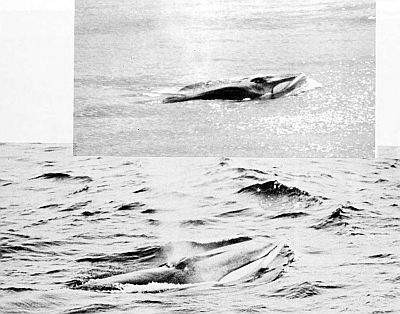
Figure 16.—A small group of fin whales off British Columbia. Fin whales may be found in groups of up to six or seven individuals and these groups may congregate in feeding grounds. (Photo by G. C. Pike, courtesy of I. MacAskie.)
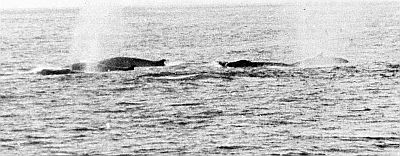
Figure 17.—The back of a harpooned fin whale in the eastern North Pacific (left) and in the North Atlantic (right). In both note the light grayish-white chevrons just behind the head. These chevrons are not usually very distinctive in North Atlantic fin whales. In the animal in the left photo note also the prominent ridge along the back behind the dorsal fin—a characteristic which prompted the common name "razorback." (Photos courtesy of Los Angeles Examiner [left] and K. C. Balcomb [right].)
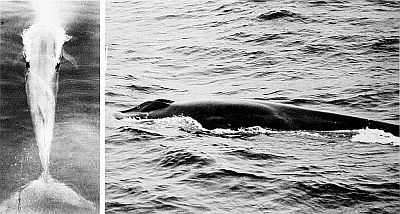
Figure 18.—Surfacing fin whales show the head and blow, then the wheellike silhouette of the back, and then the dorsal fin. Note that in this species the dorsal fin is smaller and located farther back than that of the sei whale and appears on the surface later after the animal's blow. (Photo from the northern North Atlantic by K. C. Balcomb.)
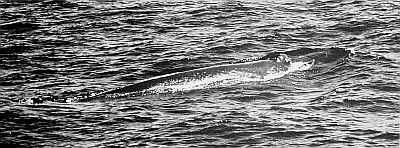
Figure 19.—As they begin a long dive, fin whales frequently arch the tail stock high into the air, exposing the dorsal fin. Even on a long dive, however, this species is not known to throw its tail flukes high into the air or even to raise them slightly, as blue whales sometimes do when beginning a long dive. (Photo from off Virginia by J. G. Mead.)
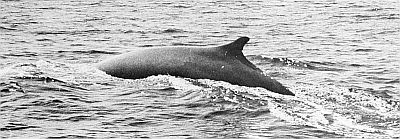
Figure 20.—Probably a fin whale (perhaps a Bryde's whale) breaching in the eastern tropical Pacific. This type of behavior has been described for humpback, minke, and fin whales but is far more common for the first two species. Breaching fin whales often reenter the water with a resounding splash, much like humpback whales, but sometimes smoothly, head first, as minkes sometimes do. (Photo by K. D. Sexton, courtesy of National Marine Fisheries Service.)
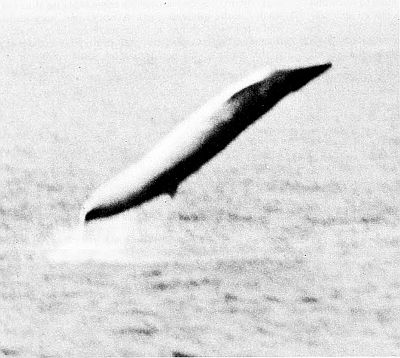
Figure 21.—A head-on view of a fin whale stranded at Ormond Beach, Fla. Note the flat narrow appearance of the head and the single, central head ridge. (Photo by F. Essapian, courtesy of Marineland of Florida.)
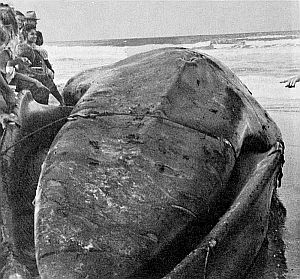
Figure 22.—In this partly flensed fin whale, at Blanford, Nova Scotia, note the white lower lip and the white baleen in the right front. [See larger main image.] The inset photo shows the right upper jaw of a fin whale with the baleen intact. (Photos by H. E. Winn, and from the North Pacific by Japanese Whales Research Institute, courtesy of H. Omura [inset].)
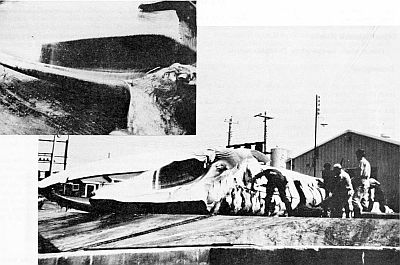
Figure 23.—A fin whale on the ramp of the whaling station also at Blanford, Nova Scotia. Note the ventral grooves, 56 to 100 and extending at least to the navel. (Photo by L. Rigley.)
SEI WHALE (B) Balaenoptera borealis Lesson 1828
Other Common Names
Pollack whale, sardine whale, Rudolphi's rorqual.
Description
Sei (pronounced "say") whales have been reported to reach 62 feet (19 m).
The snout is less acutely pointed than that of the fin whale but when viewed from the side appears slightly arched. In general, the head is intermediate in shape between that of the blue whale and that of the fin whale. The dorsal fin, which is from 10 to 24 inches (25.4 to 61 cm) tall and strongly falcate in adult animals, is located about two-thirds of the way back on the back, farther forward than that of the blue or fin whales. Sei whales are dark steel gray on the back and sides, and on the posterior portion of the ventral surface. The body often has a galvanized appearance due to scars possibly resulting from lamprey bites inflicted during migrations into warmer waters. These scars may be dark gray to almost white in color. On the belly there is a region of grayish white that is confined to the area of the ventral grooves. Neither the flippers nor the tail flukes are white underneath. The right lower lip and the mouth cavity, unlike those of the fin whale, are uniformly gray. The baleen plates are uniformly grayish black with fine grayish-white fringes. (A small number of sei whales have been noted to have a few half-white plates near the front of the mouth, a feature which might result in their confusion with fin whales.)
Natural History Notes
The blow of sei whales is an inverted cone rarely taller than 15 feet (4.6 m).
Sei whales are generally skimmer feeders and do not usually dive very deeply. For that reason they usually surface at a shallower angle than fin whales. The head rarely emerges at a steep angle (except when the whales are chased). Instead, the blowholes and a major portion of the back, including the dorsal fin, become visible almost simultaneously and remain visible for relatively long periods of time. In this species it can be generally stated that the amount of the back in the area of the dorsal fin which is exposed above the surface as the animal sounds is approximately the same height as the dorsal fin. When they begin another dive, sei whales do not arch the tail stock or flukes high. Instead, they normally submerge by slipping quietly below the surface, often remaining in view only a few feet down and leaving a series of tracks or swirls on the surface as they move their tail flukes. When they are feeding in this manner, sei whales may exhibit a highly regular blowing and diving pattern over long periods of time.
Sei whales usually travel in groups of from two to five individuals, though they may concentrate in large numbers on the feeding grounds.
In the northern portion of their range, sei whales feed on copepods. Throughout the remainder of the range, however, their food is more varied and also includes krill and a variety of small schooling fishes. The species derived its common name, in fact, from its frequent occurrence with or near sei fish.
May Be Confused With
The sei whale's smaller size and decidedly taller, more falcate dorsal fin located well more than one-third forward from the tail should prevent confusion with the blue whale. At a distance, however, sei whales are difficult to distinguish from either fin whales or Bryde's whales. The primary clues for distinguishing them from fins are the differences in swimming, blowing, and diving characteristics tabularized in detail on p. 26 and the asymmetrical coloration of the fin whale.
Sei whales may be distinguished from Bryde's whales only upon close examination. The dorsal fin of Bryde's whales is small, to 18 inches (45.7 cm), sharply pointed, and often worn on the rear margin. If close examination is possible, the sei whale will be seen to have only a single head ridge. Bryde's whales have two additional ridges—one on each side of the main ridge. Bryde's whales are primarily fish feeders and their diving behavior more closely resembles that of a fin whale than that of a sei whale. (See p. 37).
Distribution
The distribution and migrations of the sei whale during most of the year are rather poorly known. The species is known to avoid the colder regions near the pack ice and to range from Iceland south to the northeast Venezuelan coast and the northeast and southwest Gulf of Mexico. There are also records from Cuba and the Virgin Islands. Along the northeast United States and eastern Canadian coasts, where most research on sei whales has been conducted, the species migrates from New England through the Blanford, Nova Scotia area in June and July, is found in small numbers off eastern Newfoundland in August and September (abundant in Placentia Bay, Newfoundland in August), and continues northward to the Davis Straits in September and October. An offshore stock may be found year-round in the Labrador Sea. The summer range (May to September or October) extends from New England to southern Arctic waters. Though some individuals remain behind through November, the southward movement of the bulk of the population presumably begins in October. In general, sei whales do not venture as far north as fin whales but may have a greater tendency to enter tropical waters.
Stranded Specimens
Stranded sei whales are most likely to be confused with fin whales or Bryde's whales. The three head ridges of the Bryde's whale (sei whales have only one) assist in distinguishing sei whales from Bryde's whales. They may be distinguished from fin whales and all other rorquals by the following characteristics: 1) The color of the baleen plates—uniformly ash black with a blue tinge and fine white bristles (Table 2). 2) The density of bristles on the plates—sei whales have from 35 to 60 baleen fringes per centimeter; all other rorquals have far fewer (less than 35). 3) The relative lengths of the ventral grooves—the grooves of sei whales end well before the navel; those of blue, fin, and Bryde's whales extend at least to the navel. 4) The relatively small numbers of ventral grooves (38-56)—both blue and fin whales have more; Bryde's whales have approximately the same number.
If the animal is not in an advanced state of decomposition, the region of white coloration of the belly may also be visible.
Figure 24.—The head of a sei whale is intermediate in shape between that of the blue whale and that of the fin whale. When viewed from the side it is slightly arched. Note the single central head ridge, from just in front of the blowholes to near the tip of the snout. Bryde's whales, with which sei whales are most likely to be confused in the tropical and subtropical portions of their range, have two auxiliary ridges, one on each side of the top of the head, in addition to this main central ridge. (Photo from the North Pacific by Japanese Whales Research Institute, courtesy of H. Omura.)
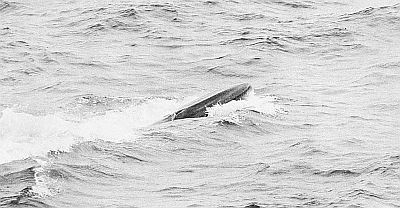
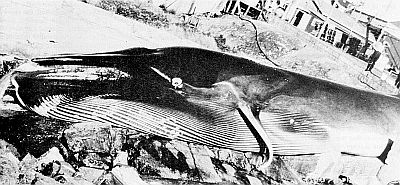
Figure 25.—Sei whales are dark gray on the right lower lip. They can be distinguished from fin whales, which have a white right lower lip, by approaching them from the right side. (Photo from the North Pacific by Japanese Whales Research Institute, courtesy of H. Omura.)
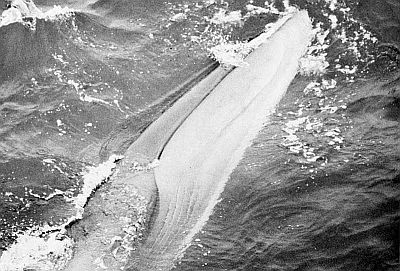
Figure 26.—Three views of swimming sei whales. In all three, note the tall, distinctly falcate dorsal fin (which has been described as sickle or scimitar in shape) positioned farther forward on the back than the fins of either the fin whale or the blue whale. In the photo in the middle, note that the dorsal fin has appeared on the surface while the blowholes are still open. Sei whales, generally skimmer feeders and rather shallow divers, often show the dorsal fin and much of the back for relatively long periods as they surface to breathe. (Photos from off central California, courtesy of National Marine Fisheries Service [middle]; northeast of Hawaii by S. Ohsumi [left inset]; and from off Japan by Japanese Whales Research Institute, courtesy of H. Omura [right inset].)
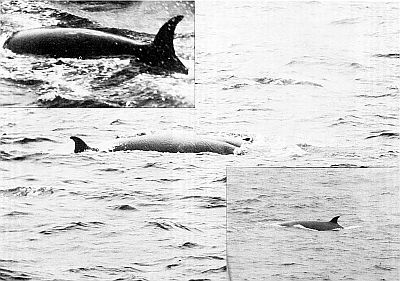
Figure 27.—A freshly dead sei whale from the Pacific (top) and a stranded specimen in an advanced stage of decomposition at Cape Island, S.C. (bottom and inset). Note that even though the distinctive coloration of the fresh specimen has faded on the rotting specimen, the numbers and lengths of the ventral grooves (38 to 56 in number and stopping well short of the navel) still permit the specimen to be distinguished from fin, blue, and Bryde's whales, in all of which the grooves extend at least to the navel. (Photos by Japanese Whales Research Institute, courtesy of H. Omura [top]; and J. G. Mead [bottom and inset].)
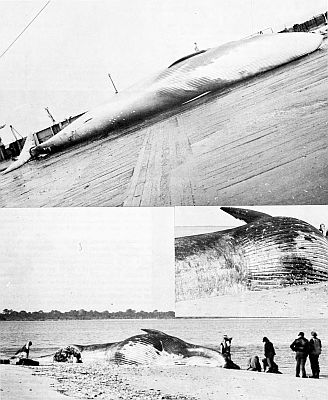
Figure 28.—Dorsal view of a sei whale on the deck of a whaling ship in the North Pacific. Note the numerous scars on the body and the otherwise dark gray coloration of the back. (Photo by Japanese Whales Research Institute, courtesy of H. Omura.)
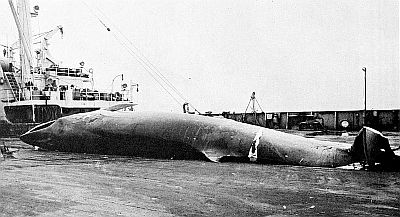
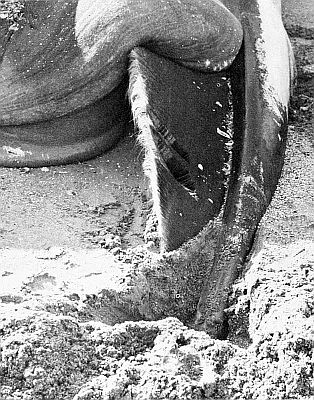
Figure 29.—The right upper jaw of the sei whale stranded at Cape Island, S.C. The baleen plates, here partly buried in the sand, numbering from 318 to 340 per side and uniform dark gray with fine lighter gray bristles, continue to serve as identifying characteristics even on a badly decomposed specimen. (Photo by J. G. Mead.)
BRYDE'S WHALE (B) Balaenoptera edeni Anderson 1879
Other Common Names
None known.
Description
Bryde's whales reach a maximum length of approximately 46 feet (14 m). They closely resemble sei whales in external appearance. At a distance, the head of this species is similar in profile and general appearance to that of the sei whale. The most distinctive field characteristic of the species, however, is the presence of three ridges along the head anterior to the blowhole. In addition to the medial ridge characteristic of all the other balaenopterid species, Bryde's whales have two secondary ridges on the top of the head—one along each side even with the blowhole running forward towards the tip of the snout. If they can be examined at close range, Bryde's whales can be positively identified by this character alone.
The dorsal fin of Bryde's whales is up to 18 inches (45.7 cm) tall, extremely falcate, pointed on the tip, located well more than one-third forward from the tail, and is often irregularly notched or frayed on the rear margin from unknown causes. Bryde's whales are dark gray overall, though some individuals, like some minke whales, have a small region of gray on each side just forward of the dorsal fin.
Natural History Notes
Bryde's whales, like minke whales, reportedly often approach close to vessels as if curious about them. During this time they may be examined carefully and their identifying characteristics seen.
Though euphausiids may be an important food for this species in limited areas, Bryde's whales often feed on schooling fish (including pilchards, anchovies, herring, and mackerel). This food preference is reflected in the diving behavior of the species. Bryde's whales are not "skimmer" feeders; they are deeper divers. When they surface to breathe, they often rise more steeply to the surface, exposing much of the head, roll the body sharply, and hump up the tail stock before beginning another dive. In this species, as in the fin whale, it can be generally stated that the amount of the back which is exposed above the surface as the animal sounds is approximately twice the height of the dorsal fin. They apparently do not raise the tail flukes when beginning a dive.
May Be Confused With
At sea Bryde's whales may be confused with sei whales, fin whales, and perhaps minke whales.
They may be most readily distinguished from sei whales by the characteristics discussed on p. 32 and by differences in diving behavior. The shallow-feeding sei whales surface and blow at regular intervals over long periods of time. Bryde's whales are deeper divers, less likely to surface, and blow at evenly spaced intervals. If they are seen only briefly or at a distance, however, the two species may be impossible to differentiate.
During the winter months, when fin whales may venture into tropical waters, they may also be confused with Bryde's whales. But fin whales seldom exhibit curiosity about boats. In addition, the dorsal fin of the fin whale is larger, is located farther back on the back than that of Bryde's whale, and does not become visible as soon after the blow. It is also less likely to be worn on the rear margin than that of a Bryde's whale.
The head of the fin whale is more acutely pointed. Furthermore, the right lower lip and the right front baleen of the fin whale are white. The baleen and the right lower lip of Bryde's whales are dark gray. If the animals can be approached closely from the right side, positive identification is possible using these differences in color.
Like Bryde's whales, minke whales often approach close to vessels. But minke whales have an acutely pointed snout, a single head ridge, and a white band on each flipper. Further, minke whales rarely reach 30 feet (9.1 m) in maximum length.
Distribution
The distribution of Bryde's whales is rather poorly known, no doubt in part, because the species is difficult to positively identify at sea, and records of its occurrence may have often been confused with those of sei whales, fin whales, or minke whales. From stranded animals and confirmed sightings at sea, the species appears to be found primarily near shore in areas of high productivity in tropical or subtropical waters, though it ventures into warmer temperate waters as well. It has been reported from Virginia south into the northeast Gulf of Mexico and the southeast Caribbean, and southern West Indies (Curacao and Granada). To date no migration has been described for the species.
Stranded Specimens
Stranded Bryde's whales can be positively identified by the three ridges along the top of the head from the area of the blowhole to the tip of the snout. All other species of balaenopterid whales, except humpback whales have but a single ridge. If the head of a stranded specimen is buried in sand, is decomposed beyond recognition, or is otherwise inaccessible for identification, Bryde's whales can still be distinguished from sei whales by differences in the relative lengths of the ventral grooves (Table 2) and from both the fin whale and the sei whale by differences in the characteristics of the baleen plates (Table 2).
Figure 30.—On the head of this Bryde's whale off La Jolla, Calif. two of the three head ridges characteristic of the species, the main ridge and the left auxiliary ridge, are clearly visible. These ridges permit this animal to be positively identified as a Bryde's whale. (Photo by F. Morejohn.)
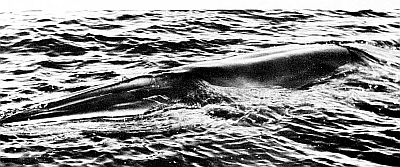
Figure 31.—Bryde's whales in the Gulf of California and north of Hawaii (inset). In both, note the tall, sickle-shaped appearance of the dorsal fin, much like that of the sei whale. In the animal in the larger photo note the ragged rear margin of the dorsal fin, a frequently observed characteristic in Bryde's whales. In the animal on the left note also the region of gray on the sides in front of the dorsal fin. (Photos by W. C. Cummings and S. Ohsumi [inset].)
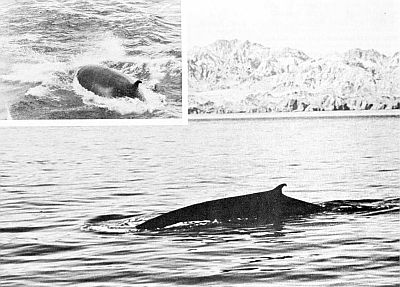
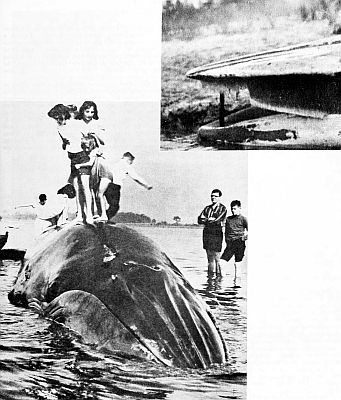
Figure 32.—Stranded Bryde's whales at Walnut Point, Va. (top) and Panacea, Fla., Gulf of Mexico (bottom). In both animals note the head shape similar to that of the sei whale, and the three distinct head ridges. In the animal on the bottom, note that the two outermost ridges have their origin in grooves beside the blowholes. In the animal on the top, note also the baleen plates, up to at least 300 per side and dark gray with coarse gray bristles. There is infrequently a rather wide interval at the front of the mouth between the left and right rows of baleen. (Photos by U.S. National Museum, courtesy of J. G. Mead [top] and M. B. Rank, courtesy of Wide World Photos [bottom].)
HUMPBACK WHALE (B) Megaptera novaeangliae (Borowski 1781)
Other Common Names
Humpbacked whale, bunch, hump whale, or hunchbacked whale.
Description
Humpback whales reach a length of 53 feet (16.2 m).
The body is robust, narrowing rapidly on the tail stock. The head is quite broad and rounded, somewhat like that of the blue whale. The head ridge characteristic of other balaenopterid species is indistinct and is replaced in prominence by a string of fleshy "knobs" or protuberances, many more of which are randomly distributed on the top of the head and on the lower jaw. There is a distinctive rounded projection near the tip of the lower jaw. Humpback whales carry many barnacles and whale lice. The baleen plates are all black with black or olive-black bristles.
The flippers are very long (nearly a third as long as the body), are scalloped on at least the leading edge, and are nearly all white.
The dorsal fin, located slightly more than two-thirds of the way back on the back in approximately the same position as that of the fin whale, is small and varies in size and shape from a small, triangular nubbin to a more substantial, sharply falcate fin. The dorsal fin frequently includes a step or hump, which is quite distinct when the animal arches its back to begin a dive and from which the species derives its common name.
Humpback whales are basically black in color with a white region of varying size on the belly, which upon close examination may often be seen to be crosshatched with thin dark lines; the flippers and the undersides of the flukes also are white.
Natural History Notes
The blow of humpback whales is from 8 to 10 feet (2.4 to 3.1 m) tall and has been described as balloon-shaped. It is wide relative to its height. Feeding humpback whales habitually blow 4-8 times at intervals of 15-30 s after a long dive. In the tropics they habitually blow 2-4 times in succession when beginning a long dive. In diving, humpback whales throw the tail flukes high into the air, exposing the sometimes white undersurface and the rippled rear margin.
Humpback whales often leap clear of the water, raise a flipper, and slap it against the water, or "lobtail," raising the tail high into the air and bringing it crashing back to the water in a loud report. Often, particularly when they are encountered on their tropical breeding grounds, humpback whales will be found lying on their sides with a long flipper in the air.
Humpback whales feed on krill and schooling fish.
May Be Confused With
From a distance humpback whales may be confused with any of the other large balaenopterid (rorqual) whales—blue, fin, sei, or Bryde's. Although it is highly variable, the dorsal fin most closely resembles that of the blue whale. However, it is located farther forward on the back. Humpback whales distinguish themselves from the remainder of the rorquals by their habit of raising the flukes high into the air when starting a long dive. (In very shallow water they may not raise the flukes at all.) The only other rorqual to do so—the blue whale—raises the flukes slightly or not at all.
Under some conditions humpback whales may be confused with sperm whales at a distance. When arching the back to begin a dive, both may show a distinct hump. Both species frequently raise their flukes nearly vertically when beginning a long dive but differ in several ways. The flukes of humpback whales show varying amounts of white beneath, are pointed on the tips, and are distinctly concaved and irregularly rippled on the rear margin. Those of sperm whales are all dark and more flattened and even along the rear margin. Further the species can be distinguished in the following ways:
Humpback Whale Sperm Whale
BLOW
Projects upwards from center of head. Usually blows 4-8 times (2-4 times in tropics) before diving. Projects obliquely forward from left side of snout. Usually blows many times (20-50 or more) before diving.
HEAD
Raised area around blowholes, knobs on upper surface. Blunted, long, smooth.
FLUKES
Often white underneath, concaved and scalloped on rear margin, deeply notched. Smooth, all black on rear margin.
FLIPPERS
Extremely long (to one-third of body), white and scalloped on leading edge. Short; all black.
DORSAL FIN (OR HUMP)
Triangular to falcate fin, including a step or hump in front of the dorsal fin; smooth. Rounded hump, two-thirds back on back followed by knuckles or crenulations.
When they can be examined at close range, humpback whales can be easily distinguished from all other large whale species with a dorsal fin by the tuberosities or knobs on the head, by the long white flippers scalloped on the leading edge, by the small distinctive dorsal fin, and by their distinctive tail flukes.
Distribution
In the western North Atlantic, humpback whales are widely distributed from north of Iceland, Disko Bay and west of Greenland, south to Venezuela and around the tropical islands of the West Indies. They have been reported from the central and eastern Gulf of Mexico. Summer ranges extend at least from New England north to the pack ice, and feeding concentrations may be found in any portion of this region. During winter, humpback whales migrate southward to the shallow borderlands of Bermuda, to the Bahamas, and to the West Indies to calve and mate.
Stranded Specimens
The most distinctive features of stranded humpback whales are 1) the ventral grooves, 14-22 in number, very wide and extending to the navel; 2) the tuberosities of the snout and lower jaw, often the sites of numerous barnacle colonies; 3) the long flippers (to nearly a third of the total body length); and 4) the distinctive rounded projection near the tip of the lower jaw.
If these characteristics are not sufficiently clear, the species may be identifiable by the characteristics of the baleen plates (Table 2).
Figure 33.—Three views of blowing humpback whales. The blow of this species is usually less than 10 feet (3.1 m) tall, wider than it is high, and has been described as balloon-shaped. In the photo on the top, the wind has already begun to distort the blow. In the photo on the bottom, two separate columns are visible. All baleen whales have a bipartite blowhole, and if an observer is directly behind or in front of either the right whale or the humpback whale under ideal wind conditions, the blows of these two species may appear as two distinct spouts. (Photos from West Indies by H. E. Winn [top and middle] and from off St. Augustine, Fla. by D. K. Caldwell [bottom].)
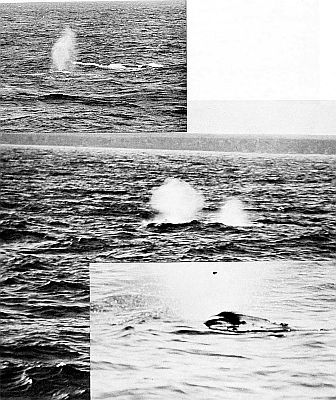
Figure 34.—Head views of surfacing humpback whales. Note the rather broad rounded appearance of the top of the head and the small head ridge, which extends from just in front of the blowholes to near the tip of the snout. In humpback whales the single central head ridge characteristic of most balaenopterid species is replaced in prominence by a series of knobs, some of which are oriented along the same line as the head ridge. On the animal in the inset photo note also the characteristic rounded projection below the tip of the lower jaw, heavily encrusted with barnacles. (Photos from off St Augustine, Fla. by D. K. Caldwell and from West Indies by H. E. Winn [inset].)
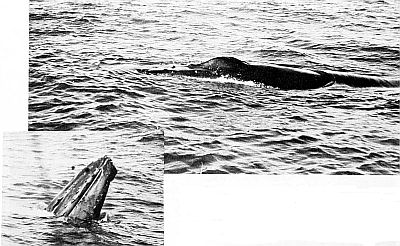
Figure 35.—A mother humpback whale with her newborn calf off the northern West Indies. Newborn humpback whales are from 12 to 15 feet (3.7 to 4.6 m) long and are colored like the adults. Note the mother's long white pectoral flipper, clearly visible below the surface. (Photo by H. E. Winn.)
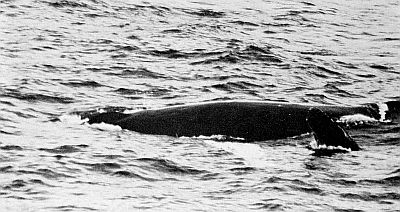
Figure 36.—Humpback whales fall back into the water after breaching. Note the long flippers, distinctly scalloped on the leading edge. In the animal on the top, note also the knobs on the head, visible in profile, the cluster of barnacles located on the rounded projection below the tip of the lower jaw, and the throat grooves. (Photos off Baja California by K. C. Balcomb [top] and off Bermuda by C. Levenson [bottom].)
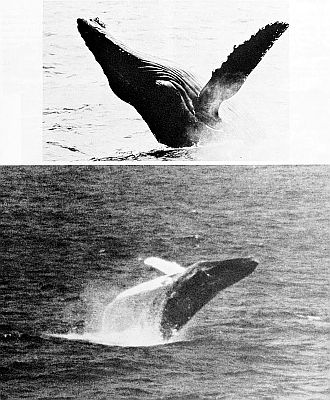
Figure 37.—Often, particularly on their tropical breeding grounds, humpback whales lie on their sides at the surface, the long white pectoral flipper in the air. Note the pronounced scalloping on the leading edge. (Photos near West Indies by C. McCann [top] and H. E. Winn [bottom].)
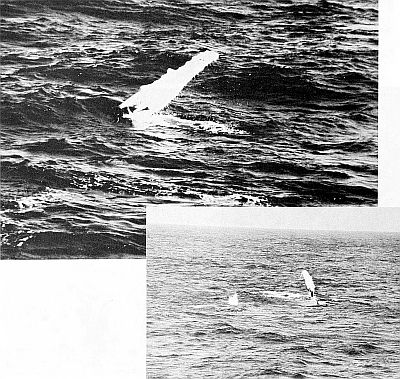
Figure 38.—A series showing the extreme variability in dorsal fin shapes of humpback whales: (a) a small ridge, (b) slightly falcate, (c) triangular with a pronounced hump, (d) slightly rounded, (e) distinctly rounded, and (f) taller and more distinctly falcate. (Photos from northern West Indies by H. E. Winn [a, c, e] and C. McCann [b]; off Baja California by K. C. Balcomb [d]; and off St. Augustine, Fla. by D. K. Caldwell [f].)
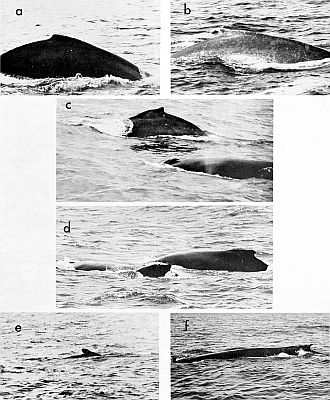
Figure 39.—The humpback whale is the only large whale species with a distinct dorsal fin which regularly raises its tail flukes when beginning a long dive. When it does so, the scalloped trailing edge is often visible (f, g, h). When the diving whale is seen from the rear, the varying degree of white coloration on the undersides of the flukes aids in identification (h). (Photos from northern North Atlantic by K. C. Balcomb [a-f], from West Indies by C. McCann [g], and from off Massachusetts by W. A. Watkins [h].)
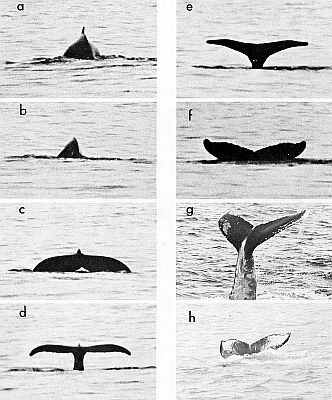
Figure 40.—Detail of the head of a humpback whale harpooned off Japan. Note the knobs along the top of the head and on the lower jaw, the rounded projection near the tip of the lower jaw and the wide ventral grooves. The large mass of tissue to the left of the animal is its tongue. In the inset photo from a Canadian whaling station, note the baleen plates, less than 3 feet (0.9 m) long and dark olive green to black in color. (Photos by Japanese Whales Research Institute, courtesy of H. Omura; and J. G. Mead [inset].)
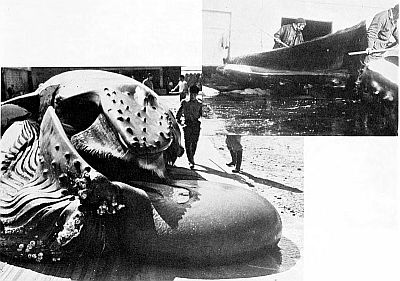
Figure 41.—A humpback whale on the deck of a whaling station in western Canada. All of the species' most distinctive characteristics are evident in this photograph: (1) the hump and the dorsal fin; (2) the knobs on the top of the snout; and (3) the long flipper, with numerous barnacles attached to its leading edge. (Photo by G. C. Pike, courtesy of I. MacAskie.)
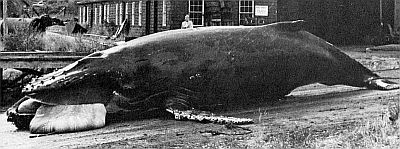
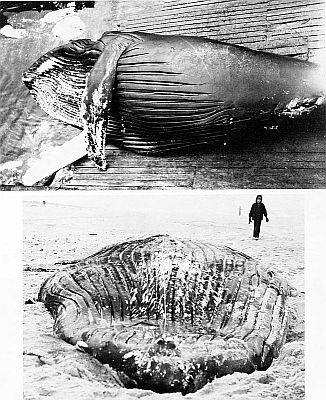
Figure 42.—North Atlantic humpback whales have from 14 to 20 broad, widely spaced ventral grooves which extend about to the navel. Those grooves remain good diagnostic characters for considerable periods after the animal's death, as evidenced in the freshly killed specimen from Newfoundland (top) and the badly decomposed stranded animal from New Jersey (bottom). (Photos from U.S. National Museum, courtesy of J. G. Mead.)
Large Whales Without a Dorsal Fin
BOWHEAD WHALE (B) Balaena mysticetus Linnaeus 1758
Other Common Names
Greenland whale, Arctic right whale, great polar whale.
Description
Bowhead whales, so-called because of the high-arching jaws and the resultant contour of the head, reach a maximum length of about 65 feet (19.8 m). They are extremely robust in form.
When viewed from the side, some swimming bowhead whales show two characteristic curves to the back: the first extends from the tip of the snout to just behind the blowholes; the second, encompassing the entire back, begins just behind the head and extends all the way to the tail. This character may be present only in adult animals and may be more pronounced in males. Younger animals, particularly females, are often stubbier and somewhat barrel-shaped behind the head. In all animals the back is smooth, lacking even a trace of a dorsal fin.
The head of the bowhead whale is smooth, black, and without the bonnet and the "rock-garden," the colorful clusters of callosities characteristic of the black right whale. The blowholes are widely separated, and the blow emanating from them projects upward as two separate, distinct spouts. Though two separate columns sometimes may be visible under windless conditions in the blows of most mysticetes, this feature is exaggerated and is most characteristic in the bowhead and right whales.
Bowhead whales are black overall, except for a white "vest" of uneven coloration on the chin. Within that vest, near the sides of the white zone, there may be a series of grayish black to black spots, which on some animals have been likened to a string of beads. The vest is clearly visible when a surfacing animal is viewed from the front or the side or when the animals hang vertically in the water with the head on the surface and the tail flukes down, as they do during periods of early spring mating.
Natural History Notes
Bowhead whales are usually found singly or in groups of up to three animals, though fall concentrations may include up to 50 animals.
Bowhead whales sometimes breach, throwing most of the body clear of the surface and reentering with a resounding splash.
May Be Confused With
Bowhead whales are the only species of large whales found routinely in Arctic waters. Though other species, including some of the balaenopterid whales and the right whale, may venture north as far as the southern limits of the bowhead whale and beyond, they usually do so in the spring and summer, at a time when the bowhead whales are farther to the north. Even if they are encountered together, bowhead whales can be distinguished from all the balaenopterid whales by the absence of a dorsal fin. Bowhead whales have neither a fin nor the slightest trace of a dorsal fin or ridge, while all the balaenopterids have a dorsal fin; and their back is extremely smooth, like that of the right whale. The bowhead and right whales may be readily distinguished from one another by the characters listed below for stranded specimens.
Distribution
Though bowhead whales in the western North Atlantic were once distributed from Arctic waters, from the edge of the ice, south as far as the Strait of Belle Isle and the St. Lawrence River in such abundance that they were once referred to simply as "the whale," overwhaling through the 19th century until as recently as 1911 has severely reduced their numbers and restricted their modern range. Today in addition to the more abundant populations of the Bering, Beaufort, and Chukchi seas and the Sea of Okhotsk, there are populations off eastern Greenland and in Davis Straits, Baffin Bay, James Bay, and the adjacent waters. Within these ranges, bowhead whales move southward in front of the advancing ice floes and may be expected near the southern limits of their range from September or October through the early spring months. Populations in the western North Atlantic appear to be increasing slowly.
Stranded Specimens
In addition to the fact that their ranges may overlap only slightly if at all, bowhead whales may be distinguished from the other right whales of the western North Atlantic by differences in 1) primary distribution, 2) coloration, 3) lengths of the longest baleen plates, and 4) presence of callosities.
Bowhead Whale Right Whale
DISTRIBUTION
Arctic distribution south to Davis Straits only during winter. Texas, southwest Florida north to Iceland, reaching northern limits only during spring and summer.
COLORATION
Black with white "vest" on front part of lower jaw, sometimes containing a string of black spots; upper jaw lacks the "rock garden." Sometimes black often brown or mottled with regions of white on chin and belly; patches of yellowish to pink callosities and lice encrusting the snout in what has been called a "rock garden."
BALEEN PLATES
325-360 per side; plates to 14 inches (35.6 cm) at base and longest plates up to 14 feet (4.3 m) long. Dark gray or black with gray fringes; anterior margin of some plates whitish, showing green iridescence in sunlight. 250-390 per side 12 inches (30.5 cm) at base and up to 7.2 feet (2.2 m) long. Dirty gray with black fringes; some anterior plates partly or completely white.
BONNET AND OTHER CALLOSITIES
Not present. Present.
Figure 43.—Swimming adult bowhead whales, particularly males, often show two characteristic humps or curves to the back—one on the head, ending just behind the blowholes, and a larger curve from just behind the blowholes to near the flukes; the second is accentuated when the animal humps up to begin a dive. (Photo by J. Lentfer.)
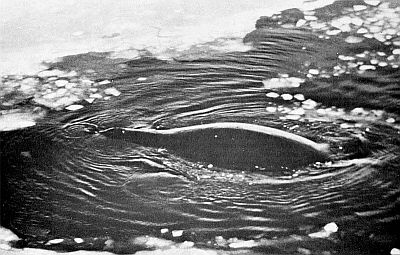
Figure 44.—Bowhead whales have no dorsal fin. The back is smooth and black, though often irregularly spaced white or grayish scars of unknown origin appear. (Photos by J. Lentfer.)
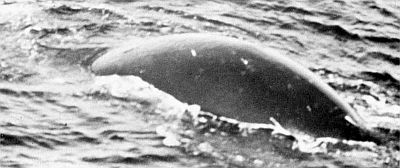
Figure 45.—The unusually shaped head and the broad lower jaw, colored by a broad white vest, are evident in the swimming bowhead whale (left) and in both members of the copulating pair (right). Also evident on the animal to the far left is the "string of black beads" which is sometimes found in the white region. (Photos by J. Lentfer.)
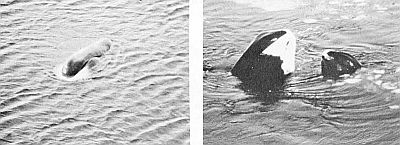
Figure 46.—A harpooned bowhead whale (this one from the Alaskan population). Note the high arching upper jaw of the species. Bowhead whales have up to at least 360 plates per side, far more than the black right whale. The longest plates, located near the middle of each jaw, are reported to reach 12 feet (3.7 m), or more, in length. (Photo by D. R. Patten.)
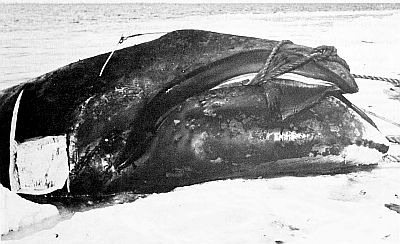
RIGHT WHALE (B) Eubalaena glacialis (Borowski 1781)
Other Common Names
Black right whale, Biscayan right whale, Biscay whale, Nordcaper right whale.
Description
These right whales reach a length of about 53 feet (16.2 m).
The body is rotund and completely lacking a dorsal fin or a dorsal ridge. The upper jaw is long, narrow, and highly arched. The lips are similarly highly arched. The top of the head has a series of bumps or callosities, the largest one of which is known as the "bonnet," on the upper surface in front of the blowholes. Yellowish-brown lice and, less frequently, barnacles grow on the callosities. The color and extent of the callosities varies from one individual to the next.
The two blowholes are widely separated, resulting in the projection of the blow upward as two distinct spouts. The body is dark on the back, sometimes black, more often brown or mottled, usually has a region of white on the chin and belly, and sometimes has numerous small grayish-white scars of unknown origin. The baleen plates are up to 7.2 feet (2.2 m) long, very narrow, and variable in color from dark brownish through dark gray to black in color. When the animals swim, mouth agape near the surface, the baleen sometimes appears pale yellowish gray in color.
Natural History Notes
Right whales are usually not wary of boats and may often be approached very closely.
Like sperm and humpback whales, they usually throw their flukes high into the air when beginning a long dive.
Right whales feed primarily on copepods.
Historically, this whale was nearly exterminated by hunters, who took advantage of its slow speed and who knew that its carcass floats, to harvest these animals for their great yield of whalebone and oil. It was these characteristics which prompted whalers to dub these animals the "right" whales to kill (as opposed to the ones that were too fast to catch and sank when killed).
May Be Confused With
The distinct blow of the right whales and their smooth dark back, devoid of any traces of a dorsal fin, make it unlikely that the species will be confused with any other large whales except, perhaps, the bowhead whale. In the event that the expansion of their ranges again causes these two species to overlap in distribution, they can be distinguished from one another by the characteristics discussed on p. 49.
If only the flukes are seen as the animal begins a dive, right and bowhead whales may be distinguished from the other two species of large whales exhibiting this behavior, the sperm and the humpback, in this way: the flukes of right and bowhead whales are broad, pointed on the tips, greatly concave towards a deep fluke notch, and dark below: those of the sperm whale are more nearly triangular, while those of the humpback whale have a jagged irregular or rippled rear margin and are sometimes variously white below.
Distribution
Like its more northern relative, the bowhead whale, the right whale was once the object of a widespread and extensive whale fishery, which reduced the species to critically low numbers.
Though the former range of right whales is not clearly known, the species is thought to have been abundant from the Davis Straits south at least to the Carolinas and Bermuda and to have occurred in winter to Florida and perhaps into the Gulf of Mexico.
Currently, right whales are known from Iceland south to Florida. Animals move north along the eastern Florida coast between early January and late March. During this time the species has also been observed in the Gulf of Mexico off southwestern Florida and Texas. Right whales pass the coast of New England in fair numbers in spring and continue as far north as at least Nova Scotia. Right whales are also found off Iceland, though the migration routes to and from Iceland waters are not known. The recent apparent increases in numbers at the northern and southern coastal approaches in New England and Florida, respectively, lend credibility to the hopeful contention that the species will again recolonize its historical range.
Stranded Specimens
Stranded right whales can be easily identified by all the characters discussed on p. 49 and summarized in Table 2.
Figure 47.—The V-shaped blow characteristic of right whales. Note the two distinct spouts, bushy in appearance. (Photo off Cape Cod by W. A. Watkins.)
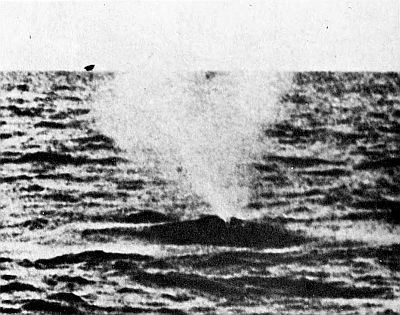
Figure 48.—A right whale off the northeastern Florida coast. Note the robust body, the smooth back, completely lacking a dorsal fin, and the narrow rostrum, bearing the characteristic yellowish callosities. Right whales, primarily mothers with calves, show up on the Florida coast in the early spring on their slow annual migration to the north. (Photo by N. Fain, courtesy of Marineland of Florida.)
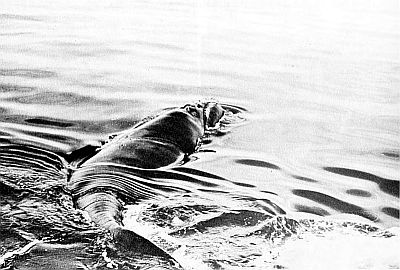
Figure 49.—Closeup views of the heads of right whales off northeastern Florida (top left and right) and off Cape Cod, Mass. (bottom left) clearly showing the narrow upper jaw, the bonnet, and the widely separated blowholes. In the photo on the bottom left note the extremely long baleen plates, characteristic of bowhead and right whales. (Photos by N. Fain, courtesy of Marineland of Florida [top left and right]; and W. A. Watkins [bottom left].)
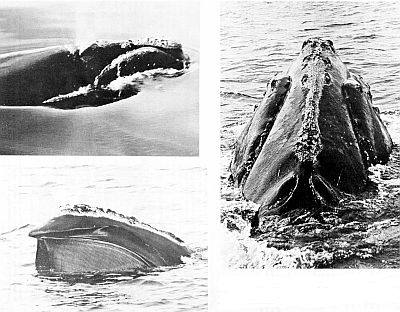
Figure 50.—Right whales frequently throw their tail flukes high into the air and then slip nearly vertically beneath the surface. Note that the rear margin of the flukes of this species, unlike that of the humpback whale, is smooth, broad, and concaved distinctly towards a deep fluke notch. (Photos from the northern North Atlantic by K. C. Balcomb [a-g] and off northeastern Florida by N. Fain, courtesy of Marineland of Florida [h].)
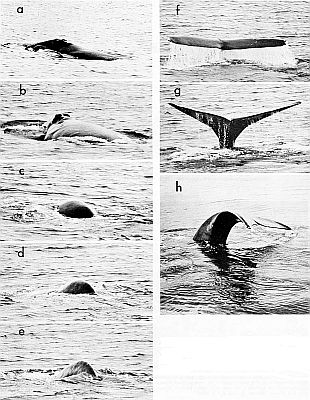
Figure 51.—A stranded right whale at Narragensett Bay, R.I. Note the narrow, highly arched lower jaw; the extremely long, narrow baleen plates, reaching lengths of 6.5 feet (2.0 m), or more; and the bonnet (the protuberance near the tip of the upper jaw). (Photo from U.S. National Museum, courtesy of J. G. Mead.)
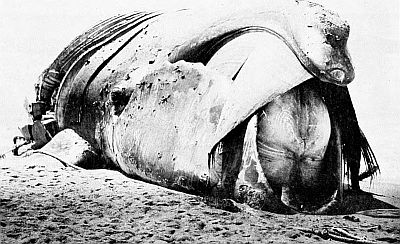
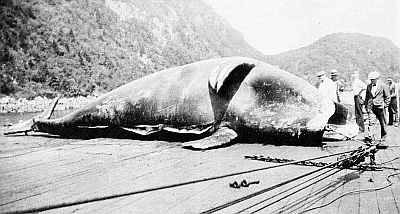
Figure 52.—A ventral view of a harpooned female right whale at Newfoundland. Note that this species, like the bowhead, lacks the series of ventral grooves which characterize all other baleen whales of the western North Atlantic. Note also the absence of the vest of white on the chin, a feature which is characteristic of the bowhead whale. Some right whales, however, do have extensive regions of white on the ventral surface, including the chin. (Photo from U.S. National Museum, courtesy of J. G. Mead.)
SPERM WHALE (T) Physeter catodon Linnaeus 1758
Other Common Names
Cachalot, Sea Wap (St. Vincent).
Description
Male sperm whales have been reported to reach a length of 69 feet (20.9 m), though today individuals larger than 50 feet (15.2 m) are rare. Females are much smaller, rarely exceeding 38 feet (11.6 m).
A sperm whale is among the easiest of whales to identify at sea even when comparatively little of the animal is visible. It has a huge head, which comprises from a fourth to a third of the animal's total length. (The proportion is considerably higher for males than for females.) The blunted "squarish" snout, which may project up to 5 feet (1.5 m) beyond the tip of the lower jaw, houses a large reservoir containing a high-quality oil called spermaceti.
The single blowhole is located well to the left of the midline and far forward on the head. As a consequence the small bushy blow, usually less than 8 feet (2.4 m), emerges forward at a sharp angle from the head and towards the left. Under good wind conditions this feature alone may permit positive identification of sperm whales even at considerable distances.
Sperm whales have a distinct dorsal hump, usually rounded in its appearance about two-thirds of the way back from the tip of the snout. Immediately behind the hump is a series of knuckles or crenulations along the midline. This hump and the crenulations are clearly visible when the animals arch the tail before beginning a dive. There is a ventral keel, which may also be visible as animals "sound" (dive). The flukes of sperm whales are broad and triangular in shape, are not concaved, but are deeply notched on the rear margin.
Sperm whales usually are dark brownish gray in color. The body has a "corrugated" or "shriveled" appearance. The belly and the front of the head may be grayish to off-white. The skin around the mouth, particularly near the corners, is white. The undersides of the flukes and flippers vary in color through numerous shades of browns and brownish grays.
Natural History Notes
Sperm whales may dive to depths in excess of 3,270 feet (996.7 m) for periods of an hour or more. As do most whales upon surfacing from a deep dive, sperm whales emit a single explosive blow and then, depending on the length of the dive, may remain on the surface for over 10 min and blow more than 50 times before beginning the next dive. Shorter periods on the surface and fewer blows are more common. Females may dive and remain on the surface for shorter periods of time than males. When beginning a deep dive, sperm whales throw their broad triangular flukes, dark on the undersides, high into the air.
Sperm whales may be found singly or in groups of up to 35 or 40 individuals. Older males are usually solitary except during the breeding season. During the remainder of the year large groups may be bachelor bulls (sexually inactive males) or nursery schools containing females and juveniles of both sexes. Sperm whales are seldom found in less than 600 feet (182.9 m) of water.
Sperm whales feed primarily on squid but may occasionally also take octopuses and a variety of fishes.
May Be Confused With
Because of their distinctive head shape and blow, sperm whales are unlikely to be confused with any other species when they can be closely examined. If only the back and tail flukes are seen, however, sperm whales may somewhat resemble humpback whales. Both species arch the back when beginning a dive, raising the fin or hump, and both throw the tail flukes. The most distinctive differences between the two species are tabularized on p. 40.
At sea the head of a sperm whale may also somewhat resemble that of an adult male northern bottlenosed whale, but this latter species is lighter brown in color, has a distinct beak and a prominent dorsal fin, and is rarely found south of lat. 42°N. In addition, the blowhole of the northern bottlenosed whale is located well back on the head and not—as in the sperm whale—on the front.
Distribution
Sperm whales are widely distributed in oceanic areas of the western North Atlantic. They may be encountered from Venezuela north at least as far as the Davis Straits, though they apparently avoid the polar ice fields. Distribution and migrations vary between males and females. Males range farther to the north, while females and immature males remain between lat. 30° and 50°N. Both groups shift northward during spring and summer and return to southern portions of their range in the fall. Adult males arrive off the New England coast in August. Those reaching the Newfoundland and Labrador coasts arrive from the deep sea, perhaps following the slope contours, in August and September. Males are abundant as far north as southeast Greenland and Iceland in summer. Some animals remain as late as November, but the majority migrate south to temperate or tropical waters in the early fall.
Historically the primary grounds in the western North Atlantic were those in all the following areas: the Grand Banks just southeast of the southern Grand Banks from lat. 30° to 40°N and long. 35° to 55°W, off the Carolinas, around the Bahamas, around many of the West Indies, and in the southwestern Caribbean.
Stranded Specimens
Stranded sperm whales should be easy to identify. The very narrow underslung jaw contains from 18 to 25 functional teeth, which fit into sockets in the upper jaw. The huge, distinctly box-shaped head and the position of the single blowhole to the left front of the head are unmistakable clues.
Figure 53.—An aerial view of 21 sperm whales, including two young calves and several large males, off Japan. Even from an aircraft, the position of the blowhole and the body shape clearly mark these animals as sperm whales. (Photos by Suisan Koku Company, courtesy of T. Kasuya.)
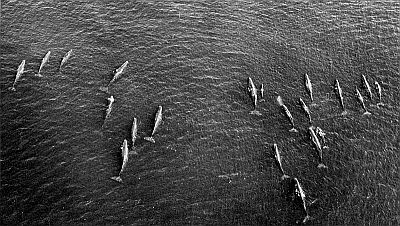
Figure 54.—A side view of a sperm whale in the West Indies, showing the distinctive blow. Note that the spout projects obliquely forward from the blowhole, which is displaced to the left front of the head. (Photo by H. E. Winn.)
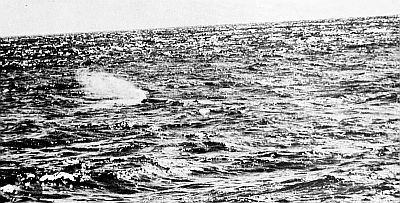
Figure 55.—Note the distinctive body shape and the position of the blowhole of these swimming sperm whales, and, in the animal on the left, the broad tail flukes. (Photos from the North Atlantic by S. Green [left] and from the North Pacific by S. Ohsumi [right].)
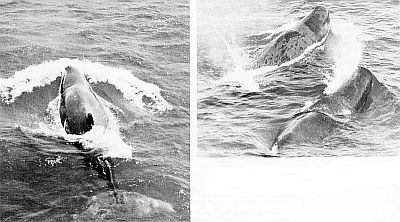
Figure 56.—A sperm whale mother and calf off Baja California, showing the distinct dorsal hump and the extremely long head. In the bottom photo, from the West Indies, note the dorsal hump and the crenulations of bumps which follow it. Both the hump and the crenulations may be visible as the animal arches its tail to begin a deep dive. Note also the wrinkled appearance of the body. (Photo by K. C. Balcomb [top] and H. E. Winn [bottom].)
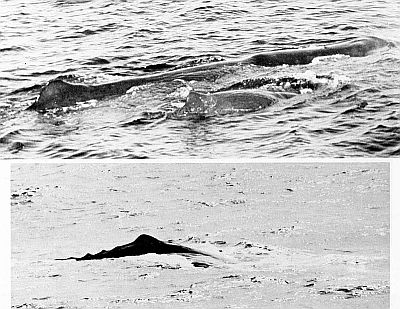
Figure 57.—Sperm whales often show their broad tail flukes as they begin long dives, which may last over an hour and take them to depths of several thousand feet or more. Note the smooth rear margin and the nearly triangular shape of the flukes. (Photo from off Baja California by K. C. Balcomb.)
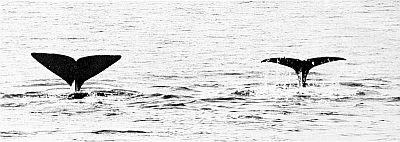
Figure 58.—A stranded infant male sperm whale at Melbourne Beach, Fla. (top) and a male adult sperm whale on the deck of a whaling ship in the Pacific (bottom). Note the bulging forehead, the narrow, underslung lower jaw, the white coloration around the mouth, particularly at the corners, and the wrinkled appearance of the body. In the bottom photo note also the whitish region on the belly. (Photos by P. Winfield [top] and Japanese Whales Research Institute, courtesy of H. Omura [bottom].)
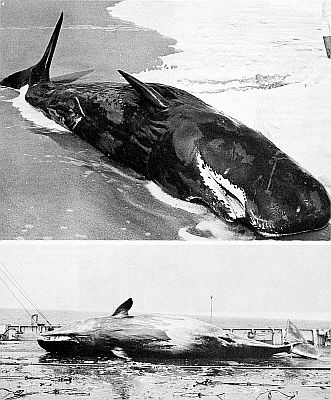
Figure 59.—The narrow lower jaw of a sperm whale contains from 18 to 25 large functional teeth, which fit neatly into sockets in the upper jaw. Occasionally, the upper jaw also contains some teeth. (Photo from the North Pacific by Japanese Whales Research Institute, courtesy of H. Omura.)
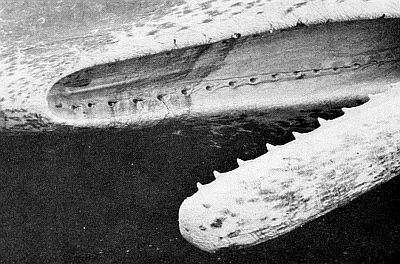
Figure 60.—The throat and lower jaw of a sperm whale on the deck of an eastern Canadian whaling station, showing the numerous short throat grooves, which are most clearly evident on adult animals. (Photo by J. G. Mead.)
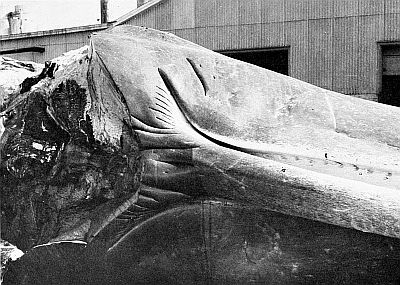
Figure 61.—Detail of the broad, paddle-shaped flipper of a sperm whale from the North Pacific. (Photo from Japanese Whales Research Institute, courtesy of H. Omura.)
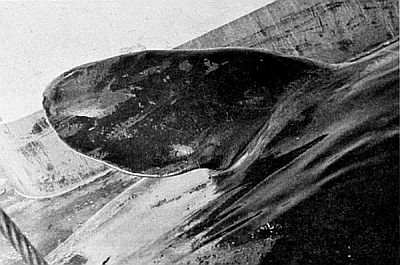
Medium-sized Whales With a Dorsal Fin
MINKE WHALE (B) Balaenoptera acutorostrata Lacepede 1804
Other Common Names
Little piked whale, lesser rorqual, little firmer, sharp-headed finner, grampus (Newfoundland), gibord (Quebec).
Description
Minke whales are the smallest baleen whale species in the northern hemisphere, reaching maximum lengths of just over 30 feet (9.1 m). One of the most distinctive features of this species is an extremely narrow, pointed, distinctly triangular rostrum with a single head ridge, similar to but much sharper than that of the fin whale (hence the common name "sharp-headed finner"). Minke whales have a tall, falcate dorsal fin located in the latter third of the back, in about the same position as that of the sei whale, which often becomes visible simultaneously with the low, usually inconspicuous blow.
Minke whales are black to dark gray on the back and white on the belly and on the underside of the flippers. Portions of the underside of the flukes may be steel bluish gray. They have a diagonal band of white on each flipper, the extent and orientation of which varies individually.
Like the fin whale, minke whales (at least from the Pacific) sometimes have a chevron on the back behind the head and often have two regions of lightish-gray coloration on each side—one just above and behind the flippers; another just in front of and below the dorsal fin. These patches may be quite conspicuous on some animals, indetectable on others. These markings may also be present on Atlantic specimens, though they have not yet been documented. The baleen, which may be visible from close range when the animal is feeding, is mostly yellowish white with fine white bristles. The posterior plates (up to half) may be brown to black.
Natural History Notes
Minke whales are frequently found as single animals, pairs, or trios, though they may congregate in areas of food concentration in the northern seas during the spring and summer. They are more likely to be seen up close than their larger cousins—the blue, fin, and sei whales—because they often closely approach boats, particularly stationary boats, as if curious about them.
Minke whales may also approach very close to shore and often enter bays, inlets, and estuaries.
Like fin whales, they often arch the tail stock high into the air when beginning a long dive. However, they do not raise the flukes above the surface when beginning a dive.
Minke whales feed primarily on small shoal fish (herring, cod, pollack, and capelin).
Minkes sometimes breach, leaping completely clear of the water and entering smoothly, head first, or with a substantial splash like humpback whales.
May Be Confused With
When they are seen at relatively close range, minke whales can be readily distinguished from the other rorquals that have relatively tall, falcate dorsal fins (fin, sei, and Bryde's whales) by their considerably smaller size and by their distinctive white band on each flipper.
At a distance, however, positive identification may be difficult. Minke whales have a small, low, inconspicuous blow. Like sei whales, they frequently expose the dorsal fin simultaneously with the blow, but minke whales hump the tail stock much higher when beginning a long dive—more like fin whales.
From a distance, minke whales might also be mistaken for northern bottlenosed whales (or any of several other beaked whales with a similar dorsal fin). They can be distinguished by the differences in head shape, body color and markings, and behavior, detailed on p. 67.
Distribution
Minke whales are distributed in the polar, temperate, and tropical waters of the western North Atlantic. They are found from the pack ice south to at least Anguilla, Lesser Antilles, and the eastern Gulf of Mexico, though they appear to be most abundant in temperate waters north of the latitude of New York and are infrequently reported from tropical waters. At least some of the population migrates to the northern portions of their range in spring and back south in autumn. They often approach close to shore and enter river mouths, inlets, and estuaries.
Minke whales arrive along the Canadian coast in May or June. Some migrate as far north as Hudson Strait, where they remain until the freeze in October, November, or December. By December the majority of the population has begun to move to the south, although some animals remain behind so long as to become entrapped in the ice and die. Spring and summer concentrations along the Canadian coast correspond to concentrations of capelin, cod, and herring. Southern concentrations, also corresponding with concentrations of herring, extend farther offshore at least to the edges of the Grand Bank. Minke whales also summer off the south coast of western Greenland, which they probably reach from waters southwest of Iceland. Minke whales also occur in deep pelagic waters.
Stranded Specimens
Stranded minke whales can be most readily identified by: 1) their small size (to just over 30 feet [9.1 m]); 2) the transverse white bands on the flippers; 3) the yellowish-white baleen plates (up to half the posteriormost plates may be brown or black), 300-325 per side in number and having fine white bristles (the plates are up to 4.75 inches [12 cm] wide at the base and up to 8 inches [20.3 cm] long); and 4) by the 50-70 thin ventral grooves, ending well before the navel, often just even with the flippers.
Figure 62.—The minke whale, at a maximum length of just over 30 feet (9.1 m), the smallest baleen whale species of the western North Atlantic, is distributed in polar, temperate, and tropical waters. These animals usually have a low, inconspicuous blow and are sometimes curious enough about boats that they will alter their course to investigate them. Note the two areas of light gray on the sides of the body, characteristic of at least Pacific minke whales. (Photo from off British Columbia, courtesy of Nanaimo Free Press.)
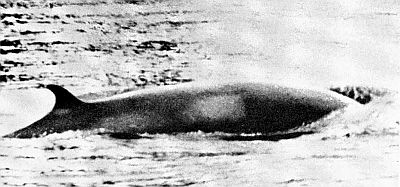
Figure 63.—Three views of minke whales at sea. In all note the transverse band of white on the flippers and the sharply pointed head. Note the gray chevron visible on the back (top), the absence of a conspicuous blow and the appearance of the prominent dorsal fin on the surface while the blowholes are still exposed (middle), and the distinctive regions of light gray on the sides (bottom). (Photos from off San Diego, Calif. by G. E. Lingle [top]; from the northern West Indies by H. E. Winn [middle]; and from the western Pacific by Japanese Whales Research Institute, courtesy of H. Omura [bottom].)
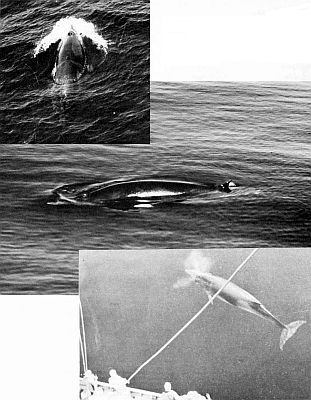
Figure 64.—Minke whales are also known as sharp-headed finners. On this animal from the North Pacific, note the sharply pointed head and the single central head ridge. (Photo by Japanese Whales Research Institute, courtesy of H. Omura.)
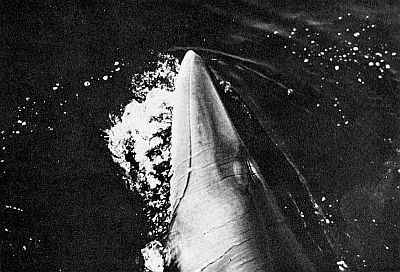
Figure 65.—A minke whale stranded at Santa Barbara, Calif. Note the dark back, the white-banded flipper, and the 60-70 fine ventral grooves extending to just behind the flippers. The short, white baleen plates are visible in the open mouth. (Photo by S. Anderson.)
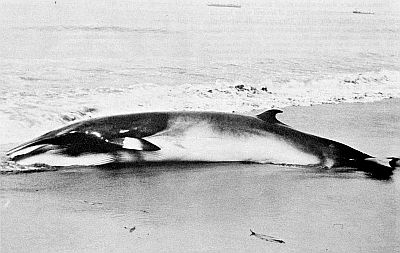
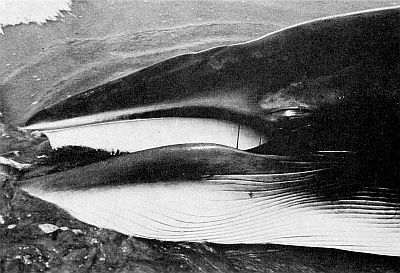
Figure 66.—Minke whales have from 300 to 325 short, yellowish-white baleen plates (up to half the anteriormost plates may be brown or black) with fine white bristles on each upper jaw. (Photo from Santa Barbara, Calif. by S. Anderson.)
NORTHERN BOTTLENOSED WHALE (T) Hyperoodon ampullatus (Forster 1770)
Other Common Names
None known.
Description
Northern bottlenosed whales reach a length of 32 feet (9.8 m) and are robust in form. They are characterized by a bulbous forehead, which is more pronounced on larger animals and most distinctive in adult males, and by the dolphinlike beak displayed in animals of all sizes and ages, which is sometimes visible as the animals surface steeply to breathe.
The blowhole is located in an indented area behind the bulbous forehead, and the blow emanating from it projects upward or slightly forward to a height of up to 6 feet (1.8 m), is bushy and is visible from a considerable distance under low wind conditions. The dorsal fin, located two-thirds of the way back on the back, reaches at least 12 inches (30.5 cm) in height and is distinctly falcate. The dorsal fin may be visible from a distance of several hundred meters.
Northern bottlenosed whales are usually brownish in color, though the markings change with age. Smaller animals are a uniform chocolate brown. Larger animals retain the chocolate brown color on the back but are often lighter on the sides and the belly and often have irregular patches or blotches of grayish-white coloration on the back and sides. Extremely large animals, presumably older males, often have a white head. The flippers and the undersides of the flukes are uniformly brown in color.
Natural History Notes
Northern bottlenosed whales often form tightly packed groups of up to 10 or more animals. This species holds the anecdotal record for the longest dives, having been reported by early whalers to remain submerged over 2 h. They are probably deep divers, feeding primarily on squid (though they may take fishes as well), and they rarely go in water shallower than 100 fathoms (183 m).
After a long dive, northern bottlenosed whales will sometimes remain on the surface for 10 min or more, blowing at regular intervals before making another dive. After the last blow of a series or when the animals are startled by a boat, they may show the tail flukes as they begin to dive. The flukes are not notched on the rear margin.
Northern bottlenosed whales have been observed to show curiosity about boats, coming to them from a considerable distance. They have also been observed to "lobtail," raising the tail flukes above the water and slapping them against the surface, and to jump clear of the water.
In the late 19th century, after stocks of bowhead whales were severely reduced by overwhaling, northern bottlenosed whales became a prime target of arctic whalers. They were sought because in addition to whale oil produced from the body blubber, the forehead of the species yielded quantities of spermaceti like that obtained from sperm whales.
May Be Confused With
Northern bottlenosed whales have a northerly and deep-water distribution. Within their range, they may be confused at a distance with minke whales, with sperm whales, or perhaps with North Sea beaked whales.
Minke whales (p. 63) have a falcate dorsal fin located in approximately the same position as that of the northern bottlenosed whale. However, minke whales have a flathead in front of their two blow holes and are black to dark gray on the back.
Sperm whales (p. 57) have a squarish head that may somewhat resemble that of an adult male northern bottlenosed whale. However, there are numerous characteristics which will permit these species to be distinguished even from a distance:
Northern Bottlenosed Whale Sperm Whale
BLOW
Low and bushy; projects upward from indentation on top of head. Low and bushy, projects obliquely forward from left side of head; usually less than 8 feet (2.4 m).
COLORATION
Lighter brown; adults splotched with grayish white; body smooth. Brownish gray; body appears wrinkled.
FLUKES
Rarely notched; seldom raised on long dive. Notched; raised on long dive.
HEAD
Tapering in younger animals; bulbous in adults; white in older animals; beaked. Squarish, long, all black; bbeakless.
A further aid to distinguishing northern bottlenosed and sperm whales at sea is the fact that the sperm whales that are found in areas where northern bottlenosed whales are encountered are usually older, larger males from 40 to 60 feet (12.2 to 18.3 m) long. Northern bottlenosed whales do not exceed 32 feet (9.8 m).
Northern bottlenosed whales may also be confused with the poorly known North Sea beaked whale (p. 82). When they can be examined at close range, however, northern bottlenosed whales should be distinguishable on the basis of the distinctly bulbous forehead.
Distribution
In the western North Atlantic, northern bottlenosed whales are restricted to Arctic and north temperate waters, where they most commonly occur in offshore areas. They have been reported from Davis Straits and the entrance to Hudson Strait, the Gully southeast of Sable Island, and as far south as Narragansett Bay, R.I.
In the spring and summer they concentrate near the northern limits of their range, occasionally visiting deep channels of the Gulf of St. Lawrence and eastern Newfoundland in summer. During these seasons they may extend to the edge of the pack ice.
In the fall and winter the bulk of the population migrates southward. Many probably winter in the Labrador Sea while others move farther southward and farther offshore.
Stranded Specimens
Like the beaked whales discussed on p. 70 through 83, the northern bottlenosed whales have no notch in the tail flukes, have two throat grooves forming a V-shape on the chin, and have only two teeth in the lower jaw, with those teeth emerged from the gums only in adult males. These teeth may have sometimes fallen out of older males, but the tooth sockets should still be visible in the gums.
NOTE: Some specimens—both male and female—will be found to have a series of vestigial teeth the size of toothpicks in the upper and/or lower jaws. Similar vestigial teeth, 5-40 in number, sometimes occur in goosebeaked whales (p. 70). Further when they are prepared for museum collections, the lower jaws of adult northern bottlenosed whales may be found to contain a second pair of teeth just behind the first.
Northern bottlenosed whales may be distinguished from the remainder of the beaked whale family, however, by the extremely robust body, by the bulbous forehead, which is more extensively developed in larger animals, particularly males, and by the pronounced dolphinlike beak.
Figure 67.—Northern bottlenosed whales at sea off Nova Scotia. Note the prominent dorsal fin and the blotches of grayish-white coloration on the body. Northern bottlenosed whales reach 32 feet (9.8 m) in overall length. (Photo by H. E. Winn.)
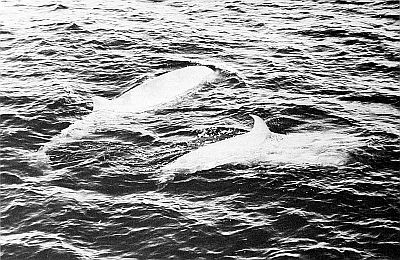
Figure 68.—Views of the heads of male northern bottlenosed whales off Nova Scotia. Note the distinctive beak (right) and the bulbous forehead, features which develop with age and are most pronounced in adult males. In the animal on the left, note also the low bushy blow emanating from the indented area on the top of the head. (Photos by H. E. Winn.)
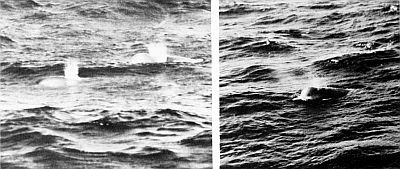
Figure 69.—Northern bottlenosed whales occasionally raise their tail flukes when beginning a dive. At close range, these flukes can often be seen to lack a distinctive notch on the rear margin. (Photo from off Nova Scotia by J. Hain.)
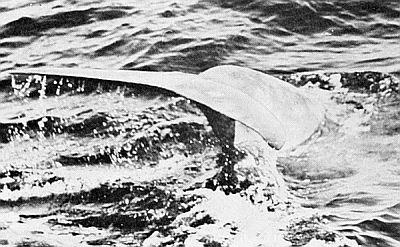
Figure 70.—A stranded northern bottlenosed whale from Holland. Note the bulbous forehead, the long dolphinlike beak and the frequent absences of a notch in the rear margin of the tail flukes. (Photo by J. P. Strijbos, courtesy of Rijksmuseum van Natuurlijke Historie te Leiden.)
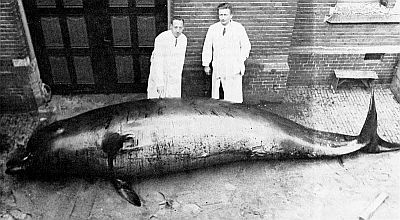
GOOSEBEAKED WHALE (T) Ziphius cavirostris G. Cuvier 1823
Other Common Names
Ziphius, Cuvier's beaked whale, grampus (St. Vincent) (see also p. 96).
Description
Goosebeaked whales reach a length of 23 feet (7 m). Females are slightly larger than males of the same age. Calves are probably less than about 6 feet (1.8 m) at birth. The head is small relative to the body length and, when viewed laterally, is slightly concaved or scooped on the upper margin. The cleft of the mouth is small, smaller than in any other species of beaked whales. The beak is indistinct in larger individuals. There is a distinct indentation on the back behind the head. Two teeth are found at the tip of the lower jaw of adult males only.
The dorsal fin is relatively tall and distinct, to at least 15 inches (38.1 cm), smoothly falcate, and located well behind the midpoint of the back. The blowhole is located far forward on the top of the head. The blow, which may project slightly forward and slightly off to the left, is usually low and inconspicuous. Though the first blow after a long dive may be more distinct, even it is rarely visible even under good wind conditions for more than a few hundred yards.
Descriptions of the color pattern vary. Individuals may be dark rust brown, slate gray, or fawn colored on the back and generally lighter on the belly. Some appear dark in both regions, still others—particularly youngsters—appear lighter gray or tan on the belly. The body is frequently covered with white or cream-colored blotches (particularly on the belly). The tail flukes are dark on the bottom. The head is frequently paler in color. Old males have a distinct white head and are frequently extensively scarred.
Natural History Notes
Goosebeaked whales frequently occur in groups of from 10 to as many as 25 individuals. They have been reported to jump clear of the water. They are presumably deep divers and are known to stay down for more than 30 min. When they begin a deep dive, they often raise their tail flukes above the surface and dive nearly vertically. Goosebeaked whales feed primarily on squid.
May Be Confused With
So little is known of the external appearance and behavior of the living beaked whales at sea that all the species may easily be confused.
Goosebeaked whales are larger than all other beaked whale species with the exception of the northern bottlenosed whale. Upon close examination they may be distinguished from the northern bottlenosed whale by the lighter coloration of the head, reaching an extreme in the white head of adult males. (See p. 67 and Fig. 75.)
Distribution
As with other species of beaked whales seldom encountered or at least seldom positively identified at sea, the distribution of goosebeaked whales is poorly known and must be constructed from records of stranded specimens. Such records, often involving sick individuals that may have washed ashore from considerable distances, may give an inaccurate picture of normal ranges.
In general, stranding reports suggest that goosebeaked whales are sparsely but widely distributed in nonpolar latitudes. They appear to be primarily tropical in distribution, though they venture into temperate areas in summer. They have been reported from Massachusetts and Rhode Island south to Florida and thence to the islands of the West Indies. They are frequently stranded along the Florida coast and are not an uncommon species in the extant whale fishery of the Antillean Islands. The fact that goosebeaked whales strand more frequently than other beaked whales may reflect either a greater abundance or a greater tendency to approach close to shore.
They are probably primarily an offshore species.
Stranded Specimens
To be positively identified, stranded goosebeaked whales in an advanced state of decomposition may require museum preparation and examination of the skull and teeth. Fresh specimens may be tentatively identified by the characters illustrated in the figures.
Figure 71.—Goosebeaked whales have been rarely seen at sea. In these photos from the eastern tropical Pacific, note the white head of the animal on the left. Goosebeaked whales are wary of boats and may dive for 30 min or more. When they surface, their blow, usually very indistinct, may project forward and slightly to the left. (Photos by K. D. Sexton, courtesy of National Marine Fisheries Service.)
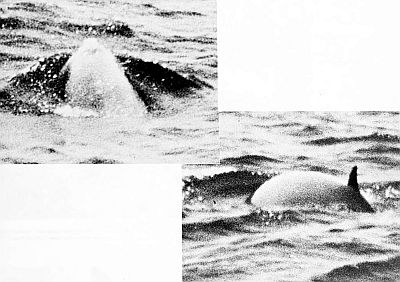
Figure 72.—A beaked whale, probably a goosebeaked whale, jumps beside a research ship off northwestern Baja California. Note the position and shape of the dorsal fin and the depression just behind the head. (Photo by S. Leatherwood.)
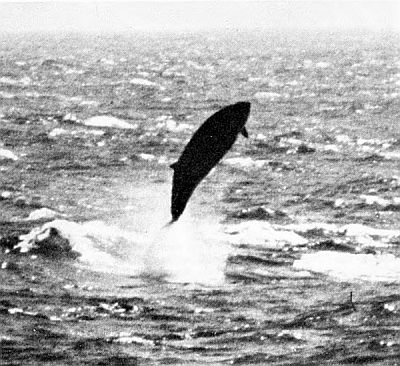
Figure 73.—A goosebeaked whale stranded in Delaware. Goosebeaked whales are primarily tropical in distribution, though they apparently venture into temperate areas in summer. Note the prominent dorsal fin, the lighter coloration of the head, and the depression just behind the head. (Photo from U.S. National Museum, courtesy of J. G. Mead.)
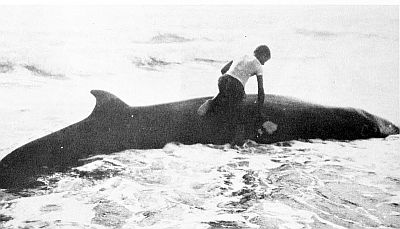
Figure 74.—A closeup of the dorsal surface of the flukes of a juvenile goosebeaked whale stranded in the northeastern Gulf of Mexico. Like other members of the beaked whale family, goosebeaked whales lack a distinctive notch in the rear margin of the flukes. (Photo courtesy of Florida's Gulfarium.)
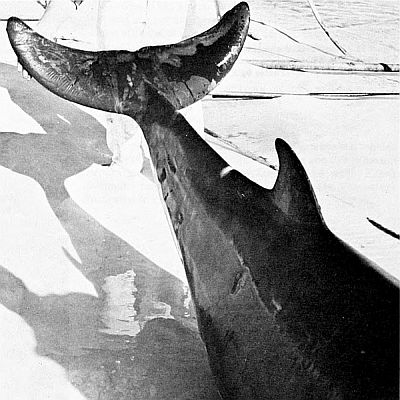
Figure 75.—Stranded goosebeaked whales, an adult male from northern California (top) and an immature female from the northeastern Gulf of Mexico (bottom). Note the brownish color of the back, marked in the adult animal by blotches of lighter gray and numerous scratch marks, presumably tooth rakes. Note also the mouth cleft, shorter in this species than in any other beaked whale species, and the slightly concave appearance to the upper margin of the head. The beak is usually less developed in large animals. The inset photo shows a ventral view of the tip of the lower jaw of an adult male from the east coast of Florida. The two teeth of the species are emerged above the gum only in adult males. (Photos by W. J. Houck [top], Florida's Gulfarium [middle], and W. A. Huck, courtesy of Marineland of Florida [inset].)
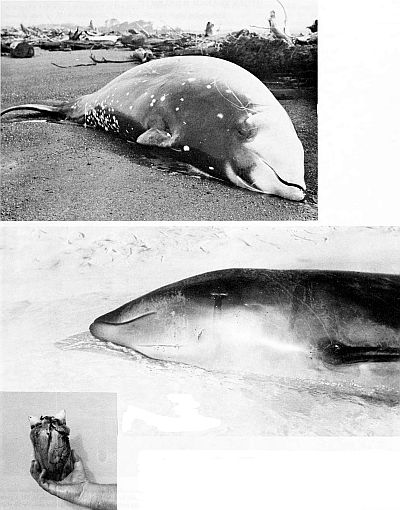
OTHER BEAKED WHALES (T) Mesoplodon spp.
Other Common Names
Grampus (St. Vincent) (see also p. 96).
Description
In addition to the northern bottlenosed whale (p. 67) and the goosebeaked whale (p. 70), four other species of beaked whales have been reported from the western North Atlantic. All four species are known primarily from stranded specimens and have been rarely encountered at sea. Therefore statements of range are usually limited to inferences from locations of strandings, and information on appearance and habits of the species in the wild is almost totally lacking.
The infrequent encounters with beaked whales at sea may result from such factors as 1) a low inconspicuous blow, 2) avoidance of ships, and/or 3) distribution in small groups in offshore areas well outside the normal boating lanes.
The following descriptions will aid primarily in identifying stranded specimens. Though subtle differences in ranges, color patterns, and dorsal fin shapes and positions may be helpful in narrowing the choices of living animals, the species will continue to be extremely difficult to distinguish from one another in the brief encounters typical at sea until additional data are collected.
The beaked whales have the following characteristics in common: 1) two small creases forming a V-shape on the throat, 2) the absence of a conspicuous notch on the rear margin of the tail flukes (some specimens have a slight indentation), and 3) the absence of functional teeth in all except adult males. Adult males have a single pair of teeth in the lower jaw, the position and description of which help to identify the species. The teeth of females are not functional and only rarely emerge from the gums. Therefore, if a stranded animal is an adult male, its species can be determined by the position and description of the teeth. For example, in Mesoplodon mirus, the teeth are located near the tip of the lower jaw; in M. europaeus, they are located about a third of the way from the tip of the snout to the corner of the mouth; in M. bidens, they are nearly half way from the tip of the snout to corner of the mouth; and in M. densirostris, they are located in large prominences near the back of the mouth.
If the animal is a female or an immature male, however, museum preparation and examination might be required before the species can be positively determined. The following four sections summarize characters of western North Atlantic beaked whales.
Figure 76.—An unidentified beaked whale from the mid-Pacific. Note the marks along the back, presumably tooth rakes, consisting of scratches that are paired and close together. A beaked whale in the western North Atlantic marked in this manner would be a northern bottlenosed whale (p. 67), a goosebeaked whale (p. 70), or a True's beaked whale (p. 77). These are the only three species in which the teeth are located close together near the tip of the lower jaw. (Photo by K. C. Balcomb.)
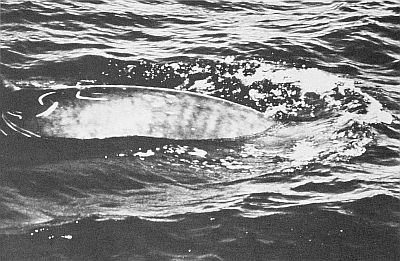
Figure 77.—Various views of a herd of five or six unidentified beaked whales, possibly dense-beaked whales, 12 miles off Pokai Bay, Oahu, Hawaii. The animals were very shy and had low indistinct blows, making them difficult to spot and track. As they surfaced, individuals frequently bucked their heads and slapped the chin against the surface, rather than rolling. They did not raise their tail flukes when beginning their long dives. (Photos by E. Shallenberger, Sea Life Park, Hawaii.) (Because so little is known of beaked whales every encounter should be recorded in as much detail as possible.)