SPECIES ACCOUNTS (continued 3)
Reading edition
Natural History Notes
Guiana dolphins are usually found in groups of fewer than 10 individuals.
May Be Confused With
Because of their limited range and specialized habitats, Guiana dolphins are unlikely to be confused with any other cetacean species except perhaps Atlantic bottlenosed dolphins (p. 128). These two species can be distinguished by the following characteristics:
Guiana Dolphins Atlantic Bottlenosed Dolphins
SIZE
To only 5.6 feet (1.7 m). 8 to as much as 12 feet (2.4 to 3.7 m).
DORSAL FIN
More nearly triangular; curved only slightly backwards near tip. Broad-based, tall, and falcate.
DISTRIBUTION
Found in rivers and estuaries, extend into only very shallow nearshore waters on limited area of South American coast. Sometimes found nearshore and in bays, river mouths, and estuaries, but extend farther offshore.
Distribution
Guiana dolphins are found in Lake Maracaibo, in the rivers of Guyana, and in the nearshore coastal waters of the northeastern portion of the Guianas.
Stranded Specimens
In their very limited range, stranded Guiana dolphins can be readily identified by their extremely small size (to 5.6 feet [1.7 m]) and nearly triangular dorsal fin. Furthermore, in addition to the characteristics listed above distinguishing living Guiana dolphins from Atlantic bottlenosed dolphins, the species can be distinguished by differences in the numbers of teeth:
Atlantic Bottlenosed Dolphins Guiana Dolphins
TEETH
20-26 in each upper jaw; 18-26 in each lower jaw. 26-35 in each jaw; often ragged in arrangement.
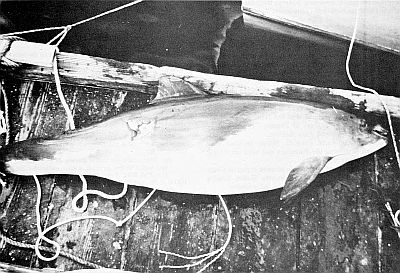
Figure 147.—A Guiana dolphin from Kartabo, British Guiana. In the coastal portion of its range along the northeastern South American coast, this species is most likely to be confused with the Atlantic bottlenosed dolphin. Guiana dolphins are much smaller, rarely exceeding 5.6 feet (1.7 m), have a more triangular dorsal fin, and tend to be found more frequently in estuaries and rivers. (Photo by A. B. Van Beneden from Zoologica VII(4), by permission of the New York Zoological Society.)

Figure 148.—Guiana dolphins harpooned in Kartabo, British Guiana. Guiana dolphins have from 26 to 35 teeth in each jaw. Atlantic bottlenosed dolphins, which are larger but somewhat similar in appearance, have from 20 to 26 teeth in each upper jaw and from 18 to 26 in each lower jaw. (Photo by A. B. Van Beneden from Zoologica VII (4), by permission of the New York Zoological Society.)
ROUGH-TOOTHED DOLPHIN (T) Steno bredanensis (G. Cuvier in Lesson 1828)
Other Common Names
Rough-toothed porpoise, goggle-eyed porpoise.
Description
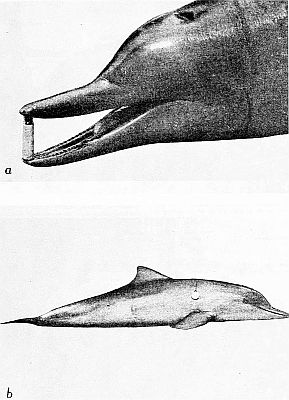
Rough-toothed dolphins reach a length of at least 8 feet (2.4 m). The coloration of the rough-toothed dolphins is quite variable. Individuals are often dark gray to dark purplish gray on the back with pinkish-white blotches on the sides and belly. The flippers and flukes are dark and the belly is white. Individuals are frequently scarred with numerous white streaks.
The most distinctive characteristic of the rough-toothed dolphin is its beak, which is quite long and slender, may be white or pinkish white along both sides, including one or both lips and the tip of the snout, and is not separated from the forehead by the transverse groove present in other long-snouted dolphins. Because the forehead and the sides of the head slope smoothly into the rostrum, when this animal is seen from above or from the side, its entire head appears very long and nearly conical.
Natural History Notes
Rough-toothed dolphins occur in small groups of 50 animals or fewer and are usually found off the edge of the continental slope. They may ride the bow waves.
May Be Confused With
In their offshore habitat, rough-toothed dolphins are most likely to be confused with Atlantic spotted dolphins (p. 104) and with Atlantic bottlenosed dolphins (p. 128). They may be distinguished from Atlantic spotted dolphins by the following:
Rough-Toothed Dolphin Atlantic Spotted Dolphin
SNOUTS
Long and slender; not clearly demarcated from forehead. Moderate in length and clearly demarcated from forehead.
They may be distinguished from Atlantic bottlenosed dolphins by the characteristics tabularized on p. 128.
Even at a distance the blotched coloration of the side and the white coloration of the rostrum of rough-toothed dolphins may be visible. If closer examination is possible, the distinctive shape and coloration of the beak make positive identification easy.
Distribution
Though records of rough-toothed dolphins from the western North Atlantic are scant, the species is assumed to be widely distributed in deep tropical to warm temperate waters. It has been reported from Virginia, Georgia, Florida, the Gulf of Mexico, the West Indies, and off the northeastern coast of South America.
Stranded Specimens
In addition to the characteristics listed above for distinguishing living animals, stranded rough-toothed dolphins can be readily identified by the fact that the 20-27 fairly large teeth per jaw per side have a series of fine vertical wrinkles on the crown, a characteristic from which the species derives its common name. (These wrinkles are often difficult to detect.)
Figure 149.—Captive rough-toothed dolphins in Japan. Note the distinctive, smoothly tapering head and the white coloration of the sides and front of the snout. Rough-toothed dolphins are probably widely distributed in the offshore waters of the tropics. The streamers on the backs of the animals are marker tags (see Appendix A.) (Photo courtesy of Japanese Whales Research Institute.)

Figure 150.—Closeups of the highly distinctive head of a rough-toothed dolphin showing the white lips and the lack of a clear demarcation between the snout and the forehead. This species has from 20 to 27 fairly large teeth in each side of both the upper and lower jaws. (Photos at Sea Life Park, Hawaii, by K. C. Balcomb [top] and S. Leatherwood [bottom].)
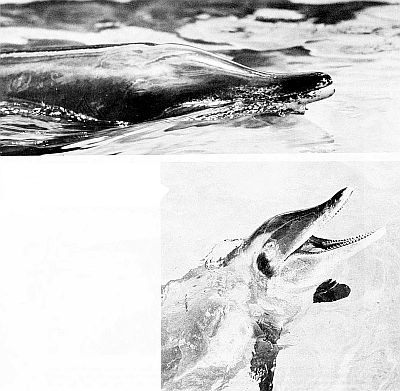
Figure 151.—A rough-toothed dolphin stranded near New Smyrna Beach, Fla. This species has from 20 to 27 fairly large teeth in each side of both the upper and lower jaws. Those teeth are sometimes marked by many fine vertical wrinkles along the crown, a characteristic from which the species derives its common name. (Photos by D. K. Caldwell.)
PYGMY KILLER WHALE (T) Feresa attenuata Gray 1874
Other Common Names
Slender blackfish, slender pilot whale.
Description
Pygmy killer whales reach a length of about 8-9 feet (2.4-2.7 m). They are usually relatively slender-bodied with a rounded head, an underslung jaw, and no beak.
The falcate dorsal fin, located about the center of the back, is usually between 8 and 12 inches (20.3 and 30.1 cm) tall (though it may reach 15 inches [38 cm] in some individuals), is sometimes very distinctive, and resembles that of the Atlantic bottlenosed dolphin. The flippers are slightly rounded on the tips.
The color has been described as dark gray or black on the back, often lighter on the sides, extending higher in front of the dorsal fin and with a small zone of white on the underside, often a lighter gray area on the sides, and distinctive white regions around the lips. The chin may be completely white. This white zone on the chin, described as a "goatee," is often clearly visible in swimming animals.
May Be Confused With
The pygmy killer whale resembles the false killer whale but is much smaller and can be distinguished at close range by the zones of white coloration. False killer whales are almost all black and reach a length of up to at least 18 feet (5.5 m). Pygmy killer whales are dark gray on the back, often lighter on the sides, and show a region of white on the belly which may extend so high up onto the sides that it is visible on a swimming animal. Further, they reach only 8-9 feet (2.4-2.7 m).
Pygmy killer whales may also be confused with the similarly sized and colored many-toothed blackfish. So little is known of the two species' appearance and behavior at sea that it is doubtful that they can be successfully distinguished, though many-toothed blackfish apparently lack the white region often seen on the sides of pygmy killer whales. Further, pygmy killer whales have rounded flippers and smoothly tapered heads, while those of the many-toothed blackfish are pointed on the tip and more sharply pointed (often described as a parrot beak).
Distribution
Pygmy killer whales are probably distributed in the tropical and subtropical waters of the western North Atlantic. They have been reported from Texas, the Atlantic coast of Florida, and St. Vincent Island, Lesser Antilles. Records of the species from the other oceans of the world suggest that its distribution is limited to tropical and subtropical waters.
Stranded Specimens
Stranded pygmy killer whales can be clearly distinguished from both the false killer whale and the many-toothed blackfish. In addition to the differences discussed above, the following are key differences between the pygmy and false killer whales:
Pygmy Killer Whale False Killer Whale
TEETH
10-13 in each side of upper and lower jaws; lower teeth smaller. 8-11 per jaw per side, prominent.
VENTRAL COLORATION
White from anus to under tail stock, white may extend up sides. Dark from anus to tail stock; lighter pale gray area forward between flippers.
FLIPPERS
Smoothly rounded. Characteristic hump on forward margin.
Pygmy killer whales can be distinguished from many-toothed blackfish on the basis of the second species' larger number of teeth. (Many-toothed blackfish have from 22 to 25 teeth in the upper jaw and from 21 to 24 in the lower jaw.)
Figure 152.—Pygmy killer whales at sea northwest of Hawaii (top) off the island of Oahu, Hawaii (middle), and from southeastern Florida in the tank at the Wometco Miami Seaquarium (bottom). When swimming rapidly, pygmy killer whales may closely resemble the much larger false killer whales. In addition to their much smaller size, rarely exceeding 9 feet (2.7 m), however, pygmy killer whales can be distinguished by their more rounded head, the white coloration of the lips and chin, and the white zone on the belly, sometimes extending up the sides. (Photos by S. Ohsumi [top]; J. Naughton, National Marine Fisheries Service and courtesy of E. Shallenberger, Sea Life Park [middle]; and courtesy of Wometco Miami Seaquarium [bottom].)

Figure 153.—Pygmy killer whales 5 miles off Kaena Point, Oahu, Hawaii. These individuals were dark on the back with varying degrees of lighter coloration on the sides, extending high onto the sides in front of the dorsal fin. Many had a white "goatee" on the chin and lower jaw. The prominent dorsal fin is characteristic. (Photos by E. Shallenberger, courtesy of Sea Life Park, Hawaii.)
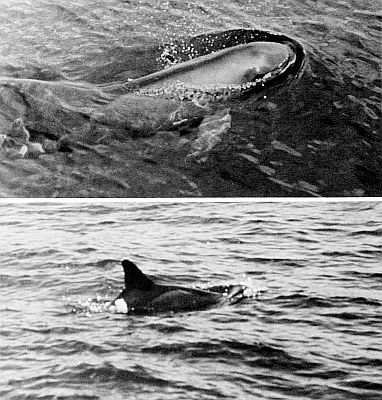
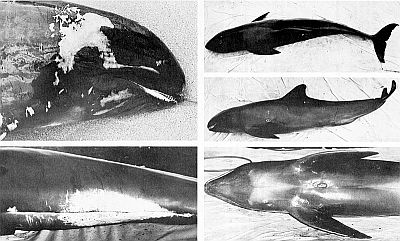
Figure 154.—Side and belly views of a pygmy killer whale from South Africa. Note the slight white coloration of the lips, the white region on the ventral surface (extending up onto the sides just below the dorsal fin), and the falcate sharply pointed dorsal fin. Note also the flippers, which lack the hump on the forward margin characteristic of false killer whales. (Photos courtesy of P. B. Best.)
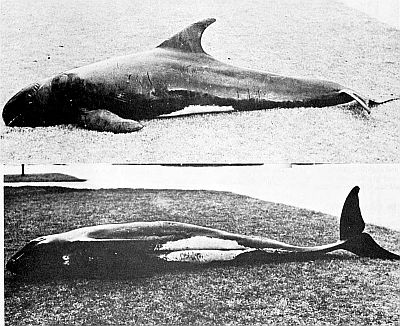
Figure 155.—Pygmy killer whales have from 8 to 11 teeth in each side of the upper jaw and from 11 to 13 in each side of the lower jaw. Many specimens reportedly have one fewer on the right than on the left side. The teeth are smaller than those of the false killer whale and far less numerous than those of the more closely sized many-toothed blackfish. Note also the white lips. (Photo courtesy of P. B. Best)
MANY-TOOTHED BLACKFISH (T) Peponocephala electra (Gray 1846)
Other Common Names
Hawaiian blackfish, melon-headed whale.
Description
Many-toothed blackfish reach lengths of at least 9 feet (2.7 m) and are similar in body shape to the larger false killer whale and the similar-sized pygmy killer whale. The body is elongated and slim with a rather slim tail stock. In general, the head is shaped like that of the false killer whale but has a sharper appearance to the snout, sometimes described as a parrot-beak. The forehead is rounded, slightly overhanging the lower jaw, and has no beak. The dorsal fin is up to 10 inches (25.4 cm). It is probably very distinctive as the animals surface to breathe. Many-toothed blackfish are black on the back and slightly lighter on the belly. The areas around the anus and genitals and the lips are unpigmented. Many-toothed blackfish are presumably rare.
May Be Confused With
Many-toothed blackfish may be confused with either the false killer whale or the pygmy killer whale. They are considerably smaller than the false killer whale, have a slightly more pointed snout, and lack the prominent humplike forward margin on the flippers which is characteristic of the false killer whale.
They are approximately the same size as pygmy killer whales, but the white area around the genitals which extends up onto the side in pygmy killer whales may be lacking in many-toothed blackfish. This species has pointed flippers, while those of pygmy killer whales are rounded on the tips. Many-toothed blackfish also have a slightly more pointed snout. Otherwise, the two species are virtually indistinguishable in encounters at sea.
Distribution
Although many-toothed blackfish have not yet been reported in the western North Atlantic, they are included in this guide because of a record from the eastern tropical North Atlantic and the known tropical distribution in other areas.
Stranded Specimens
Stranded many-toothed blackfish can be distinguished from false killer and pygmy killer whales by the number of teeth alone. Many-toothed blackfish have more than 15 per side per jaw (usually 21-25); both other species have less than 15.
Figure 156.—A live many-toothed blackfish in a holding pen in the Philippines. At sea these animals will be virtually impossible to distinguish from pygmy killer whales. (Photos by T. Hammond.)

Figure 157.—A many-toothed blackfish stranded in Hawaii. This species is smaller than the false killer whale and can be positively identified by the number of teeth, larger than any other blackfish. Many-toothed blackfish have from 21 to 25 teeth per side in both the upper and lower jaws. Other blackfish species have fewer than 15; otherwise, with the exception of differences in flipper shape (those of this species are pointed while those of pygmy killer whales are rounded on the tip), coloration and body shape of the two species are similar. (Photo courtesy of T. Dohl.)
PYGMY SPERM WHALE (T) Kogia breviceps (Blainville 1838)
Other Common Names
None known.
Description
Pygmy sperm whales reach a length of at least 11 feet (3.4 m). They are characterized by 1) an extremely robust body that rapidly tapers near the tail, 2) a squarish head, and 3) a narrow, underslung lower jaw which is located well behind the tip of the snout. Along the side of the head, in approximately the same position where gill slits would be located on a fish of comparable size, there is a crescent-shaped bracket mark, often called a false gill.
The flippers, which are smoothly curved on the forward margin and may reach a length of 18 inches (45.7 cm) or more on an adult specimen, are located well forward on the body, just below and behind the bracket mark.
The dorsal fin is very small, falcate, and located in the latter half of the back.
Though coloration can be described only from stranded specimens and a few encounters with living animals, pygmy sperm whales appear to be dark steel gray on the back, shading to a lighter gray on the sides, and gradually fading to a dull white on the belly. The outer surface of the flippers and the upper surface of the tail flukes are also steel gray.
Natural History Notes
From the few accounts, the following may be summarized about the behavior of pygmy sperm whales at sea: They reportedly usually rise slowly to the surface to breathe, produce a blow that is inconspicuous, and do not normally roll aggressively at the surface like most other species of small whales. They reportedly fold their flippers flat against their bodies when swimming. They have been reported to lie motionless in the water with the back of the head on the surface and the tail hanging loosely down in the water. (A similar behavior in sperm whales has made them a minor hazard to shipping, since it has resulted in some collisions with ships.) When they are startled in this posture, they may defecate, issuing a cloud of reddish brown to rust-colored fece. Beached pygmy sperm whales have also been observed to defecate a fine chocolate feces.
Pygmy sperm whales apparently feed primarily on squid, but do take fish as well.
May Be Confused With
In general, when they can be examined at close range, pygmy sperm whales are so distinctive that they are unlikely to be confused with any other species except perhaps the dwarf sperm whales. At a distance, they might be confused with small individuals of any of the beaked-whale species (p. 78) that also have a relatively small, falcate dorsal fin located in the latter third of the back. Closer examination should permit easy separation, however, since the pygmy sperm whale has a blunted head, while the beaked whales, as the name implies, have elongated "dolphinlike" beaks and are considerably larger. At sea, pygmy sperm whales are most likely to be confused with their cousins the dwarf sperm whales (p. 148 and Fig. 160). The two species can be distinguished as follows:
Pygmy Sperm Whale Dwarf Sperm Whale
MAXIMUM SIZE
To 11 feet (3.4 m). To 9 feet (2.7 m).
DORSAL FIN
Small to 8 inches (20.3 cm), falcate; located in latter third of back. Taller, more like that of bottlenosed dolphins; located near the midpoint of the back.
COLORATION
Both species are dark steel gray on the back, grading to lighter on the belly.
Distribution
Because they have been rarely observed at sea, normal ranges for this species are not known. Based on stranding records, however, the following can be stated. In the western North Atlantic, pygmy sperm whales have been found as far north as Sable Island, Halifax, Nova Scotia, as far south as Cuba, and as far west as Texas in the Gulf of Mexico. They are frequently found stranded along the Atlantic coast of Florida and throughout the eastern and northern Gulf of Mexico.
Stranded Specimens
Because of the distinctive characters of the genus, stranded pygmy and dwarf sperm whales are unlikely to be confused with any other species of cetacean, though the rather narrow underslung jaw and the blunted head may result in their casual dismissal by some beach walkers as stranded sharks. The two species of Kogia may be distinguished by the following:
Pygmy Sperm Whale Dwarf Sperm Whale
TEETH
12-16 (rarely 10-11) in lower jaw are larger; no teeth in upper. 8-11 (rarely 13) small and extremely sharp teeth in lower jaw; sometimes have up to 3 teeth in each upper jaw.
THROAT
No creases or grooves on throat. Several short irregular creases or grooves on throat.
Figure 158.—In this rare photograph of a pygmy sperm whale at sea in the Pacific, the animal was startled by the approaching vessel, circled quickly, and then dived out of sight. The trail of material visible in the water in front of and to the right of the animal is feces, reddish brown to rust in color. Startled whales and porpoises often defecate in this manner. (Photo by S. Ohsumi.)
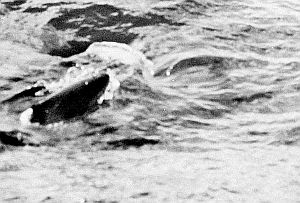
Figure 159.—A young pygmy sperm whale swimming in a tank at the New York Aquarium. Note the shape and position of the dorsal fin and the shape of the head. (Photo by H. E. Winn.)
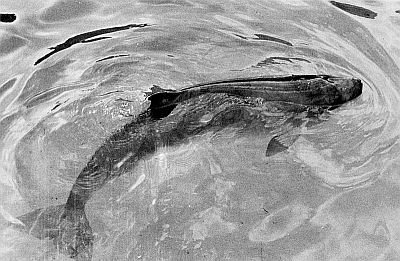
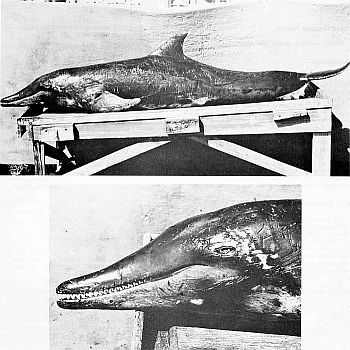
Figure 160.—On the beach the two species of Kogia can be readily distinguished. The pygmy sperm whale, K. breviceps, (top) reaches a length of about 11 feet (3.4 m); its dorsal fin is a small nubbin located in the latter half of the back. The dwarf sperm whale, K. simus, (bottom) reaches only about 9 feet (2.7 m); its dorsal fin, much taller and more "dolphinlike" in appearance, is located near the middle of the back. Coloration of fresh specimens is probably similar for both species—the lightened areas in the lower photograph are the result of decomposition. (Photos from Jekyll Island, Ga. [top] and Atlantic Beach, Fla. [bottom] by D. K. Caldwell.)
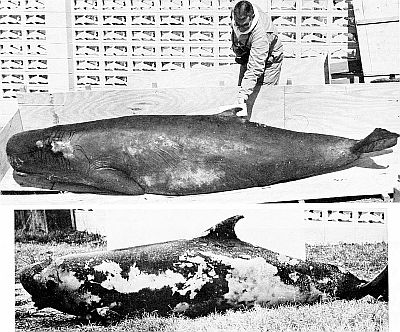
Figure 161.—Ventral view of a female pygmy sperm whale from Jekyll Island, Ga. Note the position and shape of the flippers and mouth, and the abrupt tapering of the body at the tail stock. (Photo by D. K. Caldwell.)
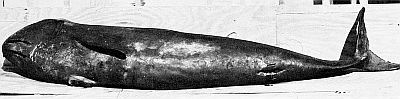
Figure 162.—Head of a pygmy sperm whale from northeastern Florida showing gill-like, lightly pigmented "bracket marks." (Photo by F. G. Wood.)
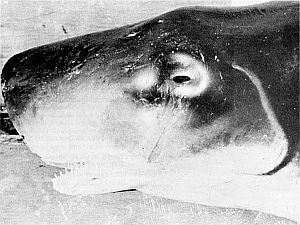
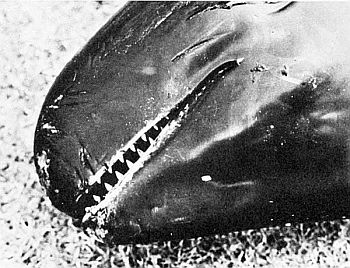
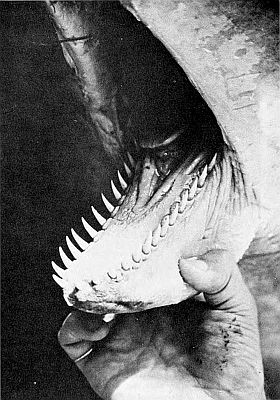
Figure 163.—A detailed view of the mouth of a pygmy sperm whale from the east coast of Florida. In both species of Kogia these long, curved, needle-sharp teeth, found in only the lower jaw, lock into sockets in the upper jaw. Pygmy sperm whales have from 12 to 16 (rarely 10 or 11) pairs of teeth; dwarf sperm whales have from 8 to 11 (rarely 13) pairs. (Photo by D. K. Caldwell.)
DWARF SPERM WHALE (T) Kogia simus (Owen 1866)
Other Common Names
Rat porpoise (West Indies).
Description
Dwarf sperm whales reach an overall length of approximately 9 feet (2.7 m). Like the other species of Kogia, the pygmy sperm whale (p. 144), the dwarf sperm whales are characterized by 1) a squarish head, 2) an extremely robust body which tapers rapidly near the tail stock, 3) a narrow, underslung lower jaw, and 4) a bracket mark or false gill on the side of the head.
The dorsal fin of this species is tall and falcate, closely resembling that of the Atlantic bottlenosed dolphin, and is located near the midpoint of the back. There are several short, irregular creases or grooves on the throat similar to those found on the sperm whale (see Figs. 60, 165).
Dwarf sperm whales are dark steel gray on the back, grading to lighter gray on the sides, and fading to dull white on the belly.
May Be Confused With
Because of their tall, falcate dorsal fin, dwarf sperm whales may be confused at a distance with any of the small dolphin species. Their all-black or dark steel-gray coloration and the blunted head increase the likelihood that they can be confused with pygmy killer whales or many-toothed blackfish. They will have to be examined at close range before they can be distinguished.
Dwarf sperm whales may also be confused with pygmy sperm whales (p. 144 and Fig. 160). The two species can be differentiated by the characteristics tabularized on p. 144.
Distribution
Since it has only recently been recognized as a species distinct from the pygmy sperm whale and even more recently given a common name, records of dwarf sperm whales may have been confused with those of its close relatives. The dwarf sperm whale has been reported from at least Georgia south to St. Vincent, Lesser Antilles, and throughout the eastern and northern Gulf of Mexico. It is highly likely that this species, like the pygmy sperm whale, extends further to the north.
Stranded Specimens
Because of the distinctive characteristics of the genus, neither species of stranded Kogia is likely to be confused with any other species. They can be distinguished from one another by the characteristics tabularized on p. 144.
Figure 164.—A dwarf sperm whale stranded near St. Augustine, Fla., shown swimming in the tank at Marineland of Florida. In this species the dorsal fin is taller than that of the pygmy sperm whale and is located near the midpoint of the back (see Figs. 159 and 160). (Photo courtesy of Marineland of Florida.)
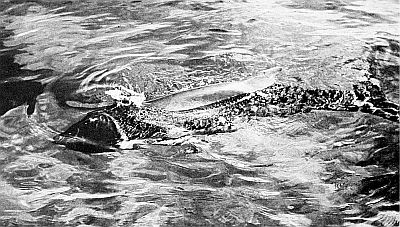
Figure 165.—Dwarf sperm whales have several short creases on the throat, similar to those found on the sperm whale (see Fig. 60); pygmy sperm whales lack these creases. To compare other features of the two species, refer back to Figure 160. (Photo by D. K. Caldwell.)
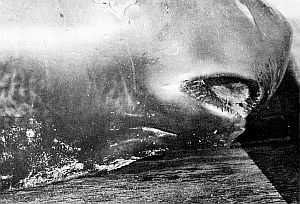
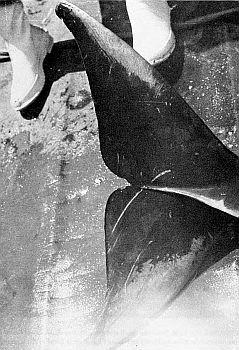
Figure 166.—Closeup of the tail flukes of a dwarf sperm whale from the Florida east coast. Note that the dorsal ridge extends almost to the notch in the flukes. (Photo by W. A. Huck, courtesy of Marineland of Florida.)
HARBOR PORPOISE (T) Phocoena phocoena (Linnaeus 1758)
Other Common Names
Common porpoise, herring hog, puffing pig (Newfoundland and New England), Pourcils (Quebec), harbour porpoise.
Description
The harbor porpoise is the smallest cetacean species in the western North Atlantic Ocean, reaching a maximum overall length of about 5 feet (1.5 m). Its most distinctive identifying features in encounters at sea are 1) the small, chunky body; 2) the coloration, dark brown or gray on the back, fading to lighter grayish brown on the sides, often with speckling in the transition zone, and white on the belly extending farther up on the sides in front of the dorsal fin; 3) the small rounded head, lacking a distinctive beak; 4) the small, triangular dorsal fin; and 5) the shallow, inshore northerly distribution.
Natural History Notes
As the name implies, the harbor porpoise inhabits bays, harbors, river mouths, and all the relatively shallow inshore water between. Though it may travel in schools of nearly a hundred individuals, it is more often seen in pairs or in small groups of from 5 to 10 individuals. It often swims quietly at the surface. It will not ride the bow wave and is very difficult to approach closely by boat.
May Be Confused With
The harbor porpoise is not known to associate with dolphins but is sometimes seen in close proximity to fin whales and humpback whales off the Canadian coast in spring and summer. Because of its northern inshore habitat, the harbor porpoise is not likely to be confused with any other cetacean.
Distribution
Harbor porpoises are restricted to the colder waters of the western North Atlantic Ocean. They have been reported from North Carolina north to the Davis Straits and the waters of southwestern Greenland. Within this range they are probably most common in the Bay of Fundy and off southwest Greenland.
Stranded Specimens
In addition to the characteristics described above for living animals, stranded harbor porpoises can be readily identified by the small spade-shaped teeth, 22-28 per jaw.
Figure 167.—Two views of a harbor porpoise just offshore from Rio del Mar, Seaside, Calif. Note the small size (usually less than 5 feet [1.5 m]), the small triangular dorsal fin, the dark brownish color of the back, and the lighter color of the sides and belly intruding higher up in front of the dorsal fin. Harbor porpoises frequent inshore areas, shallow bays, estuaries and harbors, and reportedly do not approach moving vessels nor ride bow waves. (Photos by J. D. Hall.)
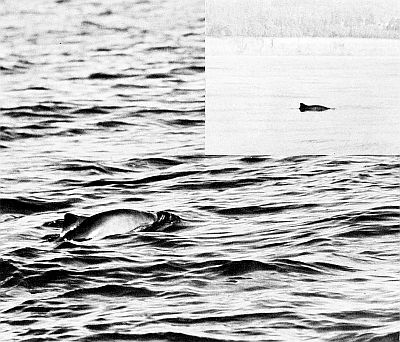
Figure 168.—A harbor porpoise harpooned in Passamaquoddy Bay, New Brunswick. Harbor porpoises have from 23 to 28 small, spade-shaped teeth in each upper jaw and from 22 to 26 in each lower jaw. Note the rounded head, the absence of a beak, and the triangular dorsal fin. (Photo by D. E. Gaskin.)