APPENDIX A TAGS ON WHALES, DOLPHINS, AND PORPOISES
Reading edition
Field studies of cetaceans are very difficult. First, it is extremely hard to be positive that an individual or a group of animals is the same from one encounter to the next. This means that it is nearly impossible to determine, for example, whether herds of animals are resident in an area or only seasonal visitors. Without information of this kind, determinations vital to population management, such as sizes of populations and natural ranges, are impossible to make.
Secondly, as we frequently point out in this guide, individual cetaceans are usually visible to a surface observer only during the brief moments when they break the air-water interface to breathe. The majority of their vital activities (e.g., feeding, reproduction, communication, establishing and maintaining position within the herd, and defending against natural enemies) take place primarily below the surface, well out of view to a surface observer.
In recent years, in an attempt to overcome some of these problems, scientists have been placing markers on various species of cetaceans and monitoring their movements. The following brief summary of major methods of tagging cetaceans is provided to acquaint the reader with markers he may expect to see in the western North Atlantic.
Static Tags
Since their development in the mid-1920's, numerous Discovery marks (small stainless steel projectiles with identifying information stamped on them) have been shot into commercially valuable species by means of a shotgun. The recovery of these marks from whales subsequently killed in the whaling industry has provided valuable information on the movement patterns and on basic aspects of the growth and development of harvested species of whales. Discovery marks are limited, however, because they are not visible in a living animal. Reduction in whaling activities will bring about a significant reduction in their use.
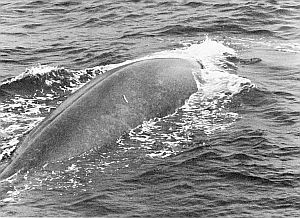
More recent tagging developments relate to marks which will be visible on a free-swimming animal. Large whales, for instance, may be tagged with color-coded streamers, such as that shown in Appendix Figure A2. The tags, which are modified versions of the spaghetti tags first constructed for use on fishes, consist of a small stainless steel head for attachment to the blubber and a colorful streamer (sometimes stamped with information on agencies to which tags should be returned) which is visible above the surface of the animal. These tags may be applied by using either a pole applicator or a crossbow and crossbow bolts. Both applicators are equipped with a stop to limit the depth of penetration into the animal's blubber. Extensive experimentation indicates that the tags do not harm the animals and that their application is not traumatic. With the continued reduction in whaling activity, it is hoped that the use of such markers in the study of movements of big whales will be increased.
Because they often ride the bow wave of a moving vessel, thereby making themselves accessible for tagging and capture, small porpoises and dolphins have been tagged with a greater variety of marks than large whales. In recent years, at least three kinds of static tags, including spaghetti streamers, have been placed on small and medium-sized cetaceans.
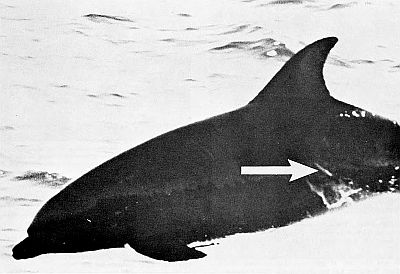
Spaghetti tags, placed in the animal's blubber near the base of the dorsal fin as it rides the bow wave, stream to conform to the contour of the animal's body as it swims (App. Fig. A3). It is not possible to identify the numbers on the spaghetti tag of a moving animal, although color codes may be used to indicate different species, populations, or tagging areas.
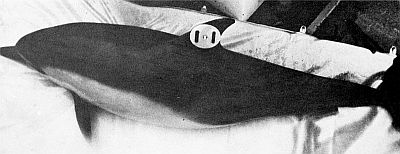
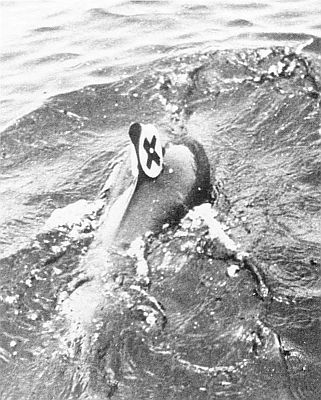
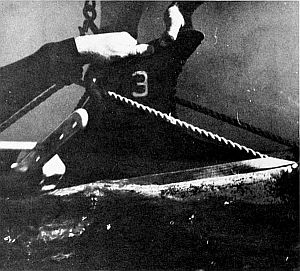
Button tags and freeze brands are placed on captured animals prior to their release. The button tags (App. Figs. A4, A5) are placed in the dorsal fin and should be visible as the animal surfaces to breathe or as it rides the bow wave. At close range, the number, letter, or design may also be visible. Freeze brands (App. Fig. A6) are placed on the back or dorsal fin with a supercooled branding iron, apparently without pain or discomfort to the animal, and provide a permanent mark which leaves the tagged animal free of encumbrances. The use of freeze brands shows promise and should come into more extensive use.
Other static tagging techniques currently under investigation include the use of laser beams to apply small brands and the use of gas branding devices. Neither technique, however, has yet reached the field biologist.
The success of any tagging program using static tags depends on the resighting of tagged animals and the recovery of tags. For that reason, we appeal to readers to be on the lookout for tagged animals and to report sightings to one of the authors.
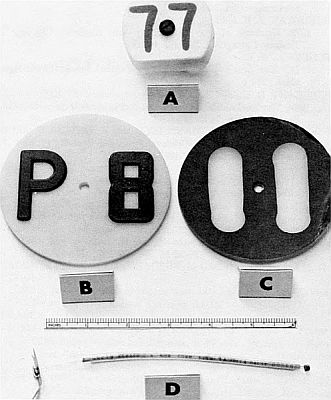
Appendix Figure A1.—Some of the basic kinds of tags used to mark porpoises, dolphins, and small whales. A, B, and C are nylon button tags, which are placed in the dorsal fin of animals and may be clearly visible as the animal surfaces to breathe. D is a vinyl spaghetti tag. (Photo by R. Krenic, courtesy of Naval Undersea Center.)
Appendix Figure A2.—A spaghetti tag in the back of a blue whale off San Clemente Island, Calif. (Photo by S. Leatherwood.)
Appendix Figure A3.—A spaghetti tag in the flank of a bottlenosed dolphin off Loreto, Baja California, Mexico. This particular tag was placed unusually low. The streamer and spaghetti tags are usually placed high on the back, just in front of the dorsal fin, and are clearly visible as the animal surfaces to breathe. (Photo by W. E. Evans.)
Appendix Figure A4.—A button tag placed on the dorsal fin of a newly captured saddleback dolphin off Catalina Island, Calif. (Photo by W. E. Evans.)
Appendix Figure A5.—This is the way the button tag appears on an animal swimming free in the open sea off Palos Verdes, Calif. (Photo by B. Noble, courtesy of Marineland of the Pacific.)
Appendix Figure A6.—Freeze-branding is an apparently painless method of applying a permanent identifying mark to the body of a porpoise or whale. (Photo of a bottlenosed dolphin off Sarasota, Fla., by A. B. Irvine.)
Radio Transmitter Tags
In recent years, radio transmitter tags have been developed for use on marine mammals. As they continue to become more reliable, these tags are expected to come into more and more widespread use.
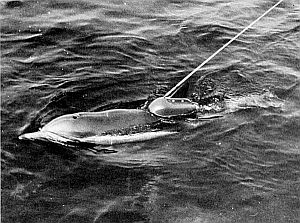
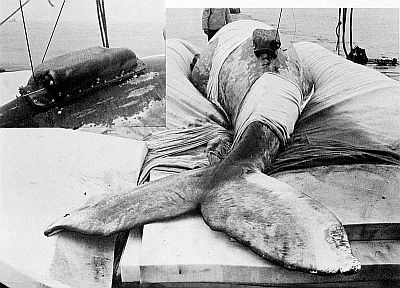
Early radio tags (Fig. A7) were simple locator beacons which permitted the animal to be tracked by sending a signal to a tracking vessel or aircraft every time the animal surfaced and the antenna tip was exposed. Even these basic packages provide important information on movement, activity patterns, and respiration rates.
Subsequent developments have involved the addition of sensors to monitor the maximum depth of each dive and environmental parameters such as the water temperature at that depth (Fig. A8).
Logical extensions of these developments include the addition of numerous other sensors to permit simultaneous monitoring of multiple aspects of the animal's environment and the transmission of these data first to aircraft and subsequently to satellites for relay to shore-based laboratories.
In addition to permitting scientists to define movement patterns and daily diving patterns of cetaceans, the use of such devices offers an exciting means of determining the environmental parameters that trigger changes in their behavior.
Radio transmitter tags, in a variety of configurations, may be constructed and attached for short-term studies or for long-term monitoring of migrating animals. In either case, depending on their size and methods of attachment, radio transmitter tags may be visible on a free-swimming animal even at a considerable distance.
Appendix Figure A7.—A saddleback dolphin wearing a radio tag transmitter surfaces to breathe off southern California. (Photo courtesy of W. E. Evans.)
Appendix Figure A8.—A radio transmitter package attached to the dorsal ridge of a California gray whale. This yearling animal, captive for most of the first year of its life, was released into the ocean off San Diego, Calif., in March 1972 and subsequently tracked from shipboard and aircraft for over 30 days. The sensor transmitter package, shown in detail in the inset, was designed to measure the maximum depth of the animal's dive and the water temperature at that depth. (Photo by S. Leatherwood.)
Natural Markings
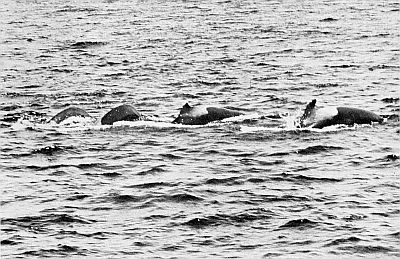
In addition to these man-made and applied tags, variations in natural markings and unusual appearances may be used to identify individuals and herds on repeated encounters. Although many species of cetaceans are characterized by changes in color pattern with age, individuals occasionally differ radically in their coloration from their fellows (App. Figs. A9, A10). In addition, individuals are sometimes seen with unusually shaped dorsal fins or scarring patterns (App. Fig. A11). These unusually marked animals should stand out in repeated encounters and can be a help in identifying a herd from one encounter to another.
Obviously, this list of tags and anomalous markings is not exhaustive. New marks may be developed at any time. The discussion is intended to make the reader aware of the value of information on natural or man-made marks in studies of cetacean natural history. Your cooperation will perhaps help us to unravel some of the mystery surrounding the distribution and movements of porpoises, dolphins, and whales.
Appendix Figure A9.—A piebald saddleback dolphin on the bow of a research vessel off San Clemente Island, Calif. (Photo by B. C. Parks.)
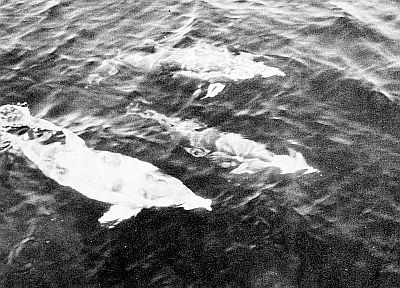
Appendix Figure A10.—A nearly all-white pilot whale seen off Catalina Island, Calif., in April 1971. The observation of this same animal at least once each quarter of the year is evidence that it is resident in that area. (Photo by S. Leatherwood.)
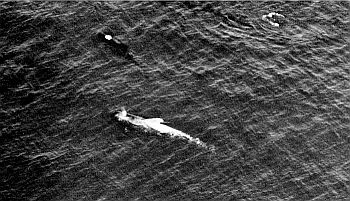
Appendix Figure A11.—A herd of pilot whales off Catalina Island, Calif., including an animal with a partially chopped-off dorsal fin, which has made him recognizable in repeated encounters with pilot whales around the various channel islands. (Photo by G. E. Lingle.)