APPENDIX B RECORDING AND REPORTING OBSERVATIONS OF CETACEANS AT SEA
Reading edition
To increase reliability of identifications, observers should train themselves to ask the following kinds of questions each time cetaceans are encountered:
1. How large was the animal?
2. Did it have a dorsal fin? If so, what was its size, shape, and position on the animal's back?
3. Was the animal's blow visible? If so, how tall did it appear? What was its shape? How frequently did the animal blow?
4. What was the animal's color and color pattern?
5. Did it have any highly distinctive markings?
6. If it was a large or medium-sized animal, did it show its tail flukes when it began its dive?
7. If it was a medium-sized or small animal, did it approach, avoid, or ignore the vessel? Did it ride the bow wave?
8. What was its behavior? Did it jump from the water? If so, did it make a smooth graceful arching jump, or did it spin, somersault, or reenter with a splash?
One characteristic is rarely sufficient by itself, and the greater amount of relevant evidence the observer can obtain, the greater the likelihood he can make a reliable identification. But it is important to remember that even the most experienced cetologists are often unable to make an identification. Therefore, even if you cannot positively identify an animal or even make a good guess as to its identity, do not hesitate to fill out the rest of the sighting record form and submit it to an appropriate office. Listing the characters you observe and filling in as much of the form as possible may enable a cetologist to make an identification based on those characters and his knowledge of the distribution, movements, and behavior of cetaceans. In this regard, a sketch made as soon as possible after the encounter and photographs taken from as many angles as possible will aid in the identification.
Two sample sighting reports are provided to demonstrate a method of recording observations. The first report, "Sighting Information," is completed as an example and is footnoted for explanation. The second report, "Cetacean Data Record." located at the end of the guide, is blank and may be photocopied in bulk for use in the field. Copies of this or similar forms are available from any of the authors or from National Marine Fisheries Service, Tiburon, Calif. Even if no form is available, however, observations should be recorded in rough form, in as much detail as possible.
Reliable intermittent reports of cetaceans are of interest to cetologists. Their locations indicate seasonality of distribution, and their frequencies help indicate relative abundances of the various species. Because scientists are attempting to determine areas in which cetaceans are often, occasionally, seldom, or never found, and are ultimately describing why animals are found in one area and not another, persons who want to go a step further in their participation in observer programs may want to keep and report records of their entire cruise tracks and zones in which vigilance was maintained but no cetaceans were observed. Data obtained in this manner may be used as the foundation of estimates of cetacean populations, estimates which are extremely difficult to obtain by any other method.
To be of maximum use in such calculations, however, records of this kind must include the following minimum information: time and location of beginning and ending of each continuous watch, weather conditions as they affect visibility, sea state, ship's speed, height of the observer(s) above the water, number of persons on watch, and details of each sighting, particularly the estimated distance of the animal(s) from the ship's track.
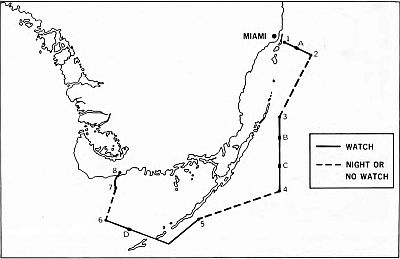
For a sample of a fictional continuous watch report might look like the following. If sighting forms are available, these observations may be recorded directly onto them. Additional information can be recorded on the opposite side of the forms.
Appendix Figure B1.—A sample cruise track with cetacean sightings. See text for detailed data recording.
GENERAL INFORMATION
RV Melville (34-foot converted fishing boat) U.S. Department of Commerce NMFS
Hydrographic Cruise Miami, Florida to Flamingo, Florida
28-31 January 1973
2 observers (G.E. Lingle and G.M. Mohr)
Eye level of observers: 16 feet above water
Average ship speed: 8.0 knots during continuous watch
Continuous watch information (refer to Fig. B1):
LegDateStart timeEnd timeStart positionEnd positionWeather—Visibility
1-22/2812001730U. Miami Dock Va. Key25-42N 80-02WBeaufort II Visibility 3 miles
3-42/290800150024-26N 80-04E25-00N 81-04WBeaufort I Visibility 3.5 miles
5-62/300700168025-12N 80-46W25-12N 81-10W3.5 miles
7-82/310700090025-00 80-45WFlamingo3.5 miles
Cetacean observations (refer to Fig. B1):
A‑2/28 1048 16 bottlenosed dolphins, Tursiops truncatus. 6 miles outside our course, headed west—rode bow briefly. Large concentrations of sea birds in area. One porpoise freeze branded N-1 on dorsal fin.
B‑2/29 1100 2 right whales directly ahead of vessel headed NE—40-foot female? with calf. 2 bottlenosed dolphins accompanying the whales were riding pressure wave off whale's head.
C‑2/29 1400 25-30 spotted porpoises, Stenella plagiodon, 1.25 miles outside our course, heading 240° mag. Did not ride bow wave.
D‑2/30 1300 8 bottlenosed dolphins, Tursiops truncatus, 200-300 yards inshore of our course, milling in area of concentrations of mullet and other small schooling fishes, dolphins (porpoises) and birds feeding on fish.
SIGHTING INFORMATION
DATE AND LOCAL TIME [Handwriting: 27 January 1977 0845] LOCATION[13] [Handwriting: Ca. 25°00'N, 80°30'W]
WEATHER CONDITIONS [Handwriting: Scattered rain squalls, visibility 1-1.5 mi, Temp 42°F]
OCEANOGRAPHIC CONDITIONS[14] [Handwriting: Swells 1-2 feet, scattered white caps Winds from S.E. @ 3-8 knots, gusting in squalls to 15 knots.]
SPECIES[15] [Handwriting: Right Whales, Eubalaena glacialis (45 ft/15 ft)] NUMBER OF ANIMAL(S) [Handwriting: 2]
HEADING OF ANIMAL(S) [Handwriting: 015°] SPEED OF ANIMAL(S) [Handwriting: 1-2]
(MAGNETIC) (KNOTS)
ASSOCIATED ORGANISMS[16] [Handwriting: Bottlenosed dolphins, Tursiops truncatus (3) and unidentified gulls (10-20)]
TAGS OR UNUSUAL MARKINGS [Handwriting: One whale had deep slash across back about 3 ft. behind blowholes-area of slash was white.]
CHARACTERISTICS OBSERVED WHICH RESULTED IN SPECIES IDENTIFICATION [Handwriting: 45 ft, No dorsal fin, smooth black back, high arching jaws, yellowish-orange growths on head, coastal habitat]
BEHAVIOR OF ANIMAL(S) [Handwriting: Adult whale swam steadily north, calf close beside, Bottlenosed dolphins riding in front of adults head.]
SKETCHES [Hand-drawn illustration of whales, dolphins and distinguishing features.]
PHOTOS AVAILABLE YES [tick] NO
[Handwriting: Photos (GEL, Roll 16, frames 8-30)]
ADDITIONAL REMARKS [Handwriting: Dolphins remained with whales entire 1/2 hour of observation, appently riding on pressure wave.]
NAME AND ADDRESS OF OBSERVER (SHIP OR A/C) [Handwriting: G. E. Lingle, Naval Undersea Center, San Diego, California 92132 and G. A. Antonelis, NMFS, Seattle, Washington 98105 aboard the RV Cape]