ORGANIZATION OF THE GUIDE
Reading edition
The differences between baleen and toothed whales are easy enough to see in animals washed up on the beach or maintained in a tank at a zoo or aquarium. But since an animal at sea can seldom be examined that closely, its most obvious characteristics may be its overall size, the presence or absence of a dorsal fin, its prominent coloration or markings, its general behavior, or its swimming, blowing, and diving characteristics. For that reason, regardless of their scientific relationships, all the whales, dolphins, and the one porpoise covered in the main text of this guide are divided into three groups. Those over 40 feet (12.2 m) long are discussed in the section on Large Whales, those from 13 to 40 feet (4.0 to 12.2 m) in the Medium-Sized Whale, and those less than 13 feet (4.0 m) in the Small Whales, Dolphins, and Porpoise (with a dorsal fin). There are no small whales, dolphins, or porpoises in this region without a dorsal fin. Each section is further divided into those animals with a dorsal fin and those without. From that point, animals likely to be confused in the field are grouped together and the important differences between them are discussed.
The synoptic accounts of the species are followed by five appendices: Appendix A discusses and illustrates man-made and applied tags and natural markings on cetaceans and their importance in studies of natural history. Appendix B discusses the data which are most important to record in observations of cetaceans at sea, gives examples, and provides blank sighting forms. Appendix C discusses possible causes of cetacean strandings and the manner in which stranded animals should be handled and adds a key and tables to aid in identifying stranded cetaceans. Appendix D provides guidelines for collecting data on stranded cetaceans and provides forms and specific instructions for taking standard measurements. Appendix E lists institutions to be contacted in the event of a cetacean stranding or for information.
A bibliography of useful references on cetaceans in general and cetaceans of this region in particular and a directory to species accounts are included.
Figure 5.—A humpback whale lying on its left side on the deck of a Canadian whaling station. Note the fringes of baleen suspended from the roof of the mouth. (Photo by J. G. Mead.)
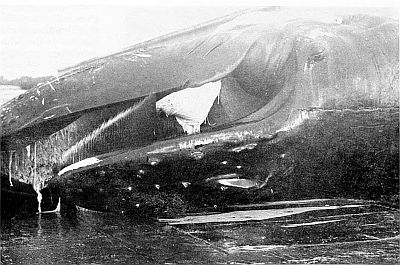
Figure 6.—Atlantic bottlenosed dolphin mother and calf from northeastern Florida. Note the single open blowhole, a characteristic that marks these animals as toothed whales. (Photo courtesy of Marineland of Florida.)

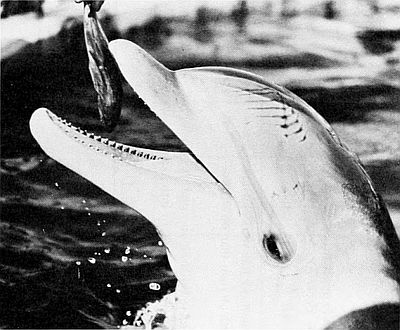
Figure 7.—The open mouth of an Atlantic bottlenosed dolphin from the northeastern Gulf of Mexico. All toothed whales have teeth, which are used primarily for grasping rather than for chewing. The number varies from 2 to over 250, though they are buried beneath the gums in females and immature animals of several species, take peculiar form in one (narwhal), and are extensively worn in others. (Photo by D. K. Caldwell.)