CLASSIFICATION OF CETACEANS
Reading edition
In addition to the two suborders (Mysticeti and Odontoceti), the cetacean order contains numerous families, genera, and species. Each of these groupings represents a progressively more specialized division of the animals into categories on the basis of similarities in their skulls, postcranial skeletons, and external characteristics. The discipline which concerns itself with naming an animal and assigning it to its appropriate scientific category is known as taxonomy. An example of the classification of a cetacean species is shown in the following:
SCIENTIFIC CLASSIFICATION OF THE ATLANTIC BOTTLENOSED DOLPHIN
Kingdom:Animaliaall animals
Phylum:Chordatahaving at some stage a notochord, the precursor of the backbone
Subphylum:Vertebrataanimals with backbones—fishes, amphibians, reptiles, birds, and mammals
Class:Mammaliaanimals that suckle their young
Order:Cetaceacarnivorous, wholly aquatic mammals: whales, including dolphins and porpoises
Suborder:Odontocetitoothed whales as distinguished from Mysticeti, the baleen whales
Family:Delphinidaedolphins
Genus:Tursiopsbottlenosed dolphins
Species:truncatusAtlantic bottlenosed dolphin
Modern taxonomy had its origin with the Swedish naturalist Linnaeus, whose tenth edition of the Systema Naturae in 1758 forms the official starting point. Following Linnaeus, modern scientific names consist of two words, a generic name, which has an initial capital, and a species name, which rarely does, occasionally in botany (some species names deriving from a person's name are capitalized). Both names are usually of Latin origin (sometimes Greek) and are italicized or underlined. These scientific names are of particular importance because, although common names of species often are different in different countries or even in different regions of the same country, the scientific name remains the same. For example, the right whale is universally known as Eubalaena glacialis though its common names include black right whale, nordcaper, sletbag, Biscay whale, and Biscayan right whale.
Although classification of many species is still in a state of flux, the classification of western North Atlantic cetaceans followed in this guide is as follows:
Page of synoptic account of the species
Order Cetacea
Suborder Mysticeti—Baleen whales
Family Balaenopteridae—Rorquals
Balaenoptera acutorostrataLacepede 1804Minke whale63
Balaenoptera physalus(Linnaeus 1758)Fin whale26
Balaenoptera musculus(Linnaeus 1758)Blue whale19
Balaenoptera borealisLesson 1828Sei whale32
Balaenoptera edeniAnderson 1879Bryde's whale37
Megaptera novaeangliae(Borowski 1781)Humpback whale40
Family Balaenidae—Right whales
Balaena mysticetusLinnaeus 1758Bowhead whale49
Eubalaena glacialis(Borowski 1781)Right whale52
Suborder Odontoceti—Toothed whales
Family Ziphiidae
Mesoplodon bidens(Sowerby 1804)North Sea beaked whale82
Mesoplodon densirostris(Blainville in Desmarest 1817)Dense-beaked whale80
Mesoplodon europaeus(Gervais 1855)Antillean beaked whale78
Mesoplodon mirusTrue 1913True's beaked whale77
Ziphius cavirostrisG. Cuvier 1823Goosebeaked whale70
Hyperoodon ampullatus(Forster 1770)Northern bottlenosed whale67
Family Physeteridae
Physeter catodonLinnaeus 1758Sperm whale57
Kogia breviceps(Blainville 1838)Pygmy sperm whale144
Kogia simus(Owen 1866)Dwarf sperm whale148
Family Monodontidae
Monodon monocerosLinnaeus 1758Narwhal102
Delphinapterus leucas(Pallas 1776)Beluga99
Family Stenidae
Steno bredanensis(G. Cuvier in Lesson 1828)Rough-toothed dolphin135
Sotalia guianensis(P. J. van Beneden 1864)Guiana dolphin132
Family Delphinidae
Peponocephala electra(Gray 1846)Many-toothed blackfish142
Feresa attenuataGray 1874Pygmy killer whale138
Pseudorca crassidens(Owen 1846)False killer whale88
Globicephala melaena(Traill 1809)Atlantic pilot whale91
Globicephala macrorhynchusGray 1846Short-finned pilot whale94
Orcinus orca(Linnaeus 1758)Killer whale84
Lagenorhynchus albirostrisGray 1846White-beaked dolphin126
Lagenorhynchus acutus(Gray 1828)Atlantic white-sided dolphin123
Lagenodelphis hoseiFraser 1956Fraser's dolphin120
Tursiops truncatus(Montagu 1821)Bottlenosed dolphin128
Grampus griseus(G. Cuvier 1812)Grampus96
Stenella longirostrisGray 1828Spinner dolphin110
Stenella frontalis(G. Cuvier 1829)Bridled dolphin108
Stenella coeruleoalba(Meyen 1833)Striped dolphin113
Stenella plagiodon(Cope 1866)Spotted dolphin104
Delphinus delphisLinnaeus 1758Saddleback dolphin116
Family Phocoenidae
Phocoena phocoena(Linnaeus 1758)Harbor porpoise150
This tentative classification follows an unpublished list by W.E. Schevill and E.M. Mitchell currently under review. The scientific names are followed by the name of the individual who named the species and the year of naming, and then by the common name most often used in the western North Atlantic.[6] It may be noted that some of the authors are in parentheses. This indicates that though the species name has remained the same since the date of naming the species has since been assigned to another genus. Because the species are not arranged in taxonomic order in this field guide, the page of the synoptic account of each is provided in the column to the right.
Figure 1.—The western North Atlantic, from lat. 35°N-65°N.
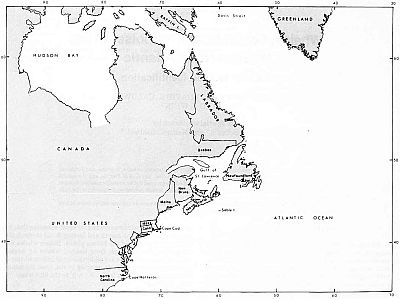
Figure 2.—The western North Atlantic, from lat. 37°N south to eastern Venezuela.
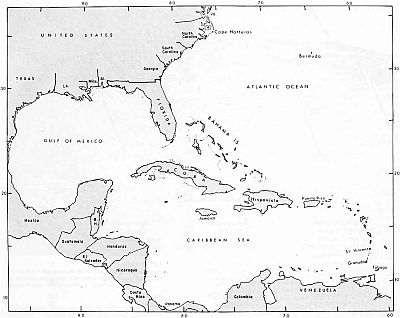
Figure 3.—A baleen whale (humpback) showing the main body parts referred to in the text.
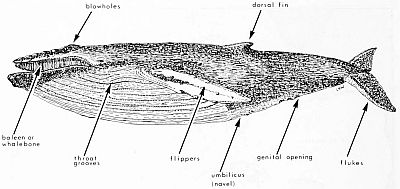
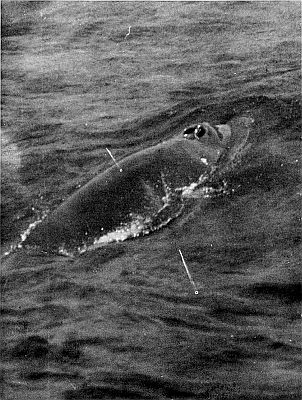
Figure 4.—A fin whale in the North Atlantic with the paired blowholes open during respiration. The paired blowholes distinguish this animal as a baleen whale. (Photo by W. A. Watkins.)