SPECIES ACCOUNTS (continued 2)
Reading edition
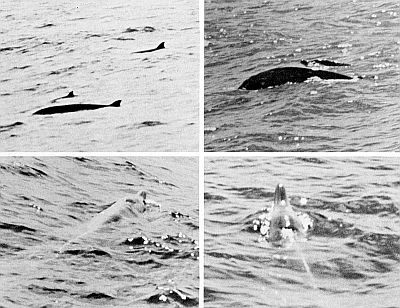
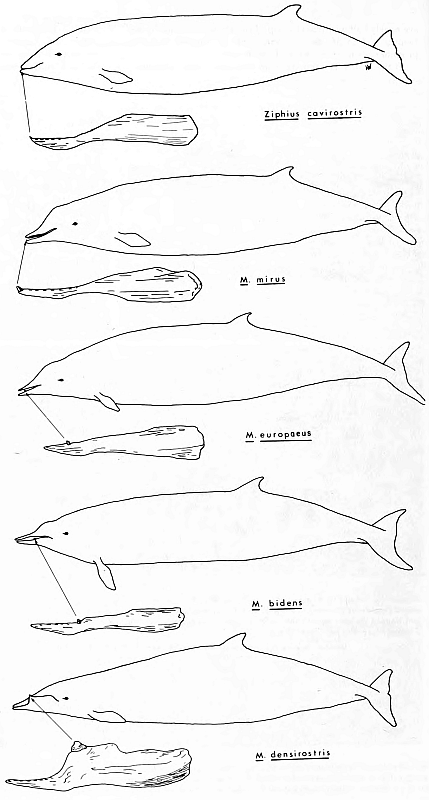
Figure 78.—Adult male beaked whales, showing the body profile and the relative positions of the teeth. Remember that the teeth of females and immature males are concealed beneath the gums. (Drawing by L. Winn.)
TRUE'S BEAKED WHALE (T) Mesoplodon minis True 1913
Other Common Names
None known.
Description
True's beaked whales reach a length of at least 16 feet (4.9 m) long. They are chunky in midbody and narrow rapidly towards the tail, closely resembling goosebeaked whales (p. 70). In overall body shape, the head is small with a slight indentation in the area of the blowhole, a slight bulge to the forehead, and a pronounced beak. The flippers are small (from one-fourteenth to one-tenth the body length). The dorsal fin is small, slightly falcate, located in the latter third of the back, and followed by a pronounced ridge on the tail stock. The flukes, which sometimes contain a very slight notch, are broad (to almost one-fifth the body length).
True's beaked whales are dull black to dark gray on the back, lighter slate gray on the sides, and white on the belly. The body is frequently covered with light colored spots or splotches and bears numerous pairs of scratch marks, presumably tooth rakes (Fig. 76).
The flippers are all black and are attached in the dark coloration of the animal's side. The flukes are dark above and below.
May Be Confused With
True's beaked whales are most likely to be confused with goosebeaked whales (p. 70) but may also be confused with any of the other beaked whales species (p. 74 and Fig. 78).
Distribution
True's beaked whales appear to be primarily temperate in distribution. They have been reported from Cape Breton Island, Nova Scotia south as far as Flagler Beach in Florida. Northernmost records are for summer months.
The range of True's beaked whales overlaps with that of the Antillean beaked whale but is more northerly.
Stranded Specimens
The teeth of adult male True's beaked whales may be visible near the tip of the lower jaw, a characteristic shared with the goosebeaked whale (p. 70) and the northern bottlenosed whale (p. 67). Both these other species reach substantially greater maximum lengths than True's beaked whales, however, and should be readily distinguishable by this and the number of other highly distinctive characteristics of each species.
Females and subadult males may be confused with any of the beaked whales species (p. 74 and Fig. 78).
Figure 79.—Two views of the body of a stranded True's beaked whale from northeastern Florida. This species reaches at least 16 feet (4.9 m) and closely resembles the goosebeaked whale in general body shape. It is distributed in temperate waters from Nova Scotia to Florida. (Photos courtesy of Marineland of Florida.)
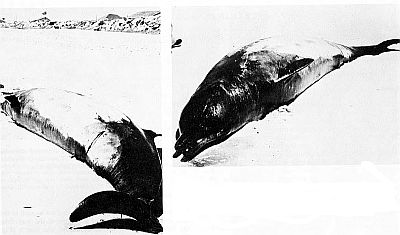
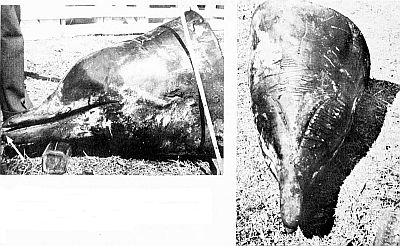
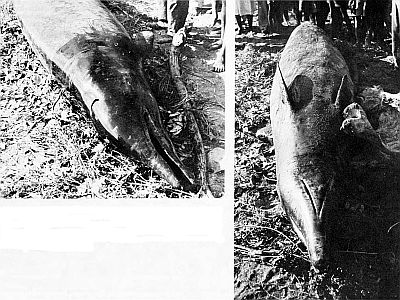
Figure 80.—The head of a True's beaked whale stranded in North Carolina. Note the small head, the pronounced beak, and the position of the blowhole in the indentation behind the forehead. The teeth, visible above the gums only in adult males, are in the position indicated by the arrow. The photo on the right shows the two V-shaped throat grooves characteristic of beaked whales. (Photos from U.S. National Museum, courtesy of J. G. Mead.)
ANTILLEAN BEAKED WHALE (T) Mesoplodon europaeus (Gervais 1855) (equals M. gervaisi [Deslongchamps])
Other Common Names
Gulfstream beaked whale, Gervais' beaked whale.
Description
Antillean beaked whales reach a length of at least 22 feet (6.7 m). They are slender in form and appear somewhat laterally compressed (i.e., taller than they are wide). The head is extremely small and tapers rapidly to a narrow beak. The flippers are small (to about one-twelfth the body length) with their origin well down on the sides of the body. The dorsal fin is small, located behind the midpoint of the back, and variable in shape from falcate to triangular. The flukes are less than one-fifth the body length and are not notched.
Antillean beaked whales are dark grayish black on the back and sides, slightly lighter on the abdomen. The flukes are dark gray above and below.
Natural History Notes
Antillean beaked whales are probably primarily oceanic in distribution and are known to feed on squid.
May Be Confused With
Antillean beaked whales may be confused with any of the other beaked whales though they are larger than all except the northern bottlenosed whale (p. 67) and the goosebeaked whale (p. 70).
Distribution
Antillean beaked whales have been reported stranded from the latitude of Long Island, N.Y. south to Florida, thence into the Caribbean and the Gulf of Mexico.
Stranded Specimens
The teeth of Antillean beaked whales are located at the suture of the mandible, about one-third of the way from the tip of the snout to the corner of the mouth (Fig. 78).
Figure 81.—Two views of an Antillean beaked whale stranded in New Jersey in 1899. Note the very small head, the prominent back-curved dorsal fin, and the slightly concave rear margin of the tail flukes, which lack a distinct notch. (Photos by F. W. True, courtesy of U.S. National Museum.)
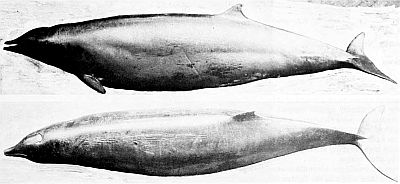
Figure 82.—Two views of an Antillean beaked whale stranded in Jamaica. This species reached at least 22 feet (6.7 m) in length. Compared to the smaller True's beaked whale, Antillean beaked whales have a smaller head, a narrower beak, and a taller, narrower body. Furthermore, the teeth of this species are located about one-third of the way back from the tip of the snout to the corner of the mouth. (Photos by J. J. Rankin.)
DENSE-BEAKED WHALE (T) Mesoplodon densirostris (Blainville in Desmarest 1817)
Other Common Names
None known.
Description
Dense-beaked whales reach a length of at least 17 feet (5.2 m). The body is distinctly spindle-shaped. The head, the contour of which is the most distinctive characteristic of this species, is marked by a prominent rise, located near the angle of the gape on each side. This rise, which bears the teeth, gives a peculiar high, arching contour to the mouth (Fig. 84), particularly in adult males.
The flippers are small (one-eleventh to one-tenth the body length) and have their origin in the lighter color of the lower sides. The dorsal fin varies from small and triangular to nearly falcate and pointed on the tip. It is located behind the midpoint of the back. The flukes are from one-sixth to one-fifth the body length, are seldom notched, and occasionally even bulge slightly backwards near the center of the rear margin.
Dense-beaked whales are black or charcoal gray on the back, slightly lighter on the abdomen. They are somewhat blotched with grayish white and are often extensively scratched or scarred. The flippers are lighter than the back. The flukes are dark above, light below.
Natural History Notes
From stomach contents of stranded animals dense-beaked whales are known to feed on squid.
May Be Confused With
Adult male dense-beaked whales can be separated from the other beaked whales by the high, arching contour to the corners of the mouth. If there is no adult male in the group, however, dense-beaked whales may be confused with any of the other beaked whales species.
Distribution
Dense-beaked whales have been reported from Peggys Cove, Nova Scotia south to Florida. From all accounts, this species appears widely but sparsely distributed in warm temperate seas.
Stranded Specimens
Adults of this species should be distinguishable by the highly distinctive contour of the mouth. The teeth, located in the high rise of the mouth, are oriented slightly backwards.
Figure 83.—A dense-beaked whale in the tank at New York Aquarium. Note the position of the prominent dorsal fin, just breaking the surface. The blow of beaked whales is usually small and inconspicuous and reportedly projects markedly forward from the head. (Photo by J. G. Mead.)

Figure 84.—Views of the heads of dense-beaked whales. Females (bottom) and immature males have a slight curvature to the rear of the mouth. As they mature, males (middle and top) begin to display the two arching prominences near the corners of the mouth which give the characteristic contour to the mouth. The teeth are located in these prominences and are oriented slightly backwards. (Photos from northeastern Florida by W. A. Huck, courtesy of Marineland of Florida [top and middle] and by J. G. Mead [bottom].)
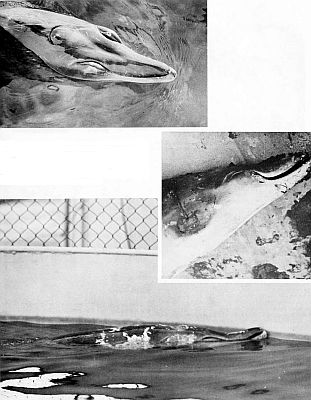
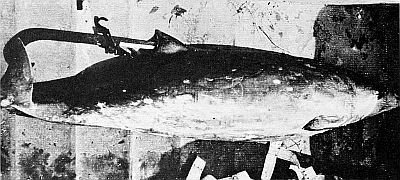
Figure 85.—A dense-beaked whale stranded in northeastern Florida. This species reaches about 17 feet (5.2 m) and is black or charcoal gray on the back, lighter gray on the sides, and frequently marked with grayish-white blotches and often extensively scarred. (Photo by W. A. Huck, courtesy of Marineland of Florida.)
NORTH SEA BEAKED WHALE (T) Mesoplodon bidens (Sowerby 1804)
Other Common Names
Sowerby's beaked whale.
Description
North Sea beaked whales reach a length of at least 16.5 feet (5 m). The body is distinctly spindle-shaped, but apparently more robust near midbody than that of the dense-beaked whale. The head is characterized by a pronounced bulge in front of the blowhole, a slightly concave forehead, and a moderate to long beak. The flippers are relatively long (one-eighth to one-ninth the body length). The dorsal fin is reportedly tall and variable in shape from triangular to slightly falcate and is located just behind the midpoint of the back. The flukes are not notched but are sometimes quite concave on the rear margin.
Adult North Sea beaked whales are dark charcoal gray on the back with white spots overall. Young animals are also dark charcoal gray on the back but are lighter on the belly and are unspotted. The flukes of adults are dark above and below. Those of young are dark above, lighter below.
Natural History Notes
North Sea beaked whales are known to feed on squid.
May Be Confused With
North Sea beaked whales are the most northerly species of beaked whales. No other species is very likely to be encountered in the same area.
Distribution
North Sea beaked whales have been reported in the offshore waters from the latitude of New England north perhaps to the pack ice. Individuals are occasionally drawn to the coasts of Newfoundland in summer, presumably by concentrations of squid, a known food item.
Stranded Specimens
The teeth of North Sea beaked whales are located about midway between the tip of the snout and the corner of the mouth. Except for this characteristic and their northerly distribution, however, this species might easily be confused with any other of the beaked whales species.
Figure 86.—North Sea beaked whales are the most northerly of the beaked whale species, extending north as far as the pack ice. They reach at least 16.5 feet (5.0 m) and can be identified on the beach by the position of the teeth near the middle of the lower jaw. Little is known of the species at sea. (Drawing by L. Winn.)
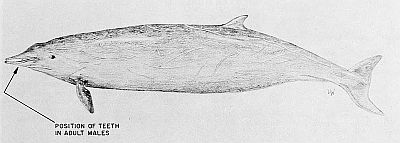
Figure 87.—A female North Sea beaked whale (16.5 feet [5.0 m]) stranded in Hjertuika in 1957. (Photo courtesy of A. Jonsgard.)

KILLER WHALE (T) Orcinus orca (Linnaeus 1758)
Other Common Names
Blackfish (see also pilot whales, p. 91 and 94), sword fish (Canada), grampus (see p. 96), whitefish (St. Vincent), Espladon (Quebec).
Description
Killer whales are the largest member of the dolphin family. Adult males reach a length of at least 30 feet (9.1 m) and are robust in form. One specimen of 31 feet (9.5 m) was recorded for the western North Pacific. Females are considerably smaller and less stocky. Newborn are approximately 7-8 feet (2.1-2.4 m) long. Killer whales have large paddle-shaped flippers.
The most distinctive field character of the species is the dorsal fin. In adult males it is extremely erect and may be as much as 6 feet (1.8 m) tall. Though the fin of females and immature males is less than 3 feet (0.9 m) tall, it is nonetheless taller even in these animals than in any other cetacean species and is distinctly falcate and pointed on the tip.
Killer whales are basically black with an extensive region of white on the undersides extending from the lower jaw to the anal region with a branch extending onto the flanks behind the dorsal fin. There is an oval white patch on the side of the head just above and behind the eye. In newborn and very young calves, these regions may be tan to lemon yellow in color. Most animals have a light-gray saddle marking just behind the dorsal fin. The undersides of the flukes are usually white. Both all-black and all-white animals have been reported.
Natural History Notes
Killer whales travel in groups of from a few to 25 or 30 individuals, though herds of 150 have been reported. Males appear polygamous, and females and young may form groups separate from young bachelors and bulls.
Killer whales are extremely fast swimmers, capable of reaching top speeds of 25 knots or more, and have been reported "porpoising" and breaching. Individuals and entire groups have also been reported "spy-hopping," or "pitchpoling," behaviors which consist of hanging vertically in the water with the head and much of the body (to just behind the flippers) exposed above the surface.
Killer whales feed on squid, fishes, sea turtles, seabirds, and marine mammals.
Controversy still continues over whether or not killer whales pose a threat to man. Documented attacks of killer whales on boats are rare and have usually been provoked (i.e., harpooning or attempts to capture). Only two uncertain instances of attacks in the wild have been reported, but all divers and mariners should be cautioned that this powerful animal is perfectly capable of doing tremendous damage and should not be provoked.
May Be Confused With
Because of its very distinctive dorsal fin, body shape, and coloration, the killer whale is not likely to be confused with any other whale when it can be examined at close range or when an adult male is present in the group. Pods of females and immature animals, however, may be confused with false killer whales or with grampus. The killer whales may be distinguished from false killers by the following differences:
Killer Whale False Killer Whale
BODY SHAPE
Chunky. Slender.
BODY COLOR
Black with white on belly, flank, and head. All black with some gray on belly.
DORSAL FIN
Very tall and erect in adult males; tall and slightly back curved in female. Shorter, slender, strongly falcate.
HEAD SHAPE
Broad, rounded. Tapered, slender.
FLIPPER SHAPE
Paddle-shaped. Moderately long with characteristic hump near middle on forward margin.
LENGTH
To at least 30 feet (9.1 m). To at least 18 feet (5.5 m).
Furthermore, false killer whales are the only "blackfish" which are known to ride the bow wave of a ship.
Grampus have a tall dorsal fin (15 inches [38.1 cm]) which is very similar in appearance to that of adult female and juvenile killer whales. But grampus have much lighter coloration, from slate gray to nearly all white, and larger animals are covered with numerous scratches. Upon closer examination they can be further distinguished from killer whales by a crease in the front of the head dividing the melon into two distinct sections. Grampus are considerably smaller, to about 13 feet (4 m) maximum length.
Distribution
In the western North Atlantic killer whales have been reported from the polar pack ice south to Florida and St. Vincent, Lesser Antilles, and into the Gulf of Mexico at least as far as Texas, though they are far more common in the cooler waters from about New Jersey north. Throughout their range, killer whales seem to prefer coastal areas and often enter shallow bays, estuaries, and river mouths in search of food.
Migrations of the species are probably closely tied to movements of their food supply. They annually arrive on the coast of New England with the tuna. Along the Canadian coasts, where distribution and migrations have been described in some detail, killer whales appear to move inshore in spring and summer. Many arrive off the east coast of Newfoundland in June, the Strait of Belle Isle in June and July, and slightly later along the Labrador coast and Arctic waters. They are found around the loose ice in April, presumably feeding on harp seals, Pagophilus groenlandicus, and hooded seals, Cystophora cristata, and are frequent in the St. Lawrence estuary in spring and autumn following the movements of the white whales. The northward movements in spring also coincide with migrations of balaenopterine whales, which have also been reported among the food items. Killer whales may remain in arctic or subarctic waters until driven out by new forming ice in October and November. Though the migration has not been as thoroughly described, killer whales apparently begin shifting southwards in autumn.
Stranded Specimens
Stranded killer whales should be readily identifiable by the robust body, the distinctive body markings, and in larger animals the tall dorsal fin. Killer whales have from 10 to 12 large, prominent teeth on each side of the upper and lower jaws.
Figure 88.—A small herd of killer whales off southern California (top) and details of an adult male from that herd (middle) and of females or immature males off Islas San Benito, Baja California (bottom). Adult males have a tall erect dorsal fin, which may be more than 6 feet (1.8 m) tall, while the fins of females and immature males are less than 3 feet (0.9 m) tall, distinctly falcate, and pointed on the tip. Both sexes frequently have a grayish-white region, called a "saddle," behind the dorsal fin. (Photos by T. Dohl [top and middle] and S. Leatherwood [bottom].)
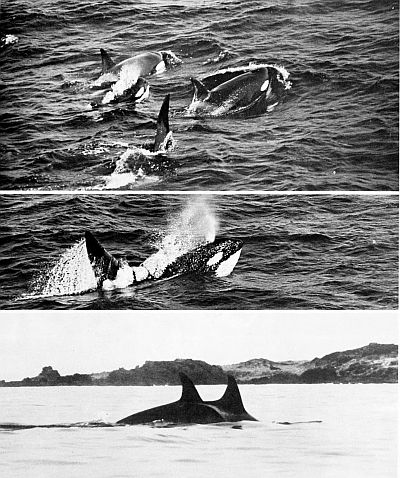
Figure 89.—Killer whales are often distributed very close to shore. In these photos from Baja California, they are shown in two characteristic behaviors—breaching (top) and "spy-hopping" or "pitchpoling" (bottom). (Photos by S. Leatherwood.)
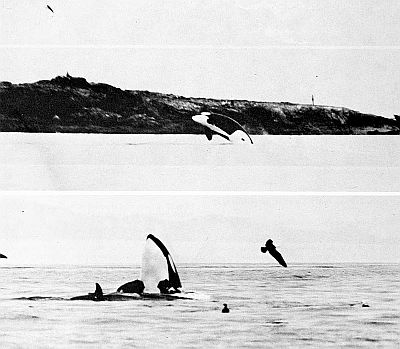
Figure 90.—A leaping killer whale in California aquarium. Note the distinctive coloration of the species, white on the lower jaw, the belly and the anus, and on both sides above the anus. Note also the distinctive white eye patch often visible on animals at sea. (Photo by D. K. Caldwell.)
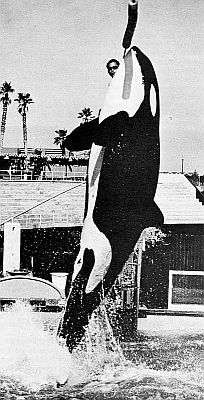
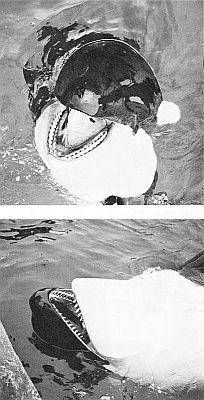
Figure 91.—Killer whales have from 10 to 12 large prominent teeth, curved slightly backwards and inwards on each side of each jaw. (Photos from Point Mugu, Calif. by S. Leatherwood.)
FALSE KILLER WHALE (T) Pseudorca crassidens (Owen 1846)
Other Common Names
Mongoose (St. Vincent).
Description
False killer whales in the western North Atlantic reach a length of at least 18 feet (5.5 m). Males are slightly larger than females. Calves from 5 to 7 feet (1.5 to 2.1 m) may be seen at any time throughout the year.
The dorsal fin, located just behind the midpoint of the back, is from 7 to 16 inches (17.8 to 40.6 cm) tall, falcate, and variable to sharply pointed on the tip. The flippers are characterized by a broad hump on the front margin near the middle, a characteristic which is diagnostic for the species.
The body of the species is all black except for a blaze of gray on the belly between the flippers. This blaze varies from barely visible to light grayish white similar to but generally fainter than that of pilot whales. The body is long and slender, and the head is narrow and gently tapered from the area of the blowhole forward.
Natural History Notes
False killer whales are a social form and may occur in herds of up to at least 100 individuals. They often jump clear of the water and frequently ride the bow waves of vessels. They are the only "blackfish" which are known to do so. False killer whales feed primarily on squid and large fishes and are notorious for their habit of stealing fish from the lines of fishermen. The large prominent teeth may be visible on a swimming animal.
May Be Confused With
False killer whales may be confused with killer whales, pilot whales, or the smaller, poorly known pygmy killer whale (p. 138) and many-toothed blackfish (p. 142).
The characteristics distinguishing the species from the killer whale are tabularized on p. 84; its differences from the pilot whales are summarized on p. 92.
At sea, false killer whales are distinguishable from the other two species primarily by their larger size and differences in coloration. False killer whales are up to 18 feet (5.5 m) in length. Pygmy killer whales and many-toothed blackfish reach only 8-9 feet (2.4-2.7 m) in length. Pygmy killer whales have an extensive region of white on the belly which may extend onto the sides and both pygmy killer whales and many-toothed blackfish have a distinctive white region on the lips, usually lacking or indistinct on false killer whales.
Neither of the smaller species of blackfish has been reported to ride bow waves.
Distribution
False killer whales are widely distributed in the pelagic tropical, subtropical, and warm temperate waters of the western North Atlantic. They have been reported from off Maryland south along the mainland coasts of North America, in the Gulf of Mexico from Cuba and the Lesser Antilles, and from the southeast Caribbean Sea. The species has been reported from Venezuela.
Stranded Specimens
Stranded false killer whales can be positively identified by: 1) the large size (to 18 feet [5.5 m]); 2) the slender body tapering rapidly to a long slender head; 3) the markedly long mouth, with from 8 to 11 large, conspicuous teeth in each side of each jaw recalling those of the killer whale, but circular and not, as in killer whales, elliptical; 4) the unusually shaped flipper bulging conspicuously on the forward margin.
For comparison with "blackfish" of similar size (the pilot whales) see p. 92 and 94.
False killer whales do not appear to occur frequently in coastal waters, sandy bays, or estuaries, though entire herds have stranded in such areas. Records from throughout the range suggest that the species has an oceanic distribution.
Figure 92.—False killer whales at sea 600 miles (968.0 km) off northeastern Florida. Note the smoothly falcate dorsal fin, pointed on the tip, and located near the midpoint of the back. Dorsal fins of this species may also be rounded on the tip but all are sharply concaved on the rear margin. (Photo by H. E. Winn.)
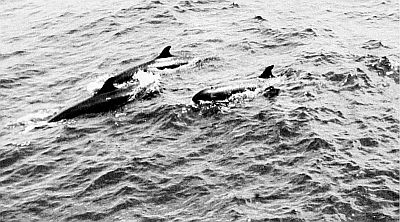
Figure 93.—False killer whales are the only "blackfish" that routinely ride the bow waves of vessels. On this animal riding on the bow wave of a research ship, note the all-black coloration of the back, head, and sides and the broad "hump" near the middle of the flippers on the leading edge. (Photo 600 miles [968 km] off northeastern Florida by H. E. Winn.)
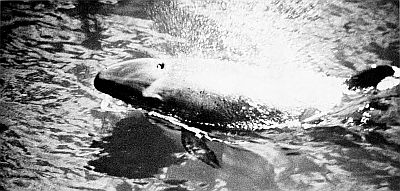
Figure 94.—A false killer whale stranded in northeastern Florida. Note the narrow tapering head, overhanging the lower jaw by several inches, the position and shape of the dorsal fin and the distinctive "hump" on the leading margin of the flippers. (Photo by W. A. Huck, courtesy of Marineland of Florida.)
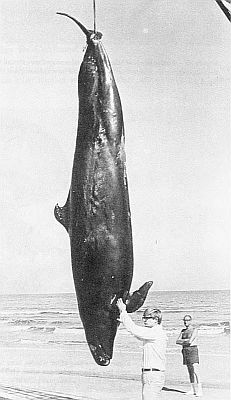
Figure 95.—Entire herds of false killer whales sometimes strand themselves. In this dorsal view of an animal stranded in southeastern Florida, note the extremely distinctive "hump" on the forward margin of the flippers and the narrow head, tapering towards the tip of the snout. (Photo by J. Krol.)
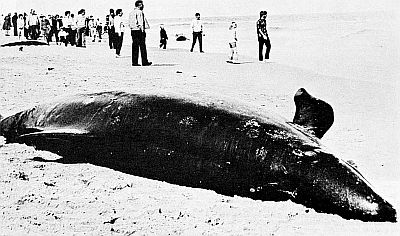
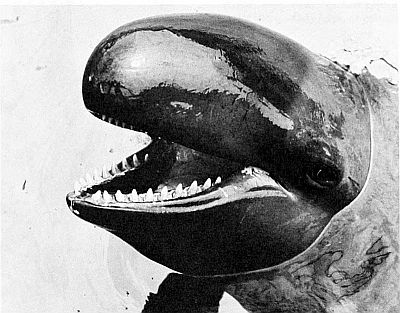
Figure 96.—False killer whales have from 8 to 11 large, conspicuous teeth in each side of each jaw. These teeth are often visible in swimming animals, particularly when they are engaged in their obnoxious habit of stealing fish from the lines of fishermen. The teeth are so distinctive that they can also be used to identify even a badly decomposed stranded specimen. (Photo, courtesy of Sea Life Park, Hawaii.)
ATLANTIC PILOT WHALE (T) Globicephala melaena (Traill 1809)
Other Common Names
Northern pilot whale, long-finned pilot whale, pothead, blackfish, calling whale, caa'ing whale.
Description
Male Atlantic pilot whales reach an average length of at least 20 feet (6.2 m). Females are slightly smaller, probably not exceeding 18 feet (5.5 m). Young are 5-7 feet (1.5-2.1 m) at birth.
The head is thick and bulbous, a characteristic which reaches an extreme in the development of the head of adult males (prompting the common name "pothead"). The flippers are long (to one-fifth of the body length, or more) and sickle-shaped. The tail is dorsally thickened just in front of the flukes.
The dorsal fin of this species is one of its most distinctive characteristics. It is low in profile, has a long base, is set far forward on the animal's back, and is falcate to "flaglike" in appearance. The dorsal fin of adult males reportedly has a thicker leading edge and a rounder form than that of the female.
Atlantic pilot whales are black on the back and sides (prompting the common name "blackfish") but have an anchor-shaped patch of grayish white on the chin and a gray area on the belly, both of which are variable in extent and intensity. Some larger animals have a gray saddle behind the dorsal fin, though this zone of color is found more frequently in short-finned pilot whales. Young animals are often a lighter medium gray.
Natural History Notes
Atlantic pilot whales may occur in herds of 200 animals or more, though herds of 50 or fewer (4-6) are more common. They are sometimes found in association with Atlantic white-sided dolphins.
Pilot whales are sometimes found hanging vertically in the water with the head and part of the back out of the water in what has been called "spy-hopping" or "pitchpoling." Individuals frequently lobtail. Pilot whales infrequently breach, a behavior which is usually confined to younger animals. They do not ride bow waves.
Atlantic pilot whales feed primarily on squid but also take cod and other fishes. A Pacific pilot whale, a closely related species, was found by radio telemetric studies to be capable of diving to 2,000 feet (609.6 m).
Atlantic pilot whales were formerly the object of an active shore fishery off Newfoundland (1950-1971). In addition, entire herds and, less frequently, individuals are sometimes stranded.
May Be Confused With
Atlantic pilot whales are most likely to be confused with false killer whales, with which they share the waters from off Virginia to those off Maryland. The two species may be distinguished by the following characteristics:
Atlantic Pilot Whale False Killer Whale
SHAPE OF HEAD
Thick and often squarish in larger animals. Slender, gently tapering mouth long.
SHAPE OF BODY
Robust. Long and slender.
DORSAL FIN
Broad-based and falcate. Slender, tall, falcate, and pointed on tip.
COLORATION
Black with gray saddle sometimes evident behind dorsal fin and gray region on chin and belly. Mostly black with gray blaze of variable extent and intensity on belly between flippers.
BEHAVIOR
Will not ride bow waves; seldom breaches. May ride bow waves, often "porpoises" and breaches.
RANGE
Temperate waters from at least North Carolina north. Temperate seas from at least Maryland south.
In the extreme southern portion of their range, Atlantic pilot whales may be confused with short-finned pilot whales with which they have only a limited seasonal common range. Characters distinguishing these species are subtle and may not be adequate to permit them to be distinguished at sea. For purposes of this guide it is generally that pilot whales living north of lat. 38°N (Virginia coast) are Atlantic pilot whales and those living south of lat. 38°N are short-finned pilot whales.
Distribution
Atlantic pilot whales, the northernmost of the two pilot whales species, are found in winter from the Grand Banks south as far as North Carolina and in summer from Iceland and Greenland south to the New Jersey coast. Winter concentrations of pilot whales may be found off the Newfoundland coast and near Cape Cod, Mass. Atlantic pilot whales are distributed both in coastal waters and in deep waters off the continental shelf.
Stranded Specimens
As discussed above, individuals and groups of pilot whales frequently strand themselves for still incompletely understood reasons. They may be identified as pilot whales primarily by: 1) the robust body and bulbous head, which is often squarish in adult animals, and 2) the broad-based, falcate dorsal fin located far forward on the back. Accurate determination of the pilot whale species involved in the stranding may require museum preparation of the skull and detailed examination of its characteristics. Preliminary identification may be made, however, based on the following:
Atlantic Pilot Whale Short-Finned Pilot Whale
FLIPPER LENGTH
To one-fifth body length, or more. To one-sixth body length, or less.
NORMAL RANGE
From North Carolina north. From North Carolina south.
TEETH
8-11 per row. 7-9 per row.
Figure 97.—A herd of Atlantic pilot whales off Massachusetts. The most distinguishing field characteristic of this species, and of their southern cousins, the short-finned pilot whales, is the highly distinctive dorsal fin, extremely long based, low in profile, and set well forward on the animals' backs. (Photo by W. A. Watkins.)
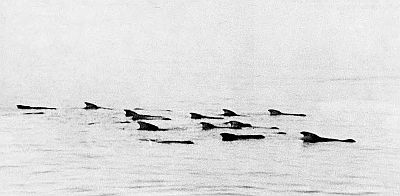
Figure 98.—Atlantic pilot whales frequently "lob tail" (raise the tail flukes above the surface and slap them against the water) (top) and pitchpole or spy-hop (hang vertically in the water with the head up and the tail down) (bottom). (Photos from the North Atlantic by H. E. Winn.)
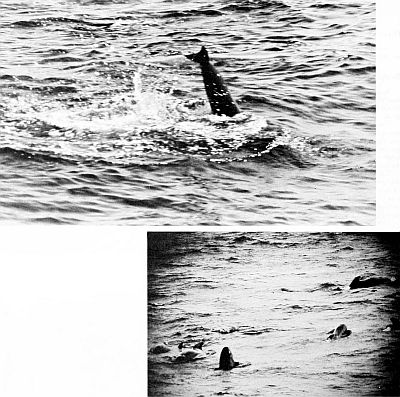
Figure 99.—North Atlantic pilot whales on the deck of a whaling station in Newfoundland. The anchor-shaped patch on the chin and the gray color of the belly are apparently more vivid and extensive in this species than in the short-finned pilot whales. Further, the flipper is longer, measuring one-fifth of the body length, or more, in adult animals. The flippers of short-finned pilot whales (see Fig. 102) measure one-sixth of the body length or less. (Photo by J. G. Mead.)

SHORT-FINNED PILOT WHALE (T) Globicephala macrorhynchus Gray 1846
Other Common Names
Blackfish (see also p. 84, 91, and 94).
Description
Male short-finned pilot whales of the western North Atlantic reach lengths of at least 17.5 feet (5.3 m). Females are reportedly slightly smaller than males (recorded only to 15.5 feet [4.7 m]).
The head, somewhat like that of the Atlantic pilot whales (p. 91), is thick and bulbous, a characteristic which reaches its extreme in the development of a flattened or squarish appearance to the front of the head in mature males (see Fig. 101). In very old males the melon may overhang the mouth up to several inches. The flippers are shorter than those of the other pilot whale species of the western North Atlantic (thus the common name short-finned pilot whale), reaching only one-sixth of the body length or less. The tail is dorsoventrally thickened just in front of the flukes.
The dorsal fin, like that of the Atlantic pilot whale, is one of the species' most distinctive characteristics. It is low in profile, has a long base, and is set far forward on the animal's back.
Short-finned pilot whales are all black on the back sides and most of the belly with an anchor-shaped patch of gray on the chin and a gray area of varying extent and intensity on the belly. These areas are less vivid and extensive than those on Atlantic pilot whales. Younger animals are lighter, often medium gray.
Natural History Notes
Short-finned pilot whales are known to occur in groups of 60 animals or more, though smaller groups are more common. They have been reported pitchpoling (spy-hopping), lobtailing, and—rarely—breaching.
Short-finned pilot whales feed on squid and fish.
May Be Confused With
In the tropical portion of their range, short-finned pilot whales may be confused with pygmy killer whales (p. 138) and many-toothed blackfish (p. 142). They may be distinguished from both species primarily by their distinctive dorsal fin and the bulbous-to-squarish head. Both pygmy killer whales and many-toothed blackfish have dorsal fins, which are more falcate, slender, and pointed on the tip, and have longer, slenderer heads.
Throughout their range short-finned pilot whales may be confused with false killer whales. The two species may be distinguished by the same differences which distinguish Atlantic pilot whales from false killer whales (p. 91).
In the extreme northern portion of their range, short-finned pilot whales may be confused with Atlantic pilot whales. The two species may be distinguished by differences itemized on p. 93.
Distribution
Though short-finned pilot whales are known from Delaware Bay, their normal range appears to extend from Bermuda and Cape Hatteras (Virginia in summer) south to the Venezuelan coast. They have been reported for the Gulf of Mexico, the Caribbean, and the islands of the West Indies.
Stranded Specimens
Stranded short-finned pilot whales may be confused with any of the species itemized under living animals. They may be identified as pilot whales primarily by the robust body and bulbous head, often squarish in adult animals, and the broad-based, falcate dorsal fin located well forward on the animal's back. Accurate determination of the pilot whale species involved may require museum preparation of the skull and detailed examination of its characteristics. Preliminary identification may be made, however, on the basis of the following:
Atlantic Pilot Whale Short-Finned Pilot Whale
DISTRIBUTION
Primarily North Carolina north. Primarily North Carolina south.
FLIPPERS
To one-fifth body length, or more. To less than one-sixth body length.
TEETH
8-11 per row. 7-9 per row.
Figure 100.—Short-finned pilot whales stranded in northeastern Florida, shown here swimming in the lagoon at Marineland of Florida. This species, like their northern cousins, the Atlantic pilot whales, have a highly distinctive dorsal fin and a bulbous head (see Figs. 97, 99). In these photos note the variation in the shape of the head. Those of females and immature males are more rounded. Those of adult males are far more blunted. (Photo courtesy of Marineland of Florida.)
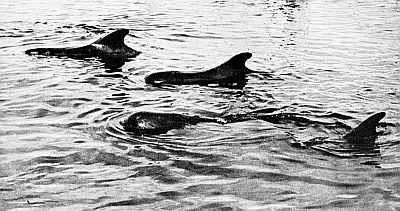
Figure 101.—Short-finned pilot whales have from 7 to 10 teeth in each side of each jaw. The bulbous forehead of the species is far less pronounced in females and immature males (left). The head of mature males is extremely "squarish" and may overhang the lower jaw by several inches (right). (Photos from Aquatarium [left] and southeastern Florida by D. K. Caldwell [right].)
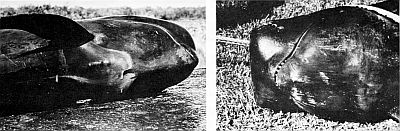
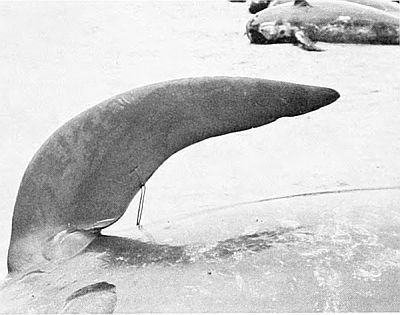
Figure 102.—The flippers of short-finned pilot whales reach only about one-sixth of the body length, while those of the Atlantic pilot whale may be one-fifth the body length or more. Note the length of the flippers of the pilot whale in the background, relative to its overall length. (Photo from South Carolina by J. G. Mead.)
GRAMPUS (T) Grampus griseus (G. Cuvier 1812)
Other Common Names
Risso's dolphin, gray grampus, white-headed grampus, mottled grampus, Risso's porpoise, hard knocks (St. Vincent), white blackfish (Cape Cod).
Description
Grampus reach a maximum length of about 13 feet (4 m). The body is robust, particularly in front of the dorsal fin, and lacks a distinct beak. The head is somewhat bulbous and is marked on the front by a V-shaped crease with the point downwards, which divides the melon into two parts. The flippers are long and pointed on the tips. The dorsal fin, located at about the midpoint of the body, is tall, to 15 inches (38.1 cm) or more, and distinctly falcate. The body narrows rapidly behind the dorsal fin and the tail stock is quite narrow. The flukes are broad, concaved on the rear margin, and deeply notched.
The bodies of grampus are a uniform light gray at birth. As the animals age, their color darkens to almost black with distinctive regions of grayish white on the belly and chest. The body of older adults is cream white or silver gray, particularly on the head, with numerous scars, presumably from encounters with other grampus and perhaps with the squid, which are one of the species' major food items.
The flippers, dorsal fin, and tail flukes usually remain dark even in adults.
Natural History Notes
Grampus are found in herds of up to several hundred individuals and may be seen "porpoising" (leaping from the water) as they surface to breathe, and breaching. They sometimes ride the bow waves of a boat.
Grampus feed on fish and squid.
May Be Confused With
From a distance grampus are most easily confused with Atlantic bottlenosed dolphins. They may be most readily distinguished by the following differences:
Grampus Atlantic Bottlenosed Dolphin
SIZE
To 13 feet (4 m). Rarely to 12 feet (3.7 m); usually less than 10 feet (3.1 m).
BODY COLOR
Young are uniform light gray; older animals dark with grayish regions on chest and belly; very old animals white and scarred. Dark gray on body; lighter gray on sides; white or pink on belly; may appear brownish in water.
DORSAL FIN
To 15 inches (38.1 cm); sharply falcate; pointed on tip To 12 inches (30.5 cm) less sharply falcate; pointed on tip.
HEAD COLOR AND SHAPE
Blunted and creased on front; frequently all white in larger animals. Uniformly brownish to gray distinctly bottlenosed.
MARKINGS
Very often extensively scarred. Less frequently scratched and scarred.
Distribution
Grampus are known to be distributed in temperate and tropical seas from at least eastern Newfoundland, south at least to St. Vincent, Lesser Antilles, and in the eastern and northern Gulf of Mexico. The species may not be as rare as the paucity of records suggests. Though they have been seen in Buzzards Bay on several occasions, grampus generally have an oceanic range and, along the Atlantic coast of North America, may be distributed from the Gulf Stream seaward, outside the theater of normal boating traffic.
Stranded Specimens
Stranded grampus are most readily identifiable by 1) the presence of only seven, or fewer, teeth in each side of the lower jaw (many of those teeth may have dropped out in older animals and remaining teeth may be extensively worn) and the absence of teeth in the upper jaw; 2) the presence of a distinct crease or bifurcation in the melon on the extreme front of the head; 3) the presence of numerous scratches and scars all over the body; and 4) the tall, slender, sharply falcate dorsal fin which may be more than 15 inches (38.1 cm) tall.
Figure 103.—Grampus are frequently found in small tight groups "porpoising." From a distance they may resemble the Atlantic bottlenosed dolphins, though grampus have taller dorsal fins, blunted beakless heads, and lighter coloration. (Photo off Washington State by C. Fiscus.)
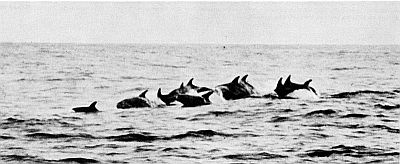
Figure 104.—Grampus off Fistler, Scotland (top) and from Baja California in the tank of Sea World, Inc., San Diego, Calif. (bottom). Note the tall pointed dorsal fin, which remains dark even in adult animals, the blunted head, which lacks a beak, and the extensive scarring of the body. In the photo on the right, note also the long pointed flippers and the white head characteristic of older animals. (Photos by A. S. Clark [top] and courtesy of D. K. Caldwell [bottom].)
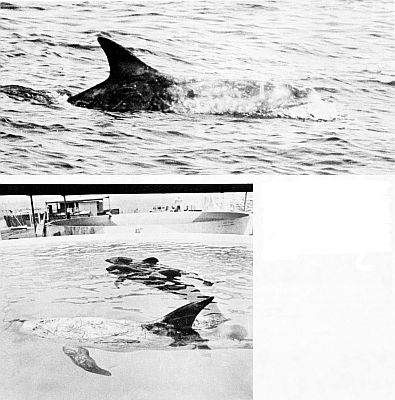
Figure 105.—Grampus, particularly younger animals, have two regions of grayish-white on the ventral surface, one in front of the flippers and another beginning on the belly narrowing towards the tail. These markings closely resemble the ventral marking of pilot whales. (Photos courtesy of Marineland of Florida.)

Figure 106.—Stranded grampus can be readily identified. On this captive animal note the blunted head, the distinct crease on the front of the head (see also Fig. 107), and the extensive scarring of the body. (Photo courtesy of D. K. Caldwell.)
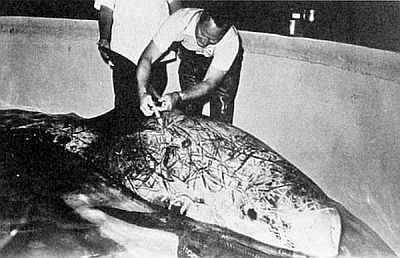
Figure 107.—Grampus have seven or fewer teeth in each side of the lower jaw. (None in the upper jaw.) Many of these teeth may have fallen out of older specimens, and the remaining teeth may be extensively worn. (Photo courtesy of Marineland of Florida.)
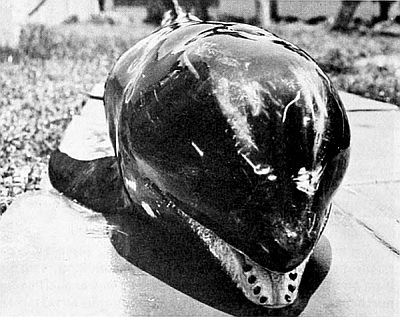
Medium-sized Whales Without a Dorsal Fin
BELUGA (T) Delphinapterus leucas (Pallas 1776)
Other Common Names
White porpoise, white whale, belukha, sea canary, marsouin blanc (Quebec).
Description
Belugas reach a maximum overall length of about 16 feet (4.9 m). Males are slightly larger than females. In the western North Atlantic they have been found to grow to greatest lengths in oceanic environments near the southern extremities of their ranges, though they are found in far greater abundance in estuarine areas of the Arctic. Belugas have extremely robust bodies tapering to a distinct "neck" region and a very small head relative to body size.
They do not have a dorsal fin. Instead, along the back just behind the midpoint there is a narrow ridge notched laterally to form a series of small bumps. These ridges may be clearly visible on a swimming animal.
Newborn belugas are brown. As they age, they gradually lighten through slate gray, and by their sixth or seventh year have assumed the all-white coloration characteristic of adult animals.
Natural History Notes
Belugas feed on a variety of fishes (including cod and capelin), on squid, and on a variety of benthic crustaceans.
They are frequently found in shallow bays and river mouths, where the young are born, and occasionally ascend rivers.
May Be Confused With
Because of their limited distribution, all-white coloration and lack of a dorsal fin, belugas are unlikely to be confused with any other species of cetacean.
Distribution
Belugas have been reported from the Arctic Circle south as far as eastern Connecticut, typically in estuarine habitats, though they do range into oceanic regions. They are most abundant from the north shore of the Gulf of St. Lawrence northward. They remain near the Arctic Circle and in Hudson Bay to northern Greenland during winter, undertaking migrations to the south in autumn, straggling to the Maritime Provinces and as far as Connecticut. Belugas are regularly seen in the St. Lawrence and Saguenay rivers throughout late spring and summer. Return migrations to the north take place in spring.
A small population in the estuary of St. Lawrence is resident throughout the year.
Stranded Specimens
Stranded belugas are unlikely to be confused with any other species of cetaceans. The all-white coloration, the robust body shape with a rather small head and a distinct neck region, and the presence of 8-11 teeth in each of the upper jaws and 8-9 in each of the lower jaws permit positive identification.
Figure 108.—A group of three belugas surfacing to breathe off northwestern Alaska. The animal to the right has just begun to exhale, the middle animal is in the midst of his inhalation, and the animal on the left has completed his blow and is preparing to dive. Note the all-white coloration and, on the center animal, the small dorsal ridge just emerging from the water. Details of the dorsal ridge are clearly visible in the inset photograph. (Photos by G. C. Ray and K. G. Hewlett [inset].)
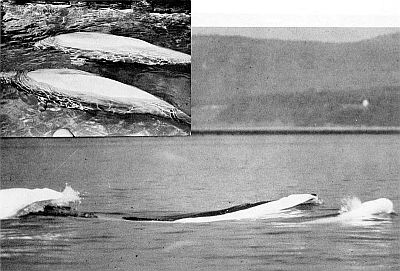
Figure 109.—Note the robust form and the small head of this swimming beluga off northwestern Alaska. (Photo by G. C. Ray.)
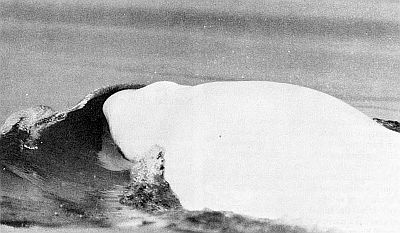
Figure 110.—Captive belugas at Vancouver public aquarium. Note the dorsal ridge, the shape of the head and body, and the unusually shaped flippers. (Photo by K. C. Balcomb.)

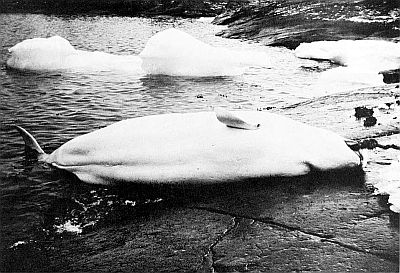
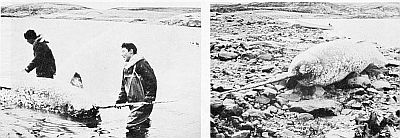
Figure 111.—Ventral view of a beluga harpooned in the northeastern Canadian Eskimo Fishery. Note the very narrow tail, just in front of the flukes, and the robust form of the species. Belugas have 8-9 teeth in each of the lower jaws, and 8-11 in each of the upper jaws. (Photo by P. F. Brodie.)
NARWHAL (T) Monodon monoceros Linnaeus 1758
Other Common Names
Unicorn whale (historical name not currently in use).
Description
The narwhal, also known as the unicorn whale because of the long tusk found on adult males, is one of two medium-sized whales found in the Arctic waters of the northwestern Atlantic. They reach a maximum length of from 15 to 16 feet (4.6 to 4.9 m) excluding the tusk. Newborn calves are approximately 5 feet (1.5 m) long. Narwhals have small rounded heads and a small mouth. Like the other medium-sized whale in the same region, the beluga or white whale, the narwhal has no dorsal fin. Instead, it has a series of bumps, approximately 2 inches (5.1 cm) high along the midline of the back in the half nearest the tail. The ridge created by these bumps may be readily seen on a swimming animal.
The basic coloration of the species changes slightly with age. Young animals are uniformly dark bluish gray on the back but rapidly begin to develop the numerous leopardlike spots on the back and sides characteristic of adults. Those spots rarely extend onto the belly even in old animals.
Narwhals have only two teeth. In the females, these teeth rarely emerge from the gums. In males, one and sometimes both of those teeth grow out the front of the snout, spiraling in a left-hand or sinistral direction, and may reach a length of 9 feet (2.7 m). One or two tusks may also be exposed, however, in females.
Natural History Notes
The function of the tusk in male narwhals is unknown, but it was this feature of the animal that earned it the name "unicorn whale" and resulted in its extensive hunting by whalers. During their annual migrations narwhals may congregate but are commonly found in groups of 10 or fewer during the rest of the year.
Narwhals feed on a variety of organisms, including cod, rockfish, flounder, and crabs, but their diet consists primarily of squid.
Distribution
Narwhals are found in the high arctic seas of the western North Atlantic, primarily in Lancaster Sound and its fringes. It has been noted that they are found in isolated pockets within that range and are not, like the beluga, widely distributed.
Narwhals make annual migrations in response to the movement of the ice. During the fall as the ice begins to form, the whales migrate to the south, sometimes reaching the Labrador coast. In the spring they return to the pack ice.
May Be Confused With
Narwhals are so different in coloration from the only medium-sized cetacean which shares its range and habitat—the beluga—that the two are highly unlikely to be confused. Belugas are usually all white or light slate gray in color, while narwhals are very much darker, ranging from bluish gray to brownish, and are often covered with light leopardlike spots. Furthermore, the body of the beluga is more robust.
Further, swimming narwhals frequently buck their heads up to breathe, a behavior which makes the tusk of adult males visible and permits positive identification.
Stranded Specimens
Stranded narwhals should be easily identifiable by the distinctive coloration and the unique characteristics of the teeth. In adults, one or two of the teeth may develop into the long, left-hand spiraling tusk, shown in Figures 112 and 114. Immature animals have no teeth which are emerged.
Figure 112.—In this photo of narwhals, the origin of the name "unicorn whale" is apparent. The animal at the right, an adult male, exposes his tusk as he surfaces aggressively to breathe. Even when this feature is not observed, however, the narwhals' mottled gray coloration makes them easy to distinguish from the all-white belugas, with which they share a common range. Note also the dorsal ridge on the animal to the left. (Photo by D. Lusby, courtesy of the Sea Library.)
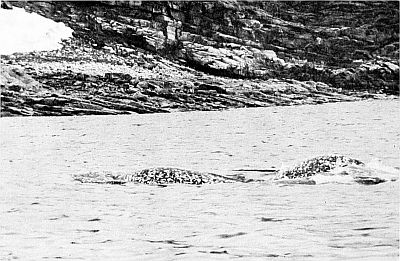
Figure 113.—A juvenile narwhal in a tank at New York Aquarium. Though newborn animals are dark bluish gray on the back, fading to white on the belly, note that the mottled gray coloration characteristic of adults is well developed even in relatively young animals. The white region on the head is lanolin cream, applied to protect the animal's skin during transport. (Photo by H. E. Winn.)
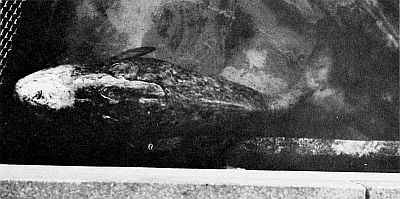
Figure 114.—A stranded male narwhal. The long unicorn tusk is the spiral extension of one of the two teeth, though the other may be exposed above the gums in males and may even develop into a second long tusk; both teeth of females are normally buried in the gums and rarely emerge. Note the highly distinctive dorsal ridge, near the midpoint of the back. (Photos by D. Lusby, courtesy of the Sea Library.)
Small Whales, Dolphins, and Porpoises With a Dorsal Fin
ATLANTIC SPOTTED DOLPHIN (T) Stenella plagiodon (Cope 1866)
Other Common Names
Spotter, Gulf Stream spotted dolphin, spotted porpoise, long-snouted dolphin.[11]
Description
Atlantic spotted dolphins reach a maximum adult length of 7.5, perhaps 8 feet (2.3 to 2.4 m). They are generally more robust in body shape than the other species of Stenella, closely resembling Atlantic bottlenosed dolphins in that regard, though the Atlantic spotted dolphins tend to be more slender.
The dorsal fin is distinctly back-curved and pointed on the tip, also closely resembling that of the Atlantic bottlenosed dolphin.
As the common name suggests, the Atlantic spotted dolphins are marked dorsally with numerous grayish-white spots on a darker background and ventrally with dark spots on a lighter background, though the extent of the spotting and the additional details of coloration change with age.
Immature animals lack spots completely. They are dark gray or purplish gray on the back, becoming lighter gray on the sides and white on the belly. The cape along the back is distinctly separated from the lighter gray coloration of the sides. The flippers and the trailing edge of the flukes are darker than the rest of the body.
As they age, the Atlantic spotted dolphins develop grayish-white spots, first low on the sides, spreading upward. During this stage, the cape becomes less distinct, and dark spotting begins to develop on the belly, the spots increasing in number with increasing age. In adult animals, the belly is often extensively covered with dark blotches but never becomes completely black. The lips may be white, and the beak is characteristically tipped with white, a feature which may aid in identification at sea.
The Atlantic spotted dolphins have a spinal blaze and a light line which extends from the flipper to the eye.
Natural History Notes
Little is known of the natural history of the Atlantic spotted dolphins. The species occurs in herds of up to several hundred individuals, though groups of 50 or fewer (6-10) are more common. They are often seen jumping clear of the water and habitually ride the bow wave of moving vessels. As they do, the distinct cape or band of purplish gray on the back of younger animals and the spotting pattern of older animals may be visible.
Atlantic spotted dolphins feed primarily on squid but may also take carangid fishes, small eels, herring, or anchovies.
May Be confused With
Atlantic spotted dolphins, particularly young animals, may be easily confused with Atlantic bottlenosed dolphins because of the similarities in color pattern and general body shape. However, the Atlantic spotted dolphins have considerable purplish gray in their background colors and the Atlantic bottlenosed dolphins are more dark gray to brownish gray. This along with considerable differences in the overall sizes of the two species should permit positive identification. In general, the key differences between spotted and bottlenosed dolphins are as follows:
Atlantic Spotted Dolphin Atlantic Bottlenosed Dolphin
MAXIMUM SIZE
To 7.5-8 feet (2.3-2.4 m). To 8-10 feet (2.4-3.1 m) inshore, to as much as 12 feet (3.7 m) offshore.
BODY COLOR
Dark purplish gray on back; lighter gray on sides and belly; body becomes increasingly spotted with age. Dark gray on back; lighter gray on sides; white or pink on belly (old animals may have a few spots on belly, but most are not spotted).
HEAD AND BEAK
Head more slender; beak longer; lips and top of snout often white. Head robust; beak short; beak usually uniformly gray (older animals' beak may be white at tip).
NORMAL DISTRIBUTION
Usually found more than 5 miles offshore; most common inside 100-fathom curve. Usually more coastal, often ascending rivers and entering lagoonal and estuarine areas.
Young Atlantic spotted dolphins are so similar in appearance to the Atlantic bottlenosed dolphins that the frequent reports of mixed schools of the two species are probably occasioned by groups of spotted dolphins which include some young, still unspotted animals.
Atlantic spotted dolphins might also be confused with bridled dolphins. The two can be most readily distinguished by the following characteristics:
Atlantic Spotted Dolphin Bridled Dolphin
BODY SHAPE
Usually robust, often like that of the Atlantic bottlenosed dolphin. More slender, more like that of the Atlantic striped dolphin.
BODY COLOR
Spotted; purplish gray on back; lighter gray on sides and belly becoming increasingly spotted with age. As animals becomes more spotted, cape become less distinct. Body has spinal blaze and light line from flipper to eye. Spotted; side of head light gray; body has stripe from flipper to corner of mouth, though the stripe tends to fade as spotting increases. Cape on top of head more distinct that on Atlantic spotted dolphin. Body has no spinal blaze.
At sea the Atlantic spotted dolphins may also be confused with rough-toothed dolphins (p. 135).
Distribution
Atlantic spotted dolphins are a common species in the continental waters of the tropical and warm temperate western North Atlantic. Although they are far more abundant south of Cape Hatteras, they have been reported from the latitude of Cape May, N.J. (some fishermen claim to have seen them even further north) south through the Gulf of Mexico and the Caribbean to Venezuela. Atlantic spotted dolphins may be replaced around the West Indies by the bridled dolphin.
Within this range, the Atlantic spotted dolphins appear to be generally restricted to the waters outside the 100-fathom curve, most commonly more than 5 miles offshore. However, populations in the Gulf of Mexico move inshore in the late spring, and may approach close to shore during spring and summer.
Stranded Specimens
Stranded Atlantic spotted dolphins may be difficult to distinguish from bridled dolphins. If the color pattern is still clearly visible, the differences in coloration described above, particularly those of the head, and the presence or absence of a spinal blaze may be used. But since external appearance other than coloration are often very similar, specimens should be photographed from as many aspects as possible and the entire specimen or the roughed-out complete skeleton transported to a museum for preparation and examination. Tooth counts recorded for the two species to date are also very similar.
Figure 115.—Atlantic spotted dolphins beside a research vessel off Beaufort, N.C., September 1965. Adults of this species can be identified by the spotting pattern and the white coloration of the lips. (See also bridled dolphin, p. 108.) Young animals which lack spots may be confused with the Atlantic bottlenosed dolphins though they are smaller and are purplish gray on the back. (Photo by G. T. Green.)
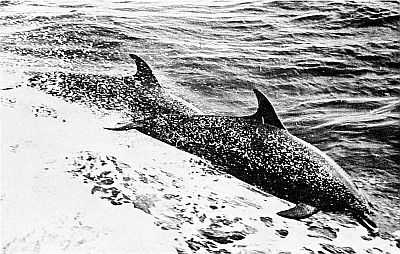
Figure 116.—A side view of two female Atlantic spotted dolphins from off St. Augustine, Fla. in the tank at Marineland of Florida. Note the tall falcate dorsal fin, pointed on the tip and varying slightly in shape between the two individuals, and the spots on the body. (Photo by S. Leatherwood.)
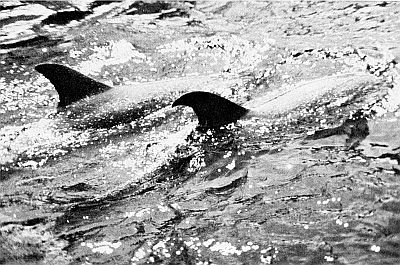
Figure 117.—A series showing the development of the color pattern of the Atlantic spotted dolphins from Florida. Newborn or young animals are dark purplish gray on the back, grading to immaculate white on the belly. As they mature, animals develop light spots, first on the lower sides, then higher on the back, and dark spots on the belly. As spotting increases, the cape becomes less distinct. (Photos by A. Solis [a], D. K. Caldwell [b, c], and courtesy of Marineland of Florida [d, e, f].)
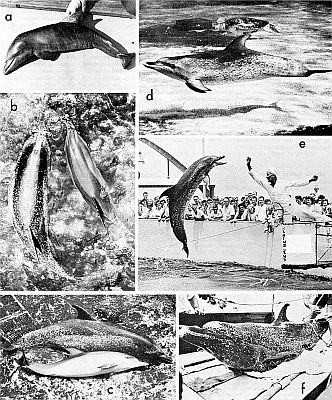
Figure 118.—Juvenile Atlantic spotted dolphins at sea in the southeastern Caribbean. Although spotters can be either relatively short-snouted and chunky or long-snouted and slightly built, the spinal blaze, flipper-to-eye stripe, white lips, and falcate dorsal fin can be used to identify them. (Photo by D. Poppe.)
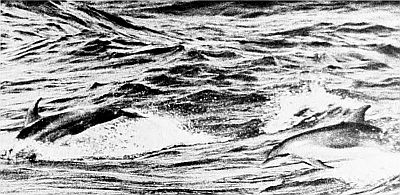
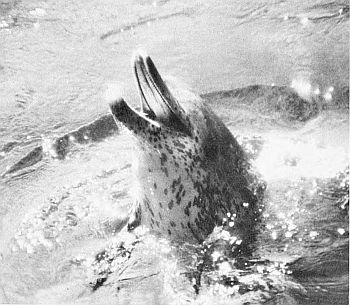
Figure 119.—A captive Atlantic spotted dolphin from off St. Augustine, Fla. This species has from 30 to 36 teeth in each upper jaw and from 28 to 35 in each lower jaw, fewer than all other Stenella except perhaps the bridled dolphin, fewer than the saddleback dolphins, but more than the Atlantic bottlenosed dolphins. (Photo by S. Leatherwood.)
BRIDLED DOLPHIN (T) Stenella frontalis (G. Cuvier 1829)
Other Common Names
Bridled spotted dolphin, Cuvier's dolphin, gamin (St. Vincent), bridled porpoise.
Description
Bridled dolphins, the second species of spotted dolphins in the western North Atlantic, reach an adult length of at least 7 feet (2.1 m). Like the other, the Atlantic spotted dolphin (p. 104), bridled dolphins are characterized by light grayish-white spots on the dark dorsal portions of the body and dark spots on the light ventral surface. Other details of the coloration differ somewhat. Bridled dolphins are dark gray on the back, fading to lighter gray on the sides and belly. They lack the spinal blaze characteristic of Atlantic spotted dolphins. Except on the head, the border between the back and side colors is indistinct. On the head, the cape (the dark color of the top of the head) is distinct. In the light gray of the side of the head are the markings from which the species derives its common name, "bridled dolphin." These are a black circle around the eye with an extension to the junction (apex) of the rostrum and the melon (present in nearly all dolphins) and a broad black stripe from the origin of the flipper to the corner of the mouth. This mouth-to-flipper stripe tends to fade as spotting increases. Both the upper and lower lips are white or pinkish.
Natural History Notes
Virtually nothing is known of the natural history of bridled dolphins except that they have been observed in small herds of from 5 to 30 individuals and sometimes ride the bow wave of a vessel.
May Be Confused With
At sea, bridled dolphins may be confused with Atlantic spotted dolphins or spinner dolphins. Differences by which they may be distinguished from the first are tabularized on p. 105. Differences between spinner and bridled dolphins permitting identification at sea are as follows:
Bridled Dolphin Spinner Dolphin
COLORATION
Distinct cape on top of head; side of head light gray; distinct stripes from flippers to corner of mouth and from dark circles around eye to apex of melon. Dark gray on back; tan or yellowish tan on sides; white on belly.
BEAK
Shorter and more slender; all black; lips white. Extremely long and slender; dark gray to black on top, white below; lips black.
DORSAL FIN
Uniformly dark gray. Often lighter gray in middle, dark around border.
Distribution
Bridled dolphins occur in tropical and subtropical waters primarily near coastal areas and islands, but are best known from the West Indies. They have been reported from the Antilles, from Texas, and from Florida north to North Carolina. It has been speculated that this species replaces the Atlantic spotted dolphin around the West Indies.
Bridled dolphins have not yet been described from the South American coast.
Stranded Specimens
Bridled dolphins have from 29 to 34 teeth in each upper jaw and from 33 to 36 in each lower jaw. They can be distinguished from spinner dolphins, which have 46-65 teeth in each jaw, by this character alone.
They may be distinguished from spotted dolphins only if the color pattern of the head is clearly visible. If it has faded, the specimen will probably require museum preparation and examination before it can be positively identified.
Figure 120.—A bridled dolphin harpooned in the commercial whale fishery off St. Vincent, Lesser Antilles. If the color pattern has faded, bridled dolphins cannot be readily distinguished from the Atlantic spotted dolphins and must be sent to a museum for preparation and examination of the skull and skeleton. (Photo by W. A. Huck, courtesy of Marineland of Florida.)
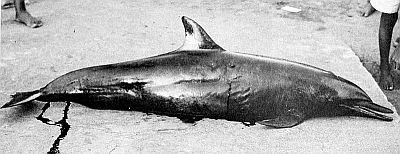
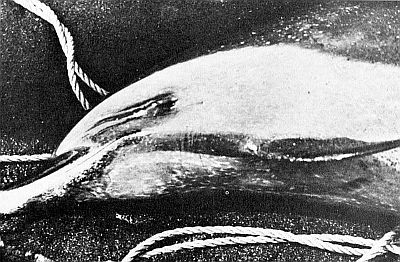
Figure 121.—A bridled dolphin from St. Vincent, Lesser Antilles. Note the dark cape of the back, the lighter side, and the dark stripes from the eye to the snout (found in most dolphin species) and the flipper to the gape, a feature which fades as the animal's spotting increases. Together these two features comprise the "bridle" from which the common name derives. Note also the white lips and the white lower jaw. (Photo by J. R. Sullivan.)
SPINNER DOLPHIN (T) Stenella longirostris Gray 1828
Other Common Names
Long-snouted dolphin, long-beaked porpoise, spinner porpoise, rollover (St. Vincent).
Description
Spinner dolphins reach a maximum length of about 7 feet (2.1 m). The body is slender. The beak varies from extremely long and slender (Fig. 123) to relatively short (Fig. 125); the beak is usually dark on top and clean white below, though there may be some white above. The tip of the snout and the lips are distinctly black, while those of both species of spotted dolphins are light. The back is dark gray to black, the sides are tan to yellowish brown, and the belly is white. Some of the larger animals appear almost all black with faint, light speckling. The dorsal fin is generally moderately falcate, but may be almost triangular in adult males. It is often a lighter gray near the middle, bordered by black or dark gray.
Natural History Notes
Spinner dolphins derive their common name from their habit of leaping clear of the water and spinning on their longitudinal axis. The reasons for this behavior are unknown. Individuals may rotate 2 times, or more, in one leap but spinning behavior is not observed as frequently in the western North Atlantic as it is in the eastern tropical Pacific.
Spinner dolphins occur in herds of up to several hundred individuals and are often seen jumping clear of the water, working the sea surface into a froth. They frequently come to the bow of a boat from considerable distances to ride in the bow wave and may ride for protracted periods.
May Be Confused With
Spinner dolphins may be confused with saddleback dolphins. Both species occur in large herds and often come to moving vessels to ride the bow wave. The two can be distinguished, however, by these differences:
Spinner Dolphin Saddleback Dolphin
COLORATION
Dark gray on back; tan or yellowish tan on sides; white on belly; lacks crisscross pattern on sides; distinct black stripe from flipper to eye. Dark gray to brownish gray on back; white on belly with crisscross or hourglass pattern of tan to yellow on sides; distinct black stripe from flipper to middle of lower jaw.
Spinner dolphins might also be confused with bridled dolphins, but may be distinguished by the differences summarized on p. 108.
Distribution
Spinner dolphins are distributed in oceanic and coastal tropical waters. Though one specimen was collected from South Carolina, they have been more frequently reported from both coasts of Florida, the Gulf of Mexico, the Caribbean, and the West Indies. They have also been reported from Venezuela. They are said to be the most abundant dolphin species from the southeastern Caribbean. Some Pacific spinner dolphins are distributed in oceanic zones. Atlantic spinners may be abundant in offshore tropical waters as well.
Stranded Specimens
Stranded spinner dolphins are most readily identified by the extremely long rostrum and the 46-65 teeth, far more than any other species of dolphin. Note that the striped dolphins may have from 43 to 50 teeth per side in each jaw. However, striped dolphins are decidedly larger (to about 9 feet [2.7 m]), have a shorter beak, and are distinctly marked with dark stripes from the eye to the flipper, from the eye to the anus, and from the area behind the dorsal fin forward, towards but not reaching the head.
Saddleback dolphins also have from 40 to 50 teeth on each side but are also easily distinguishable by the differences in coloration discussed above for living animals at sea.
Figure 122.—Spinner dolphins occur in large herds in tropical waters. As illustrated by these photos of animals off Venezuela in 1969, spinner dolphins often leap clear of the water and may come to a moving vessel from considerable distances away to frolic in its bow wave. (Photo by M. Bartlett.)
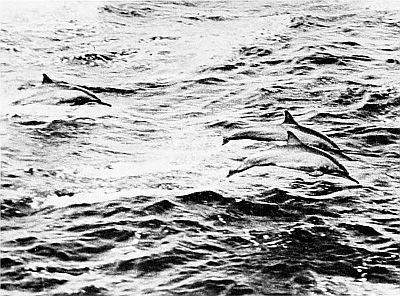
Figure 123.—A spinner dolphin jumping close beside a research vessel off the Virgin Islands. The distinctive color pattern (gray on the back, tan on the sides, and white on the belly) is clearly visible. The black-tipped rostrum and the black lips are key characters to this species. (Photo by C. McCann.)
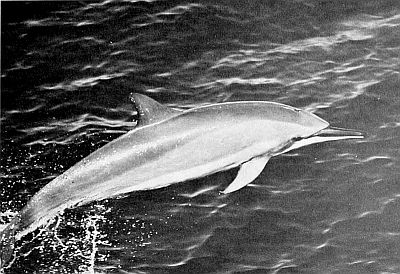
Figure 124.—Spinner dolphins are active bow riders and may stay with a vessel for long periods of time. (Photo from off the Virgin Islands by H. E. Winn.)

Figure 125.—Although all spinner dolphins so far examined have the same basic characteristics, the degree of expression of those characteristics varies from individual to individual or area to area. These small short-snouted dolphins (those on bottom stranded near St. Petersburg, Fla. and maintained alive by the Aquatarium in that city, and those on top photographed at sea, off the northwestern Africa coast in 1972) are spinners, although their classification is uncertain. There may be several species or geographical races of spinners in the Atlantic. (Photos courtesy of W. F. Perrin [top] and Aquatarium [bottom].)

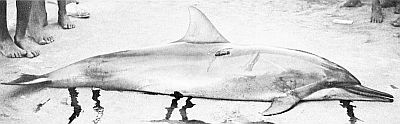
Figure 126.—A spinner dolphin harpooned in the fishery at St. Vincent, Lesser Antilles. Even after subtle aspects of the color pattern have faded, this species can be readily identified by the 46-65 teeth in both upper and lower jaws and by the distinctly black lips and black-tipped rostrum. (Photo by W. A. Huck, courtesy of Marineland of Florida.)
STRIPED DOLPHIN (T) Stenella coeruleoalba (Meyen 1833)
Other Common Names
Euphrosyne dolphin (Stenella styx), Meyen's dolphin, blue-white dolphin, Gray's dolphin, striped porpoise, streaker porpoise.
Description
The striped dolphin is a widely distributed relative of the spinner and the Atlantic spotted dolphins, though it more closely resembles saddleback dolphins than either of these two species. It reaches a maximum length of about 9 feet (2.7 m) and is characterized by a series of distinctive black stripes. One band of black begins near the eye and extends down the side of the body to the area of the anus. (A small secondary stripe originating with this band turns off and disappears in the white coloration of the side just above the flippers.) A second band of black extends from the eye to the flipper. Some workers have contended that striped dolphins are separable into distinct species depending on whether the eye-to-flipper stripe has one (S. coeruleoalba) or two (S. styx) components.
Most individuals have an additional distinctive finger of black coloration which extends from the black coloration behind the dorsal fin forward towards and about halfway to the eye. It is this feature which is most distinctive in animals riding the bow or leaping clear of the water. The back is dark gray to bluish gray, the sides are lighter gray, and the belly is white.
Natural History Notes
Though little is known of this species, it has been reported in herds of up to several hundred individuals and apparently exhibits behaviors very similar to those of the saddleback dolphins (p. 116), frequently jumping clear of the water. Atlantic and Mediterranean animals have been reported to bow ride.
May Be Confused With
This species is most likely to be confused with the saddleback dolphin, which it closely resembles. The two may be distinguished by the following characteristics:
Striped Dolphin Saddleback Dolphin
LENGTH
To about 9 feet (2.7 m) or more. Seldom greater than 7.5 feet (2.3 m).
COLORATION
Back from light gray to dark gray to bluish gray; sides gray; belly gray or white; distinctive black lateral stripping from 1) eye to flipper, 2) eye to anus, and 3) dark color behind dorsal fin forward, towards but not reaching head. Back basically black or brownish; distinct white chest or belly patch; hourglass or crisscross pattern on the sides; distinct black stripe from flipper to middle of lower jaw.
Distribution
Striped dolphins are widely distributed in the temperate, subtropical, and tropical seas of the western North Atlantic. They have been reported from at least Halifax, Nova Scotia, south as far as Jamaica. (Additional records, purportedly from southern Greenland, involved a museum specimen. Since striped dolphins of the eastern North Atlantic are rare north of England, the species occurrence near Greenland would be highly improbable.) Individuals have recently been reported from the Gulf of Mexico.
Despite this wide distribution, striped dolphins appear to prefer warmer waters and are probably normally confined to the Gulf Stream or the waters off the continental slope. Individuals appearing to the north of the range seem to have ventured northward with fingers of warm water.
Stranded Specimens
Stranded striped dolphins should be readily identifiable by the highly distinctive patterns of lateral striping discussed above for living animals. If the color pattern has faded, they may still be identified by their size, larger than other dolphin species of similar appearance, and the relatively large number of teeth (43-50 per side in both upper and lower jaws). Only the spinner dolphin, much smaller in body length and having a much longer beak, has more teeth (46-65 per side in each jaw).
Figure 127.—Despite some similarities in appearance and behavior to saddleback dolphins, striped dolphins can be readily identified by the prominent dark stripes on the side of the body. These striped dolphins were photographed between the Caribbean Islands of Curacao and Bonaire in 1972. (Photo by D. Poppe.)
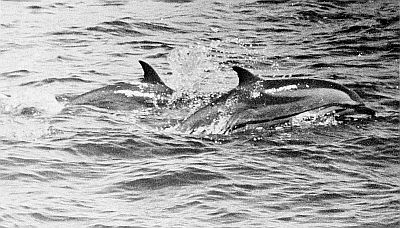
Figure 128.—When they ride the bow, the most apparent characteristic of striped dolphins is usually the dark streak beginning in the black coloration behind the dorsal fin and extending forward towards but not reaching the head. This stripe is not always present, however, and the species may sometimes appear uniformly pale gray from a distance. (Photo from the tropical Atlantic by H. E. Winn.)

Figure 129.—Stranded striped dolphins. Note the distinctive black stripes 1) eye to flipper, 2) eye to anus, and 3) (on top animal) from black behind dorsal fin forward towards but not reaching the head. Some workers contend that striped dolphins are separable into two species, depending on whether the eye-to-flipper stripe has one (Stenella coeruleoalba) or two (S. styx) components. Others contend that the two belong to the same species (S. coeruleoalba). Striped dolphins have from 43 to 50 teeth in each upper and lower jaw. (Photos from Japan by W. E. Schevill [top] and from Indian Rocks Beach, Fla. by W. A. Huck, courtesy of Marineland of Florida [bottom].)
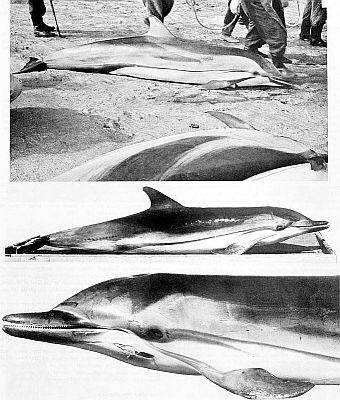
SADDLEBACK DOLPHIN (T) Delphinus delphis Linnaeus 1758
Other Common Names
Saddleback porpoise, common dolphin, crisscross dolphin.
Description
Saddleback dolphins reach a maximum overall length of about 8.5 feet (2.6 m) though most individuals are less than 7.5 feet (2.3 m) long. Males are slightly larger than females of the same age.
The body shape varies slightly but usually closely resembles that of the striped dolphin (p. 113). The dorsal fin varies from nearly triangular to distinctly falcate and is pointed on the tip. It is sometimes all black and sometimes black on the borders with a lighter grayish region of varying size near the middle.
The back is basically black or brownish black, but this coloration and the extent of the striping patterns that form the impression of a saddle and the degree of color distinction between the different zones are highly variable.
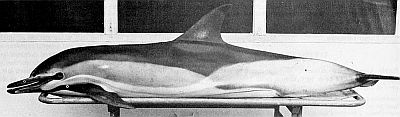
The chest and belly are cream white to white and are the most distinctive features from a distance. Up close, the sides will be seen to be distinctly marked with an hourglass or crisscross pattern of tan or yellowish tan. This crisscross pattern is diagnostic for the species.
The rostrum is intermediate in length and shape between that of the spinner and that of the striped dolphin and is often black with a white tip.
Natural History Notes
Saddleback dolphins are often seen in herds of a thousand or more and are often very active, many animals leaping clear of the water at any time. Like spinner dolphins, saddleback dolphins are active bow-riders and often come to the boat from considerable distances. Once on the bow they often ride for extended periods of time.
Saddleback dolphins feed on squid and on a variety of fishes, including anchovies, myctophids, and hake.
May Be Confused With
Saddleback dolphins might easily be confused with striped dolphins and must be examined closely to be distinguished from them. Primary differences apparent in encounters at sea are as follows:
Saddleback Dolphin Striped Dolphin
COLORATION
Back basically black or brownish; distinct white chest or belly patch; hourglass or crisscross pattern on sides, some tan to yellowish tan; distinct black stripe from flipper to middle of lower jaw. Back from light gray to dark gray to bluish gray; sides gray; belly gray or white; distinctive black lateral striping from 1) eye to flipper, 2) eye to anus, and 3) dark color behind dorsal fin forward, towards but not reaching head.
LENGTH
To 7.5 feet, rarely to 8.5 feet (2.3-2.6 m). To 9 feet (2.7 m).
From a distance, saddleback dolphins might also be confused with spinner dolphins because of the habits of both species of congregating in large schools with much jumping and splashing. Both species ride the bow wave, and close examination should permit positive identification using the following characteristics:
Saddleback Dolphin Spinner Dolphin
COLORATION
Dark gray to brownish gray on back; white on belly with crisscross or hourglass pattern of tan to yellowish tan on side; distinct black stripe from flipper to middle of lower jaw. Dark gray on back; tan or yellowish tan on sides; white on belly; lacks crisscross pattern on sides; distinct black stripe from flipper to eye.
Distribution
Saddleback dolphins are widely distributed in the temperate, subtropical, and tropical waters of the western North Atlantic Ocean. They have been reported off Newfoundland, Iceland, Nova Scotia, and the coast of Massachusetts, south along the coast of North America to the Caribbean (West Indies and Jamaica), in the Gulf of Mexico, and from South American waters at least to Margarita Island, Venezuela.
The species' occurrence in the more northerly portions of this range during the summer and early fall months appears to coincide with the intrusion of warm waters into those areas. They are not uncommon off Nova Scotia in summer and fall and are casual members of the marine mammalian fauna of the remaining Maritime Provinces during that period.
In previous years, saddleback dolphins were not uncommonly encountered by collectors of Marineland of Florida working the northeast coast of Florida, but the species has been conspicuously absent since about 1960. Reasons for this apparent shift of range are unknown.
Stranded Specimens
Saddleback dolphins have from 40 to 50 small, sharply pointed teeth in each side of both the upper and lower jaws. These numbers overlap with only those of the striped and spinner dolphins (with 43-50 and 46-65, respectively). Saddleback dolphins should be readily distinguishable from both these species by the features outlined under the descriptions of living animals and distinguishable from the bridled dolphins by the distinctive markings on the head of the two species (see Figs. 121 and 134).
Figure 130.—Saddleback dolphins captured off St. Augustine, Fla., shown in the tank at Marineland of Florida. The highly distinctive crisscross or hourglass pattern of tan or yellowish tan on the sides is clearly visible. Note also the light tip of the snout and the dark line from the center of the lower jaw to the flipper. This last characteristic readily distinguishes the saddleback dolphin from the striped dolphin, in which the black stripe begins at the corner of the mouth rather than near the center of the lower jaw. (Photos courtesy of Marineland of Florida.)
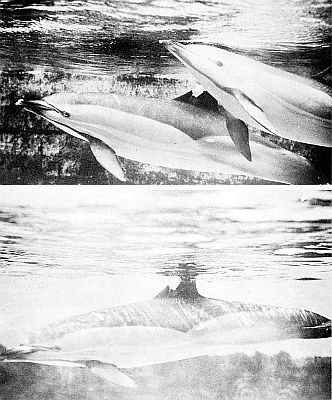
Figure 131.—Saddleback dolphins on the bow of a ship off Massachusetts in 1966. The color pattern, including the dark brownish-gray back, the crisscross pattern on the sides, and the white belly, are clearly visible. The light tip of the snout helps distinguish this species from the spinner dolphins, which have a black-tipped snout. (Photo by E. Wheeler.)
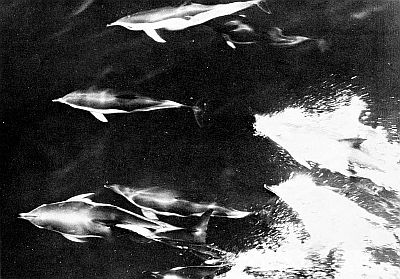
Figure 132.—The distinctive crisscross pattern of the sides of the saddleback dolphins is clearly visible even when comparatively little of the animal is seen. Note the falcate dorsal fin, which often, as here, is dark on the border, lighter near the center. (Photo by R. K. Brigham, courtesy of National Marine Fisheries Service.)
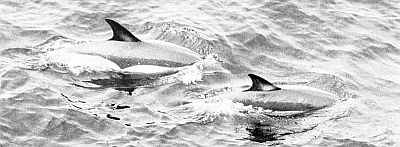
Figure 133.—Saddleback dolphins frequently jump clear of the water and may reenter in a variety of ways: 1) smoothly, head first; 2) with a chin slap; 3) with an accompanying tail lob; or 4) on the sides or back with a splash. This habit enables them to be spotted from a considerable distance. When stressed, herds bunch tightly together, like the group in the bottom photo. (Photos from off Virginia by J. G. Mead [top] and off San Diego, Calif. by S. Leatherwood [bottom].)
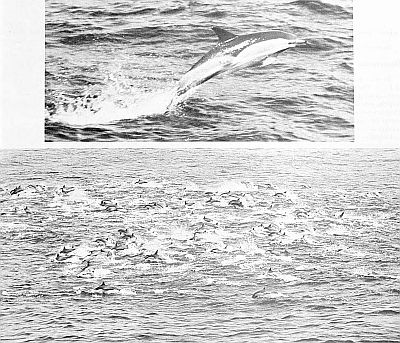
Figure 134.—A saddleback dolphin stranded on Westerly Beach, R.I. The origin of the common name "crisscross dolphin" is evident in the color pattern of the side. Note also the distinctive black stripe from the center of the lower jaw to the origin of the flipper. (Photo courtesy of H. E. Winn.)
FRASER'S DOLPHIN (T) Lagenodelphis hosei Fraser 1956
Other Common Names
Sarawak dolphin, Bornean dolphin, Fraser's porpoise.
Description
Fraser's dolphins reach an overall length of at least 8 feet (2.4 m). They are extremely short-beaked and have a pronounced dark stripe, similar to that found on the striped dolphin, extending from the rostrum to the area of the anus. They are robust in build and have rather small flippers and dorsal fin relative to body size. The dorsal fin is slender, falcate, and pointed on the tip. The body is gray on the back and white on the belly. The color of the side is dominated by the striping pattern. A cream-white band beginning high on the rostrum extends above and past the eye, continues towards the tail, and finally dissipates in the body color above the anus. Just below and parallel to this cream-white band is a black one extending from the area of the eye to the anus. A second cream-white band below and parallel to this dark strip separates the darker gray coloration of the side from the white coloration of the belly. The flippers are dark above and below.
Natural History Notes
The little that is known of the natural history and behavior of the species may be summarized as follows: Fraser's dolphins occur in groups of up to at least 500 animals and in the Pacific are occasionally seen with spotted dolphins (Stenella attenuata). From all accounts, they are not uncommon in certain areas of the tropical Pacific and off South Africa.
Fraser's dolphins appear to be deep divers. They are aggressive swimmers and, when they surface to breathe, often charge to the surface, creating a spray from their heads. They have also been reported leaping clear of the water.
May Be Confused With
Fraser's dolphin is intermediate in form between Lagenorhynchus and Delphinus delphis (thus the composite name Lagenodelphis). Because the species is apparently limited to tropical waters, however, and because of the prominent stripe on the side of the body, Fraser's dolphins are more likely to be confused with the striped dolphins (p. 113). The two species can be distinguished at sea by several characteristics:
Fraser's Dolphin Striped Dolphin
COLORATION
Single broad black stripe from beak and eye back to area of anus. Color dominated by series of stripes from: 1) eye to anus; 2) eye to flipper, and 3) black behind dorsal fin forward, towards but not reaching the head.
BEAK
Extremely short and indistinct. Longer, much more distinctive.
BODY SHAPE
Robust, particularly in front of dorsal fin. Slenderer.
FLIPPERS
Small, dark in color, and originating in light color of sides. Longer, sometimes lighter on upper surface; note stripe from front of flippers to eye.
DORSAL FIN
Small, slender, slightly falcate, and pointed on top. Taller dorsal fin, broader at base.
Distribution
Although Fraser's dolphins have yet to be described for the western North Atlantic Ocean, they are included here as "possibles" because of the recent discovery that their range is far more extensive than previously known. Records to date have been limited to offshore tropical waters.
The species was first described in 1956 from the remains of a beach-washed specimen from Sarawak in the South China Sea. Since that time specimens have been collected from the eastern tropical Pacific, and others have stranded in such widely divergent localities as Australia, South Africa, and Japan. Recent summaries have added sighting records from the Central Pacific, near the Phoenix Island, from northwest of the Galapagos Islands, and from South African waters.
Stranded Specimens
Stranded Fraser's dolphins should be readily identifiable by 1) distinctive coloration of the body; 2) short, indistinctive beak; and 3) robust form. The only other species of small dolphins with beaks of similar length and general appearance are the Atlantic white-sided and white-beaked dolphins (p. 123 and 126); these dolphins, both with far more northerly ranges, have 30-40 and 22-28 teeth in each side of each jaw, respectively, while Fraser's dolphins have from 40 to 44 teeth in the upper jaw and from 39 to 44 in the lower jaw.
Figure 135.—Fraser's dolphins, like these photographed off the Phoenix Islands in the Pacific (top) and this one off the Philippines (bottom), are definitely identifiable in their tropical range by the short snout, the dark flank stripe and the small dorsal fin and flippers. They may reach 8 feet (2.4 m), or more, in length and occur in herds of at least 500 animals, sometimes with spinner dolphins or Atlantic spotted dolphins. (Photos by K. C. Balcomb [top] and T. Hammond [bottom].)
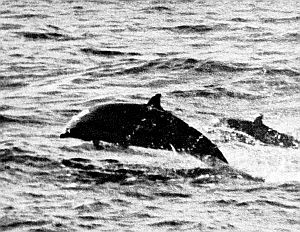
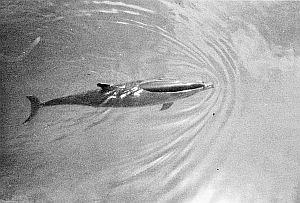
Figure 136.—Fraser's dolphins from the eastern tropical Pacific: adult (top and inset) and calf (bottom). Note the distinctive black lateral strip and the extremely small flippers and dorsal fin. (Photos by R. Garvie [top and inset] and S. Leatherwood [bottom].)
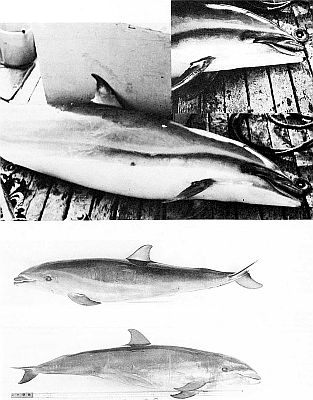
ATLANTIC WHITE-SIDED DOLPHIN (T) Lagenorhynchus acutus (Gray 1828)
Other Common Names
Atlantic white-sided porpoise, jumper (Newfoundland).
Description
Atlantic white-sided dolphins reach about 9 feet (2.7 m) in maximum length and are robust in form with a small but distinct beak (less than 2 inches [5.1 cm] long).
The dorsal fin is tall, distinctly back curved, and pointed on the tip. The tail stock is extremely thick and does not narrow laterally until very near the tail flukes.
The back is distinctly black, the belly white. The sides have zones of gray, tan, and white.
The single most distinctive feature of Atlantic white-sided dolphins is an elongated oval zone of white and yellowish white along the sides from just below the dorsal fin to the area above the anus. These patches of lighter coloration, clearly demarcated from each other and from the surrounding coloration, are frequently visible simultaneously with the dorsal fin as the animals roll at the surface to breathe. Even alone this feature permits positive identification of the species. The dorsal fin is often part gray, part black. The beak is all black.
Natural History Notes
Atlantic white-sided dolphins are known to congregate in herds of perhaps a thousand animals, though smaller herds are far more common. The species is often wary of ships and does not ordinarily ride the bow wave. Like a number of other species, white-sided dolphins have been reported in association with Atlantic pilot whales.
May Be Confused With
At sea, Atlantic white-sided dolphins are most likely to be confused with the white-beaked dolphins, with which they overlap in distribution. Though they are very similar in general appearance, the two can be distinguished in the following ways:
Atlantic White-Sided Dolphin White-Beaked Dolphin
COLORATION
Elongated band of yellowish white and white along side, visible behind and below dorsal fin as animal rolls. Two grayish areas—one in front, the other below and behind dorsal fin, visible as animal rolls.
BEAK
All black. Sometimes white in parts of range though western Atlantic animals are usually dark.
MAXIMUM SIZE
To 9 feet (2.7 m). To 10 feet (3.1 m).
DORSAL FIN
Often part black, part lighter gray. Uniformly dark.
Distribution
Atlantic white-sided dolphins are distributed, primarily offshore, in the cool waters between the Gulf Stream and the Labrador Current. They have been observed from Hudson Canyon, off New York City, north to southern Greenland and perhaps Davis Straits. Their normal range shares a southern boundary with the white-beaked dolphin but does not extend as far to the north.
Stranded Specimens
In addition to the features described above for living animals at sea, stranded Atlantic white-sided dolphins can be distinguished from white-beaked dolphins by the following:
Atlantic White-Sided Dolphin White-Beaked Dolphin
NUMBER OF TEETH
30-40 per side per jaw, sometimes more in upper. 22-28 per side per jaw; have larger individual teeth—to 6 mm in diameter.
FLIPPERS
Lower portion of forward margin more curved. Lower portion of forward margin less acutely curved.
VENTRAL COLOR
White coloration of belly extends high onto sides of body. White coloration of belly extends to lower jaw but not above flippers on sides.
CAUDAL CRESTS
Tail stock strongly compressed laterally; taller, narrows rapidly just in front of flukes. Tail stock less laterally lcompressed, tapers more gently towards tail flukes.
Figure 137.—Atlantic white-sided dolphins at sea between Cape Cod, Mass. and Nova Scotia. This species can be positively identified by the elongated zone of white and the adjacent region of tan or yellowish tan below and behind the dorsal fin, visible even in the fast-swimming animal in the bottom picture. The top photo illustrates the origin of the Newfoundland common name "jumper." (Photos by K. C. Balcomb [top] and H. E. Winn [bottom].)
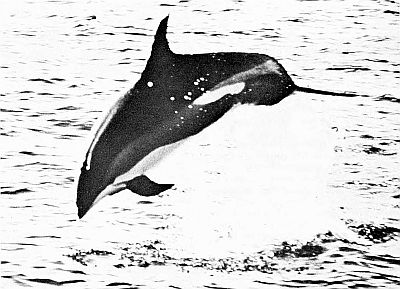
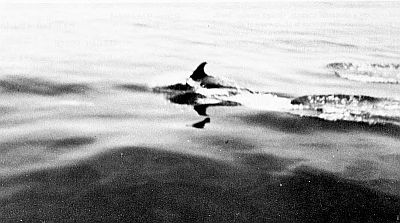
Figure 138.—An Atlantic white-sided dolphin off the eastern Canadian coast. These animals do not usually ride the bow wave, but when they can be examined at close range, they can be readily distinguished from their more northerly cousins, the white-beaked dolphins, by their highly distinctive color pattern. (Photo by P. B. Beamish.)
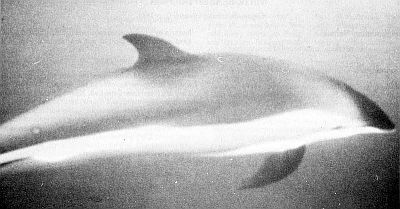
Figure 139.—The highly distinctive pattern of the Atlantic white-sided dolphins is clearly visible in this animal stranded in Scotland. Even if the color pattern has faded, however, this species should be easy to identify. The 30-40 teeth in each of the upper and lower jaws permit distinction from the white-beaked dolphins, which have only about 22-28 per side in each jaw. (Photos by B. Tullock, courtesy of A. S. Clarke.)
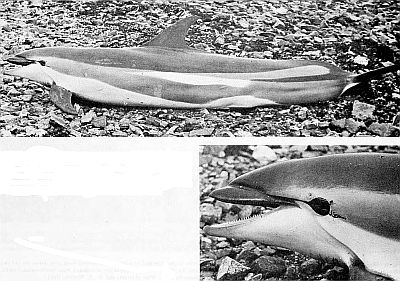
WHITE-BEAKED DOLPHIN (T) Lagenorhynchus albirostris Gray 1846
Other Common Names
White-beaked porpoise, squidhound (Newfoundland).
Description
White-beaked dolphins reach a maximum overall length of about 10 feet (3.1 m). The body is robust in form with a tall, uniformly dark-gray dorsal fin, and a short but distinct beak which, as the common name implies, is often light gray to white above and below, at least in European waters. The beak of animals in the western Atlantic populations is less frequently white. The back and sides are basically dark gray to black, and the belly is white to light gray.
Swimming white-beaked dolphins can be most readily identified by the two areas of pale coloration on the sides, one in front of and another below and behind the dorsal fin. These areas are clearly visible from a ship or aircraft as the animals roll at the surface.
Natural History Notes
White-beaked dolphins may sometimes occur in herds of up to 1,500 individuals. Like their cousins, the Atlantic white-sided dolphins, they do not commonly ride the bow waves of vessels.
White-beaked dolphins feed on squid, octopus, cod, herring, capelin, and sometimes on benthic crustaceans.
May Be Confused With
In their northerly range white-beaked dolphins are likely to be confused with only the Atlantic white-sided dolphins. The most distinctive features of white-beaked dolphins are 1) the two areas of paleness described above, 2) the prominent, dark gray dorsal fin, and sometimes 3) the white beak. Other features by which the two species may be distinguished in the brief encounters typical at sea are tabularized on p. 127.
Distribution
White-beaked dolphins are the more northerly of the two species of Lagenorhynchus in the western North Atlantic. They are found from Cape Cod, Mass., north to western and southern Greenland and Davis Straits, though they are apparently far more numerous to the north of this range. They appear in Davis Straits in spring and summer and leave that area in autumn, sometimes as late as November, to move southward. They winter as far south as Cape Cod, where they are the common dolphin species in April, May, and June (sometimes to July). Their migrations are poorly known.
Stranded Specimens
Stranded white-beaked dolphins can be most readily distinguished from white-sided dolphins by the substantial differences in coloration and the differences in numbers of teeth.
White-Beaked Dolphin Atlantic White-Sided Dolphin
TEETH
22-28 per side per jaw. 30-40 per side per jaw, sometimes more in upper jaw.
COLORATION
Beak sometimes gray or white above and below; two pale areas visible on living animals not visible on stranded specimens. Beak all black; side marked with elongated areas of white with streaking patterns of yellow and tan.
Additional characteristics by which the two species may be distinguished are summarized on p. 123.
Figure 140.—Two views of white-beaked dolphins off Newfoundland. This species is characterized by a prominent uniform dark gray dorsal fin and two areas of paleness on the sides, one in front of and one below and behind the dorsal fin. White-beaked dolphins are distributed from Newfoundland north, extending to more northerly waters than Atlantic white-sided dolphins. (Photos by H. E. Winn [bottom] and W. A. Watkins [top].)
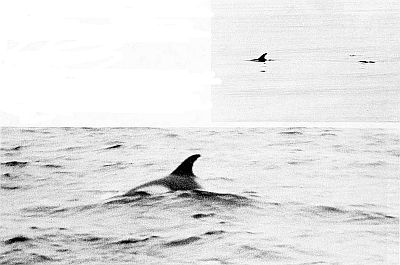
Figure 141.—White-beaked dolphins reach nearly 10 feet (3.1 m) in length. Stranded animals, such as this specimen from Scotland, should be distinguishable from Atlantic white-sided dolphins by their differences in coloration. This species sometimes has a white beak and always lacks the elongated white patch and tan or yellow streaking found on the side of Atlantic white-sided dolphins. (Photos by A. S. Clarke.)
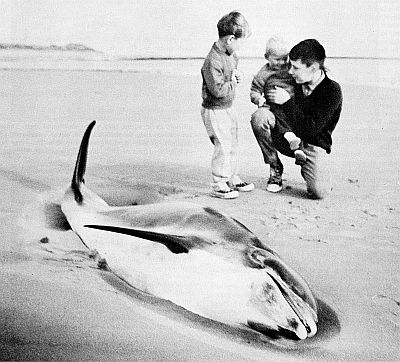
ATLANTIC BOTTLENOSED DOLPHIN (T) Tursiops truncatus (Montague 1821)
Other Common Names
Bottlenosed porpoise, gray porpoise, common porpoise.[12]
Description
Atlantic bottlenosed dolphins reach a maximum overall length of about 12 feet (3.7 m) and weigh in excess of 1,430 pounds (650 kg). They have relatively stubby snouts and dorsal fins, which are broad at the base, tall, and falcate. Coloration varies slightly, but individuals are usually dark gray on the back, lighter gray on the side, grading to white or pink on the belly. Old females may have spots on the belly. The dark coloration of the back often appears as a highly distinct cape, particularly on the head.
Natural History Notes
Atlantic bottlenosed dolphins often occur in groups of up to several hundred individuals which usually consist of aggregations of small groups of no more than a dozen animals each. They frequently associate with the Atlantic pilot whales and are frequently found accompanying the right and humpback whales travelling along the Atlantic coast of Florida.
Atlantic bottlenosed dolphins have catholic tastes, feeding on shrimp, eels, catfish, menhadden mullet, and miscellaneous trash fish, to mention only a few. They are frequently found near shrimp boats, feeding on fish stirred up by the trawls or on discarded trash fish.
They sometimes move in to ride the bow wave of a vessel, turning on their sides, sometimes spinning completely around on their longitudinal axis when doing so. Individuals may also turn their heads downward or to the side. They are often found close to shore, in bays and lagoons, and sometimes venture up the larger rivers. Some individuals, especially the larger animals, are found as far offshore as the edge of the continental shelf. Atlantic bottlenosed dolphins sometimes ride the surf. Individuals may jump clear of the water as high as 15-20 feet (4.6-6.1 m), a behavior on which aquarium shows have capitalized.
Members of this species are the dolphins most commonly maintained in captivity at zoos, aquariums, marine parks, and research institutions. For that reason, they are perhaps more familiar to the general public than any other species of porpoise, dolphin, or whale.
May Be Confused With
From at least Cape Hatteras southward, the range of the Atlantic bottlenosed dolphins distributed in inshore areas may overlap with that of Atlantic spotted dolphins, particularly during the spring and summer, when the Atlantic spotted dolphins move inshore. There the two species may be confused. The Atlantic bottlenosed dolphins and the Atlantic spotted dolphins can be distinguished, however, by the following characteristics:
Atlantic Bottlenosed Dolphin Atlantic Spotted Dolphin
MAXIMUM SIZE
8 feet to as much as 12 feet (2.4 to 3.7 m). 7.5-8 feet (2.3-2.4 m).
COLORATION
Not spotted (old females may have spots on belly); dark gray on back; light gray on sides; white or pink on belly. Dark purplish gray on back; lighter gray on sides and belly; body becomes increasingly spotted with age.
HEAD AND BEAK
Head robust; beak relatively short. Head more slender; beak longer.
Some Atlantic bottlenosed dolphins are distributed well offshore as far as the edge of the continental shelf. Those individuals may be confused with either rough-toothed dolphins (p. 135) or with grampus (p. 96). They may be distinguished from rough-toothed dolphins by the following:
Atlantic Bottlenosed Dolphin Rough-Toothed Dolphin
BODY COLOR
Dark gray on back; light gray on side; white or pink on belly. Dark gray, almost purplish with yellow spots; lighter on belly.
SNOUT
Relatively short and stubby, and clearly demarcated from forehead; usually all gray; some older individuals have white-tipped snouts and/or white lips. Long and slender; not clearly demarcated from forehead; lower jaw and lips speckled white.
Distinguishing differences between the Atlantic bottlenosed dolphins in offshore areas and grampus are tabularized on p. 96.
In northeastern South America the range of the Atlantic bottlenosed dolphin apparently overlaps with that of the Guiana dolphin, which, except for size, it closely resembles (see p. 132).
Distribution
The Atlantic bottlenosed dolphins are widely distributed in the temperate and tropical waters of the western North best known from New England southward to Florida, westward in the Gulf of Mexico, and thence throughout the West Indies and Caribbean to Venezuela.
In the northern portion of that range, Atlantic bottlenosed dolphins are distributed offshore. In the southern portions of their range from at least North Carolina southward, the majority are found nearshore and often enter bays and lagoons, and sometimes venture up the larger rivers. Daily migrations in these areas may follow tidal flow.
In these same southerly areas some Atlantic bottlenosed dolphins are distributed as far offshore as the edge of the continental shelf.
Stranded Specimens
Within their range, stranded Atlantic bottlenosed dolphins should be readily identifiable by 1) the robust body, 2) relatively short beak, and 3) the 20-26 teeth in each upper jaw and 18-24 in each lower jaw.
Figure 142.—Atlantic bottlenosed dolphins leaping on the bow of a research vessel between Cape Cod, Mass. and Nova Scotia. Note the robust body, the falcate dorsal fin, and the gradation of color in three zones—dark gray on the back, to lighter gray on the sides, to white or pink on the belly. (Photo by A. Taruski.)
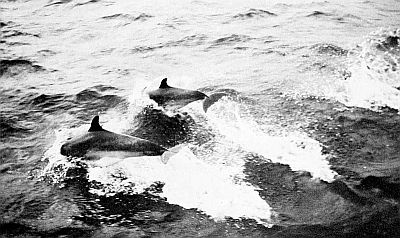
Figure 143.—A side view of the Atlantic bottlenosed dolphins off St. Augustine, Fla. Note the dark grayish coloration of the back, the lighter coloration of the side, and the tall, sharply angled dorsal fin, pointed on the tip. Though dorsal fin shapes are highly variable, dorsal fins of the Atlantic bottlenosed dolphin are usually more falcate and less pointed on the tip than on these animals. (Photo courtesy of Marineland of Florida.)
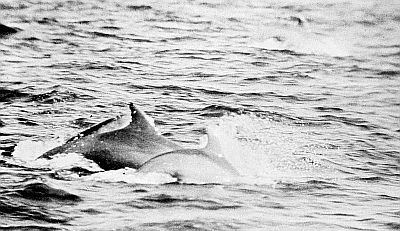
Figure 144.—Atlantic bottlenosed dolphins frequently ride the bow wave, often turning on their sides as they do so. Note the distinctive color zones, the characteristic shape of the head and beak, and the smooth lines of the flippers. (Photo by L. Rigley.)

Figure 145.—An Atlantic bottlenosed dolphin taken at Isla La Blanquilla, off Venezuela. Because they inhabit shallow waters, Atlantic bottlenosed dolphins are infrequent victims of strandings. (Photo courtesy of F. Cervigon.)
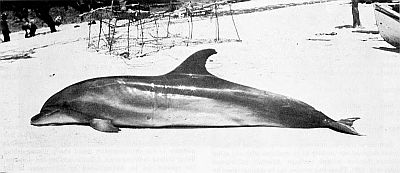
Figure 146.—Atlantic bottlenosed dolphins have from 20 to 26 teeth in each side of the upper jaw and from 18 to 24 in each side of the lower jaw. These teeth, sharply pointed in younger animals, may wear substantially as the animal ages. (Photo courtesy of Wometco Miami Seaquarium.)
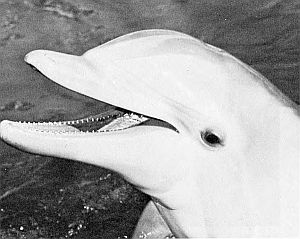
GUIANA DOLPHIN (T) Sotalia guianensis (P.-J. van Beneden 1864)
Other Common Names
None known.
Description
Guiana dolphins are the second smallest cetacean species in the western North Atlantic, reaching a maximum length of only about 5.6 feet (1.7 m).
Their body shape is very similar to that of the Atlantic bottlenosed dolphin, though the beak is less clearly demarcated from the forehead.
The rather prominent dorsal fin is nearly triangular, curving only slightly backwards near the tip.
Guiana dolphins are steel blue to dark brown on the back and white on the belly. There is sometimes a brownish band extending from the dark color of the back in front of the dorsal fin back towards but not reaching the anus.