Part 1 — The MITRED HOG: A Dialogue between Abbot Furetiere and Scarron.
Reading edition
Furetiere. OH! Have I found you at last, old friend? Tho’ I were certain you were here, and desir’d earnestly to see you; yet being gouty, and tir’d with walking, I began to have no more thoughts of searching after you. How many troublesome journeys I have made, and leagues have I travell’d, and all to kiss your hands, tho’ I am a virtuoso, I cannot tell; for in truth, I am quite out of my element, and confounded ever since I have lost sight of sun and moon.
Scarron. Who are you, and please ye? What’s your name? For the dead having neither beard nor bonnet, nor any thing else to distinguish them by, I know not exactly what, or who you are; but by your language and mien, suppose you some mungril of the French academy.
Furet. Well guess’d; I am call’d Monsieur l’Abbé Furetiere,[49] alias Porc de bon Dieu, who has long, but in vain, been gaping and scraping at Versailles for a mitre, that I might wallow in peace and plenty like a hog. But alas! what a left-handed planet was I born under? A debauch with stummed wine, setting an old pox, which lay dormant in my bones, into a ferment, soon carry’d me off, almost in the heighth of my desires, and when I bad fairest for the bishoprick.
Scar. I am sorry for your misfortune; but am at the same time heartily glad to see you, Monsieur l’Abbé. You will not, perhaps, meet with all these conveniencies here, you enjoy’d at Paris; but, in recompense, you will meet with much honester dealing. For my part, I must own myself infinitely happy; for now I am neither troubled with lawyers, physicians, apothecaries, collectors of taxes, priests, nor wife, the plague and torment of men’s days when on earth. But how have you had your health since you have been in the country.
Furet. Thanks to our master Pluto, I have not yet felt any cold. I was so very tender and chill for six months in the year at Paris, that tho’ I was loaded with ermins, and always had a dram of the best Nantz in my pocket, I could scarce keep my blood from freezing in my veins.
Scar. That’s an affliction you will not meet with here, take my word for’t; for ’tis something hotter than under the torrid zone, and the nicest wits of your academy, need not fear spoiling their brains, by catching cold here. It is not long since I met with the illustrious Balzac, who does not complain now of the cold in his head, as he did when he liv’d on the pleasant banks of the Charante. But, what news have you?
Furet. I don’t doubt, by your inquisitiveness, but you are very desirous to hear some news of your wife.
Scar. May pox and itch devour the nasty jade! I know but too much of her by mareschal d’Albert formerly, and lately, by my likeness Monsieur Luxemburg; yes, I know she’s a duchess; that she’s one of the privy-council; and she serves Lewis the XIV. in the same capacity as Livia did Augustus. But why did not the prostitute make her poor deform’d husband a duke? I should not have been the first duke and peer of France, that had been a cuckold.
Furet. By your discourse, Mr. Scarron, one would think you had lost your senses and memory: But you cannot surely have forgot how, instead of laurel, she adorn’d your learned brow with horns, before she was taken notice of at court; Indeed how could a pretty, witty, buxom, young woman, forbear making such an infirm, deform’d Æsop as you a cuckold?
Scar. I should not have much valued that, because I had brethren enough to herd with, if the damn’d whore had but got my pension augmented; but the confounded jade, instead of that, gave me the cursed’st garrison to maintain, that ever poor husband was mortify’d with: To appease which, I was forc’d to have recourse to Unguentum contra pediculos inguinales, &c. But prithee let’s discourse of something else, for the thoughts of the duchess of Maintenon, will disturb my brain, and easily put me into a fever, which is dangerous in this warm climate.
Furet. I’ll tell you but three or four words more of this famous duchess, and conclude. First, That she has kick’d her patroness, Madam Montespan out of the royal bed: And Secondly, That she is very great with the pious jesuit, father la Chaise, the monarch’s confessor.
Scar. Oh! oh! by my troth, I don’t wonder at the lascivious harlot, for closing with him! as there is no feast like the misers, so there is no gallantry like those monks. When those hypocrites undertake that business, they do it all like heroes. But you have said all, by saying he is a jesuit, since those gallants have been in reputation, they have engrossed all good whoring to their society, especially in France, and more particularly at Paris, where they have so well behav’d themselves, that they have chang’d an antient authentick proverb, Jacobine en [50] chair, Cordelier en [51] chœur, Carme en [52] cusine, & Augustine en [53] bordel, for now they say, Jesuit en bordel, &c. But so much for those gentlemen, pray what are you a doing now in the French academy?
Furet. There are as many follies committed there, as in any society in the universe; judge of the whole by this one example. That company was never so highly honour’d as it is at present, by the particular care that great monarch takes of it; for which he is repaid in flattering panegyricks. Nevertheless, these insipid, florid, gentlemen, scold and scratch like so many fish-women in an alehouse. The other day the great Charpentier fell into such a passion about a trifle, that he reproach’d the learned Taleman, of being the son of a broken apothecary at Rochel; to which Taleman with as much heat reply’d, Charpentier was the son of poor hedge ale-draper at Paris. From this Billingsgate language they came to blows. Charpentier threw Nicot’s dictionary at his adversary’s head, and Taleman threw Morery’s at Charpentier’s. We all wish’d heartily we could have recall’d you from the dead, to write the various accidents of this battle, in your comical and satyric style.
Scar. Ha, ha, ha, had I been there, they should have beat the academy dictionary and Morery’s too in pieces about each other’s ears, before I would have parted them. But I hope these two sputtering coxcombs did each other justice; I declare, whoever hinder’d it, deserv’d to be severely fined. Pray how did you behave yourself during this combat?
Furet. I happen’d not to be there; for you must know, there has been such a difference between those gentlemen and me, concerning a dictionary I have publish’d, that it came at last to a contentious law-suit; but what was laid on either side, only made the world laugh at both, and is not half so diverting as the epigram you made upon an, old lady that went to law with you: I think I still remember it.——
Thou nauseous everlasting sow, With phiz of bear, and shape of cow, With eyes that in their sockets twinkle, And forehead plow’d with many a wrinkle. With nose that runs like common-shore, And breath that murders at twelvescore: What! thou’rt resolv’d to give me war, And trounce me at the noisy bar, Though it reduces thee to eat, Thy smock for want of cleanlier meat: Agreed, old beldam! keep thy word, ’Twill soon reduce thee to eat a t——d.
Scar. May that be the fate of Taleman, Charpentier, and the rest of those reformers of the alphabet, and in a more especial manner of that thieving flattering rogue [54] Despaux, who has made a faithless poltron, a Mars, and a super-annuated lascivious adultress, a saint. So much for that —— But give me some little account now of your clergy, I mean the great plump rogues, the hogs with mitres on their heads, and crosiers on their shoulders, those janizaries of antichrist.
Furet. I know your meaning—— Never was nickname given with more justice to any society of men. In Normandy, and those parts they call all the minor clergy, as the fat monks, canons, abbots, &c. who are not mitred, Jesus Christ’s porkers; which distinction is not very fantastical, if we allow the other expression. But no more of those gentlemen, ’tis dangerous.
Scar. Prithee, dear abbot, be not so mealy-mouth’d; when I was in the world, the greatest pleasure I had, was in attacking those gentleman’s vices, and exposing them to the hereticks, that still-born generation of vipers, as they call them, and therefore let us be free now; ’tis the only enjoyment we can have. Pray what says your Monthly Mercury of those gentleman, whom the earth is more oblig’d to for bodies, than heaven for souls?
Furet. Never fuller of who made such a man a cuckold, and who pox’d such a woman, as now; neither were ever the women half so impudent; no not in the reigns of Caligula and Nero. Never was debauchery so much in fashion; nor never were the whores so often cover’d with purple.
Scar. Is there not in your herd, such a thing as a tame gentle weather? or what Virgil calls Dux Gregis? you understand me.
Furet. A weather! oh, fy, fy! not such a creature among them, I can assure you. The most christian king would not suffer such an impertinent scandalous animal, so much as at shew his head in his seraglio. ’Tis as easy to find there a pretty woman chaste, or hair in the palm of your hand, as an emasculated beast among the mitred hogs: for the Dux Gregis, Virgil speaks of, we have one at the head of our prelates, who has all the qualities requisite for so great an honour, tho’ he has neither beard nor horns: and should I name him, you’d be of my opinion.
Scar. Wou’d I recollect my memory, and their virtues, I cou’d guess within two or three; but pray save me that labour.
Furet. Do you not remember a famous song you made in praise of a sick wanton goat. Creque fait & defend l’archeveque de Roüen.
Scar. Oh, dear! oh, dear! the right reverend Francis Harley, archbishop of Paris! my most renowned friend! a worthy chief!
Furet. The very same, and ’tis a precious jewel, both for body and soul. A hedgehog has not more bristles than this prelate has mistresses, and there’s not a stallion in France that leaps oftner.
Scar. You rejoice my heart Mons. Furetiere. He was, I remember, always at Paris, when archbishop of Rouen: no man fitter for that employment. To be free, if Paris be the hell of hackney horses, ’tis the paradice of whore-masters and hackney-whores. I can guess at what he does now, by what he did formerly. Several ladies also of our neighbouring countries are witnesses of his prowess; but more especially some of the fair English ladies; the luscious morsels of a lustful monarch. But on to the rest.
Furet. I am willing to satisfy your curiosity, Mr. Scarron, but to run thro’ the whole herd, would be too tedious at present, tho’ they all deserve to be chronicled: so I will only, en passant, give you the history of those you have heard preach, both at Paris and the court, with wonderful applause; and who, for their modesty and regular lives, had the reputation of saints, whilst they were only fathers of oratory.
Scar. Take your own method, Mons. l’Abbé; but let me tell you one thing, by the way, this place is call’d the wits corner, but by some late guests, because of the smoak and liquor, the wits Coffee-House. Now you know the wits of all countries laugh at the clergy in their poems and plays; and that the clergy, to be reveng’d of them, and keep up their own reputation with the ignorant, call them atheists; therefore you may freely give a true description of them. All here are their enemies; and a priest would as soon venture his carcass in Sweden as in this place; he dreads a poet, as much as dogs do a sow-gelder.
Furet. Still a merry man, Mr. Scarron. But to return to your mitred hogs; do you remember father le Bone, and father Mascron. The first is now bishop of Perigueux, and the other bishop of Agen.
Scar. How! are these two famous preachers, those scourgers of pride and immorality, got into the herd of the mitred hogs? by my troth, I always took them for credulous humble weathers, believers of what they preached; tho’ I know most priests seldom believe what they profess.
Furet. Well, Mr. Scarron, tho’ you can see as far thro’ a mill-stone as any man, yet I find you are not infallible.
Scar. Faith, a man sees as far thro’ a mill-stone, as a priest’s surplice, tho’ ’tis reckon’d the emblem of purity. But, Mons. l’Abbé, what Montaigne said formerly of the women, I now say of the priests: Ils envoyen leur conscience au bordel, & tiennent leur countenance en regle: they send their conscience to the stews, and keep their countenance within rule.
Furet. ’Tis even as true of one, as of the other, Mr. Scarron, and my following discourse will verify it. What virtue there is in a mitre, I know not, for I could never obtain one; I was thought too good a christian in the bottom; but before I had bad adieu to Paris, your innocent believing apostles were become too as rampant and fine coated hogs as any of the herd. The reverend father le Bone, bishop of Perigueux, has so bravely plaid the county boar, that there’s not a pretty nun in his diocese but has been with pig by him; as I have been credibly informed by persons of honour.
Scar. Oh! the excellent apostle: I remember a story of him when he was bishop of Agde, which will not be unpleasant to you, if you can bear with a pun, and a poet’s making merry with several languages, a thing he can no more avoid than flattery. This worthy prelate not meeting with that plenty at Agde his voluptuousness required, made his monarch this compliment: Sir, Je suis né gueux, j’ay vecu gueux, benais s’il plait a votre majeste, je voux Perigueux.
Furet. Faith, a very comfortable reward for a very filthy pun; I have said forty pleasanter things to the king, and never could get beyond Mons. l’Abbé, which makes me believe there is a critical minute for a wit, as well as love: an excellent Roman poet was sensible of it, when he said,
Hora libellorum decima est, Eupheme, meorum, Temporat ambrosias cum tua cura dapes, Est bonus æthereo laxatur nectare Cæsare.
There’s a Latin quotation for you, to shew you I understand it; and that I have been an author as well as you.
Scar. Believe me, Mons. l’Abbé, you’ll fare much the better for it here; and tho’ those gentlemen made us poor poets pass for scoundrels and impious ridiculers of piety in the other world, yet we have much the whip-hand of them in these quarters, therefore take comfort. Tell me pray how the pious Julius Mascaron behaves himself at Agen, where he meets with greater plenty than he did at Thute.
Furet. Oh! the acorns and chesnuts of Agen have made him so plump and wanton, ’twould rejoice your heart to see him. All the females of the town caress him, and strive which shall yield him most delight; and he out of zeal and gratitude, and to preserve peace and charity among them, like a holy prelate, has given to each her hour of rendezvous, which they keep as regularly as the clock strikes.
Scar. Very well! there’s nothing so commendable as good method in whoring.
Furet. But his favourite is a pretty gentle nun, with whom he often goes to Beauregard, there tete a tete, or rather ne a ne, under the shady limes, do they both act that which will one day procure a third. There are forty other better stories of these two prelates; for they value not what common report says. They are above it: But if you will listen to the exploits of the bishop of Laon, now cardinal d’Estrée, I will shew you what a mitred hog is capable of.
Scar. As I am acquainted with the strength of his genius, so I do not doubt of the greatness of his performances. You have now named a man that would make a parish bull jealous.
Furet. The history I shall give you, will justify your opinion of him. Know then that the cardinal d’Estrée being passionately in love with the marchioness de Cœuvres, who was supposed to have granted the duke de Seaux the liberty of rifling her placket, was resolv’d to put in for his snack. To compass this, he acquainted his nephew, the marquis de Cœuvres, with the scandalous familiarity that was between the duke and his wife. Upon which their parents met at the mareschal d’Estrée’s, where it was concluded to send the young adultress into a convent; but the old mareschal, made wiser by long experience, was against it. In good faith, said he, you are more nice than wise; had not our mothers plaid the same wanton trick, not one of us had been here. I know very well what I say; there’s not a handsome nose nor leg in the company, but has been stole; and not a farthing matter from whom, whether prince or coachman, it has mended our breed: therefore we have more reason to praise those, who discreetly follow the examples of their grandmothers and mothers, than banish ’em, and so render them fruitless. Do not suppose, when I married my grandson de Cœuvres, to young mademoiselle de Lionne, that I consider’d her riches, or that her father was a minister of state; such thoughts are beneath a man of my age and experience. My great hopes were, that she being young and handsome, will still support the grandeur of our family, which as you all very well know, has been made more considerable by the intrigues of the women, than by the valour of the men. I’m sure I never discourag’d what I now maintain; and why my grandson should be more squeamish than I, or his forefathers have been, I take it to be unreasonable: therefore, since the marchioness de Cœuvres is only blam’d for having tasted those pleasures which nature allows, and which are customary in our family, I declare my self her protector. Yet I would not have this be the talk of the court; I would not have it pass my threshold; because the world might say of one of us, as of a fine curious piece of clock-work, that a great many excellent workmen had a hand in it.
Scar. In this generous and considerate speech, do I plainly discover the inclinations of the famous Gabriele d’Estrée, Harry the fourth’s mistress. But I am in trouble for the poor marchioness; I know a convent must be insupportable to a woman that has tasted the pleasures of a licentious court.
Furet. The cardinal was against publishing his niece’s wantonness, as well as the mareschal, and took upon him the care of reprimanding her, and bringing her into the path of virtue: to which the marquis de Cœuvres readily consented, not imagining he deliver’d the pretty lamb to the ravenous wolf. This being agreed on, the lustful prelate went immediately to his niece; I come, Madam, said he, from doing you a very considerable piece of service: all our family has been in consultation against you, and could think of no milder punishment for you than a convent, with all its mortifications, viz. Praying, fasting, whipping, and abstaining from the masculine kind, &c. I know, dear niece, this was as unjust as severe; but, in short, it had been your doom, had I not been your friend. Such a piece of service as this, beautiful niece, deserves a suitable return, and I believe you too generous to be ungrateful: but I shall think this, and all the other services I can render you, highly recompenc’d, if you’ll but permit me to see you often, and embrace you.
Scar. A very pious speech! I hope that which is to follow will answer this excellent beginning. Now do I imagine a place formally besieged; the next news will be of the opening the trenches.
Furet. We proceed very regularly, Mr. Scarron; the place makes a noble defence, and does not surrender till a breach is made. To be thus unjustly accused, said the marchioness, is a very great misfortune; and tho’ I will not disown my obligation to you, yet you must permit me to say, that your proceeding destroys that very obligation: if you will not have any regard to my virtue, and the fidelity I owe to my husband, you ought, nevertheless, to remember your character, and how nearly we are related. But I know the meaning of this; you believe the scandalous and malicious story that has been raised of me, and design to make your advantage of it. What can be more injurious than this attempt! Tho’ you thought me a whore, had you but thought me still virtuous enough to abhor your beastly, incestuous proposition, I should have had some reason to esteem you—
Scar. Poor prelate! Egad, I pity thee; thou hast receiv’d such a bruise in this repulse, that I cannot think thou wilt have the courage to return to the attack.
Furet. Have patience; you are not acquainted with the craft and courage of a mitred hog. The prelate, who by this resistance, was become more amorous, resolv’d to watch so narrowly his niece’s conduct, that he would oblige her to do that out of fear, which all his rhetorick and protestations of love could not tempt her to. To be short, he managed so well this important affair, that he surpris’d the duke de Seaux in bed, between Madam de Lionne and the marchioness de Cœuvres her daughter: and to magnify charity, as well as other virtues in this matter, he took Monsieur de Lionne along with him. I will leave you to imagine the confusion of these two ladies; the first to see her husband, and the other the man she had so vigorously repuls’d. The marchioness thinking wisely, her compliance would yet conceal her intrigue; taking the cardinal by the hand, and gently squeezing it, said, If you’ll promise to appease my father, and by your ghostly authority, make my mother and him good friends again, and keep this frolick from my husband, you shall, whenever you please, find me grateful, and sensible of your affection.
Scar. What said Monsieur de Lionne? The surprise of a poor cuckold, who finds a handsome, brawny young fellow in bed with his wife and daughter, surpasses my imagination.
Furet. If, like Actæon, he had been immediately metamorphosed into a stag, he could not have been more surprized.
Scar. How did the prelate behave himself after this charitable brave exploit? The breach is now made, there has been a parley; the preliminaries are agreed on; nothing now is wanting, but taking possession of the place.
Furet. You move very soldier like, Mr. Scarron. The prelate being resolv’d to perform all the articles of the treaty, like a man of honour, first preach’d on charity, and then forgiveness of crimes; then on human prudence, policy, the reputation of their family, and quoted some of the old mareschal’s remarks; which altogether so prevail’d on the poor cuckold, that he consented to put his horns in his pocket, and forgive his daughter. Then did the prelate, under the pious pretence of correcting his faulty niece, lead her with a seeming austere gravity into his chamber, where he summon’d her to the performance of articles on her part; which, on a couch, were reciprocally exchanged; she not daring to refuse it, for fear he should acquaint her husband with her intrigue with the duke de Seaux.
Scar. Oh brave hog! worthy prelate! pious cardinal. What a fine way of mortification is this! Well, for sincerity, humility, charity, sobriety, &c. commend me to a prelate.
Furet. The cardinal, tho’ he had obtained his desires, yet could not but be sensible that fear, not love, made her consent; therefore doubting she would return to her first amours, or that he should have but little share of her, so contriv’d it, that her husband sent her to a house he had in the cardinal’s diocese, and not far from his palace. This had a very good effect; because the cardinal, for the love of her, resided always in his diocese. Thus did the cardinal and his niece live very lovingly for two or three years; but the intrigues of the court calling the prelate out of the kingdom, ambition stepp’d into the place of love, and put an end to an incestuous commerce, to which the marchioness had first consented, purely in her own defence.
Scar. I find there are hogs with cardinal caps, as well as mitres. But I believe they are not so numerous; that dignity, perhaps, is a kind of curb to their licentiousness.
Furet. You mistake the matter, Mr. Scarron, inclination never changes; the only reason is, there are more bishops than cardinals, and most of them reside at Rome, at glorious Rome, which is but one entire stew; Sodom was not what Rome is now. Have you forgot the famous cardinal Bonzi? He is as absolute in Montpelier, as the grand signior in his seraglio; he needs but beckon to the dame he has a mind to enjoy. The brave cardinal de Bouillon, notwithstanding his court intrigues is as well known in all the bawdy-houses of Paris, as a young debauch’d musqetteer, or garde de corps. The cardinal de Furstenburg too was as wicked as his purse would allow him before I left the town.
Scar. I verily believe it, Monsieur l’Abbé: But pray give me leave to reckon your dignities upon my fingers, that I may not forget them. First, There is your porkers of Jesus Christ; then your mitred hogs; and lastly, your purple hogs. ’Tis wondrous pretty! pray how must we distinguish the Pope, who is chief of this herd? Must we call him the swine-herd? Some of them, ’tis true, were swine-herds before they took the order of priesthood, as Sixtus Quintus, who was swine-herd to the village of Montaste: But there is another thing that puzzles me worse than all this: you know Lewis XIV. calls himself the eldest son of St. Peter, Lewis the Great then, for all his ambition is the son of a swine-herd. Well, I know not how to settle this point; therefore pray continue your history.
Furet. I’ll make an end of my history, if you are not already glutted with the infamy of the afore-mentioned prelates; with that of the archbishop of Rheims.
Scar. How! Monsieur l’Abbé, how! Is he a hog too? I have heard him call’d by some of our new guests a horse.
Furet. You are in the right of that: the mareschal de la Feuillade was his god-father, and one day honour’d him with the title of coach-horse.
Scar. A horse is a degree of honour above a hog—— Has la Feuillade the privilege of distributing titles at the court of France? Has he more wit than in cardinal Mazarine’s days, who always greeted him in these words, Monsieur de la Feuillade, All your brains would lie in a nutshell.
Furet. ’Tis true, there is no more substance in his brains, than in whipt cream; and as that fills up the desart, and serves to cool and refresh the stomach after a plentiful dinner; so does he serve to unbend and divert the mind, after solid conversation and business. To prove this, I will tell you how he made the king to laugh very heartily, concerning the archbishop of Rheims.
Scar. As a wise politick lady, when she has not the fool her husband to divert her, will have her monkey; so must the great statesman have his buffoon. He is the same to the politician as a clyster is to the man that’s costive. But go on with your story.
Furet. He being one day with the king, looking out at a window of Versailles, that faces the great road to Paris, and observing the passengers, the king at last discover’d a coach with more, as he thought, than six horses; and turning to la Feuillade, praising the equipage, ask’d him if it was not the archbishop of Rheims’s livery: yes, Sir, said la Feuillade. I can discover but seven horses, reply’d the king: Oh! Sir, said la Feuillade, the eighth is in the coach. But I pretend to degrade this archbishop, and prove that he’s but a mitred hog as well as the rest of his brethren.
Scar. Ah dear Monsieur l’Abbé, for the love of Monsieur le Tellier, who has render’d his king and country such great service, take not from him the honour la Feuillade conferr’d on him, and with the king’s approbation.
Furet. Plead not so earnestly for him, but hear me with patience. I do not say but the archbishop of Rheims is a brute, a very animal, a coach-horse, per omnes casus; but yet he pursues the affairs of love with as much zeal, and as little conscience, as any prelate in Europe, therefore must not be distinguish’d from his brethren. Besides, if you take him from his lawful title of mitred hog, you will hinder his preferment.
Scar. Oh! by no means. I have read that Caligula honour’d one of his horses with the title of senator; why then may not the Pope, who is the successor of that emperor, call into his senate your coach-horse?
Furet. With all my heart. Nevertheless, I’ll call him if you please, mitred hog, as I did the bishop of Loan before he was cardinal d’Estrée. Now to matter of fact. The duchess d’Aumont having surpris’d one of her chamber-maids in a very indecent posture with the marquis de Villequier, her son-in-law, turn’d her out of her service. The poor wench, distracted to find herself separated from her lover, told him, out of pure revenge, that the archbishop of Rheims lay with the duchess every time the duke went to Versailles. How! my uncle! Ah! I cannot believe it; thou say’st this out of malice.
Scar. Oh fie! oh fie! The archbishop of Rheims debauch the duchess d’Aumont, his brother-in-law’s wife! Do not you plainly perceive this jade’s malice? If the duchess had but suffer’d her intrigue with the marquis, she would not have open’d her mouth. Oh, horrible! Oh, horrible!
Furet. As much as you seem to wonder now, and abhor the thoughts of such doings, you were not formerly so nice, nor incredulous.
Scar. Be not angry, good Monsieur l’Abbé; I do believe as bad of a priest, as you can desire to have me; therefore pray continue.
Furet. By what follows you’ll find that the spirit of revenge discover’d a most luscious intrigue. Since you will not believe what I say, reply’d the wench to her gallant, I will, the next time the duke goes to Versailles, make your eyes convince you. The duchess, you must know, had imprudently given her leave to stay three or four days in her house. As it happen’d, the duke went that afternoon to court, who was no sooner gone, and the marquis plac’d in a dark room leading to the duchess’s bed-chamber, but by comes the archbishop, muffled up with a dark-lanthorn in his hand. This convinced the young marquis, and was enough to convince a more incredulous man than your worship.
Scar. It was perhaps some phantome, or some amorous Devil, who to do himself honour, had taken the archbishop’s goodly form and sanctify’d mien.
Furet. Still excusing the priests! You were not such an advocate of theirs in the other world, witness your answer to your parish-priest, some few hours before you pack’d up for this place.
Scar. I have since drank a swinging draught of Lethe’s forgetful stream; I remember nothing of it: You would, perhaps, scandalize me.
Furet. It was thus, Sir, the grave hypocrite administring the last idolatrous ceremonies, asked if you knew what you received; to which you made this short answer: The body of your God carried by an ass.
Scar. ’Tis true, ’tis true, Monsieur l’Abbé; pray who can endure to be disturb’ by an impertinent coxcomb, when he’s going to take a long voyage? But go on, I will not speak one word more in their behalf.
Furet. The marquis, convinced by what he had seen, went the next morning to Versailles, and told all the young nobility of his acquaintance what had pass’d; which by being buzz’d about, in four and twenty hours became the talk of all the court.
Scar. Oh brave archbishop of Rheims! Was no body worthy of being made a cuckold by you, but your brother in-law?
Furet. Again mistaken, Mr. Scarron, for the charitable archbishop has assisted his nephew too, as well as his brother-in-law, and intends to go round the family.
Scar. The Devil! This is the most insatiable hog I ever heard of! He devours both the hen and her chickens. Pray excuse me, Monsieur l’Abbé: I cannot but think you wrong him now.
Furet. You may judge of that by the following relation. The archbishop being passionately in love with Madam d’Aumont his niece, and the marquis de Crequi’s wife, was resolv’d, the better to insinuate himself with her, to make her jealous of her husband, which he found no difficult matter to do. This done, he went to visit her, and finding her melancholy, said, Madam, I know no reason you have to be so much concern’d at your husband’s infidelity, since it lies in your power to be reveng’d. If he has a mistress, why don’t you get a gallant? I know no injustice in it; and it is the only recompensing counsel I can give you.
Scar. Ah! Marchioness, have at you; I find the hog grows rampant—— Go on, good Sir, this is like a brave metropolitan.
Furet. The young marchioness did not listen to this proportion; but on the contrary, was surpris’d to find her uncle, an archbishop, make a motion, which had she been inclined to follow, he ought to have given her more virtuous advice. Perceiving her aversion to his proposition, he suspected she might suppose he only said it to try her inclinations, therefore he was resolved to declare his mind in more intelligible terms; which he did in so amorous a style, that the marchioness plainly perceiv’d the archbishop intended to have a share in the revenge. But the young lady, tho’ she would not have made any scruple of it, had it not been for his character, was infinitely concerned at it.
Scar. Notwithstanding all this, do I see the purple victorious, and the poor victim prostrate.
Furet. As the archbishop made her frequent presents, and she expected great advantages at his death, so she did not think it prudence to mortify him too much; this filled him with hopes, and made him more amorous: therefore, to blind the husband, and have a better opportunity of lying with his wife, he proposed taking them into his palace, and defraying all their charges.
Scar. Money is the sinew of love as well as war. The poor marquis, I don’t doubt, was blinded with this fine proposal. More men are made cuckolds by their own follies than by their wives.
Furet. So it proved by our cuckold, who was so transported at the bounteous offer of the archbishop, supposing it an uncle’s kindness, not a lover’s, that he every where boasted of it, that is to say, he thought himself oblig’d to his uncle for lying with his wife at that price. The mareschal de Crequi, his father, had quite another opinion of that matter, and was affronted at the excessive liberalities of the archbishop, knowing that the most devout and zealous of their tribe were adulterers, incestuous, and sodomites. He complain’d of it to the marquis Louvois, who told him, covetousness was the reason of his complaint. The mareschal not satisfied with this answer, went to the king, who immediately commanded the archbishop to retire into his diocese. The disconsolate archbishop, whilst all were preparing for his journey, went to visit his niece, and with tears desired her ever to remember, that it was for the love of her he was banish’d.
Scar. Could the afflictions of the living affect me, I shou’d be mightily concern’d for the grief this poor prelate, who was oblig’d to leave so dear, so pretty a niece; a niece that afforded him so much pleasure and delight. Have not you left behind you other mitred hogs, whose lives and conversations are worthy your remembrance? Those you have already been so kind to relate, have been a banquet to me; and I heartily wish I may always meet with such entertainment.
Furet. Your servant, Mr. Scarron, I am extremely pleased they have diverted you; and that you may promise yourself such another entertainment, nay, twenty such; be assur’d, that there is not a bishop, archbishop, or cardinal, that is not as very a hog, as either the archbishop of Rheims, or cardinal d’Estrée, except the bishop of Escar, who lives in a barren soil, and can scarce afford himself a bellyfull of chesnuts above once in fifteen days. Poverty is a kind of leprosy, not a fair sleek female will come near him. The reason why I entertain you with the histories of these two prelates, rather than of the archbishop of Paris, the bishop of Meaux, the bishop of Beauvais, the bishop of Valence, and all the other bishops, is, because having heard the famous actions of those worthy metropolitans, faithfully related some few days before my departure, those ideas are the most present and lively. But in time, and with a little rubbing up my memory, I may be able to give you the lives of all the mitred hogs. Besides, as we have now settled three couriers weekly from this place to Versailles, because of the importance of affairs now on foot, I expect now and then a pacquet; so I don’t doubt of keeping my word, and often diverting you with stories of the like nature, and of fresher date.
Scar. ’Tis very obliging, Monsieur l’Abbé: But your last paragraph has put an odd whim into my noddle. This place, as I told you before, is now call’d the wits coffee-house; none but authors are sent hither. What think you if we should join our heads together, and digest all your stories and intelligence into form; if we should compile a book of them, we could make it very diverting, having able men both for verse and prose, whose very names would give it the reputation of a faithful history, because the dead neither hoping nor fearing any thing from the living, cannot be suspected of flattery and partiality, as they justly were when in the world.
Furet. I protest, a noble thought! The lives of the Roman prelates will make a most curious history. We have a famous history of the Roman emperors; and why should we not then have another of the Roman prelates, since they as justly deserve to be transmitted to posterity?
Beau Norton, to his Brothers at Hippollito’s in Covent-Garden. By Captain Ayloff.
Dearly beloved Brothers of the Orange-Butter-Box.
YOU will soon be satisfy’d what mighty changes we suffer by death; and that there is no two things at more distance from one another, than to be and not to be. You know how, Roman like, I took pett, and dar’d to die! for time had bejaded me a little, and to renounce the tyranny of the fickle goddess, I was oblig’d to renounce your light. Since my arrival at the grim Tartarian territories, I have received the usual compliments of the place; and tho’ the most accurate courtiers that ever was bred at Versailles, and all the wits of the most gallant courts in the universe, are here in whole shoals; yet to my great wonder and amazement, not one of them said a genteel thing to me. But with a strange familiar air, that favour’d much of our bear-garden friendship, some a hundred or two, hall’d me by the ears, and puffing out thick clouds of flaming sulphur, cry’d all with a hoarse and dismal voice, well, Doily, this was kindly done of thee, to take pas avance of destiny, and shew the world, that no man need be miserable, but who is afraid to die.
I was (amongst friends) as much out of countenance at this saucy proceeding, as when our old friends, Shore and la Rocha, refus’d to lend me five paultry guineas, after I had equipp’d them with more than one thousand apiece. I wonder’d at the roughness of their acueil, and they burst out a laughing at the impertinency of my astonishment. Well, gentlemen, give me leave to tell you, that if I had but suspected a quarter part of this inhuman and ungentleman-like reception, I would have suspended the honours of my self-sacrifice, and have chosen rather to wait the fatal period of life in a more contracted orb, than thus suddenly have plung’d myself into such a disappointment. After having allotted me my portion for my vanity and foppery, and I had been put into possession of my shop, you cannot conceive how heavy it lay upon my spirits; but suffer it I must; and if it had not been the odiousest and most abominable, most nauseous, and most execrable function I could have laboured under, they would not have been so merciful as to have enjoin’d it me. ’Twas long before I could obtain leave to insinuate thus much to you; for they are no ways here below inclined to grant any the minutest thing imaginable, that may contribute to the benefit of mankind. Jo. Haines came to me, (and his breath had as much augmented its stench, as light is different from darkness: In a word, there was as great disproportion for the worse, as between us and you) and with a displayed pair of chaps, told me, I must not have any correspondency with the upper regions, for it might tend to the dispeopling the Acherontic territories; and that I was a bubble to think they had not as much of self-interest here below, as any merchant, statesman, lawyer, or nobleman in all the dominions above. But seeing my and your old acquaintance, (gentlemen) I took heart a little, and held my nose; and after some usual ceremonies, (to which he made but a scurvy return) I told him, look you Mr Haines, you know, as well as I, that those powder’d members of the vain fraternity are all of them incorrigible; present smart and future fear affects them not; they are out of the reach of good advice; reason was never their talent; for if they were ever in election to have a thought, as it would be the first, so would it be the fatalest too. Could any glass but shew them to themselves as really they are, they would all despair like me, and die like me. A sly young whelp of the second class of Pluto’s footmen, said, well, Mr. Haines, there may be much in what he says, he came last from thence, therefore let him make an end of his epistle, it may turn to better account than we are aware of. I thank’d the gentleman for his civility, and would have administred a half-crown; but you know (my worthy brothers) that the last twelve shillings I had was laid out in three glasses of Ratifia, and a bottle of Essence; with which, I first comb’d out my wig, then clean’d my shoes, and then oil’d the locks of my pistols, and so set out for this tedious and lugubrous journey: and that you may see, that Pluto’s skip-kennels are not so insolent as yours are, the fellow told me, with a malicious smile, that if the powder’d gentry of the other world were so very despicable animals, as I represented them, he would take a small tour with me, and then I might have something material to communicate to them.
We had not walk’d so far as from the chocolate-house to the Rose, but in a narrow, obscure, obscene alley, there hung out a piece of a broken chamber-pot, upon which was written in sulphurous characters, Fleshly relief for the sons of Adam. I had hardly made an end of reading this merry motto, but the door open’d, and what should my eyes behold, but a reverend lady, of illustrious charms, that gave us too visible proofs of the depredations of time: I recollected her phiz, as engineers tell by the very ruins, whether the fabric were Doric or Ionic, &c. and who should this be but the celebrated fair Rosamond; her present occupation was to be runner to this bawdy coffee-house. Queen Eleanor, her mortal enemy, sells sprats, and has
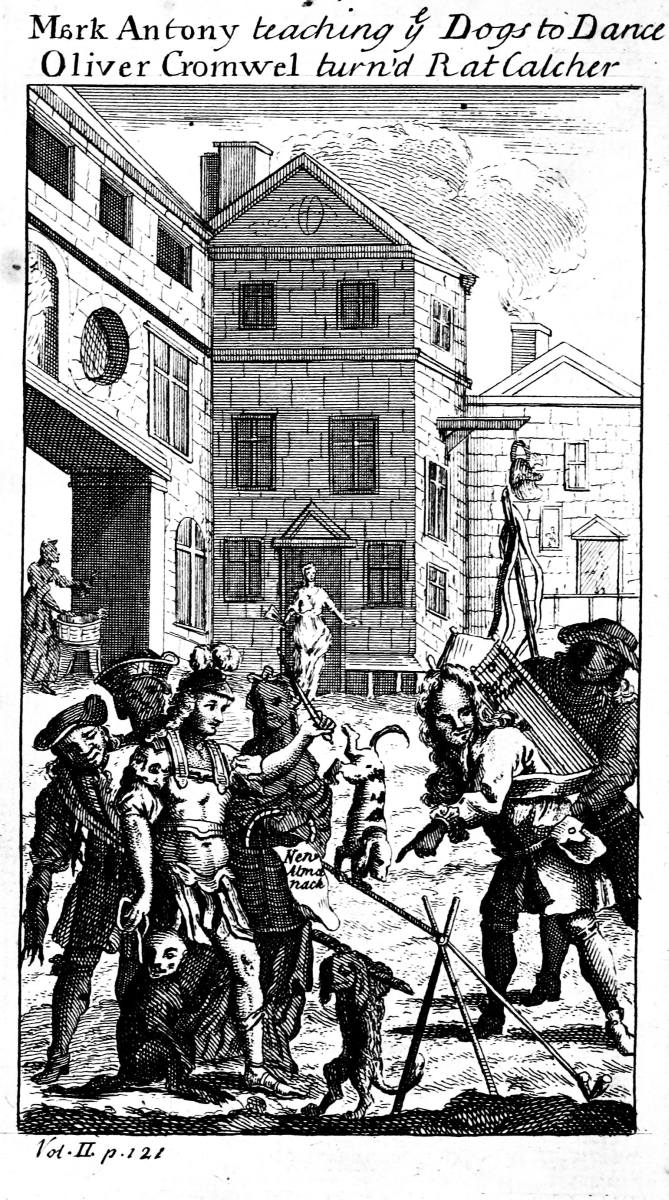
her stall in Pluto’s stable-yard. In my peregrination, I met several things unexpected, and therefore surprising; I shall not give you the trouble of every particular dark passage we went thro’, but in general terms relate the most memorable things that occurred during a very considerable walk that we had together. Taking a solitary walk on the gloomy banks of Acheron, I met a finical fellow, powder’d from top to toe, his hands in his pocket, a-la-mode de Paris, humming a new minuet; and who would it be, but Gondamour, that famous Spaniard. Helen of Greece cry’d kitchin-stuff, and Roxano had a little basket of tripe and trotters; Agamemnon sold bak’d ox-cheek, hot, hot; Hannibal sells Spanish-nuts, come crack it away; the so famous Hector of Troy is a head-dresser; the Decii keep a coblers-stall, in the corner of the Forum, and the Horatii a chandler’s-shop; Sardanapalus cries lilly-white-vinegar, and Heliogabalus bakes fritters, in the via appia of this metropolis; Lucius Æmilius Paulus is a bayliff’s follower, and the famous queen Thomyris proportions out the offals for Cerberus; Tarquin sweeps his den, and Romulus is a turnspit in Pluto’s kitchen; Artaxerxes is an under scullion, and Pompey the magnificent, a rag-man; Mark Anthony, that disputed his mistress at the price of the whole universe, goes now about with dancing-dogs, a monkey and a rope; Cleopatra, that could swallow a province at one draught, when it was to drink her lover’s health, submits now to the humble employment of feeding Proserpine’s pigs: that luxurious Roman, who was once so dissolv’d in ease, as that a very rose-leaf doubled under him, prevented his rest, is now labouring at the anvil with a half hundred hammer; Oliver Cromwell is a rat-catcher, and my lord Bellew a chimney-sweeper.
There was besides these, a list of people nearer hand; but you may easily guess upon what score they are left out of the list. We needed not have gone so far back in the records of persons and things, to have met instances of barbarity, luxury, avarice, lust of dominion, as well as of sensuality. Malversations of government in sovereigns and subjects; publick justice avoided, private feuds fomented, every thing sacrificed to a Colbert, Maintenon, or a Loüis.
There is somebody hollows most damnably on the other side of Styx, and lest I lose this opportunity, I shall only relate some memorable things to you: Therefore pray pardon me that I cannot dilate upon every particular. In short then, Alexander the Great is bully to a guinea-dropper; and cardinal Mazarine keeps a nine-holes; Mary of Medicis foots stockings, and Katherine, queen of Sweedland cries two bunches a penny card-matches, two bunches a penny; Henry the fourth of France carries a rary-show; and Mahomet, muscles; Seneca keeps a fencing-school, and Julius Cæsar a two-penny ordinary; Xenophon, that great philosopher, cries cucumbers to pickle; and Cato is the perfectest Sir Courtly of the whole Plutonian kingdom; Richelieu cries topping bunno; and the late pope, any thing to day; Lewis the thirteenth is a corn-cutter; Gustavus Adolphus cries sparrowgrass, with a thousand more particulars of this nature. You must allow the scenes to be mightily alter’d from their former stations; but alas! Sir, this change we suffer, and as pleasure is the reward of virtue, so disgrace and infamy is of cruelty, pride, and hypocrisy. What can be more surprising than to see the renowned Penthefilea, queen of the Amazons, crying new almanacks, and Darius gingerbread, van Trump cries ballads, and admiral de Ruyter long and strong thread-laces.
This disproportion is their punishment; for it must be anxious to the last degree, to fall so low even beyond a possibility of rising again. That is the advantage of moving in an humble sphere; they are not capable of those enormities that the great ones can hardly avoid; for temptation will generally have the better of mankind.
I rest, Yours in haste.
