Part 3 — Dialogues of the Dead. In Imitation of LUCIAN.
Reading edition
The Scene Hell.
The Trial of Cuckolds.
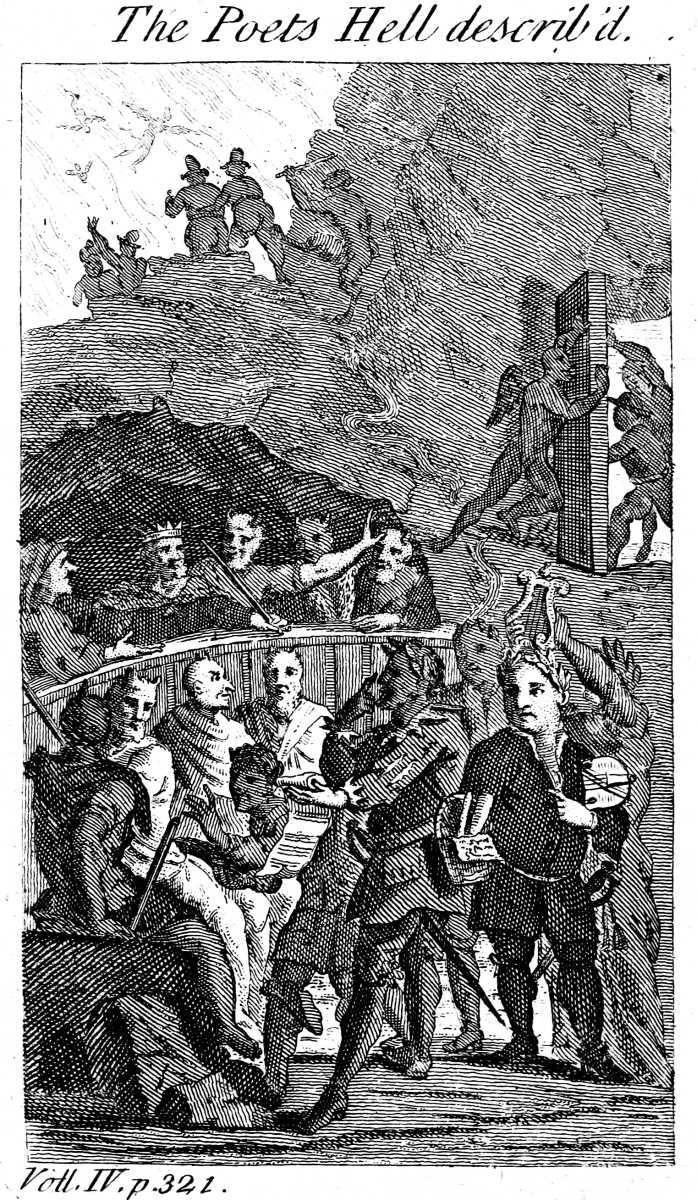
Lucifer. HOLD! porter, shut the gates of this our angust court, that we may not be thus throng’d. Let no more come in, ’till we have clear’d the bench of these numbers we have before us already.
Porter. Mighty emperor, your commands shall be obey’d.
Lucif. Now, my noble lords, set we ourselves to search and examine what of late years brings daily such gluts and spring-tides of souls to our infernal mansions, ’specially at this time, when neither war, famine, nor plague, are abroad in the upper world, or at least in that part of it from whence I observe most of this gang arrive; Europe I mean: if there were war, ’twould be no wonder so many were damn’d; the liberties of the sword surprize enough in their sins to throng our courts of justice: nor is the plague without advantages for us that way; the few that have spiritual relief, in such contagious and quickly-destroying distempers, encrease our crop: and the general cruelty of mankind is such, that in famine, those that have will keep for themselves and their dogs, and let the rest of their own species perish, without so much as a pitying look: and this makes many atheists in their wants, and does that, without our instigation, which we could not perswade Job to do, that is, Curse God, and die.
But, my lords, when none of these, our loyal vassals, are abroad, ’tis not strange that I am to seek in the cause of this great concourse at our tribunal; and, therefore, that virtue, for want of reward and due praise, may not slacken, we will examine to what industrious friend we owe this unexpected success; wherefore, you minor devils and under-officers of our court, bring them in order to the bar, and let no devil of honour, that has past that inferior office of touching the uncleanness of humanity, defile himself with too near an approach to any of them.
[Here several lacquey-devils and porter-devils, with the rest of the mob of hell, bring on the first band to the bar in Italian garbs.]
Speak, criminal, whence thou art? Of what nation, quality, or condition in the world? And what’s the happy cause of thy coming hither?
Ghost. First, Signor, adjust some points in dispute, which highly concern the honour of our country, and the decorum of good breeding, and I shall, for all this noble train that follow me, answer to your devilship’s queries. Coming to the confines of your flourishing empire, we were met by some of the officers of this honourable assembly, who gave us safe conduct to your royal presence: but just now, entring into these lifts, confronted us a company of paltry scoundrels, and press’d for precedence, swearing, That they were Englishmen, and ought to take place of all that were damn’d for cuckolds. We urg’d our title in heraldry, that we ought to take place of all nations, being the successors of the once masters of the universe; but they were deaf to reason here, as well as in the world, and one swore d—me, bl—d and z—ns, another, oaths all round the compass; and in this volly of mouth-grenadoes, one very demure gentleman press’d, by Yea and Nay, that we were in the wrong; and had it not been for this honourable devil here, that’s a friend to our nation, we had been worm’d out of our birth-right by the arse and refuse of the world: Et penitus toto divisos orbe Britannos, as our noble country-man has it, Dogs shut out of doors from all the rest of mankind. I therefore appeal to this thrice excellent senate, and you the right and most reverend doge, to redress this affront.
Lucif. Hey-day? What, has not hell yet brought you to your senses, that you can think we devils are such sots to trouble our heads about the ridiculous whims of ceremonious mankind? But since they were so obstreperous to make a disturbance in hell, they shall be the last heard: Therefore proceed to the question.
Ghost. An’t please your thrice puissant devilship, noble signor, I was coming to that point: Therefore, to be brief, (for I hate prolixity) I am, Sir, an Italian by nation, and a noble-man by quality. My own vanity, and ill chance, give me a pretty wife, and my honour made me chuse her of an illustrious house; but she prov’d lewd and prodigal, the natural issue of beauty and high birth; my dotage on her charms hath bred in me such a fond, blind, uxorious vice (which my countrymen are seldom guilty of) that I was almost ruin’d before I found I was betray’d: but travelling towards Genoa, I met the spark, my pretended friend, on the road to my dwelling; I seemingly pass’d on my way, but in the night return’d, unexpected, and surpriz’d ’em all, and, therefore, as my honour bid me, I murder’d him, and bak’d him in a pye, and (ingeniously in my revenge) swore she should eat no other food but her lover: the crust she a while did eat, but one day, having prepar’d a stelleto, at supper she dispatch’d me thus to your thrice noble and illustrious devilship.
Lucif. Very well! and worthy thou art of such a punishment, that could’st not forgive beauty a gentle slip of that nature thou thyself hadst so often transgress’d. Speak the next.
2 Ghost. I am also an Italian; and observing a gentleman often ogling my wife, which she did not a little encourage, I sent a bravo to dispatch him; (for we Italians do not love to look revenge in the face ourselves) but the rogue of a bravo, won by my wife, and by a great sum of money of my adversary’s, comes back to me, and cuts my throat. And this, most noble signor, is most of our cases; our wives have given us the casting throw for damnation.
Lucif. You, the rest of the malignant train, is this true, that your wives have sent you hither?
Omnes. Yes, yes; we have all had wives.—— All the plagues of Egypt let us undergo, but no wives, we most humbly beseech your most noble devilship.
Lucif. Prayers are in vain; transgressions are to be punish’d by the same way they are committed; nor must you be your own carvers here in hell, gentlemen. Away with ’em, down into cuckolds-cave, ten thousand fathom deeper than the whore-masters, and next the keeping-cullies, and let each have two wives to torment him.
Omnes. O wives! wives!
[They are removed off, and others brought on.
Lucif. Proceed to the next band.
Say, what were you in the world, and what dear sin brought you to this place?
Spanish Ghost. Great prince of darkness, and lord of the greatest part of mankind, may it please your catholick majesty, I was, by my worldly state and condition, a Spanish grandee, of the first magnitude, rich as fortune and an indulgent prince well could make me, (for your devilship must know, our king is but a sheep for us to fleece when we please, which we do in all places, letting his soldiers and inferior servants starve) happy, ’till too much success was my undoing; for by that I gain’d the lady I lov’d, and so in one unhappy word was married. ’Tis tedious to repeat the injuries I receiv’d from the ungrateful fair, who, after all, to make room for another, sent me away (like an Italian as she was) in all my sins, with a poisonous draught.
Lucif. Is the same your fate, you, the rest of this besotted crew, that have met with just punishment from one part of yourselves, for preferring your private grandeur before the service of your king and honour of your country?
Omnes. Yes, yes; thirst of honour and wealth made us cheat the king; and drew down the judgment of wedlock; and that brought us to this long home and fiend of matrimony.
Lucif. Away with these, and drive ’em out of their snails pace.
[A tatter’d Ghost comes forward.
Ghost. Just may be their punishment, most noble devil; but why should I be condemn’d to wincing, who was so far from cheating the king, that I could never get my due of him, and being a gentleman born, never did any thing below my extraction, and have gone without a meal, many a time, rather than degrade myself to get one? And tho’ I could arrive to it no other ways, yet kept up my part still in stately walk, and my wallet, tho’ I had no bread for either, or a shirt to my back.
Lucif. Since thy own folly made thee marry, ’tis now too late to prate, you must away with the rest.
[They are carry’d off, and others brought on.
Bring the next to the bar: declare the cause of your deserv’d damnation. My life on’t these dapper sparks are in for cakes and ale too; the very air of their faces speaks them cuckolds.
French Ghost. Sire, may it please your most victorious majesty, Vostre Esclaro is a Frenchman by birth, and a leader of the most christian king’s most magnanimous forces; and whilst I, with my commilitones, was reaping lawrels in the field of renown, and engaging the enemy abroad, my lady wife (as most of our French wives will, for having once tasted the sweets of love, they’ll ne’er have done ’till they have undone us one way or other) my lady wife, I say, was engaging with a friend at home, who very genteely gave her the pox, which I, at my return, like a gay cavalier of a husband, receiv’d of her as genteely without rebuke, it being no matter of scandal with us. But madamoiselle’s pox proving a very virago, gave me damn’d thrust in quarto, and sent me hither in decimo sexto, monseigneur.
Lucif. You, the rest, speak.
Omnes. We are all Frenchmen, and therefore you need not doubt the cause, the pox and our wives, ma foy.
Lucif. Away with them: they’ll make a fire by themselves, or will serve instead of small-coal to kindle others; for they are half burnt out already. Place ’em next the Spaniards. The next there speak.
[They are carry’d off, more brought on.
German Ghost. I am, by nation, a German, and, by damnation, a husband, a cuckold, or what you please; for I hate to mince the matter with a long preamble, when a word to the wise is enough.
Lucif. Very well; you, the rest, speak.
Omnes. Ev’n so, an’t please your imperial devilship; whilst we drank and fought against the Turks, our wives whor’d with the Christians. O wives! wives!
Lucif. Away with these into the hottest, for their carcasses are so soak’d with liquor, that they’ll put out an ordinary fire. You, the next, speak.
[They are carry’d off, others brought on.
Dutch Ghost. Gads sacrament, I am a member, or rather two members, of the Hogen-Mogen common-wealth of Europe. Two members, I say; for I am a member governed, and a member governing; for the people with us, and in all such common-wealths, are both subjects and masters, govern laws, and govern’d by the same.
Lucif. Your country’s name then is contradiction. Is it not?
Ghost. Contradiction to monarchy, tho’ set up by some monarchs to spite others. But to your question, old tarpaulin: Whilst I was getting money and drinking punch and brandy, to hearten me for the noble combats of snick or snee, or some illustrious sea-fight, or some generous undertaking at the island of Formosa, (for a true Dutchman never fights without his head full of brandy) my wife made it fly like sooterkins at home; at last she made me turn bankrupt, and cheat my creditors, and so dying, I came with a full sail and brisk gale into your port.
Lucif. You, the rest, speak.
Omnes. For our wives, O Sooterkin Hagan, our wives, whose broad-built bulk the boisterous billows bear.
Lucif. Away with them into the den of anarchy and confusion, below the founders of Babel.
[They are carry’d off, and abundance of English bands come forward.
Lucif. Numerous crew! answer me; What has brought you into this kingdom; and what were you in the world?
[A ghost of a beau speaks to another of the same feather.
1 Beau’s Gh. D—— me, Jack, didst ever hear so silly and impertinent a question? As if marriage was not the only cause of damnation.
[Aside.
2 Beau’s Gh. R——t me, Ned, as thou say’st, I never heard a country justice ask more mal à propos; but the devil’s an ass, and so let him pass.
The first of the first band answers the Devil.
I am an Englishman, who, after I had been a notorious cuckold, was perswaded by my wife to fight the man that made me so, and was fairly kill’d for satisfaction, as all this band that follows me were; and we are damn’d for fools as well as cuckolds.
Omnes. ’Tis true, honour and wedlock have been our ruin.
Lucif. Away with them into fools paradise, below the keeping-cullies, as the more unpardonable monsters.
[They are carry’d off, and as the next come in, the Beaux speak.
1 Be. Gh. D—— me, Ned, didst ever know such fools as they, that could not be satisfy’d to live cuckolds, but must die so too, with a witness,
[Aside.
2 Be. Gh. R——t me, Jack, if ever I was of that fighting humour; nor did I ever fight but once, and then forc’d to it; but my stays sav’d my life, and I wore my glove that was cut in the encounter as long as ’twould hang on my hand: therefore, tho’ I knew Sir Roger Allfight kiss’d my wife, yet as long as I could sup at the Rose, and break the drawer’s head if he made not haste, or brought bad wines, or so, ’gad I let him kiss her and welcome.
[Aside.
1 Be. Gh. S——k me, Ned, I was always of thy mind, as long as I could flutter abroad in my glass coach, have my diamond snuff-box full of Orangeree or Roderigo, &c. D—— me if I car’d a rush who rode in my saddle. But mark that formal coxcomb now going to speak: lord! how fine a thing it is to be a man of wit, and what a singular figure he makes! but hark, old grey-beard begins.
Lucif. Speak you the next.
Ghost. I was a man of quality, of the same country; but my fortune being, in my youth, run out, in France for breeding, and in England by keeping, I thought in my riper years to retrieve all by marrying a city heiress; but she had by nature, so much of the mother in her, that by intriguing and equipage she soon brought me into a worse condition than before: so that, as my last refuge, I was forc’d to turn Plotter, and being discover’d, was lopp’d shorter by the head, as all this honourable tribe that follows me were.
Lucif. Away with ’em. [They are carry’d off, and, as the next are bringing to the bar, the beaux discourse again.
1 Beau. Gh. D—me, Ned, this was a worse fool than the other.
2 Beau. Gh. R—t me, Jack, vous avez raison: for I always lov’d to keep myself out of the jeopardy of action: Jack, I’d talk treason, or so; sort myself with the disaffected, and blow up the coals of their discontent, or so: but for engagements, covenants, conditions, and unlawful assemblies, ’gad they must pardon me.
[Aside.
1 Beau. Gh. Z—ns, Ned, thou and I were always one man; I could rail at the magistrates, pen a lampoon, or, at least, convey it to Julian, give penny pies to the mob to make a noise, ridicule the transactions of the government, and give squinting reflections on the king, that was my ne plus ultra; for all that I can see, we are in the best case still, Ned. But now our band advances, let us press forward, or our cause may fail.
[Aside.
2 Beau. Gh. Hell and damnation, all’s lost; for look yonder, that conceited coxcomb, my lord Flippant, presuming on his quality, has taken upon him to be our chief, and spokes-man.
[Aside.
1 Beau. Gh. S—nk me, Ned, so say I: I never knew a conceited man, but he was a fool; but let’s hear, we may put in an appeal, or a writ of error afterward, or award judgment, if our cause be ill handled.
[Aside.
O! what an admirable thing it is to be a man of parts!
Luc. Speak, thou fluttering fool, for the rest of this thy peacock-gang.
L. Flippant’s Ghost. D—me, Sir, I have been a man of the town, or rather a man of wit, and have been confess’d a beau, and admitted into the family of the rakehellonians: and, d—me, Sir, I think I am much under that dilemma at present.—— I was learn’d in the ingenious art of dumfounding; a wit I said, dear devil, I was, and it lay as a gentleman’s shou’d, most in lewdness and atheism. I married in jest, or a frolick, which you please; but as I thought a fortune, (got by cullies) I was made a cuckold in earnest; tho’ that was no grievance to me, since it only made me in the mode: nor cou’d I expect any better, since I knew she was a whore before I had her; but ’twas with my betters, and so I was contented her money should pass currant with me, where her reputation would not: but sharping was her best quality, and gaming her greatest patrimony; and she set up a basset table, and whilst I was at the groom-porter’s throwing a-main, she would be sure to set me, at home, a pair of horns. I seldom coming to my apartment, but I met some cully nobleman or other; but that which was worst, she still had a knave in her mouth, or an alpue in her tail, that carry’d away all the gain: whilst I was at Will’s coffee-house, fast’ned in controversy or poetick rhapsodies, though I had neither religion nor learning, she was sure of me ’till play-time and then too; for at five, come, Dick, says I (to a brother of the orange and cravat string) d—me, let’s us to the play: r—t me, says he, ’tis a dull one: d—me, says I, I value not the play, my province lies in the boxes, ogling my half-crown away, or running from side-box to side-box, to the inviting incognito’s in black faces, or else wittily to cry out aloud in the pit, &c. Bough, or Boyta, and then be prettily answer’d by the rest of the wits in the same note, like musical instruments tuned to the same pitch. And whilst I was thus generously employ’d, my consort had her retreat of quality, to be provided of what I fail’d in. From the play to the Rose, where we drank ’till four, or break of day; from thence to bed, where we lay ’till four or five again, so in infinitum.
1 Beau. Gh. D—me, Jack, did’st ever hear a sot spoil a good tale in the telling so?
2 Beau. Gh. Z—ns, Ned, we’re undone thro’ this scoundrel’s ignorance and nonsense: shall I speak?
1 Beau. Gh. R—t me, if thou wilt, thou may’st: but I am sure I could make more of it: for tho’ thou art a man of wit, and a good judge of poetry, and all that, r—t me, Jack, oratory is thy blind side.
2 Beau. Gh. D—me, Sir, don’t put upon your friends; for have I been bred at the university, and think myself as good a judge as you or any man alive: and, Sir, were we out of the court, I believe you would not thus have abus’d me.
1 Beau. Gh. Nay, D—me, Ned, now thou art unjust to thy friend: r—t me, to quarrel for’t, I acknowledg’d thee a man of parts, Ned, and all that.
Luc. Away with the gay sots, and because I have no plagues in hell equal to their deserts, let them be a torment to one another. Away with them.
[As they go off, the Beaus discourse.
1 Beau. Gh. Well, Ned, shall I speak before it is too late: you may depend on my excellence in oratory, ’tis my talent; I never writ billet-deux in my life, but it prevail’d with the cruel nymph: and do you think I can’t with the devil? I’ll perswade him out of his seven senses, man? d—me, I’ll make it appear to him that he is a god, and all that, man: r—t me, Ned, be not obstinate.
2 Beau. Gh. Z—ns, Sir, no more of that strain. Sir, you’re a coxcomb. What doubt my universal parts?
Luc. You with such a busy face, speak, what are you?
Here abundance of Cits, in various dresses, come forward.
Cit. Ghost. An’t please your infernal majesty, I was a right worshipful citizen of London, that famous Metropolis of England, and I have born all the honourable employments of the same, ev’n to sheriff and lord-mayor: I was long of the court of aldermen, and one of the chief spokesmen of the common-council: I made speeches, and penn’d most of the addresses. But ’tis not for being a cuckold alone, or that I was feign to cheat so many to maintain my wife’s pride and luxury, that I am damn’d with this right worshipful crew here; for those are crimes common to the rest of our brother-citizens, as well as us; but we were so mad to marry second wives, and for their sakes turn our children out of doors, (after we had bred them up in all the ease and luxury of the age) to seek their fortunes in the wide world, and left our estates to our wives at our death, who will be sure to bestow them on some silly hectoring spendthrift bully of Alsatia or other, and let the children, begot of our own bodies, starve.
Luc. Away with that rank gang of fools, as well as knaves, who cou’d so much forget nature and its necessary and known laws, as to cast off their own off-spring, to give away their substance to those that will not only misuse it, but contemn the memory of them that were their benefactors, with so great an injury to nature.
2 Cit. May it please your most noble devilship to hear me, before you give judgment upon us, and I don’t doubt, but I shall seriously, offer such reasons of our behaviour in that matter, as shall sufficiently move that ignominy your devilship was pleas’d to cast upon us. First, then, tho’ it be true, that upon my marriage, I agreed with my second spouse to turn all my children out of doors, yet I did it not ’till she or I had found some cause so to do; for some of them were undutiful, and others put tricks upon me, (as my good wife said) and others were lewd and extravagant, and some self-will’d; so that I deserted none of ’em without some fault. If they were undutiful, was I to blame to punish ’em for it? Or was it my duty to keep and maintain them, after they were of sufficient bigness to prog for themselves? The birds and beasts take care of their young no longer, than ’till they are able to care for themselves; and why should man be confin’d to more severe laws in that point than his vassal creatures? I must profess, on the word of a citizen, that I can see no reason why a man that gets his estate himself, may not give it away to whom he pleases; and none so and near deserving, as the wife of one’s bosom. What tho’ she may have slips, the witcheries and temptations of love are great to their soft sex; and if we have been so employ’d in getting, that we could not mind that other business, why should we blame them for easing us by other supplies, where we wanted power to give them.
Luc. Thou hast spoken as much to the purpose, as when in the world thou used harangue at the choice of a sheriff; and therefore I shall proceed to a singular punishment for you. Your argument of punishing your children for their undutifulness, turns here on your own head; for when they are little, you encourage their impudence: and that is a witty child with you, that can prate saucily and lewdly before he can read, and swear and catch the maid by it before seven years old; and then when you have given them their head without controul, during their childhood and minority, you punish them for the fruit of that tree which yourselves have planted, which is in itself the height of injustice; but on the contrary, you are condemn’d for breaking the laws of your maker, which you were bred in fear of, and taught to obey; and you that could punish your own flesh and blood so for nothing, without relenting, have a just judgment for being punish’d here without mercy. And as for their being lewd and extravagant, that is no plea for you, since that is the lesson you have taught ’em both by example and precept, from the time of their birth, ’till their coming to years of understanding; for you let a taylor’s daughter, with you, go in the garb of the children of a duke in the country, and even miss ketch be call’d away from the mob: your sons must keep their horses, and their whores too, before they know the use of either; and then you punish them for persevering when they are better skill’d. And as for the birds and beasts, (examples I think unworthy to be follow’d by a nobler being, or quoted as a precedent) they are so far excelling you in that point, that they educate their young in the simple course of nature, not elevating them above what’s necessary, nor leaving them, ’till they have sufficiently inur’d them to provide for themselves all that nature requires. But just contrary to the example you quote, you, all the infancy of your children, keep them from hardship and knowing how to live and provide for themselves, and then on the sudden cast them out of their nest unfledg’d, without teaching them to fly. Nor is your proud supposition, that you may dispose of your own gettings, more pious or justifiable, unless you will make your selves gods, and claim the propriety of that which you cannot carry out of the world with you, no more than you brought it in. ’Twas heaven that gave success to your endeavours, to provide for those other blessings it bestow’d upon you, of fine hopeful children; and you were, in right, but their tenant for life, to improve your substance for their good. Nor can you in reason imagine any one deserves it better; for justice and reason both will have it, that you that begot them into the world without their seeking or desires, to satisfy your own pleasures, ought to provide all you can for them that you brought thus involuntarily into the maze of fortune and the treachery of mankind. And of all in the world, you have the least reason to leave it to a wife, that not only betrays the rights of your bed, prostituting herself and your honour to rascals; but shew’d at first so little respect and love for you, as to desire so unreasonable a thing, that you should cast off all the bonds of nature, and forsake your own children, which she could not but love, if she lov’d you: for you know the proverb, love me, love my dog. Having thus therefore shewn the villainy of your crimes, ’tis fit I proceed to your just punishment, for which you are sent hither. You that have thus more than monstrously prevaricated against nature, shall want all the benefits of nature; fire you shall have, but not to give you gentle warmth from the cold of the season, (as when you liv’d and hugg’d yourself in all epicurism, whilst your children starv’d) but to scorch your wretched consciences; and continual fears of burning your goods, houses, and writings, shall attend you; to which shall be added the piercing fire of jealousy, that shall prey upon every part of you; nor shall you be without the knowledge of your wives transactions on earth and see how they mourn in sack and claret, and how they marry and whore before you are cold; how they spend that profusely, which you scrap’d together to give them, with so much injustice to your poor orphans, whose injuries shall never let you rest, but with all the fury of hell for ever torment you worse than Onan or the Sodomites: away with them, whose villainies raises a horror, even in the prince of hell and great source of wickedness.
[As they are going off, two Quakers ghosts speak.
1 Quaker’s Ghost. Ah! um!—Josiah! verily, who would have thought that Rebecca would have fallen with the ungodly so, or that your Tabitha would have let the spirit move her to play with the calves of Bethel, the wicked of Sidon, or the profane children of Moloch?
2 Ghost. By yea and by nay, Abadoniah, as thou say’st, it was more verily than could enter into the heart of man to believe. Why, there was my neighbour Sad-face, and my cousin Goggle, Nahu, Sneakphir, and [The lord said unto Moses, praise God.] was his fore-name; had they not holy sisters, as to the appearance of the flesh, for their spouses? Yet behold with them, and within the tabernacles of their mansions, instead of raising up seed to the lord among the chosen and godly, they did sacrifice to Baal with the giants of Moab. Oh Abadoniah! what a falling off was there! what a backsliding!
1 Ghost. Oh, Josiah! As thou say’st, verily, and by yea and by nay, that the spirit should move us to come to the devil for our necessaries, without a convenience. But our lord will remember our captivity in Babylon.
The lawyers push forward, and speak very urgently.
Lawyer’s Ghost. Sure, my lord, if the Decorum of any place ought to be kept, that of a court of judgment ought, and not to let a paultry cit speak before a man of the robe. But in these popish times, all law is neglected, and all its honourable professors contemn’d and postpon’d. However, my most honourable lord and patron of all that were black, I shall humbly move this honourable court, that I may at length be heard, since my cause is of so great import and concern, and in which the wisdom of this court will be highly interessed, if it should be brought in Billa vera; and it wou’d too much reflect on the impartiality of this court of judicature, to be slack in indagating into a cause of this weight and moment. My lord, before I open, I shall only premise, that I take this to be the high court of equity. Which granted, I shall begin to open.
I will confess, that the statutes in Banco Regis may prevail, and custom in the common-pleas; but humbly presume, with submission to your lordships, that this being a court of equity, it will give the [57] devil his due. But, my lord, where a precedent of the like nature may happen in a case decided by the great council of the nation, I hope it will not be foreign, if I alledge it here where it has nothing to do. The case is parallel, as I may say, my lord, considering the circumstances; that is, in short, Consideratis Considerandis, in primo Henrici primi, according to my lord Coke upon Littleton; and if your lordship will let us read, you shall find so many gross errors in the bill, and the material objections so fully answer’d, and costs, if not charges and damages. But, my lord, I do humbly suppose, that part of this bill ought rather to have been put into an indictment, and so falls not under the cognizance of this court; and that is, my lord, that we are made Felo’s de se, the causes of our own damnation, by an instrument call’d a wife, value two-pence. Therefore, my lord, if you please, let us try it upon a jury in any county your lordship shall think fit. Tho’, I think, in our case, your lordship may decide it without farther trouble; for thus I prove the [58] negative, (hoping your lordship will let me bring in a writ of error). To deny, my lord, that we are damn’d, wou’d be perfect nonsense, and against all form of law; yet that we are damn’d for our wives, I presume, does not follow. And I will prove, that it does not, so undeniably, to all that have any profound insight into the law, that I question not but your lordship will acquiesce Nemine Contradicente; for tho’ it be,
Mark, brothers, how I will puzzle the devil, and all his learned bench with one turn, one notable quirk; mind it well. Aside to the other lawyers Ghosts that follow him, they look on one another, rejoicing, and hugging themselves.
[Aloud] For tho’ I say it be true, that our wives spend a great deal of money on our clerks, Et cætera, quæ nunc perscribere longum est, and cuckolded us as often as they pleas’d, in spite of our teeth; and though I will not deny that they were as profuse as Heliogabalus, or Caligula, and as proud as Lucifer, (with submission to your lordship) yet (now comes the paradox) yet, I say, (pray mind this) we did not get money to maintain their luxury, but they maintain’d their luxury out of the money that we got: which, I humbly conceive, falls not under the same predicament, but brings us within the act of Habeas Corpus, that we may not be carry’d away into the den of ordinary cuckolds. For, to give your lordship yet a more lively representation of this matter in question, be pleas’d to reflect on another very pertinent precedent in my lord Coke, where John-a-Noakes is tenant only for life, and John-a Stiles tenant in tail——
Luc. Heyday! what, is it Midsummer-moon with mankind? what have we got here! a cuckold hornmad, prating nonsense, and salving his knavery and folly with a quirk in law, a turn of a sentence? those shams won’t take here, where there needs no fee for counsel, nor bribe for judgment. Away with him and his villainous tribe.
Lawyer’s Ghost. Nay, but, my lord, I humbly move your honour, that we may not be condemn’d, Causa indicta, that is not right or equitable: wherefore I beseech your lordship to have some regard to me, as I am a barrister of thirty years standing, and a serjeant of ten, that you wou’d be pleas’d to reflect, that tho’ I cheated the ignorant, and squeez’d and impos’d on the necessitous.—
Luc. Has not hell yet brought thee to thy senses? Away with this impertinent fellow, and all this black gang, among the rest of the most deprav’d cuckolds, but in the most deepest cavern, for whom they shall plead, in Forma Pauperis, till their lungs crack, without fees; let the
writings of their ill got estates be for their food. Scoundrels, that had no more sense, than after they had cheated so many wise and honest men, to suffer themselves to be abus’d by women! away with them, away with them.
Lawyer. As to that, my lord, I always fetch’d my dear home in her coach from her gallant, who had pawn’d her in a tavern.——
Luc. Away with them I say; what, am I not obey’d!
As they are carry’d off, they cry, O tempora! O mores!
Luc. Who art thou, with so precise a grimace?
A Parson’s Ghost. I was in the world above, most mighty king, of the reverend crew, and having a handsom wife, as most of us love, who was proud, as they generally are, my benefice (tho’ good) was too small to maintain the grandeur she affected; but I being of a good comely port, with a pair of broad shoulders, and sufficient abilities, and the man of God too boot, (which made an easy and open way for all the rest) I ventur’d to crack a commandment with some of my wealthy parishioners wives, that they being so oblig’d, (according to my text) might prevail with their husbands to be the more generous to me in supererrogatory offerings, which flow’d all into the bottomless bag of my spouse’s pride and lust; for that too, must be supply’d.
[They are carry’d off.
Luc. You, the rest of this mad foolish crew, what are you? And what the cause of your damnation?
Poet’s Ghost. Quis Talia fando Myrmidonum, Dolopúmve, aut duri Miles Ulyssi Temperet à Lacrymis?
Ha! brothers of the quill, what fate for us remains! But death, or worse than death, inglorious chains.
Luc. What ragged regiment are you that lag behind your fellows? what are you the black-guard of the cuckolds?
Poet. No, royal Pluto, no, (altho’, indeed, we are the poorest cuckolds that come hither, I believe) we are of the learned rout.
We have on PARNASSUS slept, And in the sacred stream (To guild our amorous theam) Of HELICON our pens have dipt. And thro’ AVERNUS and black STYX By which to swear The Gods do fear, We hither slipt; And fairly bilked old CHARON As we were wont to do of yore Poor HACK, or CHAIR-MAN, Or our half-starv’d whore. Wherefore, O Sir PLUTO, Since we cannot bilk you too.——
Luc. Hold, hold I know your tribe of old; if you once get to repeating your works, or into the jingle of your rhimes, you’ll never have done. Away with them to old Sternhold and Hopkins, and the rest of the crambo-sparks: ye senseless scoundrels, that make wives of your mules when single, and whores of your wives when marry’d.
Poet. O passi graviora!—— Solamen miseris, socios habuisse dolorum.
Luc. Clear the court, and let no more come in: the fatigue of this sitting has been enough: for my part, the follies of mankind are such, that the very hearing of them has quite turn’d my stomach for this month at least.
Porter. Great Sir, here is a throng of wild Irish, that will take no denial, but thrust in whether we will or no.
Irish. Nay, nay, my deer joy, chreest bless the sweet majestees faash indeed; poor Teague is St. Patrick’s own country-man, be chreest, and poor Teague will come into St. Patrick’s purgatory; and if there be no vacancee, indeed thee must make a vacancee.
Porter. Nay, but this is hell, and not St. Patrick’s purgatory: therefore keep back.
Irish. Boo! boo, boo, boo, boo, hoo, hoo! hell indeed! say’st thou mee deer joy! be mee shoul, and bee chreest and St. Patrick, ee was think that hee that was in the highway to hell, cou’d not miss St. Patrick’s purgatory, since there is but a wall betwixt them.
Porter. Ouns, stand back, or I’ll send you back to the Boyne, ye impudent pultroons you.
Irish. Boo, hoo, ooo: bless the sweet faash of thee indeed, poor Teague will have patience ’till his good grace will let him in indeed.
[A noise without.
Lucif. What noise is that without?
Porter. Here is a troop of Scots that swear and stare to get in, and beg they may but skulk into some cold corner of hell, (which they wou’d not know from their own country above) with their Ganymedes, from the fury of their wives, whom they hear are just following them at their heels. And then here is some thousands more from Asia, Africa, and America, push’d on with the same fear: but I’ll keep them here in the Lobby, ’till your infernal majesty is more at leisure.
Lucif. Do so,—for the horrid nauseousness of these sots have almost put me into a fit of vomiting and looseness. And now, my lords and gentlemen, that have given your attendance at this court, you may depart ’till farther orders; but tendering my health, both for your sakes and my own, I shall confer the office of my deputy on our right reverend and well-belov’d cousin Belzebub, prince of the Flies; for I am unable to undergo this fatigue any more.
Belzebub. I humbly beg your majesty wou’d excuse my age, and give me my quietus. Here is prince Satan, an able and active devil, and worthy your choice.
Satan. Good prince Belzebub, you might have spar’d your good word; for I shall beg to be excus’d, if my former services may be respected; for I had enough of mankind when I tempted Eve, she foil’d me so at my own weapon; therefore I hope your majesty will confer that troublesome employment on some devil of less quality than myself.
Lucif. So be it then, and let the mob of hell make choice of one, for I am resolv’d to trouble myself no more about them. But before we rise, let proclamation be made of a general play-day and jubilee for all the lesser and laborious rank of devils, who have been thus long continually employ’d in damning mankind; let them take their ease as long as matrimony prevails above; for now our business is much better done by woman to our hands: Or if any are so zealously inclin’d to be still busy for the good of their country, let them employ their time and talents to better purpose than formerly, in perswading the easy world against cœlibacy, by stigmatizing all that affect it with the name of whores, rogues, and hypocrites; and if that prevails, we gain our point, and widow’d Heaven may bid good-night to mankind. For if we get them into our noose, we may be sure of our purchase. Let none therefore loyter away his time in tempting the marry’d; for one woman will out-do a legion of you.
For since their grandame Eve in Eden fell, The sex has learnt the damning trade so well, Where e’er that rules, there’s little need of hell.