Part 2 — Mr. Henry W——’s Answer to Bully Dawson.
Reading edition
Noble Captain and Commander in Chief of all the Cowards in Christendom.
IF being smoak’d-dry’d up a chimney, like a flitch of bacon, thro’ fear of bayliffs, being kick’d thro’ the whole town by every coxcomb, being pox’d by every whore, and dunn’d by every scoundrel, starving, lousing, begging, borrowing, bullying, and all the plagues of human life, would never mend your manners upon earth, I have little reason to believe the strict discipline of hell can make any reformation in so incorrigible a libertine; what reason have I ever given you to affront a poet? A gentleman of the law, a member of an inn of Chancery, an officer in the trained-bands, a man of invention, known courage, worth and integrity; a gentleman of my stature, figure, and parts, that am able to crush a thousand such nitts as thou art under my thumb-nail: ’tis well known to the world, I have fought many duels with success, writ many lampoons with applause, manag’d many causes to my clients satisfaction, told many a pleasant story to the benefit of coffee-houses, flirted out many a jest to the delight of my companions, march’d out often to the credit of St. Clement’s trained-bands, when I have been the only wonder of all the little boys that followed us, who, to the pleasure of my own ears, have cry’d aloud, there goes a tall ensign, there’s a swanking fellow for you between the two blunderbusses; there’s a Goliah, says the men; there’s a strong-back’d Sampson, says the women: And shall I, because I have been guilty of two or three little slips, which no man is exempt from, be put in mind of ’em, by such an arrogant crackfart as thou art: I tell thee, bully, if thou wer’t but to be found upon earth, I would grind thee in a paper-mill for thy insolence, till I had made bumfodder of thee: but however, since charity obliges every good christian to forgive a man when he is dead, I shall pass by your affront, and take no more notice of it for the future; but upon the word of a man of honour, had you been living, I would no more have forgiven you, than I would have gone one day without a dinner if I had but one book in my library; therefore all things shall be forgotten, tho’ you have deserv’d the contrary. And since you have obliged me with a short journal of your transactions on the other side Styx, I think myself oblig’d in honour to make a return of your civility after the like manner, for the world knows me to be a man of a forgiving temper, and I scorn by bearing malice, or studying revenge, to forfeit my character.
I happen’d the other night in company with some men of honour, brave fellows, who were a little nice in their conversation, as well as their wine, that try’d every word that was spoke by the touch-stone of good manners, and one of them happening to say he was a lieutenant on board one of his majesty’s small frigats, when so violent a storm rose upon the coast of Ireland, that a monumental sea washing over the topmast head, by the very pressure of its weight sunk the vessel to the bottom of the ocean, which gave such a prodigious knock against the sand with her keel, that the very rebound, being a tight ship, sent her up again to the surface, without damage; and that by a watch of Tompion’s, which he had in his pocket, they were three quarters of an hour and some odd minutes in this dangerous expedition, that is, in going down and coming up again. Lord Sir, says I, how did you breathe all that while? Zoons, Sir, says he, ’tis an affront to ask a gentleman such a question, and I demand satisfaction? am I bound to tell every blockhead how many times I fetch my breath in three quarters of an hour? Nay, Sir, said I, if you are for that sport, have at you, I’m a man of honour, and dare wait upon you any where; with that he whisper’d me to go down stairs, which we both did accordingly, and drawing at the door, the first pass I made was a home thrust (for I never love to dally in such cases) and I run him thro’ the centre of the fifth jubilee button of his coat, and just scratch’d him in the breast, upon which he dropp’d his sword, believing I had kill’d him; but I taking up the fallen weapon, stepp’d to him and unbrac’d him, found he was more afraid than hurt; and that it was but a small prick that signified nothing: Now, pray Sir, said I, how did you breathe, I think I may make bold to ask you? I’ll tell you, Sir, said he, I took in the water at my mouth, just as a fish does, but having no gills to give it vent, I let it out of my fundament. Upon which answer, I was well satisfy’d, gave him his sword, and we became as great friends as the devil and the earl of Kent.
Another duel I had since that, (for you must know challenges come thick and threefold upon me, like actions upon a breaking shop-keeper) which I hope for its singularity, will prove a little entertaining to you; I happened lately to be invited to a gentleman’s chamber in Grays-Inn, to drink part of a bowl of punch; accordingly I went, and was very plentifully entertained among some other gentlemen of my acquaintance, with a capacious vessel of this most noble Diapente, insomuch, that we were all elevated above the use of our legs, as well as our reason. The gentleman that gave us the entertainment, by the assistance of his man, made a shift to get to bed about twelve at night, but the rest lay up and down in the corners of the room, snoaring like so many gorg’d swine, and battening in their own snivel, which tobacco had drain’d from their moist entrails: I guarded the garrison of good liquor the very last man, and maintain’d my post at the table like a true English hero, till between Bacchus and Morpheus, like the rest of my companions, I was lull’d into a lethargy, and falling forward in my chair upon the table, my forehead happen’d to take the edge of the punch bowl, and turn’d it clear over my head, that it served me for a night-cap, my nose being drowned in the remains of the punch; every time I drew up my breath, up went a spoonful, so that in a little time my nostrils were syring’d as clean as a lady’s honour by noon, that has drank two quarts of Epsom waters for her mornings draught: but after some time being almost suffocated, nature finding itself oppress’d, gave me a jog, and wak’d me out of this drunken slumber. I had not scratch’d my ears, and rubb’d my eyes above three minutes, but awakes another; O lord! says he, that a man should lead this wicked life, to be married but a fortnight and play these tricks, my wife will think I am a whoring already, or plague herself with some damn’d whimsy or other. By this time a third awakes, starts up like a ghost out of a grave, crying, A little drink for the Lord’s sake, for I am
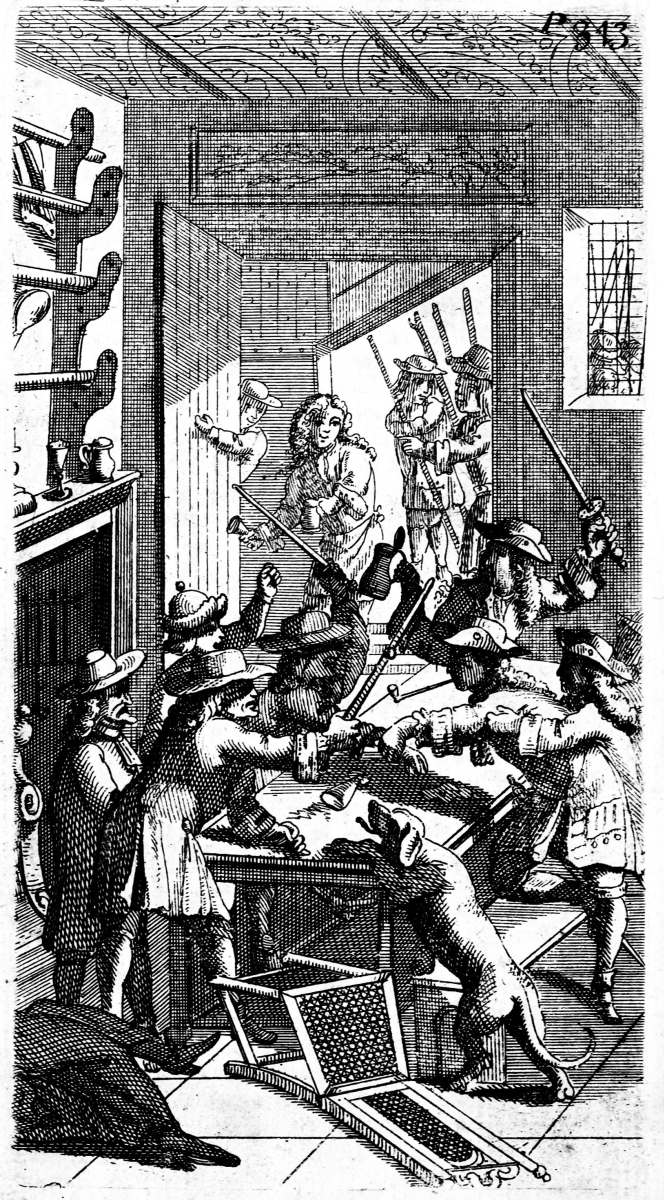
as drowsy as if I had been dry’d in an oven all night, and with that whips up the punch-bowl to his head, and drinks off the rincings of my nostrils as heartily as if it had been sherbet made on purpose for a cooler, and by the way, ever since that time has found such an alteration in his faculties, that from a very dull fellow he is become an absolute wit, to the admiration of all that knew him, tho’ I never durst tell him it was from the dripping of my brains that he deriv’d his ingenuity. But to be short in my story, when I was thoroughly awak’d, I began to have a wambling in my stomach, as if I had supp’d over night with a mountebank’s toad-eater, the chamber-pot being full, I was unwilling to defile the room, and before I was aware, let fly into my lignum-vitæ night-cap, and being then pretty well at ease, I open’d the chamber door, and stagger’d homewards; at the end of Turnstile I happen’d to make a trip at a drunkard’s enemy, a stump, and down I tumbled; who should come by before I could get up again, but the constable going his rounds, who quickly made me the centre of a circle of jack of lanthorns, and seeing me grovelling on the ground, did not know but some body had mischiev’d me, upon which they ask’d me if I was wounded? Yes said I, sadly cut. Where, where, Sir, cries the watchmen? I reply’d, about the head; they cry’d out, who did it, who did it! punch, punch, said I; one of the watchmen being a fat short fellow, they us’d to call him punch, by my soul, Sir, said he to the constable, I never saw the gentleman all the night before, and with that they haul’d me up, and perceiving their mistake, two of them, like honest fellows, handed me home to my chambers, without so much as stealing my hat, or picking my pockets, which was a wonder: I had not been many hours in bed, but comes the footman of the gentleman who entertain’d us, to my door with a challenge, for affronting him for his civility, by spewing into his punch-bowl. I sent him word I would not fail to meet him at the time and place appointed, God willing; so put on a clean shirt, and equipp’d myself for the adventure. But considering I had a man of fortitude to deal with, and one that would face any thing upon earth, except a cat, which he hated much more than he did the sight of the devil; I therefore thought policy beyond strength against such an adversary, so resolv’d to set my wits to work to prevent bloodshed, and fortunately having a cat in my chamber that had not kitten’d above a week? I took the whole progeny out of the nest, which consisted of half a dozen, puts three into one coat-pocket, and three into t’other, and away I march’d behind Southampton-wall to meet my antagonist; where I waited but a few minutes e’er he approach’d the place in a great fury; I argued the matter reasonably with him, but found nothing would atone for the affront but downright fighting, so steping a few paces back, he gave me the word and draws. I instead of applying my hands to my sword, apply’d them to my safer ammunition the kittens, and fortifies each fist with a young Mrs. Evans; I grip’d ’em hard to make ’em mew, that the onset might be the more terrible; no sooner did he set his eyes upon his little squawling adversaries, but away he scower’d, as if a legion of devils had been in pursuit of him. I after him, tossing now and then one of my hand-granadoes at him, but took care to pick them up again, lest my ammunition should be spent. Who should follow me into the fields at a distance by the scent, but the old one, in quest of her young, who by this time came up with us, and seeing her hopeful issue thus terribly abus’d, she flew about like a fury; at first he only travers’d his ground at a little distance, but when he saw the mother of the family come cocking her tail, whetting her talons, and staring worse than a dead pig, he ran outright to Totnam-Court, as if vengeance had pursued him, took sanctuary at Inman’s, since which retreat I have not yet seen him; but for self-preservation, which you know is nature’s law, I have ever since walk’d arm’d with a brace of kittens in my pocket, for fear of farther danger.
These are late testimonials of my courage, to let you see I dare yet meet any body upon the old killing spot, tho’ he be a better man than myself, and what is wanting in courage, I can supply with policy at any time: therefore consider how much you wrong me when you accuse me of idleness, since my prowess is sufficiently shewn in every days adventure.
So much for my courage, and now for a few certificates of my wit, for which the world, as well as yourself, knows I am equally famous: I happen’d the other day to be at Nando’s coffee-house in company with a person, who was exclaiming heavily against a weaver of whores hair for cheating him in a wig. Sir, said I, next time you have occasion for a new noddle-case, if you please, I’ll recommend you to the honestest perriwig maker in Christendom; I bought this wig on my head of him, it cost me but fifteen shillings, and I have wore it de die in diem these nine years and upwards, and you see it’s not yet dwindled into scandalous circumstances; and, Sir, if you please I’ll tell you for what reason he can afford better penny-worths than the rest of the trade; in the first place, you must know he dwells at Chelmsford in Essex, and the country you are sensible admits of cheap living; in the next place, he has nineteen daughters in his family, all bred up to his own trade, who being kept unmarried, that their radical moisture should by no means be exhausted, their own hair grows so prodigiously fast that it keeps them all employ’d from the first day of January, to the last of December, setting aside holy-days; once in four years he mows the family round, never failing of a very plentiful crop; much about this time I reckon his harvest is ripe, and all the neighbouring gentlemen are flocking in to bespeak their perriwigs; some are fair girls, some brown, some black, so that he can mix up a colour to suit any complexion. And is this true, Sir, says the young priest? true, Sir, said I, I hope you don’t think me so little of a christian to impose upon a scholar, a gentleman of your function: ’tis so true, Sir, that it brings a great trade to the town, and every body knows that Essex, for Chelmsford wigs, and Rumford calves, out-does all the counties in England. Say you so, says the Levite, I am come up to town about a little business that will require my attendance about a fortnight, and having a horse that has nothing else to do, I’ll e’en make a journey thither to morrow, and try if I can chaffer. Sir, said I, there is not such hair in the kingdom of England, as in his family, for they are all virtuous girls, and that makes their hair the stronger; besides, all the clergy round him are his customers, because he makes up his wigs without any mixture of whores hair; for as contagious fumes we are sensible will corrupt the body, who knows but the effluvias emitted from the locks of a polluted woman, hanging so near the noftrils may be suck’d in, to the strengthning of loose inclinations, and may beget an appetite to fornication, too rebellious and powerful for reason to curb into an orderly subjection. Well, says the young doctor, I’ll have one of the wigs to carry into the country with me and please the pigs; at Chelmsford you say? yes, Sir, at Chelmsford said I, the least child in in the town knows him; ask but for the Barber and his nineteen daughters, and you cannot miss of him.
Having thus laid the scene, I took my leave, and adjourn’d about the business of the day, and coming from Montague’s shop three or four days afterwards, I stepp’d into the same coffee-house, where I happen’d to meet with the spiritual pastor just coming to town, who had been erring and straying like a lost sheep in quest of Tonsor in nubibus. As soon as ever he set eyes upon me, he attack’d me tooth and nail, with as much fury as if I had been brother to the Whore of Baylon, and told me I was some Papist, or otherwise a Fanatick, or else I would have had more religion in me, than to have made a fool of a man of his function, for that he had taken a journey on purpose to Chelmsford, and could find no such barber. Pray, Sir, said I, don’t be so angry, for since I never gave ear to your preaching, why should you listen to my prating? and since you make fools of a whole parish every sunday, how can you be so angry with a man to make a fool of you once in his life time? so turn’d my back, and left the whole company to laugh at him.
You must know I love dearly to put a jest upon a priest, because it was always my opinion, they put more jests upon the world than any people; besides, any body may put a trick upon a block-head, but that conduces but little to a man’s reputation. I love to put my jokes upon men of parts, that the world may see I can bite the biter; nothing carries the burthen of another man’s wit with a greater grace, than a sacerdotal dromedary; therefore to let you see the wonderful regard I bear to religion, I have one story, or piece of wit more to entertain you with, that I hope may further divert you.
I chanc’d to be in company with a parcel of grave sermon-hunters, and among a long catalogue of reverend orators, whose name should bring up the rear of the eminent Black-List, but my honest neighbour the dean’s? I took not their flattery for my example, but gave my tongue the liberty to speak as I thought, and said, he was a learned blockhead; some of my good friends had the civility to report my saying to him. Upon which, he sent the reader of the parish to admonish me, who came one morning very solemnly to my chamber, and took upon him to tell me how dishonourably and unchristian-like I had done, in aspersing the doctor with the calumny of being a learned blockhead. Truly, Sir, said I, I am sorry I should be so unmannerly to express my sentiments so freely: but however, since it is done and can’t be help’d, I desire you will go back and tell him it’s more than I can say by you, for thou art a blockhead without any learning at all, and a fit man to be sent upon such errands. Upon this answer he lugg’d his hat over his eyes, and ran away as sullen and as silent as the devil pinch’d by the nose did from St. Dunstan, when the old gentleman had loosen’d his barnacles.
Now for a piece of my poetry to let you see my talent is universal, and then I believe I shall have quitted scores with you. In a hot sunshine day this summer, when the sun was climb’d to his meridian heighth, and the progeny of every cow-turd had taken wing, and were buzzing about streets in search of cooks shops, sugarbakers, and grocers, that a man cou’d not walk London-streets without having his nose persecuted by gnats, wasps or blue-bottles, my stomach, which is generally as forward without sustenance at that hour, as a hungry sucking child without the bubby, would not let me be at rest till I had purchased its pacification at the expence of nine-pence; in order to gratify the cormorant, I stepp’d into a cook’s shop where a six-penny slice of veal was brought me, so garnish’d with fly-blows, that there lay a whole covey of the little embroys upon every morsel, that I had more picking work than a surgeon has with a patient whose buttocks are pepper’d with small shot, which put me in such a poetick fury, by that time I had half swallowed up my noonings, that I pluck’d out my pen and ink, and whilst my fancy was warm writ a satire against Fly-Blows, wherein perhaps you may find as much wit and ill nature mix’d artfully together as you may in that incomparable satire, The True-born Englishman; so pray read and judge favourably.
A Satire against Fly-Blows. By Mr. W——
YE worst of vermin that our isle affords, Spawn of curs’d flies, engender’d first in t—rds Ye nitty off-spring of a winged plague, That swarms in mutton from the rump to th’ craig: Tormentors of our cooks, all England’s foes, From rural gluttons, to our London beaus. In ev’ry cloven joint thy mother’s blow, Where if not crush’d, you will to maggots grow, Raise your black heads, and crawl about our food, And poison what was eatable and good; Pollute that flesh which should our lives maintain, To dogs condemn what was design’d for man. Ye eggs of mischief that in clusters dwell, Hateful to the eyes and nauseous to the smell, Ill omens of a worse succeeding harm, That makes good housewives blush, the husbands storm. For thee the faultless cook-maid bears the blame, More salt, you slattern, crys the angry dame, And then the falchion-ladle goes to work: I’ll teach you, jade, to salt the beef and pork. May showers of brine each powdering-tub o’erflow, Pepper and salt in every orchard grow; Then may each hand to seas’ning be employ’d, That thy curs’d race may be at once destroy’d.
I’ll assure you, Captain, these verses are highly in esteem among all dealers in flesh, I have had many a dinner for a copy of them, to be put into a gilt frame, and hung up in a cook’s shop to give people a concocting laugh after dinner, that their victuals mayn’t lie heavy upon their stomachs. By this time I believe I have pretty well tir’d your patience, so think it full time to conclude myself,
Your Humble Servant, W——