Part I.
Reading edition
A Letter of News from Mr. Joseph Haines, of Merry Memory, to his Friends at Will’s Coffee-House in Covent-Garden. By Mr. Tho. Brown.
Gentlemen,
I Had done myself the honour to write to you long ago, but wanted a convenience of sending my letter; for you must not imagine ’tis as easy a matter for us on this side the river Styx, to maintain a correspondence with you in the upper world, as ’tis to send a pacquet from London to Rotterdam, or from Paris to Madrid: But upon the news of a fresh war ready to break out in your part of the world, (which, by the by, makes us keep holy-day here in hell) Pluto having thought fit to dispatch an extraordinary messenger to see how your parliament, upon whose resolutions the fate of Europe seems wholly to depend, will behave themselves in this critical conjuncture. I tipp’d the fellow a George to carry this letter for me, and leave it with the master at Will’s in his way to Westminster.
I am not insensible, gentlemen, that Homer, Virgil, Dante, Don Quevedo, and many more before me, have given an account of these subterranean dominions, for which reason it may look like affectation or vanity in me to meddle with a subject so often handled; but if new travels into Italy, Spain and Germany, are daily read with approbation, because new matters of enquiry and observation perpetually arise, I don’t see why the present state of the Plutonian kingdoms may not be acceptable, there having been as great changes and alterations in these infernal regions, as in any other part of the universe whatever.
When I shook hands with your upper hemisphere, I stumbled into a dark, uncouth, dismal lane, which, if it be lawful to compare great things with small, somewhat resembles that dusky dark cut under the mountains called the grotto of Puzzoli in the way to Naples. I was in so great a consternation, that I don’t remember exactly how long it was, but this I remember full well, that there were a world of ditches on both sides of the wall, adorned and furnished with harpies, gorgons, centaurs, chimeras, and such like pretty curiosities, which could not but give a man a world of titillation as he traveled on the road. The three-headed Gerion, put me in mind of the master of the Temple’s three intellectual minds, and when I saw Briares with his hundred arms and hands, out of my zeal to king William and his government, I could not but wish that we had so well qualify’d a person for secretary of state ever since the Revolution; for having so many heads and hands to employ, he might easily have managed all affairs domestick and foreign, and been both dictator and clerk to himself. Which besides the advantage of keeping secret all orders and instructions, (and that you know, gentlemen, is of no small importance in politicks) would have saved his majesty no inconsiderable sum in his civil list.
Being arrived at the end of this doleful and execrable lane, I came into a large open, barren plain, thro’ which ran a river, whose water was as black as my hat: Coming to the banks of this wonderful river, an old ill-look’d wrinkl’d fellow in a tatter’d boat, which did not seem to be worth a groat, making towards the shoar, beckon’d, and held out his right-hand to me: Knowing nothing of his business or character, I could not imagine what he meant by doing so; but upon second thoughts, thinking he had a mind to have his fortune told, You must understand, old gentleman, says I to him, that there are three principal lines in a man’s hand, the first of which is called by the learned Ludovicus Vives, Secretary to Tamerlain the magnificent, the linea boetica, line of life; the second, the linea hepatica, or liver line; the third and last, the linea intercalaris, so call’d by Sebastian Munster and Erra Pater, because it crosses the two aforesaid lines in an equicrural parabola. Hold your impertinent stuff, says the old ferryman, erra me no erra paters, but speak to the point, and give me my fare, if you design to come over. By this I perceiv’d my mistake, and knew him to be Charon: So I dived into my pockets, but alas! I found all the birds were flown, if ever any had been there, which you may believe, gentlemen, was no small mortification to me. Get you gone for a rascally scoundrel as you are, says Charon, some son of whore of a fiddler, or player, I warrant you; go and take up your quarters with those pennyless rogues that are sunning themselves on yonder hillock. To see now how a man may be mistaken by a fair outside! when I came up to ’em, I found them a parcel of jolly well-look’d fellows, who, one would have thought were wealthy enough to have fined for sheriffs: I counted, let me see, six princes of the empire that were younger brothers, ten French counts, fourteen knights of Malta, twelve Welsh gentlemen, sixteen Scotch lairds, with abundance of chymists, projectors, insurers, noblemens creditors, and the like; that were all wind-bound for want of the ready rhino. Two days we continued in this doleful condition; and as Dr. Sherlock says of himself, in relation to the 13th chapter of the Romans, here I stuck, and had stuck till the last conflagration, if it had not been for bishop Overall’s Convocation-Book; e’en so here we might have tarry’d world without end, if an honest teller of the Exchequer, and a clerk of the pay-office, had not come to our relief; who understanding our case, cry’d out, Come along, gentlemen, we have money enough to defray twenty such trifles as this; God be prais’d, we had the good luck to die before the parliament looked into our accounts. With that they gave Charon a broad-piece each of ’em, so our whole caravan consisting of about 70 persons in all, that had not a farthing in the world to bless themselves, ferry’d over to the other side of the river.
As we were crossing the stream, Charon told us how an Irish captain would have trick’d him. He came strutting down to the river-side, says he, as fine as a prince, in a long scarlet cloak, all bedaub’d with silver lace, but had not a penny about him. Dear joy, crys he to me, I came away in a little haste from the other world, and left my breeches behind me, but I’ll make thee amends by Chreest and St. Patrick, for I’ll refresh thy antient nostrils with some of Hippolito’s best snuff, which cost me a week ago, a crown an ounce. I told the Hibernian, that old birds were not to be taken with chaff, nor Charon to be banter’d out of his due with a little dust of sot-weed; and giving him a reprimand with my stretcher over the noddle, bid him go, like a coxcomb as he was, about his business. The wretch santer’d about the banks for a month, but at last, pretended to be a Frenchman, got over gratis this summer, among the duke of Orlean’s retinue. But what was the most surprizing piece of news I ever heard, Charon assured us, upon his veracity, that the late king of Spain was forc’d to lie by full a fortnight, for want of money to carry him over; for cardinal Portocarero had been so busy in forging his will, that he had forgot to leave the poor monarch a farthing in his pocket; and that at last, one of his own grandees, coming by that way, was so complaisant as to defray his prince’s passage; and well he might, says our surly ferryman, for in five years time he had cheated him of two millions.
We were no sooner landed on the other side of the river, but some of us fil’d off to the right, and others to the left, as their business called them: For my part, I made the best of my way to the famous city Brandinopolis, seated upon the river Phlegethon, as being a place of the greatest commerce and resort in all king Pluto’s dominions. Who should I meet upon the road but my old friend said acquaintance Mr. Nokes, the comedian, who received me with all imaginable love and affection? Mr. Haines, says he, I am glad with all my heart to see you in Hell; upon my salvation, we have expected you here this great while, and I question not but our royal master will give you a reception befitting a person of your extraordinary merit. Mr. Nokes, said I, Your most obedient servant, you are pleas’d to compliment, but I know no other merit I have, but that of being honour’d with your friendship. But my dear Jo., cries he, how go affairs in Covent-Garden? Does cuckoldom flourish, and fornication maintain its ground still against the reformers? And the play-house in Drury-Lane, is it as much frequented as it us’d to be? I had no sooner given him a satisfactory answer to these questions, but we found ourselves in the suburbs; so my friend Nokes, with that gaity and openness, which became him so well at the play-house, Jo., says he, I’ll give thee thy welcome to Hell; with that he carry’d me to a little blind coffee-house, in the middle of a dirty alley, but certainly one of the worst furnish’d tenements I ever beheld: there was nothing to be seen but a few broken pipes, two or three founder’d chairs, and bare naked walls, with not so much as a superannuated almanack, or tatter’d ballad to keep ’em in countenance; so that I could not but fancy myself in some of love’s little tabernacles about Wildstreet, or Drury-Lane. Come, Mr. Haines, and what are you disposed to drink? What you please, Sir. Here, madam, give the gentleman a glass of Geneva. As soon as I had whipp’d it down, my friend Nokes plucking me by the sleeve, and whispering me in the ear, prithee Jo., who dost think that lady at the bar is? I consider’d her very attentively, by the same token she was three times as ugly as my lady Frightall, countess of —— and three times as thick and bulky as Mrs. Pix the poetress, and very fairly told him, I knew her not. Why then I shall surprize you. This is the famous Semiramis. The Devil she is! answer’d I: What is this the celebrated and renowned queen of Babylon, she that built those stupendious walls and pensile gardens, of which antient historians tell us so many miracles; that victorious heroine, who eclipsed the triumphs of her illustrious husband; that added Æthiopia to her empire; and was the wonder as well as the ornament of her sex? Is it possible she should fall so low as to be forced to sell Geneva, and such ungodly liquors for a subsistence? ’Tis e’en so, says Mr. Nokes, and this may serve as a lesson of instruction to you, that when once death has laid his icy paws upon us, all other distinctions of fortune and quality immediately vanish. These words were no sooner out of his mouth, but in came a formal old gentleman, and plucking a large wooden box from under his cloak, Will you have any fine snuff, gentlemen, here is the finest snuff in the universe, gentlemen; a never failing remedy, gentlemen, against the megrims and head-ach. And who do you take this worthy person to be? says Mr. Nokes, But that I am in this lower world, cry’d I, I durst swear ’tis the very individual quaker that sells his herb-snuff at the Rainbow coffee-house. Damnably mistaken, says Mr. Nokes, before George, no less a man than the great Cyrus, the first founder of the Persian monarchy. I was going to bless myself at this discovery, when a jolly red-nos’d woman in a straw-hat popt into the room, and in a shrill treble cry’d out, Any buckles, combs or scissars, gentlemen, and tooth-picks, bottle-screws or twizers, silver buttons or tobacco-stoppers, gentlemen; well now, my worthy friend, Mr. Haines, who do you think this to be? The Lord knows, reply’d I, for here are such an unaccountable choppings and changings among you that the Devil can’t tell what to make of ’em. Why then, in short, this is the virtuous Thalestris, Queen of the Amazons, the same numerical princess, that beat the hoof so many hundred leagues to get Alexander the Great to administer his royal nipple to her. But Jo. since I find thee so affected at these alterations that have happen’d to persons who lived so many hundred years ago, I am resolv’d to shew thee some of a more modern date, and particularly of such as either thou wast acquainted with in the other world, or at lead hast often heard mention’d in company. So calling for the other glass of Geneva, he left a tester at the bar, and Semiramis, to shew her courtly breeding, dropp’d us abundance of curtesies, and paid us as much respect at our coming out, as your two-penny French barbers in Soho do to a gentleman that gives them a brace of odd half-pence above the original contract in their sign.
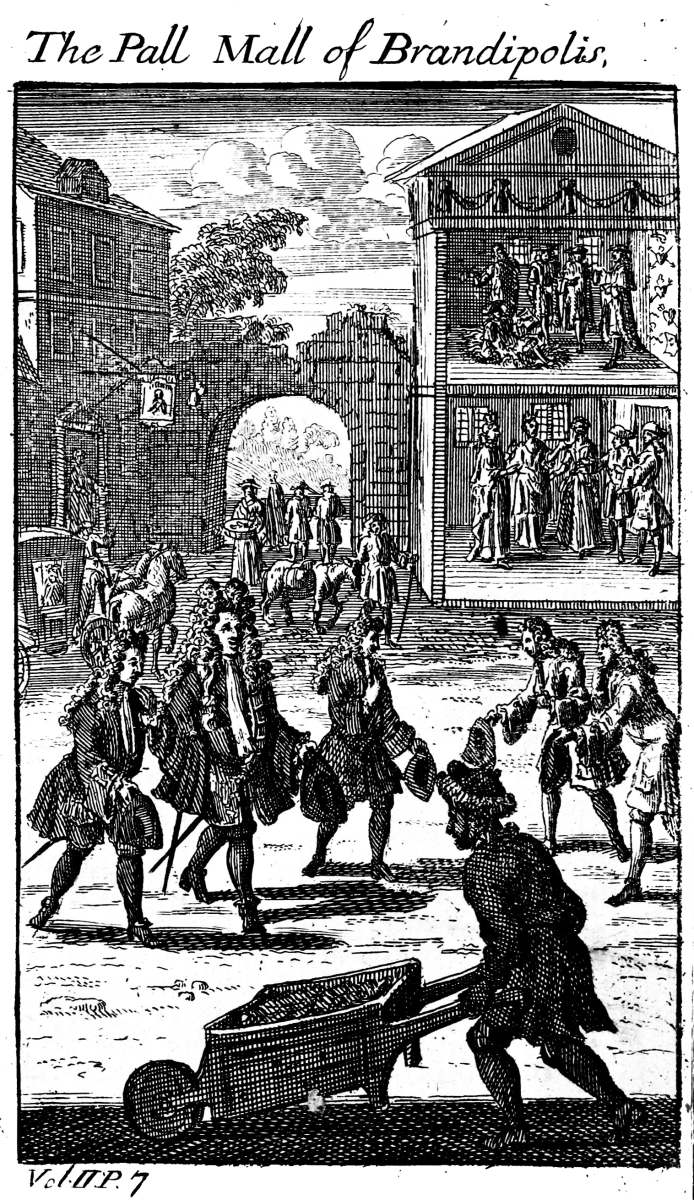
We walk’d thro’ half a dozen streets without meeting any thing worthy of observation. At last my friend Nokes, pointed to a little edifice, which exactly resembles Dr. Burgess’s conventicle in Russel-Court; says he, your old acquaintance Tony Lee, who turn’d presbyterian parson, upon his coming into these quarters, holds forth most notably here every Sunday; Jacob Hall and Jevon are his clerks, and chant it admirably. Mother Stratford, the duchess of Mazarine, my lord Warwick, and Sir Fleetwood, are his constant hearers; and to Tony’s everlasting honour be it spoken, he delivers his fire and brimstone with so good a grace, splits his text so judiciously, turns up the whites of his eyes so theologically, cuffs his cushion so orthodoxly, and twirls his band-strings so primitively, that Pluto has lately made him one of his chaplains in ordinary. From this we crossed another street, which one may properly enough call the Bow-street, or Pall-Mall of Brandinopolis. No sawcy tradesman or mechanick dares presume to live here, but ’tis wholly inhabited by fine gaudy fluttering sparks, and fine airy ladies; who in no respect are inferior to yours in Covent-Garden. When the sky is serene, and not a breath of wind stirring, you may see whole covies of them displaying their finery in the street; but at other times you never see ’em our of a chair, for fear of discomposing their commodes or periwigs. We had not gone twenty paces, before we met three flaming beaux of the first magnitude, the like of whom we never saw at the Vourthoot at the Hague, the Tuilleries at Paris, or the Mall in St. James’s-park. They were all three in black (for you must know we are in deep mourning here for the death of my lady Proserpine’s favourite monkey) but he in the middle, tho’ he had neither face nor shape to qualify him for a gallant: for he had a phyz as forbidden as beau Whitaker, and was as thick about the waste, as the fat squab porter at the Griffin-tavern in Fuller’s-Rents, yet he made a most magnificent figure: His periwig was large enough to have loaded a camel, and he had, bestowed upon it at least a bushel of powder, I warrant you. His sword-knot dangled upon the ground, and his steenkirk that was most agreeably discolour’d with snuff from top to bottom, reach’d down to his waste; he carry’d his hat under his left-arm, walk’d with both his hands in the wastband of his breeches, and his cane that hung negligently down in a string from his right-arm, trail’d most harmoniously against the pebbles, while the master of it, tripping it nicely upon his toes, was humming to himself,
Oh, ye happy happy groves, Witness of our tender loves.
Having given you this description of him, I need not trouble myself to enlarge upon the dress of his two companions, who, tho’ they fell much short of his inimitable original in point of garniture and dress, yet they were singular enough to have drawn the eyes of men, women and children after ’em in any part of Europe. As I observed this sight with a great deal of admiration, Mr. Nokes very gravely asked me, who I took the middlemost person to be; upon my telling him I had never seen him before, nor knew a syllable of him or his private history; why, says Mr. Nokes, this is Diogenes the famous cynic philosopher, and his two companions are George Fox and James Naylor the quakers. Diogenes, reply’d I to him, why he was one of the arrantest slovens in all Greece, and a profess’d enemy to laundresses, for he never parted with his shirt, ’till his shirt parted with him. No matter for that, says Mr. Nokes, the case is alter’d now with him, for he has the vanity and affectation of twenty Sir Courtly Nice’s blended together; he constantly dispatches a courier to Lisbon every month, to bring him a cargo of Limons to wash his hands with; he sends to Montpelier for Hungary-water; Turin furnishes him with Rosa Solis; Nismes with Eau de Conelle, and Paris with Ratifia to settle his maw in the morning. Nothing will go down with him but Ortolans, Snipes, and Woodcocks; and Matson, that some years ago liv’d at the Rummer in Queen-street, is the administrator of his kitchen. This, said I to him, is the most phantastick change I have seen since my passing the Styx: for who the plague wou’d have believ’d that that antient quaker Diogenes, and those modern cynicks, Fox and Naylor, should degenerate so much from their primitive institution, as to set up for fops? When we came up to ’em, Diogenes gave us a most gracious bow, but those two everlasting complimenters, his friends, I was afraid wou’d have murder’d me with their civilities; for which reason I disingaged myself from ’em something abruptly, by the same token I overheard James Naylor call me bougre insulare and tramontane, for my ill manners.
When the coast was clear of ’em, says I to my Nokes, every thing is so turned topsy-turvy here with you, that I can hardly resolve myself whether I walk upon my head or my feet: right, Mr. Haines, says he, but time is precious; so let’s mend our pace if you please, that we may see all the curiosities of this renowned city before ’tis dark.
The next street we came into, we saw a tall thin-gutted mortal driving a wheel-barrow of pears before him, and crying in a hoarse tone, pears twenty a penny; looking him earnestly in the face, I presently knew him to be beau Heveiningham, but I found he was shy, and so took no further notice of him. Not ten doors from hence, says Mr. Nokes, lives poor Norton, that shot himself. I ask’d him in what quality, he answered me, as a sub-operator to a disperser of darkness, anglicè, a journeyman to a tallow-chandler. I would willingly have made him a short visit, but was intercepted in my design by a brace of fellows that were link’d to their good behaviour, like a pair of Spanish galley-slaves; tho’ they agreed as little as Jowler and Ringwood coupled together, for one of ’em lugg’d one away, and his brother the other. I soon knew them to be Dick Baldwin, the whig-bookseller, and Mason the non-swearing parson, whom, as I was afterwards informed, judge Minos, had order’d to be yoak’d thus, to be a mutual plague and punishment to one another. Both of ’em made up to us as hard as they could drive. Well, Sir, says the Levite, what comfortable news do you bring from St. Germains? Our old friend Lewis le Grand is well I hope. Damn Lewis le Grand, and all his adherents, cries Dick Baldwin. Pray Sir, what racy touches of scandal have been publish’d of late, by my worthy friends, Sam. Johnson, Mr. Tutchin, and honest Mr. Atwood; and the gallows that groan’d so long for Robin Hog the messenger, when is it like to lose its longing? Have no fresh batteries attack’d the court lately from honest Mr. Darby’s in Bartholomew-Close? And prithee what new piracies from the quakers at the Pump in Little-Britain? What new whales, devils, ghosts, murders; from Wilkins in the Fryars? But above all, dear Sir, of what kidney are the present sheriffs; and particularly my lord-mayor, how stands he affected? Why Dick, says I to him, fearing to be stunn’d with more interrogatories, tho’ most of the folks I have seen here are changed either for the better or the worse, yet I find thou art the true, primitive, busy, pragmatical, prating, muttering Dick Baldwin still, and will be so to the end of the chapter. In the name of the three furies, what should make thee trouble thyself about sheriffs and lord-mayor? But thou art of the same foolish belief, I find, with thy brother coxcombs at North’s coffee-house, who think all the fate of christendom depends upon the choice of a lord-mayor; whereas to talk of things familiarly, and as we ought to do, what is this two-legg’d animal ycleped a lord-mayor, but a certain temporary machine of the city’s setting up, who on certain appointed days is oblig’d to ride on horse-back to please the Cheapside wives, who must scuffle his way thro’ so many furlongs of custard, who is only terrible to delinquent-bakers, oyster-women, and scavengers; and has no other privilege above his brethren, as I know of, but that of taking a comfortable nap in his gold chain at Paul’s or Salter’s-Hall; to either of which places his conscience, that is, his interest, carries him. Surly Dick was going to say something in defence of the city magistrate, but my brother Nokes and I prevented him, by calling to the next hackney coachman, whom, to my great surprise, I found to be the famous Dr. Busby of Westminster-school; who now, instead of flogging boys, was content to act in an humbler sphere, and exercise his lashing talent upon horses. We ordered him to set us down at Bedlam, where my friend Nokes assured me we should find diversion enough, and the first person we met with in this celebrated mansion, was the famous queen Dido of Carthage, supported by the ingenious Mrs. Behn on the one side, and the learned Christiana, queen of Sweden, on the other. Gentlemen, cry’d she, I conjure you, by that respect which is due to truth, and by that complaisance which is owing to us of the fair sex, to believe none of those idle lies that Virgil hath told of me. That impudent versifyer has given out, that I murder’d myself for the sake of his pious Trojan, the hero of his romance; whereas I declare to you, gentlemen, as I hope to be sav’d, that I never saw the face of that fugitive scoundrel in my life, but dy’d in my bed with as much decency and resignation as any woman in the parish: but what touches my honour most of all, is that most horrid calumny of my being all alone with Æneas in the cave. Upon this I humbly remonstrated to her majesty, that altho’ Virgil had taken the liberty to leave her and his pious Trojan in a grotto together, yet he no where insinuated that any thing criminal had passed between ’em. How, says Mr. Behn, in a fury, was it not scandal enough in all conscience, to say that a man and a woman were in a dark blind cavern by themselves? What tho’ there was no such convenience as a bed or a couch in the room; nay, not so much as a broken-back’d chair, yet I desire you to tell me, sweet Mr. Haines, what other business can a man and a woman have in the dark together, but——. Ay, cries the queen of Sweden, what other business can a man and a woman have in the dark, but, as the fellow says in the Moor of Venice, to make the beast with two backs? not to pick straws I hope, or to tell tales of a tub. Under favour, ladies, reply’d I, ’tis impossible I should think, for a grave sober man, and a woman of discretion, to pass a few hours alone, without carrying matters so far home as you insinuate. What in the dark? cries queen Dido, that’s mine a —— in a band-box. Let peoples inclinations be never so modest and virtuous, yet this cursed darkness puts the devil and all of wickedness into their heads: the man will be pushing on his side, that’s certain; and as for the woman, I’ll swear for her, that when no body can see her blush, she will be consenting. In fine, tho’ the soul be never so well fortify’d to hold out a siege, yet the body, as soon as love’s artillery begins to play upon it, it will soon beat a parley, and make a separate treaty for itself.
Thus her Punick majesty ran on, and the Lord knows when her royal clack would have done striking, if a female messenger had not come to her in the nick of time, and whisper’d her in the ear, to go to the famous Lucretia’s crying-out, who, it seems, was got with child upon a hay-cock, by Æsop the fabulist. As soon as queen Dido and her two prattling companions were gone out of the room, Mr. Nokes, says I, you have without question seen Æsop very often, therefore pray let me beg the favour of you, to tell me whether he is such a deformed ill-favoured wight, as the historians represent him; for you must know we have a modern critick of singular humanity, near St. James’s, that has been pleased, in some late dissertation upon Phalaris’s epistles, to maintain that he was a well-shap’d, handsome gentleman; and for a proof of this, insists much upon Æsop’s intriguing with his fellow-slave, the beautiful Rhodope. No, no, replies Mr. Nokes, Æsop is just such a crumpled hump-shoulder’d dog, for all the world, as you see him before Ogilby’s translation of his fables; and let the above-mentioned grammarian, I think they call him, Dr. Bentivolio, say what he will to the contrary, ’tis even so as I tell you. And now, we are upon the chapter of Dr. Bentivolio; about a month ago I happen’d to make merry over a bowl of punch with Phalaris the Sicilian tyrant, who swore by all that was good and sacred, that he would trounce the unmannerly slave for robbing him of those epistles, which have gone unquestion’d under his name for so many ages: but the time is coming, said he, when I shall make this impudent pedant cry peccavi for the unworthy treatment he has given me: I have my brazen-bull, heaven be prais’d, ready for him, and as soon as he comes into these quarters, will shut him up in it, and roast him with his own dull volumes, and those of his dearly beloved friends the Dutch commentators.
By this time we were got to the upper end of the room, when, says Mr. Nokes to me, I will shew you a most surprising sight. You must know this place, like Noah’s ark, contains beasts of all sorts and sizes; some have their brains turn’d by politicks, who, except some three or four that are suffer’d to go abroad with a keeper, are lock’d up in a large apartment up stairs. These puppies rave eternally about liberty and property, and the jura populi, and are so damn’d mischievous, that it is dangerous to venture near them. England sends more of this sort to Bedlam, than all the countries of Europe besides. Others again have their intellects fly-blown by love, by the same token that most of the poor wretches that are in this doleful predicament come out of France, Spain, Italy, and such hot climates. Now and then, indeed, we have a silly apprentice or so, takes a leap from London-Bridge into the Thames, or decently hangs himself in a garret, in his mistress’s garters, but these accidents happen but seldom; and besides, since fornication has made so great a progress among us, love is observed not to operate so powerfully in England as it formerly did, when there was no relief against him but matrimony. Some again have their pia mater addled by their religion, but neither are the sots of this species so numerous in Britain, or elsewhere, as they were in the days of yore; for the priests of most religions have play’d their game so aukwardly, that not one man in a thousand will trust them with shuffling of the cards.
But of all the various sorts of mad-men that come hither, the rhimers or versifyers far exceed the rest in number: most of these fellows in the other world were mayors, or aldermen, or deputies of wards, that knew nothing but the rising and falling of stocks, squeezing young heirs, and cheating their customers: but now the tables are turn’d, for they eat and drink, nay, sleep and dream in rhime, and have a distich to discharge at you upon every occasion. With that he open’d the wicket of the uppermost door, and bid me peep in. ’Tis impossible to describe to you the surprize I was in, to see so many of my city acquaintance there, whom I should sooner have suspected of burglary or sacrilege, than of tacking a pair of rhimes together: but it seems this is a judgment upon these wretches, for the aversion they have to the muses when they are living. The walls were lined with verses from top to bottom, and happy was the wretch that could get a bit of charcoal to express the happiness of his fancy upon the poor plaister. The first man I saw was Sir John Peak, formerly lord-mayor of London, who bluntly came up to the door, and asked me what was rhime to Crambo? Immediately Sir Thomas Pilkington popp’d over his shoulder, and pray friend, says he, for I perceive you are newly come from the other world, how go the affairs of Parnassus? What new madrigals, epithilamiums, sonnets, epigrams, and satires, have you brought with you? What pretty conceits had Mr. Settle in his last London triumphs? What plays have taken of late? Mrs. Bracegirdle, doth she live still unmarried? And pray, Sir, how doth Mr. Betterton’s lungs hold out? But now I think on’t, I have a delicious copy of verses to shew you, upon the divine Melesinda’s frying of pancakes, only stay a minute, while I step yonder to fetch ’em: he had no sooner turn’d his back, but I pluck’d too the wicket, and gave him the slip; for certainly of all the plagues in hell, or t’other side of it, nothing comes up to that of a confounded repeater. Leaving these versifying insects to themselves, we walked up a pair of stairs into the upper room, one end of which was the quarter for distracted lovers, as the other was for the lunatick republicans. I just cast my eyes into Cupid’s Bear-Garden, and observed that the walls were all adorned with mysterious hieroglyphicks of love, as hearts transfixed, and abundance of odd-fashion’d battering rams, such as young lovers use to trace upon the cieling of a coffee-house with the smoke of a candle. Some half a score of ’em were making to the door, but having seen enough of these impertinents in the other world, I had no great inclination to suffer a new persecution from ’em in this. So my friend and I turn’d up to the apartment where the republicans were lock’d up, who made such a hurricane and noise, as if a legion of devils had been broke loose among them. Harrington, I remember, was the most unruly of the whole pack. Thanks to my friends in London, says he, I hear my Oceana is lately reprinted, and furbish’d with a new dedication to those judicious and worthy gentlemen, my lord-mayor and court of aldermen, by Mr. Toland. You need not value yourself so much upon that, says Algernoon Sidney, for my works were published there long before yours. And so were mine, cries Milton, at the expence of some worthy patriots, that were not afraid to publish them under a monarchical government. But what think you of my memoirs, cries Ludlow, for if you talk of histories, there’s a history for you, which, for sincerity and truth, never saw its fellow since the creation. Upon this the uproar began afresh, so thinking it high time to withdraw, I jogg’d my friend Nokes by the elbow, and as we went down stairs told him, that Pluto was certainly in the right on’t, to lock up these hot-headed mutineers by themselves, allow them neither pen, ink, fire, nor candle; for should he give them leave to propagate their seditious doctrines, he would only find himself king of Erebus, at the courtesy of his loving subjects.
Just as we were going out of this famous edifice; I have an odd piece of news to tell you, says Mr. Nokes, which is, that altho’ we have men of all countries, more or less here, yet there never was one Irishman in it. How comes that about, I beseech you? said I to him. Why, replies he, madness always supposes a loss of reason; but the duce is in’t if a man can lose that which he never possess’d in his life. Oh your humble servant, answer’d I, ’tis well none of our swaggering Dear Joys in Covent-Garden hear you talk so, for if they did, ten to one but they would cut your throat for this reflection upon the intellects of their country, and send you to the Devil for the honour of St. Patrick.
When we came out into the open air again, and had taken half a dozen turns in the neighbouring fields, Mr. Nokes, says I, ’tis my misfortune to come in this place without a farthing of money in my pocket, and Alecto confound me, if I know what course to take for my maintenance, therefore I would desire you to put me in a way. Have no care for that, says Mr. Nokes, his infernal majesty is very kind and obliging to us players, and because we act so many different parts in the other world, as kings, princes, bishops, privy-counsellors, beaux, cits, sailors, and the like, gives us leave to fellow what profession we have most a fancy to. For my part, I keep a nicknackatory, or toy-shop, as I formerly did over against the Exchange, and turn a sweet penny by it, for our gallants here throw away their money after a furious rate. Now Jo. I think thou can’st not do better than to set up for a High-German fortune-teller; thou knowest all the cant and roguery of that practice to perfection, and besides, has the best phiz in the world to carry on such an affair. As for money to furnish thee an house, and set up a convenient equipage, to buy thee a pair of globes, a magick looking-glass, and all other accoutrements of that nature, thou shalt command as much as thou hast occasion for. I was going to thank my friend for so courteous an offer, when who should pop upon us on the sudden, but his Polish majesty’s physician in ordinary, the late famous Dr. Conner of Bowstreet, but in so wretched a pickle, so tatter’d a condition, that I could hardly know him. How comes this about, noble doctor, said I to him, what is fortune unkind, and do the planets frown upon merit? I remember you were going to set up your coach, and marry the widow Bently in Russel-street, just before your last distemper hurry’d you out of the world. Is it possible the learned author of Evangelium Medici should want bread? or, doctor, did you leave all your Hibernian confidence behind you! I thought a true Irishman could have made his fortune in any part of the universe.
Ille nihil, nec me quærentem vana moratur; Sed graviter gemitus imo de pectore ducens.
Mr. Haines, says he, Pluto, to say no worse of him, is very ungrateful to the gentlemen of our faculty; and were he not a crown’d head, I would not stick to call him a Poltroon. I am sure no body of men cultivate his interest with more industry and success, than we physicians. What would his dominions be but a bare wilderness and solitude, if we did not daily take care to stock them with fresh colonies? This I can say for myself, that I did not let him lose one patient that fell into my hands; nay, rather than he should want customers, I practised upon myself. But after the received maxim of most princes, I find he loves the treason, and hates the traytor; so that no people are put to harder shifts in hell, than the sons of Galen. Would you believe it, Mr. Haines, the immortal Dr. Willis is content to be a flayer of dead horses; the famous Harvey is turn’d higgler, and you may see him ride every morning to market upon a pannier of eggs; Mayern is glad to be pimp to noblemen’s valets de chambre; old Glisson sells vinegar upon a lean scraggy tit; Moreton is return’d to his occupation, and preaches in a little conventicle you can hardly swing a cat round in; Lower sells penny prayer-books all the week, and curls an Amen in a meeting-house on sundays; Needham, in conjunction with Capt. Dawson, is bully to a Bordello; and the celebrated Sydenham empties close-stools. As for myself, I am sometimes a small retainer to a billiard-table; and sometimes, when the matter on’t is sick, earn a penny by a whimsy-board. I lie with a link-man upon a flock-bed in a garret, and have not seen a clean shirt upon my back since I came into this cursed country. By my troth, said I, I am sorry to hear matters go so scurvily with you; but pluck up a good heart, for when the times are at worst they must certainly mend. But, pray doctor, before you go any farther, satisfy me what church you dy’d a member of, for we had the devil and all to do about you when you were gone. The parson of St. Giles’s stood out stifly that you dy’d a sound Protestant, but all your countrymen swore thou didst troop off like a good Catholick. Why really Jo. cry’d the doctor, to deal plainly with you, I don’t know well what religion I dy’d in; but if I dy’d in any, as physicians you know seldom do, it was, as I take it, that of the Church of England. I remember, indeed, when I grew light-headed, and the bed, room, and every thing began to turn round with me, that a forster-brother of mine, an Irish Priest, offer’d me the civility of Extreme Unction, and I that knew I had a long journey to go, thought it would not be amiss to have my boots well liquor’d before-hand, tho’ ofter all, for any good it did me, he might as well have rubb’d my posteriors with a brick-bat. This is all I remember of the matter; but what signifies it to the business we are talking of? In short, Jo. if thou could’st put me in a way to live, I should be exceedingly beholden to thee. Doctor, cry’d I, if you will come to me a week hence, something may be done; for I intend to build me a stage in one of the largest Piazzas of this city, take me a fine house, and set up my old trade of fortune-telling; and as I shall have occasion now and then for some understrapper to draw teeth for me, or to be my toad-eater upon the stage, if you will accept of so mean an employment, besides my old cloaths, which will be something, I’ll give you meat, drink, washing, and lodging, and four marks per annum.
I am sensible, gentlemen, that I have tried your patience with a long tedious letter, but not knowing when I should find so convenient an opportunity to send another, I resolved to give you a full account in this, of all the memorable things that fell within the compass of my observation, during my short residence in this country. At present, thanks to my kind stars, I live very comfortably; I keep my brace of geldings, and half a dozen servants; my house is as well furnish’d as most in this populous city; and to tell you what prodigious number of persons of all ages, sexes and conditions flock daily to me, to have their fortunes told, ’twould hardly find belief with you. If the celestial phenomena’s deceive me not, and there is any truth in the conjunction of Mercury and Luna, I shall in a short time rout all the pretenders to Astrology, who combine to ruin my reputation and practice, but without effect; for this opposition has rather increased my friends at court than lessen’d them. I am promised to be maître des langues, to the young prince of Acheron, (so we call the heir apparent to these subterranean dominions) and Proserpine’s camariera major assured me t’other morning, I should have the honour of teaching the beautiful princess Fuscamarilla, his sister, to dance. Once more, gentlemen, I beg your excuse for this prolix epistle, and hoping you will order one of your fraternity to send me the news of your upper world, I remain,
Your most obliged, and most obedient Servant,
Jo. Haines.
Dec. 21. 1701.
An Answer to Mr. Joseph Haines, High-German Astrologer, at the sign of the Urinal and Cassiopea’s Chair, in Brandinopolis, upon Phlegethon. By Mr. Brown.
Worthy Sir,
WE received your letter, dated Dec. 21. 1701. and read it yesterday in a full assembly at Will’s. The whole company lik’d it exceedingly, and return you their thanks for the ample and satisfactory account you have given them of Pluto’s dominions, from which we have had little or no news, however it has happened, since the famous Don Quevedo had the curiosity to travel thither.
Whereas you desire us, by way of exchange, to furnish you with some of the most memorable transactions that have lately fallen out in this part of the globe; we willingly comply with your proposal, and are proud of any opportunity to shew Mr. Haines how much we respect and value him.
Imprimis, Will’s coffee-house, Mr. Haines, is much in the same condition, as when you left it; and as a worthy gentleman has lately distributed them into their proper classes, we have four sorts of persons that resort hither; first, Such as are beaux and no wits, and these are easy to be known by their full periwigs and empty sculls; secondly, Such as are wits and no beaux, and these, not to talk of their out-sides, are distinguish’d by censuring the ill taste of the age, and railing at one another; thirdly, Such as are neither wits nor beaux, I mean your grave plodding politicians that come to us every night piping hot from the parliament-house, and finish treaties that were never thought of, and end wars before they are begun; and fourthly, Such as are both wits and beaux, to whose persons, as well as merits, you can be no stranger.
In the next place, the Playhouse stands exactly where it did. Mr. Rich finds some trouble in managing his mutinous subjects, but ’tis no more than what princes must expect to find in a mixt monarchy, as we take the Playhouse to be. The actors jog on after the old merry rate, and the women drink and intrigue. Mr. Clinch of Barnet, with his pack of dogs and organ, comes now and then to their relief; and your friend Mr. Jevon would hang himself, to see how much the famous Mr. Harvey exceeds him in the ladder-dance.
We have had an inundation of plays lately, and one of them, by a great miracle, made shift to hold out a full fortnight. The generality are either troubled with convulsion-fits, and die the first day of the representation, or by meer dint of acting, hold out to the third; which is like a consumptive man’s living by cordials, or else die a violent death, and are interr’d with the solemnity of catcalls. A merry virtuoso, who makes one of the congregation de propagando ingenio, designs to publish a weekly bill for the use of the two theatres, in imitation of that published by the parish clerks, and faithfully to set down what distemper every new play dies of.
If the author of a play strains hard for wit, and it drivels drop by drop from him, he says it is troubled with a strangury. If it is vicious in the design and performance, and dull throughout, he intends to give it out in his bill, that it died by a knock in the cradle; if it miscarries for want of fine scenes, and due acting, why then he says, ’tis starv’d at nurse; if it expires the first or second day he reckons it among the abortive; and lastly, if it is damn’d for the feebleness of its satire, he says it dies in breeding of teeth.
As our wit, generally speaking is debauch’d, so our wine, the parent of it, is sophisticated all over the town; and as we never had more plays in the two houses, and more wine in city than at present, so we were never encumber’d with worse of the two sorts than now. As for the latter, we sell that for claret which has not a drop of the juice of the grape in it, but is downright cyder. The corporation does not stop short here, but our cyder, instead of apples, is made of turnips. Who knows where the cheat will conclude? perhaps the next generation will debauch our very turnips.
’Tis well, Mr. Haines, you dy’d when you did, for that unhappy place, where you have so often exerted your talent, I mean Smithfield, has fallen under the city magistrate’s displeasure; so that now St. George and the Dragon, the Trojan horse, and Bateman’s ghost, the Prodigal Son, and Jeptha’s Daughter: In short, all the drolls of glorious memory, are routed, defeated, and sent to grass, without any hopes of a reprieve.
Next to plays, we have been over-run, in these times of publick ferment and distraction, with certain wicked things, called pamphlets; and some scriblers that shall be nameless, have writ pro and con upon the same subject, at least six times since last spring.
Both nations are at bay, and like two bull-dogs snarl at one another, yet have not thought fit, as yet, to come to actual blows. What the event will be, we cannot prophesy at this distance, but every little corporation in the kingdom has laid Lewis le Grand upon his back, and as good as call’d him perjur’d knave and villain. However, ’tis the hardest case in the world if we miscarry; our Grub-street pamphleteers advise the shires and boroughs what sort of members to chuse; the shires and boroughs advise their representatives what course to steer in parliament; and the senators, no doubt on’t, will advise his majesty what ministers to rely on, and how to behave himself in this present conjuncture. Thus, advice, you see, like malt-tickets, circulates plentifully about the kingdom; so that if we fail in our designs, after all, the wicked can never say, ’twas for want of advice. We forgot to tell you, Mr. Haines, that since you left this upper world, your life has been written by a brother-player, who pretends he received all his memoirs from your own mouth, a little before you made a leap into the dark; and really you are beholden to the fellow, for he makes you a master of arts at the university, tho’ you never took a degree there. That, and a thousand stories of other people he has father’d upon you, and the truth on’t is, the adventures of thy life, if truly set down, are so romantick, that few besides thy acquaintance would be able to distinguish between the history and the fable. But let not this disturb the serenity of your soul, Mr. Haines, for after this rate the lives of all illustrious persons, whether ancient or modern, have been written. This, Mr. Haines, is all we have to communicate to you at present, so we conclude, with subscribing ourselves,
Your most humble Servants,
Sebastian Freeman, Registrarius, Nomine Societatis.
From Will’s in Covent-Garden, Jan. 10. 1701.