Book 2 — METRES OF HORACE.
Reading edition
The metre of the Satires, Epistles, and Ars Poetica of Horace is the heroic or dactylic hexameter. The only spondaic verse is the 467th of the Ars Poetica.
The Odes are written in various metres, the verses of which are usually combined into stanzas. To these verses and stanzas names have been given in honor of ancient personages, and these names are generally retained.
A large part of the metres of the Odes belong to the class known as logaoedic. This name, derived from λόγος [speech] and ἀοιδή [song], is intended to show that the verses having the appearance of metrical irregularity, partake of the nature of ordinary conversational prose. Logaoedic verse may be defined as a variety of trochaic verse in which the irrational, or cyclic, dactyl is assigned a place: besides this, in most cases, the irrational spondee is also allowed. The cyclic dactyl is a dactyl compressed into the time of a trochee and is represented by the symbol ; in like manner, the irrational spondee is a spondee compressed into the time of a trochee and is represented by the symbol . Each foot of logaoedic verse is, therefore, to be read as having the time of a trochee, or of three short syllables. If a verse is catalectic the place of the last syllable is supplied by a pause, which is indicated thus: .


[Note.—Instead of writing the long syllable of a trochee followed by a pause , we may consider the long syllable as protracted by half its length and may write it thus, ; the former method is adopted in what follows. The student may need to be reminded that the last syllable of a verse may be either long or short, though in writing the scheme it is assumed that it conforms to the law of the verse.]


In trochaic and iambic verse the unit of measure is two feet: thus the trochaic or iambic dimeter contains four feet, and the trimeter six feet. But in logaoedic verse, it is customary to reckon by the single foot; thus, a logaoedic verse of two feet is called a dipody; of three feet, a tripody; of four feet a tetrapody; and of five feet, a pentapody.
The logaoedic dipody, having the cyclic dactyl in the first foot, is called the Adonic verse; it is written thus: .

The logaoedic tripody is called the Pherecratic verse. If the cyclic dactyl is in the first foot, the verse is called the First Pherecratic, ; if the cyclic dactyl is in the second foot, it is called the Second Pherecratic, .



The ordinary logaoedic tetrapody is called the Glyconic verse. If the cyclic dactyl is in the first place, it is called the First Glyconic, ; if in the second place, the Second Glyconic, ; if in the third place, the Third Glyconic, .



There is also a logaoedic tetrapody, having cyclic dactyls in both the first and the second feet, which is called the Lesser Alcaic; it has the following scheme: .

Horace uses two forms of the logaoedic pentapody. One, called the Lesser Sapphic, has the cyclic dactyl in the third foot, and an irrational spondee in the second foot, thus: .

The other, called the Greater Alcaic, differs from the former in being catalectic and having an anacrusis, or unaccented syllable, prefixed, thus: . In the Lesser Sapphic, there is always a caesura in the cyclic dactyl; in the Greater Alcaic, the cyclic dactyl always begins with the beginning of a word.

Five of the stanzas employed by Horace in his Odes are known as Asclepiadic; they consist of logaoedic verses in different combinations, the first foot in each complete verse being changed to an irrational spondee.
1. The First Asclepiadic stanza is composed of Lesser Asclepiadics, each of which is a Second Pherecratic followed by a First Pherecratic, both being catalectic, thus:—

This is found in three Odes: i. 1; iii. 30; iv. 8.
2. The Second Asclepiadic stanza is composed of three Lesser Asclepiadics and one Second Glyconic catalectic, sometimes called simply a Glyconic, thus:—

This is found in nine Odes: i. 6, 15, 24, 33; ii. 12; iii. 10, 16; iv. 5, 12.
3. In the Third Asclepiadic stanza, the first and third verses are Second Glyconics catalectic, and the second and fourth are Lesser Asclepiadics, thus:—

This is found in twelve Odes: i. 3, 13, 19, 36; iii. 9, 15, 19, 24, 25, 28; iv. 1, 3.
4. In the Fourth Asclepiadic stanza, the first and second verses are Lesser Asclepiadics, the third is a Second Pherecratic, and the fourth is a Second Glyconic catalectic, thus:—

This is found in seven Odes: i. 5, 14, 21, 23; iii. 7, 13; iv. 13.
5. The Fifth Asclepiadic stanza is composed of Greater Asclepiadic verses, each of which consists of a Second Pherecratic, an Adonic, and a First Pherecratic, all catalectic, thus:—

This is found in three Odes: i. 11, 18; iv. 10.
Two Sapphic stanzas are found in the Odes.
6. The Lesser Sapphic, or Sapphic and Adonic, stanza is composed of three Lesser Sapphic verses and one Adonic verse, thus:—

This is found in twenty-five Odes: i. 2, 10, 12, 20, 22, 25, 30, 32, 38; ii. 2, 4, 6, 8, 10, 16; iii. 8, 11, 14, 18, 20, 22, 27; iv. 2, 6, 11. It is also the metre of the Carmen Saeculare.
7. The Greater Sapphic stanza is composed of the First Pherecratic (known as Aristophanic) alternating with the Greater Sapphic verse, which latter consists of a Third Glyconic catalectic with an irrational spondee in the second foot followed by a First Pherecratic, thus:—

This is found only in Ode i. 8.
8. The stanza most frequently used by Horace in his Odes is known as the Alcaic or Horatian. It is composed of two Greater Alcaics, one Archilochian or trochaic dimeter with anacrusis (the second foot being an irrational spondee), and a Lesser Alcaic, thus:—

This is found in thirty-seven Odes: i. 9, 16, 17, 26, 27, 29, 31, 34, 35, 37; ii. 1, 3, 5, 7, 9, 11, 13, 14, 15, 17, 19, 20; iii. 1, 2, 3, 4, 5, 6, 17, 21, 23, 26, 29; iv. 4, 9, 14, 15.
Horace also uses in his Odes, though rarely, five other metres.
9. The Alcmanian is composed of dactylic hexameters alternating with dactylic tetrameters. It is found in Odes i. 7 and 28.
10. The First Archilochian is found in iv. 7. It is composed of the dactylic hexameter alternating with the dactylic penthemim. (A penthemim is two feet and a half.)
11. The Fourth Archilochian is found in i. 4. It is composed of the Greater Archilochian (which is a dactylic tetrameter followed by a trochaic tripody) alternating with the iambic trimeter catalectic (which allows irrational spondees in the first and third feet).
12. The Hipponactean is found in ii. 18. It is composed of the trochaic dimeter catalectic alternating with the iambic trimeter catalectic.
13. The Lesser Ionic stanza is found in iii. 12. It is composed of ten Lesser Ionics ( ), which are variously arranged into verses by different editors.

In the Epodes, Horace uses once (Epode 12) the Alcmanian metre; once (Epode 17) the Iambic trimeter; ten times (Epodes 1-10) the Iambic strophe, composed of iambic trimeters alternating with iambic dimeters, in both which irrational spondees may stand in the odd-numbered feet; and also the following:—
In Epode 13, the Second Archilochian, in which the dactylic hexameter alternates with the iambelic verse, the latter being an iambic dimeter followed by a dactylic penthemim.
In Epode 11, the Third Archilochian, in which the iambic trimeter alternates with the elegiambic verse, the latter being a dactylic penthemim followed by an iambic dimeter.
In Epodes 14 and 15, the First Pythiambic, in which the dactylic hexameter alternates with the iambic dimeter.
In Epode 16, the Second Pythiambic, in which the dactylic hexameter alternates with the iambic trimeter.
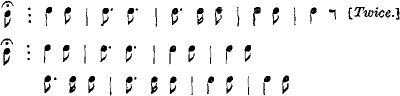
It is sometimes convenient for those familiar with musical notation to write the scheme of verses and stanzas in musical notes. In such cases a long syllable is represented by a quarter-note, , and a short syllable by an eighth-note, ; a spondee is written ; a dactyl, ; and a trochee, . Dactylic verse is therefore written in time, and trochaic or logaoedic verse in time. The cyclic dactyl may be written with sufficient accuracy , and the irrational spondee .


From the examples which follow, the student will see how the scheme of any metre may be expressed in musical notation.
Lesser Sapphic stanza:—

Alcaic stanza:—