Book 2 — SATIRES.—BOOK II. (continued 2)
Reading edition
300. sic vendas omnia pluris,] On ‘sic’ see C. i. 3. 1, n. ‘Pluris’ is simply put for ‘magno.’ Horace quietly hints to Damasippus that he had better leave off philosophy and return to his trade, in which he wishes him all success.
303. Agave] How she and the other Mænads tore her son Pentheus to pieces for intruding upon the orgies, is related at length by Ovid. (Met. iii. 701, sqq.)
308. Aedificas, hoc est,] ‘You are building, which is as much as to say, you, who are a dwarf two feet high, are aping the airs of a giant; and yet you laugh at Turbo (a gladiator of great courage, but small stature), swelling with a spirit too big for his little body.’ Horace may have been making some additions to his Sabine house, and about this time Mæcenas built his large house on the Esquiliæ. (See S. i. 8, Introduction.)
312. verum est] δίκαιόν ἐστι; ‘is it right?’ Compare Cæsar, B. G. iv. 8: “Neque verum esse qui suos fines tueri non potuerint alienos occupare.” See also Livy iii. 40.
313. Tantum dissimilem] A similar construction occurs immediately below (ver. 317), ‘tantum magna.’ ‘Multum similis’ (S. ii. 5. 92), ‘multum dissimilis’ (Epp. i. 10. 3), are like phrases. ‘Tanto’ is the dative governed by ‘certare.’
314. Absentis ranae] This fable is told by Phædrus (i. 24).
318. Major dimidio. Num tanto?] ‘Greater by half,’ is a way of speaking which must not be taken literally. By ‘num tanto’ the frog means to ask whether the calf was so much bigger than her natural size as, by puffing, she had made herself. ‘Is it so much bigger?’ she says, blowing herself out to proportions much greater than her own.
320. abludit] This word occurs nowhere else. It means to be out of harmony with.
322. sanus] See A. P. 296: “Excludit sanos Helicone poëtas Democritus.” There is not much consistency in Damasippus urging Horace to write at the beginning of the Satire, and calling him mad for doing so at the end of it.
323. horrendam rabiem.] This charge against himself need not be taken seriously. We have no reason to believe Horace was an ill-tempered man. He laments the facility of his temper on one occasion. (S. i. 9. 11.) But he says he is irritable. (Epp. i. 20. 25.)
Cultum majorem censu.] ‘Your living beyond your income.’ Horace tries to stop him, but the man goes on with one instance of his folly after another.
324. Teneas, — tuis te.] ‘Mind your own business.’
326. O major tandem] The scene winds up with a pretended deprecation of the severe truths of Damasippus, to whom the poet submits as the greater madman of the two, and humbles himself before him accordingly.
SATIRE IV.
This Satire is an essay on good living, put in the form of precepts delivered to Horace at second hand by one Catius, who professes to have received them from some sage more learned in the art, whom he does not name. Horace meets him accidentally, as he is hurrying away from the Professor’s lecture, to think over what he had learnt, and to store it in his mind. Catius recites what he has heard, from memory or from notes, and enters without preface upon the question of the first course. The Professor may be supposed to have carried his hearers through an entire dinner, “ab ovo usque ad mala” (see S. i. 3. 6, n.). Catius only gives the heads of the lecture and one or two of the sage’s reflections. The precepts he delivers inflame Horace with a desire to see and hear the great man himself, and he prays Catius to introduce him. It may be that Horace had some third person in his eye, but we have no means of knowing who it was. If it be so, there were those, no doubt, who would understand the allusion at the time. As to the man Catius himself, he appears to have been a well known follower of the Epicurean school, but he must have been dead many years before this Satire was written. Probably, therefore, Horace only introduces his name as a handle for ridiculing the Epicureans.
1. Unde et quo Catius?] On Catius, see Introduction. On the formula, see S. i. 9. 62, n.
2. Ponere signa] The ancients practiced methods for helping the memory. The first ‘memoria technica’ was said by tradition to have been invented by Simonides of Ceos. ‘Signa’ were more technically called ‘imagines,’ objects which the person arranged so that his mind’s eye could rest upon them, and thus assist his memory. ‘Ponere signa’ seems also to have been commonly used in this sense.
3. Anytique reum] Anytus was one of the three (Meletus and Lycon were his associates) who got up and conducted the prosecution of Socrates.
4. tempore laevo] See above, S. ii. 1. 18: “Nisi dextro tempore Flacci Verba,” etc.
6. Quod si] Horace apologizes for interrupting and detaining him; but, he says, if he should thereby forget any part of his lesson for a moment, he will presently recover it, he has such a wonderful memory, either by nature or art, or both.
11. celabitur auctor.] See Introduction.
12. Longa quibus facies ovis erit] On ‘ova,’ see S. i. 3. 6, n. ‘Succus’ here is equivalent to ‘sapor.’ Why Horace should make Catius say that long eggs were more white than round ones, or what is gained by the whiteness of an egg, or by its containing a male rather than a female chicken, is not clear. He puts any nonsense, it appears, into the man’s mouth. ‘Ponere’ is to put upon the table, as ‘posito pavone’ (S. ii. 2. 23). The notion that from long eggs cocks were hatched, and from round, hens, appears to have been a vulgar error. ‘Callosa’ signifies ‘tough,’ and belongs in sense, though not in construction, to the yolk.
15. Caule suburbano] Artificial streams and fishponds were commonly introduced into the gardens of rich people. Hence Catius says the vegetables grown in the suburbs were not so pleasant as those grown in the country on drier soil; meaning that they were insipid, from the quantity of water they imbibed.
17. vespertinus subito te oppresserit] On ‘vespertinus,’ see Epod. xvi. 51; ‘opprimere’ is to overtake or come upon one suddenly.
18. malum responset] ‘Responsare’ is used by Horace several times in the sense of resistance. See below, S. 7. 85: “Responsare cupidinibus, contemnere honores”; and Epp. i. 1. 68. ‘Malum responset’ means ‘it disagrees with.’
19. vivam mixto mersare Falerno;] ‘Mixto’ means mixed with water.
20. Pratensibus optima fungis] He says the ‘fungi’ that grew in the open meadows were more to be trusted than others,—that is, those which grew in the shade. Truffles and different kinds of mushrooms were much eaten by the Romans, as they are still by the Italians. Of the latter there were and are great varieties. The mushroom most highly esteemed was the boletus, which was cultivated in gardens, and kept for the eating of the rich. But all such fungi had to be chosen with great care. Even the boletus served to carry off an emperor.
24. Aufidius] This may be M. Aufidius, who was remarkable as having been the first at Rome who bred and fattened peacocks for sale, and derived a large profit (as much as 600,000 sesterces a year) from that trade. As to the composition of ‘mulsum,’ see note on S. ii. 2. 15, n. Falernian wine, which Horace appears to have esteemed next to Cæcuban, is here called ‘forte,’ and elsewhere ‘severum’ and ‘ardens’ (C. i. 27. 9; ii. 11. 19). It was a very strong spirituous wine, and required long keeping to become mellow.
27. morabitur] This may have been a medical word for costiveness. ‘Mitulus,’ the limpet, was an inferior sort of shell-fish. The Greeks called it τελλίνη or ξιφύδριον. The ‘lapathus’ is mentioned above as a purgative (Epod. ii. 57, n.). ‘Brevis’ refers to the size of the plant.
30. Lubrica nascentes implent] That shell-fish were best at the time of the new moon, appears to have been generally believed among the ancients. They had many fancies respecting the influence of the moon on various objects, in which, however, modern ignorance and superstition have perhaps surpassed them. But in respect to shell-fish, modern observation is in conformity with that of the ancients.
32. Murice Baiano] This shell-fish, from which a purple dye was obtained, was found, it seems, in great abundance at Baiæ. It would seem not to have been as useful for the table as for its dye. The ‘peloris,’ which was found in the Lacus Lucrinus, close to Baiæ, appears to have been an insipid fish, though Catius says it is better than the murex. The rival oyster-beds were in the Lacus Lucrinus and at Circeii, the opposite point of the bay which is terminated by the promontory of that name, in Latium, and the promontory of Misenum, in Campania. Catius gives the preference to the oysters of Circeii, which Pliny also says were unsurpassed (xxxii. 21). See note on Epod. ii. 49. The best oysters, however, were found at Brundisium on the other coast, whence the spawn was carried to stock the beds on the coast of Campania and Latium.
34. Pectinibus patulis] The shell-fish called ‘pecten,’ it seems, was found in greatest perfection at Tarentum. From the epithet ‘patulis’ it must have been one of the bivalved sort.
molle Tarentum.] The degenerate character of the Tarentines, which gained their city the epithets ‘molle,’ ‘imbelle’ (Epp. i. 7. 45), dates from the death of Archytas, about the middle of the fourth century B. C. Among other symptoms of this degeneracy, it is recorded that their calendar contained more festivals than there were days in the year. For full two hundred years (some make it much more) before the above period, they had flourished, above all the colonies of Magna Græcia, in arms and commerce.
36. exacta] For this meaning of ‘exigere,’ ‘to investigate,’ see Forcell. under ‘exigo’ and ‘exactus.’
37. cara pisces avertere mensa] ‘Mensa’ means the fishmonger’s board, which is called dear, instead of the fish exposed on it. ‘Avertere’ is ‘to carry off.’ Compare Virgil (Aen. x. 78): “Arva aliena jugo premere atque avertere praedas.” It is commonly used with ‘praeda,’ as in Cæsar, B. C. iii. 59: “Praedam omnem domum avertebant.” It may be applied humorously in this sense here, the man making a booty of the fish he loved. On ‘pisces patinarii’ (‘quibus jus est aptius’) and ‘assi,’ see note on S. i. 3. 81.
39. Languidus in cubitum] Catius says it is of no use for a man to buy expensive fish, if he does not know how to dress them; that is, which should be served up with sauce, and which, when fried, will tempt the guest, after he has laid himself down tired of eating, to raise himself on his elbow, and begin eating again.
41. Curvat aper] On ‘aper,’ see above, S. 3. 234.
43. Vinea submittit] He says, without much sense, as it would seem, that the flesh of wild deer fed in vineyards is not always eatable. The ‘caprea’ was a mountain goat, chamois, or some one of the deer kind. ‘Submittit’ is equivalent to ‘suppeditat,’ ‘supplies.’ See C. iv. 4. 63: “Monstrumve submisere Colchi.”
44. Fecundae leporis] ‘Lepus’ is of common gender. A modern epicure would not choose the shoulder of a hare as the most delicate part. It is so distinguished again, S. 8. 89.
51. Massica si caelo suppones] The wine in the amphora required clearing, before it could be drunk. One way of effecting this appears to have been exposing the vessel for some time to the open air, which process also took off some of its strength. Catius mentions the yolk of pigeons’ eggs as another means of precipitating the lees of the wine. White of egg was a more usual agent. Pliny mentions sulphur; several insoluble materials, such as pounded shells, gypsum, chalk, milk, etc., were used for the same purpose. But the commonest way was to strain the wine either through a ‘saccus,’ a bag of fine linen (which was apt to hurt the flavour), or through a metal sieve, ‘colum,’ these being in the hot weather filled with snow.
53. odor nervis inimicus;] This means what we call the bouquet, which helped the wine in its intoxicating effects upon the brain. With the inferior wines various aromatics were frequently introduced, for the purpose of giving them an agreeable perfume.
58. Tostis marcentem squillis] When the guest gets surfeited, or drinks so much he cannot digest any more, his appetite is to be tempted with fried shrimps and snails, of which the best sort came from the coast of Africa, and were called ‘Solitanae,’ the derivation of which name is uncertain; also with bacon and sausages. The lettuce, Catius says, ought not to be taken for this purpose, because it does not settle on the stomach when it is irritated. ‘Lactuca’ was commonly eaten at the ‘gustatorium,’ as an incentive to the appetite. Catius says the cloyed stomach would rather (‘malit’) have any coarse dish, brought in from the cook-shop, to stimulate it, than lettuce after drinking wine, which was a different thing from taking it before dinner.
61. Flagitat immorsus refici:] ‘Immorsus’ agrees with ‘stomachus,’ and signifies stimulated, ‘pervulsus,’ as “qualia lassum pervellunt stomachum” (S. 8. 9).
62. immundis fervent allata popinis.] The ‘popinae’ were the lowest sort of eating houses, where meat was cooked and usually eaten on the premises, but sometimes sent out. They were the same as the Greek καπηλεῖα. They were a lower sort of ‘cauponae’ (see S. i. 5. 2, n.). Their keepers, ‘popae,’ were, as might be expected, usually persons of no credit. The shops were dirty, and the company very low. Compare Epp. i. 14. 21. There were great numbers of these shops about the city. They were also called ‘thermopolia,’ because there the Romans drank hot spiced wine and water, ‘calda.’
63. duplicis pernoscere juris] Catius goes on to describe the sauces, of which there are two kinds; one which he calls simple, but which was not entirely so, being made of sweet olive-oil mixed with rich wine and ‘muria,’ which is but ‘garum,’ made from certain shell-fish (S. 8. 53). There was a composite sauce which was made up of the above boiled with chopped herbs, with a sprinkling of saffron, and, when it had stood to cool, the finest olive-oil of Venafrum (C. ii. 6. 16, n.).
66. Byzantia putuit orca.] The ‘thynnus’ from which the best ‘garum’ was made was found best in the neighborhood of Byzantium (Pliny ix. 20). ‘Orca’ is a jar used for preserving sauces and pickles. As to the form ‘putuit,’ see S. 3. 194, n. The ‘crocus’ of Mons Corycus in Cilicia appears to have been most celebrated. ‘Stetit’ means ‘has ceased to boil.’
69. Venafranae] See C. ii. 6. 16, n.
70. Picenis cedunt pomis Tiburtia] The apples of Tibur and Picenum have been referred to before (C. i. 7. 14; S. ii. 3. 272).
71. Venucula convenit ollis:] It is not known whence this grape derives its name. The word is variously spelt. Grapes were dried and preserved in jars for the winter. For drying in this way, Catius says the grape of the Alban hills is best. His opinion is not supported by any extant authority, as it is in the other instance.
73. Hanc ego cum malis,] Catius says he was the first to introduce Albanian raisins at the second course, and likewise ‘faex’ and ‘allec,’ two pickles, or two names for the same, being the lees of the ‘muria’ (v. 63, n.). Catius also claims the merit of introducing little dishes containing a mixture of salt and white pepper. The object of all this, as well as the pickles, was to promote thirst, and add to the pleasure of drinking after dinner. White pepper is milder than black. It is made by blanching the finer grains of the black, and taking off the rind. The ancients must have got their pepper from the East Indies. The best is grown on the Malabar coast.
75. Incretum] This comes from ‘incerno,’ ‘to sift,’ or ‘incernendo spargere’ (Forcell.), ‘to scatter with a sieve’ or ‘incerniculum.’ It therefore means that the pepper was sprinkled over the salt. ‘Catillus’ is a diminutive form of ‘catinus.’
76. millia terna macello] 3,000 sesterces (upwards of £26) for a dish of fish is a large sum, but not perhaps exaggerated. Larger sums were given for dainties. As to ‘macellum,’ see S. 3. 229, n. By ‘vagos pisces’ he means that it is a shame to confine in a narrow compass animals that have had the freedom and range of the seas. The liberty of the bird is expressed by the same epithet in C. iv. 4. 2.
79. calicem] The slave handing a drinking cup (‘calix’) to a guest, just after he had been gathering and licking up the remains of the dishes, would leave the marks of his fingers upon it, and this would turn the stomachs of the company, who would also be disgusted if they saw dirt upon the ‘cratera’ in which the wine and the water were mixed. The ‘calix’ was the same as the Greek κύλιξ. Its shapes and sizes and materials all varied very much. There were wooden and earthen-ware ‘calices,’ and others of common glass, and others of greater value of colored glass; but those that were most valued of all were the ‘crystallina,’ of a pure and highly transparent crystal glass. The colored glass cups came principally from Alexandria. The Romans were curious in collecting old vessels for their table (‘veteres craterae’), as observed before (S. 3. 21, n.).
81. Vilibus in scopis,] ‘Scopae’ were besoms for sweeping the floors, walls, and furniture of a room, usually made of the branches of the wild myrtle or tamarisk. The palm seems also to have been used. ‘Mappae’ here mean towels or dusters to clean the furniture and walls. ‘Scobe’ is sawdust, with which the floors were strewed. It was sometimes highly scented.
83. Ten lapides varios] ‘Tene?’ is it for such as you? ‘Tene decet?’ The floors in the houses of the rich were laid with slabs of marble and mosaic-work, and marble slabs were also introduced in the walls, though paintings were more common. ‘Torus’ meant properly a round pillow, as is shown by its root ‘ter’ (which appears in ‘tornus,’ ‘torqueo,’ etc.; see C. i. 1. 28, n.), and ‘toralia’ probably means coverings for the cushions, which were put over the rich ‘stragulae vestes’ (see last Satire, v. 118, n.), as we put chintz coverings over our furniture when it is not in use, or on ordinary occasions. Inviting his friend Torquatus to dinner, Horace tells him he will take care “ne turpe toral, ne sordida mappa Corruget nares.” (Epp. i. 5. 22.)
85. Oblitum quanto] Catius says that the neglect of those matters which cost little money and attention is more reprehensible than the absence of furniture, which the rich only can afford. The case he supposes is that of a man who combines dirt with finery, slovenliness with ostentation.
88. Docte Cati,] Catius, having brought his discourse to an end with an exhortation upon decency and order, Horace entreats him, wherever it is he goes to get such lessons he will take him with him, that he may drink wisdom at the fountain-head. Catius, he says, no doubt repeats accurately what he has heard, but such precepts would be more highly commended by the aspect, bearing, voice, etc. of the teacher himself.
94. fontes ut adire remotos] Horace here parodies Lucretius (i. 926): “Juvat integros accedere fontes atque haurire.”
SATIRE V.
In this Satire, which has a good deal of humor in it, Horace takes up the practice of will-hunting, of which, as of many other degrading vices that afterwards pervaded Roman society, he saw only the beginning. Describing the rage for making money in Epp. i. 1. 77, he says:
“Pars hominum gestit conducere publica: sunt qui Crustis et pomis viduas venentur avaras Excipiantque senes quos in vivaria mittant.”
The practice was sufficiently common in Cicero’s time, and Pliny connects it with the growth of wealth, and the time when money began to be the instrument of ambition and the measure of respectability; that is, he dates its birth from the decline of the Republic.
Homer (Odyss. xi.) makes Ulysses go down to Hades and there meet Teiresias, the Theban prophet, who tells him of the hardships that awaited him in his journey home, where however in the end he is destined to arrive. Horace supposes a continuation of the interview, and makes Ulysses ask the soothsayer how he is to repair his fortunes when he gets home, and finds his property wasted by his wife’s suitors, as the prophet told him it would be (see note on v. 6). Teiresias, though he implies that the cunning Ulysses would be at no loss in such a matter if he once got home, gives him his advice, which is to lay himself out for pleasing old men and women of fortune, and getting named in their wills, for which he lays down a few ordinary rules: of these, a persevering and coarse servility is the chief. Ulysses appears in as low a character as he can,—an apt disciple, ready to be the shadow of a slave, and to prostitute his chaste Penelope if need be. The Ulysses of all poets after Homer is a contemptible personage, and it must be said in favor of Horace that Penelope, whose character in the Odyssey is feminine and pure, is by later writers represented as less chaste than Homer has drawn her. Those who only know her as the virtuous wife and mother, will not easily forgive the coarse allusions to her in this Satire.
3. Quid rides?] These words are spoken by Ulysses. Teiresias may be supposed to smile at Ulysses for asking advice in a matter in which his own craftiness would help him better than any counsel he could receive. The prophet’s answer means, that, when he gets back to his home, his wits will soon teach him how to repair his fortune. ‘Jamne’ means, ‘what, now I have told you that you will get home?’
6. te vate,] See Hom. Odyss. xi. 110. The dialogue is supposed to be a continuation of that which Homer relates, and takes place in Hades. See Introduction.
7. apotheca] See C. iii. 8. 11, n.
9. missis ambagibus,] The ‘ambages’ were Ulysses’ fine words about birth and merit, and Teiresias perhaps means, ‘Since you will have my advice, let us waste no words, but begin.’
10. Turdus] This bird, the fieldfare, if well fattened, was considered a great delicacy by the Romans. In Epp. i. 15. 40, the glutton Mænius pronounces that there is nothing better than one of these birds, “obeso nil melius turdo”; and the host at Beneventum produced a dish of them in honor of his visitors, but they were poor things, and he did not know how to dress them (S. i. 5. 72). The fieldfare is still reckoned a delicate bird. ‘Privum’ means for your own private eating.
14. Ante Larem] The first fruits were offered to the Lares. See Tibull. i. 1. 13:
“Et quodcunque mihi pomum novus educat annus Libatum agricolae ponitur ante deo.”
No divinity was dearer to a Roman than his Lares, whose images stood in his hall, who reminded him of his departed ancestors, and whom he invoked and sacrificed to every day at his meals (see C. iv. 5. 34).
15. sine gente,] Suppose him to be a ‘libertinus,’ and in former days to have run away from his master, in which case he would be branded on the forehead, and the shame of attending him would be greater. He would also be ‘sine gente,’ that is, he would belong to no ‘gens,’ if he were a freedman or the descendant of a freedman.
17. Tu comes exterior] Teiresias advises that, if the rich man should call upon him to attend him when he walks abroad, he should never refuse to go, taking the least honorable place, which was by his patron’s side, and usually between him and the road. The expressions ‘tegere latus,’ ‘claudere latus,’ were common, and meant to take that side which was most exposed.
18. Utne tegam] This is a short way of saying ‘hortarisne me ut tegam?’ ‘Damae’ is used generally as a common name of slaves (see S. i. 6. 38). ‘Spurcus’ is a word Lucilius used, as in that verse quoted by Cicero (Tusc. ii. 17), “Ergo hoc poterit ‘Samnis spurcus homo vita illa dignus locoque?’”
20. hoc] When Teiresias tells him he must be content to be poor, or do as he bids him, Ulysses consents to the degradation rather than incur the poverty, and makes a merit of doing so: he will bear the disgrace with his usual magnanimity. The hero’s language is a parody of that which Homer puts into his mouth (Odyss. xx. 18):
τέτλαθι δὴ, κραδίη· καὶ κύντερον ἄλλο ποτ᾽ ἔτλης.
And v. 223:
ἤδη γὰρ μάλα πόλλ᾽ ἔπαθον καὶ πόλλ᾽ ἐμόγησα Κύμασι καὶ πολέμῳ· μετὰ καὶ τόδε τοῖσι γενέσθω.
22. Divitias aerisque ruam] ‘Ruere’ is ‘to get together.’ Virgil uses the word in a similar sense (Georg. i. 105), “cumulosque ruunt male pinguis arenae.”
27. olim,] See C. ii. 10. 17, n. On ‘ultro,’ C. iv. 4. 51; on ‘vocet in jus,’ S. i. 9. 74, n.
32. Quinte, puta, aut Publi,] These names would be given a slave at his manumission.
38. Pelliculam curare jube;] This diminutive is frequently used without any particular force. The expression is like that in Ep. i. 2. 29:
“In cute curanda plus aequo operata juventus”;
and 4. 15:
“Me pinguem et nitidum bene curata cute vises, Cum ridere voles Epicuri de grege porcum.”
‘Corpus curare’ is a common phrase, and Horace has “genium curare” (C. iii. 17. 15, n.).
— fi cognitor; ipse] ‘Cognitor’ means an attorney, one who is authorized to appear for another, either in maintaining or defending an action. He was appointed by and looked upon as the principal, and he was liable as such. The obsequiousness of the will-hunter was not to be deterred by such a responsibility. Horace says: “Become his cognitor, and let him go home, while you yourself persevere, and hold out for him, whatever the weather may be.”
39. seu rubra Canicula] He means in the height of summer or the depth of winter. The 41st verse, with the substitution of Furius for Juppiter is taken from Bibaculus; respecting whom, see S. i. 10. 36, n. Whether the other expressions are so, or whether they are only a parody of his style, or taken from some other poet, we cannot tell. The epithet ‘rubra’ for the dog-star, and ‘infantes’ as an ornamental epithet to express the speechlessness of the statues, are sufficiently absurd, and the hyperbole is not in good taste; there is vulgarity likewise in ‘conspuet.’ ‘Omaso’ signifies tripe, a vulgar dish even among the Romans. (See Epp. i. 15. 34.)
44. Plures adnabunt thunni] The tunny-fish is found in large shoals at particular seasons on either shore of the Mediterranean, into which it comes from the Atlantic to deposit its spawn. Vast quantities were and still are caught and salted. ‘Cetaria’ were artificial preserves, into which the fish were attracted and then taken. Salting-houses were built hard by. ‘Thunni’ here is put for the rich fools who would be caught by the servility of the fortune-hunter.
46. sublatus] This sense of ‘tollere,’ to educate, bring up, is said to be taken from the practice of fathers taking up in their arms immediately after their birth such of their children as they wished to be reared, while the others they left to be exposed. See Terence (Heaut. iv. 1. 13):
“So. Meministin’ me esse gravidam, et mihi te maximo opere edicere Si puellam parerem nolle tolli?” “Ch. Scio quid feceris, Sustulisti.”
It is not to be supposed that the exposure of children, or infanticide in any form, was lawful at Rome; but it is probable that it was practiced to some extent even in late times.
47. Caelibis] ‘Caelebs’ is applied to a widower as well as a bachelor. ‘Nudare’ Horace uses in this sense of ‘exposing’ in S. 8. 73.
48. ut et scribare secundus Heres] Wills were not necessarily written, though latterly they generally were so, and in that case it was usually on tablets of wax; hence below (v. 54) ‘cera’ is used as synonymous with ‘tabula.’ When a man made his will, he commonly named a ‘secundus heres,’ or more than one, who would succeed to the ‘hereditas,’ if the first ‘heres’ or ‘heredes’ refused it, or had become disqualified, or had failed to express his or their intention of accepting it within a time named in the will. These were called ‘substituti.’ He might also, if he pleased, make provision, in the case of naming his children his ‘heredes,’ that, if they died ‘impuberes,’ another person or persons named by him should get the ‘hereditas.’ This was called ‘pupillaris substitutio,’ and may be referred to by Horace in this place. ‘Vacua hereditas’ was a common legal term for an ‘hereditas’ made void by any of the above reasons, or any other.
49. puerum egerit Orco,] There is a little mock pathos in this. ‘Ago,’ with the dative, is not a prose construction. See C. i. 24. 18: “Nigro compulerit gregi.”
53. ut limis rapias] ‘Oculis’ is understood after ‘limis,’ ‘with eye askance.’ The advice given is, that, if the testator should give the man his will to read, he should affect indifference and put it from him, taking care first to get a side-glance at its contents, and see if his name appears in the next line after the testator’s. A will was commonly written on three pages, which were called severally ‘prima,’ ‘secunda,’ and ‘ima cera,’ ‘cera’ being equivalent to ‘tabula,’ the will being usually written on wax tablets. The testator’s name appeared in the first line of the first page, and after his came those of the ‘heredes.’ In the last page appeared the names of all but the ‘primi heredes,’ (that is, the ‘legatarii’ and ‘substituti,’ see note on v. 48,) together with the general provisions of the will. ‘Solus heres’ would be called ‘heres ex asse’; if there were several ‘heredes,’ they would be ‘heres ex dodrante,’ ‘ex quadrante,’ etc., according to the proportion of the estate devised to each, which was described by the different divisions of the as.
55. Plerumque recoctus Scriba ex quinqueviro] ‘Plerumque’ is used by Horace in the sense of ‘interdum’ here and elsewhere. (See A. P. v. 14 and 95.) The ‘scribae,’ of whom an example occurs above (S. i. 5. 35), were clerks in public offices. These places were often got by purchase, and the ‘scriba’ received public pay. Nevertheless the ‘quinqueviri’ appear from this passage to have ranked lower than the ‘scribae.’ They were officers appointed to relieve the other magistrates at night of the charge of the city. These were the permanent ‘quinqueviri’; but extraordinary commissions of five were often appointed for various purposes. (See Dict. Antt.) ‘Recoctus’ seems to mean that he had been a ‘quinquevir’ and was now a ‘scriba,’ the ‘re’ in ‘recoctus’ having no particular force. Teiresias means to say that Coranus, who had got into a situation in which he had acquired a good deal of money and some knowledge of business, was too wide awake to be caught in the snare, saw through the attentions of the fortune-hunter, and laughed at him. The ‘corvus hians’ is perhaps taken from Æsop’s fable of the fox and crow, copied by Phædrus (i. 13).
57. Captator] This word, and ‘captare’ above (v. 23), are commonly used for legacy-hunters. We know nothing more of the actors in this story, Nasica and Coranus, but it appears likely they were living persons, and the case well known.
58. Num furis?] Ulysses does not understand him, and asks if he is frenzied, as prophets were when inspired.
59. aut erit aut non:] This is a pompous way of stating a truism, put, by way of keeping up the humor of the scene, into the prophet’s mouth.
62. juvenis] See C. i. 2. 41, n. By his adoption into the Julia gens, Augustus claimed direct descent from Æneas. The Romans attached much importance to the legend which derived their origin from the Trojans. See C. iii. 3, Introduction. On ‘genus,’ see C. i. 3. 27, n.
64. forti nubet procera Corano] These epithets and the whole opening of the speech are mock-heroic, and adapted to the character of the speaker. Nasica owed money to Coranus, and gave him his handsome daughter by way of discharging the debt and getting an interest in his son-in-law’s will. Coranus understands him, and begs him to read his will. He coquets with the proposal just as Teiresias advises his hearer to do, but allows his modesty to be overcome, and on reading it through in silence finds no legacy left to himself or his family. As to ‘plorare,’ see S. i. 10. 91.
65. metuentis reddere soldum.] On ‘metuo,’ see C. ii. 2. 7. He had neither power nor will to pay. ‘Solidum’ means the entire debt, including principal and interest. The contracted form is used before (S. i. 2. 111).
67. orabit;] The rich man is maliciously bent on seeing the disappointment of his father-in-law.
73. vincit longe prius] ‘It is better by a great deal first to take the head by storm.’
77. tam frugi] ‘Discreet’ is the nearest English word perhaps corresponding to ‘frugi,’ and σώφρων in Greek.
79. magnum donandi parca] The suitors are once only mentioned as offering presents to Penelope, and their value was not great. (Odyss. xviii. 290, sqq.) They were offered in consequence of the taunts of Penelope herself. It is likely Horace had this passage in mind.
80. studiosa culinae.] This corresponds with Homer’s description. See, among other places, Odyss. ii. 55.
84. anus improba Thebis] ‘Improba’ means ‘sly,’ which we too call ‘wicked.’ See S. i. 9. 73.
87. Scilicet elabi si posset] ‘Of course it was to see whether she could escape from him when dead,’ or ‘in hopes that she might.’ We are to suppose she had made it a condition in her will, that, if he did not carry her without letting her drop, he was to forfeit the inheritance. It is a strange story, perhaps taken from some mimus or farce. ‘Scilicet’ is in reality a verb, and signifies ‘you may know,’ ‘you may be sure.’
89. neve — abundes.] ‘Don’t overdo it.’
90. ultro; Non etiam sileas.] ‘Garrulus ultro’ means one who speaks much before he is spoken to. On ‘ultro’ see C. iv. 4. 51, n. It is a difficult word to translate, and seems awkwardly placed here. As to ‘non’ for ‘ne,’ compare Epp. i. 18. 72; and A. P. 460.
91. Davus sis comicus] Horace has introduced a Davus in this respectful attitude in S. 7 of this book: ‘Jamdudum auscultans et cupiens tibi dicere servus Pauca reformido.’
92. Stes capite obstipo.] ‘Obstipo’ means stiff, unbending, or bent downwards, with the eyes fixed on the ground. As to ‘multum similis,’ see S. i. 3. 57, n.
93. Obsequio grassare;] ‘Grassor’ is a frequentative form of ‘gradior,’ and signifies to go on, advance. The expression in the text is like ‘grassari dolo’ (Tac. Hist. iv. 16), and other like phrases. Livy and Tacitus use the word often.
95. aurem substringe loquaci.] ‘Stringo’ means to grasp in the hand; ‘aurem substringe’ therefore may mean to hold up the ear, as we commonly do when we wish to catch every word that is said. He was to pay the strictest attention to the old man, let him be as garrulous as he would.
96. donec Ohe jam!] If he is fond of flattery, ply him with it till even he is forced to cry, ‘Hold, enough!’ and blow him up with your fulsome breath like a bladder. Though the old man might say he had had enough, he was not to be taken at his word, but plied still harder, for he never could have too much. ‘Importunus’ is one who does not easily rest, is not soon satisfied. The expression ‘Ohe jam satis’ is common. See S. i. 5. 12.
100. Et certum vigilans,] Compare Ovid, Heroid. x. 9:
“Incertum vigilans, a somno languida, movi Thesea pressuras semisupina manus”;
‘Certum vigilans’ means ‘wide awake,’ not confusedly, as those who are half asleep.
— Quartae sit partis] The ‘heres’ of one fourth of the property would be ‘ex quadrante’ or ‘ex teruncio.’ (See note on v. 53, above.) The formula in wills was such as this: “Sola mihi uxor heres esto,” “Sempronius ex parte dimidia heres esto.”
101. Dama] See v. 18, n. He is to throw in now and then (‘sparge subinde’) a whine for the dear man that is gone, and squeeze out a tear if he possibly can.
102. Unde mihi tam fortem] This abrupt and elliptical way of speaking occurs again below (S. 7. 116): “Unde mihi lapidem? Quorsum est opus? Unde sagittas?” ‘Parabo’ may be understood, or some such word.
103. est] This is equivalent to ἔξεστι.
105. Permissam arbitrio] A sum of money was generally named in the will for the funeral expenses. Sometimes they appear to have been left expressly to the judgment and liberality of the ‘heres’ or ‘heredes,’ as here. But if no mention was made of this subject in the will, or if a man died intestate, those who succeeded to the property were bound to provide all that was decent for his interment. As to ‘funus,’ see note on S. i. 6. 43. See C. i. 9. 9: “Permitte divis caetera.”
108. seu fundi sive domus sit Emptor,] ‘Fundus’ is a landed estate together with the buildings upon it. ‘Domus,’ therefore, which is opposed to ‘fundus’ here, and in Epp. i. 2. 47, may mean a town-house. The advice is, that if one of the man’s ‘coheredes,’ who is old, and by a bad cough shows he is near his end, expresses a wish to have an estate or house which forms part of his share, he should declare himself delighted to make it over to him for a nominal price, a single ‘sestertius.’ This would be a bold game, but he might hope that such generosity on his part would be remembered in the sick man’s will.
109. addicere.] This is a legal term used in selling, “and signifies the declaration of him who sells as to the transfer of the thing to the buyer.” (Long, Verr. ii. 2. 32.) It was used in private bargains as here, and at public auctions it was the word used for declaring who was the purchaser.
SATIRE VI.
In this Satire, Horace dwells upon the inconveniences of a town life and the delights of the country, the former as connected with the importunity of people asking for his influence with Mæcenas, or for information upon public affairs of which he knows nothing, though they will not believe it. The subject is illustrated by the story of a town and a country mouse. The town mouse visits the country mouse, and, taunting him with his seclusion, tempts him to accompany him to town, and then entertains him at a rich man’s table. But the servants, coming in suddenly at daybreak, frighten them both out of their wits, and the country mouse goes home again, resolving to keep to his own quiet hole in the fields, and try the town no more.
1. non ita magnus,] Compare with these lines C. iii. 16. 29, sqq. ‘Modus’ is used for any quantity.
2. jugis aquae fons] ‘Jugis’ belongs to ‘aquae.’ It signifies running water, and a good spring of this would be of great value to the property.
3. super his] ‘Besides these.’ In this sense, ‘super’ usually governs the accusative. ‘Super’ is used absolutely in this sense of ‘more,’ as in Epod. i. 31. “Satis superque me benignitas tua Ditavit,” which passage may be compared with what follows: “auctius atque Di melius fecere.” ‘Bene est’ occurs in C. iii. 16. 43, and is familiar in the formula S. V. B. E. V. (si vales bene est; valeo), which the Romans prefixed to their letters.
5. Maia nate,] Respecting Mercury, the god of luck and gain, the protector of poets, and of Horace in particular, see S. ii. 3. 68; C. ii. 7. 13; ii. 17. 29. ‘Proprius’ signifies ‘permanent,’ see S. 2. 129, n. As to the form ‘faxim,’ see S. ii. 3. 38, n.
7. vitio culpave] ‘Culpa’ is often used by the law-writers in the sense of ‘negligence.’ ‘Vitium’ appears to mean a defect of the nature, ‘culpa’ of the conduct.
8. Si veneror stultus nihil horum:] As to ‘veneror,’ ‘to pray for,’ see C. S. 49. This passage has been imitated by Persius (S. ii. 9). ‘Denormare’ is ‘to disfigure,’ ‘norma’ being the rule by which carpenters or masons keep their work straight. ‘Mercenarius’ is a free laborer who works for pay.
12. amico Hercule!] Though Hercules was especially a Grecian hero, and was in no way connected historically with the Romans, he was held by them in high esteem. He was associated with Mercury in various ways, among others as the god of gain, as he is here. There are representations of the two gods in one, which combined form is called Ἑρμηρακλῆς, and appears to have been very common. The notion seems to be that of combining strength and cunning.
13. quod adest] See C. iii. 29. 32: “Quod adest memento Componere aequus.” It is an adaptation of the Greek τὸ παρóν. ‘Gratum juvat’ may either mean ‘satisfies me, for I am grateful,’ or ‘is welcome and satisfies me.’
16. in montes et in arcem] See C. iii. 4. 21. By ‘arcem’ he means his house on the Sabine hills. (See C. ii. 7. 21.)
17. Quid prius illustrem] ‘What subject should I take in preference to this’? that is, the country to which he retires. On ‘pedestri,’ see C. ii. 12. 9, n.
18. plumbeus Auster] The south-wind is so called, as depressing the energies and spirits. The epithet is very expressive, ‘the leaden south.’ Compare C. ii. 14. 15; iii. 23. 8; Epp. i. 7. 5. Auster and Notus are not distinguished by the poets. They are invariably represented as bringing heavy rains. “Quid cogitet humidus Auster” (Georg. i. 462).
19. Libitinae quaestus acerbae.] The goddess Libitina was one of the oldest Roman divinities. She presided over funerals and all things pertaining to the dead. There were kept in her temple all manner of things required at funerals, where the undertakers (hence called Libitinarii) might purchase or hire them. Also a register of funerals was kept in the temple, and when they were registered a fee was paid. From both the above sources the temple would derive increased revenues in a season of great mortality. Horace twice uses the name of Libitina as equivalent to Mors. See C. iii. 30. 6, and Epp. ii. 1. 49; and Juvenal does the same (S. iv. 122): “Nam si Libitinam evaserit aeger Delebit Tabulas.”
20. Matutine pater,] Janus was a Latin divinity, and one of the oldest. As he presided over the opening year, so he did also over the beginning of every month and of every day. Sacrifices were offered to him on the first of every month, as well as of his own (January), and prayer in the morning of every day. Hence he is called ‘Matutinus pater’, and hence he is confounded with the Sun. ‘Pater’ was the title by which he was commonly addressed, and the two words were sometimes joined thus ‘Januspater.’ See Epp. i. 16. 59. He was worshipped before the other gods, because he was the medium through whom men got access to the others (Ovid, Fast. i. 171). ‘Jane’ is put in the vocative case by a sort of attraction. (See C. ii. 20. 6, n.) ‘Audire,’ in the sense of ‘appellari,’ ἀκούειν, occurs again in S. 7. 101; Epp. i. 7. 37, and 16. 17. The word is not commonly used in this sense except with ‘bene’ or ‘male.’
21. Unde] ‘From whom’ (C. i. 12. 17).
23. sponsorem me rapis.] ‘Sponsor’ was one who became security for another under the form of contract called ‘verborum obligatio,’ the contract taking place by question and answer, ‘ex interrogatione et responsione.’ One asked the other, “Dari spondes?” and he answered, “Spondeo.” The principals were called ‘stipulator,’ he who asked the question; and ‘promissor,’ he who answered. The sponsor was said ‘intercedere,’ and to him the same question was put, to which he returned the same answer. This explains ‘respondeat’ in v. 24, and “quod mi obsit clare certumque locuto,” v. 27. He answers “spondeo” in a clear, distinct voice, and becomes liable, possibly to his great detriment. The words, ‘Eja, ne prior,’ etc., Horace means for Janus, to whom he attributes the prompting of his zeal.
26. Interiore diem gyro trahit,] The notion is that of the heavenly bodies moving round a centre, in a series of orbits of which the diameters gradually diminish, and in the winter solstice traversing the innermost and shortest circle.
29. improbus urget Iratis precibus;] ‘Improbus’ means here ‘hot-tempered,’ and ‘precibus’ curses, as in Epod. v. 86. ‘Tu pulses’ is an angry way of speaking, ‘Are you the man to knock down everything in your way?’ as in the next Satire (v. 40). There is sarcasm in ‘memori,’ as if he was not likely to forget his duty to the great man. He says he feels an inward pleasure at the testimony thus borne to his intimacy with Mæcenas. ‘Si recurras’ means in the hopes of getting back, to see if you can get back. See S. 5. 87, n.
32. atras — Esquilias] See S. i. 8, Introduction. The former character of the place is expressed by ‘atras,’ gloomy. He says, that as soon as he gets near Mæcenas’s house he begins to remember a hundred different commissions entrusted to him by his acquaintance. They flit about him like a swarm of gnats, or anything else that is teasing.
35. Roscius orabat] Roscius may be anybody. It appears he had pressed Horace to meet him next day at the Puteal Libonis. This was some sort of building in the Forum Romanum, erected by one of the Scribonia gens, and therefore called ‘Scribonianum.’ The place or its neighbourhood was the resort of money lenders. It was probably an enclosed place, open at the top, and took its name from the stone enclosures built round wells, ‘putei.’ What Roscius wanted with Horace at this place is not certain. It is said that near the ‘puteal’ the prætor held his court, and that he wanted Horace to attend as his sponsor. But the prætor’s court did not open till the third hour.
36. De re communi scribae] The ‘scribae’ were classed in ‘decuriae,’ and were a numerous body. They formed a guild or company, and though they were employed in different branches of the public service, they had interests in common, and must have held meetings to discuss questions that concerned their body. As Horace had belonged to them, and was now known to have a good deal of influence, they wished him to attend their meeting on some particular occasion; so at least he puts it.
38. Imprimat his cura] While Augustus was absent in and after his last war with Antonius, Mæcenas, at first singly and afterwards in conjunction with M. Agrippa, was deputed to exercise those powers, in the city and in Italy, which Augustus himself would have exercised if he had been there (see Epod. 1, Introduction). The ‘tabellae’ of the text may have been a ‘diploma,’ so called from its consisting of two leaves, by which privileges of some sort were to be granted. ‘Signum’ expressed any work sculptured or engraved. Here it signifies a seal, which was usually set in the form of a ring. The practice of kings delivering their rings to those whom they deputed to represent their own authority, is of the highest antiquity. Pharaoh delivered his ring to Joseph, and Ahasuerus to Mordecai.
40. Septimus octavo propior] Horace was introduced to Mæcenas about the beginning of the year B. C. 38, and this Satire was written B. C. 30.
42. quem tollere rheda] ‘Rheda’ is the name for a travelling carriage. The shape probably varied, but it appears to have gone upon four wheels, and to have been, sometimes at least, of capacious size, since Juvenal mentions a whole family travelling in one ‘rheda’ (S. iii. 10). The only other four-wheeled carriage we read of, is the ‘petorritum,’ mentioned above (S. i. 6. 104, n.). There were public ‘rhedae’ on the great roads, for the benefit of travellers, and Horace and his friends performed part of their journey to Brundisium in these conveyances (S. i. 5. 86), and it appears from his language, ‘hinc rapimur,’ that they went pretty fast.
44. Thrax est Gallina Syro par?] ‘Thraces,’ ‘secutores,’ and ‘retiarii,’ were three different kinds of gladiators. The first had their name from being armed like the Thracians, with a short sword and round shield, from which they were sometimes called ‘parmularii.’ Gallina was one of these, Syrus was probably one of another sort. Mæcenas is supposed to ask Horace, among other trifling questions, whether he has seen the famous gladiators, and which is the better of the two.
45. mordent:] ‘Mordere’ is said of both heat and cold. See Epp. i. 8. 5. ‘Rimosa’ does not occur in any such sense as this elsewhere. We use ‘leaky’ in the same way.
48. noster.] This is a familiar way of expressing ‘myself.’ As to the construction of the next sentence, see S. i. 1. 45. ‘Luserat’ refers to ball-play. ‘Fortunae filius’ was a conventional phrase. Sophocles uses it (Oed. Tyr. 1080), ἐγὼ δ᾽ ἐμαυτὸν παῖδα τῆς τύχης νέμων.
50. Frigidus a Rostris] Suppose some bad news has been published in the Forum and been circulated in the streets. The ‘rostra,’ which Niebuhr (i. 406, n.) describes as “a stage of considerable length, with steps at each end of it,” originally separated the comitium, where the patricians met, from the space where the plebeian assemblies were held, which was properly the Forum, though that name was popularly applied to the whole. Here persons of all ranks met, and from this centre reports would naturally take their rise, and then get disseminated in the city. The ‘rostra’ had its plural name from the beaks of vessels taken from the people of Antium (Liv. viii. 14), with which the stage was ornamented. As to the ‘compita,’ see note on S. ii. 3. 25.
53. Dacis] The Daci helped M. Antonius at Actium, B. C. 31, and the following year M. Crassus was sent against them.
55. Triquetra] The veterans who fought at Actium, having been sent back to Italy, were discontented, and broke out into mutiny because they had no reward. Augustus came from Asia to quell this mutiny, and gave money to some of the soldiers, and to others he distributed lands in those parts that had been favorable to Antonius. ‘Triquetra’ signifies triangular, and is a name for the island of Sicily, called also Trinacria, from its three promontories. Cæsar describes Britain also as “insula triquetra” (B. G. v. 13).
57. unum Scilicet — mortalem] The Greeks use εἷς ἀνήρ in this way, to express a superlative.
62. Ducere] ‘To quaff the cup of oblivion.’ See C. iii. 3. 34, n., Epod. 14. 3., and Aen. vi. 714.
63. faba Pythagorae cognata] The popular notion was, that Pythagoras had taught his disciples to abstain, as from meat, so from beans, which class of vegetables he connected somehow or other with the human species, in his doctrine of metempsychosis. They were therefore forbidden fare to his disciples, under the fanciful notion that in eating them they might be devouring their own flesh and blood. Hence the expression ‘cognata,’ and this is the allusion in Epp. i. 12. 21: “seu porrum et caepe trucidas.” As to Horace’s vegetable meals, see S. i. 6. 115.
66. Ante Larem proprium] See note on Epod. ii. 66. ‘Libatis dapibus’ means that the master and his friends (‘meique’) dined lightly, and left the greater part of the dishes to his slaves. The master, in this instance, as well as his slaves, dined in the ‘atrium,’ where the images of the Lares were placed. ‘Libare’ is to touch lightly. See Aen. v. 91: “inter pateras et levia pocula serpens Libavitque dapes.” The distribution of the remains of the dinner to the slaves was a matter of course.
69. Legibus insanis,] See S. 2. 123, n. One of the strictest laws of a banquet directed by a presiding symposiarch, would have reference to the regulation of the quantity of wine to be drunk by each guest at each round. Horace’s notion of liberty here is to be able to drink as much or as little as he pleased, which is expressed by ‘inaequales calices.’
70. uvescit] ‘Uvescere’ does not occur elsewhere, but it corresponds with Horace’s word ‘uvidus,’ C. ii. 19. 18, and iv. 5. 39.
72. Nec male necne Lepos saltet;] Lepos was a ‘pantomimus’ who was so named from the grace with which he performed his part, as the name implies. The business of the ‘mimi,’ as of the ‘mimae,’ was to recite poetry, as well as to act parts in the farces that bore the same name (S. i. 10. 6, n.). The word ‘saltare’ was applied to all pantomimic acting, and the motion of the limbs in dumb show. See S. i. 5. 63, where Messius calls upon Sarmentus to act Polyphemus,—“Pastorem saltaret uti Cyclopa rogabat,” where ‘saltaret’ is equivalent to ‘movetur’ in “Nunc Satyrum nunc pastorem Cyclopa movetur” (Epp. ii. 2. 125).
75. usus rectumne] Cicero makes Lælius indignantly deny the doctrine that makes utility the foundation of friendship, and he says, with much truth and delicacy, “non enim tam utilitas parta per amicum quam amici amor ipse delectat” (Lael. c. xiv.). There is more in the same strain in c. viii., where he makes virtue the basis of friendship.
76. natura boni summumque] This subject is discussed at large in Cicero’s treatise ‘De Finibus Bonorum et Malorum,’ and was a commonplace in Horace’s day, as it has been in all ages. ‘Summum’ represents the Greek τέλος, ‘the end proposed’.
77. Cervius] This was an old neighbor of Horace’s. There is not the smallest clew to his history or to that of Arellius, who, however, must have been a rich man and careful about his money.
79. Olim] ‘Once upon a time’: a common way of beginning a story that does not profess to be true.
82. attentus] This is a common word for what we should call ‘close.’ See Epp. i. 7. 91; ii. 1. 172. ‘Ut tamen’ means ‘ita tamen ut.’ Compare S. 7. 4.
84. nec longae invidit avenae,] This construction is Greek: φθονεῖν τινί τινος. The Latin construction is with the accusative and dative, as S. i. 6. 49; Epp. i. 14. 41. The ‘avena’ here is the cultivated oat, and ‘longae’ describes the size of its grain. The wild-oat Virgil distinguishes from this by the epithet ‘sterilis’ (G. i. 153), and couples it with the ‘lolium,’ or tare, with which the host on this occasion satisfied himself.
87. male] This goes with ‘tangentis,’ and is equivalent to ‘vix.’
89. Esset ador] See C. iv. 4. 41, n.
93. mihi crede,] These words are parenthetical, as Ovid (Am. ii. 2. 9): “Si sapis, o custos, odium, mihi crede, mereri Desine.” The language that follows is very like that of Hercules in the Alcestis of Euripides (782, sqq.):
βροτοῖς ἅπασι κατθανεῖν ὀφείλεται, κοὔκ ἐστι θνητῶν ὅστις ἐξεπίσταται τὴν αὔριον μέλλουσαν εἰ βιώσεται. —— ταῦτ᾽ οὖν ἀκούσας καὶ μαθὼν ἐμοῦ πάρα εὔφραινε σαυτὸν, πῖνε, τὸν καθ᾽ ἡμέραν βίον λογίζου σὸν, τὰ δ᾽ ἄλλα τῆς τύχης.
98. pepulere] This is used absolutely in the sense of ‘movere.’
100. nocturni] See C. i. 2. 45, n.
103. canderet vestis eburnos,] On the ‘stragula vestis,’ see S. 3. 118, n. The sides of the couches were sometimes veneered with ivory. Fire is said ‘candere,’ and the flaming drapery of the bed is here described by the same word, which is not applied in this sense elsewhere. ‘Fercula’ was the name for the different courses, of which the ‘coena’ usually consisted of three, called ‘prima,’ ‘secunda,’ ‘tertia coena.’ The word, like ‘feretrum,’ contains the root ‘fer’ of ‘fero,’ and so its first meaning may have been the tray or dish on which the viands were brought. It here means the viands themselves; ‘many courses were left,’ would mean nothing. ‘Procul’ signifies ‘hard by,’ as in Epp. i. 7. 32. The remains of the evening’s ‘coena’ had been collected and put into baskets, and left in the ‘triclinium’ till the morning, and the purple coverings were still exposed, waiting till the servants should cover them (S. 4. 84, n.).
107. veluti succintus] ‘Like one tucked up,’ as the slaves when on duty. (See S. i. 5. 5, n.) The duties of the ‘structor’ are those the host is here represented as performing. It was his province to arrange the dishes, and see that they were properly served up. He runs about, puts one course after another on the table (‘continuatque dapes’), and tastes the dishes, to see if they are properly seasoned. ‘Praegustatores’ were regularly employed only at the tables of the emperors. The custom was imitated from Eastern courts. (See Xenoph. Cyrop. i. 8. 9.)
112. Valvarum strepitus] The servants, coming in early to clean the room, interrupt the banqueters, and rouse the watch-dogs, whose barking terrifies them still further. There was a dog, or more than one, kept in most houses, in the ‘cella ostiarii,’ the porter’s chamber at the side of the ‘ostium.’ ‘Conclave’ is the general term for any chamber or suit of chambers under one lock or bolt. As to Molossis, see Epod. vi. 5.
SATIRE VII.
The substance of this Satire Horace puts into the mouth of his slave Davus, giving him liberty to express himself as he pleases, on the day of the Saturnalia, when much license was granted to slaves in particular. Davus takes advantage of the permission given him to abuse his master, and to taunt the rich with a slavery (to their passions and to the world) harder and more stupid than his own. He also taunts Horace with his instability and weakness of purpose, which part of the Satire is the most natural and amusing (see note on v. 23). The rest contains a great deal that is disagreeable, and much that is commonplace. It may perhaps represent the habit of talking trash, under the name of philosophy, which those who pretended to be of the Stoic school had established, and the humor would be more perceptible to a Roman of the day than it is now.
1. Jamdudum ausculto] We may suppose Horace has been talking to a friend upon subjects that have attracted his slave’s attention, and give rise to the points he argues. Or he may have been giving Davus some good advice, and he offers him a homily in return, recommending him to practise what he preaches.
3. Mancipium] This word, which properly signifies the act of taking possession, ‘manu capiendo,’ is applied here to the ‘res mancipi,’ the object of ‘mancipium,’ which, in this instance, is a slave. It is so used in Epp. i. 6. 39. As to ‘frugi,’ see S. 5. 77, n.
4. Ut vitale putes.] ‘That you need not think him too good to live’ (S. 6. 82). As to the Saturnalia, see S. 3. 5, n. The month of December was dedicated to Saturnus. Horace speaks of the license of that festival being a custom handed down from their ancestors. The time of its institution is quite unknown.
6. Pars hominum] Davus avails himself, without preface, of his master’s permission, and begins to moralize on the instability of some men, who never know their own minds. This character he applies to his master in v. 23, sqq.
9. Cum tribus annellis,] This is mentioned as a large number. In later times the Romans wore a great profusion of rings on both hands. At this time they were only worn on the left, because they were more likely to be injured, and to be in the way, on the right hand. Priscus was a senator, and therefore entitled to wear a gold ring, which privilege did not descend, at this time, below the equestrian order. In later times it was conferred upon all manner of persons by the emperors. Those who were not entitled to wear rings of gold had them of iron, according to the most ancient practice; and such of the Romans of higher condition as adhered to the simplicity of earlier days continued to wear iron.
Priscus, as a senator, was entitled to go abroad with the ‘latus clavus,’ which he would do sometimes; while at others he would appear only as an ‘eques,’ with the ‘angustus clavus.’ He was rich enough to live in a fine house, and did so; but would from caprice go and take an obscure lodging, such as a poor man might be ashamed of. He put on first one character and then another: now a man about town, and now talking of going to Athens as a philosopher. He was just such an unstable person as Tigellius is described to be in S. i. 3. 18: “Nil fuit unquam Sic impar sibi.” He was “everything by turns, and nothing long.”
14. Vertumnis, quotquot sunt, natus iniquis.] Vertumnus, as his name indicates, was the god who represented change. Horace says Priscus was born when Vertumnus was angry (see S. 3. 8, n., “Iratis natus paries dis atque poëtis”), and he strengthens it by saying, ‘all the Vertumni that are to be found’; as if every image of the god were a separate divinity, and all were angry together, when this fickle man was born.
15. Scurra Volanerius,] Nothing is known of this person. He had the gout, which Horace says he richly deserved, and was so given to gambling (which was illegal, see C. iii. 24. 58, n.), that, when he could not handle the dice-box himself, he hired a boy to do it for him. ‘Phimus’ was the Greek word for what the Romans called ‘fritillus.’ From the shape it was also called ‘turricula’ or ‘pyrgus’ (πύργος). As to ‘talos,’ see S. 3. 171, n. They were not always thrown from a box, but sometimes with the hand.
19. levius miser ac prior illo,] ‘Levius miser’ is an unusual expression. ‘Prior illo’ means better off than that man who is always changing his character, one moment appearing strict, another loose, in his principles and conduct. The superiority of the man who is consistent in vice lies in his indifference to virtue, and the quietness of his conscience arising from that cause. In that sense he is better off, and less miserable, than the other.
21. Non dices hodie,] ‘Hodie’ is equivalent to ‘statim,’ ‘this moment.’ ‘Furcifer’ means a slave who for some slight offence was obliged to go about with a ‘furca’ round his neck, a sort of collar shaped like a V, in which the hands also were inserted. The master begins to see that Davus is aiming a stroke at him, and is getting angry.
23. antiquae plebis,] ‘Plebs’ has not its distinctive meaning in this place. (See C. iii. 14. 1, n.) Horace is no doubt touching his own infirmity here. He was fond of praising the simplicity of the olden time, but he was not the man to extricate himself from the degenerate habits of his own day (‘nequicquam coeno cupiens evellere plantam,’ which is taken from the Greek proverb ἐκτὸς πηλοῦ πόδα ἔχειν). He had been but lately, perhaps, writing the praises of a country life, and sighing for his farm (in the last Satire); but when there, we may believe he felt dull enough, and missed the society and elegances of the city. Whatever his ordinary fare may have been, he had no objection to the tables of the rich, and was proud to be invited to the Esquiliæ. There is much humor in this part of the Satire. He is supposed to be congratulating himself upon being suffered to dine quietly at home, when he gets an unexpected invitation from Mæcenas to a late dinner. He immediately shouts for his lantern, scolds the servants if they keep him waiting a moment, and runs off as fast as he can, leaving in the lurch some persons to whom he had promised a dinner, and who go away disappointed and muttering abuse.
33. sub lumina prima] ‘Immediately after the lighting of the lamps.’ (See Epod. ii. 44, n.) The ordinary dinner-hour was earlier (see C. i. 1. 20, n.), but Mæcenas’s occupations protracted his ‘solidus dies,’ at the end of which he was glad enough, no doubt, to get a cheerful companion, like Horace, to dine with him. ‘Blatero’ is to bawl, or more commonly to babble and talk nonsense. ‘Mulvius’ may be anybody, one of the numerous tribe of parasites. ‘Non referenda precati,’ uttering curses which the servants heard, but must not repeat. See last Satire, v. 30, “iratis precibus.”
37. dixerit ille,] Mulvius may be supposed to mutter this, as Horace goes off and leaves him without his expected dinner. ‘Nasum nidore supinor,’ ‘I snuff up my nose at the smell of a good dinner.’ ‘Nidor’ means ‘nidor culinae,’ as in Juv. v. 162: “Captum te nidore suae putat ille culinae.”
39. si quid vis adde popino.] ‘Popino’ is not a common word. It means an idle, dissolute fellow, a frequenter of ‘popinae,’ cook shops. (See above, S. 4. 62, n.)
40. Tu — ultro Insectere] ‘Are you the man to come forward and attack?’ that is, to be the first to do it. See S. 6. 30, and C. iv. 4. 51, n.
42. Quid, si me] Davus goes on in his own person. Five hundred drachmæ, reckoning the drachma and the denarius as nearly the same value (about 8½d.), which was the case about this time, amounts to 17l. 15s. of English money, and this was a small price, only given for inferior slaves. The price varied very widely, according to the beauty of the slaves (of either sex), which enhanced their value more than anything else, or according to their education, or skill in handicrafts, &c.
43. Aufer Me — terrere;] Literally, ‘Away with that frightening me.’ (See Epp. i. 7. 27, n.) It expresses alarm and haste, for Davus sees his master frowning, and lifting his hand to strike him.
45. Crispini docuit me janitor] About Crispinus, see S. i. 1. 120, n. Davus professes to have obtained at second hand, from the slave of this Stoic philosopher, the arguments he is going to propound. They are put generally, and he uses his own name; but the pronoun ‘te’ means any one. The ‘janitor,’ who was also called ‘ostiarius,’ kept the door of the house. He had a room on each side of the ‘ostium,’ which was a space between the outer and inner door. Crispinus’s janitor may be supposed to have overheard what his master had said, from time to time, to his friends, while sitting in the ‘atrium’ into which the inner door opened.
76. minor,] ἥσσων, a slave to (C. ii. 11. 11, n.).
quem ter vindicta quaterque] ‘Vindicta’ is used for the ‘festuca,’ or rod, laid upon the shoulder of a slave by the prætor, in the act of giving him his freedom. Davus says that manumission, repeated over and over again (though that involves an absurdity), could not deliver his master, as he called himself, from the bondage he was under to the world.
78. Adde super dictis] ‘Dictis’ is governed by ‘adde,’ and ‘super’ is used absolutely.
79. vicarius] The property a slave might accumulate was called his ‘peculium,’ and among the rest he might have a ‘vicarius,’ a slave to do his duty or help him in it. He was held to be ‘quasi dominus’ in relation to his ‘vicarius.’ What Davus says is, whether you choose to call the slave’s slave his ‘vicarius,’ or substitute, as your law does, or his fellow-slave (as strictly speaking he is, for, except by sufferance, a slave can hold no property independent of his master), what is my relation to you? I am your slave; you are the slave of your passions, which will pull you about as the strings pull a puppet (which the Greeks called νευρόσπαστον). The ancients carried their mechanical skill in the construction of automaton figures further, perhaps, than it has been carried since. Artists in this line were common among the Greeks, and were called νευρόσπασται, αὐτοματουργοί. It appears from Herodotus (ii. 48) that ἀγάλματα νευρόσπαστα, as he calls them, were in use among the Egyptians.
83. sibi qui imperiosus,] ‘He who has control over himself.’ Before Horace, no writer uses this word with a case after it.
85. Responsare cupidinibus,] ‘Responso’ is repeated in Epp. i. 1. 68. “Fortunae responsare superbae.” It seems to mean, to reply to on equal terms, and so to be a match for, and to overcome. The construction of the adjective and infinitive is common in the Odes, but not in the Satires or Epistles. See C. i. 1. 16, n.
86. in se ipso totus, teres, atque rotundus,] ‘In himself entire, smoothed, and rounded,’ that is, perfect as a sphere, and, as the next line explains, like a beautiful statue whose graces are all in itself, which is perfectly finished and polished. This is elsewhere expressed by ‘ad unguem factus homo’ (S. i. 5. 32, n.), the difference in the mode of expression being, that here it is meant there are no inequalities on the surface on which anything at all can rest. The other expression has been explained in its place. ‘In se ipso totus,’ means one who wants nothing from without to set him off, and whose resources, as well as his graces, are all in himself. The mud through which he passes as he goes through the world does not adhere to him (‘externi ne quid valeat per leve morari’); circumstances, prosperous or the reverse, do not affect his character; and, in all her assaults upon his happiness, Fortune proves but feeble, not being able to make any impression upon it. ‘Mancus’ means lame in the hand, as ‘claudus’ does in the foot. ‘Teres’ is explained in a note on C. i. 1. 28. ‘Rotundus’ is taken from the heavens, which Plato (Tim. p. 33) says the Deity σφαιροειδὲς ἐτορνεύσατο, as being most after his own image.
89. Quinque talenta] The Attic drachma of this period was worth about the same as the Roman denarius, nearly 8½d. (See above, v. 43, n.) The mina was equal to 100 drachmæ, and a talent to 60 minæ. It was worth therefore about 212l., and five talents 1,060l. The caprice of the man’s mistress is described as before, S. 3. 260, sqq.
92. Non quis;] This is the second person of ‘queo.’
95. Pausiaca torpes, insane, tabella,] Pausias was a native of Sicyon, one of the most celebrated schools of art, where there was a large collection of his pictures. Many were sold by the Sicyonian government, to pay their debts, and most of these found their way to Rome. His pictures were chiefly small, ‘tabellae,’ and among the most celebrated was the portrait of his mistress Glycera as a flower girl, Στεφανηπλόκος. He flourished about the middle of the fourth century B. C. ‘Torpes’ is a like expression to that in S. i. 4. 28, “stupet Albius aere”, and 6. 17, “Qui stupet in titulis et imaginibus.”
96. Fulvi Rutubaeque Aut Pacideiani] These are all names of gladiators, as we may gather from the context. Pliny tells us it was the practice, when shows of gladiators were exhibited, for the exhibitor to set forth a picture of the games, to inform the public, such as we see now of conjurors, circus, and the like; and these are what Davus alludes to. They were done, no doubt, roughly, as he describes. Cicero mentions repeatedly a gladiator named Pacideianus. Horace may have taken the name for any gladiator in consequence of the celebrity of this man. ‘Contento poplite’ represents the attitude of the gladiators. The Scholiasts raise a doubt upon the point, thinking the words may apply to the spectator stretching himself on tiptoe to get a nearer view.
101. callidus audis,] See S. 6. 20, n., and 3. 23: “Callidus huic signo ponebam millia centum.”
103. coenis responsat opimis] ‘Responsat’ seems here to have the sense of ‘corresponds to,’ as ‘responsura’ in S. 8. 66. What Davus says amounts to this: ‘I am good for nothing, because I am attracted by a cake just hot from the oven; you, forsooth, are virtuous and noble, because you feast upon good things.’ So the same opposition appears in these lines as in the two before. ‘Libum’ was a coarse sort of cake made of pounded cheese, eggs, and flour, all mixed together and baked. There was another sort used in sacrifice, concerning which see Epp. i. 10. 10, n.
105. Qui tu impunitior] Persius has copied this way of speaking (v. 129):
“Sed si intus et in jecore aegro Nascuntur domini, qui tu impunitior exis Atque hic quem ad strigiles scutica et metus egit herilis?”
110. Furtiva mutat strigili:] As to the construction with ‘muto,’ see C. i. 17. 2. The ‘strigil,’ which the Greeks called στλεγγίς, was a scraper of bone or metal, of a curved form and with a sharp edge, with which the skin was scraped after bathing, or exercise in the gymnasium.
112. Non horam tecum esse potes,] To a man who has no resources in himself, or is afraid of his own conscience or his own thoughts, and resorts to amusements or other means of distraction to divert his mind, these words apply. ‘Tecum habita,’ inhabit your own breast, make that your home, is a like expression of Persius, S. iv. 52.
113. fugitivus et erro,] ‘Fugitivus’ was a slave who ran away outright; ‘erro’ was an idle fellow, who skulked out of the way, to escape work or to amuse himself. There was the same distinction in the army between ‘desertor’ and ‘emansor.’ A ‘fugitivus’ was branded on the forehead, and hence he was termed ‘literatus,’ ‘notatus,’ ‘inscriptus,’ ‘stigmosus’; ‘stigma’ being the word to express the mark thus given. See above, S. 5. 15, n.
116. Unde mihi lapidem?] See above, S. 5. 102, n. Horace is supposed to get angry beyond endurance at this home-thrust of his slave, and calls out for a stone, arrows, anything, to throw at his head. The man is bewildered with fear, and thinks his master has gone mad, unless, which was as good, he was making verses. He is, or affects to be, unconscious of the license he has given himself, and the force of the truths he has been telling.
118. accedes opera agro nona] This means, ‘I will send you away to work with the other slaves (of whom therefore he appears to have had eight), at my farm.’ It was a common punishment, as it is now in slave countries, for a slave to be turned out of the ‘familia urbana,’ into the ‘familia rustica,’ and set to work in the fields. See Terence (Phorm. ii. 1. 19), where Geta looks forward to being punished in the above manner:—
“Molendum est in pistrino, vapulandum, habendae compedes, Opus ruri faciundum.”
SATIRE VIII.
This Satire represents a dinner given by a rich, vulgar man to Mæcenas and five of his friends. There is not so much to distinguish it in the way of humor as the subject admitted of. Few subjects present more scope for facetious satire than the airs of low-born men, lately become rich, aping the ways of the fashionable world, and making wealth their one passport into what is called good society. This is a very slight sketch, and some of the force even of this is perhaps lost through our ignorance of little points of etiquette and culinary refinements observed by the Romans of that day.
The host’s name is Nasidienus Rufus. Who he was, it is impossible to say.
Instead of telling the story himself, though it is probable from the tone of the Satire that he writes from a scene he had witnessed, Horace puts it into the mouth of his friend Fundanius, the comic writer mentioned in S. i. 10. 42, where see note.
1. Nasidieni] See Introduction. The third and fourth syllables coalesce. ‘Beati’ means wealthy and favored of fortune. See C. i. 4. 14, n.
2. here] ‘Heri’ is a dative form, ‘here’ an ablative, so we have ‘mani’ and ‘mane’ in the morning, ‘vesperi’ and ‘vespere’ in the evening. The termination in ‘i’ is the older of the two and it would seem as if the usage of the word was in a state of transition at this time.
3. De medio potare die.] Nasidienus dined early, to make the most of his feast. But ‘medio die’ need not be taken quite literally. The ‘prandium’ was usually taken at noon. The dinner-hour was later. (See C. i. 1. 20, n.) Busy men, as we saw in S. 7. 33, sat down by candle-light. ‘De medio die’ is like ‘de nocte’ in Epp. i. 2. 32, ‘media de luce,’ Epp. i. 14. 34. ‘De’ means ‘after,’ that is ‘de medio die’ means ‘after midday’; but it must note proximity to midday, or it would have no meaning at all.
4. fuerit melius.] See S. 6. 4, n. ‘I never was better off in my life.’ He says this ironically, or with reference to the amusement he had got from the vulgarity of Nasidienus.
Da, si grave non est,] There is a like use of ‘dare’ in Virgil (Ecl. i. 19), “sed tamen iste Deus qui sit da, Tityre, nobis.” Terence also uses it: “Nunc quam ob rem has partes didicerim paucis dabo” (Heaut. Prol. 10). From the meaning of this word, ‘to put,’ this application of it is easily derived.
5. iratum ventrem placaverit] Compare S. 2. 18: “Latrantem stomachum.” Both passages put together suggest the idea of a sop thrown to an angry dog to keep him quiet. Perhaps that notion, or something of the sort, suggested this line.
6. Lucanus aper;] See S. 3. 234; 4. 42, n. No mention is made of a ‘promulsis’ (S. i. 3. 6, n.), and the things of which it was usually in a great measure composed were sent up in the same dish with the boar, which was generally served whole, and was the chief dish, ‘caput coenae.’ Turnips, lettuces, radishes, parsnips, with pickles and sauces of various descriptions (see S. 4. 73, n.), generally formed part of the ‘gustus’ or ‘promulsis’ which preceded the ‘fercula,’ or courses of which the regular ‘coena’ consisted. The boar was killed, the host (called ‘coenae pater’ with a sort of mock respect) informed his guests, when the south wind was not at its worst, meaning, perhaps, that when this wind (‘scirocco’) was blowing hard, the meat would soon spoil, if he had any meaning at all. But it was probably some notion of his own.
10. His ubi sublatis] The narrator is inclined to make a short business of the viands, but he is brought back to them afterwards. The meat being removed, (and though he only mentions one course here, we may gather from what comes presently that there was no lack of dishes, and therefore, probably, there were the usual courses,) a slave, with his clothes well tucked up, ‘succinctus’ (see S. 6. 107, n.), came and wiped the table with a handsome purple towel, and another gathered up whatever had fallen or had been thrown on the floor, which at the same time he strewed with saw-dust, perhaps scented (see S. ii. 4. 81). ‘Gausape, -is’ (other forms of which are ‘gausapa,’ ‘gausape, -es,’ ‘gausapum’) was a woollen cloth of foreign manufacture. The table was of maple wood (see S. 2. 4, n.).
13. ut Attica virgo] When the litter is cleared away and the table wiped, two slaves, one from the East and named after his native river, the other a Greek, walk in with two amphoræ, one of Cæcuban, the other of Chian wine. They are represented as coming in in a solemn and stately manner, like the κανηφόροι who carried the baskets in procession at the festival of Ceres. See S. i. 3. 11, n.
15. Chium maris expers.] Salt-water was mixed with the sweet wines imported from the Greek isles. Whether Horace refers to this practice, and means that the wine had not been prepared, and was of inferior quality, or whether he means that this pretended Chian had in fact never crossed the seas, but had been concocted at home, is doubted. Orelli and most of the commentators adopt the first opinion, after the Scholiasts. I am more inclined to the latter. Compare Persius (vi. 39):
“Postquam sapere urbi Cum pipere et palmis venit nostrum hoc maris expers,”
where he means a learning bred not in Greece, but at home.
18. Divitias miseras!] This exclamation is drawn from Horace by his friend’s description. It was money that had brought the man out of his proper obscurity, and caused him all the petty shifts and anxieties that wait upon the position he tried to maintain.
19. pulchre fuerit] See above, v. 4, “Nunquam In vita fuerit melius.” As to Fundanius, see Introduction. ‘Laboro’ is an amusing exaggeration, ‘I am in pain to know.’
20. Summus ego] The company consisted, as was usual, of nine persons, who reclined on three couches. These were arranged so as to form three sides of a square, with the table in the middle, the fourth end being open, as shown in the accompanying diagram.
On each couch were three persons. On the ‘summus,’ Fundanius says he himself, Viscus, and Varius reclined. On the ‘medius lectus’ were Mæcenas and the two uninvited friends he brought with him, Servilius Balatro, and Vibidius. On the middle seat of the ‘imus lectus’ lay Nasidienus, above him Nomentanus, who acted as nomenclator (see Epp. i. 6. 50, n.), and below him Porcius, another of his parasites. The place of honour was the corner-seat of the ‘medius lectus,’ and next to that, on the first seat of the ‘imus,’ was usually the place of the host. But it appears that Nasidienus resigned that place to Nomentanus, probably because he supposed him better able to entertain his guests than himself. The host usually reserved the ‘imus lectus’ for himself and his family. If they were not present, their places were usually occupied by dependents of the host (parasites), who filled up the table, and helped to flatter the host and entertain the company. This explains Epp. i. 18. 10, “imi Derisor lecti.” Sometimes these places were occupied by ‘umbrae,’ brought by the invited guests. By ‘summus ego’ Fundanius means that he occupied the farthest seat on the ‘summus lectus.’ The slaves in helping the wine began from this point, and went round till they came to the ‘imus,’ or third place in the ‘imus lectus.’
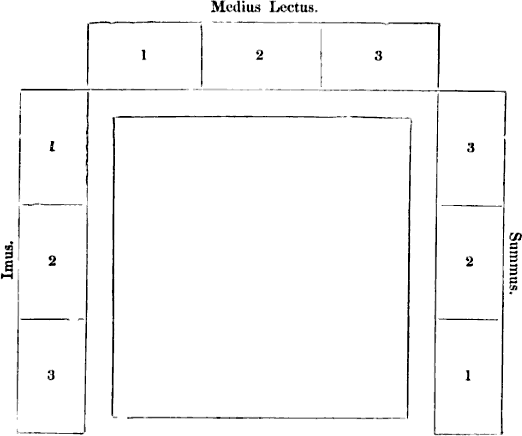
Viscus Thurinus] See S. i. 9. 22, n.; 10. 83, n. He appears to have been a native of Thurii, in Lucania, which was made a Latin colony (B. C. 195), and received the name of Copiæ. But its old name, given at its foundation by the Athenians (B. C. 444), continued to be used as well as the new. Viscus was highly esteemed by Horace. As to Varius, see S. i. 5. 40, n. Nothing whatever is known of Servilius Balatro or Vibidius. The second syllable of Servilius appears from inscriptions to be long; the third, therefore, coalesces with the last. Mæcenas had taken them with him as ‘umbrae,’ which means persons taken by guests without special invitation from the host. See Epp. i. 5. 28, n.
23. super ipsum,] This means on the seat above the host (see note on v. 20). As to Nomentanus, see S. i. 1. 102. Porcius seems to have been a notorious parasite. Here he seems to be occupied chiefly about filling his own belly, while the host and his other parasite are looking after the guests and doing the honours of the table.
24. obsorbere placentas;] ‘Placentæ’ were cakes, usually sweetened with honey. See Epp. i. 10. 11.
25. Nomentanus ad hoc, qui] ‘Nomentanus was there for this purpose, that he might —.’ His business was that of nomenclator, to direct the attention of the guests to any dainties they might have overlooked, and to explain to them the mystery of each dish; for, as Fundanius says, the commonest viands were so dressed up with sauces that they could hardly be recognized, or new sorts of dishes were put on the table, such as the entrails of different fish, turbot and plaice, for instance.
26. Indice monstraret digito:] ‘Indice digito’ is the forefinger: the middle finger was called ‘famosus.’ This name is given to it as the finger of scorn. The third finger was called ‘medicus’ or ‘medicinalis,’ for the same reason probably that got it the name ‘annularis,’ its supposed anatomical connection with the heart. By ‘cetera turba’ Fundanius means the uninitiated, Mæcenas and his party.
29. Ut vel continuo patuit,] The nature and importance of the duties of Nomentanus were shown on that occasion, when he handed Fundanius a dainty he had never tasted before, or perhaps heard of, and yet these gentlemen knew what good living was.
passeris] ‘Passer’ was a flat fish, and is generally supposed to be the plaice.
31. melimela] These were a sweet sort of rosy apple. The derivation of the name sufficiently marks their flavour. That they had a higher colour when gathered at the wane of the moon, is an invention of the nomenclator. His reasoning on the subject was so abstruse, that Fundanius does not pretend to be able to recollect it.
34. Nos nisi damnose bibimus] See Terence (Heaut. v. 4. 9):—
“Ch. At ego si me metuis mores cave esse in te istos sentiam. Cl. Quos? Ch. Si scire vis ego dicam: gerro, iners, fraus, helluo, Ganeo, damnosus.”
Vibidius means, that if this stupid dinner is to be the death of them, they had better have their revenge beforehand and drink ruinously of the host’s wine: if they do not, they will die unavenged. ‘Moriemur inulti’ is borrowed from the Epic style. See Aen. ii. 670; iv. 659.
35. Vertere pallor Tum parochi faciem] Fundanius gives two reasons why the host turned pale when he heard his guests call for larger cups: because when men have drank well they give a loose rein to their tongues, and because wine spoils the palate by destroying the delicacy of its taste. He might probably have added a third, for it seems that in the midst of his ostentation the man was a niggard. As to ‘parochi,’ see S. i. 5. 46. The host is so called as the man “qui praebet aquam” (S. i. 4. 88).
39. Invertunt Allifanis vinaria tota] Allifae was a town of Samnium. From the text we are led to suppose that cups were made there. ‘Vinaria’ is properly an adjective, and agrees with ‘vasa’ understood. It means here the ‘lagena’ or ‘amphora,’ which differed in shape, but not in use. Both were vessels either of clay, or sometimes latterly of glass, in which the wine was kept. Their contents were usually poured into a ‘crater’ for the purpose of being mixed with water. These persons helped themselves from the ‘lagena,’ and all followed their example, except the master and his two parasites (see above, v. 20). There was no ‘magister bibendi,’ and the guests drank as they pleased.
42. squillas inter muraena natantes] As to ‘squillas,’ see S. ii. 4. 58. ‘Muraena’ was a lamprey, and accounted a great delicacy by the Romans, who appear to have sometimes kept them tame. They were brought chiefly from the coast of Sicily. The prawns were swimming in sauce, the composition of which the host goes on to describe himself, as a matter of too much consequence to be left to the explanation of his nomenclator. The materials were Venafrian olive-oil (C. ii. 6. 16, n.); ‘garum,’ a sauce made of the entrails and blood of fish, and here made from the scomber, perhaps the mackerel, caught in greatest abundance off the coast of Spain; some Italian wine added while it was making, and some Chian when it was made; white pepper (see above, 4. 74, n.), and vinegar made from sour Lesbian wine (C. i. 17. 21). Of the other ingredients Nasidienus boasts of having invented two himself; one was the ‘eruca,’ which we call the rocket, and the ‘inula campana,’ ‘elecampane,’ a plant that grows in meadows and damp ground. It is used medicinally as a bitter. The last ingredient was the ‘echinus,’ a prickly shell-fish, thrown in without being washed, for the benefit of its saline qualities; for which addition to the sauce he gives credit to one Curtillus, whoever he may have been. The superiority of the ‘echinus’ to ‘muria’ (see S. ii. 4. 65, n.) is here said to consist in the fact of the former coming fresh from the sea, and furnishing a more perfect brine.
54. aulaea] See C. iii. 29. 15, n. The host’s dissertation was brought to a sudden close by the falling of the tapestry from the ceiling, bringing down among the dishes an immense cloud of dust. The guests fancy the house is coming down, but when they find the extent of the damage, they recover themselves (‘erigimur’). Rufus (Nasidienus) was so disturbed by this untoward accident, that he put down his head and began to shed tears. Nomentanus comforts him with an apostrophe to Fortune, complaining of her caprices, the solemn hypocrisy of which makes Varius laugh so immoderately, that he is obliged to stuff his napkin into his mouth to check himself. Balatro, who has a sneer always ready (μυκτηρίζων, see S. i. 6. 5), begins a long sympathetic and flattering speech, with which Nasidienus is highly pleased and comforted under his misfortune. A brilliant thought suddenly strikes him, and he calls for his shoes and goes out, on which the guests begin to titter and to whisper to one another, not wishing to give offence, or to speak out before the parasites and the slaves (54-78).
72. agaso.] This was a groom or mule-driver, or otherwise connected with the stables. Balatro intends a sneer at the establishment, the out-door slaves being had in to wait at table and swell the number of attendants.
77. Et soleas poscit.] See S. i. 3. 127. The sandals were taken off before they sat down to dinner, for which therefore ‘soleas demere, deponere,’ were common expressions, as ‘soleas poscere’ was for getting up. The Greeks had the same custom and the same way of expressing themselves.
78. Stridere secreta] In this line an attempt seems to have been made to convey the notion of whispering by the sound of the s repeated.
83. Ridetur fictis rerum] They pretend to be laughing at something else when Nasidienus comes in. As to ‘fictis rerum’ see C. iv. 12. 19, n. ‘Balatrone secundo’ means that Balatro played δευτεραγωνιστής, who supported the principal actor, but was not so prominent. (See Epp. i. 18. 14.) Balatro was a wit and sarcastic. He supplied jokes and the others laughed.
86. Mazonomo] This was a large round dish, properly one from which grain (μάζα) was distributed.
87. Membra gruis] Cranes became a fashionable dish with the Romans, but not till after this time, when storks were preferred (see S. 2. 50, n.).
88. jecur anseris albae] The liver of a white goose fattened on figs, the legs of a hare served up separately, as being (according to the host) better flavoured when dressed without the loins, blackbirds burnt in roasting, and wood-pigeons with the hinder parts, which were most sought after, removed (perhaps from the ignorance of the host, who thought novelty was the best recommendation of his dishes),—these composed the last ‘ferculum,’ brought in as special delicacies to make up for the late catastrophe. But the officiousness of the host destroyed the relish of his dishes, such as they were, and the guests took their revenge by tasting nothing that he put before them, and presently taking their leave.
95. Canidia afflasset] Here is this woman again, the last time we meet with her. See Epodes iii., v., and xvii., and S. i. 8.