JAMES BUCHANAN,
Reading edition
THIRTEENTH PRESIDENT OF THE UNITED STATES.
For the high position he so long maintained in the political affairs of this country, Mr. Buchanan is not alone indebted to his early and thorough education, but his entire devotion to whatever he undertook, and his perseverance in surmounting obstacles which would have intimidated less determined minds, had a large share in promoting his advancement. He is of Irish parentage, and was born at Stony Batter, Franklin County, Pennsylvania, April 23, 1791. At the age of seven years, he removed with his father’s family to Mercersburg, and there received an education that fitted him for entering Dickinson College, in 1805, where he graduated two years afterward with the highest honors. He then studied law with James Hopkins, of Lancaster, and in 1812 was admitted to the bar, at which he attained a high rank and commanded an extensive practice.
In 1814, he commenced political life as a member of the Pennsylvania State Legislature, and in 1820 was sent as a Representative to Congress, where he remained for ten years—at the expiration of which he declined a re-nomination.
In 1831, he was appointed minister to Russia by President Jackson, of whom he was always the consistent friend and supporter, and he negotiated a commercial treaty which proved of great advantage to American commerce.
In December, 1834, having been elected to the United States Senate, he took his seat in that body, and continued one of its most efficient members until 1845, when he accepted the office of Secretary of State, under Mr. Polk. He held this responsible place until the expiration of Mr. Polk’s term of service, when he returned home to repose awhile. But he did not, by any means, become an idle spectator in passing events; his letters and speeches show that he was no less vigilant as a private citizen, than as a counselor in the Cabinet, or a Representative and Senator in Congress.
On the accession of Mr. Pierce to the Presidency, in 1853, Mr. Buchanan was appointed minister to England, with which country questions were then pending that required great prudence and discrimination for their satisfactory adjustment. In his intercourse with the British diplomatists he was not only discreet, but displayed sound sense, courtly forbearance, a just assertion of our rights, and the true dignity of the American character. So entirely unexceptionable was his whole course while abroad, that, on his return to this country, in April, 1856—he landed in New York on the sixty-fifth anniversary of his birthday—he was received with an enthusiasm seldom accorded to political men.
In June, 1856, Mr. Buchanan was nominated by the Democratic Convention at Cincinnati, as a candidate for the Presidency; and although there were powerful political elements arrayed against him in the succeeding campaign, he was triumphantly elected to that responsible and honorable office.
His administration was attended with unusual difficulties—difficulties which it would seem he was not fully able to meet. The troubles in Kansas, arising from the repeal of the Missouri Compromise, and the opposition made to his views touching the admission of Kansas with the Lecompton Constitution, by the Douglas wing of the Democratic party, were matters of sore vexation to him, and tended greatly to unpopularize the latter part of his public life. But these were considerations of small moment as compared to the embarrassment which the Government suffered in consequence of the treacherous intrigues of some of the members of his Cabinet. His Secretary of War and Secretary of the Treasury, afterward so conspicuous in the great Rebellion, were particularly instrumental in crippling the pecuniary and military resources of the country, and turning them to the benefit of the South. When treason began to assume a threatening attitude, Buchanan declared against the right of secession, but at the same time denied the right of coercion by the Government. This, perhaps, is the most inconsistent, inexplicable position ever taken by any of the nation’s chief rulers. On the 4th of March, 1861, Mr. Buchanan retired from the Presidency, leaving to his successor the highly perplexing task of setting to right the machinery of a government crippled and weakened in all its parts, and fully ripe for the most gigantic civil war known to history.
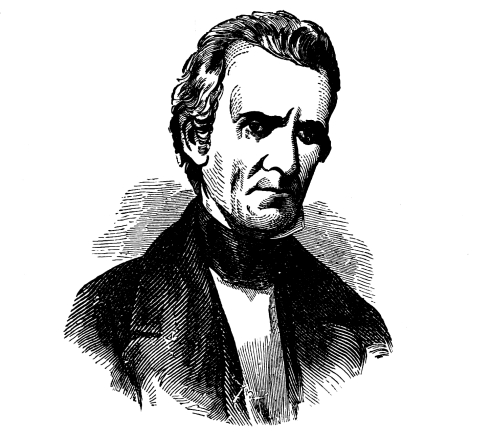
JAMES KNOX POLK.
It was, at one time, presumed by many that Mr. Buchanan was not only encouraging the rebellion by his weak, indecisive policy toward armed traitors, and by winking at the thieving proceedings of some of his Cabinet officers, but that he was himself leagued with the leaders of the secession movement, and secretly acted in unison with them.
While it is true that the unhindered appropriation of millions of treasure to the furtherance of rebellious schemes, and the large deposit of choice arms made in Southern arsenals, would indicate an affiliation of the President with the chief rebels of the South, yet there has never been adduced any direct proof of such affiliation; and nothing said or done by Mr. Buchanan since his retirement shows active sympathy with the Rebellion. There is, however, evidence on every hand of weakness—an element of character he never manifested prior to his executive career—of that negative disposition which will, under circumstances such as surrounded him during the latter part of his administration, wholly unfit a man for the performance of his duties.
The subject of the present sketch would, doubtless, have been a very good executive at a period when the country was undisturbed by sectional agitation; at a time when there were no conflicting local interests to stir up and embitter South against North. But the exigencies of the period during which he sat at the helm of state demanded a man who could take hold with a strong hand; a man of Jacksonian character, who, with the loftiest political integrity and most devoted loyalty, combined a Napoleonic will; a man who, foreseeing the certain results of the pursuits of a conciliatory course with rebellion, would have given it a decisive blow in its very infancy.
But it seems that Mr. Buchanan proposed to deal with secessionists as an over-fond, weak-minded mother deals with a spoiled child—scolding and coaxing alternately, satisfied to exhibit her authority by the former, and confident that she can reform her fondling by the latter. Perhaps he may be partially excused by some in consideration of the debt of gratitude he felt he owed to the Southern States, for the valuable services they had rendered him in his election. But a truly great executive never allows his feelings to interfere with the performance of duty. The life of the nation was in jeopardy; that grand superstructure, the American Government, whose foundation stones had been cemented by the sacred blood of the Revolutionary sires, whose columns had been reared by the wisest, purest statesmen the world ever saw, and about whose lofty dome the brightest seraphs of Heaven chanted their sweetest lays—that great temple around which clustered the hopes of the liberty-loving world, was threatened with destruction, and there can hardly be any excuse for him who, having the power to save, refused to adopt such decisive measures as were essential to salvation.
It is true that the Southern people had acted a very important part in the election of Mr. Buchanan, but it is very far from being true that a majority of these people were in favor of secession. The great Democratic party was not a party of traitors, either North or South. The masses of the people of the Southern States were by no means desirous of severing their connection with the Government of the United States, as was amply testified in the overwhelming Union majorities given in North Carolina, Tennessee, and other Southern States, even after South Carolina had sloughed off, and all the preliminary steps had been taken by the leading secessionists toward the formation of a Southern Confederacy. And there is no doubt that had Mr. Buchanan taken hold of the rebellion, while it was in the larva, with that determination to crush it which the great Jackson exhibited when South Carolina proposed her scheme of nullification, it had never seen its winged existence.
Buchanan’s administration, in one respect, may possibly yet be productive of good, in that it may serve to impress the people with the importance of selecting a man for the chief magistracy who loves the right and dares to do it.
He only survived the close of the war about three years, as he died on the 1st of June, 1868, in the 77th year of his age.
Election for the Eighteenth Term, commencing March 4, 1857, and terminating March 3, 1861.
A STATES. PRESIDENT. VICE_PRES’T.
B C D E F G
8 Maine 8 8
5 New Hampshire 5 5
13 Massachusetts 13 13
4 Rhode Island 4 4
6 Connecticut 6 6
5 Vermont 5 5
35 New York 35 35
7 New Jersey 7 7
27 Pennsylvania 27 27
3 Delaware 3 3
8 Maryland 8 8
15 Virginia 15 15
10 North Carolina 10 10
8 South Carolina 8 8
10 Georgia 10 10
12 Kentucky 12 12
12 Tennessee 12 12
23 Ohio 23 23
6 Louisiana 6 6
7 Mississippi 7 7
13 Indiana 13 13
11 Illinois 11 11
9 Alabama 9 9
9 Missouri 9 9
4 Arkansas 4 4
6 Michigan 6 6
3 Florida 3 3
4 Texas 4 4
4 Iowa 4 4
5 Wisconsin[6] 5 5
4 California 4 4
296 No. of Electors 174 114 8 174 114 8
Majority149
COLUMN HEADINGS:
(A) = No. of Electors from each State.
(B) = James Buchanan, of Pennsylvania.
(C) = John C. Fremont, of New York.
(D) = Millard Fillmore, of New York.
(E) = John C. Breckenridge, of Kentucky.
(F) = William L. Dayton, of New Jersey.
(G) = Andrew J. Donelson, of Tennessee.
James Buchanan took the oath of office, as President, and entered upon his duties, March 4, 1857.
John C. Breckenridge took the oath of office, as Vice-President, and entered upon his duties, March 4, 1857.