HISTORY OF THE STATES.
Reading edition
VIRGINIA.
“The Old Dominion,” so distinguished as being the native State of the Father of American Liberty, and the “Mother of Presidents,” really seemed at one time, to be peculiarly favorable to the birth and development of statesmen. It has furnished no less than five Presidents, among whom are Washington, Monroe, Madison, and Jefferson. It was the first Colony, on the Continent, settled by the English. In 1607, a company formed under the patronage of James I, obtained a grant to make settlements in America, between the 34th and 38th degrees of north latitude. In May, 1607, a colony of one hundred and five persons, under direction of this company, arrived off the coast of South Virginia. Their intention had been to form a settlement on Roanoke, now in North Carolina; but being driven north by a violent storm, they discovered and entered the mouth of Chesapeake Bay. Passing up this bay they named its capes—Henry and Charles—in honor of the king’s two sons. They were commanded by Capt. Christopher Newport, an experienced and distinguished navigator. Passing up James River, they arrived at a peninsula, upon which they landed and established Jamestown.
After promulgating a code of laws which had been formed by the London company, Capt. Newport sailed for England, leaving the colony under the care of Capt. John Smith, whose subsequent relations to the settlement became so important, and without whose efforts the enterprise would doubtless have proved a failure. The colonists seem to have been very poorly adapted to the labor required at their hands. Too many of them were gentlemen, and came, it appears, only to enrich themselves by gathering gold, which, they had heard, was very abundant.
Through a series of difficulties, which it is rarely the lot of man to encounter, this colony progressed; the settlers awhile quarreling among themselves, and awhile contending against savages and famine, for bare existence, until the period of the Revolution, in which it was one of the first colonies to take active part, furnishing to the young republic many of its most efficient military chieftains and statesmen. It ratified the Constitution June 26, 1788. After the Revolution its course was for many years one of great prosperity. But, unfortunately, the year 1861 found the majority of its statesmen arrayed against the Government, on the side of secession, and on the 15th of April, 1861, she seceded from the Union. On the 17th of June, 1861, all the counties lying between the Alleghany Mountains and the Ohio River, were, by a convention held at Wheeling, declared independent of the old State government, and were organized into a new State, called West Virginia, which remains loyal. The capital of the old State was selected as the seat of government of the so-called Confederate States of America.
MASSACHUSETTS.
Massachusetts was settled in the year 1620, by the Puritans. These people, having been severely persecuted in England, had previously taken refuge in Holland; but for various reasons they determined, after remaining in Holland a season, to emigrate to the New World. Unfortunately, they started at a very unpropitious season of the year, arriving at New England in the winter. The severity of the climate, their scarcity of food at times, operated seriously against their comfort and progress. It is said that they were frequently threatened with starvation. At one time the entire company had but one pint of Indian corn, which being divided equally among them, allowed to each person eight grains. But, unlike the early settlers of Virginia, they were all working men, and good economists. From the time of the landing at Plymouth, up to 1691, this first settlement was known as the Plymouth Colony. Meantime, another settlement had been formed, styled the Massachusetts Colony. Both were for some years under the control of a London company. In 1691, Massachusetts and Plymouth Colonies were united, and thenceforward their history is one. The people of Massachusetts were, during the early part of their colonial existence, sorely vexed, at times, by the Indians, especially by the Pequods. They, unfortunately, had imbibed, during their own persecutions, too much of the spirit of conscription, and, although themselves refugees from religious bigotry, sullied much of their history prior to the Revolution by punishing what they called heresy in the Quakers and Baptists. During 1774 and 1775, Massachusetts took a very prominent part in favor of colonial rights, and was the first State to manifest the spirit of resentment toward Great Britain. Its history during the War for Independence is one of glory. It adopted the Constitution June 6, 1788.
NEW HAMPSHIRE.
This State was a part of Massachusetts up to the year 1680. It was, however, settled in 1624, the first settlement being formed at Dover by the English. In 1680, it was erected into a separate colony, and its first legislative assembly met this year. John Mason was its first Governor. It suffered severely from Indian wars, and its progress, during the first years of its existence, was slow. In 1742 it contained only six hundred persons liable to taxation. Its first Constitution was formed in 1683. It suffered from the effects of an insurrection in 1686, although prior and subsequent to this affair, it seems to have been one of the most peaceful and quiet of the colonies. It is distinguished for its excellent pastures, towering hills, and fine cattle. The White Mountains are the highest in New England. It took a prominent and active part in the Revolution. It ratified the Constitution June 21, 1788, since which time it has been highly prosperous. Its present population is 326,073. Its course during the rebellion has been highly commendable.
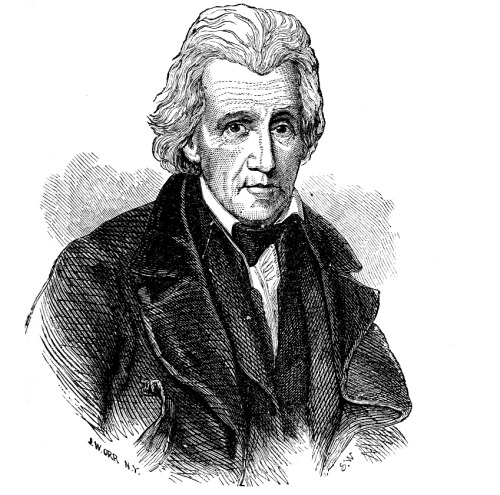
ANDREW JACKSON.
MARYLAND.
In 1632, Sir George Calvert (Lord Baltimore) visited America, explored a tract of country lying on the Chesapeake Bay, belonging to what was then called South Virginia, and returned to England to procure a grant for it. But before the patent was made out, he died, and it was given to his son Cecil. The province was named by King Charles I, in the patent, in honor of his Queen, Henrietta Maria. A part of the province appears to have been included in the grant made some time afterward to William Penn, and to have caused much contention between the successors of Penn and Baltimore.
In March, 1634, Leonard Calvert, the brother of Cecil, arrived at the mouth of the Potomac River, bringing with him two hundred emigrants, most of whom were Roman Catholic gentlemen. Leaving the vessel, he ascended in a pinnace as far as Piskataqua, an Indian village nearly opposite Mount Vernon. The Indian Sachem gave him full liberty to settle there if he chose; but not deeming it safe, he began a settlement lower down on a branch of the Potomac, at the Indian town of Yoacomoco. The settlement was called St. Mary’s.
Maryland made a very fortunate beginning. The colonists arrived in time to make a crop for that year. Their neighbors in Virginia supplied them with cattle, and protected them in great part from the Indians, while their own kind and consistent course materially promoted their happy relations with the savages.
The charter which had been granted them was very liberal—ceding to them the full power of legislation, without any interference on the part of the Crown. In 1635, they made laws for their government, which were somewhat modified in 1639. In 1650, they had an upper and lower legislative assembly, as had their Virginia neighbors.
Ten or twelve years after its settlement, Maryland was disturbed by an insurrection, headed by one Clayborne; but this difficulty was soon settled. It played a conspicuous part in the Revolution, and adopted the Constitution April 28, 1788. Its progress has been fair, its present population being 687,049. Its geographical position and the mixed political character of its people caused it to assume a rather dubious attitude at the commencement of the rebellion of 1861. Some of its best statesmen, however, were among the most uncompromising friends of the Union.
NEW YORK.
Captain Henry Hudson, the famous voyager, discovered what is now New York, together with a considerable extent of territory contiguous to it, in the year 1609. Although an Englishman by nativity, Hudson was at this time employed by the Dutch, (Hollanders) who, consequently, claimed the territory. Meantime the English set up a claim to it, as being part of North Virginia. They also claimed it on account of Hudson being an Englishman. The Dutch, however, determined to hold it, and in 1610 opened a trade with the natives at Manhattan Island, on the spot where the city of New York now stands. They erected a fort on or near the site of Albany, named the country in general, New Netherlands, and the station at Manhattan, New Amsterdam. The Dutch retained the country until the year 1664.
It seems that, up to this time, they claimed not only the present territory of New York, but also that of Connecticut and New Jersey. The liberal governments of the surrounding colonies stood in great contrast with the despotic one imposed by the Dutch Government upon their American colonists. And when, in 1664, the English squadron dispatched by James, Duke of York, with instructions to take possession of the province of New Netherlands, appeared before New Amsterdam, the inhabitants were willing to capitulate without resistance. Peter Stuyvesant, their Governor, and an able executive, made vain efforts to rouse them to defense, and was forced to surrender. The English Government was now acknowledged over the whole of New Netherlands, the capital receiving the name of New York, as well as the province. From this time forward to the Revolutionary War, New York remained in the hands of the English, and was under the control of a very arbitrary succession of Governors. The progress of the colony was steady, in numbers, wealth, and civilization. It took an active part in the Revolution, and adopted its Constitution July 26, 1788. After this it outstripped every other State in the Union in every thing pertaining to wealth and greatness, save education, in which matter no State can compare with Massachusetts. At the commencement of the great Rebellion, this noble State showed herself truly worthy to be ranked as the Empire State. She has furnished the Government more money than any other State. Her population is 3,880,735.
CONNECTICUT.
In the year 1633, the Puritans of Massachusetts, having heard very flattering reports of the valley of Connecticut, resolved to make an effort to settle it. Accordingly, a company of them sailed for the Connecticut River, taking with them the frame of a house. Meantime the Dutch, claiming the territory as theirs, built a fort on the river where Hartford now stands, to prevent the emigrants from passing up. The Yankees, however, with that steady perseverance which has always marked their course, proceeded on their way, paying no attention to the Dutch fort, whose only demonstration was an unexecuted threat to fire on the emigrants if they passed it. Landing where Farmington River enters the Connecticut, they founded the town of Windsor. Other settlements were subsequently formed at Westerfield, Hartford, and Watertown. The first general court was held at Hartford, in the year 1636. The province suffered severely from the depredations of the Pequod Indians, with which tribe a great and decisive battle was ultimately fought on the river Mystic, in the year 1636.[3] During this year the towns of Windsor, Hartford, and Wethersfield, met in convention and formed a Government, electing John Haynes the first Governor of the colony.
Its course from this period forward was one of great prosperity. It stood in the front rank during the war for Independence, and in no case was ever known to flinch from duty. It ratified the Constitution June 9, 1788. Its present population is 460,147.
At the commencement of the Rebellion, in 1861, its voice was for the Union and the Government of the Fathers. Its aid in behalf of freedom has been earnest and efficient.
RHODE ISLAND.
In June, 1636, Roger Williams, an earnest, enthusiastic advocate of religious liberty in the broadest sense, having been banished by the Puritans of Massachusetts from that colony, went to what is now known as Rhode Island, purchased the present site of Providence of the Narragansett Indians, and founded a colony, of which he was at once pastor, teacher, and father. He donated land to any whom he thought worthy, and Providence Plantation, as it was long called, became an asylum for persecuted Christians of all denominations, especially the Baptists. The first settlement in Rhode Island proper, was formed by William Codington, in the year 1636. Up to 1640, the citizens of Rhode Island made their own laws in general convention. But, in 1644, Roger Williams, with the aid of Gov. Vane, of Massachusetts, procured a charter for two settlements, under the name of Rhode Island and Providence Plantations. The Constitution framed under this charter was a good one; and lasted until the year 1818. For many years the legislative assembly of this colony met twice a year.
Rhode Island is distinguished as the smallest State in the Union. It did noble service in the war for Independence, but did not, for some reason, adopt the Constitution till the 29th of May, 1790. It has been a highly prosperous State; is distinguished for its good schools and large manufactories.
At the breaking out of the Rebellion in 1861, it stepped nobly forward in defense of the Government, sending its own Governor to Washington at the head of a regiment of volunteers. Its population is 174,620.
NEW JERSEY,
At first, formed a part of the Dutch province of New Netherlands. But soon after the latter came into the hands of the English, the Territory of New Jersey was transferred to Lord Berkley and Sir George Carteret, by the Duke of York. The first permanent settlement was formed at Elizabethtown, in 1664, by emigrants from Long Island. Philip Carteret arrived in the colony in 1665, and became its first Governor. The province had very little trouble with the Indians. Many emigrants from New England and New York soon arrived, and for a series of years the colony advanced in prosperity. It enjoyed the blessings flowing from a liberal form of government.
In the year 1685, the Duke of York became the King of England, under the title of James II, and disregarding his former pledges, assumed, in 1688, the government of New Jersey, placing it under the control of Sir Edmund Andros, whom he had already made Governor of New York and New England. This state of things was terminated by the revolution in England, but left New Jersey for years in a very precarious condition. In 1702, its proprietors having resigned their claims, it became a royal province, and was united to New York. In 1738 it became again a separate province, and so continued until the Revolution, in which it took a very active part in favor of liberty. It ratified the Constitution December 18, 1787. Thenceforward its career has been a highly prosperous one. Its strength has been put forth to aid in crushing the great Rebellion. Population 672,075.
DELAWARE.
Gustavus Adolphus, King of Sweden, formed a plan of establishing colonies in America as early as the year 1626. But as he died on the field of Leutzen, during the German war in 1633, without carrying his scheme into effect, his minister took it up, and employed Peter Minuets, the first Governor of New Netherlands, to carry it into effect. In 1638, a small Swedish colony arrived under the direction of Minuets, and settled on Christian Creek, near the present town of Wilmington. Notwithstanding the remonstrances of the Dutch Government of New Netherlands, who claimed the territory, the Swedes continued to extend their settlements from this time until they preëmpted all the territory from Cape Henlopen to the falls of the Delaware. At this time the colony was called New Sweden. In 1651, Governor Stuyvesant, to check the aggressive movements of the Swedes, built a fort near the present site of New Castle, of which the Swedes afterward obtained possession by stratagem. Enraged at this movement, the Government of Holland ordered Stuyvesant to reduce the Swedes to submission, which he speedily accomplished with six hundred men, in 1655. The province was soon after annexed to New Netherlands. Delaware was, after it fell into the hands of the English, included in the grant made to William Penn, in 1692. It remained attached to Pennsylvania till 1691, when it was allowed a separate government. It was reunited to Pennsylvania in 1692. In 1703, it was again separated, having its own legislature, though the same Governor presided over both colonies. The ancient forms of the government were preserved through the revolutionary struggle. It ratified the Constitution December 7, 1787.
Its position, at the commencement of the rebellion of 1861, was somewhat dubious. It being a northerly slave State, was somewhat divided as to where its interests lay. It, however, finally came out somewhat decidedly for the Union, although its entire strength has not been exerted against the rebellion. Its population is 112,216.
THE CAROLINAS.
In the year 1563, the coast of Carolina was explored, and named after Charles IX, of France. The first attempt to settle it was made by the celebrated and accomplished Sir Walter Raleigh, in 1585, twenty-two years before the settlement of Jamestown, and thirty-five years before the Puritans landed at Plymouth. This effort failed, on account of the incapacity of the Governor appointed by Raleigh, and the ill-behavior of the colonists toward the natives.
The first successful attempt was made sometime between 1640 and 1650, under the direction of Governor Berkley. The settlement was made in Albemarle County, by a few Virginia planters. In 1663, a large tract of land, lying between the 30th and 36th degrees of north latitude, having the Atlantic Ocean for its eastern boundary, was conveyed by Charles II, to Lord Clarendon and associates, under whose auspices a settlement was made near the mouth of Cape Fear River, in the year 1665, by emigrants from Barbadoes. Sir James Yeomans was appointed Governor. A settlement was made at Port Royal, South Carolina, in 1670; and in 1671, a few persons located at what was then called Old Charleston, which place was abandoned in 1680, and the foundation of the present city of Charleston laid, several miles nearer the sea.
All the various settlements here mentioned went under the general name of Carolina, until 1571, when a division was made, and the northern and southern portions were called by their distinctive names, North and South Carolina. These States were the scenes of many revolutionary tragedies. South Carolina, in particular, although the home of Sumter, and Marion, and Rutledge, was replete with tories, (royalists) who spared no efforts to annoy the infant Republic, and play into the hands of the British Government. South Carolina ratified the Constitution May 23, 1788, but threatened to break the compact in 1832, and was only prevented by the stern will of President Jackson. After this the State did nothing worthy of note until December 20, 1860, when it seceded from the Union, taking the lead in the great Rebellion. Present population 703,708.
North Carolina ratified the Constitution November 21, 1789, and seceded from the Union May 21, 1861. Population 992,622.
PENNSYLVANIA.
The Old Keystone State, and one of the most wealthy and prosperous in the Union, was settled by the Quakers, under the direction of Wm. Penn, at Philadelphia, in the year 1682. The founder of this colony showed himself a philosopher, a philanthropist, a thorough political economist, at the very commencement of his labors. He put the province under the government of a Council of Three and a House of Delegates, chosen by the freemen, who, according to his arrangement, were all those who acknowledged the existence of one God. He pursued such a course with the natives as won their confidence and esteem. No Quaker was ever murdered by an Indian; and to this day the “sons of Wm. Penn” are everywhere respected by the savage. The treaty Penn made with the Indians was never violated. In framing the colonial government, he provided for the largest religious liberty, allowing every one to worship according to the dictates of his own conscience. Up to 1684, Delaware, as before mentioned, was included in Penn’s grant. But about this time he procured a new charter, more strictly defining the rights and limits of Pennsylvania, and Delaware was detached. For seventy years prosperity smiled upon this colony, during much of which time Penn was, according to the historian, its governor, magistrate, preacher and teacher. It was troubled with no Indian wars till 1754, when Penn’s example and teachings began to be forgotten. The population, owing to a considerable influx from Sweden, Germany, and some other countries, began, at a later date, to assume a more varied aspect; and when the colonies rebelled against the mother country, Pennsylvania contained sufficient “fighting” material to lend valuable assistance to the cause of liberty.
She adopted the Constitution December 12th, 1787, since which time her increase in wealth, and advancement in general improvement has been almost without a parallel. Her vast coal fields and rich iron mines constitute a source of eternal wealth. Upon the breaking out of the rebellion of 1861, her position in favor of the Union was well defined.
Her population is 2,906,115.
GEORGIA.
General James Oglethorpe, and a company of twenty-one others, received, in the year 1732, from George II, of England, a grant for all the land between the Savannah and the Altamaha Rivers. In January, 1733, a company of one hundred and fourteen men, women, and children, arrived at Charleston, S. C., destined for Georgia. They were kindly treated by the Charlestonians, and were greatly assisted by them in their labor of forming a colony. The first laws made for the province by the twenty-two grantees, prohibited the importation of rum, trade with the Indians, and the use of negroes. They also provided that lands should go back to the original owners in case the purchaser had no male heirs. Although the first, second, and third of these provisions were undoubtedly wholesome, the fourth was highly objectionable, and tended very much to retard the progress of the colony. In the year 1740, General Oglethorpe, as commander-in-chief of the forces in Georgia, at the head of two thousand men, invaded Florida with the intention of forcibly annexing it to Georgia; but he was soon repelled from the territory, and returned home bootless. The Spanish, in turn, with two sail of vessels and three thousand men, invaded Georgia in 1742, and were likewise forced to return home thwarted. The progress of this colony was for many years very slow; the people manifesting that indolence and indifference which is still too prominent a characteristic of Georgians. It was mainly on the side of freedom during the revolution.
It ratified the Constitution January 9th, 1788. Since the Revolution, the State has manifested but little life as compared with its sisters, and its secession from the Union, May 19th, 1861, was followed by speedy ruin.
VERMONT.
The territory of which this State is composed began to be settled in the year 1731, but was for some years considered as a part of New Hampshire. It was also claimed at one time by New York, and a contest arose between that State and New Hampshire, which was adjusted by the King of England in a manner by no means satisfactory to the settlers. The result was a quarrel between Vermont and the Crown, in which the Green Mountain Boys, led by Col. Ethan Allen, resisted the officers of justice, as well as the New York militia, who were called out to sustain them.
The province appears not to have had even a territorial government until 1777, at which time a convention of delegates met at Westminster, and declared themselves an independent State, under the name of New Connecticut. Previous to this time, however, they had rendered material aid to the Revolution. In May, 1755, Col. Allen, at the head of two hundred and seventy men, reduced Fort Ticonderoga and Crown Point, and thus became complete masters of Lake Champlain. During the whole period of the Revolution the State did good service in the cause of liberty, although it remained independent. Some time subsequent to its declaration of independence its name was changed to Vermont. As it was not one of the original States, it did not ratify the Constitution, but, upon application, was admitted to the Union during the second session of Congress, in the year 1791. It has been a highly prosperous State, and added much to the luster of the Union in its palmy days of peace. It fully sustained its Revolutionary reputation at the commencement of the Rebellion of 1861. Its population is 315,098.
KENTUCKY
Was settled, in the year 1775, by Daniel Boone and a number of associates from North Carolina. The trials and adventures of these hardy pioneers, and especially those of Boone, constitute one of the most romantic leaves in the history of the West. For over two years, previous to 1775, Boone was busily employed in surveying Kentucky, building roads and forts. One of the latter he erected at Boonesborough; to which place he removed his family, in 1775. Boone said that his wife and daughter were the first white women who ever stood on the banks of the Kentucky River. For a number of years after Boone’s settlement, he and his associates experienced many difficulties with the natives—Boone’s daughter being at one time captured by the Indians, though shortly afterward rescued by her father. But, notwithstanding the difficulties with the savages, the young territory grew rapidly in population and wealth, and on June 1st, 1792, was admitted to the Union. Having a fertile soil, and affording excellent pasturage, she has far outstripped most of her slaveholding sisters in general improvement.
Her position for some time after the commencement of the Rebellion was by no means promotive of her prosperity. Owing to her attempt to observe strict neutrality, she became the scene of many guerrilla outrages, and has suffered, perhaps, more than any other State during the struggle.
Her population is 1,115,684.
TENNESSEE.
Was, for some time, a part of North Carolina. It was made a territorial government in the year 1790, and was admitted into the Union in 1796. The first permanent white inhabitants of Tennessee went there, in the year 1775, and built Fort Louden, now in Blount County. They were, in 1760, attacked by the savages, and two hundred persons were massacred. But, in 1767, the natives were reduced to submission by Colonel Grant, and a treaty was made with them, which encouraged emigration. Settlements were formed on Holston River in 1765, which, although frequently attacked by the Indians, made very fair progress. Colonel John Sevier, with the Tennessee militia and a few Virginia soldiers, gained a decisive victory over the savages, and, from this time forward, though more or less harassed by the Indians, the progress of the State, in population and improvement, was rapid. North Carolina gave up the Territory in 1789, and, in 1790, Congress recognized it as a separate province. It has great extent of territory, and, up to 1861, was considered as among the greatest of the agricultural States. At this time, however, it was seduced by the voice of the siren, Secession, and on the 24th of June, 1861, formally seceded from the Union. It should be stated, however, in justice to the State, that the eastern portion of it was generally loyal, and was only dragged out of the Union by force. It has, since the Rebellion, been readmitted into the Union.
OHIO.
Ohio was admitted to the Union on the 29th of November, 1802, the State containing, at the time, 72,000 inhabitants—2,000 more than was required in order to its admission. It was settled in the spring of 1788, one year after it, with a vast additional extent of North-western territory, had been ceded, by Virginia, to the United States.
The year 1788 was a famous year for emigration. It witnessed the passage of no less than 20,000 persons down the Ohio River. The company which settled Ohio consisted of forty persons, under General Rufus Putnam. They built a stockade fort at Marietta, of sufficient strength to resist the attacks of the natives, cleared several acres of ground, and planted a crop. They were joined by twenty additional families in the autumn. Both these companies were New England people.
For a number of years they were not troubled by the savages, nor did any of their number trouble the Indians, except in one or two instances. The earliest settlers of Cincinnati arrived there, about twenty in number in 1790. Until the year 1795, the attempts made to settle most parts of Ohio were attended with great difficulties, on account of Indian wars. Marietta, however, formed an exception to this rule. After the great victory which General Wayne achieved over the savages during Washington’s administration, the population increased rapidly. Unembarrassed by any centralizing or aristocratic institutions, possessed of the finest natural resources, and vitalized by an enterprising population, Ohio, after its admission into the Union, made an advancement of which any State might well be proud. In population it is the third State in the Union, numbering 2,390,502.
At the breaking out of the Rebellion, Ohio took its position staunchly for the Union, and has done much during the war for the restoration of the authority of the Government over the seceded States.
LOUISIANA.
Was ceded by Spain to France in the year 1802, and was bought by the United States of the latter power, in 1803, at a cost of $15,000,000. Governor Clayborne took possession of it the same year. It was settled by the French, at Iberville, in 1699, and was admitted into the Union April 8th, 1812. It is an important State, in that it holds the keys of entrance to the mouth of the Mississippi. In the year 1860, nearly one-half of its population was slave. It seceded from the Union on the 26th of January, 1861. Its population in 1860 was 708,002. It has been a very forward State in the great Rebellion.
INDIANA.
About the year 1690, a French settlement, the first in Indiana, was made at Vincennes, that place being within the territory claimed, at that time, by the French, upon priority of discovery by La Salle. Indiana was long the residence of various Indian tribes, and the theater of Indian wars. By the terms of the treaty of the peace of 1763, it, with the rest of the North-western Territory, was ceded to Great Britain. It was still claimed by the Indians, but, by various treaties, extensive tracts were obtained for settlement. The Indians, however, retained possession of many parts of the State up to the year 1812, and to that portion known as the Indian Reserve, even later. It was erected into a Territory in 1809, and on the 11th of December, 1816, was admitted into the Union. Its population—1,350,428, in the year 1860—is an indication of its progress. In the matter of education, Indiana is somewhat behind some of her Western sisters, but her efforts in behalf of the Government during the great Rebellion shall halo her future with glory.
MISSISSIPPI.
The territory comprising the present States of Mississippi and Alabama having been divided, that portion lying next the river was, in 1817, admitted into the Union as a State, under the name Mississippi, while the eastern portion was organized as a Territory, and named Alabama. The whole of this territory was explored, first by Ferdinand De Soto, and afterward by La Salle. It suffered greatly during the wars of the Natchez Indians. The Choctaws, for a long time, retained possession of the northern portion of it, and were, to some extent, civilized. Mississippi was settled by the French, in 1716, at Natchez. Its population—791,305—shows fair progress. On the 9th of January, 1861, it went the way of the seceding States, since which time, its course, like theirs, has been downward.
ILLINOIS.
This most thriving and prosperous State came into the Union on the 3d of December, 1818. Until 1809 it was a part of Indiana, at which time it became a separate territory, and so remained till received into the Union. This State has been little disturbed by civil divisions or by Indian wars. Its most serious troubles arose from the appearance, within its borders, of the Mormons, in 1838, and from attempts made to curb their irregularities. This singular people, believing themselves to be ill-treated, assembled to the number of 700, under their leaders, in a remote part of the State, and proposed fighting for their rights. But a body of three hundred troops marched against and captured them. The whole sect was ultimately reduced to submission, and banished the State. It was explored by La Salle, and settled by the French at Kaskaskia,[4] in 1720. Its growth has been immense. Its population, in 1860, was 1,711,951. Its history has been one of the most glorious of the loyal States during the great Rebellion.
ALABAMA
Was admitted to the Union on the 14th of December, 1819. It has a deep, rich soil, and in many places a healthful climate. It remained till the Revolution a mere hunting-ground of the savages. From the peace of 1783 to 1802 it was claimed by Georgia, and lands were sold to settlers and speculators accordingly. In the year 1802, Georgia ceded all her western territory to the United States for $1,250,000. In 1800, the present State of Alabama became a part of Mississippi Territory, from which it was separated when Mississippi became a State. It was settled, in 1711, at Mobile, by the French, being a part of the territory explored by La Salle in his Mississippi tour. It formally seceded from the Union, January 11, 1861.
MAINE.
In the year 1638, the same year in which New Haven was settled, Ferdinand Gorges procured a charter of the King of England for all the lands from the borders of New Hampshire, on the south-west, to Sagadahoc, on the Kennebeck River, on the north-east, under the name of the Province of Maine. It remained a separate province till 1652, when it became a part of Massachusetts. Various attempts were made, between 1785 and 1802 to form it into an independent State; but these efforts failed. In 1819 a large majority of the people were in favor of separating from Massachusetts. A convention was called, a Constitution prepared and adopted, and, in 1820, Maine was received into the Union. It is, by no means, an agricultural State, but its extensive fisheries and great lumber trade have greatly enriched it, and its progress in morality has, perhaps, been superior to that of any other State. It is the only State in the Union that has an efficient prohibitory liquor law. It proved itself true to the Government in 1861, and there is no danger of its ever ceasing to be so.
It was settled in 1625, at Bristol, by the English. Its population is 628,279.
MISSOURI.
This great, though crippled, State was admitted into the Union on the 10th of August, 1821. It, with all the territory then belonging to the United States, west of the Mississippi, was included in the purchase of Louisiana, made in 1803. Louisiana afterward was divided into Orleans Territory, Louisiana proper, and Missouri Territory. In 1819, Missouri Territory was divided into Arkansas, on the south, and Missouri on the north; and it was about this time that the latter took the requisite steps toward framing a State Constitution. It will be remembered that this is the State, the discussion of the propriety of the admission of which raised such a storm in Congress in 1820.
Being a border slave State, it was nearly equally divided on the question of secession in 1861, and thus, like Kentucky, has been overrun by both Southern and Northern troops during the Rebellion, and has been the scene of much bloodshed and ruin. It was settled in 1764, at St. Louis, by the French. Its population is 1,182,012.
FLORIDA.
The Peninsular States, discovered and explored by Ponce de Leon, a voyager with Columbus, and whose name was suggested to the discoverer by the abundance and beauty of its wild flora, was, from 1512 to 1819, with the exception of the interval between 1763 and 1783, a province of Spain. The first attempt to settle it was made in the year 1565, at St. Augustine, which is said to be the oldest town in America, by the Spaniards. This effort was attended with many difficulties, the colonists contending, for the first few years, alternately with the horrors of savage warfare and famine, at times being forced to subsist on roots and acorns. In 1819 it was transferred to the United States by treaty, which treaty was, after much delay, ratified by Spain, and with still more delay by the United States. Possession of the colony was granted the Government in July, 1821. The territory contained, in 1840, a population of 54,477, and on the 3d of March, 1845, became a State, and was received into the Union. Florida was the theater of the Seminole war, which cost the United States so much blood and treasure. It went the way of the seceding States, January 7th, 1861. Florida, like the Indian’s gun, has “cost more than she has come to.” Her population in 1860, was 140,425.
ARKANSAS.
This State lies South of Missouri, and was once attached to it. It has a fine climate and prolific soil. The first settlement of whites within its limits was made at Arkansas Post, in the year 1685. The earlier inhabitants were French. Its progress, for many years, was very slow. It was not till about the year 1829 that the tide of emigration began to flow from the Atlantic States in that direction. Little Rock, the early seat of government and the present capital, was laid out in the year 1820, during which year the first steamboat ascended the Arkansas River. The boat was eight days in going from New Orleans to the village of Arkansas—a distance of scarcely one hundred miles above the mouth of the Arkansas River. The State once contained the remnants of several powerful tribes of Indians. By a treaty made between the Cherokees and the United States, the former agreed to give up all their lands east of the Mississippi River, and to retire to a region guaranteed to them in the present State of Arkansas.
The State was admitted into the Union on the 15th of June, 1836. It seceded May 6th, 1861, and has since been the retreat of guerrillas, and the scene of some sanguinary battles.
MICHIGAN.
Was admitted into the Union January 26th, 1837. It had the requisite population (60,000) before this, but there were some difficulties in the way of its admission. In 1837 it contained 200,000; in 1840, 212,267, and in 1850, 851,470. The territory, when first discovered by the whites, contained a tribe of Indians called Hurons by the French, and Iroquois by the Indians themselves. Many of them were converted to Christianity, by the untiring labors of Catholic missionaries, as early as 1648. It was not, however, till 1670 that the French took possession of the territory. It was a portion of the extensive tract explored by the assiduous, daring La Salle. Its progress, while it belonged to the French, was very slow. It was not until 1763, when, by treaty, it was ceded to Great Britain, that much was done in the way of civilizing and improving it. Comparatively little, in fact, was done until 1783, when the territory was ceded by England to the United States. Until 1800 it was, for purposes of Government, considered a part of the Great North-western Territory. After Ohio, Indiana, and Illinois had been severally detached, the remainder, in 1805, became a distinct territory, the first Governor of which was General Hull, by appointment of President Jefferson. Michigan suffered much from the war of 1812. For about two years nearly the whole territory was the theater of sanguinary conflicts. It was exposed to the barbarity of the enemy and their Indian allies. Since then, however, its enterprising inhabitants have brought it up to a degree of improvement which few States of its age can boast. Its strength was offered the Government in 1861, and it continues as well as it began. Its population, in 1860, was 749,113.
IOWA.
This State derives its name from the Indians. It was included in the Louisiana purchase. It was first settled at Dubuque, by the French, in the year 1686. This settlement, however, does not seem to have been permanent, nor productive of any real good to the territory. In 1833 Burlington was settled by emigrants from the eastern States. It formed a part of Missouri from 1804 to 1821, when it was included in Michigan Territory. It subsequently belonged to Wisconsin Territory. It was admitted into the Union March 3d, 1845. It is a highly prosperous State, having a vast extent of rich soil and excellent pasturage. It is faithful to the Union; placed itself in the front rank at the commencement of the Rebellion.
TEXAS.
The territory of Texas was explored by Ponce de Leon and La Salle. After Mexico became independent of Spain, a grant which had been made to Moses Austin, a native of Connecticut, comprising a large tract of this province, was confirmed by the new Republic; and, being transferred by Moses Austin, at his death, to his son, Stephen, was subsequently enlarged by a further grant. Emigration from the United States was encouraged, and in 1830 nearly ten thousand Americans were settled in Texas. The prosperity of these inhabitants excited the jealousy of Mexico, and under the administration of Santa Anna, an unjust, oppressive policy was adopted toward Texas. Remonstrance proving useless, the people of the territory declared themselves independent. The revolution began in 1835, by a battle at Gonzales, in which five hundred Texans defeated over one thousand Mexicans. Other engagements followed, the result of which was the dispersion of the Mexican army. Santa Anna now redoubled his efforts, and appearing in March, 1835, with a force of eight thousand men, several bloody battles followed. On the 21st of April, having under his immediate command one thousand and five hundred men, he was met by General Sam. Houston, with eight hundred men, and totally defeated, on the banks of the San Jacinto. Santa Anna himself was captured the next day in the woods, when he acknowledged the independence of Texas, though the Mexican Congress refused to ratify the act. Active hostilities, however, were now abandoned, and the independence of Texas was acknowledged by the United States, Great Britain, and other European countries. It was in this condition of things that Texas was annexed to the United States. On the 24th of December, 1845, it was admitted into the Union, which act was ratified by the Texan Legislature, July 4th, 1846. But Mexico, still regarding Texas as a revolted province, refused to acknowledge the validity of this measure. The result was a war between Mexico and the United States, which terminated on the 2d of February, 1848, in a treaty by which the latter power, in consideration of the payment of a debt of $3,500,000, due from Mexico to the citizens of Texas, acquired New Mexico, Texas, and California. The progress of Texas from this time till the eve of the great Rebellion, was almost unprecedented, no less than twenty-five thousand Germans having emigrated to that State in five years’ time. These, however, owing to the jealousy aroused against them by their having demonstrated the superiority of free labor, even in a slave State, were obliged to migrate to Mexico in the year 1860. By this and other oppressive acts on the part of the advocates of slavery, Texas, purchased by the blood and treasure of the United States, was driven into the whirlpool of secession, March 4th, 1861. Its population, in 1860, was 604,215. The first settlement within its borders was made by the Spaniards, at St. Antonia de Bexar, in 1690.
WISCONSIN.
Was admitted into the Union May 29th, 1848. It was a part of the extensive territory ceded by France to Great Britain in the treaty of 1763. At the close of the Revolution it was given up by Great Britain to the United States. It was erected into a territory in 1836, the portion now forming the State of Iowa being detached in 1838. Its natural resources are extraordinary, the climate being very healthful, and the soil unsurpassed in fertility. It was settled in the year 1669, at Green Bay, by the French. It is thoroughly loyal to the Union. In 1860, it had a population of 775,881.
MINNESOTA.
Lies north of Iowa, and extends to the Canadian boundary. On the north-east it touches Lake Superior, and, to the west, is bounded by Dakotah Territory. It comprises the head waters of the Mississippi, and abounds in rivers and lakes, teeming with fish. Its soil is highly prolific, and its forests are among the finest in the world. Its name is derived from Minnisotah, the Indian name of St. Peter’s River. Primarily discovered by La Salle, it, for some years, belonged to the French, and at a very early period was traversed by their traders and soldiers. It was ceded to Great Britain by the treaty of 1763, and to the United States at the peace of 1783. It received a territorial government in 1849, and was admitted into the Union in May, 1858. It has still, within its borders, several bands of the Chippewas, with whom considerable trouble has been experienced since the breaking out of the rebellion. It is, however, a thrifty, growing State, and is thoroughly loyal. It was settled in 1846, at St. Paul, by emigrants from the eastern States.
OREGON.
Was admitted into the Union in the year 1859. It, primarily, included Washington Territory, and, with the latter, comprised the extensive tract lying between the British Possessions, on the north, and California, on the south; the Rocky Mountains, on the east, and the Pacific Ocean, on the west. The coasts of this region were discovered by the Spaniards in the 16th century. In 1792, Capt. Grey, of Boston, discovered and entered the Columbia River, and thus the United States acquired the right of sovereignty over the territory. The exploration of the country from the Missouri to the Columbia, by Lewis and Clark, government appointees, in 1804-5-6, strengthened this claim. The British, however, laid claim to the northern part of the territory, which gave rise to a threatening dispute between Great Britain and the United States. But the difficulty was adjusted by a treaty in 1846, establishing the boundary of 49°, north latitude. The State still contains the Flathead, Pend Oreille, Spokane, Shoshane, and other tribes of Indians, who are, for the most part, in the savage state, though the Christian missionaries have done much in the way of civilizing a portion of them. The furs of this region, those of the badger, beaver, bear, fisher-fox, lynx, martin, mink, muskrat, etc., have long been a great source of revenue.
The American fur companies established trading posts in Oregon at an early period, that of Astoria being founded in 1810, under the auspices of the late John Jacob Astor, of New York. It was settled, at Astoria, by emigrants from the Eastern States, in the year 1811. Its population amounted to 52,465 in 1860.
KANSAS.
About the development of this young State cluster some of the most important events of American history. Its territorial organization, by the passage of the Kansas-Nebraska Bill, in 1854, reopened the agitation of the slavery question, which seeming to have acquired fresh vigor and virulence from the sleep it had enjoyed under the Missouri Compromise, thoroughly aroused the old animosities between the pro and antislavery elements of our national politics. From 1854 to 1857 it was the theater of political tragedies, the bare mention of which may well put the blush of shame upon even the most fool-hardy partisan; and the historian has well said that these dire afflictions might have been expected when the bill organizing Kansas Territory was passed. No sooner was it decided that this territory was open alike to the abolitionist and the slave-holder, than the Emigrant Aid Societies of New England and the pro-slavery organizations of the South began pouring streams of settlers into it of opposite political views, entertaining the most hostile feelings, each party toward the other; and, as the legitimate result, came a civil war, which lasted about two years, and which, in some of its incidents would have shamed even savages.
The Territory made application to Congress, in 1857, for a place in the Union, but the Constitution under which it asked admission (the one framed at Lecompton) was known to be a fraudulent affair, and hence Kansas was rejected. The discussion of this Constitution caused a permanent division of the Democratic party. The Constitution was rejected by the people of Kansas by a majority of 10,000. Kansas was, however received into the Union, in 1861, under a free State Constitution, formed at Topeka.
CALIFORNIA.
Was admitted into the Union on the 7th of September, 1850. The alarming discussion which occurred upon the question of admission was what gave rise to the compromise measures of 1850, popularly styled the Omnibus Bill. The measures are presented in detail in another part of this work.
General Fremont, with a small but dauntless band of rangers, conquered California in 1846, having defeated, on frequent occasions, vastly superior forces of Mexicans. Its resources as a farming country early attracted attention. But when, in February, 1848, it was published that gold in quantities had been found on a branch of the Sacramento, the swarm of emigrants which rushed in, comprising representatives from every State in the Union, and from nearly all the nations of Europe, was almost incalculable. From a small village, San Francisco was rapidly inflated to a large city. In many places towns sprang up like mushrooms. Owing to the fact that its population had been thrown hastily together, from so many places, and in consequence of the want of a government, California was, for some time, the scene of many dark crimes and hideous outrages. Never was the want of wholesome legal restraint more keenly felt than here. The Constitution of California was framed by a convention of delegates in 1849. It took a firm stand for the Union in 1861. The first settlement, within its limits, was made at San Diego, by the Spanish, in 1764. It furnishes annually to the Government, seventy to eighty millions of dollars in gold.
WEST VIRGINIA.
On Virginia’s passing the ordinance of secession, mass meetings were immediately held in West Virginia, to take into consideration the best means of preserving their allegiance to the United States. A convention of nearly five hundred delegates assembled there early in May, 1861, which declared the ordinance of secession to be null and void, and elected delegates to a general convention, to meet at Wheeling, to devise such measures as the welfare of the people might demand. On the 20th of August, 1861, the convention passed an ordinance to provide for the formation of a new State out of a portion of the territory of Virginia. In compliance with its provisions, delegates were elected to a constitutional convention, which assembled at Wheeling, November 26, 1861, which proceeded to draft a Constitution, which was submitted to the people on the first Thursday of April, 1862. The vote in favor was 18,862; that against 514. On the 31st of December, 1862, Congress passed an act admitting West Virginia into the Union on an equal footing with the original States, in all respects whatever, allowing them three members in the House of Representatives of the United States. On the 1st of November, 1862, the State had furnished to the Federal Army nearly 20,000 men.
NEVADA.
This Territory having formed a State Constitution, under an enabling act previously passed by Congress, was admitted as a member of the Federal Union, on an equal footing with the original States. The State convention was held at so late a period of the year, that it was necessary to telegraph the Constitution to Washington, in order that it might be received there in time to secure the admission of the State previous to the Presidential election. Immediately upon its reception, President Lincoln issued a proclamation, dated October 31st, A. D. 1864, in which he “declared and proclaimed that the said State of Nevada is admitted into the Union, on an equal footing with the original States,” etc. The vote of the State at the Presidential election, in 1864, was 16,420—of which Mr. Lincoln received 9,826, and General McClellan 6,594. Majority for Mr. Lincoln, 3,232. This new State is probably the richest in the Union in respect to mineral resources. No region in the world is richer in argentiferous leads. Her silver mines are her great source of wealth. The Washoe region maintains the preëminence in these mineral resources.
NEBRASKA.
Nebraska was organized into a Territory in 1850. The first settlers were Americans. In the last few years it has increased in wealth and population more rapidly than any of the adjoining States or Territories. Probably the chief cause of this has been occasioned by the Pacific Railroad passing directly through the State from east to west. It is impossible, at the present time, to estimate the advantage it will be to the State in developing its resources. The value of its minerals in the western portion of the State is incalculable. It has fair prospects of becoming one of the richest mineral and agricultural States in the Union. Omaha, the capital, is a city of considerable commercial importance, being located at the junction of the Missouri River and the Pacific Railroad. In 1866, the Territory applied for admission into the Union, but, on account of the word “white” being used in its Constitution, it was rejected. The word was then stricken out, after which it was admitted, February, 1867—the bill for admission having been passed over the President’s veto.
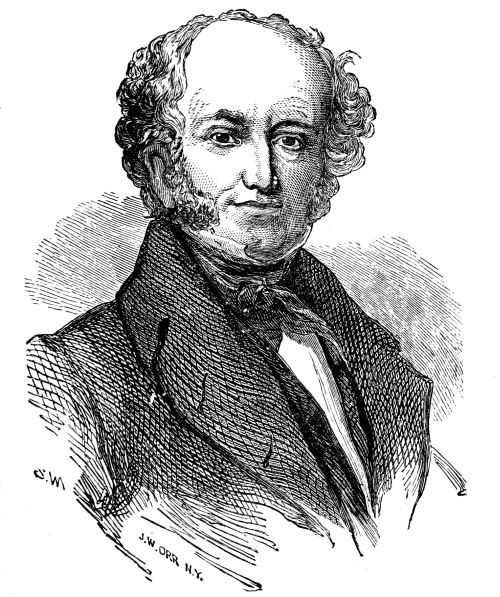
MARTIN VAN BUREN.