ANDREW JACKSON,
Reading edition
THE SEVENTH PRESIDENT OF THE UNITED STATES,
A statesman of rare integrity, and a general of invincible skill and courage, was born at Waxhaw, Lancaster County, South Carolina, in 1767, and while yet a mere lad, did something toward achieving the independence of his country. It is said that he commenced his military career at the age of fourteen years, and was soon after taken prisoner, together with an elder brother. During his captivity, he was ordered by a British officer to perform some menial service, which he promptly refused, and for this refusal was “severely wounded with the sword which the Englishman disgraced.” He was educated for the bar, and commenced practice at Nashville, Tennessee, but relinquished his legal pursuits to “gain a name in arms.” In the early part of the war of 1812, Congress, having voted to accept fifty thousand volunteers, General Jackson appealed to the militia of Tennessee, when twenty-five hundred enrolled their names, and presented themselves to Congress, with General Jackson at their head. They were accepted, and ordered to Natchez, to watch the operations of the British in lower Mississippi. Not long after, he received orders from headquarters to disband his men and send them to their homes. To obey, he foresaw, would be an act of great injustice to his command, and reflect disgrace on the country, and he resolved to disobey. He accordingly broke up his camp, and returned to Nashville, bringing all his sick with him, whose wants on the way he relieved with his private means, and there disbanded his troops in the midst of their homes.
He was soon called to the field once more, and his commission marked out his course of duty on the field of Indian warfare. Here for years he labored, and fought, and diplomatized, with the most consummate wisdom and undaunted courage. It was about this time that the treaty of the “Hickory Ground” occurred, which gave him the familiar sobriquet of “Old Hickory.”
The crowning glory of his whole military career was the battle of New Orleans; which will ever occupy one of the brightest pages in American history.
At the close of the war he returned to his home in Nashville; but in 1818 was again called on by his country to render his military services in the expulsion of the Seminoles. His conduct during this campaign has been both bitterly condemned and highly applauded. An attempt in the House of Representatives to inflict a censure on the old hero for the irregularities of this campaign, after a long and bitter debate, was defeated by a large majority.
In 1828, and again in 1832, General Jackson was elected to fill the Presidential chair; thus occupying that elevated position for eight successive years. He then retired to his hospitable mansion (“the Hermitage”), near Nashville, “loaded with wealth and honors bravely won,” where he continued to realize all the enjoyments that are inseparable from a well-spent life, until death translated him to those higher rewards, which “earth can neither give nor take away.” He died June 8, 1845, and his last hours were soothed by a trustful reliance on the Savior of the world for salvation.
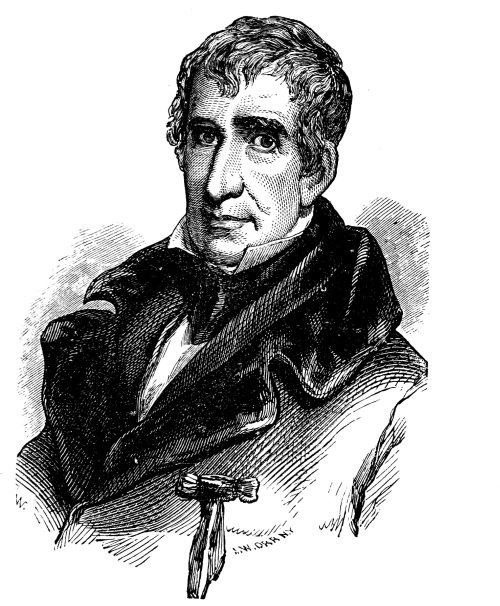
WILLIAM HENRY HARRISON.
Election for the Eleventh Term, commencing March 4, 1829, and terminating March 3, 1833.
A STATES. PRESID’T. VICE PRESID’T.
B C D E F
9 Maine 1 8 1 8
8 New Hampshire 8 8
15 Massachusetts 15 15
4 Rhode Island 4 4
8 Connecticut 8 8
7 Vermont 7 7
36 New York 20 16 20 16
8 New Jersey 8 8
28 Pennsylvania 28 28
3 Delaware 3 3
11 Maryland 5 6 5 6
24 Virginia 24 24
15 North Carolina 15 15
11 South Carolina 11 11
9 Georgia 9 2 7
14 Kentucky 14 14
11 Tennessee 11 11
16 Ohio 16 16
5 Louisiana 5 5
3 Mississippi 3 3
5 Indiana 5 5
3 Illinois 3 3
5 Alabama 5 5
3 Missouri 3 3
261 Whole No. of Electors 178 83 171 83 7
Majority131
COLUMN HEADINGS:
(A) = No. of Electors from each State.
(B) = Andrew Jackson, of Tennessee.
(C) = John Quincy Adams, of Massachusetts.
(D) = John C. Calhoun, of South Carolina.
(E) = Richard Rush, of Pennsylvania.
(F) = William Smith, of South Carolina.
Andrew Jackson took the oath of office, as President, and entered upon his duties March 4, 1829.
John C. Calhoun took the oath of office, as Vice-President, and presided in the Senate March 4, 1829.
A series of unfortunate political and social occurrences soon led to a rupture of that cordiality which had formerly existed between these two distinguished individuals, the consequences of which were peculiarly disastrous to the political aspirations of Mr. Calhoun, who was never afterwards regarded with much favor beyond the immediate limits of his own State.
Note.—It was during this administration that the doctrine of State’s rights was so strongly urged by Calhoun, and to this period may be dated the origin of the great rebellion of 1861.
Election for the Twelfth Term, commencing March 4, 1833, and terminating March 3, 1837.
A STATES. PRESIDENT. VICE-PRESIDENT.
B C D E F G H J K
10 Maine 10 10
7 New Hampshire 7 7
14 Massachusetts 14 14
4 Rhode Island 4 4
8 Connecticut 8 8
7 Vermont 7 7
42 New York 42 42
8 New Jersey 8 8
30 Pennsylvania 30 30
3 Delaware 3 3
10 Maryland 5 5 5 5
23 Virginia 23 23
15 North Carolina 15 15
11 South Carolina 11 11
11 Georgia 11 11
15 Kentucky 15 15
15 Tennessee 15 15
21 Ohio 21 21
5 Louisiana 5 5
4 Mississippi 4 4
9 Indiana 9 9
5 Illinois 5 5
7 Alabama 7 7
4 Missouri 4 4
288 Whole No. of Electors 221 49 11 7 191 49 30 11 7
Majority145
COLUMN HEADINGS:
(A) = No. of Electors from each State.
(B) = Andrew Jackson, of Tennessee.
(C) = Henry Clay, of Kentucky.
(D) = John Floyd, of Virginia.
(E) = William Wirt, of Maryland.
(F) = Martin Van Buren, of New York.
(G) = John Sergeant, of Pennsylvania.
(H) = William Wilkins, of Pennsylvania.
(J) = Henry Lee, of Massachusetts.
(K) = Amos Ellmaker, of Pennsylvania.
Andrew Jackson, re-elected President, took the oath of office, and continued his duties, March 4, 1833.
Martin Van Buren, having been elected Vice-President, took the oath of office, and attended in the Senate, March 4, 1833.
Early in June, 1833, the President left Washington on a tour through the Northern States, and was everywhere received with an enthusiasm that evinced the cordial approval of his administration by the people. One of his first measures, on returning to the seat of government, was the removal of the public moneys from the United States Bank, for which act he encountered the most virulent hostility of a small majority of the Senate, who passed resolutions censuring his course. But this injustice has not been perpetuated; for on the 16th of January, 1837, these partisan resolutions were expunged from the records by order of a handsome majority.