HON. HORATIO SEYMOUR,
Reading edition
The nominee of the Democratic National Convention for the office of President of the United States, is a native of the State of New York, having been born in Onondaga County, some time during the year 1811. He is consequently fifty-seven years of age at the present writing. His father being a gentleman of wealth, Mr. Seymour received an excellent education, and after his graduation engaged in the study of the law. Upon being admitted to the bar, he commenced the practice of his profession in the town of Utica, Oneida County, and soon became a popular lawyer. He did not long pursue this occupation, however. The death of his father made him successor to a large and valuable estate, attention to the interests of which compelled him to abandon all professional and public labors. He never after resumed practice.
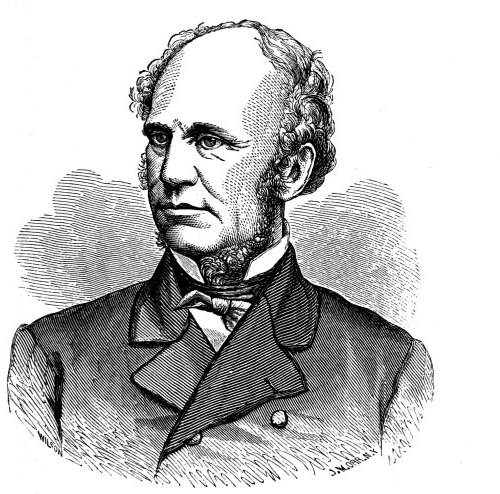
HORATIO SEYMOUR.
Mr. Seymour’s political predilections were, it may be said, inherited from his ancestors, all or nearly all of whom were and had been Democrats from the first formation of the party. To this political organization the subject of this sketch gave in his adhesion, and has ever since adhered to and been a prominent member of it. He first appeared before the public as a candidate for the suffrages of his fellow-citizens as the Democratic nominee for the office of mayor of the city of Utica. Although that city had been one of the firmest Whig strongholds, he was elected by a fair majority, as much owing, though, to the feeling of dissatisfaction with the opposing candidate, as to his personal popularity. The election took place in 1842, before he had quite attained his thirty-first year. During the same year, he was elected to the lower house of the State Legislature, and served until 1845, when he declined a reëlection. His ability as a legislator brought him considerable reputation, and had the effect of extending his popularity, which had hitherto been confined to a rather limited extent of territory.
From 1845 to 1850, Mr. Seymour does not appear to have held any political office, although he took an active part in politics, stumping the State for other candidates, and doing all that he could to further the interests and insure the success of the Democracy. During the latter year, however, he had attained to sufficient prominence to warrant his nomination for the office of Governor. His opponent was Washington Hunt, and after a very exciting contest, Mr. Hunt was elected by a majority of 262, in a total of 428,966 votes cast. The balance of the Democratic ticket was elected, and this fact had the effect of temporarily obscuring Mr. Seymour’s prospects. Still, he soon recovered from this reverse of fortune, and in 1852, was re-nominated for the same office. As before, his competitor was Mr. Hunt, whom he defeated, after an exciting canvass, by a majority of 24,385, in a total vote of 503,857. This victory added considerably to his popularity, as it was believed to presage a long lease of power to the Democratic party. His administration was distinguished by his veto of the Maine Liquor Law bill, which had passed both houses of the Legislature, and which action on the part of the Governor was regarded at the time as a bold stroke of policy. But it was not fated that the Democratic party should longer remain in power. In 1854, four candidates for gubernatorial honors appeared in the field—Horatio Seymour, regular Democrat; G. C. Bronson, hard shell Democrat; Myron H. Clark, Republican, and D. Ullman, Know-Nothing. The split in the Democratic party resulted in its defeat by a remarkably small majority. Nearly half a million votes were cast, of which Mr. Clark and Mr. Seymour received the highest, the former being elected by 309 majority.
After this defeat, Mr. Seymour returned to private life, nor was his name mentioned again in connection with public offices until 1856, when he was spoken of as one of the possible candidates of the Democracy for the Presidency. The movement, however, came to nothing. He still took an active part in politics, so far as a vigorous support of all Democratic candidates was concerned. When the rebellion broke out, Mr. Seymour took an active part in furthering its suppression, and served as chairman of the War Committee in his county, aiding in forwarding troops to the seat of war. In 1862, he was once more nominated by the Democrats for the office of Governor, and was elected by a majority of over ten thousand. During his administration he had quite an angry controversy with the general government on the subject of the draft, he claiming that the quota of troops from the southern portion of the State, which gives immense Democratic majorities, was larger in proportion to the voting population, than that of the northern or republican sections. The matter was finally settled by a revision of the draft list. In 1863, the draft riots broke out in New York city, and Mr. Seymour immediately left Albany for that place. Arriving there, he addressed the rioters, urging them to disperse and go home quietly, and promising to do all that he could to stay the execution of the law. At the same time he organized a force of citizens, which he armed and kept on duty, until the arrival of troops from Pennsylvania restored order. In 1864, he was for the fifth time nominated for the office of Governor, and was defeated by Mr. Fenton by a majority of over eight thousand.
Since the close of the war Mr. Seymour has taken an active part in politics, although he has never been a candidate. In personal appearance he is quite dignified, and is said to be a very sociable and hospitable gentleman. As a public speaker he is fluent, eloquent, and argumentative, and wherever he takes the stump he is always received by large crowds. Until a late day of the Convention he positively asserted that he would not accept the nomination of the Democracy for the Presidency, but it is natural to suppose that he will now reconsider this resolution after the unanimous vote by which he was nominated.