Front matter (continued 8)
Reading edition
"Very likely you have thought this all out for yourself and intend to see that every dollar you may use is expended legitimately."
Paul let the automobile come to a halt, and removing his goggles proceeded to wipe off the dust and moisture.
"Aunt Miriam, every word which you've said is gospel truth; but—and it is a large but—if I were to follow your advice to the letter there would not be the slightest possibility of my securing the nomination. I've thought it all out, as you say, and I'd give gladly to charity twice the sum I shall be compelled to spend, if I could only confine my outlay to legitimate expenses, stationery, printing and the hiring of a few halls. I've no objection to explaining to you why I can't, provided I wish to keep in the running. There are three men including myself in this district," he continued, starting the lever, "who are bidding for the nomination. Each of us has a machine, a machine the function of which is to create enthusiasm. Ninety per cent. of the candidates for public office do not inspire enthusiasm; they have to manufacture it. And there are all sorts of ways of doing so; by paying club assessments and equipping torch-light paraders with uniforms; by invading the homes of horny-handed proletarians and sending tennis or ping-pong sets to their progeny; or by the solider, subtler method of large direct cash payments, which can never be detected, to a certain number of local vampires as expenses for influence, and whose quid pro quo is the delivery of the goods at the polls. I have engaged a smooth and highly recommended patriot at a high salary to conduct my canvass. He has told me there will be large expenses. When he asks for money I draw a check and ask no questions—a rank coward's way I admit. I know nothing as to what he does with the money, and so I salve my conscience after a fashion." Paul shrugged his shoulders and applied a little more power to the automobile, while he chanted:
"Some naturalists observe the flea Has smaller fleas on him to prey, And these have smaller still to bite 'em, And so proceed ad infinitum.
"Which means, my dear aunt," he continued, "that when a rich man runs for office a certain proportion of the free-born consider that they are entitled to direct or indirect pickings in return for a vote."
Mrs. Wilson sighed. "But is not the price too high for a free-born citizen to pay? Why exchange private life and the herbs of personal respect for publicity and a stalled ox which is tainted?"
"I've thought occasionally of getting out, but father would be disappointed. I wish to go to Congress myself and the party wishes me to go. And what would be the result if I retired? One of the other two would win, and I don't throw any large bouquet at myself in stating that I shall make a much more useful and disinterested Congressman than either of them."
Mrs. Wilson shook her head, but at the same time she appreciated the difficulties of the situation. For she herself desired to see her nephew go to Washington. It was one thing to tell him to take a brave stand and refuse to swerve from the path of highest political probity, another to advise him in the midst of the canvass to dismiss his manager and thus invite certain defeat. It sometimes seemed to her that the ways of the world of men were past understanding. She wondered whether, if human affairs were in the hands of women, the rivalry of politics and the competition of commercialism would tolerate the same army of highwaymen who held up would-be decent citizens as successfully and appallingly as Dick Turpin and Claude Duval. She liked to believe that complete purity would reign, and yet the memory of what some women to her knowledge were capable of in the bitterness of club politics served as a caveat to that deduction. Discouraging as Paul's observations were, as bearing on the ethical progress of human nature, and deeply as she deplored the fact that he appeared to be winking at bribery, she recognized that she had shot her bolt, for she was not sufficiently conversant with the different grades of electioneering impropriety to be willing to take on herself the responsibility of imploring him to retire, even if he would consent to do so. But the confession had robbed the day of much of its beauty for her. She glanced at the little clock in the dashboard, and remembering that she desired to leave a message for her secretary, to whom she had given an afternoon off, she asked Paul if he would return home by way of Lincoln Chambers.
It happened that in turning something went wrong, so that the automobile came to a stop. Paul was obliged to potter over the mechanism a quarter of an hour before he was able to get the better of the infirmity. Somewhat nettled, and eager to make up for lost time and to demonstrate to his companion that in spite of this mishap a red devil was the peer of all vehicles, he forced the pace toward Benham. By the time he was within the city limits his blood was coursing in his veins as the result of the impetus, and he felt on his mettle to amaze the onlookers as he sped swiftly and dexterously through the streets. Gliding from avenue to avenue without misadventure he applied a little extra power as they flew down that street around one corner of which stood Lincoln Chambers, in order to make an impressive finish. In turning he described an accurate but short circle, so that the automobile careened slightly, causing Mrs. Wilson to utter an involuntary murmur. Paul, amused at her nervousness, suffered his attention to be diverted for an instant; the next he realized that a young child, darting from the sidewalk, was in the direct path of the rapidly moving machine. He strained every nerve to prevent a collision, shutting off the power and endeavoring to deflect the vehicle's course so that it might strike the curbstone to their own peril rather than the child's; but the catastrophe was complete almost before he realized that it was inevitable. There was a sickening bump, accompanied by the screams of women; the red devil had overwhelmed and crushed the little victim, and stood panting and shaking like a rudely curbed dragon.
Paul jumped from his seat and lifted the child from the gutter into which it had been hurled and where it lay ominously still with its head against the curbstone. He found himself face to face with two women, in one of whom he recognized his aunt's secretary. The other with an assertive agony which made plain her right to interfere, sought to take the child from him—a flaxen-haired girl of about four—exclaiming:
"Oh, what have you done? You've killed her. You've killed her."
Meanwhile Mrs. Wilson, utterly shocked, sought to keep her head as the only possible amelioration of the horror. She whispered in Paul's ear: "There's a drug store opposite. We'll take her there first and send for a doctor." At the same time she put her arm around the mother's shoulder, and said, "Let him carry her, Loretta, dear. It is best so."
Loretta Davis desisted, though she stared wildly in her patron's face.
"The blood—the blood," she cried, pointing to the tell-tale streaks on the child's head. "I'm sure she's dead."
Acting on his aunt's suggestion, Paul bounded across the way with the limp form clasped in his arms. While those immediately concerned endeavored with the aid of the apothecary to ascertain that the injuries were not grave, a curious crowd began to gather in the store. By the time that the trial of the ordinary restoratives had made clear that the child was already beyond the aid of medicine, though Mrs. Wilson and Constance wrung their hands and counted the seconds in hope that the physician telephoned for would arrive, a reporter, a policeman, and a doctor appeared on the scene. The physician, who happened to be passing, was Dr. Dale, the oculist with the closely cut beard and incisive manner who had attended Constance. A moment's inspection sufficed him for a verdict.
"There is nothing to be done," he said.
At the fell words a wave of anguish passed through the group. Paul allowed Mrs. Wilson to take the baby from him; and, overwhelmed beyond the point of control, he bowed his head in his hands, and burst into tears. His aunt reverently clasped the stiffening form to her bosom regardless of the oozing blood which mottled her cloak.
"We must get Loretta home as quickly as possible," she whispered to Constance, and she started to lead the way so as to save the situation from further publicity.
But now that the doctor's usefulness was at an end, the two other representatives of social authority advanced their claims for recognition. The police officer, having relegated the gaping spectators to a respectful distance, began to inquire into the circumstances of the accident, in which he was ably surpassed by the agent of the press, who, note-book in hand, had already been collecting material from the bystanders and composing a sketch of the surroundings before interviewing the principals. Paul gave his name and address, and made no attempt to disguise his responsibility for the tragedy. Mrs. Wilson, finding her way barred by the two functionaries, grudgingly gave similar information in the hope that they would be allowed to escape. As she bore the victim in her arms, this would have been the result had not Loretta, who was following close behind under the supervision of Constance, and who up to this point had seemed dazed by the proceedings, suddenly realized what was taking place. She clutched Constance's arm.
"Will it be in the newspapers?" she inquired with feverish interest.
The reporter overheard her inquiry. "You are the mother of the little girl, madam?" he asked, addressing her, pencil in hand.
"Yes. She is my only child."
"Your name is?"
"Loretta Davis."
"And the child's?"
"Tottie. She would have been five in a few weeks."
The reporter perceived that he had found a responsive subject. "I lost a little girl of just that age two years ago," he volunteered sympathetically. "Is there a photograph of Tottie which you could let me have for the press? The public would like to see what she looked like."
Loretta's eyes sparkled. She thrust her hand in her pocket and drew forth a photographer's envelope. "Isn't it lucky," she cried, "I got these proofs only yesterday, and they're the living image of my baby."
As she hastily removed the package from her pocket, together with her handkerchief, Loretta let a small bottle slip to the floor. Constance, who was spellbound with dismay at the turn of affairs, stooped mechanically to pick it up. She recognized the pellets lauded by Loretta. In doing so her head nearly bumped against that of Dr. Dale, who was intent on a similar purpose. He got possession of the bottle, and instinctively he glanced at the label before transferring it to Constance. She observed that he shrugged his shoulders. As she put out her hand to take it from him, she said in a low, resolute tone:
"Will you tell me what those are?" Then as the physician regarded her searchingly, she added, "I have a special reason for asking. I wish to befriend her."
"Cocaine tablets," answered Dr. Dale. "The woman has the appearance of a drug habitué."
XXV
In parting with the Rev. Mr. Prentiss without personal rancor and yet with an open avowal of his conviction that Constance would marry him in the end, Gordon Perry both made an admission and issued a challenge. His admission on the surface was simply that he recognized the rector's sincerity. In his own consciousness it went further; he recognized the validity of the conflict between them to an extent which he had up to this time failed to perceive, or at least to acknowledge.
The effect of this was to intensify the ardor of his convictions, but at the same time to cause him as a lawyer to respect his opponent's position, though he believed it to be utterly false. The interview had been absorbing to him sociologically, for it had crystallized in his own mind as concrete realities certain drifts or tendencies of which he had been aware, but which he had hitherto never formulated in words. Now that the occasion was come for doing so, the indictment—for it was that—had risen spontaneously to his lips. It was clear to him, as he had informed Mr. Prentiss, that there was a direct strife in American social evolution between those who sought eternal truth through the free processes of the human spirit and those who accepted it distilled through an hierarchy.
Just as in his sociological perplexities Gordon, yearning to be a sane spirit, had abstained from radicalism and had sought relief in concrete practical activities, he had watched the theological firmament and had felt his way. If he realized that the Christian organizations which saw in the human soul a dignity which rejected mediation were merely holding their own as formal bodies, he comforted himself with the knowledge that the thousands of men and women who rarely entered the churches—among them many of the most thoughtful and busiest workers in the land—were to a unit sympathizers with the creed of soul-freedom and soul-development. Not merely this; he knew that among orthodox worshippers the secret belief of the majority of the educated already rejected as superfluous or antiquated most of the old dogmas. But with his reverence for religion as an institution, Gordon had no ambition to outstrip his generation; simply to be in the van of it. There was no attraction for him in iconoclasm; he craved illumination, yet not at the expense of rationalism. Now suddenly the practical issue of the Church's interference with the State, of the Church's imposition on mankind of a cruel, inflexible ideal, labelled as superior purity, had become both an immediate and a personal concern. His soul felt seared as by an iron; all his instincts of sympathy with common humanity, the helpless victims of an arbitrary aim to preserve the family at the expense of the blameless individual, were aroused and intensified. Viewed as a general issue, Gordon felt no question as to the outcome. Was it not already decided? The Church had never ceased to deplore as usurpation society's constantly louder claim the world over of the right to regulate marriage, but without avail. It was only abuse by the State which had produced a reaction and given sacerdotalism another chance. But the particular, the personal issue, was a very different matter. For him it meant everything, and his whole being revolted at the possibility of losing the great joy of life through such a misapprehension of spiritual duty on the part of her who, so far as he was concerned, was the one woman in existence. Yet during the next weeks following the interview with the clergyman he experienced a sense of flatness which was almost despondency, for he realized that he had exhausted his resources. Mr. Prentiss had refused to aid him; on the contrary, had virtually defied him by expressing a triumphant conviction that Constance's decision was final. Could it be that she, whose lucidity of mind he had been wont to admire, would refuse to understand that the barrier which seemed to separate them was but an illusion? Surely it was not for the good of the world that true love—its most vital force—should be starved because the marriage tie was played fast and loose with by others. And yet he appreciated apprehensively the subtlety of this plea for the world's good; how modern it was, and how attractive to woman when made the motive for the exercise of renunciation. Truly, the priest had argued shrewdly, yet Gordon refused to admit that Constance could be deceived for long. That seemed too incompatible with her previous outlook and their delightful comradeship which had held love in disguise.
He concluded forthwith that his best hope lay in terminating that comradeship. To resume it would make them brother and sister, a relation tantalizing to him, and which might be better than nothing to her, and thus strengthen her resolve. Accordingly, with Spartan courage, he never visited her. But he chose by his letters and his gifts to let her know unequivocally that he was waiting for her to relent—would wait until the end of time. He wrote to her that her dear image was the constant inspiration of his thoughts, and that he sighed for the sound of her voice.
While thus he chafed within, and yet endeavored to pursue his work as earnestly as though he had been able to forget, he received and accepted an invitation from the Citizens' Club to become a candidate for the State Assembly. He saw in this both relief and an incentive; public service would tend to divert and refresh his thoughts, and opportunity would be afforded him to promote legislation. It would suit him to become a member of the free parliament of men where, whatever its abuses and shortcomings, the needs of ordinary humanity were threshed out, and where true, practical reforms were piece by piece won from the vested traditions of the past.
At the same time he declared to the members of the committee which waited on him that in accepting their nomination he was not to be understood as offering himself to the voters as a denunciatory radical or as advocating all the so-called grievances aired at the Citizens' Club. His words were, "I agree to support every measure which I believe would be an immediate benefit to the community from the standpoint of justice and public usefulness. If you are content with that guarded generalization, I shall be proud to serve you; but if you insist on my playing the demagogue or wearing the livery of the enemies of constituted society, I must decline the nomination."
"That's all right," asserted Hall Collins, who was the spokesman. "What we want this trip are two or three new pieces of timber in the ship of state, repairs we'll call them if you like it so, and we've chosen you as carpenter for the job. Side with us when you can, and when you can't we'll know you're honest."
This voiced the sentiment of the Citizens' Club, and it was no disparagement to the sincerity of its action that those who directed the club's affairs cherished hopes that the nominee, through his standing, would gain support from other quarters than the radical element and thus be more likely to win. Their hopes were justified. Gordon had a comfortable majority in his district, though it was understood that he had affiliations with so-called socialists and labor reformers.
During the first year of his service as a legislator he made no effort to fix public attention on himself by forensic readiness. He was studying the methods of procedure and familiarizing himself with the personnel of the assembly. But though his name did not appear conspicuously in the press notices—which was a disappointment to a certain lady constantly on the watch for it—this did not mean that he failed to attract the attention of his associates. On the contrary, his thoroughness, patience, and fairness were soon recognized, and when he rose to speak—which he did more frequently in the later weeks of the session in relation to bills of importance where the vote was likely to be close—the members paid attention as though they were glad to know his reasons. It was perceived that he inclined to the party of progress rather than to the conservatives, but that he did not hesitate to turn a cold shoulder towards or to rebuke mere blatherskite or visionary measures.
A modern legislature has to deal with questions which vitally affect the development of the body politic; the relations of powerful corporations to the public and it to them; the demands of toiling bread-winners for shorter hours of labor and hygienic safeguards, and the newly fermented strife between the right to hold and the obligation to share the fruits of the earth and the profits of superior ability and industry. These were problems which particularly interested Gordon, and, as one by one they arose for action, he sought to solve each on its merits without prejudice and with an eye to justice. It was understood that he would be a candidate for the next assembly, and in making their forecast the sophisticated referred to him as a coming leader, one of the men who would control the balance of power by force of his intelligence and independence. The Citizens' Club was content with the part which he had played. Several measures in which it was interested had become law through his advocacy; others, though defeated, had gained ground; two notable bills conferring valuable franchises for next to nothing upon plausible capitalists had been exposed and given their quietus in spite of a persistent lobby; and the candidate had promised during the next session to press the bill for a progressive legacy tax, an amendment to the existing legacy tax law, which would increase the sum levied in progressive ratio with the size of every estate transferred by death. This was a reform which Hall Collins and his intimates had at heart, and they had won Gordon to their side as an enthusiastic supporter of its essential reasonableness. The bill had been killed in committee for the past two years; yet the present year the adverse report had been challenged in the house and had been sustained by a comparatively small majority after strenuous and excited appeals to what was termed the sober, conservative sense of the American people. Gordon's speech in behalf of the measure was listened to with a silence which suggested a desire for enlightenment. After the debate was over there had been prophecies that another year it would stand a good chance of passing.
It was toward the close of Gordon's first session in the assembly that the harrowing death of Loretta's child occurred, and, owing to the prominence of the parties concerned in the homicide, which was the first automobile accident in Benham, became town talk. The newspaper artists illustrated the tragedy with drawings of the red devil in the act of striking the victim, portraits of everybody concerned, from Tottie to the apothecary into whose shop she had been carried, and camera cuts of the obsequies. There were appropriate editorials on the iniquity of allowing furious engines to be propelled at a rapid rate through the streets; and sensational conflicting rumors were rife in the news columns as to the amount by which the repentant multi-millionaire had sought to idemnify the mother for his carelessness. Conjecture fixed it at various sums from one thousand to fifty thousand dollars, and one imaginative scribe conjured up the information that Tottie was to be replaced as far as possible by the most beautiful baby which the Howard family could procure by search or advertisement.
In his genuine distress for the irreparable evil he had wrought Paul Howard had gone straightway to Loretta to pour out his contrition and to express a willingness to make such amends as were possible for the catastrophe. He saw her twice; the first time on the day following the accident, when she appeared excited but dazed; the second on the morning after the funeral. Then her condition of mind bordered closely on exaltation as the result of being the temporary focus of public attention. She was surrounded by newspapers, and she insisted on calling Paul's notice to all the reportorial features. With special pride she made him note a cut which showed that the coffin had been piled high with the most exquisite flowers—a joint contribution from Mrs. Wilson and himself. Loretta's own apartment was also a bower of roses from the same sympathizing source, and the young woman was in her best dress-festal mourning—as though she were expecting visitors. Paul found some difficulty in broaching the question of indemnity. He was in the mood to draw his check for any sum in reason which the bereaved mother should declare to be satisfactory compensation for her loss even though it were excessive, so that he might adjust the matter then and there. He had every intention of being generous; moreover he knew that all this publicity concerning the accident was injuring his canvass for the Congressional nomination, and he hoped to create a reaction in his favor by behaving handsomely. But Loretta, though she obviously understood what he was driving at, evaded the topic, and when, in order to clinch matters, he told her in plain terms that he wished to make her a present and asked her to name the sum, she looked knowing and suspicious, as much as to say that she knew her rights and had no intention of committing herself.
Paul, who mistook her contrariness for diffidence, was on the point of naming an amount which would have made her open her eyes when she suddenly said with a leer intended to convey the impression of shrewdness:
"I'm going to talk with my lawyer first. People say it was all your fault, and that I ought to get a fortune. I've witnesses for my side."
Paul was taken aback. "It was all my fault. I've told you already that I was entirely to blame. And I'm anxious for you to tell me how much I ought to pay as damages. So there won't be any need of a lawyer on either side."
Loretta argued to herself that she was not to be caught by any such smooth words. She tossed her head.
"I don't know about that. I'm going to get one of the smartest attorneys in Benham to attend to my case." She waited a moment, then added triumphantly, believing that her announcement would carry dismay to her crafty visitor, "It's Gordon Perry, Esq., Counsellor-at-Law."
"Gordon Perry?"
Loretta construed his inflection of astonishment as consternation.
"Yes," she said, "I'm going to consult him this afternoon."
It was on Paul's lips to inform her that Gordon was his lawyer too, but her uncompromising attitude had produced its natural effect, and he felt at liberty to practise a little craft in his turn. If he were to disclose the truth, she would be likely to consult someone else; whereas Gordon and he could come to terms speedily. So he merely responded that he knew Mr. Perry to be an excellent attorney, and that he would be content to abide by his decision.
The final settlement required some diplomacy on Gordon's part on account of the difference in point of view between the contracting parties. Loretta had definitely fixed on ten thousand dollars as the Mecca of her hopes, than which, as she declared to Gordon at their first interview, she would not accept a cent less; whereas Paul was disposed to make her comfortable for life by a donation of twenty-five thousand. He naturally had discussed the subject with his aunt, and this was the sum which had been agreed on between them as fitting. Mrs. Wilson was overwhelmed by the disaster; it haunted her thoughts; and, though she remembered Loretta's original indifference regarding the child, it seemed to her that the only possible expiation would be a princely benefaction, such as would thrill the bereaved recipient. But when she in her turn mentioned the matter to Constance, the latter, who had been mulling over the insinuation uttered by Dr. Dale, informed her what he had said. The effect of this intelligence was to strengthen the purpose which Mrs. Wilson and Paul had already formed to have the gift tied up so that Loretta could use only the income, and thus be protected indefinitely against designing companions and herself. But when Gordon, who had abstained from revealing the extent of Paul's intended liberality, suggested this arrangement, he encountered sour opposition from his client. It was manifest that Loretta had set her heart on being complete mistress of the ten thousand dollars, and that any curtailment of her power to exhibit it and spend it as she saw fit would be a bitter disappointment. Either she did not understand, or declined to understand what was meant by a trust, and plainly she regarded the proposition as a subterfuge on the part of the donor to keep his clutch on the money. Gordon endeavored to reason with her and to show her the disinterested wisdom of the plan, but she shook her head no less resolutely after he had finished. When her repugnance was stated to Paul, he bade Gordon pay her the ten thousand dollars in cash and say nothing about the remainder. He added good-naturedly:
"I suppose it's natural enough that she should like to finger the money. Let her blow it in as she chooses, and when it's gone I'll settle an annuity on her."
Loretta came to Constance on the following day with glittering eyes and exhibited her treasure-trove—a bank book and a roll of bills.
"It's all there," she said. "My lawyer went with me and he saw me hand it all over except this hundred dollars to the man in the cage. My lawyer made me count it first. He's smart—Gordon Perry, Esq., Counsellor-at-Law. I'm rich now."
"But you will go on nursing just the same, won't you, Loretta? It's your profession, you know."
Loretta looked non-committal. "Perhaps. But I'm going to take a rest first and—and buy a few things." She spread out proudly the new crisp bank bills like a pack of cards. "I've never been able to buy anything before."
Solicitous as she felt regarding the future, Constance had not the heart to repress sympathy with this radiant mood. Blood money as it was, it would, nevertheless, mean many pleasures and comforts to the pensioner. It was no time for advice or for extracting promises of good behavior. So in a few words she showed the approach to envy which was expected of her.
By way of recompense, or because she had been waiting for congratulations to be paid first, Loretta presently paused, looked knowing, and giving Constance a nudge whispered oracularly, as one whose views were now entitled to respectful consideration, "I sounded him about you, Constance, and it's all right. I could see it is, though I guess he didn't like much my speaking. And what do you suppose I told him? That he mustn't get discouraged, for one had only to look at you to know that you were perfectly miserable without him."
"How dare you tell him such a thing? What right had you to meddle?" cried Constance, beside herself with anger and humiliation. She clenched her hands; she wished that she might throw herself upon this arch, complacent busybody and box her ears. "This is too much! Besides, it is not true—it is not true."
"True? Of course it's true. And why should you mind its being true if you love him? I was trying to help you, Constance, so there's no use in getting mad."
Obviously Loretta on her side was surprised at the reception accorded her good offices, and at a loss to explain such an abnormal outburst on the part of her habitually gentle comrade. Perception of this swiftly checked the current of Constance's wrath, but, as her equanimity returned, the eyes of her mind became pitilessly fixed on herself. Perfectly miserable! Was not that indeed the real truth? And true not only of her but of him? Of him, who had told her that she was sacrificing the joy of both their lives to a fetich. Loretta's rude probing had made one thing clear—that it was futile to try longer to persuade herself that she was happy.
Yet her reply was, "I take you at your word, Loretta, that you meant no harm. Please remember, however, hereafter that my relations with Mr. Perry are a subject not to be spoken of to either of us, if you do not wish to be unkind."
Loretta stared, and laughed as though she suspected that this appeal was designed to put her off the scent. But she was too much absorbed in her own altered status to care to bandy words on the matter. Two days later she disappeared from Lincoln Chambers. But the fact of her absence awakened no concern in the mind of Constance for several weeks inasmuch as she had gathered from Mrs. Harrity that Loretta had gone to another patient. But presently it transpired that she had taken all her belongings with her, and had made the charwoman promise to make no mention of that mysterious fact for the time being. Mrs. Harrity could throw no further light on the lodger's exodus, but admitted that under the spell of one of the crisp new bills she had asked no questions and subsequently held her tongue.
Constance immediately imparted her fears to Mrs. Wilson, who instituted promptly a search through the police authorities. Investigation disclosed that a woman answering to the description of Loretta had been seen at some of the restaurants and entertainment resorts of flashy character in the company of a man with whom there was reason to believe she had left town. It was found also on inquiry at the bank where here funds had been placed that the entire deposit had been withdrawn some three weeks subsequent to the date when the account was opened.
Confronted with this disagreeable intelligence Mrs. Wilson felt aghast. It occasioned her grievous personal distress that her ward should have fallen so signally from grace at the very moment when the spirit of righteousness should have triumphed, and she was displeased to think that her philanthropic acumen had been at fault. But the elasticity of her spirit presently prevailed, and it was with an exculpating sense of recovery and of illumination which was almost breathless that she said to Constance:
"I fear that we must face the fact that she is a degenerate; one of those unhappy beings whom the helping hands of society are powerless to uplift because of their inherent preference for evil."
Upon her lips the word "degenerate" had the sound of the ring of fate and of modern scientific sophistication withal.
XXVI
A year later, in the early days of spring and the closing weeks of the next State Assembly, Carlton Howard and his son Paul sat conversing in Mrs. Wilson's study. They had been dining with her, and on rising from the table she had invited them to keep her company in her private apartment while she busied herself with matters incident to the entertainment she was to give in a little more than a week to the members of the American Society for the Discussion of Social Problems, as the crowning festivity to its four days' meeting in Benham.
Mrs. Wilson was elated over the opportunity to mingle the thoughtful people of the country—some of whom, as seen at annual meetings of the society elsewhere, appeared to her to have cultivated intellectual aptness at the expense of the graces of life—and Benham's fashionable coterie. She reasoned that the experience would be stimulating for both, and with her secretary at her elbow she was absorbed in planning various features to give distinction to the event. Her hospitality, from one point of view, would not be the first of its kind in the annals of the society, for at each of the last two meetings—the one in Chicago, the other in St. Louis—there had been an attempt to entertain the members more lavishly than hitherto. So in a sense she felt herself on her mettle to set before her visitors the best which Benham afforded, and so effectively as to eclipse the past and at the same time bring a little nearer that appropriate blending between beauty and wisdom to which she looked forward as an ultimate social aim.
She had been of many minds as to what form her entertainment should take, and had finally settled on this programme: Dinner was to be served at her house to the seventy-five visiting and resident members and a sprinkling of Benham's most socially gifted spirits, at little tables holding six or eight. A reception was to follow, to which the rest of her acquaintance was invited to meet the investigators of social problems. At this there was to be a vaudeville performance by artists from New York, after which, before supper, six of Benham's prettiest and most fashionable girls were to pass around, as keepsakes for the visitors, silver ornaments reminiscent of Benham in their shape or design. Mrs. Wilson was not wholly satisfied with this programme; she was conscious that it lacked complete novelty and was not æsthetically so convincing as some of her previous efforts; but considering the numbers to be fed—and she was determined that these thoughtful pilgrims should taste delicious food faultlessly served for once in their lives—she could think of no more subtle form of hospitality which would give them the opportunity to realize the artistic significance of her establishment.
There were so many things to be attended to, a portion of which occurred to her on the spur of the moment, that Mrs. Wilson had requested her secretary to make long working hours, and occasionally, as on this day, to protract them through the evening. Constance was at her desk in the room appropriated to her use, which led out of Mrs. Wilson's study. The door was open, and where she sat it was easy to distinguish the conversation which went on there. When Mrs. Wilson needed her she touched a silver bell far more melodious in its tone that the squeak of electric communication. Constance had already exchanged greetings with her employer's brother and nephew, whose random dialogue, broken by the digestive pauses which are apt to occur after a good dinner, provided a cosey stimulus to Mrs. Wilson's musings. Mrs. Wilson enjoyed the feeling that she was in the bosom of her family, and that, at the same time, absorbed in her cogitations, she need give no more than a careless ear to the talk of railroad earnings and other purely masculine concerns. She was pleased too by the knowledge that Lucille was coming in a few days to pay her a visit, bringing her granddaughter and the new Nicholson baby, a boy. Her new son-in-law also was coming, and she could not help feeling elated at the prospect of letting Benham see that the marriage which ought to have been a failure had turned out surprisingly well, and that her daughter was a reputable and somewhat elegant figure in society—not exactly the woman she had meant her to be, but immeasurably superior to what she had at one time feared. She was aware in her heart that logically, according to her standards, Lucille was not a person to be made much of socially, and yet she intended her and her husband to be a feature of her entertainment, and she felt sure that her acquaintance would regard them as such. Though the inconsistency troubled her, inducing, if she stopped to think, spiritual qualms, maternal instinct jealously stifled reflection, and, furthermore, pursuing its natural bent, was rejoicing in the opportunity. Once, when interrogated sharply by conscience, in the watches of the night, she had satisfied her intelligence by answering back that her behavior was ostrich-like but human. Since the rest of her world failed to turn a cold shoulder on Lucille, was it for her to withhold the welcome befitting an only child?
Paul Howard was now a Congressman-elect. His canvass for the nomination the previous autumn had been successful, and the rumors in circulation as to the sum which he had paid over to his manager to accomplish this result by methods more or less savoring of bribery, were still rife. These had reached Paul's ears, and he was unable to deny that the most sensational figures were far in excess of the actual truth. Concerning the rest of the indictment, he could say literally that he knew nothing definite. He had drawn checks and asked no questions. But in his secret soul he had no doubts as to its substantial accuracy, and after the first flush of victory was over the edge of his self-satisfaction had been dulled by regret at the moral price which he had been obliged to pay in order to become a Congressman. Yet he had comforted himself with the thought that otherwise he could not have won the nomination, and that he intended to become an exemplary and useful member. So by this time he had ceased to dwell on the irretrievable and was enjoying the consciousness that he was to go to Washington, where he hoped to make his mark. Who could tell? With his means and popularity he might eventually become a United States Senator, or secure some desirable diplomatic appointment.
Paul had been spending a few days in New York, and personal business matters formed at first the topic of conversation between the two men. When presently the younger inquired if anything of general interest had happened in Benham during his absence, his father frowned and said:
"That man Perry is pressing his socialistic legacy tax bill."
Paul looked interested. He understood the allusion, for shortly previous to his departure for New York, in consequence of his father's animadversions, he had taken occasion to see Gordon and to discuss the question with him.
"I object to the principle; it's an entering wedge," continued Mr. Howard. "When you say that because I leave a larger estate than you, my estate shall pay a larger proportionate tax than yours, you confiscate property. It is only another step to make the ratio of increase such that after a certain sum all will be appropriated by the state. It would be a blow at individual enterprise, and so at the stability of the family. If you deprive men of the right to accumulate and to leave to their children the full fruits of their industry and brains, you take away the great incentive to surmount obstacles and to excel."
The banker in broaching the subject had uttered Gordon's name with denunciatory clearness, so that Constance heard it distinctly. Her spirit rose in protest at the condemning tone, and she paused in her occupation to listen. As Mr. Howard proceeded she recognized the character of his grievance. In the last letter Gordon had written her, now more than a month previous, he had mentioned the fact that he was interested in the success of what he termed the progressive legacy tax bill, and she had closely followed its course in the legislature. She knew that the committee to which it was referred had reported in its favor by a majority of one; she had also gathered, from what she read in the newspapers, that it was regarded as the most important public measure of the session, and was to be hotly debated. While she sought to smother her personal feelings, so that she might give due consideration to Mr. Howard's argument, he paused, and Paul's voice retorted:
"I mentioned the one hundred per cent. argument to Gordon Perry, and he smiled at it. He said that so unreasonable and oppressive an extreme was out of the question, and a mere bogy."
"Will he guarantee it?" demanded the banker sternly. "He cannot; he can answer only for the legislative body of which he is a member. If the present bill passes, why may not an Assembly twenty-five years hence declare that the public good—meaning the necessary tax levy for the expenses of an extravagant socialistic republic—demands that all which any man dies possessed of in excess of half a million dollars should, by the operation of a sliding scale of percentage, be confiscated by the State?"
"But on the other hand is it really unjust to tax the estate of one, who dies possessed of a fortune larger than is sufficient to satisfy every craving of his heirs, considerably more in proportion than that of the citizen of moderate means whose children need every dollar? That is what Don Perry would answer. Moreover, this bill is tolerably easy on the children of the rich, is rather more severe on brothers and sisters than on lineal descendants, and so on through the family tree. The people who inherit millions from a cousin are scarcely to be pitied if the State steps in and takes a respectable slice."
"To hear you talk one would imagine you were a supporter of the measure," said his father haughtily, recognizing Paul's proclivity to take the opposite side of an argument, but evidently regarding the subject as too serious for economic philandering.
Paul laughed. "I suppose I should vote against it on general principles—meaning that it's best to hold on to what one has as long as possible. But it's one of the sanest attempts to get at the surplus accumulations of the prosperous for the benefit of everybody else which has thus far been devised. Indeed, we're not pioneers in this—in fact, rather behind the times as a democratic nation. It has been introduced already with success, for instance, in the republic of Switzerland, and in Australia and New Zealand."
Mr. Howard made a gesture of impatience. "Very likely. The two last-named countries are the hot-bed of socialistic experiments. Will you tell me," he added, with slow emphasis, "what society is to gain by disintegrating large fortunes acquired by energy and thrift? I myself have given away three million dollars for hospitals, libraries, and educational endowments in the last ten years. Will the State make a better use of the surplus, as you call it?"
"The trouble is, father, that some multi-millionaires are less generous than you. Evidently the State is of the opinion that the returns would foot up larger under a compulsory law than under the present voluntary system."
"Up to this time personal individuality has been the distinguishing trait of the American people. I believe that the nation has too much sense to sacrifice the rights of the individual to——"
He paused, seeking the fit phrase to express his meaning, and was glibly anticipated by Paul.
"To the envious demands of the mob. That is one way of putting it. Gordon Perry's statement would be that society has reached the point where the so-called vested rights of the individual must now and again be sacrificed on the altar of the common good, and that a moderate bill like this is the modern scientific method of rehabilitating the meaning of the word justice."
Unable to see the disputants, but listening with all her ears, Constance recognized the argument. The common good! Here was the same issue between the individual on one side and the community on the other; and this time Gordon was the champion of the State against the individual. Clearly he acknowledged the obligation—the soundness of the principle provided that the sacrifice would redound to the benefit of civilization. Yet the same mind which demanded a progressive legacy tax bill in the name of human justice rejected an inflexible mandate against remarriage as a cruel infringement on the rights of two souls as against the world. There could be only one explanation of the inconsistency; namely, that he believed profoundly that such a mandate was not for the common good. She knew this already, yet somehow its presentation in this parallel form struck her imagination. While thus she mused Constance heard Mr. Howard say in response to Paul's last sally:
"I request that you will not entrust to that young man any more of the firm's business. I prefer an attorney with less speculative ambitions."
Paul laughed again. "As you will, father. Gordon Perry has all the practice he can attend to without ours. He is hopelessly on his feet so far as our disapproval—or even a boycott—is concerned."
"And his bill will not pass," said the banker, with the concise assurance of one who knows whereof he is speaking, and is conscious of reserve power. "I have sent for the chairman of our State Committee."
"If the party is against it, you know I am a good party man, father."
"It isn't a question of party. It goes deeper than that; it's fundamental. I've arranged for a conference——"
At this point Mr. Howard saw fit to lower his voice. It was evident to Constance that he was imparting secrets, and revealing the machinations by which he expected to defeat or side-track the obnoxious measure. If only she could hear and warn Gordon! But what they said was no longer audible. The men's talk had dropped to an inarticulate murmur, which continued for a few moments, and then was interrupted by Mrs. Wilson's dulcet tones. The change of key had attracted her attention, which already in subconsciousness had followed the thread of the dialogue, though her deliberate thoughts were far away.
"I have been listening to you two people," she said aloud, "and it is an interesting theme. I agree with you, my dear Paul, academically; as an eventual sociological development the surplus should be appropriated for the public good. But I wonder if we are quite ready for it yet. In other words, can the community—the State—the mass be trusted to administer the revenues thus acquired so as to produce more wholesome and beneficent results for the general weal than are now being fostered by the wealthy and enlightened humanitarian few under the existing laws? In the present stage of our civilization might not the standards of efficiency be lowered by such a policy, and the true development of art and beauty be arrested? There is my doubt."
Her brother's response had the ring of an epigram. "To the end of time, Miriam, human affairs must be managed by the capable few, or the many will suffer. If you deprive able men of the power of accumulation, the price of bread will soon be dearer."
"And what the many hope for sooner or later is free champagne," remarked Paul.
Neither of his elders replied to this quizzical utterance, and there was a brief silence. Then Mrs. Wilson stepped to the doorway of the anteroom and told Constance that she did not require her services further that evening. She had suddenly remembered the former intimacy between her secretary and the protagonist of the bill.
For the next week Constance diligently studied the newspapers for information in regard to the mooted measure. The entire community seemed suddenly aroused to the significance of the issue, and the daily press teemed with reading matter in relation thereto. The debate on the occasion of the second reading of the bill was the most protracted and earnest of the session. As Mr. Howard had intimated, it was not strictly a party measure; that is, it found advocates and opponents among the members of each of the two great political parties; only the so-called socialistic contingent gave it undivided support. But developments soon revealed that nearly all the conservative, eminently respectable members of the party to which Mr. Carleton Howard belonged were lining up in opposition to the bill on one plea or another. It was denounced by some as dangerous, by others, as unconstitutional; numerous amendments were offered in order to kill it by exaggerating its radical features or to render it innocuous. Constance imagined that she could discern the master hand of the banker in the fluctuations of sentiment, in some of the editorials, and in the solemn resolutions of certain commercial bodies.
It was at the third reading of the bill that Gordon made his great speech—great from the point of view of the friends of the measure, because it set forth without undue excitement and superfluous oratory the essential soundness and justice of their cause. A packed house listened in absorbed silence to the forceful, concise presentation. On the morrow the rival merits of the controversy were still more eagerly bruited throughout the State. Constance could restrain herself no longer. Her lover was being stigmatized by the lips of many as an enemy of established society, yet she must not go to him and show her admiration and her faith. But she would write—just a line to let him know that she understood what he was attempting, and that she was on his side in the struggle for the common good against individualism and the pride of wealth. By way of answer there came next day merely a bunch of forget-me-nots addressed to her in his handwriting. She pressed the dainty yet humble flowers to her lips, then placed them in her breast. They seemed to express better than the pomp of roses his steadfast allegiance to her and to humanity.
The days of the debate were those just preceding the coming of the pilgrims belonging to the Society for the Discussion of Social Problems. Constance's most formal duties in connection therewith had already been performed, but Mrs. Wilson kept her constantly at hand lest new ideas should occur to her or emergencies arise. Besides there were numerous minor details relating to the august entertainment on the final evening which demanded supervision. Constance was very busy, but in her heart the query was ever rising, Will he win? She had learned that the bill had been put over for three days, and that the vote on its passage was to be taken on the date of Mrs. Wilson's festivity, probably in the late afternoon, as there was certain to be further discussion before the roll was called.
The four days' exercises of the Society consisted of the reading of papers on current national problems, one series in the morning, another in the evening, with opportunities for general comment. The afternoons were devoted to recreation and the visiting of points of local interest, such as the oil yards, pork factories, and other commercial plants across the Nye to which Benham owed its growth and vitality; to Wetmore College, the Institution of learning for the higher education of women; and to the new public library and Silas S. Parsons free hospital. Mrs. Wilson was an absorbed and prominent figure at all the meetings. She had no paper of her own to read, but on two occasions she made a few remarks on the topic before the Society when the moment for discussion arrived. On the third day, moreover, at the end of the paper on "The Development of Art in the United States," the president rose and made the announcement of a gift of five hundred thousand dollars from Mrs. Randolph Wilson and her brother for the erection of a Free Art Museum for Benham on the land already bonded by the city. Constance had the satisfaction of hearing the applause which greeted the declaration of this splendid endowment. Mrs. Wilson had made it possible for her to attend several of the meetings as educational opportunities, but she had received no inkling of this interesting secret.
Late in the afternoon of the next day, that fixed for the entertainment and for the ballot on Gordon's bill, Constance was informed by the butler that there was a woman below who desired to see her. The man's manner prompted her to make some inquiry, and she learned that the visitor was Loretta Davis; that she had asked first for Mrs. Wilson, and on being told that she was out had asked for herself. The servant volunteered the further information that she appeared to be in a disorderly condition, and that, but for his mistress's special interest in her, he would not have admitted her to the house.
Constance went downstairs excited that the wanderer had returned, yet reflecting that she had chosen a most untimely date for her reappearance. She said to herself that she would take a cab, bundle Loretta off to Lincoln Chambers, and conceal the fact of her presence in Benham from Mrs. Wilson until the following day. As she entered the small reception-room, she was shocked by Loretta's appearance. She looked as though she had lived ten years in one. Her cheeks were sunken, her eyes unnaturally bright, and her face wore the aspect of degenerate dissipation. She was more conspicuously dressed than her circumstances warranted, and her clothes appeared crumpled. But her air was jaunty, and she met Constance's solicitous greeting with an appalling gaiety.
"Well, I'm back again. I hear you've been hunting for me. I suppose you'll want to know all about it, so I might as well tell you my money's gone. Some of it I lent to my friend—him I went back to—and the rest is spent. We've been in Chicago and New York, and—and I've had the time of my life."
She evidently hoped to shock Constance by this bravado; but distressed as the latter was by the painful levity, she took for granted that Loretta was not herself, and that though her speech was fluent she was under the influence of some stimulant, presumably the drug which Dr. Dale had specified. While she was wondering how to deal with the situation and what could be the object of Loretta's visit, the latter supplied the solution to her second quandary.
"I've seen all about the big party she's giving to-night. That's why I've come." She paused a moment, then continued in a cunning whisper, as though she were afraid of unfriendly ears: "I want to get a chance to see it—the folk, I mean, and the smart dresses. Lord sake," she added, noticing doubtless the consternation in her hearer's face, "I do believe you thought I was asking to come as one of the four hundred myself. Thanks, but I've left my new ball dress at home. They can tuck me in somewhere behind a curtain; I'd be quiet; or I'd dress as a maid. Manage it for me, Constance, like a decent woman." Her voice cracked a little, and her eyes filled with tears, suggesting a tipsy person. Then suddenly her manner changed; she squared her shoulders and said malevolently, "I'm going to see it anyway. It's a small thing to ask of her who helped to kill my only child."
It was a small thing to ask certainly, absurd as the request seemed. Constance reflected that, inopportune as the application was, the decision, as Loretta had intimated, did not rest with her.
"I will ask Mrs. Wilson, Loretta," she said, to gain time to think. "She will be home before long."
At that moment the lady named entered the room. The butler had told her who her visitor was, and she had not avoided the interview. She had just come from an afternoon tea given in honor of the visiting pilgrims, and was attired in her most elegant costume. Loretta's eyes, as they took in the exquisite details of her appearance, dilated with the interest of fascination, yet their gleam was envious rather than friendly. Beholding the two women face to face, Constance, struck by the contrast, realized that they represented the two poles of the social system; that the one embodied aspiration, the graces of Christian civilization and glittering success, the other self-indulgence, moral decay, and hideous failure. Such were the prizes of deference to, and the penalties of revolt against, the mandates of society! Yet even as she thus reasoned her heart was wrung with intense pity, and it was she who offered herself as a spokesman and laid Loretta's petition before Mrs. Wilson. That lady's face was a study during the brief recital. Bewilderment, horrified repugnance, toleration, and finally hesitating acquiescence succeeded one another as she listened to the strange request and to her secretary's willingness to take charge of her discreditable ward if the permission to remain were granted. Obnoxious as the idea of having such a person in the house at this time of all others appeared to her at first blush, Mrs. Wilson's philanthropic instincts speedily responded to the demand upon them in spite of its obvious and vulgar sensationalism. She, like Constance, found herself asking why she need refuse such a small favor to this unfortunate creature merely because the supplication was so distasteful to her. If Constance were ready to see that she did not make a spectacle of herself, and would keep an eye on her, why, after all, should she not remain? Might not the sight of the brilliant, refined spectacle even serve to reinspire her with respect for the decencies of life? Mrs. Wilson's imagination snatched at the hope. Consent could not possibly do harm to anyone, and it might be a means of reclaiming this erring creature.
Constance perceived how her employer's mind was working, and she made the course of acquiescence smooth by saying:
"We will sit together, Mrs. Wilson, where we can see and no one can see us. And in return for your consideration," she added meaningly, "Loretta agrees to conduct herself as a lady—in such a manner as not to offend anyone by her behavior so long as she is in this house."
"Very well," said Mrs. Wilson. "I am very glad to give my permission. You know what Constance means, Loretta?"
Loretta nodded feverishly. "I shall be all right," she said. She understood that they referred to her habits, and she was willing enough to guarantee good behavior, for she knew that she had the assurance of it in her own pocket—a small hypodermic syringe, the use of which would steady her nerves for the time being. It was with an exultant intention of enjoying herself to the uttermost, and of fooling her hostess to the top of her bent, that after Constance had shown her to a room that she might put herself to rights, Loretta jabbed herself with the needle again and again in pursuit of forbidden transport.
An hour later when Loretta was asleep under the eye of a maid, Constance found time to consider how she could ascertain the result of the ballot, the haunting suspense as to which had kept her heart in her mouth all day. She lay in wait for the evening newspaper, but she ransacked its columns in vain, as she had feared would be the case. Evidently the vote had been taken too late for publication. While she stood in the hall trying to muster courage to call up one of the newspaper offices on the telephone and ask the question—which would assuredly be a piece of impertinence on the part of an unimportant person like herself—she heard the ring of the front door bell. When the butler answered it the commanding figure of Mr. Carleton Howard appeared in the vestibule and from the shadow of the staircase she heard him say with jubilant distinctness, "You will tell Mrs. Wilson, James, that the progressive legacy tax bill was killed this afternoon by a majority of three votes. Reconsideration was asked for and refused; consequently the measure is dead for this session."
Constance experienced that sinking feeling which a great and sudden disappointment is apt to bring. She had taken for granted that Gordon would win; that he would get the better of his opponents in the end, despite their endeavors, and gain a glorious victory for humanity and himself. Instead he had been crushed by his enemies, and was tasting the bitterness of defeat. He would bear it bravely, she did not question that, but how depressing to see the cause in behalf of which all his energies had been enlisted defeated by the narrowest margin on the very verge of success.
She remained for some moments as though rooted to the spot. As poor Loretta had once said, it is love which makes the world go round, and the world had suddenly stopped for her. She ascended the stairs like one in a trance and closed the door of her room. What would her sympathy profit him? How would it help him to know that her heart bled for him? Such condolence would be only tantalization. What he desired was herself—to possess and cherish in the soul and in the flesh—as the partner of his joys and sorrows, his helpmate and his companion. From where she sat she could behold herself in her mirror the comely embodiment of a woman in her prime, alive with energy and health. He sighed to hold her in his arms, and she would fain kiss away the disappointment of his defeat. Anything short of this would be mockery for him—yes, for her. They were natural mates, for they loved each other with the enthusiasm of mature sympathy. Yet they must go their ways apart, because the Church forbade in the name of Christ for the so-called common good. How could it be for the common good to resist nature, when she knew in her heart that in obeying the law of her being she would feel no sense of shame or blame? On the one side was the fiat of the Church, and on the other the sanction of the people—of human society struggling for light and liberty against superstition and authority. That was Gordon's claim; yet he was no demagogue, no irreverent materialist. What would her own father have said—the country doctor whose sympathy with humanity was so profound? She felt sure that he would have swept aside the Church's argument in such a case as this as untenable. What was it held her back? The taunt that in obeying the law of her being she would be letting go her hold on the highest spiritual life, that most precious ambition of her soul, and forsaking the Christ whose followers had comforted her and lifted her up.
As thus she mused she heard Loretta stirring. She had arranged as a precaution that they should occupy chambers which opened into each other, and it behooved her now to pay attention to her—to see that she was suitably attired and to supervise her movements. When they were dressed she exhibited to her the large dining-room set with little tables, and afforded her a peep at the guests as they swept in. Later Loretta and she looked down from a small balcony filled with plants on the splendid company assembling in the music-room. Her charge was completely absorbed by the pageant, asking at first eager questions, which Constance answered with mechanical scrupulousness, for to her in spite of the brilliant scene the world seemed far away, and she still dwelt as in a trance. As soon as Loretta recognized Lucille, who in the most stunning of Parisian gowns was assisting her mother to receive, she became nervously agitated, and after surveying her for a few moments she nudged her companion and said, "What did I tell you? Hasn't her marriage turned out all right, and isn't everybody at her feet? You might be down there with the rest of them to-night, if you'd only taken my advice."
The words brought Constance back to her immediate surroundings, but as she became aware that Loretta was thrusting in her face the fact of Lucille's triumphant presence, she realized that it had already been a significant item in her nebulous consciousness. But she laid her hand gently on the offender's arm and said, "Sh! No matter about that now. Remember your promise." Loretta grunted. She paid heed to the extent of changing her tone to a whisper, but murmured by way of having the last word, "It's unjust that you shouldn't be there; it's unjust." Then she became silent; but every little while during the evening she repeated under her breath the same phrase, as though it were a formula.
Constance remembered subsequently that as the evening advanced Loretta ceased to ask questions and grew strangely silent, seeming to follow with her eyes every movement of Mrs. Wilson, who in a costume of maroon-colored velvet set off by superb jewels and a tiara of large diamonds, swept with easy grace hither and thither in her endeavor as hostess to make the blending between the pilgrims and Benham's social leaders an agreeable experience for all.
It was in truth a notable entertainment; the guests appeared pleased and appreciative; there were no hitches; the music evoked enthusiasm, the supper was delicious, and the closing distribution of trinkets by Benham's fairest daughters came as a delightful surprise to the departing seekers after truth. But all save the consciousness that she was facing a gay scene and was fulfilling her responsibilities was lost on Constance. She did not know until the next day that the entertainment had been a great success, for, oblivious to the music, the lights, and the brilliantly dressed assembly, her soul was wrestling once more with the problem which she had supposed solved forever. It was nearly one o'clock when the murmur of voices died away, and she conducted Loretta to their mutual apartment. She was glad that her charge showed no disposition to talk over the events of the evening, but on the contrary undressed in silence, busy with her own reflections. Having seen her safely in bed, Constance straightway sat down at her desk and wrote. It was a short, hasty note, for she was bent on posting it that night before the lights in the house were extinguished. Throwing a cloak about her, she glided downstairs, and, with a word of warning to the butler that he might not lock her out, sought the letter-box which was less than a hundred yards distant. She had not chosen to trust her epistle to any other hands. As she lifted the iron shutter she paused for a moment, then with a joyful little sigh she dropped it in and let go. Fifteen minutes later, like a happy, tired child, and wondering what the morrow would bring, she escaped from reality into the waiting arms of sleep.
But Mrs. Randolph Wilson was in no haste to go to bed. She was in a complacent mood. Everything had gone off as she intended, and it suited her to dwell in retrospect on the incidents of the festivity, and to muse fancy free. Lucille had kissed her good-night and had retired. She had let her maid loosen her dress and had dismissed her for the night. She was inclined to dally; she liked the silence and the sense of calm after the activities of the day.
Seated at her toilet table and looking into her mirror with her cheeks resting upon her hands, she gazed introspectively at herself and destiny. Her tiara of diamonds still crested her forehead. Somehow it pleased her to leave it undisturbed until she was ready to let down her hair. She was conscious that she had reached the age when she preferred to see herself at her best rather than in the garb of nature's disorder. It had been one of the eventful evenings of her life; she felt that by her efforts mind and matter had been drawn closer together without detriment to either. And everybody had been extremely civil to Lucille, at which she could not help rejoicing. Certainly, too, Lucille was acquiring more social charm and was more anxious to please people of cultivation. Then, too, her brother had appeared in his most engaging mood as a consequence of the defeat of the legacy tax bill. No reason for doubting her conclusion that the passage of the measure would have been premature under existing conditions had occurred to her; so it seemed that society had been saved from a mistake. Altogether the immediate present was marred by no unpleasant memory but one. As to that, she felt that she had acted indulgently, and that on the morrow she would make a last effort to rescue the unhappy degenerate. As she surveyed herself in the glass she appreciated that she was well preserved and that her grizzled hair was becoming, but that the romance of life was over. She would never marry again; she was unequivocally middle-aged. Ideas were what she had left; but for this great interest she had many years of strength and activity ahead of her.
Ideas! How absorbing they were, and yet how little the most disinterested individual could accomplish! Truth looked so near, and yet ever seemed to recede as one approached it. Men and women came and went, generations lived and died, but progress, like the march of the glaciers, was to be measured by the centuries. The inequalities of life—how hideous were they still; how far from rectification, in spite of priests and charity! What was the key to the riddle? Where was the open sesame to the social truth which should be universal beauty? She was seeking it with all her soul, but she would never find it. Deep in the womb of time it lay, a magnet, yet inscrutable. Who would unearth it? Would it baffle mankind forever? or would centuries hence some searcher—perhaps a woman like herself—discern and reveal it?
Pensive with her speculation, she turned her eyes, wistful with their yearning to pierce the mysteries of time, full upon the mirror, and started. An apparition, a woman's face, cunning, resentful, demon-like, was there beside her own; a woman's figure crouching, stealthy, about to spring was stealing toward her. Was it a vision, an uncanny creature of the brain? Instinctively she turned, and as she did so a large pair of hands gleamed in her face and reached for her neck. Springing up with a cry of horror, she recoiled from the threatening fingers, but in another instant she was bent backward so that her head pressed against the glass and she felt a powerful clutch upon her throat which took away the power to scream, and made her eyes feel as though they were bursting from their sockets. A voice, exultant, cruel, yet like a revivalist's chant, rang in her ears.
"I've come for you. We'll go together, down to eternity. There you will scrub dirty marble floors for ever and ever."
In the face in the mirror Mrs. Wilson had recognized Loretta, and she divined, as the wild figure threw itself upon her and the strong hands gripped her windpipe, that she was contending with a mad-woman. The import of the strange, accusing words was unmistakable; it was a struggle for life. Powerless to give the alarm save by inarticulate gasps, she realized that only her own strength could avail her, and that this must fail owing to the superior hold which her assailant had established. She strove with all her might to wrench herself free, but in vain. The long hands squeezed like a vise, and she was choking. She felt her senses swim, and that she was about to faint. Then with a rush a third figure intervened; someone else's hands were battling on her side, and in an instant she was free.
Awaking suddenly, as one who is sleeping on guard often will, Constance had felt an instinct that something was wrong. The turning on of the electric light revealed that Loretta's bed was empty. Where had she gone? It seemed improbable that she had sought to escape from the house at that hour. Puzzled, she stepped into the hall and half-way down the staircase. There as she paused the light shining from under Mrs. Wilson's apartment on the landing below caught her eye. The next moment she heard a muffled scream.
It had required all her strength and weight to tear Loretta from her victim. Having succeeded in separating them, Constance hastily put herself on the defensive, expecting a fresh attack; but Loretta, panting from her exertions, stood facing them for a moment, then burst into a strident, gleeful laugh.
"You've saved her," she cried. "I'm crazy—stark crazy, I guess. What was it I said? I was going to take her where she'd have to scrub dirty marble floors forever and ever. I'd like to save her soul, she tried so hard to save mine. But it was time thrown away from the start. I was born bad—a moral pervert, as the doctors call it. Christianity was wasted on me."
She shook her head, and looked from one to the other. They, horrified but spellbound, waited, uncertain what course to pursue. Mrs. Wilson, now that she had partially recovered her poise, felt the impulse to elucidate this horrifying mystery. But though she wished to speak, the proper language did not suggest itself. How could one discuss causes with a mad woman? She raised her hands to put in place the tiara which had been crushed down on her brow.
"Look at her," cried Loretta, commandingly, addressing Constance and pointing. "Isn't she beautiful? She's civilization." She made a low obeisance. "I was in love with her once; I love her still. You saved her."
She frowned and passed her hand across her forehead as though to clear her brain. Then she laughed again; she had recovered her clew.
"You were the sort she could help, Constance Stuart; you were good. But how has she—her church—paid you back? Cheated you with a gold brick. Ha! Made you believe that it was your Christian duty to let Gordon Perry, Esq., Counsellor-at-Law, go. That's the way the aristocrats still try to fool the common people. But isn't she beautiful? My compliments to both of you."
She swept a low courtesy in exaggeration of those she had witnessed a few hours earlier. "It is pitiful—pitiful and perplexing," murmured Mrs. Wilson in agonized dismay.
For a moment Loretta stood irresolute, then of a sudden she began to shiver like one seized with an ague. She regarded them distractedly with staring eyes, and throwing up her hands, fell forward on her face in convulsive delirium. Constance rushed to her side; the two women raised her and laid her on the bed. Mrs. Wilson's maid was aroused, and a physician communicated with by telephone. He came within an hour and prescribed the necessary treatment. He said that the patient's system was saturated with cocaine, but intimated that she would probably recover from this attack.
After the doctor had gone and Loretta had been removed to her own room, Mrs. Wilson and Constance watched by the side of the sufferer, whose low moaning was the sole disturber of the stillness of the breaking dawn. Each was lost in her own secret thoughts. The cruel finger-marks on Mrs. Wilson's neck burned painfully, but the words of her mad critic had seared her soul. For the moment social truth seemed sadly remote. She reflected mournfully but humbly that ever and anon proud man and his systems are held up to derision by the silent forces of nature. When the darkness had faded so that they could discern each other's faces, she arose, and sitting down beside Constance on the sofa drew her toward her and kissed her. Was it in acknowledgment that she had saved her life, or as a symbol of a broader faith?
"Kiss me too, Constance," she whispered.
The embrace was fondly returned, and at this loosening of the tension of their strained spirits they wept gently in each other's arms. Then Mrs. Wilson added, "Come, let us go where we can talk. We could do nothing at present which my maid cannot do."
She led the way to her boudoir. The idea of seeking sleep had never occurred to either of them. Although Mrs. Wilson had felt the need of speech, it was some minutes after they had established themselves before she broke the silence. When she did so she spoke suddenly and with emotion, like one beset by a repugnant conviction yet loath to acknowledge it.
"Can I have deserved this, Constance?" The vivid protest in her companion's face made clear that Constance did not penetrate her subtler meaning, and she hastened to answer her own question.
"Not to be strangled by a violent lunatic," she said, raising a hand involuntarily to her neck. "But her words were a judgment—a lacerating judgment. How I should loathe it—to scrub dirty marble floors forever and ever. It is just that—the dirt, the disorder, the common reek, which I shrink from and shun in spite of myself. How did she ever find out? I love too much the lusciousness of life.
'It is the little rift within the lute That by and by will make the music mute, And ever widening slowly silence all.'
Do you not see, Constance?"
Leaning forward with clasped hands and speaking with melodious pathos while the morning light rested on her tired but interesting face, her confession had the effect of a monologue save for its final question. And Constance, listening understood. In truth, this cry of the soul at bay came as a quickener to her own surging emotions, and she realized that the walls of the temple of beauty had fallen like those of Jericho at the trumpets of Israel. Yet though she understood and saw starkly revealed the limit of the gospel of the splendor of things, with all the purging of perplexities which that meant for her, the claims of gratitude and of unabated admiration no less than pity caused her to shrink from immediate acquiescence in her patron's self-censure. And as she hesitated for the proper antidote, Mrs. Wilson pursued her confession relentlessly—pursued it, however, as one who recites the weakness of a cause to which she is hopelessly committed.
"One is spurred to refine and refine and refine,—does not even religion—my religion—so teach us?—the spirit ostensibly, and, in order to reach the spirit, the body; and in this age of things and of great possessions one reaches greedily after the quintessence of comfort until—until one needs some shock like this to perceive that one might become—perhaps is, an intellectual sybarite. Nay, more; though we crave almost by instinct individual lustre and personal safety, reaching out for luxury that we may grow superfine, must not we—we American women with ideals—mistrust the social beauty of a universe which still produces the masses and all the horrors of life? Can it fundamentally avail that a few should be exquisite and have radiant thoughts, if the rest are condemned to a coarse, unlovely heritage?"
Not only did gratitude reassert itself as Constance listened to this speculative plaint, but protesting common sense as well, which recognized the morbidness of the thought without ignoring its cogency.
"Ah, you exaggerate; you are unjust to yourself," she exclaimed fervidly. "You must not overlook what your influence and example have been to me and many others. I owe you so much! more than I can ever repay. It was you who opened the garden of life to me."
Mrs. Wilson started at the tense, spontaneous apostrophe, and the color mounted to her cheeks. Never had so grateful a tribute been laid at her feet as this in the hour of tribulation. And as she gazed she felt that she had a right to be proud of the noble-looking, the sophisticated woman who held out to her these refreshing laurels.
"And it is not that I do not comprehend—that I do not share your qualms," Constance continued, ignoring the gracious look that she might express herself completely in this crucial hour. The time had come to utter her own secret, which she felt to be the most eloquent of revolts against the mystic superfineness she had just heard deprecated. "Within the last twelve hours the scales have fallen from my eyes also, and what seemed to me truth is no longer truth. There is something I wish to tell you, Mrs. Wilson. Yesterday afternoon I heard that the legacy tax bill had been defeated; last night before I went to bed I posted a letter to Gordon Perry informing him that I would be his wife. I have asked him to come to see me at Lincoln Chambers this morning."
Mrs. Wilson's lip trembled. Genuine as was her probing of self, this flank attack from one who just now had brought balm to her wounds and cheer to her soul was a fresh and vivid shock. To feel that this other ward, whom she had deemed so safe, was about to slip from her fingers was more than she could bear. Then instinctively Constance went to her and put her arm around her. "I am sorry to hurt you," she said tenderly, "but this is a time to speak plainly. I love him, and I feel that I have been trifling with love. I am sure at last of this: that it is better for the world that two people like him and me should be happy than live apart out of deference to a bond which is a mere husk. I prefer to be natural and free rather than exquisite and artificial. As Gordon said, the ban of the Church when the law gives one freedom is nothing but a fetich. I cannot follow the Church in this. To do so would be to starve my soul for the sake of a false ideal—a false beauty cultivated for the few alone, as you have intimated, at the expense of the great heart of humanity. I can no longer be a party to such an injustice; I must not sacrifice to it the man I love."
There was a brief silence. Mrs. Wilson, as her question presently showed, was trying to piece together cause and effect.
"You wrote to him last night, Constance? Then this—horror had nothing to do with your decision?"
"Nothing; I had been on the verge of it for some time: I can see that now. And when the news of his defeat came, I felt that I must go to him if he would let me."
"He will let you, Constance."
"I think so," she answered with a happy thrill.
Mrs. Wilson looked up at her, and observing the serenity of her countenance, knew that the issue was settled beyond peradventure. Yet she was in the mood to be generous as well as humble; moreover, her inquiring mind had not failed to notice the plea for humanity and to feel its force. She sighed gently, then patted the hand that held hers, and said:
"Perhaps, dear, you are right. At all events, go now and get some sleep. You must look your own sweet self when he comes to you."
A few hours later Constance, refreshed by slumber, was on her way to Lincoln Chambers. She walked as though on wings, for she knew in her heart that her lover would not fail her. Arriving a little before the appointed time, she dismissed the children to school, and, smiling at fate, waited for what was to be. At the stroke of the trysting hour she heard his knock. She bade him enter, and as their eyes met he folded her in his arms.
"Gordon!"
"Constance!"
"I have surrendered." She looked up into his face, bewitching in her happiness.
"I have surrendered."
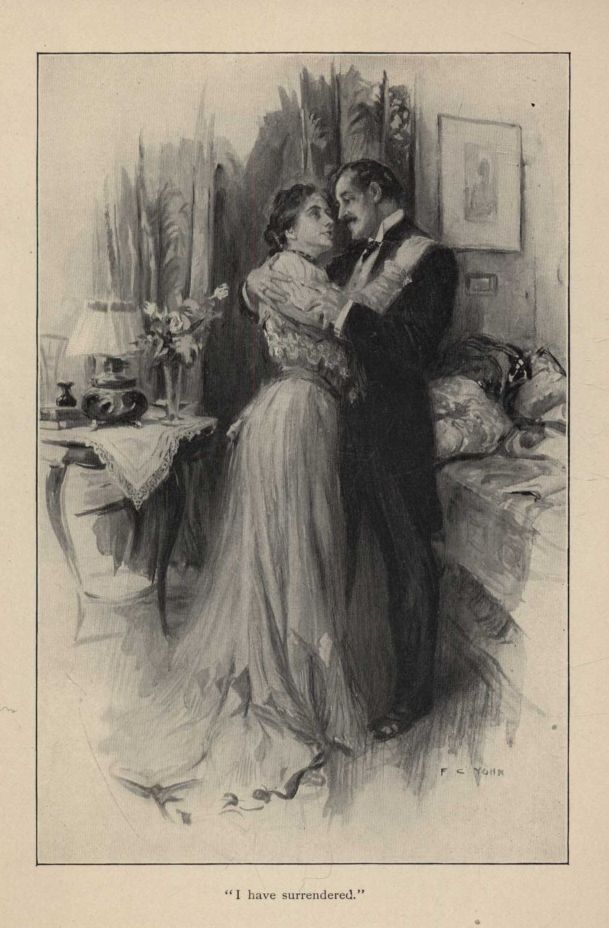
"Thank God for that!"
"But I come to you conscience free, Gordon," she said, drawing back her radiant face so that he must hear her avowal before his title was complete. "I would not have you think that I have compromised or juggled with myself. If I believed that I should be a whit less pure and spiritual a woman by becoming your wife, I would never have sent for you, dearly as I love you."
"And I would not have had you, darling. The love which is conscious of a stain is a menace to the world."
THE END
********
BY THE SAME AUTHOR
The Undercurrent.
Unleavened Bread.
Search-Light Letters.
The Art of Living.
The Bachelor's Christmas, and Other Stories. With 21 full-page illustrations.
Reflections of a Married Man.
The Opinions of a Philosopher. Illustrated.
Face to Face.