Front matter (continued 4)
Reading edition
Under the influence of this training and this point of view, Gordon went to Harvard. There he encountered a new atmosphere. The old gods were not dead, but they seemed moribund, for there were others. The college motto, "Veritas," still spoke the watchword of faith, yet the language of his class-mates led him to perceive that what was the truth was again in controversy. The Civil War was over, but the martial spirit which had sprung into being at the call of duty and love of country was seething in the veins of a new generation eager to rival in activity the heroism of its fathers. It was no longer enough to walk in contemplation beneath the college elms and develop character by introspective struggle. Truth—the whole truth, lay not there. Was not useful, skilful action in the world of affairs the true test of human efficiency? A great continent lay open to ingenious youth trained to unearth and master its secrets. How was it to be conquered unless the spirit of energy was nourished by robust frames, unless men were practical and competent as well as soulful?
Gordon listened to this new note with a receptive ear, and recognized its value. Hitherto he had thought little of his body, which, like an excellent machine, had performed its work without calling itself to his attention. Now he took part in college athletics, and realized the exhilaration which proceeds from healthful competitive exercise. Through contact with his mates, and active participation in the affairs of the college world, he experienced also the still more satisfactory glow, best described as the joy of life, which, partly physical, partly athletic, had never been a portion of his consciousness. He was drafted for the football team, and by his prowess and his pleasant, manly style acquired popularity in the college societies, that fillip to self-reliance and proper self-appreciation. If, as a consequence, he relaxed somewhat his efforts to lead his class in scholarship, which had been his sole ambition at the start, he did not forget that he was a pensioner on his mother's self-sacrifice; and though his rank at graduation was not in the first half-dozen, it was in the first twenty-five, and it could be said of him that he looked fit for the struggle of life, the possessor of a healthy mind in a well-developed body. He was sophisticated, but his soul was untarnished by dissipation, and the edge of his enthusiasm for enterprise and endeavor was not dulled. Then followed three years at the law school, where in common with nearly everyone he worked like a beaver to equip himself for his profession. There all interests—it might be said all emotions—were absorbed in contemplation of technical training. But he was still under the shadow of the Harvard elms, and the great world lay beyond, a land of mysterious promise to his eager vision.
However clear-sighted and philosophical a college graduate, his first actual contact with the great world is apt to be depressing. Society seems so large and so indifferent; he is so insignificant and so helpless—he who six months ago was a hero in the eyes of his companions. Especially is this apt to be the case when one is translated from the dizzy democratic heights of college renown to a humble, humdrum social station. It was no revelation to Gordon Perry to find himself the son of a hard-working, inconspicuous boarding-house keeper, but it sobered him. He was neither ashamed of the fact nor dismayed by it. On the contrary, the sight of his mother's tired face and figure subordinated every ambition to his loving determination to conquer the world for her sake. It seemed, however, a less simple matter to conquer the world now that he was an unknown student in a law office in a large city, with no family influence or powerful friends to abet his endeavors. For the first few years his lot was so obscure that the contrasts of life arrested his attention as they had never done before, though as a subconsciousness, for he never outwardly paused in his efforts to become indispensable to the firm of lawyers in whose office he was. He beheld acquaintances in various employments, whose mental superior he believed himself to be, put in the direct line of preferment through pecuniary or social influence, and had to solace himself with the doctrine—also the American doctrine—that it was every man's privilege to make the most of his own advantages, and his duty to acknowledge the same privilege in others.
Some young men are made cynical by the perception of the workings of free competition; others simply thoughtful. Gordon was among the latter. Life presented itself to him from a new perspective, and if it suddenly appeared both perplexing and distressing, it appeared none the less interesting. His personal dismay, if this passing reaction deserves so harsh a term, was transient, but it was the precursor to graver, disinterested musings. His attention once arrested by the inequalities of life turned further afield and became riveted by concern and by pity. Why in this city, established under free institutions, was it necessary that thousands should be living in poverty, ignorance, and social ineffectiveness if not degradation? It ought not to be. It must not be. How could it be averted? This outburst of his protesting spirit encountered the query of his dispassionate mind—what remedy do you suggest? It was like a douche of cold water. Instinctively he reached out for help. He knew that he was in search of truth this time, but he abhorred an ignis fatuus. He began to ask questions and to read. There were various answers on the lips of those whom he consulted, for the question seemed to be in the air. Many, and there were among them some whose broad shoulders, free carriage, and prosperously self-reliant air told of that joy in living and practical, world-conquering serenity typical of the successful man of the present generation, who assured him, often in a whisper, as though it were a confidence, that these inequalities must always exist. Were not men's abilities different, and would they not always be so? Was it just that one man's energy and skill should be curtailed to keep pace with another's incapacity? What would become of human individuality and brilliancy if everyone's earning and owning were to be circumscribed by metes and bounds, and we were all to become commonplace, unimaginative slaves of socialism? It was right, of course, that existing abuses in the way of long hours and insufficient pay should be rectified. That was on the cards. In many cases it had been already consummated. And what had malcontents or critics of the existing industrial system to say to the long list of splendid benefactions—free libraries, free hospitals, free parks, and free museums—given to the community by rich men—men who had been abler and more progressive than their fellows? Surely the world would be a dull place without competition.
There were others who declared that the destruction of the poor was their poverty, and that the poor man was at fault. That if he would let liquor alone, have fewer children, and brush his teeth regularly, he would be happy and prosperous. They called Gordon's attention to the many schemes for the uplifting of the industrial masses which were already in operation in Benham, homes for abandoned children, evening classes where instruction and diversion were skilfully blended, model tenements, and, most modern of all, college settlements, the voluntary transplanting of individual educated lives into social Saharas.
The books which he read were of two classes. Their writers were either optimistic apologists for the current ills of civilization, deploring and deprecating their existence, and suggesting the gradual elimination of social distress by education and intelligent humanity—"the giving of self unreservedly," as many put it—without serious modification of the structure of society; or they were outspoken enemies of the present industrial status, alleging that poverty and degradation were an inseparable incident of unchecked human competition, and that these evils would never be eradicated until the axe was applied to the fundamental cause. These latter critics had diverse preliminary crucial remedies at heart, such as the capitalization of land, government control of railroads, mines, and other sources of power, or the appropriation to the use of the community of a slice of abnormal profits.
Most of this presentation, whether through men or from books, was not new to Gordon; but it had been hitherto unheeded by him and had the full effect of novelty. He found himself staring at a condition of affairs which he had patriotically if carelessly supposed could not exist in the land of the free and the home of the brave until he suddenly opened his eyes and beheld in full operation in his native city, of which he was becomingly proud, those grave contrasts of station common to older civilizations. These included on the one hand not only the uneducated army of workers in Benham's pork factories, oil-yards, and iron mills, but an impecunious, shiftless lower class; and on the other what was, relatively speaking, a corporal's guard of wealthy, wideawake, luxurious, ambitious masters of the situation, to whom he hoped presently to commend himself as a legal adviser.
But what was the remedy? What was his remedy? In the coolness of second thoughts, after months of ferment, he had to confess that he had none—at least none at the moment. Simultaneously he had reached the further conclusion, which was both a relief and a distress, that whatever could be done must be gradual, so gradual as to be almost imperceptible when measured by the span of a single life. He recalled, with a new appreciation of the truth, the saying that the mills of God grind slowly. From the vanguard hope of a complete change in current conditions, by a series of telling blows of his own conception, he was forced back to a modest stand behind the breast-works. Modest because he began to examine with a new respect the philanthropic and economic apparatus for attack already in position, which he had at first glance been disposed to regard as too cumbersome and dilatory. Here was where his purpose not to be quixotic and visionary came to his support. He realized that it was necessary for him to wait and to study before he could hope to be of service; that he must take his position in the ranks and observe the tactics of others before attempting to assume leadership or to initiate reforms.
One effect of this check to his soaring aspirations at the dictate of his common sense was to give a fresh impetus to his resolve to succeed in his profession. For a brief period the shock of his discoveries had been so stunning that he almost felt as though it were his duty and his mission to devote his life to finding a remedy for the ills of civilization. His mother's necessities stood as a bar to this. But with the ebbing of his vision he found himself no longer beset with doubts as to the legitimacy of his apprenticeship. It seemed to him clearly his duty, not only on his mother's account but his own, to throw himself into his work unreservedly with the intention of hitting the mark. He had his bread to earn, his way to make. How would it profit him or anyone that he should forsake his calling and stand musing by the wayside merely because he was distressed by the inequalities of the industrial system? Inequalities which existed all over the world and were as old as human nature. He had no comprehensive cure to suggest, so for the time being his lips were sealed and his hands tied by his own ignorance. And if conscience, borrowing from some of the books which he had read, argued that the prosperous lawyer was the agent of the rich against the poor, the strong against the weak, his answer was that the taunt was not true, and his retort by way of a counter-sally was that in no country in the world did the laboring man receive so high wages as in this. This at least was a step forward, and so he felt justified to follow precedent and to bide his time.
In order to succeed a young lawyer must be ceaselessly vigilant. It is not enough to perform faithfully what he is told. There are many who will do this. The man who gets ahead is he who does more than the letter of his employment demands, who anticipates instructions and disregards time and comfort in order to follow a clue of evidence or elucidate a principle. So he becomes indispensable, and by and by the opportunity presents itself which the shiftless ascribe to luck. Gordon Perry revealed this faculty of indefatigable initiative. The firm in whose office he was a student had a large business, chiefly in the line of commercial law. The transit of the various commodities to which Benham owed her prosperity was necessarily productive of considerable litigation against the railroads as common carriers and between the shippers and consignees of wares and merchandise. Besides, there were constant suits for personal injuries to be prosecuted or defended, involving nice distinctions as to what is negligence, and bringing in their train much practice for the juniors in the investigation of testimony. From the outset Gordon worked with unsparing enthusiasm, seeking to do the work entrusted to him so thoroughly that those who tried the cases would find the situation clearly defined and everything at their fingers' ends. When it was perceived that he was not only diligent but discerning and accurate, they began to rely on him, and by the end of three years the responsibility of trying as well as of preparing the less important proceedings in the lower courts became his. Also, by showing himself solicitous regarding the affairs of the clients of the office, he was able now and again to supply information or tide matters over when the member of the firm inquired for was out; and it was not long before some of them formed the habit of consulting him directly in minor matters. When at the end of five years the senior partner, who had independent means, retired in order to go to Congress, his two associates came to the conclusion that it would be good policy, as well as just, to give Perry, as the most promising young man in the office, a small interest in the business. This promotion naturally gave him a new status with the clients, and most of those who had been in the habit of consulting him offhand, now laid their serious troubles before him. So by the time he was twenty-nine he was well started in his profession, and able to extract a promise from his mother that if he continued to prosper for another year, she would yield to his solicitations to give up her boarders and move into a brighter neighborhood.
Although absorbed in his profession, Gordon's genial charm soon brought him invitations of a social nature. He became a member of a law club of men of his own age, which met once a month to compare impressions and banish dull care over a good dinner. Still eager for exercise he joined a rowing club on the river Nye, and a gymnasium. After he was admitted to the firm he had his name put up for election at one of the social clubs, The University, so called because its members were college graduates. Here he met the educated young men of the city, and though his mother had an old-fashioned prejudice against clubs, as aristocratic resorts where men gambled and drank more than was good for them, Gordon felt that he needed some place where he could play a game of whist or billiards with congenial spirits or look at magazines in a cosey library as an antidote to his sterner pursuits. Mrs. Perry was more than willing to trust her son, so she sighed and set down to the changed temper of the day the spread of Benham's club fever. For, like other progressive cities, Benham was fairly honeycombed with clubs. The American social instinct had become almost daft on the subject, and no two or three men or women could come together for any purpose without organizing. From a constitution and by-laws the road was apt to be short to rooms or a clubhouse. The University was one of half a dozen of the purely social clubs of the city, a spacious establishment, modelled on European traditions with American plumbing and other modern comforts. Gordon was prompted to join by Paul Howard, who declared that he preferred it for genuine enjoyment to the Eagle Club, the favorite resort of the very rich and fashionable—the Spread Eagle, as the malicious termed it. At The University there was secular instrumental music on Sunday afternoons, a custom copied from Boston, that former hotbed of ascetic Sabbath life, and on Saturday nights a cold supper was provided, about which stood in pleasant groups the active professional and business men of the city and those who followed the arts—musicians, painters, and literary men.
"Exclusive and aristocratic all the same," said Hall Collins, contemptuously, one day when Gordon vouchsafed to him a glowing account of these Saturday nights. Hall was one of the moving spirits in the only other club of which Gordon was a member, The Citizens' Club, the somewhat ambitious title of an organization conducted by young men interested in civic and industrial reform, not unlike that to which the unhappy Emil Stuart had belonged.
"Which only shows how little you understand what we are after," was the prompt answer. "There isn't a more truly democratic place in the world—only we insist that a man should win his spurs before he is entitled to consideration. A clod, while he is a clod, isn't a gentleman, and it isn't good American doctrine to regard him as one. No logic will make him so. You're talking through your hat, Hall, and you know it."
Hall grinned. It was true he was not more than half in earnest, but he was more than half suspicious of Gordon. He could not make him out, which nettled him, for Hall Collins liked to have men docketed in his mind.
"To Gehenna with your gentlemen!" he retorted. "What use are spurs to a man who has no boots to wear them on?"
"Hear, hear!" interjected two or three bystanders whose attention was caught by the metaphor.
"It strikes me, young man," pursued Collins, who had his chair tipped back, his feet on the table and was smoking a fat cigar which one of the aldermen had given him, appropriated by the wholesale at a city banquet, "that you're trying to ride two horses." He was glad to have an audience to the discussion, for he could not make up his mind that Gordon was sincere in his interest in the Citizens' Club, and he feared some ulterior motive, political or quasi-philanthropic.
"Yes, that's just what I'm doing," answered Gordon. "Half of the lack of sympathy between the educated and the uneducated, between capital and labor, as you like to call it, lies in the imagination. What is there incompatible in being a member of a club like this and wearing patent-leather shoes and the latest thing in collars?"
"It smacks too much of college settlements. It doesn't go to the root of things."
"But it helps just as they help, unless in the ideal democracy you are aiming at there's to be no place for the refinements of life, for soft speech, gentle manners, and the arts. In the millennium are we all to be uncouth and unimaginative?"
"Score one for the man with the patent-leather shoes, only he hasn't got them on," exclaimed one of the listeners.
"You're beginning at the wrong end. You put the cart before the horse; that's the trouble with you. What's the use of decorating a house that's going to be struck by lightning?" With all his prejudice and homely exterior Hall Collins was at heart no demagogue or charlatan. He was dead in earnest himself and he wished others to be. He was conversant with the history of the development of trades-unions over the world. He was a student of humanitarian reforms, and gave all the time which he could spare from his occupation as a master-mason to the furtherance of what he considered legislative progress.
"Struck by lightning, and then there's no house, only ruins. That's not what you desire, Hall Collins, you, I, nor anyone here. We're all seeking the same thing, and we're all groping more or less in the dark—putting the cart before the horse, may be. But you haven't any panacea for what's wrong more than I have. All we can hope to do is to make a few trifling alterations on the premises—paper a wall or enlarge a flue—before our lease expires. The chief reason I joined this club was that I might stop theorizing and wringing my hands and get down to business. We all recognize there's plenty of practical work waiting for us, so what's the use of distrusting each other's theories or motives? I've no Congressional bee in my bonnet. I'm not trying to climb to political prominence on the shoulders of the horny-handed Citizens' Club."
Hall colored slightly. He had been harboring just that suspicion.
"Good talk." "Come off your perch, Hall. This man Perry's all right," was the response of several listeners. The group was now a dozen.
Hall took his feet from the table, stood up and put out his hand. "It isn't because the boys say so," he said. "I'm taking you on your own word, Perry, and you'll never hear me peep again. You've the right idea; it's no time for speculating, for there's lots of business to be done right here in Benham. And if I had a notion you might be masquerading—well, there have been cases where men in patent leathers and dandy collars showed up strong in working-men's clubs, and the only business they ever did was to lay and pull wires."
"Some men are born great, some achieve greatness, and some have greatness thrust upon them," said Ernest Bent. "Hall was born great, but if Don Perry wants to go to the Legislature why shouldn't the Citizens' Club send him there?"
"That's so," said a second.
"Not until he wins those spurs he spoke of—not if he's the man I take him to be," exclaimed Collins, doughtily.
"Not under any circumstances. I have no wish for office. I don't desire to be a politician." Gordon spoke eagerly. The only thought in his mind was to deprecate the suggestion. It was true that in looking over the field there had seemed to him almost a glut of philanthropists, and he had chosen the Citizens' Club as a more promising opening than charitable work. But his ambition was only to be a private in the ranks.
"And yet," commented Hall, "what should we do without politicians? They are the only persons who put things through, and laws on the statute books are what we need. Look at this cigar." He exhibited the butt end, which was all that was left. "The man who gave it to me helped himself to a box, and the only thing he wouldn't help himself to is a red-hot stove, but I didn't spit in his face and I smoked his cigar, and I dare say he'll vote for some of our batch of bills because I told him a good story. It's disgusting." He threw down the butt and trod it under foot. "The cardinal sin of the sovereign people is their ignorance. Will they never learn not to send dishonest men to represent them?"
"You see that Hall is both an idealist and practical," said Ernest Bent to Gordon. It was through Bent that Gordon had joined the Citizens' Club. He was his next-door neighbor, the son of an apothecary, and had, while following his trade behind the counter, read books on the science of government, and the rights and wrongs of man, with excursions to Darwin and Huxley. As the result of bandying opinions from time to time he had taken Gordon one evening to a meeting of the club, and subsequently invited him to become a member. Gordon did not need persuasion to join. It seemed to him just the opportunity he had been looking for to espouse the cause which he had at heart, by focussing his sympathies on practical measures. He recognized that the club was not only a debating body, but aimed to be a political force, and that many of its members were expert and not entirely scrupulous politicians. But, on the other hand, in spite of the jaundiced views of some of those who harangued the meetings, Gordon discerned that a half-dozen men were really in control—among them Collins and Bent—and that they were guided by a sincere and reasonably cautious ambition to procure scientific reforms. A little consideration convinced him that he was glad they were seeking to wield political influence. It gave the effect of reality, of battle. Academic discussion was a vital prelude to well-considered action, but, after all, as Hall Collins said, the only thing which really counted was law on the statute books. It suited his manhood to feel that he was about to fight for definite issues.
XIII
After eighteen months of prosperity the law firm into which Gordon Perry had been admitted was crippled by the death of one of the two other partners. The survivor, who was the junior of the two, and decidedly the inferior in mental calibre and energy, proposed to Gordon to continue the firm on the footing of two-thirds of the profits for himself, and appeared pompously grieved when his former student demurred to the terms. Before he could make up his mind to a more equable division Gordon had made up his to separate and to practise alone. While Gordon did not have a very high opinion of his partner's talents, he was grateful for his own recent promotion, and was aware that his associate's wise countenance and seniority combined would probably avail to control the cream of the business—that brought by managers of corporations and successful merchants, both prone to distrust youth. But the plan of setting up for himself was tempting, especially as he disliked the alternative of the lion's share going to a lawyer of mediocre ability, and when Paul Howard asked why he did not take the step in question, and intimated that he would befriend him in case he did, Gordon resolved to burn his bridges and make the plunge, or in more correct metaphor to hang out his own shingle.
As he had expected, there was at first a slight lull in his fortunes; but, on the other hand, he was able to pocket the whole income, and even from the outset he was reasonably busy. Paul Howard's promise was fulfilled. All his personal and presently some of the firm matters were placed in Gordon's hands, and the two men met not infrequently as a consequence. At Harvard they had been acquaintances rather than friends. Their contact on the foot-ball team had inspired respect for each other's grit, but they were not intimate. As the possessor of a liberal allowance, Paul had belonged to a rather frivolous set, notorious in college circles through lavish expenditures, which included boxes at the theatres and suppers and flowers for the chorus girls. Though Gordon was partial to comic opera himself, he had regarded Paul as a high flyer, and Paul in his turn had pitied Gordon as a good fellow spoiled by being obliged to "grind." When they met again in their native city after a lapse of years, each was impressed by the other's improvement and found him much more interesting than he had expected. Paul had toned down. His spirits were less flamboyant; he was gay-hearted instead of noisy, and his manner had lost its condescension. On his part, Gordon had mellowed through contact with the world and was more easy-going in his address, and no longer wore the New England conscience in his nostrils. They met first by chance at a restaurant at noon, and, habit bringing them to the same resort, they lunched together from time to time, and the favorable impression was strengthened on each side.
Gordon interested Paul because the former was so different from most of the men with whom he was in the habit of associating, and yet was, so to speak, a good fellow. The true creed of most of Paul's friends when reduced to terms, was substantially this, that the important thing in life is to be on top, that in America every one has a chance and the best men come to the front, that success means money, that money ensures enjoyment, and that no one is supposed to be enjoying himself or herself who does not keep feeding the dynamo of conscious existence with fresh sensations and run the human machine at full pressure. There were necessary corollaries to this, such as "the devil take the hindmost," uttered considerately but firmly; "we shall be a long time dead," murmured jocosely but shrewdly; and "the cranks may prevail and the crash come, but we shall be under the sod," spoken philosophically, with a shake of the head or a sigh; the moral of it all being that the position of the successful—that is, the rich—is delectable and intoxicating, and the rank and file are expected to comport themselves with patriotic and Christian resignation, and not interfere with the free workings of the millionairium, an ingenious American substitute for the millennium.
The stock market, athletic sports, and cocktails were the tutelary saints of this section of society. They were habitually long or short of the market from one or two hundred to several thousand shares, according to their means. They followed feverishly the prevailing fads in sport, yachting, tennis, polo, rowing, golf, rackets, hunting, horse shows (as now, a few years later, "bridge," ping-pong, and the deadly automobile). And after exercise, before lunch and dinner, and on every other excuse, they imbibed a cocktail or a whiskey and soda as a fillip to the nervous system. They were dashing, manly-looking fellows, these companions of Paul, ingenious and daring in their business enterprises, or, if men of leisure, keen and brilliant at their games. They set great store by physical courage and unflinching endurance of peril and pain, and they would have responded promptly to a national demand for troops in case of war; but when anything arose on the political or social horizon which threatened to disturb prices on the stock exchange they set their teeth as one man and howled maledictions at it and its author, though it bore the sign manual of true progress. In short, life for them meant a bull market, a galaxy of competitive sports, and perpetual novelty.
In turning from this comradeship and point of view to Gordon Perry, Paul did so guardedly. That is, although he was not altogether satisfied to follow the current in which he found himself, he had no intention of being drawn into the eddies by false sentiment or of rowing up-stream at the dictates of envy and demagogism. He was ready to admit that the policy of high-pressure enjoyment and acquisition might be ethically defective, but he did not propose to exchange his birthright for a mess of pottage and become pious or philanthropic on sing-song lines. As he once expressed it to Gordon, some two years after the latter had set up for himself, between the hypocrites and the fools it was a comparatively simple matter to charm an audience with a psalm tune compounded of the Rock of Ages and the Star-Spangled Banner until it passed resolutions against the rich and in favor of the poor, which not merely confounded common sense and subverted justice, but gave a sort of moral sanction to the small lies, the sand in the sugar, the dirt, the superstition and the slipshod ways which distinguished the people without brains and imagination from those with.
"We might divide all round," Paul continued, "but what good would that do? I might move into a smaller house, sell my steam yacht and all my stable, except a horse and buggy, and play the Puritan, but what good would that do? People would laugh and my wife would think me crazy. I tell you what, Don, we—I mean the crowd I run with—may be a grasping, extravagant, gambling, sporting, strenuous lot, but we trot square. There's no sand in our sugar, and when there's music to be faced we don't run away, squeal or delude ourselves. But I've sworn off cocktails for good. I began yesterday. And I'm going to keep my eye on you, Don. I don't promise to follow you, but I'm interested. When you get your plans in working order let me look at them. I may be able to syndicate them for you, even though I have to shock my conservative father in the process. By the way, do you happen to need a stenographer? She's said to know her business. And this one is in your line, too."
Gordon had been conscious lately that his work required another clerk. "In my line?"
"Yes. A tale of woe. She's a protegée of my aunt's, and needs a helping hand. A widow with two small children. Good looking, too, I believe. Mrs. Wilson has had her taught until she can play the type-writer like a learned pig, and take down your innermost thoughts in shorthand. And now the woman insists on being thrown down hard on her own resources, like a good American. We haven't a vacancy, unless I invent one; and it occurred to me that you must have work enough for a second stenographer by this time."
"I'll try her."
"Thanks. One good turn deserves another. I'll tell my aunt that she ought to ask you to dine; and then if you don't give her to understand that her will is all wrong and should be drawn over again the fault will be yours."
"Bankers may advertise their wares in the shop windows, but a self-respecting lawyer may only look wise. He must hold his tongue until he is consulted."
"Squat in his office, eh, like a spider waiting for flies? But you ought to know my aunt all the same."
"I should like to immensely," said Gordon.
"She's not like the rest of the family; she belongs to a different flight. My father has brains and force. It's not easy to equal him in those. He hasn't had time though to sort his ideas and tie them up in nice white packages with crimson bows or to polish anything except his wits. But Aunt Miriam goes in for the perfect life. That's what she has in her mind's eye. You would suit her to death, Don. You ought to be pals. She's absorbed in reforms and æsthetic mission work, and she has a fine scent for national tendencies, and there's no telling but you might each get points from the other."
Gordon laughed. "You flatter me, Paul."
"No, I don't. You're not alike. You're both aiming at the same thing, I suppose; but your ways are different. And you can't very well both be right. You may not be pals after all. You may disagree and fight. Come to think of it, I shouldn't be in the least surprised if you did. A pitched battle between Gordon Perry and Mrs. Randolph Wilson would be worth watching." Paul chuckled mirthfully at the conception. "I'm not quite sure which of you I would back."
"And now you're enigmatic, not to say absurd."
"Wait until you get to know her; then you'll understand. I should only tie myself up in a bow-knot trying to explain. Her daughter's marriage gave Aunt Miriam her head. If ever there was a case of disappointment, Lucille was one. Aunt Miriam had intended her to be a model of æsthetic sweetness and light, a sort of Matthew Arnold girl with American patent electrical improvements, but she must have been changed at birth. Lucille has her good points—I'm fond of her—but it's a matter of utter indifference to her whether the world improves or not provided she has what she likes. She must have been a constant jar to her mother. Yet I never heard a whimper from Mrs. Wilson. My aunt had no particular use for Clarence Waldo; yet when the thing was settled one could never have guessed from her manner that she was not to be the mother-in-law of Lord Rosebery or of the author of the great American novel. But now that her mission as a mother is fulfilled, look out for storm centres in the upper lake region of high ideas and fresh winds in reform circles. By the way, the Waldos are in this country again, and are to pass the summer at Newport. My wife says that we are to go there too, with a new steam yacht and all the latest appliances for cutting ice. So you see, I couldn't play the Puritan and the American husband in the same act."
As a result of this conversation, Constance Stuart obtained employment in Gordon Perry's office. When she presented herself he recognized her with surprise as the client whose scrupulous purpose he believed he had divined, though she had given no clue to her instructions. He realized that he was predisposed in her favor, so that she scarcely needed the letter of encomium from Mrs. Wilson, which he paused to read, chiefly because of its chirography and diction. He observed that both her face and figure were a little fuller than when he had seen her last, which was becoming, and that she was more trigly, though simply, dressed. It was clear that she had risen from the ashes of her adversity, and was determined to put her best foot forward. And what an attractive voice and fine eyes she had. As he looked at her he said to himself that she was qualified for the position as one in a thousand; the sort of woman who would understand without becoming obtrusive, who would be neither a machine nor a coquette; and though she was a novice, the endorsement was explicit on the score of her capacity. Gordon felt that she would give a new atmosphere to his office.
Constance, on her part, was pleased to encounter one not wholly a stranger. Though she had acquired deftness in her work, she felt nervous at actual responsibility, and the memory of the lawyer's kind eyes and frank smile gave her assurance. As she saw him again she was sure that he would be considerate and reasonable. Mrs. Wilson had spoken of an opening in Mr. Howard's office, where she would be one of a roomful of typewriters, but she was glad now that this opportunity had been offered her instead. There would be less excitement and less contact with the hurly-burly of large events, and less chance for promotion and for better pay in case she proved proficient. But, on the other hand, she believed that she would find here a secure and agreeable haven where she could do her best with self-respecting faithfulness and support her children suitably. As she arranged her small effects in the desk provided for her, she concluded already that she was very fortunate.
Just a year had passed since Constance had begun her new life in Lincoln Chambers, and the impulse of that new life may be said to have dated from her visit to Mrs. Randolph Wilson. From that interview and that house she had brought away encouragement and inspiration. The text of the value of the spirit of beauty possessed her soul with the ardor of a new faith. Suddenly and with captivating clearness it had been revealed to her that the external fitness of things is a fact and not to be ignored, and that the purely introspective, subjective vision sees only half the truth of existence. She perceived that she had been content with rectitude, and unadorned plainness; that she had been indifferent and blind to color, variety, and artistic excellence. It was as though she had been nourished on skimmed milk instead of cream, as though her diet had been a monotonous simple regimen without a luscious ingredient.
To begin with, she had turned her thought to her own home, where cleanliness and order ruled, but where she had hitherto refrained from other than haphazard efforts at pleasing effects. Her idea had been to be comfortable and decent, and to let the rest take care of itself, but now the ambition was awakened to impart taste to her surroundings. To her satisfaction she found that this was not difficult to accomplish even with her modest resources, as her mentor had predicted. Her woman's intelligence and native refinement reinforced her aroused interest, and by altering the angles and position of her furniture, and by introducing a few spots of color to enliven the monotony of her rooms she was able to effect a modest transformation delightful to her own eyes. To plant flowers in boxes for her windows and to arrange the few pictures she owned to advantage was the next step. The modern design of her apartment lent itself to her efforts, as though its newness, its modern tiles and its wall-papers were in league against dull commonplaceness, and it seemed to her presently almost horrible that she had remained indifferent for so long to the necessity of external appearances, absorbed in the processes of introspection. When she and Emil had married her predominant impulse had been to be a good, loving wife to him, and to make his home inviting by her cheerfulness and tact. The new, clean house had seemed to her pretty in itself, and she had taken for granted that the sets of furniture, the carpets, and other household goods, bought hastily, could not fail to set it forth to advantage. They were substantial, fresh, and paid for, and in her happiness it had not occurred to her to bother further. To do so would have seemed to savor of undue worldliness. Now how far away appeared that time of joyful ignorance, and how foreign to her present sophistication its artless outlook. She had deemed herself cultivated then, and later, in the stress of her misfortunes, had cherished thoughtful simplicity as the essence of personal refinement, the life-buoy to which she clung amid the waste of waters. By the light of experience it was plain that she had starved herself and eschewed as effete or unimportant that which was wholesome and stimulating. The same impulse led her to take a new interest in her own personal appearance, to arrange her hair tastefully, to consider a little what colors suited her best, and in various simple ways to make the most of her own personal advantages for the first time in her life. Not in the spirit of vanity, but in acknowledgment that she had too much neglected the temple of the body. And not only in respect to beauty in the outward manifestations of everyday life did she feel that she had been blind to what existence offered, but where art touched religion. She was able to approach faith from a new point of view; to wrap her naked intellectual communion with the garment of the church properties—to yield herself to the spell of the solemn architecture, the new stained-glass windows, the artistic reredos, and the vested choir of St. Stephen's—without suspicion or doubt. Her life had lacked the impulse of art, and in finding it she believed that she had discovered the secret of a closer approach to God.
She sought by zeal to make atonement to Mr. Prentiss for her past deficiencies. It did not appear to her essential to recant her errors formally; indeed, she did not do so to herself, for in respect to certain dogmas and supernatural claims of the creed she had not disowned her independence of thought. That which she wished to disown unmistakably was the coldness of her attitude toward spiritual things; she wished her rector to realize that heart was predominating over mind, and that trusting, ardent worship had taken the place of speculative lip service. A sermon by Mr. Prentiss came in the nick of time to further this attitude. It was on the essentials of the religious faith, and he defined them as the spirit of Christian brotherhood and love through man to God. Although he did not in terms disparage the importance of the dogmas and traditions of the church, the impression left on Constance was that he had passed them by as embodying the antiquated letter, but not the modern temper of Christian doctrine. To her eager imagination the doubts which had harassed her in the past concerning the truth of the miracles, and kindred scriptural deviation, from the natural order of the universe were reduced to trivial importance. Instead of stumbling-blocks to faith, they had become objects of secondary interest, to one side of the high-road along which the Christ-life was leading mankind.
How better could she manifest this change of mood to Mr. Prentiss than by devotion to church work? She became a teacher in the Sunday-school in the Church of the Redeemer, the mission church connected with St. Stephen's, joined once more a Bible-class under her rector's instruction, and undertook to befriend some poor families less fortunate than herself on the parish lists. But her dearest service was to help to deck the church for the great Christian festivals, Christmas and Easter. To arrange the evergreen and mistletoe, the profusion of lilies and roses, humbly and under the guidance of those versed in such matters, but with devoted hands, gave her a chance to ventilate the new poetry of her soul. She had become enamored of the charm of flowers; she delighted in the swell of the organ and the melodious chants of the rejoicing choir. Her willing fingers quickly became skilful. At the second Easter she was even appealed to on minor points of taste by some of her fellow-workers, so that Loretta Davis, who was standing by holding smilax, nudged her as a sign of congratulation, for she had represented herself to Loretta as a complete novice in such matters. Very grateful and inspiriting to Constance was Mrs. Wilson's voluntary tribute on the same evening that she had been of notable service. Mrs. Wilson was the presiding genius and lady bountiful of these festivals, especially on Easter Day. It was she who said yearly to Mr. Prentiss, "Date plenis lilia," and, acting on that cue, gave orders to the florists to exhaust the green-houses of the neighborhood, and to spare neither expense nor pains to make St. Stephen's the most beautiful sanctuary in Benham. It was she who organized and tactfully controlled the large committee of ladies whose annual labor of love it was to dress the church. It was she who oversaw and checkmated the commonplace intentions of the professional decorators employed to fasten festoons and clusters beyond the reach of ladylike gymnastics; and it was she who originated or set the seal of approval on the artistic scheme of design adopted by the committee.
Mrs. Wilson had had several triumphs as a consequence of the freedom afforded her by her daughter's marriage, but nothing had given her more satisfaction than the progress of Loretta Davis's redemption through association with Constance. She had jumped at the idea of placing the wayward girl in the opposite tenement, feeling that the experience would be a blessing to both women; that it would provide Loretta with a sympathetic fellow struggler and example, and give Mrs. Stuart the self-respecting occasion to help as well as to be helped. Still it was an experiment until tried, the success of which could not be taken for granted.
That their relations had become sympathetic was due mainly to Constance. In her present mood the unfortunate girl seemed to have been sent to her as an opportunity for Christian usefulness, as a test of her own spiritual regeneration. Here was the best chance of all to show her changed heart to her rector. Her recognition from the outset that Loretta was distasteful to her, and her shrinking not only from the girl's attitude toward sin but from her smart matter-of-fact personality served merely as a spur to her own zeal. She would win her over and be won over herself; she would unearth the palpitating soul of which Mrs. Wilson had confided to her that she had caught a glimpse, and teach her to reassert and develop her womanhood. Help came unexpectedly from Loretta herself after the ice of acquaintance was broken and the two women found themselves close neighbors. Constance was attracted by the keenness of her intelligence which, though Loretta was ignorant and undisciplined, was apt to go straight to the mark on the wings of rough but pungent speech. It conciliated Constance to discover this trait, for she shrank from self-deception as a moral blemish and one more typical of women than of men. The girl's directness awoke an answering chord. A clear head removed half the difficulty of the situation, and held out the hope that wise counsel would not be lost.
Loretta made no mystery of her circumstances. She told the story of her shame with matter-of-fact glibness as an every-day incident in human life, lamentable possibly on conventional grounds, but not to be judged harshly by the discerning, among whom she chose to place Constance. The thing had happened, and there was nothing to be said or done but make the best of it—which now included the baby.
"She wanted me to keep it, and I said I would, and that I'd come and live here and see how I liked it. I shocked her and—well, I had never talked with anyone just like her before. She seemed set on my living here, so I thought I'd try."
"She" was always Mrs. Wilson. This was Loretta's invariable way of referring to her, as if there could be no question who was meant. She talked of her constantly, with an eager yet shy interest, which promptly revealed to Constance how matters stood. Loretta had taken up her duties as a mother and subordinated her own wanton theories to please Mrs. Wilson. This was the bond which held her, not religion or the qualms of self-respect. Yet it was a bond, and Constance recognized it as one to be cherished. To hear this woman, so bold and indelicate in every-day speech, ask questions concerning her divinity with a shyness not unlike that of a bashful lover was interesting. Was not she herself under the influence of the same charm? Was not this infatuation another tribute to the power of the spirit of beauty? Thus Constance felt that she had a clue to her new companion's nature, which she did her best to utilize. So it happened that Loretta went to church because she could catch a glimpse of Mrs. Wilson from where they sat; and Loretta took a new interest in her baby from the hour when Mrs. Wilson sent her, tied up with a pretty ribbon, a little embroidered infant's jacket bought at a fair; and Loretta helped to deck St. Stephen's at Easter because of the chance that Mrs. Wilson would speak to her, as of course she did. Constance found herself a silent but zealous conniver and accomplice; and it impressed her that the object of devotion seemed instinctively aware both of it and the girl's need, for every now and then Mrs. Wilson would make the occasion by a few words, a note, a visit or a gift to lift Loretta above the level of her own devices. For just as Antæus gained strength by contact with the earth, Loretta's spirit seemed to crave the inspiration of Mrs. Wilson's gracious patronage.
Though slap-dash and over-confident in her ways, Loretta was capable and quick to adopt and to perform skilfully whatever appealed to her. Her experience as a cashier in a drug store had given her a lingo and a certain familiarity concerning modern remedies, and she had a natural aptitude with her hands. Some of the maternal hygienic niceties practised by Constance appeared to amuse her at first, but as she became more interested in her baby, she outdid her neighbor in pharmaceutical experiments with powder, oil, perfume, and whatever she thought likely to make her child a savory specimen of babyhood. When the child was a year old, Mrs. Wilson made good her promise that Loretta should be instructed in nursing by securing her admission to a hospital. At the same time she engaged another of her wards, a responsible, elderly woman, to take up her abode in Loretta's tenement, and it was arranged that this custodian should also tend Constance's children during their mother's absence down-town. How to guard her children properly after their return from school had been agitating Constance, and this plan was exactly to her liking. She paid a small sum weekly from her earnings for the supervision, and it was understood that Loretta should have the same privilege after her apprenticeship was over and she had become self-supporting. So it was that Mrs. Wilson felt she had reason to be gratified by her philanthropic experiment in Lincoln Chambers.
XIV
The zest of existence must be largely ethical and subjective for the majority of us or we should speedily become despondent or bored. Contact with life is necessarily so commonplace for the mass of humanity, that, were we dependent on personal participation in large events and dramatic, splendid experiences for inspiration and content, few would not find themselves restless and in the mental doldrums. Fortunately for our peace of mind, most of us not only appreciate that pictorial and world-stirring, or even exciting, affairs can be the lot of only a fraction of mankind, but, by virtue of the imagination, manage to impart to our more or less humble vicissitudes the aspect of an engrossing situation. We recognize the relative insignificance of the individual drama, but its reality holds us. Its characters may be few, its scenery bare, its action trite and simple to other eyes, yet each of us, as the leading actor, finds in the development of a human soul a part which fascinates him, and lends itself to the finest shades of expression. Whether it be a king on his throne, or a cripple in his cot, the essential matter to the world is the nice interpretation. So, as the true artist in a subordinate rôle forgets for the time that he is not the leading actor, we refuse to be depressed by the unimportance of our theatricals and are absorbed by the unfolding perplexities of our own soul play.
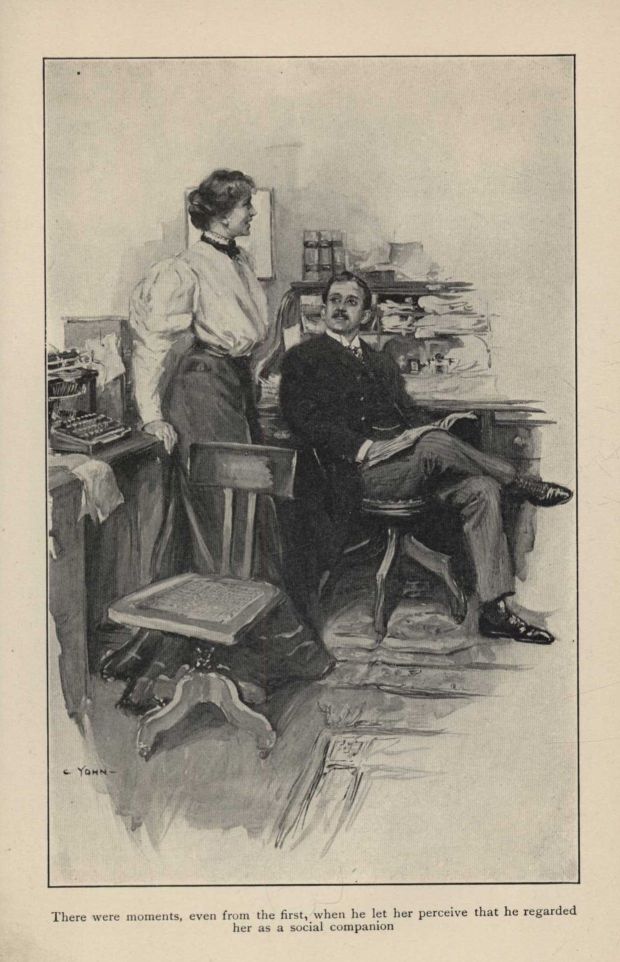
It is every American woman's privilege, according to her tastes, to dream that she may become the wife of the President of the United States, or wield a powerful influence as a poetess, humanitarian educator, or other exponent of modern feminine usefulness. In marrying Emil Stuart, Constance had renounced the latter in favor of the former possibility. She had sacrificed all hopes of personal public distinction, but there still had remained the vision of becoming famous by proxy, through her husband. If this had never appeared to her happy eyes as a bride more than an iridescent dream, the idea that she would presently be working in a lawyer's office would have seemed utterly inconsistent with her scheme of life, and a violation of her horoscope. Yet, now that she was established in this position, she found the experience not only satisfactory, as a means of subsistence, but interesting. In the first place, it stirred her to be down-town in the swift current of affairs and a part of the busy crowd which peopled the huge office-buildings and swept to and from its work with the regularity and rhythmic force of the tide. Through this daily contact she discerned, as never before, the dignity and the pathos of labor, and gained both courage and exhilaration from the thought that, though there were generals and captains, and she was in the rear rank of privates, the real strength of the army lay in the faithful performance by the individual of that portion of the world's toil entrusted to himself or herself. There was attraction, too, in her employment, though her task was but to register and reproduce with despatch the thoughts of others. The occupation tested her accuracy, patience, tact, and diligence. She must avoid blunders and be swift to comprehend. There were secrets in her keeping; affairs upon the issue of which hinged large sums of money, and often the happiness of leading citizens, who were clients of the office; close legal battles between mind and mind; domestic difficulties settled out of court; and suits for injuries, where the price of a life or of a limb were at stake. Her lips must be sealed, and she must seem unaware of the tragedies which passed beneath her observation. Yet the human element became a constant, vivid interest to her, and now and then it happened, as, for instance, when a forlorn hope brought liberal damages to the wronged or the afflicted, that she was taken into the secret by the exultant plaintiff, and was able to rejoice openly. There was, finally, her association with her employer. From this she had not expected much. She was there to execute his instructions without superfluous words or the obtrusion of her own personality. She knew, instinctively, that he would not treat her merely as a machine, but she took for granted that their relations would be formal. It pleased her that, though this was the case, there were moments, even from the first, when he let her perceive that he regarded her as a social companion. To evince a kindly interest in her personal affairs was simply human; anyone might show this; but to talk with her on the topics of the day, to call her attention to a book or an article, or, as presently happened, to invite her opinion on a question of legal ethics, was a flattering indication that he considered their point of view the same. A difference in point of view is the most insurmountable, because the most intangible, barrier to the free play of human sympathy and the social instinct. It is the last great fortress in the pathway of democracy; one which the besiegers will be able to carry only by learning the password. A free-masonry exists, from the cut of the mind to that of the hair and coat, between those who recognize each other, and not to speak the same language palsies the best intentions. Modest as her introduction to Mrs. Randolph Wilson had made her, Constance in her heart believed that she spoke the same mental language as Mr. Perry. But would he recognize it? That he did so not only increased her interest in serving him, but held out the promise of a new friend. He might so easily have passed her over, he who was so busy and had so many acquaintances. Yet it was plain that he liked to talk to her, and that he availed himself of opportunities for conversation. At the end of a year it happened that the other stenographer, her predecessor, left Mr. Perry's employment in order to marry. As a consequence, Constance became the senior clerk, and was given formal charge of the office with a slight increase in pay.
There were moments, even from the first, when he let her perceive that he regarded her as a social companion
She would scarcely have been human had Gordon Perry's complimentary interest failed to inspire her with some degree of hero-worship. Yet, though she was presently aware that she had set him on a pedestal, she felt that she had excellent reasons for her partiality. Was he not a clear-headed, astute reasoner, as well as kind? A thorough, conscientious worker, who went to the root of whatever he undertook, and prosecuted it vigorously, as well as a gracious spirit with a sense of humor? If she did not reveal much of the last quality herself, she appreciated and enjoyed it in others, especially when it was the sort of humor which championed truth against error and could be playful or caustic, as the occasion demanded. He was simple and approachable, yet he had influential and fashionable friends. Recently he had made the acquaintance of Mrs. Randolph Wilson, and was on pleasant terms with her. Constance had recognized her handwriting, and had been apprised by Loretta of his presence at Mrs. Wilson's entertainments. Loretta had, what seemed to Constance, almost a mania for the social department of newspapers. She knew by rote the names of the society leaders, and was familiar through reportorial photography with many of their faces. Mrs. Wilson was the bright, particular star in this galaxy of interest. Loretta searched with avidity for every item of gossip which concerned her divinity, and took a hectic pleasure in retailing her information. Thus it happened that every now and then she would exclaim: "I see that your boss was at her last entertainment," the fact of which was more agreeable to Constance than the phraseology. Loretta's diction was always clear, but Constance, who wished to feel that they spoke the same language, had often to bite her lips as a reproof to her sensibilities; and, especially, when she heard her hero spoken of as her boss. It was so wide of the truth regarding him.
Then there was his mother, and here again Constance had cause to feel gratified. Quite unexpectedly Mrs. Perry had called upon her, seeking her at Lincoln Chambers in the late afternoon when she was likely to be at home. While serving her five o'clock tea, Constance had observed, with interest in her personality, marked resemblances to her son. He had inherited her naturalness and mental vigor. Her cheerful directness, too, but in his case the straightforward attitude was softened by the habit of deliberation and garnished by a more tolerant gaiety. It was obvious that Mrs. Perry maintained the integrity of her convictions until they ran counter in daily life to his, and in capitulating reserved always the privilege to be of the same opinion still, which she exercised with her tongue in her cheek, thereby betraying her great pride in her son, and in her son's superior wisdom. She professed, for instance, to regard his ideas concerning the new home in which he had just installed her, and where she was keeping house for him, as extravagant. What was the use of spending so much on mere creature comforts? She did not need them. She had sat on straight-backed chairs all her days and preferred them, and she did not require a telephone to order her marketing.
"When I was young," she said to Constance, "there was only one set bath-tub in a house, if any, and no modern plumbing. We carried hot water upstairs in pails, and those who drew water from the boiler poured in as much as they took. But there are so many labor-saving machines to-day, that sheer laziness is at a premium. Gordon declares that I'm all wrong, and that more people are clean and comfortable as a consequence. Then, as to the wall-papers and carpets and upholstery, well, they're pretty, I can't deny that. But, somehow, it goes against my grain to see so many bright colors. Yet when I say it looks frivolous, Gordon simply laughs. So I've promised to hold my tongue until everything is finished, and to let him have his way. He likes to have his way almost as much as I do mine, Mrs. Stuart, and the strangest part is that, though he doesn't always convince me, I have a secret feeling that he must be right."
Constance was taken to see the new house in one of the outlying and more fashionable wards of the city, which, as Mrs. Perry had declared, was supplied with all the modern improvements and was being furnished with an eye to artistic taste. It became evident that the old lady, despite her misgivings, was very proud at heart of the whole establishment, but that her satisfaction centred in the library—her son's room—a cosey, spacious apartment with tall shelves for his books and various conveniences adapted to a bachelor and a student. As standing on the threshold, she exhibited it to her guest with a shy pride, which almost seemed to gasp at the effects disclosed, she murmured: "It sometimes seems to me a wicked waste of money; but I'm glad to think he's going to be so comfortable."
Constance replied, "It's a delightful room. Just the place, restful to the body and stimulating to the spirit, which a busy man like Mr. Perry ought to have."
"There can be nothing too good for him, if that's what you mean."
"I heartily assent," said Constance, smiling. "And I agree with your son that it is sensible and right to surround oneself with pretty things if one has the means."
"I guess that he must have talked it over with you," said the old lady, with a keen glance.
"No."
"Well, it's a wonder he hasn't, for he sets store by your opinion on lots of things. In my day, compliments weren't considered good for young people, but I don't believe from your looks that you'll work any the less well because I let you know what he thinks of you. He was saying the other day that he feared you must find thumping on that machine of yours, week in and week out, and taking down letters in double-quick time, dull work, and I told him that a woman of the right sort, with two children to support, had no time to feel dull or to think about her feelings, but was thankful for the chance of steady employment. You see I know something about that myself. You have your boy and girl to keep your thoughts busy, just as I had him."
"Yes, indeed. But it is a pleasure to work for Mr. Perry. No man is a hero to his valet, and need not be, I suppose, to his stenographer. You won't think it presumptuous of me to say that he has been very considerate, and that I enjoy taking down his words because he is so intelligent and so thorough?"
"There's no one who likes to hear nice things said about him so well as his mother. There's only one fault about him, so far as I know, and that may be cured any day. He's a bachelor. I would move straight out of this house to-morrow in order to see him well married."
"That wouldn't be necessary, I imagine, Mrs. Perry."
"Yes, it would. I should make a detestable mother-in-law. Gordon gets his clear-headedness from me, and I know my own faults. I shouldn't be jealous, but I should wish her to do things in my way, and she would wish to do them in hers, so we should clash. I wouldn't risk it. But I'd be willing to die to-morrow and never to kiss my grandchildren if only he had a good wife. I should be very particular, though."
"I should think so. I hope with all my heart that he may meet a woman worthy of him." Constance was a little surprised by her own fervor. Expressed in sound it seemed to her almost familiar. Then, without knowing why, she sighed. Was it because she painfully recalled that marriage was a lottery?
Mrs. Perry evidently ascribed the sigh to that source, for after regarding her a moment, she said softly, "It was easier for me than it is for you. When I lost my husband we were very happy. You are left alone. You see my son has told me your story."
"I am glad that you should know."
"But you are young, my dear. Young and a charming looking, lovable woman. The right man may come along. Who knows?"
Constance stared at her in astonishment. "My husband is not dead," she said, a little formally.
"Yes, I know. He deserted you."
"But he is alive."
"Gordon told me that you had not been divorced."
"I have never thought of such a thing."
"You know where he is?"
"I have not seen him or heard from him since the day he left me nearly three years ago."
"Precisely."
"He is the father of my children, however."
For a moment Mrs. Perry seemed to be pondering the thesis contained in her single word of deduction, and her visitor's reply. Then she bent her shrewd eyes on Constance, and said with a quiet pithiness of utterance, which reminded the latter of her employer. "I was not tempted to marry again because I loved my husband, and could not forget him. But I've never been able to convince my common sense that it is fair to asperse the woman who marries again after the law has separated her forever from the man who has done her a grievous wrong, but to think it only right and fitting for a widow to take a second husband when the first whom she has loved, and who has loved her, is in the grave. If I were a young woman on my death-bed, I expect I couldn't make up my mind to beg my husband to marry again. But I couldn't blame him if he did. It's the way of human nature, often as not. It's hateful to be lonely. And why shouldn't the girl marry again, who has been left in the lurch by a cruel man, who has been false to the vow he took to support and protect her? Only the other day a rich merchant whom my son knows, a man of over sixty, who had lived with his wife for thirty years, married again before she had been dead twelve months, and they had a solemn church wedding. It was your clergyman, Mrs. Stuart, who married them. I'd call it disgusting, except that some people said he was solitary, although he had daughters. But to make fish of one and flesh of the other, isn't just. I'm an old woman, and the longer I live the more I dote on justice."
"I remember now. I know whom you mean. Loretta insisted on reading me the account of it from the newspaper. I've seen him in church. He is one of the vestrymen."
"Yes, it was a society function. But I don't judge him," said Mrs. Perry, sitting up straight to emphasize her intention to be dispassionate. "Men are queer. His wife was dead, and he had the right to ask another woman to fill her place. But why, then, should anyone criticise you?"
"Have you heard anyone criticise me?" Constance asked, hoping to extricate the conversation from the depths of this argument by a ripple on the surface.
"Some of them would. You did yourself, you know."
"It was a new idea to me. I have never thought of marrying." After a moment's silence, she added, simply: "How would you like your son to marry a divorced woman, Mrs. Perry?"
Her mind had picked out, instinctively, the crucial question. The old lady gave a little gasp and start.
"A divorced woman? Gordon?" Then she laughed. "The way you said 'divorced woman' had a formidable sound." The personal application was evidently a surprise to her; evidently, too, it interested her, and she wrestled with it sitting erect and bright-eyed. In another moment she had worked out the answer to her own satisfaction. "It would depend upon her—what she was like. If she were innocent—if she had been grossly wronged, and had sought the relief from her distress which the laws allow, and I liked her and he loved her, I shouldn't object. Or, put it in this way: I should prefer that Gordon did not marry a widow, but a girl with all the freshness of her life before her."
"Yes, indeed," murmured Constance.
"But plenty of young men fall in love with widows and marry, and no one thinks any the worse of the widows, or of them. I'd fully as lief Gordon married a divorced woman as one who had buried her husband. And if I were sure she was a fine woman, I can imagine my sentiment vanishing like moonshine, and my not minding a bit."
Constance shook her head thoughtfully. "He must marry some fine, sweet girl without a past," she said with gentle positiveness.
"Amen to that, my dear. And the sooner the better."
One day early in September, in the summer following the date of this conversation, Paul Howard entered the office. As he passed into Gordon's private room, omitting the gay greeting which he was wont to exchange with her, Constance noticed that his expression was grave and tense, and that he looked tired. She said to herself that his summer at Newport could not have rested him.
It was Paul's second season at Newport. In accordance with his half-humorous prediction, he had hired there, the previous summer, one of the most desirable villas, a spacious establishment with a superb outlook to sea. He had maintained a large steam yacht, and an elaborate stable, and had entertained lavishly. All to please his wife. At least so he regarded it, and this was in a large measure the truth. Ever since his marriage, five years back, Paul had been thinking that he would like to spend his vacation in some cool, picturesque spot, far from scenes of social display, where with his wife he could enjoy the beauties of nature unreservedly, and recuperate from the fatigues of the winter. But, though he had hankered after this in theory, and had broached the project to Mrs. Howard, somehow it had never come to pass, and he had been secretly aware for some time that it never would, unless one of them had nervous prostration and were ordered away by a physician. For when one is a millionaire and has an ambitious wife, one gets into the way of doing what other millionaires do, and becomes acclimated to the amusements proper to millionaires, until presently the necessity of having luxuries at one's fingers' ends makes any other programme seem insipid and a bore. Those who neglect to follow their own tastes cannot fail to be moulded by the tastes which they adopt. We readily habituate ourselves to our surroundings, whether it be too few baths, or too many. Paul delighted in the plumbing facilities of his establishment. He was perpetually taking baths and changing his underclothes, and the apprehension lest this orgie be interfered with had taken the edge off his desire for closer contact with the beauties of nature. He recognized the change in himself, but charged it to the account of the spirit of the age, that convenient depository of modern philosophers. So, by the end of that first summer, he had found himself content rather than otherwise with the experience and disposed to return. To begin with, his wife was enthusiastic. As she expressed it, she had had the time of her life, which was comforting. Although from Monday morning to Thursday night had been spent by him in New York (he had arranged to be absent from Benham during the summer months and take temporary charge of the New York office), the rest of the week was passed at Newport, and for the trip he had his own comfortable yacht. Besides, he took a fortnight in August, during the time of the New York Yacht Club cruise, with its opportunities to meet familiarly men of importance in the financial world. There was golf and riding and driving, his baths and cocktails. If he found the widely advertised, and rather foolish, extravagant entertainments in dog-day August, to which his wife dragged him, tedious, he could generally slip away early if she wished to stay to dance, and often he could manage to be in New York when they occurred. Besides, since to be present at them seemed to be regarded as social recognition, he was gratified to be treated as a millionaire would wish to be treated in the society of millionaires. To go, or at least to be represented by his wife, who made his excuses most charmingly he was told, showed that he had not been left out, which is the controlling reason why people go to festivities at Newport, except to those where trinkets of real value are given away in the course of the evening. Paul had fully intended to renounce cocktails. In fact, he had sworn off at Benham; but since they appeared to take the place of a grace before meat at every gathering of Newport's fashionable male contingent, he had yielded again like a good fellow to the spirit of the age just for one summer. One swallow does not make a summer, as we all know, and similarly, destiny often requires more than one summer to carry the spirit of the age to its logical conclusions. This is true of the effect of cocktails on the coats of the stomach, according to the best medical authorities. But we are not considering that here. Indeed, the working out process which Paul now found confronting him was outside of himself and concerned him chiefly as a victim. If his first summer at Newport had been propitious, taking all things, including the spirit of the age, into consideration, the second had been productive of momentous issues. It was in relation to these that Paul had come to consult Gordon Perry, his friend and legal adviser.
XV
Gordon Perry looked up from his desk with an air of surprise. "Why, Paul, I thought you'd shaken the dust of Benham from your feet until the last of the month." Then noticing his client's face as they joined hands, he added, "I hope nothing has gone wrong."
"Everything is wrong." Paul seated himself with grave deliberation. "Are you at leisure? What I have to consult you about will take some time."
"No one shall disturb us."
"It isn't business." Then, after a moment's silence, "It's my wife. She has betrayed me."
"Your wife betrayed you?" Gordon, as in his bewilderment he echoed the words, recalled a woman with a dainty figure, a small, sphinx-like mouth, full cheeks devoid of color, and black hair. He had never been at Paul's house, but he had been introduced to her, and he had frequently seen her and her little girl driving in her victoria, a picture of up-to-date fastidiousness. At the time of her marriage she had been called the prettiest girl in Benham. She was the daughter of a St. Louis contractor with a reputation for executive ability, who had moved to Benham in her childhood to become the president of a car-building company. Paul's friends had intimated that he had gone rather out of his way to marry her. Certainly it had been considered a brilliant match for her.
"Yes. It's a pretty kettle of fish, as you'll appreciate when you hear the story; a hopeless case so far as our living together is concerned. I've come to you for advice and to talk it over, though she and I threshed out the situation four days ago.
"May I smoke? Thanks. You don't here, I know; but I go from cigar to cigar to keep my nerves straight, for I'm still dazed, and I haven't slept much."
"It's ghastly," murmured Gordon.
"Now that I look back I suppose I ought to have realized that she never really cared for me. Perhaps the gradual, unconscious perception of that reacted on me. I fell dead in love with her looks, and would have worshipped the ground she trod on had she proved what I thought her to be. As it is, I'm humiliated, angry, disgusted, all at sea. But I can see that we should never be happy together again. Love in the true sense is over on both sides. I tell you this, Gordon, to begin with. You haven't heard anything?"
"Not a word."
"I thought it likely they had copied the item from the Newport into the Benham newspapers. Five nights ago I popped at a man in my house with a revolver—a long shot—just as he was escaping over the balcony outside my wife's apartment, and missed. At the moment I would have given half my fortune to kill him. I dare say, it's just as well I didn't. There would have been a bigger scandal. It was one o'clock, and someone who heard the noise—servants, I know not who—talked, and two days later there appeared in one of the newspapers an allusion to the mysterious midnight pistol shot on the Howard place. A reporter called on me; I declined to see him, but my butler, who can be trusted, had instructions to say I was shooting cats. That's all the public knows as yet. Here's a nice problem for the women's debating clubs: A man discovers his wife's lover in his place; ought he to shoot him like a rat on the spot, or accept the situation for what it is worth, just as he has to accept a death in the family, a fire, or any other visitation of Providence? Eh?" Paul gave a short laugh. "Of course the primitive man shot every time. But we can remember one husband who did shoot and who killed, and that all the exquisite people and some of the wise people shook their heads and declared he ought to have thought of his daughters. There was a world-wide scandal, and after the funeral we were told that the husband had always been a crank, in proof of which he died later in an insane asylum, while his wife has hovered on the outskirts of the smart set ever since as a sort of blessed martyr to the rigor of conventions. No, my dear fellow, the only decent thing for me to do now is to compromise myself deliberately with some common woman, so as to give my wife the chance to obtain a divorce from me. That is the duty of the gallant modern husband, according to the nicest and latest fashionable code."
"You will do nothing of the kind, Paul."
"Wait until you have mulled over it as I have, For the sake of my little girl her mother's reputation must be sacred."
"I see. Then her misconduct is not known?"
"It's a profound secret. That is, no one has seen her in the act, but it seems that all Newport except myself has taken it for granted and been whispering about it all summer. It began last summer, dolt that I was. But it's not known officially. That is, the newspapers have not got on to it." Paul made a movement of impatience and, rising, took a turn or two across the office. He stopped in front of Gordon and said: "Mind you, the temptation to kill him like a rat was not presented to me. I don't say I would have done it. I don't know what I would have done under all the circumstances—the gruesome circumstances—had we been face to face and he unarmed. He heard me and fled by the window. I was in the ante-room and stepped out on the balcony, and running round merely saw a disappearing figure. I did not know who he was, but I surmised; and on the spur of the moment I felt it was almost a hopeless shot. Who do you suppose he was?"
"I have no idea, of course."
"Guess."
"It would be useless. I know no one at Newport except yourself, Paul."
"Oh, yes, you do. Here's situation number two in the tragedy. It was my cousin Lucille's husband, Clarence Waldo."
"For Heaven's sake!" Gordon ejaculated. "It can't be possible."
Paul's laugh broke forth again. "Stunning, isn't it? No dramatist can improve on that. But I can. I know what you're thinking," he said, folding his arms, as he stood before Gordon with a saturnine glee, as though he were enjoying the other's consternation. "You're wondering what Mrs. Wilson will say?"
Gordon shook his head. "It is terrible for her, of course. But I was thinking of your poor cousin."
"Spare your pity in that quarter, man, until you know the truth. Situation number three! Lucille and her husband have fallen out, agreed to differ, ceased to love each other, never have loved each other, and are to be divorced as soon as circumstances will permit. Waldo is to marry my wife, and she—Lucille—has plighted her troth to Bradbury Nicholson, of New York, a son of the president of the Chemical Trust, of whom she is enamoured, and with whom, it seems, she has been carrying on clandestinely for months. Didn't I tell you I could improve on myself? The curtain now to red fire and the strains of Tschaikowsky!"
Paul flung himself into his chair, and squared his jaw. For a moment he looked like his father.
Gordon gazed at him with a brow of dismay. "How do you know this?"
"From my wife. She made a clean breast of their affairs, and seemed to be rather surprised that I didn't know. It's all cut and dried. That is, it is to work out that way in the end, and soon, if I'm accommodating. And I am expected to be. After the first flare-up, which was all on my part, and did not take place until next morning, we talked in our ordinary voices, as we are talking now." Since the climax of his narration, Paul's sensational tone had ceased. He seemed simply tired, as though he had been suddenly let down. "She set me the example. You know her face. She looked whiter than ever, but was perfectly clear and explicit. She said it was evident we were not suited to each other. Although I agreed with her, I was fool enough to ask her why, and she intimated politely, but clearly, that I bored her—said we did not care for the same things. She admitted that I was not to blame for that, and that I had been very generous in money matters. Then we talked and we talked and we talked, at that time and again in the evening, until the small hours. The upshot is, we're to be divorced as soon as it can be arranged. She is to desert me, or I her. She seemed to be posted as to the law. Or, whatever way you suggest. I've given in. She appealed to my common sense, as she called it. She told me that we had made a mistake, that we both knew it, and that the sooner we recognized it, the better. That there need be no disagreeable publicity beyond the fact that we were no longer to be husband and wife. I couldn't deny that my love for her was dead. The only difficult question was the child. Neither of us wished to give her up, and each of us would like to have her all the time.
"Poor little thing!"
"Yes, indeed. When I thought of Helen, I told my wife at first that I was ready to preserve the outward forms of living together, in the teeth of her unfaithfulness, for the sake of our child. But she told me that I was old-fashioned. She asked whether I thought it would be worse for Helen, or whether Helen would be less happy to live as we should mutually arrange than to grow up in a wretched household, where the father and mother were utterly at variance. That was a poser. It's the devil either way. What do you think?"
"It's the devil, as you say. Amen, to that! But if it's got to be—got to be," Gordon reiterated, "I'm inclined to think your wife was right in terming your protest old-fashioned. Where a marriage is utterly blasted, to retain the husk merely for the sake of the children must fail, it seems to me, in nine cases out of ten, to accomplish its purpose—to preserve what society is pleased to call the sanctity of the home."
"There would not be much sanctity left in mine," Paul murmured. "However, when she saw that I was determined to have my full share of Helen, or fight, we came to terms. Helen is to spend her winters with me, her summer vacations with her mother; or some such arrangement; and, of course, I am to provide for the child." Paul paused reflectively. "I don't think it ever occurred to my wife that we do not stand on an equal footing, and that she would not be the best of moral influences for a daughter. It seems to be an answer to everything that we were not sympathetic, and that she has met somebody who is; her affinity, as they say. I had observed her intimacy with Waldo, and was aware of some cases at Newport where women had compromised themselves with other women's husbands; and, though I didn't exactly fancy Waldo's attentions, and had hinted to her twice my disapproval—to which the first time she pleaded surprise, and the second, shrugged her shoulders—I never divined the truth until I received this." He drew a letter from his pocket and handed it to Gordon. "Even then, I couldn't believe the worst."
Gordon perused the contents of the envelope, a single sheet of paper on which were the words: "When the cat's away, the mice will play."
"Humph! Anonymous!" he said.
"She asked me what brought matters to a crisis, and I told her. She thinks it must have been sent by a maid whom she discharged. I received it at my New York office in the middle of the week, and the following Sunday night, instead of leaving Newport in my yacht, as usual, I pretended to do so, and returned late to my house on foot. The rest you know. It may be I was too much absorbed in my business. However, it's all over now, and it's best it should be over. What I wish is advice as to the necessary steps; that you should tell me what I ought to do."
"As to a divorce?"
"Yes. She is to follow my instructions in regard to it."
"And what as to the others—the Waldos?"
"No wonder you ask. I put the same question to her, and she told me that I needn't concern myself about them; that they would find a way."
"There are certainly various ways if people choose to connive at divorce. There are certain States where the residence essential to give the court jurisdiction can be obtained in a pitifully short time—even as short as three months, and where an agreement to live apart is allowed, through lack of scrutiny, to pass for genuine desertion. If Mrs. Waldo and her husband have both been guilty of infidelity, neither is entitled to a decree of divorce in any court of justice. But that concerns them, not you. I was merely voicing the regret which every decent man feels that there shouldn't be a uniform law in all our States. But here one runs up against the vested rights of sovereign peoples. It's a far cry from South Carolina, where no divorce is granted for any cause whatever, to Wisconsin or Colorado, where desertion for one year is sufficient. Yet, if one had to choose between the two, there is less injustice and more regard for the welfare of society in the latter extreme, radical as it is, than in the former. Whatever happens, the world will never go back to marital chains and slavery." Turning to the book-case at his elbow, Gordon selected a law book and opened it. "I don't hanker after divorce cases, but I'm very glad you have come to me, Paul. I was simply shocked, at first; let me tell you now how heartily sorry I am for you."
"Thank you, Don. I knew you would be. As to my cousin, Lucille, I cannot say, positively, that she has taken the final step—actually sinned. My wife admitted that she had no real knowledge, though she took the worst for granted. But it is certain that the marriage is at an end, that she and her husband are hopelessly alienated, and that at the first opportunity she will marry this young Nicholson. As to myself, you agree with me, don't you, that a divorce is the only possible, the only sensible, course to adopt?"
Gordon paused a moment before replying. "The only possible, no; the only sensible—since you ask me as a friend as well as a client—in my opinion, yes. It's a point which every man must decide for himself, if it confronts him. Some people would say to you that you should stick to your wife, not live with her necessarily, but refuse to break the bond; that she might repent and return to you. It seems to me, though, that if my wife had been false to me and my love for her were dead, I would not allow such a sentiment—and it is only sentiment—to tie me forever to a woman who was no longer my wife, except in name. Your life is before you. Why should a vitiated contract be a bar between you and happiness? You may wish to marry again."
Paul shook his head.
"Naturally you don't think so, now. But why not?"
"As George the Second said, 'j'aurai des maitresses,'" Paul answered, a little bitterly.
"Exactly!" exclaimed Gordon, with eagerness. "The continuance of such a bond would be a premium on immorality. That's a point which sentimentalists do not take sufficiently into account. Why is it necessary to marry again, they ask. For one thing, because a man's a man, as you and I know. It's a new question to me, Paul, because, though it's one of the questions ever on the surface, I have never had to deal with it squarely until now. The more I think of it the more sure I am that a divorce would be sensible, and more than that, sensible in the highest sense, without a jot or a tittle of deprecation. I know; you don't wish to have to apologize. All I can say is, if I were in your shoes, I would do the same. You have a right to your freedom."
"I couldn't see it in any other light. Besides, my wife is bent on being free, herself. If I do not apply for a divorce, she will—and in the shortest way."
"As to the method," continued Gordon, after a moment's scrutiny of the volume before him, "it is simple enough—a mere question of time. In this State where a party is guilty of a cause for divorce—as in this case, infidelity—the injured party is justified in leaving the home, and after such separation has continued for the statutory period, the injured party may obtain a divorce for desertion. Or, simpler still, your wife can desert you, and after the necessary time has elapsed, the same result would follow. The statutory period is three years."