Front matter (continued 2)
Reading edition
Her duty obviously was to reduce the scale of family living without interfering with Emil's reasonable comfort or wounding his self-respect. She gave herself up to her work of domestic economy with fresh zeal, doing the manual labor of the household with enthusiasm. By steady industry and thoughtful care, she was able not only to minimize expenses, but to produce presentable results from a small outlay. Her heart was in it; for was not Emil at work again and hopeful? She was proud of his newspaper articles and regarded his small gains from shrewd speculations as new proof of his capacity for financial undertakings.
The end of a year found Emil rather more than holding his own pecuniarily. He had obtained commissions as a broker from the successful negotiation of a few small real-estate transactions, his ventures on a cautious scale in the stock market had been almost invariably fortunate, and his earnings as a newspaper writer had been sufficient with these accretions to cover his household expenses, pay the interest on the mortgage, and add slightly to his capital. He felt that he was on his feet again, and was correspondingly bumptious; yet he realized that his recuperation regarded as progress was a snail's pace, which must be greatly accelerated if he would attain wealth and importance. In this connection the idea of becoming an alderman kept recurring to him with increasing attraction. At present he was nobody. His name was unfamiliar and his position obscure. This irritated him, for he craved recognition and publicity. To be sure, while capital was at his disposal, he had seen fit to address his efforts solely to the accumulation of a fortune as the passport to power, but even then he had been at heart a sworn enemy of the moneyed class. And now that he had resumed his old associations, his theories had developed fresh vitality and aroused in him the desire to vindicate them by action. Since fate had condemned him to attain financial prominence slowly, why should he not secure recognition in the best way he could? As an alderman he would be a local power, and once in the arena of politics and given the opportunity to make himself felt, why might he not aspire to political prosperity?
He proceeded to seek the nomination. But he found that there were other aspirants, and that he must be stirring. In Benham the district system of election was in vogue. That is, the city was divided into municipal districts, and each district chose its own alderman. In that where Emil lived the workingman's candidate, so called, was almost invariably successful against the representative of the more conservative element of the two wards concerned, and a nomination was regarded as equivalent to election. Now there were two factions of voters belonging to the dominant party in the district, one in each ward, and for three successive years the alderman had come from the ward other than that in which Emil dwelt. This was a plausible argument why the next candidate should be selected from his ward. The faction which Emil hoped to represent contained a considerable number of Germans with socialistic affiliations, and it was agreed by a conference of the rival cliques on the eve of the canvass that their turn had come to nominate a candidate. This was fortunate for Emil, as some of the members of the social debating club to which he belonged were of this body. He had already been prominent at the meetings of the club, prompt and aggressive in the expression of his opinions on his feet, and prone to linger over his beer until late at night agitating the grievances of the under dogs of industrial competition. The suggestion of his name, backed by a vote of his associates, received respectful consideration from the political managers, and he at once became a prominent candidate. The last three aldermen from the district had been of Irish extraction, and he was an American. His grandfather on his mother's side had been a German; hence his name Emil. He was an undoubted advocate of the rights of the laboring class, and a foe of capitalistic jobbing. These were signal points in his favor. But the victory would remain to the aspirant who could obtain a majority of the delegates to the aldermanic convention, and the battle would be fought out at the preliminary caucus where the delegates were chosen by the voters of the two wards. Accordingly the contest became a house-to-house canvass of the district by the respective candidates, each of whom had an organization and lieutenants. There was speech-making at halls hired for the occasion, and some treating incident to these rallies. Poster pictures of the candidates were requisite for use in saloons and on bill-boards. All this demanded expenditure. Emil realized presently that, if he wished to succeed, he could not be niggardly with his money. Men would not work for nothing, and spontaneous enthusiasm was only to be had for remuneration. He drew upon his funds, exhausting the little he had saved the previous year, and trenching slightly on the mortgage money. He hoped to win. The contest practically was between him and a German beer manufacturer, who happened also to be the president of a small bank. The third candidate was already out of the running. Emil in his capacity as tribune of the people made the most of his opponent's connection with the moneyed interests. His satire on this score offset the advantage which his rival received from his trade as a brewer, and turned the scale. On the night of the caucus, the voting booths were crowded to repletion. A stream of excited citizens struggled to the rail to deposit their ballots. There was imprecation and several resorts to fisticuffs. Not until after midnight was the result known. Emil won by a liberal margin in both wards, and his nomination was assured. He was escorted home jubilant and beery by a detachment of his followers, whose cat-calls of triumph thrilled the listening ears of Constance. She met him at the door, and when he was safely inside she threw her arms about his neck and exclaimed, "Oh, Emil. I'm so glad!"
His small dark eyes were scintillating, his hair stood up from his brow like a bird's crest, the curl of his short mustache, odorous of malt, bristled awry, his speech was thick.
"Didn't I tell you they couldn't keep me down? I shall get now where I belong," he exclaimed as he strode into the sitting-room and dropped into a chair with the air of a fuddled but victorious field-marshal.
Constance recognized that he was exhilarated by drink. The associations of the last few weeks had awakened in her vague doubts as to the sort of influence which the career of an alderman was likely to exercise upon him. But she shrank from harboring criticism. She yearned to be happy, and her happiness was to see her husband successful and prosperous. So she put away the consciousness that his breath was tainted, his manner boastful and jarring, and gave herself up to the joy which sprang from beholding him a self-satisfied victor.
Emil's self-satisfaction was short lived. It chanced that some of the wealthy citizens of Benham were interested in the establishment of an electric street-car system for the city and its suburbs, and were laying their wires to secure the co-operation of the Board of Aldermen. The project had been kept concealed, and not until the campaign for the city election was well under way were the machinations of those interested apparent. First as an underground rumor, then as a well-credited report from diverse sources, the news reached Emil that the nominee of the other party had the backing of a powerful syndicate. The true explanation of this mystery followed, and with it the statement that Emil's radical utterances had drawn upon his head the ire of the capitalists with a mission, who were giving their moral and financial support in every district to the one of the two candidates best suited to their necessities regardless of party. In place of the walk-over he had expected, Emil found himself in the midst of a contest of the fiercest description. He was furious, and his exultation was turned to gall. Why had he not discovered the street-car company projects in advance and made friends with the promoters? This was his first and secret reflection, which added rancor to his public declaration that he would bury at the polls the candidate of these plunderers. But how? Where were his funds to come from? There had been plenty of offers of ready money when it was supposed that his election was assured. But now the tone of his supporters was less confident, and ugly rumors reached him of defections among the Irish in the other ward. He was in the fight to stay. So he declared on the stump and in his home. He could not afford to be defeated. It was a case of hit or miss, win or lose. Maddened, desperate, and excited, he threw prudence to the winds and scattered dollars freely for proselytizing expenses until the morning of the election. Each side claimed the victory until the polls were closed. The result was close—a matter of one hundred and fifty ballots—but Emil proved to be the loser, and at a cost of over three thousand dollars. The fund which he had borrowed from his wife was exhausted, and he had incurred, besides, a batch of unpaid bills for refreshments, carriages, and other incidental expenses.
He awoke at dawn from a nap at a table in a saloon from which the last of his followers had slipped away. Slouching into his kitchen, where his wife was kindling the fire, he tossed his hat on the table and said with a malignant sneer:
"The jig's up."
Constance was pale. She had been watching for him all night, and had heard from a neighbor the dismal result. Her heart was wrung with pity and distress, but she perceived that it was no time for consolatory words. She busied herself in preparing a cup of coffee, which presently she placed before him, stooping as she did so to kiss him softly on the forehead. He was sitting by the table with his legs thrust out and his hands sunk in his trousers pockets, chewing an unlighted cigar, one of those left from the supply he had bought for political hospitality. His wife's action seemed to remind him of her presence. He looked up at her viciously, showing the white of his eye like a surly dog.
"What do you want?"
"Your coffee, Emil."
He glared at the smoking cup, then with a sweep of his arm dashed it away:
"To hell with you and your messes, you—you fool!"
The crash of the crockery was followed by silence. It seemed to Constance that she had been struck by a bullet, so confounding were his words. Her husband address her like that? What did it mean?
"Emil," she gasped—"you are ill!"
"Not ill, but tired of you."
"Of me? Your wife? What have I done?"
"Why didn't you consent to move to New York when I wished to go?" he snapped. "If you had, I wouldn't be in this fix, sold out by a pack of filthy Hibernian cut-throats."
"I was ready to go if you wished it, Emil. We will go now—if only you do not speak to me so unkindly."
"It's too late," he replied with a sneer. "What use would it be, anyway? We look at everything differently. We always have."
"You do not realize what you are saying. You do not know what you are saying."
"Crazy, am I? The best thing for you to do is to ask some of your church philanthropists to supply you with laundry work. You're likely to need it. The jig's up, I tell you. We haven't a dollar left."
"Very well."
"The mortgage money with the rest." He threw the chewed cigar on the floor and ground it with his foot.
"Very well. I can bear anything except that you should speak to me so cruelly. Have I been afraid of work? Whatever has happened we mustn't forget the children, Emil. We must keep up our courage on their account at least."
He scowled at the reference. "I'll look out for the children. Is there any beer in the house?"
"No." Then after a moment's hesitation she added, "May I ask you something, Emil? Won't you give up beer? It is hurting your life. I am sure of it. I have felt so for some time, and you have known that I have hated your fondness for it. Give it up altogether and—and we will go to New York or anywhere you wish and make a fresh start."
In her dismay at his brutality she was eager and thankful to throw the responsibility for his conduct on his propensity for drink. She felt the obligation to speak fearlessly on this score, even though she irritated him. Her gentle remonstrances had been of no avail, and she must struggle with him now against himself or lose him altogether.
Emil heard her appeal with a deepening scowl. For a moment it seemed as though he were about to strike her. Then, as what he evidently considered the audacity of her expostulation worked on his mind, self-pity was mingled with his anger.
"You'd deprive me of my beer, would you? The only solace I've got. Why don't you go smash my fiddle, too? That's the way with you pious women; a man gets down on his luck and you stop his comforts and drive him into the street. Very well, then, if I can't get beer in this house, little saint, there's lots of places I can. This
VI
Constance did not see her husband again for twenty-four hours. He returned at supper-time and took his place at the table without a word of apology or explanation. He was in a state of great depression, morose and uncommunicative. On previous occasions when misfortune had befallen him, he had taken his wife into his confidence, but now it seemed either that he had lost his grip on life so completely that words failed him, or that the resentment which he had expressed toward her was still dominant. When the meal was over, he went out and did not return until late. He was boozy with drink, and threw himself on his bed with the air of a man who would fain dispel consciousness by the luxury of sleep.
Emil's mode of life for the next few weeks was substantially a repetition of this programme. Glum, sour, and listless he went his way in the morning; fuddled, indifferent, and sleepy he returned at night. Concerning his circumstances and plans he said nothing to Constance. She was left totally in the dark as to the extent and the effect of his reverses. He had told her that they were ruined, yet he continued to go down-town as though nothing had happened. Trusting that he would enlighten her of his own accord, at first she asked no questions. Then as he did not speak, she requested him one morning to tell her how his affairs stood, urging her solicitude and affection. He listened frowningly and put her off with the disconcerting utterance "You'll know soon enough. It's just as well to let a drowning man grasp at straws while there are any to grasp at."
His half-scornful, half-desperate manner forbade further inquiry at the moment if she did not wish to widen the breach between them. Constance was in deep distress. She yearned to comfort and help him, but this wifely, loving impulse was haunted by the consciousness now forced upon her with painful clearness that she had misjudged his nature and was mated to a crank. How otherwise could she interpret his hostile attitude toward herself? To what but a cross-grained perversity of soul could she ascribe his disposition to blame her for his misfortunes? Her duty was plain, to make the best of the situation, and to ignore, so far as self-respect would permit, his laceration of her feelings, trusting to time to restore his sense of justice and renew concord between them. But what hope was there for the future? Hope for the realization of that blissful, ennobling married state to which she had looked forward as a bride and had believed in store for her? Here was the thought which tormented her and gave poignancy to the dismay and anxiety of the moment. Even if their immediate circumstances were less serious than Emil had declared, was there any reason to believe that his next experiment would be more successful? She had accepted hitherto without question his declaration that ill-luck had been responsible for all his troubles, but that consolation was hers no longer. She found herself listening to the voice of criticism to which until now she had turned a deaf ear. In a new spirit, without bitterness, but in the assertion of her right as a wife to judge the man to whom she had committed her happiness, she recalled the incidents of their married life—his theories, arguments, and point of view. He had declared her to blame for his misfortunes. Surely if she had failed in her duty it had not been toward him. She had sacrificed her opinions to his, and for his sake abnegated her most precious predilections in order to make the union of their lives sweeter and more complete. If she were guilty, was it not of treason to her own instincts and her own conscience?
Emil indeed had persuaded himself not merely that fortune had betrayed him, and the hand of the prosperous world was against him, but that his wife was partly to blame for it. Looking back on his last fiasco, he conjured up the circumstance that she had not fallen in with his suggestion of an exodus to New York, and this he had promptly distorted into a grievance, which grew the more he nursed it. To the notion that she had thwarted him in everything and that their relations as husband and wife had been wholly unsympathetic was only another step. It suited him to feel that he was the injured party, for he was face to face with the responsibility of supporting his family, which must be met or avoided. The question of immediate funds was already pressing. His last reverse had discouraged and angered him, but it had not diminished his confidence that he would succeed in the right place. It had only convinced him that Benham was not the right place; that Benham was too small and provincial; too unappreciative of real ability. He was unpleasantly in debt, but the bills which he had contracted for political expenses could be disregarded for the present. He had no property with which to meet them, and if he were pressed, he had merely to go into insolvency in order to rid himself of them altogether. Nor need he worry about the mortgage for the present. It would not be due for two years, and, provided the interest were paid, they could not be molested. These redeeming features of his plight were clear to him after the first days of mental agitation, but his spirit did not reassert its wonted elasticity. Analyzing the cause, he perceived that his whole surroundings were repugnant to him, and that he shrank from recommencing life at the foot of the ladder under the conditions in which he found himself. He was determined to leave Benham, and he was determined that his family, if they came with him, should toe the mark. What this phrase meant precisely he did not formulate, but it suited his mood. "Toe the mark." He kept repeating it to himself, as though it promised relief from domestic insubordination. Yes, if his wife did not choose to adopt his theories and abet him in his undertakings, she could go her own way for all he cared. It was only on account of the children that he did not put an end to their contract of marriage to-morrow by leaving her. Except for them it were surely folly for a man and woman whose ideas were utterly at variance to continue a partnership the only fruit of which could be discord and recriminations. So he argued, and it was only the thought of his children which restrained him from precipitate action and caused him to continue to go down-town every day seeking a bare livelihood. Since the night of his defeat at the polls, Constance had not asked him for money. Presumably she had some laid by, and was living on that, but by the first of the month she must have recourse to him or starve, and then would be the time for his ultimatum. The terms of this, beyond a declaration of general discontent, were still hazy in his brain, befogged by malt liquor and inflamed by hatred of the world, but a glowing conviction that their marriage had been a failure through her fault was a satisfactory substitute for definiteness. Brooding like a spider in its web, secretive, hoping that something would turn up to put him on his feet again, yet almost reckless in his attitude, and drinking assiduously, he drifted on without aim. His evenings were spent at his workingmen's club, where he continued as an outlet to his feelings to deliver virulent philippics, which he realized as he uttered them were a sorry equivalent for personal success.
While thus limp and embittered, a final mishap impelled Emil to action. It happened that the broker on the same floor as the office where he had desk-room, and with whom he was on familiar terms, let him in for a disastrous tip and put the screws on when the market went the other way. The sum involved was three hundred dollars, the total residue of Emil's capital, which he had allowed to remain untouched with this false friend in order not to be entirely without the means to speculate. The advice offered had seemed to be friendly and disinterested. When the result proved disastrous the victim promptly suspected guile. Certainly he encountered a flinty demeanor, as though the proprietor of the "bucket-shop" were cognizant of the impecuniosity of his customer and had decided to squeeze him dry and break with him. This from the man whose social status on the street he had championed seemed to Emil rank ingratitude. Yet the broker was making no more than ordinary business demands upon him. His margin was exhausted, and the transaction would be closed unless he supplied additional security. This was business-like, but not friendly, as it seemed to Emil, especially as the ingrate, who had been so confident of the value of the tip, chose now to be sphinx-like as to what the next day's price of the stock would be. All he would vouchsafe was that it would go up sooner or later.
Since it was necessary to act at once, and to sell meant the loss of the remnant of his capital, Emil concluded to give himself a chance by making use of five hundred dollars which had just been paid over to him for a client in redemption of a mortgage. He argued that the stock, having fallen in price contrary to expectation, was not likely to decline further at once, and that if he protected his account, he would be able to make inquiries and form a more intelligent opinion by the end of a few days as to what he had best do. Besides, there was lurking in his mind the bitter argument, which he chose to believe sound, that the world owed every man a living, and assuredly owed it to a man like himself. Since the hand of society seemed to be against him, why should he not take advantage of the resources at his disposal and save himself? He was simply borrowing; if he were not able to return the money at once, he would do so later with interest. The consequences of this performance were disastrous. As Emil had predicted, the stock in question remained stationary for three days, but by the end of them he felt no clearer regarding which course to pursue. Estimates as to its value were contradictory; yet since a sale at the market price meant the safety of the five hundred dollars at the cost of his own financial obliteration, he remained hopeful. On the fourth day the stock broke sharply, and again on the day after. His holding was only one hundred shares—a paltry transaction from a capitalistic point of view—yet it was rashness for him. Adversity and his pressing needs had tempted him to disregard his meditated prudence and to venture on thin ice. He perceived himself ruined and a defaulter. The obliquity of his peculation was mitigated in his mind by the conviction that fortune had been signally cruel to him. As for the borrowed money, he would give his note and pay it presently when he was on his feet again. Yet he appreciated that his opportunities for making a living in Benham were at an end, and that if he remained, he might find difficulty in inducing the owner of the five hundred dollars to accept him as a creditor without demur. Clearly the simplest course was to come to terms by post. To shake the dust of Benham from his feet was his dearest wish, and the time had arrived for its fulfilment. There was still one hundred dollars belonging to his client in his hands which he had not used. This he drew to provide himself with travelling expenses, arguing that the sooner he were able to reach New York, the quicker the loan would be repaid, and slipped from the city without a word to anyone. He had decided to cut adrift from all his past associations, and an indispensable portion of his plan was to sever forever his relations with his wife.
A week later he wrote this letter to her from New York:
Constance:
This is to let you know what has become of me. You may have guessed the truth, but it's woman's way to worry, weep, and raise a hue and cry, though she knows in her heart that she's mismated, and that it would be a godsend to her if "hubby" had really blown his brains out or were safely at the bottom of a well. I'm not dead yet, nor am I contemplating suicide at present. Though if the time ever does come when I think the game is played out, it will be one-two-three-go! without any pause between the numbers. But I'm as good as dead now, so far as you are concerned. You won't be troubled by me further. You've seen the last of me. I told you I was strapped. I'm cleaned out to the last dollar. But that doesn't phaze me except for the moment. I'm going to make a fresh start and a clean sweep at the same time. You know as well as I that our marriage has not been a glittering success. In short, we've made a mess of it. We thought we were suited to each other, and we find we're not. That's all. I don't approve of you any more than you do of me, and what's the use of making each other miserable by protracting the relation until death do us part? It's up to me to undo the Gordian-knot, and I've cut it.
You'll shed some tears, I suppose, over the situation, and your friends will call me a brute. But when the shock is past and sentimental considerations have evaporated, just ask yourself if I'm not doing the sensible thing for us both. We don't look at life in the same way and never will. I'm a radical, and you're a conservative, and we were misled before marriage by the affinities of flesh to suppose that oil and water would harmonize. From the point of view of law I'm the offending party, and you'll be a free woman to sue for divorce on the ground of desertion, by the end of three years. In the meantime, you can go back to your kindergarten work or whatever you see fit. You have your health, and your philanthropic church friends will enable you to support yourself.
The only hitch is the children. If you had been ready to follow me to New York when I first suggested it, we might not be separating now. I expect and am anxious to provide for them. If you will send them on to me, they shall want for nothing. But if you are bent on keeping them, as I foresee may be the case, the responsibility is yours. I should like one at least—preferably the boy. If you insist on keeping them both, I can't help myself. There's where you have the whip-hand over me. But don't delude yourself with the notion that I don't love my own flesh and blood because I'm not willing to live with their mother.
There will be no use in your coming on here or trying to find me. I have made up my mind. We could never be happy together, so the fewer words said about parting the better. Send your answer regarding the children to the New York post-office. I shall expect it for a week. The money you loaned me is gone with the rest, but they can't turn you out of your house until the mortgage is due, if you pay the interest. Some day I shall pay it back to you. I wish you well, and consider I'm doing us both a service in cutting loose from you.
Good-by, EMIL.
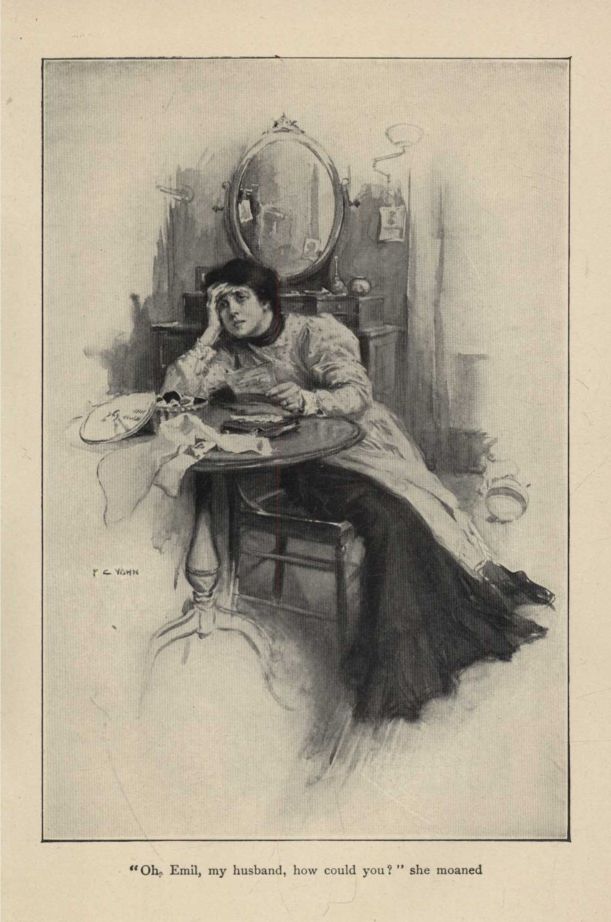
It seemed to Constance when she had finished this letter as though her heart would stop. Was this reality? Could it be that her husband was abandoning her and her children in cold blood, treating the sacred ties of marriage as lightly as though they were straws? Alas! his cruel words stared her in the face, freezing her soul, which had been sick for days over his unexplained absence; sick from dread. Yes, she had guessed; but she had put the horror from her as impossible, despite his hints. Unbalanced and embittered as he was, he could not be so unkind. Now she was face to face with certainty; there was no room for hope. It was true; so cruelly inhumanly true that her brain felt dazed and numb. She gazed at his writing stony-eyed and appalled, limp with dismay and forlornness. To avoid falling she put out her hand to the table, and the contact of her own flesh served to readjust her consciousness. Seating herself she swept her fingers across her brow to rally her senses, and read the letter again slowly. Then mortification succeeded dismay, and resentment followed close on mortification. The wounded pride of the wife, the indignation of the mother protesting for her children asserted themselves, causing her to flush to the roots of her hair and her pulses to tingle. Coward! Unnatural father! What had she done to deserve this? What had they done, helpless innocents? Give them up to him? Her children, now the only joy of her life? Never. They could not both have them. Why should he who had left them in the lurch have either? She could hear their prattle in the adjoining room, poor little souls, unconscious of their misery. Then her sense of wounded pride and her anger were forgotten in the agony of a possible separation from her offspring, and in the loss of her husband's love, and her tense nerves gave way. "Oh, Emil, my husband, how could you?" she moaned, and burying her face in her hands she let sorrow have full sway.
"Oh, Emil, my husband, how could you?" she moaned
When she had dried her eyes she was prepared to face the situation and to think more calmly. Certain points were now clear. Emil was right; since he had ceased to love her, they could never be happy together. So far as she could see, she had not been at fault, though he had persuaded himself that she was to blame. She would never have left him; but now that he had deserted her, she could dare to admit that their souls were not in accord, and that her love and respect for him had been waning in spite of herself for many months. She would not attempt to follow him, and she desired to retain both the children. Was it her duty to let Emil have one of them? Here was the only harassing point in the plans for the future which she was formulating. Would it be fair to the children to separate them? Would she be justified in keeping them both, in view of the affection which their father had professed for his own flesh and blood? As Emil had declared, he and she had made a mess of their marriage, and they were to separate. Was it fair to him to keep both the boy and the girl? Ah, but she could not bear the thought of giving up either. She felt the need of counsel. To whom could she turn? Who were her friends? She thought of Mr. Prentiss, and she remembered her husband's taunt concerning her philanthropic church friends with a sense of shrinking. The church offered itself as a refuge to all in the hour of distress, but it seemed to her as though she would rather starve than apply to Mr. Prentiss. Not that she was afraid of starving. That side of the situation had no terrors for her. She was almost glad at the idea of supporting herself and her darlings, and she had entire confidence in her ability to do so, even though she were forced to scrub floors. But she yearned for the sympathy and advice of a friend. How lonely she had suddenly become in this large, busy city! Emil had evinced little desire, especially of late, to make friends in the neighborhood, and she had been so absorbed in her home and her husband's interest that she had disregarded her social opportunities. He had been apt to speak slightingly of their acquaintances as people whom he would soon outstrip in the struggle of life. And now she was the poorest of the poor, the saddest of the sad, one of the lowly common people for whom her doctor father's heart had ever cherished fond and patient sympathy. She was one of them now herself. How different had been her dreams and her ambition. To think that she, Constance Forbes, had come to this—a wife abandoned by her husband, alone and friendless, with only the semblance of a roof to shelter her and her children. But all this was nothing if only she need not part with either of her babies. She would be able to support them, never fear, and with them to support she could be brave, even happy. But without them? No, no, Emil had forsaken her, she had lost her faith in him, he was not worthy of the sacrifice; she dared not trust him; he had no right to either. She could not, she would not let either go.
When the morning came she was more firmly of the same opinion, and she composed this reply to her husband:
Emil:
I have your letter and my heart is filled with sorrow. I cannot compel you to live with me against your will. God knows I have tried to be a loving, dutiful, and sympathetic wife, but it seems I have failed to please you. It is true that our ideas of how to live and what is right are very different. I have been aware of that in my secret soul, but for your sake I did my best to adopt your point of view. Now I shall be free to follow my own. Since you no longer love me, I am not sorry that we are to live apart, for I can see now that I have suffered much on your account. But I do not choose to reproach you. What good would it do? Besides you are the father of my children—poor little things. I do not think that I should have written to you at all if it were not for the question what is to become of them.
I am trying to do what is best for them and to be just; just to you and to myself. I have decided to keep both the children. They are babies still, and need a mother's love. A father's too, but it seems they cannot have both. Let God judge between us, Emil. They are my flesh and blood too, and it is you who are forsaking us, not we you. As you say, I have my health and we shall not starve. I am not afraid. There is nothing more to say, is there? It has all been a dreadful mistake—and we thought we should be so happy. Good-by. In spite of everything I shall always think of you kindly.
CONSTANCE.
Having despatched this she felt as though she would be glad to die. Life seemed so flat, and her condition so humiliating. Her love for Emil was dead; the union of their souls was broken; what was there to look forward to? Yet she knew that she must not stop to repine or to indulge in self-pity. The stern necessity of winning bread for her children confronted her and must be faced at once and resolutely. In this she must find happiness and fresh inspiration. It was her duty to close the ears and eyes of her soul to the voices and visions of the past. Hard work would save her brain from giving way, and hard work only. What should that work be? What was she to do? In the first glow of her pride, revolting at the slight which her husband had put upon her, the way had seemed easy, but viewed in the sober light of reality it bristled with difficulties. Yet now, as she pondered and realized what failure would mean, her spirit rose to meet them, and immediate needs forced sorrow to the background.
Where was she to find work? Since the receipt of her husband's letter everything outside her own emotions had been a blank to her; her gaze had been solely introspective. Conscious now of the need of action and of renewing her contact with the world, she took up the newspaper, yesterday's issue of which lay unopened on the table, and began to examine the page of advertisements for employment. She must find at once something which would provide her with ready money. Only through friends and only after delay could she hope to obtain a kindergarten position; it would take time and instruction to learn typewriting; she was not sufficiently proficient in languages or music to offer herself as a teacher. She could become a domestic servant or a shopgirl. In the former case it would be necessary to board out her children, to give them to some institution, perhaps, a prospect which wrung her heart; in the latter she could be with them at night, but who would look after and guard them during the day? What did other women do whose husbands ran away and left them? The long list of people out of work was appalling, and few of the opportunities offered seemed to fit her circumstances. Someone was seeking employment as a seamstress. She might take in sewing. This perhaps was the most feasible suggestion. She was handy at plain sewing, and a little practice would doubtless render her skilful. Yes, she would try this, and in order to obtain a start would solicit work from some of the neighbors, if needs be. The neighbors? They did not know as yet of her misfortune—her disgrace, for it was a disgrace to be forsaken by her husband. It would be necessary to tell them. What should she say? Entertaining sadly this necessity of an avowal, she glanced over the rest of the newspaper, and came suddenly upon a paragraph which informed her that her misfortune was already public. Prefaced by offensive headlines, "Emil Stuart disappears from Benham! What has become of Mrs. Morgan's mortgage money?" the wretched story stood exploited to the world. Constance read and the cup of her distress and humiliation overflowed. It needed only this insinuation of dishonesty to complete her misery. Her husband an embezzler? Where should she hide her head? Nor was there comfort in the reporter's closing effort at euphemism: "One or two acquaintances of the late candidate for aldermanic honors, when apprised of his mysterious disappearance, expressed the belief that his seeming irregularities would be explained to the satisfaction of all concerned; but a gentleman, whose name we are not at liberty to disclose, hazards an opinion, based on personal observation, that Mr. Stuart has been premeditating this step for several weeks, and is a fugitive from justice. The circumstance that his wife and two children have been left behind in Benham invites the further inquiry whether he has also abandoned his family. There are rumors that Mr. Stuart's domestic relations were not altogether harmonious."
Constance let the newspaper slip from her hands. Her cheeks burned with shame. This was the last straw. Her husband a defaulter, and her relations with him the subject of common newspaper gossip. As she stood spell-bound by this new phase of misfortune the door-bell rang. A visitor. Who could it be? Some sympathetic or curious neighbor who had read of her calamities. Or more probably the writer of the newspaper article coming to probe into her misery in search of fresh copy. For a moment she thought that she would not answer the call, and she waited hoping that whoever it was would go away. Again the bell rang, this time sharply. It might be something important, even a telegram from Emil to clear himself. Picking up the newspaper she concealed it hastily, then stepped into the passage and opened the door slightly.
"May I come in?" asked a strong, friendly voice.
"Oh yes, Mr. Prentiss; excuse me," she faltered. She had recognized at once who her visitor was, but so many bewildering things had happened that she stood for a moment irresolute, refusing to credit her own senses. As she opened wide the door, the clergyman strode in fearlessly as though he realized that the situation must be carried by storm. Entering the parlor, he put out his hand and said with manly effusion:
"I have come to ask you to let me help you, Mrs. Stuart."
"Sit down, please. You are very kind. I——"
Her words choked her, and she stopped.
"I saw by the newspaper yesterday that you were in trouble. I do not wish to pry into your affairs, but I thought that you might be glad of the counsel of a friend."
His visit was precious balm to her spirit, but, despite her gratitude, the knowledge that he was heaping the traditional coals of fire on her head made her uncomfortable. She had choked from mingled relief and mortification. But now her finer instinct responded to the kindness of his words and she said with simple directness: "I should like to tell you everything, Mr. Prentiss. My husband left a week ago. He does not intend to return. I have a letter from him, and he—he does not wish to live with me any longer. He was willing to support the children, but I could not make up my mind to let them go. Our money is all gone and this house is mortgaged. If you will help me to find work so that I can support them and myself, I shall be very grateful. It was very good of you to come to see me."
The children, attracted by the voice of a stranger, had run in and stood one on either side of their mother staring at him shyly with cherubic eyes. The clergyman said to himself that here was a veritable Madonna of distress—this lithe, nervous-looking woman with her slim figure and soulful face. How pretty and neat she looked in spite of her misery! How engaging were the tones in which she had set forth her calamity! He had always admired her, and it had been a disappointment to him that she had strayed. There was almost jubilation in his heart as he heard that she was free from the wretch who had pulled her down; and though he intended to temper the ardor of the priest by the tact of a man of the world, he could not entirely restrain his impulse to stigmatize her husband. "I see," he said. "You are much to be pitied. It is a cruel wrong; the act of a coward. But you must not take your trouble too much to heart, Mrs. Stuart, for the man who will leave a sweet wife and tender children from mere caprice is no real husband and father."
"Mr. Stuart has had much to worry him of late. He has lost money, and been unfortunate in politics." Her impulse was to apologize for her husband even then. "I cannot understand though how he could leave us," she added. After all why should she a second time on Emil's account set her face against the truth in the presence of this true friend? Emil was a coward, and his act was a cruel wrong.
But Mr. Prentiss had recovered his aplomb. "I will not distress you by talking about him; he has gone. The matter with which I am concerned is how to help you. We must find you employment at once."
Constance regarded him gratefully. "That is my great requirement just now, Mr. Prentiss. I need work to keep my children from starving and to help me to forget. I am not afraid of work. I shall be glad to do anything for which I am fit."
"I understand, I understand. It is the pride of my church to help just such women as you to help themselves. You need give yourself no concern as to your immediate pecuniary needs. They will be provided for. I will send the Deaconess to you at once."
The directness of his bounty, the plain intimation that she was a subject for charity brought a flush to her cheeks. But she knew in an instant that it would be false pride to protest. There was no food or money in the house.
"Thank you," she said simply.
Mr. Prentiss divined her reluctance and appreciated the delicacy of her submission. He recognized that this woman with wistful brown eyes and nervous, intelligent face was no ordinary person—was even more deserving than he had supposed, and his thoughts were already busy with the problem of her future. He must find just the right thing for her. "I know, of course, that you wish to become self-supporting as soon as possible," he said. "Will you tell me a little more about yourself and your capabilities? You came to Benham a few months before your marriage to fit yourself to be a kindergarten teacher, if I remember aright?"
During the momentary pause which preceded this inquiry her conscience had been reasserting itself. She had longed for counsel and here it was. If she had erred, there was yet time to repair her fault. "Before we talk of that, may I ask you one question, Mr. Prentiss? I wish to know if you think it was selfish of me to keep both the children. I desire to do what is right this time, whatever it cost me." She clasped her hands resolutely in her lap as though she were nerving herself for a sacrifice. "I hope you will tell me exactly what you think."
The clergyman's heart warmed at this revelation of spiritual vigor. "Here is a soul worth helping," he reflected. Then, in answer to her appeal, he exclaimed with righteous emphasis: "Ask your own heart, my dear woman. Would you dare trust these babies to your husband's keeping? This is a problem of right and wrong, and demands a severing of the sheep from the goats. You may banish that doubt forever."
Constance dropped her eyes to hide the tears of satisfaction which had sprung into them at his words. Her children were safe. The counsel given was the very echo of the test by which she had justified herself toward Emil. "Excuse me," she said in apology for her emotion. Then looking up she added with tremulous brightness, "I felt that I must be sure before anything else was decided. And now to answer your question as to my own capabilities: I have none. I am eager to learn, and I have had some education—my father was fond of books and had a library—but I tell you frankly that there is nothing but the simplest manual work for which I am fitted at the present time. I have thought that all over."
"So far so good. Much of the trouble of this world proceeds from the inability of people to discern for what they are not fitted. Can you sew?"
"I can do plain sewing satisfactorily."
"We will begin with that then. It will keep you busy for the time being. Meanwhile I shall have an opportunity to consider what you had best undertake." He rose and put out his hand with spontaneous friendliness. "Good-by. God bless you. You are a brave soul, and He will not desert you or leave you comfortless."
Constance quickened at the firm pressure, and her own fingers acknowledged the interest which it expressed. She looked into his eyes with frank confidence. "You have come to me at a time when I needed someone more than ever before in my life. I shall never forget it."
Mr. Prentiss nodded and turned to go as though he would disclaim this expression of everlasting obligation. He felt that he was about his Master's business, and was seeking neither thanks nor praise. Yet, while he deprecated her gratitude, her entire mental attitude caused him ethical and æsthetic satisfaction. The conviction that this ward of the church was worth saving and helping gave elasticity to his step and erectness to his large figure as he strode up the street, knocking now and again some bit of orange peel or other refuse from the sidewalk with a sweep of his cane, which suggested a spirit eager to do battle in behalf of righteousness.
VII
Two days later the Rev. George Prentiss dined at the house of another of his parishioners, Mrs. Randolph Wilson. She was a widow of about forty-five, the sister of Carleton Howard, reputedly the wealthiest and most sagacious of Benham's financial magnates, and a generous benefactress of St. Stephen's. Her bounty had enabled the rector from time to time to carry out his cherished plans for the æsthetic adornment of the church property. The reredos, two stained-glass windows, and the baptismal font in the enlarged edifice had been provided by her; and in the matter of charity she never failed to respond by munificent subscriptions to the various causes in aid of which he appealed to his congregation. They were friends and allies; interested mutually in St. Stephen's, and interested also, as they both liked to feel, in promoting American civilization outside of church work. Her house, or palace, as it should more properly be termed, a counterpart to that of her brother's which adjoined it, stood in the van of progress, in Benham's fashionable new quarter beyond the River Drive. No pains or expense had been spared to make these mansions impressive and magnificent. Architects of repute had been employed to superintend their construction, and their decorations and furnishings had been chosen in consultation with persons whose business it was to know the whereabouts of admirable objects of art, and to tempt impecunious noble families abroad to exchange their unique treasures for dazzling round sums of American gold.
Mrs. Wilson could fairly be termed the leader of social activity in Benham, if such a term be compatible with the institutions of a country where every women is supposed to be a law unto herself. Fashions, in the narrow sense of clothes, are in America set by the dressmakers, but what Mrs. Wilson wore was always a matter of moment to women who wished to be in style. She dressed elegantly, and she was able to take liberties with the dressmakers, doing daring things with colors and materials which justified themselves, yet were so individual that they were liable to make guys of those who copied her. Consequently, her wardrobe had a distinction of its own which proclaimed fashion yet defied it. Yet her clothes, striking and superb as they often were, constituted only a small part of her social effectiveness. Her gracious finished manners, and quick, tactful intelligence were the agents of a spirit perpetually eager to be occupied and to lead, and which had found a labor of love in directing what may well be called Benham's æsthetic renaissance.
For Benham's evolution had been no mere growth of bricks and mortar, and no mere triumph in census figures over other centres of population. Even more remarkable and swift than its physical changes had been the transformation in the point of view of its citizens. Twenty years earlier—in 1870, when Mr. Prentiss was a young man just starting in the ministry—he had been one of a small group of earnest souls interested in awakening the public to a consciousness of the paucity of their æsthetic interests, and to the value of color as a stimulating factor in the every-day life of the community, and as such he had often deplored the aridity of Benham's point of view. In those days the city was virtually a hot-bed of republican simplicity and contempt for social refinements so far as all but a very small percentage of the inhabitants was concerned. Those who built houses larger and finer than their neighbors were few in number and were stigmatized, if not as enemies of the institutions of the country, as purse-proud and frivolous. Hotels were conducted on the theory that what was good enough for the landlord was good enough for the guest, and that malcontents could go elsewhere. In matters appertaining to art, hygiene, education or municipal management, one man's opinion was regarded as equal to any other's, provided he could get the job. Special knowledge was sneered at, and the best patriots in the public estimation were those who did not distrust the ability of the average citizen to produce masterpieces in the line of his or her employment by dint of raw genius untrammelled or unpolluted by the experience of older civilizations. Though solid business men wore solemn-looking black frock-coats and black wisp ties in business hours, to dress again in the evening was looked at askance as undemocratic. It would have been considered an invasion of the rights of the free-born citizen to forbid expectoration in the street cars. Suggestions that the vicious and unregenerate adult pauper poor should not be herded with the young, that busy physicians should cleanse a lancet before probing a wound, and that sewage should not be emptied into a river used as a source of water supply, were still sniffed at by those in charge of public affairs as aristocratic innovations unworthy the attention of a sovereign people. Architectural beauty both within and without the house was disregarded in favor of monotonous sober hues and solid effects, which were deemed to be suggestive of the seriousness of the national character.
While deploring some of these civic manifestations, Mr. Prentiss had appreciated that the basis of this æsthetic sterility was ethical. When less discerning persons had attributed it solely to ignorance and self-righteous superficiality he had maintained that a puritanical, yet moral and sincere, hostility to extravagance and display was responsible for the preference for ugly architecture and homely upholstery and decoration, and that conscience was the most formidable obstacle to progress. As a priest of a church which fostered beauty and favored rational enjoyment of the fruits of the earth, he had never sympathized with this public attitude, but he had understood and, as an American, respected it.
Now, in the twinkling of an eye, as it were, all was changed, and Benham was in the throes of a revival; a revival which during the last ten years had revolutionized Benham's architecture and Benham's point of view. The public had become possessed by the conviction that they had outgrown their associations and that the standards hitherto revered were out of date and unworthy of a nation and a city pledged to enlighten the world, upon whom prosperity had been bestowed in large measure. The group of earnest souls who had dared to criticise seemed suddenly to have become a phalanx—numerically unimportant, still, when compared with the whole population, that seething army of industrial wage-earners—but assertive and energetic out of proportion to their numbers. The city had become a hive of reforming activities. Specialists in the arts and humanities were no longer classed as traitors, but were welcomed by a growing clientage as safeguards against bumptious individualism. Though a cheerful optimism in regard to the city's architectural merits still prevailed at large, a silent censorship was at work; substituting, in the business quarter, new mammoth structures adapted to modern industrial needs, erecting in the fashionable quarter, by the aid of American architects trained in Paris, well-built and individual-looking residences. Instead of three or four cheerless, barrack-like caravansaries with sodden cookery, there was a score of modern hotels, the proprietors of which vied with one another in their endeavors to lure patronage by costly and sumptuous innovations. There were comfortable and inviting restaurants. The slap-dash luncheon counter, with its display of pallid pie and one cadaverous chicken, was waning in the popular esteem, in favor of neat spas, at which the rush of patronage was alleviated by clean service and wholesome fare. There were eight theatres, each more spacious and splendid than its predecessor. A frowsy black coat, worn in the forenoon, had ceased to be a badge of patriotism or moral worth, and the community had become alive to the values of spruceness, color, and comfort in matters of dress. Not only this, but on the streets of Benham there were many stylish equipages with liveried grooms, and in the superb homes which the wealthy citizens had established, there were grand entertainments, where rivalry was rampant and money flowed like champagne. And last, but not least, there was Mrs. Randolph Wilson, the quintessence in her own person of all that was best in this revival in favor of the beautiful things of life, the living embodiment of this newly directed and freshly inspired energy. For well-to-do Benham and Mr. Prentiss liked to believe that the impulse behind these materialistic manifestations was conscience and aspiration, a reaching out for a greater human happiness and a wider human usefulness than had been possible under the old dispensation. This access of lavish philanthropy and study of charitable methods, this zeal of committees promoting new and more thorough methods in hygiene and education, and all the phases of this new awakening in quest of Christian beauty signified to him Benham's—and hence American—originality and fervor refined and spiritualized; Benham's enterprise and independence informed, chastened, and fortified.
And yet there was another side to this whole matter which had haunted Mr. Prentiss much of late, and which was in his thoughts to-night as he sat smoking his cigar after dinner. He had dined sumptuously. Cool oysters, soup of mushrooms, fish smothered in a luscious sauce, cutlets of venison with French beans, little pyramids of paté de foie gras encased in jelly, butter-ball ducks with a salad richly dressed, and a confection of fruit, cream, and pastry, which was evidently a gastronomic specialty of Mrs. Wilson's French cook. He had tasted everything; he had drunk two glasses of champagne, and been pleasantly aware that the cup of black coffee, served after dinner, was an entrancing concoction which his own kitchen did not afford; and he felt that his repast had done him good. It was for him an occasion. Obviously it was for Mrs. Wilson an every-day affair. Moreover, this rich, delicious dinner, served by noiseless servants on choice china, was in harmony with the rest of the magnificent establishment, in harmony with the artistic scheme of color, the soft lustrous draperies, the striking pictures and other masterpieces of art purchased for large sums abroad, and Mrs. Wilson's beautiful toilette and exquisite personality. Here was luxury triumphant and compelling, yet unappeased and seeking fresh opportunities for æsthetic delight; as witness a Millet, an inlaid table, and a Japanese idol in the room in which he sat, all new since he had dined there last.
What a vivid contrast all this to the cheerless often squalid homes which he was accustomed to visit as a rector of Christ's church! The thought which haunted him was that one result of the city's marvellous growth and development had been the accentuation of the distinctions between rich and poor, between class and class in a community where, until lately, there had been theoretically no classes. To be sure he had Mr. Carleton Howard's assertion that there was no country in the world where the poor man was so well off. This was very likely true, but it did not affect the proposition that the rich were daily growing richer and more self-indulgent. What was to be the limit—the outcome of this renaissance of beauty and comfort, which he had welcomed? Had not the æsthetic reaction almost reached the point where, both as a priest of God and as a good American, it behooved him to cry halt against luxury and extravagance? He frowned at this last reflection for the reason that he was painfully aware that he had fulminated against this sort of thing from the pulpit for years, formerly as part of the clerical formula championing the cause of the spirit against the flesh, and latterly because the Aladdin-like growth of great fortunes all over the land, and conspicuously in his own community, had often suggested the comparison between the passage of a camel through the eye of a needle and the rich man's entrance into the kingdom of heaven as an appropriate text. He had spoken with fervor and sincerity concerning the responsibilities of those having great possessions, and sometimes with living pictures in his mind. Neither Mrs. Wilson nor her brother had ever been among those for whom these admonitions were intended. They had opened their purse-strings liberally to every meritorious cause. The goodly size of their cheques was to him a constant source both of satisfaction and astonishment—astonishment at the new possibilities open to those interested in God's kingdom.
Yet, though he put from him as ungenerous and unnecessary any positive criticism of his hostess, in the teeth of her many benefactions and her personal activity in social undertakings, he could not help realizing that, in spite of his utterances, the evil which he deprecated was proceeding at a pace which suggested the course of wild-fire. And the worst of it was that he—the church—was so helpless. Great fortunes had been accumulated with a zeal which suggested the inevitable march of destiny—a law which seemed almost to mock the spirit of Christ—and, even while he was musing, the city had become a theatre of industrial contrasts, with the pomp and pride of life in the centre of the stage and poverty and distress in the ample background. There recurred to him the traditional image of the curate of his faith—the Church of England—cringing before or patronized by the titled worshippers of Mammon. This, at least, he could resent as impossible in his case—he had never hesitated to speak his mind to any of his parishioners, however important—still, the reminder was disconcerting and a challenge to his conscience. Nor was the reflection that this wave of luxury, this more and more exacting reverence for material comforts, was a part of the movement of the century, and was common to all civilized countries, a solace. He was an American, but first of all, he was a servant of the church, and the church was the beacon of civilization. Was she doing her work, if these terrible inequalities were to continue? What was to be the outcome of this zest for luxurious personal comfort?
To what extent the church ought to take part in the economic regeneration of the world was one of the questions which Mr. Prentiss had always found perplexing. He was well aware that his parishioners as a body were not fond of hearing him preach on what they called secular subjects. So long as he confined himself to enumerating spiritual truths, they were not averse to his illustrating his stigmas upon sin by generalizations from current worldly abuses; but he knew that many shook their heads and declared that the cobbler should stick to his last when he ventured to discourse on political topics or the relations of labor and capital. Mr. Prentiss was not aware, however, that some of this prejudice proceeded from the circumstance that he was apt to lose his head on such occasions; but, on the other hand, much of it was genuine disinclination for advice from the pulpit on subjects which, to quote the women parishioners, were not spiritual, and, to quote the men, were none of his business. His congregation was almost entirely composed of pew owners, people with vested rights, among which appeared to be the right not to be harrowed by socialistic doctrines. They were ready to help the poor in any way which he would suggest, and they had supplied him with a mission church where he could reach the ignorant and needy more effectively, but they argued that he had better leave to the politicians all suggestions tending to disturb the existing industrial order.
Mr. Prentiss sometimes sighed over these limitations, but he had become used to them, and in a measure, with advancing years, he had, in his endeavor to be a man of the world in order to remain a more useful Christian, accepted the doctrine that he had no plan to substitute for the present economic system, and that he must make the best of the existing situation. So, in practical, daily life, he exhorted the rich to give their money and themselves to the advancement of their fellow men, and the poor to shun vice and bear their privations with patience, while he held forth the promise of the church of an existence hereafter for the pure in heart where all the seeming inconsistencies of this mortal life would be explained and justified. Not being endowed with much sense of humor, Mr. Prentiss, as he waxed in years, and St. Stephen's became the fashionable church of the city, had found less and less difficulty in accommodating himself to this point of view, and in devoting all his ardor to reclaiming souls for Christ. After all, was not his mission to help men and women as he found them? First of all to minister to their souls, and in the name of Christianity to lift them from the slough of human suffering and misfortune that he might expound to them the loving mercies of the Lord? The things of the earth were not the things of the spirit, and he was more tenacious than in his youth of the prerogatives of the church as an institution controlling human consciences by standards of its own, founded on the teachings of the Prince of Peace. Nevertheless, being reasonably clear-headed and fearless, he was not without the suspicion at times that this reasoning was mystical, and in the face of facts he had every now and then his unpleasant quarters of an hour.
This was one of them to-night. His hostess, when the dinner was over, had left him to a cigar and his own devices in the library. He was to join her presently and be shown her daughter's wedding presents. He had been invited to dine in order that he might see them, but Mrs. Wilson and he both knew that this was an excuse for a quiet evening together in which they might compare notes concerning their mutual interests. Reaching out to knock off the ash of his cigar into a dainty porcelain wheelbarrow, he noticed a new photograph on the mantel-piece and rose to examine it. He recognized it as one of Clarence Waldo, the New Yorker to whom Miss Lucille Wilson was betrothed. The sight of this young man's countenance did not serve to restore Mr. Prentiss's serenity. On the contrary, he stood gazing at the photograph with an expression which suggested that his soul was still perturbed. The face was that of a man of twenty-seven or eight with delicate features—thin lips, a long nose and an indefinable haughtiness of expression which was made up of weariness and disdain. He had large eyes which lacked lustre, and his sparse hair gave the effect of having been carefully brushed. The clergyman had met him only a few times, and Mr. Prentiss had never forgotten the first occasion, which was at Lucille's coming-out ball three years before. He had happened to find himself in Mr. Waldo's path when the young man was in the act of carrying everything before him with a plate of salad for his partner, and he had never forgotten the cold impertinence of the New Yorker's stare. Paul Howard, Lucille's cousin, who witnessed the encounter, said afterward that Clarence had given Mr. Prentiss the dead eye, which was a telling description of the stoniness of the fashionable New Yorker's gaze. Mr. Prentiss had never heard this diagnosis, but he had remembered the episode. He regarded it, however, merely as additional evidence of the lack of reverence on the part of the young men of the day—and the young women, too, for the matter of that—not merely for sacred things, but for everything and everybody which were in their way or did not happen to appeal to their fancy. But though he considered this absence of social politeness as one of the cardinal failings of the age, his present thoughts regarding Lucille's future husband were not concerned with it.
Since the engagement had been announced four months ago he had been making inquiries, and the information which he had received was in his mind and troubled his soul as a corollary of the other problems which had just been haunting him. It was not of a character to justify him in forbidding the bans—not even in remonstrating with Mrs. Wilson, unless she were to ask his advice or provide him with an opportunity. But he deplored sincerely that this young man was to marry his friend's daughter. Was this to be the outcome, the crowning of the wealth of love and solicitude which had been lavished on this only child—a child brought up in his church? Was it for this that Lucille had been made the central figure of costly entertainments for the last three years, in the hope that she might make a brilliant match? Decidedly, it was a puzzling world, and circumstances seemed to be conspiring to cloud his horizon and disturb his digestion at a time when he ought to be enjoying himself and taking his ease.
"What does he offer her?" he said to himself. "Twelve months of sporting life—American sporting life. A superb stable, a four-in-hand coach and steam yacht, polo, golf, the horse show, cards, six months every third year in Europe, their summers at Newport, their winters at Palm Beach. The fortune which she will bring him will enable them to live in the lap of luxury all the year round, and he will teach her to regard those who are not rich and who do not imitate their manner of life as beneath their notice. I know the kind—I know the kind."
Soft footsteps interrupted his mental soliloquy. "No, thank you," he exclaimed in a tone which was almost militant to the waiters who approached him with a tray. Mr. Prentiss supposed that another form of stimulant was being offered him, for Madeira, liqueurs and coffee had been successively brought in and solemnly presented to him by the two men servants, one of whom seemed to him as superfluous as a plumber's helper. Then as his gaze, which had been inward, appreciated that the silver gilt tumbler contained apollinaris water, he called them back and emptied the glass. He had finished his cigar and it was time to rejoin his hostess.
VIII
Mr. Prentiss continued his monologue on his way to the drawing-room. He imagined himself saying to Mrs. Wilson, "You know that I believe in toleration, and that I would not set or preach an ascetic standard of life. I believe—my church believes—that it is not profitable to the human soul to mortify the flesh in every-day life or refuse to enjoy the comforts of civilization. But the set of people to which this young man belongs are cumberers of the soil and a menace to society. It is not merely a question of taste, but of Christian morals. We have nothing to do with other nations; our concern is with the social life of this nation and whether we are to foster and encourage a pleasure-loving, self-indulgent, and purposeless leisure class."
Yet though his thoughts thus shaped themselves in fervent words, he was conscious that in the absence of a cue his lips must remain sealed. There was a limit imposed by society on the priestly office which he could not overstep without appearing officious, and thus weakening his influence. Were it a case of notorious dissipation or some palpable fault or blemish, it would be his duty to speak. But he had no such data at his command. Clarence Waldo was simply a fastidious idler, pretentious, and indifferent to the vital interests of life. It could not even be charged that he was marrying Lucille for her money, as he had a competency of his own. They would be able to buy all the dogs and horses in the country if they saw fit. But his own tongue was tied. To all appearances Mrs. Wilson was content. At the time she had announced her daughter's engagement to him, she had said, in response to his earnest inquiry if she were satisfied—said it with a blithe smile, as though, on the whole, the best had happened—"I should have been glad of course, if Lucille had chosen a man of conspicuous talent, a future United States Senator or successful artist or author. If she had loved her lord, I should not have objected to a title, because, after all, even to a free-born American, there is a certain compensation in becoming the mother of dukes and regenerating an ancient line. But Clarence is well connected, and the child is in love with him. So long as she is happy, that is the essential thing."
Since then he had become better informed as to the young man's tendencies. But if Lucille was in love with him and her mother acquiescent, what was there to do? The church could not interfere beyond a certain point without giving offence.
Mrs. Wilson was not in the drawing-room, but Mr. Prentiss caught a glimpse of her at her desk in a smaller room which led out of it. She called to him that she was answering a note and would join him presently. The clergyman seated himself and picking up from a low teak table beside him a paper-cutter fashioned on a Japanese sword hilt he compressed his fingers on the handle as an outlet to his perplexity. Had he been walking in the fields, he would have cut off the heads of the dandelions with his cane. Marriage was a sacrament, the most solemn undertaking in life, yet how impossible it was to regulate matrimony for others. He glanced around the room admiringly. Already the musical notes of his hostess's voice had served to dissipate partially the miasma of doubt which had been assailing him. This main apartment was one of a series of drawing-rooms, each furnished with an exquisite magnificence suggestive of the salons of France in the days of Louis XIV, save that there was a superabundance of artistic furnishings; hence the sight was confused by the array of costly tapestries, marbles, bronzes, china, and gilt or otherwise illuminated ornaments which almost contended for space with one another, though the rooms were of large proportions. One feature of Benham's renaissance was the ambition to outdo the past in size and gorgeousness, but Mrs. Wilson's advisers had been animated also by the desire for artistic success, and it was only in its wealth of material that their and her—for she had been the leading spirit after all—performance was open to criticism. Here in Benham, where twenty years before the horse-hair sofa was still an object of admiring regard in the homes of the well-to-do, the desert had blossomed with the rose, and a veritable palace had been established. And, as Mr. Prentiss reflected, joining his finger-tips across his waist-band, all this lavish expenditure meant the return by the rich of accumulated wealth into circulation for the benefit of those who labored for their bread, which was another of Mr. Carleton Howard's telling truths.
The swift, animated, but noiseless glide of Mrs. Wilson into the room and onto a sofa, from which she flashed at him a gracious, electric look of attention with the words, "And now, my friend, I am entirely at your disposal. It was a note which had to be answered at once"—restored Mr. Prentiss's serenity. She was one of those pleasant persons in whose presence the world seems justified. When she entered a room people were apt to pay tribute by a pause in whatever they were doing, and she became the focus of attention. The effect of her graceful energy was largely responsible for this, suggesting the forceful but silent sweep of a ship. She had lost the figure and the countenance of youth, but though her abundant crinkly hair was grizzled no one ever thought of her age except to observe that she was handsomer than as a younger woman. She had never been a beauty; she was now a distinguished looking, comely, and effective matron. She was tall and rather willowy, but not thin, with a proud, resolutely carried head, an agreeable straight nose, short rather than long (her best feature) a spirited, sympathetic smile, eyes fundamentally gray, which changed as her thoughts changed, and ingratiating but elegant manners. Her face, notably the cheeks and lips, was a trifle full, suggesting dimples, and possibly to the critical a too-manifest desire to please. Her obvious pose—which, though deliberate was entirely genuine—was to be exquisite, sympathetic, and intellectual, and for the expression of this range of qualities she had serviceable allies in her musical voice, a bewitching way of showing just enough of her teeth, when she became vivacious, and her ornamental clothes, which always suited her. On this evening she wore an old-gold gown with jet and lace accompaniments, an aigrette of crimson gauze with which the plumage of her fan was in harmony, a band of magnificent pearls around her neck, and on her breast, though such ornaments were not strictly in fashion, a large brooch of fine workmanship containing a miniature of two children of tender age. Of these children one had died shortly after the miniature was painted, the other was her daughter Lucille. Her soul was dedicated to two interests, her joy and ambition as a mother, and to the cause of social human progress.
Mrs. Wilson had been for fifteen years a widow, and, though her husband held a hallowed place in her heart, even she was conscious that the broad scope of her present life dated from the period when, seeking a refuge from her own grief and loneliness, she had welcomed diverse social employment. Her husband, Randolph, a hero and a colonel of the Civil War, had claimed her on his return as a bride. They were ardent lovers, and they had never ceased to be so, certainly not in theory. Some of Mrs. Wilson's knowing friends were fond of insinuating, when the humor for gossip prevailed, that he had died just in time, which was their way of intimating that she had outgrown him. But these dissectors of hearts did not perhaps sufficiently remember that her own blossoming forth into the woman she now was had been subsequent to her husband's death. Nor did they take sufficiently into account the bewildering course of events which had attended her progress. Colonel Wilson, a man of small means at the time of their marriage, had become her brother's partner. The properties in which he was interested at the time of his death had subsequently proved so valuable that she had found herself presently the possessor of a million, a sum which had quadrupled in the keeping of her brother, Carleton Howard, one of the most powerful financiers in the country. Opportunity surely had waited on her widening aspirations, enabling her finally to establish herself in this magnificent home surrounded by all the æsthetic attractions and many of the treasures of modern civilization.
Probably Mrs. Wilson herself had never sought to analyze the past by the light of the present, realizing, as we all do, that life unbeknown to us has halting-places which become, as we look back, the dividing lines between what are almost separate existences. Though at her husband's death she had made no resolutions regarding the future, she had never felt the impulse to marry again, so engrossing were the concerns of motherhood and social responsibility.
"You spoke at dinner of wishing my assistance in some case in which you are interested. Will you tell me about it now before we look at the presents?" Mrs. Wilson continued with smiling interest.
"Ah, yes." Mr. Prentiss was glad to have this recalled to his mind. There was no chance here for doubt or perplexity. "It is rather out of the usual run of charity cases. The personality of the woman, I mean. The circumstance that her husband has run away and left her penniless, with two young children to support is, alas! only too common."
"Poor thing! How can I be of service?"
"The woman—her name is Mrs. Stuart—notwithstanding her disastrous marriage, seems to me distinctly superior. She came to Benham some six or seven years ago, and I knew her a little at St. Stephen's before she was a wife. Indeed, I married them, and made some inquiries at the time concerning the husband's circumstances, but learned nothing to his discredit. She has found him to be a godless, unscrupulous person with drinking habits, and recently he has deserted her on the grandiose plea that they would be happier apart. She will be happier; I am sure of that; but I have been exercised as to how to enable her to become self-supporting. She is called to higher usefulness than scrubbing or plain sewing, but though I have discerned in her capabilities and refinement, she is not at present equipped for any active employment."
"Which only tends to show, my friend, that every woman"—Mrs. Wilson paused an instant—"every woman who has not independent means of her own, I mean, should be educated to be self-supporting—should have some definite bread-winning occupation which would render her independent of the man she marries in case he dies or misbehaves. I was thinking the other day that a society formed to advocate this doctrine before clubs of girls as a condition of marriage would prove efficacious."
Mr. Prentiss nodded. "It is certainly the duty of Christian society to provide additional safeguards against the consequences of improvident wedlock. In this particular instance, the young woman plighted her troth while she was studying to become a kindergarten teacher. She was a country doctor's daughter, and is gentle and refined, as well as intelligent in appearance—one of those lithe, tense American personalities in which the spirit appears to burn at the expense of the body, but which, like the willow, bend but do not break under the stress of life."
"She sounds interesting, and I do not see that she has been to blame. We must raise a fund for her. With how large a subscription shall I head the list?" Though Mrs. Wilson gave freely on merely charitable grounds, she gave with more enthusiasm when the objects of her bounty had not offended her sense of the social fitness of things.
The clergyman put out his hand. "That wouldn't do exactly, I think. She is not too proud to let us help her for a few weeks with coal and groceries until she can earn for herself. She realizes that she must be sensible, if only for the children's sake. She has an independent simplicity of nature and clearness of perception which would stand in the way, I fear, of her accepting a donation such as you have in mind; though I should dearly love to allow you to pay off the encumbrances on their house, which, owing to her husband's rascalities have eaten up her little home—her patrimony. But I am sure she would refuse."
"I see. We should think less of her if she allowed herself to be pauperized, much as I should enjoy giving her a deed of her home free and clear—the mere thought of it causes me a thrill of pleasure. But the worst of such tragedies is that we are most powerless to aid those who are most deserving." Mrs. Wilson leaned back among her cushions, and, drawing a pale pink rose from a bunch in a vase at her elbow, laid it along her cheek and inhaled its fragrance. "If she were an undiscerning, common spirit with workaday sensibilities, as so many of them are, she would not refuse, but—half the pleasure of giving would be lost. It is a privilege and the fashion to be charitable, but so much of our charity consists in filling the mouths and clothing the bodies of the wretched who will never be appreciably different or strive to be different from what they are."
"The poor we have always with us," murmured the clergyman.
"Always. The shiftless, dirty, unaspiring, unæsthetic poor. The dregs and lees of human endeavor. We must feed and clothe them, of course, and help them to help themselves, but sometimes I forget the pathos of it all in the ugliness and squalor. Consequently, when the chance to do real good comes, it is a pity not to be able to lift the burden completely. What, then, can I do for this young person?"
"I have thought over her case for the last forty-eight hours, and have come to the conclusion that, as she has no special training, her best chance for employment is to learn short-hand and to use the typewriter. I understand that women proficient in this vocation can usually secure steady work at a fair wage. Though Mrs. Stuart would be unwilling to accept a direct gift of money, I feel confident that she would not refuse to let us put her in the position to become self-supporting—that is, defray the cost of the lessons necessary to make her a competent stenographer or office clerk. And I thought you might be glad to pay for these lessons—a matter of six months or so."
Mr. Prentiss had taken up the paper-cutter again, and he passed the flat of the metal blade across his palm as though he were smoothing out his plan as well as the creases.
"Gladly," she responded. "For as long as you desire. And, perhaps, when she has learned what is necessary, my brother may know of some opening for her down-town."
"Very likely," answered Mr. Prentiss, with resonant acquiescence. "The same thought had occurred to me."
"And, in the meantime, since you tell me that she is competent and refined, my secretary, who will have her hands full with the details of the wedding, may be able to give her occasional errands to do. You may tell her to call when her plans are adjusted and to ask for me."
"Excellent. And we shall both be your debtors."
Mrs. Wilson smiled graciously, showing the dimples in her cheeks. The demands made upon her for pecuniary aid were of daily, it might be said hourly, occurrence. Whoever in Benham was in search of money applied to her, and the post brought her solicitations from all sorts of people, among whom were the undeserving or importunate, as well as the needy or humanitarian. As lady bountiful, she purposed to exercise intelligent discrimination in her charities, and she accepted thanks as a tribute to that quality.
"Come," she said, rising, "I will show you the presents. Only think, four hundred of them, and so many beautiful things! People have been so kind. Several of my brother's friends in New York have sent most exquisite tokens—a necklace of diamonds and pearls from Mr. Fenton the banker, a gold dessert service from his railroad ally, Mr. Kennard."
She led the way from the drawing-room suite into the hall, where electricity in artistic guises illuminated the broad panellings, a splendid Terriers and three or four bronze or marble statuaries of rare merit, and up the stair-case to the next floor into what was known as the morning-room—an apartment where Mrs. Wilson conducted her affairs and did her reading and thinking. This was a combination of study and æsthetic boudoir. There were seductive sofas and quaint capacious chairs supplied with brightly colored cushions, and dainty draperies, all in silken stuffs of patterns reminiscent of the Orient. Art, in its most delicate and spiritual forms, breathed from every object of furniture or decoration; from the small pictures—some in oils, some in water-colors—which merited and often demanded the closest scrutiny; from the few vases of entrancing shape and hue, from the interesting photographs in beautiful frames, from the curious and rare memorials of travel and wise choice of what cunning fingers had wrought with infinite labor. As in the rest of the house, there was still too much wealth of material, too much scintillation and conglomeration of color, but the intent had been—and not without success—to produce a more subtle atmosphere than prevailed outside, as of an inner temple. Prominent in one angle stood Mrs. Wilson's desk, rose-wood, inlaid with poetic gilt tracery, and littered with the correspondence of a busy woman. Books and other articles of daily use lying here and there without effort at order gave to the room the air of being the intimate abode of a human soul. Opening out of this was a private music-room, which was used by Mrs. Wilson and her daughter in preference to the large music-room on the street floor intended for musical parties and dances. Here were the wedding presents, a dazzling array of gold, silver, jewels, glass, china, and ornamental knick-knacks, tastefully arranged on tables introduced for the purpose. As they entered an attendant withdrew into the hall.
"We have thought it more prudent to have a watchman on guard by night and day," explained Mrs. Wilson; "for I suppose it is true, as one of those ridiculous newspaper items asserts, that these gifts represent at least one hundred thousand dollars. By the way," she continued, with a gentle sigh, "it is so difficult to know what attitude to adopt with the newspaper people. If one refuses them the house, their sensibilities are hurt and they are liable to invent falsehoods or write disagreeable paragraphs. If they are allowed to inspect everything, they publish details which make one's heart sick, and make one appear a vain fool. How is a person in my position to be courteous toward the power of the press and yet to maintain the right to privacy? Is not this superb?" she added, holding up a crest of diamonds in the form of a tiara. "My brother's present to Lucille."
"Beautiful—beautiful, indeed," murmured the clergyman. The sight of all these costly things was bewildering to his mind as well as to his eyes. "Ah, the press—the press, it is a problem, indeed. We would seem to have the right to individual privacy, would we not? And yet in this age of ours, pressure is so often used upon us to thrust our wares into the shop-windows—as in my case, sermons for newspapers of the most sensational class—on the plea of a wider usefulness, a closer touch with the wilderness of souls, that it is difficult to know where the rights of the public end as to what one has. What would seem to be vanity may often be only another form of philanthropy. And yet——"
"And yet," interposed Mrs. Wilson, as she singled out an enchanting fan of gold and ivory and the most exquisite lace and spread it for his inspection, "why should I pander to the vulgar curiosity of the public? It is none of their business."
"In a matter of this kind I quite agree with you. If they could see all these beautiful things, there might be some sense in it; but that would be out of the question, of course."
"That will be the next step; our houses thrown open to the madding crowd. Six newspapers—two from New York—applied recently for leave to see the presents. I intended to refuse firmly, but to my astonishment Lucille seemed disappointed. It never occurred to me that she would not hate the publicity. She gave a little shriek and said, 'Mamma, how dreadful!' and then added in the next breath, 'Everybody does it, and, as something is sure to be printed, might it not be better to make certain that it's correct?' A day or two later she was photographed in her tiara, and from what has transpired since I fear that the idea of publicity was not foreign to her thought. My child, Mr. Prentiss! Only think of it! One can never quite understand the point of view of the rising generation. I consulted Carleton, and he grew successively irate, contemplative, philosophical, and weak-kneed. In short, a week ago a reportorial woman, with the social appetite of a hyena and the keen-eyed industry of a ferret, passed the forenoon in the house and went away with a photograph of Lucille in the tiara. And what is worst of all, in spite of my humiliation at the whole proceeding, I am decidedly curious to see what she has written."
The sound of voices in the morning-room broke in upon this confession. "Ah, here you are, Aunt Miriam! I have brought you an artistic masterpiece with a felicitous biography of the distinguished heroine. Behold and admire!"
The speaker was Paul Howard, Mrs. Wilson's nephew. He advanced from the doorway with radiant, teasing face, holding out a newspaper at which he pointed delightedly. At his heels followed Lucille and Clarence Waldo, she protesting, yet betraying by her laughing confusion that her indignation was half-hearted; he stalking with self-important gravity save for a thin smile, the limit of his deliberate contributions to the gayety of nations unless under the influence of alcoholic conviviality. At men's gatherings there was a stage in the proceedings when Clarence Waldo became decorously mellow and condescended—indeed, expected to be asked—to sing one of three or four quasi-humorous ditties at his command, a function which he seemed to regard as an important social contribution and for which he practised in secret. Also, after luncheon or dinner, he was liable to lay down the law in loud tones in regard to current sporting affairs. But his habitual manner was languid and his expression cold, as though he feared to compromise himself by interest or enthusiasm. He was very tall. In the centre of his crown was a bald spot. He stooped slightly, and, except among his intimates, looked straight before him lest he might see someone whom he did not wish to know. In the rear of this family party came Carleton Howard, stepping firmly yet deliberately, as he always did, as though he walked abreast of Time, not tagging at her skirts like so many of his contemporaries—a fine figure of a man approaching sixty, with a large body, but not corpulent, a broad brow, a strong, defiant nose, iron-gray hair and a closely cut iron-gray mustache, clear, fearless, yet reflective eyes, and a mouth the pleasant tension of which indicated both determination and tact. He was smoking a cigar, and had come in from his own library to enjoy the bearding of his sister by the young people.