Front matter (continued 5)
Reading edition
"My wife will not like that."
"It is the only course, if she desires to preserve her reputation. If she prefers to have you bring a libel for divorce on the ground of infidelity, she can be free in a much shorter time. Also she could obtain her liberty somewhat sooner by changing her residence to a more accommodating jurisdiction and asking a divorce from you. Provided you offered no opposition, she might succeed, but that would be a back-handed method discreditable to you both, and an evasion of the laws of this State, which might, hereafter, be productive of unpleasant complications. It's a sad business, but you should have a clean job."
"Assuredly. We could separate at once?"
"Yes. But one of you must actually desert the other. An agreement to live apart does not constitute legal desertion. On the other hand, if she were to leave your house, the court would not inquire what was going on in your mind, provided you did not show by any overt sign that you wished to get rid of her. You can be glad, but you must not say so."
"I understand. She need not be burdened with my presence from the outset. As for marrying Waldo, she must wait her three years."
"And she may be thankful that she will be able to marry as soon as the divorce is absolute. In some States the person against whom a divorce is granted, is forbidden to marry altogether, or for a period of years as a punishment. To forbid marriage altogether, in such cases, appears to me another premium on immorality. To forbid it for a time, may sometimes prevent indecent haste on the part of the guilty, but it is a good deal like keeping after school children who have been naughty. Besides, the party forbidden to marry, as in New York, for instance, has merely to step into New Jersey and be married, and the second marriage will be held legal by the New York courts and everywhere else."
Paul was silent for a few moments. "That seems to me a decent programme. My wife can go to Europe, and—and when the time is up, marry Waldo. It's easy as rolling off a log." He clapped his strong hand on the wooden arm of his chair, so that it resounded. "My father will be terribly cut up. My aunt—God knows what she will say or do. As for myself"—he paused while he lit a fresh cigar—"I shall have to go into politics."
"Politics?"
"Yes. I'd like to go to Congress." Paul sat back in his chair with the air of one taking a fresh brace on life. "I've always intended to, sooner or later. Had it at the back of my mind. But now—well, if I were sent to Washington, and presently got a foreign mission, my wife might feel sorry for a few minutes that I bored her. Yet I wouldn't have her back. Waldo is welcome to her. The real reason," he added, suddenly, after another pause, "is that I've been asked. One of the Republican State Committee spoke to me about it in June, just before I went to Newport. The election isn't until a year from this autumn. I told him I'd think it over. I've got to do something to counteract this disgrace, and to forget it. Well, I must be going. I'll see you again as soon as I hear from my wife."
Gordon detained him. "You mustn't take too despondent a view of it. After all, it's not your fault, it's your misfortune. All your friends will recognize that; and no one will be able to understand how any woman could weary of the love of a man like you, and prefer a listless, pleasure-seeker, such as Clarence Waldo."
Paul shrugged his shoulders. "It's the spirit of the age, I suppose. I'm not sorry, I tell you, but I'm piqued. We are shells upon the beach. The tide sweeps us along even though we know it is the tide, and can say of the next man, 'what a fool he is, to drift like that!' But what is a fellow to do? How is he to escape? I'm a millionaire—I'm likely to be several times that if nothing breaks. I didn't wish to go to Newport, but I went. I don't care for half the things I do, but they have to be done; that is, I do them of my own accord, when the time comes, and, though I kick, I know I should regret not doing them merely because they seem to be the proper things for people of my kind. There you are. I have a sort of double self, as you know. It isn't that I'm weak, it's—what do you call it?—the force of my environment. And a millionaire's environment has a pressure of two hundred pounds to the square inch. It's the same with the women. What with rich food, splendid apparel, perpetual self-indulgence, and the power which money gives them to gratify every whim, is it any wonder that they don't let a little thing like the marriage vow stand in the way of their individual preferences? Who is to hold them to account? The church? Some of them go to church, but in their hearts they are satisfied that this is the only world. And as to loss of social position—of which they really would be afraid—the tide is with them. There are too many sympathizers. Or at least, it is inconvenient to be obliged to hurt other people's feelings in a free country."
"Rather a formidable indictment against Newport," said Gordon.
"It isn't against Newport. It's against the plutocracy all over the country. Newport merely happens to be the place where very rich men with social instincts most do congregate in summer. My domestic tragedy is typical, yet sporadic. Every season has its crop, but, numerically, it is small. Infidelity is only one of the phases of the spirit—but the spirit is rampant. Money-money-money, luxury-luxury-luxury, self-self-self (individualism, they call it), and in the process everything is thrown overboard, except the American flag, and life becomes one grand hurrah, boys, with no limitations, save murder and lack of physical cleanliness. And I belong to the procession, my dear fellow. I'm disgusted with it at the moment, that's why I rail. But in six months I shall be in it again. See if I'm not."
"You're simply depressed, Paul, and no wonder," said Gordon, with genial solicitude. "But we mustn't judge our plutocracy—aristocracy, or whatever you choose to call the personal representatives of the prosperity of the country—by the antics of a few, disgusting as they are. I agree that their behavior apes the frivolity and license of the old French court without its elegance, and I don't suppose that the founders of our institutions ever included a leisure class as a part of their scheme. Absorbed in ideals, they neglected to take poor human nature sufficiently into account. We have lost the buffalo, but we have acquired a leisure class, and we must make the best of it, not the worst. We can't cut their heads off; this is a free country. It would be dreadful—dreadful, wouldn't it, if our institutions, of which we are so proud, were to produce merely the same old thing over again—a leisure class of voluptuaries?" Gordon paused for a moment and his smile died away at the vision which his words evoked. "I don't intend to believe it; you don't. There are students of destiny who maintain that nations rise, reach maturity and decline by regular economic laws, but that human nature never really improves. That's fatalism. The free play of human individualism is having its last grand chance here in these United States. If our aristocracy proves no better than any other—if the rich and powerful are to sneer at morals and wallow in licentiousness, we couldn't blame society if it should try a strong dose of socialism, with its repressing, monotonous dead level, rather than accept the doctrine that the law of supply and demand is the sole ruler of the universe. But as good Americans we can't afford to judge our plutocracy, as yet, by the vices of a few people at Newport."
"They sin in such a cold-blooded way," said Paul. "If they really cared, as some of the foreigners do, one could understand; but they don't."
"I know. It's one of the canons of old-world traditions that adultery is almost redeemed by the possession of an artistic sense. To commit the one without possessing the other, may be no worse morally, yet it seems much more vulgar. But we mustn't take them too seriously, even though they are our countrymen and women. They are the exceptions—the excrescences. Look at your father, for instance. He belongs to them—but he is not of them. The same is true of yourself; and it is a privilege, with all its responsibilities, a privilege I envy you. Who wouldn't be a multi-millionaire if he could? What is more alluring than power?"
Paul returned the pressure of his friend's hand. "You're a good fellow, Don. I suppose I'm hipped. That's not my way, as you know. Usually everything with me is rose color; I'm too good an American, if anything." He buttoned his well-fitting coat with a dignified air, as though the pride of the suggestion had stirred his pulses like a brass band. "The trouble is, that when I'm feeling well, everything goes, and the only thing which seems of importance is to come out ahead of the other fellow. So we kick over standards and degenerate. This time I've been struck with a club, and—and I don't see that it's my fault. Well, good-bye. As soon as I hear, I'll let you know."
XVI
There was only one shadow on Constance's present happiness, for she was happy in her independence and her work. She had demonstrated her ability to support herself and to defy the blow of fate which had deprived her of a husband's aid and protection. It was the growing perception that she might not be able to do all she desired for her children. This sprang from her own keener appreciation of the value not only of the best educational advantages, but of refined personal surroundings in the development of character. She could inculcate noble morals; she could teach her children to be truthful, brave, and simple; she could provide them with public school instruction, and she was resolved to give them, if her health remained good, the opportunity to continue their education longer than was the wont with parents whose offspring had their own way to make in life unaided. But her ambition, or rather her perception of what she desired for them, did not stop here. There were present demands which must be neglected solely because of her straitened circumstances; and she beheld ahead a long and widening vista of privileges from which, perforce, they would be debarred during the formative years for a similar reason. Henrietta's teeth were disconcertingly crooked, and should have the continuous attention of a skilful dentist, and her voice had already that nasal twang which, if unchecked, is sure to result in feminine inelegance of speech. She wished that both the children, especially the girl, might have thorough instruction in French and music, and be sent to dancing school. Little Emil was giving signs of marked talent for drawing, and the thought of how that gift could be developed, was already causing her concern. It was obvious to her that each of the next ten years had more insistent instances in store for her. She knew that she could give her children what the democratic world delights to call a solid foundation, but she was eager to equip them with stimulating mental ideals and bodily graces, to put them within reach of excellence and culture.
She was too grateful to repine or to allow this shadow to oppress her spirit. Its sole effect was to stimulate her energies, to make her fertile in resources to counteract this disability, and painstaking in attention to her duties in the hope of a small increase in salary. She kept a close watch on Henrietta's voice, and put her on her own guard against its piercing quality; she organized a small dancing class from among the children in Lincoln Chambers for one evening in the week, and from her own past experience essayed their instruction in waltzing and social decorum. Also, on Sunday afternoons, she would often lure Emil and Henrietta to the new Art Museum and give them the opportunity which her own youth had lacked to discern artistic form and color, and to acquire inspiration from world-famous or exemplary paintings and sculpture. Then there suddenly came to her as treasure-trove a new fund to be drawn on for such purposes. Her employer, scanning the field of philanthropy by the light of his own professional experience, had realized that there was need in Benham of a legal aid society—that is, of an organization which would defray the charges of a firm of attorneys to whom people in utter distress, without means, and with petty but desperate grievances in which busy lawyers could not afford to interest themselves, could apply for succor. When it appeared that the clerical duties incident to the fund collected for this charity must be performed by some suitable person, it occurred to Gordon Perry—he had been seeking some such occasion—that Mrs. Stuart would make an admirable secretary and treasurer, especially as he intended that the society should pay two hundred dollars for the annual service. Constance's heart throbbed with delight at the announcement, and the first fifty dollars was devoted by her to the treatment of Henrietta's irregular front teeth. Would she be able some day to send Emil to college? Might she hope that her daughter would grow to be thoroughly a lady, not merely a smart, self-sufficient woman, but a gracious, refined, exquisite spirit like Mrs. Randolph Wilson? In her outlook for her children's future, she had become aware that she had set up two individuals for emulation: the woman whose æsthetic Christianity had enriched her life, and the man whose unaffected intelligence and vigor offered to her daily observation an example of honorable modern living. To lift her own flesh and blood above the rut of mediocre aims and attainments was now the ambition of her soul, and she was ready to strain every nerve to bring this to pass.
Constance would find her in possession at Lincoln Chambers
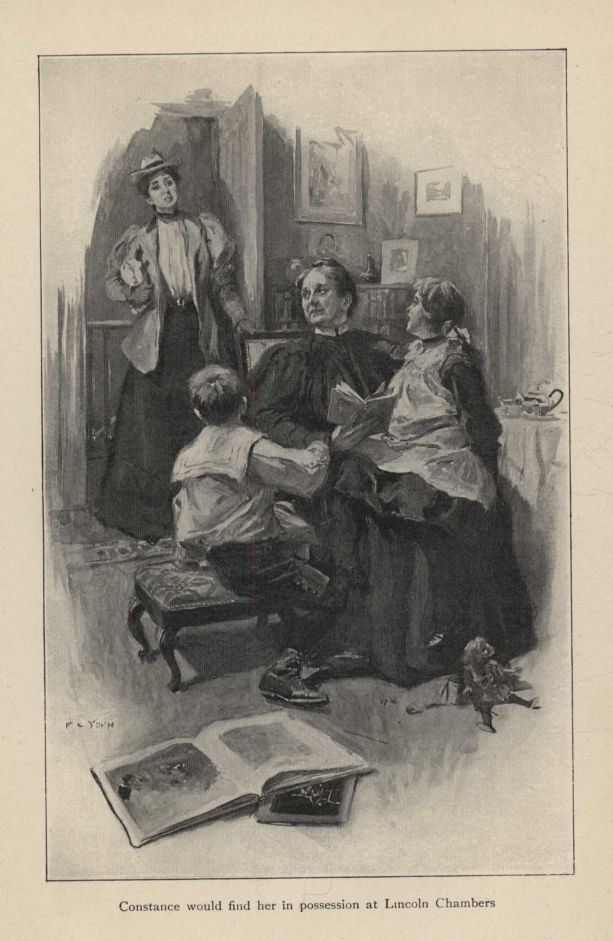
Her acquaintance with Mrs. Perry had ripened into intimacy. The old lady had taken a strong fancy to her, and the liking was cordially reciprocated. This meant increasing friendliness on both sides. Not infrequently, on her return from the office, Constance would find her in possession at Lincoln Chambers with the room warm, five o'clock tea ready, Henrietta in her lap and Emil beside her, listening to absorbing reading or stories, each of which had a pungent, personal flavor, with a not too obtrusive moral. On the other hand, Constance was asked to dine every now and then in the new house, and after dinner, sometimes it happened that they went to the theatre with Mr. Perry, or on evenings when he was busy, the two women would sit cosily with their work, and conversation never flagged. Women, when sympathetically attached to each other, seem to be inexhaustible reservoirs of speech, which flow with a bubbling copiousness bewildering to masculine ears. In their case, the hands of the clock set the only limit to their mutual enjoyment. The hour of departure brought the single uncomfortable moments of the evening for Constance—that is, for the first two evenings. Her apartment was a full mile distant, but her friends' house was not more than two hundred yards from a line of electric cars which passed within a block from her own door. Until Gordon Perry, who came out of his library to say good-night, announced his intention of accompanying her home, the idea had never occurred to her that it was necessary, or that he would offer his escort. Yet such are the inconsistencies of the feminine mind that the moment he did so she became aware that, if he had not offered it, she would have felt a trifle hurt. At the same time she did not wish him to accompany her. It would be obviously a superfluous piece of politeness; there was no risk of any kind in going home in the cars alone. She told him this in a few words of clear remonstrance. But he smilingly put on his overcoat, said it was a beautiful moonlight night, and assured her that he was anxious for a walk before going to bed. The idea of his walking only made the situation worse. Constance turned to his mother for support, but Mrs. Perry cordially seconded his assertion that it would do him good, so there was no escape from acceptance. The thought of having dragged a busy man—and her employer—out of his house at night disturbed her equinamity all the way home, so that although she delighted in having him as a companion in the exhilarating autumn air, under a glorious moon, she determined to prevent its recurrence. Yet, as she approached her destination, the fear of seeming ungracious supervened, and she had almost decided to postpone her protest until the next time, when he unwittingly gave her an opportunity to speak by remarking that he hoped that this was only one of many evenings which she would spend with them during the winter. "You must know," he added, "that my mother has taken a great fancy to you, and that it will not suit her at all if you are niggardly in your visits."
Constance smiled acquiescingly. "I love your mother," she said, "and it will be a pleasure to me to come as often as she wishes." At the same instant she said to herself, "Now for it!" Whereupon she began sturdily, "Only, Mr. Perry——"
Why did she pause? She was at a loss to know. It was the reverse of her custom to begin a sentence and leave it dangling in this unfinished manner. She accused herself of being a goose, and, simultaneously she took a new breath to go on, only to be met by her companion's blithe sally:
"Only what, Mrs. Stuart?" She could see that his eyes were laughing. Did he divine what was choking her?
"Only this: if I come to your mother, you must let me go home by myself. The electric cars are a stone's throw from your house, and run close to mine, so there is not the slightest necessity for your incommoding yourself." She paused, troubled. The last turn of the sentence, though it expressed her meaning, had not the felicitous sound she desired.
"I came because I knew it would give me pleasure," he answered, quickly, still with a laughing light in his eyes, under which she let her own fall quite unnecessarily, as it seemed to her. She was provoked with herself. The dialogue had acquired the aspect of social give and take, which was entirely remote from her intention.
"I have enjoyed it, too." She felt that this was the least she could say. "But there is no need; besides, Mr. Perry, you are my employer, and—and—" (she was halting again, but she bit her lip and plunged forward, seeking only to make herself clear) "that does make a difference—it should make a difference. If I were—if I were not your stenographer, I should probably go home in a carriage, but I can't afford one, and—and the cars are perfectly safe and comfortable. I am used to looking after myself."
Her cheeks were burning. She had said what she meant to say, but it sounded crude and almost harsh. She wondered now why it had seemed necessary to her to make such a pother. As no immediate answer came from Mr. Perry, she stole a glance at his face. It had grown almost grave, and there was a different light in his eyes—a curious expression which puzzled her. "I hope you understand," she said, "and that I do not seem ungracious."
"I understand perfectly. I was admiring your sense—your sanity. Such things do make a difference—must make a difference, so long as human nature is constituted as it is; but every woman has not the hardihood to accept the limitations of her social lot. As you say, you are used to looking after yourself. I should not have been guilty of a breach of manners, had I allowed you to go home in a car as you came—put you into one, perhaps, at the street corner, if I were not occupied. That would have been the natural course under all the circumstances, although it might have been equally natural to treat another woman with more ceremony. I came with you to-night because it gave me pleasure, as I told you, and because I wished you to understand that the relations between us are not those of employer and employee, but social in every sense. You are my mother's friend and mine."
Constance's nerves tingled pleasantly at the apostrophe. "You are very good. You have always been kindness itself to me. I have felt that you both were my friends." She put out her hand shyly and gratefully to bid him good-night, and at the same time to indicate the warmth in her heart. "But now that I do understand," she added, "you must be sensible, too, and realize that I do not need an escort." She was rather appalled by her own boldness. His plea had only strengthened her feeling that his politeness was superfluous.
"Do you forbid it?" he asked, with an inflection of gayety.
She could not help smiling. "I cannot do that, you know. But if you wish to make me feel entirely at home, you will limit yourself at most to seeing me safely on a car at your street corner." She felt that she had touched firmer ground—that she was making her claim as a friend of the family, not being forced against her will into the pose of a coquette.
"A compromise!" he ejaculated. "And what a one-sided one."
"Life is made up of compromises, is it not? I thought I was being very generous."
There was a gentle, plaintive cadence to her words which both charmed his ear and touched his sensibilities. Was she about to strike her flag in the last ditch out of sheer weariness at his bravado?
"My only wish would be to please you," he said with sudden earnestness.
Constance looked at him wonderingly, a little appalled at the change in his manner and speech. What had called forth their intensity? She became conscious that the blood was rising to her cheeks again, and that she had lost her composure a second time. For an instant Gordon gazed at her eagerly, as though he enjoyed her bewilderment, then with a return of gayety, he exclaimed:
"But I promise nothing—nothing."
He raised his hat and Constance, who had already entered the vestibule of her apartment-house, stood irresolute before ascending the stairs as one in a trance. She was displeased with herself; for the first time in her life it had seemed to her that her tongue and her wits were not under the control of her will. Presently she reflected that she might be working too hard and was run down, which on the whole, was comforting, until she looked in her mirror and saw there the refutation of this theory in her own hue of health. No, it could not be this, for there was no blinking the fact that she had improved notably in her appearance of late, which was comforting in a different way. She was so struck by the fact that she stood for a moment surveying her face and figure with contemplative surprise. But why had Mr. Perry been so queer? She asked herself that question more than once before she fell asleep, and in the morning ascribed it to her own social inaptness.
The next occasion when she spent the evening with Mrs. Perry was a fortnight later. When she was ready to go home Gordon put on his overcoat without a word and confronted her tantalizingly. She was conscious of a little disappointment, for, in spite of his declaration of independence, she had believed that he would not persist, but as he opened the front door she heard the welcome words:
"To-night I am going to comply with your wish by putting you on a car at the next corner."
"Thank you, very much." She forebore to add what was in her mind, that it was the only sensible way. But her little triumph gave elasticity to her steps.
For the first few moments the night seemed to set a seal upon his lips as he walked beside her, so that his response had the effect of being pondered. "My desire is to please you. But I shall reserve the right of pleasing myself now and then as I did the other day."
"It pleased me, too," Constance said, amiably. "What I feared was that it might become a custom—an unnecessary burden."
Gordon signalled an approaching car. "A burden? Mrs. Stuart, the burden of walking home by moonlight with the wrong woman is one which men generally manage to shift."
Constance laughed. "Perhaps I should have thought of that. But now you will be protected at all events."
From her seat in the electric car she beheld him standing at the street corner until his figure was lost in the shadows of the night. She felt complacent. She had gained her point, and since it was on terms need she feel otherwise than happy at the prospect of having him sometimes as a companion on her journeys home? The more she could see of him rightfully, without encroaching on his time, surely the better for her. The discretion rested with him, not with her; she was simply the fortunate beneficiary.
So it came to pass that once in three or four times Gordon would exercise his privilege; and as another year slipped away and the spring brought milder nights and more inviting sidewalks, the occasions became more frequent, so that before either seemed to be aware of it, the custom of riding was more honored in the breach than the observance, and this without further discussion. They would simply start as though she were to take an electric car, and before reaching the corner he would casually interrupt their discourse to say, "It is a fine night; shall we walk?" to which Constance would reply, "If you like." After a while even this formula was dispensed with, and she was ready to take for granted that they both preferred the exercise. One day he asked permission to accompany her and her children on one of their Sunday afternoon strolls into the country, a proposal which startled her, but which she had no obvious excuse for refusing. On their return home from the excursion Henrietta and little Emil were so enthusiastic over this addition to the party that she felt reluctant on their account to prevent its repetition. So the experience was renewed every now and then, and, since he seemed to enjoy it, she accepted it as one of the pleasures which Providence had thrown in her way.
Intimacy naturally resulted from this increasing association. It was a constant comfort to Constance that Mr. Perry was such a natural person; that he obviously liked her for herself, but did not affect to ignore or gloss over the fact that her life was circumscribed and straitened by her necessities; that, while assuming that she was interested in and able to appreciate the finer aspirations and concerns of existence, he let her perceive that he understood her predicament. Consequently she felt at liberty and encouraged to speak to him from time to time on the subject nearest her heart—the advancement of her children—and to ask advice in relation thereto.
On one of their evenings—a moonlight night, which rivalled in beauty that when he had first accompanied her—she had been consulting him as to the conditions of a free art school recently started in the new Art Museum, having little Emil in mind. After a short silence she suddenly said, "I admire your mother greatly, as you know. But sometimes I am doubtful whether she does not discourage me even more than she gives me hope; her example, I mean. She brought you up. She was almost as friendless as I. I dare say she did not have so many friends. Yet—yet you are you. She managed to give you everything."
"God bless her, yes, brave heart that she is."
"But——"
He cut her pensive conjunctive short. "I can guess what you are going to say. Excuse me; go on."
"I cannot give my children everything. But everything, then, would not be everything now."
"I divined your thought." The sympathy radiating from his sturdy tone brought a pleasant light to her eyes.
"Yet you are you," she reasserted.
He laughed. "Logician and flatterer! But you are right. My mother would have had a far harder struggle had she begun to-day. She might not have been able to give me everything, for everything then was not everything now, as you have said."
"Yet you have everything," she persisted, doughtily.
"Even if that were true, it would not signify. You are facing a condition, not a theory. Flour and sugar and standard oil may be cheaper to-day, but the demands of civilization on the individual are so much greater—of civilization everywhere, but especially in this country, where the growth of prosperity has been so prodigious and the stress of competition has become so fierce."
"Oh, yes; oh, yes. You understand," she said, eagerly. "There are so many things which I should like to give my children which I cannot—which I know are beyond my reach, but which would be of infinite service to them in the struggle to make the most of life. You spoke to me once of the limitation of my social lot. That is nothing. What is hard for a mother to bear is the consciousness that her children will fall short of what she would wish them to become because she has not the power to secure for them the best. Yet it must be borne, and borne bravely."
"Yes, it is lamentably hard. The chief blot on the triumph of individualism—on the American principle of the development of self—is that the choicest privileges of civilization should hang beyond the reach of those who are handicapped merely because they are handicapped. The destruction of the poor is their poverty, as my old school-master used to state, though I didn't know then what he meant. And it must be borne, as you say. Even here, where everything is possible to the individual, renunciation still stares the majority in the face as the inexorable virtue."
"Surely," she answered, with simple pathos. "Thank you for understanding me. I knew you would. If I struggle, it is because I am so ambitious for my children to rise. I would not have them remain mere hewers of wood and drawers of water—one of the majority you speak of—as I have been."
He turned his face toward her. "You are far more than that, you are a sweet woman. You must not underestimate character in your recognition of the power of things. You can give your children that, and it is no cant to say that character remains everlastingly the backbone of human progress."
"Things!" she echoed, ignoring apparently both the tribute and the consolation proffered. "That is the word." She hugged her thought in silence for a moment as though fascinated. "When I was a girl there were no things to speak of; now—" she paused and sighed; evidently the vision which her spirit entertained disconcerted her powers of speech. "It is not that I wish my children to be rich—merely rich, Mr. Perry. You know that. It is that I wish them to be able to appreciate, to feel, to enjoy what is best in life. You spoke of the power of character just now. There is Mrs. Randolph Wilson. She has all the virtues of plain character and so much more besides. Compare her with a woman like me."
"Mrs. Randolph Wilson!" His tone revealed his surprise at the antithesis. "I see. I see," he repeated, interested by the completeness of the contrast.
"I owe so much to her," Constance murmured. "Before I knew her my outlook was so narrow and colorless. She has taught me to enrich my life, poor as it still is."
"She is a fine woman. And yet, in my opinion, you need not fear comparison with Mrs. Wilson."
"Oh, Mr. Perry!" She stopped short for an instant in recoil. The protesting astonishment of her exclamation showed him not only that he had violated a temple by his words, but that, as a consequence, she believed him insincere, which in her eyes would be a more grievous fault.
"It is quite true," he said with decision. "You are very different; but it is quite true. Your outlook was narrow, perhaps, but it was clear and straight."
"Oh, no. You do not know her, then, nor me. I tried to see clearly according to my lights, but that is just it—my lights were defective, and I saw only half the truth until she revealed it to me."
"Mrs. Wilson has had great opportunities."
"Yes, indeed. And she has taken advantage of them. Great opportunities!" she repeated with an exultant sigh. "They are what I had in mind a few minutes ago; not for myself, you know, but for my children. I envy—yes, I envy opportunities for them." Her voice had a quiver as though she were daring a confession to the sphinx-like stars.
She had changed the emphasis of the dialogue, but Gordon pursued his tenor. "Her daughter has had every opportunity, yet her mother can scarcely regard her with pride."
"I barely know Mrs. Waldo. It was just before her wedding that her mother was so kind to to me. I saw her once or twice at the house, but only for a moment."
"At least she has made a mess of her marriage."
Constance started. "It is true, then, what was in the newspapers?"
"It is true that she and her husband have agreed to separate. It is an open secret that she has gone to Sioux Falls in order to obtain a divorce on a colorless ground in the shortest possible time. They will both be free in less than a year."
"How terrible! Loretta Davis read me a paragraph last week to the effect that Mr. and Mrs. Waldo were not happy. I set it down as baseless gossip. It seemed to me impossible that Mrs. Wilson's daughter—Ah, I am so sorry for Mrs. Wilson."
"She was in the office last week."
"I remember."
"She came to consult me; to see if anything could be done. She has reasoned with her daughter—used every argument in her arsenal—but without avail. Mrs. Waldo's one idea is to be free. And yet she has had every opportunity."
"But that proves nothing, Mr. Perry, surely." They had reached the threshold of Lincoln Chambers. There was the courage of conviction in the frank gaze she bent on him.
"Only that the power to have everything may numb the spirit and make individual self-will the sole arbiter of conduct."
"Agreed. But there can be no doubt that civilization offers us more to-day than it ever did if we can only be put within reach of it. The thought sometimes haunts me that I may die and Henrietta grow up to be like—like Loretta Davis; never know what life may mean, because she has not had the chance."
He looked at her admiringly. "I am more than half teasing you," he said. "While it is true that the general standard of living is higher than ever before, it remains true as ever that only the attuned spirit can grasp and utilize the best. To argue otherwise would be cant."
"So it seems to me," she said, with her air of direct simplicity.
"As for this tragedy—for it is a tragedy almost Sophoclean in its scope, as you will presently learn, my lips are sealed for the moment beyond what I have told you. But you are right in your enthusiasm for Mrs. Wilson. She is in touch with the temper of the world's progress—according to her lights."
She smiled faintly. "I still wish I were more like her."
Gordon seemed for a moment to be pondering this assertion, then fixing her with his eyes, said: "I believe you have never heard anything from your husband since he deserted you?"
"Nothing."
"You do not know his whereabouts, nor whether he is alive or dead?"
She shook her head.
"More than three years have elapsed. So you are entitled to a divorce in this State, if you see fit to claim it."
Constance had listened in astonishment. His tone was so respectful that she could not take offence. He seemed to be merely informing her as to her rights; and though the topic had never been broached up to this time between them, was he not her intimate friend? Nevertheless she felt agitated.
"It has never occurred to me that a divorce would be desirable," she answered with as much formality as her dislike of artifice allowed her to adopt. Then, yielding to curiosity or the inclination to break another lance with him, she added: "Of what benefit would it be to me to seek a divorce?"
"Merely that the bond is already broken; what remains is a husk."
"My husband may return." The response struck her as futile; still it had risen to her lips as a convenient possibility.
"That is true. But if he did return after what has happened, I should think—I have no right to invade your privacy—" He stopped short, evidently appalled by the sound of his own presumption.
There was a brief silence. It would have been easy for Constance to leave his inquiry where he had left it, but her love for the truth caused her first to face the issue thus presented, and having solved it by one full glance, to bear testimony to what was in her heart. Why she felt this frankness necessary, she did not know, unless it were that he was such a friend she did not wish him to think he had offended. The interval was only momentary, but she appeared to herself to have been standing speechless in the presence of the ashes of her past for an awkward period before she said:
"My husband said when he went away that we could never be happy together. I do not wish him to return."
She realized she was telling him her love was dead. It was the truth; why should he not know? She heard him draw a deep breath. Suddenly remembering the argument which had provoked his question, her mind flew to it for refuge and sheltered itself behind it as a bulwark.
"But that is no reason why I should seek a divorce. A divorce could not alter the situation."
He hesitated a moment as though he were about to continue the discussion, then evidently thought better of it. "I simply wished you to know your rights. Good-night."
XVII
As she reached the landing upon which her own apartment opened, Constance noticed that there was a light in Loretta Davis's room. Loretta was now a full-fledged nurse. That is, she had completed her course at the hospital, and was taking cases of her own. She had already obtained two or three through the patronage of Mrs. Wilson, but she happened to be out of work at the moment. It occurred to Constance that she would impart her information to her neighbor. Loretta was deeply interested in everything which concerned their benefactress. Loretta had seen what was in the newspapers, and, since it was true, why should not she know? This was a plausible excuse for gratifying that strong desire to share her knowledge which assails every woman who has something to tell. Had it been a real secret, Constance would have been adamant. As it was, she did not appreciate until too late that this was just the sort of subject which she and Loretta could not discuss sympathetically. She was sorry for her; she did her best to befriend and encourage her, and tried to like her; but though they got on pleasantly, their point of view was apt to be radically different.
Loretta opened the door. "Oh, it's you, Constance. I'd made up my mind that someone had sent for me."
"I'm sorry to disappoint you, Loretta. But I've something to tell you—something you'll be distressed to hear. What you read in the newspaper about Mrs. Wilson's daughter—the Waldos—is true."
Then she repeated briefly what she knew, omitting reference to Mrs. Wilson's visit to the office. Loretta listened with parted lips and an expression in her usually matter-of-fact face curiously compounded of solicitude and knowingness, as though commiseration and the glamor of the scandal were contending forces.
"I knew it was true; the newspapers wouldn't have printed it unless there'd been something in it. My! but she'll feel bad, won't she?"
"It will wound her terribly."
"How did your boss find out?"
Constance winced. Somehow the epithet jarred worse than usual, and she felt that she could not stand it. The experiences of the evening were on her nerves, though sympathy for Mrs. Wilson had thrust her personal emotions to the back of her mind for more leisurely inspection.
"You mustn't call him that, Loretta. It doesn't express him at all."
Loretta looked surprised and laughed. "What's the matter? He is your boss, isn't he?" she asserted. "Oh, well—your employer, Mr. Gordon Perry, Esq., counsellor-at-law, if that'll suit you. My! but you're getting red."
Constance was annoyed with herself for having protested. Indeed, she was biting her tongue for having brought on the interview. Now that she had told the facts she shrank from further discussion. Yet it was patent that Loretta had every intention of discussing the episode with her.
"There's no doubt about the truth of the matter, unfortunately," she said, by way of answer to the original question.
Loretta's large eyes began to rove. Then they suddenly fixed Constance with the gleam of a transporting idea.
"I'm going to see her, right off—to-morrow, I mean," she added, noting the swift, barometric sign of disapproval which her words evoked, though it was no more than a contraction of the eyelids. But, suspicious as she was, she assumed that the only criticism had been that she was going forthwith.
From the moment Gordon Perry had spoken, Constance had been yearning to hasten to Mrs. Wilson's side and offer the sympathy which she felt. This had been her first impulse too, but a moment's reflection had proved to her that to do so was out of the question; that it would be an intrusion—a violation of that subtle code of nicety which governed her benefactress's life. Mrs. Wilson was the last woman to betray to the every-day world that she was sorely wounded. Was not endurance of suffering without plaint and with an unruffled countenance one of the tenets of her friend's æsthetic creed? So what right had a person like herself to invade her privacy? No, she must remain dumb until Mrs. Wilson gave her the opportunity to speak or publicity offered an excuse for flowers or some token of affection. Thus she had reasoned, and hence her involuntary challenge to Loretta's confident announcement.
"She'll expect me to be sorry for her, and I am," pursued Loretta, complacent over her project. "I'll ask her all about it. Won't it make a stir in the newspapers! There'll be a new picture of her, sure." Thus reminded, she opened a table drawer and produced a large scrap-book, which she exhibited to Constance with an air of satisfaction. It was made up of newspaper illustrations and clippings relative to the object of adoration—pictures of Mrs. Wilson in a variety of poses, of her house, of her equipages, and of everything which the reportorial artist had been able to reproduce; also scores of allusions to her in print culled from the social columns. It was a current, but a thorough collection, for Loretta had purchased back issues in order to possess the newspaper features of the wedding ceremonies. It was to these she now turned, staying her hand at a page where the bride and her mother looked forth, ranged side by side in festal attire. Loretta surveyed them contemplatively. "I never laid eyes on the daughter. They're not much alike, are they? Perhaps she'll be at home when I go. I'd give anything to see her."
The scrap-book was not new to Constance, but it had been considerably amplified since she had seen it last. She had never been able to understand why Loretta had undertaken or prized it. Nevertheless, it was a symptom of hero-worship in line with collections of the photographs of adored actors by matinee girls, and was not to be despised too heartily if she wished to remain sympathetic. But just now Constance's mind was otherwise busy. She, too, adored Mrs. Wilson, and she painfully depicted to herself the annoyance which this visit with its threatened frankness would cause her divinity.
"Don't you think, Loretta, that it would be better to wait a little before you call?" she said, in gentle appeal.
"Better? Why better?"
"More appropriate. Mrs. Wilson will not feel like discussing the matter just yet. If her daughter is with her, so much the more reason. She must be very unhappy, and, if either of us were to visit her now to offer sympathy, I'm sure she would regard it as an intrusion."
Loretta bridled. "If I were unhappy, she'd come to see me. If my baby were to die, wouldn't she come gliding down here to make me feel resigned? Two can play at that game. She's been nice to me; why shouldn't I let her know that I'm sorry for her? Besides," she added, with a shrug of her shoulders and a bold look, "I'd like to see how she'd behave—how she'd take it. I want to see the house again, too."
Appalled as Constance was, she said to herself that she must not let the shock of this lack of taste palsy her own effectiveness. To upbraid Loretta would only confirm her in her intention.
"Let us hope that there will be no publicity; that the matter will be kept very quiet. If Mrs. Wilson is desirous of concealing it, surely she would not be pleased to know that we had heard of it. I told you because I know how fond you are of her, and that her secret would be safe in your hands."
"Publicity? Of course there'll be publicity." The suggestion of concealment was obviously distasteful to her. "Why, I read it to you in the newspaper. The reporters are certain to get wind of it in a few days, see if they don't. And when they do, look out for head-lines and half-page illustrations. The public have a right to know what's going on, haven't they?" she asked in the assertive tone of one vindicating a vested privilege.
"Not things of this kind—private concerns, surely." Constance sighed, realizing that it was only too probable that the newspapers, alert as bloodhounds for the trail of a new social scandal, would come upon this shortly and blazon it to the world.
"Private concerns! Suppose a multi-millionaire's daughter tires of her husband and runs away to South Dakota to get a divorce as quick as the law allows, do you call that a private concern? I guess not, Constance. The public—meaning such as you and me—naturally take an interest, and object to its being hushed up. The multi-millionaires have the money; we have the newspapers. We don't get any too much that's interesting in our lives."
"We don't know any of the facts; we mustn't prejudge Mrs. Waldo until we hear what they are," said Constance, ignoring the philosophy of this tirade in her dismay at the assumption.
"That's why I'm going to see her. I want to find out the facts," said Loretta, triumphantly. "I was only supposing. Like as not her daughter has been ill-treated, and is running away because she has to. If so, there's not much to worry about. She'll get her divorce, and be able to marry again as soon as she has the chance."
"But even so, Loretta, her mother must necessarily regard it as a family misfortune, which she would not like to talk about. As to marrying again, that would only make the matter worse for Mrs. Wilson."
"Worse? Why worse?"
"It would distress her, I'm certain. It would be contrary to her ideas of the eternal fitness of things."
Constance recognized her own sententiousness, which was due to the perception that she had allowed herself to speak by the card without sufficient authority. She had never discussed the subject or anything analogous to it with Mrs. Wilson, and to put arguments in her mouth would be surely a liberty. Yet her heart told her that the conclusion which she had uttered, both in its substance and phraseology, stated correctly Mrs. Wilson's position. What suddenly interested her was the wonder whether it expressed her own convictions.
Loretta lost no time in bringing this to an issue. "Supposing Mrs. Waldo has been miserable and without fault, do you mean to tell me she'd object to her daughter marrying the right man if he came along? Why, wouldn't you be glad, after all you've been through, if the right person came along—some decent man with a little money who could look after your children?"
"I?" To the ears of Constance the sound of her own voice resembled a wail. Why should Loretta be so unfeeling as to make her personal experiences the test of such a text?
"Yes, you."
Constance gathered her forces for a display of proper dignity. She wished to be kind still, but conclusive.
"Mine is not a case at all in point. I am not divorced from my husband."
Loretta plainly regarded this argument as flimsy, for she snapped her fingers. "Pooh!" she said. "You could get a divorce any day you like." She stared at Constance a moment, then rose from her chair, planted her palms on the table and bent forward by way of emphasis with an air both determined and a little diabolical.
"Supposing your—your employer, Gordon Perry, Esq., counsellor-at-law, was to make you an offer of his hand and heart to-morrow, do you mean to tell me, Constance Stuart, that you wouldn't snap him up in a jiffy?"
"It isn't a supposable case," replied poor Constance. One can slam a door in an intruder's face; there is no such buffer for impertinent speeches.
"But supposing costs nothing. Of course it's supposable, why not? You're the sort of woman who's twice as good looking now that you've filled out as you were at nineteen. You know well enough you're growing handsomer and more fetching every day. Only a blind man couldn't see that."
"That would have nothing to do with it even if it were true."
"You may bet a man like that wouldn't marry you if you were plain. But just supposing? I do believe you're getting red again."
The victim, conscious of the fact, sought relief in merriment. She jumped at the impulse to treat this indelicate effrontery jocosely as the only possible attitude. "It's because you're so absurd, Loretta. But since you seem to wish an answer to your ridiculous question——"
The sharp note of the electric bell broke in upon the slight pause which she made to weigh her words.
"Someone for me!" cried Loretta, and she ran to the tube. But she looked over her shoulder to say "Continued in our next! The offer is good for a week."
Constance felt the inclination to throw the scrapbook at her head. The next moment she was vexed with herself for allowing her equanimity to be disturbed, and began to rehabilitate the interrupted sentence. What had she been going to say? It dawned upon her that, curiously enough, she had not formulated the conclusion. Meantime Loretta was going through the functions of whistling down the tube and receiving the message. The surprising import of her next words roused Constance from a brown study.
"Talk of the devil! It's a messenger from Mr. Perry's. Somebody's ill and I'm wanted. The boy's coming up."
Somebody ill! It must be Mrs. Perry. The few moments of suspense which elapsed before the district messenger-boy arrived seemed interminable to Constance. Loretta had opened the door and the tramp of his ascent sounded leisurely. When he appeared he thrust his hand into his breast-pocket and produced a letter.
"It's for Mrs. Stuart," he said, guardedly.
"I'm Mrs. Stuart," said Constance.
"I was told to ring at your bell first, and if you was asleep or didn't answer the tube to try the other lady."
Constance read the brief contents of the note with perturbation. It was from Mr. Perry, informing her that on his return home he had found his mother stricken with paralysis, that the doctor was in attendance, and that a trained nurse was necessary. He had thought of Loretta; would Constance send her if disengaged?
"Oh, Loretta, dear Mrs. Perry is seriously ill—a stroke of paralysis. Mr. Perry asks you to come to her at once."
"I'll be ready to start in a few minutes," answered Loretta, briskly.
"We will both go," added Constance, as though to herself. "There may be something I can do." She turned to the messenger: "Return as quickly as you can, and tell the gentleman that we—wait a moment." She tore the sheet of note-paper apart and seating herself at the table wrote hastily on the blank half in pencil: "Loretta will come at once, and I shall accompany her. My heart grieves for you, my dear friend." She folded it and bent down one corner. "Give him this," she said, "and please make haste."
At this time in Benham the doctrine that sewage must be diverted from the sources of water supply used for drinking purposes was firmly established, and the doctrine that not every woman able to read and write is qualified to teach school was being gradually, if grudgingly, admitted to be not altogether un-American. So swift had been the change of attitude toward special knowledge that there had even been a revolution in regard to the theory advocated by the original board of trustees of the Silas S. Parsons Free Hospital that every woman is a born nurse, and is competent, after a fortnight's training at the utmost, to take charge of the sickest patients. Those familiar with affairs in Benham will recall that the original ruling spirit of that institution was Mrs. Selma Lyons, wife of United States Senator Lyons. She disapproved of special training and was a strong champion of the principle that an American woman with aspirations is more likely to be fettered than helped by conventional standards, and that individuality should be given free play in order to attain brilliant results. Yet though this principle was reverenced at first in the employment of nurses for the hospital, progress, that stern derider even of the American woman, gradually set it at naught during the period when Mrs. Lyons was resident in Washington and unable to give that close personal attention to the affairs of the institution which she desired. It so happened that after her husband's defeat at the end of his first term through the hostility of Horace Elton, one of the financial magnates of that section of the country, who harbored a grudge against him for alleged duplicity when Governor, the President of the United States threw a sop to the defeated candidate in the form of the Spanish mission. Selma, who was still engaged in the effort to chastise her enemies and to reëstablish what she regarded as true American social principles, was sorry to leave Washington, but she found some consolation in the thought of introducing American ethical standards at a foreign court, especially of dealing a death-blow to bull-fights by her personal influence. She was obliged, however, to relax considerably her vigilance in regard to the hospital; even, to consent to an enlargement of the board of trustees. This in its new form presently adopted what the members regarded as modern methods. Mrs. Wilson had been one of the recent additions to the body. Yet, under her regimen, though every applicant for a nurse's diploma was obliged to serve a rigorous apprenticeship of two years at the hospital, the idea of scrutinizing the antecedents and previous education of the young women offering themselves was still novel. Selma would have regarded an inquiry of this kind as aristocratic and hostile to the free development of the individual. Now—but a few years later—such a system of scrutiny is in vogue in Benham; but at the date of Loretta Davis's admittance to the Silas S. Parsons Free Hospital, though it doubtless occurred to Mrs. Wilson that her candidate was not ideal, she had not demurred. On the contrary, she had welcomed the opportunity of giving the girl a chance to redeem herself in this field of usefulness.
Similarly, though Constance might not have picked out her neighbor for this particular service, she felt only thankfulness that Loretta was disengaged, and that they were able to betake themselves at once to Mrs. Perry's bedside. The old dame employed to look after the baby in Loretta's absence was still available. Constance waked her, and requested her to keep an eye on her own children in case she were away all night. After their arrival at their destination, however, it was soon clear to Constance that there was nothing she could do. Mrs. Perry had not regained consciousness, and the physician in attendance was non-committal as to the outcome. So Gordon informed them; briefly, and Constance was left in the library to her own reflections while he showed Loretta to her post. She was not sorry that she had come; but much as she wished to remain, plainly she would be in the way. Loretta was trained, and was the proper person to be in the sick-room. Yet she would not go until Mr. Perry returned. He might have instructions for the morrow concerning the changes in his plans consequent upon his mother's illness. Besides, she wished to express more specifically her desire to be of any possible service.
Gordon returned before long. He put out his hand as though they had not met already. "I thank you heartily for your message of sympathy," he said.
"There is no change?"
"None. It is the beginning of the end."
"Yet——"
"Oh, yes, she may recover, thanks to the tireless methods of modern science; but what would the only possible recovery mean to a woman like her? Merely durance vile. No—one's natural impulse, of course, is to hold on to one we love—to delay the parting at any price. The doctors must have their way. But when I allow myself to think, I know it would be best for her not to wake again. She would prefer it. You know that."
"Yes, she would prefer it," Constance murmured. "I must not keep you from her," she added.
"Please stay a little. I can do nothing. It hurts me to see her so unlike herself, though the doctor says she is not suffering." He glanced at the clock apprehensively. "It is getting late, I know; but you must not go quite yet. I will telephone for a carriage presently. I must give you directions as to what to do at the office to-morrow in case I should not be there." Then, as though he divined what was in her thoughts, he said, "I was glad when I knew you were coming. I said to myself, 'if my mother should recover consciousness, the sight of Constance at her bedside would do her more good than any medicine.'"
He had never before employed her Christian name in her presence. The use of it now seemed to her to put a seal upon the bond of their friendship. He was become, indeed, a wise older brother whom it delighted her to serve.
"But you will come to-morrow?" he said.
"If I may. I should like to be near her. I hate to feel helpless where she is concerned."
"We are both helpless. What a mother she has been to me! I owe everything to her. Truth has been her divinity, truth—truth—and she has had the courage to live up to what she believed." He paused. Evidently his spirit quailed before the impending future. "And now she is slipping away from me. The common destiny. But she is my mother. I wonder where she is going—what is to become of all that energy and clear-headedness. Modern science tells us that force never perishes. It is as difficult to imagine my mother's individuality at an end as it is to convince one's self in the presence of death that the grave is not master." He sighed and turned to hide a tear.
"I know not where His islands lift Their fronded palms in air, I only know I cannot drift Beyond His love and care."
The lines rose to Constance's lips and she repeated them. They were not symbolic of her church; rather they were a text from the universal hope of mankind. She felt instinctively that any more orthodox definition would have jarred upon him.
"Thank you," he said, softly. "It is so easy in this age of conscientious investigation to reject everything which will not bear the test of human reason. Death is no greater a mystery than birth. We know not whence we came, nor whither we go. But when the world ceases to believe that there is some answer to it all worthy of our aspirations, it will be time for this planet to become a frozen pole again. You women are apt to bear that in mind more faithfully than we," he added, lifting his eyes to hers. "Come," he said, "we must not forget to-morrow; you have work to do. I must not be selfish."
A few minutes later he put her in a carriage. In the morning Constance, imbued with his speech, half hoped that she might hear that Mrs. Perry was dead. But Gordon appeared at the office about ten o'clock, announcing that the night had brought a change for the better. His mother had smiled at him recognizingly, and faintly pressed his hand. Though she was unable to speak, the doctor had encouraged him to believe that she would do so. Constance perceived that he was in better spirits, showing that, despite his words, he was rejoicing that the parting had been delayed.
The improvement in Mrs. Perry's condition continued for nearly three weeks. One side of her body was completely paralyzed, but she regained presently the power to utter a few occasional words, though her enunciation was difficult to understand. At the end of the fourth day from her seizure she was permitted to see Constance for a few minutes. Soon after daily visits increasing gradually in length were sanctioned, and Constance, after her duties at the office were over, was enabled to spend an hour or more at the bedside of her friend before returning to her own home. This was an agreeable arrangement to Loretta, for it gave that young woman a breathing spell—the opportunity to take the fresh air or to do whatever she pleased. Mrs. Perry evidently delighted in Constance's attendance. She listened to reading with satisfaction for a time, but later it seemed to suit her better to lie quietly, her unmaimed hand resting in or near one of Constance's, while the latter now and then broke the twilight silence by recounting the news of the day. "I like the sound of your voice, my dear," she said to Constance. "It is refreshing and musical as a brook." Occasionally Gordon joined them, but he would never permit Constance to relinquish her seat beside the bed in his favor.
"My turn comes later," he said. "I tuck my mother up for the night."
Mrs. Perry seemed to enjoy especially the days when they were there together. She would turn her eyes from one to the other as though she delighted in them equally. But only once did she make any reference to what may have been in her thoughts concerning their joint presence. It was in the third week of her illness, and what she said was spoken low to Constance, though evidently intended to be audible to them both.
"You must take good care of him, dear, when I am gone."
It was one of her best days as regards articulation, so there was no room for misunderstanding. The words were harmless enough and Constance took them in the only sense in which they were applicable.
"I shall stay with him as long as he will keep me, you may rely on that, Mrs. Perry," she responded, brightly.
A pleasant smile came over the old lady's face and she looked in the direction of her son. Her mouth twitched. "Do you hear what she says, Gordon?" There was a humorous twinkle in her voice, which doubtless was not lost on him. His back was to the light, so that he had the advantage of shadow to cover his mental processes.
"I regard it as impossible that Constance and I should ever drift apart," he said.
His sphinx-like reply seemed to be reassuring to the invalid. She lay like one serenely satisfied, and did not pursue the subject further. As for Constance, she noticed the use by Mr. Perry of her Christian name again, but it seemed to her only fitting and friendly. She did not need his assurance to feel that they were not likely to drift apart, but it was delightful to hear it from his lips.
When Mrs. Perry's seeming convalescence had reached a stage at which the doctor was on the point of sending her out to drive, a second attack of her malady occurred and brought the end. She became unconscious at once, and passed away within a few hours. On the afternoon after the funeral Constance returned to the house with Loretta in order that the latter might collect and bring away her belongings. Gordon was closeted in his library alone with his sorrow, and the two women moving noiselessly through the silent house made but a brief stay. While they were on their way to Lincoln Chambers a newsboy entered the street-car crying the evening papers. Loretta having bought one made an ejaculation. Absorbed in what she had discovered, she paid no heed at first to Constance's glance of interrogation, but read with an avidity which seemed breathless. Then she thrust the sheet under her companion's eyes, and pointing to a column bristling with large headlines, exclaimed:
"Here it is at last; a full account of the divorce proceedings with their pictures, and a picture of her. It's a worse affair than anyone imagined. It says Paul Howard and his wife are mixed up in it, and there's something about a pistol going off at Newport. I haven't read it all yet. But look—look!"
Loretta's demeanor suggested not merely excitement, but a sort of saturnine glee, so that Constance turned from the printed page toward her as though seeking to fathom its cause, then back to the newspaper, the capitals of which told their sensational story with flaring offensiveness.
"I won't read it now, Loretta. I'll wait until we get home. What a cruel shame it is that the press has got hold of it."
Loretta gave a questioning jerk to her shoulders. "I don't know about that. I knew she wouldn't be able to hush it up. How could she expect to? Besides—" She did not finish her sentence. Instead, she wagged her head, as one in possession of a secret and grinned knowingly. "I'll tell you something, some day. But not now—not now." Then she reassumed control of the newspaper, saying, "Well, if you don't care to read it, I do. There are three columns." She uttered the last words as though she were announcing treasure-trove.
But the ellipsis had left no doubt as to her attitude, which led Constance to remark on the spur of the moment, "Neither of us would like to have our misfortunes paraded before the world. I know what it means; how it cuts and stings."
Loretta looked up admiringly. "When your husband ran away?"
"Yes."
"And your picture appeared?"
"No, not that, thank heavens!"
Loretta laughed indulgently. "You're queer, Constance. You're so scared of publicity. I shouldn't mind a bit having my picture in the papers. What's more, I don't believe she does. This divorce had to come out, sooner or later. I shouldn't wonder in the least," she added, boldly, "if she lets the reporters know when she has a new photograph taken. By the way, I went to see her."
Constance knew at once what she meant, and the dismay and curiosity inspired by the announcement rose paramount to her other feelings of protest.
"When?"
"It surprises you, doesn't it? I went on two of those afternoons when you sat with Mrs. Perry. And I saw her, too. The first time the butler said she was engaged. He tried to shunt me off the same way again, but I was too smart for him. 'Tell her Loretta Davis is very anxious to talk with her on business,' I said, and the message came back that she'd be down presently. Between my baby and my nurse's work it wasn't hard to find the business, and then I told her plump I was sorry to hear about her daughter. At that she colored up—you ought to have seen her, and looked as though she had swallowed a steel rod. Said she, 'I appreciate your desire to be sympathetic, Loretta, but that is a subject I cannot discuss with anyone, please.'" Loretta spoke mincingly, evidently aiming to reproduce Mrs. Wilson's exquisiteness of manner and speech. "Said I 'I thought it might make you feel better to talk it over with someone. It would me, I know.' But it wasn't any use. She wouldn't, and she sort of froze me; and pretty soon we both got up, I to go, and she to have me go. However, now it's all out, and everyone will be talking about it."
"But not with her. I warned you that she wouldn't like it."
"Yes, you warned me. And I don't mind saying I think she needn't have been so stiff, seeing I told her everything when I was in trouble. Anyhow, I saw the house again and her, and now there's a new picture of her in the paper, and the thing is going to make a big sensation, if what's printed here is true, and I guess it is." She nodded her head with a repetition of her air of mystery. "There are the facts you said we ought to wait for."
"But you seem almost glad," Constance could not refrain from remarking. "You stated you went to see Mrs. Wilson because you were sorry for her."
"So I did; so I am. I'm dreadfully sorry for her. I'd do anything to help her, but I can't; and she won't let me show my sympathy. But since the thing has happened, I'm glad it's exciting."
Constance looked puzzled. "I don't think I understand."
"I enjoy sensations, and big head-lines. They tone me up. You're different, I guess." A sudden thought seemed to occur to her, for she regarded Constance for a moment as a doctor might look at a patient, then she thrust her hand into the pocket of her jacket and produced a small bottle which contained white tablets. "When I feel low in my mind—done up—I take one of these."
"What are they?"
"Something a friend of mine at the hospital recommended. They do the work." While delivering this not altogether candid response, Loretta unscrewed the stopper and emptying a tablet on to her palm swallowed it, then offered the bottle to her companion. "Have one?"
Constance shook her head.
"Well, the next time you feel fagged, ask me for one." An instant later she sprang to her feet, exclaiming, "Why, here we are! We ought to get out."
It was even so. The interest of their conversation had been such that they had neglected to notice the flight of time or to observe where they were. As the car was virtually at the point where they wished it to stop, Loretta hurried toward the door, signalling to the conductor as she did so; but she failed to catch his eye, for he happened to be absorbed by an organ-grinder on the other side of the car from that on which they were to get off. The car was moving slowly, and, though she had her hand-bag, it was a simple matter to spring to the ground without further ado. She did so successfully, landing a few feet beyond the crossing. Constance, who was following close behind, heard the voice of the conductor, "Wait, lady, until the car stops," and the jingle of the bell, but she disdained to heed it. She jumped lightly, but somehow the heel of her boot caught on the edge of the platform or she slipped. At all events her impetus was thwarted, and instead of landing on her feet, she pitched forward, striking her forehead on the pavement.
XVIII
When Constance came to herself she was in her own bed. It appeared that she had been carried insensible into a drug store, and thence to Lincoln Chambers, which were close at hand. A doctor presently restored her to consciousness, but he gave imperative instructions that she was to be kept absolutely quiet or he would not answer for the consequences of the nervous shock. It was the second day before her countenance expressed recognition of Mrs. Harrity, the pensioner who looked after the children, and who sat sewing at her bedside. Even then her senses shrank from every effort, and having learned by a question or two that she had fallen, and that the children were well, she lapsed into a comatose state. When she emerged from this she was very weak, but her mind was clear. She could not bear the light, however. Her eyes burned with a stinging pain whenever they encountered it, and she was forced to submit to the physician's orders that she remain in a dark room for a week.
Her first inquiry after her mind was able to focus itself was whether word had been sent to the office. She was told that Loretta had done this by telephone; that Mr. Perry had called promptly, and that the roses on the table were from him. Mrs. Harrity seemed proud of the visit and the gift.
"He told me to say you weren't to worry, and to take all the time you need to get well. He's a pleasant-spoken gentleman, Mrs. Stuart, and wanted to know everything the doctor had said."
Mrs. Harrity was proud also of the fact that Loretta had been summoned to attend a new patient. She was proudest of all of a piece of intelligence, or rather prophecy, which Loretta had let fall the day after the accident, which she hastened to impart to Constance the first moment the latter appeared able to take it in.
"She says as how you ought to get big damages from the railroad."
"But I'm not much hurt, am I?" asked Constance.
The dame perceived that she had not lived up to the doctor's orders. Yet now she could conscientiously relieve her patient's natural solicitude.
"Mercy, no. You've broken nothing. You're only shook up. And it hasn't hurt your good looks a mite. But," she added, still conscientious, "the doctor says it's your nerves, and nerves are most as good as bones before a jury, especially if one has a smart lawyer handy as you have."
Constance sat up in bed. Instead of being a comfort, as was intended, the broad hint distressed her.
"I don't wish any damages. It was my own fault. I jumped before the car stopped. It was very silly. I only want to get well."
The dread of a tedious convalescence was already haunting her reviving faculties. Her absence from the office would be very inconvenient to Mr. Perry, and confinement at home for more than a few days would prove a disastrous inroad on her resources. She must hasten to recover.
Meantime Mrs. Harrity was looking blank at the reception accorded to what she had supposed would be a nerve tonic to the sufferer. She replied stanchly:
"She says different. She's ready to go on the stand and swear against the company. You're all right, darling. Smell them flowers, and lie down like a good girl. The doctor says you must keep still and not talk." So saying, she pushed a little nearer the vase of roses, one of which Constance had reached with her outstretched hand in the dark. Constance's impulse had been to detach it from its fellows so as to enjoy its fragrance at close range. But the larger opportunity afforded her, or else the jogging of her purpose, changed her mind. She bent forward and burying her face in the cool rose leaves inhaled their rich perfume.
"It was very kind of him to send them," she murmured, as though in monologue. Then appreciating for the first time her weakness she sank back upon her pillow. She said to herself that he was such a friend that he would make the best of her absence for a week and by the end of that time she would be herself again. But what a fool she had been to jump; to take such a risk, she a grown woman with children! She ought to have known better; she was getting middle-aged, and she must be more staid. Still it was some consolation to know she had not broken her nose.
A note received from Mr. Perry twenty-four hours later and read to her by her little daughter reassured her as to his indulgence in respect to her absence. All her interest now became centred on a rapid recovery, and she made sundry attempts to bring the doctor to book as to the date when she would be able to resume work again, which he smilingly evaded. She was conscious, however, of increasing bodily vigor, which was comforting. The inability of her eyes to endure the light was her chief discomfort, a condition which her physician appeared to her to ignore, until he arrived one morning with a brother practitioner, who proved to be an oculist, and who had brought with him some of the apparatus of his specialty for the purpose of a diagnosis. Constance could not bear the sphinx-like urbanities which followed the examination. She felt possessed by a desire to have the exact condition of affairs revealed to her. She lifted her head, and addressing her own doctor, said:
"I should like to know the truth, please. Do not conceal anything. It will be much worse for me to find out later that something has been kept back."
The family physician looked at the specialist as much as to say that he proposed to throw the burden on him, but he answered, "So far as your general physical condition is concerned, you are practically well, Mrs. Stuart. All the brain symptoms have disappeared, and there are no lesions of any kind. It is now simply a question of nerves—and your eyes. Dr. Dale can speak more authoritatively about the latter."
Dr. Dale, the oculist, a man in the prime of life, with precise methods and a closely cut Van Dyke beard, hesitated briefly, as though he were analyzing his patient, then said with courteous incisiveness—"It is a question of nerves, as Dr. Baldwin has explained. The nerves affected in your case are those of the eyes. Since you have expressed a wish to know the exact state of affairs, I take you at your word, Mrs. Stuart. I agree with you that it is more satisfactory to know the truth, and I am glad to be able to assure you that by the end of six months, if you give your eyes entire rest, their weakness will be cured, and you will be able to use them as freely as before."
He had rather the air of conferring a benefit than of pronouncing a sentence, and Constance received his statement in that spirit.
"Thank you," she said. "I will be as careful as I can."
"The condition of your cure," the specialist continued with polite relentlessness, "is that you abstain from using them altogether."
Constance experienced a thrill of concern. "Which means?"
"It means, Mrs. Stuart, that you must not sew, read, write, or undertake any form of application where the eyes are a factor."
She could not believe her ears. "I am a clerk in a law-office. My employment is stenography and type-writing," she said, tentatively.
He nodded. Evidently he had been informed. "It will be impossible for you to continue it."
"But I must. I must do my work. My children are dependent on it." Her tone suggested that there could be no answer to such a plea.
"You cannot. If you do, you will become blind. I am very sorry for you."
The truth was out. She lay dumfounded. "Blind? Blind?" she echoed.
"But there is not the least danger of your becoming blind if you obey my instructions. You will be entirely cured, as I have said."
There was a painful silence. Her sentence was too appalling to grasp. There must be some escape from it. "Six months? Half a year?"
"Knowing your necessities, I have given you the shortest period that I dared consistent with perfect recovery. You will have to wear colored glasses at first," he continued, seeking a business-like basis, "and accustom yourself to do without them by degrees. I will bring them to-morrow."
She leaned back on her pillow bewildered. The trickling of a tear into her mouth reminded her that she could not afford to cry, though but for the presence of the doctors she knew that she would have burst into sobs. Her plight demanded thought, not sorrow. But what could she do? What, indeed? Yet, even as she asked herself the dreadful question, she began to nerve herself not only against breaking down at the moment, but against the threat of the future. She would keep a stiff upper lip in the teeth of all the odds, and be able to manage somehow. As thus she reasoned, swallowing the salt of her single moment of weakness, she heard Dr. Baldwin saying:
"You have had a very fortunate escape, all things considered. It might have been much worse. You might have disfigured yourself permanently, which for you," he added with a gallant bow, "would have been a serious matter, indeed. As it is, you will be able to do everything as formerly in another week, except use your eyes. Your friends will look after you, Mrs. Stuart, and six months will pass much more quickly than you expect."
"I don't suppose they'll let me starve," she found herself saying, though the notion of a return to alms almost strangled her effort at buoyancy, so that the sprightliness of her tone competed with the water in her eyes, as the sun struggles with the rain-pour just before it clears up. But she remembered that the room was dark, and that they could not see her tears. "Wasn't I a fool to jump off that car?"
"You were unlucky, that's all. You mustn't be too hard on yourself. It is the privilege of the young to jump, and you will jump again." It was Dr. Dale who spoke. His enunciation imparted a cleansing value to his note of sympathy, just as it had ruthlessly epitomized her tragedy a few minutes before.
"But I am not young; that is the folly of it," she protested.
The oculist smiled. "Excuse me if I differ with you," said he. "You have the best years of your life before you."
They left her under the spell of this assertion, which lingered in her mind on account of its absurdity, until in sheer self-defence she said to herself under her breath that she was only thirty-one. The best years of her life! And yet he knew that she was to be deprived during half of one of them of the joy of seeing and the source of her livelihood. What could he mean?
In taking his departure, Dr. Baldwin, by way of showing his friendliness, had volunteered to write to her employer. "I know Mr. Perry," he said, "and I will explain to him the situation. Perhaps he will be able to keep your place for you."
Constance had interposed no objection. It would obviate the necessity of an elaborate explanation on her part, and would, moreover, be a guaranty of her later usefulness. The future would take care of itself; it was the present which stared her in the face and demanded an immediate answer.
One solution of her quandary was offered to her a few days later. Dr. Baldwin had given her permission to get up and resume her ordinary household duties as soon as her glasses arrived, which proved to be the next morning, as the oculist had promised. Consequently, she dressed herself and sat with her children in the parlor that afternoon, and on the following day rose, bent on facing the new problem of existence with a clear brain and resigned spirit. If Mr. Perry would save her place for her, so much the better. But obviously there was nothing for her to do in the office until she was cured. She must, either through her own energies or the advice of others, discover some employment compatible with her infirmity. She might have to accept help at first, for the money she had on hand would be needed to pay the bills of the two physicians, which would necessarily be considerable; but with the aid of her friends she would surely be able to find some handiwork which would yield her enough to keep her treasures well fed and decently clothed. Humiliating as it would be to have recourse to others, it was clearly her duty to inform her friends of her predicament, and invite their counsel. They would only thank her, she knew, and she certainly was fortunate in having three persons, to whom she felt at liberty to apply, so pleasantly interested in her welfare as her employer, Mrs. Wilson, and the Reverend George Prentiss. Mr. Perry was to be made aware of what had befallen her, without further action on her part; but she would write to the two others, and soon, for the thought was harassing her that her employer, in a spirit of benevolence, might try to invent duties for her at the office, and give her some sinecure in order that she might retain her salary. This would be galling to her self-respect, and was not to be entertained for a moment. As the possibility of it grew upon her she became quite agitated; so much so that in the hope of heading off any such attempt by him, she dictated to her daughter, that afternoon, letters to Mrs. Wilson and the clergyman, informing them briefly what had occurred.
Just after the little girl had returned from putting these in the letter-box, and Constance was musing over a cup of tea, a messenger with a note arrived. It was from Gordon Perry, and read by Henrietta it ran as follows: Might he not call that evening? He had the doctor's permission to do so; and she was to send a simple "Yes" or "No" by the bearer. Now for it, she thought; he was coming to overwhelm her with his cunning schemes for continuing her salary. Her first impulse was to protect herself by delay; to ask him to wait a day or two until she felt stronger. But this would be a subterfuge, and, excepting that she dreaded his philanthropy, she yearned to see him. He would put her in touch with the world again, from which she had been shut off too long. "No" trembled on her lips, but the fear of hurting his feelings occurred to her in the nick of time as a counterbalance to her dread of being pauperized by him, and her natural inclinations found utterance. "Tell Mr. Perry, yes," she answered, and her spirits rose from that moment, though she resolved to be as firm as a rock on the threatened issue. She ascribed his coming in the evening rather than the afternoon to his being busy at the office, and as she put the children to bed she reflected that it would be pleasant to have an uninterrupted visit. She made her toilette as best she could with Mrs. Harrity's aid, and she inwardly rejoiced again that she had not broken her nose.
Gordon arrived about half-past eight. The cheer which his manner expressed did not detract from its sympathy. It seemed to say that he recognized and deplored her misfortune, but took for granted her preference to face it smilingly, and not to waste time in superfluous lamentation. At the same time, she could not but notice his eager solicitude and the ardor of his bearing, which was slightly disconcerting. Yet he made her tell him the details of the accident, listening with the ear of a lawyer. At the close his brow clouded slightly as though her story failed to coincide with his prepossessions.
"You see I haven't any case, have I?" she said, divining what was passing in his mind. She cherished a half hope that his cleverness might still extract a just cause of action from her delinquency.
"Not on your evidence."
"So I supposed. Those are the real facts. I jumped before the car stopped, though the conductor warned me, and I heard the bell."
"That settles it; contributory negligence. But the trained nurse who was with you tells a different story."
"Loretta has been to see you?"
"Yes. She came ostensibly for her pay night before last. But she seemed very anxious to testify in court in your favor. She says the conductor wasn't looking at first, and that he pushed you off the car just as you were jumping."
Constance shook her head. "She is entirely mistaken as to the last part."
"There is nothing to be said. It struck me that Miss Davis, unlike most women, enjoyed the prospect of being a witness. It was a great event to her, and she would be able to do you a good turn." He sat for a moment pondering this diagnosis, then with a start, as though he had been surprised in a trivial occupation, exclaimed:
"But what does it matter whether you can get paltry damages or not? I did not come here to consider that. I came to talk with you about your future."
He spoke the last words with a tender cadence which was partly lost on Constance, for she sprang to the conclusion that the moment for her to display firmness had arrived, and that he was about to broach a scheme for retaining her in his employment.
"I must find some other occupation for the next six months, of course. I am forbidden to use my eyes for any purpose. I have written to Mrs. Wilson and my rector, thinking they may know of some opening or vacancy where I could work with my hands or do errands until my eyes are well." Then noticing the curious smile with which he received this rather impetuous announcement, and apprehensive lest he might be hurt by her avowed reliance on others, she added: "And you, too, must be on the lookout for me. You may hear of something which would suit me."
"As for that, do you suppose that because your service to me is interrupted I would not stand in the breach? That I would not insist on continuing your salary until you were able to return to your post?"
"I knew it would be just like you to wish to," she said, quickly, "but I could not possibly allow it. That's why I wrote to Mrs. Wilson and Mr. Prentiss," she added, not averse to having him know the real reason now that it could serve her as a shield.
Her naïve admission was evidently an agreeable piece of intelligence. "I took for granted that your salary would continue. That was a matter I did not have in mind in the least."
"It can't, I assure you."
He appeared entertained by her adamantine air. "Why not?"
"It isn't an absence of a week or two," she said, trying to show herself reasonable. "It will be six months before I am able to work again."
"A whole six months?"
She met the mockery in his tone with quiet determination. "I could not allow anyone to support me for that period. Do you not see that I must find something to do in order to remain happy?"
"Happy? You do not consider my side. Do you not see that a haggling calendar account of weeks and months is not applicable to such service as you render me? How would the satisfaction of saving the modest sum I pay you compare with that I should derive from enabling you to get well as rapidly as possible, untormented by painful necessities?"
There was a strange gleam in his eyes. She looked at him wonderingly. His rhetoric troubled her, and by dint of it he had managed to make her scruples seem ungenerous. But she was unconvinced.
"You would be obliged to pay someone else," she replied with cruel practicality.
"Enough of this," he said, impetuously. "It is absurd. I have something very different at heart. When I spoke of your future just now, Constance, it was to tell you that I have come here, to-night, to ask you to be my wife—to say to you that I love you devotedly and cannot live without you. This is my errand. It is not friendship I offer, it is not pity, it is not esteem for your gentle, strong soul, it is passionate human love."
He paused and there was profound silence in the darkened room where they could scarcely see each other's faces. Constance trembled like a leaf. In a moment the whole card-board house of sisterly affection fell about her ears, and she knew the truth. These were the sweetest words she had ever listened to, though they stabbed her like a knife. "Oh!" she whispered, "Oh!"