Front matter (continued 6)
Reading edition
"Is it such a surprise, Constance?" he murmured, ascribing her accents of dismay to that source. "You must have known you were very dear to me."
The dimness gave her time to consider how she should deal with this startling certainty, the music of which was dancing in her brain. The meaning of his devotion was now so clear. Yet she had never guessed either his purpose or the secret of her own disconcerting heart-beats.
"I knew you were fond of me, but it never occurred to me that you could think of me as a wife."
"Why not? You are beautiful and charming as well as sweet and wise, and I adore you."
"I liked to feel that we should go on being dear friends for the rest of our lives," she answered, tingling with the thrill which this avowal caused her.
From the tremor of her speech he was emboldened to regard the sigh which followed this simple voicing of the exact truth as an ellipsis hiding a precious secret.
"Then you love me, Constance?"
Whatever happened, why should he not know? Why should she deny herself that ecstasy?
"Oh, yes, Gordon, I love you dearly."
"And you will be my wife?"
"How can I, Gordon? You know I must not." There was gentle pleading in her tone and a tinge of renunciating sadness.
"I mean presently. As soon as you obtain a divorce?"
The ugly word brought back reality. "Oh, no, we must put it from us. It is a delightful vision, but we must dismiss it forever."
"Why?" he asked, with the resonance of vigorous manhood.
"Because it would be an offence."
"Against what?"
"The eternal fitness of things." This phrase of Mrs. Wilson's rose to her lips again as a shibboleth. "I have made my mistake," she murmured. "I must suffer the penalty of it."
"Never!" he ejaculated. "It would be monstrous—monstrous."
There was a momentary silence. While he gazed at her ardently he was seeking command of himself so as to plead his cause with discriminating lucidity. To her darkened sight imagination pictured a swift river of fire flowing between them, across which they could touch their finger-tips, but no more.
"Do not think," he said, "that I have not considered this question from your side. It has been in my thoughts night and day for months. The idea of divorce is repugnant to you—though you have ceased to love the husband who deeply wronged you. You shrink even more from marrying again because your children's father is still alive. If he were dead, the bar would be removed, and you would not hesitate. I appeal to your common sense, Constance. What sound reason is there why you should sacrifice your happiness—the happiness of us both?"
"It is not a question of common sense—is it?"
It was a faltering query which followed the assertion. "The question is, what is right?"
"Amen to that!" he cried. "Yes, right, right. And who says it is not right?"
She had been so sure she would never marry again that she had never sought exact knowledge of her church's attitude in this regard, and yet now she had her fears. She knew that no Roman Catholic could marry again during the life of a divorced husband or wife, except by special dispensation, and she was aware of the increasing reluctance of the officials of her own church in this country to give the sanction of the marriage service to the remarriage of divorced persons; but she had never examined the church canon on the subject, for she had flattered herself that she would never need to. Discussions of the topic which she had listened to or read had played like lightnings around her oblivious head, but had served merely to intensify her repugnance to the blatant divorces and double-quick marriages, which she had seen heralded from time to time in the daily press, and which had recently been brought home to her with peculiar force by the events in Mrs. Wilson's family circle. Now the flare of the lightning was in her own eyes, and her brain was numb with the emotion of the personal shock.
"Would Mr. Prentiss marry me to you?" she asked, seeking as usual the vital issue.
"Your clergyman?" His query was merely to gain time. But he loved directness, too. "Suppose that he would not, there are plenty of clergymen who would."
"But he is my clergyman."
Gordon moved his chair nearer, and bending forward, took her hand in both of his.
"Dearest, this question is for you and me to settle, not for any outsider. It must bear the test of right and wrong, as you say, but I ask you to look at it as an intelligent human being, as the sane, noble-hearted American woman you are. The State—the considered law of the community in which we live—gives you the right to a divorce and freedom to marry again. Who stands in the way? Your clergyman—the representative of your church. The church erects a standard of conduct of its own and asks you to sacrifice your life to it. It is the church against the State—against the people. It is superstition and privilege against common sense and justice. I should like to prove to you by arguments how truly this is so."
"But I would rather not listen to your arguments now," she interposed. "I am on your side already. My heart is, and—I think my common sense."
His pulses gave a bound. "Then nothing can keep us apart!" he cried, pressing his lips upon her hands and kissing them again and again. "You are mine, we belong to one another. Why should a young and beautiful woman starve her being on such a plea, and reject such happiness as this?"
She drew her hands gently away, and herself beyond his reach. "Ah, you mustn't. If my church objects, it must have a reason, and I must hear that reason, Gordon. I must consult with Mr. Prentiss—with him and others. He is not an outsider. He was my friend and helper in the bitterest hours of my life."
"He will do his best to take you from me."
She shivered. "How do you know?"
"He cannot help himself. The canon of the Episcopal Church forbids a clergyman to marry one who has been divorced for any cause except adultery. The Catholic Church goes one step further and forbids altogether the remarriage of divorced persons. It does not recognize divorce. A large number of the clergy of your church are fiercely agitating the adoption of a similar absolute restriction. The two churches—and their attitude has stirred up other denominations—are seeking to fasten upon the American conscience an ideal inconsistent with the free development of human society."
She caught at the phrase. "Yet it is an ideal."
Gordon took a long breath. In the ardor of his mental independence he seemed to be seeking some fit word to epitomize his deduction.
"It is a fetish!" he said, earnestly. "It represents the past—privilege—superstition—injustice, as I have already told you."
"Oh, no," she murmured, "it cannot be simply that. You forget that I am a woman. You do not realize what the church means to me."
"I remember that you are an American woman."
The remark evidently impressed her. She pondered it briefly before she said, "I am, and I know how much that ought to mean. I wish to be worthy of it." She appeared troubled; then putting her hand to her head she rose, seeking instinctively an end of the interview. "I must think it over. You must not talk to me any more to-night. I did not realize how weak I am." Suddenly she exclaimed, "Ah, Gordon, you do not understand all! I forsook the church once in the pride of my heart. I wandered among false gods, and it took me back without a word of rebuke for my independence. I must do what is right this time—what is really right—at any cost."
As she stood in the shadow, erect and piteous, but with the aspect of spiritual aspiration in her voice and figure, stalwart as he was in his sense of righteousness, he thought of Marguerite in the prison scene when Faust implores her to fly with him.
"Forgive me," he said, "for having tired and harassed you. It was my love for you that led me on." He spoke with tenderness, and under the spell of his mood dropped on one knee beside her and looked up in her face.
"You may tell me about that before you go," she whispered, like one spellbound.
"It is not much to tell—except that it means everything to me. It has grown from a tiny seed, little by little, until it has become the harvest and the glory of my manhood. Ah, Constance, we love each other. How much that means. It sets the seal of beauty on this commonplace world. It will transfigure life for both of us."
She started. "The seal of beauty?" she murmured, as to herself. "If I were but sure of that! What I fear is lest I mar the beauty of the world, and so sin."
"It was my mother's hope that we should marry," he said, reverting to concrete ground.
"I think so," she answered, faintly, pressing his hand.
"And her idea was to do right."
"I know."
She sighed, then whispered, "You must go now."
Rising from his posture beside her he prepared to obey. They stood for an instant, irresolute, then, as by a common impulse, his arms opened and she suffered herself to be clasped in his strong embrace. It seemed to him as he felt her head upon his breast and her nervous, wistful face looked up into his that his happiness was assured. But she was thinking that come what might—and she was conscious of a dreadful uncertainty in her heart—she would not deny herself this single draught of the cup of happiness. It was a precious, sentient joy to be thought beautiful, and to feel that she was desired for herself alone by this hero of her ripe womanhood. So she let herself go as one who snatches at escaping joy, and their lips met in the full rapture of a lover's kiss.
XIX
The news of the tragedy in her daughter's life—of the double domestic tragedy, which included her nephew—came to Mrs. Wilson as an appalling surprise. She had gathered from the tenor of Lucille's letters that her daughter was not entirely happy; but her appreciation of this was derived rather from what she read between the lines than from actual admissions. It had never entered her head that there was danger of a rupture between Lucille and her husband until the dreadful truth was disclosed to her by her brother. From him she learned that Paul and his wife had separated and were to be divorced because of the relations between Paul's wife and Clarence Waldo. Carleton Howard added that his son had not the heart to tell her himself before his departure for New York, and had delegated him to break the intelligence.
When the first wholesale mutual commiserations had been exchanged between the brother and sister, Mrs. Wilson realized that she was practically in the dark regarding Lucille. Paul's calamity was so completely the controlling thought in her brother's mind that, though he occasionally deplored the plight in which his niece appeared to be left, he was evidently bent on working his way through the labyrinth of his personal dismay until he could find a clue which would lead his mind to daylight. After various ebullitions of anger and disgust, he found this at last in the assertion that it was best for Paul to be rid of such a wife; that he had never really fancied his daughter-in-law, and that the only course was to obliterate her from their memory. She had disgraced the family, and her name was never to be mentioned again in his presence. This was an eminently masculine method of disposing of the matter. After Mr. Howard had accepted it as a solution, he was able to compose himself in his chair and to smoke. For the past two days, ever since Paul had talked to him, he had been walking up and down his library, champing an unlighted cigar, with the measured stalk of a grim lion. Now his brow lifted appreciably. But his sister's eyes fell before his aspect of dignified relief. His solution was of no avail to her. It could not answer the distressing questions which were haunting her. Why had not Lucille written? What did the silence mean? She resolved that if she did not hear something in the morning she would take the first train East, for might not the child be sobbing her heart out, too mortified even to confide in her mother? Thus speculating, Mrs. Wilson looked up to inquire once again whether Paul had not said something more definite regarding his cousin. She had asked this twice already, and on each occasion Mr. Howard had suspended his cogitations in order to ransack his memory, but only in vain; which was not strange, for Paul had taken pains in his conversation with his father to avoid unnecessary allusion to Lucille, letting her appear, like himself, an innocent victim of the family disaster. Mr. Howard was now equally unsuccessful in his recollection. Yet while he was speaking, the tension of Mrs. Wilson's mind was relieved by the receipt of a telegram. Lucille was on her way from Newport, and would reach Benham the following evening.
Mrs. Wilson met her at the station. The mother and daughter embraced with emotion, thus betraying what was uppermost in the thought of each. But Lucille promptly recovered her composure, chatting briskly in the carriage as though she were bent on avoiding for the time being the crucial topic. On reaching the house she evinced a lively interest in the supper which had been prepared for her, eating with appetite and leading the conversation to matters of secondary import. Mrs. Wilson, though burning to ask and to hear everything, held her peace and bridled her impatience. It seemed to her that Lucille was looking well, and had gained in social dignity, which might partly be accounted for by the fact that she was a matron and a mother, partly by a slight access of flesh; but the impression produced on Mrs. Wilson's mind was that she appeared less spiritually heedless than formerly—a consummation devoutly to be desired in this hour of stress. As she watched her at table she noted with a mother's pride the tastefulness of her attire, and the sophistication of her speech. For the first time—much as she had longed for it in the past—the hope took root in her heart that their tastes might yet some day coincide, and each find in allegiance to the fit development of the human race the true zest of life. Yet how could Lucille be so calm? How could she appear so unconcerned?
Lucille's mask, such as it was, was not lifted until she had been shown to her room. "I will come to you presently, mamma," she said, and Mrs. Wilson understood what was meant. When she came—it was to her mother's boudoir and study—she had loosened her hair, and was wrapped in a dainty pink and white wrapper. She established herself comfortably on a lounge, and crossed her hands on her breast. Mrs. Wilson was sitting at her desk obliquely in the line of vision, so she had merely to turn her head on her supported elbow in order to command her daughter's expression. So they sat for a moment, until Lucille said:
"Well, mamma, I suppose Paul has told you everything. Clarence and I have separated for good, and I am on the way to South Dakota."
There was a profound silence. In spite of the introduction the import of the last words was lost on Mrs. Wilson. She was simply puzzled. "South Dakota?" she queried. "Paul told me nothing. Your uncle——"
"You know surely what has happened?" It was Lucille's turn to look surprised.
"I know, my child, that your husband has been false to you with your cousin Paul's wife."
"And both Paul and I are to obtain a divorce."
Mrs. Wilson winced. "Your uncle intimated as much in the case of Paul. I had hoped you might not think it obligatory to break absolutely with your husband. Or, rather, Lucille, my mind was so full of distress for you that I did not look beyond the dreadful present. You do not know how my heart bleeds for you, dear."
As she spoke, Mrs. Wilson left her seat, and kneeling beside the lounge, put her arms around her daughter's neck. Lucille, grateful for the sympathy, raised herself to receive and return the embrace, but her speech was calm.
"It is a mortification, of course; it would be to any woman. If he had been faithful to me, I would never have left him. But we were mismated from the first. We found out six months after our marriage that we bored each other; and then we drifted apart. So there would be no use trying to patch it up. We should only lead a dog and cat life. Besides—-" she paused an instant, then interjected, "I hoped Paul had broken this to you, mamma—I want to be free because I am going to marry again."
Mrs. Wilson sprang back as though she had been buffeted. "Marry again?" she gasped.
Lucille spoke softly but with firmness. "I am going to marry Mr. Bradbury Nicholson of New York." She added a few words as to his identity, then with an emphasis intended to express the ardor of a soul which has come to its own at last, exclaimed:
"I'm deeply in love with him, mamma; and I never was with Clarence. I thought I was, but I wasn't. This time it's the real thing."
Mrs. Wilson rose and returning to her desk rested her head again upon her supported elbow. She was stunned. The shock of the announcement was such that she did not attempt to speak. But Lucille, having begun, was evidently bent on making a clean breast of her affairs.
"So I am on my way to Sioux Falls to obtain a divorce."
"Why do you go there?"
"Because it is one of the quickest places. Residence is necessary to enable me to sue, and residence can be acquired by living there ninety days. Then, too, the courts don't insist on very strict proof, so I can obtain a divorce for neglect or cruelty, and avoid the unpleasantness of alleging anything worse. I thought of Connecticut, where the law allows a divorce for any such misconduct as permanently destroys one's happiness and defeats the marriage relation, but my lawyer said it would be simpler and quicker to go to South Dakota. Clarence knows all about it, and is only too glad, and he has agreed to give up all claim on baby."
The reference to her grandchild plunged a fresh dagger into Mrs. Wilson's heart.
"Where is your baby?" she asked, sternly. She had already in the carriage inquired for its welfare, taking for granted that its mother had been unwilling to bring it on what had appeared to be a flying journey.
"At Newport. Two of my maids and baby are to join me here. I don't wish to start for a week, if you will keep me, and, as there was packing still to be done, and the Newport air is fresher so early in the autumn, I told them to follow. You may keep baby here until I send for her, if it would make you feel any happier, mamma."
Mrs. Wilson made no response to this self-sacrificing offer. She was asking herself whether it were not her duty as an outraged parent to rise in her agony and, pointing to the door, bid Lucille choose between her lover and herself. But would not this be old-fashioned? Could she endure to quarrel with her own and only flesh and blood? Overwhelmed as she was by her daughter's absolute indifference to considerations which she reverenced as the laws of her being, Mrs. Wilson prided herself on being equally a leader of spiritual progress, a woman of the world, and an American. She recognized that it behooved her to display no less acumen and tact in dealing with her personal problem than in confronting the quandaries of others. She knew instinctively that violent opposition would simply alienate Lucille and confirm her in her purpose. It was obvious that their point of view was as divergent as the poles. How could Lucille take the affair so philosophically? How could she calmly regard the neglect and sin of her husband merely as the logical sequence of the discovery that they were mismated, and find a sufficient explanation for everything in the announcement that they had bored each other? Yet Mrs. Wilson appreciated in those moments of horror that it would be worse than futile to give bitter utterance to her emotions. By so doing she would alienate her daughter and fail to alter the situation. Though protesting with the full vigor of her being, she must be reasonable or she could accomplish nothing. So she put a curb upon her lips. There were so many things she wished to say that for a spell she could not formulate her thoughts. She was reminded that she appeared tongue-tied by hearing Lucille remark:
"I was afraid that you would be distressed, mamma. That's why I didn't write or consult you. You don't approve of divorce, I know. It's opposed to your ideas of things. But I've thought over everything thoroughly, and it's the only possible course for me."
This complacency was disconcerting as a stone wall, and made still plainer to Mrs. Wilson that the offender indulgently regretted the necessity of explaining and vindicating such common-sense principles.
"It is true, Lucille, that I disapprove of divorce on æsthetic if not religious grounds. It is an unsavory institution." She paused a moment to give complete effect to the phrase. "It seems to me to diminish spiritual self-respect, and to impair that feminine delicacy which is an essential ornament of civilization. At the same time, if you had told me that, on account of your husband's sin, you had decided not merely to leave him, but to dissolve the bond, I should have demurred, perhaps, but I should have acquiesced. I should have counselled you to live apart without divorce, as I regard marriage as a sacrament of the Christian church, but I should have accepted your decision to the contrary without a serious pang. But you have just told me, my child, that you are seeking a divorce from your husband because you are mismated, in order to become as quickly as possible the wife of another man, whom you profess to love. I cannot prevent you from doing this if you insist, but as your mother, I cannot let you commit what seems to me, from the most lenient standpoint, a gross indelicacy, without seeking to dissuade you."
In conjunction with her ambition to reason in a triple capacity, Mrs. Wilson was well aware that the world demands promptness of decision no less than wisdom from its busy leaders; that the public relies on the past equipment of the lawyer or the physician for correct advice on the spur of the moment. It was her custom to face confidently the problems of life which others invited her to solve, as a surgeon confronts the operating table, ready to do her best on the spot. She knew that the consciousness of being rushed is part of the penalty of success, and that half the effectiveness of a busy person consists in the ability to think and act quickly. So now, face to face with her own dire problem, her mind centred on the fit solution of her daughter's tragedy, she relied on the same method, yearning to apply the knife, tie up the ligaments and cauterize the heart-sorrow in summary fashion by virtue of her past equipment. So she spoke with conviction, yet aware that the problem presented had been hitherto for her mainly academic, and now for the first time loomed up on the horizon of life as an immediate practical issue.
Pursuing her theme Mrs. Wilson singled out for urgent protest the one point which stood out like an excrescence on the surface of the sorry story, and put all else in the background—the projected hasty marriage. Its precipitancy offended her most cherished sensibilities. With all the sentiment and mental suppleness at her command she endeavored to point out the vulgarity of the proceeding. How was it to be reconciled with true womanly refinement? Was the holy state of matrimony to be shuffled off and on as though it were a misfit glove? She appealed to the claims of good taste and family pride. But, though Lucille listened decorously, it was obvious that the effect of the scandal of mutual prompt remarriages had no terrors for her. Or, rather, when her mother paused, she disputed it, claiming that the affair would be a seven days' wonder; that the world would speedily forget, or, at least, forgive, if the new ventures proved successful; that precipitancy in such cases was not novel, and that the people whose social approbation she desired would consider her sensible for putting an end to an intolerable relation and claiming her happiness at the earliest possible date.
From a wholesale plea of what she referred to as spiritual decency directed against unseemly haste, Mrs. Wilson, sick at heart, began to particularize, and at the same time enlarged her attitude so as to disclose her innate feeling against divorce in general. She spoke of the plight of the children concerned, and in alluding to her grandchild, her tone was piteous. The thought seemed to give her courage, so that when Lucille, who evidently had a pat response to this contention ready, sought to interrupt, Mrs. Wilson raised a warning hand to signify that she must insist on being heard to the end. She dwelt upon the value of the home to human society, and in this appeal she gave free utterance to her religious convictions, defending the sacredness of the marriage tie from the point of view of Christian orthodoxy. She spoke with emotion and at some length, though she had never thought the matter out hitherto as a personal issue, she found that she had in reserve a whole set of argumentative principles to back her æsthetic eloquence. She urged upon her daughter that if neither good taste, family pride, nor maternal solicitude would restrain her, she heed the teachings of the church, which had prescribed the law of strict domestic ties as essential to the righteous development of human civilization, and which regarded the family as the corner-stone of social order and social beauty. Was her only child prepared to fly so flagrantly in the face of this teaching? Would she refuse to reverence this standard? As she evolved this final plea, Mrs. Wilson felt herself on firmer ground. It seemed to her that she had welded all her protesting instincts into a comprehensive claim which could not be resisted, for, though emphasizing the obligations of the soul, she had tried to be both broad and modern. She had not quoted the language of Scripture—the words of Christ imposing close limitations, if not an absolute bar on divorce. She felt that there was more chance in influencing Lucille through an intellectual appeal to her sense of social wisdom based on present conditions, though to the speaker's own mind the modern argument was simply a vindication of the precious inspired truth. But she dismissed the thought that her daughter was regarding her as old-fashioned, and she spoke from the depths of her being, so that when she ceased, there were tears upon her cheeks.
Lucille had listened indulgently with downcast eyes. She was unmoved; nevertheless, with nervous inappropriateness, she turned slowly round and round the wedding-ring on her finger as she revolved her mother's appeal. When the end came she remained respectfully silent for a moment, but there was matter-of-fact definiteness in her reply.
"You know, mamma, that you and I never did agree on things like that. I don't recognize the right of the church to interfere, so I put religion put of the question. As to injury to civilization, it seems to me of no advantage to society, and preposterous besides, that two persons utterly mismated, like Clarence and me, should continue wretched all our lives when the law of the land will set us free. What good would it do if I remained single?"
"Live apart, if you like; but to marry again—and so quickly, Lucille, is an offence both against the flesh and the spirit," said Mrs. Wilson, tensely. "Good? It would help to maintain the integrity of the home upon which progressive civilization rests."
Lucille pursed her lips. "I shall have a home when I marry again. A far happier home than before; and baby will be far happier than if she grew up in a discordant household where there was no love and mutual indifference. Besides, supposing I didn't marry again—supposing Paul's wife did not marry again, what would happen? We should lead immoral lives, as people similarly situated do in the Latin countries, where the church forbids the marriage of divorced persons. It ought to satisfy you, mamma, that there is not a word of truth in the story of too intimate relations between me and Mr. Nicholson circulated at Newport. I told him I should keep him at arm's length until I was divorced and at liberty to marry him. I let him kiss me once, and that was all. What would a woman in Paris or London have done? The church there doesn't seem to mind what goes on behind the scenes, provided the mass of the people is kept in ignorance."
Mrs. Wilson had colored at the reference to calumniating rumors. It was clear, now, why Paul had preferred to speak by proxy. Could it be her own daughter who was claiming credit for such forbearance? Her first impulse was to inquire what conduct had given rise to the more serious imputation, but she shrank from the question. It was Lucille who spoke first.
"I assure you, I expect to have a very charming home, and, if I have more children, to bring them up well. In a year or two the hateful past will seem only a nightmare. Why should you or the church seek to deprive me of happiness? In my individual case our—your church would marry me because my husband had been unfaithful, provided I procured a divorce on that ground—which I do not intend to do. But I am defending myself on general principles. As your daughter you would wish me to have the courage of my convictions."
Mrs. Wilson sighed. This appeal to her independence was discouragingly genuine. "Then, where do you draw the line?" she asked, repeating a formula.
"As to divorce?" Lucille shrugged her shoulders. "The courts decide that, I suppose. I asked what the law was, and the lawyer told me."
Mrs. Wilson groaned. "The courts! And, accordingly, you apply to the court which will grant you a divorce most speedily."
"And with the least possible unpleasant procedure. Certainly, I wish to be married as soon as possible."
"The law must be changed." Mrs. Wilson clasped her hands energetically.
"Very likely, mamma. Now we are on sensible ground. But if the law were made more strict the church would still object. So it wouldn't make much difference from your point of view."
There was a touch of complacent paganism in the tone of this last remark which fused Mrs. Wilson's poignant emotions to a fever point.
"It crucifies renunciation. It is individualism run mad. Child, child!" she exclaimed, "do not be too sure that easy-going rationalism is the answer to all the problems of the universe. The time will yet come when you will recognize what ideals mean—when your eyes will be opened to the unseen things of the spirit. Before you take this step I beg of you to talk with Mr. Prentiss."
Lucille shook her head, but her reply was unexpectedly humble. She avoided an opinion regarding the prophecy, but her words disclosed that she wished her mother to perceive that her soul had its own troubles, and was not altogether self-congratulatory in its processes.
"Of course I would give anything if Clarence and I had not fallen out, and our marriage proved a failure. I can see that such an experience takes the freshness from any woman's life. It would be of no use, however, for me to see Mr. Prentiss. We should differ fundamentally. I do not regard marriage as a sacrament, he does. You see I have considered the question from all sides, mamma."
"You regard it as a contract, I suppose," said Mrs. Wilson, pensively.
"Yes; the most solemn, the most important of contracts, if you like, but a contract." Lucille was trying to be reasonable, but her sense of humor suddenly getting the better of her filial discretion, she added:
"Why, of course, it is simply a contract. Everyone except clergymen regards it so nowadays. If Clarence had died, I could marry again; why shouldn't I be just as free, when he has been untrue to me, to regard our marriage at an end—and——"
Mrs. Wilson put up her hand. "I am familiar with the argument. For adultery, perhaps, yes; but for everything else, no. And the Roman Church forbids it absolutely." She reflected a moment, then, as one who has worked out vindication for an ancient principle by the light of modern ideas, she added, impressively, "It may well be, that from the standpoint of the welfare of the home—the protection of human society against rampant selfish individualism—the oldest church of all was wise, and is wise, in insisting on adherence to the letter of the words of Christ as best adapted to the safety of civilization. And that, too," she continued, significantly, "even though the souls affected sin in secret, because they cannot override the law. I do not say," she added, noticing the surprise in her daughter's face, "that this winking of the church is defensible; but I submit that the consequences can be no worse than those resulting from the flood-tide of easy divorce, the fruit of unbridled caprice."
"And what do you say to the attitude of the Church of England, of which our Episcopal Church is an offshoot. An English woman in Newport told me the other day that a wife cannot obtain a divorce from her husband unless infidelity be coupled with cruel and abusive treatment, though the contrary is true in case of a man. A husband can have his affairs, provided he does not make them public or beat his wife, but she must toe the mark. And in England the law of the church is the law of the land."
Mrs. Wilson pondered a moment. "Our Episcopal Church sanctions no such distinction. But, after all, woman is not quite the same as man. Her standard is different; she still expects to be held to a subtler sense of beauty and duty in matters which involve the perpetuation of the race. The English rule seems old-fashioned to us, for we insist on equal purity for the husband and the wife as essential to domestic unity. Yet the framers of that law were wise in their day; wise, surely, if the doctrine of loose marital bonds is to imperil the permanence of the institution we call the family."
"But I fail to see the advantage to human society of any family the two chief members of which are at daggers drawn, and mutually unhappy."
Mrs. Wilson recognized that the gulf of contradiction which yawned between them was bottomless, and not to be bridged. We learn with reluctance that each generation is a law unto itself. Yet she said, as a swan song, "The Episcopal Church and also the Roman Catholic Church stand for, and reverence, the ideals of beauty, of imagination, of aspiration. They abhor spiritual commonness. They forget not the words of the proverb: 'Keep thy heart with all diligence, for out of it are the issues of life.' Divorce is a device of mediocrity and dwarfed vision. It is a perquisite of commonness."
The phrase made Lucille start, and she sat troubled for a moment. To be adjudged common was the most disconcerting indictment which could have been framed. But reflection was reassuring. She answered presently.
"I'm sure it won't make any difference in my case; everybody I care about will call on me just the same."
Meanwhile, under the shock to her convictions, Mrs. Wilson had bowed her face on her hands on her desk, and hot tears moistened her palms. Lucille watched her nervously, then rose and went to her, and put her arm about her. "You mustn't feel so badly, mamma. It will come out all right: I know it will. I am certain to be happy—and though you may not think it, I am much more serious than I used to be. Of course, I wouldn't belong to any other church than the Episcopal; all the nicest people one knows are Episcopalians now. As you say, that and the Roman Catholic are the only ones which appeal to the imagination."
Mrs. Wilson's tears flowed faster at this demonstration of sympathy. She accepted and was soothed by the caresses, but she was ashamed of and stunned by her defeat, and could not reconcile herself to it. She would make one effort more.
"Since you will not permit Mr. Prentiss to remonstrate with you," she said, "you will, at least, talk with your uncle?"
Lucille reflected. She had not forgotten the diamond tiara with which her uncle had presented her as a wedding present, the crowning act of many splendid donations, though to have only one tiara had already become a sign of relative impecuniosity in the social circle in which she aspired to move. The wife of a genuine multi-millionaire was expected to have as many tiaras as she had evening dresses. Lucille was fond of her uncle, and she still wished to appear what she considered reasonable. "He could not alter my determination, mamma. But if Uncle Carleton wishes to talk with me, I shall feel bound to listen," she responded.
Mrs. Wilson felt encouraged by the first effect on her brother of the announcement of Lucille's plans. From Paul's report, Mr. Howard had assumed that his niece, like his son, was simply a victim of the distressing double-tragedy, and the news of Lucille's projected hasty divorce with a view to immediate remarriage offended his sense of propriety and evoked at once a fiat no less explicit than his earlier declaration that the sooner Paul's nuptial knot was cut, and the wretched business terminated, the better. His present words—that such indecorous proceedings were not to be tolerated for a moment—were uttered with the deliberate emphasis which marked his important verdicts—his railroad manner, some people called it—and conveyed the impression of a reserve force not to be resisted with impunity. The interview between him and Lucille took place in the evening, and lasted nearly an hour. Mrs. Wilson was not present. At its close she heard her daughter re-enter the house through the private passageway and go up-stairs. Shortly after, her brother joined her. He sat for a few moments without speaking, as though reviewing what had occurred, then said, with the plausible air of one claiming the right to revise a judgment in the light of having heard the other side of the issue:
"Apparently we have to decide whether we prefer that Lucille should marry young Nicholson as soon as the law allows, or that she should continue to receive his marked attentions, which have already inspired compromising rumors, happily baseless. It seems that the object of her infatuation—a circumstance which she did not state to you—is anxious—in fact, hopes, to obtain one of the minor diplomatic appointments. His father, as you know, is president of the Chemical Trust and intimate with some of the influential Senators. Should I intervene in his behalf with the authorities at Washington, the probabilities of his obtaining the position, already excellent, will be improved, provided, of course, there is no scandal. If we could shut Lucille up—confine her by summary process for six months, until she had time to reflect—she might change her attitude. At any rate, we should avoid the precipitancy which is the most objectionable feature of the affair. But the girl is a free agent. We cannot prevent her from going to South Dakota if she insists, and she does insist. She refuses to wait the three years requisite to obtain a divorce for desertion here; and were she to allege what the newspapers are pleased to call the statutory offence, the proof required by our court would be exceedingly painful. She prefers a more accommodating jurisdiction, where fewer questions are asked, and the tie is promptly dissolved. So on the whole——"
He paused to choose his phraseology, and his sister, guessing its substance, interposed:
"Then you sided with her?"
"On the contrary, I opposed her strenuously. I expressed my disapproval in positive terms. But it became evident to me that she is in love with this young man and determined to marry him, and from every point of view I prefer the sanction of the law to clandestine illicit relations. Would you prefer to have her abstain from a divorce and live abroad with Bradbury Nicholson? That is what she intimated would happen if she followed our wishes."
Mrs. Wilson groaned. "And to think that this is the reasoning of my daughter!"
"I will do her the justice to say," continued Mr. Howard, joining the points of his fingers, "that she talked quietly and with some discrimination. It troubles her greatly that you are distressed. I disapprove of her conduct, but I was pleased on the whole with her mental powers."
"Yes. She is cleverer than I supposed," murmured Mrs. Wilson. "So you gave in?"
"Not at all. We agreed to differ. I presume you did not wish me to quarrel with her?"
"Oh, no. We must never do that."
"Exactly. In the course of our discussion she asked me if I thought she ought to remain a widow all her days, and, as a reasonable human being, I was obliged to admit that there was much to be said on her side."
"A widow! She is not a widow."
"She chose the word, not I. She tells me that you have already discussed with her the religious—the sentimental side of the question."
"And failed utterly."
There was a silence, which was broken by the banker. "I advise you, Miriam, to make the best of a painful situation. There are only two courses open: to disown her, or to let her follow her own course, and put the best front on it we can. After all, she is only doing what thousands of other women in this country——"
"Ah, yes!" cried Mrs. Wilson. "And with that argument what becomes of noble standards—of fine ideals of life? I almost wish I had the moral courage to show myself the Spartan mother, and to disown her."
"Oh, no, you don't. You would only make yourself miserable." Having discovered that he had been checkmated, it was a business maxim with Mr. Howard to accept the inevitable and clear the board of vain regrets. He set himself to counteract these hysterical manifestations of his sister. "Besides, it would do no good in this case to cut off the revenue, for Nicholson has plenty for them both. To disinherit one's children is an antiquated method of self-torture."
"I had no reference to money," answered Mrs. Wilson with a gesture to express disdain for the consideration. "I was thinking of my love as a mother."
"You cannot help loving her, whatever happens," answered her brother significantly.
Mrs. Wilson acknowledged the force of this comment by a piteous stare. She forsook the personal for the philosophic attitude. "But if this loose view of the marriage tie is to obtain, where is it to end? How long will it be before we imitate the degeneracy of Rome? We are imitating it already."
"I made a similar remark to Lucille. I reminded her that the ease and frequency of divorce were among the causes of the decline of Rome. Her reply was that we are Americans, not Romans. Of course, there is something in what she says. Our point of view is very different from theirs." Mr. Howard felt of his strong chin meditatively.
"But where is it to end?" repeated Mrs. Wilson in a tragic tone.
He shook his head. "It is an abuse, I admit; especially as administered in some of our States. Presently, when we get time, we Americans will take the question up and go into it thoroughly."
The hopeless incongruity of this reply from Mrs. Wilson's point of view put the finishing touch to their conversation. It was obvious to her that she could not expect true sympathy or comprehension from her brother. It was clear that he was satisfied with opportunist methods, and that the precise truth had no immediate charms for him.
Rebuffed in respect to the support of both her champions, Mrs. Wilson felt strangely powerless; almost limp. She made no further appeal to her daughter; the discussion was not resumed, but when the baby arrived, she reminded Lucille of the proposal that she keep possession of her grandchild during its mother's sojourn in South Dakota, and accepted it. This was some comfort, and Mrs. Wilson remained in a trance, as it were, seeking neither sympathy nor outside suggestion until after the evil day of Mrs. Waldo's departure.
Not until then did she send for Mr. Prentiss. That the rector could do nothing to thwart the programme outlined by Lucille was clear, and she had dreaded the possibility of his advising an attitude on her part which would induce complete estrangement from her daughter. When he came she was relieved that he made no such suggestion. He seemed, like herself, overwhelmed with dismay, and, after he had heard her story, equally conscious of helplessness in the premises. Indeed it resulted that Mr. Prentiss, having realized that he could be of no avail in the particular emergency, turned from the shocking present to the future. Lucille was beyond the pale of influence (though he declared his intention of writing to her), but this painful example would be a fresh spur to the church to take strong ground against the deadly peril to Christian civilization involved in playing fast and loose with the marriage tie. Mr. Prentiss glowed with the thought of what he could and would put into a sermon. Consciousness of the abuse had for some time been smouldering in his mind, and he reflected that it was time for him to imitate the example of other leaders of his sect by undertaking a crusade against indiscriminate divorce. Appalled as he was by the behavior of his friend's daughter, he reverted—but not aloud—to his previous opinion that it had been a godless marriage. Hence there was less occasion for surprise, and the instance in question lost some of its pathos as a consequence. But it provided him with a terrible incentive for saving others from the pitfall which had engulfed this self-sufficient and worldly minded young woman. His zeal communicated itself to Mrs. Wilson—for he did not fail in due manifestation of personal sympathy—and when he left her at the end of a visit of two hours her favorite impulse toward social reform was already acting as a palliative to her anguish and disappointment as a mother.
A few days later her brother informed her that Paul's wife had refused to wait the three years necessary to entitle the one or other of them to institute dignified divorce proceedings, on the ground of desertion, in the State where her husband had his domicile, and that she had gone to Nebraska to pursue her own remedy. Mr. Howard, though obviously disgusted, finally dismissed the matter with a sweep of his hand, and the utterance, "I guess, on the whole, the sooner he is rid of her the better." But this apothegm, which for a second time did him service, only increased his sister's dejection. The disgrace of the family seemed to stare her in the face more potently than ever. Following within a few weeks of this information came the disclosures in the newspapers of the double divorce with their sensational innuendoes as to what had occurred at Newport. For three days she kept the house, too sick at heart to attempt to simulate in public the veneer of an unruffled countenance. Then she visited Gordon Perry's office, and consulted him as to the feasibility of putting some legal obstacle in the way of her daughter's procedure; but learned from him, as she had feared, that she was powerless. When she resumed her ordinary avocations she feared lest the shame she felt should mantle her cheek and impair the varnish of well-bred serenity. It was while she was in this frame of mind that she was accosted by Loretta, and the effect of the bald remarks was as though someone had invaded her bosom with a rude cold hand. They froze her to the marrow, and while, on second thought, she ascribed the liberty to ignorance, she felt disappointed at the evolution of her ward. Such lack of delicacy, such inability to appreciate the vested rights of the soul argued ill for Loretta's progress in refinement. There was no second invasion of Mrs. Wilson's privacy. It seemed to her, as the days passed, that she had been through a crushing illness, and she felt the mental lassitude of slow convalescence. The receipt of Mrs. Stuart's brief letter informing her that she had been injured and was in need of counsel was a sudden reminder that she had allowed her personal sorrow to render her selfishly heedless of all else. It served as the needed tonic to her system. She swept away the cobwebs of depression from her brain, and with a firm purpose to resume her place in the world despatched forthwith a sympathetic note and two bunches of choice grapes to the invalid, and on the following morning gave orders to her coachman to drive her to Lincoln Chambers.
XX
The sight of Constance's colored glasses stirred Mrs. Wilson's sensibilities, already on edge.
"You poor child!" she exclaimed, advancing with emotional eagerness, as the culmination of which she drew the young woman toward her and kissed her. This was a touch of bounty beyond Mrs. Wilson's ordinary reserve, but in bestowing it she was conscious that the recipient had deserved it, and consequently she was pleased at having yielded to the impulse. Besides having noticed with satisfaction the gradual change in Constance's appearance—both her increasing comeliness and tasteful adaptiveness in respect to dress—it distressed her that her ward's charm should be marred by so unæsthetic an accompaniment.
"What does this mean? What grisly thing has happened?"
Constance was touched by the embrace. She had passed a sleepless night confronting her exciting problem. Already this morning she had listened to the passages in those chapters of the first three gospels, Matthew xix, Mark x and Luke xvi, in which are set forth Christ's doctrine concerning divorce and remarriage. As soon as the children had gone to school, she had taken her concordance of the Bible from the shelf, and heedless of Mrs. Harrity's wonder, had pressed the old woman into service to find and read to her the texts in question. Constance had not considered these for years, and had only a general remembrance of their phraseology, but in the watches of the night her thoughts had turned to them as traditional spiritual sign-posts with which she must familiarize herself forthwith. Just before Mrs. Wilson's entrance she had taken up her broom, hoping that, while she performed her necessary housework, she might thresh out the truth from her bundle of doubts. What if the truth meant the sacrifice of bright, alluring prospects for her children, and of her own new, great happiness? Could it then be the truth? More than ever did she feel the need of counsel and sympathy. At the appearance of her benefactress her pulses bounded, and the appeal in her glad greeting doubtless gave a cue to the visitor's initiative. The gracious kiss on her cheek, so unexpected and so grateful, added the finishing touch to her overstrained nerves, and she burst into tears.
Mrs. Wilson folded her in her arms and encouraged her to sob. Such philanthropy seemed to bless the giver no less than the receiver. She had arrived in the nick of time to be of service.
"There, there," she said, "you are suffering; you should be in bed. You must tell me presently everything, and I will send my own doctor to prescribe for you." So, presuming the cause of this distress, she stroked the back of Constance's hair and held her soothingly.
For some moments Constance made no attempt to check her convulsive mood, but with her head bowed on the friendly shoulder wept hysterically. When the reaction came she drew back dismayed at having lost her self-control, and as she wiped away her tears and hastily regained her ordinary dignity of spirit, exclaimed, "It isn't that. I have been in bed—I had a fall in the street; but I am quite strong again except for my eyes. I am forbidden to use them for six months. But otherwise I am as well as ever. And I have had a competent doctor."
"Not use your eyes for six months?"
There was incredulity no less than horror in Mrs. Wilson's tone. Constance was herself again by this time. She made her visitor sit down, and she succinctly described the circumstances of the accident and the specialist's examination, so that the authenticity of his verdict and the reality of her predicament were patent. Mrs. Wilson rose gladly and promptly to what seemed to her the occasion.
"You poor child. It is cruel—disastrous. But give yourself no concern. I shall claim my prerogative as a warm friend to see that you and yours do not suffer until the time when you are able to resume your regular work. Your employer, Mr. Perry, what has he said to this? His necessities oblige him to let you go, I dare say."
"On the contrary, he has been kindness itself. He wished me to remain; he would have invented occupation for me. Then I wrote to you and Mr. Prentiss. It occurred to me that you might think of something genuine which I could do for a living until I could use my eyes." Constance paused. Her heart was in her mouth again at the approach of the impending revelation.
"Leave it all to me. There will not be the slightest difficulty. I will find just the thing." Then, suspecting that Constance's troubled look was due to suspicion of this blithe generality, Mrs. Wilson bent forward and added beseechingly, "You will let me help you this time, won't you?"
"Indeed I will—if—if you wish," answered Constance with a sweet smile. So at this heart-to-heart appeal she stripped herself of her pride as of a superfluous garment and cast it from her. Then she said, "You don't understand. Everything has changed since I wrote to you yesterday afternoon. I need your help, your advice, Mrs. Wilson, more than I ever needed it before. You do not know how thankful I was when I saw you at the door. I have been trying to bring myself to the point ever since. I think I can talk composedly now. Last evening my employer, Mr. Gordon Perry, asked me to become his wife."
The instinctive thrill which the disclosure of unsuspected romance inspires in every woman seized Mrs. Wilson, and with it swift realization of what a piece of good fortune from every point of view had befallen her deserving ward. Constance's tears and need for counsel suggested but one thing, a situation old as the hills, but like them always interesting. Jumping at this hypothesis, Mrs. Wilson, eager to show that she had comprehended in a flash, responded, "And you do not love him?"
"That is the pity of it; I love him with all my heart."
Then Mrs. Wilson remembered. She had been so accustomed to think of Constance as alone in the world, that in the first glow of interest she had overlooked the crucial fact in the case. The recollection of it was disconcerting in a double sense, for she suddenly found herself confronting the same dire problem from the haunting consideration of which she had just emerged. But though her first resulting emotion was similar to that which one feels at re-encountering an obnoxious acquaintance, from whom one has escaped, that which followed was a sense of contrast between the two points of view presented by the separate situations, which culminated in the animating thought that here at last was a soul alive to its own responsibilities. Meanwhile she heard Constance say by way of interpretation:
"My husband is still living so far as I know, and I have never been divorced from him."
Mrs. Wilson put up her hand. "I know, I know, my dear. Pardon the momentary lapse. I am entirely aware of your circumstances. And there is no need, Constance, to explain anything. Believe me, I appreciate all; I understand the meaning of your agitation, I recognize the luminous reality of the issue with which you have been brought face to face."
Constance drew a deep breath. It was a relief to her to be spared preliminaries and to pass directly to the vital question.
"It would mean so much for my children."
To Mrs. Wilson's ear the simple words were imbued with a plaintive but courageous sadness, suggesting that the speaker was already conscious that this plea for her own flesh and blood, although the most convincing she could utter, fell short of justification.
"It would."
Constance ignored if she observed the laconic intensity of the acquiescence. She was bent on setting forth the argument with more color, so she continued:
"If I become Mr. Perry's wife, my children's future is assured. My son will be able to acquire a thorough education in art; my daughter, instead of being obliged to earn her living before she is mature, will have leisure to cultivate refinement. They would become members of a different social class. I need not explain to you, Mrs. Wilson, for it is from you that I have learned the value and the power of beauty. I covet for them the chance to gain appreciation of what is inspiring and beautiful in life, so that they need not be handicapped by ignorance as I have been."
No other appeal so well adapted to engage her listener's sympathies could have been devised by a practical schemer. And the obvious ingenuousness of the almost naïve statement increased the force of it, for like the woman herself the plea stood out in simple relief impressive through its very lack of circumlocution and sophistry. Except for the church's ban a new marriage seemed the most desirable—the most natural thing for this sympathetic woman in the heyday of feminine maturity and usefulness. Mrs. Wilson felt the blood rush to her face as the currents of religious and æsthetic interest collided. Her brain was staggered for a moment.
"Oh, yes. I am sure you do," she murmured. "But——"
Her utterance was largely mechanical and the pause betrayed the temporary equilibrium of contending forces. But Constance received the qualifying conjunction as a warning note.
"There is a 'but,' an unequivocal 'but.' That is why I wish to consult you. I need your help. There is something more to add, though, first. Marriage with Gordon Perry would freshen, sweeten my life, and make a new woman of me. He is the finest man I have ever known." She spoke the last sentence with heightened emphasis, plainly glorying in the avowal. "The simple question is, must I—is it my duty, to renounce all this? I ask you to tell me the truth."
"The truth?" Mrs. Wilson echoed the words still in a maze. Yet the clew was already in her grasp, and she delayed following it only because the greatness of the responsibility, precious as it was to her, kept her senses vibrant. At length she said with emotion:
"This is a strange coincidence, Constance. I have been face to face with this same issue for the past fortnight. My daughter has begun divorce proceedings against her husband in order to marry again. They simply were tired of each other; that is the true, flippant reason they are separating. Each is to marry someone else. Her light view of the marriage relation has almost broken my heart. And what is to blame? The low standard of society in respect to the sacredness of the marriage tie. I endeavored with all my soul to dissuade her, but in vain. I come from her to you. The circumstances of your two lives are very different, but is not the principle involved the same? My dear, if Lucille—my daughter—could have seen the question as you see it, I should have been a happy mother. You ask my opinion. I recognize the solemnity of the trust. A blissful future is before you if you marry, welfare for your children and yourself. But in the other scale of the balance are the eternal verities, the duty one owes to society, the fealty one owes to Christ. You spoke of beauty. The most beautiful life of all is that which embraces renunciation for a great cause, even at the cost of the most alluring human joys and privileges."
Gaining in fluency as she proceeded, because more and more enamoured of the cruel necessity of the sacrifice, Mrs. Wilson poured into these concluding words all the intensity of her nature. She would gladly have fallen on her knees and joined in ecstatic prayer with the victim had the demeanor of the latter given her the chance. Her heart was full of admiration and of pity for Constance and also of solicitude for the triumph of a human soul in behalf of an ideality which was at the same time the highest social wisdom. If for a moment her modern mind had revolted at the sternness of the sacrifice demanded, she was now spellbound by the shibboleth which meditation on her late experience had reaffirmed on her lips as a rallying cry, the safety of the home.
"You cannot be ignorant," she exclaimed in another burst of expression, "that the stability of the family—the greatest safeguard of civilization—is threatened. What is the happiness of the individual compared with the welfare of all? In this day of easy divorces and quick remarriages is it not your duty to heed the teaching of the Christian Church, which stands as the champion of the sacrament of marriage?"
Constance's mien during the delivery of this exhortation suggested that of a prisoner of war listening to sentence of death, one who yearned to live, but who was trying already to derive comfort from the consequent glory; yet a prisoner, too, who clung to life and who was not prepared to accept his doom, however splendid, without exhausting every possibility of escape. Though her face reflected spiritual appreciation of the great opportunity for service held out to her, and her nostrils quivered, her almost dauntless and obviously critical brow offered no encouragement to Mrs. Wilson's hope of a tumultuous quick surrender. She listened, weighing impartially the value of every word. But suddenly at the final sentences she quivered, as though they had pierced the armor of her suspended judgment, and inflicted a mortal wound.
"Would the church demand it absolutely?" she asked after a moment.
"Our church forbids remarriage except in case of divorce for adultery granted to the innocent party. The language of Christ in the gospel of Matthew seems to sanction this exception, contrary to His teaching as expressed in the other gospels. But there are many who maintain with the Roman Catholic Church that the marriage tie can be dissolved only by death."
"I know. I had them read to me this morning."
Though Mrs. Wilson regarded herself as a liberal constructionist of scriptural texts, and as in sympathy with the priests of her faith who glossed over or ignored biblical language justifying out-worn philosophy, she was glad now of the support of the letter of the Christian law for the great social principal involved. Divining by intuition what was working in the struggler's mind, and ever on the watch to satisfy her own standard as regards modern progressiveness of vision, she ventured this:
"Though the words of Christ seem far away—though His world was very different from ours, as perhaps you were thinking, the human needs of to-day are a grand and unanswerable vindication of His teachings and of the church's canon."
Constance looked up wonderingly. Was she dealing with a seer?
"I was thinking that very thing, that the Saviour's words seem so far away, perhaps He did not anticipate such a case as mine."
"He invites you to suffer for His sake even as He did for yours."
Mrs. Wilson had heard the doctrine of the atonement criticised as outworn, and she was by no means sure in her heart that it would survive the processes of religious evolution; yet she felt no scruples in proffering this cup of inspiration to a thirsty and not altogether sophisticated spirit.
Constance's lip trembled. "I neglected once to heed the voice of the church. I strayed away from Christ. When I was in trouble the church sought me out, helped me and took me back."
"I remember. Mr. Prentiss has told me."
"Would Mr. Prentiss consent to marry me?"
"He could not perform the service; he is forbidden. You could be married only by some clergyman of another sect, if one would consent, or before a justice of the peace."
It was evident from her tone that Mrs. Wilson classed the civil ceremony with the ugly things of life.
"I see," said Constance. "I feared that he would not—that he could not." She sat for some moments with her hands clasped before her staring at destiny. Then spurred by one of the voices of protest she cried like one deploring an inevitable deed, "Gordon will not understand. He will deem that I am flying in the face of reason and sacrificing our and the children's happiness to a delusion. He is a sane and conscientious man. He strives to do what is right. Is it common sense that I must give him up?" she asked almost fiercely.
Mrs. Wilson recognized the cry as the fluttering of a spirit resolved to conquer temptation. "To satisfy common sense would not satisfy you, Constance," she answered with gentle fervor. "What you desire would be selfish; what the church invites you to do for the sake of the world, of the family, would be spiritual."
"I wish to do what is right this time at any cost."
As Constance spoke there was a knock, and a moment later the rector of St. Stephen's appeared in the doorway, a large, impressive figure. For an instant he stood looking to right and left, taking in the surroundings while the two women rose to greet him, and Mrs. Wilson uttered an eager aside to Constance:
"Here is someone who will tell you what is right."
Perhaps she did not intend to smother the remark. At all events it was overheard by Mr. Prentiss, and it suggested to him an appropriate greeting.
"I know of few better qualified to decide for herself what is right than Mrs. Stuart," he exclaimed with sonorous geniality, advancing. "I received your letter, and here I am. I am glad to see that another friend has been even more prompt," he added, shaking hands with Mrs. Wilson.
"Yes, I wrote to you both that I had been ill because I felt sure that you would be willing to advise with me as to my future," said Constance.
She endeavored to take the clergyman's silk hat, but he urbanely waved her back, and, depositing it on the table, threw open his long coat, and squaring himself in the chair offered him glanced around the somewhat darkened room.
"Well," he said, with cheery solicitude, "you must tell me your story."
"Let me explain, my dear," interposed Mrs. Wilson, and thereupon she glided from her chair, and seating herself on the sofa beside Constance, proceeded to enlighten him. "Our young friend has had a painful accident," she began, and in half a dozen graphic sentences she informed Mr. Prentiss of the details of the catastrophe and the scope of the injury. Meanwhile she possessed herself of Constance's hand, and from time to time patted it softly during the narration, in the course of which the rector on his part expressed appropriate concern for the victim.
"When Mrs. Stuart wrote," she continued, "it was in order to consult us as to how she might best earn her livelihood until such time as her eyesight is restored. This was a pressing and delicate consideration for the reason that she suspected her employer of a design to invent occupation for her relief, which under all the circumstances was distasteful to her pride. The particular matter of providing her with suitable means of support I have taken upon myself, and the question is no longer perplexing her. It has been put in the shade by another and far more momentous problem, the solution of which we have been discussing for the last half hour. You come just in time to give her the benefit of your abundant insight and experience. Since she wrote to you an unexpected and appealing event has come to pass. Mrs. Stuart has received an offer of marriage from Mr. Perry, her employer, who of course is aware that she still has a husband living from whom she has never been divorced."
Mrs. Wilson designedly threw this searchlight upon the past history of her ward in order to save her rector from the possibility of finding himself in the same slough into which she had slipped as a result of inadvertence, and also to place the precise situation before him in one vivid flash.
Presumably what he had heard was a stirring surprise to Mr. Prentiss, but versed in receiving confessions he gave no sign of perturbation beyond compressing his lips and settling himself further back in his chair like one seeking to get his grip on an interesting theme. When Mrs. Wilson in bright-eyed consciousness of having sprung a sensation waited to enjoy its effect, he nodded, as much as to inform her that he had grasped the facts and that she might proceed.
She fondled Constance's hand for a little before doing so. She wished to come to the point directly, yet exhaustively; to avoid non-essentials, yet to present the theme with picturesqueness.
"This little woman's heart is deeply engaged," she resumed. "She loves dearly the man who has offered himself to her. His wish to make her his wife is not only a precious compliment, but it holds forth interesting opportunities for happiness and advancement for her and for her two children. He is, as you know, a man of high standing in the community with prospects of distinction. From the point of view of worldly blessedness the offer is exceptionally alluring. Moreover she would be a wife of whom he could be justly proud. You see what I mean. I have given you, I think, all the vital data which bear on the case." As she paused she noticed that Constance stirred beside her. It had not been her intention to proceed further, but she made this clear by saying, "I leave the rest for you, my dear."
The next moment the rector responded with grave, solicitous emphasis. "I believe that I recognize precisely the circumstances with all the inseparable perplexities and pathos."
By an involuntary restless movement Constance had indeed revealed her dread that Mrs. Wilson was about to state the arguments as well as the point at issue, and her spirit had risen in protest. For sitting there intent on every word she had had time to realize that a crucial moment in her life had arrived, and that no one else however clever could fitly express what was working in her mind in defence of her lover's cause. When now the desired chance to speak was afforded her there was no hesitation; the necessary burning question was on her lips—the one question which demanded an unequivocal answer.
"Mrs. Wilson has stated all the facts. I ask you, Mr. Prentiss, to tell me truly if it is possible for me to marry Mr. Perry without doing wrong, without doing what you—the church—would not have me do. I am ready to renounce this great happiness if it would not be right in the highest sense for me to become his wife."
It was the rector's turn to stir uneasily. His soul was rampant over the horrors of the divorce evil, but his humanity was momentarily touched by the rigor of this particular case. He, too, had had time to think, and his opinion was already formed. It had indeed arisen spontaneously from the depths of his inner consciousness as the only possible answer. Yet as a wrestler with modern social problems he was disturbed to perceive that this sacrifice on this petitioner's part would have the surface effect of a hardship which, however salutary as a tenet of Christian doctrine, was not altogether satisfactory from the practical standpoint. Consequently his reply was a trifle militant.
Have you as a woman considered whether remarriage while your husband is alive would be consistent with the highest feminine purity? It was a specious attack, but for a moment Constance did not comprehend. Then when it came over her that he was imposing chastity upon her, and expressing surprise at her restlessness, she lowered her eyes instinctively. That phase of the case had occurred to her many times already. Was it an impurity that she, with a husband living, should love another man? Was the implied reproach sound? Her feminine self-respect was dearer to her than life. Yet she had not discussed the point with Mrs. Wilson, as exploration with the plummet of conscience of the recesses of her womanly self had left her without a qualm. She had even faced the repugnant possibility that, as the wife of Gordon, she might hereafter be brought in contact with Emil, and decided that it could not become a controlling bugbear. Yet now when she raised her eyes again she looked first at her mentor. That lady had hers turned toward the ceiling in rapt meditation, but becoming conscious of Constance's glance, she lowered them to meet it, and Constance gathered from their troubled appeal that she agreed with the clergyman that remarriage for her would be incompatible with the highest personal delicacy and a breach of the law of beauty. This was almost a shock, and increased her trouble. Her reason was still unconvinced that the objection was other than an affectation, but the joint disapproval was a challenge to her confidence. Still she answered with the courage of her convictions:
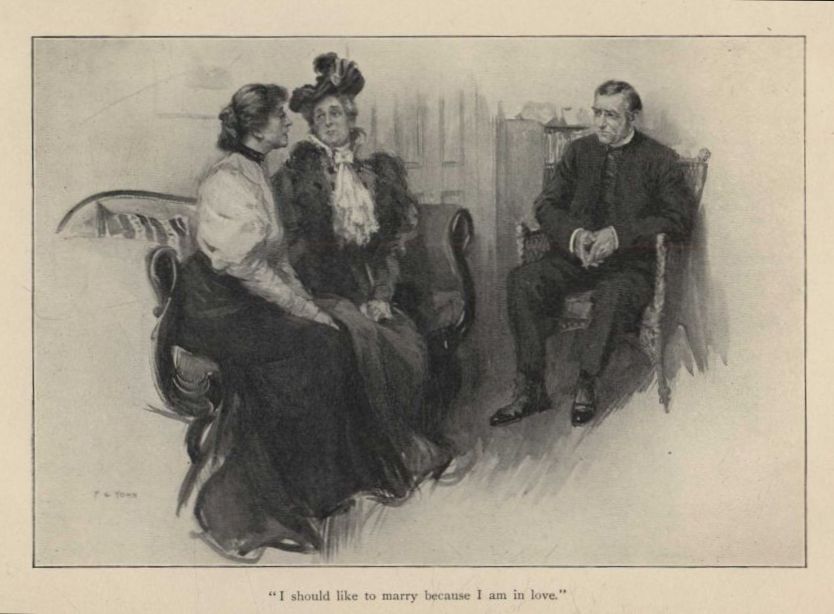
"I should like to marry because I am in love. If my husband were dead, it would not seem inappropriate that I should wed another."
"I should like to marry because I am in love."
"You are well provided for; you have employment and are earning a decent livelihood. You have friends who will see that your children do not lack opportunities for advancement. Is not that enough?" He paused and quoted rhetorically: "Wherefore they are no more twain, but one flesh."
Constance broke the silence by completing the passage with reverence, "What therefore God hath joined together let not man put asunder."
"Precisely," murmured the rector.
Constance slipped her hand from Mrs. Wilson's and rose to her feet. Why, she scarcely knew. She felt the impulse to stand before her judges, even as a petitioner at a court of final resort. Though her heart was hungry for permission to enter the land of promise, she already guessed what the verdict would be. If her rector's hint that the project ought to have jarred upon her finer feminine instincts had left her unconvicted before the tribunal of her own wits, it had set her thinking. It had brought before her a retrospective vision of the long fealty of her sex to the voice of carnal purity, and its twin sister, woman's long fealty to the church. She must be true to her birthright as a woman; she must obey the higher law whatever the cost. No happiness could be comparable to that which obedience would bring. Yet another thought held her, and a little doggedly. Whatever her penitence for past error, she had never abdicated her heritage as an American woman—her right to the exercise of free judgment where the interests of her soul were concerned. Her intelligence must be satisfied before she yielded. Yet even as she rallied her energies for a second bout, it seemed to her that the memory of her late forgiveness by the church stood in the guise of an angel at the rector's side with grieving eyes, and the charge of ingratitude on its lips. But Constance said sturdily and carefully:
"I have reread the Bible texts, Mr. Prentiss, and Mrs. Wilson has explained to me that as a priest of the Episcopal Church you could not marry me. I understand that. What I wish you to tell me is whether it would be a sin, a real sin, were I to be married elsewhere. The law allows it, only the church forbids. Has the church no discretion, could no exception be made in a case like mine? In this age of the world it would seem as though justice and the demands which religion makes on the conscience ought to tally. You know the circumstances of my first marriage. Because I made a dreadful mistake, is it my highest duty to renounce this happiness as a forbidden thing? It is for you to tell me. I must trust in you; I cannot decide for myself. My reason whispers to me that it would not be wrong for me to consent, but I am prepared to put this seeming blessing from me if by accepting it I should be guilty of a genuine weakness, should be helping to push society down instead of helping to maintain the standards of the world."
Mr. Prentiss beamed upon her with pitying, gracious approval. Now that he had recovered from his momentary access of temper he beheld in a clear light the reality of the sacrifice, her touching sincerity and his own opportunity. From the standpoint of righteousness there was no room in his mind for doubt or evasion; yet he felt that it behooved him to meet this spiritual conflict with all the tenderness of his priestly office. He had learned to admire this lithe, dark-haired woman, nor was her greater physical attraction lost on him. He realized as she stood before him that under the new dispensation she had waxed in charm and social effectiveness; and once more she was showing herself worthy of his enthusiasm. His ear had noticed the felicity of her last thought, and he was musing on the sophisticated scope of it when Mrs. Wilson's dulcet voice broke the silence.
"I have made clear to Mrs. Stuart, Mr. Prentiss, that the advanced thought of the church finds in the words of Christ not merely an inspired utterance concerning divorce, but the rallying cry in behalf of a profound, practical, social reform."
The rector bent on his ally a discerning glance of satisfaction. He perceived gratefully that she had made the most of her opportunities to till the soil from which he looked for a rich harvest.
"My dear friend," he said to Constance, "you have put upon me a great responsibility from which I must not shrink. But however uncompromising my duty as a servant of Christ may cause me to appear, believe me that my understanding is not blind to the human distress under which you labor. You are asked to renounce what is for woman the greatest of temporal joys, the love of a deserving man." He paused a moment to mark the fervor of his sympathy. "Were I willing to palter with the truth, and did I deem you to be common clay unable to appreciate and live up to it, I might say to you 'go and be married elsewhere. It will be an offence; it will not have the sanction of the church; but others have done the same, and you will have the protection of the secular law.' Although the Roman Catholic priest has but one answer under all circumstances however pitiful, 'who, having a husband or wife living, marries again, cannot remain a member of the church,' it might seem permissible to some of my cloth not to condemn remarriage in the case of a dense soul as a grievous sin. But such palliation would sear my lips were I to utter it for your relief. You have asked me what is the vital truth—your highest Christian duty. There can be but one answer. To respect the marriage bond and, keeping yourself unspotted from the world, hold to one husband for your mortal life so long as you both do live. To yield would not be a crime as the ignorant know crime, but it would be a sapping carnal weakness, inconsistent with the spiritual wisdom which has hitherto led you. It would indeed help to lower the standards of human society. I may not equivocate, my dear friend. This is the ideal of the Christian Church in respect to marriage and divorce. Invoke the human law for your protection against your husband if you will, but he is still your husband in the eyes of God, and if you wed another you commit adultery."
Constance, seeming like a breathing statue, save for her odd disfigurement, her arms before her at full length, her hands folded one upon the other, heard her sentence and love's banishment. Already she felt the thrill of a solemn impulse to bear this cross laid upon her, not as a cross but as a fresh opportunity for service, yet she said:
"Then the law of the church and the law of the State stand opposed to each other!" She spoke in soliloquy as it were, phrasing an existing condition for the explanation of which her intelligence still lacked the key.
Mr. Prentiss drew himself up. "Yes, they stand opposed, as in so many other instances. The law of the State is for the weak; the law of the church—of Christ—is for the strong. Verily the church has been magnanimous and forbearing. It has resigned to the State little by little control of the social machinery. But here, where the foundations of society are at stake, it behooves her to stand firm. The law of spirit is at war with the law of flesh. Monogamy is the corner-stone of Christian civilization."
"And hence it is that marriage is a sacrament; that the marriage bond bears the seal of heaven," added Mrs. Wilson ardently, as the rector, contented with his metaphor, stopped short in his righteous foray.
"If my marriage was made in heaven, we were ill-mated," retorted Constance. The thought seemed so repugnant to her that she revolted at it. But Mr. Prentiss, like a true physician of the soul, was equal to the emergency.
"The choice was yours, and you made a dreadful mistake. Have you yourself not said so? Shall you not pay the penalty, my daughter? You thought you knew him whom you married."
"Oh, yes, indeed; but I was very young."
"May they not all say the same? And yet," pursued the rector, in a tone of proselytizing triumph, "the demon of divorce lurks at our firesides and, stalking through every walk of life, makes light of the holy tie as though it were of straw, mocking the solemn associations of the family, and taking from the innocent child the refining and safe-guarding influence of a stable, unsullied home. Yet the State stands by and winks at—aye, connives at and promotes the foul programme, rehabilitating shallowness and vice through the respectable red seal of the law. Yes, there are two standards. As a modern priest I am aware of the sophistry of the criticism, for who, if the church does not, will stand as the protector of the home? And if it sometimes happens, as it must happen," he concluded in an exalted whisper, "that the apparent earthly happiness of one must be sacrificed for the good of the many, I know that you are not the woman to falter."
"Oh, no—oh, no," answered Constance, shaking her head. "It is a terrible condition of affairs, is it not? I see; I understand." She resumed her seat on the sofa and covered her face with her hands. For a few moments there was silence. Mrs. Wilson restrained a melting impulse to put her arm around her ward's shoulder in pitying encouragement. She felt that it was wiser to wait.
"Terrible," repeated Constance, as though she had been dwelling on the thought, and she looked up. Her manner was calm and sweetly determined. "Thank you, Mr. Prentiss—thank you both so much. There is only one thing to do—one thing I wish to do, now that my duty has been made entirely plain. I shall tell Mr. Perry that though I love him I cannot marry him."
"There is no reason that you should come to a decision on the spot," said Mr. Prentiss, reluctant to take undue advantage of an emotional frame of mind. "Take time to consider the matter."
But Constance shook her head. "That would not help me. I have thought it out already. I could not consent to sin, and you have explained, to me that it would be a sin."
"A sin surely; a carnal sin for you, Mrs. Stuart," said the clergyman with doughty firmness.
Constance gave a little nervous laugh—or was it the echo of a shiver? "I had a conviction that it could never be. It was a pleasant dream."
The pathos of the simple utterance reawoke Mrs. Wilson's strained sensibilities. She bent and kissed Constance on the forehead. Then turning to her rector she murmured with reverent ecstasy:
"Will you not pray with us, Mr. Prentiss?"
It was a grateful, benignant suggestion to the sufferer; the tonic which her yearning, baffled spirit needed. Divining as by telepathy that the moment had arrived for just this spiritual communion, the clergyman set the example to the two women by falling on his knees, and presently his voice was raised in fervent prayer. It was the prayer of praise and victory, not of consolation and distress. He thanked God—as he could do with an overflowing heart—for this triumph of intelligent spiritual discernment over the lures of easygoing and numbing materialism. The outcome of the occasion was indeed for him an oasis, one of those green, fruitful passages in the more or less general dryness of heart-to-heart contact with his parishioners, the occurrence of which made him surer both of his own professional capacity and of the eternal truths of his religion. His invocation of his God was alike a pæan of thanksgiving and an acknowledgment of rekindled faith. As for Constance, his words were so many cups of water to a thirsty soul. Scorched by his exaltation, the cloud mists of doubt no longer perplexed her, and she beheld with radiant eyes her cross, her privilege to renounce what reason and human passion urged, for the sake of an ideal—the higher, vital needs of the human race.
When Mr. Prentiss had finished Mrs. Wilson did not for a moment trust herself to speak. Her eyes were full of tears. She had knelt as close to Constance as she felt to be harmonious. It was a glorious hour also for her. The steadfastness of this woman of the people was not only a subtle personal tribute, but it had refreshed the tired arteries of her being. When her daughter had left her house, secure and cold in the pride of a revolting scheme of life, it had almost seemed that God mocked her. But now the glories of His grace were manifest.
"Constance," she said, "I will call for you to-morrow, to sit in my pew. It is Sunday, you know."
XXI
In saying to Constance that he had pondered the question of their marriage from her standpoint, Gordon Perry felt that he had given indeed the fullest weight to every legitimate scruple, and believed that, provided he was beloved, there was no substance in any one of them. He knew that Constance had shrunk from a divorce. What more natural so long as she was undisturbed by her deserting husband? But now that the element of a new, strong affection was introduced the necessary legal proceedings seemed a paltry bar to her happiness. He had expected that she would demur to the step at first, but he had felt confident that her acute sense would shortly convince her that she was divorced to all intents and purposes already, and that the mere formal abdication of the fact, however unpleasant sentimentally was not a valid obstacle. He had also appreciated that this repugnance to a legal dissolution of the marriage tie for the purpose of becoming a second time a wife would be accompanied by an instinctive feminine aversion to giving her person to another man while it was still possible to encounter the original husband in the flesh. He did not pride himself on his knowledge of women, but the attitude suggested itself to him as possible, even probable, in the case of one whose sensibilities were so delicate as hers, for the reason that there lingered in his mind the remembrance of shrinking words both in books and in real life by other women when the same topic had been broached in the past. Consequently it was a relief to him that Constance did not openly manifest this form of repugnance, and he radiantly jumped to the conclusion that her love for him was so reciprocal and mastering that false delicacy had been shrivelled up as in a furnace. Was not such a process in keeping with her sterling sanity and intelligence? For a moment he had jubilantly assumed that all was won, since, after conscientious if somewhat scornful analysis of the Church's claim, he had already decided that the pure religious objection would never in the end avail to keep them apart. Nor did the foreboding definiteness of her opposition discourage him appreciably. It merely cast a damper on his hopes for an immediate surrender, and indicated to him that he had been premature in supposing that she had been able to purge herself of superstitions and conventional prejudices forthwith. It could simply be a question of time when so human and discerning a bride would come to his arms without a qualm.
Nevertheless he felt that he must convince her. Now that he was sure she loved him, the possibility of losing her was not even to be entertained; but he wished her to succumb as the result of agreement, and not in spite of herself, both because he realized that she would not be happy otherwise, and because the doctrine which she had invoked as a binding obligation jarred not only with his desires, but with his deepest opinions. Therefore, at the conclusion of their interview, he took up straightway the cudgels of thought in defence of his convictions against what seemed to him the essential injustice and unreasonableness of the Church's claim. This necessarily involved fresh consideration of that claim itself. That night before he went to bed he rehearsed the arguments by which he purposed to appeal to her. Did she not appreciate that they were influenced by no base motives? That neither lust nor undue haste, nor covetous trifling with the feelings of others tarnished their mutual passion. Theirs was no case of putting off the old bonds of matrimony in order to be on with the new, but one where love had been starved to death, and been born again by gradual and chaste processes in a lonely, forsaken heart. What could be wrong in such a union? And were not their own consciences and their own intelligences the only fit judges of the eternal merits?
Gordon Perry's attitude toward religion—toward churches and toward churchmen—was abstractly respectful and friendly. He had been brought up by his mother in her faith, and the period of stress through which most young men pass in early life had been productive of a frame of mind which was reverent as well as critical. Not a small portion of mankind in Benham accepted their religious doctrine on trust, as they did their drinking water. Either they were too busy to question what seemed authority, or that particular compartment of the brain where absorbing interest in the unseen germinates was empty. Some of the most pious never reasoned, and their docile worship constituted the cement in the walls of dogma. Again, there was a class—a growing class in Benham as elsewhere—composed of well-equipped, active-minded men who were polite to Religion if they met her in the street, and would even go to church now and again to oblige a wife or preserve outward appearances, for they were still of the opinion that religion is good for the masses. But in their secret souls what did they believe?
Gordon belonged to still another class. Religious truth had an absorbing interest for him, but what was religious truth? Different sects—and they were manifold in Benham—told him different things, and each sect proclaimed its doctrine insistently as vital, if not to salvation, to the highest spiritual development. Like many a young man before him, he argued that all could not be right, and as a result he presently found himself a member of that secret society of able-bodied, able-minded male citizens—the largest class of all—who reasoned about religious doctrine somewhat in this way: That they were hopefully looking forward to the time when the controversial differences which divided the sects into rival camps should disappear; and that until then they and their successors, whose number was sure to be legion, would turn deaf ears to the clashing of the divines, and attend church in order to gain strength and inspiration to play their parts well in complex modern human society, ignoring all else but the spirit of Christian love. If it be said that they and Gordon were not strong on dogma, denied that the laws of the universe had ever been suspended to produce fear or admiration in man, because to believe the contrary seemed to be an insult to God, and looked askance at certain other extraordinary phenomena to which the orthodox cling, it should also be stated that they and he were heartily in sympathy with every effort of all the clergy to improve human nature along intelligent lines, to help the poor to help themselves, to prevent the rich from misappropriating the earth and to foster truth, courage, unselfishness and refinement in the name of religion. Therefore it happened that Gordon was apt to take with a grain of salt what he heard in the pulpit; and now and then he would play golf on Sunday if he were in need of fresh air for his soul; but although he was slightly impatient of clerical sophistries up town, down town he lent a ready hand in the active reforms of the city, in the furtherance of which he had learned to know well, and to admire as good fellows, half a dozen energetic, enthusiastic clergymen. Was not religion one of the great forces of the world? Because one could not believe everything, and revolted at mystical or puerile superstitions, were the highest cravings of one's nature to be allowed to atrophy? So, just as in his social perplexities, he had sought refuge in practical service from the conflict of theories, and on more than one occasion he had been agreeably surprised by the confidential admission of the divines with whom he was co-operating that their and his views were not essentially far apart. Gordon was glad on their account to hear so, and was only the more convinced as a consequence that it was difficult to reconcile most of the strict tenets of theology with the modern ideas of wide-awake, enlightened laymen concerning the workings of the universe or the best social development of the creature man.