Front matter (continued 3)
Reading edition
IX
Before Mrs. Wilson could ascertain what it was, Lucille made a dash at the newspaper. Paul thrust it behind his back.
"Give it to me, Paul," demanded the young woman, imperiously. "I order you to give it to me," she reiterated, tapping her foot. "You are a hateful tease."
"Give it to me, Paul," demanded the young woman imperiously
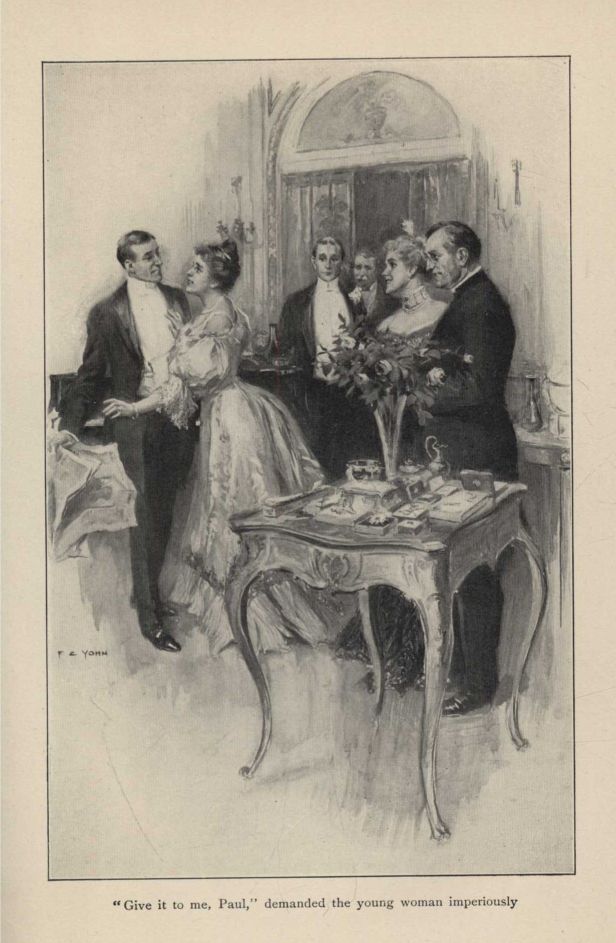
"Surely, my fair cousin, you're not going to deprive your mother of the satisfaction of gazing on this work of art, and reading this appreciative description of your personal charms? Can you not see how impatient she is to have it all to herself?"
"You have certainly whetted my curiosity, Paul," said Mrs. Wilson.
"I forbid you to show it to her."
"Why?"
"It is too ridiculous and foolish, and the picture—" Her criticism on that score instead of seeking words culminated in another spring, which Paul evaded by wheeling spryly about so that he still faced her.
Paul Howard was an ornamental, attractive specimen of athletic, optimistic American youth; a fine animal of manly, well-knit proportions with no sign of physical weakness or of effeminacy in his person or his face. His countenance was open and ruddy; his eyes clear blue, his hair light brown. His lip was scrupulously clean-shaven, exposing the full, pleasant strength of his father's mouth. Indeed, in conformity with the prevailing fashion among his contemporaries, he wore neither mustache, beard, nor whiskers, as though in immaculate protest against every style of hirsute ornamentation, from the goat-like beard of Methodistical statesmanship to the spruce mustache and well-trimmed whiskers of men of the world of fifteen years earlier. He was a Harvard graduate; he had been on the foot-ball team, and a leading spirit in the social life of the college; had been around the globe since graduation, and spent nearly a year shooting big game in the Rockies and getting near to nature, as he called it, by living on a ranch. All this as preliminary to taking advantage of the golden spoon which was in his mouth at his birth. At twenty-three he had signified that he was ready to buckle down to the responsibilities of guarding and increasing the family possessions, an announcement delighting his father's heart, who had feared, perhaps, lest his only son might conclude to become merely a clubman or a poet. This was the fourth year of his novitiate, much of which had been spent in New York, where Mr. Howard, though his home was in Benham, had established a branch of his banking-house, at the head of which he intended presently to place Paul. On the young man's twenty-fifth birthday the magnate had made him a present of a million dollars so as to put him on his feet and permit him to support a wife. If this were a hint, Paul had taken it. Though absorbed in financial undertakings of magnitude (which had included the electric street-car combination hostile to the aspirations of Emil Stuart), he had wooed and wed one of the prettiest girls in Benham, and he possessed, not many blocks away, a stately establishment of his own. He was accustomed to walk hand in hand with prosperity, and this habit was reflected in the gay and slightly self-satisfied quality of his manliness.
After foiling his cousin for a few moments, with a tantalizing smile, a new idea occurred to him. He held out the newspaper, saying, "Very well then, here it is. I dare you, Lucille, to destroy it. Nothing would induce you to part with it."
Lucille snatched the sheet from his hand, and her ruffled hesitation indicated that to destroy it was the last thing she had intended. In another instant she tore the newspaper into strips with an air of disdain and cast them on the floor. Delighted at the success of his taunt, Paul stooped and gathering the fragments began to piece them together.
"That is only a blind. She knows she can buy a dozen copies to-morrow. Listen, Aunt Miriam, to this gem which I have rescued: 'The fair bride has a complexion of cream of alabaster, with beautiful almond-shaped eyes, and hair of black lustre, which, rising from her forehead in queenly bands, seems the natural throne of the glittering diadem in the picture, one of her choicest bridal gifts.' Could anything be more exquisite and fetching?" He gave a laugh which was almost a whoop of exultation.
"No matter, Lucille," said Mrs. Wilson, coming to her daughter's rescue. "It is only envy on Paul's part. The newspapers did not make half so much of his wedding." In her own heart she did not approve of the publicity, but the sense of importance which it conveyed was not without its effect even on her. Besides, the personal description, though florid in style, was to her maternal eyes not an exaggerated estimate of her daughter's charms.
"The writer was evidently under the spell of her subject," said Mr. Prentiss, gallantly. Though tolerant of banter, especially at clerical gatherings, and partial to Paul Howard as one of the young men whom he desired to draw into closer union with the church, the idea of the possibilities of the newspaper as a dispenser of benefits was still in his mind, and served to minimize the vanity, if any, of his friend's daughter.
"Quite naturally, Mr. Prentiss," retorted the tormenting Paul, "for the subject gave a private audience to the writer only a few days ago."
Paul spoke from the desire to tease, not because he objected actively to the connivance of his cousin with the designs of the press. If the opportunity to do away with the whole practice of prying into and advertising private social matters had been presented to him, he would gladly have embraced it, and welcomed at the same time the further opportunity to tar and feather or duck the race of social reporters. But as an astute and easy-going American he recognized the prevalence of the habit, and though personally he tried to dodge with good humor the impertinent inquiries of press agents, he was not disposed to censure those who yielded to their importunities. Indeed, Paul Howard was so bubbling over with health prosperity, and a generally roseate conception of life as he saw it, that he shrank from active criticism of existing social conditions. He was a strong patriot, and it pleased him to believe that Americans were world-conquerors and world-teachers. Hence that it was the part of good Americans to join hands all round and, avoiding nice strictures, to put their shoulders to the wheel of progress.
"How absurd you are, Paul," answered Lucille. "That woman badgered me with questions, and was positively pathetic into the bargain, for she confided to me that she hated the whole business, but that her bread and butter depended on it. She was certain to write something, and so rather than have everything wrong, I told her a few things."
"And gave her your photograph in the tiara."
"She asked for it. She saw it lying on the table. Wasn't that better than to be caricatured by some snap-shot with a camera?"
The dire results of what would have ensued had she been less accommodating seemed so convincing to Lucille as she recited them that her tone changed from defence to conviction.
"I know a woman," said Clarence Waldo, "who told her servants not to let any of those newspaper beggars inside the house, and what do you suppose happened? On the day of the wedding there appeared an insulting account of the affair with everything turned topsy-turvy and disparaging remarks about both families. It's an awful bore, but when people of our sort are married the public doesn't like to be kept in the dark, you know."
"There! You see!" exclaimed Lucille, triumphantly.
The description of this young lady which her cousin had read was fundamentally correct. Her eyes could scarcely be called almond-shaped, but their curves were more gradual than those of most American women, a feature which, in conjunction with her thin lips and thin, pointed nose, gave to her countenance an expression of fastidiousness, which was characteristic. She was an example of the so-called Gibson girl, with a tall and springy, yet slight, figure, and a race-horse air which suggested both mettle and disdain. She had been brought up on the theory of free development—a theory for which not her mother but the tendency of the day was responsible. Parents, when it comes to a choice in educational methods, are apt at heart to recognize their own personal ignorance, and those with the highest aims for their offspring are most likely to adopt the newest fashionable graft on human experience. We are perpetually on the look-out for discoveries which will enable our children to become the bright particular stars which we are not. So what more natural than that Mrs. Wilson, with her ardent bent for improving social conditions, should swallow—hook, bait, and sinker—the theory that the budding intelligence should be cajoled and humored, not thwarted and coerced? The idea thus pursued at kindergarten, that everything should be made easy and agreeable for the infant mind, had been steadily adhered to, and Lucille could fairly be said to have had her own way all her life. This own way had been at times bewildering, not to say disheartening, to her mother. Mrs. Wilson had expected and yearned for a soulful, aspiring, poetic daughter with an ambition for culture—herself, but reincarnated and much improved. Instead, Lucille had showed herself to be utterly indifferent to poetry, lukewarm in regard to culture, almost matter of fact in her mental attitude, and sedulously enamoured of athletic pursuits. She had a fancy for dogs. From fifteen to eighteen she had followed golf, tennis, and boating, hatless and with her sleeves rolled up to her elbows, a free and easy and rather mannerless maiden, Amazon-like in her bearing, but unlike an Amazon in that she was a jolly companion to the boys, who called her promiscuously by her Christian name, as she did them by theirs. Does such a process of familiarity dull the edge of romance? We do not yet know. Each rising generation provides new problems for the wise elders, and this was one of those which had kept Mrs. Wilson uneasy.
She had looked forward to Lucille's formal introduction to society as a social corrective, and argued that, as soon as her daughter met the world face to face, there would be a modification both of Lucille's tastes and point of view. So strong is the emphasis laid by American mothers in fashionable society on what is called "the coming out" of their daughters that the concern engendered by the approach of the ordeal could fitly be described as a phase of hysteria. The true perspective of life becomes utterly and absurdly distorted by apprehension lest the dear child should not have "a good time" and by a fierce ambition that she should have a better "time" than her mates. As a consequence, competition—that absorbing passion of American character—is prone to take advantage of all the opportunities at its command, not merely to decorate the unprepossessing or provide the duck with the environment of the swan, but to make princesses out of goose girls by sheer gorgeous manifestations of the power of the almighty dollar. We all know that every woman in the world would prefer at heart to be called wicked rather than common, unless she were common—one of those extraordinary results of the tyranny of the social instinct which plays havoc with religious codes; and there is probably no country where the most socially adept are more intolerant of commonness than in democratic America—a fact which should be disconcerting to that form of socialism which yearns for a dead-level. Yet the tendency to exploit one's daughters by means of money and to exploit them even with barbaric splendor is current among our most socially sophisticated people.
Mr. Carleton Howard's "coming-out" ball for his niece was the most splendid function which Benham had ever known, and for the next three years Lucille's life had been one round of social gayety, emphasized by the character of the things done in her behalf by her family, which were severally executed, if not conceived, in a spirit of emulation, though Mrs. Wilson would doubtless have resented the impeachment. Mrs. Wilson would have put the blame on the tendency of the age, arguing that American society was becoming more and more exacting in its Esthetic demands, and that one must conform to existing usage in order to lead. But an examination of the facts would reveal that whatever form of entertainment was given by her for Lucille, as, for instance, the four colored luncheons, when the food and the table ornaments were successively red, orange, blue, and heliotrope, and four sets of twelve young girls stuffed themselves through eight courses at mid-day, was carried out with a lavish accentuation of new and costly effects. It was currently recognized that at her house the cotillion favors and the prizes at games were worth having—silver ornaments, pretty fans, things of price—always a step beyond the last fashion, as though the world would not be content to stand still, but must be kept moving by more and more expensive social novelties.
Though three years of this life had served to transform the mannerless Amazon into a socially correct and fastidious young woman, the result, nevertheless, was a secret disappointment to her mother, who had hoped that Lucille would develop intellectual or æsthetic tastes under the influence of these many advantages. But what can a mother whose daughter prefers athletics to art, and fox terriers to philanthropy, do but make the best of it? Lucille had a will of her own and seemed to know exactly what she wished, which included marrying Clarence Waldo. To thwart her would be useless, to quarrel with her was out of the question. The only thing was to give her as brilliant a wedding as possible and hope for the best. And after all, the best was by no means out of the question. Lucille was young and was going to New York. There was no telling what a girl of twenty-one, with large means and the best social opportunities, might not become by the time she was thirty-five. Mrs. Wilson had herself cast sheep's eyes at New York as a residence before building her new house, but she had decided to remain dominant in a small puddle. There were compensations in doing so. She flattered herself that in this age of telephones and telepathy she was able to keep in touch with the metropolis and to get her social cues accordingly. But to have a daughter there would be interesting, provided all went well. The proviso should not be overlooked; for Mrs. Wilson had not lowered her own standards. She was merely trying to extract all the maternal comfort and pride she could out of the existing situation.
"But, my dear Lucille," said Paul, intending a crushing blow to his cousin's returning assurance, "if you were really so anxious to escape notoriety, you had merely to mention it to father. A word from him would have silenced every newspaper in town."
"Scarcely that—scarcely that, young man," interposed Mr. Howard in a tone of friendly authority. "Very possibly, had I expressed a preference, my wishes would have been respected by one or two newspapers where I happen to have some influence. But your statement is altogether too sweeping." He spoke incisively, as though he desired to deprecate the suggestion of the power attributed to him by his more impulsive son. "The press is jealous of its privileges and must be humored as a popular institution. And, after all, what does a little publicity matter? You mustn't mind what Paul says, Lucille. There's no reason to feel abashed because the public has been given a chance to see the most charming bride of the year."
"Abashed? She is tickled to death," retorted Paul.
Mr. Howard put his arm around his niece's shoulder in the guise of a champion. When controversy had reached the stage where adjustment was no longer possible, he was an uncompromising antagonist. But, as a successful man content with existing conditions, he deplored friction in all the relations of life, and to use an industrial phrase, liked to see everything running smoothly. He laughed incredulously, and patting Lucille's arm exclaimed, "Nonsense!" Then, accosting the clergyman, he added, "Now that this momentous matter has been disposed of, Mr. Prentiss, will you join me in a cigar in my own library?"
Mr. Prentiss excused himself. He had work to do, and knew that if he remained he would be apt to stay late. But he was interested from a theoretic stand-point in the discussion to which he had been listening.
"You evidently feel as I do, Mr. Howard," he said, "that there are two sides to the question of newspaper publicity, and that as good citizens we are not always at liberty to insist on privacy."
Mr. Howard answered with the suave force and clearness which gave to all his utterances the effect of deliberate conviction. "Mr. Prentiss, I accept the institutions of my country as I find them, and try to make the best of them. There are those whose only pleasure seems to be to carp at what they do not wholly admire in our civic system. The press is one of the most powerful and useful forces of modern life. As such I value and support it, though I'm keenly alive to the flagrant evils and the cruel vulgarities for which it is daily responsible. But one can't afford as an American citizen to condemn as worthless and ill-begotten the things of which the people as a whole approve. We must compromise here as in so many matters in our complex civilization, and where trifles are concerned, be complacent even against our convictions."
"Indisputably," said the clergyman. "In the constant faith that our tolerance will work for improvement."
"Ah, but the newspapers are worse than ever," exclaimed Mrs. Wilson, with a sigh. "One has to wade through so much for so little. I read them scrupulously, because, if I do not, I'm sure to miss something which I would like to see. That sounds inconsistent. But why doesn't somebody establish a really first-class newspaper?"
"Because a newspaper must be first of all a successful business enterprise in order to be able to exist," responded her brother. "It is a question of dollars and cents. All that will come presently. And we are really improving all the time. Just think of what a large and complicated industry a modern newspaper establishment has grown to be." He spoke as though he saw and wished to bring before his hearers' eyes the towering, mammoth homes of the press in all our large cities, the enforced outcome of the ever-increasing popular demand for the world's news. "Come, Paul," he said, putting his arm through his son's, "since Mr. Prentiss will not join us in a cigar we will leave these good people to their own devices, and go back to our work."
Paul, with a pocket full of documents and with the obnoxious newspaper in his hand, had reached the door of his father's house just as Lucille and her betrothed were alighting from a carriage. Lured by his goading remarks they had followed him within and into his father's library, where at a safe distance he had vouchsafed his cousin glimpses of her tiara-crowned figure and read aloud choice extracts until the spirit had moved him to pass through the dividing door between the two establishments in search of his aunt. He had left home with the idea of an hour's confabulation with his father over certain schemes in which they were jointly interested—a frequent habit of his late in the evening. Mr. Carleton Howard never went to bed before one, and was invariably to be found after eleven in his library reading or cogitating, and always prepared at that quiet time to give his keenest intelligence to the issues presented to him.
Father and son passed along through the secret passageway until they found themselves in Mr. Howard's capacious library. This superb room was the result of an architect's conscientious ambition to see what could be accomplished where his client was obviously willing to obtain excellence and had imposed on him no limits either in respect to space or expense. As regards size, it bore the same relation to the ordinary library of the civilized citizen that the Auditorium in Chicago bears to every-day hotels, or the steamship Great Eastern bore to other ocean carriers. Consequently it was a little vast for strict cosiness. The huge stamped leather chairs and sofas, though inviting, seemed designed for persons of elephantine figure, in order perhaps to avoid being dwarfed. But the shelves upon shelves of books which covered completely from floor to ceiling two of the walls—choice editions in fine bindings—gained dignity from the superfluous dimensions. If it be said in this connection that, to one familiar with Mr. Howard's associations, the idea of many storied office buildings might occur, the answer is that he was responsible for nothing which the room contained except its large and admirable display of etchings, which, owing to almost weekly accretions, had begun to disarrange the original æsthetic scheme of the designer. Mr. Howard had left everything else to his architect, but etchings were his hobby—one which had attracted his fancy years before by accident, and had retained its hold upon him. He was familiar now, as a man of sagacity and method, with the many bibliographical and ethnological treasures by which he was surrounded, and could exhibit them becomingly, but when the conversation turned on the etcher's art he was on firm ground and could talk as clearly and authoritatively as about his railroads.
The banker chose his favorite seat, within comfortable distance of one of the fire-places, facing a beautiful polar bear-skin rug of extraordinary size. Close at hand was a large table with writing materials and such magazine literature or documents as he might wish to examine. Adjustable lights were at either elbow, and in the direct line of his vision as he ordinarily sat were two of his favorite works of art, an Albert Dürer and a Wenceslaus Hollar. He lighted another cigar and, after a few puffs, said:
"That clergyman is decidedly a useful man. He has common sense and he has discretion."
"He isn't at all a bad sort," responded Paul. Though guarded in form, this was intended as an encomium, just as when Paul meant that he had enjoyed himself thoroughly, he was apt to state that he had had a pretty good time. Anglo-Saxon youth is proverbially shy of enthusiasm of the lips lest it be suspected of freshness, as the current phrase is. "I wonder," he added a moment later as he stood with his back to the wood fire, straightening his sturdy shoulders against the mantel-piece, "if he really believes all the things he preaches. I'd just like to know for curiosity. I suppose he has to preach them even if he doesn't or else be fired out, and he compromises with himself for the mental reservation by the argument that if he were out of it altogether, his usefulness and occupation, like Othello's, would be gone. That's the way clergymen must have to argue nowadays, or there wouldn't be many of them left at the old stands."
Though he spoke colloquially, and with an assurance which dispensed with reverence of treatment, Paul intended to express genuine interest and even sympathy. Knowing that his father's ideas on religious subjects were fundamentally liberal, perhaps he was not averse to shocking him in a mere matter of form. Mr. Howard was silent a moment, then replied:
"In every walk of life it is necessary, from time to time, to sacrifice non-essentials for the sake of the essentials. As in everything else, so in religion. The world moves; opinions change. Human society cannot prosper without religion, and human society never needed its influence more than to-day. Sensible religion, of course."
"All sensible men have the same religion. What is that? A sensible man never tells." Paul was quoting. He had heard his father more than once in his comments on the mysteries of life utter this Delphic observation. He laughed sweetly and fearlessly.
Mr. Howard understood his son. They were good comrades. He was aware that though Paul felt free to jest at his remarks, his boy respected his intellect and would ponder what he said.
"We agree about these things in the main, my dear Paul. If one were to go out on the housetops and proclaim one's scepticism concerning some of the supernatural dogmas which the mass of the people find comfort in, how would it benefit religion? The world will find out soon enough that it has been mistaken. But we can neither of us afford to forget that the security of human society is dependent on religion. One always comes back to that in the end."
"It is good for the masses," said Paul, with a chuckle. "We, as the present lords of creation—captains of industry—should encourage it for the protection of our railroads, mines, and other glorious monopolies. That is one of the arguments with which the truly great salved their consciences before the French revolution."
Mr. Howard frowned slightly. He knew that Paul was only half in earnest, but the reference to socialism was repellent to him, even though it was rhetorical. Why was he the possessor of twenty millions? Because he had been wiser and more long-sighted than his competitors, because he had used his clear brains to better advantage than other men year after year, planning boldly and executing thoroughly, making few mistakes and taking advantage of every opportunity. Because he had fostered his powers, and controlled his weaknesses. He was rich because, like a true American, he had conquered circumstances and moulded them for his own and the world's profit. Inequalities? Must there not always be inequalities so long as some men were strong and others weak, some courageous and others shiftless? And as for charity, God knew he was willing to do—was trying to do his part to help those who could not or would not help themselves, and to encourage all meritorious undertakings for the relief of human society.
"Yes, we must humor the masses in this as in a thousand matters, and our protection is their protection. I am not disturbed by your insinuation, Paul. Ignorance and sloth and folly and false sentiment would bankrupt mankind in three generations if it were not for the modern captains of industry, as you call them."
Mr. Howard spoke somewhat sternly, as one stating a proposition which was irrefutable and yet was sometimes overlooked by an ungrateful world. "Similarly," he continued, "it is one thing to be unorthodox in one's opinions and to discard as childish articles of faith to which the multitude adhere, another to deny the reality and force of religion. So, though I am a free thinker, if you will, I regard it as no inconsistency to uphold the hands of the church. On the contrary, every thoughtful man must realize that without religion of some sort the human race would become brutes again."
"And your form is to present fifty or a hundred thousand to a hospital or a college whenever you happen to feel like it, which every clergyman will admit to be practical Christianity. You certainly give away barrels of money, father."
"I can afford to." Mr. Howard was pleasantly but not vain-gloriously aware that he had given away a million dollars in the last three years. "In what better way can I share my profits with the public than by entrusting it to trained educators and philanthropists to spend for the common good? A great improvement, young man, on the theory that every man jack of us should be limited to the same wage, and originality, grit, and enterprise be pushed off the face of the earth."
"Nevertheless it is tolerably pleasant to be your son," said Paul, smiling brightly from his post against the mantel-piece.
"Yes. But you have responsibilities as my son, and pray do not imagine that I am blind to them. I have made the money." He paused a moment, for he was looking back along the vista of the years and recalling the succession of shrewd undertakings by which his property had grown from a few thousand dollars to imposing wealth. "I have made the money, and it is for you to keep and increase it—yes, increase it, remember—but to spend it freely and wisely. And if you ask me what is wisely, I can only answer that this is a problem for your generation. If you will only use the same pains in trying to solve it as I have in accumulating the money, you will succeed. You are fond, Paul, of exploiting radical propositions, of which you at heart disapprove, in order to test my self-control. Here is something, young man, to chasten your spirit and keep your imagination busy."
"You see through me, father, don't you? But you'll admit that my familiarity with radical doctrines is a good sign, especially since I recognize their fallacies, for it shows that I sometimes think. Yes, it is a great responsibility, but I wouldn't exchange—not even with Gordon Perry."
"With whom? Ah, yes, I remember; the attorney who was on the foot-ball team with you at Harvard. And why should you consider changing places with him?"
"Because the mere question of dollars and cents interests him so little."
"Ah! You have been employing him lately, I believe?"
"Yes. I like to throw what I can in his way. He understands his business. We lunched together this morning. I enjoy his humor, his independence and his common sense, and at the same time his enthusiasm."
"Concerning what?"
"Most things except the price of railroad shares and the condition of the money market. We didn't refer to them once." Paul paused with a serio-comic sigh. Mr. Howard knocked the white ash from his cigar and responded:
"One of the reasons for sending you to college was that you need not be confined in your conversation to the money market. Another that you should be free in life to do as you chose."
"Don't be alarmed, father. You know well enough that nothing would induce me not to follow your lead. Give up business? I couldn't. I love the power and excitement of it. It's bred in the bone, I suppose."
The banker's eyes kindled with pride in the son of his heart.
"And it's because I know I'm myself that a fellow like Don Perry fascinates me," pursued Paul. "There's no nonsense in him. He objects to cranks and mere psalm-singers as much as I do. But he's absorbed in the social problems of the day—legislative questions, philanthropic questions, all the burning questions. 'And your young men shall see visions.' He is one of them. You will notice that I have not forgotten my Bible altogether, father."
"We have, and to burn, reformers who see visions and proclaim them from platforms which have no underpinnings. What we need are reformers who will study and think before they speak, and not seek to destroy the existing structure of society before they have provided a serviceable substitute."
"In other words, you are prepared to part with a portion of your worldly possessions, but you object to wholesale confiscation?" Having indulged in this pleasantry Paul took from the table a packet of papers which he had brought with him, as though to show that he had not forgotten business concerns. "Speaking of the existing structure of society," he continued, "Don and I got into a religious discussion. That is, I found myself holding a brief for the proposition, which I had read somewhere or other, that religion and capital are in alliance against every-day men and women, in order to preserve existing social conditions. Don't look so shocked, father. There are two sides to every question, and I was curious to see how Don would look at this."
"And how did he look at it?" inquired Mr. Howard, coldly, seeing that he was expected to display interest.
"He wouldn't deny that there was some truth in the proposition, but he agreed with you, father, that whatever else is true or false, the world will never be able to dispense with religion. But he says, too, that it must be sensible religion. Just what you said, isn't it? And when two such intelligent individuals come to the same conclusion, it is time for a sceptic like myself to take off his hat to the church. You heard me just now concede that the Rev. Mr. Prentiss is not at all a bad lot."
"Paul, you are sometimes incorrigible. You have common sense when it comes to action, I admit, but you have a perverse fondness for harboring all the philosophical sewage of the age. I trust that your friend Perry brought you up with a round turn."
"Oh, he did," said Paul, with mock meekness, as he sorted his documents. "We must get to work or else I'd tell you about it. He was very interesting. As to aggregations of capital, Don was highly conservative too. He recognizes that they will last far beyond our time. For a seeker after ultimate truth, I thought that extremely reasonable." Whereupon Paul indulged in a laugh of bubbling, melodious mirth.
Mr. Howard made no comment, but threw the butt of his cigar into the fire-place with the emphasis of one expelling folly by the scruff of the neck, and composed his features for business.
X
Constance consented to be taught typewriting and stenography at the expense of Mrs. Randolph Wilson. She decided that to refuse an offer which would enable her presently to become self-supporting would be false pride. She acknowledged as sound, under her present circumstances, Mr. Prentiss's assertion that it was no less the duty of the unfortunate to accept bounty within proper limits than of the prosperous to give. She consented also at his instance to call upon her benefactress.
Any encouragement on the part of Constance would have induced Mr. Prentiss to raise a subscription to pay off the second mortgage on the house incurred by Emil, and thus provide her with a home. But at the first hint of such a thing she shook her head decisively. A very different thought was in her mind. Emil was still alive and liable for the bills which he had incurred for the expenses of the canvass, but she felt that the six hundred dollars which he had withheld from his client as an enforced loan must be paid at once or the good name of her children would be tarnished. His appropriation of this money on the eve of his disappearance was damning in its suggestion; but she had thankfully adopted and was clinging tenaciously to the explanation proffered by one of the easy-going and good-natured co-tenants of the office occupied by her husband, that the money had been borrowed to carry out a speculation, and that Emil had meant to return it. Did not the broker's report of the purchase and sale, found among the papers in Emil's desk, support this? She realized fully that from the mere stand-point of legal responsibility his motive was immaterial. But with her knowledge of his characteristics and of the past she felt that she had the right to insist on the theory that he had been led astray by sanguine anticipations which, as usual, had been disappointed. His conduct had been weak and miserable, and exposed him to obloquy, but it was not the same as deliberate theft. As a mother, she was solicitous to treat the transaction as a loan and to repay it without delay. The world might not discriminate, but for herself and for the children the distinction was essential.
Having been informed how matters stood, and that there was probably still some small value left in the house over and above the two mortgages, she thought she saw an opportunity to discharge this vital obligation. Accordingly, when she found that the clergyman was still considering means for rescuing her home, she disclosed her theory and her purpose.
"My husband borrowed that money, Mr. Prentiss. He expected to be able to return it. I am sure of this. It was just like him. People think it was something worse because of what was in the newspapers. But, guilty as he was, he would not have done that. This being so, I am anxious to have the mortgages foreclosed, or whatever is necessary done, and to have what is left returned to the woman whose money he borrowed. It was six hundred dollars, and there is the interest. You told me you thought there would be over five hundred left, if the mortgagee was disposed to be reasonable."
Although Mr. Prentiss may have had doubts whether Emil Stuart was entitled to the distinction drawn by his wife, he understood and admired her solicitude. "I see," he said. "I am told that the value of real estate in the neighborhood of your house has improved somewhat, and that you ought to get at least five hundred dollars. But in any event the money which your husband borrowed shall be returned. You need give yourself no further concern as to this; I will see that it is done."
Constance shook her head again. "It wouldn't be the same if anyone else were to pay it," she said directly.
"So it would not. You are right," he replied with equal promptness, admitting the accuracy of her perception, which had confounded his too glib generosity. "Unless you paid it, you would feel that you had no right to consider that the money had been borrowed."
"Though I am certain of it."
"Precisely—precisely. I understood what you desired, and it was unintelligent of me to bungle." A confession of lack of intelligence by Mr. Prentiss signified not merely deliberate self-mortification, but was offered as a tribute to the mental quality of his visitor. He had chosen a word which would have been wasted on or misinterpreted by the ordinary applicant for counsel, that he might let her perceive that he was alive to the nicety of her spiritual intuitions. They were at his house—in his comfortable, attractive library—and he understood now that the object of her call had been conscientious eagerness to discharge this debt. There was nothing for him to do but acquiesce in her requirements, and to thank God for this manifestation of grace. This quiet, simple directness, which separated the right from the wrong with unswerving precision, proceeding from the lips and eyes of this pale but interesting woman in faded garb, was fresh and invigorating testimony to the vitality of the human soul exposed to the stress of sordid, workaday realities and unassisted by the choicer blessings of civilization.
Mr. Prentiss pressed her hand with a new warmth as he bade her good-by. "You must come to see me often," he said. "Not for your needs only, but for mine. It helps me to talk with you. And I shall keep my eye on you and see that you get work."
As the upshot of this conversation, Constance surrendered her house to the mortgagee and received six hundred and fifty dollars for her interest in the equity. The small sum remaining after the claim of Emil's client had been satisfied was supplemented presently by the sale of that portion of the furniture unavailable in the tenement into which she moved, so that she had about a hundred dollars saved from the wreck of her former fortunes. The tenement consisted of two sunny rooms in a new apartment house for people of humble means, built by a real estate investor with progressive business instincts from plans suggested by the Home Beautifying Society of Benham, an aggregation of philanthropic spirits, of which Mrs. Wilson was one of the vice-presidents. Here light, the opportunity for cleanliness, and some modern fixtures, including a fire-escape, were obtainable at a moderate rental; and while the small suites were monotonous from their number and uniformity, their occupants could fitly regard them as a paradise compared with the old-fashioned homes for the poor supervised solely by the dull mercy of unenlightened landlords. Though this was a business enterprise, the owner had felt at liberty even to give some artistic touches to the exterior, and altogether it could be said that the investment represented a model hive of modern workingmen's homes from the point of view of Benham's, and hence American philanthropic commercial aspiration. The structure—Lincoln Chambers, it was called—was on the confines of the poorer section of the city where, owing to the spread of trade, the expansion of the homes of the people was forced further to the south. From two of her windows Constance looked out on vacant lands but half redeemed from the grasp of nature, a prospect littered with the unsightly disorder of a neighborhood in the throes of confiscation by a metropolis; but the mongrel character of the vicinity was to her more than atoned for by the fresh air and the wide expanse of horizon. Her home was on the eighth story—there were ten stories in all—and on the roof there was an arrangement of space for drying clothes which seemed to bring her much closer to the impenetrable blue of the sky. As under the influence of this communion she gave rein to introspection and fancy, her thoughts harbored for the moment chiefly thankfulness. The stress of her plight had been relieved. Discriminating kindness had enabled her to get a fresh hold on life without loss of her self-respect. What mattered it that her social lot must be obscure, and that she had become one of the undistinguishable many whose identity was lost in this towering combination of small and uniform tenements? She had still a roof over her children's heads and a legitimate prospect of being able to support them without accepting the bitter bread of charity. Yes, she had become one of the humblest of human strugglers, but her abounding interest in these two dear possessions made not only her duty plain but her opportunity inspiring and almost golden. The mortification and anguish of the past she would never be able to forget entirely, but she would make the most of this new chance for world-service and happiness.
It had been necessary to sign some papers in order to convey her interest in the equity of her house, and she went for the purpose to the office of the mortgagee's lawyer. He was a young man, somewhat over thirty, with a noticeably frank face and lucid utterance and kind, intelligent eyes. As he handed her the six hundred and fifty dollars it occurred to her that she would like to employ him to satisfy Emil's obligation. She preferred not to have a personal interview with the creditor lest she be obliged to listen to recriminations against her husband, and she was loth to bother Mr. Prentiss. So she broached the matter, stating briefly that it was a debt which her husband had intended to pay before his departure. She had already discovered when the papers were signed that the attorney was aware that she had been deserted, and neither did she supply nor did he seek enlightenment beyond the bare explanation offered. Nevertheless, it was obvious to Constance, despite his professional reserve, that he was alive to the import of the transaction for which she was employing him, and that it had inspired in him more than a mere business interest. There was a gentle deference in his manner which seemed to suggest that he knew he was charged with a delicate mission and that he would fulfil it scrupulously. She liked the straightforward simplicity of his address, which was both emphasized and illuminated by the intelligent, amiable glint of his eyes which indicated independence and humor, as well as probity. As she rose to go, Constance realized that she had forgotten his name, and was on the point of opening the receipt for the money which he had given her, in order to ascertain it, when he reached out and taking some cards from one of the pigeon-holes of his desk handed them to her.
"I shall write to you the result of my interview, Mrs. Stuart, and send you a written discharge. Here are a few of my business cards. I hope that none of your neighbors will need the assistance of a lawyer, but if they do, that is my profession, and I intend to do the best I can for my clients."
There was a pleasant earnestness in his tone which saved his speech from the effect of mere solicitation. It seemed to Constance as though he had said not merely that he was eager to get on, but that he stood ready to help those who like herself had need to bring their small affairs to a sympathetic and upright counsellor. She had asked him previously what his charge would be for securing a release of the claim against Emil. He had hesitated for a moment and she had been apprehensive lest he might say that it would be nothing, but he had replied that it would be three dollars.
She glanced at the cards and read the name—Gordon Perry, Attorney and Counsellor-at-Law, 144 Baker St. Their interview had been in an inner office—a room of moderate size, near the roof of a modern building, with a fine view, eclipsing that of her own flat, and furnished, besides a couple of chairs, with rows of law books and a few large photographs of legal celebrities. On the way out she passed through the general office, where there were more chairs, several of them occupied by visitors who had been waiting for her interview to come to an end, more shelves of books, and two or three desks, at one of which a woman type-writer was sitting at work. The click of the machine sounded melodiously in Constance's ears, and she turned her glance in that direction, in wistful anticipation of the time when she would have similar employment. On her arrival her gaze had been introspective, but now that her errand was over she felt the inclination to observe external things. As she closed the outer door she saw that the glass panel bore a painted inscription similar to that of the card—Gordon Perry, Attorney and Counsellor-at-Law. She reflected that he had been courteous and sympathetic to her, and she felt sure that he was to be trusted, notwithstanding the rude shock which Emil's perfidy had given to her faith in her own powers of discrimination. There are some dispositions which are turned to gall and forever charged with suspicion by a great shock to love and faith as sweet milk turns to vinegar at the clap of a thunder-storm. There are others whose horizon is cleared by the bitterness of the blow, and who, partly from humility, partly from an instinctive revolt against the doctrine of despair, readjust their perspectives and harbor still the god-like belief that they can know good from evil.
Preliminary to beginning her lessons, Constance had still her call to make on Mrs. Wilson. The new fashionable quarter of Benham, beyond the river Nye, was scarcely more than a name to her, though, especially in the early days of her marriage, she had from time to time included this in her Sabbath saunterings with her husband, and she remembered Emil's having pointed out in terms of irony the twin mansions of Mr. Carleton Howard and his sister in process of erection. She had not felt envious, but when Emil, after inveighing against the extravagance of millionaires, had with characteristic inconsistency, as they stood gazing at the walls of these modern palaces, asserted that he intended some day to have a house of this kind, she had wondered what it would be like, and had contrasted for a moment the lives of the dwellers in this locality with her own, with a sudden appreciation of the power of material circumstances and a wistful curiosity to be translated into an experience which should include white-aproned maids, drawing-room draperies, and a private equipage as daily accessories. She had silently wondered, too, pondering without abetting her husband's caustic cue, how this contrast was to be reconciled with what she had been taught of American notions of social uniformity and the subordination of the unnecessary vanities and splendor of life to spiritual considerations. It was puzzling, and yet the manifestations of these discrepancies were apparently in good repute and becoming more obvious as the city grew in population and importance.
It is the personal equation in this world which forces truths most clearly upon our attention. So it was that Constance on her way to Mrs. Wilson's was fully alive to the fact—not bitterly, but philosophically and equably—that, despite the theory of democratic social institutions which she had imbibed, actual conditions in Benham were repeating the old-world distinctions between the powerful and the lowly, the rich and the impecunious. There was no blinking the knowledge that she was living obscurely in a flat on the lookout for the bare necessaries of existence, while the woman she was going to see was a woman of wealth and importance, to whom she was beholden for the opportunity of a new start. Obviously, the American experiment had not succeeded in doing away with the distinctions between rich and poor, though patriotic school-books had given her to understand that there were none, or rather that such as existed were spiritual and in favor of people of humble means. Constance could be sardonic if she chose, but like most women she had little taste for irony. On the other hand, she had a yearning to see things clearly which her misfortunes had only served to intensify.
As she entered Mrs. Wilson's house a new emotion superseded this consciousness of contrast. She had expected to be somewhat edified by the decorations and upholsteries, and had felt a mild curiosity regarding them. But she was wholly unprepared for the superb and spacious surroundings in which she found herself. She walked bewildered through the august hall behind the solemn, fastidious man-servant, who, when she had disclosed her name and errand, ushered her into the reception-room, which served as an ante-chamber to the vista of elegant connecting drawing-rooms. While she waited for Mrs. Wilson she sat gazing with surprise and admiration at the costly and elaborate furnishings and ornaments. It was not that such things were beyond the experience of her imagination at least, for, though she had never been abroad, she felt familiar, through books, with the appearance of splendid houses. She had seen pictures of them, and was not without definite impressions of grandeur. But she had not expected to behold them realized in the social life of Benham. If the discovery was, spiritually speaking, a slight shock, it was a far greater source of delight. Neat as wax herself, but confined both by poverty and early associations to sober hues, she found in the close presence of these bright, seductive, and artistic effects a sort of revelation of the power of beauty which thrilled her deliciously. Here was the culmination of the movement in æsthetic expression of which, as revealed in shop windows and on women's backs, she had for some time been vaguely aware, but in which she had been forbidden by the rigor of her life to participate. The full meaning of this as an ally to human happiness now burst upon her, and gave her a new joy, though it emphasized the lowliness of her own station.
The aspect and greeting of Mrs. Wilson gave the crowning touch to her pleasure by adding the human complement to the situation. She was facing a smiling, gracious personality whose features, bearing, and gown alike were fascinating and distinguished. Constance felt no inclination to be obsequious. Her native birthright of unconscious ease stood her in good stead. At the same time she desired to appear grateful. She had come to thank the lady of the house, and it was obvious that the lady of the house was a superior individual. What a melodious voice she had, and what a pretty dress! How becoming her crinkly, grizzled hair! What an interesting expression, what a sympathetic light in her eyes! Constance noted these points with womanlike avidity during their interchange of greetings. Mrs. Wilson asked her to sit down.
"I have heard all about you from Mr. Prentiss, Mrs. Stuart," she said, evidently intending by this comprehensive remark to obviate for her visitor the necessity of recurring to a painful past. "He tells me that you have shown great courage. He tells me also that you have left your house and moved into Lincoln Chambers—the new dormitory built under the supervision of our Home Beautifying Society."
"Yes; it is very comfortable. We get a glimpse of the country from our windows."
"I know. That is a conspicuous factor in its favor. Light and fresh air, good plumbing, pure milk, a regular, even though small, supply of ice—these are some of the invaluable aids to health and happiness for all of us, and especially for those upon whom the stress of life falls most heavily. You can command all of these where you are. You have two children, I believe?"
"Yes. A boy of seven and a girl of six."
"They will be a great comfort to you."
"I do not know what I should have done without them."
The pride of maternity encouraged by courtesy drew from Constance this simple avowal of the heart. Though she was not unconscious that Mrs. Wilson's friendliness was imbued with patronage, it was sweet to open her heart for a moment to another woman—and to a woman like this.
"And you have planned to pursue type-writing as an occupation?"
"Yes; I begin my lessons to-morrow, owing to you. I came to thank you for your generosity. It was——"
"I understand. I am very glad that there was something I could do for you. I was interested when Mr. Prentiss spoke to me concerning your necessities and your zeal; I am even more interested now that we have met. I am told by those best informed that there is steady employment for accomplished stenographers. It may be that my own private secretary—a woman who, like yourself, had her own way to make—will be able to send for you presently. My daughter is to be married before long, and there will be errands to be run and things to be done down-town and in the house, if you would not object to making yourself generally useful."
"I shall be grateful for any employment which you can give me."
"I shall remember." Mrs. Wilson smiled sweetly. She had felt her way decorously, but was pleased to find an absence of false pride in her visitor, who was obviously a gentle woman, though lacking the advantages of wardrobe and social prestige—as she reflected, a sort of Burne-Jones type of severe æstheticism, with a common-sense individuality of her own, and an agreeable voice. "It will be a little discouraging at first, I dare say, until you acquire facility in your work; but I feel certain that in a short time you will be not only self-supporting but happy. A woman with two young children can really live on very little if she is provident and discerning. It is the man who eats. Have you ever studied the comparative nutritive properties of foods?"
Constance shook her head.
"I will send you a little pamphlet in regard to this. Many Americans eat more meat than they require; more Americans are wasteful, and ignorant of food values. Housewives of moderate means who approach this subject in a serious spirit can learn how to nourish adequately the human body at a far less cost than their unenlightened sisters. Cereals, macaroni, milk, bread and butter, cheese—they are all nutritive and easy to prepare. If I may say so, you appear to me just the woman to appreciate these modern scientific truths, and to make the most of them."
It seemed to Constance that she had never heard anyone speak more alluringly. What was said interested her, and she was pleased by the flattering personal allusion at the close, but every other effect was subordinated for her at the moment to the charm of expression, or, indeed, to Mrs. Wilson's whole magnetic personality as shown in looks and words. She had never before come in personal contact with anything just like it, and it fascinated her. An admiration of this sort would have promptly generated envy and dislike in some women, but in Constance it awoke interest and ambition. Although she felt that she had stayed long enough, she was loth to go, so absorbed was she by the consummate graciousness and sympathetic fluency, by the effective gown and elegant personal details of her hostess. She rose at last, and, impelled to make some acknowledgment of her emotions, said, wistfully, yet in nowise abashed:
"What a beautiful house this is! I have never seen anything like it before. It must be a great pleasure to live here."
The frank artlessness of this tribute was grateful to Mrs. Wilson. "Yes, we think it beautiful. We have tried to make it so. Would you like to walk through some of the other rooms?"
Constance was glad to accept this invitation. As they proceeded Mrs. Wilson let the apartments speak for themselves, adding only an occasional phrase of enlightenment. She was pleased with her visitor, and divined that words were not needful to produce the proper impression. Constance walked as in a trance, admiring unreservedly in thought the splendor, elegance, and diversity of the upholsteries and decoration, admiring also the graceful magnetic woman beside her whose every gesture and intonation seemed attuned to the exquisite surroundings. As they parted Constance said:
"This has been a great pleasure to me." She added, "I had no idea that people here—in this country—had such beautiful homes, such beautiful things."
There was no repugnance in the confession, but a mere statement of fact which suggested satisfaction rather than umbrage at the discovery, although the ethical doubt of the relevancy of these splendors to American ideals was a part of her sub-consciousness. Mrs. Wilson's response gave the finishing touch to this passive doubt. That lady had recognized that she was not dealing with dross but a sensitive human soul, and had refrained from didactic utterances. Yet she felt it her duty, or rather her duty and her mission combined, to take advantage of this opportunity to sow the seed of culture in this rich but unploughed soil by a deft and genuine illustration.
"The spirit which has accomplished what you see here can be introduced into any home, Mrs. Stuart, and work marvels in the cause of beauty, health, and decency," she said with incisive sweetness, her head a little on one side. "Because one is poor it is not necessary to have or foster ugly, inartistic, and sordid surroundings. A little thought, a little reverence for æsthetic truth will not enable those of restricted means to live in luxury, but it will serve to keep beauty enshrined in the hearts of the humblest household—beauty and her hand-maidens, cleanliness, hygiene, and that subtle sense of the eternal fitness of things which neither neglects to use nor irreligiously mismates God's glorious colors. We as a people have been loth to recognize the value of artistic merit as an element of the highest civilization. Until recently we have been content to cultivate morality at the expense of æsthetic feeling, and have only just begun to realize that that type of virtue which disdains or is indifferent to beauty is like salt without savor. There is no reason why in its way your home—your apartment—should not be as faithful to the spirit of beauty as mine. Do you understand me? Do I make myself clear?" Her mobile face was vibrant with the ardor of proselytism.
Constance looked at her eagerly. "I think I understand," she said. "But," she added, "I might not have understood unless I had seen this house—unless I had seen and talked with you." She paused an instant, for the vision of her own tenement as a thing of beauty, alluring as was the opportunity, had to run the gauntlet of her common sense. Then she asked a practical question. "If one had aptitude and experience, I can see that much might be accomplished. But how is one with neither to be sure of being right?"
Conscious of these honest, thoughtful eyes—eyes, too, in which she felt that she discerned latent charming possibilities—Mrs. Wilson had an inspiration which satisfied herself fully as she thought of it later.
"There is often the great difficulty—also the obstacle to those who labor in that vineyard. But in your case I am sure that you have only to search your own heart in order to find the spirit of beauty. After all, the artistic sense is fundamentally largely a matter of character."
Constance went on her way with winged feet. She felt uplifted by the interview. Her starved senses had been refreshed, and her imagination imbued with a new outlook on life, which though foreign, if not inimical, to some of her past associations, she already perceived to be vital and stimulating.
XI
Three months later, on a rare day in early June, Miss Lucille Wilson was made Mrs. Clarence Waldo, in the presence of a fashionable company. Journalistic social tittle-tattle had engendered such lively public interest that the neighborhood of St. Stephen's was beset by a throng of sight-seers—chiefly random women—who for two hours previous to the ceremony occupied the adjacent sidewalks and every spot which would command a glimpse of the bride and guests. A force of policemen guarded the church against the incursion of the multitude. Yet perhaps the patient waiters felt rewarded for their pains, inasmuch as the heroine of the occasion, after alighting from her carriage, stood for an instant at the entrance to the canopy before proceeding, as though she were willing to give the world a brief opportunity to behold her loveliness and grandeur. For those with pocket cameras there was time enough for a snap-shot before she was lost to sight.
Within the church were gay silks and nodding bonnet plumes and imposing formalities. Six maids, each wearing as a memento an exquisite locket encrusted with diamonds, and six ushers with scarf-pins of a pearl set in a circle of tiny rubies, escorted the bride to the altar, where the Rev. Mr. Prentiss and two assistant priests were in attendance. When the happy pair had been made man and wife a choir of expensive voices chanted melodiously "O Perfect Love," and the procession streamed down the aisle on its way to the wedding-breakfast. This was served by a New York caterer on little tables with all the gorgeous nicety of which he was capable. Though June is a month when most delicious things are to be had, an effort had evidently been made to procure delicacies which were not in season. The effect of a jam of guests elbowing for their food, as is usual on such occasions, would have lacerated Mrs. Wilson's sensibilities. Her house was large, so she had been able to invite her entire social acquaintance without crowding her rooms, and her instructions had been that there should be numerous deft waiters in order that each guest might come under the benign influence of personal supervision. Accordingly everyone was pleased and in good spirits unless it were the bridegroom, and the doubt in his case was suggested only by the impassiveness of his countenance at a time when it should properly have been the mirror of his heart's joy. Perhaps he had not fully recovered from the farewell dinner given him by his stag friends, as newspaper women are apt to designate a bachelor's intimates, where he had seen fit to express his emotion by drinking champagne to the point when he became musically mellow, a curious and singularly Anglo-Saxon prelude to the holy rite of matrimony. Nevertheless, he was dignified if unemotional; and his frock coat, built for the occasion, his creased trousers, and mouse-colored spats were irreproachable.
When the hour came for the bride and groom to depart there were so many sight-seers about the door that the police had to keep the public at bay in order to afford the happy pair a clear passage to the carriage; and also to give the blithe young men and women ample scope for the discharge of the rice and slippers which convention prescribes shall be hurled at those who set forth on their honeymoon in the blaze of social distinction. For a moment the fun was furious, and, the contagion spreading to the spectators, a cheer partly of sympathy, partly of derision broke forth as the spirited horses, bewildered by the shower of missiles, bounded away toward the station. Two hatless, exhilarated youths chased the retreating victims down the street, one of whom skilfully threw an old shoe so that it remained on the top of the vehicle. When the young couple entered the special Pullman car reserved for them the newsboys were already offering papers containing full accounts of the wedding ceremony, including a list of the guests and of the presents with their donors, large pictures of the bride and groom, and diverse cuts reproductive of the salient features of what one of the scribes designated as the most imposing nuptials in Benham's social history.
And so they were married. And sorry as she was to lose her daughter, Mrs. Wilson was thankful to have it all over, and to be able to settle down once more and unreservedly to the schemes for social regeneration which had shared with maternal affection the energies of her adult mind. To a certain extent these interests had been rivals, unconsciously and involuntarily so, but it has already been intimated that Lucille was not the kind of girl her mother had intended her to be, and lacked the sympathies which might have made Mrs. Wilson's interests virtually one. To give Lucille all which a modern parent could give and to see her happily married had been her paramount thought. This was now accomplished. The child had received every advantage which wealth could supply, and every stimulus which her own intelligence could suggest. Lucille had not chosen the husband she would have picked out for her. Still Lucille loved him, and since fate had so ordained it, and they had become husband and wife, she was determined to be pleased, and she felt in a measure relieved. The main responsibility was at an end, and she could now enjoy her daughter's married state, and was free to give almost undivided thought to her social responsibilities.
Accordingly on the days which followed the wedding Mrs. Wilson shut herself up in her study, and with the aid of her private secretary proceeded to dispose of her accumulated correspondence, and to put her personal affairs to rights. June was the fag end of the social year. Many of those who had been energetic in social enterprises since the autumn were now a little jaded and on the eve of departure for the country, the Lakes, the Atlantic coast or Europe, in search of that respite from the full pressure of modern life which all who can afford it in our large cities now endeavor to procure for themselves. Nevertheless it was the best time to look the field over and to sow the seeds of new undertakings by broaching them to those whose support she desired by a short note of suggestion which could be mulled over during the summer. It was not the season to extract definite promises from allies or to enlist new recruits, but essentially that for exploiting ideas which might bear fruit later when the brains and sensibilities of Benham's best element had been rested and refreshed. Mrs. Wilson had numerous charities, clubs in furtherance of knowledge and classes promoting hygienic or æsthetic development to be pondered. For some of these—the struggling annual charities—methods like a fair or theatricals must be devised in order to raise fresh annual funds. The progressive courses of the past winter, such as the practical talks to young mothers, with live babies as object-lessons, and lectures on the relaxation of the muscles, must be superseded by others no less instructive and alluring. Then again new blood must be introduced into the various coteries which worked for the regeneration and enlightenment of the poor to make good the losses caused by matrimony or fickleness, and new schemes originated for retaining the attention of the meritorious persons to be benefited. In this last connection the idea of a course which should emphasize the importance to every woman of learning something on which she could fall back for self-support, suggested by Mrs. Stuart's plight, now recurred to her as timely. And besides these public interests there were the—perhaps more absorbing because more flattering—numerous personal demands on her sympathies and time made by other women—women largely of her own, but of every walk. Here it seemed to her was her most precious vineyard, for here the opportunity was given for soul to compass soul in an affinity which blessed both the giver and the receiver of spiritual benefits. Sometimes the need which sought her was that of the sinful woman, eager to rehabilitate herself. Sometimes that of the friendless, aspiring student seeking recognition or guidance; but oftener than any that of the blossoming maid or wife of her own class whose yearning nature, reaching out to hers as the flower to the sun and breeze, received the mysterious quickening which is the essence of the higher life, and gave to her in return a love which was like sexual passion in its ardor, but savoring only of the spirit. If she were thus able by the unconscious gifts or grace which were in her to relieve the necessities and attune the aspirations of these choice—and it seemed to her that often the neediest were the choicest—natures, was it strange that she should cherish and even cultivate this involuntary power? Mrs. Wilson's theory in regard to this personal influence was that it was the grateful product of her allegiance to, and passion for, beauty so far as she could lay claim to any merit in the matter. She accepted it as a heaven-sent and heaven-kissing gift which was to be rejoiced in and administered as a trust. Since her talent had turned out to be that of a leader to point the way by virtue of sympathetic intelligence—or, to quote her own mental simile, the electric medium which opened to eager, groping souls the realm of spirit—was not the mission the most congenial which could have been offered her, and in the direct line of her tastes and ambitions? Consequently her private correspondence with those who sought counsel and inspiration in return for adoring fealty was a labor of care as well as of love. Just the right words must be written, and the individual personal touch imparted to each message of criticism, revelation, homely advice, or mere greeting. To be true to beauty and to maintain her individuality by the free outpouring of herself from day to day in felicitous speech of tongue and pen was her glowing task. In the pursuance of it she had acquired mannerisms which were now a part of herself. Her phrases of endearment, her chirography, her note-paper, her method of signing herself, had severally a distinction or peculiarity of their own. All this was now a second nature; but at the outset she had been conscious of it, and, though never challenged, she had once written in vindication in one of her heart-to-heart missives that the mysterious forces of the universe through which God talks with man wear not the garb of conforming plainness, but have each its special exquisiteness; witness the moon-bathed summer night, the mountain peak at sunrise, the lightening glare among the forest pines, the lordly ocean in its many moods. She had a memory for birthdays and anniversaries. In the hour of bereavement her unique words of consolation were the first to arrive. She was prodigal of flowers, and her proselytes, knowing her affection for the rose and the lily, were apt to transform her study into a bower on the slightest excuse. She never wrote without flowers within her range of vision. In the evening of one of these days following her daughter's wedding, Mrs. Wilson was interrupted in her correspondence by the entrance of her maid with the bewildering news that a baby had been left on the doorsteps, and that a woman, presumably its mother, had, in the act of stealing away after ringing the bell, run into the arms of one of the servants, and was now a prisoner below stairs. The maid was agitated. Should they send for a policeman, or what was to be done? The course to adopt had not been clear to those in authority in the kitchen, and the solution had been left to the mistress whose eleemosynary tendencies had to be taken into account.
An infant, a waif of destiny, left on her doorsteps at dead of night! There was only one thing to do, to see the baby, and to talk to the mother, and for this purpose Mrs. Wilson had both brought before her in the ante-room where she had received Constance Stuart. Rumor flies fast, and by this time a burly, belted policeman had arrived on the scene and stood towering in the background behind the quartette of servants, the butler, the second-man, who had apprehended the woman, a housemaid who had taken the custody of the child, and Mrs. Wilson's own maid. Mrs. Wilson surveyed the group for an instant with the air of a photographer in search of a correct setting. Then, with a smile of divination, she said, authoritatively, "Now, Mary, give the child to its mother, and when I need anyone, I will ring. You, too, Mr. Officer, please wait outside. I am sure that this woman will tell me her story more freely if we are alone. And, James, bring some tea—the regular tea-service."
"I am sure that this woman will tell me her story"
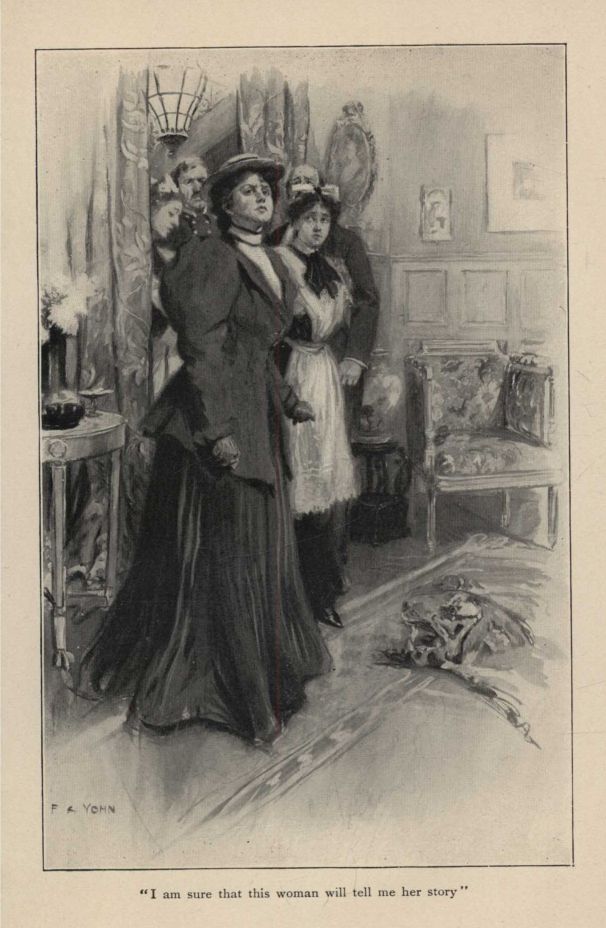
As the servants took their departure, Mrs. Wilson looked again at the woman, whom she had already perceived to be young and good looking. She stood holding her baby securely but not tenderly, with a half-defiant, half-bewildered air, as of a cat at bay in strange surroundings. But though her mien expressed a feline dismay, Mrs. Wilson perceived that she was no desperate creature of the slums. Nor was she flauntily dressed like the courtesan of tradition. Her attire—a neat straw sailor hat, a well-fitting dark blue serge skirt and serge jacket over a white shirt, and decent boots indicated some social aptness; and her features, especially her clever and sensitive, though somewhat hard, mouth gave the challenge of intelligence. It was a smart face, one which suggested quick-wittedness and the habit of self-reliance, if not self-satisfaction, to the detriment of sentiment and delicacy. She appeared to Mrs. Wilson to be about twenty-three, and slightly shorter than Mrs. Stuart, with a sturdier, less flexible figure. Her hair was light brown, and her complexion fair, but she had roving dark eyes which gave a touch of picturesqueness to what might be called the matter-of-fact modernness of her aspect. They were curious eyes, almost Italian in their hue and calibre, yet in repose coldly scrutinizing and impassive. Mrs. Wilson appreciated with a sense of relief that here was no case of sodden ignorance and degradation; for though in such instances the remedy was more obvious, she preferred to be brought in contact with natures which drew upon her intellectual faculties. She believed herself modern in her sympathies, and in her capacity as a philanthropic worker was partial to the problems with which modern conditions and modern thought confront struggling human nature.
"Won't you sit down? And perhaps you would like to lay your baby on the sofa while we talk and I make you some tea."
The girl, who was prepared probably for a sterner method, yielded, after a quiver of uncertainty, to the fascination of this gracious appeal; pausing for a brief instant to examine the tiny face peering from the folds of the knit shawl in which the child was wrapped, but with a gaze scientific rather than maternal, as though she were seeking to trace a likeness or some law of heredity. Then she sat down and raised her eyes to meet her entertainer's with a glance bordering on irony, and which seemed to ask, "Well, what are you going to do about it?" Mrs. Wilson noticed that her hands, which lay in her lap, lightly crossed, with the palms down, were long and efficient-looking, and that she wore no wedding-ring.
"Is it a boy or a girl?" Mrs. Wilson resumed, with disarming gentleness.
"A girl." With a contraction of her mouth which began in a bitter smile and ended against her will in a gulp, she added, "I didn't intend to have it. I didn't want to have it. I suppose you've guessed I'm not a married woman."
"Yes, I guessed that. I see, too, that you are in trouble, and my sole object in detaining you here to-night is to give you all the aid in my power. I'm not seeking to judge or to lecture you, but to help you."
The girl regarded her with a matter-of-fact stare, then said, bluntly, "I'd have been all right now if your servant hadn't nabbed me."
"You mean if you had succeeded in abandoning your child?"
"Yes. I was earning my living before, and I could go on. I guess I could have got back my old place."
"But— Do you mind telling me why you wished to abandon your baby?"
"That's why. I've just told you. To make a fresh start."
"I see. And it was chance, I suppose, that you left it on my door-steps rather than elsewhere?"
"You're Mrs. Randolph Wilson, aren't you?"
"Yes."
"I had read about you in the newspapers, and all about the wedding, and that you were tremendously rich. When my child was born I hoped she'd die; but, as she didn't, I made up my mind that the best thing I could do was to let you look after her. But the luck was against me a second time. I was caught again." She laughed as though her only concern was to let fate perceive that she had some sense of humor.
Mrs. Wilson frowned involuntarily. Yet, though her taste was offended her curiosity was whetted.
"But wasn't your—wasn't he man enough to look after you and provide for the child?"
"I didn't tell him. He doesn't know. It wasn't his fault. That is"—she paused for a moment, but her expression suggested solicitude lest the naked truth should be disconcerting rather than shame—"I took the chance. Neither of us intended to be married. He travels mostly, and is here only two or three times a year. What would he do with a baby anyway?"
The entrance of the butler with the tea things was opportune. It gave Mrs. Wilson time to think. Her experience of women of this class had been considerable. If not invariably penitent, they had always shown shame or humble-mindedness. Here was a new specimen, degenerate and appalling, but interesting to the imagination.
While the servant set the glittering, dainty silver service on the table at his mistress's side the girl watched her and him with obvious curiosity and a mixture of disdain and fascination. Now and again her roving eyes took in the exquisite surroundings, then reverted to the face of her would-be benefactress as to a magnet. It seemed to be the triumph of a desire not to appear worse than she really was which made her speak when they were alone, and Mrs. Wilson, still in search of inspiration, was busy with the tea-caddy.
"I wasn't going to let her out of my sight until I knew she was safe." She nervously compressed the back of one of her hands with the long fingers of the other in the apparent effort to justify her course, a consideration to which she was evidently not accustomed. "Wouldn't she have had a better home at the expense of the State than any I could have given her? And there was the chance you might take a fancy to her and adopt her. She's less homely than the average new-born young one. You see I thought everything over, lady. And next to its dying that seemed to me the best chance it had for happiness in a best possible world."
"Ah, but you mustn't talk like that. It's hard, I know, egregiously hard. But you mustn't be bitter," said Mrs. Wilson, with mandatory kindness.
The girl smiled in a superior fashion; it was almost a sneer. Her desire to justify herself had been an involuntary expression. Now vanity intervened, vanity and the pride of smouldering opinion. "I'm not bitter; I'm only telling you the plain truth. I'm ignorant, I dare say, compared to you; but I'm not so ignorant as you think. I've thought for myself some; and—and all I say is that this isn't any too good a world for a girl like me anyway, and when a girl like me goes wrong, as you call it, and has a kid, instead of crying her eyes out the sensible thing for her to do is to find someone to look after it for her."
"Which only proves, my child, that such a thing ought never to happen to her."
"No—not if she has luck."
There was a brief pause; then with an impulsive glide Mrs. Wilson swept across the room and transferred a cup of tea to the hands of this wanderer from the fold of grace and ethics. The girl, taken off her guard, tried to rise to receive it, and looked at her with the half-fascinated expression of a bird struggling against the fowler. Sitting down beside her, Mrs. Wilson took one of her hands and said, "Do you not understand, my dear, that society must insist for its own preservation that a woman shouldn't go wrong? The whole safety of the family is based on that. That's the reason the world has to seem a little cruel to those of our sex who sin against purity. Children must know who their fathers are." She had these precepts in their modern guise at the tip of her tongue; she hastened to add, benignly, "But though the world in self-defence turns a cold shoulder on the unchaste woman, for her who seeks forgiveness and a fresh start there are helping hands and loving words which offer forbearance and counsel and friendship."
"But supposing I'm not seeking forgiveness? That's the trouble, lady. If only now I were a shame-faced, contrite sinner down in the dust at the foot of the cross asking permission to lead a new life, how much simpler it would be for both of us!"
Mrs. Wilson gasped. The coolness of the sacrilege disturbed her intellectual poise. The girl might have been speaking of an invitation to dinner instead of the redemption of her soul so casual was her regret. "That is where you belong; that is where you must come in order to find grace and peace," she said, in an intense whisper.
"I've shocked you."
"Yes, you've shocked me. But that doesn't matter. You don't realize what you're saying. The important thing is to save you from yourself, to cleanse the windows of your soul so that the blessed light of truth may enter."
The girl regarded her curiously, nervously abashed at the impetuous kindness of this proselytism. "That's what I meant by saying I'd thought some. If it's church doctrine you mean, you'd only be disappointed. It may help people like you. But for the working people—well, some of us who use our wits don't think much of it."
Though Mrs. Wilson looked profoundly grieved, the spiritual melancholy emanating from her willowy figure and mobile countenance was charged with resolution as well as pity.
"It isn't merely church doctrine that you lack. You lack the spirit of Christian civilization. Your entire point of view is distorted. You are blind, child, utterly blind to the eternal verities."
The girl's dark eyes grew luminous in response to this indictment, but a deprecating smile trembled on her lip in protest at her own susceptibility.
"What is it you want me to do?" she said at last.
"To begin with, I wish you to support your child as a woman should. You brought it into the world, and you owe to the helpless little thing a mother's love and care. Will you tell me your name?"
"Loretta Davis."
"And what has been your employment?"
"They don't know. I don't want them to know. I gave them as an excuse that I was tired of the place."
"I'm not asking your employer's name. What kind of work was it?"
"I was assistant cashier in a drug store."
"And before that?"
"I answered the bell for a doctor."
"I see. I don't wish to pry into your affairs; but do you belong here? Are your parents living?"
"I don't mind telling. There's not much to tell. My father and mother are dead. I was born about a hundred miles from here and attended the public school. I had my living to make, so I came to Benham about two years ago. I had acquaintances, and was crazy to go into a store. But a girl who came from the same town as I was going to be married, and got me her place to look after the doctor's bell and tidy up. He was a dentist. He lost his health and had to go to Colorado for his lungs, and then I went to the drug store. That's all there is to tell, lady—that is, except one thing, which doesn't count much now."
"You might as well tell me that also."
"Oh, well, I'd been thinking of training to be a nurse when I got into trouble. I'd got used to doctors and medicine, and they told me I had the sort of hands for it." She exhibited her strong, flexible fingers. "If I had got rid of my baby, I was going to apply to a hospital. So you see I've got some ambition, lady. I wanted to be of some use. I'm not altogether bad."
"No, no, I'm sure you're not. I understand perfectly. And the baby shan't stand in the way of your making the most of yourself. I will arrange all that." Mrs. Wilson spoke with fluent enthusiasm. She felt that she had discovered the secret of, if not the excuse for, the girl's callousness. Unwelcome maternity had interrupted the free play of her individuality at the moment when she was formulating a career, and as a modern woman herself, Mrs. Wilson understood the bitterness of the disappointment. It gave her a cue to Loretta's perversion, so that she no longer felt out of touch with her. She refrained from the obvious temptation of pointing out that a nurse's best usefulness would be to guard her tender child, and broached instead the project which swiftly suggested itself the moment she felt that she had fathomed the cause of the culprit's waywardness.
"I know just the home for you; a little tenement in the Lincoln Chambers. The rooms are savory, convenient, and attractive, and on the opposite side of your entry lives an earnest, interesting spirit, a woman whose husband has deserted her, left her with two children to provide for. She will be glad to befriend you, and you will like her. I happen to know that the tenement is vacant, and it is the very place for you."
Loretta had listened with sphinx-like attention. When Mrs. Wilson paused her eyes began to make another tour of her surroundings, and at the close of her remark ignored the theme of conversation.
"I never was inside a multi-millionaire's house before. That's what you are, ain't it?"
The query was queer, but not to be evaded. "I'm a rich woman certainly, which makes it all the easier for me to help you." If this savored of a pauperizing line, which was contrary to Mrs. Wilson's philanthropic principles, she felt that she must not at all hazards let the girl slip through her fingers.
"If I'm willing that you should."
"Of course. But you are, I'm sure you are. You're going to trust me and to put yourself into my hands."
The confidence and charm of this fervor suddenly met with their reward. Loretta had held back from genuine scruples, such as they were. Instinctive independence and a preconceived distrust of fine ladies had kept her muscles stiff and her face set, though she felt thrilled by a strange and delicious music. No one could have guessed that it was only the habit of awkwardness which restrained her from falling on her knees in an ecstasy of self-abasement, not from an access of shame, but as a tribute to the woman whose personality had captivated her against her will.
"You seem to take a heap of interest in me, don't you?" The words by themselves suggested chiefly surprise, but the sign of her surrender showed itself in her eyes. They were lit suddenly with an intensity which overspread her countenance, bathing its matter-of-fact smartness in the soft light of emotion. "I'm willing to do whatever you like," she said.
XII
If it be said of Gordon Perry, attorney and counsellor-at-law, that he was loth to incur the modern epithet, "crank," it was equally true that he had ideals and cherished them. He believed in living up to his convictions. At the same time his sense of humor made him aware that to dwell unduly on premeditated virtue is the prerogative of a prig, and that it is often wise in a workaday world to yield an inch if one would gain an ell. His form of yielding was apt to be genial, thoughtful consideration of the other man's point of view, a virtual admission that there were two sides to the case, instead of flying in the face of his opponent. The modern American regards this tactful moderation as essential to the despatch of business, and prides himself on its possession. It is the oil of the social industrial machine. Also it is slippery stuff. One is liable to slide yards away from one's point of view unless one plants one's feet firmly. It is so much easier to follow the trend than to resist it. The natural tendency of those not very much in earnest is to woo success by dancing attendance on the powers which are, both movements and men. So convictions become palsied, and their owners mere puppets in the whirl of human activity. For the sake of fortune, fame, or oftenest for the sake of our bread and butter, we subscribe to theories and support standards which we suspect at heart to be unsound, lest we fail to keep step with the class to which we belong.
How to preserve his poise as an independent character and at the same time avoid antagonism with some of his new friends had become interesting to Gordon Perry. He had reached a point where he had only to be quiescent in order to reap presently a rich harvest. His clear-headedness, his quickness, and his common sense had been recognized, and it was in the air that he was a rising man in his profession. People of importance had taken him up. It was known that he had attended to certain matters for Paul Howard, from whom it was only one step to the source of many gigantic undertakings productive of fat fees. To the eye of shrewd observers in Benham he had only to go on as he had been going, and attend strictly to business, in order to emerge from the ranks of his brother lawyers, and become one of the small group which controlled the cream of the legal business of the city. Instead of bringing accident cases he would defend them for powerful corporations. Instead of conducting many small proceedings at an expense of vitality for which his clients could not afford and did not expect to pay adequately, he would be employed by banks and trust companies, would organize and reorganize railroads, be made the executor of large estates and the legal adviser of capitalists in financial schemes from which profits would accrue to him in the tens of thousands. It ought to be comparatively plain sailing. This was obvious to the man in question as well as to his contemporaries. He knew that his business was growing, and sundry rumors had reached him that he had been spoken of in inner circles as skilful and level-headed.
To indicate the current which ran counter in Gordon Perry's thoughts to his appreciation of these possibilities it will be necessary to refer briefly to his past and to his mental perspective. He was the son of a widow. Also a soldier's son. His father, a volunteer, had survived the Civil War, and, attracted by the rising destinies of Benham, had made his home there, only to fall victim to a fever within a year of his coming. Gordon was then eleven years old. A policy of life insurance kept the wolf from the door for the afflicted widow so far as a bare subsistence was concerned. She had a small roof over her head, and was able by means of boarders and needlework to present a decent front to the world while she watched over her sole treasure, her only child. Her ambition was to give him an education, and her ambition in this respect was neither niggardly nor ignorant. He was to have the best—a college training—and to give him this it delighted her to pinch and to slave. When a woman's duty is squarely determined by responsibility for a fatherless son, it is comparatively easy for her to be true to her trust to the extent of complete devotion and unselfishness. But devotion and unselfishness do not include wisdom. Happy for him whose mother is a victim neither to superstition nor to silliness, but sees life with a clear, sane outlook. Mrs. Perry was one of those American women educated in the days of Emersonian spirituality, when society walked in the lightest marching order as regards material comforts and embellishments, who were austere and sometimes narrow in their judgments, but who set before them as the one purpose of life the development of character. She was simple, pious, brisk, and direct; setting great store on acting and speaking to the point, and abhorring compromise or evasions. In her religious faith she believed, as a Unitarian, about what liberal Episcopalians and Presbyterians believe to-day. Doctrine, however, appeared to her of minor importance compared to the pursuit of noble aims and the practice of self-control. She wished her son to care for the highest things, those of the spirit and the intellect, because she regarded them with sincerity as the passports to human progress; and, though her æsthetic aims were dwarfed, and human color and grandeur may have seemed to her to smack of degeneracy, the white light of her aspirations had a convincing beauty of its own.